

































Jamaica, a leading per capita export
country known for its commitment to
creativity, innovation and exceptional quality.
September 2009
ISBN 978-976-610-849-6
The National Export Strategy of Jamaica
was developed on the basis of the process,
methodology and technical assistance of the
International Trade Centre (ITC).
w w w . j a m a i c a t r a d e a n d i n v e s t . o r g / n e s | 1 - 8 8 8 - 4 2 9 - 5 N E S ( 1 - 8 8 8 - 4 2 9 - 5 6 3 7 )
2
Table of Contents
Foreword	 4
The Honourable Prime Minister of Jamaica
Messages	 5
The Honourable Minister of Industry, Investment and Commerce
The Honourable Leader of the Opposition
Statements	 7
The President, Jamaica Trade and Invest
The President, Jamaica Exporters’ Association
The Director-General, Planning Institute of Jamaica
The Executive Director, International Trade Centre, Geneva
Acknowledgements	 11
SECTION 1: Why A National Export Strategy for Jamaica	 14
Achieving Export-led Growth	 14
•	 The Macro Picture
•	 Figure - Key Economic Indicators
•	 Chart - Main Destination of Exports
Improving Export Performance	 17
•	 National Export Performance 2002-2008, Goods
•	 National Export Performance, 2002-2007, Services
•	 The National Export Strategy and Jamaica’s Trade Agreements
°	 Multi-lateral Trade Regime
°	 New Trade Policy
°	 Impact of Trade Agreements on Export Performance
Achieving Global Export Competitiveness	 21
•	 Assessment of Jamaica’s Global Competitiveness
•	 Competitiveness Performance: Industry Analysis
National SWOT Analysis	 23
Conclusions	 25
National Export Strategy at a Glance	 26
SECTION 2: Developing the National Export Strategy - the Process	 27
•	 Development, Competitiveness, Client and Institutional Perspectives
•	 Four Functional Gears of the Strategy
•	 Priority Industries of the National Export Strategy
•	 Industry Prioritisation
•	 How the Strategy Addresses Manufacturing, Agriculture and Tourism Industries
n a t i o n a l e x p o r t s t r a t e g y 3
Key Considerations	 31
•	 Public Private Sector Partnership (PPP)
•	 The Trade Support Network
•	 Value Chain and Value Options
•	 Stakeholder Perspectives and Strategic Considerations
SECTION 3: Cross-Cutting Industry Strategies	 33
Development Perspective
•	 Human Capital Formation and Development  
Competitiveness Perspective
•	 Innovation and Technology / Capacity Diversification
•	 Transportation
•	 Energy
•	 Security
•	 Trade Facilitation
•	 National Image and Branding
•	 Trade Promotion
Client Perspective
•	 Business Development and Export Readiness
•	 Financing
•	 Packaging
•	 Quality Management
•	 Trade Information
Section 4: Priority Industry Strategies 	 59
•	 Agro-processing (Food & Beverage)
•	 Aquaculture
•	 Coffee
•	 Education
•	 Entertainment
•	 Fashion
•	 ICT
•	 Mining and Minerals
Section 5: Strategy Management	 123
Institutional Support
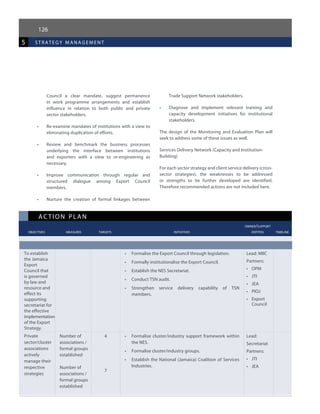
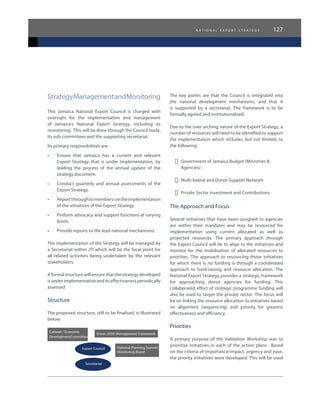
Strategy Management and Monitoring
•	 Structure
•	 The Approach and Focus
•	 Priorities
•	 Export Centres and Business Information Points (EC/BIPS)
Glossary	 130
4
for ward
The Hon. Bruce Golding, MP
Prime Minister of Jamaica
T
he Government of Jamaica is totally
invested in the process to create an
enabling environment for the trade
and exportation of our many high quality
products and services that can fetch
premium prices in the global marketplace.
Looking forward, it is my belief that we can
significantly increase the levels of export
competiveness and sales by executing a
winning strategy fuelled by healthy doses
of self-belief.
In reflecting on the journey and efforts
of all the benchmark countries in global
trade and business - Singapore, Hong
Kong, China, the United States and
Panama - one must acknowledge that
the sensible, cutting edge systems and
procedures innovated by these countries
were rooted in a fundamental ‘can do’
philosophy. It is this ‘can do’ energy and
collaborative spirit that all our producers
and exporters must tap into, in order
to make this National Export Strategy
work, in partnership with all the relevant
agencies of the State and our international
partners such as the International Trade
Centre and the European Union.
As Prime Minister, I want to pledge my
support to be a champion and a driver of
this process. When all is said and done, it
will be our shared belief in our capacity to
innovate and produce that will drive the
competitiveness of our export industry and
create increased wealth for the nation. It
will be the skilful execution of this National
ExportStrategythatwilleffectivelyposition
Jamaica’s exports in target markets.
Notwithstanding the vicissitudes of global
trade and business, let us never cease to
draw inspiration from our glorious history,
which has defined us as a unique people,
a nation of world class competitors, who
have time and time again prevailed against
incredible odds!
I congratulate all the stakeholders in this
critical process for wealth creation and
economic development. Let us never stop
believing and working hard to make this
vision a reality.
n a t i o n a l e x p o r t s t r a t e g y 5
message
The Hon. Karl Samuda, MP
Minister of Industry, Investment
and Commerce
T
he National Export Strategy
represents an important policy tool in
the Ministry of Industry, Investment
and Commerce that seeks to prepare the
Export Industry on all fronts - beginning
with the producer taking his goods and
services to market, to the critical role of
the facilitators of trade who provide the
lubricant to make the process happen…
all the moving parts in this process,
synchronised and working in perfect
harmony.
This vision of a finely honed mechanism
that accommodates every cog in the wheel
to work hard in pursuit of an export trade
that is efficient, globally competitive, and
a high revenue earner that contributes to
the overall development of the economy is
the ultimate goal of the NES.
Inkeepingwiththis,theMinistryofIndustry,
Investment and Commerce is committed
to providing the requisite support to make
the Strategy a resounding success. This
National Export Strategy represents an
important milestone in that journey to
defeat the myriad of challenges that have
stymied our progress. We now have a
system where every player engaged in
the process of packaging, processing and
delivering a Jamaican good or service to
export markets can collaborate cohesively
and consistently!
In so doing, we can make Jamaica, in a
relatively short time, the undisputed trade
and export hub of the Caribbean, in a
world without borders that affords the 21st
century Jamaican businessperson the
benefit of doing business with anybody he
or she desires. This must be the mission
of the NES.
I commend the continuing work of the
Jamaica Export Council, Jamaica Trade
and Invest and the Jamaica Exporters’
Association for their leadership role in
this arduous but important process that
requires the engagement of so wide a
cross section of stakeholders.
Generations to come will remember us
kindly for our efforts in this initiative.
message
6
Portia Simpson Miller, ON, MP
Leader of the Opposition
T
he promulgation of a National Export
Strategy is a critical corollary to
Jamaica’s sustainable economic
development. In keeping with the intent,
objectives and nature of the National
Industrial Policy, the Tourism Master
Plan for Sustainable Development and
most recently, the Vision 2030 Document,
the National Export Strategy will, in its
execution, highlight and emphasise those
activities - inclusive of appropriate policies
- that are required to promote the export of
indigenous value-added commodities to a
wider market outside of Jamaica.
Jamaica Trade and Invest (JTI), formerly
JAMPRO, presents a natural anchor for
this strategy. Leveraging the relationships,
connections and networks that JTI has
amassed over the years, to position and
promote Jamaica’s export offerings, is
precisely the purpose of the JTI.
In executing the strategy, I am sure the JTI
and its many partners and stakeholders
are aware of the multi-dimensional
approaches that will have to be taken.
These include the thorough researching
and gathering of market intelligence for
the consumer markets for the products
we will seek to export. Of necessity will be
the alignment of required standards for
quality and supply with local benchmarks
used to calibrate the production and
manufacturing processes.
The National Export Strategy also has to
utilisevisioningasakeytoolinitsexecution.
We must begin to register trends and new
trails to blaze, if we want to remain ahead
of the curve, and to establish local centres
of production excellence to become
and remain competitive. In this regard,
careful analysis will have to be given to
areas of comparative advantage as well
as competitive advantage - our cultural
and creative assets spring easily to mind.
Jamaica’s recognition as a brand - with
respect to music, sports, cuisine and other
saleable lifestyle commodities - must be
underpinned by a robust set of policies
and programmes that will enhance the
national earning potential from these areas
where we truly have both comparative and
competitive advantages.
Buoyed by these essential objectives, and
recognising as we do that the successful
implementation of the National Export
Strategy is at this point mission critical to
our economic and social development,
we stand committed, as all Jamaicans at
home and abroad should, to ensure that
our talent and expertise will be applied in
the consultative and partnership processes
towards this goal.
n a t i o n a l e x p o r t s t r a t e g y 7
statement
Sancia Bennett Templer
President, Jamaica Trade and Invest
A
s the world seeks to recover from the
current economic crisis developing
countries, such as Jamaica, have
beenforcedtotakearenewedandstrategic
look at the way in which we achieve
sustainable economic development goals
– key of which is a thriving export sector.
Jamaica Trade & Invest (JTI/JAMPRO), as
the country’s export promotion agency,
operates on the underlying premise that
the development and implementation of
a comprehensive and forward-thinking
National Export Strategy (NES), designed
to boost the country’s export potential, is
a significant element to the advancement
of the economic growth of our country.
The NES provides a practical roadmap
of how Jamaica can and must achieve
increased levels of economic development
by focusing its limited, but extremely
valuable, resources on developing export
capacity in those sectors and areas in
which the country has the greatest
competitive advantage. In addition, the
NES provides a functional network that
will address the cross-sectoral issues that
need to be resolved in order to increase
our competitiveness in the global arena.
The strategy of public-private sector
partnership (PPP), which successfully
guided the development of the NES,
will continue to be employed in its
implementation. The collaborative effort
between JTI and the Jamaica Exporters
Association (JEA) will be further deepened
and expanded to form the basis on which
the Strategy will be communicated and
monitored going forward. Additionally,
the NES will continue to be aligned in its
implementation to the activities of the
Vision 2030 National Development Plan, as
well as the National Planning Summit (NPS)
and the Partnership for Transformation
(PFT).
Ultimately, it is our hope that the NES
will empower the Jamaican exporter
– existing and emerging, traditional &
non-traditional, large & small - to better
penetrate international markets and take
full advantage of the global opportunities.
To this end, the Strategy seeks to ensure
that our exporters are well-positioned
to efficiently respond to trade openings
and market penetration initiatives by
providing for the dissemination of quality
business advice, training for prospective
exporters and standardised, universal
and value-added services being offered
through island wide Export Centres and
Business Information Points.
JTI, as it seeks to fulfill its primary functions
of export and investment promotion –
and in its ongoing participation in the
development and implementation of
the NES, will continue to work towards
establishing “Jamaica as the place of
choice to live, work, raise families and do
business”.
8
statement
Michael Lumsden
President, Jamaica Exporters’Association
T
he Jamaica Exporters’ Association
(JEA) sees the National Export
Strategy (NES) as an important
framework for the advancement of
Jamaica’s Export Industry. We believe that
with the successful implementation of the
NES we will be able to realise the vision
of Jamaica being one of the leading per
capita export countries in the Caribbean.
The JEA is confident that the NES will
improve the standard of the export
industry by the implementation of industry
strategies for more effective, efficient and
globally competitive trade. The NES will
alsoenhancethedevelopmentofJamaica’s
export industry and business environment
and improve the competitiveness of our
firms.
Brand Jamaica is one of the most
recognisable brands internationally and
it is important that we utilise the National
Export Strategy to position Jamaican
exporters of goods and services to
capitalise on the opportunities which exist
for Jamaican products and services in the
international market, while at the same
time strengthen Brand Jamaica to achieve
a stronger positioning globally.
The National Export Strategy will transform
Jamaica’s export industry and improve
our performance in our leading export
markets. Through employment creation,
export diversification, improved Net
International Reserve and increased
contribution to GDP, the NES will also help
in creating greater wealth for the nation by
reducing the disparity between earnings
from exports and imports.
As part of Jamaica’s National Development
Plan, Vision 2030, the NES has set specific
goals to be achieved in the next five years
and the JEA is committed to working
with our partners on the National Export
Council to realise these goals.
We look forward to the continued
collaboration with the Government
of Jamaica, through the Ministry of
Industry, Investment and Commerce, the
International Trade Centre, multilateral
agencies and all the players in the Export
Industry as we work together to build a
better Jamaica.
n a t i o n a l e x p o r t s t r a t e g y 9
statement
Dr. Pauline Knight
Act’g Director General, Planning Institute of Jamaica
A
s barriers to trade fall, nations with
small domestic markets, such as
Jamaica, are able increasingly
to achieve economies of scale through
access to large international markets.
Our ability to take advantage of export
markets is fundamental to our economic
development and is enhanced by our
strategic geographic location, strong
Nation Brand and relations with the
Jamaican Diaspora.
The National Export Strategy represents a
majorinitiativetoimproveJamaica’sexport
performance by enhancing the trade and
business environment, and improving the
competitiveness of firms and industries.
It will provide industry-specific measures
to enhance key exporting industries,
improve the bureaucratic processes
for exporters, and strengthen a range
of supporting services such as trade
information and finance, export quality
management, trade facilitation, branding,
and trade promotion. As such, it is wholly
consistent with the goals of Vision 2030
Jamaica - National Development Plan and
is a key action for achieving international
competitiveness on our path to becoming
a developed country with a prosperous
economy.
As the agency established to stimulate,
facilitate, and promote the development
of trade and industry, the JTI is
strategically positioned to ensure the
successful implementation of this key
export strategy which has been identified
as a priority within the first three years of
implementation of Vision 2030 Jamaica –
National Development Plan.
The Planning Institute congratulates
the JTI for spearheading this initiative
and pledges its support for its full
implementation.
10
statement
Patricia Francis
Executive Director,
International Trade Centre (ITC)
T
heNationalExportStrategyofJamaica
represents an important milestone
in the country’s drive to position
exports as a principal means to achieve
further development, within the context
of the broader national goals. The Vision
2030 National Development Plan, which
specifies international competitiveness
as a key area for the country’s national
development, has served as the beacon
and the inspiration for Jamaica’s National
Export Strategy.
The strategy design process has been a
challenging, but rewarding experience. It
has engaged the expertise and the insights
of a large number of practitioners at the
policy, institutional and enterprise levels in
a consultative forum over many months.
It has taken into account the constraints
and the concerns of those who have an
impact on export development and export
competitiveness, and built upon mutually
agreed opportunities. The result is a highly
detailed, specific and realistic strategy that
will serve as the roadmap for enhanced
export performance, and the socio-
economic benefits that this promotes. It
is truly a national export strategy made by
Jamaicans, for Jamaicans.
The National Export Strategy is not
written in stone; nor is the national and
international trading environment static.
New challenges will surely emerge. The
public-private dialogue that the export
strategy initiative has strengthened
should not stop. Rather, this consultative
process should be reinforced to keep the
key stakeholders engaged in the pursuit
of an export strategy that is relevant and
that continues to respond to the country’s
current needs and challenges.
This strategy document is not an end in
itself. Whilst the purpose of the strategy
is to provide an agreed and transparent
architecture for the export industry to
flourish, it will make an impact only
through its implementation. The end of the
design phase thus marks the beginning
of an even more challenging chapter –
the implementation of the initiatives and
activities elaborated in the strategy’s plan
of action so that the targets, the objectives
and the impact are achieved.
Jamaicans are right to feel proud of this
important achievement. International
Trade Council (ITC) is equally proud to
have been Jamaica’s partner throughout
the process. We pledge our commitment
to continue providing excellent support
and assistance in line with our vision of
achieving “Export Impact for Good”.
n a t i o n a l e x p o r t s t r a t e g y 11
Acknowledgements
T
he National Export Strategy was
developed under the leadership of
the Minister of Industry, Investment
and Commerce with the invaluable
contribution, dedication and commitment
of a wide cross-section of the Jamaican
Export Community and the Trade Support
Network.Theseindividualsandstakeholder
groups, drawn primarily from across the
eight focus industries governed by the
Strategy, spent long hours in extended
consultative and strategy sessions, the
results of which constitute the substance
of this National Export Strategy.
To them, and the many other individuals,
businesses and organizations, the Export
Council offer its grateful thanks for the
contributionoftime,resourcesandintellect
to produce and finalize this definitive
National Export Strategy document.
The Strategy owes a lot to the Ministry
of Industry, Investment and Commerce,
which is championing this initiative at the
policy level; as well as to the JEA and its
outgoing President Marjorie Kennedy,
whose indomitable spirit in many ways
have come to symbolize the character of
this Private-Public Sector collaborative to
increase Jamaica’s exports to the World.
We sincerely thank Mrs. Kennedy for her
tireless efforts and inspired leadership and
the insightful knowledge and boundless
energies of incoming President Michael
Lumsden. It goes without saying that
the support of the JEA Secretariat led by
General Manager, Jean Smith has been
nothing short of remarkable.
From start to finish, the approach and
methodology employed in the design of
the Strategy has been premised around
a sincere commitment to build strong
consensus and broad stakeholdership.
In this regard, the leadership of JTI’s
President Robert Gregory and Deputy
President, Lisa Bell has been exemplary.
We are also grateful for the indefatigable
contributions of Andrea Reid, who
buttressed the work of the NES Project
Team, which met weekly to review the
progress of the initiative.
Commendations should also be paid to
Arlene Martin and Carole Rowe, two of the
consultants on the Strategy Development
Project, who facilitated the many
consultation and validation sessions, and
JTI Corporate Communications which
edited the many iterations of the draft
technical document.
Jamaica owes much to the GOJ/EU
Private Sector Development Programme
(PSDP), which provided partial funding
for the NES, as well as to the International
Marjorie
Kennedy
12
ack nowledgements
Trade Centre (ITC) in Geneva, which has
been central to the development and
implementation of the strategy.
The NES has been developed on the
process, methodology and technical
assistance of the ITC.
The Strategy development and
implementationisbeingmanagedjointlyby
Jamaica Trade and Invest and the Jamaica
Exporters’ Association. The Strategy fits
under the “International Competitiveness
Outcome” of   Vision 2030, Jamaica’s
National Development Plan.
The development of the National Export
Strategy has been a one-year process
involving public and private industry
entities; some of which are members of
the Jamaica Export Council. The Council
is an independent body comprising
representatives of the public and private
industries, charged with the execution of
the Strategy while acting in an advisory
capacity to the Government and private
industry stakeholders.
The Council comprises representatives of
the following public and private industry
entities which are critical members of the
trade support network and wider export
community:
MinistryofIndustry,Investment&Commerce
Jamaica Trade and Invest
Jamaica Exporters’ Association
The Planning Institute of Jamaica
Private Industry Organisation of Jamaica
Jamaica Manufacturers’ Association
Small Businesses Association of Jamaica
Bureau of Standards of Jamaica
Factories Corporation of Jamaica
JamaicaBusinessDevelopmentCorporation
University of the West Indies
Scientific Research Council
Trade Board Ltd.
Ministry of Finance & the Public Service
Jamaica Customs
Office of the Prime Minister (Planning &
Development)
Urban Development Corporation
NationalExport-ImportBankofJamaicaLtd.
Development Bank of Jamaica
Ministry of Transport & Works
Ministry of Energy
MinistryofMining&Telecommunications
Mines & Geology Division
Jamaica Bauxite Institue
Jamaica Constabulary Force
Port Authority of Jamaica
Ministry of Health & Environment
MinistryofForeignAffairs&ForeignTrade
NationalEnvironmentalPlanningAgency
Ministry of Agriculture
Ministry of Information, Culture, Youth &
Sports
HEART Trust / NTA
Jamaica Bankers’ Association
JamaicaCulturalDevelopmentCommission
CaribbeanRegionalNegotiatingMachinery
Owen Skae,
ITC consultant
makes a point to
NES Project Team.
n a t i o n a l e x p o r t s t r a t e g y 13
Jamaica Deposit Insurance Corporation
Jamaica Stock Exchange
Jamaica Employers’ Federation
Shipping Association of Jamaica
Customs Brokers Association & Freight
Forwarders Association of Jamaica
Jamaica Chamber of Commerce
The specific industry strategies emerged
from the work of dedicated teams for each
of the priority industries, which met for
numerous consultations. There were over
eighty (80) participants from the private
sector alone.
TheStrategywasvalidatedatastakeholders
workshop held on March 17, 2009 at
the Jamaica Pegasus Hotel in Kingston
attended by one hundred and fourteen
(114) persons comprising individuals from
firms and organisations in the public and
private industry:
RecordingIndustryAssociationofJamaica/
JACAP
JamaicaReggaeIndustryAssociation-Music
Cluster
CaribbeanAgribusinessAssociation(CABA)
FreightForwardersAssociationofJamaicaLtd.
Jamaica Association of Dramatic Artists
Jamaica Fashion & Apparel Cluster
MinistryofIndustry,Investment&Commerce
Jamaica Trade and Invest
Jamaica Exporters’ Association
Planning Institute of Jamaica
Private Industry Organisation of Jamaica
Jamaica Manufacturers’ Association
Small Business Association of Jamaica
Bureau of Standards of Jamaica
Factories Corporation of Jamaica
Jamaica Business Development Centre
University of the West Indies
Scientific Research Council
Trade Board Ltd.
Ministry of Finance & the Public Service
Jamaica Customs
Office of the Prime Minister (Planning &
Development)
Urban Development Corporation
NationalExport-ImportBankofJamaicaLtd.
Development Bank of Jamaica
Ministry of Transport & Works
Ministry of Energy
MinistryofMining&Telecommunications
Mines & Geology Division
Jamaica Bauxite Institue
Jamaica Constabulary Force
Port Authority of Jamaica
Ministry of Health & Environment
MinistryofForeignAffairs&ForeignTrade
NationalEnvironmentalPlanningAgency
Ministry of Agriculture
Ministry of Information, Culture, Youth &
Sports
HEART Trust / NTA
Jamaica Bankers’ Association
JamaicaCulturalDevelopmentCommission
CaribbeanRegionalNegotiatingMachinery
Jamaica Deposit Insurance Corporation
Jamaica Stock Exchange
Jamaica Employers’ Federation
Shipping Association of Jamaica
Customs Brokers Association & Freight
Forwarders Association of Jamaica
Jamaica Chamber of Commerce
The National Export Strategy has received
the endorsement and support of the
following key private industry entities:
•	 Jamaica Chamber of Commerce
•	 Jamaica Manufacturers’ Association
•	 Private Sector Organisation of
Jamaica
•	 Small Businesses Association of
Jamaica
14
Why a National Export Strategy for Jamaica?
Jamaica’s National Export Strategy is based on (i) the
current imperative for achieving export-led growth (ii)
export performance, (iii) global competitiveness and
(iv) the current international context that combines the
current global economic situation as well as the trade
environment.
The National Export Strategy, whilst not a panacea,
proposes actions and responses to these perennial
challenges, and lays out a coherent road-map to grow
and sustain exports that create wealth and engender
real economic development. As such, it is one of the
pillars of the National Development Plan, Vision 2030.  
Jamaica’s National Development Plan, Vision 2030
which states:
“Jamaica, the Place of Choice to
Live, Work, Raise Families, and Do
Business”
provides the framework for the vision of the National
Export Strategy which seeks to make:
“Jamaica, a leading per capita
export country known for its com-
mitment to creativity, innovation
andexceptionalquality.”
The success of the strategy requires broad stakeholder
collaboration that will inform policy formulation by
the Ministry of Industry, Investment and Commerce,
which in turn supports high levels of performance by
our exporters, buttressed by a highly facilitative trade
support network.
As a point of emphasis, the vision reinforces creativity,
innovation and quality as central to the formidable goals
of the National Export Strategy. It posits the creation of
quality of jobs, national economic development and the
sustainable use of resources as key deliverables in the
initial five years of the Strategy, by:
•	 Contributing to overall GDP growth by increasing
the export sector’s contribution to GDP from one-
fifth to one-third by 2013;
•	 Increasing the export sector’s contribution to
overall employment generation thereby improving
the livelihoods of marginalised groups;
•	 Achieving greater diversification of the export
industry by:
•	 Attaining higher value addition in all priority
industries;
•	 Increasing the current value of non-traditional
exports of goods by 2013 through increased
volumes and higher value addition;
•	 Increasing the contribution of services exports
as a percentage of overall exports with particular
emphasis on developing professional services
and creative industries;
•	 Increasing penetration in existing markets and
accessing new and emerging markets;
•	 Maintaining a ‘competitiveness mindset’ at all
levels to ensure the reliability and sustainability
of the industry.
The Government and the productive sector have long
pinpointed a range of industry-specific weaknesses and
a number of cross-cutting issues which have impeded
the global competitiveness of the industry, and the
achievement of export-led growth. These form the basis
of the strategy and are identified later.
Achieving Export-led Growth
With its near-shore location to the largest consumer
market in the world, and exports accounting for one-fifth
of GDP, Jamaica regards itself a trading nation with vast
prospects to exponentially increase its current levels of
exports to the world. As the second-biggest market in the
1.
n a t i o n a l e x p o r t s t r a t e g y 15
Caribbean Community (CARICOM) trading bloc, it boasts
an economy that is highly open and diverse relative to its
Caribbean neighbours, but which has traditionally been
an under-performer in export volumes, resulting in a
widening trade deficit.
Yet, when considered in the context of the overall sub-
optimal performance of Jamaican exports, there have
been some notable achievements. The services industry,
led by tourism, has attracted sizeable foreign investment
this decade and export-free zones across the island are
encouraging further industrial diversification to achieve
a positive impact on productivity, fostering increased
and improved exports.
While the strategy seeks to contribute to export-led
growth, in the context of the current macro-economic
situation, the Strategy is expected in the first few years
to contribute to economic recovery and to stem the
likely impact of the economic downturn. The design and
implementation of the Export Strategy is therefore timely
as it may assist in minimising the projected economic
fallout in Jamaica due to the current global crisis.
The Macro Picture
In the face of the external turbulence from the global
financial meltdown, which has had a major impact on the
North American markets on which Jamaica depends for
half of its export revenues, as well as invisible earnings,
the stance of the Jamaican export industry is to be
prepared and proactive. Jamaica enjoys political stability
and broad consensus on market-oriented reforms.
The Government has committed to maintaining a
stable macro-economic framework to improve business
confidence and create predictability, whilst keeping
inflation in single digit range. The macro-economic
environment also seeks to facilitate tax reform and
continued support for:
•	 A real exchange rate,
•	 A relatively efficient tax system,
•	 An independent Central Bank,
•	 A well-developed, globally connected Financial
Services Industry,
•	 World-class accounting and auditing standards,
•	 Diminishing bureaucracy and red tape, a major
mandate of the Ministry of Industry, Investment and
Commerce,
•	 And, a well-developed infrastructure for business,
characterised by sophisticated technology, superior
air transport infrastructure quality and world-class
ground and highway transportation links.
The International Financial Institutions (IFIs) have
consistently praised Jamaica’s efforts to entrench
macroeconomic stability and raise growth by improving
the business climate over the medium-term. The
Government in dialogue with the Private Sector has
formulated a medium-term strategy, supported by
multilateral organisations, aimed at putting the island
on a path of robust growth while reducing poverty and
unemployment. The Government’s main objectives are
to achieve:
•	 Reduced public debt/GDP ratio by fiscal
consolidation and elimination of budget deficit by
2010/11. Servicing of debt absorbs one-third of
public spending or 13% of GDP at the expense of
badly needed capital investments;
•	 Private sector led growth through the expansion of
capacity in the manufacturing and export industries
and ultimately boosting job creation;
•	 Prudent monetary policy to reduce inflation
expectations and maintenance of adequate foreign
exchange reserves to underpin confidence in
national currency;
•	 Social sector priorities including the Millennium
Development Goals (MDGs) and targets on human
development/opportunity, as well as law and
crime;
•	 Enhanced business climate and a reformed tax
1 why a national expor t strategy for jamaica?
16
system to increase efficiency and effectiveness,
thus higher revenue collection;
•	 Further improvement in the quality of governance
through better public sector management and a
trimmed bureaucracy.
Jamaica faces challenges such as 10% unemployment,
brain drain and urban crime, which in some areas
imposes ‘opportunity costs’ in terms of lost production,
health expenses and private spending on security.
A World Bank study, ‘Jamaica: The Road to Sustained
Growth’, argues that to achieve self-sustaining growth, it
shouldimproveoverallcompetitivenessandproductivity,
while taking concrete actions on debt overhang, job
creation and tackling corruption.
There are risks and uncertainties facing all Caribbean
nations in an increasingly complex and interdependent
world. However, a genuine commitment to growth-
enhancing reforms underpinned by prudent macro-
policies, and a well-designed and far-reaching National
Export Strategy, provides the foundation for future
prosperity.
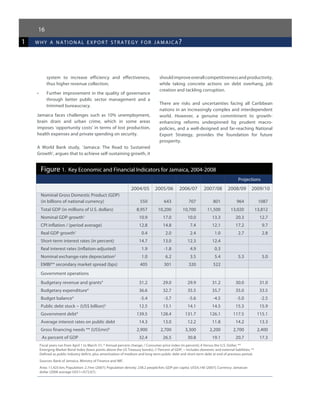
Figure 1.  Key Economic and Financial Indicators for Jamaica, 2004-2008
Projections
2004/05 2005/06 2006/07 2007/08 2008/09 2009/10
Nominal Gross Domestic Product (GDP)
(in billions of national currency) 550 643 707 801 964 1087
Total GDP (in millions of U.S. dollars) 8,957 10,200 10,700 11,500 13,020 13,812
Nominal GDP growth1
10.9 17.0 10.0 13.3 20.3 12.7
CPI inflation / (period average) 12.8 14.8 7.4 12.1 17.2 9.7
Real GDP growth1
0.4 2.0 2.4 1.0 2.7 2.8
Short-term interest rates (in percent) 14.7 13.0 12.3 12.4
Real interest rates (inflation-adjusted) 1.9 -1.8 4.9 0.3
Nominal exchange-rate depreciation2
1.0 6.2 3.5 5.4 5.3 5.0
EMBI** secondary market spread (bps) 405 301 320 522
Government operations
Budgetary revenue and grants4
31.2 29.0 29.9 31.2 30.0 31.0
Budgetary expenditure4
36.6 32.7 35.5 35.7 35.0 33.5
Budget balance4
-5.4 -3.7 -5.6 -4.5 -5.0 -2.5
Public debt stock ~ (US$ billion)5
12.5 13.1 14.1 14.5 15.3 15.9
Government debt4
139.5 128.4 131.7 126.1 117.5 115.1
Average interest rates on public debt 14.3 13.0 12.2 11.8 14.2 13.3
Gross financing needs ** (US$mn)6
2,900 2,700 3,300 2,200 2,700 2,400
As percent of GDP 32.4 26.5 30.8 19.1 20.7 17.3
Fiscal years run from April 1 to March 31; * Annual percent change; / Consumer price index (in percent); # Versus the U.S. Dollar; **
Emerging-Market Bond Index (basis points above the US Treasury bonds); // Percent of GDP; ~ Includes domestic and external liabilities; **
Defined as public industry deficit, plus amortisation of medium and long-term public debt and short-term debt at end of previous period.
Sources: Bank of Jamaica, Ministry of Finance and IMF.
Area: 11,425 km; Population: 2.7mn (2007); Population density: 238.2 people/km; GDP per capita: US$4,140 (2007); Currency: Jamaican
dollar (2008 average US$1=J$72.67).
34%
17%
11%
10% 4%4%
20%
n a t i o n a l e x p o r t s t r a t e g y 17
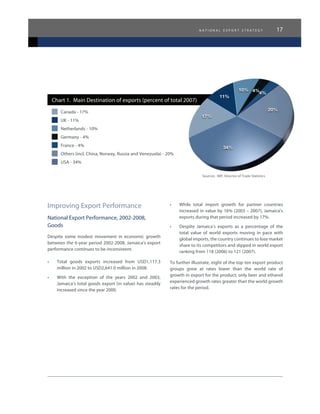
Chart 1. Main Destination of exports (percent of total 2007)
Canada - 17%
UK - 11%
Netherlands - 10%
Germany - 4%
France - 4%
Others (incl. China, Norway, Russia and Venezuela) - 20%
USA - 34%
Sources: IMF, Director of Trade Statistics
Improving Export Performance
National Export Performance, 2002-2008,
Goods
Despite some modest movement in economic growth
between the 6-year period 2002-2008, Jamaica’s export
performance continues to be inconsistent.
•	 Total goods exports increased from USD1,117.3
million in 2002 to USD2,641.0 million in 2008.  
•	 With the exception of the years 2002 and 2003,
Jamaica’s total goods export (in value) has steadily
increased since the year 2000.
•	 While total import growth for partner countries
increased in value by 16% (2003 – 2007), Jamaica’s
exports during that period increased by 17%.
•	 Despite Jamaica’s exports as a percentage of the
total value of world exports moving in pace with
global imports, the country continues to lose market
share to its competitors and slipped in world export
ranking from 118 (2006) to 121 (2007).
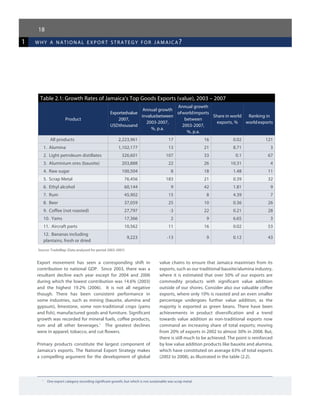
To further illustrate, eight of the top ten export product
groups grew at rates lower than the world rate of
growth in export for the product; only beer and ethanol
experienced growth rates greater than the world growth
rates for the period.
1 why a national expor t strategy for jamaica?
18
1	
One export category recording significant growth, but which is not sustainable was scrap metal.
Table 2.1: Growth Rates of Jamaica’s Top Goods Exports (value), 2003 – 2007
Product
Exportedvalue
2007,
USDthousand
Annual growth
invaluebetween
2003-2007,
%, p.a.
Annual growth
ofworldimports
between
2003-2007,
%, p.a.
Share in world
exports, %
Ranking in
worldexports
All products 2,223,961 17 16 0.02 121
1. Alumina 1,102,177 13 21 8.71 3
2. Light petroleum distillates 326,601 107 33 0.1 67
3. Aluminium ores (bauxite) 203,888 22 26 10.31 4
4. Raw sugar 100,504 8 18 1.48 11
5. Scrap Metal 76,456 183 21 0.39 32
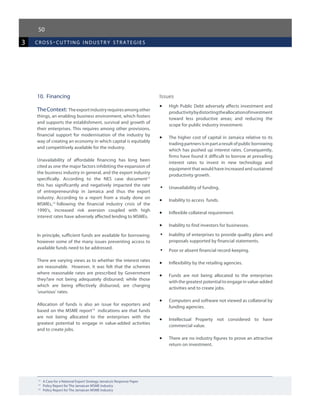
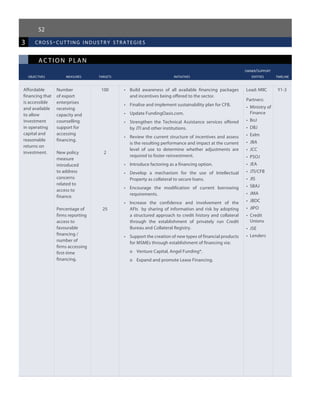
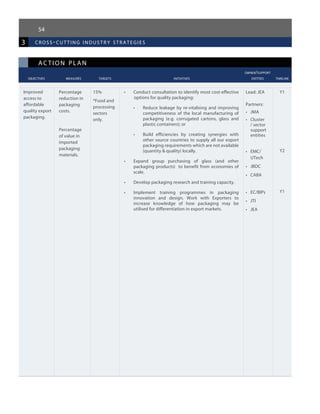
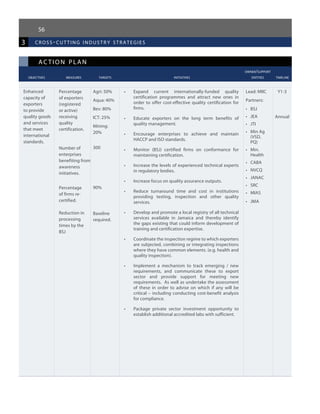
6. Ethyl alcohol 60,144 9 42 1.81 9
7. Rum 45,902 15 8 4.39 7
8. Beer 37,059 25 10 0.36 26
9. Coffee (not roasted) 27,797 -3 22 0.21 28
10. Yams 17,366 2 9 6.65 3
11. Aircraft parts 10,562 11 16 0.02 53
12. Bananas including
plantains, fresh or dried
9,223 -13 9 0.12 43
Source: TradeMap (Data analysed for period 2003-2007)
Export movement has seen a corresponding shift in
contribution to national GDP. Since 2003, there was a
resultant decline each year except for 2004 and 2006
during which the lowest contribution was 14.6% (2003)
and the highest 19.2% (2006). It is not all negative
though. There has been consistent performance in
some industries, such as mining (bauxite, alumina and
gypsum), limestone, some non-traditional crops (yams
and fish), manufactured goods and furniture. Significant
growth was recorded for mineral fuels, coffee products,
rum and all other beverages.1
The greatest declines
were in apparel, tobacco, and cut flowers.
Primary products constitute the largest component of
Jamaica’s exports. The National Export Strategy makes
a compelling argument for the development of global
value chains to ensure that Jamaica maximises from its
exports, such as our traditional bauxite/alumina industry,
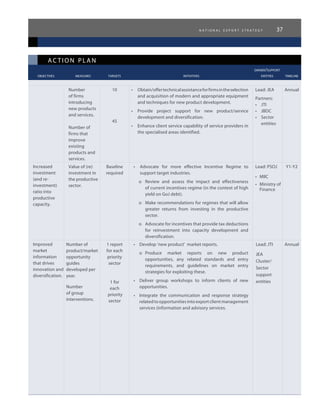
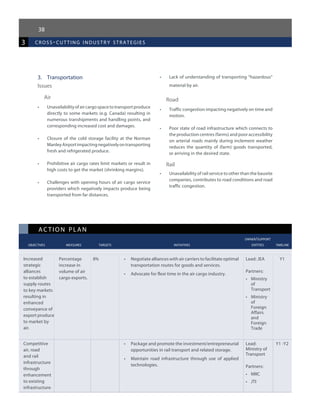
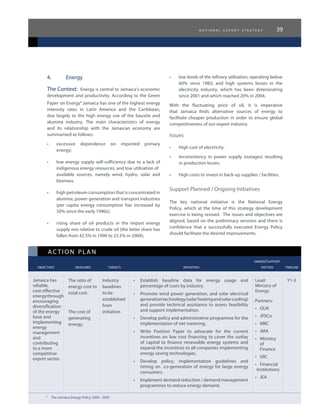
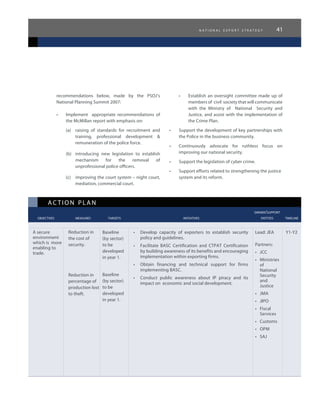
where it is estimated that over 50% of our exports are
commodity products with significant value addition
outside of our shores. Consider also our valuable coffee
exports, where only 10% is roasted and an even smaller
percentage undergoes further value addition, as the
majority is exported as green beans. There have been
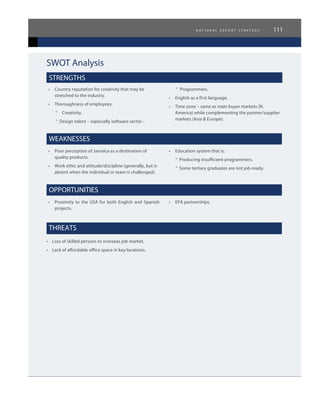
achievements in product diversification and a trend
towards value addition as non-traditional exports now
command an increasing share of total exports; moving
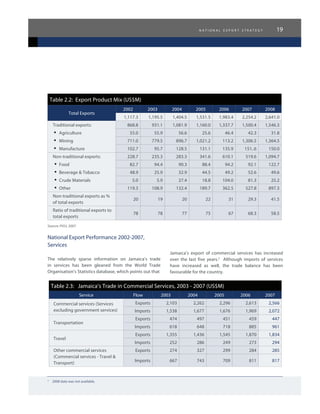
from 20% of exports in 2002 to almost 30% in 2008. But,
there is still much to be achieved. The point is reinforced
by low value addition products like bauxite and alumina,
which have constituted on average 63% of total exports
(2002 to 2008), as illustrated in the table (2.2).
Table 2.2:  Export Product Mix (US$M)
Total Exports
2002 2003 2004 2005 2006 2007 2008
1,117.3 1,195.5 1,404.5 1,531.5 1,983.4 2,254.2 2,641.0
Traditional exports: 868.8 931.1 1,081.9 1,160.0 1,337.7 1,500.4 1,546.3
•	 Agriculture 55.0 55.9 56.6 25.6 46.4 42.3 31.8
•	 Mining 711.0 779.5 896.7 1,021.2 113.2 1,306.5 1,364.5
•	 Manufacture 102.7 95.7 128.5 131.1 135.9 151..6 150.0
Non-traditional exports: 228.7 235.3 283.3 341.6 610.1 519.6 1,094.7
•	Food 82.7 94.4 90.3 88.4 94.2 92.1 122.7
•	Beverage & Tobacco 48.9 25.9 32.9 44.5 49.2 52.6 49.6
•	Crude Materials 5.0 5.9 27.4 18.8 104.0 81.3 25.2
•	Other 119.3 108.9 132.4 189.7 362.5 527.8 897.3
Non-traditional exports as %
of total exports
20 19 20 22 31 29.3 41.5
Ratio of traditional exports to
total exports
78 78 77 75 67 68.3 58.5
Source: PIOJ, 2007.
Table 2.3:   Jamaica’s Trade in Commercial Services, 2003 - 2007 (US$M)
Service Flow 2003 2004 2005 2006 2007
Commercial services (Services
excluding government services)
Exports 2,103 2,262 2,296 2,613 2,566
Imports 1,538 1,677 1,676 1,969 2,072
Transportation
Exports 474 497 451 459 447
Imports 618 648 718 885 961
Travel
Exports 1,355 1,436 1,545 1,870 1,834
Imports 252 286 249 273 294
Other commercial services
(Commercial services - Travel &
Transport)
Exports 274 327 299 284 285
Imports 667 743 709 811 817
n a t i o n a l e x p o r t s t r a t e g y 19
2	
2008 data was not available.
National Export Performance 2002-2007,
Services
The relatively sparse information on Jamaica’s trade
in services has been gleaned from the World Trade
Organisation’s Statistics database, which points out that
Jamaica’s export of commercial services has increased
over the last five years.2
Although imports of services
have increased as well, the trade balance has been
favourable for the country.
11%
1%
1%
2%2% 2%
17%
64%
1 why a national expor t strategy for jamaica?
20
3	
There is one exception. Quantitative restrictions were instituted in 1999 against the importation of Chlorofluorocarbons (CFCs), in order to
	 satisfy Montreal Protocol treaty obligations (WTO, 2005:49).
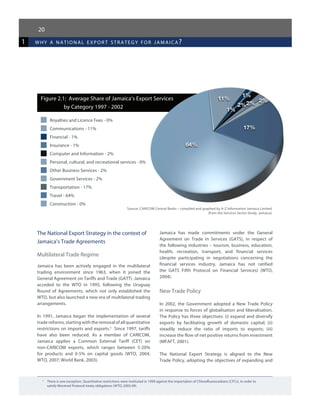
Figure 2.1: Average Share of Jamaica’s Export Services
by Category 1997 - 2002
Royalties and Licence Fees - 0%
Communications - 11%
Financial - 1%
Insurance - 1%
Computer and Information - 2%
Personal, cultural, and recreational services - 0%
Other Business Services - 2%
Government Services - 2%
Transportation - 17%
Travel - 64%
Construction - 0%
Source: CARICOM Central Banks – compiled and graphed by A-Z Information Jamaica Limited
(from the Services Sector Study, Jamaica)
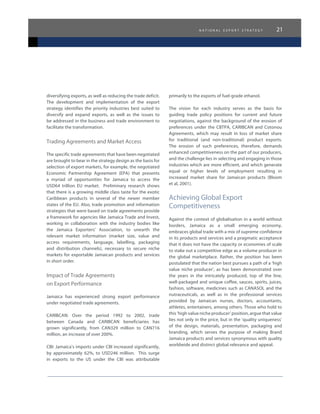
The National Export Strategy in the context of
Jamaica’s Trade Agreements
Multilateral Trade Regime
Jamaica has been actively engaged in the multilateral
trading environment since 1963, when it joined the
General Agreement on Tariffs and Trade (GATT). Jamaica
acceded to the WTO in 1995, following the Uruguay
Round of Agreements, which not only established the
WTO, but also launched a new era of multilateral trading
arrangements.
In 1991, Jamaica began the implementation of several
trade reforms, startingwiththeremovalofallquantitative
restrictions on imports and exports.3
Since 1997, tariffs
have also been reduced. As a member of CARICOM,
Jamaica applies a Common External Tariff (CET) on
non-CARICOM exports, which ranges between 5-20%
for products and 0-5% on capital goods (WTO, 2004;
WTO, 2007; World Bank, 2003).
Jamaica has made commitments under the General
Agreement on Trade in Services (GATS), in respect of
the following industries – tourism, business, education,
health, recreation, transport, and financial services
(despite participating in negotiations concerning the
financial services industry, Jamaica has not ratified
the GATS Fifth Protocol on Financial Services) (WTO,
2004).
New Trade Policy
In 2002, the Government adopted a New Trade Policy
in response to forces of globalisation and liberalisation.
The Policy has three objectives: (i) expand and diversify
exports by facilitating growth of domestic capital; (ii)
steadily reduce the ratio of imports to exports; (iii)
increase the flow of net positive returns from investment
(MFAFT, 2001).
The National Export Strategy is aligned to the New
Trade Policy, adopting the objectives of expanding and
n a t i o n a l e x p o r t s t r a t e g y 21
diversifying exports, as well as reducing the trade deficit.
The development and implementation of the export
strategy identifies the priority industries best suited to
diversify and expand exports, as well as the issues to
be addressed in the business and trade environment to
facilitate the transformation.
Trading Agreements and Market Access
The specific trade agreements that have been negotiated
are brought to bear in the strategy design as the basis for
selection of export markets, for example, the negotiated
Economic Partnership Agreement (EPA) that presents
a myriad of opportunities for Jamaica to access the
USD64 trillion EU market.   Preliminary research shows
that there is a growing middle class taste for the exotic
Caribbean products in several of the newer member
states of the EU. Also, trade promotion and information
strategies that were based on trade agreements provide
a framework for agencies like Jamaica Trade and Invest,
working in collaboration with the industry bodies like
the Jamaica Exporters’ Association, to unearth the
relevant market information (market size, value and
access requirements, language, labelling, packaging
and distribution channels), necessary to secure niche
markets for exportable Jamaican products and services
in short order.
Impact of Trade Agreements
on Export Performance
Jamaica has experienced strong export performance
under negotiated trade agreements.
CARIBCAN: Over the period 1992 to 2002, trade
between Canada and CARIBCAN beneficiaries has
grown significantly, from CAN329 million to CAN716
million, an increase of over 200%.
CBI: Jamaica’s imports under CBI increased significantly,
by approximately 62%, to USD246 million.   This surge
in exports to the US under the CBI was attributable
primarily to the exports of fuel-grade ethanol.
The vision for each industry serves as the basis for
guiding trade policy positions for current and future
negotiations, against the background of the erosion of
preferences under the CBTPA, CARIBCAN and Cotonou
Agreements, which may result in loss of market share
for traditional (and non-traditional) product exports.
The erosion of such preferences, therefore, demands
enhanced competitiveness on the part of our producers,
and the challenge lies in selecting and engaging in those
industries which are more efficient, and which generate
equal or higher levels of employment resulting in
increased market share for Jamaican products (Bloom
et al, 2001).
Achieving Global Export
Competitiveness
Against the context of globalisation in a world without
borders, Jamaica as a small emerging economy,
embraces global trade with a mix of supreme confidence
in its products and services and a pragmatic acceptance
that it does not have the capacity or economies of scale
to stake out a competitive edge as a volume producer in
the global marketplace. Rather, the position has been
postulated that the nation best pursues a path of a ‘high
value niche producer’, as has been demonstrated over
the years in the intricately produced, top of the line,
well-packaged and unique coffee, sauces, spirits, juices,
fashion, software, medicines such as CANASOL and the
nutraceuticals, as well as in the professional services
provided by Jamaican nurses, doctors, accountants,
athletes, entertainers, among others. Those who hold to
this ‘high value niche producer’ position, argue that value
lies not only in the price, but in the ‘quality uniqueness’
of the design, materials, presentation, packaging and
branding, which serves the purpose of making Brand
Jamaica products and services synonymous with quality
worldwide and distinct global relevance and appeal.
1 why a national expor t strategy for jamaica?
22
4
This analysis of Jamaica’s exports between 2001 and 2006 uses the TradeMap tool. COMTRADE statistics were used for the calculations of
	 market and world shares. Jamaica’s export figures are based on mirror figures from importing countries because Jamaica does not report to
	 COMTRADE.
5
ESSJ 2006 6.4
Assessment of Jamaica’s Global
Competitiveness
Jamaica’s global competitiveness rankings have
declined in recent years. The Global Competitiveness
Index (GCI), provides a holistic ranking based on those
features of the Jamaican economy which positively or
negatively affect competitiveness.
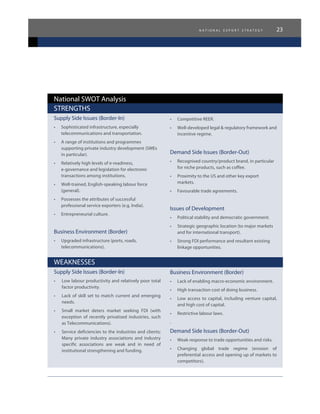
2004-05 2005-06 2006-07
Global
Competitiveness
Index (GCI)
65 (/104) 70*(/117) 67 (/125)
Macroeconomic
Stability
sub-index
83/104 99/117 118/125
Business
Competitiveness
Index (BCI)
52 (/93) 53 (110) 54 (/121)
The statistics bear out that Jamaica’s overall
competitiveness in the global environment has been
improving (taking into consideration variation in sample
size of the various surveys, as well as variability in sub-
indices composition). While there has been deterioration
in the macro-economic stability sub-index, there have
been improvements in the Business Competitiveness
Index ranking.
Competitiveness Performance: Industry
Analysis
4
The International Trade Centre Competitiveness Index
groups exports (products) by global performance level in
the categories of Champions, Underachievers, Achievers
in Adversity and Declining Sectors.
The Champions category classifies national exports that
experience growth in industries for which global import
demand is increasing. The Underachievers category
classifies national exports that though experiencing
growth, are losing market share to competitors in
product groups with increasing global demand.
Achievers in Adversity classifies national exports that
while are experiencing growth, global import demand is
on the decline. And, Declining sectors classifies national
exports that are losing market share in globally declining
sectors.
The 2006 index shows that Jamaica had 3 Champions
(which commanded the highest share of total national
exports at 8.2%), 4 Underachievers, 5 Achievers in
adversity and 8 Declining Sectors. The majority of
Jamaica’s exports (13 out of the 21 HS4 product groups
examined or 61%) were thus in the Declining Sectors
and losers in growth sectors (Underachievers).
Of particular note is that the Underachievers group
commanded the second largest share of national exports
at 4.5% as well as the largest world market share of
exports at 7%; whilst the Achievers in Adversity group
commanded 0.0% of world market share of exports and
0.6% share of national exports.
Moreover, all products classified as Champions were
traditional export products and fall within the mining/
manufacturing industry. Other traditional exports
amongst the top ten national exports (namely banana
and coffee) were from the agricultural industry and,
were losers in declining markets. The majority of the
Underachievers and losers in declining markets tended
to be non-traditional exports but spanned across a variety
of industries including agriculture/food, crude materials,
apparel and beverages.5
The Achievers in Adversity
consisted of both traditional and non-traditional export
products and industries.
The performance of product groups was taken into
account for the industry selection exercise to choose
industries of focus for the first phase of the NES.
n a t i o n a l e x p o r t s t r a t e g y 23
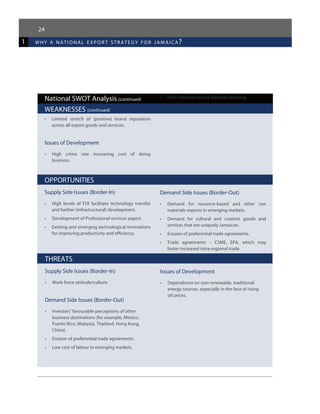
National SWOT Analysis
STRENGTHS
Supply Side Issues (Border-In)
•	 Sophisticated infrastructure, especially
telecommunications and transportation.
•	 A range of institutions and programmes
supporting private industry development (SMEs
	 in particular).
•	 Relatively high levels of e-readiness,
e-governance and legislation for electronic
transactions among institutions.
•	 Well-trained, English-speaking labour force
(general).
•	 Possesses the attributes of successful
professional service exporters (e.g. India).
•	 Entrepreneurial culture.
Business Environment (Border)
•	 Upgraded infrastructure (ports, roads,
telecommunications).
•	 Competitive REER.
•	 Well-developed legal & regulatory framework and
incentive regime.
Demand Side Issues (Border-Out)
•	 Recognised country/product brand, in particular
for niche products, such as coffee.
•	 Proximity to the US and other key export
markets.
•	 Favourable trade agreements.
Issues of Development
•	 Political stability and democratic government.
•	 Strategic geographic location (to major markets
and for international transport).
•	 Strong FDI performance and resultant existing
linkage opportunities.
WEAKNESSES
Supply Side Issues (Border-In)
•	 Low labour productivity and relatively poor total
factor productivity.
•	 Lack of skill set to match current and emerging
needs.
•	 Small market deters market seeking FDI (with
exception of recently privatised industries, such
as Telecommunications).
•	 Service deficiencies to the industries and clients;
Many private industry associations and industry
specific associations are weak and in need of
institutional strengthening and funding.
Business Environment (Border)
•	 Lack of enabling macro-economic environment.
•	 High transaction cost of doing business.
•	 Low access to capital, including venture capital,
and high cost of capital.
•	 Restrictive labour laws.
.
Demand Side Issues (Border-Out)
•	 Weak response to trade opportunities and risks.
•	 Changing global trade regime (erosion of
preferential access and opening up of markets to
competitors).
1 why a national expor t strategy for jamaica?
24
National SWOT Analysis (continued)
WEAKNESSES (continued)
•	 Limited stretch of (positive) brand reputation
across all export goods and services.
Issues of Development
•	 High crime rate increasing cost of doing
business.
•	 Poor urban/rural and regional planning.
OPPORTUNITIES
Supply Side Issues (Border-In)
•	 High levels of FDI facilitate technology transfer
and further (infrastructural) development.
•	 Development of Professional services export.
•	 Existing and emerging technological innovations
for improving productivity and efficiency.
Demand Side Issues (Border-Out)
•	 Demand for resource-based and other raw
materials exports in emerging markets.
•	 Demand for cultural and creative goods and
services that are uniquely Jamaican.
•	 Erosion of preferential trade agreements.
•	 Trade agreements – CSME, EPA, which may
foster increased intra-regional trade.
THREATS
Supply Side Issues (Border-In)
•	 Work-force attitude/culture.
Demand Side Issues (Border-Out)
•	 Investors’ favourable perceptions of other
business destinations (for example, Mexico,
Puerto Rico, Malaysia, Thailand, Hong Kong,
China).
•	 Erosion of preferential trade agreements.
•	 Low cost of labour in emerging markets.
Issues of Development
•	 Dependence on non-renewable, traditional
energy sources, especially in the face of rising
oil prices.
n a t i o n a l e x p o r t s t r a t e g y 25
Conclusions
The Jamaican economy is the most diverse and
sophisticated economy in the English-speaking
Caribbean; and as such, requires economic planning
that ascribes to the new global context and the high
levels of responsiveness that the imperatives and
challenges of globalisation demand. The Vision 2030
Plan squarely positions the National Export Strategy
in the matrix of Jamaica’s development agenda and is
indicative of the Government’s comprehensive approach
to development.
The NES is also a model of modern public-private sector
partnership, as it fits into other partnership initiatives
such as the National Planning Summit and the Social
Partnership discussions that include the labour unions
and Opposition party.
Executing the National Export Strategy will require,
(i) more effective and efficient allocation and use of
recurrent funds, (ii) private sector investments, and (iii)
better planning and coordination among the producers/
exporters and the relevant agencies of the State to
reduce duplication, emphasise quality and ultimately,
realise the vision of the NES.
Jamaica’s export performance has been influenced/
characterised by:
•	 Over-reliance on traditional exports, which are
declining in market share yet still constitute (68%)
of total goods exported, and continued dominance
of a few commodities (bauxite and alumina (58%),
sugar (5.6%),coffee, and rum;
•	 Recorded services export sector dominated by
tourism;
•	 Low value addition and lack of differentiation in
traditional and non-traditional exports;
•	 Over dependence on preferential market access
(under the ACP/EU, CBTPA, CARIBCAN
agreements) that has lead to uncompetitive
industry practices, coupled with a lack of market
diversificationandpenetrationtopotentialemerging
markets;
•	 No integrated national framework for export
development across key industries and institutions
(both public and private).
In the current global trade environment, a fragmented
approachtoexportdevelopmentisnolongerappropriate
and will not lead to enhanced competitiveness
and sustainable improvement in Jamaica’s export
performance.
The National Export Strategy therefore seeks to
comprehensively address these issues, by:
•	 Positioning the export sector to contribute to
Jamaica’s overall development within the context
of Vision 2030 Jamaica by addressing international
competitiveness;
•	 Removing impediments to competitiveness within
the export sector (includes capacity development
and diversification, human capital development,
cost of doing business and export facilitation,
and market access and promotion) by harnessing
Jamaica’s creativity and innovation;
•	 Allocating scarce resources to the priority industries
and business support services that enable current
exporters to export more, potential exporters to
begin exporting and aspiring exporters to move
from idea to execution;
•	 Engaging key stakeholders in the trade support
network in a participatory approach to formulate
and execute a national export strategy within a
formalised, institutional arrangement.
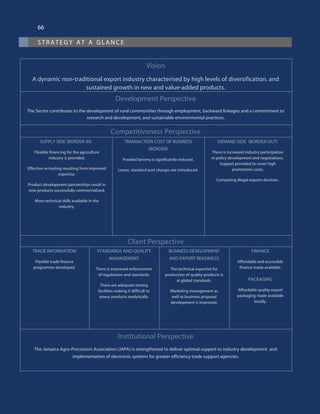
strategy at a glance
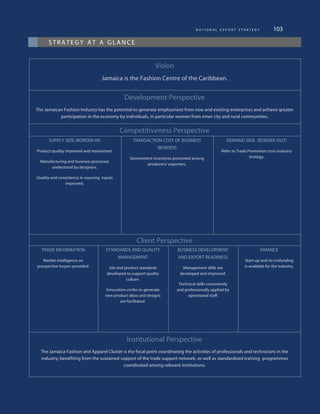
26
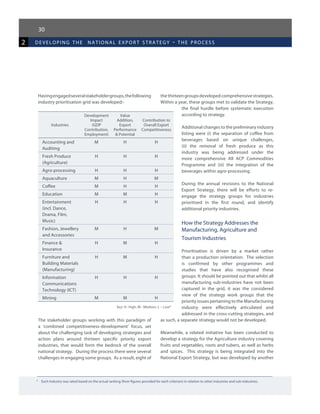
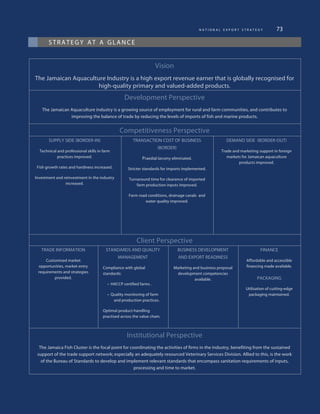
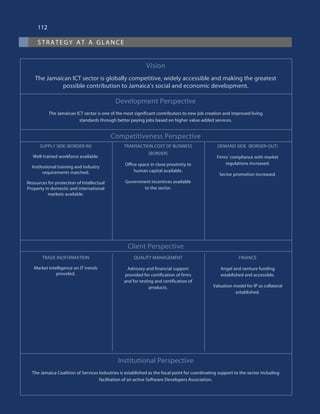
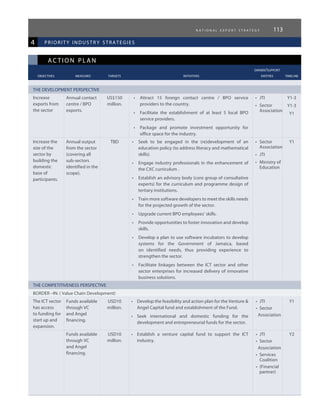
Vision
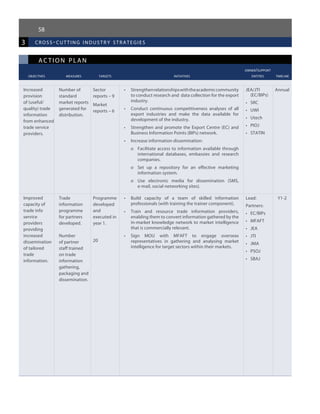
Jamaica is a leading per capita export country known for its commitment
to creativity, innovation and exceptional quality.
Development Perspective
The export sector’s contribution to GDP will increase from one-fifth to one-third by 2013. This will be reflected in increased
employment and the improvement of the livelihoods of marginalised groups through greater diversification of the sector and by
pursuing a path of a high value niche production.
Competitiveness Perspective
SUPPLY SIDE (BORDER-IN)
A competitive workforce prepared through
an integrated approach to education and
training.
Productivity and efficiency indicators
improved.
More R&D and technology innovations
applied in firms.
TRANSACTION COST OF BUSINESS
(BORDER)
Increased strategic alliances between
exporters and facilitators in the movement of
goods and services.
Road and rail infrastructure improved.
Energy sources diversified.
Reduced business risk through effective
crime management.
A more business-oriented trade facilitation
environment.
DEMAND SIDE  (BORDER-OUT)
Increased penetration of existing markets
and entry into new markets.
Increased understanding of market
access opportunities provided for under
negotiated trade agreements.
Increased participation of the private
sector in trade policy formulation.
Trade and marketing support in export
markets improved.
A nation branding framework is in place to
manage the country’s reputation, brands,
goods and services.
Client Perspective
TRADE INFORMATION
Increased provision of data-
driven trade information:
•	 Country/market reports.
•	 Product reports.
•	 Export opportunities.
STANDARDS AND QUALITY
MANAGEMENT
Capacity-building of exporters
enhanced:
•	 Global standards and
certification.
•	 Quality production and
assurance systems.
•	 Compliance with
international standard
requirements.
BUSINESS DEVELOPMENT
AND EXPORT READINESS
In-depth training in key
areas such as export plan
development, marketing,
financial management, pricing,
ICT and E-readiness.
FINANCE
Affordable and accessible
financing made available.
PACKAGING
Affordable quality export
packaging made available
locally.
Institutional Perspective
The Jamaica Export Council is a legally established entity that is adequately resourced to coordinate export policy, facilitate
export capacity and manage the implementation of the Export Strategy.
n a t i o n a l e x p o r t s t r a t e g y 27
Developing the National Export Strategy - the Process
In a highly collaborative and multi-sectoral way, the NES
seeks to galvanise all stakeholders - public and private
- to agree on a set of common objectives, backed by
coordinated actions; mindful that the limited resources
available for export development are utilised optimally;
and that the actions executed are not only short-term,
but also long-term, i.e. a balance is struck between
commercial and developmental actions.
Traditionally, nations have pursued export
competitiveness by focusing on issues relating to trade
policy, such as securing market access, negotiating
preferential treatment through trade treaties and
protocols, protecting local industries and promotion.
The NES suggests a broadening of the focus to embrace
a development paradigm given the imperatives of
globalisation, where the ultimate objective is to improve
conditions under which enterprises do business, thereby
contributing to economic and social development.
Jamaica’s National Export Strategy is benchmarked on
the Strategy Development Model of the International
Trade Centre (ITC) in Geneva, Switzerland, which has
been our sponsor in this initiative. Consider the following
four perspectives that are captured by the National
Export Strategy, which seeks to include all stakeholders
in a vibrant and highly successful Jamaican Export
sector:
The Development Perspective
“An achieved vision of how all stakeholders, including
taxpayers, politicians, government ministries, labour
unions, NGOs and the donor community perceive that
the strategy meets their needs”
The Competitiveness Perspective
“An achieved vision of how business associations,
advocacy groups, potential foreign buyers and investors
perceive that the strategy meets their needs.”
The Client Perspective
“An achieved vision of how current, potential and
aspiring exporters, and other key enterprises and players
in the value chain perceive that the strategy meets their
needs.”
The Institutional Perspective
“An achieved vision of how each member of the national
trade support network perceives its relevance, in terms
of how the strategy consolidates/reinforces its position,
by facilitating its work and enhancing its capacities and
competence.”
The Competitiveness and Development perspectives are
further defined as the functional gears in the strategy
development, and are illustrated below:
Border-In (supply-side)
issues refer to:
•	 Capacity development
•	 Capacity diversification
•	 Skills and
entrepreneurship
development
Border (business environment)
issues refer to:
•	 Infrastructure
•	 Trade facilitation
•	 Cost of doing business
2.
28
2 developing the national expor t strategy - the process
Border-Out (demand-side)
issues refer to:
•	 Market access
•	 In-market support
•	 National promotion
Development isues
refer to:
•	 Poverty alleviation
and employment
•	 Regional
development
•	 Environmental
sustainability
•	 Gender equality
The Four Functional Gears of the Strategy
The three competitiveness gears of strategy must reinforce each other, while powering the development gear.
Result: A combined competitiveness-development focus.
n a t i o n a l e x p o r t s t r a t e g y 29
6	
The Statistical Institute of Jamaica (STATIN) completed a comprehensive revision of Jamaica’s System of National Accounts in October 2008. The
nation’s accounts were previously based on the United Nations 1968 System of National Accounts (1968 SNA).  The process revision resulted in
changes in: concepts and definition and terminologies to name but a few. One such change in terminology was from Industry to INDUSTRY.
7
	 The criteria, which assessed current and potential future state, were
•	 Contribution to GDP
•	 Export performance
•	 Alignment to Vision 2030 development objectives
•	 Employment (considering quantity, quality and the location of jobs created or enhanced)
•	 Linkages
•	 Export Growth/Market Potential of the Industry (based on international demand as well as market feasibility and potential)
•	 Potential Ability to Compete (product differentiation, price, value, reliability of supply, etc.)
•	 Key Constraints inhibiting export success
•	 Possible Scale of Resources Required within the industry (in particular as it relates to increasing the industry’s export performance)
Priority Industries
6
of the National Export
Strategy
The National Export Strategy may be described as
targeted or focused. The client perspective of strategy
design encourages the focus on specific industries,
rather than trying to address the entire export sector.
These are the priority industries included in the first
phase of the National Export Strategy:
1.	 Agro-processing (Food & Beverages)
2.	 Aquaculture
3.	 Coffee
4.	 Education
5.	 Entertainment
6.	 Information Communication Technology (ICT)
7.	 Fashion
8.	 Minerals and Mining
These are the cross-cutting industry issues addressed
by the National Export Strategy:
•	 Human Capital Development
•	 Innovation & Technology (Capacity
Diversification)
•	 Cost of Business
i.	 Energy
ii.	 Security
•	 Trade Facilitation
•	 Transportation (Infrastructure)
•	 Market Access
•	 Business & Export Competency
•	 Finance
•	 Quality Management
•	 Packaging
•	 Trade Information
•	 Trade Promotion and In-Market Support
•	 Nation Branding
Industry Prioritisation
Jamaica is fortunate in that there are potentially 40
sub-industries that could become world-class exports,
however in formulating a National Export Strategy due
recognition was given to the resource requirements
necessary to implement it. At the start of the strategy
design process in April 2008, prioritisation was required
based on justifiable criteria.7
These are the priority industries identified at the start of
the National Export Strategy design process:
1.	 Accounting and Auditing
2.	 Agro-processing (Food)
3.	 Aquaculture
4.	 Beverages
5.	 Education
6.	 Entertainment
7.	 Finance and Accounting
8.	 Furniture and Building Products
9.	 Fresh Produce
10.	 Health & Wellness
11.	 Information Communication Technology (ICT)
12.	 Fashion
13.	 Minerals and Mining
30
2 developing the national expor t strategy - the process
8	
Each Industry was rated based on the actual ranking (from figures provided for each criterion) in relation to other industries and sub-industries.
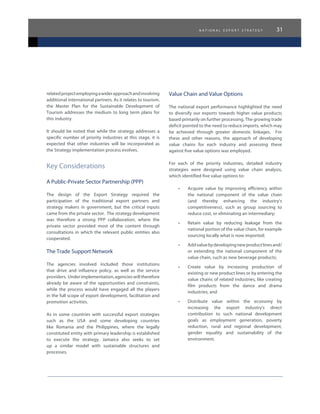
Havingengagedseveralstakeholdergroups,thefollowing
industry prioritisation grid was developed:-
Industries
Development
Impact
(GDP
Contribution,
Employment)
Value
Addition,
Export
Performance
& Potential
Contribution to
Overall Export
Competitiveness
Accounting and
Auditing
M H H
Fresh Produce
(Agriculture)
H H H
Agro-processing H H H
Aquaculture M H M
Coffee M H H
Education M M H
Entertainment
(incl. Dance,
Drama, Film,
Music)
H H H
Fashion, Jewellery
and Accessories
M H M
Finance &
Insurance
H M H
Furniture and
Building Materials
(Manufacturing)
H M H
Information
Communications
Technology (ICT)
H H H
Mining M M H
Key: H- High, M– Medium, L – Low8
The stakeholder groups working with this paradigm of
a ‘combined competitiveness-development’ focus, set
about the challenging task of developing strategies and
action plans around thirteen specific priority export
industries, that would form the bedrock of the overall
national strategy. During the process there were several
challenges in engaging some groups. As a result, eight of
thethirteengroupsdevelopedcomprehensivestrategies.
Within a year, these groups met to validate the Strategy,
the final hurdle before systematic execution
according to strategy.
Additional changes to the preliminary industry
listing were (i) the separation of coffee from
beverages based on unique challenges,
(ii) the removal of fresh produce as this
industry was being addressed under the
more comprehensive All ACP Commodities
Programme and (iii) the integration of the
beverages within agro-processing.
During the annual revisions to the National
Export Strategy, there will be efforts to re-
engage the strategy groups for industries
prioritised in the first round, and identify
additional priority industries.
How the Strategy Addresses the
Manufacturing, Agriculture and
Tourism Industries
Prioritisation is driven by a market rather
than a production orientation. The selection
is confirmed by other programmes and
studies that have also recognised these
groups. It should be pointed out that whilst all
manufacturing sub-industries have not been
captured in the grid, it was the considered
view of the strategy work groups that the
priority issues pertaining to the Manufacturing
industry were effectively articulated and
addressed in the cross-cutting strategies, and
as such, a separate strategy would not be developed.
Meanwhile, a related initiative has been conducted to
develop a strategy for the Agriculture industry covering
fruits and vegetables, roots and tubers, as well as herbs
and spices. This strategy is being integrated into the
National Export Strategy, but was developed by another
n a t i o n a l e x p o r t s t r a t e g y 31
relatedprojectemployingawiderapproachandinvolving
additional international partners. As it relates to tourism,
the Master Plan for the Sustainable Development of
Tourism addresses the medium to long term plans for
this industry.
It should be noted that while the strategy addresses a
specific number of priority industries at this stage, it is
expected that other industries will be incorporated as
the Strategy implementation process evolves.
Key Considerations
A Public-Private Sector Partnership (PPP)
The design of the Export Strategy required the
participation of the traditional export partners and
strategy makers in government, but the critical inputs
came from the private sector. The strategy development
was therefore a strong PPP collaboration, where the
private sector provided most of the content through
consultations in which the relevant public entities also
cooperated.
The Trade Support Network
The agencies involved included those institutions
that drive and influence policy, as well as the service
providers.  Underimplementation,agencieswilltherefore
already be aware of the opportunities and constraints,
while the process would have engaged all the players
in the full scope of export development, facilitation and
promotion activities.
As in some countries with successful export strategies
such as the USA and some developing countries
like Romania and the Philippines, where the legally
constituted entity with primary leadership is established
to execute the strategy, Jamaica also seeks to set
up a similar model with sustainable structures and
processes.
Value Chain and Value Options
The national export performance highlighted the need
to diversify our exports towards higher value products
based primarily on further processing. The growing trade
deficit pointed to the need to reduce imports, which may
be achieved through greater domestic linkages. For
these and other reasons, the approach of developing
value chains for each industry and assessing these
against five value options was employed.
For each of the priority industries, detailed industry
strategies were designed using value chain analysis,
which identified five value options to:
•	 Acquire value by improving efficiency within
the national component of the value chain
(and thereby enhancing the industry’s
competitiveness), such as group sourcing to
reduce cost, or eliminating an intermediary;
•	 Retain value by reducing leakage from the
national portion of the value chain, for example
sourcing locally what is now imported;
•	 Addvaluebydevelopingnewproductlinesand/
or extending the national component of the
value chain, such as new beverage products;
•	 Create value by increasing production of
existing or new product lines or by entering the
value chains of related industries, like creating
film products from the dance and drama
industries; and
•	 Distribute value within the economy by
increasing the export industry’s direct
contribution to such national development
goals as employment generation, poverty
reduction, rural and regional development,
gender equality and sustainability of the
environment.
32
2 developing the national expor t strategy - the process
This assessment using these five value options ensures
that the strategy and action plan remain focused on the
premise that the industries and national objectives may
be attained with a focus on increasing value.
Stakeholder Perspectives and Strategic
Considerations
The different stakeholder perspectives and the relative
importance of each were considered with the result being
a weighting of each. This ensures that the resources are
focussed on the area of highest prioritisation rather than
being spread across many areas, ensuring results and
impact. Below is the result of the prioritisation.
The weighting for each of the perspectives is outlined
below:
•	 The Development Perspective: 20%	
•	 The Competitiveness Perspective: 20%	
•	 The Client Perspective: 25%	
•	 The Institutional Perspective: 35%	
These form the basis of the Monitoring & Evaluation of
the Strategy using the balanced score card methodology.
However, these weightings are subject to change.
Each stakeholder perspective is also supported by
several strategic considerations that are also aligned to
the vision and objectives of the export strategy.
Within each of the four general framework areas
(perspectives), the strategic considerations were further
prioritised.
Strategic considerations of greatest importance are:
employment, capacity diversification (innovation and
technology),humancapitaldevelopment,energy,security,
in-market support, policy coordination and strategy
management. The most important service needs of the
export client were in the areas of business competency
and finance. The table below shows the priority levels of
all the strategic considerations.
Development Perspective Competitiveness Perspective
Strategic Consideration Priority Strategic Consideration Priority
Employment 1 Capacity Development 2
Environment 3 Capacity Diversification (Innovation and Technology) 1
Geographic Distribution 3 Human Capital Development 1
Poverty Reduction 2 Infrastructure Development 2
Gender 3 Trade Facilitation 2
Energy 1
Security 1
Market Access 3
In-market Support 1
National Promotion 3
Client Perspective Institutional Perspective
Strategic Consideration Priority Strategic Consideration Priority
Client Focus Policy Coordination 1
•  Business Development & Export Readiness 1 Strategy Management 1
•  Finance 1 Capacity Development 2
•  Trade Information 2 Service Delivery Coordination 1
•  Quality Management 2
•  Packaging 2
•  Branding 2
Where 1= most important, and 3 = least important.
n a t i o n a l e x p o r t s t r a t e g y 33
Strategy-making is largely a matter of applying common
sense within a commonly understood and accepted
framework in a process where the public sector
establishes priorities among industries and the private
sector establishes priorities within industries. This is
especially important when it comes to addressing cross-
cutting issues that impede international competitiveness
and export growth, where integrated responses are
required. This section is a compilation of the macro
and cross-cutting industry strategies identified. NOTE:
Where issues are to be addressed by other national
programmes, there are no corresponding activities in
the Action Plans.
1.	 HumanCapitalFormationandDevelopment
TheContext:At the heart of the global competitiveness
agendaisthecriticalmatterofhumancapitaldevelopment.
This premised on the creation of a confident educated
Jamaican population, the construction of a world-class
Jamaican workforce driven by creativity and innovation,
and the systematic reversal of the brain drain.
Significant concerns have been expressed about the
productivity of the Jamaican workforce. Some argue
that there is an absence of a productivity culture,
meaning the general population is yet to grasp the
connection between the individual value inputs of
workers and productivity as a basis for competitiveness
and improved living standards. This is evidenced by,
among other things, demands for wage increases that
bear no relationship to labour productivity. Furthermore,
simple behavioural adjustments that could substantially
improve productivity are ignored at the level of the
individualworkerandemployer(punctuality,goodrecord
of attendance and absenteeism) as well as governments
(e.g. the need to address the impact of traffic congestion
on productivity).
Real wages are also rising faster than labour productivity.
Unit labour costs and real wages have been growing
faster than labour productivity in Jamaica over extended
periods. This in part, is attributable to the competitive
collective bargaining environment. From 1994 to 2001,
unit labour costs increased twice as fast in Jamaica as
in its major trading partners, without clear evidence of a
comparable increase in labour productivity.
Issues
•	 No policy regarding establishing an education and
training system that supplies the skills needed by
industries.
•	 Output/employment is not being considered when
determining where to channel funds for education.
•	 Low investments in education, skills and health
which prevents the achievement of improved and
sustained worker productivity.
•	 Unavailability of skilled workers and concomitant
unavailability of middle to upper level managers.
•	 No promotion of productivity in the workplace, in
key industries or at a national level.
•	 No policy regarding the ‘brain-drain’ of qualified
human resources.
Support Planned / Ongoing Initiatives
In addition to the strategic initiatives outlined in the
action plan, the following supporting national initiatives
are recommended:
Enhanced human capital development resulting from
adopting a strategic and integrated approach to training,
education, labour and resource allocation.
•	 Advocate for further outlay in human capital (and
infrastructure) by the government to build a more
advanced skill set to attract higher value added
investment, which will achieve greater productivity
and competitiveness.
•	 Focus on improvements in basic educational areas,
such as mathematics and English.
Cross-CuttingIndustryStrategies3.
34
ac tion plan
					 owner/support
	 objectives	 measures 	 targets	 initiatives	 entities	 timeline
3 cross-cutting industr y strategies
Human Capital Development
Enhanced
human capital
development
that meets
the human
resource
requirements
of the key
sectors.
Number of
training and
education
programmes
that are linked
to actual and
projected
labour needs
(in priority/
target
industries).
9 such
program-
mes by
year 3.
•	 Implement industry/sector-specific training and
education programmes in each priority sector:
o	 Develop/Enhance curricula for:
•	 Coffee: Certified Coffee Extension officers
•	 Music: business management, technical areas
(mixing, production)
•	 Film: Trained Executive Producers
•	 Fashion: Enhance and integrate the different
curricula now in place
•	 Mining: tertiary
•	 Aquaculture: tertiary
•	 Agro-Processing: tertiary
•	 ICT:
(a) Secondary (CXC)
(b) Tertiary
o	 Facilitate the registration and/or accreditation of
each programme by the relevant authority.
o	 Design tracer studies for programme tracking.
Lead:
Ministry of
Education
Partners:
•	 Respective
Clusters
•	 Respective
Training/
Education
Institutions
o	RADA
o	EMC
o	UTech
o	UWI
•	 UCJ
•	 HEART/
NTA
•	 Ministry of
Labour
Y1 – Y2
Increased
productivity
across priority
sectors.
Productivity
index or
productivity
indicator by
industry.
Bench-
marks to be
established
in Y1.
•	 Provide support for firms and industries to benchmark
to international standards.
•	 Develop performance-based pay models that firms may
adopt.
•	 Provide technical assistance to firms to select and
implement the model that best suits their enterprise.
•	 Develop an institutional framework for the national
values and attitudes programmes.
Lead:
Productivity
Centre
Partners:
•	 Ministry of
Labour
•	 JMA
•	 PSOJ
•	 JEF
•	 OPM
•	 Sector
entities
Y1 – Y2
•	 Improve foreign language training.
Improved productivity in all industries
•	 Develop a permanent institutional framework for
identifying,promotingandreviewingnationalvalues
and attitudes to instill a productivity culture in
Jamaica (from the company to institutional level).
Increased productivity through retention of human
resources
•	 Support the creation of an improved business
environment to help promote better quality jobs for
graduates and fostering entrepreneurship.
n a t i o n a l e x p o r t s t r a t e g y 35
2.	 Innovation and Technology /
	 Capacity Diversification
The Context: Achieving increased value of exports
and transforming the profile of exports to reflect greater
portions of value added products will require the critical
expanded capacity to diversify production and delivery
of goods and services.
Capacity diversification deals with the value option of
creating value where new product lines are developed
or new industries are entered (for target industries).
Innovation in products and services as well as
technologies and methodologies are critical to fostering
capacity diversification.
Major inhibitors are (i) lack of investment in science and
technology, (ii) lack of information on trends that match
Jamaica’s actual and potential competitive advantage, as
well as (iii) challenges to financing the implementation
of diversification plans.
Investment in Science and Technology is critical to the
success of any country and is a crucial plank in driving
competitive advantage. Jamaica spends very little in
Scientific and Technological (S&T) pursuits. This is in
the order of 0.4% of GDP, a figure which is low even by
Latin American standards, and well behind expenditure
ratios in S&T in most OECD and East Asian countries. In
fact, Jamaica’s innovation system has so far played only
a marginal role as a source of innovation and productivity
growth.
Diversification is often driven by market demands and
trends, and requires research and product development
for new products and services, with corresponding
investments in quality requirements, packaging,
labelling, plant and infrastructure improvements. This
application in S&T should be based on innovations
driven by market demands and trends that both foster
and harness Jamaica’s competitive advantages.
The extent to which there are linkages within and among
industries, based on potential to extend value chains,
may also generate opportunities for diversification. On
the other hand, the absence of these linkages and
efforts to foster these may stifle innovations that lead to
diversification.
Issues
•	 Inadequate investments in Science and Technology
institutions that are geared to priority productive
industries (such as Agro-processing and ICT) and
supporting industries (such as packaging).
•	 Inability to finance those costs associated with the
new products and new lines.
•	 Limited availability of talent/ skilled persons trained
in product development (and diversification).
°	 Notenoughbeingchannelledintodevelopment
towards shelf life extension for processed
foods.
°	 Large segments of Jamaican enterprises lack
adequate product design capabilities, process
reconfiguration and production organisation
that will give them a competitive edge even in
niche markets.
•	 Not enough linkages and clusters within and among
industries, or value chains, to generate opportunities
for diversification and joint ventures.
•	 There is inadequate opportunity identification
based on market information that results in limited
market-driven innovation towards diversification.
Companies are not focussed in this area typically,
but also there is no monitoring and sharing of such
opportunities information by the trade support
network’s service delivery institutions to provide
these to firms.
•	 There is no national promotion with related
support, such as incentives like a tax credit for
36
3 cross-cutting industr y strategies
ac tion plan
					 owner/support
	 objectives	 measures 	 targets	 initiatives	 entities	 timeline
product development, aimed at fostering increasing
innovations (that lead to diversification).
•	 Industrial and technical development functions and
services such as prototype development and testing
for commercialising through divestment are no
longer provided at adequate levels and affordable
prices.
•	 Despite, proactive innovations in a few areas,
there are weaknesses in transitioning these
into commercial success based on industrial
development gaps, for example moving from tissue
culture to plantlets in commercial operations.
•	 No entrepreneurial support for new ventures to
be established to commercialise innovations,
where existing enterprises do not exist or are not
able or interested to take on new innovations
(and no supporting entrepreneurial drive linked to
innovation).
Support Planned / Ongoing Initiatives
A key constraint to pursuing and implementing
innovation and technology acquisition towards capacity
development and diversification is the ability to finance
such initiatives. It is therefore important to support
initiatives related to reduction in GOJ spending and debt
levels that will enhance the business environment.
Increased
focus and
application of
research and
development
and of
technology
innovation in
export sector.
Number of
new product
developments
(from
collaboration)
that are
developed.
Number of
products
improved.
Beverages: 5
ICT: 2
Agro-
processing:
3
Education: 1
Aquaculture:
2
ICT: 2
Agro-
processing:
3
Education: 1
Aquaculture:
2
Mining:: 1
•	 Implement policies and programmes to boost the
country’scapacityfortechnologygeneration,adoption
and transfer.
•	 Obtain/offer technical assistance for firms in the
selection and acquisition of modern and appropriate
equipment/models and techniques for new product/
service development.
•	 Develop active public and private partnerships with
research and development institutions to lead the
innovation process.
•	 Initiate public and private-sector partnerships for
funding of adaptive research.
•	 Expand the remit of the SRC to embrace/support
additional export industries.
•	 Identify, obtain and allocate adequate resources to the
industries to strengthen and facilitate implementation
of new product development capabilities.
Lead: MIIC
Partners:
•	 SRC
•	 JTI
•	 JEA
•	 MoF
•	 JMA
•	 PSOJ
•	 SBAJ
•	 JAPA
Lead (food):
SRC
Lead (ICT):
JSDA
Lead (Edu):
JSC
Lead (Min):
MGD
Y1
n a t i o n a l e x p o r t s t r a t e g y 37
ac tion plan
					 owner/support
	 objectives	 measures 	 targets	 initiatives	 entities	 timeline
Number
of firms
introducing
new products
and services.
Number of
firms that
improve
existing
products and
services.
10
45
•	 Obtain/offertechnicalassistanceforfirmsintheselection
and acquisition of modern and appropriate equipment
and techniques for new product development.
•	 Provide project support for new product/service
development and diversification.
•	 Enhance client service capability of service providers in
the specialised areas identified.
Lead: JEA
Partners:
•	 JTI
•	 JBDC
•	 Sector
entities
Annual
Increased
investment
(and re-
investment)
ratio into
productive
capacity.
Value of (re)
investment in
the productive
sector.
Baseline
required
•	 Advocate for more effective Incentive Regime to
support target industries.
o	 Review and assess the impact and effectiveness
of current incentives regime (in the context of high
yield on GoJ debt).
o	 Make recommendations for regimes that will allow
greater returns from investing in the productive
sector.
o	 Advocate for incentives that provide tax deductions
for reinvestment into capacity development and
diversification.
Lead: PSOJ
•	 MIIC
•	 Ministry of
Finance
Y1-Y2
Improved
market
information
that drives
innovation and
diversification.
Number of
product/market
opportunity
guides
developed per
year.
Number
of group
interventions.
1 report
for each
priority
sector
1 for
each
priority
sector
•	 Develop ‘new product’  market reports.
o	 Produce market reports on new product
opportunities, any related standards and entry
requirements, and guidelines on market entry
strategies for exploiting these.
•	 Deliver group workshops to inform clients of new
opportunities.
•	 Integrate the communication and response strategy
relatedtoopportunitiesintoexportclientmanagement
services (information and advisory services.
Lead: JTI
JEA
Cluster/
Sector
support
entities
Annual
38
3 cross-cutting industr y strategies
ac tion plan
					 owner/support
	 objectives	 measures 	 targets	 initiatives	 entities	 timeline
3.	 Transportation
Issues
Air
•	 Unavailabilityofaircargospacetotransportproduce
directly to some markets (e.g. Canada) resulting in
numerous transhipments and handling points, and
corresponding increased cost and damages.
•	 Closure of the cold storage facility at the Norman
ManleyAirportimpactingnegativelyontransporting
fresh and refrigerated produce.
•	 Prohibitive air cargo rates limit markets or result in
high costs to get the market (shrinking margins).
•	 Challenges with opening hours of air cargo service
providers which negatively impacts produce being
transported from far distances.
•	 Lack of understanding of transporting “hazardous”
material by air.
Road
•	 Traffic congestion impacting negatively on time and
motion.
•	 Poor state of road infrastructure which connects to
the production centres (farms) and poor accessibility
on arterial roads mainly during inclement weather
reduces the quantity of (farm) goods transported,
or arriving in the desired state.
Rail
•	 Unavailability of rail service to other than the bauxite
companies, contributes to road conditions and road
traffic congestion.
Increased
strategic
alliances
to establish
supply routes
to key markets
resulting in
enhanced
conveyance of
export produce
to market by
air.
Percentage
increase in
volume of air
cargo exports.
8% •	 Negotiate alliances with air carriers to facilitate optimal
transportation routes for goods and services.
•	 Advocate for flexi time in the air cargo industry.
Lead: JEA
Partners:
•	 Ministry
of
Transport
•	 Ministry
of
Foreign
Affairs
and
Foreign
Trade
Y1
Competitive
air, road
and rail
infrastructure
through
enhancement
to existing
infrastructure.
•	 Package and promote the investment/entrepreneurial
opportunities in rail transport and related storage.
•	 Maintain road infrastructure through use of applied
technologies.
Lead:
Ministry of
Transport
Partners:
•	 MIIC
•	 JTI
Y1 -Y2
n a t i o n a l e x p o r t s t r a t e g y 39
ac tion plan
					 owner/support
	 objectives	 measures 	 targets	 initiatives	 entities	 timeline
4.	 Energy
The Context: Energy is central to Jamaica’s economic
development and productivity. According to the Green
Paper on Energy9
Jamaica has one of the highest energy
intensity rates in Latin America and the Caribbean,
due largely to the high energy use of the bauxite and
alumina industry. The main characteristics of energy
and its relationship with the Jamaican economy are
summarised as follows:
•	 excessive dependence on imported primary
energy;
•	 low energy supply self-sufficiency due to a lack of
indigenous energy resources, and low utilisation of 	
available sources, namely wind, hydro, solar and
biomass;
•	 high petroleum consumption that is concentrated in
alumina, power generation and transport industries
(per capita energy consumption has increased by
50% since the early 1990s);
•	 rising share of oil products in the import energy
supply mix relative to crude oil (the latter share has
fallen from 42.5% in 1990 to 23.5% in 2004);
•	 low levels of the refinery utilisation, operating below
60% since 1983; and high systems losses in the
electricity industry, which has been deteriorating
since 2001 and which reached 20% in 2004.
With the fluctuating price of oil, it is imperative
that Jamaica finds alternative sources of energy to
facilitate cheaper production in order to ensure global
competitiveness of our export industry.
Issues
•	 High cost of electricity.
•	 Inconsistency in power supply (outages) resulting
in production losses.
•	 High costs to invest in back-up supplies / facilities.
Support Planned / Ongoing Initiatives
The key national initiative is the National Energy
Policy, which at the time of this strategy development
exercise is being revised. The issues and objectives are
aligned, based on the preliminary versions and there is
confidence that a successfully executed Energy Policy
should facilitate the desired improvements.
Jamaica has
reliable,
cost-effective
energythrough
encouraging
diversification
of the energy
base and
implementing
energy
management
and
contributing
to a more
competitive
export sector.
The ratio of
energy cost to
total cost.
The cost of
generating
energy.
Industry
baselines
to be
established
from
initiative.
•	 Establish baseline data for energy usage and
percentage of costs by industry.
•	 Promote wind power generation, and solar electrical
generationtechnology(solarheatingandsolarcooling)
and provide technical assistance to assess feasibility
and support implementation.
•	 Develop policy and administrative programme for the
implementation of net metering.
•	 Write Position Paper to advocate for the current
incentives on low cost financing to cover the outlay
of capital to finance renewable energy systems and
expand the incentives to all companies implementing
energy saving technologies.
•	 Develop policy, implementation guidelines and
timing on co-generation of energy for large energy
consumers.
•	 Implement demand reduction / demand management
programmes to reduce energy demand.
Lead:
Ministry of
Energy
Partners:
•	 OUR
•	 JPSCo
•	 MIIC
•	 JMA
•	 Ministry
of
Finance
•	 SRC
•	 Financial
Institutions
•	 JEA
Y1-3
9
	 The Jamaica Energy Policy 2006 - 2020
40
3 cross-cutting industr y strategies
5. Security
The Context: A 2007 United Nations Office on Drugs
and Crime (UNODC) report revealed that high levels of
crime and violence are major threats to Caribbean growth
and prosperity (UNODC, 2007).   Crime not only affects
economic activity, but also precludes investments. Crime
has a strong impact on most firms in terms of security
costs. This includes plant security as well as security of
assets, goods in transit and port security associated with
import and export of goods (e.g. container stripping).
Crimenegativelyimpactsbusinessexpansion,investments
and capacity utilisation that are all necessary conditions
for increased productivity. In particular, it hinders
greater capacity utilisation by limiting night shifts and
longer operating hours, and provides a disincentive for
firms to locate in Jamaica. Firms that increase capacity
utilisation by using night shifts have had to incur security
related costs to do so. It appears that the number of
firms that limits utilisation by night shifts is not as high
as perceived, as in a consultation with exporting firms;
it was found that a number of these reported use of
night shifts by themselves and their counterparts. Crime
manifests itself to various extents in small business firms
in the form of burglary, internal theft, and extortion as
reported in a study.10
This creates the need to utilise
measures such as electronic security, and/or hired
security guards, which is in most cases outside of the
capability of MSMEs. Other measures are: reliance on
physical infrastructure such as locks, burglar bars and
grills, security fencing, communal security.
The security of information is an area that is often
overlooked but critical to the success of organisations.
The cost of crime is a major concern as it hinders
development by diverting resources which could have
been otherwise used for expansion or diversification.
Issues:
Increased cost of doing business based on costs to
secure and inspect shipments to ensure integrity
(impacting ALL goods industries).
•	 High crime and costs of related security
measures limit multi shifts in production (such as
manufacturing) and service operations (such as
back-office service providers/contact centres).
•	 Praedial larceny/pilferage results in losses to
enterprises that decrease their profitability,
especially farms including aquaculture, where it is
a major cost/loss factor.
•	 Intellectual property theft
a. Piracy in music/film industry
b. Information theft
•	 Difficulty in attracting foreigners to consume
services in Jamaica, such as in the Education
industry that faces crime as a deterrent in attracting
foreign students.
Crime is a priority issue for five of
the priority export industries, and is
identified as critical to be addressed
if their development and export
performancearetoadvance.
Support Planned / Ongoing Initiatives
Achieve secure and more enabling environment to
facilitate trade
•	 Contribute to the improvement of national
security by supporting the implementation of the
10	
A Landscape Assessment of Jamaica Enterprises (2008)
n a t i o n a l e x p o r t s t r a t e g y 41
ac tion plan
					 owner/support
	 objectives	 measures 	 targets	 initiatives	 entities	 timeline
recommendations below, made by the PSOJ’s
National Planning Summit 2007:
•	 Implement   appropriate recommendations of
the McMillan report with emphasis on:
(a)	 raising of standards for recruitment and
training, professional development &
remuneration of the police force.
(b)	 introducing new legislation to establish
mechanism for the removal of
unprofessional police officers.
(c)	 improving the court system – night court,
mediation, commercial court.
•	 Establish an oversight committee made up of
members of civil society that will communicate
with the Ministry of National Security and
Justice, and assist with the implementation of
the Crime Plan.
•	 Support the development of key partnerships with
the Police in the business community.
•	 Continuously advocate for ruthless focus on
improving our national security.
•	 Support the legislation of cyber crime.
•	 Support efforts related to strengthening the justice
system and its reform.
A secure
environment
which is more
enabling to
trade.
Reduction in
the cost of
security.
Reduction in
percentage of
production lost
to theft.
Baseline
(by sector)
to be
developed
in year 1.
Baseline
(by sector)
to be
developed
in year 1.
•	 Develop capacity of exporters to establish security
policy and guidelines.
•	 Facilitate BASC Certification and CTPAT Certification
by building awareness of its benefits and encouraging
implementation within exporting firms.
•	 Obtain financing and technical support for firms
implementing BASC.
•	 Conduct public awareness about IP piracy and its
impact on economic and social development.
Lead: JEA
Partners:
•	 JCC
•	 Ministries
of
National
Security
and
Justice
•	 JMA
•	 JIPO
•	 Fiscal
Services
•	 Customs
•	 OPM
•	 SAJ
Y1-Y2
42
3 cross-cutting industr y strategies
6.	 Trade Facilitation
The Context: Trade facilitation involves government
regulations and all public industry arrangements that
affect international trade. To achieve efficiency and
effectiveness all the customs and border-crossing
procedures that constitute barriers to trade must be
identified and removed.
Issues
According to the report of the recently concluded
benchmarking study of Jamaica’s trade facilitation
systems and processes, Jamaica is favourably positioned
in terms of its location and technological readiness, but
it still lags in world rankings for global competitiveness.
•	 Jamaica slipped to 92 from 82 out of 178 countries
in the most recent Trade Across Border category,
which considers processing times and document
requirements for export (and import), as well as the
per container costs.
•	 Jamaica’s per container costs were over $600
higher on average than competitors like Panama.
•	 Jamaica also needs to reduce the number of days
for export as well as the number of documents
required. Other specific issues include:
•	 Lack of a single clearing facility for trade
facilitation.
•	 The export registration process.
The Trade Board cited the inaccurate completion of
forms by exporters as another issue. Additionally, the
poorqualityofinformationprovidedresultsinduplication
of efforts and unnecessary delays, and the detainment
of shipments when exporters knowingly try to export
goods not compliant with specific requirements.
•	 General Consumption Tax (GCT) is payable on
some inputs which makes inventory and material
costs high. Despite the claim for return of the GCT,
it is often not repaid, and the double transaction
requires administrative time and money for both the
exporter and administrator.
•	 Standardisation of systems, processes and
requirements in accordance to international best
practice is being pursued. A number of initiatives
underway are aimed at improving the business
environment and the cost of doing business, such
as improved service delivery at Jamaica Customs
and Trade Board electronic processes. The following
summarises the main issues identified:
•	 Jamaica still lags in world rankings for global
competitiveness.
•	 Lack of electronic processing mechanism for
all transactions.
•	 Long processing times.
•	 Numerous document requirements for export
•	 Lack of a single clearing facility for trade
facilitation.
•	 Lengthy export registration process.
•	 High container costs.
•	 Outlay of capital for payment of GCT on
inventory and material is not being timely
reimbursed or ‘net off’.
•	 Weak exporter competency related to trade
facilitation processes and procedures.
•	 Slow pace of implementation of Jamaica Trade
Point.
Support Planned / Ongoing Initiatives
A more business friendly (trade facilitation) service
delivery network.
n a t i o n a l e x p o r t s t r a t e g y 43
ac tion plan
					 owner/support
	 objectives	 measures 	 targets	 initiatives	 entities	 timeline
•	 Improve the service delivery of the institutions that
impact transaction time and cost.
•	 Implement the recommendations of the Trade
Facilitation benchmarking study:
i.	 Establish a cross-ministerial National
Transportation and Trade Facilitation
Committee, constituted of those institutions
charged with areas to be addressed by the
body – registration, licensing, certification,
inspection, testing and trade processes.
ii.	 Enhance Jamaica Trade Point to make it a full
service Single Electronic Window.
iii.	 Link existing and planned trade-related systems
to the Trade Facilitation Platform.
iv.	 Enhance capacity of specific facilitation
institutions.
v.	 Introduce a Rules of Origin office and provide
related training.
•	 Createarigorousmechanismtofacilitateinformation
sharing, discussions and feedback to enhance the
implementation process.
•	 Mandate the cross-ministerial National
Transportation and Trade Facilitation Committee
to become an arm of the proposed National Export
Council.
A more
business-
friendly (trade
facilitation)
service
delivery
network.
(Same as
facilitation
study).
(Same as
facilitation
study).
•	 Improve the service delivery of the institutions that
impact transaction time and cost:
(i)	 Improvement in the service delivery of the
institutions, such as Jamaica Customs and
Trade Board electronic processes.
(ii)	 Implementing the Trade Facilitation
benchmarking study’s export-related
recommendations highlighted in the previous
section.
•	 Create a rigorous mechanism to facilitate information
sharing, discussions and feedback to enhance the
implementation process.
•	 Mandate the cross-ministerial National Transportation
and Trade Facilitation Committee to become an arm
of the proposed National Export Council.
•	 Advocate for collaboration of revenue collection
agency in order that credit can be transferable to
enable refund of GCT paid to be allocated to other
revenue collection.
Lead: MIIC
Partners:
•	 Customs
•	 Trade
Board
•	 JTI
•	 Ministry
of
Finance
•	 Fiscal
Services
•	 BSJ
•	 Ministry
of Agri-
culture
Y1-2
44
ac tion plan
					 owner/support
	 objectives	 measures 	 targets	 initiatives	 entities	 timeline
3 cross-cutting industr y strategies
Reduced
cost of doing
business
through
increased cost
efficiency of
the sectors.
Reduction
in export
processing
errors (reported
by the Trade
Board)
Reduction
in container
costs.
80%
accuracy
reported.
•	 Provide export training on export procedures to reduce
(i) exporter errors and therefore processing times and
(ii) the number of detained shipments that are due to
exporter error on facilitation documentation.
•	 Resource a study to make recommendations for
reducing container cost through time volume contract
and a structured approach to consolidation.
•	 Increase the support services for the sector through
constant dialogue and regular sector meetings.
•	 Partner with the Productivity Centre to facilitate
implementation of best practice within the industry.
•	 Develop programmes and implement workshops
focusing on: collaborating to achieve economies
of scale through: group purchasing, outsourcing of
business processes, partnerships, supplier efficiency,
etc.
•	 Develop capacity of exporters   in supply chain
management, importance of productivity, record
keeping, business plan, proposal writing through
training and education.
•	 Provide regional and global benchmark data for
exporters.
As above
plus
•	 SAJ
•Productivity
Centre
•	 JEA
•	 JTI
•	 Trade
Board
•	 Export
Council
Y1-3
7.	 National Image and Branding
The Context: Nation branding is the act of deliberately
shaping the world image of the country based on
the country’s definition of its social and economic
development goals. The process of nation branding
can provide for Jamaica an effective tool by which to
coordinate the management of the world image of the
country both internally and internationally. Importantly,
for the government of the country, a nation branding
strategy has the potential to serve as a nexus for the
transformation of the nation – its economy and social
infrastructure – the psyche and attitudes of its people;
the accomplishments of enterprise.
Through the process of developing a nation branding
strategy, Jamaica will obtain a lever with which to
manage its identity and image on the world stage, by
systematically shaping the world’s understanding and
conceptualisation of Jamaica, and more importantly,
through sharpening the country’s understanding and
esteem of itself.
Despite the tremendous opportunity to define its
global competitive identity, no formal audits have been
undertaken to date in Jamaica to support development
of its Nation Brand.
The primary stakeholders have agreed to collaborate
on a nation branding initiative as a matter of priority.
This overarching framework will guide all the elements
of country branding including destination or tourism
branding, cultural aspects of the brand, as well as the
country’s business image. Critical to the initiative will
be the protection of our marks, country of origin issues,
intellectual property and branding support and services
to firms for their own marks.
n a t i o n a l e x p o r t s t r a t e g y 45
ac tion plan
					 owner/support
	 objectives	 measures 	 targets	 initiatives	 entities	 timeline
A national
coordinated
efforttouphold
Jamaica’s
reputation
through a
nationbranding
framework and
programme
supported by
creation and
management
of Intellectual
Property.
Creation and
approval of
a national
branding
framework.
Enacting
supporting
legislation.
Number of
collective
marks
registered.
Number of
GIs registered/
protected.
Framework
approved
Y1.
Supporting
legislation
in Y2.
3
3
•	 Develop a national branding strategy
o	 Secure Cabinet approval to address the mechanisms
forthedevelopmentoftheNationBrandingStrategy
in Phase I.
o	 Execute using the suggested three phase
approach:
Phase I – Developing the Nation Branding Strategy:
This phase focuses on the development of the
Nation Branding Strategy, as well as design of the
National Brand.
Phases II & III: This phase focuses on the
implementation and monitoring of the Strategy.
•	 Review current Intellectual Property legislations to
ascertain adequacy.
•	 Increase opportunities to exploit national branding
while protecting national marks and symbols.
•	 Continued and increased development of Certification
and Collective Marks to protect, support and promote
selected Jamaican products and services in discerning
international market segments.
•	 Establish a team with a mandate to improving
the capacity of micro, small and medium-sized
enterprises to benefit from the intellectual property
that is embedded in their goods and services.
•	 Promote the concept and build capacity for the
management of Intellectual Property as a tradable
good or service.
•	 Provide support to firms in enterprise and product/
service branding linked to national branding in order
to harness the benefits to association.
•	 Promote our market in a more coherent and strategic
manner aligned to target sectors and markets for each,
with improvements in the service delivery, such as the
planning timeframe and scope, activity management
and follow-up.
Lead: OPM
Partners:
•	 MIIC
•	 Ministry of
Tourism
•	 MCYS
•	 JIPO
•	 JTI
•	 JEA
•	 JCC
•	 JMA
•	 MFAFT
•	 JTB
•	 CIB
•	 JTB
•	 SBAJ
•	 Ministry of
Finance
•	 Diaspora
Entity/
ies yet to
be deter-
mined
Y1
Y2
46
3 cross-cutting industr y strategies
11
*will be dealt with under National Image and Branding
8.	 Trade Promotion
The Context: Jamaica Trade & Invest (JAMPRO/
JTI) is the national trade and investment facilitation
and promotion agency. It provides a range of services
including the provision of trade information, technical
assistance and export promotion (trade shows, missions
and business matching). These are provided primarily
from its head office in Kingston Jamaica, but also its
offices in Montego Bay, Jamaica, London, UK, and soon
to be re-opened offices in New York and Toronto. The
governmentisalsocommittedtoimprovingthein-market
support firms require, and is exploring the re-activation
of its agricultural marketing company in London,
JAMCO, and building closer operational synergies with
the Ministry of Foreign Affairs and Foreign Trade’s
overseas diplomatic missions.
Jamaican exporters have suggested that they prefer to
focus on fewer (existing) markets, rather than trying
to span their reach into too many additional and new
markets.
Issues
•	 While there is a lack of understanding in interpreting
trade agreements, stakeholders (including the
private industry firms) are not making themselves
available to engage in the discussion/preparation
for trade agreements (which would inform their
trade promotion objectives). Additionally, there is:
•	 Inadequate knowledge of market access
requirements, standards and compliance in order
to design market entry and promotions strategies.
•	 Lack of competency to access technical assistance
to effectively promote products and services.
•	 Inadequate budget and availability of information
and research to undertake trade activities.
•	 It is perceived by some exporters that much of
the national promotional endeavours are directed
towards few industries, such as the agro-processing
industry, leaving gaps in services and support to
other industries.
•	 More focused effort is needed in promoting benefits
of protecting intellectual property11
in target
markets.
•	 Fragmented approach in (i) our promotional efforts,
(ii) exploiting national branding and (iii) protecting
national marks and symbols*.
n a t i o n a l e x p o r t s t r a t e g y 47
ac tion plan
					 owner/support
	 objectives	 measures 	 targets	 initiatives	 entities	 timeline
Increased
penetration
to new and
existing
markets with
favourable
agreements
negotiated.
% increase
in exports to
markets that
are identified.
To be de-
termined
and
tracked by
markets
selected
for each
industry,
and con-
solidated
by market.
•	 Provide market access information to the export
community on new market opportunities arising from
trade negotiations.
•	 Engage the private sector and relevant stakeholders
in trade negotiations and trade adjustment plans.
Lead:
MFAFT
Partners:
•	 ECs
•	 JEA
•	 JTI
•	 JMA
•	 PSOJ
•	 SBAJ
•	 JTAT
•	 Sector
entities
Annual
Minimised
negative
impact from
market access
changes.
Positive
growth rates
for exports to
the specific
markets are
maintained.
Baseline
export
growth
rates will
be used
for any
market to
be tracked
for market
access
changes.
•	 Provide alerts to private sector and relevant
stakeholders of proposed and pending market access
changes.
Lead:
MFAFT
Partners:
•	 ECs
•	 JEA
•	 JTI
•	 JMA
•	 PSOJ
•	 SBAJ
•	 JTAT
Sector
entities
Annual
48
3 cross-cutting industr y strategies
9.	 BusinessDevelopmentandExportReadiness
The Context: Critical to the success of implementing
an export strategy is the level of export competence of
managers in the business community.  Keeping pace with
international business requirements calls for extensive
and continuous investment in competency development
and keeping track of demand for new services in the
form of training and business counselling.
A range of institutions in the TSN (JTI, JBDC and
private industry associations) offer business and export
competency training in the form of short workshops
in the following areas: business plan development,
marketing, financial management, pricing, among
others. There are however less consistent advisory
and support services tailored for the individual clients
or in-depth training in these and other areas. While
some service providers offer effective services (such
as the CFB that has been successful in the number of
clients being approved for loans), the export industry
has reported dissatisfaction with the quality of service
provided by some institutions.
Countries with export success typically provide a suite
of business and export competency services such as
consulting, counselling, mentoring, and training through
a variety of institutions, network of retired business
executives and business development service providers.
There is evidence that some of these exist to a greater
or lesser extent in Jamaica, however an integrated and
complementary approach that targets current, potential
and aspiring exporters is lacking.
Issues
•	 Lack of consistent advisory and support services
tailored for the individual clients.
•	 Limited in-depth training in business plan
development, marketing, financial management,
pricing, among others.
•	 Inadequate service quality offered by some
institutions in the area of financing.
•	 Fragmentedapproachtotargetingcurrent,potential
and aspiring exporters in the areas of business and
export competency services such as consulting,
counselling, mentoring, and training.
•	 Lack of an export training curriculum with
the requisite scope and depth that enables
complementary short courses (such as market
development and penetration).
• 	 Lack of understanding of the new business models
for the future, such as in music.
n a t i o n a l e x p o r t s t r a t e g y 49
ac tion plan
					 owner/support
	 objectives	 measures 	 targets	 initiatives	 entities	 timeline
Adopting an
integrated and
complementary
approach
to building
capacity and
competence in
the public and
private sectors
to support the
national export
training and
development
agenda.
Percentage
of registered
exporters /
active exporters
receiving
export
competency
training.
Percentage of
staff at relevant
institutions
trained in
business
and export
competency
delivery.
60%
80%
•	 Develop and implement a curriculum for introductory
supervisory and management export training.
•	 Establish Human Resource planning mechanisms to
determine the skills necessary to meet national and
global demands.
•	 Utilise national skills report to plan for education and
training to meet the opportunities and fill any gaps in
HCD programmes.
•	 Train personnel within public and private sector
primary service institutions (JTI, JEA, JBDC, ECs,
etc.) to provide cutting-edge business and export
competency services.
•	 Build institutional capacity to certify service providers
and training institutions in keeping with globally-
recognised certification standards.
•	 Deliver ongoing business development training to
exporters in cost accounting, control, record keeping,
financial reporting, and business performance
reporting and loan applications.
•	 Promote the training so as to influence a change in
the mindset of MSME exporters regarding the value
of training and education and its contribution to the
enhancement of competitiveness.
o	 Design and deliver awareness campaign tied to
productivity results from training.
o	 Advocate for tax credits for enterprises that invest
in training and education.
Lead: JTI/
JEA
Partners:
•	 JBDC
•	 HEART /
NTA
•	 PIOJ
•	 NCTVET
•	 Ministry of
Labour
•	 Relevant
Training
organisa-
tions
•	 SBAJ
•	 JMA
•	 JAS
•	 Ministry of
Education
•	 BSJ
•	 JIS
•	 MFAFT
•	 SRC
•	 Jamaica
Productivity
Centre
Y1
50
3 cross-cutting industr y strategies
12	
A Case for a National Export Strategy Jamaica’s Response Paper
13	
Policy Report for The Jamaican MSME Industry
14	
Policy Report for The Jamaican MSME Industry
10.	 Financing
TheContext: Theexportindustryrequiresamongother
things, an enabling business environment, which fosters
and supports the establishment, survival and growth of
their enterprises. This requires among other provisions,
financial support for modernisation of the industry by
way of creating an economy in which capital is equitably
and competitively available for the industry.
Unavailability of affordable financing has long been
cited as one the major factors inhibiting the expansion of
the business industry in general, and the export industry
specifically. According to the NES case document12
this has significantly and negatively impacted the rate
of entrepreneurship in Jamaica and thus the export
industry. According to a report from a study done on
MSMEs,13
following the financial industry crisis of the
1990’s, increased risk aversion coupled with high
interest rates have adversely affected lending to MSMEs.
In principle, sufficient funds are available for borrowing;
however some of the many issues preventing access to
available funds need to be addressed.
There are varying views as to whether the interest rates
are reasonable. However, it was felt that the schemes
where reasonable rates are prescribed by Government
they?are not being adequately disbursed; while those
which are being effectively disbursed, are charging
‘usurious’ rates.
Allocation of funds is also an issue for exporters and
based on the MSME report14
indications are that funds
are not being allocated to the enterprises with the
greatest potential to engage in value-added activities
and to create jobs.
Issues
•	 High Public Debt adversely affects investment and
productivitybydistortingtheallocationofinvestment
toward less productive areas; and reducing the
scope for public industry investment.
•	 The higher cost of capital in Jamaica relative to its
tradingpartnersisinpartaresultofpublicborrowing
which has pushed up interest rates. Consequently,
firms have found it difficult to borrow at prevailing
interest rates to invest in new technology and
equipment that would have increased and sustained
productivity growth.
•	 Unavailability of funding.
•	 Inability to access funds.
•	 Inflexible collateral requirement.
•	 Inability to find investors for businesses.
•	 Inability of enterprises to provide quality plans and
proposals supported by financial statements.
•	 Poor or absent financial record-keeping.
•	 Inflexibility by the retailing agencies.
•	 Funds are not being allocated to the enterprises
with the greatest potential to engage in value-added
activities and to create jobs.		
•	 Computers and software not viewed as collateral by
funding agencies.
•	 Intellectual Property not considered to have
commercial value.
•	 There are no industry figures to prove an attractive
return on investment.
n a t i o n a l e x p o r t s t r a t e g y 51
Support Planned / Ongoing Initiatives
Based on the issues identified and prioritised, the
following strategic objective and initiatives/actions are
recommended:
Affordable financing that is accessible and available to
allow investment in operating capital and reasonable
returns on investment.
•      Advocate for the country pursuing:
•	 Macro-economic stability in order to achieve
further reduction in the interest rates and
increasing availability of funding for loans.
•	 Stable exchange rate, with a policy that takes
into account competitiveness considerations
and allow flexibility in nominal exchange rates
to ensure that local inflation does not erode the
competitiveness of export.
•     Reduce the high collateral requirements for MSMEs  
by providing export credit and guarantees in the
form of a Mutual Guarantee Fund*.
•     Implement measures to improve the financing
offered through the GOJ and donor agencies by:
(i) Adopt Guiding Principles for GOJ-Supported
Lines of Credit,
(ii) Review of existing lending Mechanisms,
(iii) Special Incentives to Guide Allocation of Funds
to Critical Industries,
(iv) Adopt General Guiding Principles regarding
Lending rates for MSMEs,
(v) Expand the reach of supporting agencies to
enable SMEs and MSMEs to take advantage of
donor funding,
(vi) Develop a collaborative approach between
public and private industry.
Through the National Planning Summit, the efficiency
of property title transfer is being improved. This should
facilitate the use of land in accessing capital.
A national initiative to establish and operate Credit
Bureau* is also underway. The improved ability of
institutions to assess credit risk is welcome.
52
ac tion plan
					 owner/support
	 objectives	 measures 	 targets	 initiatives	 entities	 timeline
3 cross-cutting industr y strategies
Affordable
financing that
is accessible
and available
to allow
investment
in operating
capital and
reasonable
returns on
investment.
Number
of export
enterprises
receiving
capacity and
counselling
support for
accessing
financing.
New policy
measure
introduced
to address
concerns
related to
access to
finance.
Percentage of
firms reporting
access to
favourable
financing /
number of
firms accessing
first-time
financing.
100
2
25
•	 Build awareness of all available financing packages
and incentives being offered to the sector.
•	 Finalise and implement sustainability plan for CFB.
•	 Update FundingOasis.com.
•	 Strengthen the Technical Assistance services offered
by JTI and other institutions.
•	 Review the current structure of incentives and assess
is the resulting performance and impact at the current
level of use to determine whether adjustments are
required to foster reinvestment.
•	 Introduce factoring as a financing option.
•	 Develop a mechanism for the use of Intellectual
Property as collateral to secure loans.
•	 Encourage the modification of current borrowing
requirements.
•	 Increase the confidence and involvement of the
AFIs by sharing of information and risk by adopting
a structured approach to credit history and collateral
through the establishment of privately run Credit
Bureau and Collateral Registry.
•	 Support the creation of new types of financial products
for MSMEs through establishment of financing via:
o	 Venture Capital, Angel Funding*.
o	 Expand and promote Lease Financing.
Lead: MIIC
Partners:
•	 Ministry of
Finance
•	 BoJ
•	 DBJ
•	 ExIm
•	 JBA
•	 JCC
•	 PSOJ
•	 JEA
•	 JTI/CFB
•	 JIS
•	 SBAJ
•	 JMA
•	 JBDC
•	 JIPO
•	 Credit
Unions
•	 JSE
•	 Lenders
Y1-3
n a t i o n a l e x p o r t s t r a t e g y 53
15	
Competitiveness Assessment  (Poot & Brown, 2006)
11.	 Packaging
The Context: Product packaging is the art and
science of creating boxes, covers, tubes, bags and other
containers that are sturdy enough to protect the product
inside and that are effective promotional pieces in
themselves. To a very large degree, the quality of design
work on the package affects how well products sell.
Packaging is, therefore, fundamental to the protection of
products during transport and also crucial to the image
of the brand being exported. Packaging has significant
implications for the value of exported products and
therefore critical to the success of the business of
exporting.
According to a Competitive Assessment,15
in Jamaica,
packaging costs account for a substantial share of total
costs. Cans, plastic bottles and labels are produced
locally. However, bottles have to be imported. Changes
in the trade regime, particularly the removal of protective
tariffs and the rationalisation of packaging firms
within the Caricom region (e.g. relocation of Jamaica
Packaging Industries to Trinidad and Tobago and the
closure of West Indies Glass), has eroded the ability of
the local packaging industry to supply the local needs,
especially of the Agro-Processing sub industry. Whereas
companies in the industry prefer to acquire packaging
material locally, it is not clear whether a local packaging
industry will be able to produce glass bottles and other
packaging material at a competitive cost with imports. A
new, up to date packaging plant is being set up.
Regarding design, reports from companies involved in
product development indicate that there is not enough
technical support to facilitate packaging product
development across all industries.
Issues
•	 Local packaging industry unable to supply the needs
of industries – especially the Agro- Processing sub
industry.
•	 Unavailability of competitive local packaging (cost,
range, and/or quality).
•	 Limited technical support in (i) branding/
packaging related regulation and, (ii) packaging
innovations.
•	 Limited knowledge of packaging and the
implications for intellectual property.
•	 Inadequateknowledgeofdesigns(andrequirements)
for foreign markets.
•	 The quality of the execution of designs (printing) on
export packages/labels is too low.
•	 Difficulties in introducing joint export marketing
strategies between producers/packers of related
products.
54
3 cross-cutting industr y strategies
ac tion plan
					 owner/support
	 objectives	 measures 	 targets	 initiatives	 entities	 timeline
Improved
access to
affordable
quality export
packaging.
Percentage
reduction in
packaging
costs.
Percentage
of value in
imported
packaging
materials.
15%
*Food and
processing
sectors
only.
•	 Conduct consultation to identify most cost-effective
options for quality packaging:
•	 Reduce leakage by re-vitalising and improving
competitiveness of the local manufacturing of
packaging (e.g. corrugated cartons, glass and
plastic containers); or
•	 Build efficiencies by creating synergies with
other source countries to supply all our export
packaging requirements which are not available
(quantity & quality) locally.  
•	 Expand group purchasing of glass (and other
packaging products) to benefit from economies of
scale.
•	 Develop packaging research and training capacity.
•	 Implement training programmes in packaging
innovation and design. Work with Exporters to
increase knowledge of how packaging may be
utilised for differentiation in export markets.
Lead: JEA
Partners:
•	 JMA
•	 Cluster
/ sector
support
entities
•	 EMC/
UTech
•	 JBDC
•	 CABA
•	 EC/BIPs
•	 JTI
•	 JEA
Y1
Y2
Y1
n a t i o n a l e x p o r t s t r a t e g y 55
16	
PIOJ, 2007 and Sanjay Ross, SRC, personal communication, February 7, 2008
12.	 Quality Management
The Context: Inability to meet international quality
standards is a key issue facing exporters, and exporting
firms, especially in the agro-processing industry, face
stringent quality requirements. Jamaica has the relevant
legislative and institutional framework for quality,
standards and other requirements. However, the
timeliness and consistency of the service delivery needs
improvement.
The primary institutions include the: The Bureau of
Standards (BSJ), Jamaica Agricultural Society Crop
Certification Programme, IDB MIF/GOJ Implementation
of Quality Environmental and Food Safety Systems
in Jamaica /Quality Jamaica Project (a Certification
Body has been established, but is not yet operational),
National Quality Awards (NQA) Programme, Scientific
Research Council: Veterinary Services Division, Ministry
of Agriculture, Plant Quarantine and Inspection, Ministry
of Agriculture, and the Ministry of Health. However,
while within the public and private sectors there are a
number of quality support service providers, there are a
number of capacity constraints that impede the delivery
of a comprehensive and affordable range of quality
services to the export community.
Issues
Inability of firms to meet stringent international quality
standards due to:
•	 High costs of some basic services.
•	 Limited (but growing) availability of local experts
in some technological support services, such as
HACCP and ISO certification, product development
research and testing (such as formulation) within
firms and institutions.
•	 Costs of services such as product testing and
certification provided by the private industry are in
some cases still prohibitive, and in other cases the
quality of service provided by these professionals is
variable.
•	 Highcostsofcompliancewithinternationalstandard
requirements.
•	 Food exporters have to contend with a range
of testing and laboratory services that reside in
multiple agencies, resulting in the country not
meeting international standards (such as the single
or aligned veterinary authority for meat and poultry
products as required by the World Organisation for
Animal Health (OIE)16
.
•	 Low appreciation for quality and its importance to
competitiveness.
•	 A perceived lack of technical and experienced
personnel in the government regulatory bodies.
•	 The perception by exporters that government
regulatory bodies are too focused on
commercialisation rather than regulation which
results in lack of transparency.
56
3 cross-cutting industr y strategies
ac tion plan
					 owner/support
	 objectives	 measures 	 targets	 initiatives	 entities	 timeline
Enhanced
capacity of
exporters
to provide
quality goods
and services
that meet
international
standards.
Percentage
of exporters
(registered
or active)
receiving
quality
certification.
Number of
enterprises
benefiting from
awareness
initiatives.
Percentage
of firms re-
certified.
Reduction in
processing
times by the
BSJ
Agri: 50%
Aqua: 40%
Bev: 80%
ICT: 25%
Mining:
20%
300
90%
Baseline
required.
•	 Expand current internationally-funded quality
certification programmes and attract new ones in
order to offer cost-effective quality certification for
firms.
•	 Educate exporters on the long term benefits of  
quality management.
•	 Encourage enterprises to achieve and maintain
HACCP and ISO standards.
•	 Monitor (BSJ) certified firms on conformance for
maintaining certification.
•	 Increase the levels of experienced technical experts
in regulatory bodies.
•	 Increase focus on quality assurance outputs.
•	 Reduce turnaround time and cost in institutions
providing testing, inspection and other quality
services.
•	 Develop and promote a local registry of all technical
services available in Jamaica and thereby identify
the gaps existing that could inform development of
training and certification expertise.
•	 Coordinate the inspection regime to which exporters
are subjected, combining or integrating inspections
where they have common elements. (e.g. health and
quality inspection).
•	 Implement a mechanism to track emerging / new
requirements, and communicate these to export
sector and provide support for meeting new
requirements. As well as undertake the assessment
of these in order to advise on which if any will be
critical – including conducting cost-benefit analysis
for compliance.
•	 Package private sector investment opportunity to
establish additional accredited labs with sufficient.
Lead: MIIC
Partners:
•	 BSJ
•	 JEA
•	 JTI
•	 Min Ag
(VSD,
PQ)
•	 Min.
Health
•	 CABA
•	 NVCQ
•	 JANAC
•	 SRC
•	 MIAS
•	 JMA
Y1-3
Annual
n a t i o n a l e x p o r t s t r a t e g y 57
13.	 Trade Information
The Context: Information is critical to the success
of any organisation. Dissemination of information is
always a challenge for trade support institutions. This
is due to the human and financial resources required
for acquiring, producing and distributing material. ICTs
such as the internet now offer a wide range of distribution
media with limited investment, enabling rapid delivery of
information. In the framework of worldwide deregulation
and liberalisation, where barriers to trade are continually
falling and new methods of business emerge, reliable
trade information is becoming increasingly important.
According to the NES Response Paper,19
to improve
exporter access to information, a joint Jamaica GOJ/
EU initiative was launched to provide crucial support
services to exporters via Export Centres (EC) and
Business Information Points (BIP). Potential and existing
exporters will be provided with a range of standardised
universal and value-added services at ECs. On the other
hand, BIPs will offer a range of standardised, specific
business information, which will assist entrepreneurs
and individuals in improving competitiveness (Forrester,
2007). Five thousand (5,000) entities have been targeted
under this initiative.
Issues:
•	 Lack of packaged and updated export-specific
reports, such as country or product profiles.
•	 Limited resources within the service delivery
institutionsforthepreparationofspecialinformation
needs, such as market entry or feasibility reports.
•	 Limited awareness by the export community of the
types of information available and the sources of
information.
•	 Lack of information about regulatory changes and
other export requirements resulting in delays and
additional charges.
19
The Case for a National Export Strategy
58
ac tion plan
					 owner/support
	 objectives	 measures 	 targets	 initiatives	 entities	 timeline
3 cross-cutting industr y strategies
Increased
provision
of (useful/
quality) trade
information
from enhanced
trade service
providers.
Number of
standard
market reports
generated for
distribution.
Sector
reports – 9
Market
reports – 6
•	 Strengthenrelationshipswiththeacademiccommunity
to conduct research and data collection for the export
industry.
•	 Conduct continuous competitiveness analyses of all
export industries and make the data available for
development of the industry.
•	 Strengthen and promote the Export Centre (EC) and
Business Information Points (BIPs) network.
•	 Increase information dissemination:
o	 Facilitate access to information available through
international databases, embassies and research
companies.
o	 Set up a repository for an effective marketing
information system.
o	 Use electronic media for dissemination (SMS,
e-mail, social networking sites).
JEA/JTI
(EC/BIPs)
•	 SRC
•	 UWI
•	 Utech
•	 PIOJ
•	 STATIN
Annual
Improved
capacity of
trade info
service
providers
providing
increased
dissemination
of tailored
trade
information.
Trade
information
programme
for partners
developed.
Number
of partner
staff trained
on trade
information
gathering,
packaging and
dissemination.
Programme
developed
and
executed in
year 1.
20
•	 Build capacity of a team of skilled information
professionals (with training the trainer component).
•	 Train and resource trade information providers,
enabling them to convert information gathered by the
in-market knowledge network to market intelligence
that is commercially relevant.
•	 Sign MOU with MFAFT to engage overseas
representatives in gathering and analysing market
intelligence for target sectors within their markets.
Lead:
Partners:
•	 EC/BIPs
•	 MFAFT
•	 JEA
•	 JTI
•	 JMA
•	 PSOJ
•	 SBAJ
Y1-2
Agro-Processing
(Food and Beverages)
1	
2007 figure not available.
2	
One export category recording significant growth, but which is not sustainable was scrap metal.
Jamaica’s unique and diverse
range of food products continues
to be in increasing demand
internationally, and consistently
helps build Brand Jamaica. The
priority product groups within
the industry that are targeted in
the Strategy account for 6% of
total goods export. The export of
food products has increased each
year and grew by almost 43%
in 2008, proving the industry
to be a reliable and consistent
contributor to the growth of non-
traditional exports.
The Manufacturing industry is one of the most
important contributors to the country in terms of GDP
and employment. The Agro-processing Industry, within
this wider industry, contributes to adding value to
Jamaican agricultural products as well as to employment
opportunities in rural areas. Its linkages go beyond the
agriculture industry to tourism, packaging and other
supporting industries.
4.
Priority Industry Strategies
60
4 priorit y industr y strategies
Value Chain - Agro-Processing
Objectives
•   To increase exports by 15% each year by improving access to overseas buyers.
•   To introduce 5 new products by year 2012 to the export market.
•   60% of the industry adopting full global best practices in order to achieve improved efficiencies and
productivity.
•   To improve JAPA so that it is a vibrant association driving the industry’s development policies and
programmes.
n a t i o n a l e x p o r t s t r a t e g y 61
Value Chain - Non-Carbonated Beverages
Value Chain - Carbonated Beverages
62
4 priorit y industr y strategies
Value Chain - Beer
Value Chain - Branded Rum
n a t i o n a l e x p o r t s t r a t e g y 63
Value Chain - Bulk Rum
64
4 priorit y industr y strategies
SWOT Analysis
STRENGTHS
•	 Brand equity and strong country of origin reputation.
•	 Established niche markets, brands  and products.
•	 Established channels to the target markets with
experience to expand reach – supply chain is well
established.
•	 Export-orientated, diverse product range that
includes unique products.
•	 World-class enterprises within the industry able to
make high quality products.
•	 Support programmes in place for the industry.
•	 Presence of industry competition to drive  
performance.
•	 Standard compliance and quality products.
•	 Availability of some ‘green’ raw materials.
•	 Reasonable and improving product development
competency exists.
WEAKNESSES
•	 Inconsistency in quality and supply of domestic raw
materials.
•	 Limited/Insufficient innovation in technology and
product development to match evolving market
trends.
•	 Weak linkages to R&D resources (private and
academic), like the SRC.
•	 High import content and therefore significant
leakages.
•	 Few companies follow best practices and quality
standards.,withlowutilisationofQualityManagement
Systems (QMS) and Environmental Management
Systems (EMS).
•	 No IP protection in place.
•	 Uncoordinated marketing efforts among the
industry.
•	 Mistrust, poor networking between processors.
•	 Weak procurement networks.
•	 Weak coordination among policy and services
entities that support or guide the industry (Ministries
and agencies).
•	 Lowuptakeofavailableincentivesandpoorutilisation
of funding and technical assistance.
•	 Inadequate linkages in the supply chain.
•   Weak export focus among many potential and current
exporters.
•	 Exporters are too USA-focused.
•	 Limited availability of technical skills necessary to
build viable businesses.
OPPORTUNITIES
•   Strong demand for Jamaican products, which is
increasing in some markets.
•   Research and Development support is available.
•   Plant layout and design support available.
•   Access to product knowledge.
•   Training programmes are available.
•   Climate and soil quality conducive to growing
certain crops.
•    Environmental positioning based on products and
processes/systems.
•    Growth in potential linkage industries – such as
wellness.
•    General tourism market growth with the capacity to
increase purchases.
•   Proximity to main export market (USA).
n a t i o n a l e x p o r t s t r a t e g y 65p r i o r i t y i n d u s t r y s t r a t e g i e s - t h e c l i e n t p e r s p e c t i v e , i n d u s t r y a n d f o c u s
THREATS
•	 Increasing theft in the industry.
•	 Lack of a clear Agricultural Policy.
•	 Continued increase in labour costs without
corresponding productivity improvements.
•	 Low growth in the domestic market.
•	 Low levels of investment in the industry.
•	 Increasing security costs.
•	 Continued urban migration reducing the labour
force for the industry.
•	 Poor perception of agriculture as a viable economic
industry.
•	 Inadequate (poor) transportation impacting on
product quality arriving to processors.
•   Weather conditions impact raw material (ingredient)
supply.
•	 Increasing numbers of international and local
environmental regulations.
•	 Exports of Jamaican “knock-offs”.
•	 Violation of geographic indicators by foreign
manufactured products.
•	 New product development in competing countries.
•	 An unstable FX regime – based on the rate at which
it changes.
•	 No competitive interest rates to allow for
reinvestment in the industry.
The Development Perspective
To increase export Perecentage increase in value of
export
Y1 – 5%
Y2-3 – 15%
To increase the acceptability and accessibility
of Jamaican aquaculture products as a main
protein source
Annual output from the industry
(covering all sub-industries identified
in the scope)
TBD
The Competitiveness Perspective
Border–In:
To improve production efficiencies, while
reducing costs of production
Improved growth rate of fish by 10-
20%,
10%
Improved feed conversion (from 2 to
1.5)
1.5
To increase recovery from 30% Production recovery 80%
strategy at a glance
66
Vision
A dynamic non-traditional export industry characterised by high levels of diversification, and
sustained growth in new and value-added products.
Development Perspective
The Sector contributes to the development of rural communities through employment, backward linkages and a commitment to
research and development, and sustainable environmental practices.
Competitiveness Perspective
SUPPLY SIDE (BORDER-IN)
Flexible financing for the agriculture
industry is provided.
Effective re-tooling resulting from improved
expertise.
Product development partnerships result in
new products successfully commercialised.
More technical skills available in the
industry.
TRANSACTION COST OF BUSINESS
(BORDER)
Praedial larceny is significantly reduced.
Lower, standard port charges are introduced.
DEMAND SIDE  (BORDER-OUT)
There is increased industry participation
in policy development and negotiations.
Support provided to cover high
promotions costs.
Competing illegal exports declines.
Client Perspective
TRADE INFORMATION
Flexible trade finance
programme developed.
STANDARDS AND QUALITY
MANAGEMENT
There is improved enforcement
of regulations and standards.
There are adequate testing
facilities making it difficult to
assess products analytically.
BUSINESS DEVELOPMENT
AND EXPORT READINESS
The technical expertise for
production of quality products is
at global standards.
Marketing management as
well as business proposal
development is improved.
FINANCE
Affordable and accessible
finance made available.
PACKAGING
Affordable quality export
packaging made available
locally.
Institutional Perspective
The Jamaica Agro-Processors Association (JAPA) is strengthened to deliver optimal support to industry development and
implementation of electronic systems for greater efficiency trade support agencies.
n a t i o n a l e x p o r t s t r a t e g y 67
					 owner/support
	 objectives	 measures 	 targets	 initiatives	 entities	 timeline
ac tion plan
THE DEVELOPMENT PERSPECTIVE
Investment
Cost of Doing
Business
To increase
exports by
15% each year
•	 Develop feasibility and business model for a primary
processing facility.
•	 Develop investment opportunity profile and promote
the opportunity.
•	 JAPA
•	 JTI
Human Capital
Development /
Productivity
Please refer to HCD agro-processing tertiary programme.
THE COMPETITIVENESS PERSPECTIVE
BORDER –IN
Capacity
Development
Percent of
factories
increasing
product range
by 20%
30% Support the priority competiveness initiatives identified in
the relevant cross-cutting strategies.
60% of the
industry has
adopted full
global best
practices in
order to
achieve
improved
efficiencies
and improve
productivity
Percent of
factories
increasing yield
of products by
at least 50%
Each processor
obtains a
retooling plan
30% •	 Identify and obtain resources to contract technical
expertise to advise processors on retooling.
•	 Inform enterprises of incentives and schemes to
foster retooling.
•	 JAPA
•	 JEA
•	 JTI
Capacity
Diversification
To introduce 5
new products
by year 2012
to the export
market
•	 Improve the product development expertise and
technology to facilitate new product development.
•	 Obtain resources for product research to  identify:
•	 value added products that are feasible for
introduction into operations.
•	 high value alternatives for waste processing.  
Examples include compost, energy, bricks, and
fertilisers.
•	 Promote the introduction of new product lines based
on the possible processes of inputs that exists, such
as dried fruits.
•	 JEA
•	 JAPA
•	 JTI
BORDER
Cost of Doing
Business
•	 Foster group purchasing mechanism and initiatives to
facilitate group purchase of products in bulk to reduce
per unit cost of items as well as shipping and other
transactional costs.
•	 Facilitate processor-grower buyer matching for
purchasing directly instead of intermediaries, which
would mean better quality, and prices.
•	 JAPA
•	 RADA
•	 Ministry of
Agriculture
68
ac tion plan
					 owner/support
	 objectives	 measures 	 targets	 initiatives	 entities	 timeline
4 priorit y industr y strategies
BORDER (continued)
Cost of Doing
Business
(continued)
•	 Facilitate the introduction of alternate and renewable
sources of energy in facilities to reduce use of energy
from imported fuels.
•	 JAPA
•	 Continue lobby for strengthening of  initiatives aimed at
reducing Praedial Larceny.
BORDER-OUT:   ALL CROSS-CUTTING INDUSTRY INITIATIVES ARE RELEVANT
THE CLIENT PERSPECTIVE:  ALL CROSS-CUTTING INDUSTRY INITIATIVES ARE RELEVANT
Quality
Management
Percent
industry
compliant to
HAACP, ISO
9000 (or ISO
200) and
14000
50% •	 Improve enforcement of regulations and standards.
•	 Increase the number of testing facilities to allow firms
to assess products analytically.
Trade
Promotion
•	 Design and execute in-bound missions to bring
overseas buyers to Jamaica for industry familiarisation
tours and match-making by.
•	 Design and deliver technical assistance training
to farmers aimed at improving yield, enhancing
efficiencies, crop planning, such as when to reap.
•	 Provide technical support and information to support
training provided.
•	 RADA
resources
All ACP Commodities
programme
•	 Develop industry purchasing planning platform
to facilitate arranged purchasing between buyers
(processors or intermediary) and grower that provides
buyer times that allow growers to plan reaping to
correspond with storage and transport to maintain the
quality.
THE INSTITUTIONAL PERSPECTIVE
To improve
JAPA so that
it is a vibrant
association
driving the
sector’s
development
policies and
programme
•	 Engage the TSN in discussions on the industry
development programme, their role and functions and
cooperation towards the agreed objectives.
•	 JAPA
•	 Provide support for strengthening JAPA. •	 JEA
Aquaculture
18
Exports, 2003-2007 (Statistical Institute of Jamaica, 2008)
19
Economic and Statistical Survey of Jamaica 2006 (Planning Institute of Jamaica, 2007)
Fish, crustaceans and molluscs
have been one of Jamaica’s
best performing exports in the
non-traditional export category;
making the aquaculture industry
a potential champion export for
Jamaicawithgrowthopportunities
for production and export.
Although exports have fluctuated between 2003 and
2008, peaking in 2006 at USD$10.6m, it has comprised
on average 7% of non-traditional exports, eclipsing other
product categories such as sauces, dairy products,
ackees and breads/biscuits/buns/cakes.18
Crustaceans
have been identified as an emerging product and could
become a star performer with consistent production
levels and improved quality standards.
Aquaculture farms are concentrated in plains of
Clarendon and St. Catherine, contributing to regional
development within Jamaica.
Aquaculture is subsumed within a larger category
Agriculture, Fishing and Forestry, which contributes
USD$14.5m to GDP, equivalent to 5.9%.19
The greatest challenges and opportunities for the
industry may be addressed with a few priority initiatives
identified in the action plan that are focussed on (a)
farming practices and the certification of the facilities,
(b) feed and stock as primary inputs for the operations,
(c) security and (d) import controls.
70
4 priorit y industr y strategies
Value Chain - Farm Raised Fish
Objectives
•	 To improve production efficiencies, while
reducing costs of production, resulting in:
°	 Improved growth rate of fish by 10-20%.
°	 Improved feed conversion (from 2 to 1.5).
•	 To increase profitability of firms by 20%.
•	 To increase recovery from 70% to 80% (world
average) by 2011 by:
°	 Significantly improving brood stock quality
(hardiness and fecundity).
°	 Reducing losses from theft.
•	 To increase the export value by 15%
annually.
•	 To increase the acceptability and accessibility
of Tilapia as a main protein source.
n a t i o n a l e x p o r t s t r a t e g y 71
Value Chain - Farm Raised Shrimp
SWOT Analysis
STRENGTHS
•	 Infrastructural capacity in place to produce between
2 and 10 times as much of the current tilapia
output.
•	 Technically competent farm owners, managers
and operators - Most enterprises have well trained
persons in fisheries management, and related
sciences including postgraduate training.
•	 Enterprises typically aware of technologies and how
they may be applied to their farms – and therefore
able to make the right strategic decisions for
improvements.
•	 General industry and related business awareness for
success exists among the firms.
•	 History of collaboration within the industry and
openness to future collaboration.
•	 A strong and dedicated cluster has been formed.
72
4 priorit y industr y strategies
SWOT Analysis (continued)
WEAKNESSES
•	 Weak to no advocacy from the industry, which may
not yet realise its economic and social significance,
and potential strength.
•	 Lack of funding for working capital financing, re-
financing and upgrading.
•	 Poor perception of fresh-water fish in terms of
taste and quality (compared to marine product)
that is based on inferior imports and some farms’
products.
•	 Poor production practices at some farms.
OPPORTUNITIES
•	 There is growing demand for Tilapia in the USA
(which exceeds their production and would be filled
by imports).
•	 High local demand for marine Tilapia.
•	 A sustainable and viable option to the marine
products sub-industry, which needs proper
environmental management.
•	 The new and planned high-end restaurants
and non-all-inclusive hotels provide a market
opportunity based on the importance of quality to
their operations.
•	 Availability of lands near/along the Jamaican coast
for additional farms (and particularly salt-water
farms).
•	 Opportunity to practice poly-culture to improve
competitiveness.
•	 Individual members in the industry may leverage
their strengths for collaborative initiatives, such as
group purchasing.
•	 Growing domestic hotel industry presents a growing
domestic export market.
THREATS
•	 Increasing theft in the industry.
•	 Weak import regulation enforcement.
•	 Poor policy and implementation of existing ones
that facilitate increased import of cheaper product
threatens the domestic industry’s viability (lack of
standards enforcement and in some instances, the
lack of import standards despite the presence of
export standards).
•	 Ease of circumventing import duties that makes
imports cheaper (through under-invoicing).
•	 Imports (typically cheap poor quality) are competing
with current buyers and preventing access to new
buyers.
•	 Lack on an agriculture policy that could address
some of the issues that threaten the industry.
•	 Inability to store large quantities of product for later
distribution.
•	 Inability to access funds to undertake proposed
initiatives.
•	 Impact of global crisis on demand in the hotel
industry.
n a t i o n a l e x p o r t s t r a t e g y 73
strategy at a glance
Vision
The Jamaican Aquaculture Industry is a high export revenue earner that is globally recognised for
high-quality primary and valued-added products.
Development Perspective
The Jamaican Aquaculture industry is a growing source of employment for rural and farm communities, and contributes to
improving the balance of trade by reducing the levels of imports of fish and marine products.
Competitiveness Perspective
SUPPLY SIDE (BORDER-IN)
Technical and professional skills in farm
practices improved.
Fish growth rates and hardiness increased.
Investment and reinvestment in the industry
increased.
TRANSACTION COST OF BUSINESS
(BORDER)
Praedial larceny eliminated.
Stricter standards for imports implemented.
Turnaround time for clearance of imported
farm production inputs improved.
Farm road conditions, drainage canals and
water quality improved.
DEMAND SIDE  (BORDER-OUT)
Trade and marketing support in foreign
markets for Jamaican aquaculture
products improved.
Client Perspective
TRADE INFORMATION
Customised market
opportunities, market entry
requirements and strategies
provided.
STANDARDS AND QUALITY
MANAGEMENT
Compliance with global
standards:
•  HACCP certified farms .
•  Quality monitoring of farm
and production practices.
Optimal product-handling
practised across the value chain.
BUSINESS DEVELOPMENT
AND EXPORT READINESS
Marketing and business proposal
development competencies
available.
FINANCE
Affordable and accessible
financing made available.
PACKAGING
Utilisation of cutting-edge
packaging maintained.
Institutional Perspective
The Jamaica Fish Cluster is the focal point for coordinating the activities of firms in the industry, benefiting from the sustained
support of the trade support network; especially an adequately resourced Veterinary Services Division. Allied to this, is the work
of the Bureau of Standards to develop and implement relevant standards that encompass sanitation requirements of inputs,
processing and time to market.
74
4 priorit y industr y strategies
ac tion plan
					 owner/support
	 objectives	 measures 	 targets	 initiatives	 entities	 timeline
THE DEVELOPMENT PERSPECTIVE
To increase
export
Percentage
increase in
value of export
Y1 – 5%
Y2-3 –
15%
•	 Implement a farm certification programme.
•	 Develop a quality standard and brand/label for the
industry.
•	 Obtain processing facility certification.
•	 Structure an agreement to facilitate contract farming
with existing processors.
Lead:
Ministry of
Agriculture
Partners:
•	 Cluster
•	 BSJ
Y1
To increase the
acceptability
and
accessibility
of Jamaican
aquaculture
products as a
main protein
source
•	 Assess and present sanitary measures, country
of origin, and labelling, testing and certification
requirements.
•	 Support Min.Ag and Customs upgrade and awareness
to monitor imports.
•	 BSJ
•	 Ministry of
Agriculture
•	 Customs
Y1 – Y3
THE COMPETITIVENESS PERSPECTIVE
BORDER –IN
To improve
production
efficiencies,
while reducing
costs of
production
Improved
growth rate of
fish by 10-20%
10% •	 Introduce new gene pool (fish). •	 Cluster
•  Ministry of
Agriculture
•	 Agricultur-
al Training
Institutions
Y1
Improved feed
conversion
(from 2 to 1.5)
1.5 •	 Obtain better quality feed.
•	 Develop business plan for Jamaica AquaFoods
Limited.
•	 Cluster
•  Ministry of
Agriculture
Y1
To increase
recovery from
30%
Production
recovery
80% •	 Improve grading and stocking of fingerlings.
•	 Introduce a progress tracking system to benchmark
enterprises and assist in their attaining the desired
standards/targets.
•	 Cluster Y1
(Baseline:
50%)
70% •	 Promote the use of a nursery phase to prevent early
introduction of fries into fish ponds.
•  Ministry of
Agriculture
•	 Cluster
Y1
•	 Provide support to the cluster to engage in
collaborative initiatives, such as group purchase of
feed.
Y1-2
•	 Promote poly-culture practice among farms. Y2-3
•	 Prepare business plan for the concept of having
main processors collaborate with farmers previously
contracted by AQJ.
•	 Foster implementation of the contract processor
concept, based on feasibility outcome.
Y1
n a t i o n a l e x p o r t s t r a t e g y 75
ac tion plan
					 owner/support
	 objectives	 measures 	 targets	 initiatives	 entities	 timeline
•	 Provide technical (and extension) support to
potential farmers for production of marine Tilapia.
Y1
BORDER-OUT:   ALL CROSS-CUTTING INDUSTRY INITIATIVES ARE RELEVANT
To reduce
the losses
from theft
and costs of
implementing
security
measures
Percentage
theft (of
production)
from farms
10% •	 Review and enforce Praedial larceny Act.  
•	 Monitor application of Praedial Larceny Act, rather
than Petty Thief Act.
•	 Cluster
•	 Ministry of
Security &
Justice
Y1
Ongoing
Trade
Facilitation
To stem
the import
of inferior
products
•	 Increase training for improved monitoring of
imports for verifying Import permit validity, customs
valuation, and country of origin.
Customs Ongoing
THE CLIENT PERSPECTIVE
Quality
Management
(Same as certification initiatives designed to increase
exports).
Trade
Promotion
Percentage
increase in
sales to the
tourism sector
10% Design and execute a linkage programme aimed at
increasing purchase of local product by the tourism
sector.
Y1
THE INSTITUTIONAL PERSPECTIVE
To stem
the import
of inferior
products
TBD •	 Update list of approved import countries
o	 Prohibit products treated with carbon monoxide.
o	 Zero trace of antibiotics.
o	 Disease presence in the country – any fish/shrimp
viral disease.
o	 Parasites testing.
•	 Improve testing for bacteria, heavy metals and
antibiotics, carcinogenic chemicals (melamine,
malachite green).
•	 Improve country of origin vs. third country approval
for importation based on VSD equivalent certification.
Y2
Y1
To improve
the delivery
of quality
services to the
industry and
thus facilitate
product
improvement
(and competi-
tiveness)
Number of
firms receiving
support
TBD •	 Improve (i) Date of processing / use best before
standard (ii) Labelling standards.
•	 Begin enforcement of grading and net weight.
•	 Enhance institutional capacity of the VSD.
•  BSJ Y1
Y2
Coffee
The Jamaican brand of coffee,
Blue Mountain, remains an iconic
brand globally and stands as a
symbol of quality product from
Jamaica. It is also an example
of a protected mark, serving as
inspiration and a viable model
to several other products and
product groups from Jamaica.
Coffee is grown in a region with full employment;
something very few geographical areas are able to
boast. In addition to its social contribution, there is
significant export potential that may be realised from
both increased production and export volume, increased
value of export by expanding the percentage of value
added production locally, as well as development of
value-added products.
Coffee is one of Jamaica’s top ten export products.
Although not a major producer, the Jamaican product
attracts the highest market value in export markets.
Recent hurricanes have resulted in sharp reductions in
production and export. However the recovery rates in
growth have ranged from 30-44%.
n a t i o n a l e x p o r t s t r a t e g y 77
Objectives
•	 To access new market niches in at least three countries.
•	 To increase the volume of exports by 20%.
•	 To improve ‘clean bean’ yield to 980 kilograms per hectare (from 590).
•	 To increase premium exports to 45% of total (green bean) export (from 23% baseline).
•	 To increase in sales to the tourism industry by 15%.
Value Chain - Coffee
78
4 priorit y industr y strategies
SWOT Analysis
STRENGTHS
•	 Established product brands and very strong destination reputation.
WEAKNESSES
•	 Very little collaboration among members of the industry.
•	 Few processors and roasters have international certifications.
•	 The industry has not successfully told their story to drive sales, enhance social equity of the brand.
•	 The industry standards and requirements do not include social and environmental standards, and therefore it may
be perceived as weak in these areas.
OPPORTUNITIES
•	 Opportunities exist for increasing use of current lands (fill gaps) to increase the production volume using currently
dedicated lands.
THREATS
•	 Low domestic consumption limits sales for business and industry growth.
•	 Heavy concentration in the Japan market.
n a t i o n a l e x p o r t s t r a t e g y 79
strategy at a glance
Vision
The Jamaican Coffee Sector is the global benchmark and standard of quality for the growing
and processing of coffee for export.
Development Perspective
The Jamaican Coffee Sector is promoting environmental sustainability by utilising environmentally friendly practices and
fostering farmer welfare and increased community development programmes.
Competitiveness Perspective
SUPPLY SIDE (BORDER-IN)
Coffee yields increased.
Adaptive research in primary production
increased.
Research in product development and
higher value waste alternatives increased.
TRANSACTION COST OF BUSINESS
(BORDER)
Farm and parochial roads improved.
Alternative pesticides & fertilisers
sourced.
Credit / micro-lending for growers made
available.
Stock of seedling increased.
Praedial larceny eliminated.
Crop insurance costs reduced.
DEMAND SIDE (BORDER-OUT)
New markets Accessed.
Sector programme for increased brand
promotion and market penetration
developed.
Client Perspective
TRADE INFORMATION
Data for decision making made
available.
QUALITY AND STANDARDS
MANAGEMENT
Quality Management Systems
and Environmental Management
Systems certification applied.
EXPORT BUSINESS
EFFICIENCY AND EXPORT
READINESS
Competency training and
counselling provided.
Marketing competency of
processors and roasters
improved.
FINANCE
Affordable and accessible
finance made available.
PACKAGING
Affordable quality export
packaging made available
locally.
Institutional Perspective
The Coffee Industry Board of Jamaica (CIB) and the Coffee Exporters Association are the primary vehicles for coordinating policy
initiatives and implementing the sector development plan.
80
ac tion plan
					 owner/support
	 objectives	 measures 	 targets	 initiatives	 entities	 timeline
4 priorit y industr y strategies
THE DEVELOPMENT PERSPECTIVE
The coffee
industry to
mimises the
negatives
inpact of
growing
practices
on the
environment
Environmental
standards
developed
Completed
in Y1
•	 Produce and disseminate technical manuals for the
promotion of agro Forestry and intercropping, and
provide technical services for their implementation.
•	 Promote organic coffee farming.
•	 Develop National Industry Standards manual ( for
growers, dealers, processors and roasters) expanded
to cover:
o	 technical manual related to production: from farm
to cup.
o	 environmental standards.
o	 Health and safety standards.
o	 Social standards, such as employment, wage
minimums/ farm gate prices, etc..
•	 CIB
•	 Ministry of
Agriculture
•	 JOAM
•	 NEPA
Y1
Investment is
attracted into
the sector
to enhance
competitive-
ness and
capacity
Percentage
of investment
opportunities
attracting
investment
50% •	 Prepare investment opportunity profiles for NBM &
BM coffee that include:
o	 Cost of production models (mono/intercropped/
agro forestry).
o	 Current partnership opportunities.
•	 Survey coffee regions and develop an inventory of
idle land & abandoned farms that may be put in
production and promoted for investment.
•	 Match prospective growers and land owners to
facilitate increased production.
•	 CIB
•	 Min.
Agriculture
•	 JTI
Y1-3
Sector’s
economic
contribution
Production
output
Yield
980 kg
per hectare
•	 Promote best practices among growers in order to
foster improvement in labour productivity through the
best farmer award.
•	 Increase the provision of technical information
and support to growers that is required to increase
production yield.
•	 Ministry of
Agriculture
•	 CIB
Y1-3
THE COMPETITIVENESS PERSPECTIVE
BORDER –IN:
Sector
Diversification
The coffee
sector
increases
domestic value
addition
Number of
value added
product
developed for
commercialisa-
tion
2 •	 Conduct product research to  identify:
o	 value added products that are feasible for
introduction into operations.
o	 higher value alternatives for waste (such as
briquettes).
•	 Promote and facilitate commercialising feasible
products.
•	 SRC
•	 CEA
•	 CIB
•	 Ministry of
Energy
Y2
n a t i o n a l e x p o r t s t r a t e g y 81
ac tion plan
					 owner/support
	 objectives	 measures 	 targets	 initiatives	 entities	 timeline
Capacity
development
There is
increased
yield (output)
resulting from
improved
practices and
efficiencies
Production
output
Yield
980 kg
per hectare
•	 Increase adaptive research conducted on the density
and planting systems, nutrition management and
Coffee Berry Borer management, to transform the
efficiency of the sector.
•	 Increase the stock and size of seedlings.
•	 Ministry of
Agriculture
•	 CIB
Y1-3
The Jamaican
Coffee Industry
is recognised
as the global
industry
standard
TBD TBD •	 See initiative to Develop Industry Standards Manual
for Objective 1
•	 CIB
•	 Ministry of
Agriculture
•	 JOAM
•	 NEPA
•	 Ministry of
Labour
Y1-2
BORDER
Cost of Doing
Business
There is
improved
infrastructure
and business
environment
for growers
and processors
to enhance
revenue
Percentage
of farm roads
targeted that
are improved
50% •	 Advocate GoJ to improve farm and parochial roads.
•	 Facilitate and promote alliance to source and
purchase alternative pesticides & fertilisers to reduce
the current high costs.
•	 CIB
•	 CEA
•	 Advocate for increased availability of credit / micro-
lending for growers to finance their production.
•	 CIB
•	 CEA
Programme
redesigned
•	 Engage stakeholders in review and design of crop
insurance programme.
•	 CIB
•	 CEA
Y2
Crime
Percentage
reduction in
loss due to
theft
50% CROSS-CUTTING INDUSTRY INITIATIVES ARE
RELEVANT
•	 Ministry of
Agriculture
•	 Ministry of
National
Security
•	 JCF
Y1-3
BORDER-OUT
The sector
benefits from
an improved
branding and
marketing
programme
Percentage
increase in
export sales
20% •	 Design and implement a programme for increased
brand promotion and market penetration that includes
(brand building exercises, developing and telling the
story of the product and industry, creative market
promotions based on opportunities that exists, such as
country promotion of other sectors).
•	 CIB (R)
•	 JEA (R)
•	 JTI (R)
•	 CEA (A)
Y1
82
4 priorit y industr y strategies
ac tion plan
					 owner/support
	 objectives	 measures 	 targets	 initiatives	 entities	 timeline
Sector
Promotion
International As above •	 Generate and communicate positive messages about
the brand.
•	 Identify and recruit branding and marketing expertise
for the sector’s programme.
•	 Determine/validate market positioning  & promotion
strategy.
•	 Maintain and improve our relationship with Japanese
Importers.
•	 CIB
•	 JEA
•	 JTI
•	 CEA
Y1-2
Domestic –
Tourism
Percentage
increase in
tourism sales
15% •	 Design and execute a promotional campaign targeting
buyers at all ports (air & sea) that includes partnering
with retailers on supporting promotional activities.
•	 Develop a promotional campaign to be integrated into
Restaurant Week.
•	 Create linkage with HEART Runaway Bay to train
hospitality staff in coffee preparation & terminology.
•	 Initiate training programme in hotel sector.
•	 CIB
•	 JEA
•	 JTI
•	 CEA
Y1
THE CLIENT PERSPECTIVE
Business
Development
and Export
Competency
CROSS-CUTTING INDUSTRY INITIATIVES ARE
RELEVANT
Increased
participation
in exports in
the sector,
and improved
export
performance of
enterprises
Percentage of
roasters and
processors
participating
80% •	 Design and deliver and export awareness and
readiness programme for the sector.
•	 Inform the enterprises of export agencies and their
services.
•	 JTI
•	 JEA
Quality
Management
The Jamaican
Coffee Industry
is recognised
as the global
industry
standard
Standards
and support
programmes
developed
Completed
in Y1
•	 Execute a certified seed program for private coffee
nurseries.
•	 Collaborate with relevant entity(s) and lobby for funds
for the certification of Coffee Extension Agent.
•	 Provide technical and financial support to firms to
address the lack of QMS and EMS certification which
are critical to the future of the industry.
•	 CIB
•	 Ministry of
Agriculture
•	 JOAM
•	 NEPA
•	 Ministry of
Labour
Y1
Trade
Information
•	 Develop and disseminate market reports for the sector
to provide firms with data for decision-making.
•	 JTI
•	 JEA
Other Trade
Support
Services
•	 Identify packaging and labelling expertise as a support
service for the industry.
•	 JTI
•	 JEA
THE INSTITUTIONAL PERSPECTIVE
•	 Provide support for cluster development to facilitate
collaboration among enterprises within the sector.
JEA
CIB diversifies
and expands
its revenue
streams
•	 Strengthen agency network and relationships.
•	 Lobby to modify the Cess order to include Imports of
coffee.
CIB
Education
1	
2007 figure not available.
2	
One export category recording significant growth, but which is not sustainable was scrap metal.
Jamaica has an active and
vibrant education industry with
strong growth potential. There
are a number of well-established
public and private institutions
and a range of study offerings
in an attractive location.
By building on these strengths, Jamaica could develop
a viable education export industry capable of providing
significant foreign exchange earnings. The country
has the potential to become a destination for students
interested in university degree programmes, specialised
professional and vocational training and English
language training (ELT).
Objectives
•	 Export earnings of over US$30 million.
•	 1,000 additional extra-regional students
at tertiary institutions with differential fee
structures per year. These institutions include
UWI, Mico and NCU.
84
4 priorit y industr y strategies
•	 1,000 additional regional students at tertiary
institutionswithhomogenousfeestructuresper
year.  These institutions include the University
of Technology (UTech), the UCC and the
International University of the Caribbean
(IUC).
•	 Attract 3 foreign ELT providers to Jamaica and
increase the number of ELT students by 500.
Value Chain - Education
n a t i o n a l e x p o r t s t r a t e g y 85
SWOT Analysis
STRENGTHS
•	 Available pool of quality academic administrators
to develop policy, standard operating procedures,
systems.
•	 Jamaican programmes have high mobility in terms
of articulation and accreditation.
•	 Extra-curricular and professional programmes, such
as athletics (UTech).
WEAKNESSES
•	 No tracer studies have been done to establish
benchmarks that may be used to advise policy,
programme design, benchmarking or promotion.
•	 Capital investment for the industry – as an attractive
investment industry.
OPPORTUNITIES
•	 The further development of the academic
administrators through global discussion and
networks to enhance programmes through best
practice adoption and a global perspective.
•	 Diversificationofthebed&breakfastaccommodation
sub-industry and real estate rental industry for
foreign students.
•	 Linking programmes of study based on our unique
factors.
• 	 Recognition of quality professionals and demand for
these which could be translated to the quality of our
training institutions.
•	 May capitalise on the strength of extra-curricular
and professional programmes eg. athletic training.
THREATS
•	 Limited funding from both public and private sources
to facilitate growth and expansion of the industry.
strategy at a glance
86
Vision
Jamaica is a preferred education destination offering quality programmes in specialised areas.
Development Perspective
The sector provides a range of full-time and part-time employment opportunities through establishment of new institutions and
diversification of programme offerings.
Competitiveness Perspective
SUPPLY SIDE (BORDER-IN)
Increased capital investment in the sector.
Trained and certified pool of experts for service
delivery increased.
TRANSACTION COST OF BUSINESS
(BORDER)
Crime reduced thus lessening its impact on
customer perception of the destination.
DEMAND SIDE  (BORDER-OUT)
Awareness of Jamaica as a destination for
education Increased.
Education destination marketing support
provided.
Client Perspective
TRADE INFORMATION
Information of global training
needs and trends provided.
STANDARDS AND QUALITY
MANAGEMENT
Institutions continue to focus on
quality of programmes, trainers/
educators and facilities.
BUSINESS DEVELOPMENT
AND EXPORT READINESS
Instructional Design capabilities
in priority specialised areas are
enhanced.
FINANCE
Affordable and accessible
financing provided for
continuous improvement of
institutions.
Institutional Perspective
The Jamaica Coalition of Services Industries is established as the focal point for coordinating support to the industry including
engagement of the Jamaica University Steering Committee development and promotion.
n a t i o n a l e x p o r t s t r a t e g y 87
ac tion plan
					 owner/support
	 objectives	 measures 	 targets	 initiatives	 entities	 timeline
THE DEVELOPMENT PERSPECTIVE
To increase
the levels of
export-oriented
investment in
the sector
Number of
FDI projects in
the Education
sector.
Number of
ELT students
studying in
Jamaica.
4
500
•	 Develop Investment profiles and target investors for
•	 3 foreign ELT providers.
•	 private medical training.
•	 criminology studies.
•	 Target investment for executing the Knowledge City
concept.
Lead: JTI
Partners:
•	 NCSI
•	 JUSC
•	 Ministry of
Education
Y1-3
Y2
THE COMPETITIVENESS PERSPECTIVE
BORDER –IN: ( Value Chain Development)
Improvedrange
and quality of
programmes
that are offered
by tertiary
institutions
Number of
additional
regional
students
at tertiary
institutionswith
homogenous
fee structures
per year.
Number of
additional
extra-regional
students
at tertiary
institutionswith
differential fee
structures per
year.
1,000
1,000
•	 Develop curricula for specialised areas that would
appeal to international students for e.g. cultural
studies.
•	 Promote ESL / ELT as an export opportunity for local
institutions.
•	 Enhanceuniversities’cooperativeeducation,including
internships, positioning / promoting Jamaica as a
location for overseas cooperative options.
•	 Provide support to attract funding for individual or
common (first-rate) library.
•	 Review Dubai Knowledge City model among others to
develop a best of breed model for Jamaica.
•	 Cluster
•	 Services
Coalition
•	 JTI
Y1
BORDER
Crime
To increase
the number
of foreign
students in
Jamaica
As above as above •	 Advocate for instituting proposed interventions to
address crime, and participate in initiatives where
appropriate.
•	 Cluster
•	 Services
Coalition
Ongoing
Trade
Facilitation
To increase
the number
of foreign
students in
Jamaica
As above as above •	 Examine the work permit regime and submit
recommendations to make it comparable to that
operated by the UK or other foreign study market
selected as best model.
•	 Improve the student visa and work permit regime by
streamlining visa application procedure for students
and firms to facilitate work-study programmes.
•	 Ministry of
National
Security
•	 NCSI
Y2
88
4 priorit y industr y strategies
ac tion plan
					 owner/support
	 objectives	 measures 	 targets	 initiatives	 entities	 timeline
Infrastructure
To increase
the number
of foreign
students in
Jamaica
As above as above •	 Develop student rentals programme for home-
owners.
•	 Develop investment proposals for student housing.
•	 Ministry of
Finance
•	 JTI
•	 Ministry of
Housing
•	 NCSI
•	 JUSC
•	 TPDCo
Y1 – 2
Y1
BORDER-OUT
Sector
Promotion
Jamaica is
perceived
globally as
a preferred
education
destination
As above as above •	 Conductgroundworktodeterminewhatconsiderations
are required for ranking and how this may be instituted
(regionally or nationally to get on international lists).
•	 Cluster
•	 Services
Coalition
Y1
•	 Develop a ‘Study in Jamaica’ website. •	 Cluster
•	 Services
Coalition
Y2
THE CLIENT PERSPECTIVE
Client Focus
Increased
engagement
in export
activities
Number of
institutions
actively
exporting (any
mode)
10 •	 Conduct export awareness programmes for the sector
to encourage and foster exports.
•	 Provide export-readiness training and upgrading to
institutions to facilitate export activities.
Lead: NCSI
Partners:
•	 JUSC
•	 JTI
•	 UCJ
Annual
Trade
Promotion
Same as sector
promotion
Same as sector
promotion
Same as
sector
promotion
•	 Raise the profile of local universities using a multi-
faceted approach through the following initiatives:
•	 Develop strategic alliances withforeign universities
to offer combined programmes and offering partial
scholarships to a select few top foreign students.
•	 Individual institutions international promotion of
their programmes.
•	 Engage trade promotion service providers to include
the sector in client targeting and servicing.
•	 NCSI
•	 Individual
institutions
•	 Services
Coalition
•	 JTI
•	 JEA
Ongoing
THE INSTITUTIONAL PERSPECTIVE
To strengthen
the manage-
ment structure
for the sector’s
development
and the level of
networkingand
cooperation in
the sector
•	 Provide support to strengthen the Jamaica University
Steering Committee Consortium.
•	 Foster increased institutional collaborations (such as
UCC/UTEch MOU and articulation agreement between
UCC-UWI).
•	 Collaboratively develop an inventory of programmes to
be used as a strategic input for the sector.
•	 NCSI
•	 Services
Coalition
Y1-2
Entertainment
Jamaica is known globally for its
cultural and creative industries,
which are a major contributor to
the local economy. A recent study
indicated that the Copyright
Industry contributes about
5.1% to the GDP of Jamaica,
and accounts for 3.0% of all
employment in Jamaica.
Within the Creative Industries, Dance, Drama, Film
and Music are among the strongest export services
and have the greatest potential to promote our culture
and creativity.   Various reports on the Music industry
place the employment estimate between 6,000 and
15,000, with estimates of export earnings as high as
USD100million.   Film location projects may contribute
USD14million in the local economy, with 1,500 – 2,500
employees who also export their services.
Objectives
•	 To increase music exports by USD50million over
five years.
90
4 priorit y industr y strategies
Value Chain - Music
•	 To increase exports across the industry by 20%
annually.
•	 To strengthen the industry by focusing on the
formalisation and development of enterprises.
•	 To enhance the institutions that support the industry
to improve coordination and business approach to
its development.
n a t i o n a l e x p o r t s t r a t e g y 91
Value Chain - Dance
Value Chain - Drama
92
4 priorit y industr y strategies
Value Chain - Film
SWOT Analysis
STRENGTHS
•	 An abundance of talent in each of the sub-
industries.
•	 Creative source.
•	 Abundant talent.
•	 World-class achievements.
•	 Varied and valuable cultural and heritage
resources.
•	 Increased collaboration between tourism, cultural,
entertainment and sports industries.
•	 Strength of “Brand Jamaica”.
•	 Modern copyright regime in place; Jamaica party
to relevant IP agreements/international treaties.
WEAKNESSES
•	 Lack of appropriate and sufficient venues for the
performance sub-industries.
•	 Absence of a film studio that meets minimum
global industry standards.
•	 Inadequate intellectual property framework for
protection, valuation and management of works
resulting in limitations in (i) monitoring and
penalising for infringements (ii) valuation and
use of collateral (iii) commercial management for
optimal revenue.
•	 In most sub-industries the absence of a listing of
qualified professionals for accessing/contracting
them.
•	 Insufficient measurement and monitoring of
industry.
•	 Insufficient capacity and financial support for
institutions and infrastructure for culture and
world-class entertainment industry.
•	 High levels of piracy.
•	 Insufficient regard and respect for the worth and
economic value of creative industry professions
and professionals.
n a t i o n a l e x p o r t s t r a t e g y 93
•	 Limited capacity to enforce intellectual property
rights.
•	 Insufficient knowledge of, support by and  benefit by
stakeholders of existing rights management systems.
•	 Insufficient business management capacity in creative
industries.
•	 Inadequate institutional financing for creative
ventures.
•	 Insufficient budgetary allocation for development of
the industry.
•	 Inadequate human resource development for creative
industries.
•	 Insufficient incentive for retention/holding earnings
from creative industries in Jamaica.
•	 Gaps in existing rights management system.
•	 Inadequate linkages with other economic industries.
•	 Fragmentation, lack of coordination and  duplication
of roles among agencies.
•	 Inordinate delay in implementing some treaties
through domestic law and reform of other relevant
laws.
OPPORTUNITIES
•	 Growthineconomicvalueofglobalculturalindustries
and markets.
•	 Growth of media channels and demand for content
(In videogames there is also an emerging trend
where Damian Marley and Wayne Marshall both
landed deals for the inclusion of their music on the
soundtrack of the world’s best selling videogame -
EA Sports’ FIFA 2006 and FIFA 2005 respectively
- The negotiation of ring tone contracts is another
lucrative area that is still evolving, but from which
Jamaican artists stand to benefit significantly).
•	 Development of bilateral and international
agreements for intellectual property rights and
support for creative industries.
•	 Value of Internet in creating new markets, business
opportunities and channels for exposure and
distribution of cultural products.
•	 Cheaper and more user-friendly technology.
•	 Widening of the regional market through CSME.
•	 Existence of West Indian Diaspora as market for
local creative products.
•	 High awareness of and demand for “Brand
Jamaica”.
•	 Brand Jamaica through Jamaican music continues
to be in demand, with the increased use of reggae in
the soundtracks of feature films and advertisements
in North America.
THREATS
•	 The copying and adaptation of the Jamaican style
and genres by non-Jamaicans that is eroding our
share in formerly indigenous areas, e.g. international
reggae artistes, reggaeton (also reguetón and
reggaetón), popularised dances.
•	 Potential loss of comparative advantage in
Jamaican cultural products through increased
quality and use by other countries of Jamaican
symbols and arts.
•	 Potential erosion of geographic indicators
for “Brand Jamaica” through imitation by
competitors.
•	 Low degree of local ownership and control of
creative industries resulting in low retention of
value-added.
•	 Increasing use of technology reduces creative
input of performers and artistes.
•	 Low level of understanding by Jamaican private
industry regarding business intricacies of creative
industries.
•	 The negative implications of creative industries in
the WTO trade regime.
•	 Impact of negative activities on the image of
Jamaica.
strategy at a glance
94
Vision
Jamaica’s Creative Industries is a sustainable contributor to the economy with optimal financial
benefits being realised from our intellectual property.
Development Perspective
Jamaica’s Creative Industries contributes significantly to employment generation through new enterprise development in the
Entertainment and related industries, achieving greater participation in the economy by individuals particularly from inner-cities
and rural communities.
Competitiveness Perspective
SUPPLY SIDE (BORDER-IN)
Appropriate entertainment venues
constructed.
Model for acceptance for creative works as
collateral established.
Business and professional practices by
enterprises improved.
TRANSACTION COST OF BUSINESS
(BORDER)
A well developed and accepted IP framework
in place.
Financial institutions perception of to the
industry altered.
DEMAND SIDE  (BORDER-OUT)
New (and innovative) marketing and
distribution channels developed.
Local marketing and distribution channels
increased.
Client Perspective
TRADE INFORMATION
Updated listing of global
business opportunities
maintained.
Information on market trends
and potential buyers provided.
STANDARDS AND QUALITY
MANAGEMENT
Culture of professionalism
established and maintained.
BUSINESS DEVELOPMENT
AND EXPORT READINESS
Business services provided to
support the formalisation of
entities.
Access to professional training
expanded across the island.
Effective royalty collection and
payment systems maintained.
FINANCE
Financing tools specific to
the industry introduced.
IP accepted as collateral.
Institutional Perspective
The Creative Industries Clusters are recognised focal points for the activities of their stakeholders ensuring alignment to eliminate
duplication of services and supporting enhanced collecting societies and a duly established Council for the Arts.
n a t i o n a l e x p o r t s t r a t e g y 95
ac tion plan
					 owner/support
	 objectives	 measures 	 targets	 initiatives	 entities	 timeline
THE DEVELOPMENT PERSPECTIVE
The Creative
Industries
increases
contribution to
GDP
Percent
contribution to
GDP.
Perecentage
increase in
royalty fees
collected.
Baseline
to be
determined
•	 Improve mechanisms for collecting royalties:
•	 Negotiate bilateral agreements with key markets such
as Italy, Germany, France.
•	 Facilitate registration of artistes with appropriate
collection agencies.
•	 Conduct workshops and provide information material
to increase awareness of artistes’ on intellectual
property rights and collection mechanisms.
•	 Expand awareness and training to reduce IP violations
in Jamaica.
•	 Integrate industry into national tourism linkage
programme.
•	 JACAP
•	 MFAFT
•	 MCYS
•	 Cluster
•	 JIPO
•	 JTI
Y1-2
Y1
Y1-2
Number of
new firms in
the industry
registeringtheir
businesses.
30 •	 Provide assistance to entities to facilitate their
formalisation:
•	 Business registration.
•	 tax and accounting systems.
•	 business planning and business advisory support.
•	 JBDC
•	 Cluster
•	 ORC
•	 BIPs
Y1
(on-
going)
Increased
capital and
infrastructure
investment
•	 Develop,packageandpromoteinvestmentopportunity
for a mixing studio for local or foreign investment.
•	 Develop,packageandpromoteinvestmentopportunity
for a film studio for local or foreign investment.
•	 JTI
•	 Cluster
Y1
THE COMPETITIVENESS PERSPECTIVE
BORDER –IN
Capacity
Development
Enhance
capacity exists
in Jamaica
to train the
relevant
personnel to
international
standards
to maximise
their earning
potential
The location
of training
institutions
across
Jamaica ( with
Registration,
accreditation,
physical
facilities,
locations).
3 •	 Expand the reach of creative and technical training
institutions in Jamaica by introducing new locations,
and enhancing their capacity.
•	 Cluster
•	 Education/
Training
Institutions
•	 Services
Coalition
•	 Ministry of
Education
Y1-3
The number
of registered
training
institutions
and accredited
programmes
available to the
entertainment
sector.
Baselines
to be
refined
based on
audit
•	 Develop and execute relevant (internationally
accredited) programmes for the industry (in fields
such as artiste management, theatre) – and that
covers development of the trainer core.
•	 Cluster
•	 Education/
Training
Institutions
•	 Services
Coalition
•	 Ministry of
Education
Y1-3
96
ac tion plan
					 owner/support
	 objectives	 measures 	 targets	 initiatives	 entities	 timeline
4 priorit y industr y strategies
The number
of qualified
/ certified
professionals
in the
entertainment
sector (to
be further
detailed).
Baselines
to be
refined
based on
audit.
•	 Design and implement apprenticeship initiatives -
especially in technical fields, such as mixing.
•	 Cluster
•	 Education/
Training3
Institutions
•	 Services
Coalition
Y1-3
•	 Obtain funding for initiatives aimed at community and
cultural groups.
•	 MCYS
•	 Services
Coalition
Y1-2
In the
industries
The number
of qualified
/ certified
professionals
in the
entertainment
sector (to
be further
detailed).
Baselines
to be re-
fined based
on audit.
•	 Develop and execute (Music) engineers training and
certification programme.
•	 Develop and execute (Film) Producer training
programme.
•	 Cluster
•	 Institutions
•	 Services
Coalition
Y1
(Film)
Increased
creation
of Good
Jamaican-
themed
products
based on our
stories with
international
marketing
potential
Number of
completed full
length feature
film scripts per
year.
5 •	 Develop andexecute 12months programme to facilitate/
follow the development of 5 feature scripts.
•	 Encourage the financial backers to assist in the
development of a Jamaican Film genre.
•	 Cluster
•	 Film
Commis-
sion (JTI)
•	 TBD
Y1-2
(Film)
Increased
financing of
local film
projects so that
ownership and
distribution
rights may be
retained
•	 Advocatethegovernmenttoputinvestorandproduction
initiatives and incentives in place.
•	 Provide support to firms to develop proper/bankable
marketing plans to make investment attractive.
•	 Cluster
•	 Firms
•	 Services
Coalition
•	 JTI
Y1
3	
Edna Manley College, HEART/NTA, CPTC
n a t i o n a l e x p o r t s t r a t e g y 97
ac tion plan
					 owner/support
	 objectives	 measures 	 targets	 initiatives	 entities	 timeline
Improved
production
skills exist to
take quality of
the Jamaican
product to an
international
level
Jamaica a
self-sufficient
production
industry and
also a self-
production
destination
Industry
possesses the
required levels
and quantities
of skilled
persons.
Industry
at desired
standard in
5 years.
•	 Identify the skills required for self-sufficiency based
on the capability that exists in the baseline year.
•	 Put in place an internship, training and development
programme for the crews and persons interested in
investing in the industry.
•	 Cluster
•	 Firms
Y1
BORDER
Cost of Doing
Business
The costs of
transactions
and tools
acquisition for
the sector are
reduced
•	 Revise and update the Tools of the Trade Incentive. •	 MCYS
•	 Cluster
Y1
“Payola”
practice is
eliminated
•	 Develop a partnership between the regulatory
authorities, industry and media to develop and
implement an initiative to eliminate the practice.
•	 MCYS
•	 Clusters
•	 Services
Coalition
•	 Ministry of
Security
•	 Media
Association
•	 Broadcast
Commis-
sion
Intellectual
Property
•	 Review of current IP legislation to ensure that the scope
of the industry is covered by the current framework,
and if not any gaps are filled.
•	 Conduct sensitisation sessions to inform firms of IP
rights, assist firms in registering and other measures
to protect those rights.
•	 Develop Business models for managing (and
exploiting) IP rights and present models to firms
through workshops and printed material.
•	 MCYS
•	 Cluster
•	 Services
Coalition
•	 JIPO
Y1
98
4 priorit y industr y strategies
ac tion plan
					 owner/support
	 objectives	 measures 	 targets	 initiatives	 entities	 timeline
Infrastructure
Jamaica
has a multi-
disciplinary
state-of-the-art
performing
venue
Venue
constructed
and
operational.
Year 3 •	 Assess all performance venues (including those
under construction or planned) to identify any gaps
based on the recommended features and capacity.
•	 Develop investment proposal for the development
and construction of such a venue, to include
proposed use and marketing plans.
•	 MCYS
•	 JTI
•	 Cluster
Y1
BORDER-OUT
Market Access •	 Explore new music distribution models for accessing
markets that will be feasible for firms in the sector.
•	 JTI
•	 Cluster
Y1
Sector
Promotion
•	 Provide greater support for overseas promotion of
the sector:
•	 Identify 2 trade shows for each sub-sector.
•	 Coordinate and execute an inbound mission to
showcase the sector.
•	 JTI
•	 Cluster
Y1-Y2
THE CLIENT PERSPECTIVE
Business
Development
& Export
Competency
Improved
business
practices and
higher levels of
professional-
ism in the
sector
•	 Design and deliver workshops on professionalism
and business etiquette in creative industries.
•	 Cluster Y1
Enhanced
ability of
cluster
members to
identify and
take advantage
of market
opportunities
domestically
and
internationally.
Number of
programmes
developed or
enhanced.
1 general
(per year)
1 per sub-
sector (per
year).
•	 Develop and implement General business management
for the creative industries.
•	 Expand and enhance music business management
programmes.
•	 Expand and enhance Artiste development
programmes.
•	 Develop Film production programmes, with reputed
institutions.
•	 Formally train Music distribution executives and
employees, and provide information on developments,
trends and opportunities in this area.
•	 Cluster
•	 Institutions
•	 Services
Coalition
•	 Ministry of
Education
Ongoing
Financing •	 Upgrade Service providers to provide hand-holding
and counselling to creative enterprises in (i) developing
grant proposals (ii) preparing and presenting business
and investment proposals (iii) preparing and presenting
sponsorship proposals (iv) preparing loan packages.
•	 Create of an incubator fund for creative enterprises
(micro-small enterprises).
•	 MCYS
•	 MIIC
•	 Min. Fi-
nance
•	 Cluster
•	 JTI
•	 JBDC
•	 CFB
Y1 – 2
Y2
n a t i o n a l e x p o r t s t r a t e g y 99
ac tion plan
					 owner/support
	 objectives	 measures 	 targets	 initiatives	 entities	 timeline
Trade
Information
Firms are
provided
quality market
information
to facilitate
market
selection for
events and
related sales
efforts
•	 Create and disseminate market specific reports that
outline market size, potential and entry strategies
based on channels.
•	 Post and Update business opportunities for services
from the sector based on needs in linked industries
(e.g. tourism sector opportunities, film projects, and
events).
•	 JTI
•	 EC/BIPs
•	 Cluster
Annual /
Ongoing
Business
Opportunities
Number of
value creation
options that are
commerciali-
sed.
Number
of firms
undertaking
value creation/
addition
activities
towards
expansion.
5
10
•	 Document / package and disseminate business
opportunities based on value creation possibilities in
sector chains.
•	 Develop mechanisms for networking within and
across sub-sectors and sectors.
•	 Clusters
•	 JTI
•	 JBDC
Ongoing
THE INSTITUTIONAL PERSPECTIVE
An effective
national
coordinating
entity for
the creative
industries is
developed
•	 Launch, empower and support an industry-wide
policy framework and unit.
•	 MCYS
•	 Clusters
•	 Services
Coalition
Y1
Royalties
payment/
collection
entities are
strengthened.
•	 Provide technical support to the collections
agencies to improve effectiveness and efficiencies.
•	 Cluster
•	 JACAP
•	 JTI
Fashion, Jewellery and Accessories
Jamaica’s fashion industry also
captures the vibrant and bold
energy of its people, and may be
considered the strongest goods
producing industry in Jamaica’s
creative industries. As with other
creative industries it provides the
potentialforregionaldevelopment
and the economic engagement of
less advantaged groups – based
on economic or education level
– who may not easily find (have
access to) traditional employment
opportunities.
Jamaica’s total export figures for the apparel and
jewellery industries include items manufactured locally
for international firms as well as the export of items
not manufactured locally, but not captured as re-
exports, such as wristwatches. The declining figures in
these areas are felt to reflect the decline in outsourced
production rather than the decline of local exports.
n a t i o n a l e x p o r t s t r a t e g y 101
Objectives
•	 A strong national fashion cluster that will be sustained following the termination of the PSDP and its
support.
•	 A competitive fashion industry producing quality garments to international-level standards to meet market
demands.
•	 A nationally and regionally prominent industry based on the increased awareness of the Jamaican cluster.
•	 Increased production of locally designed and manufactured fashion products.
Value Chain
102
4 priorit y industr y strategies
SWOT Analysis
STRENGTHS
•	 Strong national brand linked to creativity.
•	 Creative and skilled designers.
•	 Trained pool of workers in garment construction.
•	 Presence of support institutions (though needs
some strengthening).
WEAKNESSES
•	 New entrants lack the level of technical training
previously available to persons who have now left
the industry.
•	 Productivity and focus on quality is often weak in
workers who have been technically trained.
•	 Difficulty for designers to identify partners, and
suppliers – particularly potential contractors who
have been trained.
•	 Poor quality fabrics and limited range in trimmings.
•	 Lack of innovation and creativity support in
a somewhat structured way for the industry
(particularly jewellery and accessories).
OPPORTUNITIES
•	 Jamaica may be an outsourcing destination for
some regional manufacturing based on availability
of workers and factory space (however may not be
competitive on cost and quality).
•	 Growing demand for Jamaican creative and design
products – e.g. merchandise for entertainment
product.
•	 Increased sales to the tourism market.
THREATS
•	 Emergence of competing cultural and ethical fashion
brands globally.
•	 Increasing availability of affordable fashion
products.
•	 Overseas mass, as well as designer production of
“Jamaican inspired” designs.
n a t i o n a l e x p o r t s t r a t e g y 103
strategy at a glance
Vision
Jamaica is the Fashion Centre of the Caribbean.
Development Perspective
The Jamaican Fashion Industry has the potential to generate employment from new and existing enterprises and achieve greater
participation in the economy by individuals, in particular women from inner city and rural communities.
Competitiveness Perspective
SUPPLY SIDE (BORDER-IN)
Product quality improved and maintained.
Manufacturing and business processes
understood by designers.
Quality and consistency in sourcing  inputs
improved.
TRANSACTION COST OF BUSINESS
(BORDER)
Government incentives promoted among
producers/ exporters.
DEMAND SIDE  (BORDER-OUT)
Refer to Trade Promotion cross industry
strategy.
Client Perspective
TRADE INFORMATION
Market intelligence on
prospective buyers provided.
STANDARDS AND QUALITY
MANAGEMENT
Job and product standards
developed to support quality
culture.
Innovation circles to generate
new product ideas and designs
are facilitated.
BUSINESS DEVELOPMENT
AND EXPORT READINESS
Management skills are
developed and improved.
Technical skills consistently
and professionally applied by
operational staff.
FINANCE
Start-up and mi crofunding
is available for the industry.
Institutional Perspective
The Jamaica Fashion and Apparel Cluster is the focal point coordinating the activities of professionals and technicians in the
industry; benefiting from the sustained support of the trade support network, as well as standardised training programmes
coordinated among relevant institutions.
104
4 priorit y industr y strategies
ac tion plan
					 owner/support
	 objectives	 measures 	 targets	 initiatives	 entities	 timeline
THE DEVELOPMENT PERSPECTIVE
Investment
Increased
availability to
local designers
of WISIC
Greater local
retention of
the value of
WISIC based
on expansion
of the value
chain
Number of
potential
investment
partners.
Percentage
increase of
production of
WISIC.
5 potential
partners
identified
20%
•	 Conduct feasibility study for the development of the
WISIC value chain to engage in further processing in
the region.
•	 Promote and facilitate investment in the ginning and
spinning of yarn for fabric production.
•	 Promote and facilitate investment for WISIC growing
and production.
•	 JADF
•	 JTI
•	 MIIC
•	 Ministry of
Agriculture
Y1
Y1-2
Human Capital
Development /
Productivity
Increased
levels of
productivity
and quality in
the industry
Increase in
output from the
sector.
Benchmark
required
•	 Establish job classifications and performance
standards for the industry.
•	 Develop a registry all skilled workers based on the
industry job classifications.
•	 Design and deliver training and certification to address
gaps in worker skills.
•	 Conduct productivity workshops for garment
construction workers and designers.
•	 Ministry of
Labour
•	 Ministry of
Education
•	 Cluster
•	 Product-
ivity Centre
•	 Training
institutions
•	 NES
Secretariat
Y1-2
THE COMPETITIVENESS PERSPECTIVE
BORDER –IN
Capacity
Development
Increased
business
support to
designers for
start-up and
management
Number of
firms accessing
business
support (back-
office) services.
Number of
areas in which
support is
developed.
Number of
workshops held
Number of
workshop
participants/
beneficiaries.
Y1 - 25
Y2 – 50
3 support
areas in Y1
3 additional
areas in Y2
5
40 firms
•	 Develop back-office support services for designers.
•	 Design and execute workshops in key business
areas.
•	 Promote Enterprise Rating and Upgrading of firms to
facilitate participation of all firms in the industry.
•	 JBDC
•	 Cluster
Annual
n a t i o n a l e x p o r t s t r a t e g y 105
ac tion plan
					 owner/support
	 objectives	 measures 	 targets	 initiatives	 entities	 timeline
Improved
production
quality and
output
Number of
designers
(a) linked to
manufacturers
or service
providers,
(b) establishing
own
operations, or
(c)
participating in
a group/cluster
manufacturing
arrangement.
15 (total) •	 Design and execute workshop and training for
designers on how (i) to manage external manufacturer
relationships and contracts (ii) design, set-up and
manage own manufacturing facilities.
•	 Design and execute workshop to manufacturers and
construction service providers on sensitivities to the
industry in order to improve response and order
fulfilment.
•	 Develop of a list of manufacturers and service
providers that provide outsourcing services.
•	 Design and execute quality management and control
training for manufacturers and service contractors.
•	 JBDC
•	 Cluster
•	 JMA
•	 JTI
•	 BSJ
Y1
Y1
Y1
Y1-2
Improved
production
quality and
output
Improved
access to
quality fabrics
and improved
consistency of
supply
Number of
suppliers
assessed are
providing
improved
quality.
Number of
suppliers
assessed
improving
consistency.
2
2
•	 Deliver sensitisation workshop with suppliers on the
issues of quality and consistency in fabric supply.
•	 Develop and execute a supplier assessment to allow
for monitoring and tracking of results, as well as
service provision to suppliers.
•	 Facilitate relationships between suppliers and
designers to have suppliers source globally for
designers.
•	 JBDC
•	 Cluster
•	 JMA
•	 JTI
•	 NES
Secre-
tariat
Y1
Y1
(annual)
Y1-2
BORDER
Cost of Doing
Business
Reduced cost
to establishing
and operating
a fashion
enterprise
Number of
designers
benefiting from
awareness
initiatives.
50 •	 Deliver workshop for designers about. •	 JTI
•	 Cluster
•	 JBDC
Y1
Number
of entities
receiving
assistance to
seek grant
funding.
•	 Informfirmsofgrantfundingopportunitiesandprovide
hand-holding sessions to assist with applications.
•	 JTI
•	 Cluster
•	 JBDC
Ongoing
BORDER-OUT
Market Access •	 Strengthen participation of the sector in the JMA /JEA
Trade shows.
•	 Facilitate trade missions to potential markets geared to
buyer markets, while assessing supplier constraints.
JMA
JEA
Cluster
JTI
106
ac tion plan
					 owner/support
	 objectives	 measures 	 targets	 initiatives	 entities	 timeline
4 priorit y industr y strategies
Sector
Promotion
•	 Increase support to designers to maximise results
from participation in existing roster of promotional
events:
•	 Assist with marketing and sales collateral.
•	 Sales workshops.
•	 Contract “cluster” sales representative.
•	 JTI
•	 Cluster
•	 JBDC
Ongoing
THE CLIENT PERSPECTIVE
Client Focus •	 Develop a client classification system to group clients
in the industry and design and deliver programmes
geared to each category.
Business
Development
& Export
Competency
As outlined in the development perspective.
Trade
Information
•	 Subscribe to industry information resources in order to
develop targeted information for dissemination to the
sector.
Quality
Management
As outlined in the development perspective.
Trade
Promotion
•	 Provide support to strengthen existing promotional
channels, such as Caribbean Fashion Week, Style
Week and monthly cluster shows in order to improve
trade outcomes using current channels.
•	 Develop and execute a buyer programme including
business matching to be integrated within CFW.
•	 Promote CFW to foster its reputation and positioning as
the premium fashion event for the region.
Other Trade
Support
Services.
•	 Facilitateinnovationexercisestodrivefurtherinnovation
by the firms.
•	 Provide support to cluster development and
strengthening.
•	 Cluster
•	 JBDC
Semi-
annual
THE INSTITUTIONAL PERSPECTIVE
Institutions
reporting
increased
ability to
service the
industry.
2 •	 Assess work-plans and service delivery methodology to
identify areas for improvement.
•	 Advocate for resource (re-)allocation or non-traditional
funding to upgrade service institutions (and in particular
the JBDC).
•	 All
partners
Y1-2
•	 Engage all institutions within the sector to align
programmes that are delivered.
•	 All
partners
Y1
•	 Seek resources for the sustainability of the Cluster. •	 Cluster
•	 JBDC
•	 NES
Secretariat
Y1-2
Information Communications
and Techology (ICT)
Jamaica has already emerged as a
recognised leader in ICT services
in the region as well as in target
markets, supported by a solid and
improving infrastructure, and has
the opportunity to build upon this
position to tap into the large US
market. Jamaica has an active ICT
industry centred around software
development services and the
largest call centre industry in
the region. Exporting is already
taking place across the segments
of this market, with exports from
the call centre industry alone
conservatively estimated to be
between US$300-400 million.
The ICT industry continues to experience growth with
respect to investment within the various industries,
including Information Technology, business processing
outsourcing (BPO) and telecommunications. One
indicator of the performance of the industry in recent
years comes from the data for investment and earnings
in the industry. Foreign direct investment inflows to the
108
4 priorit y industr y strategies
Value Chain / Business Model: Contact Centre / BPO
ICT industry has averaged US$69 million per annum over
the period 2001-2005, representing 11% of total foreign
direct investment inflows over the period.
It is estimated by Jamaica Trade and Invest (JTI) that the
ICT projects facilitated by JTI in the telecommunications
and call centre industries employ over 14,000 persons.
Objectives
•	 Double annual contact centre / BPO exports by
US$150 million.   Assuming 75% of the revenue
is added value, the total addition to GDP from this
industry would be around US$110 million.
•	 Establish a venture capital fund to support the ICT
industry. Government contribution to the venture
capital fund should reach US$1 million annually;
private contributions should reach US$10 million
annually. 30% of the fund’s resources should be set
aside for ICT start-ups (including call centres), 50%
for development of proprietary software and 20% for
export marketing.
•	 Attract 15 foreign contact centre / BPO service
providers to the country. FDI in this segment has
enabled rapid growth and has raised Jamaica’s profile
as a regional industry leader. These benefits, along
with the jobs created and transfer of expertise that
have resulted, should continue to be pursued by
courting investment.
•	 Facilitate the set-up of at least 5 local BPO service
providers. While foreign investment does have a
number of benefits and even though their exports do
count in the output calculation of GDP, much of the
profits generated do not remain in the local economy.
Given the labour expertise that now exists in the
country, local firms should be encouraged to set up
shop.
•	 An industry association to be established (within the
first 2 years of implementation of this strategy). At the
end of the period, the association should represent
60% of the ICT firms in the country. In addition to
taking on the roles outlined above, it should lead on
implementation of the Strategic Plan.
n a t i o n a l e x p o r t s t r a t e g y 109
Value Chain / Business Model: Software Development (Open Source)
Value Chain / Business Model: Software Development
110
4 priorit y industr y strategies
Value Chain / Business Model: ICT Services
n a t i o n a l e x p o r t s t r a t e g y 111
SWOT Analysis
STRENGTHS
•	 Country reputation for creativity that may be
stretched to the industry.
•	 Thoroughness of employees:
°	 Creativity.
° Design talent – especially software sector -
° Programmers.
•	 English as a first language.
•	 Time zone – same as main buyer markets (N.
America) while complementing the partner/supplier
markets (Asia & Europe).
WEAKNESSES
•	 Poor perception of Jamaica as a destination of
quality products.
•	 Work ethic and attitude/discipline (generally, but is
absent when the individual or team is challenged).
•	 Education system that is:
° Producing insufficient programmers.
° Some tertiary graduates are not job-ready.
OPPORTUNITIES
•	 Proximity to the USA for both English and Spanish
projects.
•	 EPA partnerships.
THREATS
•    Loss of skilled persons to overseas job market.
•    Lack of affordable office space in key locations.
strategy at a glance
112
Vision
The Jamaican ICT sector is globally competitive, widely accessible and making the greatest
possible contribution to Jamaica’s social and economic development.
Development Perspective
The Jamaican ICT sector is one of the most significant contributors to new job creation and improved living
standards through better paying jobs based on higher value-added services.
Competitiveness Perspective
SUPPLY SIDE (BORDER-IN)
Well-trained workforce available.
Institutional training and industry
requirements matched.
Resources for protection of Intellectual
Property in domestic and international
markets available.
TRANSACTION COST OF BUSINESS
(BORDER)
Office space in close proximity to
human capital available.
Government incentives available
to the sector.
DEMAND SIDE  (BORDER-OUT)
Firms’ compliance with market
regulations increased.
Sector promotion increased.
Client Perspective
TRADE INOFORMATION
Market Intelligence on IT trends
provided.
QUALITY MANAGEMENT
Advisory and financial support
provided for certification of firms
and for testing and certification of
products.
FINANCE
Angel and venture funding
established and accessible.
Valuation model for IP as collateral
established.
Institutional Perspective
The Jamaica Coalition of Services Industries is established as the focal point for coordinating support to the sector including
facilitation of an active Software Developers Association.
n a t i o n a l e x p o r t s t r a t e g y 113
ac tion plan
					 owner/support
	 objectives	 measures 	 targets	 initiatives	 entities	 timeline
4 priorit y industr y strategies
THE DEVELOPMENT PERSPECTIVE
Increase
exports from
the sector
Annual contact
centre / BPO
exports.
US$150
million.
•	 Attract 15 foreign contact centre / BPO service
providers to the country.
•	 Facilitate the establishment of at least 5 local BPO
service providers.
•	 Package and promote investment opportunity for
office space for the industry.
•	 JTI
•	 Sector
Association
Y1-3
Y1-3
Y1
Increase the
size of the
sector by
building the
domestic
base of
participants.
Annual output
from the sector
(covering all
sub-sectors
identified in the
scope).
TBD •	 Seek to be engaged in the (re)development of an
education policy (to address literacy and mathematical
skills).
•	 Engage industry professionals in the enhancement of
the CXC curriculum .
•	 Establish an advisory body (core group of consultative
experts) for the curriculum and programme design of
tertiary institutions.
•	 Train more software developers to meet the skills needs
for the projected growth of the sector.
•	 Upgrade current BPO employees’ skills.
•	 Provide opportunities to foster innovation and develop
skills.
•	 Develop a plan to use software incubators to develop
systems for the Government of Jamaica, based
on identified needs, thus providing experience to
strengthen the sector.
•	 Facilitate linkages between the ICT sector and other
sector enterprises for increased delivery of innovative
business solutions.
•	 Sector
Association
•	 JTI
•	 Ministry of
Education
Y1
THE COMPETITIVENESS PERSPECTIVE
BORDER –IN: ( Value Chain Development)
The ICT sector
has access
to funding for
start up and
expansion.
Funds available
through VC
and Angel
financing.
USD10
million.
•	 Develop the feasibility and action plan for the Venture &
Angel Capital fund and establishment of the Fund.
•	 Seek international and domestic funding for the
development and entrepreneurial funds for the sector.
•	 JTI
•	 Sector
Association
Y1
Funds available
through VC
and Angel
financing.
USD10
million.
•	 Establish a venture capital fund to support the ICT
industry.
•	 JTI
•	 Sector
Association
•	 Services
Coalition
•	 (Financial
partner)
Y2
114
ac tion plan
					 owner/support
	 objectives	 measures 	 targets	 initiatives	 entities	 timeline
4 priorit y industr y strategies
Number of
firms listed
on the Junior
exchange.
3 •	 Promote participation in the Junior Stock Exchange. •	 JTI
•	 Sector
Association
•	 Services
Coalition
•	 JSE
Framework in
place for IP to
be accepted as
collateral.
Number of
financial
institutions that
accept IP as
collateral.
2
•	 Develop a standard for IP (to include patents and
copyrights) as collateral and engage financial
institutions in accepting these.
•	 JTI
•	 Sector
Association
•	 Services
Coalition
•	 JIPO
•	 BOJ
•	 JBA
•	 Ministry of
Finance
Y1-Y2
•	 Seek to introduce Government Procurement
guidelines to facilitate acquisition of local software.
•	 Min.
Telecoms
•	 JTI
•	 Sector
Association
•	 Services
Coalition
BORDER
Cost of Doing
Business
Increase in
the number of
firms accessing
incentives.
5 news
firms
•	 Promote relevant incentives. •	 JTI
•	 Sector
Association
•	 Services
Coalition
•	 Ministry of
Finance
Y1
Infrastructure
To provide
adequate
space for the
growth and
developmentof
the industry.
Increase in
office space
available.
TBD (sq.ft.) •	 Investigate the inclusion of the respective sector in the
proposed technology park(s) in Jamaica, and engage
the owners.
•	 Become engaged in current national initiatives to
develop a Technology Park and provide feedback and
support for Business Model / Plan / proposal.
•	 Review zoning laws, and assess the adequacy of
infrastructure in commercial (and ICT) zones to
plan and locate any infrastructure not deemed to be
sufficient, such as electricity and telecommunications
capabilities.
•	 JTI
•	 Sector
Association
•	 Services
Coalition
Y1
n a t i o n a l e x p o r t s t r a t e g y 115
ac tion plan
					 owner/support
	 objectives	 measures 	 targets	 initiatives	 entities	 timeline
BORDER-OUT
Sector
Promotion
•	 Diversify marketing approach to identify opportunities
in Caribbean/ Latin America.
•	 JTI
•	 Sector
Association
•	 Services
Coalition
Y1-2
THE CLIENT PERSPECTIVE
Business
Development
& Export
Competency.
•	 Provide business development services for software
developers to improve the business competency to
include an entrepreneurial programme for their start-
up or strengthen back-office services for the sector.
•	 Facilitate knowledge exchange and transfer within the
industry between (i) more experienced participants
and new entrants and (ii) foreign and local participants
in the sector.
•	 Sector
Association
•	 JTI
•	 Services
Coalition
Annual
Financing See initiatives for (i) IP as collateral, (ii) VC and (iii) stock
exchange.
Quality
Management
•	 Identify the relevant international standards for
the industry and develop programmes to foster
implementation of these standards and certification
of firms and individuals.
THE INSTITUTIONAL PERSPECTIVE
Number of
institutions
increasing
capabilities.
2 •	 Increase capability to train designers, developers,
programmers and analysts.
•	 UWI
•	 UTech
•	 Sector
Association
Y1-3
Association
created.
Number of
members.
15
•	 Provide support to establish and build capacity for
the proposed sector-wide industry organisation.
•	 Provide support to the JCS for their transformation.
•	 Sector
Association
•	 JTI
•	 Services
Coalition
•	 Ministry
Y1
•	 Perform Benchmark or JCS/JTI survey as an extension
of the Services Sector Study:
•	 Software development.
•	 ICT services.
•	 Sector
Association
•	 JTI
•	 Services
Coalition
Y1, Y3
Mining
Jamaica has a range of
commercially exploitable
minerals, including a wide
variety of limestone, hard
volcanic rocks, bauxite, marble,
base and precious metals, sand
and gravel. These minerals are of
major significance to Jamaica’s
economic development,
particularly their contribution
to the national economy, their
impact on, and linkages with
other industries, and their
overall contribution to GDP. In
fact, since 1985 the Minerals
Industry has contributed at
least 5.2% to Jamaica’s annual
GDP.
During the period 2001-2006 Mining and Quarrying
represented on average 5.6% of Jamaica’s GDP. The
most important metallic mineral for the Jamaican mining
and quarrying industry is bauxite, the ore from which
alumina and aluminium are derived.
n a t i o n a l e x p o r t s t r a t e g y 117
The relative contribution of the mining and quarrying
industry to the Jamaican economy has shown a long-
term decline over the period since Independence, falling
from 10.3% of GDP in 1962 to 5.9% of GDP in 1982
and to 5.1% in 2001. However the industry has shown
growth in recent years, rising to 5.4% of GDP in 2006.
The industry also has the highest labour productivity
in the Jamaican economy, due to its capital intensity
and efficiency, advanced technology and the high
quality of its human capital. It also has linkages with
several industries including transport, urban and
regional planning, agriculture, tourism, environmental
management and housing.
Obejctives
•	 An industry in which current investments are
safeguarded, new investments are attracted and
benefits are maximized in the interest of the national
economy, local communities and the companies.
•	 An economically viable and globally competitive
industry based on value-added products that
contributestosustainablenationaldevelopmentand
integrates the concept and principles of sustainable
development in local and national decisions that
affect the industry.
•	 Increased mineral exploitation, value-added
products, increased consumption of local minerals
and mineral products, exportation of minerals
and mineral products, and the expansion and
modernization of the Minerals Industry.
•	 The effective management of mineral resources
and the Minerals Industry.
•	 A modern legislative framework and supporting
institutions which enable continued development
of the Minerals Industry.
•	 A strong and profitable industry.
Value Chain: Mining
118
4 priorit y industr y strategies
SWOT Analysis
STRENGTHS
•	 Significant quantities and excellent grade of mineral
resources, namely bauxite, limestone and hard
volcanic rocks.
•	 Strategic location to major international markets.
•	 Ongoinginvestmentintheindustry-Thisisespecially
the case in the Bauxite/Alumina sub-industry and
the Industrial Minerals Industry.
•	 Growing businesses - Some companies have
amassed a favourable amount of experience and
financial resources which are being reinvested to
facilitate further growth.
WEAKNESSES
General
•	 High level of dependence on the Bauxite Alumina
Industry.
•	 Over-reliance on foreign direct investment capital.
•	 Slow pace of modernising aging infrastructure.
•	 Absence of detailed non-bauxite/alumina data.
•	 Tardiness at rehabilitation of mined lands.
•	 Proliferation of illegal quarrying activities.
The Industrial Minerals Industry
•	 Under-capitalisation of operations.
•	 Limited access to bulk loading port facilities.
•	 Large number of land-locked quarries, which
contributes to high inland freight cost and the
transportation of material over long distances on
public roads.
•	 Proliferation of small, globally unproductive and
uncompetitive quarries.
•	 Poor public image.
•	 Low levels of formally trained personnel.
•	 The quarry zoning process is not streamlined.
OPPORTUNITIES
•	 Significant export potential, especially in the United
States, segments of South America and other
segments of the Caribbean.
•	 The southern United States has an annual deficit of
approximately 40 million tonnes of crushed rock for
use in the construction industry.
•	 Large volumes of value-added mineral products,
including lime, marble and marble products (bath
tubs, face basins, counter-tops, tiles, etc.), skid
resistant aggregates, construction and decorative
blocks, and boulders for coastal defence.
•   A growing and increasingly sophisticated local
construction industry, which uses an array of
mineral products that can be locally produced at
very competitive prices.
•   Planned pet-coke and coal-fired power plants
within the Americas present opportunities for
the exportation of limestone for desulphurisation
purposes.
•    Increased quantities of limestone for soil stabili-
sation, pollution control and the production of
more environmentally friendly products.
n a t i o n a l e x p o r t s t r a t e g y 119
•    Expansion and diversification of the minerals in-
dustry - This involves an overall increase in the
size of the industry, and diversifying into industries
such as the Metallic Minerals Industry and the
Industrial Minerals industry; Currently, the former
plays no role, while the latter plays only a marginal
role in the industry.
THREATS
•	 Increased imports that can be locally produced
based on liberalised industry.
•	 Low levels of research and product development to
spark diversification and value addition.
•	 Absence of institutions training mining/minerals
professionals.
•	 Difficulties in locally-owned entities accessing ca-
pital funding on terms which would stimulate their
development.
•	 The development of disruptive technologies
and manufacturing of substitutes in competing
markets.
•	 Therestrictedownershipstructureofparticularlythe
Bauxite and Alumina Industry, and the frequency
with which the ownership of major entities within
the industry has changed particularly since the late
1990s.
•	 The possible economic impacts of mergers and
take-overs by major multi-national minerals-related
companies - Particular concerns relate to the
ownership, management practices and business
ethos of companies in the local minerals industry.
•	 More facilitatory government policies and a more
engaging private industry in competing mineral
producing countries such as the Dominican
Republic, The Bahamas and Mexico, threaten
growth potentials in Jamaica.
•	 Failure to present a consistent and organised
public relation campaign promoting the industry.
strategy at a glance
120
Vision
Jamaica is a world leader in the Minerals Industry, efficiently leveraging all endowments based
on value-added products, responsible environmental stewardship, enlightened community
engagement and commitment to health and safety.
Development Perspective
The Jamaican Minerals Industry optimises its contribution to increased export earnings, job creation and community
development through modernisation and improved efficiencies.
Competitiveness Perspective
SUPPLY SIDE (BORDER-IN)
Specialised tertiary and technical training
introduced and/ or increased.
Research provided to facilitate increased
value addition.
Firms modernised to achieve improved
efficiencies.
TRANSACTION COST OF BUSINESS
(BORDER)
Investment and access to capital provided to
enable implementation of R&D findings.
Number of strategically located specialised
ports increased.
DEMAND SIDE  (BORDER-OUT)
Market opportunities are packaged and
disseminated to firms.
Export sales generated by local operations
(independent of overseas operations) is
increased.
Client Perspective
TRADE INFORMATION
Market intelligence on
prospective market and buyers
provided.
STANDARDS AND QUALITY
MANAGEMENT
Firms in the industry obtain
international quality certification.
Local testing facilities upgraded
to provide specifications tests for
export products.
BUSINESS DEVELOPMENT
AND EXPORT READINESS
Management skills are
developed and improved through
introduction of benchmarks.
Export market knowledge and
ex port management skills
developed.
FINANCE
Affordable and accessible
finance made available.
Institutional Perspective
The Mines & Geology Division is strengthened to deliver optimal support to industry development, and coordination of services
provided by relevant technical entities.
n a t i o n a l e x p o r t s t r a t e g y 121
ac tion plan
					 owner/support
	 objectives	 measures 	 targets	 initiatives	 entities	 timeline
ac tion plan
					 owner/support
	 objectives	 measures 	 targets	 initiatives	 entities	 timeline
THE DEVELOPMENT PERSPECTIVE
Environmental
The Mining
sector is
coordinated
and minimises
negative
impact on
the natural
environment.
Percentage of
firms with full
compliance
to lease
agreements
and
regulations.
100 •	 Conduct rationalisation of current lease agreements
beginning with the assessment of existing leases,
including the review for compliance to legal
agreements.
•	 Mines &
Geology/
Ministry
•	 DBJ
Y1-2
THE COMPETITIVENESS PERSPECTIVE
BORDER –IN: ( Value Chain Development)
To facilitate
product
diversification,
increased
levels of import
substitution,
improved
product
quality,
optimised
utilisation
of mineral
resources, and
expansion of
the industry.
Increase range
of products.
Percentage
of products
that are value-
added.
Value of
exports
Ratio of
export sales to
production.
Baseline
to be
provided.
•	 Design and implementation of a modernisation
programme for the industry.
•	 Provide technical support to access MOI, or write loan
proposals to access funds.
•	 Provide training in quality management systems for
all staff (quarry and processing).
•	 Train personnel on technical know how, financial and
business management.
•	 Implement specialised industry professional courses
(mgmt and supervisory mgmt levels).
•	 Provide assistance to get ISO certification funding.
•	 Ministry of
Mining
•	 MIIC
•	 JTI
•	 Sector/
Cluster
group
•	 University
of
Technology
•	 (Financial
Institu-
tions)
•	 HEART/
NTA
•	 UWI
•	 NEPA
•	 PIOJ
•	 MQAJ
•	 PAJ
Y1
Annual
BORDER
Infrastructure
To increase
exports.
Access to
current
export points
maintained and
expanded.
New
countries.
New
products
Types of
products
Value &
volume of
exports.
•	 Develop a shared port policy to ensure access to key
strategic ports for exports.
•	 Facilitate joint venture with major international partner
for value –added production.
•	 Expand the time window provided by the PAJ for
export from 6 months to at least 2 years.
•	 Mines &
Geology/
Ministry
•	 MIIC
•	 Ministry of
Tourism
•	 JTI /JEA
•	 Port
Authority
of Jamaica
Y1
BORDER-OUT
Sector
Promotion
(export
objective)
Export targets •	 Conduct opportunity awareness and matching
initiative.
JTI
MQAJ
Annual
122
ac tion plan
					 owner/support
	 objectives	 measures 	 targets	 initiatives	 entities	 timeline
4 priorit y industr y strategies
THE CLIENT PERSPECTIVE
Business
& Export
Competency
To increase
exports
Percentage of
industry firms
participating
(current and
potential
exporters).
80%
15%)
•	 Provide export financial management skills
training.
•	 Develop a simple guide for contracting a marketing
consultant to enter the export field - export
readiness/venture guide for the sector.
JEA
JTI
Mines &
Geology
Sector/
Cluster group
Y1
(possible
annual
renewal)
Quality
Management
Percentage of
industry firms
certified.
30% •	 Provide cost-effective certification and training
programme in ISO 1400.
Mines &
Geology
Sector/
Cluster
group
Annual
n a t i o n a l e x p o r t s t r a t e g y 123
JTI964 NAT. EXPORT STRATEGY.indd 123 11/12/09 6:01:22 PM
Figure 4. Service Delivery Network
124
5 strategy management
JTI964 NAT. EXPORT STRATEGY.indd 124 11/12/09 6:04:43 PM
n a t i o n a l e x p o r t s t r a t e g y 125
Issues
The Quality of Services Offered
•	 A lack of Institutional Capacity to implement existing
mandates in some cases, as well as deficiencies in
skills and levels of expertise, presents an obstacle
to effective service delivery.
•	 The level of communication among agencies is
too paper-based. There is a need for increased
electronic mechanisms to support a seamless
business process in the handling of export
transactions, including permits and licenses. This
will very likely reduce transaction costs, processing
time, bureaucracy and corrupt practices.
•	 Productivity and efficiency of resources, particularly
in relation to cost and response time results in sub-
optimal use of resources.
•	 Measurement of levels of satisfaction in customer
service in order to identify what enterprises think
of institutions as clients utilising services of the
agencies is ad-hoc, uneven and inconsistently
done.
•	 More bureaucracy and less efficiency.
Coordination and the Extent of Duplication
•	 Absence of strong leadership (the NEC) and
a strategic plan (the proposed National Export
Strategy) in order to achieve results-oriented
improvements.
•	 Absence of a coordination process and lack of a
focal point limits the ability to coordinate plans,
and/or rapid responses to specific challenges as the
need arises.
•	 Duplication in services and activities of private sector
associations results in over allocation of resources
in some areas while gaps remain in others
•	 Clients of agencies must typically visit multiple
locations, in seeking to transact business, resulting
in confusion and ambiguity, waste of physical
energy and national resources in relation to human
productivity.
•	 Communication between agencies and clients
needs to be greatly improved to minimise ambiguity
and confusion.
•	 Identification and engagement of the appropriate
stakeholders is not always done, and the same
individuals and agencies are often represented
at the table - There is often apathy on the part of
private sector stakeholders to participate fully in
planning processes.
•	 Too much turf protection hinders the coordination
process.
•	 Suspicion and lack of trust results in communication
challenges, lack of transparency and preservation
of special interest groups.
Recommendations
Strategy Support Network (Leadership, Synergy,
Coordination and Structure)
To establish the Export Council that is resourced with a
supporting secretariat for the effective implementation
of the Export Strategy.
The key points are summarised below:
•	 Maintain strong leadership for the Export Council at
the Cabinet level.
•	 Formally institutionalise the Trade Support network
under the Export Council, including the introduction
of requisite legislation, in order to give Export
126
5 strategy management
ac tion plan
					 owner/support
	 objectives	 measures 	 targets	 initiatives	 entities	 timeline
Council a clear mandate, suggest permanence
in work programme arrangements and establish
influence in relation to both public and private
sector stakeholders.
•	 Re-examine mandates of institutions with a view to
eliminating duplication of efforts.
•	 Review and benchmark the business processes
underlying the interface between institutions
and exporters with a view to re-engineering as
necessary.
•	 Improve communication through regular and
structured dialogue among Export Council
members.
•	 Nurture the creation of formal linkages between
Trade Support Network stakeholders.
•	 Diagnose and implement relevant training and
capacity development initiatives for institutional
stakeholders.
The design of the Monitoring and Evaluation Plan will
seek to address some of these issues as well.
Services Delivery Network (Capacity and Institution-
Building)
For each sector strategy and client service delivery (cross-
sector strategies), the weaknesses to be addressed
or strengths to be further developed are identified.
Therefore recommended actions are not included here.
To establish
the Jamaica
Export
Council that
is governed
by law and
resource and
effect its
supporting
secretariat for
the effective
implementation
of the Export
Strategy.
•	 Formalise the Export Council through legislation.
•	 Formally institutionalise the Export Council.
•	 Establish the NES Secretariat.
•	 Conduct TSN audit.
•	 Strengthen service delivery capability of TSN
members.
Lead: MIIC
Partners:
•	 OPM
•	 JTI
•	 JEA
•	 PIOJ
•	 Export
Council
Private
sector/cluster
associations
actively
manage their
respective
strategies
Number of
associations /
formal groups
established
Number of
associations /
formal groups
established
4
7
•	 Formalise cluster/industry support framework within
the NES.
•	 Formalise cluster/industry groups.
•	 Establish the National (Jamaica) Coalition of Services
Industries.
Lead:
Secretariat
Partners:
•	 JTI
•	 JEA
n a t i o n a l e x p o r t s t r a t e g y 127
StrategyManagementandMonitoring
This Jamaica National Export Council is charged with
oversight for the implementation and management
of Jamaica’s National Export Strategy, including its
monitoring. This will be done through the Council body,
its sub-committees and the supporting secretariat.
Its primary responsibilities are:
•	 Ensure that Jamaica has a current and relevant
Export Strategy that is under implementation, by
leading the process of the annual update of the
strategy document.
•	 Conduct quarterly and annual assessments of the
Export Strategy.
•	 Report(throughitsmembers)ontheimplementation
of the initiatives of the Export Strategy.
•	 Perform advocacy and support functions at varying
levels.
•	 Provide reports to the lead national mechanisms.
The implementation of the Strategy will be managed by
a Secretariat within JTI which will be the focal point for
all related activities being undertaken by the relevant
stakeholders.
A formal structure will ensure that the strategy developed
isunderimplementationanditseffectivenessperiodically
assessed
Structure
The proposed structure, still to be finalised, is illustrated
below:
Cabinet / Economic
DevelopmentCommittee
Vision 2030: Management Framework
National Planning Summit
Monitoring Board
Export Council
Secretariat
The key points are that the Council is integrated into
the national development mechanisms, and that it
is supported by a secretariat. The framework is to be
formally agreed and institutionalised.
Due to the over-arching nature of the Export Strategy, a
number of resources will need to be identified to support
the implementation which includes, but not limited, to
the following:
-	 Government of Jamaica Budget (Ministries &
Agencies)
-	 Multi-lateral and Donor Support Network
-	 Private Sector investment and Contributions
The Approach and Focus
Several initiatives that have been assigned to agencies
are within their mandates and may be resourced for
implementation using current allocated as well as
projected resources. The primary approach through
the Export Council will be to align to the initiatives and
monitor for the mobilisation of allocated resources to
priorities. The approach to resourcing those initiatives
for which there is no funding is through a coordinated
approach to fund-raising and resource allocation. The
National Export Strategy provides a strategic framework
for approaching donor agencies for funding. This
collaborated effort of strategic programme funding will
also be used to target the private sector. The focus will
be on linking the resource allocation to initiatives based
on alignment (sequencing) and priority for greatest
effectiveness and efficiency.
Priorities
A primary purpose of the Validation Workshop was to
prioritise initiatives in each of the action plans. Based
on the criteria of importance/impact, urgency and ease,
the priority initiatives were developed. This will be used
128
5 strategy management
Resource Mobilisation
to guide resource allocation for implementation. This
will also be within the concept of the weighting of
perspectives based on the areas on which the greatest
level of impact is needed.
Export Centres and Business Information Points
With the support of the Private Sector Development
Programme, a joint initiative of the European Union
and the Government of Jamaica, Export Centres and
Business Information Points have been established to
provide a wide range of value-added services to the local
business community, aimed at increasing performance
and profitability.
The Business Information Points are both virtual and
physical offices specifically set up island wide to give
micro, small and medium sized enterprises (MSMEs)
access to a range of standardized and value-added
business information. The Export Centres on the
other hand, aim to positively impact national export
performance & competiveness through the provision of
a range of export-related advisory services and export
development tools.
All Export Centres and Business Information Points offer
a basic suite of services that are standard wherever you
are in the island. In addition to these services, different
locations may offer customised value-added options.
To date, fourteen (14) satellites have been launched
island wide, of which ten (10) are Export Centres and
four (4) are Business Information Points. Services can
be accessed at the locations island wide as follows:
Primary Agencies
Jamaica Trade and Invest (JTI/JAMPRO)
18 Trafalgar Rd.
Kingston 10
T: +1(876) 978-7755 ext. 2004
E: mporter@jti.org.jm
Jamaica Exporters’ Association
1 Winchester Road
Kingston 10
T: +1(876) 960-4908
E: eileenc@exportja.org
Jamaica Business Development Centre
14 Camp Road
Kingston 4
T: +1(876) 928-5161
E: awest-myers@jbdc.net
Satellites
Rural Agricultural Development Authority
(RADA)
Vanity Fair
Linstead, St. Catherine
T /F: +1(876) 903-2916
C: +1(876) 821-2469
E: krobinson@exportjamaica.org
Shop 93
Portmore Pines Plaza
Portmore, St. Catherine
T: +1(876) 989-9574
E: pcci@cwjamaica.com
Denbigh Show Ground
May Pen, Clarendon
C: +1(876) 821-2468
E: slewis@exportjamaica.org
Port Maria, St. Mary
T: +1(876) 994-9473
F: +1(876) 725-0865 C: +1(876) 824-5536
E: sgrant@exportjamaica.org
Port Antonio, Portland
T /F: +1(876) 715-5344
C: +1(876) 806-7220
E: gmclean@exportjamaica.org
n a t i o n a l e x p o r t s t r a t e g y 129
Belfast
Morant Bay, St. Thomas
T /F: +1(876) 982-1842
E: zbennet@exportjamaica.org
Christiana Potato Growers Association
Christiana, Manchester
T: +1(876) 964-4279 and +1(876) 476-5317
E: sshakespeare@exportjamaica.org
St. Elizabeth Co-Op
Credit Union
St. Elizabeth
T: +1(876) 966-3346 and +1(876) 493-8729
E: awhitely@exportjamaica.org
Negril Vendors Plaza
West End
P.O Box 3055
T: +1(876) 957-4067
F: +1(876) 957-4591
E: negriljambic@yahoo.com
Civic Centre
Great George Street
Savanna-la-mar, Westmoreland
T: +1(876) 918-1747
E: westccj@yahoo.com
4 Millers Drive
Lucea P.O.
Lucea, Hanover
T: +1(876) 956-9722
E: info@hanoverchamberofcommerce.com
Jamaica Trade and Invest (JTI/JAMPRO)
UGI Building
30 Market Street, 2nd Floor
Montego Bay, St. James
T: +1(876) 952-6045
F: +1(876) 952-2784
E: jambic.mobay@cwjamaica.com
Union Street
Montego Bay, St. James
T: +1(876) 952-6045
F: +1(876) 952-2784
E: jambic.mobay@cwjamaica.com
Trelawny Chamber of Commerce & Industry
Albert George Shopping Centre
Falmouth, Trelawny
T /F: +1(876) 485-7902
130
glossar y
Abbreviations
ACP	 African, Caribbean and Pacific group of
states
AFI	 Approved Financial Institution
B 	 Border
BASC 	 Business Anti-Smuggling Coalition
BCI 	 Business Competitiveness Index
BI 	 Border-In
BIPs 	 Business Information Points
BO 	 Border-Out
BoJ 	 Bank of Jamaica
BM 	 Blue Mountain
BPO 	 Business Process Outsourcing
BSJ 	 Bureau of Standards Jamaica
CABA 	 Caribbean Agri-Business Association
CARIBCAN 	 Caribbean-Canada Trade Agreement
CARICOM 	 Caribbean Community
CARIFORUM 	 Caribbean Forum (CARICOM +
	 Dominican Republic)
CAPs	 Community Access Points
CBI	 Caribbean Basin Initiative
CBTPA 	 Caribbean Basin Trade and Partnership
Act
CEA 	 Coffee Exporters Association
CEDA 	 Caribbean Export Development Agency
CET 	 Common External Tariff
CFB 	 Corporate Finance Brokerage
CFW 	 Caribbean Fashion Week
CIB 	 Caribbean Industry Board of Jamaica
CSME 	 Caribbean Single Market Economy
CTPAT 	 Customs-Trade Partnership Against
Terrorism
CXC 	 Caribbean Examination Council
DBJ 	 Development Bank of Jamaica
EAMN 	 Export Access Monitoring Network
ECs 	 Export Centres		
ELT 	 English Language Teaching
EMC 	 Edna Manley College
EMS 	 Environmental Management Systems
EPA 	 Economic Partnership Agreement
ERU 	 Enterprise Rating & Upgrading
ESL 	 English as a Second Language
ESSJ 	 Economic and Social Survey Jamaica
EU 	 European Union
FDI 	 Foreign Direct Investment
FX 	 Foreign Exchange
GATS 	 General Agreement on Trade in Services
GATT 	 General Agreement on Tariffs and Trade
GCI 	 Global Competitiveness Index
GCT 	 General Consumption Tax
GoJ 	 Government of Jamaica
GDP 	 Gross Domestic Product
HACCP 	 Hazard Analysis and Critical Control
Points 	
HEART/NTA 	 Human Employment and Resource
Training / National Traning Agency
HS4 	 4 digit level Harmonised Code
(Harmonised Commodity Description
and Coding System)
ICT 	 Information and Communication
Technology
IDB 	 International Development Bank
IFI 	 International Financial Institutions
IP 	 Intellectual Property
ISO 	 International Standards Organisation
IT 	 Information Technology
ITC 	 International Trade Centre
IUC 	 International University of the Caribbean
JAMCO 	 Jamaica Marketing Company
JBA	 Jamaica Bankers Association
JACAP 	 Jamaica Association of Composers,
Authors and Publishers Ltd.
JADF 	 Jamaica Agricultural Development
Foundation
JAPA 	 Jamaica Agro-Processors Association
JAS 	 Jamaica Agricultural Society
JBDC 	 Jamaica Business Development
Corporation
JCAA 	 Jamaica Civil Aviation Authority
JCC 	 Jamaica Chamber of Council
JCF 	 Jamaica Constabulary Force
JEA 	 Jamaica Exporter’s Association
JEC 	 Jamaica Export Council
JEF 	 Jamaica Employer’s Federation
JIDC 	 Jamaica Industrial Development
Corporation
JIPO 	 Jamaica Intellectual Property Office
n a t i o n a l e x p o r t s t r a t e g y 131
JIS 	 Jamaica Information Service
JMA 	 Jamaica Manufacturers’ Association
JOAM 	 Jamaica Organic Agricultural Movement
JPS 	 Jamaica Public Service
JSDA 	 Jamaica Software Developers Associa-
tion
JSE 	 Jamaica Stock Exchange
JTAT 	 Jamaica Trade Adjustment Team
JTB 	 Jamaica Tourist Board
JTI/JAMPRO 	 Jamaica Trade and Invest
JUSC 	 Jamaica Universities Steering
Committee
MCYS 	 Minster of Culture, Youth and Sports
MDG 	 Millennium Development Goals
MFAFT 	 Ministry of Foreign Affairs & Foreign
Trade
MGD 	 Mines and Geology Division
MIAS 	 Mona Institute of Applied Sciences
MIIC 	 Ministry of Industry Investment &
Commerce
MIF 	 Multilateral Investment Fund
MOI	 Modernisation of Industry
MQAJ 	 Mining and Quarry Association of
Jamaica
MSME 	 Micro Small Medium Enterprise
NBM 	 Non-Blue Mountain
NCSI 	 National Coalition of Services Industries
NCU 	 Northern Caribbean University
NCT VET	 National Council on Technical and
Vocational Education and Training
NEPA 	 National Environment and Planning
Agency
NES 	 National Export Strategy
NGO 	 Non-Governmental Organisation
NIP 	 National Industrial Policy
NQA 	 National Quality Awards
OECD 	 Organisation for Economic Co-operation
and Development
OIE 	 The World Organisation for Animal
Health
OPM 	 Office of The Prime Minister
ORC 	 Office of the Registrar of Companies
OUR 	 Office of Utilities Regulation
PAJ	 Port Authority of Jamaica 	
PIOJ 	 Planning Institute of Jamaica
PPP 	 Public-Private Sector Partnership
PQ 	 Plant Quarantine, Ministry of Agriculture  
PSDP 	 Private Sector Development Programme
PSOJ 	 Private Sector Organisation of Jamaica
PSOs 	 Private Sector Organisations
QMS 	 Quality Management Systems
RADA 	 Rural Agricultural Development Author-
ity
REER 	 Real Effective Exchange Rate
SAJ 	 Shipping Association of Jamaica
SBAJ 	 Small Business Association of Jamaica
S&T 	 Science and Technology
SMEs 	 Small & Medium Enterprises
SRC 	 Scientific Research Council
STATIN 	 Statistical Institute (of Jamaica)
SWOT 	 Strength Weakness Opportunity and
Threat
R&D 	 Research and Development
TA 	 Technical Assistance
TBA	 To be determined
TEU 	 Twenty-Foot Equivalent Unit
TNC 	 Trans National Corporation
TPDCo 	 Tourist Product Development Company
TSN 	 Trade Support Network
UCC 	 University College of the Caribbean
UCJ	 University Council of  Jamaica
UNCTAD 	 United Nations Conference on Trade
and Development
UNODC 	 United Nations Office on Drugs and
Crime
USD 	 United States Dollar
US 	 United States of America
UTech 	 University of Technology
UWI 	 University of the West Indies
VSD	 Veterinary Services  Division, Ministry of  
Agriculture
WIPO 	 World Intellectual Property Organisation
WISIC 	 West Indies Sea Island Cotton
WTO 	 World Trade Organisation
VC 	 Value Chain

JAMPRO - National Export Strategy [Jamaica]

  • 1.
    Jamaica, a leadingper capita export country known for its commitment to creativity, innovation and exceptional quality. September 2009 ISBN 978-976-610-849-6 The National Export Strategy of Jamaica was developed on the basis of the process, methodology and technical assistance of the International Trade Centre (ITC). w w w . j a m a i c a t r a d e a n d i n v e s t . o r g / n e s | 1 - 8 8 8 - 4 2 9 - 5 N E S ( 1 - 8 8 8 - 4 2 9 - 5 6 3 7 )
  • 2.
    2 Table of Contents Foreword 4 The Honourable Prime Minister of Jamaica Messages 5 The Honourable Minister of Industry, Investment and Commerce The Honourable Leader of the Opposition Statements 7 The President, Jamaica Trade and Invest The President, Jamaica Exporters’ Association The Director-General, Planning Institute of Jamaica The Executive Director, International Trade Centre, Geneva Acknowledgements 11 SECTION 1: Why A National Export Strategy for Jamaica 14 Achieving Export-led Growth 14 • The Macro Picture • Figure - Key Economic Indicators • Chart - Main Destination of Exports Improving Export Performance 17 • National Export Performance 2002-2008, Goods • National Export Performance, 2002-2007, Services • The National Export Strategy and Jamaica’s Trade Agreements ° Multi-lateral Trade Regime ° New Trade Policy ° Impact of Trade Agreements on Export Performance Achieving Global Export Competitiveness 21 • Assessment of Jamaica’s Global Competitiveness • Competitiveness Performance: Industry Analysis National SWOT Analysis 23 Conclusions 25 National Export Strategy at a Glance 26 SECTION 2: Developing the National Export Strategy - the Process 27 • Development, Competitiveness, Client and Institutional Perspectives • Four Functional Gears of the Strategy • Priority Industries of the National Export Strategy • Industry Prioritisation • How the Strategy Addresses Manufacturing, Agriculture and Tourism Industries
  • 3.
    n a ti o n a l e x p o r t s t r a t e g y 3 Key Considerations 31 • Public Private Sector Partnership (PPP) • The Trade Support Network • Value Chain and Value Options • Stakeholder Perspectives and Strategic Considerations SECTION 3: Cross-Cutting Industry Strategies 33 Development Perspective • Human Capital Formation and Development Competitiveness Perspective • Innovation and Technology / Capacity Diversification • Transportation • Energy • Security • Trade Facilitation • National Image and Branding • Trade Promotion Client Perspective • Business Development and Export Readiness • Financing • Packaging • Quality Management • Trade Information Section 4: Priority Industry Strategies 59 • Agro-processing (Food & Beverage) • Aquaculture • Coffee • Education • Entertainment • Fashion • ICT • Mining and Minerals Section 5: Strategy Management 123 Institutional Support Strategy Management and Monitoring • Structure • The Approach and Focus • Priorities • Export Centres and Business Information Points (EC/BIPS) Glossary 130
  • 4.
    4 for ward The Hon.Bruce Golding, MP Prime Minister of Jamaica T he Government of Jamaica is totally invested in the process to create an enabling environment for the trade and exportation of our many high quality products and services that can fetch premium prices in the global marketplace. Looking forward, it is my belief that we can significantly increase the levels of export competiveness and sales by executing a winning strategy fuelled by healthy doses of self-belief. In reflecting on the journey and efforts of all the benchmark countries in global trade and business - Singapore, Hong Kong, China, the United States and Panama - one must acknowledge that the sensible, cutting edge systems and procedures innovated by these countries were rooted in a fundamental ‘can do’ philosophy. It is this ‘can do’ energy and collaborative spirit that all our producers and exporters must tap into, in order to make this National Export Strategy work, in partnership with all the relevant agencies of the State and our international partners such as the International Trade Centre and the European Union. As Prime Minister, I want to pledge my support to be a champion and a driver of this process. When all is said and done, it will be our shared belief in our capacity to innovate and produce that will drive the competitiveness of our export industry and create increased wealth for the nation. It will be the skilful execution of this National ExportStrategythatwilleffectivelyposition Jamaica’s exports in target markets. Notwithstanding the vicissitudes of global trade and business, let us never cease to draw inspiration from our glorious history, which has defined us as a unique people, a nation of world class competitors, who have time and time again prevailed against incredible odds! I congratulate all the stakeholders in this critical process for wealth creation and economic development. Let us never stop believing and working hard to make this vision a reality.
  • 5.
    n a ti o n a l e x p o r t s t r a t e g y 5 message The Hon. Karl Samuda, MP Minister of Industry, Investment and Commerce T he National Export Strategy represents an important policy tool in the Ministry of Industry, Investment and Commerce that seeks to prepare the Export Industry on all fronts - beginning with the producer taking his goods and services to market, to the critical role of the facilitators of trade who provide the lubricant to make the process happen… all the moving parts in this process, synchronised and working in perfect harmony. This vision of a finely honed mechanism that accommodates every cog in the wheel to work hard in pursuit of an export trade that is efficient, globally competitive, and a high revenue earner that contributes to the overall development of the economy is the ultimate goal of the NES. Inkeepingwiththis,theMinistryofIndustry, Investment and Commerce is committed to providing the requisite support to make the Strategy a resounding success. This National Export Strategy represents an important milestone in that journey to defeat the myriad of challenges that have stymied our progress. We now have a system where every player engaged in the process of packaging, processing and delivering a Jamaican good or service to export markets can collaborate cohesively and consistently! In so doing, we can make Jamaica, in a relatively short time, the undisputed trade and export hub of the Caribbean, in a world without borders that affords the 21st century Jamaican businessperson the benefit of doing business with anybody he or she desires. This must be the mission of the NES. I commend the continuing work of the Jamaica Export Council, Jamaica Trade and Invest and the Jamaica Exporters’ Association for their leadership role in this arduous but important process that requires the engagement of so wide a cross section of stakeholders. Generations to come will remember us kindly for our efforts in this initiative.
  • 6.
    message 6 Portia Simpson Miller,ON, MP Leader of the Opposition T he promulgation of a National Export Strategy is a critical corollary to Jamaica’s sustainable economic development. In keeping with the intent, objectives and nature of the National Industrial Policy, the Tourism Master Plan for Sustainable Development and most recently, the Vision 2030 Document, the National Export Strategy will, in its execution, highlight and emphasise those activities - inclusive of appropriate policies - that are required to promote the export of indigenous value-added commodities to a wider market outside of Jamaica. Jamaica Trade and Invest (JTI), formerly JAMPRO, presents a natural anchor for this strategy. Leveraging the relationships, connections and networks that JTI has amassed over the years, to position and promote Jamaica’s export offerings, is precisely the purpose of the JTI. In executing the strategy, I am sure the JTI and its many partners and stakeholders are aware of the multi-dimensional approaches that will have to be taken. These include the thorough researching and gathering of market intelligence for the consumer markets for the products we will seek to export. Of necessity will be the alignment of required standards for quality and supply with local benchmarks used to calibrate the production and manufacturing processes. The National Export Strategy also has to utilisevisioningasakeytoolinitsexecution. We must begin to register trends and new trails to blaze, if we want to remain ahead of the curve, and to establish local centres of production excellence to become and remain competitive. In this regard, careful analysis will have to be given to areas of comparative advantage as well as competitive advantage - our cultural and creative assets spring easily to mind. Jamaica’s recognition as a brand - with respect to music, sports, cuisine and other saleable lifestyle commodities - must be underpinned by a robust set of policies and programmes that will enhance the national earning potential from these areas where we truly have both comparative and competitive advantages. Buoyed by these essential objectives, and recognising as we do that the successful implementation of the National Export Strategy is at this point mission critical to our economic and social development, we stand committed, as all Jamaicans at home and abroad should, to ensure that our talent and expertise will be applied in the consultative and partnership processes towards this goal.
  • 7.
    n a ti o n a l e x p o r t s t r a t e g y 7 statement Sancia Bennett Templer President, Jamaica Trade and Invest A s the world seeks to recover from the current economic crisis developing countries, such as Jamaica, have beenforcedtotakearenewedandstrategic look at the way in which we achieve sustainable economic development goals – key of which is a thriving export sector. Jamaica Trade & Invest (JTI/JAMPRO), as the country’s export promotion agency, operates on the underlying premise that the development and implementation of a comprehensive and forward-thinking National Export Strategy (NES), designed to boost the country’s export potential, is a significant element to the advancement of the economic growth of our country. The NES provides a practical roadmap of how Jamaica can and must achieve increased levels of economic development by focusing its limited, but extremely valuable, resources on developing export capacity in those sectors and areas in which the country has the greatest competitive advantage. In addition, the NES provides a functional network that will address the cross-sectoral issues that need to be resolved in order to increase our competitiveness in the global arena. The strategy of public-private sector partnership (PPP), which successfully guided the development of the NES, will continue to be employed in its implementation. The collaborative effort between JTI and the Jamaica Exporters Association (JEA) will be further deepened and expanded to form the basis on which the Strategy will be communicated and monitored going forward. Additionally, the NES will continue to be aligned in its implementation to the activities of the Vision 2030 National Development Plan, as well as the National Planning Summit (NPS) and the Partnership for Transformation (PFT). Ultimately, it is our hope that the NES will empower the Jamaican exporter – existing and emerging, traditional & non-traditional, large & small - to better penetrate international markets and take full advantage of the global opportunities. To this end, the Strategy seeks to ensure that our exporters are well-positioned to efficiently respond to trade openings and market penetration initiatives by providing for the dissemination of quality business advice, training for prospective exporters and standardised, universal and value-added services being offered through island wide Export Centres and Business Information Points. JTI, as it seeks to fulfill its primary functions of export and investment promotion – and in its ongoing participation in the development and implementation of the NES, will continue to work towards establishing “Jamaica as the place of choice to live, work, raise families and do business”.
  • 8.
    8 statement Michael Lumsden President, JamaicaExporters’Association T he Jamaica Exporters’ Association (JEA) sees the National Export Strategy (NES) as an important framework for the advancement of Jamaica’s Export Industry. We believe that with the successful implementation of the NES we will be able to realise the vision of Jamaica being one of the leading per capita export countries in the Caribbean. The JEA is confident that the NES will improve the standard of the export industry by the implementation of industry strategies for more effective, efficient and globally competitive trade. The NES will alsoenhancethedevelopmentofJamaica’s export industry and business environment and improve the competitiveness of our firms. Brand Jamaica is one of the most recognisable brands internationally and it is important that we utilise the National Export Strategy to position Jamaican exporters of goods and services to capitalise on the opportunities which exist for Jamaican products and services in the international market, while at the same time strengthen Brand Jamaica to achieve a stronger positioning globally. The National Export Strategy will transform Jamaica’s export industry and improve our performance in our leading export markets. Through employment creation, export diversification, improved Net International Reserve and increased contribution to GDP, the NES will also help in creating greater wealth for the nation by reducing the disparity between earnings from exports and imports. As part of Jamaica’s National Development Plan, Vision 2030, the NES has set specific goals to be achieved in the next five years and the JEA is committed to working with our partners on the National Export Council to realise these goals. We look forward to the continued collaboration with the Government of Jamaica, through the Ministry of Industry, Investment and Commerce, the International Trade Centre, multilateral agencies and all the players in the Export Industry as we work together to build a better Jamaica.
  • 9.
    n a ti o n a l e x p o r t s t r a t e g y 9 statement Dr. Pauline Knight Act’g Director General, Planning Institute of Jamaica A s barriers to trade fall, nations with small domestic markets, such as Jamaica, are able increasingly to achieve economies of scale through access to large international markets. Our ability to take advantage of export markets is fundamental to our economic development and is enhanced by our strategic geographic location, strong Nation Brand and relations with the Jamaican Diaspora. The National Export Strategy represents a majorinitiativetoimproveJamaica’sexport performance by enhancing the trade and business environment, and improving the competitiveness of firms and industries. It will provide industry-specific measures to enhance key exporting industries, improve the bureaucratic processes for exporters, and strengthen a range of supporting services such as trade information and finance, export quality management, trade facilitation, branding, and trade promotion. As such, it is wholly consistent with the goals of Vision 2030 Jamaica - National Development Plan and is a key action for achieving international competitiveness on our path to becoming a developed country with a prosperous economy. As the agency established to stimulate, facilitate, and promote the development of trade and industry, the JTI is strategically positioned to ensure the successful implementation of this key export strategy which has been identified as a priority within the first three years of implementation of Vision 2030 Jamaica – National Development Plan. The Planning Institute congratulates the JTI for spearheading this initiative and pledges its support for its full implementation.
  • 10.
    10 statement Patricia Francis Executive Director, InternationalTrade Centre (ITC) T heNationalExportStrategyofJamaica represents an important milestone in the country’s drive to position exports as a principal means to achieve further development, within the context of the broader national goals. The Vision 2030 National Development Plan, which specifies international competitiveness as a key area for the country’s national development, has served as the beacon and the inspiration for Jamaica’s National Export Strategy. The strategy design process has been a challenging, but rewarding experience. It has engaged the expertise and the insights of a large number of practitioners at the policy, institutional and enterprise levels in a consultative forum over many months. It has taken into account the constraints and the concerns of those who have an impact on export development and export competitiveness, and built upon mutually agreed opportunities. The result is a highly detailed, specific and realistic strategy that will serve as the roadmap for enhanced export performance, and the socio- economic benefits that this promotes. It is truly a national export strategy made by Jamaicans, for Jamaicans. The National Export Strategy is not written in stone; nor is the national and international trading environment static. New challenges will surely emerge. The public-private dialogue that the export strategy initiative has strengthened should not stop. Rather, this consultative process should be reinforced to keep the key stakeholders engaged in the pursuit of an export strategy that is relevant and that continues to respond to the country’s current needs and challenges. This strategy document is not an end in itself. Whilst the purpose of the strategy is to provide an agreed and transparent architecture for the export industry to flourish, it will make an impact only through its implementation. The end of the design phase thus marks the beginning of an even more challenging chapter – the implementation of the initiatives and activities elaborated in the strategy’s plan of action so that the targets, the objectives and the impact are achieved. Jamaicans are right to feel proud of this important achievement. International Trade Council (ITC) is equally proud to have been Jamaica’s partner throughout the process. We pledge our commitment to continue providing excellent support and assistance in line with our vision of achieving “Export Impact for Good”.
  • 11.
    n a ti o n a l e x p o r t s t r a t e g y 11 Acknowledgements T he National Export Strategy was developed under the leadership of the Minister of Industry, Investment and Commerce with the invaluable contribution, dedication and commitment of a wide cross-section of the Jamaican Export Community and the Trade Support Network.Theseindividualsandstakeholder groups, drawn primarily from across the eight focus industries governed by the Strategy, spent long hours in extended consultative and strategy sessions, the results of which constitute the substance of this National Export Strategy. To them, and the many other individuals, businesses and organizations, the Export Council offer its grateful thanks for the contributionoftime,resourcesandintellect to produce and finalize this definitive National Export Strategy document. The Strategy owes a lot to the Ministry of Industry, Investment and Commerce, which is championing this initiative at the policy level; as well as to the JEA and its outgoing President Marjorie Kennedy, whose indomitable spirit in many ways have come to symbolize the character of this Private-Public Sector collaborative to increase Jamaica’s exports to the World. We sincerely thank Mrs. Kennedy for her tireless efforts and inspired leadership and the insightful knowledge and boundless energies of incoming President Michael Lumsden. It goes without saying that the support of the JEA Secretariat led by General Manager, Jean Smith has been nothing short of remarkable. From start to finish, the approach and methodology employed in the design of the Strategy has been premised around a sincere commitment to build strong consensus and broad stakeholdership. In this regard, the leadership of JTI’s President Robert Gregory and Deputy President, Lisa Bell has been exemplary. We are also grateful for the indefatigable contributions of Andrea Reid, who buttressed the work of the NES Project Team, which met weekly to review the progress of the initiative. Commendations should also be paid to Arlene Martin and Carole Rowe, two of the consultants on the Strategy Development Project, who facilitated the many consultation and validation sessions, and JTI Corporate Communications which edited the many iterations of the draft technical document. Jamaica owes much to the GOJ/EU Private Sector Development Programme (PSDP), which provided partial funding for the NES, as well as to the International Marjorie Kennedy
  • 12.
    12 ack nowledgements Trade Centre(ITC) in Geneva, which has been central to the development and implementation of the strategy. The NES has been developed on the process, methodology and technical assistance of the ITC. The Strategy development and implementationisbeingmanagedjointlyby Jamaica Trade and Invest and the Jamaica Exporters’ Association. The Strategy fits under the “International Competitiveness Outcome” of Vision 2030, Jamaica’s National Development Plan. The development of the National Export Strategy has been a one-year process involving public and private industry entities; some of which are members of the Jamaica Export Council. The Council is an independent body comprising representatives of the public and private industries, charged with the execution of the Strategy while acting in an advisory capacity to the Government and private industry stakeholders. The Council comprises representatives of the following public and private industry entities which are critical members of the trade support network and wider export community: MinistryofIndustry,Investment&Commerce Jamaica Trade and Invest Jamaica Exporters’ Association The Planning Institute of Jamaica Private Industry Organisation of Jamaica Jamaica Manufacturers’ Association Small Businesses Association of Jamaica Bureau of Standards of Jamaica Factories Corporation of Jamaica JamaicaBusinessDevelopmentCorporation University of the West Indies Scientific Research Council Trade Board Ltd. Ministry of Finance & the Public Service Jamaica Customs Office of the Prime Minister (Planning & Development) Urban Development Corporation NationalExport-ImportBankofJamaicaLtd. Development Bank of Jamaica Ministry of Transport & Works Ministry of Energy MinistryofMining&Telecommunications Mines & Geology Division Jamaica Bauxite Institue Jamaica Constabulary Force Port Authority of Jamaica Ministry of Health & Environment MinistryofForeignAffairs&ForeignTrade NationalEnvironmentalPlanningAgency Ministry of Agriculture Ministry of Information, Culture, Youth & Sports HEART Trust / NTA Jamaica Bankers’ Association JamaicaCulturalDevelopmentCommission CaribbeanRegionalNegotiatingMachinery Owen Skae, ITC consultant makes a point to NES Project Team.
  • 13.
    n a ti o n a l e x p o r t s t r a t e g y 13 Jamaica Deposit Insurance Corporation Jamaica Stock Exchange Jamaica Employers’ Federation Shipping Association of Jamaica Customs Brokers Association & Freight Forwarders Association of Jamaica Jamaica Chamber of Commerce The specific industry strategies emerged from the work of dedicated teams for each of the priority industries, which met for numerous consultations. There were over eighty (80) participants from the private sector alone. TheStrategywasvalidatedatastakeholders workshop held on March 17, 2009 at the Jamaica Pegasus Hotel in Kingston attended by one hundred and fourteen (114) persons comprising individuals from firms and organisations in the public and private industry: RecordingIndustryAssociationofJamaica/ JACAP JamaicaReggaeIndustryAssociation-Music Cluster CaribbeanAgribusinessAssociation(CABA) FreightForwardersAssociationofJamaicaLtd. Jamaica Association of Dramatic Artists Jamaica Fashion & Apparel Cluster MinistryofIndustry,Investment&Commerce Jamaica Trade and Invest Jamaica Exporters’ Association Planning Institute of Jamaica Private Industry Organisation of Jamaica Jamaica Manufacturers’ Association Small Business Association of Jamaica Bureau of Standards of Jamaica Factories Corporation of Jamaica Jamaica Business Development Centre University of the West Indies Scientific Research Council Trade Board Ltd. Ministry of Finance & the Public Service Jamaica Customs Office of the Prime Minister (Planning & Development) Urban Development Corporation NationalExport-ImportBankofJamaicaLtd. Development Bank of Jamaica Ministry of Transport & Works Ministry of Energy MinistryofMining&Telecommunications Mines & Geology Division Jamaica Bauxite Institue Jamaica Constabulary Force Port Authority of Jamaica Ministry of Health & Environment MinistryofForeignAffairs&ForeignTrade NationalEnvironmentalPlanningAgency Ministry of Agriculture Ministry of Information, Culture, Youth & Sports HEART Trust / NTA Jamaica Bankers’ Association JamaicaCulturalDevelopmentCommission CaribbeanRegionalNegotiatingMachinery Jamaica Deposit Insurance Corporation Jamaica Stock Exchange Jamaica Employers’ Federation Shipping Association of Jamaica Customs Brokers Association & Freight Forwarders Association of Jamaica Jamaica Chamber of Commerce The National Export Strategy has received the endorsement and support of the following key private industry entities: • Jamaica Chamber of Commerce • Jamaica Manufacturers’ Association • Private Sector Organisation of Jamaica • Small Businesses Association of Jamaica
  • 14.
    14 Why a NationalExport Strategy for Jamaica? Jamaica’s National Export Strategy is based on (i) the current imperative for achieving export-led growth (ii) export performance, (iii) global competitiveness and (iv) the current international context that combines the current global economic situation as well as the trade environment. The National Export Strategy, whilst not a panacea, proposes actions and responses to these perennial challenges, and lays out a coherent road-map to grow and sustain exports that create wealth and engender real economic development. As such, it is one of the pillars of the National Development Plan, Vision 2030. Jamaica’s National Development Plan, Vision 2030 which states: “Jamaica, the Place of Choice to Live, Work, Raise Families, and Do Business” provides the framework for the vision of the National Export Strategy which seeks to make: “Jamaica, a leading per capita export country known for its com- mitment to creativity, innovation andexceptionalquality.” The success of the strategy requires broad stakeholder collaboration that will inform policy formulation by the Ministry of Industry, Investment and Commerce, which in turn supports high levels of performance by our exporters, buttressed by a highly facilitative trade support network. As a point of emphasis, the vision reinforces creativity, innovation and quality as central to the formidable goals of the National Export Strategy. It posits the creation of quality of jobs, national economic development and the sustainable use of resources as key deliverables in the initial five years of the Strategy, by: • Contributing to overall GDP growth by increasing the export sector’s contribution to GDP from one- fifth to one-third by 2013; • Increasing the export sector’s contribution to overall employment generation thereby improving the livelihoods of marginalised groups; • Achieving greater diversification of the export industry by: • Attaining higher value addition in all priority industries; • Increasing the current value of non-traditional exports of goods by 2013 through increased volumes and higher value addition; • Increasing the contribution of services exports as a percentage of overall exports with particular emphasis on developing professional services and creative industries; • Increasing penetration in existing markets and accessing new and emerging markets; • Maintaining a ‘competitiveness mindset’ at all levels to ensure the reliability and sustainability of the industry. The Government and the productive sector have long pinpointed a range of industry-specific weaknesses and a number of cross-cutting issues which have impeded the global competitiveness of the industry, and the achievement of export-led growth. These form the basis of the strategy and are identified later. Achieving Export-led Growth With its near-shore location to the largest consumer market in the world, and exports accounting for one-fifth of GDP, Jamaica regards itself a trading nation with vast prospects to exponentially increase its current levels of exports to the world. As the second-biggest market in the 1.
  • 15.
    n a ti o n a l e x p o r t s t r a t e g y 15 Caribbean Community (CARICOM) trading bloc, it boasts an economy that is highly open and diverse relative to its Caribbean neighbours, but which has traditionally been an under-performer in export volumes, resulting in a widening trade deficit. Yet, when considered in the context of the overall sub- optimal performance of Jamaican exports, there have been some notable achievements. The services industry, led by tourism, has attracted sizeable foreign investment this decade and export-free zones across the island are encouraging further industrial diversification to achieve a positive impact on productivity, fostering increased and improved exports. While the strategy seeks to contribute to export-led growth, in the context of the current macro-economic situation, the Strategy is expected in the first few years to contribute to economic recovery and to stem the likely impact of the economic downturn. The design and implementation of the Export Strategy is therefore timely as it may assist in minimising the projected economic fallout in Jamaica due to the current global crisis. The Macro Picture In the face of the external turbulence from the global financial meltdown, which has had a major impact on the North American markets on which Jamaica depends for half of its export revenues, as well as invisible earnings, the stance of the Jamaican export industry is to be prepared and proactive. Jamaica enjoys political stability and broad consensus on market-oriented reforms. The Government has committed to maintaining a stable macro-economic framework to improve business confidence and create predictability, whilst keeping inflation in single digit range. The macro-economic environment also seeks to facilitate tax reform and continued support for: • A real exchange rate, • A relatively efficient tax system, • An independent Central Bank, • A well-developed, globally connected Financial Services Industry, • World-class accounting and auditing standards, • Diminishing bureaucracy and red tape, a major mandate of the Ministry of Industry, Investment and Commerce, • And, a well-developed infrastructure for business, characterised by sophisticated technology, superior air transport infrastructure quality and world-class ground and highway transportation links. The International Financial Institutions (IFIs) have consistently praised Jamaica’s efforts to entrench macroeconomic stability and raise growth by improving the business climate over the medium-term. The Government in dialogue with the Private Sector has formulated a medium-term strategy, supported by multilateral organisations, aimed at putting the island on a path of robust growth while reducing poverty and unemployment. The Government’s main objectives are to achieve: • Reduced public debt/GDP ratio by fiscal consolidation and elimination of budget deficit by 2010/11. Servicing of debt absorbs one-third of public spending or 13% of GDP at the expense of badly needed capital investments; • Private sector led growth through the expansion of capacity in the manufacturing and export industries and ultimately boosting job creation; • Prudent monetary policy to reduce inflation expectations and maintenance of adequate foreign exchange reserves to underpin confidence in national currency; • Social sector priorities including the Millennium Development Goals (MDGs) and targets on human development/opportunity, as well as law and crime; • Enhanced business climate and a reformed tax
  • 16.
    1 why anational expor t strategy for jamaica? 16 system to increase efficiency and effectiveness, thus higher revenue collection; • Further improvement in the quality of governance through better public sector management and a trimmed bureaucracy. Jamaica faces challenges such as 10% unemployment, brain drain and urban crime, which in some areas imposes ‘opportunity costs’ in terms of lost production, health expenses and private spending on security. A World Bank study, ‘Jamaica: The Road to Sustained Growth’, argues that to achieve self-sustaining growth, it shouldimproveoverallcompetitivenessandproductivity, while taking concrete actions on debt overhang, job creation and tackling corruption. There are risks and uncertainties facing all Caribbean nations in an increasingly complex and interdependent world. However, a genuine commitment to growth- enhancing reforms underpinned by prudent macro- policies, and a well-designed and far-reaching National Export Strategy, provides the foundation for future prosperity. Figure 1. Key Economic and Financial Indicators for Jamaica, 2004-2008 Projections 2004/05 2005/06 2006/07 2007/08 2008/09 2009/10 Nominal Gross Domestic Product (GDP) (in billions of national currency) 550 643 707 801 964 1087 Total GDP (in millions of U.S. dollars) 8,957 10,200 10,700 11,500 13,020 13,812 Nominal GDP growth1 10.9 17.0 10.0 13.3 20.3 12.7 CPI inflation / (period average) 12.8 14.8 7.4 12.1 17.2 9.7 Real GDP growth1 0.4 2.0 2.4 1.0 2.7 2.8 Short-term interest rates (in percent) 14.7 13.0 12.3 12.4 Real interest rates (inflation-adjusted) 1.9 -1.8 4.9 0.3 Nominal exchange-rate depreciation2 1.0 6.2 3.5 5.4 5.3 5.0 EMBI** secondary market spread (bps) 405 301 320 522 Government operations Budgetary revenue and grants4 31.2 29.0 29.9 31.2 30.0 31.0 Budgetary expenditure4 36.6 32.7 35.5 35.7 35.0 33.5 Budget balance4 -5.4 -3.7 -5.6 -4.5 -5.0 -2.5 Public debt stock ~ (US$ billion)5 12.5 13.1 14.1 14.5 15.3 15.9 Government debt4 139.5 128.4 131.7 126.1 117.5 115.1 Average interest rates on public debt 14.3 13.0 12.2 11.8 14.2 13.3 Gross financing needs ** (US$mn)6 2,900 2,700 3,300 2,200 2,700 2,400 As percent of GDP 32.4 26.5 30.8 19.1 20.7 17.3 Fiscal years run from April 1 to March 31; * Annual percent change; / Consumer price index (in percent); # Versus the U.S. Dollar; ** Emerging-Market Bond Index (basis points above the US Treasury bonds); // Percent of GDP; ~ Includes domestic and external liabilities; ** Defined as public industry deficit, plus amortisation of medium and long-term public debt and short-term debt at end of previous period. Sources: Bank of Jamaica, Ministry of Finance and IMF. Area: 11,425 km; Population: 2.7mn (2007); Population density: 238.2 people/km; GDP per capita: US$4,140 (2007); Currency: Jamaican dollar (2008 average US$1=J$72.67).
  • 17.
    34% 17% 11% 10% 4%4% 20% n at i o n a l e x p o r t s t r a t e g y 17 Chart 1. Main Destination of exports (percent of total 2007) Canada - 17% UK - 11% Netherlands - 10% Germany - 4% France - 4% Others (incl. China, Norway, Russia and Venezuela) - 20% USA - 34% Sources: IMF, Director of Trade Statistics Improving Export Performance National Export Performance, 2002-2008, Goods Despite some modest movement in economic growth between the 6-year period 2002-2008, Jamaica’s export performance continues to be inconsistent. • Total goods exports increased from USD1,117.3 million in 2002 to USD2,641.0 million in 2008. • With the exception of the years 2002 and 2003, Jamaica’s total goods export (in value) has steadily increased since the year 2000. • While total import growth for partner countries increased in value by 16% (2003 – 2007), Jamaica’s exports during that period increased by 17%. • Despite Jamaica’s exports as a percentage of the total value of world exports moving in pace with global imports, the country continues to lose market share to its competitors and slipped in world export ranking from 118 (2006) to 121 (2007). To further illustrate, eight of the top ten export product groups grew at rates lower than the world rate of growth in export for the product; only beer and ethanol experienced growth rates greater than the world growth rates for the period.
  • 18.
    1 why anational expor t strategy for jamaica? 18 1 One export category recording significant growth, but which is not sustainable was scrap metal. Table 2.1: Growth Rates of Jamaica’s Top Goods Exports (value), 2003 – 2007 Product Exportedvalue 2007, USDthousand Annual growth invaluebetween 2003-2007, %, p.a. Annual growth ofworldimports between 2003-2007, %, p.a. Share in world exports, % Ranking in worldexports All products 2,223,961 17 16 0.02 121 1. Alumina 1,102,177 13 21 8.71 3 2. Light petroleum distillates 326,601 107 33 0.1 67 3. Aluminium ores (bauxite) 203,888 22 26 10.31 4 4. Raw sugar 100,504 8 18 1.48 11 5. Scrap Metal 76,456 183 21 0.39 32 6. Ethyl alcohol 60,144 9 42 1.81 9 7. Rum 45,902 15 8 4.39 7 8. Beer 37,059 25 10 0.36 26 9. Coffee (not roasted) 27,797 -3 22 0.21 28 10. Yams 17,366 2 9 6.65 3 11. Aircraft parts 10,562 11 16 0.02 53 12. Bananas including plantains, fresh or dried 9,223 -13 9 0.12 43 Source: TradeMap (Data analysed for period 2003-2007) Export movement has seen a corresponding shift in contribution to national GDP. Since 2003, there was a resultant decline each year except for 2004 and 2006 during which the lowest contribution was 14.6% (2003) and the highest 19.2% (2006). It is not all negative though. There has been consistent performance in some industries, such as mining (bauxite, alumina and gypsum), limestone, some non-traditional crops (yams and fish), manufactured goods and furniture. Significant growth was recorded for mineral fuels, coffee products, rum and all other beverages.1 The greatest declines were in apparel, tobacco, and cut flowers. Primary products constitute the largest component of Jamaica’s exports. The National Export Strategy makes a compelling argument for the development of global value chains to ensure that Jamaica maximises from its exports, such as our traditional bauxite/alumina industry, where it is estimated that over 50% of our exports are commodity products with significant value addition outside of our shores. Consider also our valuable coffee exports, where only 10% is roasted and an even smaller percentage undergoes further value addition, as the majority is exported as green beans. There have been achievements in product diversification and a trend towards value addition as non-traditional exports now command an increasing share of total exports; moving from 20% of exports in 2002 to almost 30% in 2008. But, there is still much to be achieved. The point is reinforced by low value addition products like bauxite and alumina, which have constituted on average 63% of total exports (2002 to 2008), as illustrated in the table (2.2).
  • 19.
    Table 2.2: Export Product Mix (US$M) Total Exports 2002 2003 2004 2005 2006 2007 2008 1,117.3 1,195.5 1,404.5 1,531.5 1,983.4 2,254.2 2,641.0 Traditional exports: 868.8 931.1 1,081.9 1,160.0 1,337.7 1,500.4 1,546.3 • Agriculture 55.0 55.9 56.6 25.6 46.4 42.3 31.8 • Mining 711.0 779.5 896.7 1,021.2 113.2 1,306.5 1,364.5 • Manufacture 102.7 95.7 128.5 131.1 135.9 151..6 150.0 Non-traditional exports: 228.7 235.3 283.3 341.6 610.1 519.6 1,094.7 • Food 82.7 94.4 90.3 88.4 94.2 92.1 122.7 • Beverage & Tobacco 48.9 25.9 32.9 44.5 49.2 52.6 49.6 • Crude Materials 5.0 5.9 27.4 18.8 104.0 81.3 25.2 • Other 119.3 108.9 132.4 189.7 362.5 527.8 897.3 Non-traditional exports as % of total exports 20 19 20 22 31 29.3 41.5 Ratio of traditional exports to total exports 78 78 77 75 67 68.3 58.5 Source: PIOJ, 2007. Table 2.3: Jamaica’s Trade in Commercial Services, 2003 - 2007 (US$M) Service Flow 2003 2004 2005 2006 2007 Commercial services (Services excluding government services) Exports 2,103 2,262 2,296 2,613 2,566 Imports 1,538 1,677 1,676 1,969 2,072 Transportation Exports 474 497 451 459 447 Imports 618 648 718 885 961 Travel Exports 1,355 1,436 1,545 1,870 1,834 Imports 252 286 249 273 294 Other commercial services (Commercial services - Travel & Transport) Exports 274 327 299 284 285 Imports 667 743 709 811 817 n a t i o n a l e x p o r t s t r a t e g y 19 2 2008 data was not available. National Export Performance 2002-2007, Services The relatively sparse information on Jamaica’s trade in services has been gleaned from the World Trade Organisation’s Statistics database, which points out that Jamaica’s export of commercial services has increased over the last five years.2 Although imports of services have increased as well, the trade balance has been favourable for the country.
  • 20.
    11% 1% 1% 2%2% 2% 17% 64% 1 whya national expor t strategy for jamaica? 20 3 There is one exception. Quantitative restrictions were instituted in 1999 against the importation of Chlorofluorocarbons (CFCs), in order to satisfy Montreal Protocol treaty obligations (WTO, 2005:49). Figure 2.1: Average Share of Jamaica’s Export Services by Category 1997 - 2002 Royalties and Licence Fees - 0% Communications - 11% Financial - 1% Insurance - 1% Computer and Information - 2% Personal, cultural, and recreational services - 0% Other Business Services - 2% Government Services - 2% Transportation - 17% Travel - 64% Construction - 0% Source: CARICOM Central Banks – compiled and graphed by A-Z Information Jamaica Limited (from the Services Sector Study, Jamaica) The National Export Strategy in the context of Jamaica’s Trade Agreements Multilateral Trade Regime Jamaica has been actively engaged in the multilateral trading environment since 1963, when it joined the General Agreement on Tariffs and Trade (GATT). Jamaica acceded to the WTO in 1995, following the Uruguay Round of Agreements, which not only established the WTO, but also launched a new era of multilateral trading arrangements. In 1991, Jamaica began the implementation of several trade reforms, startingwiththeremovalofallquantitative restrictions on imports and exports.3 Since 1997, tariffs have also been reduced. As a member of CARICOM, Jamaica applies a Common External Tariff (CET) on non-CARICOM exports, which ranges between 5-20% for products and 0-5% on capital goods (WTO, 2004; WTO, 2007; World Bank, 2003). Jamaica has made commitments under the General Agreement on Trade in Services (GATS), in respect of the following industries – tourism, business, education, health, recreation, transport, and financial services (despite participating in negotiations concerning the financial services industry, Jamaica has not ratified the GATS Fifth Protocol on Financial Services) (WTO, 2004). New Trade Policy In 2002, the Government adopted a New Trade Policy in response to forces of globalisation and liberalisation. The Policy has three objectives: (i) expand and diversify exports by facilitating growth of domestic capital; (ii) steadily reduce the ratio of imports to exports; (iii) increase the flow of net positive returns from investment (MFAFT, 2001). The National Export Strategy is aligned to the New Trade Policy, adopting the objectives of expanding and
  • 21.
    n a ti o n a l e x p o r t s t r a t e g y 21 diversifying exports, as well as reducing the trade deficit. The development and implementation of the export strategy identifies the priority industries best suited to diversify and expand exports, as well as the issues to be addressed in the business and trade environment to facilitate the transformation. Trading Agreements and Market Access The specific trade agreements that have been negotiated are brought to bear in the strategy design as the basis for selection of export markets, for example, the negotiated Economic Partnership Agreement (EPA) that presents a myriad of opportunities for Jamaica to access the USD64 trillion EU market. Preliminary research shows that there is a growing middle class taste for the exotic Caribbean products in several of the newer member states of the EU. Also, trade promotion and information strategies that were based on trade agreements provide a framework for agencies like Jamaica Trade and Invest, working in collaboration with the industry bodies like the Jamaica Exporters’ Association, to unearth the relevant market information (market size, value and access requirements, language, labelling, packaging and distribution channels), necessary to secure niche markets for exportable Jamaican products and services in short order. Impact of Trade Agreements on Export Performance Jamaica has experienced strong export performance under negotiated trade agreements. CARIBCAN: Over the period 1992 to 2002, trade between Canada and CARIBCAN beneficiaries has grown significantly, from CAN329 million to CAN716 million, an increase of over 200%. CBI: Jamaica’s imports under CBI increased significantly, by approximately 62%, to USD246 million. This surge in exports to the US under the CBI was attributable primarily to the exports of fuel-grade ethanol. The vision for each industry serves as the basis for guiding trade policy positions for current and future negotiations, against the background of the erosion of preferences under the CBTPA, CARIBCAN and Cotonou Agreements, which may result in loss of market share for traditional (and non-traditional) product exports. The erosion of such preferences, therefore, demands enhanced competitiveness on the part of our producers, and the challenge lies in selecting and engaging in those industries which are more efficient, and which generate equal or higher levels of employment resulting in increased market share for Jamaican products (Bloom et al, 2001). Achieving Global Export Competitiveness Against the context of globalisation in a world without borders, Jamaica as a small emerging economy, embraces global trade with a mix of supreme confidence in its products and services and a pragmatic acceptance that it does not have the capacity or economies of scale to stake out a competitive edge as a volume producer in the global marketplace. Rather, the position has been postulated that the nation best pursues a path of a ‘high value niche producer’, as has been demonstrated over the years in the intricately produced, top of the line, well-packaged and unique coffee, sauces, spirits, juices, fashion, software, medicines such as CANASOL and the nutraceuticals, as well as in the professional services provided by Jamaican nurses, doctors, accountants, athletes, entertainers, among others. Those who hold to this ‘high value niche producer’ position, argue that value lies not only in the price, but in the ‘quality uniqueness’ of the design, materials, presentation, packaging and branding, which serves the purpose of making Brand Jamaica products and services synonymous with quality worldwide and distinct global relevance and appeal.
  • 22.
    1 why anational expor t strategy for jamaica? 22 4 This analysis of Jamaica’s exports between 2001 and 2006 uses the TradeMap tool. COMTRADE statistics were used for the calculations of market and world shares. Jamaica’s export figures are based on mirror figures from importing countries because Jamaica does not report to COMTRADE. 5 ESSJ 2006 6.4 Assessment of Jamaica’s Global Competitiveness Jamaica’s global competitiveness rankings have declined in recent years. The Global Competitiveness Index (GCI), provides a holistic ranking based on those features of the Jamaican economy which positively or negatively affect competitiveness. 2004-05 2005-06 2006-07 Global Competitiveness Index (GCI) 65 (/104) 70*(/117) 67 (/125) Macroeconomic Stability sub-index 83/104 99/117 118/125 Business Competitiveness Index (BCI) 52 (/93) 53 (110) 54 (/121) The statistics bear out that Jamaica’s overall competitiveness in the global environment has been improving (taking into consideration variation in sample size of the various surveys, as well as variability in sub- indices composition). While there has been deterioration in the macro-economic stability sub-index, there have been improvements in the Business Competitiveness Index ranking. Competitiveness Performance: Industry Analysis 4 The International Trade Centre Competitiveness Index groups exports (products) by global performance level in the categories of Champions, Underachievers, Achievers in Adversity and Declining Sectors. The Champions category classifies national exports that experience growth in industries for which global import demand is increasing. The Underachievers category classifies national exports that though experiencing growth, are losing market share to competitors in product groups with increasing global demand. Achievers in Adversity classifies national exports that while are experiencing growth, global import demand is on the decline. And, Declining sectors classifies national exports that are losing market share in globally declining sectors. The 2006 index shows that Jamaica had 3 Champions (which commanded the highest share of total national exports at 8.2%), 4 Underachievers, 5 Achievers in adversity and 8 Declining Sectors. The majority of Jamaica’s exports (13 out of the 21 HS4 product groups examined or 61%) were thus in the Declining Sectors and losers in growth sectors (Underachievers). Of particular note is that the Underachievers group commanded the second largest share of national exports at 4.5% as well as the largest world market share of exports at 7%; whilst the Achievers in Adversity group commanded 0.0% of world market share of exports and 0.6% share of national exports. Moreover, all products classified as Champions were traditional export products and fall within the mining/ manufacturing industry. Other traditional exports amongst the top ten national exports (namely banana and coffee) were from the agricultural industry and, were losers in declining markets. The majority of the Underachievers and losers in declining markets tended to be non-traditional exports but spanned across a variety of industries including agriculture/food, crude materials, apparel and beverages.5 The Achievers in Adversity consisted of both traditional and non-traditional export products and industries. The performance of product groups was taken into account for the industry selection exercise to choose industries of focus for the first phase of the NES.
  • 23.
    n a ti o n a l e x p o r t s t r a t e g y 23 National SWOT Analysis STRENGTHS Supply Side Issues (Border-In) • Sophisticated infrastructure, especially telecommunications and transportation. • A range of institutions and programmes supporting private industry development (SMEs in particular). • Relatively high levels of e-readiness, e-governance and legislation for electronic transactions among institutions. • Well-trained, English-speaking labour force (general). • Possesses the attributes of successful professional service exporters (e.g. India). • Entrepreneurial culture. Business Environment (Border) • Upgraded infrastructure (ports, roads, telecommunications). • Competitive REER. • Well-developed legal & regulatory framework and incentive regime. Demand Side Issues (Border-Out) • Recognised country/product brand, in particular for niche products, such as coffee. • Proximity to the US and other key export markets. • Favourable trade agreements. Issues of Development • Political stability and democratic government. • Strategic geographic location (to major markets and for international transport). • Strong FDI performance and resultant existing linkage opportunities. WEAKNESSES Supply Side Issues (Border-In) • Low labour productivity and relatively poor total factor productivity. • Lack of skill set to match current and emerging needs. • Small market deters market seeking FDI (with exception of recently privatised industries, such as Telecommunications). • Service deficiencies to the industries and clients; Many private industry associations and industry specific associations are weak and in need of institutional strengthening and funding. Business Environment (Border) • Lack of enabling macro-economic environment. • High transaction cost of doing business. • Low access to capital, including venture capital, and high cost of capital. • Restrictive labour laws. . Demand Side Issues (Border-Out) • Weak response to trade opportunities and risks. • Changing global trade regime (erosion of preferential access and opening up of markets to competitors).
  • 24.
    1 why anational expor t strategy for jamaica? 24 National SWOT Analysis (continued) WEAKNESSES (continued) • Limited stretch of (positive) brand reputation across all export goods and services. Issues of Development • High crime rate increasing cost of doing business. • Poor urban/rural and regional planning. OPPORTUNITIES Supply Side Issues (Border-In) • High levels of FDI facilitate technology transfer and further (infrastructural) development. • Development of Professional services export. • Existing and emerging technological innovations for improving productivity and efficiency. Demand Side Issues (Border-Out) • Demand for resource-based and other raw materials exports in emerging markets. • Demand for cultural and creative goods and services that are uniquely Jamaican. • Erosion of preferential trade agreements. • Trade agreements – CSME, EPA, which may foster increased intra-regional trade. THREATS Supply Side Issues (Border-In) • Work-force attitude/culture. Demand Side Issues (Border-Out) • Investors’ favourable perceptions of other business destinations (for example, Mexico, Puerto Rico, Malaysia, Thailand, Hong Kong, China). • Erosion of preferential trade agreements. • Low cost of labour in emerging markets. Issues of Development • Dependence on non-renewable, traditional energy sources, especially in the face of rising oil prices.
  • 25.
    n a ti o n a l e x p o r t s t r a t e g y 25 Conclusions The Jamaican economy is the most diverse and sophisticated economy in the English-speaking Caribbean; and as such, requires economic planning that ascribes to the new global context and the high levels of responsiveness that the imperatives and challenges of globalisation demand. The Vision 2030 Plan squarely positions the National Export Strategy in the matrix of Jamaica’s development agenda and is indicative of the Government’s comprehensive approach to development. The NES is also a model of modern public-private sector partnership, as it fits into other partnership initiatives such as the National Planning Summit and the Social Partnership discussions that include the labour unions and Opposition party. Executing the National Export Strategy will require, (i) more effective and efficient allocation and use of recurrent funds, (ii) private sector investments, and (iii) better planning and coordination among the producers/ exporters and the relevant agencies of the State to reduce duplication, emphasise quality and ultimately, realise the vision of the NES. Jamaica’s export performance has been influenced/ characterised by: • Over-reliance on traditional exports, which are declining in market share yet still constitute (68%) of total goods exported, and continued dominance of a few commodities (bauxite and alumina (58%), sugar (5.6%),coffee, and rum; • Recorded services export sector dominated by tourism; • Low value addition and lack of differentiation in traditional and non-traditional exports; • Over dependence on preferential market access (under the ACP/EU, CBTPA, CARIBCAN agreements) that has lead to uncompetitive industry practices, coupled with a lack of market diversificationandpenetrationtopotentialemerging markets; • No integrated national framework for export development across key industries and institutions (both public and private). In the current global trade environment, a fragmented approachtoexportdevelopmentisnolongerappropriate and will not lead to enhanced competitiveness and sustainable improvement in Jamaica’s export performance. The National Export Strategy therefore seeks to comprehensively address these issues, by: • Positioning the export sector to contribute to Jamaica’s overall development within the context of Vision 2030 Jamaica by addressing international competitiveness; • Removing impediments to competitiveness within the export sector (includes capacity development and diversification, human capital development, cost of doing business and export facilitation, and market access and promotion) by harnessing Jamaica’s creativity and innovation; • Allocating scarce resources to the priority industries and business support services that enable current exporters to export more, potential exporters to begin exporting and aspiring exporters to move from idea to execution; • Engaging key stakeholders in the trade support network in a participatory approach to formulate and execute a national export strategy within a formalised, institutional arrangement.
  • 26.
    strategy at aglance 26 Vision Jamaica is a leading per capita export country known for its commitment to creativity, innovation and exceptional quality. Development Perspective The export sector’s contribution to GDP will increase from one-fifth to one-third by 2013. This will be reflected in increased employment and the improvement of the livelihoods of marginalised groups through greater diversification of the sector and by pursuing a path of a high value niche production. Competitiveness Perspective SUPPLY SIDE (BORDER-IN) A competitive workforce prepared through an integrated approach to education and training. Productivity and efficiency indicators improved. More R&D and technology innovations applied in firms. TRANSACTION COST OF BUSINESS (BORDER) Increased strategic alliances between exporters and facilitators in the movement of goods and services. Road and rail infrastructure improved. Energy sources diversified. Reduced business risk through effective crime management. A more business-oriented trade facilitation environment. DEMAND SIDE (BORDER-OUT) Increased penetration of existing markets and entry into new markets. Increased understanding of market access opportunities provided for under negotiated trade agreements. Increased participation of the private sector in trade policy formulation. Trade and marketing support in export markets improved. A nation branding framework is in place to manage the country’s reputation, brands, goods and services. Client Perspective TRADE INFORMATION Increased provision of data- driven trade information: • Country/market reports. • Product reports. • Export opportunities. STANDARDS AND QUALITY MANAGEMENT Capacity-building of exporters enhanced: • Global standards and certification. • Quality production and assurance systems. • Compliance with international standard requirements. BUSINESS DEVELOPMENT AND EXPORT READINESS In-depth training in key areas such as export plan development, marketing, financial management, pricing, ICT and E-readiness. FINANCE Affordable and accessible financing made available. PACKAGING Affordable quality export packaging made available locally. Institutional Perspective The Jamaica Export Council is a legally established entity that is adequately resourced to coordinate export policy, facilitate export capacity and manage the implementation of the Export Strategy.
  • 27.
    n a ti o n a l e x p o r t s t r a t e g y 27 Developing the National Export Strategy - the Process In a highly collaborative and multi-sectoral way, the NES seeks to galvanise all stakeholders - public and private - to agree on a set of common objectives, backed by coordinated actions; mindful that the limited resources available for export development are utilised optimally; and that the actions executed are not only short-term, but also long-term, i.e. a balance is struck between commercial and developmental actions. Traditionally, nations have pursued export competitiveness by focusing on issues relating to trade policy, such as securing market access, negotiating preferential treatment through trade treaties and protocols, protecting local industries and promotion. The NES suggests a broadening of the focus to embrace a development paradigm given the imperatives of globalisation, where the ultimate objective is to improve conditions under which enterprises do business, thereby contributing to economic and social development. Jamaica’s National Export Strategy is benchmarked on the Strategy Development Model of the International Trade Centre (ITC) in Geneva, Switzerland, which has been our sponsor in this initiative. Consider the following four perspectives that are captured by the National Export Strategy, which seeks to include all stakeholders in a vibrant and highly successful Jamaican Export sector: The Development Perspective “An achieved vision of how all stakeholders, including taxpayers, politicians, government ministries, labour unions, NGOs and the donor community perceive that the strategy meets their needs” The Competitiveness Perspective “An achieved vision of how business associations, advocacy groups, potential foreign buyers and investors perceive that the strategy meets their needs.” The Client Perspective “An achieved vision of how current, potential and aspiring exporters, and other key enterprises and players in the value chain perceive that the strategy meets their needs.” The Institutional Perspective “An achieved vision of how each member of the national trade support network perceives its relevance, in terms of how the strategy consolidates/reinforces its position, by facilitating its work and enhancing its capacities and competence.” The Competitiveness and Development perspectives are further defined as the functional gears in the strategy development, and are illustrated below: Border-In (supply-side) issues refer to: • Capacity development • Capacity diversification • Skills and entrepreneurship development Border (business environment) issues refer to: • Infrastructure • Trade facilitation • Cost of doing business 2.
  • 28.
    28 2 developing thenational expor t strategy - the process Border-Out (demand-side) issues refer to: • Market access • In-market support • National promotion Development isues refer to: • Poverty alleviation and employment • Regional development • Environmental sustainability • Gender equality The Four Functional Gears of the Strategy The three competitiveness gears of strategy must reinforce each other, while powering the development gear. Result: A combined competitiveness-development focus.
  • 29.
    n a ti o n a l e x p o r t s t r a t e g y 29 6 The Statistical Institute of Jamaica (STATIN) completed a comprehensive revision of Jamaica’s System of National Accounts in October 2008. The nation’s accounts were previously based on the United Nations 1968 System of National Accounts (1968 SNA).  The process revision resulted in changes in: concepts and definition and terminologies to name but a few. One such change in terminology was from Industry to INDUSTRY. 7 The criteria, which assessed current and potential future state, were • Contribution to GDP • Export performance • Alignment to Vision 2030 development objectives • Employment (considering quantity, quality and the location of jobs created or enhanced) • Linkages • Export Growth/Market Potential of the Industry (based on international demand as well as market feasibility and potential) • Potential Ability to Compete (product differentiation, price, value, reliability of supply, etc.) • Key Constraints inhibiting export success • Possible Scale of Resources Required within the industry (in particular as it relates to increasing the industry’s export performance) Priority Industries 6 of the National Export Strategy The National Export Strategy may be described as targeted or focused. The client perspective of strategy design encourages the focus on specific industries, rather than trying to address the entire export sector. These are the priority industries included in the first phase of the National Export Strategy: 1. Agro-processing (Food & Beverages) 2. Aquaculture 3. Coffee 4. Education 5. Entertainment 6. Information Communication Technology (ICT) 7. Fashion 8. Minerals and Mining These are the cross-cutting industry issues addressed by the National Export Strategy: • Human Capital Development • Innovation & Technology (Capacity Diversification) • Cost of Business i. Energy ii. Security • Trade Facilitation • Transportation (Infrastructure) • Market Access • Business & Export Competency • Finance • Quality Management • Packaging • Trade Information • Trade Promotion and In-Market Support • Nation Branding Industry Prioritisation Jamaica is fortunate in that there are potentially 40 sub-industries that could become world-class exports, however in formulating a National Export Strategy due recognition was given to the resource requirements necessary to implement it. At the start of the strategy design process in April 2008, prioritisation was required based on justifiable criteria.7 These are the priority industries identified at the start of the National Export Strategy design process: 1. Accounting and Auditing 2. Agro-processing (Food) 3. Aquaculture 4. Beverages 5. Education 6. Entertainment 7. Finance and Accounting 8. Furniture and Building Products 9. Fresh Produce 10. Health & Wellness 11. Information Communication Technology (ICT) 12. Fashion 13. Minerals and Mining
  • 30.
    30 2 developing thenational expor t strategy - the process 8 Each Industry was rated based on the actual ranking (from figures provided for each criterion) in relation to other industries and sub-industries. Havingengagedseveralstakeholdergroups,thefollowing industry prioritisation grid was developed:- Industries Development Impact (GDP Contribution, Employment) Value Addition, Export Performance & Potential Contribution to Overall Export Competitiveness Accounting and Auditing M H H Fresh Produce (Agriculture) H H H Agro-processing H H H Aquaculture M H M Coffee M H H Education M M H Entertainment (incl. Dance, Drama, Film, Music) H H H Fashion, Jewellery and Accessories M H M Finance & Insurance H M H Furniture and Building Materials (Manufacturing) H M H Information Communications Technology (ICT) H H H Mining M M H Key: H- High, M– Medium, L – Low8 The stakeholder groups working with this paradigm of a ‘combined competitiveness-development’ focus, set about the challenging task of developing strategies and action plans around thirteen specific priority export industries, that would form the bedrock of the overall national strategy. During the process there were several challenges in engaging some groups. As a result, eight of thethirteengroupsdevelopedcomprehensivestrategies. Within a year, these groups met to validate the Strategy, the final hurdle before systematic execution according to strategy. Additional changes to the preliminary industry listing were (i) the separation of coffee from beverages based on unique challenges, (ii) the removal of fresh produce as this industry was being addressed under the more comprehensive All ACP Commodities Programme and (iii) the integration of the beverages within agro-processing. During the annual revisions to the National Export Strategy, there will be efforts to re- engage the strategy groups for industries prioritised in the first round, and identify additional priority industries. How the Strategy Addresses the Manufacturing, Agriculture and Tourism Industries Prioritisation is driven by a market rather than a production orientation. The selection is confirmed by other programmes and studies that have also recognised these groups. It should be pointed out that whilst all manufacturing sub-industries have not been captured in the grid, it was the considered view of the strategy work groups that the priority issues pertaining to the Manufacturing industry were effectively articulated and addressed in the cross-cutting strategies, and as such, a separate strategy would not be developed. Meanwhile, a related initiative has been conducted to develop a strategy for the Agriculture industry covering fruits and vegetables, roots and tubers, as well as herbs and spices. This strategy is being integrated into the National Export Strategy, but was developed by another
  • 31.
    n a ti o n a l e x p o r t s t r a t e g y 31 relatedprojectemployingawiderapproachandinvolving additional international partners. As it relates to tourism, the Master Plan for the Sustainable Development of Tourism addresses the medium to long term plans for this industry. It should be noted that while the strategy addresses a specific number of priority industries at this stage, it is expected that other industries will be incorporated as the Strategy implementation process evolves. Key Considerations A Public-Private Sector Partnership (PPP) The design of the Export Strategy required the participation of the traditional export partners and strategy makers in government, but the critical inputs came from the private sector. The strategy development was therefore a strong PPP collaboration, where the private sector provided most of the content through consultations in which the relevant public entities also cooperated. The Trade Support Network The agencies involved included those institutions that drive and influence policy, as well as the service providers. Underimplementation,agencieswilltherefore already be aware of the opportunities and constraints, while the process would have engaged all the players in the full scope of export development, facilitation and promotion activities. As in some countries with successful export strategies such as the USA and some developing countries like Romania and the Philippines, where the legally constituted entity with primary leadership is established to execute the strategy, Jamaica also seeks to set up a similar model with sustainable structures and processes. Value Chain and Value Options The national export performance highlighted the need to diversify our exports towards higher value products based primarily on further processing. The growing trade deficit pointed to the need to reduce imports, which may be achieved through greater domestic linkages. For these and other reasons, the approach of developing value chains for each industry and assessing these against five value options was employed. For each of the priority industries, detailed industry strategies were designed using value chain analysis, which identified five value options to: • Acquire value by improving efficiency within the national component of the value chain (and thereby enhancing the industry’s competitiveness), such as group sourcing to reduce cost, or eliminating an intermediary; • Retain value by reducing leakage from the national portion of the value chain, for example sourcing locally what is now imported; • Addvaluebydevelopingnewproductlinesand/ or extending the national component of the value chain, such as new beverage products; • Create value by increasing production of existing or new product lines or by entering the value chains of related industries, like creating film products from the dance and drama industries; and • Distribute value within the economy by increasing the export industry’s direct contribution to such national development goals as employment generation, poverty reduction, rural and regional development, gender equality and sustainability of the environment.
  • 32.
    32 2 developing thenational expor t strategy - the process This assessment using these five value options ensures that the strategy and action plan remain focused on the premise that the industries and national objectives may be attained with a focus on increasing value. Stakeholder Perspectives and Strategic Considerations The different stakeholder perspectives and the relative importance of each were considered with the result being a weighting of each. This ensures that the resources are focussed on the area of highest prioritisation rather than being spread across many areas, ensuring results and impact. Below is the result of the prioritisation. The weighting for each of the perspectives is outlined below: • The Development Perspective: 20% • The Competitiveness Perspective: 20% • The Client Perspective: 25% • The Institutional Perspective: 35% These form the basis of the Monitoring & Evaluation of the Strategy using the balanced score card methodology. However, these weightings are subject to change. Each stakeholder perspective is also supported by several strategic considerations that are also aligned to the vision and objectives of the export strategy. Within each of the four general framework areas (perspectives), the strategic considerations were further prioritised. Strategic considerations of greatest importance are: employment, capacity diversification (innovation and technology),humancapitaldevelopment,energy,security, in-market support, policy coordination and strategy management. The most important service needs of the export client were in the areas of business competency and finance. The table below shows the priority levels of all the strategic considerations. Development Perspective Competitiveness Perspective Strategic Consideration Priority Strategic Consideration Priority Employment 1 Capacity Development 2 Environment 3 Capacity Diversification (Innovation and Technology) 1 Geographic Distribution 3 Human Capital Development 1 Poverty Reduction 2 Infrastructure Development 2 Gender 3 Trade Facilitation 2 Energy 1 Security 1 Market Access 3 In-market Support 1 National Promotion 3 Client Perspective Institutional Perspective Strategic Consideration Priority Strategic Consideration Priority Client Focus Policy Coordination 1 • Business Development & Export Readiness 1 Strategy Management 1 • Finance 1 Capacity Development 2 • Trade Information 2 Service Delivery Coordination 1 • Quality Management 2 • Packaging 2 • Branding 2 Where 1= most important, and 3 = least important.
  • 33.
    n a ti o n a l e x p o r t s t r a t e g y 33 Strategy-making is largely a matter of applying common sense within a commonly understood and accepted framework in a process where the public sector establishes priorities among industries and the private sector establishes priorities within industries. This is especially important when it comes to addressing cross- cutting issues that impede international competitiveness and export growth, where integrated responses are required. This section is a compilation of the macro and cross-cutting industry strategies identified. NOTE: Where issues are to be addressed by other national programmes, there are no corresponding activities in the Action Plans. 1. HumanCapitalFormationandDevelopment TheContext:At the heart of the global competitiveness agendaisthecriticalmatterofhumancapitaldevelopment. This premised on the creation of a confident educated Jamaican population, the construction of a world-class Jamaican workforce driven by creativity and innovation, and the systematic reversal of the brain drain. Significant concerns have been expressed about the productivity of the Jamaican workforce. Some argue that there is an absence of a productivity culture, meaning the general population is yet to grasp the connection between the individual value inputs of workers and productivity as a basis for competitiveness and improved living standards. This is evidenced by, among other things, demands for wage increases that bear no relationship to labour productivity. Furthermore, simple behavioural adjustments that could substantially improve productivity are ignored at the level of the individualworkerandemployer(punctuality,goodrecord of attendance and absenteeism) as well as governments (e.g. the need to address the impact of traffic congestion on productivity). Real wages are also rising faster than labour productivity. Unit labour costs and real wages have been growing faster than labour productivity in Jamaica over extended periods. This in part, is attributable to the competitive collective bargaining environment. From 1994 to 2001, unit labour costs increased twice as fast in Jamaica as in its major trading partners, without clear evidence of a comparable increase in labour productivity. Issues • No policy regarding establishing an education and training system that supplies the skills needed by industries. • Output/employment is not being considered when determining where to channel funds for education. • Low investments in education, skills and health which prevents the achievement of improved and sustained worker productivity. • Unavailability of skilled workers and concomitant unavailability of middle to upper level managers. • No promotion of productivity in the workplace, in key industries or at a national level. • No policy regarding the ‘brain-drain’ of qualified human resources. Support Planned / Ongoing Initiatives In addition to the strategic initiatives outlined in the action plan, the following supporting national initiatives are recommended: Enhanced human capital development resulting from adopting a strategic and integrated approach to training, education, labour and resource allocation. • Advocate for further outlay in human capital (and infrastructure) by the government to build a more advanced skill set to attract higher value added investment, which will achieve greater productivity and competitiveness. • Focus on improvements in basic educational areas, such as mathematics and English. Cross-CuttingIndustryStrategies3.
  • 34.
    34 ac tion plan owner/support objectives measures targets initiatives entities timeline 3 cross-cutting industr y strategies Human Capital Development Enhanced human capital development that meets the human resource requirements of the key sectors. Number of training and education programmes that are linked to actual and projected labour needs (in priority/ target industries). 9 such program- mes by year 3. • Implement industry/sector-specific training and education programmes in each priority sector: o Develop/Enhance curricula for: • Coffee: Certified Coffee Extension officers • Music: business management, technical areas (mixing, production) • Film: Trained Executive Producers • Fashion: Enhance and integrate the different curricula now in place • Mining: tertiary • Aquaculture: tertiary • Agro-Processing: tertiary • ICT: (a) Secondary (CXC) (b) Tertiary o Facilitate the registration and/or accreditation of each programme by the relevant authority. o Design tracer studies for programme tracking. Lead: Ministry of Education Partners: • Respective Clusters • Respective Training/ Education Institutions o RADA o EMC o UTech o UWI • UCJ • HEART/ NTA • Ministry of Labour Y1 – Y2 Increased productivity across priority sectors. Productivity index or productivity indicator by industry. Bench- marks to be established in Y1. • Provide support for firms and industries to benchmark to international standards. • Develop performance-based pay models that firms may adopt. • Provide technical assistance to firms to select and implement the model that best suits their enterprise. • Develop an institutional framework for the national values and attitudes programmes. Lead: Productivity Centre Partners: • Ministry of Labour • JMA • PSOJ • JEF • OPM • Sector entities Y1 – Y2 • Improve foreign language training. Improved productivity in all industries • Develop a permanent institutional framework for identifying,promotingandreviewingnationalvalues and attitudes to instill a productivity culture in Jamaica (from the company to institutional level). Increased productivity through retention of human resources • Support the creation of an improved business environment to help promote better quality jobs for graduates and fostering entrepreneurship.
  • 35.
    n a ti o n a l e x p o r t s t r a t e g y 35 2. Innovation and Technology / Capacity Diversification The Context: Achieving increased value of exports and transforming the profile of exports to reflect greater portions of value added products will require the critical expanded capacity to diversify production and delivery of goods and services. Capacity diversification deals with the value option of creating value where new product lines are developed or new industries are entered (for target industries). Innovation in products and services as well as technologies and methodologies are critical to fostering capacity diversification. Major inhibitors are (i) lack of investment in science and technology, (ii) lack of information on trends that match Jamaica’s actual and potential competitive advantage, as well as (iii) challenges to financing the implementation of diversification plans. Investment in Science and Technology is critical to the success of any country and is a crucial plank in driving competitive advantage. Jamaica spends very little in Scientific and Technological (S&T) pursuits. This is in the order of 0.4% of GDP, a figure which is low even by Latin American standards, and well behind expenditure ratios in S&T in most OECD and East Asian countries. In fact, Jamaica’s innovation system has so far played only a marginal role as a source of innovation and productivity growth. Diversification is often driven by market demands and trends, and requires research and product development for new products and services, with corresponding investments in quality requirements, packaging, labelling, plant and infrastructure improvements. This application in S&T should be based on innovations driven by market demands and trends that both foster and harness Jamaica’s competitive advantages. The extent to which there are linkages within and among industries, based on potential to extend value chains, may also generate opportunities for diversification. On the other hand, the absence of these linkages and efforts to foster these may stifle innovations that lead to diversification. Issues • Inadequate investments in Science and Technology institutions that are geared to priority productive industries (such as Agro-processing and ICT) and supporting industries (such as packaging). • Inability to finance those costs associated with the new products and new lines. • Limited availability of talent/ skilled persons trained in product development (and diversification). ° Notenoughbeingchannelledintodevelopment towards shelf life extension for processed foods. ° Large segments of Jamaican enterprises lack adequate product design capabilities, process reconfiguration and production organisation that will give them a competitive edge even in niche markets. • Not enough linkages and clusters within and among industries, or value chains, to generate opportunities for diversification and joint ventures. • There is inadequate opportunity identification based on market information that results in limited market-driven innovation towards diversification. Companies are not focussed in this area typically, but also there is no monitoring and sharing of such opportunities information by the trade support network’s service delivery institutions to provide these to firms. • There is no national promotion with related support, such as incentives like a tax credit for
  • 36.
    36 3 cross-cutting industry strategies ac tion plan owner/support objectives measures targets initiatives entities timeline product development, aimed at fostering increasing innovations (that lead to diversification). • Industrial and technical development functions and services such as prototype development and testing for commercialising through divestment are no longer provided at adequate levels and affordable prices. • Despite, proactive innovations in a few areas, there are weaknesses in transitioning these into commercial success based on industrial development gaps, for example moving from tissue culture to plantlets in commercial operations. • No entrepreneurial support for new ventures to be established to commercialise innovations, where existing enterprises do not exist or are not able or interested to take on new innovations (and no supporting entrepreneurial drive linked to innovation). Support Planned / Ongoing Initiatives A key constraint to pursuing and implementing innovation and technology acquisition towards capacity development and diversification is the ability to finance such initiatives. It is therefore important to support initiatives related to reduction in GOJ spending and debt levels that will enhance the business environment. Increased focus and application of research and development and of technology innovation in export sector. Number of new product developments (from collaboration) that are developed. Number of products improved. Beverages: 5 ICT: 2 Agro- processing: 3 Education: 1 Aquaculture: 2 ICT: 2 Agro- processing: 3 Education: 1 Aquaculture: 2 Mining:: 1 • Implement policies and programmes to boost the country’scapacityfortechnologygeneration,adoption and transfer. • Obtain/offer technical assistance for firms in the selection and acquisition of modern and appropriate equipment/models and techniques for new product/ service development. • Develop active public and private partnerships with research and development institutions to lead the innovation process. • Initiate public and private-sector partnerships for funding of adaptive research. • Expand the remit of the SRC to embrace/support additional export industries. • Identify, obtain and allocate adequate resources to the industries to strengthen and facilitate implementation of new product development capabilities. Lead: MIIC Partners: • SRC • JTI • JEA • MoF • JMA • PSOJ • SBAJ • JAPA Lead (food): SRC Lead (ICT): JSDA Lead (Edu): JSC Lead (Min): MGD Y1
  • 37.
    n a ti o n a l e x p o r t s t r a t e g y 37 ac tion plan owner/support objectives measures targets initiatives entities timeline Number of firms introducing new products and services. Number of firms that improve existing products and services. 10 45 • Obtain/offertechnicalassistanceforfirmsintheselection and acquisition of modern and appropriate equipment and techniques for new product development. • Provide project support for new product/service development and diversification. • Enhance client service capability of service providers in the specialised areas identified. Lead: JEA Partners: • JTI • JBDC • Sector entities Annual Increased investment (and re- investment) ratio into productive capacity. Value of (re) investment in the productive sector. Baseline required • Advocate for more effective Incentive Regime to support target industries. o Review and assess the impact and effectiveness of current incentives regime (in the context of high yield on GoJ debt). o Make recommendations for regimes that will allow greater returns from investing in the productive sector. o Advocate for incentives that provide tax deductions for reinvestment into capacity development and diversification. Lead: PSOJ • MIIC • Ministry of Finance Y1-Y2 Improved market information that drives innovation and diversification. Number of product/market opportunity guides developed per year. Number of group interventions. 1 report for each priority sector 1 for each priority sector • Develop ‘new product’ market reports. o Produce market reports on new product opportunities, any related standards and entry requirements, and guidelines on market entry strategies for exploiting these. • Deliver group workshops to inform clients of new opportunities. • Integrate the communication and response strategy relatedtoopportunitiesintoexportclientmanagement services (information and advisory services. Lead: JTI JEA Cluster/ Sector support entities Annual
  • 38.
    38 3 cross-cutting industry strategies ac tion plan owner/support objectives measures targets initiatives entities timeline 3. Transportation Issues Air • Unavailabilityofaircargospacetotransportproduce directly to some markets (e.g. Canada) resulting in numerous transhipments and handling points, and corresponding increased cost and damages. • Closure of the cold storage facility at the Norman ManleyAirportimpactingnegativelyontransporting fresh and refrigerated produce. • Prohibitive air cargo rates limit markets or result in high costs to get the market (shrinking margins). • Challenges with opening hours of air cargo service providers which negatively impacts produce being transported from far distances. • Lack of understanding of transporting “hazardous” material by air. Road • Traffic congestion impacting negatively on time and motion. • Poor state of road infrastructure which connects to the production centres (farms) and poor accessibility on arterial roads mainly during inclement weather reduces the quantity of (farm) goods transported, or arriving in the desired state. Rail • Unavailability of rail service to other than the bauxite companies, contributes to road conditions and road traffic congestion. Increased strategic alliances to establish supply routes to key markets resulting in enhanced conveyance of export produce to market by air. Percentage increase in volume of air cargo exports. 8% • Negotiate alliances with air carriers to facilitate optimal transportation routes for goods and services. • Advocate for flexi time in the air cargo industry. Lead: JEA Partners: • Ministry of Transport • Ministry of Foreign Affairs and Foreign Trade Y1 Competitive air, road and rail infrastructure through enhancement to existing infrastructure. • Package and promote the investment/entrepreneurial opportunities in rail transport and related storage. • Maintain road infrastructure through use of applied technologies. Lead: Ministry of Transport Partners: • MIIC • JTI Y1 -Y2
  • 39.
    n a ti o n a l e x p o r t s t r a t e g y 39 ac tion plan owner/support objectives measures targets initiatives entities timeline 4. Energy The Context: Energy is central to Jamaica’s economic development and productivity. According to the Green Paper on Energy9 Jamaica has one of the highest energy intensity rates in Latin America and the Caribbean, due largely to the high energy use of the bauxite and alumina industry. The main characteristics of energy and its relationship with the Jamaican economy are summarised as follows: • excessive dependence on imported primary energy; • low energy supply self-sufficiency due to a lack of indigenous energy resources, and low utilisation of available sources, namely wind, hydro, solar and biomass; • high petroleum consumption that is concentrated in alumina, power generation and transport industries (per capita energy consumption has increased by 50% since the early 1990s); • rising share of oil products in the import energy supply mix relative to crude oil (the latter share has fallen from 42.5% in 1990 to 23.5% in 2004); • low levels of the refinery utilisation, operating below 60% since 1983; and high systems losses in the electricity industry, which has been deteriorating since 2001 and which reached 20% in 2004. With the fluctuating price of oil, it is imperative that Jamaica finds alternative sources of energy to facilitate cheaper production in order to ensure global competitiveness of our export industry. Issues • High cost of electricity. • Inconsistency in power supply (outages) resulting in production losses. • High costs to invest in back-up supplies / facilities. Support Planned / Ongoing Initiatives The key national initiative is the National Energy Policy, which at the time of this strategy development exercise is being revised. The issues and objectives are aligned, based on the preliminary versions and there is confidence that a successfully executed Energy Policy should facilitate the desired improvements. Jamaica has reliable, cost-effective energythrough encouraging diversification of the energy base and implementing energy management and contributing to a more competitive export sector. The ratio of energy cost to total cost. The cost of generating energy. Industry baselines to be established from initiative. • Establish baseline data for energy usage and percentage of costs by industry. • Promote wind power generation, and solar electrical generationtechnology(solarheatingandsolarcooling) and provide technical assistance to assess feasibility and support implementation. • Develop policy and administrative programme for the implementation of net metering. • Write Position Paper to advocate for the current incentives on low cost financing to cover the outlay of capital to finance renewable energy systems and expand the incentives to all companies implementing energy saving technologies. • Develop policy, implementation guidelines and timing on co-generation of energy for large energy consumers. • Implement demand reduction / demand management programmes to reduce energy demand. Lead: Ministry of Energy Partners: • OUR • JPSCo • MIIC • JMA • Ministry of Finance • SRC • Financial Institutions • JEA Y1-3 9 The Jamaica Energy Policy 2006 - 2020
  • 40.
    40 3 cross-cutting industry strategies 5. Security The Context: A 2007 United Nations Office on Drugs and Crime (UNODC) report revealed that high levels of crime and violence are major threats to Caribbean growth and prosperity (UNODC, 2007). Crime not only affects economic activity, but also precludes investments. Crime has a strong impact on most firms in terms of security costs. This includes plant security as well as security of assets, goods in transit and port security associated with import and export of goods (e.g. container stripping). Crimenegativelyimpactsbusinessexpansion,investments and capacity utilisation that are all necessary conditions for increased productivity. In particular, it hinders greater capacity utilisation by limiting night shifts and longer operating hours, and provides a disincentive for firms to locate in Jamaica. Firms that increase capacity utilisation by using night shifts have had to incur security related costs to do so. It appears that the number of firms that limits utilisation by night shifts is not as high as perceived, as in a consultation with exporting firms; it was found that a number of these reported use of night shifts by themselves and their counterparts. Crime manifests itself to various extents in small business firms in the form of burglary, internal theft, and extortion as reported in a study.10 This creates the need to utilise measures such as electronic security, and/or hired security guards, which is in most cases outside of the capability of MSMEs. Other measures are: reliance on physical infrastructure such as locks, burglar bars and grills, security fencing, communal security. The security of information is an area that is often overlooked but critical to the success of organisations. The cost of crime is a major concern as it hinders development by diverting resources which could have been otherwise used for expansion or diversification. Issues: Increased cost of doing business based on costs to secure and inspect shipments to ensure integrity (impacting ALL goods industries). • High crime and costs of related security measures limit multi shifts in production (such as manufacturing) and service operations (such as back-office service providers/contact centres). • Praedial larceny/pilferage results in losses to enterprises that decrease their profitability, especially farms including aquaculture, where it is a major cost/loss factor. • Intellectual property theft a. Piracy in music/film industry b. Information theft • Difficulty in attracting foreigners to consume services in Jamaica, such as in the Education industry that faces crime as a deterrent in attracting foreign students. Crime is a priority issue for five of the priority export industries, and is identified as critical to be addressed if their development and export performancearetoadvance. Support Planned / Ongoing Initiatives Achieve secure and more enabling environment to facilitate trade • Contribute to the improvement of national security by supporting the implementation of the 10 A Landscape Assessment of Jamaica Enterprises (2008)
  • 41.
    n a ti o n a l e x p o r t s t r a t e g y 41 ac tion plan owner/support objectives measures targets initiatives entities timeline recommendations below, made by the PSOJ’s National Planning Summit 2007: • Implement appropriate recommendations of the McMillan report with emphasis on: (a) raising of standards for recruitment and training, professional development & remuneration of the police force. (b) introducing new legislation to establish mechanism for the removal of unprofessional police officers. (c) improving the court system – night court, mediation, commercial court. • Establish an oversight committee made up of members of civil society that will communicate with the Ministry of National Security and Justice, and assist with the implementation of the Crime Plan. • Support the development of key partnerships with the Police in the business community. • Continuously advocate for ruthless focus on improving our national security. • Support the legislation of cyber crime. • Support efforts related to strengthening the justice system and its reform. A secure environment which is more enabling to trade. Reduction in the cost of security. Reduction in percentage of production lost to theft. Baseline (by sector) to be developed in year 1. Baseline (by sector) to be developed in year 1. • Develop capacity of exporters to establish security policy and guidelines. • Facilitate BASC Certification and CTPAT Certification by building awareness of its benefits and encouraging implementation within exporting firms. • Obtain financing and technical support for firms implementing BASC. • Conduct public awareness about IP piracy and its impact on economic and social development. Lead: JEA Partners: • JCC • Ministries of National Security and Justice • JMA • JIPO • Fiscal Services • Customs • OPM • SAJ Y1-Y2
  • 42.
    42 3 cross-cutting industry strategies 6. Trade Facilitation The Context: Trade facilitation involves government regulations and all public industry arrangements that affect international trade. To achieve efficiency and effectiveness all the customs and border-crossing procedures that constitute barriers to trade must be identified and removed. Issues According to the report of the recently concluded benchmarking study of Jamaica’s trade facilitation systems and processes, Jamaica is favourably positioned in terms of its location and technological readiness, but it still lags in world rankings for global competitiveness. • Jamaica slipped to 92 from 82 out of 178 countries in the most recent Trade Across Border category, which considers processing times and document requirements for export (and import), as well as the per container costs. • Jamaica’s per container costs were over $600 higher on average than competitors like Panama. • Jamaica also needs to reduce the number of days for export as well as the number of documents required. Other specific issues include: • Lack of a single clearing facility for trade facilitation. • The export registration process. The Trade Board cited the inaccurate completion of forms by exporters as another issue. Additionally, the poorqualityofinformationprovidedresultsinduplication of efforts and unnecessary delays, and the detainment of shipments when exporters knowingly try to export goods not compliant with specific requirements. • General Consumption Tax (GCT) is payable on some inputs which makes inventory and material costs high. Despite the claim for return of the GCT, it is often not repaid, and the double transaction requires administrative time and money for both the exporter and administrator. • Standardisation of systems, processes and requirements in accordance to international best practice is being pursued. A number of initiatives underway are aimed at improving the business environment and the cost of doing business, such as improved service delivery at Jamaica Customs and Trade Board electronic processes. The following summarises the main issues identified: • Jamaica still lags in world rankings for global competitiveness. • Lack of electronic processing mechanism for all transactions. • Long processing times. • Numerous document requirements for export • Lack of a single clearing facility for trade facilitation. • Lengthy export registration process. • High container costs. • Outlay of capital for payment of GCT on inventory and material is not being timely reimbursed or ‘net off’. • Weak exporter competency related to trade facilitation processes and procedures. • Slow pace of implementation of Jamaica Trade Point. Support Planned / Ongoing Initiatives A more business friendly (trade facilitation) service delivery network.
  • 43.
    n a ti o n a l e x p o r t s t r a t e g y 43 ac tion plan owner/support objectives measures targets initiatives entities timeline • Improve the service delivery of the institutions that impact transaction time and cost. • Implement the recommendations of the Trade Facilitation benchmarking study: i. Establish a cross-ministerial National Transportation and Trade Facilitation Committee, constituted of those institutions charged with areas to be addressed by the body – registration, licensing, certification, inspection, testing and trade processes. ii. Enhance Jamaica Trade Point to make it a full service Single Electronic Window. iii. Link existing and planned trade-related systems to the Trade Facilitation Platform. iv. Enhance capacity of specific facilitation institutions. v. Introduce a Rules of Origin office and provide related training. • Createarigorousmechanismtofacilitateinformation sharing, discussions and feedback to enhance the implementation process. • Mandate the cross-ministerial National Transportation and Trade Facilitation Committee to become an arm of the proposed National Export Council. A more business- friendly (trade facilitation) service delivery network. (Same as facilitation study). (Same as facilitation study). • Improve the service delivery of the institutions that impact transaction time and cost: (i) Improvement in the service delivery of the institutions, such as Jamaica Customs and Trade Board electronic processes. (ii) Implementing the Trade Facilitation benchmarking study’s export-related recommendations highlighted in the previous section. • Create a rigorous mechanism to facilitate information sharing, discussions and feedback to enhance the implementation process. • Mandate the cross-ministerial National Transportation and Trade Facilitation Committee to become an arm of the proposed National Export Council. • Advocate for collaboration of revenue collection agency in order that credit can be transferable to enable refund of GCT paid to be allocated to other revenue collection. Lead: MIIC Partners: • Customs • Trade Board • JTI • Ministry of Finance • Fiscal Services • BSJ • Ministry of Agri- culture Y1-2
  • 44.
    44 ac tion plan owner/support objectives measures targets initiatives entities timeline 3 cross-cutting industr y strategies Reduced cost of doing business through increased cost efficiency of the sectors. Reduction in export processing errors (reported by the Trade Board) Reduction in container costs. 80% accuracy reported. • Provide export training on export procedures to reduce (i) exporter errors and therefore processing times and (ii) the number of detained shipments that are due to exporter error on facilitation documentation. • Resource a study to make recommendations for reducing container cost through time volume contract and a structured approach to consolidation. • Increase the support services for the sector through constant dialogue and regular sector meetings. • Partner with the Productivity Centre to facilitate implementation of best practice within the industry. • Develop programmes and implement workshops focusing on: collaborating to achieve economies of scale through: group purchasing, outsourcing of business processes, partnerships, supplier efficiency, etc. • Develop capacity of exporters in supply chain management, importance of productivity, record keeping, business plan, proposal writing through training and education. • Provide regional and global benchmark data for exporters. As above plus • SAJ •Productivity Centre • JEA • JTI • Trade Board • Export Council Y1-3 7. National Image and Branding The Context: Nation branding is the act of deliberately shaping the world image of the country based on the country’s definition of its social and economic development goals. The process of nation branding can provide for Jamaica an effective tool by which to coordinate the management of the world image of the country both internally and internationally. Importantly, for the government of the country, a nation branding strategy has the potential to serve as a nexus for the transformation of the nation – its economy and social infrastructure – the psyche and attitudes of its people; the accomplishments of enterprise. Through the process of developing a nation branding strategy, Jamaica will obtain a lever with which to manage its identity and image on the world stage, by systematically shaping the world’s understanding and conceptualisation of Jamaica, and more importantly, through sharpening the country’s understanding and esteem of itself. Despite the tremendous opportunity to define its global competitive identity, no formal audits have been undertaken to date in Jamaica to support development of its Nation Brand. The primary stakeholders have agreed to collaborate on a nation branding initiative as a matter of priority. This overarching framework will guide all the elements of country branding including destination or tourism branding, cultural aspects of the brand, as well as the country’s business image. Critical to the initiative will be the protection of our marks, country of origin issues, intellectual property and branding support and services to firms for their own marks.
  • 45.
    n a ti o n a l e x p o r t s t r a t e g y 45 ac tion plan owner/support objectives measures targets initiatives entities timeline A national coordinated efforttouphold Jamaica’s reputation through a nationbranding framework and programme supported by creation and management of Intellectual Property. Creation and approval of a national branding framework. Enacting supporting legislation. Number of collective marks registered. Number of GIs registered/ protected. Framework approved Y1. Supporting legislation in Y2. 3 3 • Develop a national branding strategy o Secure Cabinet approval to address the mechanisms forthedevelopmentoftheNationBrandingStrategy in Phase I. o Execute using the suggested three phase approach: Phase I – Developing the Nation Branding Strategy: This phase focuses on the development of the Nation Branding Strategy, as well as design of the National Brand. Phases II & III: This phase focuses on the implementation and monitoring of the Strategy. • Review current Intellectual Property legislations to ascertain adequacy. • Increase opportunities to exploit national branding while protecting national marks and symbols. • Continued and increased development of Certification and Collective Marks to protect, support and promote selected Jamaican products and services in discerning international market segments. • Establish a team with a mandate to improving the capacity of micro, small and medium-sized enterprises to benefit from the intellectual property that is embedded in their goods and services. • Promote the concept and build capacity for the management of Intellectual Property as a tradable good or service. • Provide support to firms in enterprise and product/ service branding linked to national branding in order to harness the benefits to association. • Promote our market in a more coherent and strategic manner aligned to target sectors and markets for each, with improvements in the service delivery, such as the planning timeframe and scope, activity management and follow-up. Lead: OPM Partners: • MIIC • Ministry of Tourism • MCYS • JIPO • JTI • JEA • JCC • JMA • MFAFT • JTB • CIB • JTB • SBAJ • Ministry of Finance • Diaspora Entity/ ies yet to be deter- mined Y1 Y2
  • 46.
    46 3 cross-cutting industry strategies 11 *will be dealt with under National Image and Branding 8. Trade Promotion The Context: Jamaica Trade & Invest (JAMPRO/ JTI) is the national trade and investment facilitation and promotion agency. It provides a range of services including the provision of trade information, technical assistance and export promotion (trade shows, missions and business matching). These are provided primarily from its head office in Kingston Jamaica, but also its offices in Montego Bay, Jamaica, London, UK, and soon to be re-opened offices in New York and Toronto. The governmentisalsocommittedtoimprovingthein-market support firms require, and is exploring the re-activation of its agricultural marketing company in London, JAMCO, and building closer operational synergies with the Ministry of Foreign Affairs and Foreign Trade’s overseas diplomatic missions. Jamaican exporters have suggested that they prefer to focus on fewer (existing) markets, rather than trying to span their reach into too many additional and new markets. Issues • While there is a lack of understanding in interpreting trade agreements, stakeholders (including the private industry firms) are not making themselves available to engage in the discussion/preparation for trade agreements (which would inform their trade promotion objectives). Additionally, there is: • Inadequate knowledge of market access requirements, standards and compliance in order to design market entry and promotions strategies. • Lack of competency to access technical assistance to effectively promote products and services. • Inadequate budget and availability of information and research to undertake trade activities. • It is perceived by some exporters that much of the national promotional endeavours are directed towards few industries, such as the agro-processing industry, leaving gaps in services and support to other industries. • More focused effort is needed in promoting benefits of protecting intellectual property11 in target markets. • Fragmented approach in (i) our promotional efforts, (ii) exploiting national branding and (iii) protecting national marks and symbols*.
  • 47.
    n a ti o n a l e x p o r t s t r a t e g y 47 ac tion plan owner/support objectives measures targets initiatives entities timeline Increased penetration to new and existing markets with favourable agreements negotiated. % increase in exports to markets that are identified. To be de- termined and tracked by markets selected for each industry, and con- solidated by market. • Provide market access information to the export community on new market opportunities arising from trade negotiations. • Engage the private sector and relevant stakeholders in trade negotiations and trade adjustment plans. Lead: MFAFT Partners: • ECs • JEA • JTI • JMA • PSOJ • SBAJ • JTAT • Sector entities Annual Minimised negative impact from market access changes. Positive growth rates for exports to the specific markets are maintained. Baseline export growth rates will be used for any market to be tracked for market access changes. • Provide alerts to private sector and relevant stakeholders of proposed and pending market access changes. Lead: MFAFT Partners: • ECs • JEA • JTI • JMA • PSOJ • SBAJ • JTAT Sector entities Annual
  • 48.
    48 3 cross-cutting industry strategies 9. BusinessDevelopmentandExportReadiness The Context: Critical to the success of implementing an export strategy is the level of export competence of managers in the business community. Keeping pace with international business requirements calls for extensive and continuous investment in competency development and keeping track of demand for new services in the form of training and business counselling. A range of institutions in the TSN (JTI, JBDC and private industry associations) offer business and export competency training in the form of short workshops in the following areas: business plan development, marketing, financial management, pricing, among others. There are however less consistent advisory and support services tailored for the individual clients or in-depth training in these and other areas. While some service providers offer effective services (such as the CFB that has been successful in the number of clients being approved for loans), the export industry has reported dissatisfaction with the quality of service provided by some institutions. Countries with export success typically provide a suite of business and export competency services such as consulting, counselling, mentoring, and training through a variety of institutions, network of retired business executives and business development service providers. There is evidence that some of these exist to a greater or lesser extent in Jamaica, however an integrated and complementary approach that targets current, potential and aspiring exporters is lacking. Issues • Lack of consistent advisory and support services tailored for the individual clients. • Limited in-depth training in business plan development, marketing, financial management, pricing, among others. • Inadequate service quality offered by some institutions in the area of financing. • Fragmentedapproachtotargetingcurrent,potential and aspiring exporters in the areas of business and export competency services such as consulting, counselling, mentoring, and training. • Lack of an export training curriculum with the requisite scope and depth that enables complementary short courses (such as market development and penetration). • Lack of understanding of the new business models for the future, such as in music.
  • 49.
    n a ti o n a l e x p o r t s t r a t e g y 49 ac tion plan owner/support objectives measures targets initiatives entities timeline Adopting an integrated and complementary approach to building capacity and competence in the public and private sectors to support the national export training and development agenda. Percentage of registered exporters / active exporters receiving export competency training. Percentage of staff at relevant institutions trained in business and export competency delivery. 60% 80% • Develop and implement a curriculum for introductory supervisory and management export training. • Establish Human Resource planning mechanisms to determine the skills necessary to meet national and global demands. • Utilise national skills report to plan for education and training to meet the opportunities and fill any gaps in HCD programmes. • Train personnel within public and private sector primary service institutions (JTI, JEA, JBDC, ECs, etc.) to provide cutting-edge business and export competency services. • Build institutional capacity to certify service providers and training institutions in keeping with globally- recognised certification standards. • Deliver ongoing business development training to exporters in cost accounting, control, record keeping, financial reporting, and business performance reporting and loan applications. • Promote the training so as to influence a change in the mindset of MSME exporters regarding the value of training and education and its contribution to the enhancement of competitiveness. o Design and deliver awareness campaign tied to productivity results from training. o Advocate for tax credits for enterprises that invest in training and education. Lead: JTI/ JEA Partners: • JBDC • HEART / NTA • PIOJ • NCTVET • Ministry of Labour • Relevant Training organisa- tions • SBAJ • JMA • JAS • Ministry of Education • BSJ • JIS • MFAFT • SRC • Jamaica Productivity Centre Y1
  • 50.
    50 3 cross-cutting industry strategies 12 A Case for a National Export Strategy Jamaica’s Response Paper 13 Policy Report for The Jamaican MSME Industry 14 Policy Report for The Jamaican MSME Industry 10. Financing TheContext: Theexportindustryrequiresamongother things, an enabling business environment, which fosters and supports the establishment, survival and growth of their enterprises. This requires among other provisions, financial support for modernisation of the industry by way of creating an economy in which capital is equitably and competitively available for the industry. Unavailability of affordable financing has long been cited as one the major factors inhibiting the expansion of the business industry in general, and the export industry specifically. According to the NES case document12 this has significantly and negatively impacted the rate of entrepreneurship in Jamaica and thus the export industry. According to a report from a study done on MSMEs,13 following the financial industry crisis of the 1990’s, increased risk aversion coupled with high interest rates have adversely affected lending to MSMEs. In principle, sufficient funds are available for borrowing; however some of the many issues preventing access to available funds need to be addressed. There are varying views as to whether the interest rates are reasonable. However, it was felt that the schemes where reasonable rates are prescribed by Government they?are not being adequately disbursed; while those which are being effectively disbursed, are charging ‘usurious’ rates. Allocation of funds is also an issue for exporters and based on the MSME report14 indications are that funds are not being allocated to the enterprises with the greatest potential to engage in value-added activities and to create jobs. Issues • High Public Debt adversely affects investment and productivitybydistortingtheallocationofinvestment toward less productive areas; and reducing the scope for public industry investment. • The higher cost of capital in Jamaica relative to its tradingpartnersisinpartaresultofpublicborrowing which has pushed up interest rates. Consequently, firms have found it difficult to borrow at prevailing interest rates to invest in new technology and equipment that would have increased and sustained productivity growth. • Unavailability of funding. • Inability to access funds. • Inflexible collateral requirement. • Inability to find investors for businesses. • Inability of enterprises to provide quality plans and proposals supported by financial statements. • Poor or absent financial record-keeping. • Inflexibility by the retailing agencies. • Funds are not being allocated to the enterprises with the greatest potential to engage in value-added activities and to create jobs. • Computers and software not viewed as collateral by funding agencies. • Intellectual Property not considered to have commercial value. • There are no industry figures to prove an attractive return on investment.
  • 51.
    n a ti o n a l e x p o r t s t r a t e g y 51 Support Planned / Ongoing Initiatives Based on the issues identified and prioritised, the following strategic objective and initiatives/actions are recommended: Affordable financing that is accessible and available to allow investment in operating capital and reasonable returns on investment. • Advocate for the country pursuing: • Macro-economic stability in order to achieve further reduction in the interest rates and increasing availability of funding for loans. • Stable exchange rate, with a policy that takes into account competitiveness considerations and allow flexibility in nominal exchange rates to ensure that local inflation does not erode the competitiveness of export. • Reduce the high collateral requirements for MSMEs by providing export credit and guarantees in the form of a Mutual Guarantee Fund*. • Implement measures to improve the financing offered through the GOJ and donor agencies by: (i) Adopt Guiding Principles for GOJ-Supported Lines of Credit, (ii) Review of existing lending Mechanisms, (iii) Special Incentives to Guide Allocation of Funds to Critical Industries, (iv) Adopt General Guiding Principles regarding Lending rates for MSMEs, (v) Expand the reach of supporting agencies to enable SMEs and MSMEs to take advantage of donor funding, (vi) Develop a collaborative approach between public and private industry. Through the National Planning Summit, the efficiency of property title transfer is being improved. This should facilitate the use of land in accessing capital. A national initiative to establish and operate Credit Bureau* is also underway. The improved ability of institutions to assess credit risk is welcome.
  • 52.
    52 ac tion plan owner/support objectives measures targets initiatives entities timeline 3 cross-cutting industr y strategies Affordable financing that is accessible and available to allow investment in operating capital and reasonable returns on investment. Number of export enterprises receiving capacity and counselling support for accessing financing. New policy measure introduced to address concerns related to access to finance. Percentage of firms reporting access to favourable financing / number of firms accessing first-time financing. 100 2 25 • Build awareness of all available financing packages and incentives being offered to the sector. • Finalise and implement sustainability plan for CFB. • Update FundingOasis.com. • Strengthen the Technical Assistance services offered by JTI and other institutions. • Review the current structure of incentives and assess is the resulting performance and impact at the current level of use to determine whether adjustments are required to foster reinvestment. • Introduce factoring as a financing option. • Develop a mechanism for the use of Intellectual Property as collateral to secure loans. • Encourage the modification of current borrowing requirements. • Increase the confidence and involvement of the AFIs by sharing of information and risk by adopting a structured approach to credit history and collateral through the establishment of privately run Credit Bureau and Collateral Registry. • Support the creation of new types of financial products for MSMEs through establishment of financing via: o Venture Capital, Angel Funding*. o Expand and promote Lease Financing. Lead: MIIC Partners: • Ministry of Finance • BoJ • DBJ • ExIm • JBA • JCC • PSOJ • JEA • JTI/CFB • JIS • SBAJ • JMA • JBDC • JIPO • Credit Unions • JSE • Lenders Y1-3
  • 53.
    n a ti o n a l e x p o r t s t r a t e g y 53 15 Competitiveness Assessment (Poot & Brown, 2006) 11. Packaging The Context: Product packaging is the art and science of creating boxes, covers, tubes, bags and other containers that are sturdy enough to protect the product inside and that are effective promotional pieces in themselves. To a very large degree, the quality of design work on the package affects how well products sell. Packaging is, therefore, fundamental to the protection of products during transport and also crucial to the image of the brand being exported. Packaging has significant implications for the value of exported products and therefore critical to the success of the business of exporting. According to a Competitive Assessment,15 in Jamaica, packaging costs account for a substantial share of total costs. Cans, plastic bottles and labels are produced locally. However, bottles have to be imported. Changes in the trade regime, particularly the removal of protective tariffs and the rationalisation of packaging firms within the Caricom region (e.g. relocation of Jamaica Packaging Industries to Trinidad and Tobago and the closure of West Indies Glass), has eroded the ability of the local packaging industry to supply the local needs, especially of the Agro-Processing sub industry. Whereas companies in the industry prefer to acquire packaging material locally, it is not clear whether a local packaging industry will be able to produce glass bottles and other packaging material at a competitive cost with imports. A new, up to date packaging plant is being set up. Regarding design, reports from companies involved in product development indicate that there is not enough technical support to facilitate packaging product development across all industries. Issues • Local packaging industry unable to supply the needs of industries – especially the Agro- Processing sub industry. • Unavailability of competitive local packaging (cost, range, and/or quality). • Limited technical support in (i) branding/ packaging related regulation and, (ii) packaging innovations. • Limited knowledge of packaging and the implications for intellectual property. • Inadequateknowledgeofdesigns(andrequirements) for foreign markets. • The quality of the execution of designs (printing) on export packages/labels is too low. • Difficulties in introducing joint export marketing strategies between producers/packers of related products.
  • 54.
    54 3 cross-cutting industry strategies ac tion plan owner/support objectives measures targets initiatives entities timeline Improved access to affordable quality export packaging. Percentage reduction in packaging costs. Percentage of value in imported packaging materials. 15% *Food and processing sectors only. • Conduct consultation to identify most cost-effective options for quality packaging: • Reduce leakage by re-vitalising and improving competitiveness of the local manufacturing of packaging (e.g. corrugated cartons, glass and plastic containers); or • Build efficiencies by creating synergies with other source countries to supply all our export packaging requirements which are not available (quantity & quality) locally. • Expand group purchasing of glass (and other packaging products) to benefit from economies of scale. • Develop packaging research and training capacity. • Implement training programmes in packaging innovation and design. Work with Exporters to increase knowledge of how packaging may be utilised for differentiation in export markets. Lead: JEA Partners: • JMA • Cluster / sector support entities • EMC/ UTech • JBDC • CABA • EC/BIPs • JTI • JEA Y1 Y2 Y1
  • 55.
    n a ti o n a l e x p o r t s t r a t e g y 55 16 PIOJ, 2007 and Sanjay Ross, SRC, personal communication, February 7, 2008 12. Quality Management The Context: Inability to meet international quality standards is a key issue facing exporters, and exporting firms, especially in the agro-processing industry, face stringent quality requirements. Jamaica has the relevant legislative and institutional framework for quality, standards and other requirements. However, the timeliness and consistency of the service delivery needs improvement. The primary institutions include the: The Bureau of Standards (BSJ), Jamaica Agricultural Society Crop Certification Programme, IDB MIF/GOJ Implementation of Quality Environmental and Food Safety Systems in Jamaica /Quality Jamaica Project (a Certification Body has been established, but is not yet operational), National Quality Awards (NQA) Programme, Scientific Research Council: Veterinary Services Division, Ministry of Agriculture, Plant Quarantine and Inspection, Ministry of Agriculture, and the Ministry of Health. However, while within the public and private sectors there are a number of quality support service providers, there are a number of capacity constraints that impede the delivery of a comprehensive and affordable range of quality services to the export community. Issues Inability of firms to meet stringent international quality standards due to: • High costs of some basic services. • Limited (but growing) availability of local experts in some technological support services, such as HACCP and ISO certification, product development research and testing (such as formulation) within firms and institutions. • Costs of services such as product testing and certification provided by the private industry are in some cases still prohibitive, and in other cases the quality of service provided by these professionals is variable. • Highcostsofcompliancewithinternationalstandard requirements. • Food exporters have to contend with a range of testing and laboratory services that reside in multiple agencies, resulting in the country not meeting international standards (such as the single or aligned veterinary authority for meat and poultry products as required by the World Organisation for Animal Health (OIE)16 . • Low appreciation for quality and its importance to competitiveness. • A perceived lack of technical and experienced personnel in the government regulatory bodies. • The perception by exporters that government regulatory bodies are too focused on commercialisation rather than regulation which results in lack of transparency.
  • 56.
    56 3 cross-cutting industry strategies ac tion plan owner/support objectives measures targets initiatives entities timeline Enhanced capacity of exporters to provide quality goods and services that meet international standards. Percentage of exporters (registered or active) receiving quality certification. Number of enterprises benefiting from awareness initiatives. Percentage of firms re- certified. Reduction in processing times by the BSJ Agri: 50% Aqua: 40% Bev: 80% ICT: 25% Mining: 20% 300 90% Baseline required. • Expand current internationally-funded quality certification programmes and attract new ones in order to offer cost-effective quality certification for firms. • Educate exporters on the long term benefits of quality management. • Encourage enterprises to achieve and maintain HACCP and ISO standards. • Monitor (BSJ) certified firms on conformance for maintaining certification. • Increase the levels of experienced technical experts in regulatory bodies. • Increase focus on quality assurance outputs. • Reduce turnaround time and cost in institutions providing testing, inspection and other quality services. • Develop and promote a local registry of all technical services available in Jamaica and thereby identify the gaps existing that could inform development of training and certification expertise. • Coordinate the inspection regime to which exporters are subjected, combining or integrating inspections where they have common elements. (e.g. health and quality inspection). • Implement a mechanism to track emerging / new requirements, and communicate these to export sector and provide support for meeting new requirements. As well as undertake the assessment of these in order to advise on which if any will be critical – including conducting cost-benefit analysis for compliance. • Package private sector investment opportunity to establish additional accredited labs with sufficient. Lead: MIIC Partners: • BSJ • JEA • JTI • Min Ag (VSD, PQ) • Min. Health • CABA • NVCQ • JANAC • SRC • MIAS • JMA Y1-3 Annual
  • 57.
    n a ti o n a l e x p o r t s t r a t e g y 57 13. Trade Information The Context: Information is critical to the success of any organisation. Dissemination of information is always a challenge for trade support institutions. This is due to the human and financial resources required for acquiring, producing and distributing material. ICTs such as the internet now offer a wide range of distribution media with limited investment, enabling rapid delivery of information. In the framework of worldwide deregulation and liberalisation, where barriers to trade are continually falling and new methods of business emerge, reliable trade information is becoming increasingly important. According to the NES Response Paper,19 to improve exporter access to information, a joint Jamaica GOJ/ EU initiative was launched to provide crucial support services to exporters via Export Centres (EC) and Business Information Points (BIP). Potential and existing exporters will be provided with a range of standardised universal and value-added services at ECs. On the other hand, BIPs will offer a range of standardised, specific business information, which will assist entrepreneurs and individuals in improving competitiveness (Forrester, 2007). Five thousand (5,000) entities have been targeted under this initiative. Issues: • Lack of packaged and updated export-specific reports, such as country or product profiles. • Limited resources within the service delivery institutionsforthepreparationofspecialinformation needs, such as market entry or feasibility reports. • Limited awareness by the export community of the types of information available and the sources of information. • Lack of information about regulatory changes and other export requirements resulting in delays and additional charges. 19 The Case for a National Export Strategy
  • 58.
    58 ac tion plan owner/support objectives measures targets initiatives entities timeline 3 cross-cutting industr y strategies Increased provision of (useful/ quality) trade information from enhanced trade service providers. Number of standard market reports generated for distribution. Sector reports – 9 Market reports – 6 • Strengthenrelationshipswiththeacademiccommunity to conduct research and data collection for the export industry. • Conduct continuous competitiveness analyses of all export industries and make the data available for development of the industry. • Strengthen and promote the Export Centre (EC) and Business Information Points (BIPs) network. • Increase information dissemination: o Facilitate access to information available through international databases, embassies and research companies. o Set up a repository for an effective marketing information system. o Use electronic media for dissemination (SMS, e-mail, social networking sites). JEA/JTI (EC/BIPs) • SRC • UWI • Utech • PIOJ • STATIN Annual Improved capacity of trade info service providers providing increased dissemination of tailored trade information. Trade information programme for partners developed. Number of partner staff trained on trade information gathering, packaging and dissemination. Programme developed and executed in year 1. 20 • Build capacity of a team of skilled information professionals (with training the trainer component). • Train and resource trade information providers, enabling them to convert information gathered by the in-market knowledge network to market intelligence that is commercially relevant. • Sign MOU with MFAFT to engage overseas representatives in gathering and analysing market intelligence for target sectors within their markets. Lead: Partners: • EC/BIPs • MFAFT • JEA • JTI • JMA • PSOJ • SBAJ Y1-2
  • 59.
    Agro-Processing (Food and Beverages) 1 2007figure not available. 2 One export category recording significant growth, but which is not sustainable was scrap metal. Jamaica’s unique and diverse range of food products continues to be in increasing demand internationally, and consistently helps build Brand Jamaica. The priority product groups within the industry that are targeted in the Strategy account for 6% of total goods export. The export of food products has increased each year and grew by almost 43% in 2008, proving the industry to be a reliable and consistent contributor to the growth of non- traditional exports. The Manufacturing industry is one of the most important contributors to the country in terms of GDP and employment. The Agro-processing Industry, within this wider industry, contributes to adding value to Jamaican agricultural products as well as to employment opportunities in rural areas. Its linkages go beyond the agriculture industry to tourism, packaging and other supporting industries. 4. Priority Industry Strategies
  • 60.
    60 4 priorit yindustr y strategies Value Chain - Agro-Processing Objectives • To increase exports by 15% each year by improving access to overseas buyers. • To introduce 5 new products by year 2012 to the export market. • 60% of the industry adopting full global best practices in order to achieve improved efficiencies and productivity. • To improve JAPA so that it is a vibrant association driving the industry’s development policies and programmes.
  • 61.
    n a ti o n a l e x p o r t s t r a t e g y 61 Value Chain - Non-Carbonated Beverages Value Chain - Carbonated Beverages
  • 62.
    62 4 priorit yindustr y strategies Value Chain - Beer Value Chain - Branded Rum
  • 63.
    n a ti o n a l e x p o r t s t r a t e g y 63 Value Chain - Bulk Rum
  • 64.
    64 4 priorit yindustr y strategies SWOT Analysis STRENGTHS • Brand equity and strong country of origin reputation. • Established niche markets, brands and products. • Established channels to the target markets with experience to expand reach – supply chain is well established. • Export-orientated, diverse product range that includes unique products. • World-class enterprises within the industry able to make high quality products. • Support programmes in place for the industry. • Presence of industry competition to drive performance. • Standard compliance and quality products. • Availability of some ‘green’ raw materials. • Reasonable and improving product development competency exists. WEAKNESSES • Inconsistency in quality and supply of domestic raw materials. • Limited/Insufficient innovation in technology and product development to match evolving market trends. • Weak linkages to R&D resources (private and academic), like the SRC. • High import content and therefore significant leakages. • Few companies follow best practices and quality standards.,withlowutilisationofQualityManagement Systems (QMS) and Environmental Management Systems (EMS). • No IP protection in place. • Uncoordinated marketing efforts among the industry. • Mistrust, poor networking between processors. • Weak procurement networks. • Weak coordination among policy and services entities that support or guide the industry (Ministries and agencies). • Lowuptakeofavailableincentivesandpoorutilisation of funding and technical assistance. • Inadequate linkages in the supply chain. • Weak export focus among many potential and current exporters. • Exporters are too USA-focused. • Limited availability of technical skills necessary to build viable businesses. OPPORTUNITIES • Strong demand for Jamaican products, which is increasing in some markets. • Research and Development support is available. • Plant layout and design support available. • Access to product knowledge. • Training programmes are available. • Climate and soil quality conducive to growing certain crops. • Environmental positioning based on products and processes/systems. • Growth in potential linkage industries – such as wellness. • General tourism market growth with the capacity to increase purchases. • Proximity to main export market (USA).
  • 65.
    n a ti o n a l e x p o r t s t r a t e g y 65p r i o r i t y i n d u s t r y s t r a t e g i e s - t h e c l i e n t p e r s p e c t i v e , i n d u s t r y a n d f o c u s THREATS • Increasing theft in the industry. • Lack of a clear Agricultural Policy. • Continued increase in labour costs without corresponding productivity improvements. • Low growth in the domestic market. • Low levels of investment in the industry. • Increasing security costs. • Continued urban migration reducing the labour force for the industry. • Poor perception of agriculture as a viable economic industry. • Inadequate (poor) transportation impacting on product quality arriving to processors. • Weather conditions impact raw material (ingredient) supply. • Increasing numbers of international and local environmental regulations. • Exports of Jamaican “knock-offs”. • Violation of geographic indicators by foreign manufactured products. • New product development in competing countries. • An unstable FX regime – based on the rate at which it changes. • No competitive interest rates to allow for reinvestment in the industry.
  • 66.
    The Development Perspective Toincrease export Perecentage increase in value of export Y1 – 5% Y2-3 – 15% To increase the acceptability and accessibility of Jamaican aquaculture products as a main protein source Annual output from the industry (covering all sub-industries identified in the scope) TBD The Competitiveness Perspective Border–In: To improve production efficiencies, while reducing costs of production Improved growth rate of fish by 10- 20%, 10% Improved feed conversion (from 2 to 1.5) 1.5 To increase recovery from 30% Production recovery 80% strategy at a glance 66 Vision A dynamic non-traditional export industry characterised by high levels of diversification, and sustained growth in new and value-added products. Development Perspective The Sector contributes to the development of rural communities through employment, backward linkages and a commitment to research and development, and sustainable environmental practices. Competitiveness Perspective SUPPLY SIDE (BORDER-IN) Flexible financing for the agriculture industry is provided. Effective re-tooling resulting from improved expertise. Product development partnerships result in new products successfully commercialised. More technical skills available in the industry. TRANSACTION COST OF BUSINESS (BORDER) Praedial larceny is significantly reduced. Lower, standard port charges are introduced. DEMAND SIDE (BORDER-OUT) There is increased industry participation in policy development and negotiations. Support provided to cover high promotions costs. Competing illegal exports declines. Client Perspective TRADE INFORMATION Flexible trade finance programme developed. STANDARDS AND QUALITY MANAGEMENT There is improved enforcement of regulations and standards. There are adequate testing facilities making it difficult to assess products analytically. BUSINESS DEVELOPMENT AND EXPORT READINESS The technical expertise for production of quality products is at global standards. Marketing management as well as business proposal development is improved. FINANCE Affordable and accessible finance made available. PACKAGING Affordable quality export packaging made available locally. Institutional Perspective The Jamaica Agro-Processors Association (JAPA) is strengthened to deliver optimal support to industry development and implementation of electronic systems for greater efficiency trade support agencies.
  • 67.
    n a ti o n a l e x p o r t s t r a t e g y 67 owner/support objectives measures targets initiatives entities timeline ac tion plan THE DEVELOPMENT PERSPECTIVE Investment Cost of Doing Business To increase exports by 15% each year • Develop feasibility and business model for a primary processing facility. • Develop investment opportunity profile and promote the opportunity. • JAPA • JTI Human Capital Development / Productivity Please refer to HCD agro-processing tertiary programme. THE COMPETITIVENESS PERSPECTIVE BORDER –IN Capacity Development Percent of factories increasing product range by 20% 30% Support the priority competiveness initiatives identified in the relevant cross-cutting strategies. 60% of the industry has adopted full global best practices in order to achieve improved efficiencies and improve productivity Percent of factories increasing yield of products by at least 50% Each processor obtains a retooling plan 30% • Identify and obtain resources to contract technical expertise to advise processors on retooling. • Inform enterprises of incentives and schemes to foster retooling. • JAPA • JEA • JTI Capacity Diversification To introduce 5 new products by year 2012 to the export market • Improve the product development expertise and technology to facilitate new product development. • Obtain resources for product research to identify: • value added products that are feasible for introduction into operations. • high value alternatives for waste processing. Examples include compost, energy, bricks, and fertilisers. • Promote the introduction of new product lines based on the possible processes of inputs that exists, such as dried fruits. • JEA • JAPA • JTI BORDER Cost of Doing Business • Foster group purchasing mechanism and initiatives to facilitate group purchase of products in bulk to reduce per unit cost of items as well as shipping and other transactional costs. • Facilitate processor-grower buyer matching for purchasing directly instead of intermediaries, which would mean better quality, and prices. • JAPA • RADA • Ministry of Agriculture
  • 68.
    68 ac tion plan owner/support objectives measures targets initiatives entities timeline 4 priorit y industr y strategies BORDER (continued) Cost of Doing Business (continued) • Facilitate the introduction of alternate and renewable sources of energy in facilities to reduce use of energy from imported fuels. • JAPA • Continue lobby for strengthening of initiatives aimed at reducing Praedial Larceny. BORDER-OUT: ALL CROSS-CUTTING INDUSTRY INITIATIVES ARE RELEVANT THE CLIENT PERSPECTIVE: ALL CROSS-CUTTING INDUSTRY INITIATIVES ARE RELEVANT Quality Management Percent industry compliant to HAACP, ISO 9000 (or ISO 200) and 14000 50% • Improve enforcement of regulations and standards. • Increase the number of testing facilities to allow firms to assess products analytically. Trade Promotion • Design and execute in-bound missions to bring overseas buyers to Jamaica for industry familiarisation tours and match-making by. • Design and deliver technical assistance training to farmers aimed at improving yield, enhancing efficiencies, crop planning, such as when to reap. • Provide technical support and information to support training provided. • RADA resources All ACP Commodities programme • Develop industry purchasing planning platform to facilitate arranged purchasing between buyers (processors or intermediary) and grower that provides buyer times that allow growers to plan reaping to correspond with storage and transport to maintain the quality. THE INSTITUTIONAL PERSPECTIVE To improve JAPA so that it is a vibrant association driving the sector’s development policies and programme • Engage the TSN in discussions on the industry development programme, their role and functions and cooperation towards the agreed objectives. • JAPA • Provide support for strengthening JAPA. • JEA
  • 69.
    Aquaculture 18 Exports, 2003-2007 (StatisticalInstitute of Jamaica, 2008) 19 Economic and Statistical Survey of Jamaica 2006 (Planning Institute of Jamaica, 2007) Fish, crustaceans and molluscs have been one of Jamaica’s best performing exports in the non-traditional export category; making the aquaculture industry a potential champion export for Jamaicawithgrowthopportunities for production and export. Although exports have fluctuated between 2003 and 2008, peaking in 2006 at USD$10.6m, it has comprised on average 7% of non-traditional exports, eclipsing other product categories such as sauces, dairy products, ackees and breads/biscuits/buns/cakes.18 Crustaceans have been identified as an emerging product and could become a star performer with consistent production levels and improved quality standards. Aquaculture farms are concentrated in plains of Clarendon and St. Catherine, contributing to regional development within Jamaica. Aquaculture is subsumed within a larger category Agriculture, Fishing and Forestry, which contributes USD$14.5m to GDP, equivalent to 5.9%.19 The greatest challenges and opportunities for the industry may be addressed with a few priority initiatives identified in the action plan that are focussed on (a) farming practices and the certification of the facilities, (b) feed and stock as primary inputs for the operations, (c) security and (d) import controls.
  • 70.
    70 4 priorit yindustr y strategies Value Chain - Farm Raised Fish Objectives • To improve production efficiencies, while reducing costs of production, resulting in: ° Improved growth rate of fish by 10-20%. ° Improved feed conversion (from 2 to 1.5). • To increase profitability of firms by 20%. • To increase recovery from 70% to 80% (world average) by 2011 by: ° Significantly improving brood stock quality (hardiness and fecundity). ° Reducing losses from theft. • To increase the export value by 15% annually. • To increase the acceptability and accessibility of Tilapia as a main protein source.
  • 71.
    n a ti o n a l e x p o r t s t r a t e g y 71 Value Chain - Farm Raised Shrimp SWOT Analysis STRENGTHS • Infrastructural capacity in place to produce between 2 and 10 times as much of the current tilapia output. • Technically competent farm owners, managers and operators - Most enterprises have well trained persons in fisheries management, and related sciences including postgraduate training. • Enterprises typically aware of technologies and how they may be applied to their farms – and therefore able to make the right strategic decisions for improvements. • General industry and related business awareness for success exists among the firms. • History of collaboration within the industry and openness to future collaboration. • A strong and dedicated cluster has been formed.
  • 72.
    72 4 priorit yindustr y strategies SWOT Analysis (continued) WEAKNESSES • Weak to no advocacy from the industry, which may not yet realise its economic and social significance, and potential strength. • Lack of funding for working capital financing, re- financing and upgrading. • Poor perception of fresh-water fish in terms of taste and quality (compared to marine product) that is based on inferior imports and some farms’ products. • Poor production practices at some farms. OPPORTUNITIES • There is growing demand for Tilapia in the USA (which exceeds their production and would be filled by imports). • High local demand for marine Tilapia. • A sustainable and viable option to the marine products sub-industry, which needs proper environmental management. • The new and planned high-end restaurants and non-all-inclusive hotels provide a market opportunity based on the importance of quality to their operations. • Availability of lands near/along the Jamaican coast for additional farms (and particularly salt-water farms). • Opportunity to practice poly-culture to improve competitiveness. • Individual members in the industry may leverage their strengths for collaborative initiatives, such as group purchasing. • Growing domestic hotel industry presents a growing domestic export market. THREATS • Increasing theft in the industry. • Weak import regulation enforcement. • Poor policy and implementation of existing ones that facilitate increased import of cheaper product threatens the domestic industry’s viability (lack of standards enforcement and in some instances, the lack of import standards despite the presence of export standards). • Ease of circumventing import duties that makes imports cheaper (through under-invoicing). • Imports (typically cheap poor quality) are competing with current buyers and preventing access to new buyers. • Lack on an agriculture policy that could address some of the issues that threaten the industry. • Inability to store large quantities of product for later distribution. • Inability to access funds to undertake proposed initiatives. • Impact of global crisis on demand in the hotel industry.
  • 73.
    n a ti o n a l e x p o r t s t r a t e g y 73 strategy at a glance Vision The Jamaican Aquaculture Industry is a high export revenue earner that is globally recognised for high-quality primary and valued-added products. Development Perspective The Jamaican Aquaculture industry is a growing source of employment for rural and farm communities, and contributes to improving the balance of trade by reducing the levels of imports of fish and marine products. Competitiveness Perspective SUPPLY SIDE (BORDER-IN) Technical and professional skills in farm practices improved. Fish growth rates and hardiness increased. Investment and reinvestment in the industry increased. TRANSACTION COST OF BUSINESS (BORDER) Praedial larceny eliminated. Stricter standards for imports implemented. Turnaround time for clearance of imported farm production inputs improved. Farm road conditions, drainage canals and water quality improved. DEMAND SIDE (BORDER-OUT) Trade and marketing support in foreign markets for Jamaican aquaculture products improved. Client Perspective TRADE INFORMATION Customised market opportunities, market entry requirements and strategies provided. STANDARDS AND QUALITY MANAGEMENT Compliance with global standards: • HACCP certified farms . • Quality monitoring of farm and production practices. Optimal product-handling practised across the value chain. BUSINESS DEVELOPMENT AND EXPORT READINESS Marketing and business proposal development competencies available. FINANCE Affordable and accessible financing made available. PACKAGING Utilisation of cutting-edge packaging maintained. Institutional Perspective The Jamaica Fish Cluster is the focal point for coordinating the activities of firms in the industry, benefiting from the sustained support of the trade support network; especially an adequately resourced Veterinary Services Division. Allied to this, is the work of the Bureau of Standards to develop and implement relevant standards that encompass sanitation requirements of inputs, processing and time to market.
  • 74.
    74 4 priorit yindustr y strategies ac tion plan owner/support objectives measures targets initiatives entities timeline THE DEVELOPMENT PERSPECTIVE To increase export Percentage increase in value of export Y1 – 5% Y2-3 – 15% • Implement a farm certification programme. • Develop a quality standard and brand/label for the industry. • Obtain processing facility certification. • Structure an agreement to facilitate contract farming with existing processors. Lead: Ministry of Agriculture Partners: • Cluster • BSJ Y1 To increase the acceptability and accessibility of Jamaican aquaculture products as a main protein source • Assess and present sanitary measures, country of origin, and labelling, testing and certification requirements. • Support Min.Ag and Customs upgrade and awareness to monitor imports. • BSJ • Ministry of Agriculture • Customs Y1 – Y3 THE COMPETITIVENESS PERSPECTIVE BORDER –IN To improve production efficiencies, while reducing costs of production Improved growth rate of fish by 10-20% 10% • Introduce new gene pool (fish). • Cluster • Ministry of Agriculture • Agricultur- al Training Institutions Y1 Improved feed conversion (from 2 to 1.5) 1.5 • Obtain better quality feed. • Develop business plan for Jamaica AquaFoods Limited. • Cluster • Ministry of Agriculture Y1 To increase recovery from 30% Production recovery 80% • Improve grading and stocking of fingerlings. • Introduce a progress tracking system to benchmark enterprises and assist in their attaining the desired standards/targets. • Cluster Y1 (Baseline: 50%) 70% • Promote the use of a nursery phase to prevent early introduction of fries into fish ponds. • Ministry of Agriculture • Cluster Y1 • Provide support to the cluster to engage in collaborative initiatives, such as group purchase of feed. Y1-2 • Promote poly-culture practice among farms. Y2-3 • Prepare business plan for the concept of having main processors collaborate with farmers previously contracted by AQJ. • Foster implementation of the contract processor concept, based on feasibility outcome. Y1
  • 75.
    n a ti o n a l e x p o r t s t r a t e g y 75 ac tion plan owner/support objectives measures targets initiatives entities timeline • Provide technical (and extension) support to potential farmers for production of marine Tilapia. Y1 BORDER-OUT: ALL CROSS-CUTTING INDUSTRY INITIATIVES ARE RELEVANT To reduce the losses from theft and costs of implementing security measures Percentage theft (of production) from farms 10% • Review and enforce Praedial larceny Act. • Monitor application of Praedial Larceny Act, rather than Petty Thief Act. • Cluster • Ministry of Security & Justice Y1 Ongoing Trade Facilitation To stem the import of inferior products • Increase training for improved monitoring of imports for verifying Import permit validity, customs valuation, and country of origin. Customs Ongoing THE CLIENT PERSPECTIVE Quality Management (Same as certification initiatives designed to increase exports). Trade Promotion Percentage increase in sales to the tourism sector 10% Design and execute a linkage programme aimed at increasing purchase of local product by the tourism sector. Y1 THE INSTITUTIONAL PERSPECTIVE To stem the import of inferior products TBD • Update list of approved import countries o Prohibit products treated with carbon monoxide. o Zero trace of antibiotics. o Disease presence in the country – any fish/shrimp viral disease. o Parasites testing. • Improve testing for bacteria, heavy metals and antibiotics, carcinogenic chemicals (melamine, malachite green). • Improve country of origin vs. third country approval for importation based on VSD equivalent certification. Y2 Y1 To improve the delivery of quality services to the industry and thus facilitate product improvement (and competi- tiveness) Number of firms receiving support TBD • Improve (i) Date of processing / use best before standard (ii) Labelling standards. • Begin enforcement of grading and net weight. • Enhance institutional capacity of the VSD. • BSJ Y1 Y2
  • 76.
    Coffee The Jamaican brandof coffee, Blue Mountain, remains an iconic brand globally and stands as a symbol of quality product from Jamaica. It is also an example of a protected mark, serving as inspiration and a viable model to several other products and product groups from Jamaica. Coffee is grown in a region with full employment; something very few geographical areas are able to boast. In addition to its social contribution, there is significant export potential that may be realised from both increased production and export volume, increased value of export by expanding the percentage of value added production locally, as well as development of value-added products. Coffee is one of Jamaica’s top ten export products. Although not a major producer, the Jamaican product attracts the highest market value in export markets. Recent hurricanes have resulted in sharp reductions in production and export. However the recovery rates in growth have ranged from 30-44%.
  • 77.
    n a ti o n a l e x p o r t s t r a t e g y 77 Objectives • To access new market niches in at least three countries. • To increase the volume of exports by 20%. • To improve ‘clean bean’ yield to 980 kilograms per hectare (from 590). • To increase premium exports to 45% of total (green bean) export (from 23% baseline). • To increase in sales to the tourism industry by 15%. Value Chain - Coffee
  • 78.
    78 4 priorit yindustr y strategies SWOT Analysis STRENGTHS • Established product brands and very strong destination reputation. WEAKNESSES • Very little collaboration among members of the industry. • Few processors and roasters have international certifications. • The industry has not successfully told their story to drive sales, enhance social equity of the brand. • The industry standards and requirements do not include social and environmental standards, and therefore it may be perceived as weak in these areas. OPPORTUNITIES • Opportunities exist for increasing use of current lands (fill gaps) to increase the production volume using currently dedicated lands. THREATS • Low domestic consumption limits sales for business and industry growth. • Heavy concentration in the Japan market.
  • 79.
    n a ti o n a l e x p o r t s t r a t e g y 79 strategy at a glance Vision The Jamaican Coffee Sector is the global benchmark and standard of quality for the growing and processing of coffee for export. Development Perspective The Jamaican Coffee Sector is promoting environmental sustainability by utilising environmentally friendly practices and fostering farmer welfare and increased community development programmes. Competitiveness Perspective SUPPLY SIDE (BORDER-IN) Coffee yields increased. Adaptive research in primary production increased. Research in product development and higher value waste alternatives increased. TRANSACTION COST OF BUSINESS (BORDER) Farm and parochial roads improved. Alternative pesticides & fertilisers sourced. Credit / micro-lending for growers made available. Stock of seedling increased. Praedial larceny eliminated. Crop insurance costs reduced. DEMAND SIDE (BORDER-OUT) New markets Accessed. Sector programme for increased brand promotion and market penetration developed. Client Perspective TRADE INFORMATION Data for decision making made available. QUALITY AND STANDARDS MANAGEMENT Quality Management Systems and Environmental Management Systems certification applied. EXPORT BUSINESS EFFICIENCY AND EXPORT READINESS Competency training and counselling provided. Marketing competency of processors and roasters improved. FINANCE Affordable and accessible finance made available. PACKAGING Affordable quality export packaging made available locally. Institutional Perspective The Coffee Industry Board of Jamaica (CIB) and the Coffee Exporters Association are the primary vehicles for coordinating policy initiatives and implementing the sector development plan.
  • 80.
    80 ac tion plan owner/support objectives measures targets initiatives entities timeline 4 priorit y industr y strategies THE DEVELOPMENT PERSPECTIVE The coffee industry to mimises the negatives inpact of growing practices on the environment Environmental standards developed Completed in Y1 • Produce and disseminate technical manuals for the promotion of agro Forestry and intercropping, and provide technical services for their implementation. • Promote organic coffee farming. • Develop National Industry Standards manual ( for growers, dealers, processors and roasters) expanded to cover: o technical manual related to production: from farm to cup. o environmental standards. o Health and safety standards. o Social standards, such as employment, wage minimums/ farm gate prices, etc.. • CIB • Ministry of Agriculture • JOAM • NEPA Y1 Investment is attracted into the sector to enhance competitive- ness and capacity Percentage of investment opportunities attracting investment 50% • Prepare investment opportunity profiles for NBM & BM coffee that include: o Cost of production models (mono/intercropped/ agro forestry). o Current partnership opportunities. • Survey coffee regions and develop an inventory of idle land & abandoned farms that may be put in production and promoted for investment. • Match prospective growers and land owners to facilitate increased production. • CIB • Min. Agriculture • JTI Y1-3 Sector’s economic contribution Production output Yield 980 kg per hectare • Promote best practices among growers in order to foster improvement in labour productivity through the best farmer award. • Increase the provision of technical information and support to growers that is required to increase production yield. • Ministry of Agriculture • CIB Y1-3 THE COMPETITIVENESS PERSPECTIVE BORDER –IN: Sector Diversification The coffee sector increases domestic value addition Number of value added product developed for commercialisa- tion 2 • Conduct product research to identify: o value added products that are feasible for introduction into operations. o higher value alternatives for waste (such as briquettes). • Promote and facilitate commercialising feasible products. • SRC • CEA • CIB • Ministry of Energy Y2
  • 81.
    n a ti o n a l e x p o r t s t r a t e g y 81 ac tion plan owner/support objectives measures targets initiatives entities timeline Capacity development There is increased yield (output) resulting from improved practices and efficiencies Production output Yield 980 kg per hectare • Increase adaptive research conducted on the density and planting systems, nutrition management and Coffee Berry Borer management, to transform the efficiency of the sector. • Increase the stock and size of seedlings. • Ministry of Agriculture • CIB Y1-3 The Jamaican Coffee Industry is recognised as the global industry standard TBD TBD • See initiative to Develop Industry Standards Manual for Objective 1 • CIB • Ministry of Agriculture • JOAM • NEPA • Ministry of Labour Y1-2 BORDER Cost of Doing Business There is improved infrastructure and business environment for growers and processors to enhance revenue Percentage of farm roads targeted that are improved 50% • Advocate GoJ to improve farm and parochial roads. • Facilitate and promote alliance to source and purchase alternative pesticides & fertilisers to reduce the current high costs. • CIB • CEA • Advocate for increased availability of credit / micro- lending for growers to finance their production. • CIB • CEA Programme redesigned • Engage stakeholders in review and design of crop insurance programme. • CIB • CEA Y2 Crime Percentage reduction in loss due to theft 50% CROSS-CUTTING INDUSTRY INITIATIVES ARE RELEVANT • Ministry of Agriculture • Ministry of National Security • JCF Y1-3 BORDER-OUT The sector benefits from an improved branding and marketing programme Percentage increase in export sales 20% • Design and implement a programme for increased brand promotion and market penetration that includes (brand building exercises, developing and telling the story of the product and industry, creative market promotions based on opportunities that exists, such as country promotion of other sectors). • CIB (R) • JEA (R) • JTI (R) • CEA (A) Y1
  • 82.
    82 4 priorit yindustr y strategies ac tion plan owner/support objectives measures targets initiatives entities timeline Sector Promotion International As above • Generate and communicate positive messages about the brand. • Identify and recruit branding and marketing expertise for the sector’s programme. • Determine/validate market positioning & promotion strategy. • Maintain and improve our relationship with Japanese Importers. • CIB • JEA • JTI • CEA Y1-2 Domestic – Tourism Percentage increase in tourism sales 15% • Design and execute a promotional campaign targeting buyers at all ports (air & sea) that includes partnering with retailers on supporting promotional activities. • Develop a promotional campaign to be integrated into Restaurant Week. • Create linkage with HEART Runaway Bay to train hospitality staff in coffee preparation & terminology. • Initiate training programme in hotel sector. • CIB • JEA • JTI • CEA Y1 THE CLIENT PERSPECTIVE Business Development and Export Competency CROSS-CUTTING INDUSTRY INITIATIVES ARE RELEVANT Increased participation in exports in the sector, and improved export performance of enterprises Percentage of roasters and processors participating 80% • Design and deliver and export awareness and readiness programme for the sector. • Inform the enterprises of export agencies and their services. • JTI • JEA Quality Management The Jamaican Coffee Industry is recognised as the global industry standard Standards and support programmes developed Completed in Y1 • Execute a certified seed program for private coffee nurseries. • Collaborate with relevant entity(s) and lobby for funds for the certification of Coffee Extension Agent. • Provide technical and financial support to firms to address the lack of QMS and EMS certification which are critical to the future of the industry. • CIB • Ministry of Agriculture • JOAM • NEPA • Ministry of Labour Y1 Trade Information • Develop and disseminate market reports for the sector to provide firms with data for decision-making. • JTI • JEA Other Trade Support Services • Identify packaging and labelling expertise as a support service for the industry. • JTI • JEA THE INSTITUTIONAL PERSPECTIVE • Provide support for cluster development to facilitate collaboration among enterprises within the sector. JEA CIB diversifies and expands its revenue streams • Strengthen agency network and relationships. • Lobby to modify the Cess order to include Imports of coffee. CIB
  • 83.
    Education 1 2007 figure notavailable. 2 One export category recording significant growth, but which is not sustainable was scrap metal. Jamaica has an active and vibrant education industry with strong growth potential. There are a number of well-established public and private institutions and a range of study offerings in an attractive location. By building on these strengths, Jamaica could develop a viable education export industry capable of providing significant foreign exchange earnings. The country has the potential to become a destination for students interested in university degree programmes, specialised professional and vocational training and English language training (ELT). Objectives • Export earnings of over US$30 million. • 1,000 additional extra-regional students at tertiary institutions with differential fee structures per year. These institutions include UWI, Mico and NCU.
  • 84.
    84 4 priorit yindustr y strategies • 1,000 additional regional students at tertiary institutionswithhomogenousfeestructuresper year. These institutions include the University of Technology (UTech), the UCC and the International University of the Caribbean (IUC). • Attract 3 foreign ELT providers to Jamaica and increase the number of ELT students by 500. Value Chain - Education
  • 85.
    n a ti o n a l e x p o r t s t r a t e g y 85 SWOT Analysis STRENGTHS • Available pool of quality academic administrators to develop policy, standard operating procedures, systems. • Jamaican programmes have high mobility in terms of articulation and accreditation. • Extra-curricular and professional programmes, such as athletics (UTech). WEAKNESSES • No tracer studies have been done to establish benchmarks that may be used to advise policy, programme design, benchmarking or promotion. • Capital investment for the industry – as an attractive investment industry. OPPORTUNITIES • The further development of the academic administrators through global discussion and networks to enhance programmes through best practice adoption and a global perspective. • Diversificationofthebed&breakfastaccommodation sub-industry and real estate rental industry for foreign students. • Linking programmes of study based on our unique factors. • Recognition of quality professionals and demand for these which could be translated to the quality of our training institutions. • May capitalise on the strength of extra-curricular and professional programmes eg. athletic training. THREATS • Limited funding from both public and private sources to facilitate growth and expansion of the industry.
  • 86.
    strategy at aglance 86 Vision Jamaica is a preferred education destination offering quality programmes in specialised areas. Development Perspective The sector provides a range of full-time and part-time employment opportunities through establishment of new institutions and diversification of programme offerings. Competitiveness Perspective SUPPLY SIDE (BORDER-IN) Increased capital investment in the sector. Trained and certified pool of experts for service delivery increased. TRANSACTION COST OF BUSINESS (BORDER) Crime reduced thus lessening its impact on customer perception of the destination. DEMAND SIDE (BORDER-OUT) Awareness of Jamaica as a destination for education Increased. Education destination marketing support provided. Client Perspective TRADE INFORMATION Information of global training needs and trends provided. STANDARDS AND QUALITY MANAGEMENT Institutions continue to focus on quality of programmes, trainers/ educators and facilities. BUSINESS DEVELOPMENT AND EXPORT READINESS Instructional Design capabilities in priority specialised areas are enhanced. FINANCE Affordable and accessible financing provided for continuous improvement of institutions. Institutional Perspective The Jamaica Coalition of Services Industries is established as the focal point for coordinating support to the industry including engagement of the Jamaica University Steering Committee development and promotion.
  • 87.
    n a ti o n a l e x p o r t s t r a t e g y 87 ac tion plan owner/support objectives measures targets initiatives entities timeline THE DEVELOPMENT PERSPECTIVE To increase the levels of export-oriented investment in the sector Number of FDI projects in the Education sector. Number of ELT students studying in Jamaica. 4 500 • Develop Investment profiles and target investors for • 3 foreign ELT providers. • private medical training. • criminology studies. • Target investment for executing the Knowledge City concept. Lead: JTI Partners: • NCSI • JUSC • Ministry of Education Y1-3 Y2 THE COMPETITIVENESS PERSPECTIVE BORDER –IN: ( Value Chain Development) Improvedrange and quality of programmes that are offered by tertiary institutions Number of additional regional students at tertiary institutionswith homogenous fee structures per year. Number of additional extra-regional students at tertiary institutionswith differential fee structures per year. 1,000 1,000 • Develop curricula for specialised areas that would appeal to international students for e.g. cultural studies. • Promote ESL / ELT as an export opportunity for local institutions. • Enhanceuniversities’cooperativeeducation,including internships, positioning / promoting Jamaica as a location for overseas cooperative options. • Provide support to attract funding for individual or common (first-rate) library. • Review Dubai Knowledge City model among others to develop a best of breed model for Jamaica. • Cluster • Services Coalition • JTI Y1 BORDER Crime To increase the number of foreign students in Jamaica As above as above • Advocate for instituting proposed interventions to address crime, and participate in initiatives where appropriate. • Cluster • Services Coalition Ongoing Trade Facilitation To increase the number of foreign students in Jamaica As above as above • Examine the work permit regime and submit recommendations to make it comparable to that operated by the UK or other foreign study market selected as best model. • Improve the student visa and work permit regime by streamlining visa application procedure for students and firms to facilitate work-study programmes. • Ministry of National Security • NCSI Y2
  • 88.
    88 4 priorit yindustr y strategies ac tion plan owner/support objectives measures targets initiatives entities timeline Infrastructure To increase the number of foreign students in Jamaica As above as above • Develop student rentals programme for home- owners. • Develop investment proposals for student housing. • Ministry of Finance • JTI • Ministry of Housing • NCSI • JUSC • TPDCo Y1 – 2 Y1 BORDER-OUT Sector Promotion Jamaica is perceived globally as a preferred education destination As above as above • Conductgroundworktodeterminewhatconsiderations are required for ranking and how this may be instituted (regionally or nationally to get on international lists). • Cluster • Services Coalition Y1 • Develop a ‘Study in Jamaica’ website. • Cluster • Services Coalition Y2 THE CLIENT PERSPECTIVE Client Focus Increased engagement in export activities Number of institutions actively exporting (any mode) 10 • Conduct export awareness programmes for the sector to encourage and foster exports. • Provide export-readiness training and upgrading to institutions to facilitate export activities. Lead: NCSI Partners: • JUSC • JTI • UCJ Annual Trade Promotion Same as sector promotion Same as sector promotion Same as sector promotion • Raise the profile of local universities using a multi- faceted approach through the following initiatives: • Develop strategic alliances withforeign universities to offer combined programmes and offering partial scholarships to a select few top foreign students. • Individual institutions international promotion of their programmes. • Engage trade promotion service providers to include the sector in client targeting and servicing. • NCSI • Individual institutions • Services Coalition • JTI • JEA Ongoing THE INSTITUTIONAL PERSPECTIVE To strengthen the manage- ment structure for the sector’s development and the level of networkingand cooperation in the sector • Provide support to strengthen the Jamaica University Steering Committee Consortium. • Foster increased institutional collaborations (such as UCC/UTEch MOU and articulation agreement between UCC-UWI). • Collaboratively develop an inventory of programmes to be used as a strategic input for the sector. • NCSI • Services Coalition Y1-2
  • 89.
    Entertainment Jamaica is knownglobally for its cultural and creative industries, which are a major contributor to the local economy. A recent study indicated that the Copyright Industry contributes about 5.1% to the GDP of Jamaica, and accounts for 3.0% of all employment in Jamaica. Within the Creative Industries, Dance, Drama, Film and Music are among the strongest export services and have the greatest potential to promote our culture and creativity. Various reports on the Music industry place the employment estimate between 6,000 and 15,000, with estimates of export earnings as high as USD100million. Film location projects may contribute USD14million in the local economy, with 1,500 – 2,500 employees who also export their services. Objectives • To increase music exports by USD50million over five years.
  • 90.
    90 4 priorit yindustr y strategies Value Chain - Music • To increase exports across the industry by 20% annually. • To strengthen the industry by focusing on the formalisation and development of enterprises. • To enhance the institutions that support the industry to improve coordination and business approach to its development.
  • 91.
    n a ti o n a l e x p o r t s t r a t e g y 91 Value Chain - Dance Value Chain - Drama
  • 92.
    92 4 priorit yindustr y strategies Value Chain - Film SWOT Analysis STRENGTHS • An abundance of talent in each of the sub- industries. • Creative source. • Abundant talent. • World-class achievements. • Varied and valuable cultural and heritage resources. • Increased collaboration between tourism, cultural, entertainment and sports industries. • Strength of “Brand Jamaica”. • Modern copyright regime in place; Jamaica party to relevant IP agreements/international treaties. WEAKNESSES • Lack of appropriate and sufficient venues for the performance sub-industries. • Absence of a film studio that meets minimum global industry standards. • Inadequate intellectual property framework for protection, valuation and management of works resulting in limitations in (i) monitoring and penalising for infringements (ii) valuation and use of collateral (iii) commercial management for optimal revenue. • In most sub-industries the absence of a listing of qualified professionals for accessing/contracting them. • Insufficient measurement and monitoring of industry. • Insufficient capacity and financial support for institutions and infrastructure for culture and world-class entertainment industry. • High levels of piracy. • Insufficient regard and respect for the worth and economic value of creative industry professions and professionals.
  • 93.
    n a ti o n a l e x p o r t s t r a t e g y 93 • Limited capacity to enforce intellectual property rights. • Insufficient knowledge of, support by and benefit by stakeholders of existing rights management systems. • Insufficient business management capacity in creative industries. • Inadequate institutional financing for creative ventures. • Insufficient budgetary allocation for development of the industry. • Inadequate human resource development for creative industries. • Insufficient incentive for retention/holding earnings from creative industries in Jamaica. • Gaps in existing rights management system. • Inadequate linkages with other economic industries. • Fragmentation, lack of coordination and duplication of roles among agencies. • Inordinate delay in implementing some treaties through domestic law and reform of other relevant laws. OPPORTUNITIES • Growthineconomicvalueofglobalculturalindustries and markets. • Growth of media channels and demand for content (In videogames there is also an emerging trend where Damian Marley and Wayne Marshall both landed deals for the inclusion of their music on the soundtrack of the world’s best selling videogame - EA Sports’ FIFA 2006 and FIFA 2005 respectively - The negotiation of ring tone contracts is another lucrative area that is still evolving, but from which Jamaican artists stand to benefit significantly). • Development of bilateral and international agreements for intellectual property rights and support for creative industries. • Value of Internet in creating new markets, business opportunities and channels for exposure and distribution of cultural products. • Cheaper and more user-friendly technology. • Widening of the regional market through CSME. • Existence of West Indian Diaspora as market for local creative products. • High awareness of and demand for “Brand Jamaica”. • Brand Jamaica through Jamaican music continues to be in demand, with the increased use of reggae in the soundtracks of feature films and advertisements in North America. THREATS • The copying and adaptation of the Jamaican style and genres by non-Jamaicans that is eroding our share in formerly indigenous areas, e.g. international reggae artistes, reggaeton (also reguetón and reggaetón), popularised dances. • Potential loss of comparative advantage in Jamaican cultural products through increased quality and use by other countries of Jamaican symbols and arts. • Potential erosion of geographic indicators for “Brand Jamaica” through imitation by competitors. • Low degree of local ownership and control of creative industries resulting in low retention of value-added. • Increasing use of technology reduces creative input of performers and artistes. • Low level of understanding by Jamaican private industry regarding business intricacies of creative industries. • The negative implications of creative industries in the WTO trade regime. • Impact of negative activities on the image of Jamaica.
  • 94.
    strategy at aglance 94 Vision Jamaica’s Creative Industries is a sustainable contributor to the economy with optimal financial benefits being realised from our intellectual property. Development Perspective Jamaica’s Creative Industries contributes significantly to employment generation through new enterprise development in the Entertainment and related industries, achieving greater participation in the economy by individuals particularly from inner-cities and rural communities. Competitiveness Perspective SUPPLY SIDE (BORDER-IN) Appropriate entertainment venues constructed. Model for acceptance for creative works as collateral established. Business and professional practices by enterprises improved. TRANSACTION COST OF BUSINESS (BORDER) A well developed and accepted IP framework in place. Financial institutions perception of to the industry altered. DEMAND SIDE (BORDER-OUT) New (and innovative) marketing and distribution channels developed. Local marketing and distribution channels increased. Client Perspective TRADE INFORMATION Updated listing of global business opportunities maintained. Information on market trends and potential buyers provided. STANDARDS AND QUALITY MANAGEMENT Culture of professionalism established and maintained. BUSINESS DEVELOPMENT AND EXPORT READINESS Business services provided to support the formalisation of entities. Access to professional training expanded across the island. Effective royalty collection and payment systems maintained. FINANCE Financing tools specific to the industry introduced. IP accepted as collateral. Institutional Perspective The Creative Industries Clusters are recognised focal points for the activities of their stakeholders ensuring alignment to eliminate duplication of services and supporting enhanced collecting societies and a duly established Council for the Arts.
  • 95.
    n a ti o n a l e x p o r t s t r a t e g y 95 ac tion plan owner/support objectives measures targets initiatives entities timeline THE DEVELOPMENT PERSPECTIVE The Creative Industries increases contribution to GDP Percent contribution to GDP. Perecentage increase in royalty fees collected. Baseline to be determined • Improve mechanisms for collecting royalties: • Negotiate bilateral agreements with key markets such as Italy, Germany, France. • Facilitate registration of artistes with appropriate collection agencies. • Conduct workshops and provide information material to increase awareness of artistes’ on intellectual property rights and collection mechanisms. • Expand awareness and training to reduce IP violations in Jamaica. • Integrate industry into national tourism linkage programme. • JACAP • MFAFT • MCYS • Cluster • JIPO • JTI Y1-2 Y1 Y1-2 Number of new firms in the industry registeringtheir businesses. 30 • Provide assistance to entities to facilitate their formalisation: • Business registration. • tax and accounting systems. • business planning and business advisory support. • JBDC • Cluster • ORC • BIPs Y1 (on- going) Increased capital and infrastructure investment • Develop,packageandpromoteinvestmentopportunity for a mixing studio for local or foreign investment. • Develop,packageandpromoteinvestmentopportunity for a film studio for local or foreign investment. • JTI • Cluster Y1 THE COMPETITIVENESS PERSPECTIVE BORDER –IN Capacity Development Enhance capacity exists in Jamaica to train the relevant personnel to international standards to maximise their earning potential The location of training institutions across Jamaica ( with Registration, accreditation, physical facilities, locations). 3 • Expand the reach of creative and technical training institutions in Jamaica by introducing new locations, and enhancing their capacity. • Cluster • Education/ Training Institutions • Services Coalition • Ministry of Education Y1-3 The number of registered training institutions and accredited programmes available to the entertainment sector. Baselines to be refined based on audit • Develop and execute relevant (internationally accredited) programmes for the industry (in fields such as artiste management, theatre) – and that covers development of the trainer core. • Cluster • Education/ Training Institutions • Services Coalition • Ministry of Education Y1-3
  • 96.
    96 ac tion plan owner/support objectives measures targets initiatives entities timeline 4 priorit y industr y strategies The number of qualified / certified professionals in the entertainment sector (to be further detailed). Baselines to be refined based on audit. • Design and implement apprenticeship initiatives - especially in technical fields, such as mixing. • Cluster • Education/ Training3 Institutions • Services Coalition Y1-3 • Obtain funding for initiatives aimed at community and cultural groups. • MCYS • Services Coalition Y1-2 In the industries The number of qualified / certified professionals in the entertainment sector (to be further detailed). Baselines to be re- fined based on audit. • Develop and execute (Music) engineers training and certification programme. • Develop and execute (Film) Producer training programme. • Cluster • Institutions • Services Coalition Y1 (Film) Increased creation of Good Jamaican- themed products based on our stories with international marketing potential Number of completed full length feature film scripts per year. 5 • Develop andexecute 12months programme to facilitate/ follow the development of 5 feature scripts. • Encourage the financial backers to assist in the development of a Jamaican Film genre. • Cluster • Film Commis- sion (JTI) • TBD Y1-2 (Film) Increased financing of local film projects so that ownership and distribution rights may be retained • Advocatethegovernmenttoputinvestorandproduction initiatives and incentives in place. • Provide support to firms to develop proper/bankable marketing plans to make investment attractive. • Cluster • Firms • Services Coalition • JTI Y1 3 Edna Manley College, HEART/NTA, CPTC
  • 97.
    n a ti o n a l e x p o r t s t r a t e g y 97 ac tion plan owner/support objectives measures targets initiatives entities timeline Improved production skills exist to take quality of the Jamaican product to an international level Jamaica a self-sufficient production industry and also a self- production destination Industry possesses the required levels and quantities of skilled persons. Industry at desired standard in 5 years. • Identify the skills required for self-sufficiency based on the capability that exists in the baseline year. • Put in place an internship, training and development programme for the crews and persons interested in investing in the industry. • Cluster • Firms Y1 BORDER Cost of Doing Business The costs of transactions and tools acquisition for the sector are reduced • Revise and update the Tools of the Trade Incentive. • MCYS • Cluster Y1 “Payola” practice is eliminated • Develop a partnership between the regulatory authorities, industry and media to develop and implement an initiative to eliminate the practice. • MCYS • Clusters • Services Coalition • Ministry of Security • Media Association • Broadcast Commis- sion Intellectual Property • Review of current IP legislation to ensure that the scope of the industry is covered by the current framework, and if not any gaps are filled. • Conduct sensitisation sessions to inform firms of IP rights, assist firms in registering and other measures to protect those rights. • Develop Business models for managing (and exploiting) IP rights and present models to firms through workshops and printed material. • MCYS • Cluster • Services Coalition • JIPO Y1
  • 98.
    98 4 priorit yindustr y strategies ac tion plan owner/support objectives measures targets initiatives entities timeline Infrastructure Jamaica has a multi- disciplinary state-of-the-art performing venue Venue constructed and operational. Year 3 • Assess all performance venues (including those under construction or planned) to identify any gaps based on the recommended features and capacity. • Develop investment proposal for the development and construction of such a venue, to include proposed use and marketing plans. • MCYS • JTI • Cluster Y1 BORDER-OUT Market Access • Explore new music distribution models for accessing markets that will be feasible for firms in the sector. • JTI • Cluster Y1 Sector Promotion • Provide greater support for overseas promotion of the sector: • Identify 2 trade shows for each sub-sector. • Coordinate and execute an inbound mission to showcase the sector. • JTI • Cluster Y1-Y2 THE CLIENT PERSPECTIVE Business Development & Export Competency Improved business practices and higher levels of professional- ism in the sector • Design and deliver workshops on professionalism and business etiquette in creative industries. • Cluster Y1 Enhanced ability of cluster members to identify and take advantage of market opportunities domestically and internationally. Number of programmes developed or enhanced. 1 general (per year) 1 per sub- sector (per year). • Develop and implement General business management for the creative industries. • Expand and enhance music business management programmes. • Expand and enhance Artiste development programmes. • Develop Film production programmes, with reputed institutions. • Formally train Music distribution executives and employees, and provide information on developments, trends and opportunities in this area. • Cluster • Institutions • Services Coalition • Ministry of Education Ongoing Financing • Upgrade Service providers to provide hand-holding and counselling to creative enterprises in (i) developing grant proposals (ii) preparing and presenting business and investment proposals (iii) preparing and presenting sponsorship proposals (iv) preparing loan packages. • Create of an incubator fund for creative enterprises (micro-small enterprises). • MCYS • MIIC • Min. Fi- nance • Cluster • JTI • JBDC • CFB Y1 – 2 Y2
  • 99.
    n a ti o n a l e x p o r t s t r a t e g y 99 ac tion plan owner/support objectives measures targets initiatives entities timeline Trade Information Firms are provided quality market information to facilitate market selection for events and related sales efforts • Create and disseminate market specific reports that outline market size, potential and entry strategies based on channels. • Post and Update business opportunities for services from the sector based on needs in linked industries (e.g. tourism sector opportunities, film projects, and events). • JTI • EC/BIPs • Cluster Annual / Ongoing Business Opportunities Number of value creation options that are commerciali- sed. Number of firms undertaking value creation/ addition activities towards expansion. 5 10 • Document / package and disseminate business opportunities based on value creation possibilities in sector chains. • Develop mechanisms for networking within and across sub-sectors and sectors. • Clusters • JTI • JBDC Ongoing THE INSTITUTIONAL PERSPECTIVE An effective national coordinating entity for the creative industries is developed • Launch, empower and support an industry-wide policy framework and unit. • MCYS • Clusters • Services Coalition Y1 Royalties payment/ collection entities are strengthened. • Provide technical support to the collections agencies to improve effectiveness and efficiencies. • Cluster • JACAP • JTI
  • 100.
    Fashion, Jewellery andAccessories Jamaica’s fashion industry also captures the vibrant and bold energy of its people, and may be considered the strongest goods producing industry in Jamaica’s creative industries. As with other creative industries it provides the potentialforregionaldevelopment and the economic engagement of less advantaged groups – based on economic or education level – who may not easily find (have access to) traditional employment opportunities. Jamaica’s total export figures for the apparel and jewellery industries include items manufactured locally for international firms as well as the export of items not manufactured locally, but not captured as re- exports, such as wristwatches. The declining figures in these areas are felt to reflect the decline in outsourced production rather than the decline of local exports.
  • 101.
    n a ti o n a l e x p o r t s t r a t e g y 101 Objectives • A strong national fashion cluster that will be sustained following the termination of the PSDP and its support. • A competitive fashion industry producing quality garments to international-level standards to meet market demands. • A nationally and regionally prominent industry based on the increased awareness of the Jamaican cluster. • Increased production of locally designed and manufactured fashion products. Value Chain
  • 102.
    102 4 priorit yindustr y strategies SWOT Analysis STRENGTHS • Strong national brand linked to creativity. • Creative and skilled designers. • Trained pool of workers in garment construction. • Presence of support institutions (though needs some strengthening). WEAKNESSES • New entrants lack the level of technical training previously available to persons who have now left the industry. • Productivity and focus on quality is often weak in workers who have been technically trained. • Difficulty for designers to identify partners, and suppliers – particularly potential contractors who have been trained. • Poor quality fabrics and limited range in trimmings. • Lack of innovation and creativity support in a somewhat structured way for the industry (particularly jewellery and accessories). OPPORTUNITIES • Jamaica may be an outsourcing destination for some regional manufacturing based on availability of workers and factory space (however may not be competitive on cost and quality). • Growing demand for Jamaican creative and design products – e.g. merchandise for entertainment product. • Increased sales to the tourism market. THREATS • Emergence of competing cultural and ethical fashion brands globally. • Increasing availability of affordable fashion products. • Overseas mass, as well as designer production of “Jamaican inspired” designs.
  • 103.
    n a ti o n a l e x p o r t s t r a t e g y 103 strategy at a glance Vision Jamaica is the Fashion Centre of the Caribbean. Development Perspective The Jamaican Fashion Industry has the potential to generate employment from new and existing enterprises and achieve greater participation in the economy by individuals, in particular women from inner city and rural communities. Competitiveness Perspective SUPPLY SIDE (BORDER-IN) Product quality improved and maintained. Manufacturing and business processes understood by designers. Quality and consistency in sourcing inputs improved. TRANSACTION COST OF BUSINESS (BORDER) Government incentives promoted among producers/ exporters. DEMAND SIDE (BORDER-OUT) Refer to Trade Promotion cross industry strategy. Client Perspective TRADE INFORMATION Market intelligence on prospective buyers provided. STANDARDS AND QUALITY MANAGEMENT Job and product standards developed to support quality culture. Innovation circles to generate new product ideas and designs are facilitated. BUSINESS DEVELOPMENT AND EXPORT READINESS Management skills are developed and improved. Technical skills consistently and professionally applied by operational staff. FINANCE Start-up and mi crofunding is available for the industry. Institutional Perspective The Jamaica Fashion and Apparel Cluster is the focal point coordinating the activities of professionals and technicians in the industry; benefiting from the sustained support of the trade support network, as well as standardised training programmes coordinated among relevant institutions.
  • 104.
    104 4 priorit yindustr y strategies ac tion plan owner/support objectives measures targets initiatives entities timeline THE DEVELOPMENT PERSPECTIVE Investment Increased availability to local designers of WISIC Greater local retention of the value of WISIC based on expansion of the value chain Number of potential investment partners. Percentage increase of production of WISIC. 5 potential partners identified 20% • Conduct feasibility study for the development of the WISIC value chain to engage in further processing in the region. • Promote and facilitate investment in the ginning and spinning of yarn for fabric production. • Promote and facilitate investment for WISIC growing and production. • JADF • JTI • MIIC • Ministry of Agriculture Y1 Y1-2 Human Capital Development / Productivity Increased levels of productivity and quality in the industry Increase in output from the sector. Benchmark required • Establish job classifications and performance standards for the industry. • Develop a registry all skilled workers based on the industry job classifications. • Design and deliver training and certification to address gaps in worker skills. • Conduct productivity workshops for garment construction workers and designers. • Ministry of Labour • Ministry of Education • Cluster • Product- ivity Centre • Training institutions • NES Secretariat Y1-2 THE COMPETITIVENESS PERSPECTIVE BORDER –IN Capacity Development Increased business support to designers for start-up and management Number of firms accessing business support (back- office) services. Number of areas in which support is developed. Number of workshops held Number of workshop participants/ beneficiaries. Y1 - 25 Y2 – 50 3 support areas in Y1 3 additional areas in Y2 5 40 firms • Develop back-office support services for designers. • Design and execute workshops in key business areas. • Promote Enterprise Rating and Upgrading of firms to facilitate participation of all firms in the industry. • JBDC • Cluster Annual
  • 105.
    n a ti o n a l e x p o r t s t r a t e g y 105 ac tion plan owner/support objectives measures targets initiatives entities timeline Improved production quality and output Number of designers (a) linked to manufacturers or service providers, (b) establishing own operations, or (c) participating in a group/cluster manufacturing arrangement. 15 (total) • Design and execute workshop and training for designers on how (i) to manage external manufacturer relationships and contracts (ii) design, set-up and manage own manufacturing facilities. • Design and execute workshop to manufacturers and construction service providers on sensitivities to the industry in order to improve response and order fulfilment. • Develop of a list of manufacturers and service providers that provide outsourcing services. • Design and execute quality management and control training for manufacturers and service contractors. • JBDC • Cluster • JMA • JTI • BSJ Y1 Y1 Y1 Y1-2 Improved production quality and output Improved access to quality fabrics and improved consistency of supply Number of suppliers assessed are providing improved quality. Number of suppliers assessed improving consistency. 2 2 • Deliver sensitisation workshop with suppliers on the issues of quality and consistency in fabric supply. • Develop and execute a supplier assessment to allow for monitoring and tracking of results, as well as service provision to suppliers. • Facilitate relationships between suppliers and designers to have suppliers source globally for designers. • JBDC • Cluster • JMA • JTI • NES Secre- tariat Y1 Y1 (annual) Y1-2 BORDER Cost of Doing Business Reduced cost to establishing and operating a fashion enterprise Number of designers benefiting from awareness initiatives. 50 • Deliver workshop for designers about. • JTI • Cluster • JBDC Y1 Number of entities receiving assistance to seek grant funding. • Informfirmsofgrantfundingopportunitiesandprovide hand-holding sessions to assist with applications. • JTI • Cluster • JBDC Ongoing BORDER-OUT Market Access • Strengthen participation of the sector in the JMA /JEA Trade shows. • Facilitate trade missions to potential markets geared to buyer markets, while assessing supplier constraints. JMA JEA Cluster JTI
  • 106.
    106 ac tion plan owner/support objectives measures targets initiatives entities timeline 4 priorit y industr y strategies Sector Promotion • Increase support to designers to maximise results from participation in existing roster of promotional events: • Assist with marketing and sales collateral. • Sales workshops. • Contract “cluster” sales representative. • JTI • Cluster • JBDC Ongoing THE CLIENT PERSPECTIVE Client Focus • Develop a client classification system to group clients in the industry and design and deliver programmes geared to each category. Business Development & Export Competency As outlined in the development perspective. Trade Information • Subscribe to industry information resources in order to develop targeted information for dissemination to the sector. Quality Management As outlined in the development perspective. Trade Promotion • Provide support to strengthen existing promotional channels, such as Caribbean Fashion Week, Style Week and monthly cluster shows in order to improve trade outcomes using current channels. • Develop and execute a buyer programme including business matching to be integrated within CFW. • Promote CFW to foster its reputation and positioning as the premium fashion event for the region. Other Trade Support Services. • Facilitateinnovationexercisestodrivefurtherinnovation by the firms. • Provide support to cluster development and strengthening. • Cluster • JBDC Semi- annual THE INSTITUTIONAL PERSPECTIVE Institutions reporting increased ability to service the industry. 2 • Assess work-plans and service delivery methodology to identify areas for improvement. • Advocate for resource (re-)allocation or non-traditional funding to upgrade service institutions (and in particular the JBDC). • All partners Y1-2 • Engage all institutions within the sector to align programmes that are delivered. • All partners Y1 • Seek resources for the sustainability of the Cluster. • Cluster • JBDC • NES Secretariat Y1-2
  • 107.
    Information Communications and Techology(ICT) Jamaica has already emerged as a recognised leader in ICT services in the region as well as in target markets, supported by a solid and improving infrastructure, and has the opportunity to build upon this position to tap into the large US market. Jamaica has an active ICT industry centred around software development services and the largest call centre industry in the region. Exporting is already taking place across the segments of this market, with exports from the call centre industry alone conservatively estimated to be between US$300-400 million. The ICT industry continues to experience growth with respect to investment within the various industries, including Information Technology, business processing outsourcing (BPO) and telecommunications. One indicator of the performance of the industry in recent years comes from the data for investment and earnings in the industry. Foreign direct investment inflows to the
  • 108.
    108 4 priorit yindustr y strategies Value Chain / Business Model: Contact Centre / BPO ICT industry has averaged US$69 million per annum over the period 2001-2005, representing 11% of total foreign direct investment inflows over the period. It is estimated by Jamaica Trade and Invest (JTI) that the ICT projects facilitated by JTI in the telecommunications and call centre industries employ over 14,000 persons. Objectives • Double annual contact centre / BPO exports by US$150 million. Assuming 75% of the revenue is added value, the total addition to GDP from this industry would be around US$110 million. • Establish a venture capital fund to support the ICT industry. Government contribution to the venture capital fund should reach US$1 million annually; private contributions should reach US$10 million annually. 30% of the fund’s resources should be set aside for ICT start-ups (including call centres), 50% for development of proprietary software and 20% for export marketing. • Attract 15 foreign contact centre / BPO service providers to the country. FDI in this segment has enabled rapid growth and has raised Jamaica’s profile as a regional industry leader. These benefits, along with the jobs created and transfer of expertise that have resulted, should continue to be pursued by courting investment. • Facilitate the set-up of at least 5 local BPO service providers. While foreign investment does have a number of benefits and even though their exports do count in the output calculation of GDP, much of the profits generated do not remain in the local economy. Given the labour expertise that now exists in the country, local firms should be encouraged to set up shop. • An industry association to be established (within the first 2 years of implementation of this strategy). At the end of the period, the association should represent 60% of the ICT firms in the country. In addition to taking on the roles outlined above, it should lead on implementation of the Strategic Plan.
  • 109.
    n a ti o n a l e x p o r t s t r a t e g y 109 Value Chain / Business Model: Software Development (Open Source) Value Chain / Business Model: Software Development
  • 110.
    110 4 priorit yindustr y strategies Value Chain / Business Model: ICT Services
  • 111.
    n a ti o n a l e x p o r t s t r a t e g y 111 SWOT Analysis STRENGTHS • Country reputation for creativity that may be stretched to the industry. • Thoroughness of employees: ° Creativity. ° Design talent – especially software sector - ° Programmers. • English as a first language. • Time zone – same as main buyer markets (N. America) while complementing the partner/supplier markets (Asia & Europe). WEAKNESSES • Poor perception of Jamaica as a destination of quality products. • Work ethic and attitude/discipline (generally, but is absent when the individual or team is challenged). • Education system that is: ° Producing insufficient programmers. ° Some tertiary graduates are not job-ready. OPPORTUNITIES • Proximity to the USA for both English and Spanish projects. • EPA partnerships. THREATS • Loss of skilled persons to overseas job market. • Lack of affordable office space in key locations.
  • 112.
    strategy at aglance 112 Vision The Jamaican ICT sector is globally competitive, widely accessible and making the greatest possible contribution to Jamaica’s social and economic development. Development Perspective The Jamaican ICT sector is one of the most significant contributors to new job creation and improved living standards through better paying jobs based on higher value-added services. Competitiveness Perspective SUPPLY SIDE (BORDER-IN) Well-trained workforce available. Institutional training and industry requirements matched. Resources for protection of Intellectual Property in domestic and international markets available. TRANSACTION COST OF BUSINESS (BORDER) Office space in close proximity to human capital available. Government incentives available to the sector. DEMAND SIDE (BORDER-OUT) Firms’ compliance with market regulations increased. Sector promotion increased. Client Perspective TRADE INOFORMATION Market Intelligence on IT trends provided. QUALITY MANAGEMENT Advisory and financial support provided for certification of firms and for testing and certification of products. FINANCE Angel and venture funding established and accessible. Valuation model for IP as collateral established. Institutional Perspective The Jamaica Coalition of Services Industries is established as the focal point for coordinating support to the sector including facilitation of an active Software Developers Association.
  • 113.
    n a ti o n a l e x p o r t s t r a t e g y 113 ac tion plan owner/support objectives measures targets initiatives entities timeline 4 priorit y industr y strategies THE DEVELOPMENT PERSPECTIVE Increase exports from the sector Annual contact centre / BPO exports. US$150 million. • Attract 15 foreign contact centre / BPO service providers to the country. • Facilitate the establishment of at least 5 local BPO service providers. • Package and promote investment opportunity for office space for the industry. • JTI • Sector Association Y1-3 Y1-3 Y1 Increase the size of the sector by building the domestic base of participants. Annual output from the sector (covering all sub-sectors identified in the scope). TBD • Seek to be engaged in the (re)development of an education policy (to address literacy and mathematical skills). • Engage industry professionals in the enhancement of the CXC curriculum . • Establish an advisory body (core group of consultative experts) for the curriculum and programme design of tertiary institutions. • Train more software developers to meet the skills needs for the projected growth of the sector. • Upgrade current BPO employees’ skills. • Provide opportunities to foster innovation and develop skills. • Develop a plan to use software incubators to develop systems for the Government of Jamaica, based on identified needs, thus providing experience to strengthen the sector. • Facilitate linkages between the ICT sector and other sector enterprises for increased delivery of innovative business solutions. • Sector Association • JTI • Ministry of Education Y1 THE COMPETITIVENESS PERSPECTIVE BORDER –IN: ( Value Chain Development) The ICT sector has access to funding for start up and expansion. Funds available through VC and Angel financing. USD10 million. • Develop the feasibility and action plan for the Venture & Angel Capital fund and establishment of the Fund. • Seek international and domestic funding for the development and entrepreneurial funds for the sector. • JTI • Sector Association Y1 Funds available through VC and Angel financing. USD10 million. • Establish a venture capital fund to support the ICT industry. • JTI • Sector Association • Services Coalition • (Financial partner) Y2
  • 114.
    114 ac tion plan owner/support objectives measures targets initiatives entities timeline 4 priorit y industr y strategies Number of firms listed on the Junior exchange. 3 • Promote participation in the Junior Stock Exchange. • JTI • Sector Association • Services Coalition • JSE Framework in place for IP to be accepted as collateral. Number of financial institutions that accept IP as collateral. 2 • Develop a standard for IP (to include patents and copyrights) as collateral and engage financial institutions in accepting these. • JTI • Sector Association • Services Coalition • JIPO • BOJ • JBA • Ministry of Finance Y1-Y2 • Seek to introduce Government Procurement guidelines to facilitate acquisition of local software. • Min. Telecoms • JTI • Sector Association • Services Coalition BORDER Cost of Doing Business Increase in the number of firms accessing incentives. 5 news firms • Promote relevant incentives. • JTI • Sector Association • Services Coalition • Ministry of Finance Y1 Infrastructure To provide adequate space for the growth and developmentof the industry. Increase in office space available. TBD (sq.ft.) • Investigate the inclusion of the respective sector in the proposed technology park(s) in Jamaica, and engage the owners. • Become engaged in current national initiatives to develop a Technology Park and provide feedback and support for Business Model / Plan / proposal. • Review zoning laws, and assess the adequacy of infrastructure in commercial (and ICT) zones to plan and locate any infrastructure not deemed to be sufficient, such as electricity and telecommunications capabilities. • JTI • Sector Association • Services Coalition Y1
  • 115.
    n a ti o n a l e x p o r t s t r a t e g y 115 ac tion plan owner/support objectives measures targets initiatives entities timeline BORDER-OUT Sector Promotion • Diversify marketing approach to identify opportunities in Caribbean/ Latin America. • JTI • Sector Association • Services Coalition Y1-2 THE CLIENT PERSPECTIVE Business Development & Export Competency. • Provide business development services for software developers to improve the business competency to include an entrepreneurial programme for their start- up or strengthen back-office services for the sector. • Facilitate knowledge exchange and transfer within the industry between (i) more experienced participants and new entrants and (ii) foreign and local participants in the sector. • Sector Association • JTI • Services Coalition Annual Financing See initiatives for (i) IP as collateral, (ii) VC and (iii) stock exchange. Quality Management • Identify the relevant international standards for the industry and develop programmes to foster implementation of these standards and certification of firms and individuals. THE INSTITUTIONAL PERSPECTIVE Number of institutions increasing capabilities. 2 • Increase capability to train designers, developers, programmers and analysts. • UWI • UTech • Sector Association Y1-3 Association created. Number of members. 15 • Provide support to establish and build capacity for the proposed sector-wide industry organisation. • Provide support to the JCS for their transformation. • Sector Association • JTI • Services Coalition • Ministry Y1 • Perform Benchmark or JCS/JTI survey as an extension of the Services Sector Study: • Software development. • ICT services. • Sector Association • JTI • Services Coalition Y1, Y3
  • 116.
    Mining Jamaica has arange of commercially exploitable minerals, including a wide variety of limestone, hard volcanic rocks, bauxite, marble, base and precious metals, sand and gravel. These minerals are of major significance to Jamaica’s economic development, particularly their contribution to the national economy, their impact on, and linkages with other industries, and their overall contribution to GDP. In fact, since 1985 the Minerals Industry has contributed at least 5.2% to Jamaica’s annual GDP. During the period 2001-2006 Mining and Quarrying represented on average 5.6% of Jamaica’s GDP. The most important metallic mineral for the Jamaican mining and quarrying industry is bauxite, the ore from which alumina and aluminium are derived.
  • 117.
    n a ti o n a l e x p o r t s t r a t e g y 117 The relative contribution of the mining and quarrying industry to the Jamaican economy has shown a long- term decline over the period since Independence, falling from 10.3% of GDP in 1962 to 5.9% of GDP in 1982 and to 5.1% in 2001. However the industry has shown growth in recent years, rising to 5.4% of GDP in 2006. The industry also has the highest labour productivity in the Jamaican economy, due to its capital intensity and efficiency, advanced technology and the high quality of its human capital. It also has linkages with several industries including transport, urban and regional planning, agriculture, tourism, environmental management and housing. Obejctives • An industry in which current investments are safeguarded, new investments are attracted and benefits are maximized in the interest of the national economy, local communities and the companies. • An economically viable and globally competitive industry based on value-added products that contributestosustainablenationaldevelopmentand integrates the concept and principles of sustainable development in local and national decisions that affect the industry. • Increased mineral exploitation, value-added products, increased consumption of local minerals and mineral products, exportation of minerals and mineral products, and the expansion and modernization of the Minerals Industry. • The effective management of mineral resources and the Minerals Industry. • A modern legislative framework and supporting institutions which enable continued development of the Minerals Industry. • A strong and profitable industry. Value Chain: Mining
  • 118.
    118 4 priorit yindustr y strategies SWOT Analysis STRENGTHS • Significant quantities and excellent grade of mineral resources, namely bauxite, limestone and hard volcanic rocks. • Strategic location to major international markets. • Ongoinginvestmentintheindustry-Thisisespecially the case in the Bauxite/Alumina sub-industry and the Industrial Minerals Industry. • Growing businesses - Some companies have amassed a favourable amount of experience and financial resources which are being reinvested to facilitate further growth. WEAKNESSES General • High level of dependence on the Bauxite Alumina Industry. • Over-reliance on foreign direct investment capital. • Slow pace of modernising aging infrastructure. • Absence of detailed non-bauxite/alumina data. • Tardiness at rehabilitation of mined lands. • Proliferation of illegal quarrying activities. The Industrial Minerals Industry • Under-capitalisation of operations. • Limited access to bulk loading port facilities. • Large number of land-locked quarries, which contributes to high inland freight cost and the transportation of material over long distances on public roads. • Proliferation of small, globally unproductive and uncompetitive quarries. • Poor public image. • Low levels of formally trained personnel. • The quarry zoning process is not streamlined. OPPORTUNITIES • Significant export potential, especially in the United States, segments of South America and other segments of the Caribbean. • The southern United States has an annual deficit of approximately 40 million tonnes of crushed rock for use in the construction industry. • Large volumes of value-added mineral products, including lime, marble and marble products (bath tubs, face basins, counter-tops, tiles, etc.), skid resistant aggregates, construction and decorative blocks, and boulders for coastal defence. • A growing and increasingly sophisticated local construction industry, which uses an array of mineral products that can be locally produced at very competitive prices. • Planned pet-coke and coal-fired power plants within the Americas present opportunities for the exportation of limestone for desulphurisation purposes. • Increased quantities of limestone for soil stabili- sation, pollution control and the production of more environmentally friendly products.
  • 119.
    n a ti o n a l e x p o r t s t r a t e g y 119 • Expansion and diversification of the minerals in- dustry - This involves an overall increase in the size of the industry, and diversifying into industries such as the Metallic Minerals Industry and the Industrial Minerals industry; Currently, the former plays no role, while the latter plays only a marginal role in the industry. THREATS • Increased imports that can be locally produced based on liberalised industry. • Low levels of research and product development to spark diversification and value addition. • Absence of institutions training mining/minerals professionals. • Difficulties in locally-owned entities accessing ca- pital funding on terms which would stimulate their development. • The development of disruptive technologies and manufacturing of substitutes in competing markets. • Therestrictedownershipstructureofparticularlythe Bauxite and Alumina Industry, and the frequency with which the ownership of major entities within the industry has changed particularly since the late 1990s. • The possible economic impacts of mergers and take-overs by major multi-national minerals-related companies - Particular concerns relate to the ownership, management practices and business ethos of companies in the local minerals industry. • More facilitatory government policies and a more engaging private industry in competing mineral producing countries such as the Dominican Republic, The Bahamas and Mexico, threaten growth potentials in Jamaica. • Failure to present a consistent and organised public relation campaign promoting the industry.
  • 120.
    strategy at aglance 120 Vision Jamaica is a world leader in the Minerals Industry, efficiently leveraging all endowments based on value-added products, responsible environmental stewardship, enlightened community engagement and commitment to health and safety. Development Perspective The Jamaican Minerals Industry optimises its contribution to increased export earnings, job creation and community development through modernisation and improved efficiencies. Competitiveness Perspective SUPPLY SIDE (BORDER-IN) Specialised tertiary and technical training introduced and/ or increased. Research provided to facilitate increased value addition. Firms modernised to achieve improved efficiencies. TRANSACTION COST OF BUSINESS (BORDER) Investment and access to capital provided to enable implementation of R&D findings. Number of strategically located specialised ports increased. DEMAND SIDE (BORDER-OUT) Market opportunities are packaged and disseminated to firms. Export sales generated by local operations (independent of overseas operations) is increased. Client Perspective TRADE INFORMATION Market intelligence on prospective market and buyers provided. STANDARDS AND QUALITY MANAGEMENT Firms in the industry obtain international quality certification. Local testing facilities upgraded to provide specifications tests for export products. BUSINESS DEVELOPMENT AND EXPORT READINESS Management skills are developed and improved through introduction of benchmarks. Export market knowledge and ex port management skills developed. FINANCE Affordable and accessible finance made available. Institutional Perspective The Mines & Geology Division is strengthened to deliver optimal support to industry development, and coordination of services provided by relevant technical entities.
  • 121.
    n a ti o n a l e x p o r t s t r a t e g y 121 ac tion plan owner/support objectives measures targets initiatives entities timeline ac tion plan owner/support objectives measures targets initiatives entities timeline THE DEVELOPMENT PERSPECTIVE Environmental The Mining sector is coordinated and minimises negative impact on the natural environment. Percentage of firms with full compliance to lease agreements and regulations. 100 • Conduct rationalisation of current lease agreements beginning with the assessment of existing leases, including the review for compliance to legal agreements. • Mines & Geology/ Ministry • DBJ Y1-2 THE COMPETITIVENESS PERSPECTIVE BORDER –IN: ( Value Chain Development) To facilitate product diversification, increased levels of import substitution, improved product quality, optimised utilisation of mineral resources, and expansion of the industry. Increase range of products. Percentage of products that are value- added. Value of exports Ratio of export sales to production. Baseline to be provided. • Design and implementation of a modernisation programme for the industry. • Provide technical support to access MOI, or write loan proposals to access funds. • Provide training in quality management systems for all staff (quarry and processing). • Train personnel on technical know how, financial and business management. • Implement specialised industry professional courses (mgmt and supervisory mgmt levels). • Provide assistance to get ISO certification funding. • Ministry of Mining • MIIC • JTI • Sector/ Cluster group • University of Technology • (Financial Institu- tions) • HEART/ NTA • UWI • NEPA • PIOJ • MQAJ • PAJ Y1 Annual BORDER Infrastructure To increase exports. Access to current export points maintained and expanded. New countries. New products Types of products Value & volume of exports. • Develop a shared port policy to ensure access to key strategic ports for exports. • Facilitate joint venture with major international partner for value –added production. • Expand the time window provided by the PAJ for export from 6 months to at least 2 years. • Mines & Geology/ Ministry • MIIC • Ministry of Tourism • JTI /JEA • Port Authority of Jamaica Y1 BORDER-OUT Sector Promotion (export objective) Export targets • Conduct opportunity awareness and matching initiative. JTI MQAJ Annual
  • 122.
    122 ac tion plan owner/support objectives measures targets initiatives entities timeline 4 priorit y industr y strategies THE CLIENT PERSPECTIVE Business & Export Competency To increase exports Percentage of industry firms participating (current and potential exporters). 80% 15%) • Provide export financial management skills training. • Develop a simple guide for contracting a marketing consultant to enter the export field - export readiness/venture guide for the sector. JEA JTI Mines & Geology Sector/ Cluster group Y1 (possible annual renewal) Quality Management Percentage of industry firms certified. 30% • Provide cost-effective certification and training programme in ISO 1400. Mines & Geology Sector/ Cluster group Annual
  • 123.
    n a ti o n a l e x p o r t s t r a t e g y 123 JTI964 NAT. EXPORT STRATEGY.indd 123 11/12/09 6:01:22 PM
  • 124.
    Figure 4. ServiceDelivery Network 124 5 strategy management JTI964 NAT. EXPORT STRATEGY.indd 124 11/12/09 6:04:43 PM
  • 125.
    n a ti o n a l e x p o r t s t r a t e g y 125 Issues The Quality of Services Offered • A lack of Institutional Capacity to implement existing mandates in some cases, as well as deficiencies in skills and levels of expertise, presents an obstacle to effective service delivery. • The level of communication among agencies is too paper-based. There is a need for increased electronic mechanisms to support a seamless business process in the handling of export transactions, including permits and licenses. This will very likely reduce transaction costs, processing time, bureaucracy and corrupt practices. • Productivity and efficiency of resources, particularly in relation to cost and response time results in sub- optimal use of resources. • Measurement of levels of satisfaction in customer service in order to identify what enterprises think of institutions as clients utilising services of the agencies is ad-hoc, uneven and inconsistently done. • More bureaucracy and less efficiency. Coordination and the Extent of Duplication • Absence of strong leadership (the NEC) and a strategic plan (the proposed National Export Strategy) in order to achieve results-oriented improvements. • Absence of a coordination process and lack of a focal point limits the ability to coordinate plans, and/or rapid responses to specific challenges as the need arises. • Duplication in services and activities of private sector associations results in over allocation of resources in some areas while gaps remain in others • Clients of agencies must typically visit multiple locations, in seeking to transact business, resulting in confusion and ambiguity, waste of physical energy and national resources in relation to human productivity. • Communication between agencies and clients needs to be greatly improved to minimise ambiguity and confusion. • Identification and engagement of the appropriate stakeholders is not always done, and the same individuals and agencies are often represented at the table - There is often apathy on the part of private sector stakeholders to participate fully in planning processes. • Too much turf protection hinders the coordination process. • Suspicion and lack of trust results in communication challenges, lack of transparency and preservation of special interest groups. Recommendations Strategy Support Network (Leadership, Synergy, Coordination and Structure) To establish the Export Council that is resourced with a supporting secretariat for the effective implementation of the Export Strategy. The key points are summarised below: • Maintain strong leadership for the Export Council at the Cabinet level. • Formally institutionalise the Trade Support network under the Export Council, including the introduction of requisite legislation, in order to give Export
  • 126.
    126 5 strategy management action plan owner/support objectives measures targets initiatives entities timeline Council a clear mandate, suggest permanence in work programme arrangements and establish influence in relation to both public and private sector stakeholders. • Re-examine mandates of institutions with a view to eliminating duplication of efforts. • Review and benchmark the business processes underlying the interface between institutions and exporters with a view to re-engineering as necessary. • Improve communication through regular and structured dialogue among Export Council members. • Nurture the creation of formal linkages between Trade Support Network stakeholders. • Diagnose and implement relevant training and capacity development initiatives for institutional stakeholders. The design of the Monitoring and Evaluation Plan will seek to address some of these issues as well. Services Delivery Network (Capacity and Institution- Building) For each sector strategy and client service delivery (cross- sector strategies), the weaknesses to be addressed or strengths to be further developed are identified. Therefore recommended actions are not included here. To establish the Jamaica Export Council that is governed by law and resource and effect its supporting secretariat for the effective implementation of the Export Strategy. • Formalise the Export Council through legislation. • Formally institutionalise the Export Council. • Establish the NES Secretariat. • Conduct TSN audit. • Strengthen service delivery capability of TSN members. Lead: MIIC Partners: • OPM • JTI • JEA • PIOJ • Export Council Private sector/cluster associations actively manage their respective strategies Number of associations / formal groups established Number of associations / formal groups established 4 7 • Formalise cluster/industry support framework within the NES. • Formalise cluster/industry groups. • Establish the National (Jamaica) Coalition of Services Industries. Lead: Secretariat Partners: • JTI • JEA
  • 127.
    n a ti o n a l e x p o r t s t r a t e g y 127 StrategyManagementandMonitoring This Jamaica National Export Council is charged with oversight for the implementation and management of Jamaica’s National Export Strategy, including its monitoring. This will be done through the Council body, its sub-committees and the supporting secretariat. Its primary responsibilities are: • Ensure that Jamaica has a current and relevant Export Strategy that is under implementation, by leading the process of the annual update of the strategy document. • Conduct quarterly and annual assessments of the Export Strategy. • Report(throughitsmembers)ontheimplementation of the initiatives of the Export Strategy. • Perform advocacy and support functions at varying levels. • Provide reports to the lead national mechanisms. The implementation of the Strategy will be managed by a Secretariat within JTI which will be the focal point for all related activities being undertaken by the relevant stakeholders. A formal structure will ensure that the strategy developed isunderimplementationanditseffectivenessperiodically assessed Structure The proposed structure, still to be finalised, is illustrated below: Cabinet / Economic DevelopmentCommittee Vision 2030: Management Framework National Planning Summit Monitoring Board Export Council Secretariat The key points are that the Council is integrated into the national development mechanisms, and that it is supported by a secretariat. The framework is to be formally agreed and institutionalised. Due to the over-arching nature of the Export Strategy, a number of resources will need to be identified to support the implementation which includes, but not limited, to the following: - Government of Jamaica Budget (Ministries & Agencies) - Multi-lateral and Donor Support Network - Private Sector investment and Contributions The Approach and Focus Several initiatives that have been assigned to agencies are within their mandates and may be resourced for implementation using current allocated as well as projected resources. The primary approach through the Export Council will be to align to the initiatives and monitor for the mobilisation of allocated resources to priorities. The approach to resourcing those initiatives for which there is no funding is through a coordinated approach to fund-raising and resource allocation. The National Export Strategy provides a strategic framework for approaching donor agencies for funding. This collaborated effort of strategic programme funding will also be used to target the private sector. The focus will be on linking the resource allocation to initiatives based on alignment (sequencing) and priority for greatest effectiveness and efficiency. Priorities A primary purpose of the Validation Workshop was to prioritise initiatives in each of the action plans. Based on the criteria of importance/impact, urgency and ease, the priority initiatives were developed. This will be used
  • 128.
    128 5 strategy management ResourceMobilisation to guide resource allocation for implementation. This will also be within the concept of the weighting of perspectives based on the areas on which the greatest level of impact is needed. Export Centres and Business Information Points With the support of the Private Sector Development Programme, a joint initiative of the European Union and the Government of Jamaica, Export Centres and Business Information Points have been established to provide a wide range of value-added services to the local business community, aimed at increasing performance and profitability. The Business Information Points are both virtual and physical offices specifically set up island wide to give micro, small and medium sized enterprises (MSMEs) access to a range of standardized and value-added business information. The Export Centres on the other hand, aim to positively impact national export performance & competiveness through the provision of a range of export-related advisory services and export development tools. All Export Centres and Business Information Points offer a basic suite of services that are standard wherever you are in the island. In addition to these services, different locations may offer customised value-added options. To date, fourteen (14) satellites have been launched island wide, of which ten (10) are Export Centres and four (4) are Business Information Points. Services can be accessed at the locations island wide as follows: Primary Agencies Jamaica Trade and Invest (JTI/JAMPRO) 18 Trafalgar Rd. Kingston 10 T: +1(876) 978-7755 ext. 2004 E: mporter@jti.org.jm Jamaica Exporters’ Association 1 Winchester Road Kingston 10 T: +1(876) 960-4908 E: eileenc@exportja.org Jamaica Business Development Centre 14 Camp Road Kingston 4 T: +1(876) 928-5161 E: awest-myers@jbdc.net Satellites Rural Agricultural Development Authority (RADA) Vanity Fair Linstead, St. Catherine T /F: +1(876) 903-2916 C: +1(876) 821-2469 E: krobinson@exportjamaica.org Shop 93 Portmore Pines Plaza Portmore, St. Catherine T: +1(876) 989-9574 E: pcci@cwjamaica.com Denbigh Show Ground May Pen, Clarendon C: +1(876) 821-2468 E: slewis@exportjamaica.org Port Maria, St. Mary T: +1(876) 994-9473 F: +1(876) 725-0865 C: +1(876) 824-5536 E: sgrant@exportjamaica.org Port Antonio, Portland T /F: +1(876) 715-5344 C: +1(876) 806-7220 E: gmclean@exportjamaica.org
  • 129.
    n a ti o n a l e x p o r t s t r a t e g y 129 Belfast Morant Bay, St. Thomas T /F: +1(876) 982-1842 E: zbennet@exportjamaica.org Christiana Potato Growers Association Christiana, Manchester T: +1(876) 964-4279 and +1(876) 476-5317 E: sshakespeare@exportjamaica.org St. Elizabeth Co-Op Credit Union St. Elizabeth T: +1(876) 966-3346 and +1(876) 493-8729 E: awhitely@exportjamaica.org Negril Vendors Plaza West End P.O Box 3055 T: +1(876) 957-4067 F: +1(876) 957-4591 E: negriljambic@yahoo.com Civic Centre Great George Street Savanna-la-mar, Westmoreland T: +1(876) 918-1747 E: westccj@yahoo.com 4 Millers Drive Lucea P.O. Lucea, Hanover T: +1(876) 956-9722 E: info@hanoverchamberofcommerce.com Jamaica Trade and Invest (JTI/JAMPRO) UGI Building 30 Market Street, 2nd Floor Montego Bay, St. James T: +1(876) 952-6045 F: +1(876) 952-2784 E: jambic.mobay@cwjamaica.com Union Street Montego Bay, St. James T: +1(876) 952-6045 F: +1(876) 952-2784 E: jambic.mobay@cwjamaica.com Trelawny Chamber of Commerce & Industry Albert George Shopping Centre Falmouth, Trelawny T /F: +1(876) 485-7902
  • 130.
    130 glossar y Abbreviations ACP African,Caribbean and Pacific group of states AFI Approved Financial Institution B Border BASC Business Anti-Smuggling Coalition BCI Business Competitiveness Index BI Border-In BIPs Business Information Points BO Border-Out BoJ Bank of Jamaica BM Blue Mountain BPO Business Process Outsourcing BSJ Bureau of Standards Jamaica CABA Caribbean Agri-Business Association CARIBCAN Caribbean-Canada Trade Agreement CARICOM Caribbean Community CARIFORUM Caribbean Forum (CARICOM + Dominican Republic) CAPs Community Access Points CBI Caribbean Basin Initiative CBTPA Caribbean Basin Trade and Partnership Act CEA Coffee Exporters Association CEDA Caribbean Export Development Agency CET Common External Tariff CFB Corporate Finance Brokerage CFW Caribbean Fashion Week CIB Caribbean Industry Board of Jamaica CSME Caribbean Single Market Economy CTPAT Customs-Trade Partnership Against Terrorism CXC Caribbean Examination Council DBJ Development Bank of Jamaica EAMN Export Access Monitoring Network ECs Export Centres ELT English Language Teaching EMC Edna Manley College EMS Environmental Management Systems EPA Economic Partnership Agreement ERU Enterprise Rating & Upgrading ESL English as a Second Language ESSJ Economic and Social Survey Jamaica EU European Union FDI Foreign Direct Investment FX Foreign Exchange GATS General Agreement on Trade in Services GATT General Agreement on Tariffs and Trade GCI Global Competitiveness Index GCT General Consumption Tax GoJ Government of Jamaica GDP Gross Domestic Product HACCP Hazard Analysis and Critical Control Points HEART/NTA Human Employment and Resource Training / National Traning Agency HS4 4 digit level Harmonised Code (Harmonised Commodity Description and Coding System) ICT Information and Communication Technology IDB International Development Bank IFI International Financial Institutions IP Intellectual Property ISO International Standards Organisation IT Information Technology ITC International Trade Centre IUC International University of the Caribbean JAMCO Jamaica Marketing Company JBA Jamaica Bankers Association JACAP Jamaica Association of Composers, Authors and Publishers Ltd. JADF Jamaica Agricultural Development Foundation JAPA Jamaica Agro-Processors Association JAS Jamaica Agricultural Society JBDC Jamaica Business Development Corporation JCAA Jamaica Civil Aviation Authority JCC Jamaica Chamber of Council JCF Jamaica Constabulary Force JEA Jamaica Exporter’s Association JEC Jamaica Export Council JEF Jamaica Employer’s Federation JIDC Jamaica Industrial Development Corporation JIPO Jamaica Intellectual Property Office
  • 131.
    n a ti o n a l e x p o r t s t r a t e g y 131 JIS Jamaica Information Service JMA Jamaica Manufacturers’ Association JOAM Jamaica Organic Agricultural Movement JPS Jamaica Public Service JSDA Jamaica Software Developers Associa- tion JSE Jamaica Stock Exchange JTAT Jamaica Trade Adjustment Team JTB Jamaica Tourist Board JTI/JAMPRO Jamaica Trade and Invest JUSC Jamaica Universities Steering Committee MCYS Minster of Culture, Youth and Sports MDG Millennium Development Goals MFAFT Ministry of Foreign Affairs & Foreign Trade MGD Mines and Geology Division MIAS Mona Institute of Applied Sciences MIIC Ministry of Industry Investment & Commerce MIF Multilateral Investment Fund MOI Modernisation of Industry MQAJ Mining and Quarry Association of Jamaica MSME Micro Small Medium Enterprise NBM Non-Blue Mountain NCSI National Coalition of Services Industries NCU Northern Caribbean University NCT VET National Council on Technical and Vocational Education and Training NEPA National Environment and Planning Agency NES National Export Strategy NGO Non-Governmental Organisation NIP National Industrial Policy NQA National Quality Awards OECD Organisation for Economic Co-operation and Development OIE The World Organisation for Animal Health OPM Office of The Prime Minister ORC Office of the Registrar of Companies OUR Office of Utilities Regulation PAJ Port Authority of Jamaica PIOJ Planning Institute of Jamaica PPP Public-Private Sector Partnership PQ Plant Quarantine, Ministry of Agriculture PSDP Private Sector Development Programme PSOJ Private Sector Organisation of Jamaica PSOs Private Sector Organisations QMS Quality Management Systems RADA Rural Agricultural Development Author- ity REER Real Effective Exchange Rate SAJ Shipping Association of Jamaica SBAJ Small Business Association of Jamaica S&T Science and Technology SMEs Small & Medium Enterprises SRC Scientific Research Council STATIN Statistical Institute (of Jamaica) SWOT Strength Weakness Opportunity and Threat R&D Research and Development TA Technical Assistance TBA To be determined TEU Twenty-Foot Equivalent Unit TNC Trans National Corporation TPDCo Tourist Product Development Company TSN Trade Support Network UCC University College of the Caribbean UCJ University Council of Jamaica UNCTAD United Nations Conference on Trade and Development UNODC United Nations Office on Drugs and Crime USD United States Dollar US United States of America UTech University of Technology UWI University of the West Indies VSD Veterinary Services Division, Ministry of Agriculture WIPO World Intellectual Property Organisation WISIC West Indies Sea Island Cotton WTO World Trade Organisation VC Value Chain