IntroducingIntroducing
2
Agenda
What is Python?
Features
Characteristics
Programming in Python
Modules and Tools
Q&A
3
What is Python?
Created by Guido Van Rossum as a successor
to the ABC programming language
Conceived in 1980, started development in
1989, v1.0 out in 1994
Name is derived from Monty Python’s Flying
Circus
4
Python in the real world
Uses millions of lines of Python code for ad
management to build automation
Employs the creator of Python himself
5
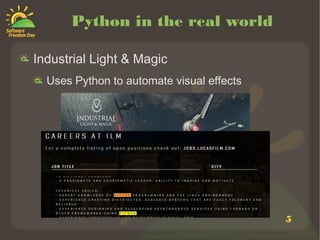
Python in the real world
Industrial Light & Magic
Uses Python to automate visual effects
6
Python in the real world
Uses Python for their desktop application
Python automates the synchronization and file
sending over the internet to Dropbox’s cloud
storage servers
7
Python in the real world
Django web framework is built using Python
Notable users of Django are some of the
biggest websites today
8
Python in the real world
Blender, a 3D Imaging program uses Python
as its main scripting language
9
Python in the real world
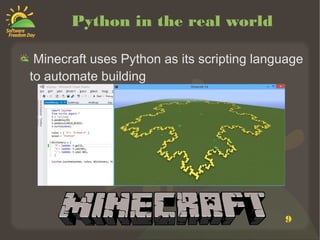
Minecraft uses Python as its scripting language
to automate building
10
Python in the real world
Google
Industrial Light and Magic (Star Wars)
Django web framework (used in Pinterest, Instagram, Mozilla)
Dropbox
Reddit
LibreOffice
Games (Battlefield, EVE Online, Civilization IV, Minecraft, etc.)
...and many more!
11
Why Python?
Simple, like speaking English
It’s FOSS! Lots of resources available
High level programming language
Object-oriented, but not enforced
Portable, works on a lot of different systems
Can be embedded in programs for scripting capabilities
Extensive libraries available
Extensible
12
Getting Started
Go to https://www.python.org and download
the latest version of Python for your OS
13
Installing on Windows
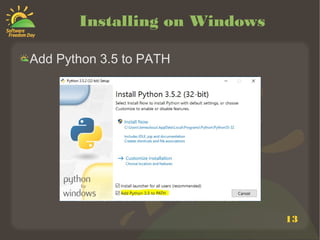
Add Python 3.5 to PATH
14
Running Python
Run the Python interpreter by typing “python”
in the command line
15
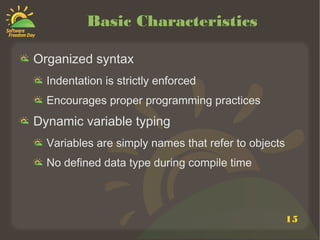
Basic Characteristics
Organized syntax
Indentation is strictly enforced
Encourages proper programming practices
Dynamic variable typing
Variables are simply names that refer to objects
No defined data type during compile time
16
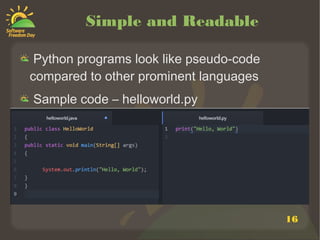
Simple and Readable
Python programs look like pseudo-code
compared to other prominent languages
Sample code – helloworld.py
17
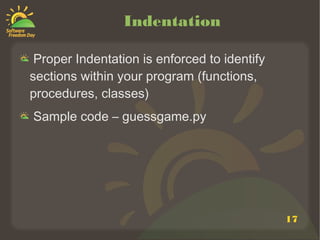
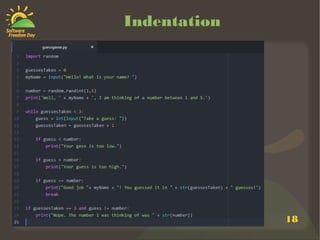
Indentation
Proper Indentation is enforced to identify
sections within your program (functions,
procedures, classes)
Sample code – guessgame.py
18
Indentation
19
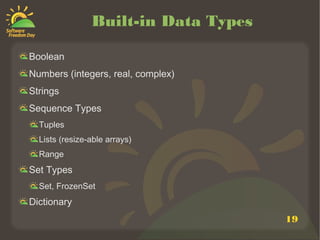
Built-in Data Types
Boolean
Numbers (integers, real, complex)
Strings
Sequence Types
Tuples
Lists (resize-able arrays)
Range
Set Types
Set, FrozenSet
Dictionary
20
Data Types – Tuples
class tuple([iterable])
Immutable sequence of data – once assigned,
elements within cannot be changed
Using a pair of parentheses to denote the empty tuple:
()
Using a trailing comma for a singleton tuple: a, or (a,)
Separating items with commas: a, b, c or (a, b, c)
Using the tuple() built-in: tuple() or tuple(iterable)
21
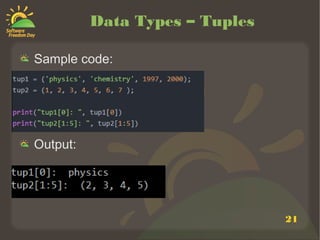
Data Types – Tuples
Sample code:
Output:
22
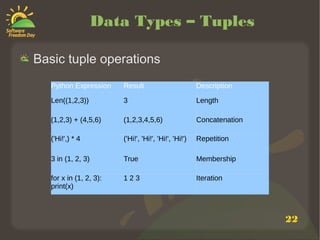
Data Types – Tuples
Python Expression Result Description
Len((1,2,3)) 3 Length
(1,2,3) + (4,5,6) (1,2,3,4,5,6) Concatenation
('Hi!',) * 4 ('Hi!', 'Hi!', 'Hi!', 'Hi!') Repetition
3 in (1, 2, 3) True Membership
for x in (1, 2, 3):
print(x)
1 2 3 Iteration
Basic tuple operations
23
Data Types – List
class list([iterable])
Mutable sequence of data – once assigned,
elements within cannot be changed
Using a pair of square brackets to denote the empty
list: []
Using square brackets, separating items with commas:
[a], [a, b, c]
Using a list comprehension: [x for x in iterable]
Using the type constructor: list() or list(iterable)
24
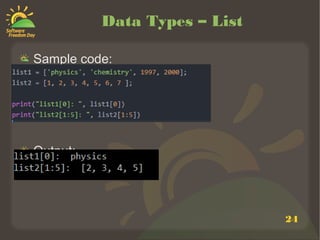
Data Types – List
Sample code:
Output:
25
Data Types – List
Basic list operations
Python Expression Result Description
Len([1,2,3]) 3 Length
[1,2,3] + [4,5,6] [1,2,3,4,5,6] Concatenation
['Hi!',] * 4 ['Hi!', 'Hi!', 'Hi!', 'Hi!'] Repetition
3 in [1, 2, 3] True Membership
for x in [1, 2, 3]:
print(x)
1 2 3 Iteration
26
Built-in Functions
Some built-in functions that work with tuples
and lists
min() - Return the smallest item
max() - Return the largest item
len() - Return the length of the object
sorted() - Sorts an iterable object
27
When to use Tuple and List
A tuple’s contents cannot be changed
individually once assigned
Each element of a list can be dynamically
assigned
28
Data Types – Range
class range(stop)
class range(start, stop[, step])
Represents an immutable sequence of numbers and is commonly
used for looping a specific number of times
start - The value of the start parameter (or 0 if the parameter was not
supplied)
stop - The value of the stop parameter
step - The value of the step parameter (or 1 if the parameter was not
supplied)
It only stores the start, stop and step values, calculating
individual items and subranges as needed
29
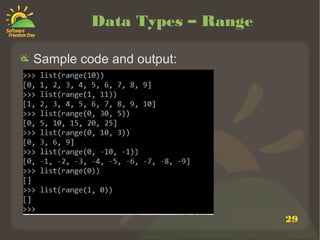
Data Types – Range
Sample code and output:
30
Data Types – Set
class set([iterable])
class frozenset([iterable])
An unordered collection of distinct hashable
(non-dynamic) objects
Common use includes membership testing,
removing duplicates from a sequence,
mathematical operations (union, intersection,
difference, symmetric difference)
31
Data Types – Set
Sample code and output:
32
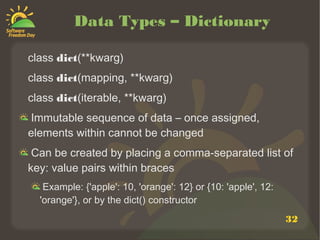
Data Types – Dictionary
class dict(**kwarg)
class dict(mapping, **kwarg)
class dict(iterable, **kwarg)
Immutable sequence of data – once assigned,
elements within cannot be changed
Can be created by placing a comma-separated list of
key: value pairs within braces
Example: {'apple': 10, 'orange': 12} or {10: 'apple', 12:
'orange'}, or by the dict() constructor
33
Data Types – Dictionary
Sample code:
Output:
34
Defining Functions
You can define functions to provide the required functionality. Here are
simple rules to define a function in Python.
Function blocks begin with the keyword def followed by the function name and
parentheses ( ( ) ).
Any input parameters or arguments should be placed within these parentheses.
You can also define parameters inside these parentheses.
The first statement of a function can be an optional statement - the
documentation string of the function or docstring.
The code block within every function starts with a colon (:) and is indented.
The statement return [expression] exits a function. A return statement with no
arguments is the same as return None.
35
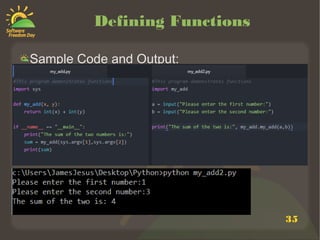
Defining Functions
Sample Code and Output:
36
Object-oriented Programming
Object: A unique instance of a data structure that's defined by its class. An
object comprises both data members (class variables and instance
variables) and methods.
Class: A user-defined prototype for an object that defines a set of attributes
that characterize any object of the class. The attributes are data members
(class variables and instance variables) and methods, accessed via dot
notation.
Class variable: A variable that is shared by all instances of a class. Class
variables are defined within a class but outside any of the class's methods.
Class variables are not used as frequently as instance variables are.
Data member: A class variable or instance variable that holds data
associated with a class and its objects.
37
Object-oriented Programming
Instance variable: A variable that is defined inside a method and
belongs only to the current instance of a class.
Inheritance: The transfer of the characteristics of a class to other
classes that are derived from it.
Instance: An individual object of a certain class. An object obj that
belongs to a class Circle, for example, is an instance of the class
Circle.
Instantiation: The creation of an instance of a class.
Method : A special kind of function that is defined in a class
definition.
38
Object-oriented Programming
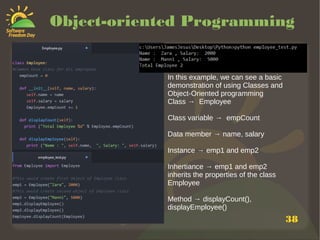
In this example, we can see a basic
demonstration of using Classes and
Object-Oriented programming
Class → Employee
Class variable → empCount
Data member → name, salary
Instance → emp1 and emp2
Inhertiance → emp1 and emp2
inherits the properties of the class
Employee
Method → displayCount(),
displayEmployee()
39
Commonly Used Standard
Modules
time – provides objects and functions for working with Time
calendar - provides objects and functions for working with Dates
os, shutil – contains functions that allow Python to interact with the operating
system and the shell
sys – common utility scripts needed to process command line arguments
re – regular expression tools for advanced string processing
math – gives access to floating point Mathematical functions and operations
urllib – access internet and processing internet protocols
Smtplib – sending email
40
Graphical Interfaces
41
Notable Third-party Modules
42
Tools

James Jesus Bermas on Crash Course on Python

  • 1.
  • 2.
  • 3.
    3 What is Python? Createdby Guido Van Rossum as a successor to the ABC programming language Conceived in 1980, started development in 1989, v1.0 out in 1994 Name is derived from Monty Python’s Flying Circus
  • 4.
    4 Python in thereal world Uses millions of lines of Python code for ad management to build automation Employs the creator of Python himself
  • 5.
    5 Python in thereal world Industrial Light & Magic Uses Python to automate visual effects
  • 6.
    6 Python in thereal world Uses Python for their desktop application Python automates the synchronization and file sending over the internet to Dropbox’s cloud storage servers
  • 7.
    7 Python in thereal world Django web framework is built using Python Notable users of Django are some of the biggest websites today
  • 8.
    8 Python in thereal world Blender, a 3D Imaging program uses Python as its main scripting language
  • 9.
    9 Python in thereal world Minecraft uses Python as its scripting language to automate building
  • 10.
    10 Python in thereal world Google Industrial Light and Magic (Star Wars) Django web framework (used in Pinterest, Instagram, Mozilla) Dropbox Reddit LibreOffice Games (Battlefield, EVE Online, Civilization IV, Minecraft, etc.) ...and many more!
  • 11.
    11 Why Python? Simple, likespeaking English It’s FOSS! Lots of resources available High level programming language Object-oriented, but not enforced Portable, works on a lot of different systems Can be embedded in programs for scripting capabilities Extensive libraries available Extensible
  • 12.
    12 Getting Started Go tohttps://www.python.org and download the latest version of Python for your OS
  • 13.
    13 Installing on Windows AddPython 3.5 to PATH
  • 14.
    14 Running Python Run thePython interpreter by typing “python” in the command line
  • 15.
    15 Basic Characteristics Organized syntax Indentationis strictly enforced Encourages proper programming practices Dynamic variable typing Variables are simply names that refer to objects No defined data type during compile time
  • 16.
    16 Simple and Readable Pythonprograms look like pseudo-code compared to other prominent languages Sample code – helloworld.py
  • 17.
    17 Indentation Proper Indentation isenforced to identify sections within your program (functions, procedures, classes) Sample code – guessgame.py
  • 18.
  • 19.
    19 Built-in Data Types Boolean Numbers(integers, real, complex) Strings Sequence Types Tuples Lists (resize-able arrays) Range Set Types Set, FrozenSet Dictionary
  • 20.
    20 Data Types –Tuples class tuple([iterable]) Immutable sequence of data – once assigned, elements within cannot be changed Using a pair of parentheses to denote the empty tuple: () Using a trailing comma for a singleton tuple: a, or (a,) Separating items with commas: a, b, c or (a, b, c) Using the tuple() built-in: tuple() or tuple(iterable)
  • 21.
    21 Data Types –Tuples Sample code: Output:
  • 22.
    22 Data Types –Tuples Python Expression Result Description Len((1,2,3)) 3 Length (1,2,3) + (4,5,6) (1,2,3,4,5,6) Concatenation ('Hi!',) * 4 ('Hi!', 'Hi!', 'Hi!', 'Hi!') Repetition 3 in (1, 2, 3) True Membership for x in (1, 2, 3): print(x) 1 2 3 Iteration Basic tuple operations
  • 23.
    23 Data Types –List class list([iterable]) Mutable sequence of data – once assigned, elements within cannot be changed Using a pair of square brackets to denote the empty list: [] Using square brackets, separating items with commas: [a], [a, b, c] Using a list comprehension: [x for x in iterable] Using the type constructor: list() or list(iterable)
  • 24.
    24 Data Types –List Sample code: Output:
  • 25.
    25 Data Types –List Basic list operations Python Expression Result Description Len([1,2,3]) 3 Length [1,2,3] + [4,5,6] [1,2,3,4,5,6] Concatenation ['Hi!',] * 4 ['Hi!', 'Hi!', 'Hi!', 'Hi!'] Repetition 3 in [1, 2, 3] True Membership for x in [1, 2, 3]: print(x) 1 2 3 Iteration
  • 26.
    26 Built-in Functions Some built-infunctions that work with tuples and lists min() - Return the smallest item max() - Return the largest item len() - Return the length of the object sorted() - Sorts an iterable object
  • 27.
    27 When to useTuple and List A tuple’s contents cannot be changed individually once assigned Each element of a list can be dynamically assigned
  • 28.
    28 Data Types –Range class range(stop) class range(start, stop[, step]) Represents an immutable sequence of numbers and is commonly used for looping a specific number of times start - The value of the start parameter (or 0 if the parameter was not supplied) stop - The value of the stop parameter step - The value of the step parameter (or 1 if the parameter was not supplied) It only stores the start, stop and step values, calculating individual items and subranges as needed
  • 29.
    29 Data Types –Range Sample code and output:
  • 30.
    30 Data Types –Set class set([iterable]) class frozenset([iterable]) An unordered collection of distinct hashable (non-dynamic) objects Common use includes membership testing, removing duplicates from a sequence, mathematical operations (union, intersection, difference, symmetric difference)
  • 31.
    31 Data Types –Set Sample code and output:
  • 32.
    32 Data Types –Dictionary class dict(**kwarg) class dict(mapping, **kwarg) class dict(iterable, **kwarg) Immutable sequence of data – once assigned, elements within cannot be changed Can be created by placing a comma-separated list of key: value pairs within braces Example: {'apple': 10, 'orange': 12} or {10: 'apple', 12: 'orange'}, or by the dict() constructor
  • 33.
    33 Data Types –Dictionary Sample code: Output:
  • 34.
    34 Defining Functions You candefine functions to provide the required functionality. Here are simple rules to define a function in Python. Function blocks begin with the keyword def followed by the function name and parentheses ( ( ) ). Any input parameters or arguments should be placed within these parentheses. You can also define parameters inside these parentheses. The first statement of a function can be an optional statement - the documentation string of the function or docstring. The code block within every function starts with a colon (:) and is indented. The statement return [expression] exits a function. A return statement with no arguments is the same as return None.
  • 35.
  • 36.
    36 Object-oriented Programming Object: Aunique instance of a data structure that's defined by its class. An object comprises both data members (class variables and instance variables) and methods. Class: A user-defined prototype for an object that defines a set of attributes that characterize any object of the class. The attributes are data members (class variables and instance variables) and methods, accessed via dot notation. Class variable: A variable that is shared by all instances of a class. Class variables are defined within a class but outside any of the class's methods. Class variables are not used as frequently as instance variables are. Data member: A class variable or instance variable that holds data associated with a class and its objects.
  • 37.
    37 Object-oriented Programming Instance variable:A variable that is defined inside a method and belongs only to the current instance of a class. Inheritance: The transfer of the characteristics of a class to other classes that are derived from it. Instance: An individual object of a certain class. An object obj that belongs to a class Circle, for example, is an instance of the class Circle. Instantiation: The creation of an instance of a class. Method : A special kind of function that is defined in a class definition.
  • 38.
    38 Object-oriented Programming In thisexample, we can see a basic demonstration of using Classes and Object-Oriented programming Class → Employee Class variable → empCount Data member → name, salary Instance → emp1 and emp2 Inhertiance → emp1 and emp2 inherits the properties of the class Employee Method → displayCount(), displayEmployee()
  • 39.
    39 Commonly Used Standard Modules time– provides objects and functions for working with Time calendar - provides objects and functions for working with Dates os, shutil – contains functions that allow Python to interact with the operating system and the shell sys – common utility scripts needed to process command line arguments re – regular expression tools for advanced string processing math – gives access to floating point Mathematical functions and operations urllib – access internet and processing internet protocols Smtplib – sending email
  • 40.
  • 41.
  • 42.

Editor's Notes

  • #3 Let's agree of what it means, or at least convey a general consensus