re-think!
           Click to edit Master title style
 FuturetoAccess subtitle style
    Click edit Master to Finance


31/07/12                                      1
Background
• The research aimed to gain insight and
  understanding into the challenges faced not
  only by the SME sector but also by the key
  suppliers of finance to that community,
  specifically the Banking sector and Business
  Angels.
• The report captures the perceptions and
  experiences of these three groups.
Data capture
• Mixed methods approach
• Major contribution made through the deep
  rich qualitative data obtained
• Banks: 11 interviews with directors/senior
  managers plus questionnaire of RMs (n=51)
• BAs: 12 interviews
• SMEs: focus group and questionnaire (n=119)
• Funding difficulties for SMEs have been the
  subject of research and debate since the first
  use of the term “equity gap” in the Macmillan
  Committee on Finance and Industry Report,
  1931
Sources of finance
• Almost 3/4 of SMEs were unable to raise the required
  amounts of capital from their preferred or alternative
  sources of finance ‘forced stagnation’
• 1/3 lack knowledge of the suitability of various funding
  providers, which may possibly indicate a demand-side
  reason underlying their inability to raise capital.
• 1/3 stated they were unaware of what funders are
  looking for in a funding proposal.
• The fundraising process has become more cumbersome
  and is expected to remain difficult in the future.
Perceived change in attitude

“….I find this, the word ‘credit team’ appears a through an
                                       “They went
 bit more now, before you used extensive cost-cutting exercise,
                                   to talk to your
relationship manager and they’d you yes or no might have
                                     say know, they
 and now you don’t really know if wiped £20,000 off the cost
                                     you’re going
to be approved for something or not because it you would go
                                    base and then
 goes away to ‘the credit team’ and theyand wipe that out
                                        out come
                                      overnight by doubling the
        back with lots more questions….”
                                       interest margin on the
                                    overdraft facility and putting
                                     up the money transmission
                                         fees and all this…..”
Difficulties in raising finance
• “Banks are not helpful.”
• “The bank … did not understand our business.”
• “The bank wanted a house as security for £25K.”
• “Each time we have approached the bank they have quoted
  different reasons for not lending. They are inconsistent.”
• “Banks… reluctant to loan.”
• “Banks are not lending - they are pretending they are, but
  can only substantiate this by turning overdrafts into loans, so
  they look as if they are lending to business… It's actually a
  SCANDAL.”
• Emphasis on supply-side constraints and on
  bank financing (or lack of it) to detriment of
  other potentially suitable types of investment
  finance
• 51% are confident that they know what the
  different funders require from them when they
  apply for finance but 30% are not confident
  about this.
• Only 15% (14 out of 95 respondents) think
  that the range of different financial products
  for business has improved in recent years
• more than half of SMEs believe fundraising
  has become more problematic over the years.
• Low confidence in the country’s ability to
  improve access to finance for their types of
  business
Business support
• 42% would like further support or training to
  develop ability to obtain finance
• Almost 2/3 of participants thought that finding
  the right business support involved having to
  contact too many different organisations
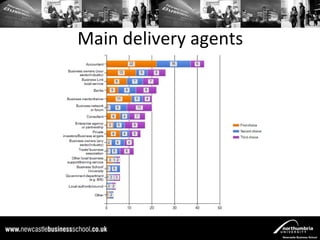
• SMEs are most confident in accountants, other
  businesses in their own industry and
  mentors/trainers to deliver support services.
Main delivery agents
Guidance and support

    “…having somebody who could pull my
application together for me, who knew exactly
                           “Awareness and communication….
 what the funders were asking, who could tell
me that… ‘your business plan saysif there was one place which I
                           think X - we’re not
 changing the business plan but you need to what
                           know is probably
highlight why’ and that’s what they’re lookingmeant to be –
                           [organisation] are
                           but one place could pull all that
   for and that was absolutely invaluable.”
                           together and communicate it out
                           regularly to the business
                           community, I think that would be a
                           massive difference.”
Other comments
• Poor and very complex sources of information.
• SMEs do not have the time to search for information, to
  attend many sessions, write bids or to keep updated with
  websites etc.
• SMEs need to be part of a network otherwise it is difficult to
  get access to any support.
• There are too many consultants, mentors, coaches, etc. and
  the support provider area is highly confusing.
• Make it easier.
• Simplify it, for God’s sake, simplify it!!!
• One response was simply ‘Help’
Decision making
• Demand from the SME sector is low. Whether this is
  influenced by the economy or by their perception of banks’
  attitudes to lending is difficult to establish.
• Great emphasis is placed on the importance of relationship
  banking
• Banks are paying greater attention to the detail of business
  proposals.
   – Strengthened by input from professionals such as accountants
   – They are seeing increasing sophistication in the proposals being
     received
• Many of the banks have adopted new strategies in order to
  support SMEs in the current economic climate.
   – some deliver workshops, employ role models and
      ambassadors
• The banks seek to differentiate themselves on the basis of
  quality of service
• Many of the banks were hopeful but also concerned for the
  future of SME finance as any improvement in the economic
  situation could result in an increase in base rates placing
  additional stress onto businesses
Appetite
• “Some sectors have an additional layer of decision-making
  within the credit process.”
• “Limited appetite for lending in certain sectors.”
• “Caution is [applied to] certain sectors.”
• “More defined policies and guidelines around many sectors.”
• “We became more conservative.”
Perceptions

   “Yeah, it certainly changed from a demand
point of view, undoubtedly. A lot of what you'll
 read about is the banks not lending. Certainly
  where we are, that's not our major “The issues the banks have is
                                       issue, our
   major issue is that a lot of customers don't key income stream is
                                     that– our
want to borrow, customers have used out of lending money and
                                         this as an
  opportunity to, I think, redress their balance lending the money
                                       we’re not
      sheets, deleverage where they that we anticipated because
                                       can.”
                                      the market isn’t hungry for it.”
Perceptions

“There is a re-pricing exercise that every bank is
going through at this point in time because our
raw material cost has changed. So the price we
 pay for the funds on the wholesale market has
  gone from 60 basis points to - if it’s five year a re-pricing exercise
                                          “There is
money - to somewhere around about 280 basis  that every bank is going
    points. The conversations we havethrough at this point in time
                                            with
 customers have to be very sensitive to the fact raw material cost
                                         because our
 that they’re not expecting that and they don’t changed.”
                                                  has
                  understand….”
• “Customers expect Bank support which is right. Occasionally
  they do not recognise though when a deal is equity not debt.”
• “I believe that many customers have unreasonable pricing
  expectations in the current market, and they don't understand
  the key levers that influence bank pricing.”
• “I think there is an over expectation from clients as to both
  the availability, and cost, of Bank funding…”
• “some customers …..think current pricing is unjustified given
  that base rate is so low without considering that the cost of
  borrowing is increasing due to cost of funds, capital and risk
  and stricter regulations imposed by the Government and
  FSA.”
Reason for rejection
• “Bad business plan.”
• “Lack of proven ability to service debt from historic financial
  information.”
• “We have a strong client base and start from a position of
  looking to help/assist. New to Bank proposals are in the main
  very poorly packaged/presented and businesses are not doing
  all they can to present case in a detailed and positive manner
  - first impressions!!”
• “Lack of detailed information, did not qualify for product (for
  whatever reason), poor quality financials, previous poor track
  record and lack of appetite.”
Business support
• The use of role models or ambassadors are seen to
  inject increased confidence into local businesses and
  provide additional knowledge through workshops
   – “Some are well attended, some are not … and actually
     they're attended by loads of business introducers and not
     actually down to the customers that we want to be there.”
   – “If the reason for decline is that there's too much debt,
     there's no contribution, you've looked at the - at all the
     alternatives then you'll talk to them about Business Angels,
     we don't just kind of say no, go away, you're always look
     at how you can help the business.”
The future
• “It’s all down to the level of demand and the extent to which
  an SME will put together a well thought through, well
  constructed proposal.”
• “SMEs need to up their game/pay for right professional input
  and guidance is how they go about asking for and justifying
  proposals.”
• “The supply is available if the demand is viable.”
• “I'm positive ....everyone recognises the importance of the
  SME sector in terms of employment and the SMEs growing
  and providing wealth for the country, so we will continue to
  support the SME sector undoubtedly, there's political pressure
  to do so”.
Motivations
• Business Angels in the North East are not
  purely interested in financial gain but instead
  have a strong interest in supporting others
  and being involved in something that is of
  personal interest to them.
• There seems to be a lot of money available for
  investment which is currently not being used.
Criteria
• The quality and personality of the people
  running the investee business.
• The specific business concept relating to their
  individual investment preferences and
• the quality and ‘understandability’ of the
  business plan, as well as the management’s
  ability to present and defend it.
Person
• “Whether we thought we could work with him - we were
  making a judgement on him and his team.”
• “And I invested with them because the individual/individuals
  were credible, believable and I didn’t get the whiff of bullshit
  when they were presenting.”
• “It’s about the personal chemistry and the feeling of trust and
  respect of other people involved, the person you are working
  with…”
• Unless the chemistry is right, unless you feel you can work
  with them, the investment rarely proceeds.”
Plan
• “The general quality of business plans is often poor.
  ….Business plans put together based on advice from
  accounting and law firms tend to be put together as
  funding documents. They don’t always really represent a
  true business plan.”
• “Carefully thought through business plans, properly
  stress-tested, are very welcome.”
• Entrepreneurs must “live and breathe the business plan”
• Substantial dissatisfaction with the quality of the
  opportunities presented.
Complexity
• The financial environment in the North East is viewed as
  highly complex, confusing and dynamic
• “I think it’s a more general thing about the North East of
  England. We’ve had SO many initiatives in this area to try and
  provide finance for growing businesses but I think people are
  getting a bit lost as to what is going on.
• “I find the investment environment a confusing one. There are
  a lot of organisations out there purporting to support
  businesses, new businesses, and business start-ups. Frankly, I
  don’t know what the hell they all do. You know there is a lot
  of government this and that, Business Link and da-der da-der
  da-der da-der. And I just find the whole thing very confusing .

Jackie nea2 f presentation_3rd july 2012

  • 1.
    re-think! Click to edit Master title style FuturetoAccess subtitle style Click edit Master to Finance 31/07/12 1
  • 2.
    Background • The researchaimed to gain insight and understanding into the challenges faced not only by the SME sector but also by the key suppliers of finance to that community, specifically the Banking sector and Business Angels. • The report captures the perceptions and experiences of these three groups.
  • 3.
    Data capture • Mixedmethods approach • Major contribution made through the deep rich qualitative data obtained • Banks: 11 interviews with directors/senior managers plus questionnaire of RMs (n=51) • BAs: 12 interviews • SMEs: focus group and questionnaire (n=119)
  • 4.
    • Funding difficultiesfor SMEs have been the subject of research and debate since the first use of the term “equity gap” in the Macmillan Committee on Finance and Industry Report, 1931
  • 6.
    Sources of finance •Almost 3/4 of SMEs were unable to raise the required amounts of capital from their preferred or alternative sources of finance ‘forced stagnation’ • 1/3 lack knowledge of the suitability of various funding providers, which may possibly indicate a demand-side reason underlying their inability to raise capital. • 1/3 stated they were unaware of what funders are looking for in a funding proposal. • The fundraising process has become more cumbersome and is expected to remain difficult in the future.
  • 7.
    Perceived change inattitude “….I find this, the word ‘credit team’ appears a through an “They went bit more now, before you used extensive cost-cutting exercise, to talk to your relationship manager and they’d you yes or no might have say know, they and now you don’t really know if wiped £20,000 off the cost you’re going to be approved for something or not because it you would go base and then goes away to ‘the credit team’ and theyand wipe that out out come overnight by doubling the back with lots more questions….” interest margin on the overdraft facility and putting up the money transmission fees and all this…..”
  • 8.
    Difficulties in raisingfinance • “Banks are not helpful.” • “The bank … did not understand our business.” • “The bank wanted a house as security for £25K.” • “Each time we have approached the bank they have quoted different reasons for not lending. They are inconsistent.” • “Banks… reluctant to loan.” • “Banks are not lending - they are pretending they are, but can only substantiate this by turning overdrafts into loans, so they look as if they are lending to business… It's actually a SCANDAL.”
  • 9.
    • Emphasis onsupply-side constraints and on bank financing (or lack of it) to detriment of other potentially suitable types of investment finance • 51% are confident that they know what the different funders require from them when they apply for finance but 30% are not confident about this.
  • 10.
    • Only 15%(14 out of 95 respondents) think that the range of different financial products for business has improved in recent years • more than half of SMEs believe fundraising has become more problematic over the years. • Low confidence in the country’s ability to improve access to finance for their types of business
  • 11.
    Business support • 42%would like further support or training to develop ability to obtain finance • Almost 2/3 of participants thought that finding the right business support involved having to contact too many different organisations • SMEs are most confident in accountants, other businesses in their own industry and mentors/trainers to deliver support services.
  • 12.
  • 13.
    Guidance and support “…having somebody who could pull my application together for me, who knew exactly “Awareness and communication…. what the funders were asking, who could tell me that… ‘your business plan saysif there was one place which I think X - we’re not changing the business plan but you need to what know is probably highlight why’ and that’s what they’re lookingmeant to be – [organisation] are but one place could pull all that for and that was absolutely invaluable.” together and communicate it out regularly to the business community, I think that would be a massive difference.”
  • 14.
    Other comments • Poorand very complex sources of information. • SMEs do not have the time to search for information, to attend many sessions, write bids or to keep updated with websites etc. • SMEs need to be part of a network otherwise it is difficult to get access to any support. • There are too many consultants, mentors, coaches, etc. and the support provider area is highly confusing. • Make it easier. • Simplify it, for God’s sake, simplify it!!! • One response was simply ‘Help’
  • 16.
    Decision making • Demandfrom the SME sector is low. Whether this is influenced by the economy or by their perception of banks’ attitudes to lending is difficult to establish. • Great emphasis is placed on the importance of relationship banking • Banks are paying greater attention to the detail of business proposals. – Strengthened by input from professionals such as accountants – They are seeing increasing sophistication in the proposals being received
  • 17.
    • Many ofthe banks have adopted new strategies in order to support SMEs in the current economic climate. – some deliver workshops, employ role models and ambassadors • The banks seek to differentiate themselves on the basis of quality of service • Many of the banks were hopeful but also concerned for the future of SME finance as any improvement in the economic situation could result in an increase in base rates placing additional stress onto businesses
  • 18.
    Appetite • “Some sectorshave an additional layer of decision-making within the credit process.” • “Limited appetite for lending in certain sectors.” • “Caution is [applied to] certain sectors.” • “More defined policies and guidelines around many sectors.” • “We became more conservative.”
  • 19.
    Perceptions “Yeah, it certainly changed from a demand point of view, undoubtedly. A lot of what you'll read about is the banks not lending. Certainly where we are, that's not our major “The issues the banks have is issue, our major issue is that a lot of customers don't key income stream is that– our want to borrow, customers have used out of lending money and this as an opportunity to, I think, redress their balance lending the money we’re not sheets, deleverage where they that we anticipated because can.” the market isn’t hungry for it.”
  • 20.
    Perceptions “There is are-pricing exercise that every bank is going through at this point in time because our raw material cost has changed. So the price we pay for the funds on the wholesale market has gone from 60 basis points to - if it’s five year a re-pricing exercise “There is money - to somewhere around about 280 basis that every bank is going points. The conversations we havethrough at this point in time with customers have to be very sensitive to the fact raw material cost because our that they’re not expecting that and they don’t changed.” has understand….”
  • 21.
    • “Customers expectBank support which is right. Occasionally they do not recognise though when a deal is equity not debt.” • “I believe that many customers have unreasonable pricing expectations in the current market, and they don't understand the key levers that influence bank pricing.” • “I think there is an over expectation from clients as to both the availability, and cost, of Bank funding…” • “some customers …..think current pricing is unjustified given that base rate is so low without considering that the cost of borrowing is increasing due to cost of funds, capital and risk and stricter regulations imposed by the Government and FSA.”
  • 22.
    Reason for rejection •“Bad business plan.” • “Lack of proven ability to service debt from historic financial information.” • “We have a strong client base and start from a position of looking to help/assist. New to Bank proposals are in the main very poorly packaged/presented and businesses are not doing all they can to present case in a detailed and positive manner - first impressions!!” • “Lack of detailed information, did not qualify for product (for whatever reason), poor quality financials, previous poor track record and lack of appetite.”
  • 23.
    Business support • Theuse of role models or ambassadors are seen to inject increased confidence into local businesses and provide additional knowledge through workshops – “Some are well attended, some are not … and actually they're attended by loads of business introducers and not actually down to the customers that we want to be there.” – “If the reason for decline is that there's too much debt, there's no contribution, you've looked at the - at all the alternatives then you'll talk to them about Business Angels, we don't just kind of say no, go away, you're always look at how you can help the business.”
  • 24.
    The future • “It’sall down to the level of demand and the extent to which an SME will put together a well thought through, well constructed proposal.” • “SMEs need to up their game/pay for right professional input and guidance is how they go about asking for and justifying proposals.” • “The supply is available if the demand is viable.” • “I'm positive ....everyone recognises the importance of the SME sector in terms of employment and the SMEs growing and providing wealth for the country, so we will continue to support the SME sector undoubtedly, there's political pressure to do so”.
  • 26.
    Motivations • Business Angelsin the North East are not purely interested in financial gain but instead have a strong interest in supporting others and being involved in something that is of personal interest to them. • There seems to be a lot of money available for investment which is currently not being used.
  • 27.
    Criteria • The qualityand personality of the people running the investee business. • The specific business concept relating to their individual investment preferences and • the quality and ‘understandability’ of the business plan, as well as the management’s ability to present and defend it.
  • 28.
    Person • “Whether wethought we could work with him - we were making a judgement on him and his team.” • “And I invested with them because the individual/individuals were credible, believable and I didn’t get the whiff of bullshit when they were presenting.” • “It’s about the personal chemistry and the feeling of trust and respect of other people involved, the person you are working with…” • Unless the chemistry is right, unless you feel you can work with them, the investment rarely proceeds.”
  • 29.
    Plan • “The generalquality of business plans is often poor. ….Business plans put together based on advice from accounting and law firms tend to be put together as funding documents. They don’t always really represent a true business plan.” • “Carefully thought through business plans, properly stress-tested, are very welcome.” • Entrepreneurs must “live and breathe the business plan” • Substantial dissatisfaction with the quality of the opportunities presented.
  • 30.
    Complexity • The financialenvironment in the North East is viewed as highly complex, confusing and dynamic • “I think it’s a more general thing about the North East of England. We’ve had SO many initiatives in this area to try and provide finance for growing businesses but I think people are getting a bit lost as to what is going on. • “I find the investment environment a confusing one. There are a lot of organisations out there purporting to support businesses, new businesses, and business start-ups. Frankly, I don’t know what the hell they all do. You know there is a lot of government this and that, Business Link and da-der da-der da-der da-der. And I just find the whole thing very confusing .