Download to read offline
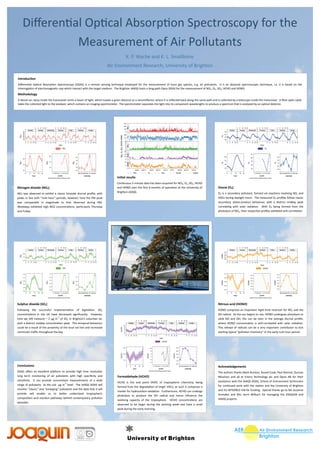

This document discusses the use of Differential Optical Absorption Spectroscopy (DOAS) to measure air pollutants at the University of Brighton's Joint Air Quality and Atmospheric Study (JAAQS) station. DOAS works by emitting light that travels through the air to a retroreflector and back, which is then analyzed to determine concentrations of pollutants like NO2, O3, SO2, HCHO and HONO at the 5-minute level. Initial 6 months of data show patterns like NO2 peaks during rush hours, O3 forming during the day, and SO2 decreasing but still around 2 μg/m3 possibly from local traffic. DOAS can accurately monitor classic and emerging


