J. M. Synge & the Irish
Theatre
Emily Roberts
History of Theatre II
February 21, 2012
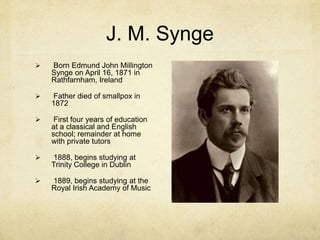
J. M. Synge
   Born Edmund John Millington
    Synge on April 16, 1871 in
    Rathfarnham, Ireland

   Father died of smallpox in
    1872

    First four years of education
    at a classical and English
    school; remainder at home
    with private tutors

   1888, begins studying at
    Trinity College in Dublin

   1889, begins studying at the
    Royal Irish Academy of Music
1892, graduates
from Trinity with
Second Class
Honours
1895, travels to
France to study at
the Sorbonne
1897, briefly
member of
L’AssociationIrland
aise (Irish League)
in Paris
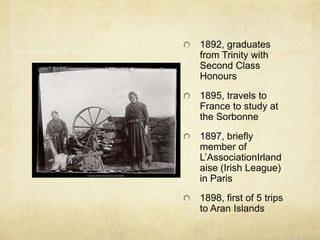
1898, first of 5 trips
to Aran Islands
1902, returns to Dublin    1907, first production
and joins Irish National   of Playboy of the
Theatre Society            Western World

1903, The Shadow of        Synge dies on March
the Glen performed in      24, 1909 in Dublin
Dublin
                           The Tinker’s Wedding
1904                       first produced at His
   First performance of    Majesty’s Theatre in
   Riders to the Sea       London in 1909
   The Shadow of the
   Glen published          1910, Deirdre of the
                           Sorrows first produced
   Abbey Theatre
   founded
                           at Abbey Theatre
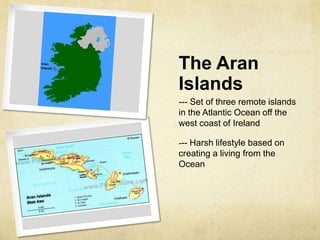
The Aran
Islands
--- Set of three remote islands
in the Atlantic Ocean off the
west coast of Ireland

--- Harsh lifestyle based on
creating a living from the
Ocean
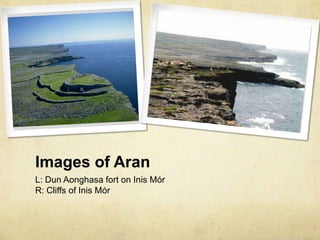
Images of Aran
L: Dun Aonghasa fort on Inis Mór
R: Cliffs of Inis Mór
Works Cited
“Aran Islands History: The Man of Aran Film.”
The Aran Islands Complete Travel Guide. 17
Feb. 2012. <http://www.aranislands.ie/Inis-
Oiir/aran-islands-history/the-man-of-aran-
film_48.html>.

Gerstenberger, Donna. John Millington
Synge, Rev. Ed. Kinley E. Roby, Ed. Boston:
Twayne Publishers, 1990.

Jacobus, Lee A. “John Millington Synge.” The
Bedford Introduction to Drama, Sixth Ed.
Boston: Bedford/St. Martin’s, 2009. Pp. 884-885.
Pictures
Slide 2:
http://www.goodreads.com/author/show/4332478.J_
M_Synge

Slide 3:
http://www.advertiser.ie/galway/article/39578/jm-
synges-photographs-on-show-on-inis-orr

Slide 5: http://en.wikipedia.org/wiki/Aran_Islands;
http://www.planetware.com/map/aran-islands-map-irl-
aranisls.htm

Slide 6:
http://www.galway.net/galwayguide/visit/aran/about/;
http://www.bamjam.net/Ireland/Aran.html

J. M. Synge

  • 1.
    J. M. Synge& the Irish Theatre Emily Roberts History of Theatre II February 21, 2012
  • 2.
    J. M. Synge  Born Edmund John Millington Synge on April 16, 1871 in Rathfarnham, Ireland  Father died of smallpox in 1872  First four years of education at a classical and English school; remainder at home with private tutors  1888, begins studying at Trinity College in Dublin  1889, begins studying at the Royal Irish Academy of Music
  • 3.
    1892, graduates from Trinitywith Second Class Honours 1895, travels to France to study at the Sorbonne 1897, briefly member of L’AssociationIrland aise (Irish League) in Paris 1898, first of 5 trips to Aran Islands
  • 4.
    1902, returns toDublin 1907, first production and joins Irish National of Playboy of the Theatre Society Western World 1903, The Shadow of Synge dies on March the Glen performed in 24, 1909 in Dublin Dublin The Tinker’s Wedding 1904 first produced at His First performance of Majesty’s Theatre in Riders to the Sea London in 1909 The Shadow of the Glen published 1910, Deirdre of the Sorrows first produced Abbey Theatre founded at Abbey Theatre
  • 5.
    The Aran Islands --- Setof three remote islands in the Atlantic Ocean off the west coast of Ireland --- Harsh lifestyle based on creating a living from the Ocean
  • 6.
    Images of Aran L:Dun Aonghasa fort on Inis Mór R: Cliffs of Inis Mór
  • 7.
    Works Cited “Aran IslandsHistory: The Man of Aran Film.” The Aran Islands Complete Travel Guide. 17 Feb. 2012. <http://www.aranislands.ie/Inis- Oiir/aran-islands-history/the-man-of-aran- film_48.html>. Gerstenberger, Donna. John Millington Synge, Rev. Ed. Kinley E. Roby, Ed. Boston: Twayne Publishers, 1990. Jacobus, Lee A. “John Millington Synge.” The Bedford Introduction to Drama, Sixth Ed. Boston: Bedford/St. Martin’s, 2009. Pp. 884-885.
  • 8.
    Pictures Slide 2: http://www.goodreads.com/author/show/4332478.J_ M_Synge Slide 3: http://www.advertiser.ie/galway/article/39578/jm- synges-photographs-on-show-on-inis-orr Slide5: http://en.wikipedia.org/wiki/Aran_Islands; http://www.planetware.com/map/aran-islands-map-irl- aranisls.htm Slide 6: http://www.galway.net/galwayguide/visit/aran/about/; http://www.bamjam.net/Ireland/Aran.html

Editor's Notes

  • #3 Prior to enrolling at Trinity (1885-1888) discovered Darwin and renounced Christianity. Also studied violin.Member of student orchestra at the Academy; originally planned to be a professional musician.
  • #4 Second Class Honours – lowest degree student can receive and still go on to postgraduate studyWon college prizes for Hebrew and Irish.1893, travels to Germany to study music, but gives up idea of a career in 1894Studies foreign languages in France, as well as modern French literature, medieval literature, and comparative phonetics.1897, also becomes interested in Brittany and Breton folklore and has 1st operation for Hodgkin’s disease.
  • #5 1905, becomes member of Abbey Theatre Board of Directors.Riders to the Sea and The Well of the Saints first published.Playboy caused riots in Dublin because of its “indecent” language and its honest portrayal of country people. Published later that year, along with The Aran Islands (can be found on Project Gutenberg).Mother dies in 19081909, Poems and Translations published.1st edition of collected works printed in 1910
  • #6 “In 1934 Robert Flaherty launched the ‘ Man of Aran’ film. Filmed on location in Inis Mór it describes the life of the islands and in particular shows the struggle inherent in earning a living from the Atlantic Ocean. When the film was released it was hailed as one of the greatest films ever made and triggered a new wave of interest in the islands among the Irish, European and American public. Islanders generally hold that it marked the start of the modern tourism era.”