Academic Work (Writing)
Accurate Referencing
to
Avoid Plagiarism
Dr Jennifer Loke
j.loke@hull.ac.uk
Aims of the session
The aims of this session are:
For students to consolidate their
understanding of how to reference written
work within Faculty guidelines
To enable students to perfect good
referencing techniques which is a
requirement for credible academic work
Learning Outcomes
At the end of this session, you will be able to:
understand the requirements in academic work and
the purpose of referencing;
identify Harvard referencing style and be aware that
there are other referencing styles;
include appropriate information in an in-text citation
and also within a reference list, based on Harvard
referencing style;
identify where references are needed in a piece of
work to avoid plagiarism and;
construct a list of references using Harvard
referencing style, which are in accordance with the
requirements of the Faculty of Health & Social Care
©Loke 2014
Academic Work (Writing)
Preserving Integrity & Achieving credibility
Requires work to be presented in one’s own
writing
Involves summarizing, synthesizing, analysing or
evaluating other people’s arguments.
Involves changing more than just one odd word or
phrase from one’s source material
It is acceptable to repeat some words or phrases,
particularly where these are part of the technical
vocabulary of the discipline
©Loke 2014
The purpose of referencing
To acknowledge others’ ideas in one’s own
work
To avoid allegations of deliberately
attempting to pass off someone else’s work
as one’s own
©Loke 2014
Other important purposes of
referencing
To show that you have explored and UNDERSTOOD the
relevant literature, and have put them in your own words.
To show that your arguments and discussions have gone
through a process of ‘internalising’ the relevant literature.
To help readers identify where you found the material so
they can find it should they wish to do so in order to:
•continue pursuing the arguments you have presented.
•critique your work and expand the knowledge.
©Loke 2014
http://www2.hull.ac.uk/lli/skills-development/referencing.aspx
Harvard referencing
http://libguides.hull.ac.uk/ld.php?content_id=4919233
Reference List: all sources that have been cited in
the text of your work
– Word count issues
– Style for various editions
• Authorship (numbers of authors)
• Sources (Various forms; Primary/Secondary sources)
In-text citation: Citing references in the text of
your work
– Word count issues
– Style
• Authorship (numbers of authors)
• Sources (Various forms; Primary/Secondary sources)
Bibliography list
(text you have read,
but not cited in your
work)
©Loke 2014
Referencing List – Book with two authors
Surname of first author, Initials of first author’s
name(s). & Surname of second author, Initials of
second author’s name(s). (Year). Title of book.
City Published: Publisher.
Baughan, J. & Smith, A. (2009). Caring in Nursing Practice.
Harlow: Pearson.
©Loke 2014
Referencing List – Book chapter with more than 2 authors
Surname of first author, Initials of first author’s name(s). & Surname of second author,
Initials of second author’s name(s) etc. (Year). Title of Chapter. In Editors’ initials. Editors’
Surname. (ed) Book Title. Chapter Number City Published: Publisher, page range/Chapter
number
Loke, J. C. F., Colquhoun, D. Lee, K. W. (2011). Analysing healthcare professional’s
interprofessional learning experiences in asynchronous text-based environment.
In C. F. Macteer. (ed). Distance Education. New York: Nova Science Publishing,
Chapter 1.
Referencing List – Journal paper/article
Surname of first author, Initials of first author’s name(s). &
Surname of second author, Initials of second author’s name(s).
etc (Year). Title of article. Journal Title: Vol(Issue No), page
number.
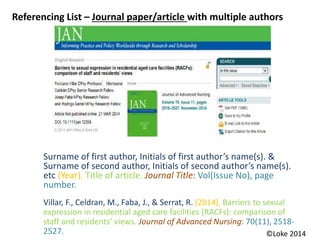
Villar, F., Celdran, M., Faba, J., & Serrat, R. (2014). Barriers to sexual
expression in residential aged care facilities (RACFs): comparison of
staff and residents’ views. Journal of Advanced Nursing: 70(11), 2518-
2527.
Referencing List – Journal paper/article with multiple authors
©Loke 2014
Referencing List – Online Journal paper/article with multiple authors
Bos. E., Alinaghizadeh. H., Saarikoski. M., Kaila. P. (In Press). Factors associated with
student learning processes in primary health care units: A questionnaire study. Nurse
Education Today. Available online:
http://www.sciencedirect.com/science/article/pii/S0260691714003335. [Accessed on
ddmmyy].
Surname of first author, Initials of first author’s name(s). & Surname of second author,
Initials of second author’s name(s). etc (Year). Title of article. Journal Title: Vol(Issue
No), page number.
©Loke 2014
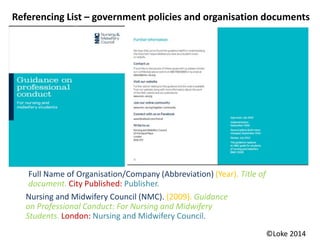
Full Name of Organisation/Company (Abbreviation) (Year). Title of
document. City Published: Publisher.
Nursing and Midwifery Council (NMC). (2009). Guidance
on Professional Conduct: For Nursing and Midwifery
Students. London: Nursing and Midwifery Council.
Referencing List – government policies and organisation documents
©Loke 2014
Reference list
Commence this list at the start of your work
(reading stage)
List them in Alphabetical order (based on first
author/name of organisation).
No numbering or bullet points needed
Space out each reference clearly.
This list is not included in your word count, unless
stated otherwise.
Present this list at the end of your work, forming
the final section of your discussion.
Location of reference list
Cover page – contains information on: 1) module title & number, 2) student number, 2) date of
submission, 3) Full name of academic supervisor
Abstract – this is a brief summary of the work (portfolio/dissertation/thesis), this is not required in
essays
Contents page – list titles of sections and subsections of portfolio/thesis/dissertation, and indicate the
page number; contents page not required in essays
1. Introduction
2. Discussions – should comprise several sections
2.1 Main section 1
2.1.2 Subsection 1
2.1.2 Subsection 2
2.1.3 Subsection 3
2.2 Main Section 2
2.2.2 Subsection 1
2.3 Main Section 3
2.3.1 Subsection 1
2.3.2 Subsection 2
3. Conclusion
References
Tables – reference source(s) as required
Figures – reference source(s) as required
Reference list
©Loke 2014
Example of a reference list
Adapted from:
Loke, J. C. F., Laurenson, M., Lee, K. W. (2014). Embracing a culture in conducting research requires
more than nurses' enthusiasm. Nurse Education Today. 34(1), 132-173.
©Loke 2014
Construct a Reference list for the 5 publications…
©Loke 2014
©Loke 2014
Nursing and Midwifery Council (NMC). (2009). Guidance on Professional Conduct: For Nursing
and Midwifery Students. London: Nursing and Midwifery Council.
Loke, J. C. F., Colquhoun, D. Lee, K. W. (2011). Analysing healthcare
professional’s interprofessional learning experiences in asynchronous text-
based environment. In C. F. MacTeer. (ed). Distance Education. New York:
Nova Science Publishing, Chapter 1.
Bos. E., Alinaghizadeh. H., Saarikoski. M., Kaila. P. (In Press). Factors associated with
student learning processes in primary health care units: A questionnaire study. Nurse
Education Today. Available online:
http://www.sciencedirect.com/science/article/pii/S0260691714003335. [Accessed on
ddmmyy].
References
Baughan, J. & Smith, A. (2009). Caring in Nursing Practice. Harlow: Pearson.
©Loke 2014
Villar, F., Celdran, M., Faba, J., & Serrat, R. (2014). Barriers to sexual expression in residential
aged care facilities (RACFs): comparison of staff and residents’ views. Journal of Advanced
Nursing: 70(11), 2518-2527.
What happens when you have the
same authors with different
publications?
Loke, J. C. F., Colquhoun, D. Lee, K. W. (2011). Analysing
healthcare professional’s interprofessional learning
experiences in asynchronous text-based environment. In C.
F. Macteer. (ed). Distance Education. New York: Nova
Science Publishing, Chapter 1.
Loke, J. C. F., Colquhoun, D., Lee, K. W. (2011). Critical
Discourse Analysis of Interprofessional Online Learning in
Healthcare Education. New York: Nova Science Publishing.
©Loke 2014
Nursing and Midwifery Council (NMC). (2009). Guidance on Professional Conduct: For Nursing
and Midwifery Students. London: Nursing and Midwifery Council.
Loke, J. C. F., Colquhoun, D. Lee, K. W. (2011a). Analysing healthcare professional’s
interprofessional learning experiences in asynchronous text-based environment. In C. F.
MacTeer. (ed). Distance Education. New York: Nova Science Publishing, Chapter 1.
Loke, J. C. F., Colquhoun, D., Lee, K. W. (2011b). Critical Discourse Analysis of
Interprofessional Online Learning in Healthcare Education. New York: Nova Science
Publishing.
Bos. E., Alinaghizadeh. H., Saarikoski. M., Kaila. P. (In Press). Factors associated with
student learning processes in primary health care units: A questionnaire study. Nurse
Education Today. Available online:
http://www.sciencedirect.com/science/article/pii/S0260691714003335. [Accessed on
ddmmyy].
References
Baughan, J. & Smith, A. (2009). Caring in Nursing Practice. Harlow: Pearson.
©Loke 2014
Villar, F., Celdran, M., Faba, J., & Serrat, R. (2014). Barriers to sexual expression in residential
aged care facilities (RACFs): comparison of staff and residents’ views. Journal of Advanced
Nursing: 70(11), 2518-2527.
In-text-citation– Book with two authors
Authors name(s) included in text:
According to Baughan and Smith (2009), caring is an
important nursing practice and that every nurse
should…….
There are many ways how you might include Author’s
name in text:
Baughan and Smith (2009) claimed that…
Baughan and Smith (2009) suggested that that…
Baughan and Smith (2009) pointed out that….., the
authors (Ibid) also highlighted that
Not only have Baughan and Smith (2009) argued for…,
the authors (Ibid) have also advocated that...
©Loke 2014
‘IBID’
Ibid is an abbreviation of the Latin word
“ibidem,” which means “in the same place.”
used in formal writing to indicate that a
reference is from the same source as a
previous reference
©Loke 2014
In-text-citation– Book with two authors
Authors name(s) included in text:
According to Baughan and Smith (2009),
caring is an important nursing practice and
that every nurse should…….
Authors name(s) not included in text:
Caring is an important practice and every
nurse should be able to show compassionate
care (Baughan & Smith, 2009).
In situation when you have more than one
sources, list citations in chronological order:
Caring is an important practice and every
nurse should be able to show compassionate
care (Baughan & Smith, 2009; Loke, 2014).
©Loke 2014
In-text-citation– Book chapter with more than 2 authors
Loke, J. C. F., Colquhoun, D. Lee, K. W. Yeo A. T. M.(2011).
Analysing healthcare professional’s interprofessional
learning experiences in asynchronous text-based
environment. In C. F. MacTeer. (ed). Distance Education.
New York: Nova Science Publishing, Chapter 1.
Authors name(s) included in text:
Loke at el. (2011) were concerned that methodologies of
current research did not fully identify problems associated with
asynchronous text-based learning in…
Authors name(s) not included in text:
It has been highlighted that methodologies of current research work did not fully
identify problems associated with asynchronous text-based learning (Loke et al., 2011).
In situations where you have more than one sources, list citations in chronological
order (as reflected in your reference list:
It has been highlighted that methodologies of current research work did not fully
identify problems associated with asynchronous text-based learning (Loke et al., 2011a;
2011b).
©Loke 2014
Nursing and Midwifery Council (NMC).
(2009). Guidance on Professional Conduct:
For Nursing and Midwifery Students.
London: Nursing and Midwifery Council.
In-text citation– government policies and organisation documents
Authors name(s) included in text:
The Nursing and Midwifery Council (2009) states
that….
The guideline published by the Nursing and
Midwifery Council NMC (2009) on …..states that….
Authors name(s) not included in text:
All nursing students were expected to adhere to
the guidelines laid down by the professional
nursing body Nursing and Midwifery Council
NMC (2009).
©Loke 2014
How are abbreviations used?
Abbreviations are only used for words or phrases that are repeated a number of
times throughout your document.
Abbreviations should be used sparingly.
Abbreviations should still be explained when first used. You therefore need to
write out the full name (with the abbreviation in parentheses) on the first use.
For example:
Interprofessional education (IPE) in health and social care is widely promoted
globally (World Health Organisation (WHO), 2010) to improve collaborative
practice across different professions. The general claims are that interprofessional
practice can provide a higher quality of skilled care, respond with innovative
solutions to complex multi-dimensional problems, and mitigate critical shortages
of professional workers. To this end, policies across the UK have enshrined
aspirations for improved IPE (Department of Health (DH), 2007).
Avoid using abbreviations at the start of any sentences, even if the abbreviations
have been explained when first used in earlier discussions.
For example:
Nurses were expected to be able to demonstrate....(Department of Health (DH),
2009). This was agreed by Thompson (2012) who insisted that nurses should able
to perform such functions effectively. The Department of Health (DH, 2009) had
developed guidelines for…
©Loke 2014
Direct quotations
Use direct quotations only when absolutely necessary
Use direct quotations only when you are making an assertion that will indicate a
relationship of the quotations to your text.
When using direct quotation, make sure you signal a quotation into your text
For example:
©Loke 2014
Direct quotations
Use direct quotations only when absolutely necessary
Use direct quotations only when you are making an assertion that will indicate a
relationship of the quotations to your text.
When using direct quotation, make sure you signal a quotation into your text
For example:
Signal
assertion
connection
Dr. Jean Watson’s caring theory is well known in nursing. The three major
elements of her theory are the carative factors, the transpersonal caring
relationship, and the caring occasion/caring moment (Watson, 2001).
Her carative factors endeavor to “honor the human dimensions of
nursing’s work and the inner life world and subjective experiences of the
people we serve” (Watson, 1997, p. 50).
Example taken from:
Lachman, V. D. (2012). Applying the ethics of care to your nursing practice. Medical and Surgical Nursing.
21(2)112-116.
©Loke 2014
Long DIRECT quotations
Longer DIRECT quotations - insert in text as separate paragraph and indent
it:
“We continue to set stretching targets in areas where we
already have much to be proud of, such as sustainable operations
and our role in supporting the NHS to embrace good corporate
citizenship and particularly to reduce its carbon footprint. We have
also begun to explore new areas, in particular that of social care,
where there is exciting potential to apply much of the learning from
other areas such as the NHS and local government.” (Department of
Health, 2009 p1)
Department of Health (2009) Sustainable Development action plan 2009-11. London, Crown
Copyright
©Loke 2014
Long DIRECT quotations
Longer DIRECT quotations - insert in text as separate paragraph and indent
it:
“We continue to set stretching targets in areas where we
already have much to be proud of, such as sustainable operations
and our role in supporting the NHS to embrace good corporate
citizenship and particularly to reduce its carbon footprint. We have
also begun to explore new areas, in particular that of social care,
where there is exciting potential to apply much of the learning from
other areas such as the NHS and local government.” (Department of
Health, 2009 p1)
You may omit sentences in between by using ….
“We continue to set stretching targets…such as sustainable
operations and our role in supporting the NHS to embrace good
corporate citizenship…to apply much of the learning from other
areas such as the NHS and local government.” (Department of
Health, 2009 p1)
Department of Health (2009) Sustainable Development action plan 2009-11. London, Crown
Copyright
©Loke 2014
Secondary Sources
Should be avoided and ensure every attempt to access
the original sources (which can be located in the
reference list in the book or article you are reading).
If the original source is not available: you may use the
quotation but acknowledge the source by using
secondary referencing.
Secondary sources should always be used with caution.
©Loke 2014
Secondary Referencing
“Dr. Jean Watson’s caring theory is well known in nursing. The three major elements of her
theory are the carative factors, the transpersonal caring relationship, and the caring
occasion/caring moment (Watson, 2001). Her carative factors endeavor to “honor the human
dimensions of nursing’s work and the inner life world and subjective experiences of the people
we serve” (Watson, 1997, p. 50).”
Found in
Page 113 in Lachman, V. D. (2012). Applying the ethics of care to your nursing practice. Medical
and Surgical Nursing. 21(2)112-116
©Loke 2014
Secondary Referencing
“Dr. Jean Watson’s caring theory is well known in nursing. The three major elements of her
theory are the carative factors, the transpersonal caring relationship, and the caring
occasion/caring moment (Watson, 2001). Her carative factors endeavor to “honor the human
dimensions of nursing’s work and the inner life world and subjective experiences of the people
we serve” (Watson, 1997, p. 50).”
Found in
Page 113 in Lachman, V. D. (2012). Applying the ethics of care to your nursing practice. Medical
and Surgical Nursing. 21(2)112-116
In-text citation
Eg1: Caring in nursing comprises the carative factors
which has an operative function (Watson, 2001, cited in
Lachman, 2012, p.113).
Eg2: Many researchers would agree that Watson’s
carative factors in her caring theory were to “honor the
human dimensions of nursing’s work and the inner life
world and subjective experiences of the people we
serve” (Watson, 1997, p. 50 in Lachman, 2012, p.113).”
Reference list
Include only the book or
article you read. In this case,
Lachman, V. D. (2012).
©Loke 2014
Referencing Style
Accuracy
&
Consistency
©Loke 2014
- There is prima facie for plagiarism when
references are omitted or presented inaccurately
You will be investigated for allegations of
Plagiarism.
If proven guilty, will result in automatic
termination of programme and may result in
rejection of future application for undertaking
academic work
©Loke 2014
Plagiarism
Survival Pack
Important contact: Skills@hull.ac.uk
Important strategies to achieve quality academic
work:
read widely and independently (access published
academic papers from journals, books and news
articles)
keep practising by engaging in writing: learn to
summarise what you have read and reference the
source.
©Loke 2014

J loke.referencing and plagiarism

  • 1.
    Academic Work (Writing) AccurateReferencing to Avoid Plagiarism Dr Jennifer Loke j.loke@hull.ac.uk
  • 2.
    Aims of thesession The aims of this session are: For students to consolidate their understanding of how to reference written work within Faculty guidelines To enable students to perfect good referencing techniques which is a requirement for credible academic work
  • 3.
    Learning Outcomes At theend of this session, you will be able to: understand the requirements in academic work and the purpose of referencing; identify Harvard referencing style and be aware that there are other referencing styles; include appropriate information in an in-text citation and also within a reference list, based on Harvard referencing style; identify where references are needed in a piece of work to avoid plagiarism and; construct a list of references using Harvard referencing style, which are in accordance with the requirements of the Faculty of Health & Social Care ©Loke 2014
  • 4.
    Academic Work (Writing) PreservingIntegrity & Achieving credibility Requires work to be presented in one’s own writing Involves summarizing, synthesizing, analysing or evaluating other people’s arguments. Involves changing more than just one odd word or phrase from one’s source material It is acceptable to repeat some words or phrases, particularly where these are part of the technical vocabulary of the discipline ©Loke 2014
  • 5.
    The purpose ofreferencing To acknowledge others’ ideas in one’s own work To avoid allegations of deliberately attempting to pass off someone else’s work as one’s own ©Loke 2014
  • 6.
    Other important purposesof referencing To show that you have explored and UNDERSTOOD the relevant literature, and have put them in your own words. To show that your arguments and discussions have gone through a process of ‘internalising’ the relevant literature. To help readers identify where you found the material so they can find it should they wish to do so in order to: •continue pursuing the arguments you have presented. •critique your work and expand the knowledge. ©Loke 2014
  • 7.
  • 8.
    Harvard referencing http://libguides.hull.ac.uk/ld.php?content_id=4919233 Reference List:all sources that have been cited in the text of your work – Word count issues – Style for various editions • Authorship (numbers of authors) • Sources (Various forms; Primary/Secondary sources) In-text citation: Citing references in the text of your work – Word count issues – Style • Authorship (numbers of authors) • Sources (Various forms; Primary/Secondary sources) Bibliography list (text you have read, but not cited in your work) ©Loke 2014
  • 9.
    Referencing List –Book with two authors
  • 10.
    Referencing List –Book with two authors Surname of first author, Initials of first author’s name(s). & Surname of second author, Initials of second author’s name(s). (Year). Title of book. City Published: Publisher. Baughan, J. & Smith, A. (2009). Caring in Nursing Practice. Harlow: Pearson. ©Loke 2014
  • 11.
    Referencing List –Book chapter with more than 2 authors Surname of first author, Initials of first author’s name(s). & Surname of second author, Initials of second author’s name(s) etc. (Year). Title of Chapter. In Editors’ initials. Editors’ Surname. (ed) Book Title. Chapter Number City Published: Publisher, page range/Chapter number Loke, J. C. F., Colquhoun, D. Lee, K. W. (2011). Analysing healthcare professional’s interprofessional learning experiences in asynchronous text-based environment. In C. F. Macteer. (ed). Distance Education. New York: Nova Science Publishing, Chapter 1.
  • 12.
    Referencing List –Journal paper/article
  • 13.
    Surname of firstauthor, Initials of first author’s name(s). & Surname of second author, Initials of second author’s name(s). etc (Year). Title of article. Journal Title: Vol(Issue No), page number. Villar, F., Celdran, M., Faba, J., & Serrat, R. (2014). Barriers to sexual expression in residential aged care facilities (RACFs): comparison of staff and residents’ views. Journal of Advanced Nursing: 70(11), 2518- 2527. Referencing List – Journal paper/article with multiple authors ©Loke 2014
  • 14.
    Referencing List –Online Journal paper/article with multiple authors Bos. E., Alinaghizadeh. H., Saarikoski. M., Kaila. P. (In Press). Factors associated with student learning processes in primary health care units: A questionnaire study. Nurse Education Today. Available online: http://www.sciencedirect.com/science/article/pii/S0260691714003335. [Accessed on ddmmyy]. Surname of first author, Initials of first author’s name(s). & Surname of second author, Initials of second author’s name(s). etc (Year). Title of article. Journal Title: Vol(Issue No), page number. ©Loke 2014
  • 15.
    Full Name ofOrganisation/Company (Abbreviation) (Year). Title of document. City Published: Publisher. Nursing and Midwifery Council (NMC). (2009). Guidance on Professional Conduct: For Nursing and Midwifery Students. London: Nursing and Midwifery Council. Referencing List – government policies and organisation documents ©Loke 2014
  • 16.
    Reference list Commence thislist at the start of your work (reading stage) List them in Alphabetical order (based on first author/name of organisation). No numbering or bullet points needed Space out each reference clearly. This list is not included in your word count, unless stated otherwise. Present this list at the end of your work, forming the final section of your discussion.
  • 17.
    Location of referencelist Cover page – contains information on: 1) module title & number, 2) student number, 2) date of submission, 3) Full name of academic supervisor Abstract – this is a brief summary of the work (portfolio/dissertation/thesis), this is not required in essays Contents page – list titles of sections and subsections of portfolio/thesis/dissertation, and indicate the page number; contents page not required in essays 1. Introduction 2. Discussions – should comprise several sections 2.1 Main section 1 2.1.2 Subsection 1 2.1.2 Subsection 2 2.1.3 Subsection 3 2.2 Main Section 2 2.2.2 Subsection 1 2.3 Main Section 3 2.3.1 Subsection 1 2.3.2 Subsection 2 3. Conclusion References Tables – reference source(s) as required Figures – reference source(s) as required Reference list ©Loke 2014
  • 18.
    Example of areference list Adapted from: Loke, J. C. F., Laurenson, M., Lee, K. W. (2014). Embracing a culture in conducting research requires more than nurses' enthusiasm. Nurse Education Today. 34(1), 132-173. ©Loke 2014
  • 19.
    Construct a Referencelist for the 5 publications… ©Loke 2014
  • 20.
  • 21.
    Nursing and MidwiferyCouncil (NMC). (2009). Guidance on Professional Conduct: For Nursing and Midwifery Students. London: Nursing and Midwifery Council. Loke, J. C. F., Colquhoun, D. Lee, K. W. (2011). Analysing healthcare professional’s interprofessional learning experiences in asynchronous text- based environment. In C. F. MacTeer. (ed). Distance Education. New York: Nova Science Publishing, Chapter 1. Bos. E., Alinaghizadeh. H., Saarikoski. M., Kaila. P. (In Press). Factors associated with student learning processes in primary health care units: A questionnaire study. Nurse Education Today. Available online: http://www.sciencedirect.com/science/article/pii/S0260691714003335. [Accessed on ddmmyy]. References Baughan, J. & Smith, A. (2009). Caring in Nursing Practice. Harlow: Pearson. ©Loke 2014 Villar, F., Celdran, M., Faba, J., & Serrat, R. (2014). Barriers to sexual expression in residential aged care facilities (RACFs): comparison of staff and residents’ views. Journal of Advanced Nursing: 70(11), 2518-2527.
  • 22.
    What happens whenyou have the same authors with different publications? Loke, J. C. F., Colquhoun, D. Lee, K. W. (2011). Analysing healthcare professional’s interprofessional learning experiences in asynchronous text-based environment. In C. F. Macteer. (ed). Distance Education. New York: Nova Science Publishing, Chapter 1. Loke, J. C. F., Colquhoun, D., Lee, K. W. (2011). Critical Discourse Analysis of Interprofessional Online Learning in Healthcare Education. New York: Nova Science Publishing. ©Loke 2014
  • 23.
    Nursing and MidwiferyCouncil (NMC). (2009). Guidance on Professional Conduct: For Nursing and Midwifery Students. London: Nursing and Midwifery Council. Loke, J. C. F., Colquhoun, D. Lee, K. W. (2011a). Analysing healthcare professional’s interprofessional learning experiences in asynchronous text-based environment. In C. F. MacTeer. (ed). Distance Education. New York: Nova Science Publishing, Chapter 1. Loke, J. C. F., Colquhoun, D., Lee, K. W. (2011b). Critical Discourse Analysis of Interprofessional Online Learning in Healthcare Education. New York: Nova Science Publishing. Bos. E., Alinaghizadeh. H., Saarikoski. M., Kaila. P. (In Press). Factors associated with student learning processes in primary health care units: A questionnaire study. Nurse Education Today. Available online: http://www.sciencedirect.com/science/article/pii/S0260691714003335. [Accessed on ddmmyy]. References Baughan, J. & Smith, A. (2009). Caring in Nursing Practice. Harlow: Pearson. ©Loke 2014 Villar, F., Celdran, M., Faba, J., & Serrat, R. (2014). Barriers to sexual expression in residential aged care facilities (RACFs): comparison of staff and residents’ views. Journal of Advanced Nursing: 70(11), 2518-2527.
  • 24.
    In-text-citation– Book withtwo authors Authors name(s) included in text: According to Baughan and Smith (2009), caring is an important nursing practice and that every nurse should……. There are many ways how you might include Author’s name in text: Baughan and Smith (2009) claimed that… Baughan and Smith (2009) suggested that that… Baughan and Smith (2009) pointed out that….., the authors (Ibid) also highlighted that Not only have Baughan and Smith (2009) argued for…, the authors (Ibid) have also advocated that... ©Loke 2014
  • 25.
    ‘IBID’ Ibid is anabbreviation of the Latin word “ibidem,” which means “in the same place.” used in formal writing to indicate that a reference is from the same source as a previous reference ©Loke 2014
  • 26.
    In-text-citation– Book withtwo authors Authors name(s) included in text: According to Baughan and Smith (2009), caring is an important nursing practice and that every nurse should……. Authors name(s) not included in text: Caring is an important practice and every nurse should be able to show compassionate care (Baughan & Smith, 2009). In situation when you have more than one sources, list citations in chronological order: Caring is an important practice and every nurse should be able to show compassionate care (Baughan & Smith, 2009; Loke, 2014). ©Loke 2014
  • 27.
    In-text-citation– Book chapterwith more than 2 authors Loke, J. C. F., Colquhoun, D. Lee, K. W. Yeo A. T. M.(2011). Analysing healthcare professional’s interprofessional learning experiences in asynchronous text-based environment. In C. F. MacTeer. (ed). Distance Education. New York: Nova Science Publishing, Chapter 1. Authors name(s) included in text: Loke at el. (2011) were concerned that methodologies of current research did not fully identify problems associated with asynchronous text-based learning in… Authors name(s) not included in text: It has been highlighted that methodologies of current research work did not fully identify problems associated with asynchronous text-based learning (Loke et al., 2011). In situations where you have more than one sources, list citations in chronological order (as reflected in your reference list: It has been highlighted that methodologies of current research work did not fully identify problems associated with asynchronous text-based learning (Loke et al., 2011a; 2011b). ©Loke 2014
  • 28.
    Nursing and MidwiferyCouncil (NMC). (2009). Guidance on Professional Conduct: For Nursing and Midwifery Students. London: Nursing and Midwifery Council. In-text citation– government policies and organisation documents Authors name(s) included in text: The Nursing and Midwifery Council (2009) states that…. The guideline published by the Nursing and Midwifery Council NMC (2009) on …..states that…. Authors name(s) not included in text: All nursing students were expected to adhere to the guidelines laid down by the professional nursing body Nursing and Midwifery Council NMC (2009). ©Loke 2014
  • 29.
    How are abbreviationsused? Abbreviations are only used for words or phrases that are repeated a number of times throughout your document. Abbreviations should be used sparingly. Abbreviations should still be explained when first used. You therefore need to write out the full name (with the abbreviation in parentheses) on the first use. For example: Interprofessional education (IPE) in health and social care is widely promoted globally (World Health Organisation (WHO), 2010) to improve collaborative practice across different professions. The general claims are that interprofessional practice can provide a higher quality of skilled care, respond with innovative solutions to complex multi-dimensional problems, and mitigate critical shortages of professional workers. To this end, policies across the UK have enshrined aspirations for improved IPE (Department of Health (DH), 2007). Avoid using abbreviations at the start of any sentences, even if the abbreviations have been explained when first used in earlier discussions. For example: Nurses were expected to be able to demonstrate....(Department of Health (DH), 2009). This was agreed by Thompson (2012) who insisted that nurses should able to perform such functions effectively. The Department of Health (DH, 2009) had developed guidelines for… ©Loke 2014
  • 30.
    Direct quotations Use directquotations only when absolutely necessary Use direct quotations only when you are making an assertion that will indicate a relationship of the quotations to your text. When using direct quotation, make sure you signal a quotation into your text For example: ©Loke 2014
  • 31.
    Direct quotations Use directquotations only when absolutely necessary Use direct quotations only when you are making an assertion that will indicate a relationship of the quotations to your text. When using direct quotation, make sure you signal a quotation into your text For example: Signal assertion connection Dr. Jean Watson’s caring theory is well known in nursing. The three major elements of her theory are the carative factors, the transpersonal caring relationship, and the caring occasion/caring moment (Watson, 2001). Her carative factors endeavor to “honor the human dimensions of nursing’s work and the inner life world and subjective experiences of the people we serve” (Watson, 1997, p. 50). Example taken from: Lachman, V. D. (2012). Applying the ethics of care to your nursing practice. Medical and Surgical Nursing. 21(2)112-116. ©Loke 2014
  • 32.
    Long DIRECT quotations LongerDIRECT quotations - insert in text as separate paragraph and indent it: “We continue to set stretching targets in areas where we already have much to be proud of, such as sustainable operations and our role in supporting the NHS to embrace good corporate citizenship and particularly to reduce its carbon footprint. We have also begun to explore new areas, in particular that of social care, where there is exciting potential to apply much of the learning from other areas such as the NHS and local government.” (Department of Health, 2009 p1) Department of Health (2009) Sustainable Development action plan 2009-11. London, Crown Copyright ©Loke 2014
  • 33.
    Long DIRECT quotations LongerDIRECT quotations - insert in text as separate paragraph and indent it: “We continue to set stretching targets in areas where we already have much to be proud of, such as sustainable operations and our role in supporting the NHS to embrace good corporate citizenship and particularly to reduce its carbon footprint. We have also begun to explore new areas, in particular that of social care, where there is exciting potential to apply much of the learning from other areas such as the NHS and local government.” (Department of Health, 2009 p1) You may omit sentences in between by using …. “We continue to set stretching targets…such as sustainable operations and our role in supporting the NHS to embrace good corporate citizenship…to apply much of the learning from other areas such as the NHS and local government.” (Department of Health, 2009 p1) Department of Health (2009) Sustainable Development action plan 2009-11. London, Crown Copyright ©Loke 2014
  • 34.
    Secondary Sources Should beavoided and ensure every attempt to access the original sources (which can be located in the reference list in the book or article you are reading). If the original source is not available: you may use the quotation but acknowledge the source by using secondary referencing. Secondary sources should always be used with caution. ©Loke 2014
  • 35.
    Secondary Referencing “Dr. JeanWatson’s caring theory is well known in nursing. The three major elements of her theory are the carative factors, the transpersonal caring relationship, and the caring occasion/caring moment (Watson, 2001). Her carative factors endeavor to “honor the human dimensions of nursing’s work and the inner life world and subjective experiences of the people we serve” (Watson, 1997, p. 50).” Found in Page 113 in Lachman, V. D. (2012). Applying the ethics of care to your nursing practice. Medical and Surgical Nursing. 21(2)112-116 ©Loke 2014
  • 36.
    Secondary Referencing “Dr. JeanWatson’s caring theory is well known in nursing. The three major elements of her theory are the carative factors, the transpersonal caring relationship, and the caring occasion/caring moment (Watson, 2001). Her carative factors endeavor to “honor the human dimensions of nursing’s work and the inner life world and subjective experiences of the people we serve” (Watson, 1997, p. 50).” Found in Page 113 in Lachman, V. D. (2012). Applying the ethics of care to your nursing practice. Medical and Surgical Nursing. 21(2)112-116 In-text citation Eg1: Caring in nursing comprises the carative factors which has an operative function (Watson, 2001, cited in Lachman, 2012, p.113). Eg2: Many researchers would agree that Watson’s carative factors in her caring theory were to “honor the human dimensions of nursing’s work and the inner life world and subjective experiences of the people we serve” (Watson, 1997, p. 50 in Lachman, 2012, p.113).” Reference list Include only the book or article you read. In this case, Lachman, V. D. (2012). ©Loke 2014
  • 37.
  • 38.
    - There isprima facie for plagiarism when references are omitted or presented inaccurately You will be investigated for allegations of Plagiarism. If proven guilty, will result in automatic termination of programme and may result in rejection of future application for undertaking academic work ©Loke 2014 Plagiarism
  • 39.
    Survival Pack Important contact:Skills@hull.ac.uk Important strategies to achieve quality academic work: read widely and independently (access published academic papers from journals, books and news articles) keep practising by engaging in writing: learn to summarise what you have read and reference the source. ©Loke 2014

Editor's Notes

  • #38 You need to provide a reference when you; Mention facts or data produced by someone else Quote theories which have been suggested by someone else Refer to a document or source of information produced by someone else Directly quote someone Essentially, they are necessary whenever you present some information which you have read somewhere and which does not belong to you