Vetiver eco-engineering –
plant characteristics and
overview of applications
worldwide
Presentation for
webinar in Jamaica
18 January 2022
by Elise Pinners (MSc), elise.pinners@gmail.com
Director in The Vetiver Network International (TVNI), www.vetiver.org
Green Cycle Consulting Ltd. www.greencycleconsulting.com, with many thanks to other contributors
from this great non-profit worldwide knowledge network: TVNI
GC2
Green Cycle Consulting Ltd.
TVNI
Content
1. Vetiver plant characteristics
2. Climate change relevance
3. Applications – overview
4. Conditions for success
5. The Vetiver Network International and
where to find your local network
Separate presentations
1. On-farm SWC and other benefits
2. Infrastructure I: Roads, railways
3. Infrastructure II: Water related infrastructure
4. Prevention & treatment of contaminated water & land
5. Handicraft
6. Vetiver multiplication
1. Vetiver plant characteristics
I: Name and origin
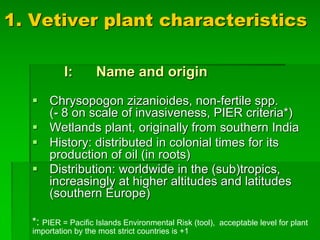
§ Chrysopogon zizanioides, non-fertile spp.
(- 8 on scale of invasiveness, PIER criteria*)
§ Wetlands plant, originally from southern India
§ History: distributed in colonial times for its
production of oil (in roots)
§ Distribution: worldwide in the (sub)tropics,
increasingly at higher altitudes and latitudes
(southern Europe)
*: PIER = Pacific Islands Environmental Risk (tool), acceptable level for plant
importation by the most strict countries is +1
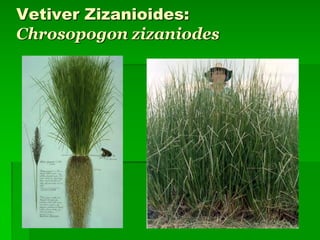
Vetiver Zizanioides:
Chrosopogon zizaniodes
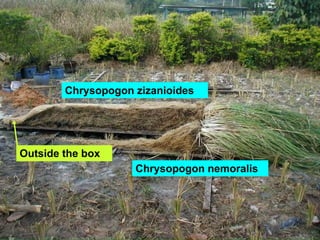
Chrysopogon zizanioides
Chrysopogon nemoralis
Outside the box
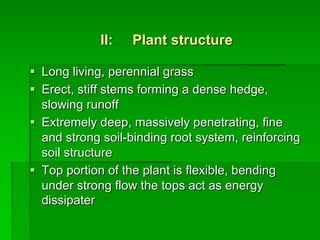
II: Plant structure
§ Long living, perennial grass
§ Erect, stiff stems forming a dense hedge,
slowing runoff
§ Extremely deep, massively penetrating, fine
and strong soil-binding root system, reinforcing
soil structure
§ Top portion of the plant is flexible, bending
under strong flow the tops act as energy
dissipater
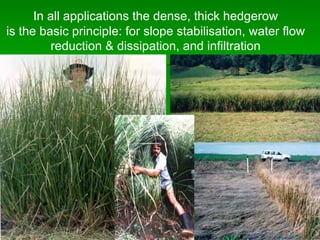
In all applications the dense, thick hedgerow
is the basic principle: for slope stabilisation, water flow
reduction & dissipation, and infiltration
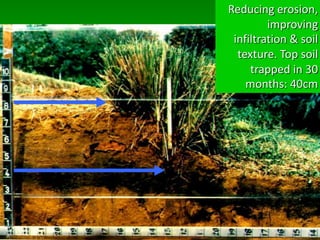
Reducing erosion,
improving
infiltration & soil
texture. Top soil
trapped in 30
months: 40cm
Australia: 1.3 m en 1
año.
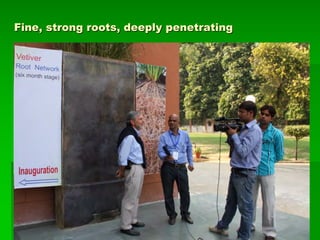
Fine, strong roots, deeply penetrating
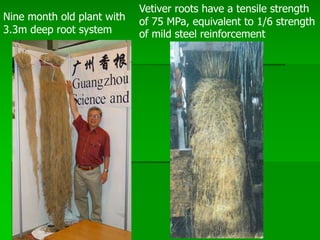
Nine month old plant with
3.3m deep root system
Vetiver roots have a tensile strength
of 75 MPa, equivalent to 1/6 strength
of mild steel reinforcement
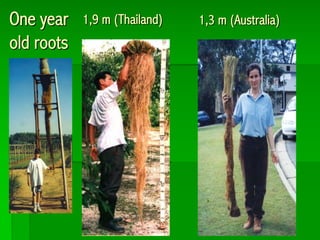
One year
old roots
1,9 m (Thailand) 1,3 m (Australia)
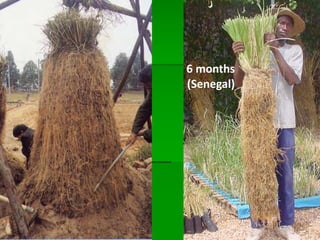
6 months
(Senegal)
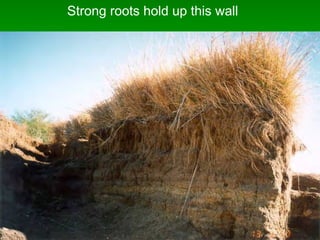
Strong roots hold up this wall
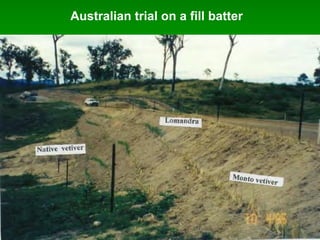
Australian trial on a fill batter
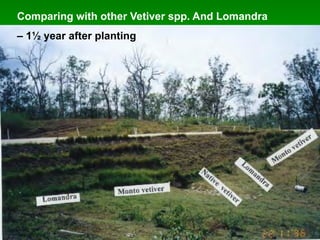
Comparing with other Vetiver spp. And Lomandra
– 1½ year after planting
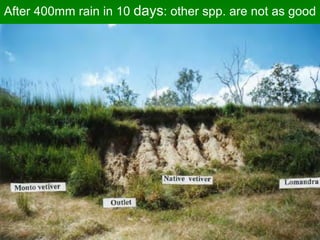
After 400mm rain in 10 days: other spp. are not as good
III. Mechanical characteristics
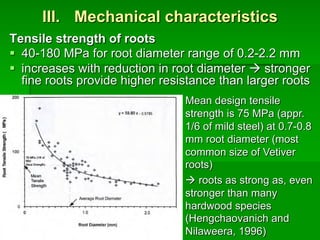
Tensile strength of roots
§ 40-180 MPa for root diameter range of 0.2-2.2 mm
§ increases with reduction in root diameter à stronger
fine roots provide higher resistance than larger roots
§ Mean design tensile
strength is 75 MPa (appr.
1/6 of mild steel) at 0.7-0.8
mm root diameter (most
common size of Vetiver
roots)
à roots as strong as, even
stronger than many
hardwood species
(Hengchaovanich and
Nilaweera, 1996)
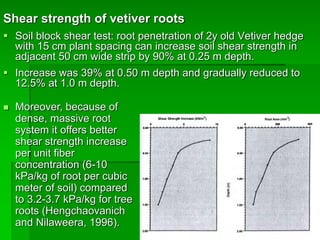
Shear strength of vetiver roots
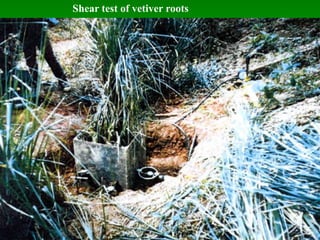
§ Soil block shear test: root penetration of 2y old Vetiver hedge
with 15 cm plant spacing can increase soil shear strength in
adjacent 50 cm wide strip by 90% at 0.25 m depth.
§ Increase was 39% at 0.50 m depth and gradually reduced to
12.5% at 1.0 m depth.
n Moreover, because of
dense, massive root
system it offers better
shear strength increase
per unit fiber
concentration (6-10
kPa/kg of root per cubic
meter of soil) compared
to 3.2-3.7 kPa/kg for tree
roots (Hengchaovanich
and Nilaweera, 1996).
Shear test of vetiver roots
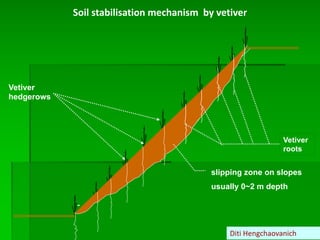
Soil stabilisation mechanism by vetiver
slipping zone on slopes
usually 0~2 m depth
Vetiver
roots
Vetiver
hedgerows
Diti Hengchaovanich
§ Thick hedges with their stiff stems can stand up to >
0.6-0.8m, forming living barrier, slows and
spreading runoff water. Hedges act as very effective
diversion structures spreading and diverting runoff
water safely to stable areas or proper drains
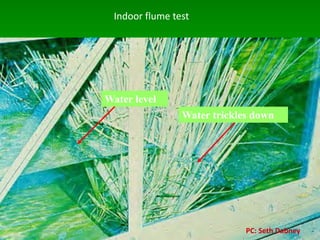
§ V. hedges under deep flows: flume tests at Univ. of
Southern Queensland for design strip cropping
layout for flood mitigation. Hedges successfully
reduced flood velocity, limiting soil movement
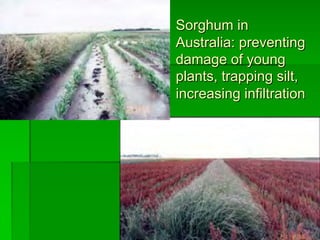
à very little erosion in fallow strips, a young
sorghum crop was completely protected from flood
damage (Dalton et al, 1996)
IV. Hydraulic characteristics
Water level
Water trickles down
Indoor flume test
PC: Seth Dabney
Sorghum in
Australia: preventing
damage of young
plants, trapping silt,
increasing infiltration
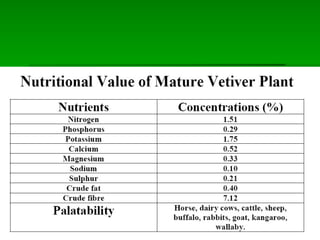
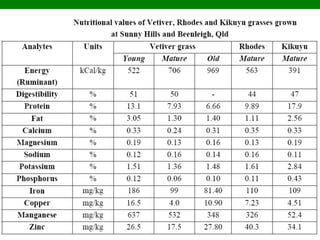
§ Properly managed Vetiver hedges have enormous capacity
to produce biomass. Frequent cutting produces fresh fodder
well into the dry season
§ Dry leaves are not digestible (contrary to young & mature,
green leaves), due to high silica content, BUT:
§ Highly useful for mulch, thatch, handicraft.
IN SEMI-ARID AREAS
§ Planting during the rains: cattle will favor lower, softer grass
§ With dry season coming along, Vetiver will remain the food
of last resort. If timely established, Vetiver can then tolerate
cattle (the crown sits under the soil surface, and recovers
from severe grazing, or burning).
§ In some more favorable semi-arid areas Vetiver is even
used as cattle fence (thick hedges pruned at 60cm will
prevent cattle to pass).
V. Characteristics relevant for by-products
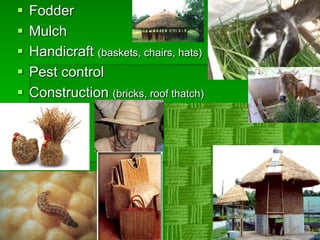
§ Fodder
§ Mulch
§ Handicraft (baskets, chairs, hats)
§ Pest control
§ Construction (bricks, roof thatch)
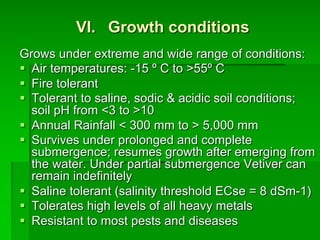
Grows under extreme and wide range of conditions:
§ Air temperatures: -15 º C to >55º C
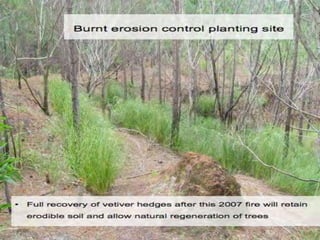
§ Fire tolerant
§ Tolerant to saline, sodic & acidic soil conditions;
soil pH from <3 to >10
§ Annual Rainfall < 300 mm to > 5,000 mm
§ Survives under prolonged and complete
submergence; resumes growth after emerging from
the water. Under partial submergence Vetiver can
remain indefinitely
§ Saline tolerant (salinity threshold ECse = 8 dSm-1)
§ Tolerates high levels of all heavy metals
§ Resistant to most pests and diseases
VI. Growth conditions
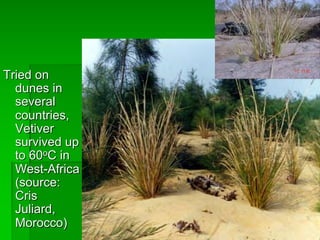
Tried on
dunes in
several
countries,
Vetiver
survived up
to 60oC in
West-Africa
(source:
Cris
Juliard,
Morocco)
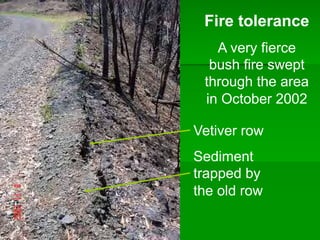
Vetiver row
Sediment
trapped by
the old row
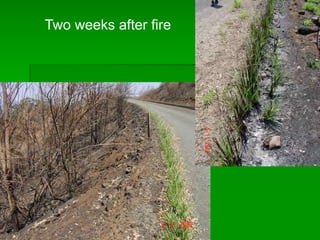
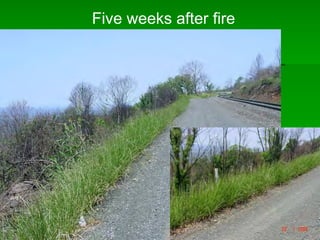
Fire tolerance
A very fierce
bush fire swept
through the area
in October 2002
Two weeks after fire
Five weeks after fire
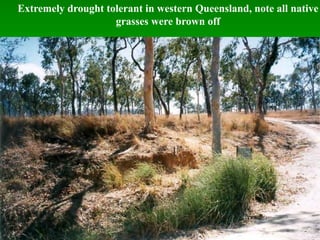
Extremely drought tolerant in western Queensland, note all native
grasses were brown off
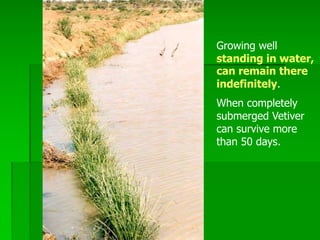
Growing well
standing in water,
can remain there
indefinitely.
When completely
submerged Vetiver
can survive more
than 50 days.
VII. Chemicals and Vetiver
§ Tolerant to high levels of N and P, and high
capacity of nutrient intake due to vigorous
growth (breaking down nitrates and
phosphates)
§ Tolerant to heavy metals: accumulating in roots
§ Tolerant to pesticides, herbicides (Diuron,
Atrazine, Dioxin, Lindane) and breaking down a
number of toxins
More characteristic in presentation on prevention
and treatment of contaminated water and land.
Adaptation & enhancing resilience:
§ Autonomous adaptation by farmers, groups,
communities
§ Planned adaptation: government and projects to
enhance various applications by farmer
communities and private sector
§ Many VS applications can have mitigation
benefits
Mitigation
§ Perennial, high production of biomass, storing
carbon in the roots
2. Climate change relevance
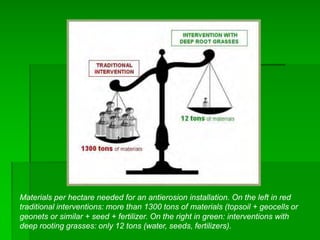
Materials per hectare needed for an antierosion installation. On the left in red
traditional interventions: more than 1300 tons of materials (topsoil + geocells or
geonets or similar + seed + fertilizer. On the right in green: interventions with
deep rooting grasses: only 12 tons (water, seeds, fertilizers).
3. Vetiver Systems
Applications - overview
§ On-farm: farm land and gully plugging. Added benefits:
fodder, handicraft (thatch, baskets, hats), pest control (on-
farm and in storage).
§ Infrastructure: slope stabilisation, landslide prevention
on roadsides, railways, bridges. Dealing with point-source
erosion caused by improper drainage.
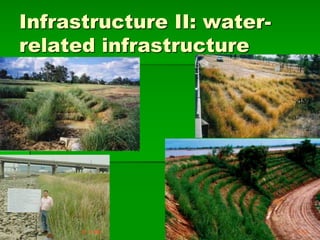
§ Water-related infrastructure: slope stabilisation on
banks of rivers, canals, dikes, dams - also trapping silt!
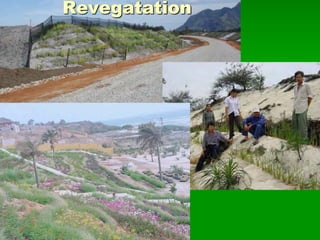
§ Rehab of vegetation: assisting reforestation, soil
rehab, fixing dunes affected by water/streams or wind.
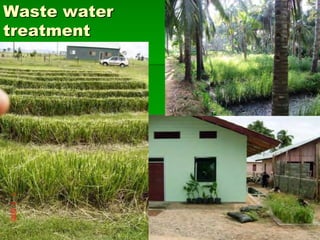
§ Waste water treatment: sewage /black water,
industrial soil & water pollution, waste dump leachate, and
mine rehab (combining the last three)
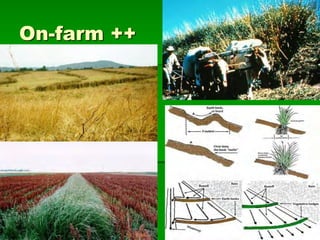
On-farm ++
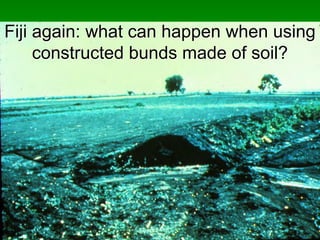
Fiji again: what can happen when using
constructed bunds made of soil?
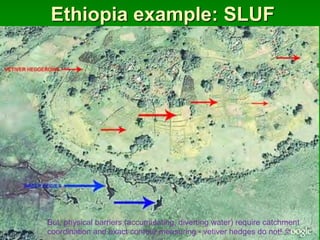
Ethiopia example: SLUF
But, physical barriers (accumulating, diverting water) require catchment
coordination and exact contour measuring - vetiver hedges do not! J
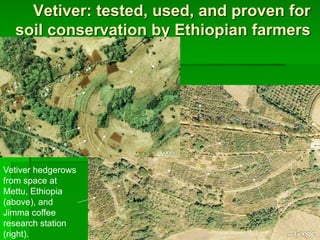
Vetiver: tested, used, and proven for
soil conservation by Ethiopian farmers
Vetiver hedgerows
from space at
Mettu, Ethiopia
(above), and
Jimma coffee
research station
(right).
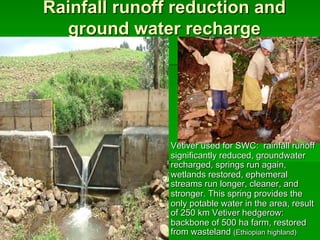
Rainfall runoff reduction and
ground water recharge
Vetiver used for SWC: rainfall runoff
significantly reduced, groundwater
recharged, springs run again,
wetlands restored, ephemeral
streams run longer, cleaner, and
stronger. This spring provides the
only potable water in the area, result
of 250 km Vetiver hedgerow:
backbone of 500 ha farm, restored
from wasteland (Ethiopian highland)
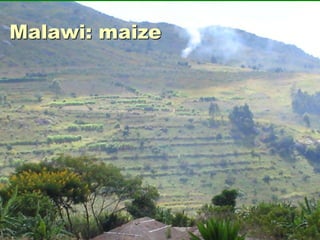
Malawi: maize
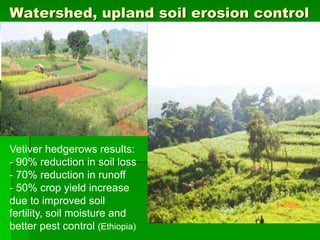
Watershed, upland soil erosion control
Vetiver hedgerows results:
- 90% reduction in soil loss
- 70% reduction in runoff
- 50% crop yield increase
due to improved soil
fertility, soil moisture and
better pest control (Ethiopia)
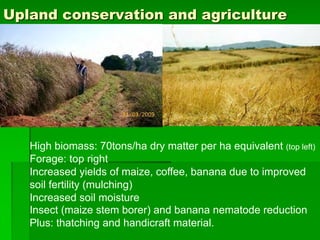
Upland conservation and agriculture
High biomass: 70tons/ha dry matter per ha equivalent (top left)
Forage: top right
Increased yields of maize, coffee, banana due to improved
soil fertility (mulching)
Increased soil moisture
Insect (maize stem borer) and banana nematode reduction
Plus: thatching and handicraft material.
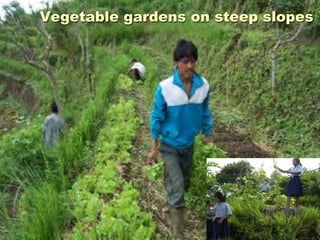
Children: “..
- school garden location was
shock: too steep & dry, rain
would wash away anything
planted
- surprise when being told to
cut terraces & plant ‘Vetiver
grass’
- agriculture teacher:
“Vetiver has roots going deep,
storing water below à grass
would stop soil washing away
Adults: awareness raising,
signing MoU…
- community learning garden
- protecting school, houses
- protection of spring
Vegetable gardens on steep slopes
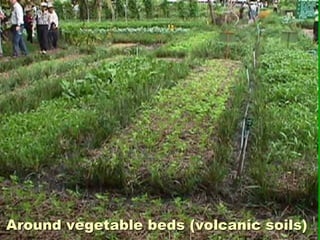
Around vegetable beds (volcanic soils)
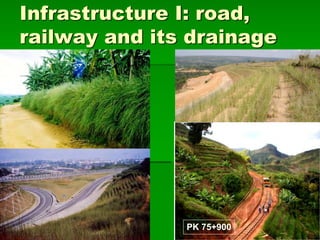
Infrastructure I: road,
railway and its drainage
PK 75+900
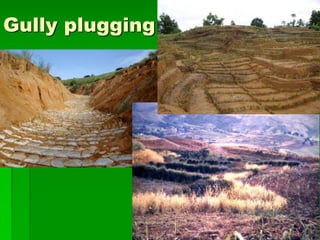
Gully plugging
Infrastructure II: water-
related infrastructure
Waste water
treatment
Revegatation
4. Conditions for success
Vetiver System advantages
low-cost, more local inputs & -jobs, high benefits (effective
infrastructure protection, reduced siltation of waterbodies, by-
products), easy to maintain à sustainable and lessons
Knowledge:
§ Engineering with a plant (roots and stems, local
conditions) and understanding hydrology: design and
planning is critical
§ Extension: i) product info; ii) show economic
incentives (also by-products); iii) monitoring, learning,
up-scaling
Leadership & economic incentives:
§ Managing watershed multi-stakeholders, multi-
sector, and politics (land and water)
§ Civil infrastructure: decide for green procurement,
different from conventional ways; understanding
the benefits (reducing flood damage, waterway
siltation) and: low-cost solutions result in lower
fees for design & implementation? (conventional
contractors will not lead, but follow; “if the slope
does not fail, what shall we eat?”!)
5. The Vetiver Network
International and where
to find your local network
Professional, open-source
knowledge network
§ Patron: Her Royal Highness
Princess
Maha Chakri Sirindhorn of
Thailand
§ NGO, active in +120 countries:
www.vetiver.org
§ for webpages of national or
regional networks, and much
more!
§ Registered in USA
info@vetiver.org
§ Chairperson: James Smile
vetiverlatina@googlegroups.com
• Jonathan Barcant, Trinidad & Tobago
jcb.vetivertt@gmail.com
• Daniel Londoño, Colombia
juandaniellondo@gmail.com
• Daniel Mascaró, Ecuador
danielmascaro@ludanmas.com
• Leonel Castro, Guatemala
viverosnaturalgarden@yahoo.com
• Carlos Pineda, Honduras
apsiercke@yahoo.com
• Rafael Luque, Venezuela
rafaeluque@gmail.com
• Oswaldo Luque, Venezuela
oluque1@gmail.com
TVNI
Thank
You!
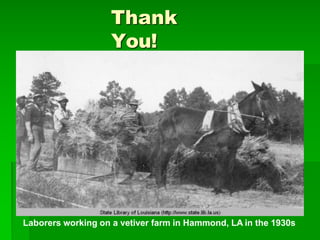
Laborers working on a vetiver farm in Hammond, LA in the 1930s

Vetiver eco-engineering - plant characteristics and overview of applications worldwide (TVNI)

  • 1.
    Vetiver eco-engineering – plantcharacteristics and overview of applications worldwide Presentation for webinar in Jamaica 18 January 2022 by Elise Pinners (MSc), elise.pinners@gmail.com Director in The Vetiver Network International (TVNI), www.vetiver.org Green Cycle Consulting Ltd. www.greencycleconsulting.com, with many thanks to other contributors from this great non-profit worldwide knowledge network: TVNI GC2 Green Cycle Consulting Ltd. TVNI
  • 2.
    Content 1. Vetiver plantcharacteristics 2. Climate change relevance 3. Applications – overview 4. Conditions for success 5. The Vetiver Network International and where to find your local network Separate presentations 1. On-farm SWC and other benefits 2. Infrastructure I: Roads, railways 3. Infrastructure II: Water related infrastructure 4. Prevention & treatment of contaminated water & land 5. Handicraft 6. Vetiver multiplication
  • 3.
    1. Vetiver plantcharacteristics I: Name and origin § Chrysopogon zizanioides, non-fertile spp. (- 8 on scale of invasiveness, PIER criteria*) § Wetlands plant, originally from southern India § History: distributed in colonial times for its production of oil (in roots) § Distribution: worldwide in the (sub)tropics, increasingly at higher altitudes and latitudes (southern Europe) *: PIER = Pacific Islands Environmental Risk (tool), acceptable level for plant importation by the most strict countries is +1
  • 4.
  • 5.
  • 6.
    II: Plant structure §Long living, perennial grass § Erect, stiff stems forming a dense hedge, slowing runoff § Extremely deep, massively penetrating, fine and strong soil-binding root system, reinforcing soil structure § Top portion of the plant is flexible, bending under strong flow the tops act as energy dissipater
  • 7.
    In all applicationsthe dense, thick hedgerow is the basic principle: for slope stabilisation, water flow reduction & dissipation, and infiltration
  • 8.
    Reducing erosion, improving infiltration &soil texture. Top soil trapped in 30 months: 40cm
  • 9.
    Australia: 1.3 men 1 año. Fine, strong roots, deeply penetrating
  • 10.
    Nine month oldplant with 3.3m deep root system Vetiver roots have a tensile strength of 75 MPa, equivalent to 1/6 strength of mild steel reinforcement
  • 11.
    One year old roots 1,9m (Thailand) 1,3 m (Australia)
  • 12.
  • 13.
    Strong roots holdup this wall
  • 14.
    Australian trial ona fill batter
  • 15.
    Comparing with otherVetiver spp. And Lomandra – 1½ year after planting
  • 16.
    After 400mm rainin 10 days: other spp. are not as good
  • 17.
    III. Mechanical characteristics Tensilestrength of roots § 40-180 MPa for root diameter range of 0.2-2.2 mm § increases with reduction in root diameter à stronger fine roots provide higher resistance than larger roots § Mean design tensile strength is 75 MPa (appr. 1/6 of mild steel) at 0.7-0.8 mm root diameter (most common size of Vetiver roots) à roots as strong as, even stronger than many hardwood species (Hengchaovanich and Nilaweera, 1996)
  • 18.
    Shear strength ofvetiver roots § Soil block shear test: root penetration of 2y old Vetiver hedge with 15 cm plant spacing can increase soil shear strength in adjacent 50 cm wide strip by 90% at 0.25 m depth. § Increase was 39% at 0.50 m depth and gradually reduced to 12.5% at 1.0 m depth. n Moreover, because of dense, massive root system it offers better shear strength increase per unit fiber concentration (6-10 kPa/kg of root per cubic meter of soil) compared to 3.2-3.7 kPa/kg for tree roots (Hengchaovanich and Nilaweera, 1996).
  • 19.
    Shear test ofvetiver roots
  • 20.
    Soil stabilisation mechanismby vetiver slipping zone on slopes usually 0~2 m depth Vetiver roots Vetiver hedgerows Diti Hengchaovanich
  • 21.
    § Thick hedgeswith their stiff stems can stand up to > 0.6-0.8m, forming living barrier, slows and spreading runoff water. Hedges act as very effective diversion structures spreading and diverting runoff water safely to stable areas or proper drains § V. hedges under deep flows: flume tests at Univ. of Southern Queensland for design strip cropping layout for flood mitigation. Hedges successfully reduced flood velocity, limiting soil movement à very little erosion in fallow strips, a young sorghum crop was completely protected from flood damage (Dalton et al, 1996) IV. Hydraulic characteristics
  • 22.
    Water level Water tricklesdown Indoor flume test PC: Seth Dabney
  • 23.
    Sorghum in Australia: preventing damageof young plants, trapping silt, increasing infiltration
  • 24.
    § Properly managedVetiver hedges have enormous capacity to produce biomass. Frequent cutting produces fresh fodder well into the dry season § Dry leaves are not digestible (contrary to young & mature, green leaves), due to high silica content, BUT: § Highly useful for mulch, thatch, handicraft. IN SEMI-ARID AREAS § Planting during the rains: cattle will favor lower, softer grass § With dry season coming along, Vetiver will remain the food of last resort. If timely established, Vetiver can then tolerate cattle (the crown sits under the soil surface, and recovers from severe grazing, or burning). § In some more favorable semi-arid areas Vetiver is even used as cattle fence (thick hedges pruned at 60cm will prevent cattle to pass). V. Characteristics relevant for by-products
  • 25.
    § Fodder § Mulch §Handicraft (baskets, chairs, hats) § Pest control § Construction (bricks, roof thatch)
  • 28.
    Grows under extremeand wide range of conditions: § Air temperatures: -15 º C to >55º C § Fire tolerant § Tolerant to saline, sodic & acidic soil conditions; soil pH from <3 to >10 § Annual Rainfall < 300 mm to > 5,000 mm § Survives under prolonged and complete submergence; resumes growth after emerging from the water. Under partial submergence Vetiver can remain indefinitely § Saline tolerant (salinity threshold ECse = 8 dSm-1) § Tolerates high levels of all heavy metals § Resistant to most pests and diseases VI. Growth conditions
  • 29.
    Tried on dunes in several countries, Vetiver survivedup to 60oC in West-Africa (source: Cris Juliard, Morocco)
  • 30.
    Vetiver row Sediment trapped by theold row Fire tolerance A very fierce bush fire swept through the area in October 2002
  • 31.
  • 32.
  • 33.
    Extremely drought tolerantin western Queensland, note all native grasses were brown off
  • 34.
    Growing well standing inwater, can remain there indefinitely. When completely submerged Vetiver can survive more than 50 days.
  • 35.
    VII. Chemicals andVetiver § Tolerant to high levels of N and P, and high capacity of nutrient intake due to vigorous growth (breaking down nitrates and phosphates) § Tolerant to heavy metals: accumulating in roots § Tolerant to pesticides, herbicides (Diuron, Atrazine, Dioxin, Lindane) and breaking down a number of toxins More characteristic in presentation on prevention and treatment of contaminated water and land.
  • 36.
    Adaptation & enhancingresilience: § Autonomous adaptation by farmers, groups, communities § Planned adaptation: government and projects to enhance various applications by farmer communities and private sector § Many VS applications can have mitigation benefits Mitigation § Perennial, high production of biomass, storing carbon in the roots 2. Climate change relevance
  • 38.
    Materials per hectareneeded for an antierosion installation. On the left in red traditional interventions: more than 1300 tons of materials (topsoil + geocells or geonets or similar + seed + fertilizer. On the right in green: interventions with deep rooting grasses: only 12 tons (water, seeds, fertilizers).
  • 39.
    3. Vetiver Systems Applications- overview § On-farm: farm land and gully plugging. Added benefits: fodder, handicraft (thatch, baskets, hats), pest control (on- farm and in storage). § Infrastructure: slope stabilisation, landslide prevention on roadsides, railways, bridges. Dealing with point-source erosion caused by improper drainage. § Water-related infrastructure: slope stabilisation on banks of rivers, canals, dikes, dams - also trapping silt! § Rehab of vegetation: assisting reforestation, soil rehab, fixing dunes affected by water/streams or wind. § Waste water treatment: sewage /black water, industrial soil & water pollution, waste dump leachate, and mine rehab (combining the last three)
  • 40.
  • 41.
    Fiji again: whatcan happen when using constructed bunds made of soil?
  • 42.
    Ethiopia example: SLUF But,physical barriers (accumulating, diverting water) require catchment coordination and exact contour measuring - vetiver hedges do not! J
  • 43.
    Vetiver: tested, used,and proven for soil conservation by Ethiopian farmers Vetiver hedgerows from space at Mettu, Ethiopia (above), and Jimma coffee research station (right).
  • 44.
    Rainfall runoff reductionand ground water recharge Vetiver used for SWC: rainfall runoff significantly reduced, groundwater recharged, springs run again, wetlands restored, ephemeral streams run longer, cleaner, and stronger. This spring provides the only potable water in the area, result of 250 km Vetiver hedgerow: backbone of 500 ha farm, restored from wasteland (Ethiopian highland)
  • 45.
  • 46.
    Watershed, upland soilerosion control Vetiver hedgerows results: - 90% reduction in soil loss - 70% reduction in runoff - 50% crop yield increase due to improved soil fertility, soil moisture and better pest control (Ethiopia)
  • 47.
    Upland conservation andagriculture High biomass: 70tons/ha dry matter per ha equivalent (top left) Forage: top right Increased yields of maize, coffee, banana due to improved soil fertility (mulching) Increased soil moisture Insect (maize stem borer) and banana nematode reduction Plus: thatching and handicraft material.
  • 48.
    Children: “.. - schoolgarden location was shock: too steep & dry, rain would wash away anything planted - surprise when being told to cut terraces & plant ‘Vetiver grass’ - agriculture teacher: “Vetiver has roots going deep, storing water below à grass would stop soil washing away Adults: awareness raising, signing MoU… - community learning garden - protecting school, houses - protection of spring Vegetable gardens on steep slopes
  • 49.
    Around vegetable beds(volcanic soils)
  • 50.
    Infrastructure I: road, railwayand its drainage PK 75+900
  • 51.
  • 52.
  • 53.
  • 54.
  • 56.
    4. Conditions forsuccess Vetiver System advantages low-cost, more local inputs & -jobs, high benefits (effective infrastructure protection, reduced siltation of waterbodies, by- products), easy to maintain à sustainable and lessons Knowledge: § Engineering with a plant (roots and stems, local conditions) and understanding hydrology: design and planning is critical § Extension: i) product info; ii) show economic incentives (also by-products); iii) monitoring, learning, up-scaling
  • 57.
    Leadership & economicincentives: § Managing watershed multi-stakeholders, multi- sector, and politics (land and water) § Civil infrastructure: decide for green procurement, different from conventional ways; understanding the benefits (reducing flood damage, waterway siltation) and: low-cost solutions result in lower fees for design & implementation? (conventional contractors will not lead, but follow; “if the slope does not fail, what shall we eat?”!)
  • 58.
    5. The VetiverNetwork International and where to find your local network Professional, open-source knowledge network § Patron: Her Royal Highness Princess Maha Chakri Sirindhorn of Thailand § NGO, active in +120 countries: www.vetiver.org § for webpages of national or regional networks, and much more! § Registered in USA info@vetiver.org § Chairperson: James Smile vetiverlatina@googlegroups.com • Jonathan Barcant, Trinidad & Tobago jcb.vetivertt@gmail.com • Daniel Londoño, Colombia juandaniellondo@gmail.com • Daniel Mascaró, Ecuador danielmascaro@ludanmas.com • Leonel Castro, Guatemala viverosnaturalgarden@yahoo.com • Carlos Pineda, Honduras apsiercke@yahoo.com • Rafael Luque, Venezuela rafaeluque@gmail.com • Oswaldo Luque, Venezuela oluque1@gmail.com TVNI
  • 59.
    Thank You! Laborers working ona vetiver farm in Hammond, LA in the 1930s