ITU-T

       Security and Privacy
         International Cloud Symposium
          Washington DC October 2012


Abbie Barbir, Ph.D.
Rapporteur, Q10/17
Identity Management Question
Abbie.barbir@ties.itu.int

                                         International
                                         Telecommunication
                                         Union
ITU-T Objectives
 International Telecommunication Union
 Develop and publish
  standards for global ICT
  interoperability
 Identify areas for future
  standardization
 Provide an attractive and effective forum for the development
  of international standards
 Promote the value of ITU standards
 Disseminate information and know-how
 Cooperate and collaborate
 Provide support and assistance
ITU-T Key Features
 Truly global public/private
  partnership
 95% of work is done by
  private sector
 Continuously adapting to
  market needs
 Pre-eminent global ICT
  standards body
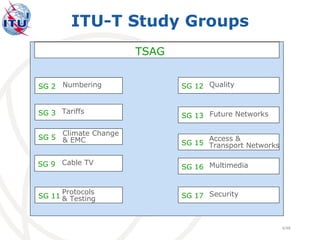
ITU-T Study Groups
                      TSAG


SG 2 Numbering               SG 12 Quality


SG 3 Tariffs                 SG 13 Future Networks

     Climate Change
SG 5 & EMC                         Access &
                             SG 15 Transport Networks


SG 9 Cable TV                SG 16 Multimedia


      Protocols
SG 11 & Testing              SG 17 Security


                                                        4/48
Personally Identifiable
        Information (PII)
 Aspects of privacy and protection of PII data is a key concern to
  the ITU-T (SG 17 )
 Recommendations published have identified security threats and
  provide guidelines in that area.
    Recommendation ITU-T X.1171 identifies threats and
     requirements for PII protection in application using tag-based
     identification.
    Recommendation ITU-T X.1275 standardizes a possible,
     privacy impact assessment (PIA) process for the entire RFID
     system
 Joint Coordination Activity on Internet of Things (JCA-IoT)
 Focus Group on Machine-to-Machine Service Layer
SG 17 Questions involved in
        “privacy” studies
 Question 3/17 “Telecommunications information security
    management”
   Question 4/17 “Cybersecurity”
   Question 6/17 “Security aspects of ubiquitous telecommunication
    services”
   Question 7/17 “Secure application services”
   Question 9/17 “Telebiometrics”
   Question 10/17 “Identity management architecture and
    mechanisms”
   Further candidate Questions could be
      Question 8/17 “Cloud computing security”
      Question 11/17 “Directory services, Directory systems, and
       public- key/attribute certificates”
Definitions of Privacy in
     ITU-T Recommendations
Privacy
 ITU-T X.1252 (04/2010) “Baseline identity management
  terms and definitions”
    The right of individuals to control or influence what personal
     information related to them may be collected, managed, retained,
     accessed, and used or distributed.
 ITU-T Y.2720 (01/2009) “NGN identity management
  framework”
    The protection of personally identifiable information.
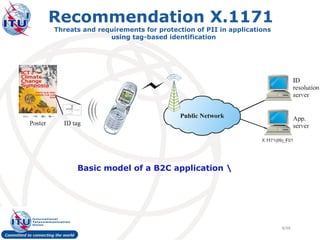
Recommendation X.1171
Threats and requirements for protection of PII in applications
               using tag-based identification


      Basic model of a B2C application 


                                                                 8/48
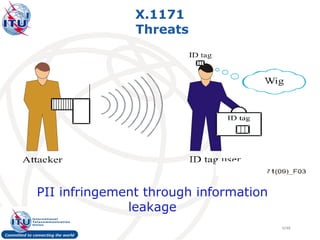
X.1171
               Threats


PII infringement through information
              leakage
                                       9/48
ITU-T X.1275
 Guidelines on protection of personally identifiable information
    in the application of RFID technology
   Privacy principles (based on privacy principles of: Council of
    Europe], EC Directive 95/46, EC Directive 2002/58/EC,
    OECD, and UNHCR)
   Threats and infringements of PII in RFID
   Typical RFID applications and possible threats to PII
      Supply-chain management
      Transportation and logistics
      Healthcare and medical application
      e-government
      Information service
   Guidelines on protection for personally identifiable
    information
                                                               10/48
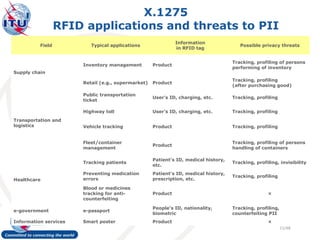
X.1275
                  RFID applications and threats to PII
                                                              Information
          Field           Typical applications                                          Possible privacy threats
                                                              in RFID tag


                                                                                     Tracking, profiling of persons
                       Inventory management         Product
                                                                                     performing of inventory
Supply chain
                                                                                     Tracking, profiling
                       Retail (e.g., supermarket)   Product
                                                                                     (after purchasing good)

                       Public transportation
                                                    User's ID, charging, etc.        Tracking, profiling
                       ticket

                       Highway toll                 User's ID, charging, etc.        Tracking, profiling
Transportation and
logistics              Vehicle tracking             Product                          Tracking, profiling


                       Fleet/container                                               Tracking, profiling of persons
                                                    Product
                       management                                                    handling of containers

                                                    Patient's ID, medical history,
                       Tracking patients                                             Tracking, profiling, invisibility
                                                    etc.
                       Preventing medication        Patient's ID, medical history,
                                                                                     Tracking, profiling
Healthcare             errors                       prescription, etc.

                       Blood or medicines
                       tracking for anti-           Product                                         ×
                       counterfeiting

                                                    People's ID, nationality,        Tracking, profiling,
e-government           e-passport
                                                    biometric                        counterfeiting PII
Information services   Smart poster                 Product                                         ×
                                                                                                            11/48
Other Work
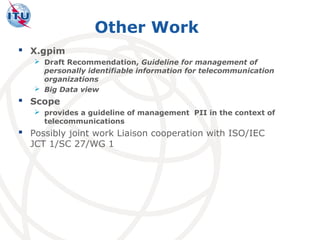
 X.gpim
    Draft Recommendation, Guideline for management of
     personally identifiable information for telecommunication
     organizations
    Big Data view
 Scope
    provides a guideline of management PII in the context of
     telecommunications
 Possibly joint work Liaison cooperation with ISO/IEC
  JCT 1/SC 27/WG 1
Summary
 Internet-of-Things (IoT), ubiquitous sensor networks (USN), Machine-
   to-Machine (M2M) and network aspects of identification systems,
   including RFID (NID) play an important role in ITU-T’s standardization
   activities.

 Various ITU-T Study Groups and ITU-T initiatives are addressing
   RFID/NID, IoT, USN and M2M including the security aspects thereof;
   an initial suite of ITU-T Recommendations has already been
   developed in that domain and serves as a tool set for standard
   developers and implementers; yet the comprehensive subject is still
   emerging and forthcoming drafts are in preparation by the ITU-T
   Global Standards Initiative (GSI-IoT) where those standards are
   being developed in cooperation among the experts.

 Aspects of privacy and protection of PII (personally identifiable
   information) data is a key concern and first set of ITU-T
   Recommendations published have identified security threats and
   provide guidelines in that area.

 Recommendation ITU-T X.1171 identifies threats and requirements
   for PII protection in application using tag-based identification.

 Recommendation ITU-T X.1275 standardizes a possible, privacy
                                                             13/48
   impact assessment (PIA) process for the entire RFID system.
THANK YOU


For further information

http://www.itu.int/ITU-T
http://www.itu.int/ITU-
  T/studygroups/com17


                           14/48
Itu ics-pii

Itu ics-pii

  • 1.
    ITU-T Security and Privacy International Cloud Symposium Washington DC October 2012 Abbie Barbir, Ph.D. Rapporteur, Q10/17 Identity Management Question Abbie.barbir@ties.itu.int International Telecommunication Union
  • 2.
    ITU-T Objectives  InternationalTelecommunication Union  Develop and publish standards for global ICT interoperability  Identify areas for future standardization  Provide an attractive and effective forum for the development of international standards  Promote the value of ITU standards  Disseminate information and know-how  Cooperate and collaborate  Provide support and assistance
  • 3.
    ITU-T Key Features Truly global public/private partnership  95% of work is done by private sector  Continuously adapting to market needs  Pre-eminent global ICT standards body
  • 4.
    ITU-T Study Groups TSAG SG 2 Numbering SG 12 Quality SG 3 Tariffs SG 13 Future Networks Climate Change SG 5 & EMC Access & SG 15 Transport Networks SG 9 Cable TV SG 16 Multimedia Protocols SG 11 & Testing SG 17 Security 4/48
  • 5.
    Personally Identifiable Information (PII)  Aspects of privacy and protection of PII data is a key concern to the ITU-T (SG 17 )  Recommendations published have identified security threats and provide guidelines in that area.  Recommendation ITU-T X.1171 identifies threats and requirements for PII protection in application using tag-based identification.  Recommendation ITU-T X.1275 standardizes a possible, privacy impact assessment (PIA) process for the entire RFID system  Joint Coordination Activity on Internet of Things (JCA-IoT)  Focus Group on Machine-to-Machine Service Layer
  • 6.
    SG 17 Questionsinvolved in “privacy” studies  Question 3/17 “Telecommunications information security management”  Question 4/17 “Cybersecurity”  Question 6/17 “Security aspects of ubiquitous telecommunication services”  Question 7/17 “Secure application services”  Question 9/17 “Telebiometrics”  Question 10/17 “Identity management architecture and mechanisms”  Further candidate Questions could be  Question 8/17 “Cloud computing security”  Question 11/17 “Directory services, Directory systems, and public- key/attribute certificates”
  • 7.
    Definitions of Privacyin ITU-T Recommendations Privacy  ITU-T X.1252 (04/2010) “Baseline identity management terms and definitions”  The right of individuals to control or influence what personal information related to them may be collected, managed, retained, accessed, and used or distributed.  ITU-T Y.2720 (01/2009) “NGN identity management framework”  The protection of personally identifiable information.
  • 8.
    Recommendation X.1171 Threats andrequirements for protection of PII in applications using tag-based identification Basic model of a B2C application 8/48
  • 9.
    X.1171 Threats PII infringement through information leakage 9/48
  • 10.
    ITU-T X.1275  Guidelineson protection of personally identifiable information in the application of RFID technology  Privacy principles (based on privacy principles of: Council of Europe], EC Directive 95/46, EC Directive 2002/58/EC, OECD, and UNHCR)  Threats and infringements of PII in RFID  Typical RFID applications and possible threats to PII  Supply-chain management  Transportation and logistics  Healthcare and medical application  e-government  Information service  Guidelines on protection for personally identifiable information 10/48
  • 11.
    X.1275 RFID applications and threats to PII Information Field Typical applications Possible privacy threats in RFID tag Tracking, profiling of persons Inventory management Product performing of inventory Supply chain Tracking, profiling Retail (e.g., supermarket) Product (after purchasing good) Public transportation User's ID, charging, etc. Tracking, profiling ticket Highway toll User's ID, charging, etc. Tracking, profiling Transportation and logistics Vehicle tracking Product Tracking, profiling Fleet/container Tracking, profiling of persons Product management handling of containers Patient's ID, medical history, Tracking patients Tracking, profiling, invisibility etc. Preventing medication Patient's ID, medical history, Tracking, profiling Healthcare errors prescription, etc. Blood or medicines tracking for anti- Product × counterfeiting People's ID, nationality, Tracking, profiling, e-government e-passport biometric counterfeiting PII Information services Smart poster Product × 11/48
  • 12.
    Other Work  X.gpim  Draft Recommendation, Guideline for management of personally identifiable information for telecommunication organizations  Big Data view  Scope  provides a guideline of management PII in the context of telecommunications  Possibly joint work Liaison cooperation with ISO/IEC JCT 1/SC 27/WG 1
  • 13.
    Summary  Internet-of-Things (IoT),ubiquitous sensor networks (USN), Machine- to-Machine (M2M) and network aspects of identification systems, including RFID (NID) play an important role in ITU-T’s standardization activities.  Various ITU-T Study Groups and ITU-T initiatives are addressing RFID/NID, IoT, USN and M2M including the security aspects thereof; an initial suite of ITU-T Recommendations has already been developed in that domain and serves as a tool set for standard developers and implementers; yet the comprehensive subject is still emerging and forthcoming drafts are in preparation by the ITU-T Global Standards Initiative (GSI-IoT) where those standards are being developed in cooperation among the experts.  Aspects of privacy and protection of PII (personally identifiable information) data is a key concern and first set of ITU-T Recommendations published have identified security threats and provide guidelines in that area.  Recommendation ITU-T X.1171 identifies threats and requirements for PII protection in application using tag-based identification.  Recommendation ITU-T X.1275 standardizes a possible, privacy 13/48 impact assessment (PIA) process for the entire RFID system.
  • 14.
    THANK YOU For furtherinformation http://www.itu.int/ITU-T http://www.itu.int/ITU- T/studygroups/com17 14/48

Editor's Notes

  • #9 http://www.itu.int/ITU-T/recommendations/rec.aspx?rec=X.1171
  • #11 http://www.itu.int/ITU-T/recommendations/rec.aspx?rec=X.1275
  • #12 http://www.itu.int/ITU-T/recommendations/rec.aspx?rec=X.1275