CASE STUDY
Intel®Xeon®Processor E5 Family
High-Performance Computing
Energy/Utilities
Supercomputing Beyond the Horizon
The Technological Institute of Renewable Energies (ITER) was founded by the Island Council of Tenerife
in 1990. Its purpose is to conduct research into ways of reducing the island’s dependency on externally-
supplied energy by maximizing its own clean, natural energy resources (such as wind and geothermal
activity). It is also committed to making a contribution to the island’s society through other activities
such as seismic-volcanic surveillance, environmental control and the development of information and
communication technology (ICT).
Challenges
• Local power. ITER helps Tenerife generate energy from natural resources as effectively and cost
efficiently as possible
• Optimize investment. Following data center upgrades and the laying of a new fiber optic cable to
the mainland, ITER had an opportunity to boost its computing capabilities further
• Support business. It wanted to share any new ICT resources with the Canarian business community
to enhance the region’s international competitiveness
Solutions
• Intel advantage. The chosen platform is powered by Fujitsu PRIMERGY* CX250 servers with Intel®
Xeon® processors E5 family. Intel® Compilers enhance application performance
• Cost effective. The combination of energy efficiency and performance enabled the solution provided
by Atos, Fujitsu and Intel to deliver the most compelling total cost of ownership (TCO)
Impact
• Energy savings. According to internal tests, more accurate weather predictions enable ITER to save
nearly 75 percent of the costs associated with deviations from energy-production forecasts
• Diverse users. Local organizations including universities and audiovisual companies can now access
advanced high-performance computing resources
• European player. Atos plans to connect the supercomputer to the Helix Nebula* European Cloud
Partnership
ITER uses Intel®technology to position the Canary Islands as a European leader in high-performance computing
“With Intel® technology, we benefit
from advanced performance and
energy efficiency. Intel® Compilers
enable us to make sure all appli-
cations function optimally as well.
All these advantages combine
to make this solution the most
cost effective in the long term.”
Jesús Rodríguez Álamo,
Chief Information Officer,
ITER
Harnessing island energy
Energy production is a constant challenge, partic-
ularly for island communities that often have to
rely on distant mainland supplies. Wanting to avoid
the high costs and complex logistics involved in
drawing its energy from the Spanish national grid,
the Island Council of Tenerife in the Canary Islands
is committed to generating as much of its own
power as possible. ITER’s task is to ensure that
its own energy-providing resources are identified
and used in the most efficient way possible. This
involves extensive, ongoing research and complex
calculations.
A connected island
The team at ITER invested heavily in upgrading
various parts of its data centers and ICT resources
to ensure it can continue to meet the computational
demands placed upon it. This investment even
extended to installing a new submarine cable to
deliver superior levels of Internet connectivity
to the island. With these new resources in place,
ITER wanted to take one final step and create
its own supercomputer.
“We wanted to make the most of our improved
connectivity and data centers to build a powerful,
European-class supercomputer that would benefit
not only our own researchers, but also any other
organizations in the Canary Islands that need en-
hanced computing power to make them more com-
petitive,” explains Jesús Rodríguez Álamo, chief
information officer, ITER. “Being separated from
the European mainland presents a challenge for
many businesses in the Canaries, so we want to
help the region become more connected and
better equipped to participate in the European
economy.”
This document and the information given are for the convenience of Intel’s customer base and are provided “AS IS” WITH NO WARRANTIES WHATSOEVER, EXPRESS OR IMPLIED,
INCLUDING ANY IMPLIED WARRANTY OF MERCHANTABILITY, FITNESS FOR A PARTICULAR PURPOSE, AND NONINFRINGEMENT OF INTELLECTUAL PROPERTY RIGHTS. Receipt or
possession of this document does not grant any license to any of the intellectual property described, displayed, or contained herein. Intel® products are not intended for use in
medical, lifesaving, life-sustaining, critical control, or safety systems, or in nuclear facility applications.
Intel does not control or audit the design or implementation of third party benchmark data or Web sites referenced in this document. Intel encourages all of its customers to visit
the referenced Web sites or others where similar performance benchmark data are reported and confirm whether the referenced benchmark data are accurate and reflect per-
formance of systems available for purchase.
Software and workloads used in performance tests may have been optimized for performance only on Intel microprocessors. Performance tests, such as SYSmark and MobileMark,
are measured using specific computer systems, components, software, operations and functions. Any change to any of those factors may cause the results to vary. You should
consult other information and performance tests to assist you in fully evaluating your contemplated purchases, including the performance of that product when combined with
other products. For more information go to http://www.intel.com/performance.
Copyright
©2014, Intel Corporation. All rights reserved. Intel, the Intel logo, Intel Xeon and Xeon inside are trademarks of Intel Corporation in the U.S. and other countries.
*Other names and brands may be claimed as the property of others. 0314/JNW/RLC/XX/PDF 330372-001EN
Complex user needs
Given that it planned to make its new high-perfor-
mance computing platform available to a variety
of users, ITER needed to ensure that whatever
solution it chose would offer the flexibility and
performance necessary to handle a complex range
of applications. As an energy-focused organization,
it also prioritized power efficiency. Having secured
a loan from the Spanish government to invest in
the new platform, ITER also needed to ensure
that the total cost of ownership was reasonable.
After assessing a range of technology vendors,
processor technologies and systems integrators,
the organization chose Atos to manage the proj-
ect, using Fujitsu servers powered by the Intel
Xeon processor E5 family. “We felt that this com-
bination offered us all the features we needed,”
says Rodríguez Álamo. “With Intel® technology, we
benefit from advanced performance and energy
efficiency. Intel Compilers, which are included in
the solution, enable us to make sure all applications
function optimally as well. All these advantages
combine to make this solution the most cost ef-
fective in the long term.”
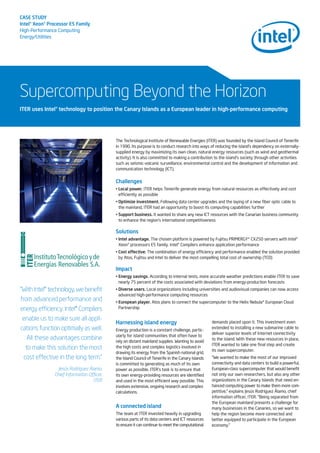
The supercomputer that Atos delivered for ITER was
named TEIDE (after Tenerife’s primary volcano
and the highest point in Spain). It includes 1,100
Fujitsu PRIMERGY CX250 servers, powered by
dual-core Intel Xeon processors E5 family. It also
features three types of connectivity, including
InfiniBand* for supercomputing, double 1GB Ether-
net for each server and 10GB Ethernet for each
node. Advanced cooling capabilities, extensive
storage capacity and high power density are also
featured. TEIDE is the second largest supercom-
puter in all of Spain, and ranks 138th internation-
ally on both the Top 500 and Green 500 lists. All
the energy used by TEIDE HPC and the D-ALiX
Datacenter that houses it comes from renewable
sources, combining both the power of wind farms
and photovoltaic plants located at ITER.
Performing internationally
With the implementation complete, ITER can now
offer its supercomputing platform to a range of
users. Its own researchers can now run their sim-
ulation and research applications much more ef-
ficiently, generating more accurate results more
quickly. “We’re able to be much more accurate in
our weather predictions for the region now, for
example,” explains Rodríguez Álamo. “Given that
so much of our energy comes from weather-de-
pendent sources, like wind power, this is a great
advantage. Any electricity that we need in addi-
tion to what we can generate ourselves needs
to be drawn from the Spanish national grid. The
grid requires us to predict in advance how much
energy we’ll produce and consume from the grid,
and we’re fined if we get our predictions wrong.
So the more accurate we can be about our antici-
pated power needs, the more we save. In fact, in-
ternal estimates indicate that we are now paying
just 25 percent of what we used to due to these
deviations.”
Meanwhile, a number of local organizations are
also hiring computing resource from ITER. These
include a diverse mix, from local university scien-
tists to audiovisual companies needing to develop
advanced graphics and special effects.
Lessons Learned
Building a high-performance computing platform
is no simple task. It requires coordination, in-
vestment and careful planning. Getting the
best possible return on all this is important.
By carefully selecting a flexible, efficient Intel®
technology-powered platform, ITER ensured
that the TEIDE supercomputer delivered value
not only for its own employees, but also for
the wider Canarian business community and
its international research peers.
Atos also has big ambitions for TEIDE. It is planning
to take advantage of the superior connectivity
provided by the new submarine fiber optic cable
to link ITER’s platform to the Helix Nebula Euro-
pean Cloud Partnership. This high-performance
computing collaboration includes other leading
organizations such as CERN and the European
Space Agency. Rodríguez Álamo concludes: “By
participating in this community of ground-break-
ing research institutions, we’re able to take our
place among the supercomputing leaders in our
region. And we look forward to playing a role in
opening up advanced computing capabilities for
western Africa as well. Furthermore, we’ve pro-
vided a route for other organizations in the Canaries
to operate at a European, even global, level.”
Find the solution that’s right for your organization.
View success stories from your peers
(www.intel.co.uk/Itcasestudies),
learn more about server products for business
(www.intel.com/xeon) and check out the IT
Center, Intel’s resource for the IT Industry
(www.intel.co.uk/itcenter).
Intel® technology powers Spain’s second
largest supercomputer

Iter supercomputing beyond_horizon

  • 1.
    CASE STUDY Intel®Xeon®Processor E5Family High-Performance Computing Energy/Utilities Supercomputing Beyond the Horizon The Technological Institute of Renewable Energies (ITER) was founded by the Island Council of Tenerife in 1990. Its purpose is to conduct research into ways of reducing the island’s dependency on externally- supplied energy by maximizing its own clean, natural energy resources (such as wind and geothermal activity). It is also committed to making a contribution to the island’s society through other activities such as seismic-volcanic surveillance, environmental control and the development of information and communication technology (ICT). Challenges • Local power. ITER helps Tenerife generate energy from natural resources as effectively and cost efficiently as possible • Optimize investment. Following data center upgrades and the laying of a new fiber optic cable to the mainland, ITER had an opportunity to boost its computing capabilities further • Support business. It wanted to share any new ICT resources with the Canarian business community to enhance the region’s international competitiveness Solutions • Intel advantage. The chosen platform is powered by Fujitsu PRIMERGY* CX250 servers with Intel® Xeon® processors E5 family. Intel® Compilers enhance application performance • Cost effective. The combination of energy efficiency and performance enabled the solution provided by Atos, Fujitsu and Intel to deliver the most compelling total cost of ownership (TCO) Impact • Energy savings. According to internal tests, more accurate weather predictions enable ITER to save nearly 75 percent of the costs associated with deviations from energy-production forecasts • Diverse users. Local organizations including universities and audiovisual companies can now access advanced high-performance computing resources • European player. Atos plans to connect the supercomputer to the Helix Nebula* European Cloud Partnership ITER uses Intel®technology to position the Canary Islands as a European leader in high-performance computing “With Intel® technology, we benefit from advanced performance and energy efficiency. Intel® Compilers enable us to make sure all appli- cations function optimally as well. All these advantages combine to make this solution the most cost effective in the long term.” Jesús Rodríguez Álamo, Chief Information Officer, ITER Harnessing island energy Energy production is a constant challenge, partic- ularly for island communities that often have to rely on distant mainland supplies. Wanting to avoid the high costs and complex logistics involved in drawing its energy from the Spanish national grid, the Island Council of Tenerife in the Canary Islands is committed to generating as much of its own power as possible. ITER’s task is to ensure that its own energy-providing resources are identified and used in the most efficient way possible. This involves extensive, ongoing research and complex calculations. A connected island The team at ITER invested heavily in upgrading various parts of its data centers and ICT resources to ensure it can continue to meet the computational demands placed upon it. This investment even extended to installing a new submarine cable to deliver superior levels of Internet connectivity to the island. With these new resources in place, ITER wanted to take one final step and create its own supercomputer. “We wanted to make the most of our improved connectivity and data centers to build a powerful, European-class supercomputer that would benefit not only our own researchers, but also any other organizations in the Canary Islands that need en- hanced computing power to make them more com- petitive,” explains Jesús Rodríguez Álamo, chief information officer, ITER. “Being separated from the European mainland presents a challenge for many businesses in the Canaries, so we want to help the region become more connected and better equipped to participate in the European economy.”
  • 2.
    This document andthe information given are for the convenience of Intel’s customer base and are provided “AS IS” WITH NO WARRANTIES WHATSOEVER, EXPRESS OR IMPLIED, INCLUDING ANY IMPLIED WARRANTY OF MERCHANTABILITY, FITNESS FOR A PARTICULAR PURPOSE, AND NONINFRINGEMENT OF INTELLECTUAL PROPERTY RIGHTS. Receipt or possession of this document does not grant any license to any of the intellectual property described, displayed, or contained herein. Intel® products are not intended for use in medical, lifesaving, life-sustaining, critical control, or safety systems, or in nuclear facility applications. Intel does not control or audit the design or implementation of third party benchmark data or Web sites referenced in this document. Intel encourages all of its customers to visit the referenced Web sites or others where similar performance benchmark data are reported and confirm whether the referenced benchmark data are accurate and reflect per- formance of systems available for purchase. Software and workloads used in performance tests may have been optimized for performance only on Intel microprocessors. Performance tests, such as SYSmark and MobileMark, are measured using specific computer systems, components, software, operations and functions. Any change to any of those factors may cause the results to vary. You should consult other information and performance tests to assist you in fully evaluating your contemplated purchases, including the performance of that product when combined with other products. For more information go to http://www.intel.com/performance. Copyright ©2014, Intel Corporation. All rights reserved. Intel, the Intel logo, Intel Xeon and Xeon inside are trademarks of Intel Corporation in the U.S. and other countries. *Other names and brands may be claimed as the property of others. 0314/JNW/RLC/XX/PDF 330372-001EN Complex user needs Given that it planned to make its new high-perfor- mance computing platform available to a variety of users, ITER needed to ensure that whatever solution it chose would offer the flexibility and performance necessary to handle a complex range of applications. As an energy-focused organization, it also prioritized power efficiency. Having secured a loan from the Spanish government to invest in the new platform, ITER also needed to ensure that the total cost of ownership was reasonable. After assessing a range of technology vendors, processor technologies and systems integrators, the organization chose Atos to manage the proj- ect, using Fujitsu servers powered by the Intel Xeon processor E5 family. “We felt that this com- bination offered us all the features we needed,” says Rodríguez Álamo. “With Intel® technology, we benefit from advanced performance and energy efficiency. Intel Compilers, which are included in the solution, enable us to make sure all applications function optimally as well. All these advantages combine to make this solution the most cost ef- fective in the long term.” The supercomputer that Atos delivered for ITER was named TEIDE (after Tenerife’s primary volcano and the highest point in Spain). It includes 1,100 Fujitsu PRIMERGY CX250 servers, powered by dual-core Intel Xeon processors E5 family. It also features three types of connectivity, including InfiniBand* for supercomputing, double 1GB Ether- net for each server and 10GB Ethernet for each node. Advanced cooling capabilities, extensive storage capacity and high power density are also featured. TEIDE is the second largest supercom- puter in all of Spain, and ranks 138th internation- ally on both the Top 500 and Green 500 lists. All the energy used by TEIDE HPC and the D-ALiX Datacenter that houses it comes from renewable sources, combining both the power of wind farms and photovoltaic plants located at ITER. Performing internationally With the implementation complete, ITER can now offer its supercomputing platform to a range of users. Its own researchers can now run their sim- ulation and research applications much more ef- ficiently, generating more accurate results more quickly. “We’re able to be much more accurate in our weather predictions for the region now, for example,” explains Rodríguez Álamo. “Given that so much of our energy comes from weather-de- pendent sources, like wind power, this is a great advantage. Any electricity that we need in addi- tion to what we can generate ourselves needs to be drawn from the Spanish national grid. The grid requires us to predict in advance how much energy we’ll produce and consume from the grid, and we’re fined if we get our predictions wrong. So the more accurate we can be about our antici- pated power needs, the more we save. In fact, in- ternal estimates indicate that we are now paying just 25 percent of what we used to due to these deviations.” Meanwhile, a number of local organizations are also hiring computing resource from ITER. These include a diverse mix, from local university scien- tists to audiovisual companies needing to develop advanced graphics and special effects. Lessons Learned Building a high-performance computing platform is no simple task. It requires coordination, in- vestment and careful planning. Getting the best possible return on all this is important. By carefully selecting a flexible, efficient Intel® technology-powered platform, ITER ensured that the TEIDE supercomputer delivered value not only for its own employees, but also for the wider Canarian business community and its international research peers. Atos also has big ambitions for TEIDE. It is planning to take advantage of the superior connectivity provided by the new submarine fiber optic cable to link ITER’s platform to the Helix Nebula Euro- pean Cloud Partnership. This high-performance computing collaboration includes other leading organizations such as CERN and the European Space Agency. Rodríguez Álamo concludes: “By participating in this community of ground-break- ing research institutions, we’re able to take our place among the supercomputing leaders in our region. And we look forward to playing a role in opening up advanced computing capabilities for western Africa as well. Furthermore, we’ve pro- vided a route for other organizations in the Canaries to operate at a European, even global, level.” Find the solution that’s right for your organization. View success stories from your peers (www.intel.co.uk/Itcasestudies), learn more about server products for business (www.intel.com/xeon) and check out the IT Center, Intel’s resource for the IT Industry (www.intel.co.uk/itcenter). Intel® technology powers Spain’s second largest supercomputer