Italy
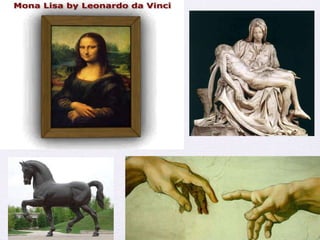
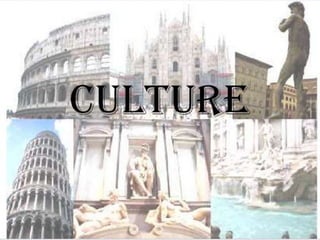
An emphasis on Culture
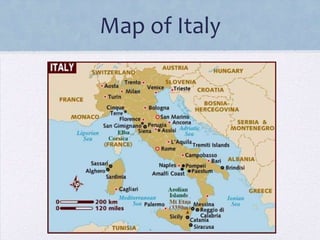
Map of Italy
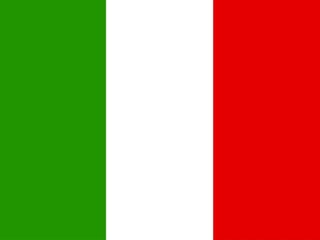
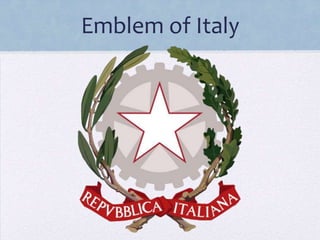
Emblem of Italy
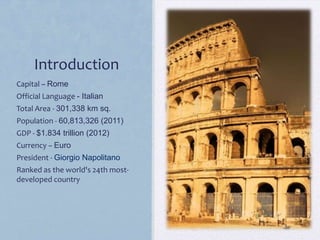
Introduction
Capital – Rome
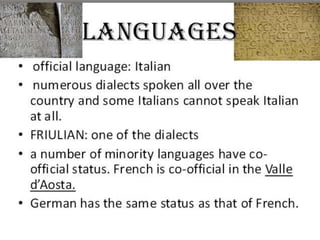
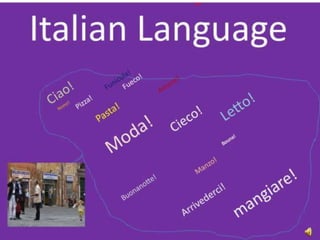
Official Language - Italian
Total Area - 301,338 km sq.
Population - 60,813,326 (2011)
GDP - $1.834 trillion (2012)
Currency – Euro
President - Giorgio Napolitano
Ranked as the world's 24th mostdeveloped country
History
Civilization And Invasion
• The migrations of Indo-European peoples into
Italy begun in 2000 B.C.
• The Etruscan civilization dominated from
about the 9th century B.C. till 3rd century B.C.
• By 264 B.C., all Italy south of Cisalpine Gaul was
under the leadership of Rome.

• They ruled for next 7 centuries and therefore
the history of Italy is largely the history of
Rome.
Early Modern Period
• The Black Death pandemic in 1348 left its mark
on Italy by killing one third of the population.
• Following the Italian Wars (1494 to 1559), Italy
saw a long period of relative peace under
• 1. Habsburg Spain (1559 to 1713)
• 2. Habsburg Austria (1713 to 1796)

• During 1800s, Italy was unified by Napoléon,
who crowned himself as the King in 1805.
During

th
19

Century

• But with the Congress of Vienna in 1815,
Austria once again became the dominant
power in a disunited Italy.

• Austrian armies crushed Italian uprisings in
1820–1821 and 1831.
• In 1830s, Giuseppe Mazzini, a brilliant liberal
nationalist, organized the Resurrection, which
laid the foundation for Italian unity.
Unification
of Italy

• Victor Emmanuel II, king
of Sardinia, was
proclaimed king of Italy
in 1861.
• With this, Italy was
united on 17th March,
1861.
During the World Wars
• In 1915, Italy entered the war on the side of the Allies
but obtained less territory than it expected in the
postwar settlement.
• Benito Mussolini, a former Socialist, organized
discontented Italians in 1919 into the Fascist Party to
“rescue Italy from Bolshevism.”

• On Oct 28, 1922 he became the prime minister and
transformed Italy into a dictatorship
• He allied himself with Adolf Hitler in the Rome-Berlin
Axis in 1936.
• When the Allies invaded Italy in 1943, Mussolini's
dictatorship collapsed.
• Finally on 2nd June 1946,
Italy became a Republic.

The
Republic Of
Italy

• Italy became an integral
member of NATO and
the European Economic
Community.
• Italy adopted the euro as
its currency in Jan 1999.

• Today, Italy has a
parliamentary
government based on a
proportional voting
system.
BENVENUTI IN
ITALIA
LE ARTI FAMOSI D’ITALIA
DOING BUSINESS
IN ITALY
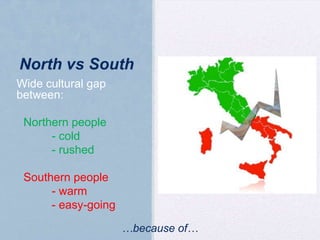
North vs South
Wide cultural gap
between:
oNorthern people
- cold
- rushed
oSouthern people
- warm
- easy-going
…because of…
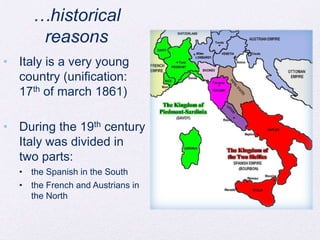
…historical
reasons
• Italy is a very young
country (unification:
17th of march 1861)
• During the 19th century
Italy was divided in
two parts:
• the Spanish in the South
• the French and Austrians in
the North
Business background
• Big percentage of small and medium sized, family-run
businesses.
• Larger companies are still controlled in large part by single
families (Fiat, Benetton etc.)

• The idea of an enterprise being an arrangement of strongly felt
relationships
• Long-standing affiliations – old society
• -Regionalism - one of the least mobile management populations
• High degree of hierarchy – usually old man (wisdom)
• The number of women and young in senior management
positions is quite small.

That’s it because of…
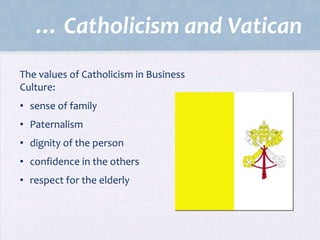
… Catholicism and Vatican
The values of Catholicism in Business
Culture:
• sense of family
• Paternalism

• dignity of the person
• confidence in the others
• respect for the elderly
Business Etiquette
• Indirect

• Fond of behavioral formulas
• Stylish
• Talkative
• Warm and tactile
• Easy-going

• Convinced (proud)
Behavioral Formals
• Good manners and courtesy are prized qualities in Italy
• Italians rate considerateness above behavioral formulas
• In the presentation: shaking always the right hand
absolutely on your feet.
• When meeting and departing always shake hands

• The guest seats always before the host
• Women enter inside the places always before men
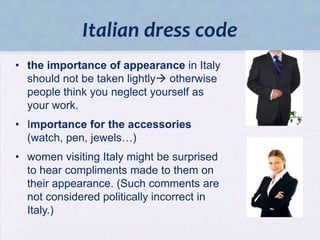
Italian dress code
• the importance of appearance in Italy
should not be taken lightly otherwise
people think you neglect yourself as
your work.
• Importance for the accessories
(watch, pen, jewels…)

• women visiting Italy might be surprised
to hear compliments made to them on
their appearance. (Such comments are
not considered politically incorrect in
Italy.)
Italian communication
style
• BODY LANGUAGE:
• little personal space is left between people

• a lot of body language also during a simple
conversation  Italian like this kind of
communication
• After doing business in Italy for a period of
time and building relationships do not be
surprised if you are embraced
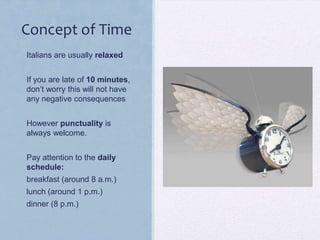
Concept of Time
• Italians are usually relaxed
• If you are late of 10 minutes,
don’t worry this will not have
any negative consequences
• However punctuality is
always welcome.
• Pay attention to the daily
schedule:
• breakfast (around 8 a.m.)
• lunch (around 1 p.m.)

• dinner (8 p.m.)
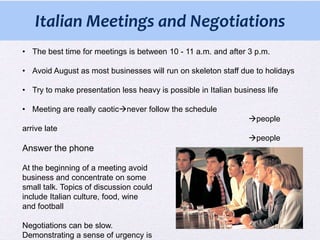
Italian Meetings and Negotiations
• The best time for meetings is between 10 - 11 a.m. and after 3 p.m.
• Avoid August as most businesses will run on skeleton staff due to holidays
• Try to make presentation less heavy is possible in Italian business life
• Meeting are really caoticnever follow the schedule
people
arrive late
people

Answer the phone
At the beginning of a meeting avoid
business and concentrate on some
small talk. Topics of discussion could
include Italian culture, food, wine
and football
Negotiations can be slow.
Demonstrating a sense of urgency is
:
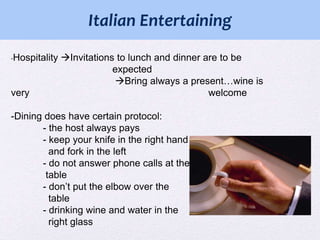
Italian Entertaining
-Hospitality

very

Invitations to lunch and dinner are to be
expected
Bring always a present…wine is
welcome

-Dining does have certain protocol:
- the host always pays
- keep your knife in the right hand
and fork in the left
- do not answer phone calls at the
table
- don’t put the elbow over the
table
- drinking wine and water in the
right glass
Free Day and Festivity
• Days in which is better not to organize work
meeting:
Saturday and Sunday
August
All the catholic festivities (Easter, Christmas, all
saints, etc…)
25th April: national party
1st may: feast of the workers
2nd June: feast of the republic
• They're both in the Eurasian continent
• Indians and Italians both love food and
celebration
• They're both young nation states
• They're both ancient civilizations
• They’re both democratic
• Both a five letter words
• Both start with an I
• Both words contain an a
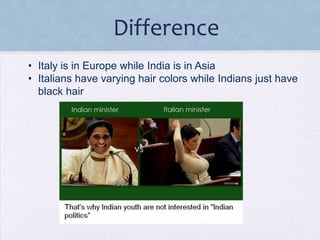
Difference
• Italy is in Europe while India is in Asia
• Italians have varying hair colors while Indians just have
black hair
Italian Inventions
• Ambulance the first ambulance service (horse drawn carts) was
instituted in 1244 in Florence by a pious organization known as
"Arciconfraternita della Misericordia"
• Bicycle. Leonardo da Vinci had designed a bicycle, which has now
been constructed and is functional
• Dictionary first dictionary widely diffused and translated in multiple
languages invented by Ambrogio Calepino in 1502.
• Eyeglasses invented by Salvino Armati in 1280
• Highway, first Autostrada built in 1921
• Nuclear reactor, first artificial reactor built by Enrico Fermi in 1942
• Radio, first long-range transmission by Guglielmo Marconi in 1895
• Typewriter first practical and perfectly working typewriter invented
by Pellegrino Turri in 1808
• University. The University of Bologna was founded in 1083 and is still
operating to this day.
• Disco music was pioneered by Italian Composer Giorgio Moroder in
1972
Thank
You !

Presentation By :
Ayush Parekh
Sunny Waugh

Sampurna Chawdhary
Suchit Chauhan

Italy : Art & Culture

  • 1.
  • 3.
  • 4.
  • 5.
    Introduction Capital – Rome OfficialLanguage - Italian Total Area - 301,338 km sq. Population - 60,813,326 (2011) GDP - $1.834 trillion (2012) Currency – Euro President - Giorgio Napolitano Ranked as the world's 24th mostdeveloped country
  • 12.
  • 13.
    Civilization And Invasion •The migrations of Indo-European peoples into Italy begun in 2000 B.C. • The Etruscan civilization dominated from about the 9th century B.C. till 3rd century B.C. • By 264 B.C., all Italy south of Cisalpine Gaul was under the leadership of Rome. • They ruled for next 7 centuries and therefore the history of Italy is largely the history of Rome.
  • 14.
    Early Modern Period •The Black Death pandemic in 1348 left its mark on Italy by killing one third of the population. • Following the Italian Wars (1494 to 1559), Italy saw a long period of relative peace under • 1. Habsburg Spain (1559 to 1713) • 2. Habsburg Austria (1713 to 1796) • During 1800s, Italy was unified by Napoléon, who crowned himself as the King in 1805.
  • 15.
    During th 19 Century • But withthe Congress of Vienna in 1815, Austria once again became the dominant power in a disunited Italy. • Austrian armies crushed Italian uprisings in 1820–1821 and 1831. • In 1830s, Giuseppe Mazzini, a brilliant liberal nationalist, organized the Resurrection, which laid the foundation for Italian unity.
  • 16.
    Unification of Italy • VictorEmmanuel II, king of Sardinia, was proclaimed king of Italy in 1861. • With this, Italy was united on 17th March, 1861.
  • 17.
    During the WorldWars • In 1915, Italy entered the war on the side of the Allies but obtained less territory than it expected in the postwar settlement. • Benito Mussolini, a former Socialist, organized discontented Italians in 1919 into the Fascist Party to “rescue Italy from Bolshevism.” • On Oct 28, 1922 he became the prime minister and transformed Italy into a dictatorship • He allied himself with Adolf Hitler in the Rome-Berlin Axis in 1936. • When the Allies invaded Italy in 1943, Mussolini's dictatorship collapsed.
  • 18.
    • Finally on2nd June 1946, Italy became a Republic. The Republic Of Italy • Italy became an integral member of NATO and the European Economic Community. • Italy adopted the euro as its currency in Jan 1999. • Today, Italy has a parliamentary government based on a proportional voting system.
  • 19.
    BENVENUTI IN ITALIA LE ARTIFAMOSI D’ITALIA
  • 42.
  • 43.
    North vs South Widecultural gap between: oNorthern people - cold - rushed oSouthern people - warm - easy-going …because of…
  • 44.
    …historical reasons • Italy isa very young country (unification: 17th of march 1861) • During the 19th century Italy was divided in two parts: • the Spanish in the South • the French and Austrians in the North
  • 45.
    Business background • Bigpercentage of small and medium sized, family-run businesses. • Larger companies are still controlled in large part by single families (Fiat, Benetton etc.) • The idea of an enterprise being an arrangement of strongly felt relationships • Long-standing affiliations – old society • -Regionalism - one of the least mobile management populations • High degree of hierarchy – usually old man (wisdom) • The number of women and young in senior management positions is quite small. That’s it because of…
  • 46.
    … Catholicism andVatican The values of Catholicism in Business Culture: • sense of family • Paternalism • dignity of the person • confidence in the others • respect for the elderly
  • 47.
    Business Etiquette • Indirect •Fond of behavioral formulas • Stylish • Talkative • Warm and tactile • Easy-going • Convinced (proud)
  • 48.
    Behavioral Formals • Goodmanners and courtesy are prized qualities in Italy • Italians rate considerateness above behavioral formulas • In the presentation: shaking always the right hand absolutely on your feet. • When meeting and departing always shake hands • The guest seats always before the host • Women enter inside the places always before men
  • 49.
    Italian dress code •the importance of appearance in Italy should not be taken lightly otherwise people think you neglect yourself as your work. • Importance for the accessories (watch, pen, jewels…) • women visiting Italy might be surprised to hear compliments made to them on their appearance. (Such comments are not considered politically incorrect in Italy.)
  • 50.
    Italian communication style • BODYLANGUAGE: • little personal space is left between people • a lot of body language also during a simple conversation  Italian like this kind of communication • After doing business in Italy for a period of time and building relationships do not be surprised if you are embraced
  • 51.
    Concept of Time •Italians are usually relaxed • If you are late of 10 minutes, don’t worry this will not have any negative consequences • However punctuality is always welcome. • Pay attention to the daily schedule: • breakfast (around 8 a.m.) • lunch (around 1 p.m.) • dinner (8 p.m.)
  • 52.
    Italian Meetings andNegotiations • The best time for meetings is between 10 - 11 a.m. and after 3 p.m. • Avoid August as most businesses will run on skeleton staff due to holidays • Try to make presentation less heavy is possible in Italian business life • Meeting are really caoticnever follow the schedule people arrive late people Answer the phone At the beginning of a meeting avoid business and concentrate on some small talk. Topics of discussion could include Italian culture, food, wine and football Negotiations can be slow. Demonstrating a sense of urgency is
  • 53.
    : Italian Entertaining -Hospitality very Invitations tolunch and dinner are to be expected Bring always a present…wine is welcome -Dining does have certain protocol: - the host always pays - keep your knife in the right hand and fork in the left - do not answer phone calls at the table - don’t put the elbow over the table - drinking wine and water in the right glass
  • 54.
    Free Day andFestivity • Days in which is better not to organize work meeting: Saturday and Sunday August All the catholic festivities (Easter, Christmas, all saints, etc…) 25th April: national party 1st may: feast of the workers 2nd June: feast of the republic
  • 55.
    • They're bothin the Eurasian continent • Indians and Italians both love food and celebration • They're both young nation states • They're both ancient civilizations • They’re both democratic • Both a five letter words • Both start with an I • Both words contain an a
  • 56.
    Difference • Italy isin Europe while India is in Asia • Italians have varying hair colors while Indians just have black hair
  • 57.
    Italian Inventions • Ambulancethe first ambulance service (horse drawn carts) was instituted in 1244 in Florence by a pious organization known as "Arciconfraternita della Misericordia" • Bicycle. Leonardo da Vinci had designed a bicycle, which has now been constructed and is functional • Dictionary first dictionary widely diffused and translated in multiple languages invented by Ambrogio Calepino in 1502. • Eyeglasses invented by Salvino Armati in 1280 • Highway, first Autostrada built in 1921 • Nuclear reactor, first artificial reactor built by Enrico Fermi in 1942 • Radio, first long-range transmission by Guglielmo Marconi in 1895 • Typewriter first practical and perfectly working typewriter invented by Pellegrino Turri in 1808 • University. The University of Bologna was founded in 1083 and is still operating to this day. • Disco music was pioneered by Italian Composer Giorgio Moroder in 1972
  • 58.
    Thank You ! Presentation By: Ayush Parekh Sunny Waugh Sampurna Chawdhary Suchit Chauhan