
IT Services Provider Presentation
CANVAS Business Model
Who we are
• Group of IT professionals from Moldova
What we want
• Provide IT services to the customers.
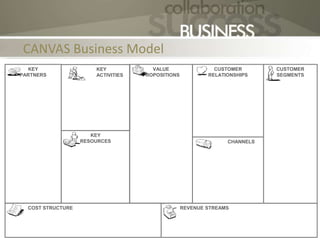
CANVAS Business Model
VALUE
PROPOSITIONS
CHANNELS
CUSTOMER
RELATIONSHIPS
CUSTOMER
SEGMENTS
REVENUE STREAMSCOST STRUCTURE
KEY
PARTNERS
KEY
RESOURCES
KEY
ACTIVITIES
Customer Segment
• Main segment of customers is a company with business,
mostly based on IT Infrastructure. For example: Financial
companies, Insurance Companies, Health Care, etc…
• Second segment is Software Development Companies and
IT Service Providers
• IT Startups
Value Propositions
• Provide high quality IT services, delivered according
Industry Standards and best practices, based on previous
experience.
• Have access to the wide range of IT Community
professionals, with a different range of services and skill
matrix.
• Concurrent market prices.
Channels
• Source Code management system (SCM): git, svn,
clearcase
• Short visits on client side (EU)
• Communications:
– Teleconference
– Skype Conference
– Shared Desktops
Customer Relationships
• Find Customer: through networking, freelance portals, Key
Persons, IT Department heads.
• Keep Customer: provide high quality services with
concurrent prices, analyses existing systems, focusing on
problem solution, improve customer business
Revenue Streams
• Development: 20-25 $/h
• Architecture: 30-35 $/h
• Testing: 15-20$/h
• Analysis: 30-35$/h
• ITSM: 20$/h
Key Resources
• Human Resources:
– Software Architect (1)
– Software Developer (3)
– Software Tester (2)
• Hardware Resources:
– Server (1-2)
– Desktop/Laptops (6)
– Network (switch, router, load balancer)
Key Activities
• Interview with customers in order to define their needs. Output is
Conceptualization/Specification document.
• Define an architecture proposal for improving current IT system or
design brand new one application to satisfy customer needs. Output
is Architecture (High/Low) design document.
• Review of existing IT systems according industry standards. Output is
a report which covers: security analysis, database logical/physical
structure review, architecture review, implementation (code review)
with proposal on how to improve. Every review type is based on
quantitative metrics, which helps to measure every aspect of
application in number format.
Key Activities (continue 2 of 3)
• Create Minimum Value Product (MVP) prototypes in order to
demonstrate a core functionality of proposal to customer. That
may help to win a project contract. Output: Simple Application.
• Create MVP for customer in order to demonstrate new
technology or framework. That may help to estimate amount
of work for future uses of this technology in commerce project.
Output: Simple Application
• User Interface prototype (Look & Feel). Output: Adobe
Photoshop file/ HTML prototype.
• Research & Development & Consulting on client side (short
visits: 1-4 weeks)
• Development
Key Activities (continue 3 from 3)
• Testing: Selenium tests, Unit testing, Integration tests,
Performance Testing.
• Build: design automation building tasks for
build/release/deploy of software package
• Design: Provide documentation for existing system/code.
• Implementation: implement software modules according
requirements, defect fixes
Services for IT Companies (Extended Team model)
Key Partnerships
• Key Persons in Company’s IT Departments
• IT Consulting Companies
• System Integrators
Cost Structure
• Server: 1-2K $
• Another Hardware: 1K $
• Network: 150$

IT Profile CANVAS Presentation

  • 1.
    IT Services ProviderPresentation CANVAS Business Model
  • 2.
    Who we are •Group of IT professionals from Moldova What we want • Provide IT services to the customers.
  • 3.
  • 4.
    Customer Segment • Mainsegment of customers is a company with business, mostly based on IT Infrastructure. For example: Financial companies, Insurance Companies, Health Care, etc… • Second segment is Software Development Companies and IT Service Providers • IT Startups
  • 5.
    Value Propositions • Providehigh quality IT services, delivered according Industry Standards and best practices, based on previous experience. • Have access to the wide range of IT Community professionals, with a different range of services and skill matrix. • Concurrent market prices.
  • 6.
    Channels • Source Codemanagement system (SCM): git, svn, clearcase • Short visits on client side (EU) • Communications: – Teleconference – Skype Conference – Shared Desktops
  • 7.
    Customer Relationships • FindCustomer: through networking, freelance portals, Key Persons, IT Department heads. • Keep Customer: provide high quality services with concurrent prices, analyses existing systems, focusing on problem solution, improve customer business
  • 8.
    Revenue Streams • Development:20-25 $/h • Architecture: 30-35 $/h • Testing: 15-20$/h • Analysis: 30-35$/h • ITSM: 20$/h
  • 9.
    Key Resources • HumanResources: – Software Architect (1) – Software Developer (3) – Software Tester (2) • Hardware Resources: – Server (1-2) – Desktop/Laptops (6) – Network (switch, router, load balancer)
  • 10.
    Key Activities • Interviewwith customers in order to define their needs. Output is Conceptualization/Specification document. • Define an architecture proposal for improving current IT system or design brand new one application to satisfy customer needs. Output is Architecture (High/Low) design document. • Review of existing IT systems according industry standards. Output is a report which covers: security analysis, database logical/physical structure review, architecture review, implementation (code review) with proposal on how to improve. Every review type is based on quantitative metrics, which helps to measure every aspect of application in number format.
  • 11.
    Key Activities (continue2 of 3) • Create Minimum Value Product (MVP) prototypes in order to demonstrate a core functionality of proposal to customer. That may help to win a project contract. Output: Simple Application. • Create MVP for customer in order to demonstrate new technology or framework. That may help to estimate amount of work for future uses of this technology in commerce project. Output: Simple Application • User Interface prototype (Look & Feel). Output: Adobe Photoshop file/ HTML prototype. • Research & Development & Consulting on client side (short visits: 1-4 weeks) • Development
  • 12.
    Key Activities (continue3 from 3) • Testing: Selenium tests, Unit testing, Integration tests, Performance Testing. • Build: design automation building tasks for build/release/deploy of software package • Design: Provide documentation for existing system/code. • Implementation: implement software modules according requirements, defect fixes Services for IT Companies (Extended Team model)
  • 13.
    Key Partnerships • KeyPersons in Company’s IT Departments • IT Consulting Companies • System Integrators
  • 14.
    Cost Structure • Server:1-2K $ • Another Hardware: 1K $ • Network: 150$