5/14/2020
1
Richard Cascarino CISM,
CIA, ACFE, CRMA
Ethics for Internal
Auditors
About Jim Kaplan, CIA, CFE
 President and Founder of AuditNet®,
the global resource for auditors
(available on iOS, Android and
Windows devices)
 Auditor, Web Site Guru,
 Internet for Auditors Pioneer
 IIA Bradford Cadmus Memorial Award
Recipient
 Local Government Auditor’s Lifetime
Award
 Author of “The Auditor’s Guide to
Internet Resources” 2nd Edition
Page 2
1
2
5/14/2020
2
ABOUT AUDITNET® LLC
• AuditNet®, the global resource for auditors, serves the global audit
community as the primary resource for Web-based auditing content. As the first online
audit portal, AuditNet® has been at the forefront of websites dedicated to promoting the
use of audit technology.
• Available on the Web, iPad, iPhone, Windows and Android devices and
features:
• Over 3,100 Reusable Templates, Audit Programs, Questionnaires, and
Control Matrices
• Webinars focusing on fraud, data analytics, IT audit, and internal audit
with free CPE for subscribers and site license users.
• Audit guides, manuals, and books on audit basics and using audit
technology
• LinkedIn Networking Groups
• Monthly Newsletters with Expert Guest Columnists
• Surveys on timely topics for internal auditors
Introductions
Page 3
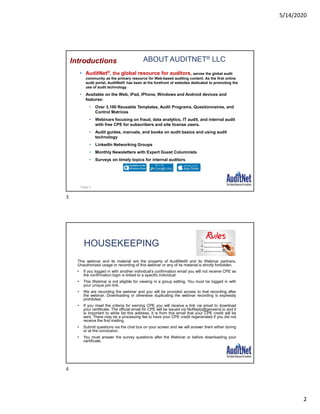
HOUSEKEEPING
This webinar and its material are the property of AuditNet® and its Webinar partners.
Unauthorized usage or recording of this webinar or any of its material is strictly forbidden.
• If you logged in with another individual’s confirmation email you will not receive CPE as
the confirmation login is linked to a specific individual
• This Webinar is not eligible for viewing in a group setting. You must be logged in with
your unique join link.
• We are recording the webinar and you will be provided access to that recording after
the webinar. Downloading or otherwise duplicating the webinar recording is expressly
prohibited.
• If you meet the criteria for earning CPE you will receive a link via email to download
your certificate. The official email for CPE will be issued via NoReply@gensend.io and it
is important to white list this address. It is from this email that your CPE credit will be
sent. There may be a processing fee to have your CPE credit regenerated if you did not
receive the first mailing.
• Submit questions via the chat box on your screen and we will answer them either during
or at the conclusion.
• You must answer the survey questions after the Webinar or before downloading your
certificate.
3
4
5/14/2020
3
IMPORTANT INFORMATION
REGARDING CPE!
• ATTENDEES - If you attend the entire Webinar and meet the criteria for CPE you will receive
an email with the link to download your CPE certificate. The official email for CPE will be
issued via NoReply@gensend.io and it is important to white list this address. It is from this
email that your CPE credit will be sent. There may be a processing fee to have your CPE credit
regenerated after the initial distribution.
• We cannot manually generate a CPE certificate as these are handled by our 3rd party provider.
We highly recommend that you work with your IT department to identify and correct any email
delivery issues prior to attending the Webinar. Issues would include blocks or spam filters in
your email system or a firewall that will redirect or not allow delivery of this email from
Gensend.io
• You must opt in for our mailing list. If you indicate you do not want to receive our emails your
registration will be cancelled and you will not be able to attend the Webinar.
• We are not responsible for any connection, audio or other computer related issues. You must
have pop-ups enabled on you computer otherwise you will not be able to answer the polling
questions which occur approximately every 20 minutes. We suggest that if you have any
pressing issues to see to that you do so immediately after a polling question.
The views expressed by the presenters do not necessarily represent the views,
positions, or opinions of AuditNet® LLC. These materials, and the oral presentation
accompanying them, are for educational purposes only and do not constitute
accounting or legal advice or create an accountant-client relationship.
While AuditNet® makes every effort to ensure information is accurate and complete,
AuditNet® makes no representations, guarantees, or warranties as to the accuracy or
completeness of the information provided via this presentation. AuditNet® specifically
disclaims all liability for any claims or damages that may result from the information
contained in this presentation, including any websites maintained by third parties and
linked to the AuditNet® website.
Any mention of commercial products is for information only; it does not imply
recommendation or endorsement by AuditNet® LLC
5
6
5/14/2020
4
ABOUT RICHARD CASCARINO,
MBA, CIA, CISM, CFE, CRMA
• Principal of Richard Cascarino &
Associates based in Colorado USA
• Over 28 years experience in IT audit
training and consultancy
• Past President of the Institute of
Internal Auditors in South Africa
• Member of ISACA
• Member of Association of Certified
Fraud Examiners
• Author of Data Analytics for Internal
Auditors
7
Today’s Agenda
Major terms involved in ethics and business
ethics in particular
Levels of business at which ethics is evaluated
and the core issues involved
Why ethics is necessary on the personal and
organisational level
Distinguish between ‘morality’ and ‘ethics’
Why IIA professional ethics and professional
virtues are important.
Page 8
7
8
5/14/2020
5
Overall Ethical Values
Honesty
Integrity
Promise-keeping
Fidelity
Fairness
Caring
Respect
Responsibility
Striving for Excellence
Accountability
Ethics Theory
What are Ethics?
Go beyond moral principles
Designed for both practical and idealistic purposes
"above the law but below the ideal"
(Kell & Zeigler)
A professional way of life
Wheelwright's three key elements
Ethics involve questions requiring reflective choice
Ethics involve guides of right and wrong
Ethics are concerned with consequences of decisions
10
9
10
5/14/2020
6
Ethics Theory
 Religious Ethics – an authoritative rule book to tell us what
rules to follow.
 Duty Ethics - Fulfill your obligations. Duties and rights are
two sides of the same coin.
 Utilitarianism – There is one and only one supreme moral
principal – that we should seek the greatest happiness of the
greatest number. Maximize happiness. Jeremy Bentham and
John Stuart Mill (1800).
 Kant’s Approach To Ethics – Can your actions be
consistently generalized? Ask yourself “What if everyone did
that?”. According to Kant, if something is wrong, it is always
wrong!
In Kant’s view, happiness does not equal morality. Only a
good will has ultimate moral value. Moral rules should be
universal.
Special pleading – rationalizing to ourselves
The golden rule - treat others the way you
wish to be treated
Veil of ignorance - imagine the situation
from both points of view
Kant’s Approach to Ethics
11
12
5/14/2020
7
Ethics in Differing Religions
Common heritage going back a thousand
years before Christ
have important internal distinctions and structures
Orthodox Judaism, Reform or Progressive Judaism
Roman Catholic, Eastern Orthodox, Anglican, Protestant and
Pentecostal ... and others
Four shared features of the ethics of Jewish and Christian
people.
Jewish Ethics
Grounded in the Torah
Mitzvoth (ethical commandments)
The golden rule
That which is hateful unto you, do not do unto others. Thou
shalt love thy neighbour as thyself
The Talmud
Prophecy.
13
14
5/14/2020
8
Christian ethics
Ethics concerned with conscientiously living a whole
Christian life
 Loving invitation and free response rather than law and duty
Jesus of Nazareth
Core moral guidelines in Christianity
Natural law
Sources of moral guidance
 The Bible
 Reason
 Tradition
 Experience
Modern moral maze.
Islamic ethics
Origins in Arabia
Islam means peace – engaged surrender or
submission to God or Allah’s will
Central belief: acceptance of God’s oneness and the
prophethood of Muhammad
 Sources of moral guidance
• Qur’an
• Muhammad’s example
• shari’a (Islamic law)
Basis for evaluating ethical behaviour: God’s will
Action-based
Modern debate for Muslims today.
15
16
5/14/2020
9
Hindu ethics
Origins in India – oldest of Indian traditions
The eternal way
A richly diverse value system – tolerant & flexible
Deeds count more than sameness of belief
 Life’s goals
 Karma (actions)
 Dharma (right or appropriate actions)
Sources of ethics
 Various scriptures, such as Great Epic, the popular Ramayana and the Gita
Some controversial earlier practices
Modern revitalising movements.
Internal Auditors must balance
Their personal feelings and moral
standards
The IIA code of ethics
Applicable statutes
An empathetic approach to attitudes
The auditee's
Management's
Society's
The law's
18
17
18
5/14/2020
10
A Body of Ethics
The hallmark of a profession
A profession characterized by
Acceptance by society
Service to society
A common body of knowledge
A body of standards of the technical requirements and
methodology of the profession
A body of ethics
The imposition by itself or by society when the ethics or
standards are not upheld
19
Ethics Therefore
Help establish credibility of the members of the
profession
Establish public confidence in the profession as a whole
Establish a common guideline for measurement
Allow judgement by peers
To be effective they must
 Be known
 Be enforced vigorously and objectively
 Be seen to be effective
20
19
20
5/14/2020
11
Applicable areas within Internal
Audit
Attitudes and actions relative to the organization
• Management
• Auditees
• Others
Attitudes and actions relative to other auditors
Professional proficiency and competence
Other ethical issues
Integrity
Objectivity
Independence
Acts bringing the profession into disrepute
21
Ethics and Business
Amoral
Business is business and law = ethics
Ethically unaware (naïve)
Business exists only to make money
Immoral
If you don’t get caught it isn’t wrong
Unethical for the firm / Unethical against the firm
The Moral Employee
Ethically aware
Proactive
Code of conduct
21
22
5/14/2020
12
Classes of Ethics (1)
Imperative Principle
Requires strict compliance with the code
• No choices
• No rules with exceptions allowed
• No "lesser of two evils"
May cause problems when two or more provisions appear to be
at odds
May cause problems when the ethical principle produces results
out of proportion to the materiality
23
Classes of Ethics (2)
Utilarianism
Course of action bringing most good to most people
Primary support of social ethics in countries
Act utilarianism
• Acts must lead to the greatest good for the greatest number
• If rules do not assist this, they are to be broken
Rule utilarianism
• Firm and publicly advocated moral rules
• All acts must conform to these
• No special cases
24
23
24
5/14/2020
13
Classes of Ethics (3)
Deontological Ethics
Concern is on the consequences of acts
Actions result from the concepts of duty
Principles are "independent of each person's conscience" (Kant)
Consistency is a requirement and conscience may condone acts
which could lead to societal disintegration
25
Role of Business
Classical theories
Plato, Aristotle and Adam Smith
Business has no relationship to societal goals and social
objectives
"The purpose of business is business" (Friedman)
The Ethics Egoist
Achieving egoistical goals
Following established rules for the benefit of all
Social Responsibility
Held by "Moralists"
Business should have special goals
Business as a good citizen (Kant)
Social responsibilities beyond profits
26
25
26
5/14/2020
14
Ethics of Employees
The Duty of Obedience
A duty to obey all reasonable directions
No obligation to perform illegal or unethical acts
The Duty of Loyalty
Acts should be performed only in the interest of employers
• Only when acting as an employee
27
The Duty of Confidentiality
Information acquired as a result of the
organization's operations may not be used
to further the interests of the employee or
another
Does not apply if the information is general
knowledge
28
27
28
5/14/2020
15
Codes of Conduct
Do not enforce "ethical" behavior
Serve as a means of expelling non-conforming members
of a population
Should be in place for all companies (recommended in
1987 by the Treadway Commission and 1994 by King)
Should be enforced
Internal Auditors can assist management in its design
Can then be reviewed and appraised by Internal Audit
29
ETHICAL GUIDELINES
FOR AUDIT PROFESSIONALS
Special Aspects of Professional Ethics
 Internal Audit Professionals:
 Are experts in their field,
 Know customers rely on their knowledge, expertise, and honesty,
 Understand their products (and related risks) affect many people,
 Follow good professional standards and practices,
 Maintain an expected level of competence and are up-to-date on
current knowledge and technology, and
 Educate the non-audit professional.
29
30
5/14/2020
16
“He or she must go beyond the
rules, thinking about why the
rules are necessary and written
as they are – in other words, the
substance behind the form.”
Ethical Issues in the Practice of Accounting, p.38 [ref. 2]
Professional Practices Framework
• Code of Ethics
• Attribute, Performance, &
Implementation Standards
32
Ethics &
Standards
Practice
Advisories
Development &
Practice Aids
•Books
•Research Studies
•Seminars
•Conferences
• Professional Practices
Guidance, Representation
31
32
5/14/2020
17
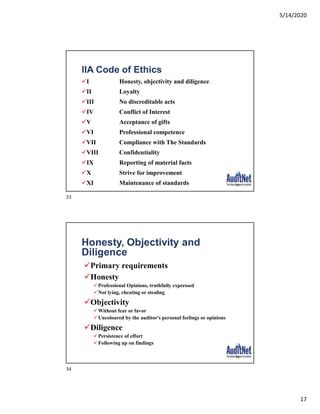
IIA Code of Ethics
I Honesty, objectivity and diligence
II Loyalty
III No discreditable acts
IV Conflict of Interest
V Acceptance of gifts
VI Professional competence
VII Compliance with The Standards
VIII Confidentiality
IX Reporting of material facts
X Strive for improvement
XI Maintenance of standards 33
Honesty, Objectivity and
Diligence
Primary requirements
Honesty
Professional Opinions, truthfully expressed
Not lying, cheating or stealing
Objectivity
Without fear or favor
Uncoloured by the auditor's personal feelings or opinions
Diligence
Persistence of effort
Following up on findings
34
33
34
5/14/2020
18
Loyalty
To
 Organization
 Management
 Auditee
 Public
Placing the organization's interests first
Loyalty does not require the Internal Auditor to break
the law
 Non-disclosure of illegal activities
 Becoming party to an illegal act
It does, however, preclude whistle-blowing except where
the Internal Auditor has been so tasked
35
Discreditable Acts
Internal Auditors shall not knowingly
participate in:
Acts which are discreditable to the organization
Acts which are discreditable to Internal Auditing
Discrediting
Anything which leads to a loss of repute
Anything which causes doubt
Includes
Unprofessional activities
Acts directly against the interest of the organisation
36
35
36
5/14/2020
19
Conflicts of Interest
Activities in conflict with the interests of their
organizations
Activities which could prejudice the Auditor's ability to
carry out his responsibilities
 Actual
 Perceived
May include
 Auditing in areas where there was a recent line management role
 Auditing in areas where there will in the future be a line role
 Auditing in areas where there is a family connection
 Auditing in areas where there is a vested interest
37
Acceptance of Gifts
From
Employees
Clients
Customers
Suppliers
Business Associates
38
37
38
5/14/2020
20
Items of Value
Items which could impair objectivity
 Actual
 Presumed
Previously "Items which could not be utilized
in one day"
Previously acceptable if the gift had
management's blessing
Now only non-valuable and promotional items
freely available may be accepted
39
Professional Competence
Internal Auditors shall be professionally
competent
Refuse work in areas where they are not
competent
Competent
Knowledge
Skills
Disciplines
Does not imply infallibility
40
39
40
5/14/2020
21
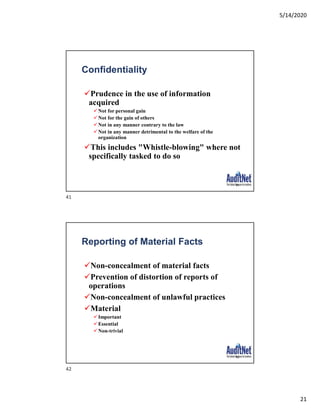
Confidentiality
Prudence in the use of information
acquired
Not for personal gain
Not for the gain of others
Not in any manner contrary to the law
Not in any manner detrimental to the welfare of the
organization
This includes "Whistle-blowing" where not
specifically tasked to do so
41
Reporting of Material Facts
Non-concealment of material facts
Prevention of distortion of reports of
operations
Non-concealment of unlawful practices
Material
Important
Essential
Non-trivial
42
41
42
5/14/2020
22
Strive for Improvement
Continuous
Improvement in Proficiency
Improvement in the Quality of Service
Efficiency
Effectiveness
Economy
Ongoing Professional Development
Training
Reading
Conferences
43
Maintenance of Standards
Competence
Morality
Dignity
Abiding by the Bylaws of the Institute
Upholding the Objectives of the Institute
44
43
44
5/14/2020
23
EVALUATING ETHICAL CHOICES
Is the action you have arrived at one that lives up to your
sense of moral integrity?
[Could I do this and still look at myself in the mirror]
Would it be the action chosen by someone you consider
a moral model?
[Could I feel good about telling my mother (father, minister, spiritual advisor,
spouse, etc.) I took this action]
Would you be comfortable if the action or its results were
made public?
[What if this became headline news?]
The Ethics Audit
Systematic evaluation of an organization’s
ethics program and performance to
determine whether it is effective
Regular, complete, and documented measurements of
compliance with policies and procedures
Can be a precursor to establishing an ethics program
Helps to identify the firm’s current ethical standards, policies,
and risk areas
45
46
5/14/2020
24
Benefits of an Ethics Audit
Identify potential risks and liabilities and
improve legal compliance
Can be key in improving organizational
performance
Improved relationships with stakeholders
Pressure to account for actions in areas including corporate
governance, ethics programs, customer relationships, employee
relations, environmental policies, and community involvement
ASKING KEY QUESTIONS
What are the core values and beliefs of my organization?
Whose values, beliefs and interests may be at risk in this
decision?
Who will be harmed or helped by this decision or by the
decision of my organization?
How will my own or my organization’s core values and
beliefs be affected or changed by this decision?
How will I and my organization be affected by this
decision.
47
48
5/14/2020
25
Risks in Ethics Auditing
Ethics audits may uncover ethical problems
that a company cannot remedy
Stakeholders may be dissatisfied with the
information
Conducting the audits is a financial and
record keeping burden
No guarantee that auditing is the solution to
ethics concerns
QUESTIONS?
Any Questions?
Don’t be Shy!
49
50
5/14/2020
26
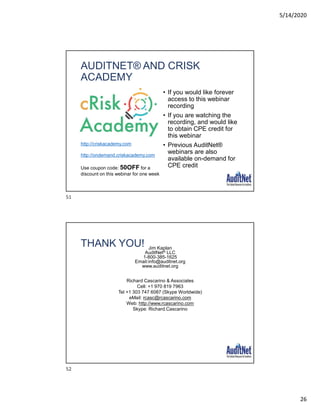
AUDITNET® AND CRISK
ACADEMY
• If you would like forever
access to this webinar
recording
• If you are watching the
recording, and would like
to obtain CPE credit for
this webinar
• Previous AuditNet®
webinars are also
available on-demand for
CPE credit
http://criskacademy.com
http://ondemand.criskacademy.com
Use coupon code: 50OFF for a
discount on this webinar for one week
THANK YOU! Jim Kaplan
AuditNet® LLC
1-800-385-1625
Email:info@auditnet.org
www.auditnet.org
Richard Cascarino & Associates
Cell: +1 970 819 7963
Tel +1 303 747 6087 (Skype Worldwide)
eMail: rcasc@rcascarino.com
Web: http://www.rcascarino.com
Skype: Richard.Cascarino
51
52

Ethics and the Internal Auditor

  • 1.
    5/14/2020 1 Richard Cascarino CISM, CIA,ACFE, CRMA Ethics for Internal Auditors About Jim Kaplan, CIA, CFE  President and Founder of AuditNet®, the global resource for auditors (available on iOS, Android and Windows devices)  Auditor, Web Site Guru,  Internet for Auditors Pioneer  IIA Bradford Cadmus Memorial Award Recipient  Local Government Auditor’s Lifetime Award  Author of “The Auditor’s Guide to Internet Resources” 2nd Edition Page 2 1 2
  • 2.
    5/14/2020 2 ABOUT AUDITNET® LLC •AuditNet®, the global resource for auditors, serves the global audit community as the primary resource for Web-based auditing content. As the first online audit portal, AuditNet® has been at the forefront of websites dedicated to promoting the use of audit technology. • Available on the Web, iPad, iPhone, Windows and Android devices and features: • Over 3,100 Reusable Templates, Audit Programs, Questionnaires, and Control Matrices • Webinars focusing on fraud, data analytics, IT audit, and internal audit with free CPE for subscribers and site license users. • Audit guides, manuals, and books on audit basics and using audit technology • LinkedIn Networking Groups • Monthly Newsletters with Expert Guest Columnists • Surveys on timely topics for internal auditors Introductions Page 3 HOUSEKEEPING This webinar and its material are the property of AuditNet® and its Webinar partners. Unauthorized usage or recording of this webinar or any of its material is strictly forbidden. • If you logged in with another individual’s confirmation email you will not receive CPE as the confirmation login is linked to a specific individual • This Webinar is not eligible for viewing in a group setting. You must be logged in with your unique join link. • We are recording the webinar and you will be provided access to that recording after the webinar. Downloading or otherwise duplicating the webinar recording is expressly prohibited. • If you meet the criteria for earning CPE you will receive a link via email to download your certificate. The official email for CPE will be issued via NoReply@gensend.io and it is important to white list this address. It is from this email that your CPE credit will be sent. There may be a processing fee to have your CPE credit regenerated if you did not receive the first mailing. • Submit questions via the chat box on your screen and we will answer them either during or at the conclusion. • You must answer the survey questions after the Webinar or before downloading your certificate. 3 4
  • 3.
    5/14/2020 3 IMPORTANT INFORMATION REGARDING CPE! •ATTENDEES - If you attend the entire Webinar and meet the criteria for CPE you will receive an email with the link to download your CPE certificate. The official email for CPE will be issued via NoReply@gensend.io and it is important to white list this address. It is from this email that your CPE credit will be sent. There may be a processing fee to have your CPE credit regenerated after the initial distribution. • We cannot manually generate a CPE certificate as these are handled by our 3rd party provider. We highly recommend that you work with your IT department to identify and correct any email delivery issues prior to attending the Webinar. Issues would include blocks or spam filters in your email system or a firewall that will redirect or not allow delivery of this email from Gensend.io • You must opt in for our mailing list. If you indicate you do not want to receive our emails your registration will be cancelled and you will not be able to attend the Webinar. • We are not responsible for any connection, audio or other computer related issues. You must have pop-ups enabled on you computer otherwise you will not be able to answer the polling questions which occur approximately every 20 minutes. We suggest that if you have any pressing issues to see to that you do so immediately after a polling question. The views expressed by the presenters do not necessarily represent the views, positions, or opinions of AuditNet® LLC. These materials, and the oral presentation accompanying them, are for educational purposes only and do not constitute accounting or legal advice or create an accountant-client relationship. While AuditNet® makes every effort to ensure information is accurate and complete, AuditNet® makes no representations, guarantees, or warranties as to the accuracy or completeness of the information provided via this presentation. AuditNet® specifically disclaims all liability for any claims or damages that may result from the information contained in this presentation, including any websites maintained by third parties and linked to the AuditNet® website. Any mention of commercial products is for information only; it does not imply recommendation or endorsement by AuditNet® LLC 5 6
  • 4.
    5/14/2020 4 ABOUT RICHARD CASCARINO, MBA,CIA, CISM, CFE, CRMA • Principal of Richard Cascarino & Associates based in Colorado USA • Over 28 years experience in IT audit training and consultancy • Past President of the Institute of Internal Auditors in South Africa • Member of ISACA • Member of Association of Certified Fraud Examiners • Author of Data Analytics for Internal Auditors 7 Today’s Agenda Major terms involved in ethics and business ethics in particular Levels of business at which ethics is evaluated and the core issues involved Why ethics is necessary on the personal and organisational level Distinguish between ‘morality’ and ‘ethics’ Why IIA professional ethics and professional virtues are important. Page 8 7 8
  • 5.
    5/14/2020 5 Overall Ethical Values Honesty Integrity Promise-keeping Fidelity Fairness Caring Respect Responsibility Strivingfor Excellence Accountability Ethics Theory What are Ethics? Go beyond moral principles Designed for both practical and idealistic purposes "above the law but below the ideal" (Kell & Zeigler) A professional way of life Wheelwright's three key elements Ethics involve questions requiring reflective choice Ethics involve guides of right and wrong Ethics are concerned with consequences of decisions 10 9 10
  • 6.
    5/14/2020 6 Ethics Theory  ReligiousEthics – an authoritative rule book to tell us what rules to follow.  Duty Ethics - Fulfill your obligations. Duties and rights are two sides of the same coin.  Utilitarianism – There is one and only one supreme moral principal – that we should seek the greatest happiness of the greatest number. Maximize happiness. Jeremy Bentham and John Stuart Mill (1800).  Kant’s Approach To Ethics – Can your actions be consistently generalized? Ask yourself “What if everyone did that?”. According to Kant, if something is wrong, it is always wrong! In Kant’s view, happiness does not equal morality. Only a good will has ultimate moral value. Moral rules should be universal. Special pleading – rationalizing to ourselves The golden rule - treat others the way you wish to be treated Veil of ignorance - imagine the situation from both points of view Kant’s Approach to Ethics 11 12
  • 7.
    5/14/2020 7 Ethics in DifferingReligions Common heritage going back a thousand years before Christ have important internal distinctions and structures Orthodox Judaism, Reform or Progressive Judaism Roman Catholic, Eastern Orthodox, Anglican, Protestant and Pentecostal ... and others Four shared features of the ethics of Jewish and Christian people. Jewish Ethics Grounded in the Torah Mitzvoth (ethical commandments) The golden rule That which is hateful unto you, do not do unto others. Thou shalt love thy neighbour as thyself The Talmud Prophecy. 13 14
  • 8.
    5/14/2020 8 Christian ethics Ethics concernedwith conscientiously living a whole Christian life  Loving invitation and free response rather than law and duty Jesus of Nazareth Core moral guidelines in Christianity Natural law Sources of moral guidance  The Bible  Reason  Tradition  Experience Modern moral maze. Islamic ethics Origins in Arabia Islam means peace – engaged surrender or submission to God or Allah’s will Central belief: acceptance of God’s oneness and the prophethood of Muhammad  Sources of moral guidance • Qur’an • Muhammad’s example • shari’a (Islamic law) Basis for evaluating ethical behaviour: God’s will Action-based Modern debate for Muslims today. 15 16
  • 9.
    5/14/2020 9 Hindu ethics Origins inIndia – oldest of Indian traditions The eternal way A richly diverse value system – tolerant & flexible Deeds count more than sameness of belief  Life’s goals  Karma (actions)  Dharma (right or appropriate actions) Sources of ethics  Various scriptures, such as Great Epic, the popular Ramayana and the Gita Some controversial earlier practices Modern revitalising movements. Internal Auditors must balance Their personal feelings and moral standards The IIA code of ethics Applicable statutes An empathetic approach to attitudes The auditee's Management's Society's The law's 18 17 18
  • 10.
    5/14/2020 10 A Body ofEthics The hallmark of a profession A profession characterized by Acceptance by society Service to society A common body of knowledge A body of standards of the technical requirements and methodology of the profession A body of ethics The imposition by itself or by society when the ethics or standards are not upheld 19 Ethics Therefore Help establish credibility of the members of the profession Establish public confidence in the profession as a whole Establish a common guideline for measurement Allow judgement by peers To be effective they must  Be known  Be enforced vigorously and objectively  Be seen to be effective 20 19 20
  • 11.
    5/14/2020 11 Applicable areas withinInternal Audit Attitudes and actions relative to the organization • Management • Auditees • Others Attitudes and actions relative to other auditors Professional proficiency and competence Other ethical issues Integrity Objectivity Independence Acts bringing the profession into disrepute 21 Ethics and Business Amoral Business is business and law = ethics Ethically unaware (naïve) Business exists only to make money Immoral If you don’t get caught it isn’t wrong Unethical for the firm / Unethical against the firm The Moral Employee Ethically aware Proactive Code of conduct 21 22
  • 12.
    5/14/2020 12 Classes of Ethics(1) Imperative Principle Requires strict compliance with the code • No choices • No rules with exceptions allowed • No "lesser of two evils" May cause problems when two or more provisions appear to be at odds May cause problems when the ethical principle produces results out of proportion to the materiality 23 Classes of Ethics (2) Utilarianism Course of action bringing most good to most people Primary support of social ethics in countries Act utilarianism • Acts must lead to the greatest good for the greatest number • If rules do not assist this, they are to be broken Rule utilarianism • Firm and publicly advocated moral rules • All acts must conform to these • No special cases 24 23 24
  • 13.
    5/14/2020 13 Classes of Ethics(3) Deontological Ethics Concern is on the consequences of acts Actions result from the concepts of duty Principles are "independent of each person's conscience" (Kant) Consistency is a requirement and conscience may condone acts which could lead to societal disintegration 25 Role of Business Classical theories Plato, Aristotle and Adam Smith Business has no relationship to societal goals and social objectives "The purpose of business is business" (Friedman) The Ethics Egoist Achieving egoistical goals Following established rules for the benefit of all Social Responsibility Held by "Moralists" Business should have special goals Business as a good citizen (Kant) Social responsibilities beyond profits 26 25 26
  • 14.
    5/14/2020 14 Ethics of Employees TheDuty of Obedience A duty to obey all reasonable directions No obligation to perform illegal or unethical acts The Duty of Loyalty Acts should be performed only in the interest of employers • Only when acting as an employee 27 The Duty of Confidentiality Information acquired as a result of the organization's operations may not be used to further the interests of the employee or another Does not apply if the information is general knowledge 28 27 28
  • 15.
    5/14/2020 15 Codes of Conduct Donot enforce "ethical" behavior Serve as a means of expelling non-conforming members of a population Should be in place for all companies (recommended in 1987 by the Treadway Commission and 1994 by King) Should be enforced Internal Auditors can assist management in its design Can then be reviewed and appraised by Internal Audit 29 ETHICAL GUIDELINES FOR AUDIT PROFESSIONALS Special Aspects of Professional Ethics  Internal Audit Professionals:  Are experts in their field,  Know customers rely on their knowledge, expertise, and honesty,  Understand their products (and related risks) affect many people,  Follow good professional standards and practices,  Maintain an expected level of competence and are up-to-date on current knowledge and technology, and  Educate the non-audit professional. 29 30
  • 16.
    5/14/2020 16 “He or shemust go beyond the rules, thinking about why the rules are necessary and written as they are – in other words, the substance behind the form.” Ethical Issues in the Practice of Accounting, p.38 [ref. 2] Professional Practices Framework • Code of Ethics • Attribute, Performance, & Implementation Standards 32 Ethics & Standards Practice Advisories Development & Practice Aids •Books •Research Studies •Seminars •Conferences • Professional Practices Guidance, Representation 31 32
  • 17.
    5/14/2020 17 IIA Code ofEthics I Honesty, objectivity and diligence II Loyalty III No discreditable acts IV Conflict of Interest V Acceptance of gifts VI Professional competence VII Compliance with The Standards VIII Confidentiality IX Reporting of material facts X Strive for improvement XI Maintenance of standards 33 Honesty, Objectivity and Diligence Primary requirements Honesty Professional Opinions, truthfully expressed Not lying, cheating or stealing Objectivity Without fear or favor Uncoloured by the auditor's personal feelings or opinions Diligence Persistence of effort Following up on findings 34 33 34
  • 18.
    5/14/2020 18 Loyalty To  Organization  Management Auditee  Public Placing the organization's interests first Loyalty does not require the Internal Auditor to break the law  Non-disclosure of illegal activities  Becoming party to an illegal act It does, however, preclude whistle-blowing except where the Internal Auditor has been so tasked 35 Discreditable Acts Internal Auditors shall not knowingly participate in: Acts which are discreditable to the organization Acts which are discreditable to Internal Auditing Discrediting Anything which leads to a loss of repute Anything which causes doubt Includes Unprofessional activities Acts directly against the interest of the organisation 36 35 36
  • 19.
    5/14/2020 19 Conflicts of Interest Activitiesin conflict with the interests of their organizations Activities which could prejudice the Auditor's ability to carry out his responsibilities  Actual  Perceived May include  Auditing in areas where there was a recent line management role  Auditing in areas where there will in the future be a line role  Auditing in areas where there is a family connection  Auditing in areas where there is a vested interest 37 Acceptance of Gifts From Employees Clients Customers Suppliers Business Associates 38 37 38
  • 20.
    5/14/2020 20 Items of Value Itemswhich could impair objectivity  Actual  Presumed Previously "Items which could not be utilized in one day" Previously acceptable if the gift had management's blessing Now only non-valuable and promotional items freely available may be accepted 39 Professional Competence Internal Auditors shall be professionally competent Refuse work in areas where they are not competent Competent Knowledge Skills Disciplines Does not imply infallibility 40 39 40
  • 21.
    5/14/2020 21 Confidentiality Prudence in theuse of information acquired Not for personal gain Not for the gain of others Not in any manner contrary to the law Not in any manner detrimental to the welfare of the organization This includes "Whistle-blowing" where not specifically tasked to do so 41 Reporting of Material Facts Non-concealment of material facts Prevention of distortion of reports of operations Non-concealment of unlawful practices Material Important Essential Non-trivial 42 41 42
  • 22.
    5/14/2020 22 Strive for Improvement Continuous Improvementin Proficiency Improvement in the Quality of Service Efficiency Effectiveness Economy Ongoing Professional Development Training Reading Conferences 43 Maintenance of Standards Competence Morality Dignity Abiding by the Bylaws of the Institute Upholding the Objectives of the Institute 44 43 44
  • 23.
    5/14/2020 23 EVALUATING ETHICAL CHOICES Isthe action you have arrived at one that lives up to your sense of moral integrity? [Could I do this and still look at myself in the mirror] Would it be the action chosen by someone you consider a moral model? [Could I feel good about telling my mother (father, minister, spiritual advisor, spouse, etc.) I took this action] Would you be comfortable if the action or its results were made public? [What if this became headline news?] The Ethics Audit Systematic evaluation of an organization’s ethics program and performance to determine whether it is effective Regular, complete, and documented measurements of compliance with policies and procedures Can be a precursor to establishing an ethics program Helps to identify the firm’s current ethical standards, policies, and risk areas 45 46
  • 24.
    5/14/2020 24 Benefits of anEthics Audit Identify potential risks and liabilities and improve legal compliance Can be key in improving organizational performance Improved relationships with stakeholders Pressure to account for actions in areas including corporate governance, ethics programs, customer relationships, employee relations, environmental policies, and community involvement ASKING KEY QUESTIONS What are the core values and beliefs of my organization? Whose values, beliefs and interests may be at risk in this decision? Who will be harmed or helped by this decision or by the decision of my organization? How will my own or my organization’s core values and beliefs be affected or changed by this decision? How will I and my organization be affected by this decision. 47 48
  • 25.
    5/14/2020 25 Risks in EthicsAuditing Ethics audits may uncover ethical problems that a company cannot remedy Stakeholders may be dissatisfied with the information Conducting the audits is a financial and record keeping burden No guarantee that auditing is the solution to ethics concerns QUESTIONS? Any Questions? Don’t be Shy! 49 50
  • 26.
    5/14/2020 26 AUDITNET® AND CRISK ACADEMY •If you would like forever access to this webinar recording • If you are watching the recording, and would like to obtain CPE credit for this webinar • Previous AuditNet® webinars are also available on-demand for CPE credit http://criskacademy.com http://ondemand.criskacademy.com Use coupon code: 50OFF for a discount on this webinar for one week THANK YOU! Jim Kaplan AuditNet® LLC 1-800-385-1625 Email:info@auditnet.org www.auditnet.org Richard Cascarino & Associates Cell: +1 970 819 7963 Tel +1 303 747 6087 (Skype Worldwide) eMail: rcasc@rcascarino.com Web: http://www.rcascarino.com Skype: Richard.Cascarino 51 52