The Wikipedia Survey iSummit 08 Sapporo Convention Center July 31, 2008 Philipp Schmidt, Rishab Ayer Ghosh Ruediger Glott United Nations University MERIT http://ccg.merit.unu.edu
UNU MERIT Collaborative Creativity Group FLOSS FLOSSPOLS FLOSSWORLD FLOSSINCLUDE
FLOSS
Where - FLOSS Locations of Debian GNU/Linux leaders/maintainers
Who - FLOSS FLOSS source code shares by author type


     Để thế giới ngày một tốt hơn To make the world a better place etc ....  20+ 3 FLOSS studies Other research
 &*  $£¥          
Who? Why? Quality How? Gender Formats Barriers Donations Languages Wikimedia
3   4 Open Access  
Challenges Size  Alexa: 8 th  most popular site,~ 9% of users, 0.6% pageviews, but how many users/ contributors? Sampling  anonymous readers and contributors, non-homogenous community, high turn-over rates Sharing / Open Access  (privacy, userid)
Who and Why? Basic demographics 80/20 - 95/5 – 95/95 :-)  (Wales vs Swartz) Rise of the Bourgeoisie – Temporal shift of contribution patterns (Kittur et al. 2007) Zealots - Good Samaritans (Anthony et al. 2005) EN: Edits 195M, 4000 editors (non bots) 32.82% Active Wikipedians (5 edt/mth): delta -10% +20% 25% of edits by newbies (less than 1 mth)
 
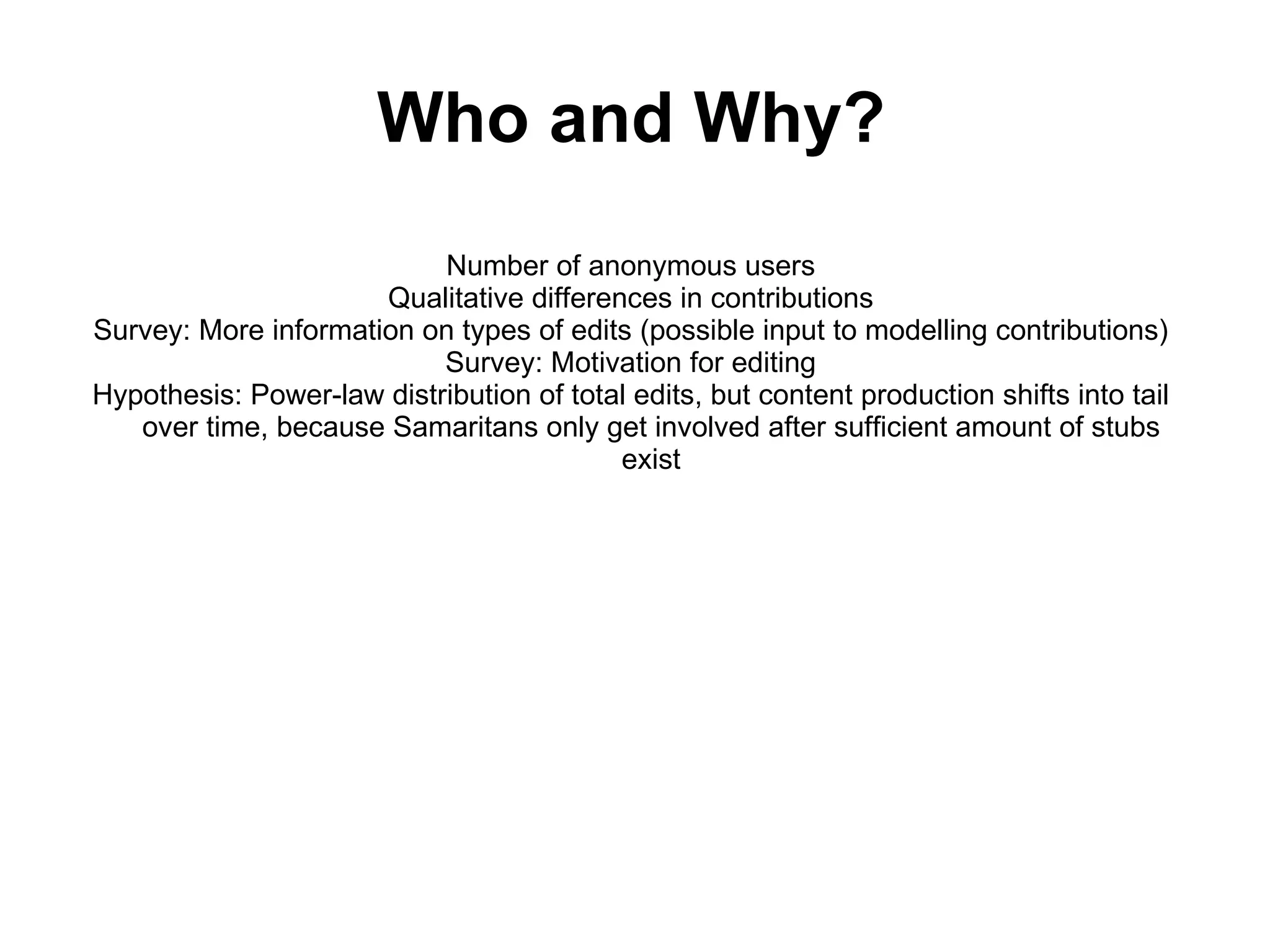
Number of anonymous users Qualitative differences in contributions Survey: More information on types of edits (possible input to modelling contributions) Survey: Motivation for editing Hypothesis: Power-law distribution of total edits, but content production shifts into tail over time, because Samaritans only get involved after sufficient amount of stubs exist Who and Why?
Quality Pagerank (Wilkinson) No. of Revisions, Authors, Words ...  Peer-review (Nature, Wedemeyer 2008) New concept and understanding of quality Awareness of quality assurance processes Diversity of expertise contributing (Page)
www.wikipediasurvey.org August 2008

iSummit 2008 - Wikipedia Survey

  • 1.
    The Wikipedia SurveyiSummit 08 Sapporo Convention Center July 31, 2008 Philipp Schmidt, Rishab Ayer Ghosh Ruediger Glott United Nations University MERIT http://ccg.merit.unu.edu
  • 2.
    UNU MERIT CollaborativeCreativity Group FLOSS FLOSSPOLS FLOSSWORLD FLOSSINCLUDE
  • 3.
  • 4.
    Where - FLOSSLocations of Debian GNU/Linux leaders/maintainers
  • 5.
    Who - FLOSSFLOSS source code shares by author type
  • 6.
  • 7.
  • 8.
  • 9.
        Để thế giới ngày một tốt hơn To make the world a better place etc ....  20+ 3 FLOSS studies Other research
  • 10.
     &* $£¥       
  • 11.
    Who? Why? QualityHow? Gender Formats Barriers Donations Languages Wikimedia
  • 12.
    3 4 Open Access  
  • 13.
    Challenges Size Alexa: 8 th most popular site,~ 9% of users, 0.6% pageviews, but how many users/ contributors? Sampling anonymous readers and contributors, non-homogenous community, high turn-over rates Sharing / Open Access (privacy, userid)
  • 14.
    Who and Why?Basic demographics 80/20 - 95/5 – 95/95 :-) (Wales vs Swartz) Rise of the Bourgeoisie – Temporal shift of contribution patterns (Kittur et al. 2007) Zealots - Good Samaritans (Anthony et al. 2005) EN: Edits 195M, 4000 editors (non bots) 32.82% Active Wikipedians (5 edt/mth): delta -10% +20% 25% of edits by newbies (less than 1 mth)
  • 15.
  • 16.
    Number of anonymoususers Qualitative differences in contributions Survey: More information on types of edits (possible input to modelling contributions) Survey: Motivation for editing Hypothesis: Power-law distribution of total edits, but content production shifts into tail over time, because Samaritans only get involved after sufficient amount of stubs exist Who and Why?
  • 17.
    Quality Pagerank (Wilkinson)No. of Revisions, Authors, Words ... Peer-review (Nature, Wedemeyer 2008) New concept and understanding of quality Awareness of quality assurance processes Diversity of expertise contributing (Page)
  • 18.