WHEN rain touches down it becomes stormwater; at that point how we manage it defines whether it will become a nuisance or a benefit.  Raincycle designs and installs Rainwater Recycling Systems to better manage stormwater on residential and commercial properties.
WHY RECYCLE RAINWATER |Sustainable Building PracticeCompliance toStormwaterOrdinanceSecurity & Natural Disaster PreparednessCredit towards LEED CertificationMonetary Savings
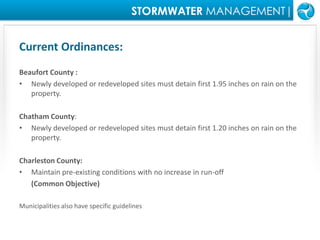
STORMWATER MANAGEMENT|Current Ordinances: Beaufort County :Newly developed or redeveloped sites must detain first 1.95 inches on rain on the   property.Chatham County: Newly developed or redeveloped sites must detain first 1.20 inches on rain on the   property.Charleston County:Maintain pre-existing conditions with no increase in run-off(Common Objective)Municipalities also have specific guidelines
OUR SERVICES|AvailabilityandUseAnalysisSystemDesign&EngineeringInstallation& Start-upLEED Documentation
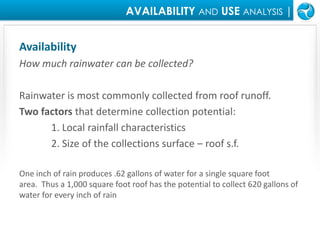
AVAILABILITY ANDUSEANALYSIS |AvailabilityHow much rainwater can be collected?Rainwater is most commonly collected from roof runoff. Two factors that determine collection potential:1. Local rainfall characteristics 	2. Size of the collections surface – roof s.f.  One inch of rain produces .62 gallons of water for a single square foot area.  Thus a 1,000 square foot roof has the potential to collect 620 gallons of water for every inch of rain
AVAILABILITY ANDUSEANALYSIS |UseHow can you best use the collected water?Potential uses for recycled water include (but are not limited to):Irrigation (usually accounts for about 60% of overall usage)Flushing ToiletsWashing LaundryWashing VehiclesGeneral MaintenanceDrinking (with proper filtration)
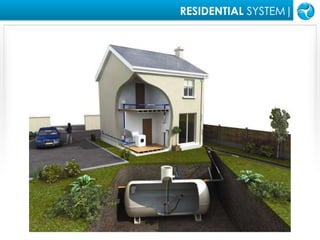
RESIDENTIAL SYSTEM|
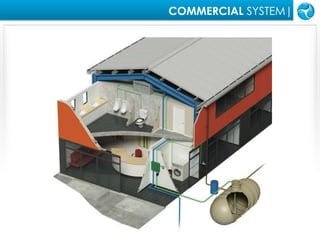
COMMERCIAL SYSTEM|
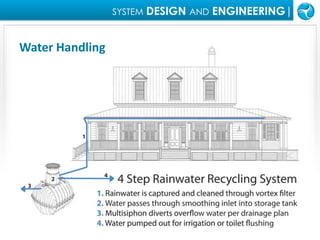
SYSTEMDESIGN ANDENGINEERING|Every Raincycle system has a storage component and a water handling component.  Proper sizing and configuration of both components is necessary for a sustainable rainwater recycling system.  The BALANCE between having too much EMPTYstorage space and having too much OVERFLOWEvery system according to the specific project needs.
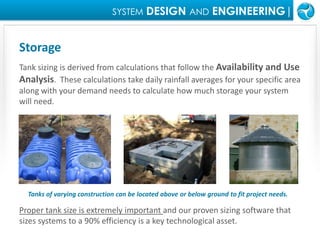
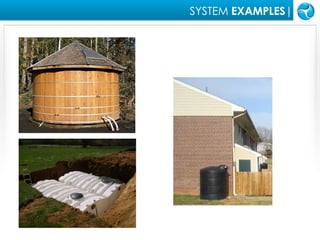
SYSTEMDESIGN ANDENGINEERING|StorageTank sizing is derived from calculations that follow the Availability and Use Analysis.  These calculations take daily rainfall averages for your specific area along with your demand needs to calculate how much storage your system will need.Tanks of varying construction can be located above or below ground to fit project needs.  Proper tank size is extremely important and our proven sizing software that sizes systems to a 90% efficiency is a key technological asset.
AVAILABILITY AND USE|Availability and Use Questionnaire
SYSTEM EXAMPLES|
SYSTEMDESIGN ANDENGINEERING|Water Handling 
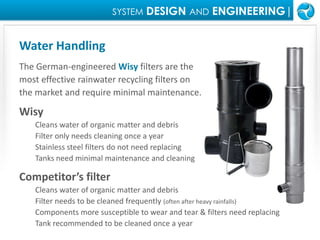
SYSTEMDESIGN ANDENGINEERING|Water HandlingThe German-engineered Wisy filters are the most effective rainwater recycling filters on the market and require minimal maintenance.  WisyCleans water of organic matter and debrisFilter only needs cleaning once a yearStainless steel filters do not need replacingTanks need minimal maintenance and cleaningCompetitor’s filterCleans water of organic matter and debrisFilter needs to be cleaned frequently (often after heavy rainfalls)Components more susceptible to wear and tear & filters need replacingTank recommended to be cleaned once a year
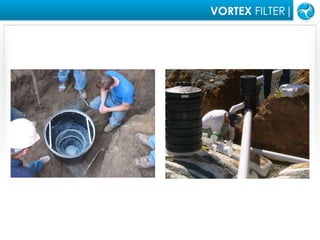
SYSTEMDESIGN ANDENGINEERING|Vortex Filter
VORTEX FILTER|
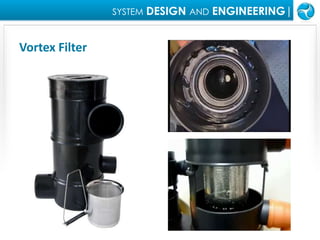
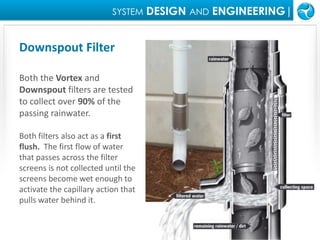
SYSTEMDESIGN ANDENGINEERING|Downspout FilterBoth the Vortex and Downspout filters are tested to collect over 90% of the passing rainwater.Both filters also act as a first flush.  The first flow of water that passes across the filter screens is not collected until the screens become wet enough to activate the capillary action that pulls water behind it.
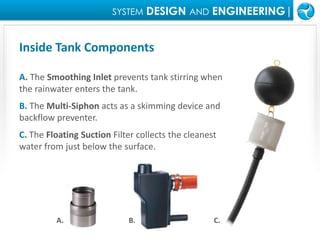
SYSTEMDESIGN ANDENGINEERING|Inside Tank ComponentsA. The Smoothing Inlet prevents tank stirring when the rainwater enters the tank.B. The Multi-Siphon acts as a skimming device and  backflow preventer.C. The Floating Suction Filter collects the cleanest water from just below the surface.A.B.C.
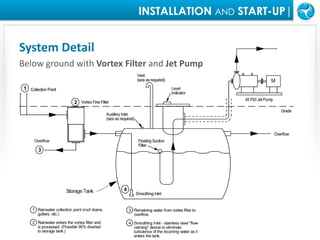
INSTALLATION ANDSTART-UP|System DetailBelow ground with Vortex Filter and Jet Pump
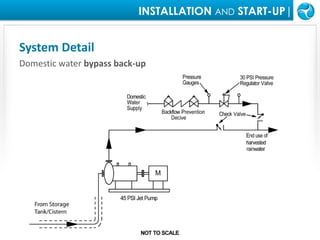
INSTALLATION ANDSTART-UP|System DetailDomestic water bypass back-up
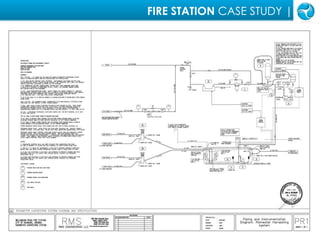
FIRE STATION CASE STUDY |
FIRE STATION CASE STUDY|ChallengeReduce the use of municipal water for nonpotable water needs.Reduce stormwater runoff from the site to protect the environment.Attain LEED certification through the USGBC.Application9,000 sq.ft. roof collection area10,000 gallons of storageTwo Wisy WFF 150 vortex filtersTwo Wisy coarse 2" floating filtersUV light filtration systemBenefitsHarvested rainwater used to wash vehicles and flush toilets.Promote green infrastructure for fire stations and public service buildings.Prevent stormwater runoff.
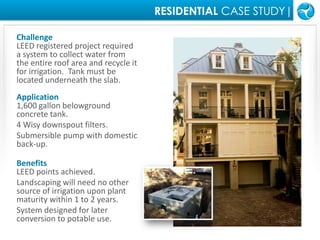
RESIDENTIAL CASE STUDY|ChallengeLEED registered project required a system to collect water from the entire roof area and recycle it for irrigation.  Tank must be located underneath the slab.  Application1,600 gallon belowground concrete tank.4 Wisy downspout filters.Submersible pump with domestic back-up.BenefitsLEED points achieved.Landscaping will need no other source of irrigation upon plant maturity within 1 to 2 years.System designed for later conversion to potable use.
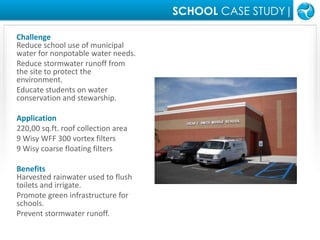
SCHOOL CASE STUDY|ChallengeReduce school use of municipal water for nonpotable water needs.Reduce stormwater runoff from the site to protect the environment.Educate students on water conservation and stewarship.Application220,00 sq.ft. roof collection area9 Wisy WFF 300 vortex filters9 Wisy coarse floating filtersBenefitsHarvested rainwater used to flush toilets and irrigate.Promote green infrastructure for schools.Prevent stormwater runoff.
http://www.RaincycleSystems.com

http://www.RaincycleSystems.com

  • 1.
    WHEN rain touches downit becomes stormwater; at that point how we manage it defines whether it will become a nuisance or a benefit.  Raincycle designs and installs Rainwater Recycling Systems to better manage stormwater on residential and commercial properties.
  • 2.
    WHY RECYCLE RAINWATER|Sustainable Building PracticeCompliance toStormwaterOrdinanceSecurity & Natural Disaster PreparednessCredit towards LEED CertificationMonetary Savings
  • 3.
    STORMWATER MANAGEMENT|Current Ordinances:Beaufort County :Newly developed or redeveloped sites must detain first 1.95 inches on rain on the property.Chatham County: Newly developed or redeveloped sites must detain first 1.20 inches on rain on the property.Charleston County:Maintain pre-existing conditions with no increase in run-off(Common Objective)Municipalities also have specific guidelines
  • 4.
  • 5.
    AVAILABILITY ANDUSEANALYSIS |AvailabilityHowmuch rainwater can be collected?Rainwater is most commonly collected from roof runoff. Two factors that determine collection potential:1. Local rainfall characteristics 2. Size of the collections surface – roof s.f.  One inch of rain produces .62 gallons of water for a single square foot area.  Thus a 1,000 square foot roof has the potential to collect 620 gallons of water for every inch of rain
  • 6.
    AVAILABILITY ANDUSEANALYSIS |UseHowcan you best use the collected water?Potential uses for recycled water include (but are not limited to):Irrigation (usually accounts for about 60% of overall usage)Flushing ToiletsWashing LaundryWashing VehiclesGeneral MaintenanceDrinking (with proper filtration)
  • 7.
  • 8.
  • 9.
    SYSTEMDESIGN ANDENGINEERING|Every Raincyclesystem has a storage component and a water handling component.  Proper sizing and configuration of both components is necessary for a sustainable rainwater recycling system.  The BALANCE between having too much EMPTYstorage space and having too much OVERFLOWEvery system according to the specific project needs.
  • 10.
    SYSTEMDESIGN ANDENGINEERING|StorageTank sizingis derived from calculations that follow the Availability and Use Analysis.  These calculations take daily rainfall averages for your specific area along with your demand needs to calculate how much storage your system will need.Tanks of varying construction can be located above or below ground to fit project needs.  Proper tank size is extremely important and our proven sizing software that sizes systems to a 90% efficiency is a key technological asset.
  • 11.
  • 12.
  • 13.
  • 14.
    SYSTEMDESIGN ANDENGINEERING|Water HandlingTheGerman-engineered Wisy filters are the most effective rainwater recycling filters on the market and require minimal maintenance.  WisyCleans water of organic matter and debrisFilter only needs cleaning once a yearStainless steel filters do not need replacingTanks need minimal maintenance and cleaningCompetitor’s filterCleans water of organic matter and debrisFilter needs to be cleaned frequently (often after heavy rainfalls)Components more susceptible to wear and tear & filters need replacingTank recommended to be cleaned once a year
  • 15.
  • 16.
  • 17.
    SYSTEMDESIGN ANDENGINEERING|Downspout FilterBoththe Vortex and Downspout filters are tested to collect over 90% of the passing rainwater.Both filters also act as a first flush. The first flow of water that passes across the filter screens is not collected until the screens become wet enough to activate the capillary action that pulls water behind it.
  • 18.
    SYSTEMDESIGN ANDENGINEERING|Inside TankComponentsA. The Smoothing Inlet prevents tank stirring when the rainwater enters the tank.B. The Multi-Siphon acts as a skimming device and backflow preventer.C. The Floating Suction Filter collects the cleanest water from just below the surface.A.B.C.
  • 19.
    INSTALLATION ANDSTART-UP|System DetailBelowground with Vortex Filter and Jet Pump
  • 20.
  • 21.
  • 22.
    FIRE STATION CASESTUDY|ChallengeReduce the use of municipal water for nonpotable water needs.Reduce stormwater runoff from the site to protect the environment.Attain LEED certification through the USGBC.Application9,000 sq.ft. roof collection area10,000 gallons of storageTwo Wisy WFF 150 vortex filtersTwo Wisy coarse 2" floating filtersUV light filtration systemBenefitsHarvested rainwater used to wash vehicles and flush toilets.Promote green infrastructure for fire stations and public service buildings.Prevent stormwater runoff.
  • 23.
    RESIDENTIAL CASE STUDY|ChallengeLEEDregistered project required a system to collect water from the entire roof area and recycle it for irrigation. Tank must be located underneath the slab. Application1,600 gallon belowground concrete tank.4 Wisy downspout filters.Submersible pump with domestic back-up.BenefitsLEED points achieved.Landscaping will need no other source of irrigation upon plant maturity within 1 to 2 years.System designed for later conversion to potable use.
  • 24.
    SCHOOL CASE STUDY|ChallengeReduceschool use of municipal water for nonpotable water needs.Reduce stormwater runoff from the site to protect the environment.Educate students on water conservation and stewarship.Application220,00 sq.ft. roof collection area9 Wisy WFF 300 vortex filters9 Wisy coarse floating filtersBenefitsHarvested rainwater used to flush toilets and irrigate.Promote green infrastructure for schools.Prevent stormwater runoff.