ISTANBUL
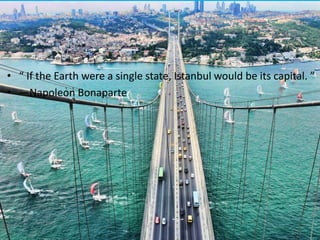
• “ If the Earth were a single state, Istanbul would be its capital. ” 
• —Napoleon Bonaparte
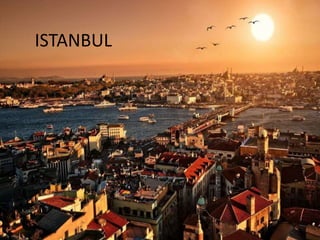
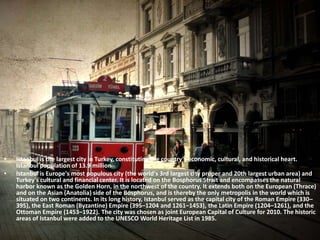
• Istanbul is the largest city in Turkey, constituting the country's economic, cultural, and historical heart. 
Istanbul population of 13.9 million 
• Istanbul is Europe's most populous city (the world's 3rd largest city proper and 20th largest urban area) and 
Turkey's cultural and financial center. It is located on the Bosphorus Strait and encompasses the natural 
harbor known as the Golden Horn, in the northwest of the country. It extends both on the European (Thrace) 
and on the Asian (Anatolia) side of the Bosphorus, and is thereby the only metropolis in the world which is 
situated on two continents. In its long history, Istanbul served as the capital city of the Roman Empire (330– 
395), the East Roman (Byzantine) Empire (395–1204 and 1261–1453), the Latin Empire (1204–1261), and the 
Ottoman Empire (1453–1922). The city was chosen as joint European Capital of Culture for 2010. The historic 
areas of Istanbul were added to the UNESCO World Heritage List in 1985.
Historic Areas of Istanbul 
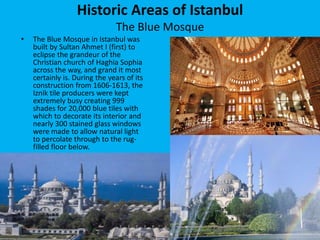
The Blue Mosque 
• The Blue Mosque in Istanbul was 
built by Sultan Ahmet I (first) to 
eclipse the grandeur of the 
Christian church of Haghia Sophia 
across the way, and grand it most 
certainly is. During the years of its 
construction from 1606-1613, the 
Iznik tile producers were kept 
extremely busy creating 999 
shades for 20,000 blue tiles with 
which to decorate its interior and 
nearly 300 stained glass windows 
were made to allow natural light 
to percolate through to the rug-filled 
floor below.
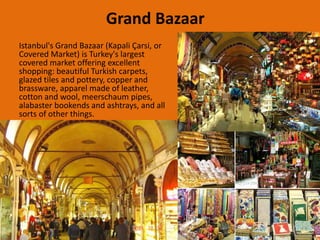
Grand Bazaar 
Istanbul's Grand Bazaar (Kapali Çarsi, or 
Covered Market) is Turkey's largest 
covered market offering excellent 
shopping: beautiful Turkish carpets, 
glazed tiles and pottery, copper and 
brassware, apparel made of leather, 
cotton and wool, meerschaum pipes, 
alabaster bookends and ashtrays, and all 
sorts of other things.
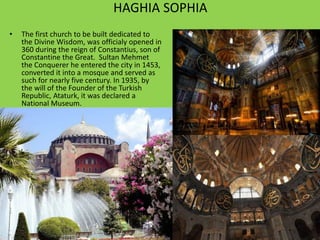
HAGHIA SOPHIA 
• The first church to be built dedicated to 
the Divine Wisdom, was officialy opened in 
360 during the reign of Constantius, son of 
Constantine the Great. Sultan Mehmet 
the Conquerer he entered the city in 1453, 
converted it into a mosque and served as 
such for nearly five century. In 1935, by 
the will of the Founder of the Turkish 
Republic, Ataturk, it was declared a 
National Museum.
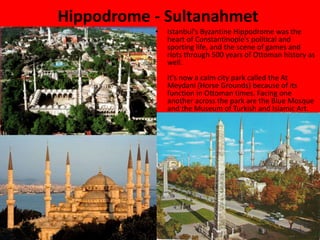
Hippodrome - Sultanahmet 
• Istanbul's Byzantine Hippodrome was the 
heart of Constantinople's political and 
sporting life, and the scene of games and 
riots through 500 years of Ottoman history as 
well. 
It's now a calm city park called the At 
Meydani (Horse Grounds) because of its 
function in Ottoman times. Facing one 
another across the park are the Blue Mosque 
and the Museum of Turkish and Islamic Art.
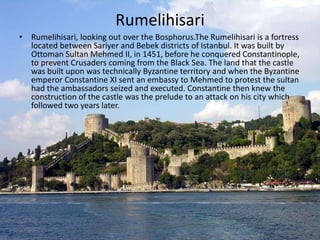
Rumelihisari 
• Rumelihisari, looking out over the Bosphorus.The Rumelihisari is a fortress 
located between Sariyer and Bebek districts of Istanbul. It was built by 
Ottoman Sultan Mehmed II, in 1451, before he conquered Constantinople, 
to prevent Crusaders coming from the Black Sea. The land that the castle 
was built upon was technically Byzantine territory and when the Byzantine 
emperor Constantine XI sent an embassy to Mehmed to protest the sultan 
had the ambassadors seized and executed. Constantine then knew the 
construction of the castle was the prelude to an attack on his city which 
followed two years later.
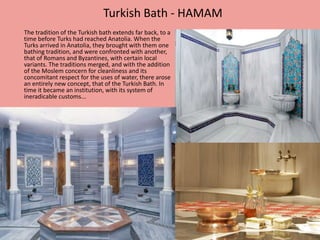
Turkish Bath - HAMAM 
The tradition of the Turkish bath extends far back, to a 
time before Turks had reached Anatolia. When the 
Turks arrived in Anatolia, they brought with them one 
bathing tradition, and were confronted with another, 
that of Romans and Byzantines, with certain local 
variants. The traditions merged, and with the addition 
of the Moslem concern for cleanliness and its 
concomitant respect for the uses of water, there arose 
an entirely new concept, that of the Turkish Bath. In 
time it became an institution, with its system of 
ineradicable customs...
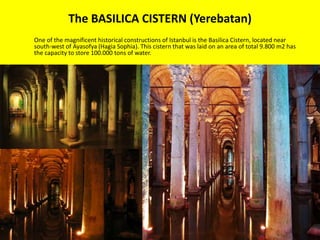
The BASILICA CISTERN (Yerebatan) 
One of the magnificent historical constructions of Istanbul is the Basilica Cistern, located near 
south-west of Ayasofya (Hagia Sophia). This cistern that was laid on an area of total 9.800 m2 has 
the capacity to store 100.000 tons of water.
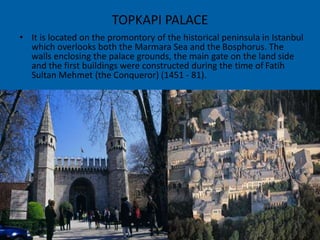
TOPKAPI PALACE 
• It is located on the promontory of the historical peninsula in Istanbul 
which overlooks both the Marmara Sea and the Bosphorus. The 
walls enclosing the palace grounds, the main gate on the land side 
and the first buildings were constructed during the time of Fatih 
Sultan Mehmet (the Conqueror) (1451 - 81).
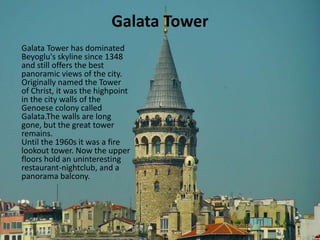
Galata Tower 
Galata Tower has dominated 
Beyoglu's skyline since 1348 
and still offers the best 
panoramic views of the city. 
Originally named the Tower 
of Christ, it was the highpoint 
in the city walls of the 
Genoese colony called 
Galata.The walls are long 
gone, but the great tower 
remains. 
Until the 1960s it was a fire 
lookout tower. Now the upper 
floors hold an uninteresting 
restaurant-nightclub, and a 
panorama balcony.
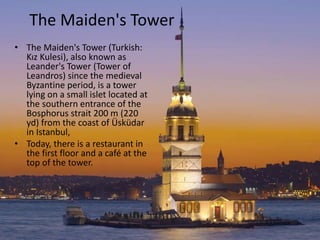
The Maiden's Tower 
• The Maiden's Tower (Turkish: 
Kız Kulesi), also known as 
Leander's Tower (Tower of 
Leandros) since the medieval 
Byzantine period, is a tower 
lying on a small islet located at 
the southern entrance of the 
Bosphorus strait 200 m (220 
yd) from the coast of Üsküdar 
in Istanbul, 
• Today, there is a restaurant in 
the first floor and a café at the 
top of the tower.
Thanks For Listening  
Preapered by : 
• Sevinç Alptekin 
• Nazlı Turna

Istanbul Presentation

  • 1.
  • 2.
    • “ Ifthe Earth were a single state, Istanbul would be its capital. ” • —Napoleon Bonaparte
  • 3.
    • Istanbul isthe largest city in Turkey, constituting the country's economic, cultural, and historical heart. Istanbul population of 13.9 million • Istanbul is Europe's most populous city (the world's 3rd largest city proper and 20th largest urban area) and Turkey's cultural and financial center. It is located on the Bosphorus Strait and encompasses the natural harbor known as the Golden Horn, in the northwest of the country. It extends both on the European (Thrace) and on the Asian (Anatolia) side of the Bosphorus, and is thereby the only metropolis in the world which is situated on two continents. In its long history, Istanbul served as the capital city of the Roman Empire (330– 395), the East Roman (Byzantine) Empire (395–1204 and 1261–1453), the Latin Empire (1204–1261), and the Ottoman Empire (1453–1922). The city was chosen as joint European Capital of Culture for 2010. The historic areas of Istanbul were added to the UNESCO World Heritage List in 1985.
  • 4.
    Historic Areas ofIstanbul The Blue Mosque • The Blue Mosque in Istanbul was built by Sultan Ahmet I (first) to eclipse the grandeur of the Christian church of Haghia Sophia across the way, and grand it most certainly is. During the years of its construction from 1606-1613, the Iznik tile producers were kept extremely busy creating 999 shades for 20,000 blue tiles with which to decorate its interior and nearly 300 stained glass windows were made to allow natural light to percolate through to the rug-filled floor below.
  • 5.
    Grand Bazaar Istanbul'sGrand Bazaar (Kapali Çarsi, or Covered Market) is Turkey's largest covered market offering excellent shopping: beautiful Turkish carpets, glazed tiles and pottery, copper and brassware, apparel made of leather, cotton and wool, meerschaum pipes, alabaster bookends and ashtrays, and all sorts of other things.
  • 6.
    HAGHIA SOPHIA •The first church to be built dedicated to the Divine Wisdom, was officialy opened in 360 during the reign of Constantius, son of Constantine the Great. Sultan Mehmet the Conquerer he entered the city in 1453, converted it into a mosque and served as such for nearly five century. In 1935, by the will of the Founder of the Turkish Republic, Ataturk, it was declared a National Museum.
  • 7.
    Hippodrome - Sultanahmet • Istanbul's Byzantine Hippodrome was the heart of Constantinople's political and sporting life, and the scene of games and riots through 500 years of Ottoman history as well. It's now a calm city park called the At Meydani (Horse Grounds) because of its function in Ottoman times. Facing one another across the park are the Blue Mosque and the Museum of Turkish and Islamic Art.
  • 8.
    Rumelihisari • Rumelihisari,looking out over the Bosphorus.The Rumelihisari is a fortress located between Sariyer and Bebek districts of Istanbul. It was built by Ottoman Sultan Mehmed II, in 1451, before he conquered Constantinople, to prevent Crusaders coming from the Black Sea. The land that the castle was built upon was technically Byzantine territory and when the Byzantine emperor Constantine XI sent an embassy to Mehmed to protest the sultan had the ambassadors seized and executed. Constantine then knew the construction of the castle was the prelude to an attack on his city which followed two years later.
  • 9.
    Turkish Bath -HAMAM The tradition of the Turkish bath extends far back, to a time before Turks had reached Anatolia. When the Turks arrived in Anatolia, they brought with them one bathing tradition, and were confronted with another, that of Romans and Byzantines, with certain local variants. The traditions merged, and with the addition of the Moslem concern for cleanliness and its concomitant respect for the uses of water, there arose an entirely new concept, that of the Turkish Bath. In time it became an institution, with its system of ineradicable customs...
  • 10.
    The BASILICA CISTERN(Yerebatan) One of the magnificent historical constructions of Istanbul is the Basilica Cistern, located near south-west of Ayasofya (Hagia Sophia). This cistern that was laid on an area of total 9.800 m2 has the capacity to store 100.000 tons of water.
  • 11.
    TOPKAPI PALACE •It is located on the promontory of the historical peninsula in Istanbul which overlooks both the Marmara Sea and the Bosphorus. The walls enclosing the palace grounds, the main gate on the land side and the first buildings were constructed during the time of Fatih Sultan Mehmet (the Conqueror) (1451 - 81).
  • 12.
    Galata Tower GalataTower has dominated Beyoglu's skyline since 1348 and still offers the best panoramic views of the city. Originally named the Tower of Christ, it was the highpoint in the city walls of the Genoese colony called Galata.The walls are long gone, but the great tower remains. Until the 1960s it was a fire lookout tower. Now the upper floors hold an uninteresting restaurant-nightclub, and a panorama balcony.
  • 13.
    The Maiden's Tower • The Maiden's Tower (Turkish: Kız Kulesi), also known as Leander's Tower (Tower of Leandros) since the medieval Byzantine period, is a tower lying on a small islet located at the southern entrance of the Bosphorus strait 200 m (220 yd) from the coast of Üsküdar in Istanbul, • Today, there is a restaurant in the first floor and a café at the top of the tower.
  • 14.
    Thanks For Listening Preapered by : • Sevinç Alptekin • Nazlı Turna