ukedchat.com December 2014 Issue 12
Supporting the Educational Community
25 Pedagogical Ideas
From Twitter
p20 How to Teach
the Nativity a
little differently
Wrapping Up
For Christmas p10
A Time
To Share
A Time
To Reflect
p6 Christmas
Coding
04
Write for UKED Magazine
Email
editor@ukedchat.com
08
View
online
at
issuu.com
/ukedchat
ukedchat.com
/m
agazine
to
orderprinted
copiesofthe
m
agazine
Twitter
@UKEdMag
@UKEdChat
12
Changing
Mindset
p18
jobs@ukedchat.com
FeaturedPositions
Nursery Teacher
Duncombe Primary School
Islington, London
bit.ly/ukedjob261
Closing date: 08/12/2014
WHY ADVERTISE
SCHOOL VACANCIES
WITH UKEDCHAT?
Access Thousands of Engaged Educators
Social Media Support
Cost Effective
Fast and Efficient Service
Easy Set-up
Thank you @UKEdJobs for a great, value for money
service. And, all of the other Tweeps who RT’d We had
over 2000 views of our vacancy. :))
Choose Your Package
£99 (just £55 for schools who contact us directly) per job
listing, including social media promotion; listing on the
ukedchat.com website; and featured in the UKED Magazine (if
deadlines are met).
£350 Annual Subscription - allowing unlimited number of
job listings to UKEdJobs for schools (including Head-Teacher,
Senior Leadership, Teaching or Teaching Assistant vacancies).
All jobs receive the coverage as above.
VISIT ukedchat.com/jobs CONTACT jobs@ukedchat.com
Currently just
£55
for schools posting direct
KS2 Teacher
Norbridge Academy
Worksop, Nottinghamshire
bit.ly/ukedjob263
Closing date: 08/12/2014
Teachers can list themselves for our
job matching service for free.
Add details of the job you are looking
for and let schools come to you!
ukedchat.com/jobs/5
The publishers accepts no responsibility for any claims made in any advertisement
appearing in this publication. Whilst every effort is made to ensure accuracy, the pub-
lishers accept no responsibility for errors, inaccuracies or omissions.
Many images have been source under a Commercial Creative Commons License. See
http://creativecommons.org/licenses/by/2.0
Cover Photo Credit:
https://www.flickr.com/photos/michalo/3133346920 by Anna & Michal used under
Commercial Creative Commons 2.0 License.
Issue 12: December 2014
Subscribe by email for free at bit.ly/ukedmagsub
Subscribe to the print edition at ukedchat.com/magazine
4 Changing our Mindset
Debbie Light and Mel Aberson discuss four books that have changed
their teaching to include a growth mindset culture.
17 Book Shelf Science, and Behaviour
Contributors
Debbie Light and Mel Aberson @TeacherTweaks
James Abela @ESLweb
Stephen Tierney @LeadingLearner
Kat Howard @Saysmiss
Nancy Walbank @nan282
Andy Knill @aknill @globalsolo @gasigict
Eylan Ezekiel @eylanezekiel
Andy Lewis @iTeachRE
Scott Allsop @MrAllsopHistory
Stephen Mills @_MrMills
Mandi Miles @mandmiles
Kate McCabe @evenbetterif
Mike Watson @WatsEd
ADVERTISE WITH US
If you are interested in advertising in the
magazine, please contact
editor@ukedchat.com
for more information.
Follow @UKED_Directory for commercial updates
Contact & Social Media
Email ukedchat.com/contact or editor@ukedchat.com
Twitter @UKEdMag @UKEdChat @UKEdJobs @UKEdResources
Website ukedchat.com
Facebook facebook.com/ukedchat
Pinterest pinterest.com/ukedchat
Scoop It scoop.it/ukedchat
Google+ plus.google.com/+Ukedchat
FlipBoard bit.ly/ukedflip
Issuu issuu.com/ukedchat
Weibo weibo.com/3743315975
From the Editor
The atmosphere of a school changes each December
- priorities are different and learning activities take
on a distinctly festive theme. For myself as a primary
school teacher, it is my favourite time of the year.
Yet far from winding down to the Christmas break,
a whole new set of pressures and tasks make their
annual appearance. Angel wings need to be fixed;
cards need to be glittered; and crying nativity sheep
need to be comforted after saying ‘baaa’ at a biblically
inappropriate moment.
In this edition of UKED Magazine we share a host
of festive activities and pedagogical ideas to try with
your class and get you ready for 2015.
I hope you have a restful festive break.
Martin Burrett - Editor
@ICTmagic @UKEdMag editor@ukedchat.com
6 Coding Christmas Fun
James Abela shares a great festive computer coding project for young
programmers to try and build on using Scratch.
8 Political Manifestos & Pantomimes
What are your educational wishes for the future? Stephen Tierney
shares his priorities and hopes for the years to come.
10 Wrapping Up
Rather than winding down for Christmas, Kat Howard explores ideas
and activities to end the term on a high.
11 What if Christmas...
Sparky Teaching explore a range of creative Christmas activities.
12 RSPB’s Big Schools’ Birdwatch
Read about how you and your school can take part in the annual
bird watching event from the RSBP. Make a bird feeder and see who
comes to visit.
13 Fast Festive Role Play
Dr Nancy Walbank shares her ideas for enhancing learning during the
festive season with a range of role-play activities and ideas.
14 Rewarding Schools Success
UKEdChat attended the Educate Awards in Merseyside and spoke to
the winning teachers and schools.
16 Developing a Revived Department. . .
Andy Knill returns to explore of his new role in school and provides an
update of developments on how the department is moving forward.
18 Twenty-Five Pedagogical Ideas from Twitter
A glossary of teaching strategies and pedagogical favourites from the
Twitter teaching community.
20 The Greatest Story Ever Told
Andy Lewis takes a look at how the Nativity story is taught in schools
and asks whether there is a better way.
23 Teaching the Truce
Scott Allsop discusses ideas, resources and techniques for introducing
the World War One Christmas Truce of 1914 to your class.
24 Fifteen Educational Toys
We’ve made Christmas shopping a little easier by listing some of the
best educational toys in one place.
27 Teaching Values
Kate McCabe explores whether we can teach grit, rigour and resilience
and how she has developed this in her school.
04 UKED Magazine
Four Books That
Changed Our Mindset
By Debbie Light and Mel Aberson
Reading research-based books is a big step forward for two teachers who had read little more than the odd DfE(S) update since
finishing our PGCEs. If you’re in a similar position and don’t have time to read lots of books, we hope our summary of the key
findings from this selection, as presented at Teaching and Learning Takeover in Southampton last month, will give you something
to think about and discuss with colleagues. You may be inspired to go out and read them all, especially when you see that the
longest is less than 350 pages. In which case we hope you find them as thought-provoking and interesting as we did.
We have spent a lot of time, both consciously and unconsciously, digesting and reflecting on the findings of these books. In
some cases we have completely changed how we think/plan/teach/explain, but in many cases it’s just a ‘tweak’ to how we go
about our teaching and how we conduct conversations with learners.
Mindset by Carol Dweck
The key points from this book are as
follows:
•	 Ability is not fixed and students will
achieve more if they have a growth
mindset, making the connection
between effort and outcome.
•	 If you believe you can improve through
sustained effort, you will be more open
to engaging in deliberate practice and
will place great value on feedback.
•	 Students should be taught to embrace
challenging work and persist when
they find it tough, because only doing
work that they find easy means they will not become better learners.
Mindset has become a hot topic in education, so predictably it has also gained critics. It is
always a danger that this sort of concept becomes a gimmick whereby people decide to ‘do a
bit of Mindset’, but in the words of John Tomsett (see bit.ly/uked14dec01) ‘You can’t just do
View on Amazon at
bit.ly/mindpotential
Mindset, it’s a culture.’ As well as trying to tweak the mindset in our students, we have found ourselves applying this approach
to teachers as learners – ourselves included. When we shared this mindset-inspired meme (above) on Twitter as ‘Something for
the classroom’ the overwhelming response seemed to be ‘I’m putting this up in the staffroom!’
An Ethic of Excellence by Ron Berger
Key messages from Berger:
•	 Producing a piece of excellent work changes the way students feel about what they can
do.
•	 Having a detailed understanding of what constitutes an excellent piece of work helps
students to do it themselves.
•	 Creating a culture of critique where students actively seek out kind, specific and helpful
feedback from their peers increases students’ chances of producing excellent work.
•	 Raising expectations of what students are able to achieve enables students to develop an
internal model of quality that they carry with them around school.
Another very inspirational read that has inspired whole schools to change their culture (for
some examples, see bit.ly/uked14dec02 and bit.ly/uked14dec03). Another culture shift, not
just in raising expectations but also very importantly to develop a desire in learners to seek
out feedback.View on Amazon at
bit.ly/ethicexcellence
Debbie Light and Mel Aberson worked together as ASTs in
a West London secondary school. They set up the shared
@TeacherTweaks Twitter account so they could continue
working together to share their passion for teaching and
learning when Debbie moved for promotion to Assistant
Head in a new school.
Image credit:
freepik.com/free-vector/creative-brain-illustration_713654.htm
(modified) by freepik used under Commercial Creative Commons 2.0
License.
https://www.flickr.com/photos/arwilkinson/10830400356 (cropped) by
Andy Wilkinson used under Commercial Creative Commons 2.0 License.
All other images provided by Debbie Light and Mel Aberson
UKED Magazine 05
The Hidden lives of Learners by Graham Nuthall
The key points from this book are as follows:
•	 The underlying process of learning is essentially the same for
all students, meaning low ability students can learn in the same
way as high ability students; the differences creep in because of
students’ prior knowledge, motivation and individual experiences.
•	 Learning is multilayered; a student experiences new learning
through the public world where tasks are managed by the teacher, the
semi-private interactions between peers and the private world of the
individual student. How they make sense of these three worlds impacts
on how much they learn. Low ability students are just as capable of learning
new ideas/concepts.
•	 Students need to experience at least three different sets of complete information about
a new idea/concept before it becomes embedded in their memory so we need to give them
opportunities to revisit these ideas/concepts.
•	 Students remember how they learnt something just as much as the content of what they
learnt so task design is crucial and should encourage students to think about what helps them
learn.
This, just like the other three books is by no means a weighty tome, but some of the findings of Nuthall’s research are so mind-
blowing that they may well need a second read. Perhaps the most interesting point for us is the idea that lower and higher
ability students don’t learn in a different way; it is just the fact that lower attaining students have less prior knowledge to form
connections with their new learning and this limits how much they can make sense of the new things they are learning.
Make it Stick by Peter Brown, Henry Roediger and Mark McDaniel
Key points from the book:
•	Learning that is difficult and requires more effort will last longer than learning that is easy and
quick to grasp because our memories are having to work harder in the former.
•	Repeated retrieval practice (through quizzes and testing) is a better strategy than rereading
or cramming because it strengthens students’ ability to retrieve what is in our stored memory.
•	Trying to solve a problem before being taught properly how to do it leads to better learning,
even when mistakes are made in the attempt (as long as they are corrected).
•	The more a student can explain in detail what they have learnt and how this connects to what
they already know, the better chance they have of remembering it much later on.
The book stresses the importance of repeated retrieval practice: the process of trying to recall
information strengthens the learning of that information. It is not important for a student to get
the answer correct, rather to put in the effort to retrieve it and subsequently for the teacher to
identify any incorrect or missing answers and correct them.
The other key finding in ‘Make it stick’ that we have applied to our teaching is that of
‘generation’. This relates very well to Nuthall’s findings and is what a plenary should be about:
engaging the mind in trying to make sense of new learning by making the effort to explain in
your own words and relating it to what you already know. Our plenary or reflection activities didn’t always achieve this, so now
tasks such as ‘Summary tweets’ and ‘reflection pyramids’ are designed with this in mind.
Moreinformationonhowthesebookshaveinfluencedourteachinginour#TLT14presentationatslideshare.net/debbieandmel
View on Amazon at
bit.ly/liveslearner
View on Amazon at
bit.ly/makestick
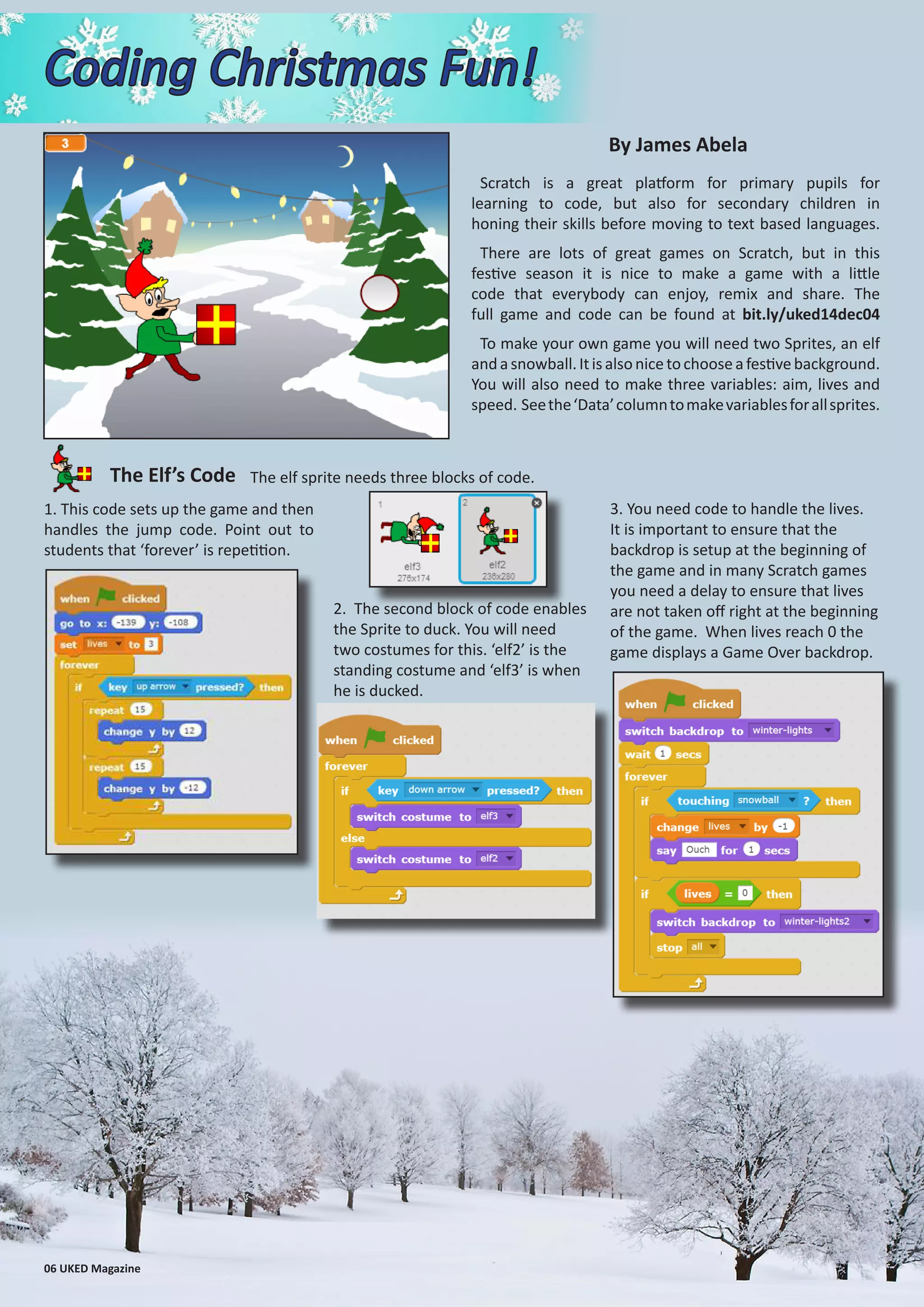
Scratch is a great platform for primary pupils for
learning to code, but also for secondary children in
honing their skills before moving to text based languages.
There are lots of great games on Scratch, but in this
festive season it is nice to make a game with a little
code that everybody can enjoy, remix and share. The
full game and code can be found at bit.ly/uked14dec04
To make your own game you will need two Sprites, an elf
andasnowball.Itisalsonicetochooseafestivebackground.
You will also need to make three variables: aim, lives and
speed. Seethe‘Data’columntomakevariablesforallsprites.
Coding Christmas Fun!
1. This code sets up the game and then
handles the jump code. Point out to
students that ‘forever’ is repetition.
The Elf’s Code
By James Abela
06 UKED Magazine
The elf sprite needs three blocks of code.
2. The second block of code enables
the Sprite to duck. You will need
two costumes for this. ‘elf2’ is the
standing costume and ‘elf3’ is when
he is ducked.
3. You need code to handle the lives.
It is important to ensure that the
backdrop is setup at the beginning of
the game and in many Scratch games
you need a delay to ensure that lives
are not taken off right at the beginning
of the game. When lives reach 0 the
game displays a Game Over backdrop.
Never miss an issue...
Subscribe to UKED Magazine
Receive the magazine via email by going to
bit.ly/ukedmagsub
Available free online
Subscribe to the printed edition of Magazine
and get it delivered straight to your door for
as little as £1 per issue
The magazine is free. Just pay Postage and Packing*
Monthly individual copy £2 p&p
Yearly individual copy £24 p&p
Monthly 5 copies £5 p&p
Yearly 5 copies £60 p&p
See details at
ukedchat.com/magazine
*Prices for UK delivery. Overseas may vary.
UKED Magazine 07
Image credit:
https://www.flickr.com/photos/singhmv/5302422042 (modified) by
Singh used under Commercial Creative Commons 2.0 License.
Scratch Sceenshots used in line with the terms of use - scratch.mit.
edu/terms_of_use
http://pixabay.com/p-313360 (cropped) used under Commercial
Creative Commons License.
All other images provided by James Abela
The Snowball’s Code
4. This code sets the start speed, decides randomly to aim
high or low and then sends the snowball at the elf.
5. This code makes the snowballs go faster and faster for
an easier game you can make it wait longer for before
getting faster.
The nice thing about these games is that you can easily extend the code to include sound effects, change backdrops after
a certain time, time how long you can survive and give you points for every duck or jump you make! Every student can
make something that they will enjoy playing!
Have a wonderful Christmas!
JamesAbela@ESLwebhasbeenworkinginITsince1998,firstly
in the industry and is now head of department in an all-through
school in Thailand. He is passionate about getting children
to learn to code, because it improves their understanding of
the digital world and helps them to think both logically and
creatively. Read his blog at jamesabela.co.uk
After the next election I may be taking an oath or having a
quick MoT. Suddenly, politicians no longer want to kick me
to death. In fact, they’re taking a rather unhealthy interest
in my workload. I’m now being accused of working too hard
as opposed to being a wastrel, card carrying member of the
Education Blob.
As we move into the pantomime season it’s easy to confuse
what we see happening on the Parliamentary stage and
the theatre stage. However, if Aladdin met Parliament met
Education and you were given three manifesto wishes, what
would you wish for? I’ve gone for some specifics to underline
where I think we need to go next.
It would be great to see a total rethinking of the
accountability system. Rather than looking at symptoms,
such as workload, the political parties need to dig down to
the root cause. The current pernicious effects of our over
inflated accountability system are creating a fright, flight or
fight approach in too many schools. Recruiting and retaining
high quality people in some of the most disadvantaged areas,
with high numbers of “hard pressed families”, is becoming a
problem. There is a need to rethink our approach and move
towards a peer accountability model, which in the first stage
of its development is quality assured by the best HMIs. This
would be my first wish. It’s what the countries with great
education systems have moved to.
My second wish would be to rethink our approach to the
recruitment, training and pay of teachers in the early years.
We need to make teaching such an unbelievably attractive
career option that we can select the most able, emotionally
literate and capable graduates. We want the best people
to be teachers. I’m a fan of a blended and balanced Higher
Education and work based route into teaching - understand
the deep theory and learn how to apply it is a coherent twin
track approach. The theory must be rich and relevant and the
coaching in the classroom of the highest order. If this means
needing two years to acquire QTS then that might be no bad
thing. I would also have everyone on the two year QTS route
being paid a salary. These are wishes after all. No education
system can outperform the quality of the teachers within it.
The supply of teachers is already highly variable around the
country. We need to act now if we are to avoid a shortage
crisis.
A work life balance for teachers and the great support
staff who work in our schools. I don’t mind working hard,
education is my passion. However, my family need a part of
me and my time. Not the part left over when I’m shattered
and in need of recovery. I worry some staff return from
Christmas more exhausted than when they left in December,
if that is possible. Workload and balance will move up our
collective agendas. I wish the politicians good luck with the
consultation.
For a number of people reading this, already in senior
leadership and considering headship, you will be entering
some of the prime years of your headship by 2020. The 2020s
must be the decade we commit to moving beyond good, as
an education system, and becoming great. Above are some
of the leadership challenges we are facing over the coming
years. You will need to address them individually within you
school and connect beyond the school to work with others
in the Education System. The challenges are too big for any
one person, but together we can move mountains. I’m not
going to tell you it’s going to be easy, I’m telling you it will be
worth it.
Stephen is on Twitter as @LeadingLearner and his
blog can be found at leadinglearner.me. Formerly
Headteacher of St. Mary’s in Blackpool for fourteen
years, he is currently Executive Director of the MAT
consisting of two primary and a secondary academy
- Christ the King, St. Cuthbert’s & St. Mary’s Catholic
Academies. He chairs the SSAT Vision 2040 Group.
Political Manifestos
& Pantomimes
08 UKED Magazine
by Stephen Tierney
What would
you wish for
this Christmas?
Share your ideas
on Twitter using
#UKEdChat.
What would
you wish for
this Christmas?
Share your ideas
on Twitter using
#UKEdChat.
UKED Magazine 09
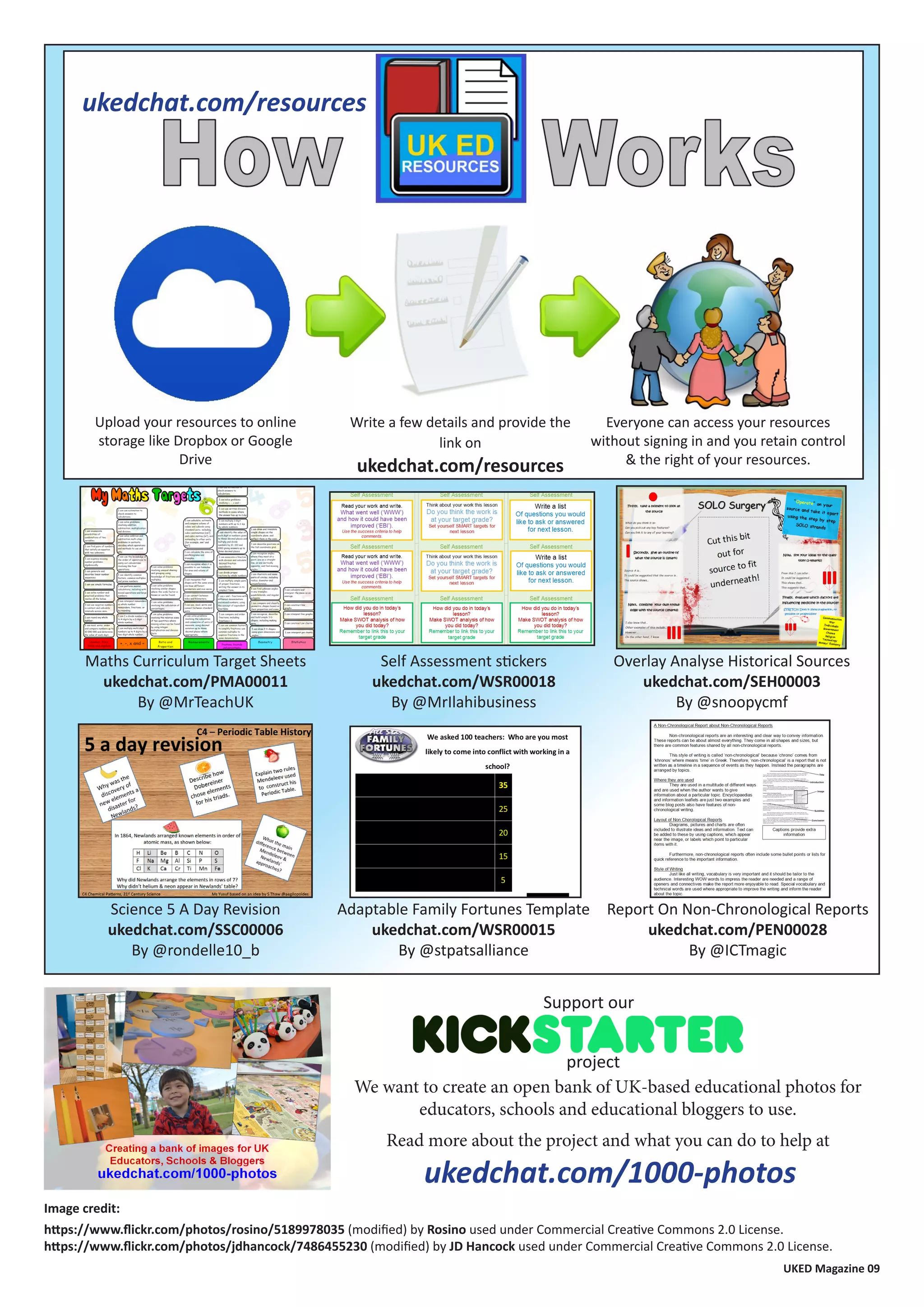
Maths Curriculum Target Sheets
ukedchat.com/PMA00011
By @MrTeachUK
Support our
project
We want to create an open bank of UK-based educational photos for
educators, schools and educational bloggers to use.
Read more about the project and what you can do to help at
ukedchat.com/1000-photos
Upload your resources to online
storage like Dropbox or Google
Drive
Write a few details and provide the
link on
ukedchat.com/resources
Everyone can access your resources
without signing in and you retain control
& the right of your resources.
ukedchat.com/resources
Image credit:
https://www.flickr.com/photos/rosino/5189978035 (modified) by Rosino used under Commercial Creative Commons 2.0 License.
https://www.flickr.com/photos/jdhancock/7486455230 (modified) by JD Hancock used under Commercial Creative Commons 2.0 License.
Science 5 A Day Revision
ukedchat.com/SSC00006
By @rondelle10_b
Self Assessment stickers
ukedchat.com/WSR00018
By @MrIlahibusiness
Overlay Analyse Historical Sources
ukedchat.com/SEH00003
By @snoopycmf
Adaptable Family Fortunes Template
ukedchat.com/WSR00015
By @stpatsalliance
Report On Non-Chronological Reports
ukedchat.com/PEN00028
By @ICTmagic
10 UKED Magazine
Image Credit:
http://pixabay.com/en/gift-made-surprise-loop-christmas-548286 by blickpixel
used under Commercial Creative Commons 2.0 License.
https://www.flickr.com/photos/gazeronly/6527323805 by torbakhopper HE
DEAD used under Commercial Creative Commons 2.0 License.
https://www.flickr.com/photos/queenbeebh/8179595608 by Queen Bee used
under Commercial Creative Commons 2.0 License.
Winding Down or revved up for 2015? Here is how to go out
with a (learning) bang...
As we drag our heels through the snow towards Christmas
Day, it is interesting to hear how different staff approach
the festive season with their students. It is a perfect time
to present classes with a way in to reflect upon their own
performance and achievements, and make manageable
goals for the year ahead. How can we ensure that students
start 2015 with a (learning) bang?
Student awards
I like to hand over to students to manage an award
ceremony for specific achievements within the class. These
should ideally be aimed at long term achievements, but not
necessarily directed at high achieving students. All my classes
accumulate a weekly score for their spelling tests. Words
provided before the test so they revise these and spelling
strategies with online game resources to assist. We have
a ‘super speller’ reward, for the highest percentage score
which they have worked towards since the start of term.
Other titles may be subject specific in the same way, but we
have ‘most improved,’ ‘dark horse’ that celebrates previously
unknown talents, and ‘remember that time’ award when
someone blew us away within a particular lesson.
Wrapping Up
Dear Myself...
I like to set aside a specific point in our final lessons before
Christmas for students to write a letter to either me or
themselves, celebrating their achievements and what they
have benefited from within the classroom that term. It is
preferable to draw on real life context here, and consider
the bigger picture of their learning - what could they now do
with what they have learned? It is a nice exercise to complete
yourself as they write, so they can see the process in action.
New Years Resolutions
TakingmyinspirationfromRJPalacio’sMrBrowne’sPrecepts
(bit.ly/uked14dec05), I like the idea of creating reflective
statements for the year ahead. Rather than setting subject
specific targets, students create a motto for themselves to
adhere to for the forthcoming year. I intend to follow this
up with a homework activity at a later point that will help
them reflect and respond to this goal that they have set for
themselves.
Mirror Image
Once you have been bombarded with gifts and start to
tuck into what appears to be the best chocolate box from
your pile, it is always good to close the year with a little self
reflection. You are not required to sit crossed legged on
your classroom floor with a solitary tear cascading over your
cheek. @Dandesignthink has produced a fantastic weekly
reflection sheet that allowed me to celebrate my successes
during my NQT year, and focus specifically on what I wanted
to achieve moving forward. Whilst it is always enjoyable to
sprint manically for the door on that final day of term, a few
moments to congratulate yourself and realign your aims is a
healthy way to close the door on 2014 and concentrate on
out-fattening the turkey.
By Kat Howard
Wrapping Up
Looking for even more educators to
follow? Browse our international map
of educators and even add yourself.
Go to bit.ly/educatormap
Kat Howard @SaysMiss is an English teacher,
freelance writer for BBC Bitesize and coordinator
for Teach Meet Leicester in South Leicestershire.
Read her blog at saysmiss.wordpress.com
UKED Magazine 11
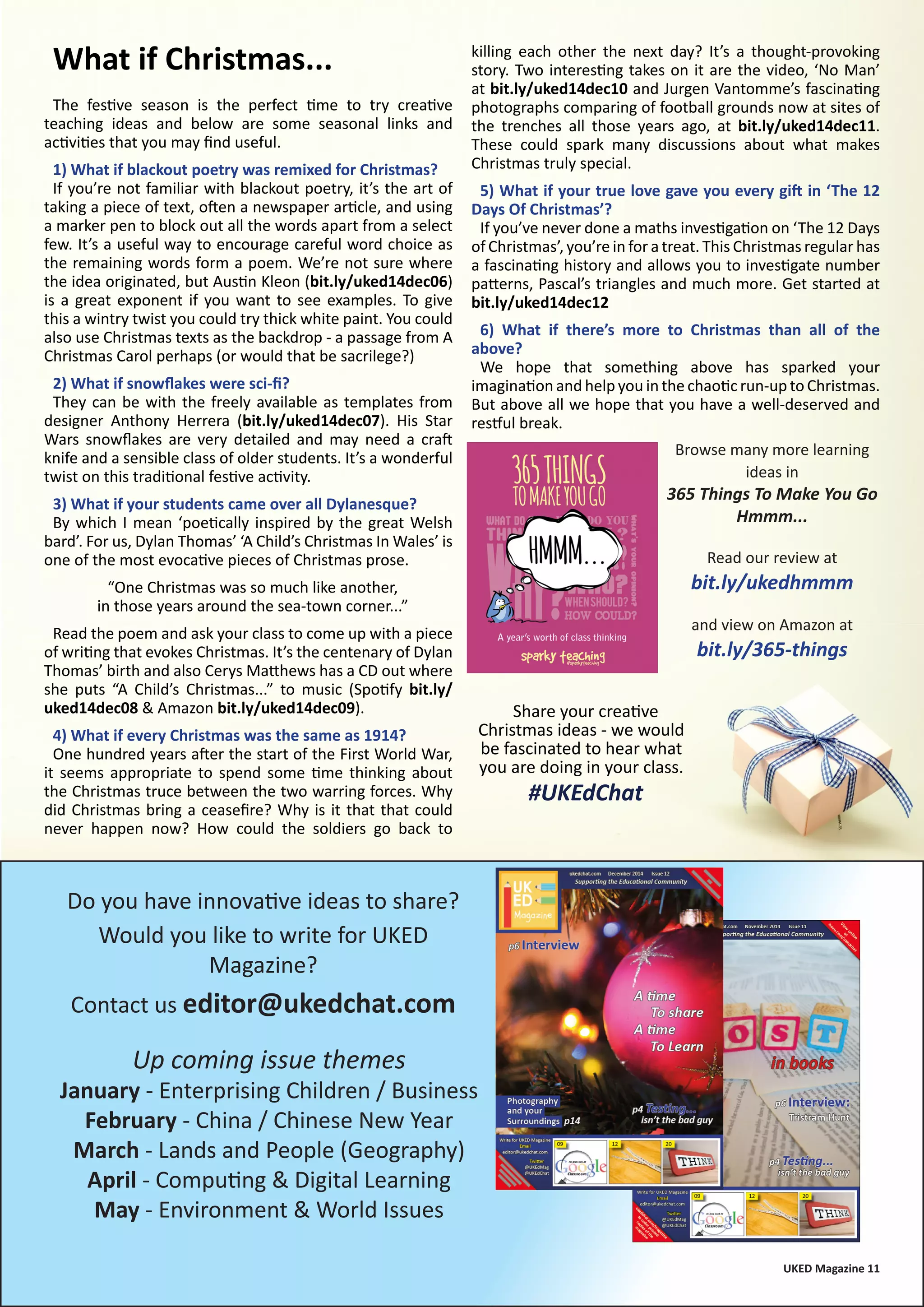
The festive season is the perfect time to try creative
teaching ideas and below are some seasonal links and
activities that you may find useful.
1) What if blackout poetry was remixed for Christmas?
If you’re not familiar with blackout poetry, it’s the art of
taking a piece of text, often a newspaper article, and using
a marker pen to block out all the words apart from a select
few. It’s a useful way to encourage careful word choice as
the remaining words form a poem. We’re not sure where
the idea originated, but Austin Kleon (bit.ly/uked14dec06)
is a great exponent if you want to see examples. To give
this a wintry twist you could try thick white paint. You could
also use Christmas texts as the backdrop - a passage from A
Christmas Carol perhaps (or would that be sacrilege?)
2) What if snowflakes were sci-fi?
They can be with the freely available as templates from
designer Anthony Herrera (bit.ly/uked14dec07). His Star
Wars snowflakes are very detailed and may need a craft
knife and a sensible class of older students. It’s a wonderful
twist on this traditional festive activity.
3) What if your students came over all Dylanesque?
By which I mean ‘poetically inspired by the great Welsh
bard’. For us, Dylan Thomas’ ‘A Child’s Christmas In Wales’ is
one of the most evocative pieces of Christmas prose.
“One Christmas was so much like another,
in those years around the sea-town corner...”
Read the poem and ask your class to come up with a piece
of writing that evokes Christmas. It’s the centenary of Dylan
Thomas’ birth and also Cerys Matthews has a CD out where
she puts “A Child’s Christmas...” to music (Spotify bit.ly/
uked14dec08 & Amazon bit.ly/uked14dec09).
4) What if every Christmas was the same as 1914?
One hundred years after the start of the First World War,
it seems appropriate to spend some time thinking about
the Christmas truce between the two warring forces. Why
did Christmas bring a ceasefire? Why is it that that could
never happen now? How could the soldiers go back to
Do you have innovative ideas to share?
Would you like to write for UKED
Magazine?
Contact us editor@ukedchat.com
Up coming issue themes
January - Enterprising Children / Business
February - China / Chinese New Year
March - Lands and People (Geography)
April - Computing & Digital Learning
May - Environment & World Issues
killing each other the next day? It’s a thought-provoking
story. Two interesting takes on it are the video, ‘No Man’
at bit.ly/uked14dec10 and Jurgen Vantomme’s fascinating
photographs comparing of football grounds now at sites of
the trenches all those years ago, at bit.ly/uked14dec11.
These could spark many discussions about what makes
Christmas truly special.
5) What if your true love gave you every gift in ‘The 12
Days Of Christmas’?
If you’ve never done a maths investigation on ‘The 12 Days
of Christmas’, you’re in for a treat. This Christmas regular has
a fascinating history and allows you to investigate number
patterns, Pascal’s triangles and much more. Get started at
bit.ly/uked14dec12
6) What if there’s more to Christmas than all of the
above?
We hope that something above has sparked your
imagination and help you in the chaotic run-up to Christmas.
But above all we hope that you have a well-deserved and
restful break.
What if Christmas...
Browse many more learning
ideas in
365 Things To Make You Go
Hmmm...
Read our review at
bit.ly/ukedhmmm
and view on Amazon at
bit.ly/365-things
Share your creative
Christmas ideas - we would
be fascinated to hear what
you are doing in your class.
#UKEdChat
Big Schools' Birdwatch
5 January - 13 February
From 5 January – 13 February 2015, schools across the UK will be making
bird feeders and binoculars, turning classrooms into bird hides and getting
excited children into position with their noses pressed against the
window. Why? To take part in the Big Schools’ Birdwatch.
Big Schools’ Birdwatch is a simple activity that gets children
and their teachers closer to the birds visiting their school
grounds.
It is a simple survey that takes just one hour
and can be carried out in school or by visiting
a local outdoor space. It works across a
wide age and ability range. There’s
plenty of flexibility for schools to
run it as simply as they would
like, or as the centrepiece
of cross-curricular studies,
project work or as part of
work to improve their school grounds.
Big Schools’ Birdwatch aims to encourage children, and their teachers, to identify and take an interest in the birds
visiting their school grounds. It is also suitable for youth groups, e.g. brownies and cubs.
Nearly 2500 classes, involving 75,000 children and teachers took part in the wildlife survey last year.
Since its launch in 2002, more than 70 different species have been recorded in school grounds, ranging from starlings
and house sparrows, to kestrels and even pheasants.
Taking part in the activity could not be easier. Everything a teacher would need to plan a fantastic birdwatch and
develop their children’s knowledge and interest in the birds they see every day is available to download from our
website, including guidance notes, recipes, make and dos and counting charts.
We also have specially designed resources for different age groups: Under 5s, 5-7s, 7-11s and 11-14 years old.
By participating in the Big Schools’ Birdwatch and preparing your grounds for some feathered visitors you’ll be helping
to give nature a home at your school.
The birdwatch is a simple survey that takes just one hour and can be carried out in school or by visiting a local outdoor
space. All schools need to do to take part is watch and count the birds in their school grounds for one hour, then send
the RSPB one set of results detailing what they saw. It doesn’t matter how many or how few birds – all sightings are
useful! They don’t need to be an expert birdwatcher – the main thing is to have fun watching!
Sending in your survey results is a vital part of the activity. Once the survey results are in, we collect them all together
and do some adding up. This helps us to see how birds are doing across the UK, but it also means that we can feed back
the results to schools that took part.
12 UKED Magazine
The RSPB website has a specially designed online results
form. It can be used as a fun data-handling class activity,
via an interactive whiteboard. Teachers and children can
build their choice of graphs and charts using their results
data.
Big Schools’ Birdwatch is part of the world’s biggest
birdwatching event, the RSPB’s Big Garden Birdwatch. It
takes place over the weekend of 24/25 January 2015.
Further information can be found on the RSPB website
rspb.org.uk/birdwatch
Visit: www.rspb.org.uk/schoolswatch
for everything you need!
Image Credit: All images by Martin Burrett
Fast Festive Role Play
Advent is supposed to be a season of expectant waiting and
preparation. In primary schools it is often a hectic season of
making cards, calendars and decorations whilst learning the
words to ‘Away in a manger’ and keeping everything crossed
that the angel Gabriel doesn’t come down with a bout of
norovirus. The good intentions to transform the classroom
into a festive wonderland can just become the last straw.
Here are my ideas for some easy role play solutions that
take minimum time, but inject some festive fun into that
corner of the classroom.
Using Janet and Allan Ahlberg’s “Jolly Christmas Postman”
(bit.ly/uked14dec13) as an inspiration, set up a writing
table where children can pretend to be characters from
fairy tales writing to each other. If you have costumes for
the Bad Wolf or Red Riding Hood, you can get them out as
extra inspiration. If not, write the names of characters on
post it notes, the children must pick one and then make a
Christmas card from that character, this can be extended by
asking children to write a letter to Father Christmas in role,
what would Baby Bear want for Christmas.
A variation for older children is to get them to imagine
they are a famous writer, historical figure, sporting hero, or
even just someone from the past. What are their hopes and
dreams at Christmas and the new year. Put on a top hat and
they become Charles Dickens or a beret with a brooch and
they are Henry VIII. The anniversary of World War I provides
an opportunity for thinking about what would have been
in Christmas letters from soldiers, parents or sweethearts.
Find a selection of Nativity stories and make a stable in
the classroom. A doll wrapped in ‘swaddling’ and some
sticky name labels is all you really need, though you can use
costumes from the school play, if they are not too precious!
A literacy focus is maintained if you have a badge saying
‘narrator’ and one child reading the story whilst the others
act it out.
Flatten out some cardboard boxes - cereal boxes are
perfect. Wearing Santa hats the children become elves and
their job is to remake the boxes plain side out and make
their own special design on the box. Link this to literacy by
introducing story characters, maybe design a parcel for the
Gruffalo? A variation on this is to design some wrapping
paper and write a label for their intended recipient. This
can be done with stampers or potato prints, though I think
it is quite good to observe what they produce imaginatively.
Again, using Santa hats to make the children into elves,
put out some construction kit and an instruction, such as
“Santa needs five cars, a tall tower and an aeroplane”. They
can tick off each item as they make it and then stick a label
saying what they have made. Older children can write how
they made their toys on white boards and leave them as
instructions for the next group.
This is just a whistle stop tour through some festive fun.
Happy Christmas!
Dr. Nancy Walbank is an educational consultant. She has
worked across primary, secondary and tertiary educa-
tion. She has held leadership roles in the primary sector.
Her PhD focused on inclusion in faith schools. She is the
author of “Six Top Tips for a Trainee Teachers.” Follow
her on Twitter @nan282.
By Nancy Walbank
Image Credit: http://pixabay.com/en/star-christmas-red-white-snow-474864 (adapted) by geralt used under Commercial Creative Commons 2.0 License.
Read and download all of our back issues for
free at
issuu.com/ukedchat
Order a free printed edition of the magazine
at ukedchat.com/magazine
(just pay postage and packing)
Next issue...
Our January issue has a Business &
Enterprise theme, as well as a mix of
other article from front-line educators.
Have you got a idea for an article?
Contact us at
editor@ukedchat.com
Take part in weekly educational discussions on Twitter
Thursday at 8pm
Just look for the #ukedchat hashtag
See the chat archive at
http://ukedchat.com/archive
UKED Magazine 13
14 UKED Magazine
Rewarding Schools Success
UKEdChat attended Educate Awards and spoke with the winning schools
Celebrating the positive aspects of school life is always a
pleasure to behold, but with so much negative treatment
focused within the media, the encouraging side of what
is happening in schools is easily overlooked. The Educate
Awards, in Merseyside, explore such positive activities within
schools encompassing five local education areas within the
county, considering various categories that value all parts
of a school community. At a gala-filled evening at Liverpool
Cathedral, we caught up with some of the winners, as they
explained how they had achieved so much, celebrating the
pupils, teachers and community that the school serves:
Communication Award -
Whitefield Primary
@WhitefieldPS
Winners of the Communication
Award for its school radio station
and successful embrace of social
media was Whitefield Primary.
They continue to innovate and
grow their communication
methods which makes them
worthy winners of this award.
Speaking to UKED Magazine
after receiving the award, head-
teacher Nadine Carroll said,
“We’re absolutely delighted. It
means so much to our school community and really lifts our
area of Everton where the school is. We can’t wait to take
the award back to our children to show in Monday morning’s
assembly”.
Innovative and Creative Literacy Award -
Alsop High School @AlsopHighSchool
Alsop High School won the Innovative and Creative Literacy
Award for its broad and innovative approach to literacy. They
instil in their pupils creative literacy skills, but also a love and
passion of the written word. Teacher Claire Madeloso told us,
“One of the things for us, in the area where we work, pupils
do have a very varied background, many of whom come with
a low reading age. Improving their literacy skills is key to us
and helping them to be successful in the future. It’s great to
be recognised for what we’re doing”.
Spirit of Enterprise - Evelyn CP School
From Knowsley, Evelyn CP School was awarded the Spirit of
Enterprise award for its ‘entrepreneurial continuum’. From
nursery to year 6, the school puts enterprise firmly in the
children’s sights and truly encompasses the innovative spirit
of enterprise. Headteacher Carol Arnold spoke after receiving
the award, “We’re just absolutely delighted, and it’s been a
whole team effort. We feel we have done something really
unique.”
Outstanding Arts in Primary
School - Netherton Moss
Primary School
Netherton Moss Primary
School was awarded the
Outstanding Arts in a Primary
School Award for its production
of ‘The Timekey Travellers’.
The fully inclusive production
involved all year groups, of all
talents and abilities. It’s a fine
example of involving every pupil
in to a performance. The staff
were delighted at winning the
award for the third year running.
The headteacher, Fiona Wood enthused, “The teachers and
the staff and pupils all worked so hard together to do it, and
it’s just wonderful. It really is a whole school involvement.
The children write the script and are already writing this
years’ epic.” Teacher David Hird continued, “The children are
also busy making all the stage props, the set, and designing
the tickets and programmes – everybody from Reception
right the way to Year 6 are involved. The participation, I think,
is key – the children own it.”
Outstanding Arts in a Secondary School Award -
Gateacre School @GateacreSchool
For its production of Charlie and the Chocolate Factory,
Gateacre School won the Outstanding Arts in a Secondary
School award. The production embraced all year groups and
even had the kitchen staff involved by making some delicious
Willy Wonker style creations. Subject Leader for drama,
Helen Williams told how the school had encompassed the
production, “It all span out of control a little bit – in a positive
way – in a sense of how it started to embed in lot of other
curriculum, with design and technology, plus arts. Our aims
are to make drama broader to the whole school and I’d
like to think that we managed that in the
production”.
UKED Magazine 15
Image Credit:
Background image by UKEdChat staff.
All other images have been provided by the Educate Magazine.
SEN Provision Award -
Summerhill Primary
@SummerhillL31
Summerhill Primary was
awarded the SEN Provision
Award; the judges noting that
they are a fine example of a
school embracing children across
the spectrum of ability and
disability. SENCo, Yvonne Gleig
expressed, “We’re very proud
to receive this and the children
certainly are at the heart of our
school.”
Science Project of the Year - Liverpool Life Sciences UTC
Liverpool Life Sciences UTC had a successful evening,
winning two awards on the night. Winners in the Science
Project of the Year category, Liverpool Life Sciences UTC
has developed a simple, school
friendly and inexpensive model
for understanding fundamental
principles in the life sciences.
A great example of providing
genuine opportunities for
studentstoconductrealscientific
research.Speakingaboutthetwo
awards they picked up during
the evening, Lyndsay MacAulay
(Director of Enterprise) told us,
“At the end of our first year of
opening to be here and to have
won two prestigious awards,
particularly in areas that we are
so passionate about”.
Wow Recognition Award - Calderstones School
@CaldiesSchool
The final award of the evening,
the Wow Recognition Award
was presented to Calderstones
School for its Tower2Tower
bicycle challenge. This project
was a fitting way to remember a
popular teacher while crucially
raising awareness of mental
health issues. Cycling from
Liverpool to Paris, the success
of the challenge was incredible,
it pulled a community together
byhostingfundraisers,engaging
local primary schools with the
team’s branding design and
included everyone possible to pay tribute to one of its great
teachers. Assistant head-teacher Alan Preston expanded on
the story, “We lost one of our teachers, who took his own life
this week last year. Unfortunately, the mental health provision
nationally is simply not good enough. We came together as
a community and decided we needed to raise a significant
amount of money for that cause. We raised just short of
£20,000. What everyone got out of it was phenomenal. There
were 16 riders and 4 support staff involved”.
The young Radio presenters at Whitefield Primary School
Developing a Revived Department. . .
By Andy Knill
Back in September 2014, I wrote an article titled ‘Moving
on...’ about starting at a new school and in a new role. I have
been in post for just under a term and this is my progress
so thus of ‘reviving a department’. Why have I chosen this
phrase? I am new and much of my geography department
are new.
Here are some of the ideas that we have developed so far
with a long way still to go.
Staffing - Recent headlines have mentioned recruiting
staff concerns. Our department is an international mix of
English, Irish and Australian and we have gelled fantastically
well. I am an extremely lucky Head of Department as we
have a team spirit, which is evident through the amount of
staff interaction and collaboration everyday. I am blessed
with the chance to work with a mix of experience, travel
experience and a team with fresh ideas.
Curriculum - I hoped to take 6 months to review and revise
our Key Stage 3 course as I was uncertain of what I found on
arrival. The outcome has been a new scheme of work that
has responded to National Curriculum changes, discovering
weaknesses in geographical skills and/or knowledge within
the year groups and a desire to develop young geographers
who can succeed to their full potential.
We have forged ahead with new units and next term we
will work as a team to develop the shape of geography at
the school. In the summer term we will be in a position to
delegate and play to individual strengths.
We have lessons that utilise our textbooks, we have used
web and app resources and, best of all, a relevance to recent
news events. We have dispelled some of the media based
misunderstandings linked to Ebola, and on a local level,
we have looked at the changes at the Dartford crossings
over the River Thames in the week before Dart charge is
introduced. Improvements needed? Yes, we need more
resourcing across the ability range to differentiate more,
but it is an open conversation without barriers and a great
start in only our first term.
GCSE - In my previous post, personal health problems
had seen me pull back from GCSE teaching in geography.
However, now I have five groups across Year 10 and 11.
Attending a WJEC exam course gave me the boost in
confidence that all was on the right track. I have challenged
my pupils in a more active learning style. There was a
little resistant initially, but I am now seeing a confidence
developing that we will take through to June – and yes, to
improve on previous outcomes.
Display - These have not always been my strength, but
something that has started well, from the signs about New
management which used the ‘Moving On’ article image. We
have developed a range of display materials and activities
for Open Evening that included some models from the
previous department, but mostly it was already about what
we are doing and it was well received.
Pedagogy - We are using Solo Taxonomy across a
department, including in staff briefing and sharing ideas
further. We are also developing ‘critique’ based on the work
of Ron Berger (see page 4) linked to homework projects and
sharing Austin’s Butterfly with a new audience, staff and
pupils. We have had assemblies on rainforests for all houses
which encompassed move towards a growth mindset
culture in the school.
We have also been pro-active in having interactive
whiteboard and technology training for new staff; hosting
the third Teachmeet Havering to the school in the first few
weeks with great enthusiasm to take part, including the
Head Teacher who was keen to present. This has culminated
in a great first Parents’ Evening with Year 11 which that a
queue that went out of the door.
I am happy. I moved at the right time for me. I am in a
place where I intend to keep making a difference.
InBrief
Project Based Learning in Primary
Trapped in discrete subject teaching, and effort
that rarely extends beyond a 50min session,
kids and teachers yearn for purposeful learning,
beyond imposed ‘requirements’.
Project Based Learning is about making the
learning matter.
It is rigorous, sharing what success will look like,
with kids and parents, and everyone being held
accountable.
Start with a real question (around a theme of
your choice), and give the children a time-frame to
solve it, ending with a public exhibition, inviting parents
and the school community. Of course you teach skills,
facts and practice those. But, crucially, the kids will care.
It should be whole school, but I recommend starting
with your own class, and being brave enough to set an
end goal for the end of term that allows the kids to work
towards a display of their response to a shared challenge.
I’ve done it, been judged to be effective and successful
in a normal school: and teachers all over the world are
making a success of it. What have you got to lose?
@eylanezekiel - Teacher/Consultant, Oxford
Andy Knill is Head of Geography at The Albany School,
Hornchurch, Havering.
Find him online at mishmashlearning.wordpress.com
and globalsolo.wordpress.com and on Twitter @aknill
& @globalsolo.
Image credit: http://freestock.ca/flags_maps_g80-world_map__
abstract_acrylic_p2970.html (modified) by Nicolas Raymond used
under Commercial Creative Commons 3.0 License.
Book ShelfBook Shelf
UKED Magazine 17
For many more book reviews, go to
http://ukedchat.com/category/book
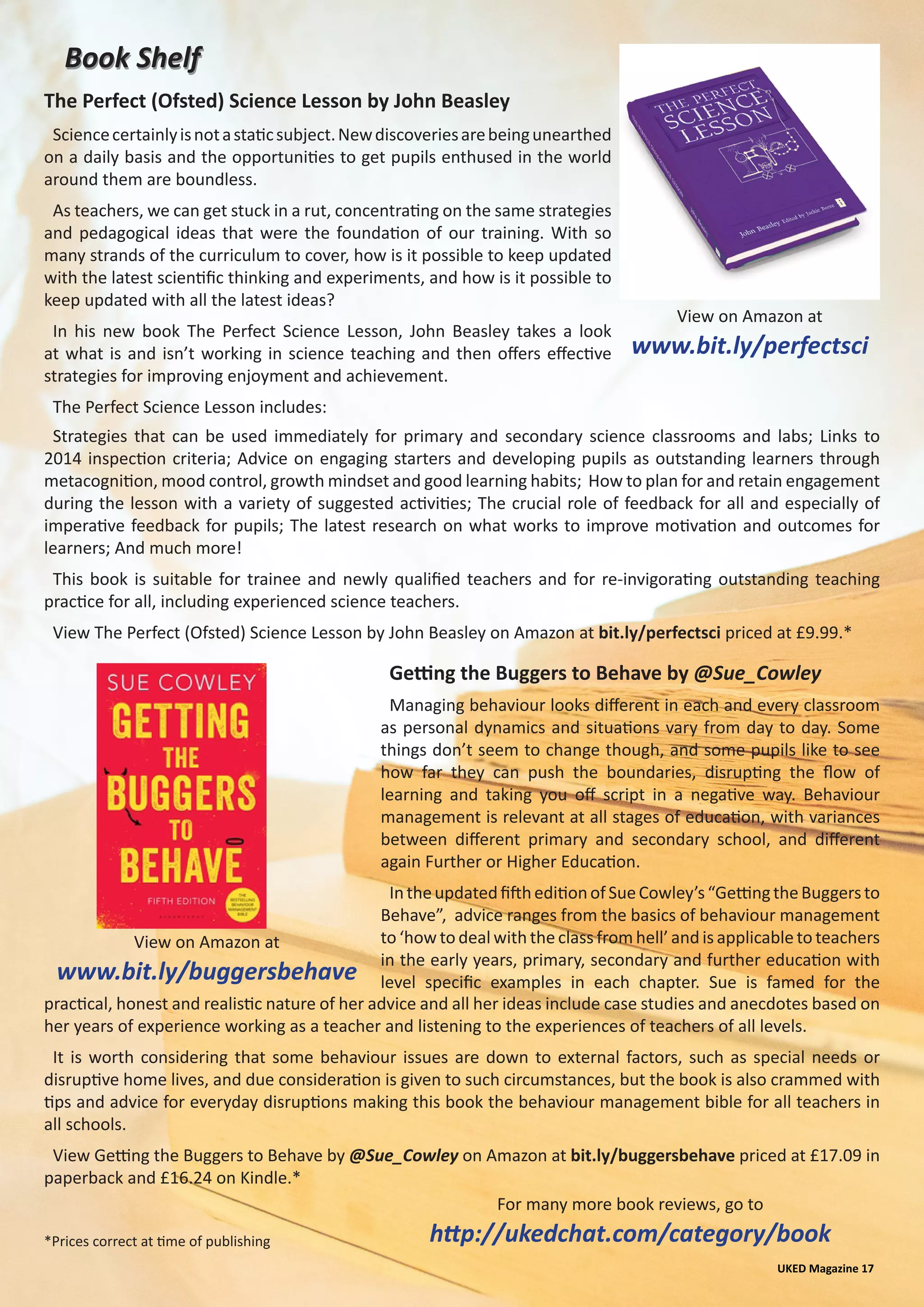
Sciencecertainlyisnotastaticsubject.Newdiscoveriesarebeingunearthed
on a daily basis and the opportunities to get pupils enthused in the world
around them are boundless.
As teachers, we can get stuck in a rut, concentrating on the same strategies
and pedagogical ideas that were the foundation of our training. With so
many strands of the curriculum to cover, how is it possible to keep updated
with the latest scientific thinking and experiments, and how is it possible to
keep updated with all the latest ideas?
In his new book The Perfect Science Lesson, John Beasley takes a look
at what is and isn’t working in science teaching and then offers effective
strategies for improving enjoyment and achievement.
The Perfect Science Lesson includes:
View on Amazon at
www.bit.ly/perfectsci
Strategies that can be used immediately for primary and secondary science classrooms and labs; Links to
2014 inspection criteria; Advice on engaging starters and developing pupils as outstanding learners through
metacognition, mood control, growth mindset and good learning habits; How to plan for and retain engagement
during the lesson with a variety of suggested activities; The crucial role of feedback for all and especially of
imperative feedback for pupils; The latest research on what works to improve motivation and outcomes for
learners; And much more!
This book is suitable for trainee and newly qualified teachers and for re-invigorating outstanding teaching
practice for all, including experienced science teachers.
View The Perfect (Ofsted) Science Lesson by John Beasley on Amazon at bit.ly/perfectsci priced at £9.99.*
The Perfect (Ofsted) Science Lesson by John Beasley
Getting the Buggers to Behave by @Sue_Cowley
Managing behaviour looks different in each and every classroom
as personal dynamics and situations vary from day to day. Some
things don’t seem to change though, and some pupils like to see
how far they can push the boundaries, disrupting the flow of
learning and taking you off script in a negative way. Behaviour
management is relevant at all stages of education, with variances
between different primary and secondary school, and different
again Further or Higher Education.
IntheupdatedfiftheditionofSueCowley’s“GettingtheBuggersto
Behave”, advice ranges from the basics of behaviour management
to ‘how to deal with the class from hell’ and is applicable to teachers
in the early years, primary, secondary and further education with
level specific examples in each chapter. Sue is famed for the
View on Amazon at
www.bit.ly/buggersbehave
practical, honest and realistic nature of her advice and all her ideas include case studies and anecdotes based on
her years of experience working as a teacher and listening to the experiences of teachers of all levels.
It is worth considering that some behaviour issues are down to external factors, such as special needs or
disruptive home lives, and due consideration is given to such circumstances, but the book is also crammed with
tips and advice for everyday disruptions making this book the behaviour management bible for all teachers in
all schools.
View Getting the Buggers to Behave by @Sue_Cowley on Amazon at bit.ly/buggersbehave priced at £17.09 in
paperback and £16.24 on Kindle.*
*Prices correct at time of publishing
In our survey, we asked teachers to tell
us about resources that they found on
twitter which they then implemented
in the classroom. Here are 25 of the
most commonly shared ideas:
FiSH Feedback
Educators love acronyms, and here
is the first in our list. This feedback
method, encourages teachers and
pupils to ensure their critique is
Friendly, Specific, Helpful. The 'I'?
Genius Hour
Inspired from Google's 20% project,
genius hour (bit.ly/uked14dec14)
allows pupils to follow a passion
of theirs without any marking,
assessment or grading. Just encourage
your students to learn or explore
something they love. See the ukedchat
session which discussed the concept at
bit.ly/uked14dec15.
Blooms Taxonomy
Refers to a classification of the
different learning objectives that
educators set for pupils.
Mindsets
A concept introduced by Carol Dweck
(bit.ly/uked14dec16) who explains
why it's not just our abilities and talent
that bring us success - but whether we
approach them with a fixed or growth
mindset. Some colleagues may benefit
from reading the ideas behind the
theory.
5-Minute Lesson Plan
Showcased by Ross Morrison McGill
@TeacherToolkit, this resource
(ukedchat.com/wsr00001) helps cut
downthetimetakenplanning,ensuring
most aspects of lesson planning are
covered.
Slow Writing
A fantastic idea that can re-invigour
thewritingprocess,developedbyDavid
Didau @LearningSpy in his "The Secret
ofLiteracyBook"(bit.ly/uked14dec17),
and also his blog at learningspy.co.uk,
the concept challenges pupils to follow
explicit instructions on how to write a
text sentence by sentence.
Takeaway Homework
A homework menu which encourages
children to become independent
learners and take responsibility for
choosing their own homework from a
selection of dishes on a menu.
Flipped Learning
Can be interpreted as flipping the
classroom open – providing links to
prior learning so development takes
priority. Technology can play a role, in
providing links or videos so students
UKED Magazine 19
can get to grips with learning concepts before the formal
teaching - perhaps! Read the archived ukedchat session at
bit.ly/uked14dec18 which explored the idea.
TeachMeets
An opportunity for teachers to get together an informally
share ideas and pedagogy that works in their classroom. No
tech required. Presentations are 2 or 7 minutes long, and
beware of the camel. See teachmeet.pbworks.com for a list
of upcoming events globally.
Educational Policy and Curriculum Developments
With curriculum changes seemingly happening every year,
in every country - Twitter is a great place to see how teaching
colleagues are coping with these changes, helping keep on
top of the changes as they are implemented.
Extension Task Cards
One of the most popular resources on UKEdResources (via
@misstait_85), these cards / extension ideas are ideal for
those pupils who finish their work early, allowing for learning
to continue and extending ideas.
Go to ukedchat.com/wsr00010 to view / download the
freely available resource.
Shared Planning Ideas
Planning a new topic, or sequence of lessons from scratch?
The chances are, there will be another teacher somewhere
else doing exactly the same. Our survey revealed that
teachers found collaborative sharing of planning ideas to
be inspirational, creative and take the teaching & learning
sequence beyond the initial expectations - positively.
Assessment Strategies
Within England, teachers were faced with the withdrawal
of assessment levels, with greater 'freedoms' given for
assessing. This caused general panic as schools were still
accountable by inspection regimes. Our survey revealed that
teachers took comfort and inspiration from other teachers
who were faced with the same situation, sharing strategies
and options being explored.
Books, Books, Books
The education community is a buzz with many fantastic
books to help teachers develop their practice - and books
regularly pop up on twitter which have helped in some
aspect. We regularly review new publications - view over 40
inspiring books at ukedchat.com/category/book.
DIRT Feedback
A popular and regular search term on the ukedchat site
bit.ly/uked14dec19, DIRT Feedback stands for ‘Dedicated
Improvement and Reflection Time‘, mainly aimed at
secondary aged pupils (11+), although some aspects are
already embedded within primary practice. Explore further
by clicking here. For more inform go to bit.ly/uked14dec20.
Specific Science Demonstrations
Gaining ideas and inspiration to demonstrate tricky
scientific concepts is a lot easier by following many great
science teachers on Twitter, who share their demonstrations
and concepts with colleagues which can help reinvigorate
the teaching and learning process. The volcano is now dead.
Exit Tickets
A fast and easy vehicle to get feedback from students. Can
be open ended, sharing thoughts on what pupils thought was
easy within the lesson, too hard, or how much they feel they
learned. Technologically astute settings could manage this
initiative using free software and sites like Socrative.com.
Virtual Global Exchanges
Twitter allows teachers to link globally, allowing for
virtual exchanges via SKYPE Classroom or other online
communication tools. It is easy to explore other classrooms
without leaving yours, and many teachers collaborate with
classrooms on the other side of the globe easily. Why? Why
not! It is easy to broaden cultural understandings, languages
and explore the lives of contemporaries in other continents.
NaNoWriMo
Stands for, "National Novel Writing Month" and is an annual
(November) novel writing project that brings together
professional and amateur writers from all over the world,
which has keenly been picked up by educators globally. See
nanowrimo.org for more details.
Questioning Techniques
One of the most powerful tools in the teachers kit,
questioning pupils and their thinking can really help develop
learning, but needs to be done with careful consideration
and planning. Whether questions are philosophical, or help
understanding, making sure that the teachers techniques
are honed takes time. See ideas / resources at bit.ly/
uked14dec21, "Questions are the only useful things in
planning! Planning how you take learning forward using
questioning is SO important".
Display Ideas
Faced with a HUGE blank classroom display board that really
doesn't inspire you or your pupils. Take your display to the
next level by exploring ideas from your PLN on Twitter. View
ukedchat.com/tag/display for UKEdChat sessions that look
at classroom displays. Share yours. You can easily inspire.
Behaviour Management Techniques
Girls and boys can equally challenge the most patient
teachers, but it is easy to feel isolated when trying to deal
with behaviour issues in the classroom. This happens from
Early Years all the way through to university classrooms. Our
survey revealed that teachers turn to their PLN for support
and advice, with many ideas or strategies shared on our site
at ukedchat.com/tag/behaviour.
SOLO Taxonomy
Proposed in the early 1980's, the SOLO Taxonomy consists
of 5 levels of understanding: Pre-structural; Uni-structural;
Multi-structural; Relational, and; Extended abstract. This
model describes levels of increasing complexity in student's
understanding of subjects. View ukedchat.com/tag/solo for
more information.
RAG 123 Plenaries
Developed by @ListerKev, the concept was to make
marking a lot less time consuming, yet being of value to the
pupil who could develop their work. Read the blog posting
at bit.ly/uked14dec22 which goes into greater detail.
Apps & Websites
Twitter is saturated with useful links and apps worthy of
exploration, and sometimes you will come across a gem
which you can use with your class to help develop a learning
concept. There are so many ideas, links and apps but your
Twitter network will help you sort out the useful from the
rubbish!
Share your favourite ideas, strategies and resources on
Twitter using #UKEdChat and share with the community.
20 UKED Magazine
●	 Which Gospels tell the story of the nativity?
●	 How many Magi were there?
●	 Who mentions the shepherds?
Despite the Nativity being one of the most frequently told,
and certainly the most acted out, stories in the Bible, it is
often inaccurately told and its complexities overlooked. Few
realise that it only features in two of the four gospels, that the
Magi probably visited anything from six months to a year after
Jesus was born (they had three gifts, so we presume there was
three of them), and that only Luke refers to the shepherds.
Even Pope Benedict XVI felt the need to address the
commonly held Nativity beliefs in his book, Jesus of Nazareth
- The Infancy Narratives (2012). He pointed out that there was
no mention of animals in the place where Jesus was born and
the angels spoke and didn’t sing as many carols suggest.
The word Nativity has its roots in the Latin nativus ‘arisen by
birth’, and gives the start point of Christianity; the moment
“God became flesh through Virgin Birth”. This monumental
occasion deserves the attention of all those teaching RE, yet at
times, lessons can easily become tired and dull, or incredibly
superficial.
My Approach - I studied New Testament papers at university
as a Theology and Religious Studies undergraduate and so I
still cultivate a love a scripture study. Anyone who says the
Bible is boring really hasn’t bothered to invest any time into
understanding it’s rich and varied cultural, historical and
poetic content. I also teach in a Catholic school where I have
five lessons per fortnight with classes, which allows a mixture
of the rigorous and academic, as well as the creative.
An example of its intricacies are the Nativity accounts. One
could look at the two accounts and dismiss their differences
as clear evidence that they are inaccurate. However to look a
little closer, with even the most basic background knowledge,
it becomes evident that they are far easier to reconcile than
on face value.
Luke is writing to a Roman official and Matthew is writing
to Christians who were formerly Jews. In simple terms, Luke
is writing to the oppressor and Matthew is writing to the
oppressed. This is vital to any understanding of the Nativity
and its perceived inconsistency.
Luke carefully omitted those things that would upset the
Roman official, Theophilus, or any other Roman official that
Theophilus might show Luke’s gospel. This included the Roman
atrocity of Slaughter of the Innocents and the highlighting
of Jesus’ Messiahship, which could be considered a political
threat to the Empire. The mentioned shepherds were lowly,
marginal visitors and so permitted for inclusion.
Matthew has similarly left out those things that would
upset Jewish Christians. He only briefly deals with the virginal
conception and birth of Jesus and then rushes on to the Magi.
This story, with gifts of exotic and expensive gifts would have
impressed a Jewish audience. Luke doesn’t include it as the
Romans may have suspected that the Christians were making
alliances with powerful people beyond the empire.
This prudence is not sinful as St Paul says, “...try to fit your
answers to the needs of each one.” (Colossians 4:6) and as
Jesus instructs, “... be cunning as serpents and yet as harmless
as doves.” (Matthew 10:16).
Only after we have got our head around this do we move
on… Ask your students to describe their school day. What do
they tell their friend? What do they tell their parent? What do
they tell their teacher? Just because the stories are different,
does it mean they are necessarily false?
Activities for KS3 - Often we create an overview with three
columns; Luke, Matthew and Both. We may discuss the
possible existence of ‘Q’ with more able or interested classes.
Once the basics have been mapped out, we try to work out
why Matthew included what he did, and likewise with Luke.
A creative task from this may then be a ‘Luke Christmas Card’
with a piece of exclusive scripture on the front. Or obviously
a ‘Matthew Christmas Card’. The opposite is also possible,
collecting a selection of religious Christmas cards and
categorising them in to: Luke, Matthew, Both or Neither! The
‘Neither’ pile includes those that have the shepherds AND the
Magi, or feature a donkey...
It is important to remind students, that despite this, a
consistent story can be constructed if we recognise the
different audiences that the writers were trying to win over.
They were writing the truth as they knew it, but at no point
proclaimed that their accounts were legal testimonies, nor
the whole truth.
IalsoliketolookatJewishexpectationsofMessiahshipwithin
the Nativity, as it is a really hard thing for many students to
grasp. A Church in New Zealand have come to my help here!
“The Unexpected Nativity” (bit.ly/uked14dec23) is one of the
most loved of my Christmas videos and I urge you to watch it
and find a way to include it somehow!
A modern retelling can be another interesting approach
and Mary and Joseph’s time in Egypt can lead to careful
consideration of asylum seekers and immigrants in the UK.
My Y9 students have just done some detailed diary accounts
of this part of the Nativity: new language, new culture, no job,
no place to call home, young baby… However I am not entirely
comfortable with the ‘Chav Nativity’ image as a respectful and
useful start point.
There are some great video stimulus for writing, particularly
to put into a modern context, see the ‘Mary and Joe’ videos
(bit.ly/uked14dec24). After reading the Gospel accounts, it
can be interesting to try and match scenes in the video and
make connections to life 2000 years ago in Palestine to life
today in the UK.
For those who like to use social networks to retell narratives,
there was a few videos produced that share the story this
The Greatest Story Ever Told
How can I teach the Nativity a little bit differently?By Andy Lewis
UKED Magazine 21
Image Credit
https://www.flickr.com/photos/jeffweese/4161935408 by Jeff Weese used
under Commercial Creative Commons 2.0 License.
http://pixabay.com/en/poinsettia-holy-three-kings-camels-528006 by geralt
used under Commercial Creative Commons 2.0 License.
way (although they have dated slightly now). They can help
students realise that the story still brings hope and joy to
millions of Christians globally and that it is still something of
relevance (bit.ly/uked14dec25). Also it can provoke questions
about how the story of Jesus spread pre-social media.
Other Ideas - Using my PLN of Twitter (via #REchatUK
and #REteacher) and via Facebook, I’ve brought together a
few other ideas for teaching the Nativity. Some of these are
variations on the ideas that I have used, while some of them I
would be wary of using in schools with limited RE time as the
opportunity cost is great, with little theological outcome:
● You could look at the different birth narratives and ask
pupils to write a nativity story as if it was happening today
and create a modern day version (Jesus coming for the poor,
marginalised, foreigners, asylum seekers etc). You could do it
as a Twitter feed maybe? As a plenary I often get pupils to
create a Google doodle based on the story, works well for
lower ability. For GCSE classes, I do a Christmas jukebox task
with lots of hymns and contemporary songs to analyse the
meaning of Christmas/the Nativity. - Helen Elizabeth
● We do a guided meditation. We also looked at the true
meaning of Christmas and have students decide which Advent
Jesus would approve of. - Sarah Doughty
● I often use a big selection of Christmas cards and pupils
work in teams to sort into categories: ‘In the narrative’ (e.g.
inn, star, wise men), ‘Non-religious’ (eg robins, snowmen),
‘Unsure’(egdonkey-notmentionedingospel,buttraditional).
I then challenge students to retell the story using their own
version cards which they design (like a storyboard). The
juxtaposition of Christmas and Easter in the Graham Kendrick
song ‘Thorns in the Straw’ is also of use (bit.ly/uked14dec26)
as is The Bethlehem Rhapsody (bit.ly/uked14dec27). Also see
TS Elliot’s “The Journey of the Magi”.- Gerry Cohen
● I have used the Nativity to discuss migrants and refugees
with KS3 - Hannah Koller
● Mary and Joe videos [see page 20]. I work in a school that
serves a community which has had socio-economic problems
and I always try to cover the meaning of Christmas as not
being about how much money is spent. - Kimberley Heavey
● The Lego Nativity is good for low ability KS3 / Primary. I
also have masks for each of the characters and get the class to
act it out having prepared a script. - Marged Williams
● A ‘Has Christmas lost its religious meaning?’ lesson.
Children have to keep a tally when sorting a selection of
Christmas cards and then make a graph with the data. More
able classes will collect data from the whole room and we
analyse it. They then write an extended answer on whether
they think Christmas has lost religious meaning based on the
results. - Hannah Downs
● I use the Picturing Jesus resource [RE Today] for this one -
awesome! - Aljo Gibbs Jones
● How about giving the pupils roles and retelling from that
perspective? E.g. shepherds, innkeeper, Mary etc. Then have
an interviewer ‘TV style’ to give their view on the event which
could be recorded and edited. - Sue Nurse
● For KS3, I used to get them to get them to make a crib
scene out of clay modelling. Also, they writing ‘Mary’s Diary’
and ‘Joseph’s Diary’. The Nativity Story film was pretty good
for the traditional story. At KS4 it’s nice to start looking at
some of the theology; family trees, comparing genealogies
even get in some exegesis of John 1. At KS5, I’m going to hit
them with some Karl Barth’s “The Miracle of Christmas”. To do
some more creative activities, try writing poems and songs. -
Tristan John S
● Half the class create a Christmas card based on the account
in Matthew and the other half Luke. They then compare
images; a way in to discuss the two different accounts with no
stables! - Lorraine Abbott
● We have made labyrinths in KS3 with different stations,
which have focussed on the nativity. Also, with KS3 we got
students to analyse Christmas carols and songs, and then
picked out the best lines and put them together in order to
tell their own most accurate telling of the Nativity. We mixed
sound clips of the lines and put them together to make up
their own song - we then played it in assembly. - Sarah Cobbold
● Using the good book company’s Christmas book, we’ve
gone through the story and talked about how different people
within the story might have been feeling. We’ve sequenced
the story and linked it with the children’s Nativity play and
then they have made their own Nativity story zig zag books
with detailed pictures and key events. Also, looking at
symbolism, we’ve talked through the story and looked at key
events within the life of Jesus. I asked the children to consider
the gifts that wise men brought the the stable and we’ve had
a class discussion about why those gifts were symbolically
linked to his later life. After reading the story we’ve discussed
key events and sequenced them using picture cards (linked
with some of Lat Blaylock’s work), then we made wooden
Nativity scenes using cut lollypop sticks. Sometimes we have
told the children the story and then used oil pastels to draw a
scene from the story, with children all given different scenes.
Hot seating activities also work; children take on a role of one
of the people from the nativity and then talked about key
events and feelings. - Katie Freeman
Conclusions
Find time to revisit the Nativity. It doesn’t have to be boring
and ‘same old’; find a new angle for your students and you may
find yourself enjoying it too! Whatever level you teach, there
is something new to be discovered. Perhaps start by trying to
find out why Jesus’ birth was almost certainly September or
October? Merry Christmas!
Andy Lewis is Assistant Subject Leader in RE, Head of
Y10 at Sacred Heart of Mary Girls’ School, Upminster
and is a lead for TheLondonREHub.com. Find him
online at mrlewisre.com and on Twitter @iTeachRE.
Recently on UKEdChat.com
Disco Fingers for iPad
bit.ly/uked14dec30
If you would like to re-blog your blog posts on ukedchat.com, enter your details at
bit.ly/ukedreblog
UKEdChat
Re-Blog
Browse our community pages to find
other educators to collaborate with
ukedchat.com/community
and even add yourself
Find great deals and discounts for
leading educational companies at
ukedchat.com/directory
What Should I do if I’m Worried
about a Friend’s Mental
Health?
bit.ly/uked14dec32
Social Sensing Game detects
Classroom Bullies
bit.ly/uked14dec31
Research explores Boys
Perception of their Weight
bit.ly/uked14dec33
bit.ly/uked14dec34 by @jigsawschoolapp bit.ly/uked14dec35 by @ScienceDouglas
bit.ly/uked14dec36 by @MrW1se bit.ly/uked14dec37 by @_theteachr
bit.ly/uked14dec38 by @ICTEvangelist bit.ly/uked14dec39 by @BradwayStockley
UKED Magazine 23
The Christmas Truce of 1914 is one of the most
fascinating stories of the First World War. The
tale of German and British troops singing
Silent Night, meeting each other in No Man’s
Land, and then playing a game of football is
a powerful counterpoint to the death and
destruction of the Great War. As history
teachers, however, we face the
problem that a number of
stories of the truce are
uncorroborated and thus
potentially inaccurate. How
can we engage students
with a discussion of the
Christmas Truce, whilst
ensuring that we don’t fuel
the mythology?
Sainsbury’s supermarket have
chosen to use the story of the Christmas
Truce to drive their 2014 seasonal advertising campaign.
The advert has spread a long way thanks to YouTube and
within two days of its first broadcast in the UK my students
in Romania were discussing it on their way to my history
lesson. I’ve always held the view that lessons and schemes
of work should somehow tap into students’ interests,
so I chose to seize this ‘teachable moment’ to deliver
an impromptu lesson. I asked the students to analyse
the advert as an historical source in order to answer the
question, “How much can we learn from the Sainsbury’s
advert about the First World War?”
To answer this question successfully, the students would
need to analyse the advert in the same way as they
would any other historical source. In order to direct their
discussions, they were asked to focus on four key questions:
•	 Who made the advert?
•	 Why was it made?
•	 What does it tell us about the First World War?
•	 What does it not tell us about the First World War?
This guidance was given to keep students focused on an
analysis of the advert as an historical source, rather than
allow the lesson to slip into a discussion of the moral and
ethical issues surrounding it. They immediately commented
that it tells us that soldiers played football on Christmas
Day, but also mentioned other details such as it telling
us about what soldiers wore and how the trenches were
constructed. On the flip side, a student highlighted that the
advert only shows the Truce for one group of soldiers. This
point was developed by another who commented that the
explosion that sends the two sides back to their trenches
proves that the fighting continued. This last point was really
important as it led us to a discussion of the dangers of using
one event to draw conclusions about the past in general.
Further background information about the
advertwasthenpresentedtothestudents,
to help them understand how the advert
had been created. They watched the
‘making of’ video, and read a series of
extracts from the Twitter feed of
Taff Gillingham, the historical
consultantwhoworkedonthe
advert (bit.ly/uked14dec28).
A copy of the joint press release by the British
Legion and Sainsbury’s also helped the students add
detail to their responses (bit.ly/uked14dec29).
These materials helped students to recognise that
the advert was an interpretation of the Truce, and
that it was therefore a compromise of the different
aims of those involved in its production. They quickly
spotted that the press release refers to the advert as
“a creative interpretation”, but pointed out that the
creators “sought to make the portrayal of the truce
as accurate as possible”. They recognised that this was
proved by the involvement of Mr Gillingham, whose Twitter
posts go into significant detail about the sources he used
to ensure the historical accuracy of the advert. Students
did, however, identify that Mr Gillingham tells of how he
and the director didn’t want the recorded football match to
dominate the advert, but that “the client” (i.e. Sainsbury’s)
wanted to “push the football hard”.
As a final activity, students from different groups were then
asked to pair off to share their findings with each other, and
to reach a conclusion of the overall lesson question about
how much the advert can teach us about the First World
War. Their opinions were written on Post-It notes, which
they arranged into a continuum on the board for a plenary
discussion.
Teaching history through current events is a rare privilege,
and so I am glad that I seized the opportunity to use the
Sainsbury’s advert in class. Although there are many
things I would like to improve about the way I taught this
lesson, I was very happy with the outcome. My Year 9
students proved that they were able to analyse a source
by considering its origin and purpose, and they gained a
more balanced understanding of the Christmas Truce in the
process.
Scott Allsop teaches History at the British School of
Bucharest, having previously taught in Egypt and the
UK. He runs an award-winning educational website at
mrallsophistory.com and you can find him on Twitter at
@MrAllsopHistory.
Teaching The Truce
Image Credit
https://www.flickr.com/photos/duncanh1/15129456264 (modified) by Duncan
Harris used under Commercial Creative Commons 2.0 License.
By Scott Allsop
Card People to Colour and Play
bit.ly/uked14dec44
Washable Dry Erase Markers
bit.ly/uked14dec45
Gruffalo Finger Puppets
bit.ly/uked14dec46
Minecraft Paper Craft Set
bit.ly/uked14dec47
Programmable Logo Robot
bit.ly/uked14dec48
Toy Post Office
bit.ly/uked14dec49
Charades For Kids
bit.ly/uked14dec50
Dinosaur Torch and Projector
bit.ly/uked14dec51
Easy to Design Circuits
bit.ly/uked14dec52
Image credit: http://pixabay.com/en/wrapping-paper-santa-clauses-funny-235939 by Hans under Commercial Creative Commons 3.0 License.
MineCraft Toy Set with Horse
bit.ly/uked14dec53
Word Game with a Banana Bag
bit.ly/uked14dec55
Boardgame To Build Coding Skills
bit.ly/uked14dec54
Verbal Description Game
bit.ly/uked14dec56
Verbal Skills Game
bit.ly/uked14dec58
Multi-Function Robot with Mobile App
bit.ly/uked14dec57
15 Educational Toys
Selected by educators from the UKEdChat community
InBrief
UKED Magazine 25
ictmagic.wikispaces.com
The best websites from
bit.ly/uked14dec40 A superb Christmas themed strategy
game where players help Santa by making a track for him to
sleigh down to collect presents.
Golden Segment
Many trainee teachers are advised to plan
one “Golden Lesson” a week. As an NQT I
attempted this for the first half term. This I felt
resulted in the other lessons not measuring up
to my high standards. Roll-on the second half
term and a new strategy, “Golden Segment”.
In every lesson planned there is a section that
is planned with a high level of consideration for
AFL and differentiation. The benefits have been
immense, an improvement in assessments as the
consideration of all students in all lessons means
that students are acquiring the knowledge and
skills associated with the course.
@_MrMills - Business Studies Teacher (NQT),
Altrincham
Favourite Colours
How well do you know your students? I don’t mean how well
they did on in their last assessment, their predicted grades, what
their support plan says or their areas of need. I mean how well
do you know your students?
What are their favourite colours, singers or authors? Has their
sister recovered from her appendicitis? Did they make it to their
cousin’s party? What are their fears, hopes and dreams but, as
importantly, what do their day-to-day lives consist of?
If you want your students to care about what they are doing
they need to know they matter. Take in all the information they
let slip and ask them about these things in later classes, on other
days or even five weeks later. If you care; they care.
@mandmiles - GCSE Lecturer, Hampshire
bit.ly/uked14dec41 This is the Christmas edition of an
old favourite. Guide the sugar into the cups to complete the
levels in this fun and additive logic game.
yuleplay.com Listen to a large collection of festive music,
including traditional carols, Christmas classics, and the
latest Christmas releases.
bit.ly/uked14dec42 An amazing set of Christmas games
and activities from Google with a new activity released
everyday in December. Click on the buildings or on the
calendar to choose a game.
bit.ly/uked14dec43 Listen to Charles Dickens’ classic
tale of Christmas memories and redemption with this BBC
podcast.
christmasfurious.com Avoid the obstacles and help
Santa to fly to collect as many presents as possible in this
fun game.
There can be very few teachers & leaders who are not
familiar with mindset, grit, rigour and resilience. Current
thinking has decisively moved onto ‘How do we teach and is
it even possible to teach these qualities?’ This is also in light
of a number of other key recent events such as Michael
Gove & Nicky Morgan calling for the teaching of British
values and Tristram Hunt decreeing earlier this year that
children needed character building in school.
FreedupfromITlessons,Iwasaskedtocreateaprogramme
for Year 7&8 with the broad instruction being that it should
not be an off-the-peg PSHE or Citizenship course. Terrified
and delighted, I knew I wanted to incorporate every useful
thing I had learnt from Twitter over the past few years and,
most importantly, pass onto students what we had all found
out from research. All of Year 7&8 students now have one
hour per week on the Core Programme, which is essentially
problem solving, research, ethics & enrichment. The course
also addresses e-safety and IT skills.
There is significant emphasis on articulating questions,
opinions and supporting points of view, inspired by the
Oracy work of School 21. From the very first lesson, students
are encouraged to question why they are even at school,
moving far from an attitude of passive acceptance ‘because
I have to’. Other lessons in Term One, where the theme is
‘Being a Learner’, emphasise the importance of checking
as a life skill, to embed DIRT, and a class takeover, where
students teach everyone, including their teachers. The best
thing for me is having the freedom to come up with lesson
names such as ‘How to make 963 friends and influence
People’ and ‘R.E.S.P.E.C.T: find out what it means to me’.
Teaching Values
By Kate McCabe
So far, responses to the course have been very positive. The
16 teachers rolling out the course come from departments
across the school and include Heads of Houses and the Vice
Principal. There is an excitement and a buzz about what the
children can independently and creatively contribute when
teachers are not trying to get that one very specific and
exact answer from them. We have children talking!
As we move into broader areas next term, ‘Qualities and
Interaction with Others’, I have reflected at length how
to ‘teach’ resilience, grit, moral courage, aspirations etc.
In answer to whether we should, it is a resounding yes.
Knowledge is power and we have a responsibility to make
sure students are fully aware of the consequences of their
actions. They need to know what conditions optimise
success, how seeking instant gratification can lead to poor
decision making and why optimism about their future life
is a must. Not discussions of concrete absolutes, but an
environment of enquiry that demands students look at
facts and make informed judgements.
Will the course enable students to make ‘progress’ in this
area? Will the course lead to changes in behaviour? I don’t
know. Maybe we can only show students what resilience or
problem solving is, but they need to ‘feel it’ to understand
it themselves and this is more likely to occur through other
subjects. My gut feeling is that although qualities and values
need to be experienced rather than taught, by making
explicit what we value as a school, there is a possibility we
may sow some seeds for life beyond school. As one teacher
said, “The students have been given an opportunity to
participate in a way that is impossible in many other areas
of school”.
Kate McCabe @evenbetterif is Head of Core
Programme and Media Studies at St Gregory the
Great Catholic School in Oxford.
InBrief
Are you a Pit-Pony or a Show-Pony?
A colleague visited a school graded ‘Outstanding’ by OfSted. The HT greeted her guests telling them her staff were
not ‘Show Ponies’ but ‘Pit Ponies’, hard working staff delivering everyday for the children. This was considered a great
mindset. I can see why, but let’s consider this analogy:
The Pit Pony:
•	 Works hard in unpleasant conditions
•	Mistreated
•	Undervalued
•	 Churns out performance/quality is less important
•	 Failure = Punishment
•	 Made to do more work than is healthy
•	 Given just enough nourishment to survive
•	 Little support/training
•	 Faces a cruel death in the workplace
•	 Little rest/regard to wellbeing
Based on this is it best to be a Pit Pony? The model of excellence? A pit pony’s workload was hard, but it was never
sustainable. A show pony has a long, successful career and when it ends they are used to create more show ponies.
News that 90% of teachers have considered leaving in the last 2 years due to excessive workload surely suggests against
this.
I want to work hard, but every week I am spending less time NOT working. I find myself working longer hours and
having more meetings giving me less time to do the job! Is all the work I am doing getting the best out of me?
They say, “Work hard, work smart”. That’s Show Pony mentality. A Pit Pony works hard with no end in sight.
I have PPA/Leadership time (2 x 1/2 days a week). I’m grateful and lucky to have it, but it’s full, there’s more to do and
it’s not sustainable in the budget. I think I’d thrive given the chance to be a Show Pony. What about you?
@WatsEd - Assistant Headteacher, Lincolnshire
The Show Pony:
•	 Protected
•	 Supported
•	 Given the best
•	 Pressured to perform/expected to be the best
•	 Held as an example of the best of its kind
•	 Failure = Care, Attention and Training
•	 Trained to highest standards
•	 Coached, groomed and developed professionally
•	 Given rest/the best of care
UKED Magazine 27
Don’ttakeit
personally
Itdoesnotmake
youabad
teacher!
Thelongterm
picture-always
remember:you
willsucceed!
Keepbeing
consistent.
Followupthe
behaviour
Lookattheclasslayout:
-DidyouuseaSeatingplan?TimetoRe-arrangeit?
-Re-arrangetableshapegroups-rows?
-Moveafewpupilsaround/wholegroup?
Whatwasthestartofthelessonlike?
-Didyoumeetandgreet?
-Didyouhaveeverythingreadyandsetup?
-Wastheresomethingforthemtodostraightawayso
thatyoucandealwithpens/lates/missingbooksetc
whilemostpupilsgetonwithwork.
-Focused,calm,productivestart–setthetoneand
keepit.Chatstarts?Straightaway:“RememberIdidsay
silencetogetyourbestideas...Thankyou”.
Whatdidyourbodylanguagesay?
-Wheredidyoustand,why?
-Wheredidyoulook?Didyoumakeeyecontact?
-Wheredidyouputyourhands,didyoupaceor
stayinoneplace?Didyou‘lookstressed’?
-Didyoustandorsitdown?–Patroltheroom?
-Effectiveteacherlook?
Whatwasyourvoicesaying?
-Beggingthemtobehave?Please?Beassertive
andconfidence.Rushinginstructions?
-Shouting?Controlledoroutofcontrol?
-Clear,confident,steadyvoice?
-Couldpupilshearyou?“Name.Pause.Correct.”
-Didyouhavelotsofermms,ummsetc
Planhowyoudealwithpoorbehaviour:
-Praisethepupilsmeetingexpectations.Focusonthe
goodthingsgoingonaswell.Tacticalignore+chaseup
later?Inlesson/atend/when?
-Warn,standnextto,teacherglare,nameonboard,
sanctiongiven...Whatdoesyourpolicysay?
-Timeout-speaking1-1withpupil?Planit.
-Tellpupilswhattheyshouldbedoingtoavoid
argumentsandconfrontations-“Xyoushouldbe
workingsilently”,“youshouldbedoingquestion2”
Wasthereaspecificreason?
-Justonepupil?Why?Askadvicefromotherstaff
thatteachthem:Theformtutor?HomeReasons?
-Wasitrelatedtoasituationinanotherlesson/
break/outsideofschool-getsupport.Windyday?
-Wasthechallengeattherightlevel?Whyarethey
tryingtoavoidwork?Fearoffailure?
Freshstartsare
needed-after
sanctions.It’s
dealtwithnow
startagain.
REFLECTINGONTHOSELESSONSWHEN
BEHAVIOURMAKESYOUWANTTOCRY!
WHATWILLYOUDONEXTLESSON?
FOCUSONTHEBEHAVIOURNOTTHECHILD.
Designed by @stpatsalliance
Download an editable version at
ukedchat.com/wsr00020
ukedchat.com/resources

Issue 12 UKEd Magazine Dec 2014

  • 1.
    ukedchat.com December 2014Issue 12 Supporting the Educational Community 25 Pedagogical Ideas From Twitter p20 How to Teach the Nativity a little differently Wrapping Up For Christmas p10 A Time To Share A Time To Reflect p6 Christmas Coding 04 Write for UKED Magazine Email editor@ukedchat.com 08 View online at issuu.com /ukedchat ukedchat.com /m agazine to orderprinted copiesofthe m agazine Twitter @UKEdMag @UKEdChat 12 Changing Mindset p18
  • 2.
    jobs@ukedchat.com FeaturedPositions Nursery Teacher Duncombe PrimarySchool Islington, London bit.ly/ukedjob261 Closing date: 08/12/2014 WHY ADVERTISE SCHOOL VACANCIES WITH UKEDCHAT? Access Thousands of Engaged Educators Social Media Support Cost Effective Fast and Efficient Service Easy Set-up Thank you @UKEdJobs for a great, value for money service. And, all of the other Tweeps who RT’d We had over 2000 views of our vacancy. :)) Choose Your Package £99 (just £55 for schools who contact us directly) per job listing, including social media promotion; listing on the ukedchat.com website; and featured in the UKED Magazine (if deadlines are met). £350 Annual Subscription - allowing unlimited number of job listings to UKEdJobs for schools (including Head-Teacher, Senior Leadership, Teaching or Teaching Assistant vacancies). All jobs receive the coverage as above. VISIT ukedchat.com/jobs CONTACT jobs@ukedchat.com Currently just £55 for schools posting direct KS2 Teacher Norbridge Academy Worksop, Nottinghamshire bit.ly/ukedjob263 Closing date: 08/12/2014 Teachers can list themselves for our job matching service for free. Add details of the job you are looking for and let schools come to you! ukedchat.com/jobs/5
  • 3.
    The publishers acceptsno responsibility for any claims made in any advertisement appearing in this publication. Whilst every effort is made to ensure accuracy, the pub- lishers accept no responsibility for errors, inaccuracies or omissions. Many images have been source under a Commercial Creative Commons License. See http://creativecommons.org/licenses/by/2.0 Cover Photo Credit: https://www.flickr.com/photos/michalo/3133346920 by Anna & Michal used under Commercial Creative Commons 2.0 License. Issue 12: December 2014 Subscribe by email for free at bit.ly/ukedmagsub Subscribe to the print edition at ukedchat.com/magazine 4 Changing our Mindset Debbie Light and Mel Aberson discuss four books that have changed their teaching to include a growth mindset culture. 17 Book Shelf Science, and Behaviour Contributors Debbie Light and Mel Aberson @TeacherTweaks James Abela @ESLweb Stephen Tierney @LeadingLearner Kat Howard @Saysmiss Nancy Walbank @nan282 Andy Knill @aknill @globalsolo @gasigict Eylan Ezekiel @eylanezekiel Andy Lewis @iTeachRE Scott Allsop @MrAllsopHistory Stephen Mills @_MrMills Mandi Miles @mandmiles Kate McCabe @evenbetterif Mike Watson @WatsEd ADVERTISE WITH US If you are interested in advertising in the magazine, please contact editor@ukedchat.com for more information. Follow @UKED_Directory for commercial updates Contact & Social Media Email ukedchat.com/contact or editor@ukedchat.com Twitter @UKEdMag @UKEdChat @UKEdJobs @UKEdResources Website ukedchat.com Facebook facebook.com/ukedchat Pinterest pinterest.com/ukedchat Scoop It scoop.it/ukedchat Google+ plus.google.com/+Ukedchat FlipBoard bit.ly/ukedflip Issuu issuu.com/ukedchat Weibo weibo.com/3743315975 From the Editor The atmosphere of a school changes each December - priorities are different and learning activities take on a distinctly festive theme. For myself as a primary school teacher, it is my favourite time of the year. Yet far from winding down to the Christmas break, a whole new set of pressures and tasks make their annual appearance. Angel wings need to be fixed; cards need to be glittered; and crying nativity sheep need to be comforted after saying ‘baaa’ at a biblically inappropriate moment. In this edition of UKED Magazine we share a host of festive activities and pedagogical ideas to try with your class and get you ready for 2015. I hope you have a restful festive break. Martin Burrett - Editor @ICTmagic @UKEdMag editor@ukedchat.com 6 Coding Christmas Fun James Abela shares a great festive computer coding project for young programmers to try and build on using Scratch. 8 Political Manifestos & Pantomimes What are your educational wishes for the future? Stephen Tierney shares his priorities and hopes for the years to come. 10 Wrapping Up Rather than winding down for Christmas, Kat Howard explores ideas and activities to end the term on a high. 11 What if Christmas... Sparky Teaching explore a range of creative Christmas activities. 12 RSPB’s Big Schools’ Birdwatch Read about how you and your school can take part in the annual bird watching event from the RSBP. Make a bird feeder and see who comes to visit. 13 Fast Festive Role Play Dr Nancy Walbank shares her ideas for enhancing learning during the festive season with a range of role-play activities and ideas. 14 Rewarding Schools Success UKEdChat attended the Educate Awards in Merseyside and spoke to the winning teachers and schools. 16 Developing a Revived Department. . . Andy Knill returns to explore of his new role in school and provides an update of developments on how the department is moving forward. 18 Twenty-Five Pedagogical Ideas from Twitter A glossary of teaching strategies and pedagogical favourites from the Twitter teaching community. 20 The Greatest Story Ever Told Andy Lewis takes a look at how the Nativity story is taught in schools and asks whether there is a better way. 23 Teaching the Truce Scott Allsop discusses ideas, resources and techniques for introducing the World War One Christmas Truce of 1914 to your class. 24 Fifteen Educational Toys We’ve made Christmas shopping a little easier by listing some of the best educational toys in one place. 27 Teaching Values Kate McCabe explores whether we can teach grit, rigour and resilience and how she has developed this in her school.
  • 4.
    04 UKED Magazine FourBooks That Changed Our Mindset By Debbie Light and Mel Aberson Reading research-based books is a big step forward for two teachers who had read little more than the odd DfE(S) update since finishing our PGCEs. If you’re in a similar position and don’t have time to read lots of books, we hope our summary of the key findings from this selection, as presented at Teaching and Learning Takeover in Southampton last month, will give you something to think about and discuss with colleagues. You may be inspired to go out and read them all, especially when you see that the longest is less than 350 pages. In which case we hope you find them as thought-provoking and interesting as we did. We have spent a lot of time, both consciously and unconsciously, digesting and reflecting on the findings of these books. In some cases we have completely changed how we think/plan/teach/explain, but in many cases it’s just a ‘tweak’ to how we go about our teaching and how we conduct conversations with learners. Mindset by Carol Dweck The key points from this book are as follows: • Ability is not fixed and students will achieve more if they have a growth mindset, making the connection between effort and outcome. • If you believe you can improve through sustained effort, you will be more open to engaging in deliberate practice and will place great value on feedback. • Students should be taught to embrace challenging work and persist when they find it tough, because only doing work that they find easy means they will not become better learners. Mindset has become a hot topic in education, so predictably it has also gained critics. It is always a danger that this sort of concept becomes a gimmick whereby people decide to ‘do a bit of Mindset’, but in the words of John Tomsett (see bit.ly/uked14dec01) ‘You can’t just do View on Amazon at bit.ly/mindpotential Mindset, it’s a culture.’ As well as trying to tweak the mindset in our students, we have found ourselves applying this approach to teachers as learners – ourselves included. When we shared this mindset-inspired meme (above) on Twitter as ‘Something for the classroom’ the overwhelming response seemed to be ‘I’m putting this up in the staffroom!’ An Ethic of Excellence by Ron Berger Key messages from Berger: • Producing a piece of excellent work changes the way students feel about what they can do. • Having a detailed understanding of what constitutes an excellent piece of work helps students to do it themselves. • Creating a culture of critique where students actively seek out kind, specific and helpful feedback from their peers increases students’ chances of producing excellent work. • Raising expectations of what students are able to achieve enables students to develop an internal model of quality that they carry with them around school. Another very inspirational read that has inspired whole schools to change their culture (for some examples, see bit.ly/uked14dec02 and bit.ly/uked14dec03). Another culture shift, not just in raising expectations but also very importantly to develop a desire in learners to seek out feedback.View on Amazon at bit.ly/ethicexcellence
  • 5.
    Debbie Light andMel Aberson worked together as ASTs in a West London secondary school. They set up the shared @TeacherTweaks Twitter account so they could continue working together to share their passion for teaching and learning when Debbie moved for promotion to Assistant Head in a new school. Image credit: freepik.com/free-vector/creative-brain-illustration_713654.htm (modified) by freepik used under Commercial Creative Commons 2.0 License. https://www.flickr.com/photos/arwilkinson/10830400356 (cropped) by Andy Wilkinson used under Commercial Creative Commons 2.0 License. All other images provided by Debbie Light and Mel Aberson UKED Magazine 05 The Hidden lives of Learners by Graham Nuthall The key points from this book are as follows: • The underlying process of learning is essentially the same for all students, meaning low ability students can learn in the same way as high ability students; the differences creep in because of students’ prior knowledge, motivation and individual experiences. • Learning is multilayered; a student experiences new learning through the public world where tasks are managed by the teacher, the semi-private interactions between peers and the private world of the individual student. How they make sense of these three worlds impacts on how much they learn. Low ability students are just as capable of learning new ideas/concepts. • Students need to experience at least three different sets of complete information about a new idea/concept before it becomes embedded in their memory so we need to give them opportunities to revisit these ideas/concepts. • Students remember how they learnt something just as much as the content of what they learnt so task design is crucial and should encourage students to think about what helps them learn. This, just like the other three books is by no means a weighty tome, but some of the findings of Nuthall’s research are so mind- blowing that they may well need a second read. Perhaps the most interesting point for us is the idea that lower and higher ability students don’t learn in a different way; it is just the fact that lower attaining students have less prior knowledge to form connections with their new learning and this limits how much they can make sense of the new things they are learning. Make it Stick by Peter Brown, Henry Roediger and Mark McDaniel Key points from the book: • Learning that is difficult and requires more effort will last longer than learning that is easy and quick to grasp because our memories are having to work harder in the former. • Repeated retrieval practice (through quizzes and testing) is a better strategy than rereading or cramming because it strengthens students’ ability to retrieve what is in our stored memory. • Trying to solve a problem before being taught properly how to do it leads to better learning, even when mistakes are made in the attempt (as long as they are corrected). • The more a student can explain in detail what they have learnt and how this connects to what they already know, the better chance they have of remembering it much later on. The book stresses the importance of repeated retrieval practice: the process of trying to recall information strengthens the learning of that information. It is not important for a student to get the answer correct, rather to put in the effort to retrieve it and subsequently for the teacher to identify any incorrect or missing answers and correct them. The other key finding in ‘Make it stick’ that we have applied to our teaching is that of ‘generation’. This relates very well to Nuthall’s findings and is what a plenary should be about: engaging the mind in trying to make sense of new learning by making the effort to explain in your own words and relating it to what you already know. Our plenary or reflection activities didn’t always achieve this, so now tasks such as ‘Summary tweets’ and ‘reflection pyramids’ are designed with this in mind. Moreinformationonhowthesebookshaveinfluencedourteachinginour#TLT14presentationatslideshare.net/debbieandmel View on Amazon at bit.ly/liveslearner View on Amazon at bit.ly/makestick
  • 6.
    Scratch is agreat platform for primary pupils for learning to code, but also for secondary children in honing their skills before moving to text based languages. There are lots of great games on Scratch, but in this festive season it is nice to make a game with a little code that everybody can enjoy, remix and share. The full game and code can be found at bit.ly/uked14dec04 To make your own game you will need two Sprites, an elf andasnowball.Itisalsonicetochooseafestivebackground. You will also need to make three variables: aim, lives and speed. Seethe‘Data’columntomakevariablesforallsprites. Coding Christmas Fun! 1. This code sets up the game and then handles the jump code. Point out to students that ‘forever’ is repetition. The Elf’s Code By James Abela 06 UKED Magazine The elf sprite needs three blocks of code. 2. The second block of code enables the Sprite to duck. You will need two costumes for this. ‘elf2’ is the standing costume and ‘elf3’ is when he is ducked. 3. You need code to handle the lives. It is important to ensure that the backdrop is setup at the beginning of the game and in many Scratch games you need a delay to ensure that lives are not taken off right at the beginning of the game. When lives reach 0 the game displays a Game Over backdrop.
  • 7.
    Never miss anissue... Subscribe to UKED Magazine Receive the magazine via email by going to bit.ly/ukedmagsub Available free online Subscribe to the printed edition of Magazine and get it delivered straight to your door for as little as £1 per issue The magazine is free. Just pay Postage and Packing* Monthly individual copy £2 p&p Yearly individual copy £24 p&p Monthly 5 copies £5 p&p Yearly 5 copies £60 p&p See details at ukedchat.com/magazine *Prices for UK delivery. Overseas may vary. UKED Magazine 07 Image credit: https://www.flickr.com/photos/singhmv/5302422042 (modified) by Singh used under Commercial Creative Commons 2.0 License. Scratch Sceenshots used in line with the terms of use - scratch.mit. edu/terms_of_use http://pixabay.com/p-313360 (cropped) used under Commercial Creative Commons License. All other images provided by James Abela The Snowball’s Code 4. This code sets the start speed, decides randomly to aim high or low and then sends the snowball at the elf. 5. This code makes the snowballs go faster and faster for an easier game you can make it wait longer for before getting faster. The nice thing about these games is that you can easily extend the code to include sound effects, change backdrops after a certain time, time how long you can survive and give you points for every duck or jump you make! Every student can make something that they will enjoy playing! Have a wonderful Christmas! JamesAbela@ESLwebhasbeenworkinginITsince1998,firstly in the industry and is now head of department in an all-through school in Thailand. He is passionate about getting children to learn to code, because it improves their understanding of the digital world and helps them to think both logically and creatively. Read his blog at jamesabela.co.uk
  • 8.
    After the nextelection I may be taking an oath or having a quick MoT. Suddenly, politicians no longer want to kick me to death. In fact, they’re taking a rather unhealthy interest in my workload. I’m now being accused of working too hard as opposed to being a wastrel, card carrying member of the Education Blob. As we move into the pantomime season it’s easy to confuse what we see happening on the Parliamentary stage and the theatre stage. However, if Aladdin met Parliament met Education and you were given three manifesto wishes, what would you wish for? I’ve gone for some specifics to underline where I think we need to go next. It would be great to see a total rethinking of the accountability system. Rather than looking at symptoms, such as workload, the political parties need to dig down to the root cause. The current pernicious effects of our over inflated accountability system are creating a fright, flight or fight approach in too many schools. Recruiting and retaining high quality people in some of the most disadvantaged areas, with high numbers of “hard pressed families”, is becoming a problem. There is a need to rethink our approach and move towards a peer accountability model, which in the first stage of its development is quality assured by the best HMIs. This would be my first wish. It’s what the countries with great education systems have moved to. My second wish would be to rethink our approach to the recruitment, training and pay of teachers in the early years. We need to make teaching such an unbelievably attractive career option that we can select the most able, emotionally literate and capable graduates. We want the best people to be teachers. I’m a fan of a blended and balanced Higher Education and work based route into teaching - understand the deep theory and learn how to apply it is a coherent twin track approach. The theory must be rich and relevant and the coaching in the classroom of the highest order. If this means needing two years to acquire QTS then that might be no bad thing. I would also have everyone on the two year QTS route being paid a salary. These are wishes after all. No education system can outperform the quality of the teachers within it. The supply of teachers is already highly variable around the country. We need to act now if we are to avoid a shortage crisis. A work life balance for teachers and the great support staff who work in our schools. I don’t mind working hard, education is my passion. However, my family need a part of me and my time. Not the part left over when I’m shattered and in need of recovery. I worry some staff return from Christmas more exhausted than when they left in December, if that is possible. Workload and balance will move up our collective agendas. I wish the politicians good luck with the consultation. For a number of people reading this, already in senior leadership and considering headship, you will be entering some of the prime years of your headship by 2020. The 2020s must be the decade we commit to moving beyond good, as an education system, and becoming great. Above are some of the leadership challenges we are facing over the coming years. You will need to address them individually within you school and connect beyond the school to work with others in the Education System. The challenges are too big for any one person, but together we can move mountains. I’m not going to tell you it’s going to be easy, I’m telling you it will be worth it. Stephen is on Twitter as @LeadingLearner and his blog can be found at leadinglearner.me. Formerly Headteacher of St. Mary’s in Blackpool for fourteen years, he is currently Executive Director of the MAT consisting of two primary and a secondary academy - Christ the King, St. Cuthbert’s & St. Mary’s Catholic Academies. He chairs the SSAT Vision 2040 Group. Political Manifestos & Pantomimes 08 UKED Magazine by Stephen Tierney What would you wish for this Christmas? Share your ideas on Twitter using #UKEdChat. What would you wish for this Christmas? Share your ideas on Twitter using #UKEdChat.
  • 9.
    UKED Magazine 09 MathsCurriculum Target Sheets ukedchat.com/PMA00011 By @MrTeachUK Support our project We want to create an open bank of UK-based educational photos for educators, schools and educational bloggers to use. Read more about the project and what you can do to help at ukedchat.com/1000-photos Upload your resources to online storage like Dropbox or Google Drive Write a few details and provide the link on ukedchat.com/resources Everyone can access your resources without signing in and you retain control & the right of your resources. ukedchat.com/resources Image credit: https://www.flickr.com/photos/rosino/5189978035 (modified) by Rosino used under Commercial Creative Commons 2.0 License. https://www.flickr.com/photos/jdhancock/7486455230 (modified) by JD Hancock used under Commercial Creative Commons 2.0 License. Science 5 A Day Revision ukedchat.com/SSC00006 By @rondelle10_b Self Assessment stickers ukedchat.com/WSR00018 By @MrIlahibusiness Overlay Analyse Historical Sources ukedchat.com/SEH00003 By @snoopycmf Adaptable Family Fortunes Template ukedchat.com/WSR00015 By @stpatsalliance Report On Non-Chronological Reports ukedchat.com/PEN00028 By @ICTmagic
  • 10.
    10 UKED Magazine ImageCredit: http://pixabay.com/en/gift-made-surprise-loop-christmas-548286 by blickpixel used under Commercial Creative Commons 2.0 License. https://www.flickr.com/photos/gazeronly/6527323805 by torbakhopper HE DEAD used under Commercial Creative Commons 2.0 License. https://www.flickr.com/photos/queenbeebh/8179595608 by Queen Bee used under Commercial Creative Commons 2.0 License. Winding Down or revved up for 2015? Here is how to go out with a (learning) bang... As we drag our heels through the snow towards Christmas Day, it is interesting to hear how different staff approach the festive season with their students. It is a perfect time to present classes with a way in to reflect upon their own performance and achievements, and make manageable goals for the year ahead. How can we ensure that students start 2015 with a (learning) bang? Student awards I like to hand over to students to manage an award ceremony for specific achievements within the class. These should ideally be aimed at long term achievements, but not necessarily directed at high achieving students. All my classes accumulate a weekly score for their spelling tests. Words provided before the test so they revise these and spelling strategies with online game resources to assist. We have a ‘super speller’ reward, for the highest percentage score which they have worked towards since the start of term. Other titles may be subject specific in the same way, but we have ‘most improved,’ ‘dark horse’ that celebrates previously unknown talents, and ‘remember that time’ award when someone blew us away within a particular lesson. Wrapping Up Dear Myself... I like to set aside a specific point in our final lessons before Christmas for students to write a letter to either me or themselves, celebrating their achievements and what they have benefited from within the classroom that term. It is preferable to draw on real life context here, and consider the bigger picture of their learning - what could they now do with what they have learned? It is a nice exercise to complete yourself as they write, so they can see the process in action. New Years Resolutions TakingmyinspirationfromRJPalacio’sMrBrowne’sPrecepts (bit.ly/uked14dec05), I like the idea of creating reflective statements for the year ahead. Rather than setting subject specific targets, students create a motto for themselves to adhere to for the forthcoming year. I intend to follow this up with a homework activity at a later point that will help them reflect and respond to this goal that they have set for themselves. Mirror Image Once you have been bombarded with gifts and start to tuck into what appears to be the best chocolate box from your pile, it is always good to close the year with a little self reflection. You are not required to sit crossed legged on your classroom floor with a solitary tear cascading over your cheek. @Dandesignthink has produced a fantastic weekly reflection sheet that allowed me to celebrate my successes during my NQT year, and focus specifically on what I wanted to achieve moving forward. Whilst it is always enjoyable to sprint manically for the door on that final day of term, a few moments to congratulate yourself and realign your aims is a healthy way to close the door on 2014 and concentrate on out-fattening the turkey. By Kat Howard Wrapping Up Looking for even more educators to follow? Browse our international map of educators and even add yourself. Go to bit.ly/educatormap Kat Howard @SaysMiss is an English teacher, freelance writer for BBC Bitesize and coordinator for Teach Meet Leicester in South Leicestershire. Read her blog at saysmiss.wordpress.com
  • 11.
    UKED Magazine 11 Thefestive season is the perfect time to try creative teaching ideas and below are some seasonal links and activities that you may find useful. 1) What if blackout poetry was remixed for Christmas? If you’re not familiar with blackout poetry, it’s the art of taking a piece of text, often a newspaper article, and using a marker pen to block out all the words apart from a select few. It’s a useful way to encourage careful word choice as the remaining words form a poem. We’re not sure where the idea originated, but Austin Kleon (bit.ly/uked14dec06) is a great exponent if you want to see examples. To give this a wintry twist you could try thick white paint. You could also use Christmas texts as the backdrop - a passage from A Christmas Carol perhaps (or would that be sacrilege?) 2) What if snowflakes were sci-fi? They can be with the freely available as templates from designer Anthony Herrera (bit.ly/uked14dec07). His Star Wars snowflakes are very detailed and may need a craft knife and a sensible class of older students. It’s a wonderful twist on this traditional festive activity. 3) What if your students came over all Dylanesque? By which I mean ‘poetically inspired by the great Welsh bard’. For us, Dylan Thomas’ ‘A Child’s Christmas In Wales’ is one of the most evocative pieces of Christmas prose. “One Christmas was so much like another, in those years around the sea-town corner...” Read the poem and ask your class to come up with a piece of writing that evokes Christmas. It’s the centenary of Dylan Thomas’ birth and also Cerys Matthews has a CD out where she puts “A Child’s Christmas...” to music (Spotify bit.ly/ uked14dec08 & Amazon bit.ly/uked14dec09). 4) What if every Christmas was the same as 1914? One hundred years after the start of the First World War, it seems appropriate to spend some time thinking about the Christmas truce between the two warring forces. Why did Christmas bring a ceasefire? Why is it that that could never happen now? How could the soldiers go back to Do you have innovative ideas to share? Would you like to write for UKED Magazine? Contact us editor@ukedchat.com Up coming issue themes January - Enterprising Children / Business February - China / Chinese New Year March - Lands and People (Geography) April - Computing & Digital Learning May - Environment & World Issues killing each other the next day? It’s a thought-provoking story. Two interesting takes on it are the video, ‘No Man’ at bit.ly/uked14dec10 and Jurgen Vantomme’s fascinating photographs comparing of football grounds now at sites of the trenches all those years ago, at bit.ly/uked14dec11. These could spark many discussions about what makes Christmas truly special. 5) What if your true love gave you every gift in ‘The 12 Days Of Christmas’? If you’ve never done a maths investigation on ‘The 12 Days of Christmas’, you’re in for a treat. This Christmas regular has a fascinating history and allows you to investigate number patterns, Pascal’s triangles and much more. Get started at bit.ly/uked14dec12 6) What if there’s more to Christmas than all of the above? We hope that something above has sparked your imagination and help you in the chaotic run-up to Christmas. But above all we hope that you have a well-deserved and restful break. What if Christmas... Browse many more learning ideas in 365 Things To Make You Go Hmmm... Read our review at bit.ly/ukedhmmm and view on Amazon at bit.ly/365-things Share your creative Christmas ideas - we would be fascinated to hear what you are doing in your class. #UKEdChat
  • 12.
    Big Schools' Birdwatch 5January - 13 February From 5 January – 13 February 2015, schools across the UK will be making bird feeders and binoculars, turning classrooms into bird hides and getting excited children into position with their noses pressed against the window. Why? To take part in the Big Schools’ Birdwatch. Big Schools’ Birdwatch is a simple activity that gets children and their teachers closer to the birds visiting their school grounds. It is a simple survey that takes just one hour and can be carried out in school or by visiting a local outdoor space. It works across a wide age and ability range. There’s plenty of flexibility for schools to run it as simply as they would like, or as the centrepiece of cross-curricular studies, project work or as part of work to improve their school grounds. Big Schools’ Birdwatch aims to encourage children, and their teachers, to identify and take an interest in the birds visiting their school grounds. It is also suitable for youth groups, e.g. brownies and cubs. Nearly 2500 classes, involving 75,000 children and teachers took part in the wildlife survey last year. Since its launch in 2002, more than 70 different species have been recorded in school grounds, ranging from starlings and house sparrows, to kestrels and even pheasants. Taking part in the activity could not be easier. Everything a teacher would need to plan a fantastic birdwatch and develop their children’s knowledge and interest in the birds they see every day is available to download from our website, including guidance notes, recipes, make and dos and counting charts. We also have specially designed resources for different age groups: Under 5s, 5-7s, 7-11s and 11-14 years old. By participating in the Big Schools’ Birdwatch and preparing your grounds for some feathered visitors you’ll be helping to give nature a home at your school. The birdwatch is a simple survey that takes just one hour and can be carried out in school or by visiting a local outdoor space. All schools need to do to take part is watch and count the birds in their school grounds for one hour, then send the RSPB one set of results detailing what they saw. It doesn’t matter how many or how few birds – all sightings are useful! They don’t need to be an expert birdwatcher – the main thing is to have fun watching! Sending in your survey results is a vital part of the activity. Once the survey results are in, we collect them all together and do some adding up. This helps us to see how birds are doing across the UK, but it also means that we can feed back the results to schools that took part. 12 UKED Magazine The RSPB website has a specially designed online results form. It can be used as a fun data-handling class activity, via an interactive whiteboard. Teachers and children can build their choice of graphs and charts using their results data. Big Schools’ Birdwatch is part of the world’s biggest birdwatching event, the RSPB’s Big Garden Birdwatch. It takes place over the weekend of 24/25 January 2015. Further information can be found on the RSPB website rspb.org.uk/birdwatch Visit: www.rspb.org.uk/schoolswatch for everything you need! Image Credit: All images by Martin Burrett
  • 13.
    Fast Festive RolePlay Advent is supposed to be a season of expectant waiting and preparation. In primary schools it is often a hectic season of making cards, calendars and decorations whilst learning the words to ‘Away in a manger’ and keeping everything crossed that the angel Gabriel doesn’t come down with a bout of norovirus. The good intentions to transform the classroom into a festive wonderland can just become the last straw. Here are my ideas for some easy role play solutions that take minimum time, but inject some festive fun into that corner of the classroom. Using Janet and Allan Ahlberg’s “Jolly Christmas Postman” (bit.ly/uked14dec13) as an inspiration, set up a writing table where children can pretend to be characters from fairy tales writing to each other. If you have costumes for the Bad Wolf or Red Riding Hood, you can get them out as extra inspiration. If not, write the names of characters on post it notes, the children must pick one and then make a Christmas card from that character, this can be extended by asking children to write a letter to Father Christmas in role, what would Baby Bear want for Christmas. A variation for older children is to get them to imagine they are a famous writer, historical figure, sporting hero, or even just someone from the past. What are their hopes and dreams at Christmas and the new year. Put on a top hat and they become Charles Dickens or a beret with a brooch and they are Henry VIII. The anniversary of World War I provides an opportunity for thinking about what would have been in Christmas letters from soldiers, parents or sweethearts. Find a selection of Nativity stories and make a stable in the classroom. A doll wrapped in ‘swaddling’ and some sticky name labels is all you really need, though you can use costumes from the school play, if they are not too precious! A literacy focus is maintained if you have a badge saying ‘narrator’ and one child reading the story whilst the others act it out. Flatten out some cardboard boxes - cereal boxes are perfect. Wearing Santa hats the children become elves and their job is to remake the boxes plain side out and make their own special design on the box. Link this to literacy by introducing story characters, maybe design a parcel for the Gruffalo? A variation on this is to design some wrapping paper and write a label for their intended recipient. This can be done with stampers or potato prints, though I think it is quite good to observe what they produce imaginatively. Again, using Santa hats to make the children into elves, put out some construction kit and an instruction, such as “Santa needs five cars, a tall tower and an aeroplane”. They can tick off each item as they make it and then stick a label saying what they have made. Older children can write how they made their toys on white boards and leave them as instructions for the next group. This is just a whistle stop tour through some festive fun. Happy Christmas! Dr. Nancy Walbank is an educational consultant. She has worked across primary, secondary and tertiary educa- tion. She has held leadership roles in the primary sector. Her PhD focused on inclusion in faith schools. She is the author of “Six Top Tips for a Trainee Teachers.” Follow her on Twitter @nan282. By Nancy Walbank Image Credit: http://pixabay.com/en/star-christmas-red-white-snow-474864 (adapted) by geralt used under Commercial Creative Commons 2.0 License. Read and download all of our back issues for free at issuu.com/ukedchat Order a free printed edition of the magazine at ukedchat.com/magazine (just pay postage and packing) Next issue... Our January issue has a Business & Enterprise theme, as well as a mix of other article from front-line educators. Have you got a idea for an article? Contact us at editor@ukedchat.com Take part in weekly educational discussions on Twitter Thursday at 8pm Just look for the #ukedchat hashtag See the chat archive at http://ukedchat.com/archive UKED Magazine 13
  • 14.
    14 UKED Magazine RewardingSchools Success UKEdChat attended Educate Awards and spoke with the winning schools Celebrating the positive aspects of school life is always a pleasure to behold, but with so much negative treatment focused within the media, the encouraging side of what is happening in schools is easily overlooked. The Educate Awards, in Merseyside, explore such positive activities within schools encompassing five local education areas within the county, considering various categories that value all parts of a school community. At a gala-filled evening at Liverpool Cathedral, we caught up with some of the winners, as they explained how they had achieved so much, celebrating the pupils, teachers and community that the school serves: Communication Award - Whitefield Primary @WhitefieldPS Winners of the Communication Award for its school radio station and successful embrace of social media was Whitefield Primary. They continue to innovate and grow their communication methods which makes them worthy winners of this award. Speaking to UKED Magazine after receiving the award, head- teacher Nadine Carroll said, “We’re absolutely delighted. It means so much to our school community and really lifts our area of Everton where the school is. We can’t wait to take the award back to our children to show in Monday morning’s assembly”. Innovative and Creative Literacy Award - Alsop High School @AlsopHighSchool Alsop High School won the Innovative and Creative Literacy Award for its broad and innovative approach to literacy. They instil in their pupils creative literacy skills, but also a love and passion of the written word. Teacher Claire Madeloso told us, “One of the things for us, in the area where we work, pupils do have a very varied background, many of whom come with a low reading age. Improving their literacy skills is key to us and helping them to be successful in the future. It’s great to be recognised for what we’re doing”. Spirit of Enterprise - Evelyn CP School From Knowsley, Evelyn CP School was awarded the Spirit of Enterprise award for its ‘entrepreneurial continuum’. From nursery to year 6, the school puts enterprise firmly in the children’s sights and truly encompasses the innovative spirit of enterprise. Headteacher Carol Arnold spoke after receiving the award, “We’re just absolutely delighted, and it’s been a whole team effort. We feel we have done something really unique.” Outstanding Arts in Primary School - Netherton Moss Primary School Netherton Moss Primary School was awarded the Outstanding Arts in a Primary School Award for its production of ‘The Timekey Travellers’. The fully inclusive production involved all year groups, of all talents and abilities. It’s a fine example of involving every pupil in to a performance. The staff were delighted at winning the award for the third year running. The headteacher, Fiona Wood enthused, “The teachers and the staff and pupils all worked so hard together to do it, and it’s just wonderful. It really is a whole school involvement. The children write the script and are already writing this years’ epic.” Teacher David Hird continued, “The children are also busy making all the stage props, the set, and designing the tickets and programmes – everybody from Reception right the way to Year 6 are involved. The participation, I think, is key – the children own it.” Outstanding Arts in a Secondary School Award - Gateacre School @GateacreSchool For its production of Charlie and the Chocolate Factory, Gateacre School won the Outstanding Arts in a Secondary School award. The production embraced all year groups and even had the kitchen staff involved by making some delicious Willy Wonker style creations. Subject Leader for drama, Helen Williams told how the school had encompassed the production, “It all span out of control a little bit – in a positive way – in a sense of how it started to embed in lot of other curriculum, with design and technology, plus arts. Our aims are to make drama broader to the whole school and I’d like to think that we managed that in the production”.
  • 15.
    UKED Magazine 15 ImageCredit: Background image by UKEdChat staff. All other images have been provided by the Educate Magazine. SEN Provision Award - Summerhill Primary @SummerhillL31 Summerhill Primary was awarded the SEN Provision Award; the judges noting that they are a fine example of a school embracing children across the spectrum of ability and disability. SENCo, Yvonne Gleig expressed, “We’re very proud to receive this and the children certainly are at the heart of our school.” Science Project of the Year - Liverpool Life Sciences UTC Liverpool Life Sciences UTC had a successful evening, winning two awards on the night. Winners in the Science Project of the Year category, Liverpool Life Sciences UTC has developed a simple, school friendly and inexpensive model for understanding fundamental principles in the life sciences. A great example of providing genuine opportunities for studentstoconductrealscientific research.Speakingaboutthetwo awards they picked up during the evening, Lyndsay MacAulay (Director of Enterprise) told us, “At the end of our first year of opening to be here and to have won two prestigious awards, particularly in areas that we are so passionate about”. Wow Recognition Award - Calderstones School @CaldiesSchool The final award of the evening, the Wow Recognition Award was presented to Calderstones School for its Tower2Tower bicycle challenge. This project was a fitting way to remember a popular teacher while crucially raising awareness of mental health issues. Cycling from Liverpool to Paris, the success of the challenge was incredible, it pulled a community together byhostingfundraisers,engaging local primary schools with the team’s branding design and included everyone possible to pay tribute to one of its great teachers. Assistant head-teacher Alan Preston expanded on the story, “We lost one of our teachers, who took his own life this week last year. Unfortunately, the mental health provision nationally is simply not good enough. We came together as a community and decided we needed to raise a significant amount of money for that cause. We raised just short of £20,000. What everyone got out of it was phenomenal. There were 16 riders and 4 support staff involved”. The young Radio presenters at Whitefield Primary School
  • 16.
    Developing a RevivedDepartment. . . By Andy Knill Back in September 2014, I wrote an article titled ‘Moving on...’ about starting at a new school and in a new role. I have been in post for just under a term and this is my progress so thus of ‘reviving a department’. Why have I chosen this phrase? I am new and much of my geography department are new. Here are some of the ideas that we have developed so far with a long way still to go. Staffing - Recent headlines have mentioned recruiting staff concerns. Our department is an international mix of English, Irish and Australian and we have gelled fantastically well. I am an extremely lucky Head of Department as we have a team spirit, which is evident through the amount of staff interaction and collaboration everyday. I am blessed with the chance to work with a mix of experience, travel experience and a team with fresh ideas. Curriculum - I hoped to take 6 months to review and revise our Key Stage 3 course as I was uncertain of what I found on arrival. The outcome has been a new scheme of work that has responded to National Curriculum changes, discovering weaknesses in geographical skills and/or knowledge within the year groups and a desire to develop young geographers who can succeed to their full potential. We have forged ahead with new units and next term we will work as a team to develop the shape of geography at the school. In the summer term we will be in a position to delegate and play to individual strengths. We have lessons that utilise our textbooks, we have used web and app resources and, best of all, a relevance to recent news events. We have dispelled some of the media based misunderstandings linked to Ebola, and on a local level, we have looked at the changes at the Dartford crossings over the River Thames in the week before Dart charge is introduced. Improvements needed? Yes, we need more resourcing across the ability range to differentiate more, but it is an open conversation without barriers and a great start in only our first term. GCSE - In my previous post, personal health problems had seen me pull back from GCSE teaching in geography. However, now I have five groups across Year 10 and 11. Attending a WJEC exam course gave me the boost in confidence that all was on the right track. I have challenged my pupils in a more active learning style. There was a little resistant initially, but I am now seeing a confidence developing that we will take through to June – and yes, to improve on previous outcomes. Display - These have not always been my strength, but something that has started well, from the signs about New management which used the ‘Moving On’ article image. We have developed a range of display materials and activities for Open Evening that included some models from the previous department, but mostly it was already about what we are doing and it was well received. Pedagogy - We are using Solo Taxonomy across a department, including in staff briefing and sharing ideas further. We are also developing ‘critique’ based on the work of Ron Berger (see page 4) linked to homework projects and sharing Austin’s Butterfly with a new audience, staff and pupils. We have had assemblies on rainforests for all houses which encompassed move towards a growth mindset culture in the school. We have also been pro-active in having interactive whiteboard and technology training for new staff; hosting the third Teachmeet Havering to the school in the first few weeks with great enthusiasm to take part, including the Head Teacher who was keen to present. This has culminated in a great first Parents’ Evening with Year 11 which that a queue that went out of the door. I am happy. I moved at the right time for me. I am in a place where I intend to keep making a difference. InBrief Project Based Learning in Primary Trapped in discrete subject teaching, and effort that rarely extends beyond a 50min session, kids and teachers yearn for purposeful learning, beyond imposed ‘requirements’. Project Based Learning is about making the learning matter. It is rigorous, sharing what success will look like, with kids and parents, and everyone being held accountable. Start with a real question (around a theme of your choice), and give the children a time-frame to solve it, ending with a public exhibition, inviting parents and the school community. Of course you teach skills, facts and practice those. But, crucially, the kids will care. It should be whole school, but I recommend starting with your own class, and being brave enough to set an end goal for the end of term that allows the kids to work towards a display of their response to a shared challenge. I’ve done it, been judged to be effective and successful in a normal school: and teachers all over the world are making a success of it. What have you got to lose? @eylanezekiel - Teacher/Consultant, Oxford Andy Knill is Head of Geography at The Albany School, Hornchurch, Havering. Find him online at mishmashlearning.wordpress.com and globalsolo.wordpress.com and on Twitter @aknill & @globalsolo. Image credit: http://freestock.ca/flags_maps_g80-world_map__ abstract_acrylic_p2970.html (modified) by Nicolas Raymond used under Commercial Creative Commons 3.0 License.
  • 17.
    Book ShelfBook Shelf UKEDMagazine 17 For many more book reviews, go to http://ukedchat.com/category/book Sciencecertainlyisnotastaticsubject.Newdiscoveriesarebeingunearthed on a daily basis and the opportunities to get pupils enthused in the world around them are boundless. As teachers, we can get stuck in a rut, concentrating on the same strategies and pedagogical ideas that were the foundation of our training. With so many strands of the curriculum to cover, how is it possible to keep updated with the latest scientific thinking and experiments, and how is it possible to keep updated with all the latest ideas? In his new book The Perfect Science Lesson, John Beasley takes a look at what is and isn’t working in science teaching and then offers effective strategies for improving enjoyment and achievement. The Perfect Science Lesson includes: View on Amazon at www.bit.ly/perfectsci Strategies that can be used immediately for primary and secondary science classrooms and labs; Links to 2014 inspection criteria; Advice on engaging starters and developing pupils as outstanding learners through metacognition, mood control, growth mindset and good learning habits; How to plan for and retain engagement during the lesson with a variety of suggested activities; The crucial role of feedback for all and especially of imperative feedback for pupils; The latest research on what works to improve motivation and outcomes for learners; And much more! This book is suitable for trainee and newly qualified teachers and for re-invigorating outstanding teaching practice for all, including experienced science teachers. View The Perfect (Ofsted) Science Lesson by John Beasley on Amazon at bit.ly/perfectsci priced at £9.99.* The Perfect (Ofsted) Science Lesson by John Beasley Getting the Buggers to Behave by @Sue_Cowley Managing behaviour looks different in each and every classroom as personal dynamics and situations vary from day to day. Some things don’t seem to change though, and some pupils like to see how far they can push the boundaries, disrupting the flow of learning and taking you off script in a negative way. Behaviour management is relevant at all stages of education, with variances between different primary and secondary school, and different again Further or Higher Education. IntheupdatedfiftheditionofSueCowley’s“GettingtheBuggersto Behave”, advice ranges from the basics of behaviour management to ‘how to deal with the class from hell’ and is applicable to teachers in the early years, primary, secondary and further education with level specific examples in each chapter. Sue is famed for the View on Amazon at www.bit.ly/buggersbehave practical, honest and realistic nature of her advice and all her ideas include case studies and anecdotes based on her years of experience working as a teacher and listening to the experiences of teachers of all levels. It is worth considering that some behaviour issues are down to external factors, such as special needs or disruptive home lives, and due consideration is given to such circumstances, but the book is also crammed with tips and advice for everyday disruptions making this book the behaviour management bible for all teachers in all schools. View Getting the Buggers to Behave by @Sue_Cowley on Amazon at bit.ly/buggersbehave priced at £17.09 in paperback and £16.24 on Kindle.* *Prices correct at time of publishing
  • 18.
    In our survey,we asked teachers to tell us about resources that they found on twitter which they then implemented in the classroom. Here are 25 of the most commonly shared ideas: FiSH Feedback Educators love acronyms, and here is the first in our list. This feedback method, encourages teachers and pupils to ensure their critique is Friendly, Specific, Helpful. The 'I'? Genius Hour Inspired from Google's 20% project, genius hour (bit.ly/uked14dec14) allows pupils to follow a passion of theirs without any marking, assessment or grading. Just encourage your students to learn or explore something they love. See the ukedchat session which discussed the concept at bit.ly/uked14dec15. Blooms Taxonomy Refers to a classification of the different learning objectives that educators set for pupils. Mindsets A concept introduced by Carol Dweck (bit.ly/uked14dec16) who explains why it's not just our abilities and talent that bring us success - but whether we approach them with a fixed or growth mindset. Some colleagues may benefit from reading the ideas behind the theory. 5-Minute Lesson Plan Showcased by Ross Morrison McGill @TeacherToolkit, this resource (ukedchat.com/wsr00001) helps cut downthetimetakenplanning,ensuring most aspects of lesson planning are covered. Slow Writing A fantastic idea that can re-invigour thewritingprocess,developedbyDavid Didau @LearningSpy in his "The Secret ofLiteracyBook"(bit.ly/uked14dec17), and also his blog at learningspy.co.uk, the concept challenges pupils to follow explicit instructions on how to write a text sentence by sentence. Takeaway Homework A homework menu which encourages children to become independent learners and take responsibility for choosing their own homework from a selection of dishes on a menu. Flipped Learning Can be interpreted as flipping the classroom open – providing links to prior learning so development takes priority. Technology can play a role, in providing links or videos so students
  • 19.
    UKED Magazine 19 canget to grips with learning concepts before the formal teaching - perhaps! Read the archived ukedchat session at bit.ly/uked14dec18 which explored the idea. TeachMeets An opportunity for teachers to get together an informally share ideas and pedagogy that works in their classroom. No tech required. Presentations are 2 or 7 minutes long, and beware of the camel. See teachmeet.pbworks.com for a list of upcoming events globally. Educational Policy and Curriculum Developments With curriculum changes seemingly happening every year, in every country - Twitter is a great place to see how teaching colleagues are coping with these changes, helping keep on top of the changes as they are implemented. Extension Task Cards One of the most popular resources on UKEdResources (via @misstait_85), these cards / extension ideas are ideal for those pupils who finish their work early, allowing for learning to continue and extending ideas. Go to ukedchat.com/wsr00010 to view / download the freely available resource. Shared Planning Ideas Planning a new topic, or sequence of lessons from scratch? The chances are, there will be another teacher somewhere else doing exactly the same. Our survey revealed that teachers found collaborative sharing of planning ideas to be inspirational, creative and take the teaching & learning sequence beyond the initial expectations - positively. Assessment Strategies Within England, teachers were faced with the withdrawal of assessment levels, with greater 'freedoms' given for assessing. This caused general panic as schools were still accountable by inspection regimes. Our survey revealed that teachers took comfort and inspiration from other teachers who were faced with the same situation, sharing strategies and options being explored. Books, Books, Books The education community is a buzz with many fantastic books to help teachers develop their practice - and books regularly pop up on twitter which have helped in some aspect. We regularly review new publications - view over 40 inspiring books at ukedchat.com/category/book. DIRT Feedback A popular and regular search term on the ukedchat site bit.ly/uked14dec19, DIRT Feedback stands for ‘Dedicated Improvement and Reflection Time‘, mainly aimed at secondary aged pupils (11+), although some aspects are already embedded within primary practice. Explore further by clicking here. For more inform go to bit.ly/uked14dec20. Specific Science Demonstrations Gaining ideas and inspiration to demonstrate tricky scientific concepts is a lot easier by following many great science teachers on Twitter, who share their demonstrations and concepts with colleagues which can help reinvigorate the teaching and learning process. The volcano is now dead. Exit Tickets A fast and easy vehicle to get feedback from students. Can be open ended, sharing thoughts on what pupils thought was easy within the lesson, too hard, or how much they feel they learned. Technologically astute settings could manage this initiative using free software and sites like Socrative.com. Virtual Global Exchanges Twitter allows teachers to link globally, allowing for virtual exchanges via SKYPE Classroom or other online communication tools. It is easy to explore other classrooms without leaving yours, and many teachers collaborate with classrooms on the other side of the globe easily. Why? Why not! It is easy to broaden cultural understandings, languages and explore the lives of contemporaries in other continents. NaNoWriMo Stands for, "National Novel Writing Month" and is an annual (November) novel writing project that brings together professional and amateur writers from all over the world, which has keenly been picked up by educators globally. See nanowrimo.org for more details. Questioning Techniques One of the most powerful tools in the teachers kit, questioning pupils and their thinking can really help develop learning, but needs to be done with careful consideration and planning. Whether questions are philosophical, or help understanding, making sure that the teachers techniques are honed takes time. See ideas / resources at bit.ly/ uked14dec21, "Questions are the only useful things in planning! Planning how you take learning forward using questioning is SO important". Display Ideas Faced with a HUGE blank classroom display board that really doesn't inspire you or your pupils. Take your display to the next level by exploring ideas from your PLN on Twitter. View ukedchat.com/tag/display for UKEdChat sessions that look at classroom displays. Share yours. You can easily inspire. Behaviour Management Techniques Girls and boys can equally challenge the most patient teachers, but it is easy to feel isolated when trying to deal with behaviour issues in the classroom. This happens from Early Years all the way through to university classrooms. Our survey revealed that teachers turn to their PLN for support and advice, with many ideas or strategies shared on our site at ukedchat.com/tag/behaviour. SOLO Taxonomy Proposed in the early 1980's, the SOLO Taxonomy consists of 5 levels of understanding: Pre-structural; Uni-structural; Multi-structural; Relational, and; Extended abstract. This model describes levels of increasing complexity in student's understanding of subjects. View ukedchat.com/tag/solo for more information. RAG 123 Plenaries Developed by @ListerKev, the concept was to make marking a lot less time consuming, yet being of value to the pupil who could develop their work. Read the blog posting at bit.ly/uked14dec22 which goes into greater detail. Apps & Websites Twitter is saturated with useful links and apps worthy of exploration, and sometimes you will come across a gem which you can use with your class to help develop a learning concept. There are so many ideas, links and apps but your Twitter network will help you sort out the useful from the rubbish! Share your favourite ideas, strategies and resources on Twitter using #UKEdChat and share with the community.
  • 20.
    20 UKED Magazine ● Which Gospels tell the story of the nativity? ● How many Magi were there? ● Who mentions the shepherds? Despite the Nativity being one of the most frequently told, and certainly the most acted out, stories in the Bible, it is often inaccurately told and its complexities overlooked. Few realise that it only features in two of the four gospels, that the Magi probably visited anything from six months to a year after Jesus was born (they had three gifts, so we presume there was three of them), and that only Luke refers to the shepherds. Even Pope Benedict XVI felt the need to address the commonly held Nativity beliefs in his book, Jesus of Nazareth - The Infancy Narratives (2012). He pointed out that there was no mention of animals in the place where Jesus was born and the angels spoke and didn’t sing as many carols suggest. The word Nativity has its roots in the Latin nativus ‘arisen by birth’, and gives the start point of Christianity; the moment “God became flesh through Virgin Birth”. This monumental occasion deserves the attention of all those teaching RE, yet at times, lessons can easily become tired and dull, or incredibly superficial. My Approach - I studied New Testament papers at university as a Theology and Religious Studies undergraduate and so I still cultivate a love a scripture study. Anyone who says the Bible is boring really hasn’t bothered to invest any time into understanding it’s rich and varied cultural, historical and poetic content. I also teach in a Catholic school where I have five lessons per fortnight with classes, which allows a mixture of the rigorous and academic, as well as the creative. An example of its intricacies are the Nativity accounts. One could look at the two accounts and dismiss their differences as clear evidence that they are inaccurate. However to look a little closer, with even the most basic background knowledge, it becomes evident that they are far easier to reconcile than on face value. Luke is writing to a Roman official and Matthew is writing to Christians who were formerly Jews. In simple terms, Luke is writing to the oppressor and Matthew is writing to the oppressed. This is vital to any understanding of the Nativity and its perceived inconsistency. Luke carefully omitted those things that would upset the Roman official, Theophilus, or any other Roman official that Theophilus might show Luke’s gospel. This included the Roman atrocity of Slaughter of the Innocents and the highlighting of Jesus’ Messiahship, which could be considered a political threat to the Empire. The mentioned shepherds were lowly, marginal visitors and so permitted for inclusion. Matthew has similarly left out those things that would upset Jewish Christians. He only briefly deals with the virginal conception and birth of Jesus and then rushes on to the Magi. This story, with gifts of exotic and expensive gifts would have impressed a Jewish audience. Luke doesn’t include it as the Romans may have suspected that the Christians were making alliances with powerful people beyond the empire. This prudence is not sinful as St Paul says, “...try to fit your answers to the needs of each one.” (Colossians 4:6) and as Jesus instructs, “... be cunning as serpents and yet as harmless as doves.” (Matthew 10:16). Only after we have got our head around this do we move on… Ask your students to describe their school day. What do they tell their friend? What do they tell their parent? What do they tell their teacher? Just because the stories are different, does it mean they are necessarily false? Activities for KS3 - Often we create an overview with three columns; Luke, Matthew and Both. We may discuss the possible existence of ‘Q’ with more able or interested classes. Once the basics have been mapped out, we try to work out why Matthew included what he did, and likewise with Luke. A creative task from this may then be a ‘Luke Christmas Card’ with a piece of exclusive scripture on the front. Or obviously a ‘Matthew Christmas Card’. The opposite is also possible, collecting a selection of religious Christmas cards and categorising them in to: Luke, Matthew, Both or Neither! The ‘Neither’ pile includes those that have the shepherds AND the Magi, or feature a donkey... It is important to remind students, that despite this, a consistent story can be constructed if we recognise the different audiences that the writers were trying to win over. They were writing the truth as they knew it, but at no point proclaimed that their accounts were legal testimonies, nor the whole truth. IalsoliketolookatJewishexpectationsofMessiahshipwithin the Nativity, as it is a really hard thing for many students to grasp. A Church in New Zealand have come to my help here! “The Unexpected Nativity” (bit.ly/uked14dec23) is one of the most loved of my Christmas videos and I urge you to watch it and find a way to include it somehow! A modern retelling can be another interesting approach and Mary and Joseph’s time in Egypt can lead to careful consideration of asylum seekers and immigrants in the UK. My Y9 students have just done some detailed diary accounts of this part of the Nativity: new language, new culture, no job, no place to call home, young baby… However I am not entirely comfortable with the ‘Chav Nativity’ image as a respectful and useful start point. There are some great video stimulus for writing, particularly to put into a modern context, see the ‘Mary and Joe’ videos (bit.ly/uked14dec24). After reading the Gospel accounts, it can be interesting to try and match scenes in the video and make connections to life 2000 years ago in Palestine to life today in the UK. For those who like to use social networks to retell narratives, there was a few videos produced that share the story this The Greatest Story Ever Told How can I teach the Nativity a little bit differently?By Andy Lewis
  • 21.
    UKED Magazine 21 ImageCredit https://www.flickr.com/photos/jeffweese/4161935408 by Jeff Weese used under Commercial Creative Commons 2.0 License. http://pixabay.com/en/poinsettia-holy-three-kings-camels-528006 by geralt used under Commercial Creative Commons 2.0 License. way (although they have dated slightly now). They can help students realise that the story still brings hope and joy to millions of Christians globally and that it is still something of relevance (bit.ly/uked14dec25). Also it can provoke questions about how the story of Jesus spread pre-social media. Other Ideas - Using my PLN of Twitter (via #REchatUK and #REteacher) and via Facebook, I’ve brought together a few other ideas for teaching the Nativity. Some of these are variations on the ideas that I have used, while some of them I would be wary of using in schools with limited RE time as the opportunity cost is great, with little theological outcome: ● You could look at the different birth narratives and ask pupils to write a nativity story as if it was happening today and create a modern day version (Jesus coming for the poor, marginalised, foreigners, asylum seekers etc). You could do it as a Twitter feed maybe? As a plenary I often get pupils to create a Google doodle based on the story, works well for lower ability. For GCSE classes, I do a Christmas jukebox task with lots of hymns and contemporary songs to analyse the meaning of Christmas/the Nativity. - Helen Elizabeth ● We do a guided meditation. We also looked at the true meaning of Christmas and have students decide which Advent Jesus would approve of. - Sarah Doughty ● I often use a big selection of Christmas cards and pupils work in teams to sort into categories: ‘In the narrative’ (e.g. inn, star, wise men), ‘Non-religious’ (eg robins, snowmen), ‘Unsure’(egdonkey-notmentionedingospel,buttraditional). I then challenge students to retell the story using their own version cards which they design (like a storyboard). The juxtaposition of Christmas and Easter in the Graham Kendrick song ‘Thorns in the Straw’ is also of use (bit.ly/uked14dec26) as is The Bethlehem Rhapsody (bit.ly/uked14dec27). Also see TS Elliot’s “The Journey of the Magi”.- Gerry Cohen ● I have used the Nativity to discuss migrants and refugees with KS3 - Hannah Koller ● Mary and Joe videos [see page 20]. I work in a school that serves a community which has had socio-economic problems and I always try to cover the meaning of Christmas as not being about how much money is spent. - Kimberley Heavey ● The Lego Nativity is good for low ability KS3 / Primary. I also have masks for each of the characters and get the class to act it out having prepared a script. - Marged Williams ● A ‘Has Christmas lost its religious meaning?’ lesson. Children have to keep a tally when sorting a selection of Christmas cards and then make a graph with the data. More able classes will collect data from the whole room and we analyse it. They then write an extended answer on whether they think Christmas has lost religious meaning based on the results. - Hannah Downs ● I use the Picturing Jesus resource [RE Today] for this one - awesome! - Aljo Gibbs Jones ● How about giving the pupils roles and retelling from that perspective? E.g. shepherds, innkeeper, Mary etc. Then have an interviewer ‘TV style’ to give their view on the event which could be recorded and edited. - Sue Nurse ● For KS3, I used to get them to get them to make a crib scene out of clay modelling. Also, they writing ‘Mary’s Diary’ and ‘Joseph’s Diary’. The Nativity Story film was pretty good for the traditional story. At KS4 it’s nice to start looking at some of the theology; family trees, comparing genealogies even get in some exegesis of John 1. At KS5, I’m going to hit them with some Karl Barth’s “The Miracle of Christmas”. To do some more creative activities, try writing poems and songs. - Tristan John S ● Half the class create a Christmas card based on the account in Matthew and the other half Luke. They then compare images; a way in to discuss the two different accounts with no stables! - Lorraine Abbott ● We have made labyrinths in KS3 with different stations, which have focussed on the nativity. Also, with KS3 we got students to analyse Christmas carols and songs, and then picked out the best lines and put them together in order to tell their own most accurate telling of the Nativity. We mixed sound clips of the lines and put them together to make up their own song - we then played it in assembly. - Sarah Cobbold ● Using the good book company’s Christmas book, we’ve gone through the story and talked about how different people within the story might have been feeling. We’ve sequenced the story and linked it with the children’s Nativity play and then they have made their own Nativity story zig zag books with detailed pictures and key events. Also, looking at symbolism, we’ve talked through the story and looked at key events within the life of Jesus. I asked the children to consider the gifts that wise men brought the the stable and we’ve had a class discussion about why those gifts were symbolically linked to his later life. After reading the story we’ve discussed key events and sequenced them using picture cards (linked with some of Lat Blaylock’s work), then we made wooden Nativity scenes using cut lollypop sticks. Sometimes we have told the children the story and then used oil pastels to draw a scene from the story, with children all given different scenes. Hot seating activities also work; children take on a role of one of the people from the nativity and then talked about key events and feelings. - Katie Freeman Conclusions Find time to revisit the Nativity. It doesn’t have to be boring and ‘same old’; find a new angle for your students and you may find yourself enjoying it too! Whatever level you teach, there is something new to be discovered. Perhaps start by trying to find out why Jesus’ birth was almost certainly September or October? Merry Christmas! Andy Lewis is Assistant Subject Leader in RE, Head of Y10 at Sacred Heart of Mary Girls’ School, Upminster and is a lead for TheLondonREHub.com. Find him online at mrlewisre.com and on Twitter @iTeachRE.
  • 22.
    Recently on UKEdChat.com DiscoFingers for iPad bit.ly/uked14dec30 If you would like to re-blog your blog posts on ukedchat.com, enter your details at bit.ly/ukedreblog UKEdChat Re-Blog Browse our community pages to find other educators to collaborate with ukedchat.com/community and even add yourself Find great deals and discounts for leading educational companies at ukedchat.com/directory What Should I do if I’m Worried about a Friend’s Mental Health? bit.ly/uked14dec32 Social Sensing Game detects Classroom Bullies bit.ly/uked14dec31 Research explores Boys Perception of their Weight bit.ly/uked14dec33 bit.ly/uked14dec34 by @jigsawschoolapp bit.ly/uked14dec35 by @ScienceDouglas bit.ly/uked14dec36 by @MrW1se bit.ly/uked14dec37 by @_theteachr bit.ly/uked14dec38 by @ICTEvangelist bit.ly/uked14dec39 by @BradwayStockley
  • 23.
    UKED Magazine 23 TheChristmas Truce of 1914 is one of the most fascinating stories of the First World War. The tale of German and British troops singing Silent Night, meeting each other in No Man’s Land, and then playing a game of football is a powerful counterpoint to the death and destruction of the Great War. As history teachers, however, we face the problem that a number of stories of the truce are uncorroborated and thus potentially inaccurate. How can we engage students with a discussion of the Christmas Truce, whilst ensuring that we don’t fuel the mythology? Sainsbury’s supermarket have chosen to use the story of the Christmas Truce to drive their 2014 seasonal advertising campaign. The advert has spread a long way thanks to YouTube and within two days of its first broadcast in the UK my students in Romania were discussing it on their way to my history lesson. I’ve always held the view that lessons and schemes of work should somehow tap into students’ interests, so I chose to seize this ‘teachable moment’ to deliver an impromptu lesson. I asked the students to analyse the advert as an historical source in order to answer the question, “How much can we learn from the Sainsbury’s advert about the First World War?” To answer this question successfully, the students would need to analyse the advert in the same way as they would any other historical source. In order to direct their discussions, they were asked to focus on four key questions: • Who made the advert? • Why was it made? • What does it tell us about the First World War? • What does it not tell us about the First World War? This guidance was given to keep students focused on an analysis of the advert as an historical source, rather than allow the lesson to slip into a discussion of the moral and ethical issues surrounding it. They immediately commented that it tells us that soldiers played football on Christmas Day, but also mentioned other details such as it telling us about what soldiers wore and how the trenches were constructed. On the flip side, a student highlighted that the advert only shows the Truce for one group of soldiers. This point was developed by another who commented that the explosion that sends the two sides back to their trenches proves that the fighting continued. This last point was really important as it led us to a discussion of the dangers of using one event to draw conclusions about the past in general. Further background information about the advertwasthenpresentedtothestudents, to help them understand how the advert had been created. They watched the ‘making of’ video, and read a series of extracts from the Twitter feed of Taff Gillingham, the historical consultantwhoworkedonthe advert (bit.ly/uked14dec28). A copy of the joint press release by the British Legion and Sainsbury’s also helped the students add detail to their responses (bit.ly/uked14dec29). These materials helped students to recognise that the advert was an interpretation of the Truce, and that it was therefore a compromise of the different aims of those involved in its production. They quickly spotted that the press release refers to the advert as “a creative interpretation”, but pointed out that the creators “sought to make the portrayal of the truce as accurate as possible”. They recognised that this was proved by the involvement of Mr Gillingham, whose Twitter posts go into significant detail about the sources he used to ensure the historical accuracy of the advert. Students did, however, identify that Mr Gillingham tells of how he and the director didn’t want the recorded football match to dominate the advert, but that “the client” (i.e. Sainsbury’s) wanted to “push the football hard”. As a final activity, students from different groups were then asked to pair off to share their findings with each other, and to reach a conclusion of the overall lesson question about how much the advert can teach us about the First World War. Their opinions were written on Post-It notes, which they arranged into a continuum on the board for a plenary discussion. Teaching history through current events is a rare privilege, and so I am glad that I seized the opportunity to use the Sainsbury’s advert in class. Although there are many things I would like to improve about the way I taught this lesson, I was very happy with the outcome. My Year 9 students proved that they were able to analyse a source by considering its origin and purpose, and they gained a more balanced understanding of the Christmas Truce in the process. Scott Allsop teaches History at the British School of Bucharest, having previously taught in Egypt and the UK. He runs an award-winning educational website at mrallsophistory.com and you can find him on Twitter at @MrAllsopHistory. Teaching The Truce Image Credit https://www.flickr.com/photos/duncanh1/15129456264 (modified) by Duncan Harris used under Commercial Creative Commons 2.0 License. By Scott Allsop
  • 24.
    Card People toColour and Play bit.ly/uked14dec44 Washable Dry Erase Markers bit.ly/uked14dec45 Gruffalo Finger Puppets bit.ly/uked14dec46 Minecraft Paper Craft Set bit.ly/uked14dec47 Programmable Logo Robot bit.ly/uked14dec48 Toy Post Office bit.ly/uked14dec49 Charades For Kids bit.ly/uked14dec50 Dinosaur Torch and Projector bit.ly/uked14dec51 Easy to Design Circuits bit.ly/uked14dec52 Image credit: http://pixabay.com/en/wrapping-paper-santa-clauses-funny-235939 by Hans under Commercial Creative Commons 3.0 License. MineCraft Toy Set with Horse bit.ly/uked14dec53 Word Game with a Banana Bag bit.ly/uked14dec55 Boardgame To Build Coding Skills bit.ly/uked14dec54 Verbal Description Game bit.ly/uked14dec56 Verbal Skills Game bit.ly/uked14dec58 Multi-Function Robot with Mobile App bit.ly/uked14dec57 15 Educational Toys Selected by educators from the UKEdChat community
  • 25.
    InBrief UKED Magazine 25 ictmagic.wikispaces.com Thebest websites from bit.ly/uked14dec40 A superb Christmas themed strategy game where players help Santa by making a track for him to sleigh down to collect presents. Golden Segment Many trainee teachers are advised to plan one “Golden Lesson” a week. As an NQT I attempted this for the first half term. This I felt resulted in the other lessons not measuring up to my high standards. Roll-on the second half term and a new strategy, “Golden Segment”. In every lesson planned there is a section that is planned with a high level of consideration for AFL and differentiation. The benefits have been immense, an improvement in assessments as the consideration of all students in all lessons means that students are acquiring the knowledge and skills associated with the course. @_MrMills - Business Studies Teacher (NQT), Altrincham Favourite Colours How well do you know your students? I don’t mean how well they did on in their last assessment, their predicted grades, what their support plan says or their areas of need. I mean how well do you know your students? What are their favourite colours, singers or authors? Has their sister recovered from her appendicitis? Did they make it to their cousin’s party? What are their fears, hopes and dreams but, as importantly, what do their day-to-day lives consist of? If you want your students to care about what they are doing they need to know they matter. Take in all the information they let slip and ask them about these things in later classes, on other days or even five weeks later. If you care; they care. @mandmiles - GCSE Lecturer, Hampshire bit.ly/uked14dec41 This is the Christmas edition of an old favourite. Guide the sugar into the cups to complete the levels in this fun and additive logic game. yuleplay.com Listen to a large collection of festive music, including traditional carols, Christmas classics, and the latest Christmas releases. bit.ly/uked14dec42 An amazing set of Christmas games and activities from Google with a new activity released everyday in December. Click on the buildings or on the calendar to choose a game. bit.ly/uked14dec43 Listen to Charles Dickens’ classic tale of Christmas memories and redemption with this BBC podcast. christmasfurious.com Avoid the obstacles and help Santa to fly to collect as many presents as possible in this fun game.
  • 27.
    There can bevery few teachers & leaders who are not familiar with mindset, grit, rigour and resilience. Current thinking has decisively moved onto ‘How do we teach and is it even possible to teach these qualities?’ This is also in light of a number of other key recent events such as Michael Gove & Nicky Morgan calling for the teaching of British values and Tristram Hunt decreeing earlier this year that children needed character building in school. FreedupfromITlessons,Iwasaskedtocreateaprogramme for Year 7&8 with the broad instruction being that it should not be an off-the-peg PSHE or Citizenship course. Terrified and delighted, I knew I wanted to incorporate every useful thing I had learnt from Twitter over the past few years and, most importantly, pass onto students what we had all found out from research. All of Year 7&8 students now have one hour per week on the Core Programme, which is essentially problem solving, research, ethics & enrichment. The course also addresses e-safety and IT skills. There is significant emphasis on articulating questions, opinions and supporting points of view, inspired by the Oracy work of School 21. From the very first lesson, students are encouraged to question why they are even at school, moving far from an attitude of passive acceptance ‘because I have to’. Other lessons in Term One, where the theme is ‘Being a Learner’, emphasise the importance of checking as a life skill, to embed DIRT, and a class takeover, where students teach everyone, including their teachers. The best thing for me is having the freedom to come up with lesson names such as ‘How to make 963 friends and influence People’ and ‘R.E.S.P.E.C.T: find out what it means to me’. Teaching Values By Kate McCabe So far, responses to the course have been very positive. The 16 teachers rolling out the course come from departments across the school and include Heads of Houses and the Vice Principal. There is an excitement and a buzz about what the children can independently and creatively contribute when teachers are not trying to get that one very specific and exact answer from them. We have children talking! As we move into broader areas next term, ‘Qualities and Interaction with Others’, I have reflected at length how to ‘teach’ resilience, grit, moral courage, aspirations etc. In answer to whether we should, it is a resounding yes. Knowledge is power and we have a responsibility to make sure students are fully aware of the consequences of their actions. They need to know what conditions optimise success, how seeking instant gratification can lead to poor decision making and why optimism about their future life is a must. Not discussions of concrete absolutes, but an environment of enquiry that demands students look at facts and make informed judgements. Will the course enable students to make ‘progress’ in this area? Will the course lead to changes in behaviour? I don’t know. Maybe we can only show students what resilience or problem solving is, but they need to ‘feel it’ to understand it themselves and this is more likely to occur through other subjects. My gut feeling is that although qualities and values need to be experienced rather than taught, by making explicit what we value as a school, there is a possibility we may sow some seeds for life beyond school. As one teacher said, “The students have been given an opportunity to participate in a way that is impossible in many other areas of school”. Kate McCabe @evenbetterif is Head of Core Programme and Media Studies at St Gregory the Great Catholic School in Oxford. InBrief Are you a Pit-Pony or a Show-Pony? A colleague visited a school graded ‘Outstanding’ by OfSted. The HT greeted her guests telling them her staff were not ‘Show Ponies’ but ‘Pit Ponies’, hard working staff delivering everyday for the children. This was considered a great mindset. I can see why, but let’s consider this analogy: The Pit Pony: • Works hard in unpleasant conditions • Mistreated • Undervalued • Churns out performance/quality is less important • Failure = Punishment • Made to do more work than is healthy • Given just enough nourishment to survive • Little support/training • Faces a cruel death in the workplace • Little rest/regard to wellbeing Based on this is it best to be a Pit Pony? The model of excellence? A pit pony’s workload was hard, but it was never sustainable. A show pony has a long, successful career and when it ends they are used to create more show ponies. News that 90% of teachers have considered leaving in the last 2 years due to excessive workload surely suggests against this. I want to work hard, but every week I am spending less time NOT working. I find myself working longer hours and having more meetings giving me less time to do the job! Is all the work I am doing getting the best out of me? They say, “Work hard, work smart”. That’s Show Pony mentality. A Pit Pony works hard with no end in sight. I have PPA/Leadership time (2 x 1/2 days a week). I’m grateful and lucky to have it, but it’s full, there’s more to do and it’s not sustainable in the budget. I think I’d thrive given the chance to be a Show Pony. What about you? @WatsEd - Assistant Headteacher, Lincolnshire The Show Pony: • Protected • Supported • Given the best • Pressured to perform/expected to be the best • Held as an example of the best of its kind • Failure = Care, Attention and Training • Trained to highest standards • Coached, groomed and developed professionally • Given rest/the best of care UKED Magazine 27
  • 28.
    Don’ttakeit personally Itdoesnotmake youabad teacher! Thelongterm picture-always remember:you willsucceed! Keepbeing consistent. Followupthe behaviour Lookattheclasslayout: -DidyouuseaSeatingplan?TimetoRe-arrangeit? -Re-arrangetableshapegroups-rows? -Moveafewpupilsaround/wholegroup? Whatwasthestartofthelessonlike? -Didyoumeetandgreet? -Didyouhaveeverythingreadyandsetup? -Wastheresomethingforthemtodostraightawayso thatyoucandealwithpens/lates/missingbooksetc whilemostpupilsgetonwithwork. -Focused,calm,productivestart–setthetoneand keepit.Chatstarts?Straightaway:“RememberIdidsay silencetogetyourbestideas...Thankyou”. Whatdidyourbodylanguagesay? -Wheredidyoustand,why? -Wheredidyoulook?Didyoumakeeyecontact? -Wheredidyouputyourhands,didyoupaceor stayinoneplace?Didyou‘lookstressed’? -Didyoustandorsitdown?–Patroltheroom? -Effectiveteacherlook? Whatwasyourvoicesaying? -Beggingthemtobehave?Please?Beassertive andconfidence.Rushinginstructions? -Shouting?Controlledoroutofcontrol? -Clear,confident,steadyvoice? -Couldpupilshearyou?“Name.Pause.Correct.” -Didyouhavelotsofermms,ummsetc Planhowyoudealwithpoorbehaviour: -Praisethepupilsmeetingexpectations.Focusonthe goodthingsgoingonaswell.Tacticalignore+chaseup later?Inlesson/atend/when? -Warn,standnextto,teacherglare,nameonboard, sanctiongiven...Whatdoesyourpolicysay? -Timeout-speaking1-1withpupil?Planit. -Tellpupilswhattheyshouldbedoingtoavoid argumentsandconfrontations-“Xyoushouldbe workingsilently”,“youshouldbedoingquestion2” Wasthereaspecificreason? -Justonepupil?Why?Askadvicefromotherstaff thatteachthem:Theformtutor?HomeReasons? -Wasitrelatedtoasituationinanotherlesson/ break/outsideofschool-getsupport.Windyday? -Wasthechallengeattherightlevel?Whyarethey tryingtoavoidwork?Fearoffailure? Freshstartsare needed-after sanctions.It’s dealtwithnow startagain. REFLECTINGONTHOSELESSONSWHEN BEHAVIOURMAKESYOUWANTTOCRY! WHATWILLYOUDONEXTLESSON? FOCUSONTHEBEHAVIOURNOTTHECHILD. Designed by @stpatsalliance Downloadan editable version at ukedchat.com/wsr00020 ukedchat.com/resources