FLEXIBLE ASEPTIC
MANUFACTURING
TRADITIONAL VS. FLEXIBLE ASEPTIC
MANUFACTURING
Steven Walter,
Process Systems
Tech. Specialist
Hargrove LS
Josh Russell
Principal Engineer
AST
Objective / Agenda
Provide an overview and comparison between traditional
and flexible aseptic manufacturing, the impact to facility,
operations, and cost.
• Industry Trends & General Requirements
• Traditional Aseptic Processing Overview
• Flexible Aseptic Processing Overview
• Comparison Between Tradition and Flexible
Approaches
• Operational Differences
• Cost & Savings
Trends & General Requirements
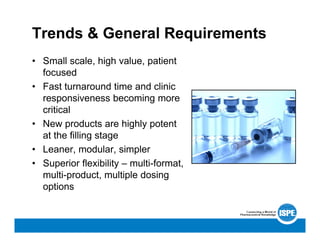
• Small scale, high value, patient
focused
• Fast turnaround time and clinic
responsiveness becoming more
critical
• New products are highly potent
at the filling stage
• Leaner, modular, simpler
• Superior flexibility – multi-format,
multi-product, multiple dosing
options
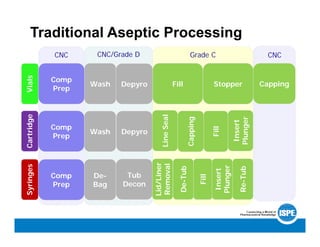
CNC CNC
CNC/Grade D Grade C
Traditional Aseptic Processing
Depyro
Wash Fill
Comp
Prep
Capping
Vials
Cartridge
Comp
Prep
Wash Depyro
Stopper
Line
Seal
Capping
Fill
Insert
Plunger
Syringes
Comp
Prep
De-
Bag
Tub
Decon
Lid/Liner
Removal
De-Tub
Fill
Insert
Plunger
Re-Tub
Traditional Aseptic Processing
• Dedicated fill-finish capabilities for a specific
container type or “format”
• Adding additional container filling capabilities is a
significant investment in facilities, time and
equipment
• Processing challenges include glass on glass
contact, machine jams, broken containers, etc.
• Very efficient for high volume dedicated products
where flexibility is not necessary
Flexible Aseptic Processing
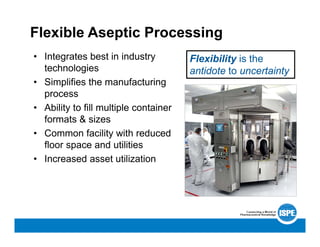
• Integrates best in industry
technologies
• Simplifies the manufacturing
process
• Ability to fill multiple container
formats & sizes
• Common facility with reduced
floor space and utilities
• Increased asset utilization
Flexibility is the
antidote to uncertainty
Enabling Technologies
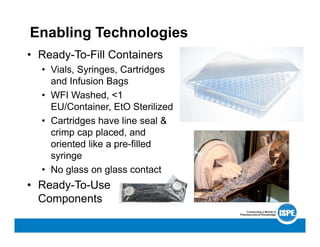
• Ready-To-Fill Containers
• Vials, Syringes, Cartridges
and Infusion Bags
• WFI Washed, <1
EU/Container, EtO Sterilized
• Cartridges have line seal &
crimp cap placed, and
oriented like a pre-filled
syringe
• No glass on glass contact
• Ready-To-Use
Components
Enabling Technologies
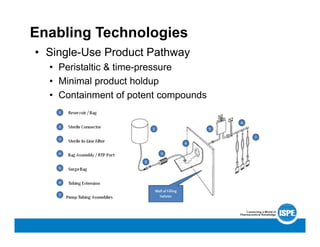
• Single-Use Product Pathway
• Peristaltic & time-pressure
• Minimal product holdup
• Containment of potent compounds
Enabling Technologies
• Isolator Barrier
Technology + Robotics
• Provides full separation
between the operator and
the process
• Compatible with VHP bio-
decontamination
• Recipe driven operation
• Maximum flexibility and
functionality
• Negligible particle
generation
“Automation of other
process steps, including
the use of technologies
such as robotics, can
further reduce risk to the
product.”
Guidance for Industry: Sterile Drug Products
Produced by Aseptic Processing — Current
Good Manufacturing Practice (Pg.10)
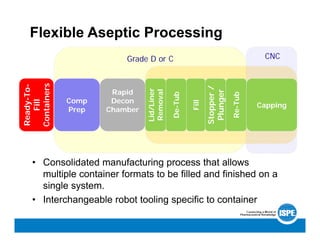
Flexible Aseptic Processing
CNC
Grade D or C
• Consolidated manufacturing process that allows
multiple container formats to be filled and finished on a
single system.
• Interchangeable robot tooling specific to container
Capping
Rapid
Decon
Chamber
Comp
Prep
Lid/Liner
Removal
De-Tub
Fill
Stopper
/
Plunger
Re-Tub
Ready-To-
Fill
Containers
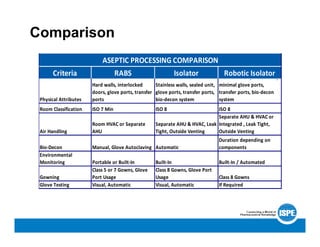
Physical Attributes
Hard walls, interlocked
doors, glove ports, transfer
ports
Stainless walls, sealed unit,
glove ports, transfer ports,
bio‐decon system
Stainless walls, sealed unit,
minimal glove ports,
transfer ports, bio‐decon
system
Room Classification ISO 7 Min ISO 8 ISO 8
Air Handling
Room HVAC or Separate
AHU
Separate AHU & HVAC, Leak
Tight, Outside Venting
Separate AHU & HVAC or
Integrated , Leak Tight,
Outside Venting
Bio‐Decon Manual, Glove Autoclaving Automatic
Duration depending on
components
Environmental
Monitoring Portable or Built‐In Built‐In Built‐In / Automated
Gowning
Class 5 or 7 Gowns, Glove
Port Usage
Class 8 Gowns, Glove Port
Usage Class 8 Gowns
Glove Testing Visual, Automatic Visual, Automatic If Required
ASEPTIC PROCESSING COMPARISON
Criteria RABS Isolator Robotic Isolator
Comparison
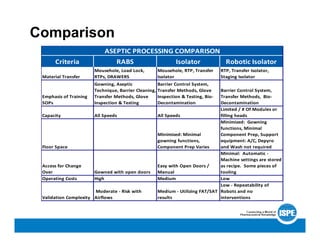
Material Transfer
Mousehole, Load Lock,
RTPs, DRAWERS
Mousehole, RTP, Transfer
Isolator
RTP, Transfer Isolator,
Staging Isolator
Emphasis of Training
SOPs
Gowning, Aseptic
Technique, Barrier Cleaning,
Transfer Methods, Glove
Inspection & Testing
Barrier Control System,
Transfer Methods, Glove
Inspection & Testing, Bio‐
Decontamination
Barrier Control System,
Transfer Methods, Bio‐
Decontamination
Capacity All Speeds All Speeds
Limited / # Of Modules or
filling heads
Floor Space
Minimized: Minimal
gowning functions,
Component Prep Varies
Minimized: Gowning
functions, Minimal
Component Prep, Support
equipment: A/C, Depyro
and Wash not required
Access for Change
Over Gowned with open doors
Easy with Open Doors /
Manual
Minimal: Automatic ‐
Machine settings are stored
as recipe. Some pieces of
tooling
Operating Costs High Medium Low
Validation Complexity
Moderate ‐ Risk with
Airflows
Medium ‐ Utilizing FAT/SAT
results
Low ‐ Repeatability of
Robots and no
interventions
ASEPTIC PROCESSING COMPARISON
Criteria RABS Isolator Robotic Isolator
Comparison
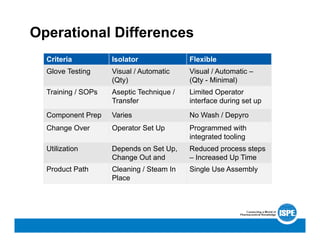
Criteria Isolator Flexible
Glove Testing Visual / Automatic
(Qty)
Visual / Automatic –
(Qty - Minimal)
Training / SOPs Aseptic Technique /
Transfer
Limited Operator
interface during set up
Component Prep Varies No Wash / Depyro
Change Over Operator Set Up Programmed with
integrated tooling
Utilization Depends on Set Up,
Change Out and
Reduced process steps
– Increased Up Time
Product Path Cleaning / Steam In
Place
Single Use Assembly
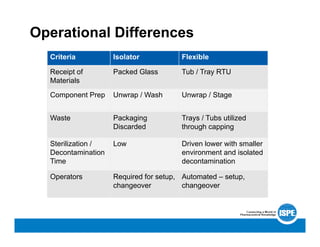
Operational Differences
Criteria Isolator Flexible
Receipt of
Materials
Packed Glass Tub / Tray RTU
Component Prep Unwrap / Wash Unwrap / Stage
Waste Packaging
Discarded
Trays / Tubs utilized
through capping
Sterilization /
Decontamination
Time
Low Driven lower with smaller
environment and isolated
decontamination
Operators Required for setup,
changeover
Automated – setup,
changeover
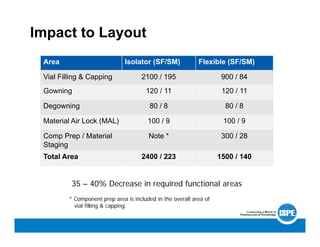
Operational Differences
* Component prep area is included in the overall area of
vial filling & capping.
Area Isolator (SF/SM) Flexible (SF/SM)
Vial Filling & Capping 2100 / 195 900 / 84
Gowning 120 / 11 120 / 11
Degowning 80 / 8 80 / 8
Material Air Lock (MAL) 100 / 9 100 / 9
Comp Prep / Material
Staging
Note * 300 / 28
Total Area 2400 / 223 1500 / 140
35 – 40% Decrease in required functional areas
Impact to Layout
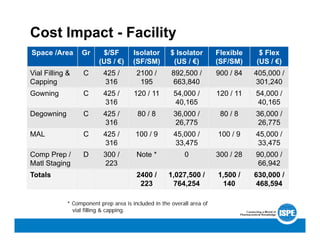
Space /Area Gr $/SF
(US / €)
Isolator
(SF/SM)
$ Isolator
(US / €)
Flexible
(SF/SM)
$ Flex
(US / €)
Vial Filling &
Capping
C 425 /
316
2100 /
195
892,500 /
663,840
900 / 84 405,000 /
301,240
Gowning C 425 /
316
120 / 11 54,000 /
40,165
120 / 11 54,000 /
40,165
Degowning C 425 /
316
80 / 8 36,000 /
26,775
80 / 8 36,000 /
26,775
MAL C 425 /
316
100 / 9 45,000 /
33,475
100 / 9 45,000 /
33,475
Comp Prep /
Matl Staging
D 300 /
223
Note * 0 300 / 28 90,000 /
66,942
Totals 2400 /
223
1,027,500 /
764,254
1,500 /
140
630,000 /
468,594
Cost Impact - Facility
* Component prep area is included in the overall area of
vial filling & capping.
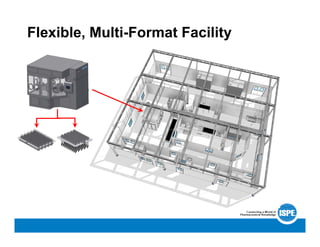
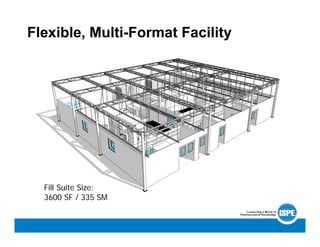
Flexible, Multi-Format Facility
Fill Suite Size:
3600 SF / 335 SM
Size, Cost & Equipment
• Facility Size
• Reduce operating areas by 30-40%
• Facility Cost
• Reduced engineering / design & construction costs
• Reduced construction / constructability challenges
• Reduced capital equipment investment
• Equipment Operations
• Eliminate washing and depryogenation operations from the
manufacturing site
• Increase equipment utilization
• Single fill line has the ability to process multiple container
formats
• Eliminates some of the most common routine interventions
Conclusions
• Flexible aseptic processing simplifies the traditional
aseptic manufacturing process
• Flexible aseptic processing leverages the strengths of
best in industry technologies to:
• Focus on core aseptic manufacturing processes
• Provide an adaptable platform capable of multi-
container format filling
• Minimize routine operator interventions
• Reduce facility size, utilities, cost, and validation
• Increase operational efficiency
Acknowledgements:
Andrew Scherer, President, SmartFit Modular
George Wiker, Principal, SmartFit Modular
Chris Tyree, Ompi North America
Thank You!
Joshua Russell, Principle Engineer – Life Sciences
Automated Systems of Tacoma (AST)
4110 South Washington St. Tacoma, WA 98409
(253) 475-0200
jrussell@ast-inc.com
Steven Walter, Process Systems Tech. Specialist
Hargrove Life Sciences
1880 JFK Blvd., Suite 700, Philadelphia, PA 19103
(215) 789-9665
swalter@hargrove-epc.com

ISPE Aseptic Manufacturing.pdf pharmaceutical manufacturing

  • 1.
    FLEXIBLE ASEPTIC MANUFACTURING TRADITIONAL VS.FLEXIBLE ASEPTIC MANUFACTURING Steven Walter, Process Systems Tech. Specialist Hargrove LS Josh Russell Principal Engineer AST
  • 2.
    Objective / Agenda Providean overview and comparison between traditional and flexible aseptic manufacturing, the impact to facility, operations, and cost. • Industry Trends & General Requirements • Traditional Aseptic Processing Overview • Flexible Aseptic Processing Overview • Comparison Between Tradition and Flexible Approaches • Operational Differences • Cost & Savings
  • 3.
    Trends & GeneralRequirements • Small scale, high value, patient focused • Fast turnaround time and clinic responsiveness becoming more critical • New products are highly potent at the filling stage • Leaner, modular, simpler • Superior flexibility – multi-format, multi-product, multiple dosing options
  • 4.
    CNC CNC CNC/Grade DGrade C Traditional Aseptic Processing Depyro Wash Fill Comp Prep Capping Vials Cartridge Comp Prep Wash Depyro Stopper Line Seal Capping Fill Insert Plunger Syringes Comp Prep De- Bag Tub Decon Lid/Liner Removal De-Tub Fill Insert Plunger Re-Tub
  • 5.
    Traditional Aseptic Processing •Dedicated fill-finish capabilities for a specific container type or “format” • Adding additional container filling capabilities is a significant investment in facilities, time and equipment • Processing challenges include glass on glass contact, machine jams, broken containers, etc. • Very efficient for high volume dedicated products where flexibility is not necessary
  • 6.
    Flexible Aseptic Processing •Integrates best in industry technologies • Simplifies the manufacturing process • Ability to fill multiple container formats & sizes • Common facility with reduced floor space and utilities • Increased asset utilization Flexibility is the antidote to uncertainty
  • 7.
    Enabling Technologies • Ready-To-FillContainers • Vials, Syringes, Cartridges and Infusion Bags • WFI Washed, <1 EU/Container, EtO Sterilized • Cartridges have line seal & crimp cap placed, and oriented like a pre-filled syringe • No glass on glass contact • Ready-To-Use Components
  • 8.
    Enabling Technologies • Single-UseProduct Pathway • Peristaltic & time-pressure • Minimal product holdup • Containment of potent compounds
  • 9.
    Enabling Technologies • IsolatorBarrier Technology + Robotics • Provides full separation between the operator and the process • Compatible with VHP bio- decontamination • Recipe driven operation • Maximum flexibility and functionality • Negligible particle generation “Automation of other process steps, including the use of technologies such as robotics, can further reduce risk to the product.” Guidance for Industry: Sterile Drug Products Produced by Aseptic Processing — Current Good Manufacturing Practice (Pg.10)
  • 10.
    Flexible Aseptic Processing CNC GradeD or C • Consolidated manufacturing process that allows multiple container formats to be filled and finished on a single system. • Interchangeable robot tooling specific to container Capping Rapid Decon Chamber Comp Prep Lid/Liner Removal De-Tub Fill Stopper / Plunger Re-Tub Ready-To- Fill Containers
  • 11.
    Physical Attributes Hard walls,interlocked doors, glove ports, transfer ports Stainless walls, sealed unit, glove ports, transfer ports, bio‐decon system Stainless walls, sealed unit, minimal glove ports, transfer ports, bio‐decon system Room Classification ISO 7 Min ISO 8 ISO 8 Air Handling Room HVAC or Separate AHU Separate AHU & HVAC, Leak Tight, Outside Venting Separate AHU & HVAC or Integrated , Leak Tight, Outside Venting Bio‐Decon Manual, Glove Autoclaving Automatic Duration depending on components Environmental Monitoring Portable or Built‐In Built‐In Built‐In / Automated Gowning Class 5 or 7 Gowns, Glove Port Usage Class 8 Gowns, Glove Port Usage Class 8 Gowns Glove Testing Visual, Automatic Visual, Automatic If Required ASEPTIC PROCESSING COMPARISON Criteria RABS Isolator Robotic Isolator Comparison
  • 12.
    Material Transfer Mousehole, LoadLock, RTPs, DRAWERS Mousehole, RTP, Transfer Isolator RTP, Transfer Isolator, Staging Isolator Emphasis of Training SOPs Gowning, Aseptic Technique, Barrier Cleaning, Transfer Methods, Glove Inspection & Testing Barrier Control System, Transfer Methods, Glove Inspection & Testing, Bio‐ Decontamination Barrier Control System, Transfer Methods, Bio‐ Decontamination Capacity All Speeds All Speeds Limited / # Of Modules or filling heads Floor Space Minimized: Minimal gowning functions, Component Prep Varies Minimized: Gowning functions, Minimal Component Prep, Support equipment: A/C, Depyro and Wash not required Access for Change Over Gowned with open doors Easy with Open Doors / Manual Minimal: Automatic ‐ Machine settings are stored as recipe. Some pieces of tooling Operating Costs High Medium Low Validation Complexity Moderate ‐ Risk with Airflows Medium ‐ Utilizing FAT/SAT results Low ‐ Repeatability of Robots and no interventions ASEPTIC PROCESSING COMPARISON Criteria RABS Isolator Robotic Isolator Comparison
  • 13.
    Criteria Isolator Flexible GloveTesting Visual / Automatic (Qty) Visual / Automatic – (Qty - Minimal) Training / SOPs Aseptic Technique / Transfer Limited Operator interface during set up Component Prep Varies No Wash / Depyro Change Over Operator Set Up Programmed with integrated tooling Utilization Depends on Set Up, Change Out and Reduced process steps – Increased Up Time Product Path Cleaning / Steam In Place Single Use Assembly Operational Differences
  • 14.
    Criteria Isolator Flexible Receiptof Materials Packed Glass Tub / Tray RTU Component Prep Unwrap / Wash Unwrap / Stage Waste Packaging Discarded Trays / Tubs utilized through capping Sterilization / Decontamination Time Low Driven lower with smaller environment and isolated decontamination Operators Required for setup, changeover Automated – setup, changeover Operational Differences
  • 15.
    * Component preparea is included in the overall area of vial filling & capping. Area Isolator (SF/SM) Flexible (SF/SM) Vial Filling & Capping 2100 / 195 900 / 84 Gowning 120 / 11 120 / 11 Degowning 80 / 8 80 / 8 Material Air Lock (MAL) 100 / 9 100 / 9 Comp Prep / Material Staging Note * 300 / 28 Total Area 2400 / 223 1500 / 140 35 – 40% Decrease in required functional areas Impact to Layout
  • 16.
    Space /Area Gr$/SF (US / €) Isolator (SF/SM) $ Isolator (US / €) Flexible (SF/SM) $ Flex (US / €) Vial Filling & Capping C 425 / 316 2100 / 195 892,500 / 663,840 900 / 84 405,000 / 301,240 Gowning C 425 / 316 120 / 11 54,000 / 40,165 120 / 11 54,000 / 40,165 Degowning C 425 / 316 80 / 8 36,000 / 26,775 80 / 8 36,000 / 26,775 MAL C 425 / 316 100 / 9 45,000 / 33,475 100 / 9 45,000 / 33,475 Comp Prep / Matl Staging D 300 / 223 Note * 0 300 / 28 90,000 / 66,942 Totals 2400 / 223 1,027,500 / 764,254 1,500 / 140 630,000 / 468,594 Cost Impact - Facility * Component prep area is included in the overall area of vial filling & capping.
  • 17.
  • 18.
    Flexible, Multi-Format Facility FillSuite Size: 3600 SF / 335 SM
  • 19.
    Size, Cost &Equipment • Facility Size • Reduce operating areas by 30-40% • Facility Cost • Reduced engineering / design & construction costs • Reduced construction / constructability challenges • Reduced capital equipment investment • Equipment Operations • Eliminate washing and depryogenation operations from the manufacturing site • Increase equipment utilization • Single fill line has the ability to process multiple container formats • Eliminates some of the most common routine interventions
  • 20.
    Conclusions • Flexible asepticprocessing simplifies the traditional aseptic manufacturing process • Flexible aseptic processing leverages the strengths of best in industry technologies to: • Focus on core aseptic manufacturing processes • Provide an adaptable platform capable of multi- container format filling • Minimize routine operator interventions • Reduce facility size, utilities, cost, and validation • Increase operational efficiency
  • 21.
    Acknowledgements: Andrew Scherer, President,SmartFit Modular George Wiker, Principal, SmartFit Modular Chris Tyree, Ompi North America
  • 22.
    Thank You! Joshua Russell,Principle Engineer – Life Sciences Automated Systems of Tacoma (AST) 4110 South Washington St. Tacoma, WA 98409 (253) 475-0200 jrussell@ast-inc.com Steven Walter, Process Systems Tech. Specialist Hargrove Life Sciences 1880 JFK Blvd., Suite 700, Philadelphia, PA 19103 (215) 789-9665 swalter@hargrove-epc.com