DBM 301
ADVANCED TOTAL QUALITY MANAGEMENT
STUDIES
QUALITY MANAGEMENT SYSTEM:
ISO 9000
ISAGANI D. VALENZUELA II
06.09.18
I. ISO Standards / ISO 9000: Overview
II. ISO 9000 Principles of Quality
Management
III. Registration Steps to become ISO
Certified
IV. Example of ISO Audit Checklist
ISO Standards / ISO 9000:
OVERVIEW
ISO Standards / ISO 9000:
OVERVIEW
 The International Organization for
Standardization (ISO) is an international
standard-setting body composed of
representatives from various national
standards organization.
ISO Standards / ISO 9000:
OVERVIEW
 Different Types of ISO
1. Quality Management (ISO 9000)
2. Environmental Management
3. Health and Safety
4. Transportation
5. Social Responsibility
6. Energy Management
7. Risk Management
8. Food Safety Management
9. Information Security Management
10. Occupational Health and Safety
11. Anti-Bribery Management Systems
12. Medical Devices
ISO Standards / ISO 9000:
OVERVIEW
 ISO 9000 is a set of international
standards on quality management and
quality assurance developed to help
companies effectively document the
quality system elements to be
implemented to maintain efficient quality
system.
ISO Standards / ISO 9000:
OVERVIEW
 Standards in the ISO 9000 family include:
 ISO 9001:2015 – set out the requirements of a
quality management system.
 ISO 9000:2015 – covers the basic concepts and
language.
 ISO 9004:2009 – focus on how to make a quality
management system more efficient and effective.
 ISO 19011:2011 – sets out guidance on internal
and external audits of quality management
systems.
ISO 9000 Principles of Quality
Management
ISO 9000 Principles of
Quality Management (7)
1. Customer Focus
 Understand the needs of existing and future
customers
 Meet customer requirements
 Measure customer satisfaction
 Aim to exceed customer expectations
2. Leadership
 Establish a vision and direction for the organization
 Establish trust
 Equip and empower employees
 Recognize employee contributions
ISO 9000 Principles of
Quality Management (7)
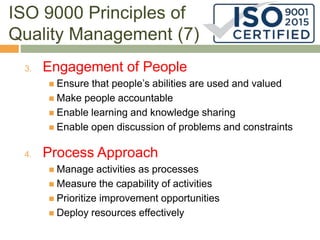
3. Engagement of People
 Ensure that people’s abilities are used and valued
 Make people accountable
 Enable learning and knowledge sharing
 Enable open discussion of problems and constraints
4. Process Approach
 Manage activities as processes
 Measure the capability of activities
 Prioritize improvement opportunities
 Deploy resources effectively
ISO 9000 Principles of
Quality Management (7)
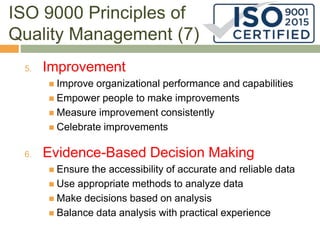
5. Improvement
 Improve organizational performance and capabilities
 Empower people to make improvements
 Measure improvement consistently
 Celebrate improvements
6. Evidence-Based Decision Making
 Ensure the accessibility of accurate and reliable data
 Use appropriate methods to analyze data
 Make decisions based on analysis
 Balance data analysis with practical experience
ISO 9000 Principles of
Quality Management (7)
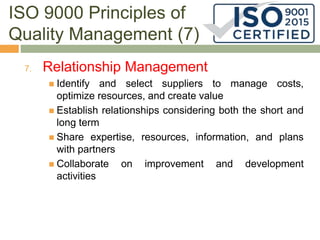
7. Relationship Management
 Identify and select suppliers to manage costs,
optimize resources, and create value
 Establish relationships considering both the short and
long term
 Share expertise, resources, information, and plans
with partners
 Collaborate on improvement and development
activities
Registration Steps to become
ISO Certified (8)
Registration Steps to
become ISO Certified (8)
1. Finding an ISO 9001 Registrar
 There is a need to begin searching for an ISO registrar
during the 2 to 3 months the company is still building
its quality system.
 Search can be done in the ANSI-ASQ National
Accreditation Board (ANAB) to select the registrar
right for the company.
 Registrars must meet the requirements of the ISO
Accreditation Bodies.
Registration Steps to
become ISO Certified (8)
2. Selecting an ISO Registrar
 A company applying for registration should select a
registrar that has experience within the scope
category of its specific industry, which can be found
also on the ANAB site.
 Accreditation, scheduling issues, fees and comfort
level should be considered by the company when
selecting for the right registrar.
Registration Steps to
become ISO Certified (8)
3. Creating an ISO Application
 A company and a registrar will agree on the
application contract. This is an important step of the
ISO Registration Process because it defines the rights
and obligations of both parties, and includes liability
issues, confidentiality and access rights.
Registration Steps to
become ISO Certified (8)
4. Conducting a Quality Document Review
 The registrar will require a copy of the company
quality manual and procedures to verify that all the
requirements of the standard are addressed.
 The ISO Registration Process is not a quick response;
the registrar should be allowed around 2-4 weeks in
advance to fully review all of the necessary
documents.
Registration Steps to
become ISO Certified (8)
5. Determining Pre-Assessment Need
 The Pre-Assessment is an initial review of the
company’s Quality Management System to identify
any significant omissions or weaknesses in the system
and provide the organization an opportunity to correct
any deficiencies before the regular registration
assessment is conducted.
Registration Steps to
become ISO Certified (8)
6. Issuing an ISO Assessment
 The length of this step of the ISO Registration Process
will depend on the scope of the audit and the size of
the organization.
The flow of activities during the audit is as follows:
1. Opening Meeting – an introduction of the audit team
and key personnel in the company. The scope and
general approach to the audit is discussed.
Registration Steps to
become ISO Certified (8)
2. Brief tour of the facility – auditors just want to get a
general feel for the layout and processes involved.
3. Additional review of documents – audit team
members review documentation for areas they will
audit.
4. Examination – the audit is conducted, personnel are
interviewed, and objective evidence is collected to
show the system has been effectively implemented.
5. Daily review – at the end of each day or the
beginning of the next, the audit team reviews any
issues identified during the assessment. Potential
findings or non-conformities may be clarified at this
time.
Registration Steps to
become ISO Certified (8)
6. Closing Meeting – the audit states their conclusions
regarding the audit and presents any findings or
nonconformities.
7. Audit Report issued – within a few weeks of the
audit, the Registrar issues the audit report.
Two Categories of Non-Conformities
1. Minor Nonconformance (these will not hold up the
registration)
2. Major Nonconformance (this will hold up the
registration)
Registration Steps to
become ISO Certified (8)
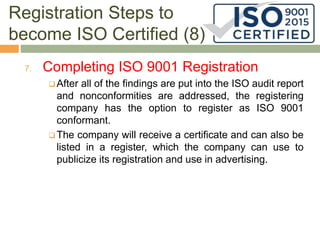
7. Completing ISO 9001 Registration
 After all of the findings are put into the ISO audit report
and nonconformities are addressed, the registering
company has the option to register as ISO 9001
conformant.
 The company will receive a certificate and can also be
listed in a register, which the company can use to
publicize its registration and use in advertising.
Registration Steps to
become ISO Certified (8)
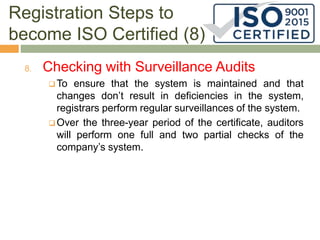
8. Checking with Surveillance Audits
 To ensure that the system is maintained and that
changes don’t result in deficiencies in the system,
registrars perform regular surveillances of the system.
 Over the three-year period of the certificate, auditors
will perform one full and two partial checks of the
company’s system.
Example of ISO Audit Checklist
Example of ISO
Audit Checklist
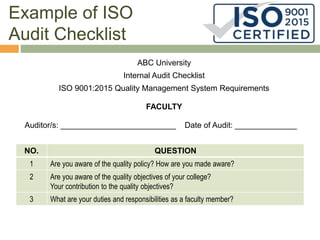
ABC University
Internal Audit Checklist
ISO 9001:2015 Quality Management System Requirements
FACULTY
Auditor/s: __________________________ Date of Audit: ______________
NO. QUESTION
1 Are you aware of the quality policy? How are you made aware?
2 Are you aware of the quality objectives of your college?
Your contribution to the quality objectives?
3 What are your duties and responsibilities as a faculty member?
Example of ISO
Audit Checklist
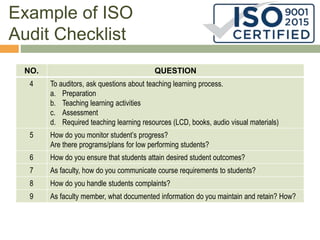
NO. QUESTION
4 To auditors, ask questions about teaching learning process.
a. Preparation
b. Teaching learning activities
c. Assessment
d. Required teaching learning resources (LCD, books, audio visual materials)
5 How do you monitor student’s progress?
Are there programs/plans for low performing students?
6 How do you ensure that students attain desired student outcomes?
7 As faculty, how do you communicate course requirements to students?
8 How do you handle students complaints?
9 As faculty member, what documented information do you maintain and retain? How?
Example of ISO
Audit Checklist
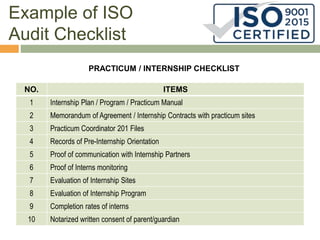
PRACTICUM / INTERNSHIP CHECKLIST
NO. ITEMS
1 Internship Plan / Program / Practicum Manual
2 Memorandum of Agreement / Internship Contracts with practicum sites
3 Practicum Coordinator 201 Files
4 Records of Pre-Internship Orientation
5 Proof of communication with Internship Partners
6 Proof of Interns monitoring
7 Evaluation of Internship Sites
8 Evaluation of Internship Program
9 Completion rates of interns
10 Notarized written consent of parent/guardian
REFERENCE:
Production and Operations Management Basics (2015)
3G Elearning FZ LLC: UAE
Production and Operations Management (2014)
McGraw-Hill Education
James R. Evans | William M. Lindsay (2015). Total Quality
Management
Cengage Learning: Philippines
Angelita Ong Serrano (2016). Total Quality Management.
Unlimited Books: Library Services & Publishing Inc.
ISO 9000.pptx

ISO 9000.pptx

  • 1.
    DBM 301 ADVANCED TOTALQUALITY MANAGEMENT STUDIES QUALITY MANAGEMENT SYSTEM: ISO 9000 ISAGANI D. VALENZUELA II 06.09.18
  • 2.
    I. ISO Standards/ ISO 9000: Overview II. ISO 9000 Principles of Quality Management III. Registration Steps to become ISO Certified IV. Example of ISO Audit Checklist
  • 3.
    ISO Standards /ISO 9000: OVERVIEW
  • 4.
    ISO Standards /ISO 9000: OVERVIEW  The International Organization for Standardization (ISO) is an international standard-setting body composed of representatives from various national standards organization.
  • 5.
    ISO Standards /ISO 9000: OVERVIEW  Different Types of ISO 1. Quality Management (ISO 9000) 2. Environmental Management 3. Health and Safety 4. Transportation 5. Social Responsibility 6. Energy Management 7. Risk Management 8. Food Safety Management 9. Information Security Management 10. Occupational Health and Safety 11. Anti-Bribery Management Systems 12. Medical Devices
  • 6.
    ISO Standards /ISO 9000: OVERVIEW  ISO 9000 is a set of international standards on quality management and quality assurance developed to help companies effectively document the quality system elements to be implemented to maintain efficient quality system.
  • 7.
    ISO Standards /ISO 9000: OVERVIEW  Standards in the ISO 9000 family include:  ISO 9001:2015 – set out the requirements of a quality management system.  ISO 9000:2015 – covers the basic concepts and language.  ISO 9004:2009 – focus on how to make a quality management system more efficient and effective.  ISO 19011:2011 – sets out guidance on internal and external audits of quality management systems.
  • 8.
    ISO 9000 Principlesof Quality Management
  • 9.
    ISO 9000 Principlesof Quality Management (7) 1. Customer Focus  Understand the needs of existing and future customers  Meet customer requirements  Measure customer satisfaction  Aim to exceed customer expectations 2. Leadership  Establish a vision and direction for the organization  Establish trust  Equip and empower employees  Recognize employee contributions
  • 10.
    ISO 9000 Principlesof Quality Management (7) 3. Engagement of People  Ensure that people’s abilities are used and valued  Make people accountable  Enable learning and knowledge sharing  Enable open discussion of problems and constraints 4. Process Approach  Manage activities as processes  Measure the capability of activities  Prioritize improvement opportunities  Deploy resources effectively
  • 11.
    ISO 9000 Principlesof Quality Management (7) 5. Improvement  Improve organizational performance and capabilities  Empower people to make improvements  Measure improvement consistently  Celebrate improvements 6. Evidence-Based Decision Making  Ensure the accessibility of accurate and reliable data  Use appropriate methods to analyze data  Make decisions based on analysis  Balance data analysis with practical experience
  • 12.
    ISO 9000 Principlesof Quality Management (7) 7. Relationship Management  Identify and select suppliers to manage costs, optimize resources, and create value  Establish relationships considering both the short and long term  Share expertise, resources, information, and plans with partners  Collaborate on improvement and development activities
  • 13.
    Registration Steps tobecome ISO Certified (8)
  • 14.
    Registration Steps to becomeISO Certified (8) 1. Finding an ISO 9001 Registrar  There is a need to begin searching for an ISO registrar during the 2 to 3 months the company is still building its quality system.  Search can be done in the ANSI-ASQ National Accreditation Board (ANAB) to select the registrar right for the company.  Registrars must meet the requirements of the ISO Accreditation Bodies.
  • 15.
    Registration Steps to becomeISO Certified (8) 2. Selecting an ISO Registrar  A company applying for registration should select a registrar that has experience within the scope category of its specific industry, which can be found also on the ANAB site.  Accreditation, scheduling issues, fees and comfort level should be considered by the company when selecting for the right registrar.
  • 16.
    Registration Steps to becomeISO Certified (8) 3. Creating an ISO Application  A company and a registrar will agree on the application contract. This is an important step of the ISO Registration Process because it defines the rights and obligations of both parties, and includes liability issues, confidentiality and access rights.
  • 17.
    Registration Steps to becomeISO Certified (8) 4. Conducting a Quality Document Review  The registrar will require a copy of the company quality manual and procedures to verify that all the requirements of the standard are addressed.  The ISO Registration Process is not a quick response; the registrar should be allowed around 2-4 weeks in advance to fully review all of the necessary documents.
  • 18.
    Registration Steps to becomeISO Certified (8) 5. Determining Pre-Assessment Need  The Pre-Assessment is an initial review of the company’s Quality Management System to identify any significant omissions or weaknesses in the system and provide the organization an opportunity to correct any deficiencies before the regular registration assessment is conducted.
  • 19.
    Registration Steps to becomeISO Certified (8) 6. Issuing an ISO Assessment  The length of this step of the ISO Registration Process will depend on the scope of the audit and the size of the organization. The flow of activities during the audit is as follows: 1. Opening Meeting – an introduction of the audit team and key personnel in the company. The scope and general approach to the audit is discussed.
  • 20.
    Registration Steps to becomeISO Certified (8) 2. Brief tour of the facility – auditors just want to get a general feel for the layout and processes involved. 3. Additional review of documents – audit team members review documentation for areas they will audit. 4. Examination – the audit is conducted, personnel are interviewed, and objective evidence is collected to show the system has been effectively implemented. 5. Daily review – at the end of each day or the beginning of the next, the audit team reviews any issues identified during the assessment. Potential findings or non-conformities may be clarified at this time.
  • 21.
    Registration Steps to becomeISO Certified (8) 6. Closing Meeting – the audit states their conclusions regarding the audit and presents any findings or nonconformities. 7. Audit Report issued – within a few weeks of the audit, the Registrar issues the audit report. Two Categories of Non-Conformities 1. Minor Nonconformance (these will not hold up the registration) 2. Major Nonconformance (this will hold up the registration)
  • 22.
    Registration Steps to becomeISO Certified (8) 7. Completing ISO 9001 Registration  After all of the findings are put into the ISO audit report and nonconformities are addressed, the registering company has the option to register as ISO 9001 conformant.  The company will receive a certificate and can also be listed in a register, which the company can use to publicize its registration and use in advertising.
  • 23.
    Registration Steps to becomeISO Certified (8) 8. Checking with Surveillance Audits  To ensure that the system is maintained and that changes don’t result in deficiencies in the system, registrars perform regular surveillances of the system.  Over the three-year period of the certificate, auditors will perform one full and two partial checks of the company’s system.
  • 24.
    Example of ISOAudit Checklist
  • 25.
    Example of ISO AuditChecklist ABC University Internal Audit Checklist ISO 9001:2015 Quality Management System Requirements FACULTY Auditor/s: __________________________ Date of Audit: ______________ NO. QUESTION 1 Are you aware of the quality policy? How are you made aware? 2 Are you aware of the quality objectives of your college? Your contribution to the quality objectives? 3 What are your duties and responsibilities as a faculty member?
  • 26.
    Example of ISO AuditChecklist NO. QUESTION 4 To auditors, ask questions about teaching learning process. a. Preparation b. Teaching learning activities c. Assessment d. Required teaching learning resources (LCD, books, audio visual materials) 5 How do you monitor student’s progress? Are there programs/plans for low performing students? 6 How do you ensure that students attain desired student outcomes? 7 As faculty, how do you communicate course requirements to students? 8 How do you handle students complaints? 9 As faculty member, what documented information do you maintain and retain? How?
  • 27.
    Example of ISO AuditChecklist PRACTICUM / INTERNSHIP CHECKLIST NO. ITEMS 1 Internship Plan / Program / Practicum Manual 2 Memorandum of Agreement / Internship Contracts with practicum sites 3 Practicum Coordinator 201 Files 4 Records of Pre-Internship Orientation 5 Proof of communication with Internship Partners 6 Proof of Interns monitoring 7 Evaluation of Internship Sites 8 Evaluation of Internship Program 9 Completion rates of interns 10 Notarized written consent of parent/guardian
  • 28.
    REFERENCE: Production and OperationsManagement Basics (2015) 3G Elearning FZ LLC: UAE Production and Operations Management (2014) McGraw-Hill Education James R. Evans | William M. Lindsay (2015). Total Quality Management Cengage Learning: Philippines Angelita Ong Serrano (2016). Total Quality Management. Unlimited Books: Library Services & Publishing Inc.