(ISO 22000)
Food Safety
Management System
Management System
MUHAMMAD KASHIF HUSSAIN
FOOD TECHNOLOGIST
Introduction
 ISO 22000 is an international standard that specifies
the requirements for a food safety management
system (FSMS).
 The adoption of a food safety management system
(FSMS) is a strategic decision for an organization that
can help to improve its overall performance in food
safety.
 It integrates the principles of the Hazard Analysis
and Critical Control Point (HACCP) system and
application steps developed by the Codex
Alimentarius Commission.
 It employs Process approach & risk based thinking
Process Approach
The organizations use the PDCA model to drive improvement
for ISO 22000 implementation
Risk-based thinking
It addresses 2 levels.
 ORGANIZATIONAL PROCESS
1) Risk
2) ORGANIZATIONAL RISK MANAGEMENT
 OPERATIONAL PROCESSES
1) Hazard analysis (HACCP)
History and Development
 ISO 22000 was first published in 2005 by the
International Organization for Standardization
(ISO). It was developed by experts from the food
industry, along with representatives from
governments and other organizations. The
standard was revised in 2018 to align with ISO's
High-Level Structure (HLS) for management system
standards.
Key Elements of ISO 22000
 1. **Interactive Communication**: Ensures
effective communication among all stakeholders
within the food chain.
 2. **System Management**: Involves the
systematic approach to managing food safety
risks.
 3. **Prerequisite Programs (PRPs)**: Fundamental
conditions and activities necessary to maintain a
hygienic environment.
 4. **HACCP Principles**: Systematic preventive
approach to food safety from biological,
chemical, and physical hazards.
a) The ability to consistently provide safe foods and products and
services that meet customer and applicable statutory and
regulatory requirements.
b) Addressing risks associated with its objective.
Benefits of ISO 22000
c) The ability to demonstrate conformity to specified FSMS
requirements.
d) Facilitates international trade by meeting global food safety
standards.
e) Promotes continuous improvement and organizational
efficiency.
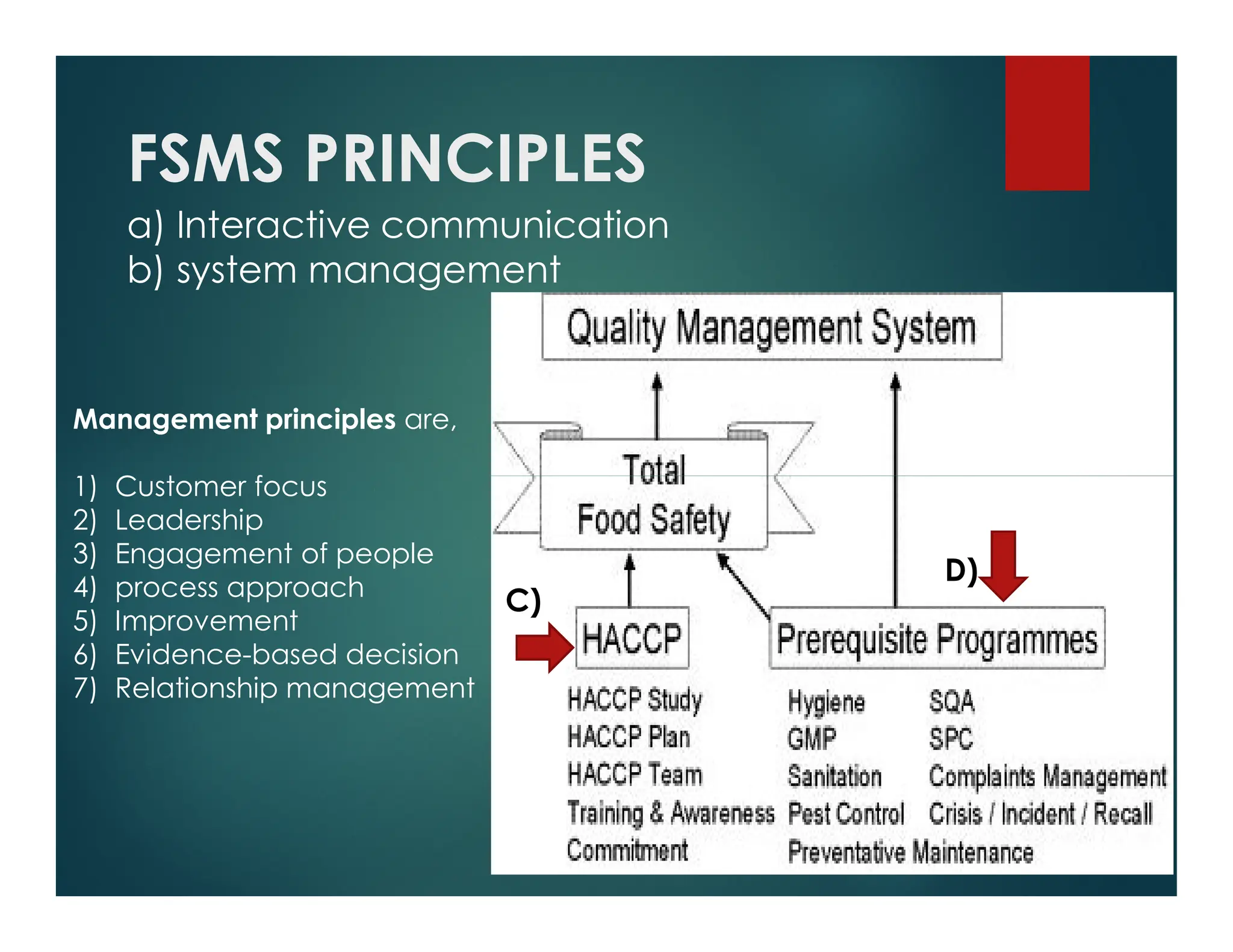
FSMS PRINCIPLES
a) Interactive communication
b) system management
Management principles are,
1) Customer focus
1) Customer focus
2) Leadership
3) Engagement of people
4) process approach
5) Improvement
6) Evidence-based decision
7) Relationship management
C)
D)
Scope and Applicability
 ISO 22000 is applicable to all organizations in the
food chain.
 Installation of Food Safety Management System to
ensure safety of products to their intended use.
 To evaluate and assess mutually agreed customer
food safety requirements and to demonstrate
 To evaluate and assess mutually agreed customer
food safety requirements and to demonstrate
conformity with them.
 To effectively communicate food safety issues to
interested parties within the food chain
 To ensure that the organization conforms to its
stated food safety policy
 To demonstrate conformity to relevant interested
parties
 To seek certification
HOW IT WORKS?
Requirements of
Food Safety Management System
(FSMS)
 Leadership
1) Leadership and commitment
 Policy
1) Establishing the food safety policy
2) Communicating the food safety policy
3) Organizational roles, responsibilities and authorities
a) Top Management
b) Food Safety Team Lead
c) Food Handlers
 Planning
1) Actions to address risks and opportunities
2) Understanding the organization and its context
3) Understanding the needs and expectations of interested parties
Requirements of
Food Safety Management System
(FSMS)
3) Understanding the needs and expectations of interested parties
4) Determining the scope of the food safety management system
5) The organization shall plan:
a) Actions to address these risks and opportunities;
 Taking risk in order to pursue an opportunity, eliminating the risk source, changing the likelihood or
consequences, sharing the risk, or accepting the presence of risk by informed decision
 Opportunities can lead to the adoption of new practices
6) Objectives of the food safety management system and planning to achieve
them
7) Planning of changes
 Support
Resources
People
Infrastructure
Requirements of
Food Safety Management System
(FSMS)
Infrastructure
Work environment
Externally developed elements of the food safety management system
Control of externally provided processes, products or services
 Competence
 Awareness
 Communication
 External communication
 Internal communication
 Documented information
Requirements of
Food Safety Management System
(FSMS)
 Documented information
 Creating and updating
 Control of documented information
 Operation
 Operational planning and control
 Prerequisite programmes (PRPs)
 (Part 1 PRP’s) Building Exterior & Construction
Requirements of
Food Safety Management System
(FSMS)
 (Part 1 PRP’s) Building Exterior & Construction
 Surrounding Grounds.
 Adjacent Properties
 Building Exterior
 Documents and Records
 (Part 1 – PRP’s) Building Interior
 Floors, walls and ceilings
 Doors and windows
 Lighting
 Ambient temperature
Requirements of
Food Safety Management System
(FSMS)
 Ambient temperature
 Air quality and ventilation
 Water quality
 Drainage and sewage systems
 Building Services
 Staff facilities
 Locker rooms and changing facilities
 Toilets
 Hand washing facility
 Kitchen and dining facilities for staff
 Documents and records
 Waste disposal
 Pest Management
 Pest management program
 Pest management equipment
Requirements of
Food Safety Management System
(FSMS)
Pest management equipment
 Presence or evidence of pests, birds and animals
 Documents and records
 Cleaning and Disinfection
 Cleaning and Disinfection Methods
 Cleaning and Disinfection Program
 Cleaning and Disinfection Chemicals
 Equipment Used for Cleaning and Disinfection
 Cleaning and Disinfection of utensils and processing environment
 Documents and Records
 Equipment and Utensils
 Design and material of equipment
 Equipment and utensils use
 Storage
 Maintenance
Requirements of
Food Safety Management System
(FSMS)
 Maintenance
 Calibration
 Documents and records
 Personnel
 Personal Hygiene Policies
 Personal Hygiene Practices
 Staff movements
 Personal Protection Equipment (PPE)
 Hand washing
 Food handlers’ health
 Food handlers’ skills, knowledge and training
 Documents and Records
 Receiving
 Receiving principles
 Temperature control
 Documents and Records
 Storage
Requirements of
Food Safety Management System
(FSMS)
 Storage
 Storage principles
 Dry storage
 Refrigerated (Chilled) storage
 Frozen storage:
 Documents and Records Checked:
 Transportation
 Transportation Vehicles
 Loading and unloading
 Temperature control
 Documents and Records
 (Part B – OPRP) Operation control
 Preparation of Food
 Ingredient Thawing
 Weighing
Requirements of
Food Safety Management System
(FSMS)
 Weighing
 Mixing
 Food Further Processing (Peeling, Slicing, Cutting
and Dicing)
 Sanitization Wash
 Documents and Records
 Cooking
 Cooking Method
 Taking Cooking Temperatures
 Controls after Cooking
Requirements of
Food Safety Management System
(FSMS)
 Documents and Records:
 Cooling
 Cooling Methods
 Cooling Unit
 Ice bath and ice wand methods
 Taking Cooling Temperatures
 Controls after Cooling
 Documents and Records
 Baking (Breads/Cakes/Pastries)
 Additives
 Proving (Leavening)
 Filling/Icing/Topping
Requirements of
Food Safety Management System
(FSMS)
 Filling/Icing/Topping
 Baking
 Documents and Records:
 Reheating
 Reheat method
 Taking Reheating Temperatures
 Controls after Reheating
 Documents and Records
 Food display
 Food Display Method
 Taking Display Temperatures
 Chilled Displays
Requirements of
Food Safety Management System
(FSMS)
 Chilled Displays
 Hot Hold Displays
 Ambient Perishable Displays
 Serving from Displays
 Documents and Records
 Ice cubes making machine
 Commercial Ice Making Machine
 Documents and Records
 Packing
 Packaging Source
 Packaging Storage
 Documents and records
Requirements of
Food Safety Management System
(FSMS)
 Documents and records
 End Product
 Final product verification (where applicable)
 Retention samples (where applicable)
 Labeling
 Documents and records
 Traceability system / Management
 Traceability
 Traceability at receiving:
Traceability at storage
Requirements of
Food Safety Management System
(FSMS)
 Traceability at storage
 Traceability at processing
 Traceability at Display/Dispatch/Transportation
 Documents and Records
 Emergency preparedness and response
 Management
 Recall Plan
Requirements of
Food Safety Management System
(FSMS)
 Hazard control (HACCP Implementation)
 Preliminary steps to enable hazard analysis
 Characteristics of raw materials,
 ingredients and product contact materials
Requirements of
Food Safety Management System
(FSMS)
 ingredients and product contact materials
 Characteristics of end products
 Intended use
 Flow diagrams and description of processes
a) Preparation of the flow diagrams
b) On-site confirmation of flow diagrams
c) Description of processes and process environment
Requirements of
Food Safety Management System
(FSMS)
The HACCP Principles
 1. **Conduct a hazard analysis**: Identify potential hazards
that could occur in the food production process.
 2. **Determine critical control points (CCPs)**: Points in the
process where controls are essential to prevent hazards.
 3. **Establish critical limits**: Maximum or minimum values
to which biological, chemical, or physical parameters must
be controlled.
 4. **Establish monitoring procedures**: Ensure CCPs are
under control.
 5. **Establish corrective actions**: Actions to be taken if a
CCP is not under control.
 6. **Establish verification procedures**: Ensure the HACCP
system is working effectively.
 7. **Establish record-keeping and documentation
procedures**: Maintain records of the HACCP system.
HACCP Implementation
 Hazard identification and determination of acceptable levels
 Type of product
 Type of process and process environment
 Identify step(s) (i.e. Receiving raw materials, processing, distribution
and delivery) at which each food safety hazard can be present, be
introduced, increase or persist
 Determine the acceptable level in the end product of each food
safety hazard identified, whenever possible
HACCP Implementation
 Hazard assessment
 likelihood of its occurrence
 severity of its adverse health effects
Selection and categorization of control measure(s)
 Selection and categorization of control measure(s)
 Validation of control measure(s) and combinations of
control measures
HACCP Implementation
 Hazard control plan (HACCP/OPRP plan)
 Determination of critical limits and action criteria
 Monitoring systems at CCPs and for OPRPs
 Actions when critical limits or action criteria are not met
 Implementation of the hazard control plan
 Updating the information specifying the PRPs and the hazard control
plan
HACCP Implementation
 Control of monitoring and measuring
a) Calibrated or verified at specified intervals prior to
use;
b) Adjusted or re-adjusted as necessary;
c) Identified to enable the calibration status to be
determined
d) Safeguarded from adjustments that would
invalidate the measurement results;
e) Protected from damage and deterioration
HACCP Implementation
 Verification related to PRPs and the hazard control plan
 Verification
a) The PRP(s) are implemented and effective;
b) The hazard control plan is implemented and effective;
c) Hazard levels are within identified acceptable levels;
d) Input to the hazard analysis is updated;
e) Other actions determined by the organization are implemented and effective.
 Analysis of results of verification activities
 Control of product and process nonconformities
 Non- conformances
 (Correction) Control of non-conformance or action
taken in case of any non-conformance
HACCP Implementation
taken in case of any non-conformance
 Identification of Non-Conforming Product,
Equipment or Areas
 (Corrective actions) Managing Non-Conformances
 Documents and Records
 Customer Complaint Handling
 Managing Complaint
 Documents and Records
HACCP Implementation
 Handling of potentially unsafe products
 The organization shall take action(s) to prevent potentially unsafe
products from entering the food chain, unless it can demonstrate
that:
a) The food safety hazard(s) of concern is (are) reduced to the defined
acceptable levels;
b) The food safety hazard(s) of concern will be reduced to identified
acceptable levels prior to entering the food chain; or
c) The product still meets the defined acceptable level(s) of the food
safety hazard(s) of concern despite the nonconformity
 Evaluation for release
a) Products affected by failure to remain within critical limits at CCPs shall
not be released
 Products affected by failure to meet action criterion for OPRPs shall only
Requirements of
Food Safety Management System
(FSMS)
 Products affected by failure to meet action criterion for OPRPs shall only
be released as safe when any of the following conditions apply:
a) evidence other than the monitoring system
b) evidence shows that the combined effect of the control measures for
that particular product conforms to the performance intended (i.e.
identified acceptable levels);
c) the results of sampling, analysis and/or other verification activities
demonstrate that the affected products conform to the identified
acceptable levels for the food safety hazard(s) concerned
 Disposition of nonconforming products
 Performance evaluation
 Monitoring, measurement, analysis and evaluation
a) To confirm that the overall performance of the system meets the
planned arrangements and the FSMS requirements established by the
Requirements of
Food Safety Management System
(FSMS)
planned arrangements and the FSMS requirements established by the
organization;
b) To identify the need for updating or improving the FSMS;
c) To identify trends which indicate a higher incidence of potentially
unsafe products or process failures;
d) To establish information for planning of the internal audit programme
related to the status and importance of areas to be audited;
e) To provide evidence that corrections and corrective actions are
effective
 Internal audit
a) conforms to:
1) the organization’s own requirements for its FSMS;
2) the requirements of this document;
Requirements of
Food Safety Management System
(FSMS)
2) the requirements of this document;
b) is effectively implemented and maintained
 The organization shall:
a) plan, establish, implement and maintain (an) audit programme(s).
b) define the audit criteria and scope for each audit;
c) determine if the FSMS meets the intent of the food safety policy and
objectives of the FSMS.
 Management review
a) Top management shall review the organization’s FSMS, at planned
intervals, to ensure its continuing suitability, adequacy and
effectiveness
Requirements of
Food Safety Management System
(FSMS)
effectiveness
b) Management review input
c) Management review output
 Improvement
a) Nonconformity and corrective action
b) Continual improvement
Update of the food safety management system
Requirements of
Food Safety Management System
(FSMS)
c) Update of the food safety management system
Key Elements of ISO 22000
 1. **Interactive Communication**: Ensures
effective communication among all stakeholders
within the food chain.
 2. **System Management**: Involves the
systematic approach to managing food safety
risks.
 3. **Prerequisite Programs (PRPs)**: Fundamental
conditions and activities necessary to maintain a
hygienic environment.
 4. **HACCP Principles**: Systematic preventive
approach to food safety from biological,
chemical, and physical hazards.
Implementation Steps
 1. **Conduct a gap analysis**: Assess current practices against
ISO 22000 requirements.
 2. **Develop a project plan**: Outline the steps, resources, and
timelines needed for implementation.
 3. **Train staff and allocate resources**: Ensure employees
understand their roles in the FSMS.
 4. **Implement prerequisite programs**: Establish and
document PRPs.
 5. **Establish a HACCP plan**: Identify hazards, CCPs, and
controls.
 6. **Monitor and review the system**: Regularly check the
effectiveness of the FSMS.
 7. **Conduct internal audits**: Ensure ongoing compliance
and identify areas for improvement.
 8. **Achieve certification**: Undergo an external audit by a
certification body.
Challenges in
Implementation
 - Understanding and interpreting the standard
requirements.
 - Ensuring top management commitment and
involvement.
involvement.
 - Allocating sufficient resources, including time
and money.
 - Training staff and changing organizational
culture.
 - Maintaining documentation and records.
 - Continually improving the FSMS amidst changing
regulations and market conditions.
Certification Process
 1. **Select a certification body**: Choose an accredited
body to conduct the audit.
 2. **Pre-audit assessment**: Optional stage to identify
potential gaps before the official audit.
 3. **Stage 1 audit**: Review of documentation and
readiness for the certification audit.
 4. **Stage 2 audit**: On-site evaluation of the
implementation of the FSMS.
 5. **Certification decision**: Certification body reviews the
audit findings and decides on certification.
 6. **Surveillance audits**: Regular audits to ensure
continued compliance with ISO 22000.
 7. **Recertification audit**: Conducted every three years
to renew certification.
ISO 22000  (Standard and its Implementation at industry)

ISO 22000 (Standard and its Implementation at industry)

  • 1.
    (ISO 22000) Food Safety ManagementSystem Management System MUHAMMAD KASHIF HUSSAIN FOOD TECHNOLOGIST
  • 2.
    Introduction  ISO 22000is an international standard that specifies the requirements for a food safety management system (FSMS).  The adoption of a food safety management system (FSMS) is a strategic decision for an organization that can help to improve its overall performance in food can help to improve its overall performance in food safety.  It integrates the principles of the Hazard Analysis and Critical Control Point (HACCP) system and application steps developed by the Codex Alimentarius Commission.  It employs Process approach & risk based thinking
  • 3.
    Process Approach The organizationsuse the PDCA model to drive improvement for ISO 22000 implementation
  • 4.
    Risk-based thinking It addresses2 levels.  ORGANIZATIONAL PROCESS 1) Risk 2) ORGANIZATIONAL RISK MANAGEMENT  OPERATIONAL PROCESSES 1) Hazard analysis (HACCP)
  • 5.
    History and Development ISO 22000 was first published in 2005 by the International Organization for Standardization (ISO). It was developed by experts from the food industry, along with representatives from governments and other organizations. The governments and other organizations. The standard was revised in 2018 to align with ISO's High-Level Structure (HLS) for management system standards.
  • 6.
    Key Elements ofISO 22000  1. **Interactive Communication**: Ensures effective communication among all stakeholders within the food chain.  2. **System Management**: Involves the  2. **System Management**: Involves the systematic approach to managing food safety risks.  3. **Prerequisite Programs (PRPs)**: Fundamental conditions and activities necessary to maintain a hygienic environment.  4. **HACCP Principles**: Systematic preventive approach to food safety from biological, chemical, and physical hazards.
  • 7.
    a) The abilityto consistently provide safe foods and products and services that meet customer and applicable statutory and regulatory requirements. b) Addressing risks associated with its objective. Benefits of ISO 22000 c) The ability to demonstrate conformity to specified FSMS requirements. d) Facilitates international trade by meeting global food safety standards. e) Promotes continuous improvement and organizational efficiency.
  • 8.
    FSMS PRINCIPLES a) Interactivecommunication b) system management Management principles are, 1) Customer focus 1) Customer focus 2) Leadership 3) Engagement of people 4) process approach 5) Improvement 6) Evidence-based decision 7) Relationship management C) D)
  • 9.
    Scope and Applicability ISO 22000 is applicable to all organizations in the food chain.  Installation of Food Safety Management System to ensure safety of products to their intended use.  To evaluate and assess mutually agreed customer food safety requirements and to demonstrate  To evaluate and assess mutually agreed customer food safety requirements and to demonstrate conformity with them.  To effectively communicate food safety issues to interested parties within the food chain  To ensure that the organization conforms to its stated food safety policy  To demonstrate conformity to relevant interested parties  To seek certification
  • 10.
  • 11.
    Requirements of Food SafetyManagement System (FSMS)  Leadership 1) Leadership and commitment  Policy 1) Establishing the food safety policy 2) Communicating the food safety policy 2) Communicating the food safety policy 3) Organizational roles, responsibilities and authorities a) Top Management b) Food Safety Team Lead c) Food Handlers
  • 12.
     Planning 1) Actionsto address risks and opportunities 2) Understanding the organization and its context 3) Understanding the needs and expectations of interested parties Requirements of Food Safety Management System (FSMS) 3) Understanding the needs and expectations of interested parties 4) Determining the scope of the food safety management system 5) The organization shall plan: a) Actions to address these risks and opportunities;  Taking risk in order to pursue an opportunity, eliminating the risk source, changing the likelihood or consequences, sharing the risk, or accepting the presence of risk by informed decision  Opportunities can lead to the adoption of new practices 6) Objectives of the food safety management system and planning to achieve them 7) Planning of changes
  • 13.
     Support Resources People Infrastructure Requirements of FoodSafety Management System (FSMS) Infrastructure Work environment Externally developed elements of the food safety management system Control of externally provided processes, products or services  Competence  Awareness
  • 14.
     Communication  Externalcommunication  Internal communication  Documented information Requirements of Food Safety Management System (FSMS)  Documented information  Creating and updating  Control of documented information
  • 15.
     Operation  Operationalplanning and control  Prerequisite programmes (PRPs)  (Part 1 PRP’s) Building Exterior & Construction Requirements of Food Safety Management System (FSMS)  (Part 1 PRP’s) Building Exterior & Construction  Surrounding Grounds.  Adjacent Properties  Building Exterior  Documents and Records
  • 16.
     (Part 1– PRP’s) Building Interior  Floors, walls and ceilings  Doors and windows  Lighting  Ambient temperature Requirements of Food Safety Management System (FSMS)  Ambient temperature  Air quality and ventilation  Water quality  Drainage and sewage systems  Building Services  Staff facilities  Locker rooms and changing facilities  Toilets  Hand washing facility  Kitchen and dining facilities for staff  Documents and records
  • 17.
     Waste disposal Pest Management  Pest management program  Pest management equipment Requirements of Food Safety Management System (FSMS) Pest management equipment  Presence or evidence of pests, birds and animals  Documents and records  Cleaning and Disinfection  Cleaning and Disinfection Methods  Cleaning and Disinfection Program  Cleaning and Disinfection Chemicals  Equipment Used for Cleaning and Disinfection  Cleaning and Disinfection of utensils and processing environment  Documents and Records
  • 18.
     Equipment andUtensils  Design and material of equipment  Equipment and utensils use  Storage  Maintenance Requirements of Food Safety Management System (FSMS)  Maintenance  Calibration  Documents and records  Personnel  Personal Hygiene Policies  Personal Hygiene Practices  Staff movements  Personal Protection Equipment (PPE)  Hand washing  Food handlers’ health  Food handlers’ skills, knowledge and training  Documents and Records
  • 19.
     Receiving  Receivingprinciples  Temperature control  Documents and Records  Storage Requirements of Food Safety Management System (FSMS)  Storage  Storage principles  Dry storage  Refrigerated (Chilled) storage  Frozen storage:  Documents and Records Checked:  Transportation  Transportation Vehicles  Loading and unloading  Temperature control  Documents and Records
  • 20.
     (Part B– OPRP) Operation control  Preparation of Food  Ingredient Thawing  Weighing Requirements of Food Safety Management System (FSMS)  Weighing  Mixing  Food Further Processing (Peeling, Slicing, Cutting and Dicing)  Sanitization Wash  Documents and Records
  • 21.
     Cooking  CookingMethod  Taking Cooking Temperatures  Controls after Cooking Requirements of Food Safety Management System (FSMS)  Documents and Records:  Cooling  Cooling Methods  Cooling Unit  Ice bath and ice wand methods  Taking Cooling Temperatures  Controls after Cooling  Documents and Records
  • 22.
     Baking (Breads/Cakes/Pastries) Additives  Proving (Leavening)  Filling/Icing/Topping Requirements of Food Safety Management System (FSMS)  Filling/Icing/Topping  Baking  Documents and Records:  Reheating  Reheat method  Taking Reheating Temperatures  Controls after Reheating  Documents and Records
  • 23.
     Food display Food Display Method  Taking Display Temperatures  Chilled Displays Requirements of Food Safety Management System (FSMS)  Chilled Displays  Hot Hold Displays  Ambient Perishable Displays  Serving from Displays  Documents and Records  Ice cubes making machine  Commercial Ice Making Machine  Documents and Records
  • 24.
     Packing  PackagingSource  Packaging Storage  Documents and records Requirements of Food Safety Management System (FSMS)  Documents and records  End Product  Final product verification (where applicable)  Retention samples (where applicable)  Labeling  Documents and records
  • 25.
     Traceability system/ Management  Traceability  Traceability at receiving: Traceability at storage Requirements of Food Safety Management System (FSMS)  Traceability at storage  Traceability at processing  Traceability at Display/Dispatch/Transportation  Documents and Records
  • 26.
     Emergency preparednessand response  Management  Recall Plan Requirements of Food Safety Management System (FSMS)
  • 27.
     Hazard control(HACCP Implementation)  Preliminary steps to enable hazard analysis  Characteristics of raw materials,  ingredients and product contact materials Requirements of Food Safety Management System (FSMS)  ingredients and product contact materials  Characteristics of end products  Intended use  Flow diagrams and description of processes a) Preparation of the flow diagrams b) On-site confirmation of flow diagrams c) Description of processes and process environment
  • 28.
    Requirements of Food SafetyManagement System (FSMS) The HACCP Principles  1. **Conduct a hazard analysis**: Identify potential hazards that could occur in the food production process.  2. **Determine critical control points (CCPs)**: Points in the process where controls are essential to prevent hazards. process where controls are essential to prevent hazards.  3. **Establish critical limits**: Maximum or minimum values to which biological, chemical, or physical parameters must be controlled.  4. **Establish monitoring procedures**: Ensure CCPs are under control.  5. **Establish corrective actions**: Actions to be taken if a CCP is not under control.  6. **Establish verification procedures**: Ensure the HACCP system is working effectively.  7. **Establish record-keeping and documentation procedures**: Maintain records of the HACCP system.
  • 29.
    HACCP Implementation  Hazardidentification and determination of acceptable levels  Type of product  Type of process and process environment  Identify step(s) (i.e. Receiving raw materials, processing, distribution  Identify step(s) (i.e. Receiving raw materials, processing, distribution and delivery) at which each food safety hazard can be present, be introduced, increase or persist  Determine the acceptable level in the end product of each food safety hazard identified, whenever possible
  • 30.
    HACCP Implementation  Hazardassessment  likelihood of its occurrence  severity of its adverse health effects Selection and categorization of control measure(s)  Selection and categorization of control measure(s)  Validation of control measure(s) and combinations of control measures
  • 31.
    HACCP Implementation  Hazardcontrol plan (HACCP/OPRP plan)  Determination of critical limits and action criteria  Monitoring systems at CCPs and for OPRPs  Actions when critical limits or action criteria are not met  Actions when critical limits or action criteria are not met  Implementation of the hazard control plan  Updating the information specifying the PRPs and the hazard control plan
  • 32.
    HACCP Implementation  Controlof monitoring and measuring a) Calibrated or verified at specified intervals prior to use; b) Adjusted or re-adjusted as necessary; b) Adjusted or re-adjusted as necessary; c) Identified to enable the calibration status to be determined d) Safeguarded from adjustments that would invalidate the measurement results; e) Protected from damage and deterioration
  • 33.
    HACCP Implementation  Verificationrelated to PRPs and the hazard control plan  Verification a) The PRP(s) are implemented and effective; b) The hazard control plan is implemented and effective; b) The hazard control plan is implemented and effective; c) Hazard levels are within identified acceptable levels; d) Input to the hazard analysis is updated; e) Other actions determined by the organization are implemented and effective.  Analysis of results of verification activities
  • 34.
     Control ofproduct and process nonconformities  Non- conformances  (Correction) Control of non-conformance or action taken in case of any non-conformance HACCP Implementation taken in case of any non-conformance  Identification of Non-Conforming Product, Equipment or Areas  (Corrective actions) Managing Non-Conformances  Documents and Records  Customer Complaint Handling  Managing Complaint  Documents and Records
  • 35.
    HACCP Implementation  Handlingof potentially unsafe products  The organization shall take action(s) to prevent potentially unsafe products from entering the food chain, unless it can demonstrate that: a) The food safety hazard(s) of concern is (are) reduced to the defined a) The food safety hazard(s) of concern is (are) reduced to the defined acceptable levels; b) The food safety hazard(s) of concern will be reduced to identified acceptable levels prior to entering the food chain; or c) The product still meets the defined acceptable level(s) of the food safety hazard(s) of concern despite the nonconformity
  • 36.
     Evaluation forrelease a) Products affected by failure to remain within critical limits at CCPs shall not be released  Products affected by failure to meet action criterion for OPRPs shall only Requirements of Food Safety Management System (FSMS)  Products affected by failure to meet action criterion for OPRPs shall only be released as safe when any of the following conditions apply: a) evidence other than the monitoring system b) evidence shows that the combined effect of the control measures for that particular product conforms to the performance intended (i.e. identified acceptable levels); c) the results of sampling, analysis and/or other verification activities demonstrate that the affected products conform to the identified acceptable levels for the food safety hazard(s) concerned  Disposition of nonconforming products
  • 37.
     Performance evaluation Monitoring, measurement, analysis and evaluation a) To confirm that the overall performance of the system meets the planned arrangements and the FSMS requirements established by the Requirements of Food Safety Management System (FSMS) planned arrangements and the FSMS requirements established by the organization; b) To identify the need for updating or improving the FSMS; c) To identify trends which indicate a higher incidence of potentially unsafe products or process failures; d) To establish information for planning of the internal audit programme related to the status and importance of areas to be audited; e) To provide evidence that corrections and corrective actions are effective
  • 38.
     Internal audit a)conforms to: 1) the organization’s own requirements for its FSMS; 2) the requirements of this document; Requirements of Food Safety Management System (FSMS) 2) the requirements of this document; b) is effectively implemented and maintained  The organization shall: a) plan, establish, implement and maintain (an) audit programme(s). b) define the audit criteria and scope for each audit; c) determine if the FSMS meets the intent of the food safety policy and objectives of the FSMS.
  • 39.
     Management review a)Top management shall review the organization’s FSMS, at planned intervals, to ensure its continuing suitability, adequacy and effectiveness Requirements of Food Safety Management System (FSMS) effectiveness b) Management review input c) Management review output
  • 40.
     Improvement a) Nonconformityand corrective action b) Continual improvement Update of the food safety management system Requirements of Food Safety Management System (FSMS) c) Update of the food safety management system
  • 41.
    Key Elements ofISO 22000  1. **Interactive Communication**: Ensures effective communication among all stakeholders within the food chain.  2. **System Management**: Involves the  2. **System Management**: Involves the systematic approach to managing food safety risks.  3. **Prerequisite Programs (PRPs)**: Fundamental conditions and activities necessary to maintain a hygienic environment.  4. **HACCP Principles**: Systematic preventive approach to food safety from biological, chemical, and physical hazards.
  • 42.
    Implementation Steps  1.**Conduct a gap analysis**: Assess current practices against ISO 22000 requirements.  2. **Develop a project plan**: Outline the steps, resources, and timelines needed for implementation.  3. **Train staff and allocate resources**: Ensure employees understand their roles in the FSMS. understand their roles in the FSMS.  4. **Implement prerequisite programs**: Establish and document PRPs.  5. **Establish a HACCP plan**: Identify hazards, CCPs, and controls.  6. **Monitor and review the system**: Regularly check the effectiveness of the FSMS.  7. **Conduct internal audits**: Ensure ongoing compliance and identify areas for improvement.  8. **Achieve certification**: Undergo an external audit by a certification body.
  • 43.
    Challenges in Implementation  -Understanding and interpreting the standard requirements.  - Ensuring top management commitment and involvement. involvement.  - Allocating sufficient resources, including time and money.  - Training staff and changing organizational culture.  - Maintaining documentation and records.  - Continually improving the FSMS amidst changing regulations and market conditions.
  • 44.
    Certification Process  1.**Select a certification body**: Choose an accredited body to conduct the audit.  2. **Pre-audit assessment**: Optional stage to identify potential gaps before the official audit.  3. **Stage 1 audit**: Review of documentation and  3. **Stage 1 audit**: Review of documentation and readiness for the certification audit.  4. **Stage 2 audit**: On-site evaluation of the implementation of the FSMS.  5. **Certification decision**: Certification body reviews the audit findings and decides on certification.  6. **Surveillance audits**: Regular audits to ensure continued compliance with ISO 22000.  7. **Recertification audit**: Conducted every three years to renew certification.