

+The Jazz is
 strong in this
     one=
Presentation and positioning of
   knowers in performance
        student texts
                       Jodie Martin
                           PhD Candidate
                  Discipline of Linguistics
                   University of Adelaide
                  About.me/jodiemartin

              Supervisor: Dr Peter Mickan
What is jazz?
Man, if you have
to ask you’ll never
know.
         Louis Armstrong
+you must learn
the ways of Jazz=

Jazz in tertiary education
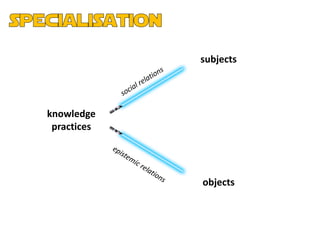
subjects


knowledge
 practices


             objects
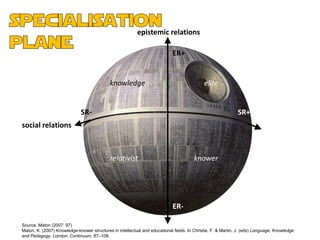
epistemic relations

                                                                             ER+


                                            knowledge                                        elite


                              SR-                                                                             SR+
social relations


                                            relativist                                 knower


                                                                             ER-

Source. Maton (2007: 97)
Maton, K. (2007) Knowledge-knower structures in intellectual and educational fields. In Christie, F. & Martin, J. (eds) Language, Knowledge
and Pedagogy. London: Continuum, 87–108.
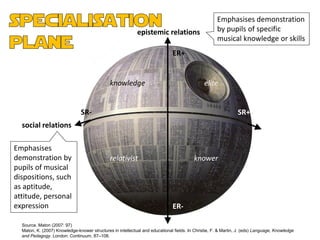
Emphasises demonstration
                                                            epistemic relations                      by pupils of specific
                                                                                                     musical knowledge or skills
                                                                               ER+


                                              knowledge                                        elite


                                SR-                                                                             SR+
  social relations

Emphasises
demonstration by                              relativist                                 knower
pupils of musical
dispositions, such
as aptitude,
attitude, personal
expression                                                                     ER-

  Source. Maton (2007: 97)
  Maton, K. (2007) Knowledge-knower structures in intellectual and educational fields. In Christie, F. & Martin, J. (eds) Language, Knowledge
  and Pedagogy. London: Continuum, 87–108.
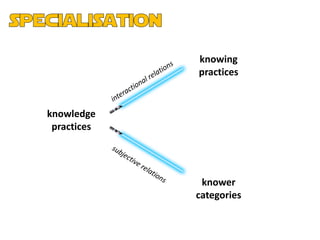
knowing
             practices


knowledge
 practices


              knower
             categories
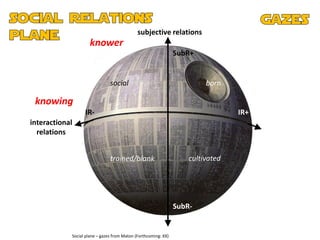
subjective relations
                     knower
                                                                SubR+


                               social                                    born

 knowing
                  IR-                                                            IR+
interactional
  relations


                               trained/blank                        cultivated


                                                                SubR-


            Social plane – gazes from Maton (Forthcoming: XX)
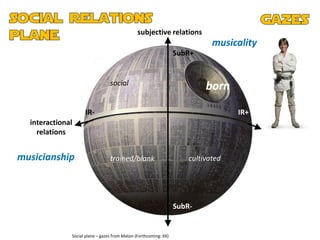
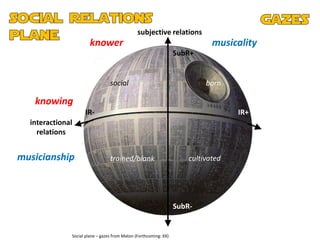
subjective relations
                       knower                                                musicality
                                                                  SubR+


                                 social                                    born

   knowing
                    IR-                                                            IR+
  interactional
    relations


musicianship                     trained/blank                        cultivated


                                                                  SubR-


              Social plane – gazes from Maton (Forthcoming: XX)
+The Jazz is with
you, young student,
but you are not an
 academic musician
        yet+
 Students as knowers in their
            texts
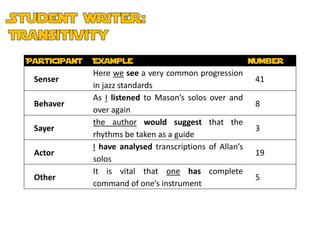
Participant   Example                                     Number
              Here we see a very common progression
 Senser                                                    41
              in jazz standards
              As I listened to Mason’s solos over and
 Behaver                                                   8
              over again
              the author would suggest that the
 Sayer                                                     3
              rhythms be taken as a guide
              I have analysed transcriptions of Allan’s
 Actor                                                     19
              solos
              It is vital that one has complete
 Other                                                     5
              command of one’s instrument
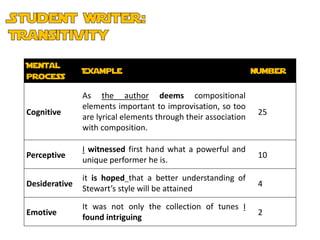
Mental
               Example                                          Number
process

               As the author deems compositional
               elements important to improvisation, so too
Cognitive                                                        25
               are lyrical elements through their association
               with composition.

               I witnessed first hand what a powerful and
Perceptive                                                       10
               unique performer he is.

               it is hoped that a better understanding of
Desiderative                                                     4
               Stewart’s style will be attained

               It was not only the collection of tunes I
Emotive                                                          2
               found intriguing
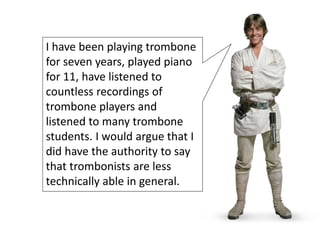
I have been playing trombone
for seven years, played piano
for 11, have listened to
countless recordings of
trombone players and
listened to many trombone
students. I would argue that I
did have the authority to say
that trombonists are less
technically able in general.
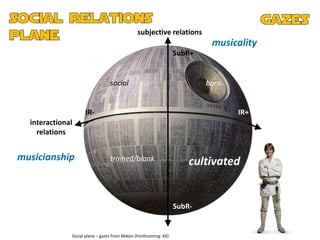
subjective relations
                                                                           musicality
                                                                  SubR+


                                 social                                   born


                    IR-                                                          IR+
  interactional
    relations


musicianship                     trained/blank
                                                                      cultivated


                                                                  SubR-


              Social plane – gazes from Maton (Forthcoming: XX)
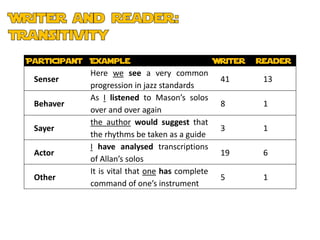
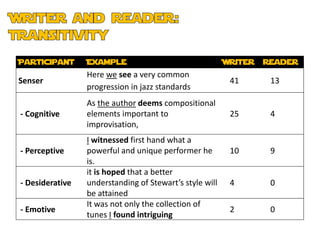
Participant Example                            Writer   Reader
           Here we see a very common
 Senser                                         41       13
           progression in jazz standards
           As I listened to Mason’s solos
 Behaver                                        8        1
           over and over again
           the author would suggest that
 Sayer                                          3        1
           the rhythms be taken as a guide
           I have analysed transcriptions
 Actor                                          19       6
           of Allan’s solos
           It is vital that one has complete
 Other                                          5        1
           command of one’s instrument
Participant      Example                                 Writer   Reader
                 Here we see a very common
Senser                                                    41       13
                 progression in jazz standards
                 As the author deems compositional
- Cognitive      elements important to                    25       4
                 improvisation,
                 I witnessed first hand what a
- Perceptive     powerful and unique performer he         10       9
                 is.
                 it is hoped that a better
- Desiderative   understanding of Stewart’s style will    4        0
                 be attained
                 It was not only the collection of
- Emotive                                                 2        0
                 tunes I found intriguing
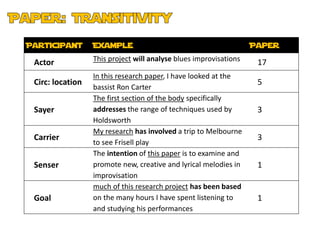
Participant       Example                                          Paper

 Actor            This project will analyse blues improvisations    17
                  In this research paper, I have looked at the
 Circ: location                                                     5
                  bassist Ron Carter
                  The first section of the body specifically
 Sayer            addresses the range of techniques used by         3
                  Holdsworth
                  My research has involved a trip to Melbourne
 Carrier                                                            3
                  to see Frisell play
                  The intention of this paper is to examine and
 Senser           promote new, creative and lyrical melodies in     1
                  improvisation
                  much of this research project has been based
 Goal             on the many hours I have spent listening to       1
                  and studying his performances
+The Jazz runs
 strong in my
   family+
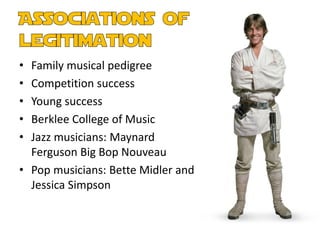
Associations of legitimation
• Family musical pedigree
• Competition success
• Young success
• Berklee College of Music
• Jazz musicians: Maynard
  Ferguson Big Bop Nouveau
• Pop musicians: Bette Midler and
  Jessica Simpson
Prominence:
                             ‘greatest’, ‘famous’, ‘established’
            Normality   28
                             Individuality:
                             ‘unique’, ‘virtuoso’, ‘prodigy’


Judgement   Capacity    39
                              “[each solo] is executed with
                              unfathomably virtuosic
                              technique”

                              “Elliot Mason can only be
                              described as a musical prodigy”
            Tenacity    2
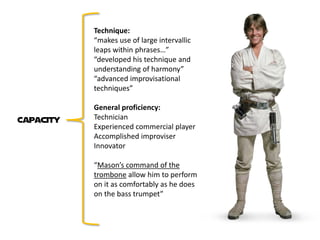
Technique:
           “makes use of large intervallic
           leaps within phrases…”
           “developed his technique and
           understanding of harmony”
           “advanced improvisational
           techniques”

           General proficiency:
Capacity   Technician
           Experienced commercial player
           Accomplished improviser
           Innovator

           “Mason’s command of the
           trombone allow him to perform
           on it as comfortably as he does
           on the bass trumpet”
This command [judg: cap] of advanced [judg: cap]
improvisational techniques coupled with a strong
sense of musicality [judg: cap] makes him an
impressive [app: reac: imp] musician to behold and one
of the most formidable [app: reac: imp]
trombonists/bass trumpeters in the world today.
Further still, he manages [judg: cap] to have a
completely unique [judg: norm] musical voice.
Regardless of the instruments he plays, and perhaps
most [grad: force: int] importantly [app: val], Mason is
an exceptionally [judg: norm; grad: force: int] musical
player [judg: cap], not just [grad: force: int] an
impressive [judg: norm] technician [judg: cap].
subjective relations
                                                                             musicality
                                                                  SubR+


                                 social
                                                                           born

                    IR-                                                            IR+
  interactional
    relations


musicianship                     trained/blank                        cultivated


                                                                  SubR-


              Social plane – gazes from Maton (Forthcoming: XX)
+May the Jazz be
   with you+
    Conclusion
Bernstein, B. (1999). Vertical and Horizontal Discourse: an essay. British Journal of Sociology of
Education, 20(2), 157-173.
Halliday, M. A. K., & Matthiessen, C. M. I. M. (2004). An introduction to Functional Grammar (3rd ed.).
London: Edward Arnold.
Hood, S. (2010). Appraising research : evaluation in academic writing. London: Palgrave Macmillan.
Lamont, A., & Maton, K. (2008). Choosing music: exploratory studies into the low uptake of music
GCSE. British Journal of Music Education, 25(3), 267-282.
Lamont, A., & Maton, K. (2010). Unpopular Music: Beliefs and Behaviours towards Music in Education.
In R. Wright (Ed.), Sociology and Music Education (pp. 63-80). Basingstoke: Ashgate.
Martin, J.L. (Forthcoming). “The Jazz is strong in this one: Presentation and positioning of knowers in
performance student texts”. Proceedings of 39th International Systemic Functional Congress.
Martin, J.L. (Forthcoming). “Musicality and musicianship: specialization in jazz studies”. In K. Maton, S.
Hood and S. Shay (Eds). Knowledge-building: Educational studies in Legitimation Code Theory. London:
Routledge.
Maton, K. (2000). Languages of legitimation: The structuring significance for intellectual fields of
strategic knowledge claims. British Journal of Sociology of Education, 21(2), 147-167.
Maton, K. (2007). Knowledge-knower structures in intellectual and educational fields. In F. Christie & J.
R. Martin (Eds.), Language, knowledge and pedagogy: Functional linguistic and sociological perspectives
(pp. 87-108). London: Continuum.
Maton, K. (2009). Cumulative and segmented learning: exploring the role of curriculum structures in
knowledge-building. British Journal of Sociology of Education, 30(1), 43-57.
Maton, K. (2010). Canons and Progress in the Arts and Humanities: Knowers and Gazes. In K. Maton &
R. Moore (Eds.), Social Realism, Knowledge and the Sociology of Education : Coalitions of the mind (pp.
154-178). London: Continuum.
jodie.martin@adelaide.edu.au

twitter.com/jazzlinguist

about.me/jodiemartin

The Jazz is strong in this one ISFC

  • 1.
    +The Jazz is strong in this one= Presentation and positioning of knowers in performance student texts Jodie Martin PhD Candidate Discipline of Linguistics University of Adelaide About.me/jodiemartin Supervisor: Dr Peter Mickan
  • 2.
    What is jazz? Man,if you have to ask you’ll never know. Louis Armstrong
  • 3.
    +you must learn theways of Jazz= Jazz in tertiary education
  • 4.
  • 5.
    epistemic relations ER+ knowledge elite SR- SR+ social relations relativist knower ER- Source. Maton (2007: 97) Maton, K. (2007) Knowledge-knower structures in intellectual and educational fields. In Christie, F. & Martin, J. (eds) Language, Knowledge and Pedagogy. London: Continuum, 87–108.
  • 6.
    Emphasises demonstration epistemic relations by pupils of specific musical knowledge or skills ER+ knowledge elite SR- SR+ social relations Emphasises demonstration by relativist knower pupils of musical dispositions, such as aptitude, attitude, personal expression ER- Source. Maton (2007: 97) Maton, K. (2007) Knowledge-knower structures in intellectual and educational fields. In Christie, F. & Martin, J. (eds) Language, Knowledge and Pedagogy. London: Continuum, 87–108.
  • 7.
    knowing practices knowledge practices knower categories
  • 8.
    subjective relations knower SubR+ social born knowing IR- IR+ interactional relations trained/blank cultivated SubR- Social plane – gazes from Maton (Forthcoming: XX)
  • 9.
    subjective relations knower musicality SubR+ social born knowing IR- IR+ interactional relations musicianship trained/blank cultivated SubR- Social plane – gazes from Maton (Forthcoming: XX)
  • 11.
    +The Jazz iswith you, young student, but you are not an academic musician yet+ Students as knowers in their texts
  • 12.
    Participant Example Number Here we see a very common progression Senser 41 in jazz standards As I listened to Mason’s solos over and Behaver 8 over again the author would suggest that the Sayer 3 rhythms be taken as a guide I have analysed transcriptions of Allan’s Actor 19 solos It is vital that one has complete Other 5 command of one’s instrument
  • 13.
    Mental Example Number process As the author deems compositional elements important to improvisation, so too Cognitive 25 are lyrical elements through their association with composition. I witnessed first hand what a powerful and Perceptive 10 unique performer he is. it is hoped that a better understanding of Desiderative 4 Stewart’s style will be attained It was not only the collection of tunes I Emotive 2 found intriguing
  • 14.
    I have beenplaying trombone for seven years, played piano for 11, have listened to countless recordings of trombone players and listened to many trombone students. I would argue that I did have the authority to say that trombonists are less technically able in general.
  • 15.
    subjective relations musicality SubR+ social born IR- IR+ interactional relations musicianship trained/blank cultivated SubR- Social plane – gazes from Maton (Forthcoming: XX)
  • 16.
    Participant Example Writer Reader Here we see a very common Senser 41 13 progression in jazz standards As I listened to Mason’s solos Behaver 8 1 over and over again the author would suggest that Sayer 3 1 the rhythms be taken as a guide I have analysed transcriptions Actor 19 6 of Allan’s solos It is vital that one has complete Other 5 1 command of one’s instrument
  • 17.
    Participant Example Writer Reader Here we see a very common Senser 41 13 progression in jazz standards As the author deems compositional - Cognitive elements important to 25 4 improvisation, I witnessed first hand what a - Perceptive powerful and unique performer he 10 9 is. it is hoped that a better - Desiderative understanding of Stewart’s style will 4 0 be attained It was not only the collection of - Emotive 2 0 tunes I found intriguing
  • 18.
    Participant Example Paper Actor This project will analyse blues improvisations 17 In this research paper, I have looked at the Circ: location 5 bassist Ron Carter The first section of the body specifically Sayer addresses the range of techniques used by 3 Holdsworth My research has involved a trip to Melbourne Carrier 3 to see Frisell play The intention of this paper is to examine and Senser promote new, creative and lyrical melodies in 1 improvisation much of this research project has been based Goal on the many hours I have spent listening to 1 and studying his performances
  • 19.
    +The Jazz runs strong in my family+ Associations of legitimation
  • 20.
    • Family musicalpedigree • Competition success • Young success • Berklee College of Music • Jazz musicians: Maynard Ferguson Big Bop Nouveau • Pop musicians: Bette Midler and Jessica Simpson
  • 21.
    Prominence: ‘greatest’, ‘famous’, ‘established’ Normality 28 Individuality: ‘unique’, ‘virtuoso’, ‘prodigy’ Judgement Capacity 39 “[each solo] is executed with unfathomably virtuosic technique” “Elliot Mason can only be described as a musical prodigy” Tenacity 2
  • 22.
    Technique: “makes use of large intervallic leaps within phrases…” “developed his technique and understanding of harmony” “advanced improvisational techniques” General proficiency: Capacity Technician Experienced commercial player Accomplished improviser Innovator “Mason’s command of the trombone allow him to perform on it as comfortably as he does on the bass trumpet”
  • 23.
    This command [judg:cap] of advanced [judg: cap] improvisational techniques coupled with a strong sense of musicality [judg: cap] makes him an impressive [app: reac: imp] musician to behold and one of the most formidable [app: reac: imp] trombonists/bass trumpeters in the world today. Further still, he manages [judg: cap] to have a completely unique [judg: norm] musical voice.
  • 24.
    Regardless of theinstruments he plays, and perhaps most [grad: force: int] importantly [app: val], Mason is an exceptionally [judg: norm; grad: force: int] musical player [judg: cap], not just [grad: force: int] an impressive [judg: norm] technician [judg: cap].
  • 25.
    subjective relations musicality SubR+ social born IR- IR+ interactional relations musicianship trained/blank cultivated SubR- Social plane – gazes from Maton (Forthcoming: XX)
  • 26.
    +May the Jazzbe with you+ Conclusion
  • 28.
    Bernstein, B. (1999).Vertical and Horizontal Discourse: an essay. British Journal of Sociology of Education, 20(2), 157-173. Halliday, M. A. K., & Matthiessen, C. M. I. M. (2004). An introduction to Functional Grammar (3rd ed.). London: Edward Arnold. Hood, S. (2010). Appraising research : evaluation in academic writing. London: Palgrave Macmillan. Lamont, A., & Maton, K. (2008). Choosing music: exploratory studies into the low uptake of music GCSE. British Journal of Music Education, 25(3), 267-282. Lamont, A., & Maton, K. (2010). Unpopular Music: Beliefs and Behaviours towards Music in Education. In R. Wright (Ed.), Sociology and Music Education (pp. 63-80). Basingstoke: Ashgate. Martin, J.L. (Forthcoming). “The Jazz is strong in this one: Presentation and positioning of knowers in performance student texts”. Proceedings of 39th International Systemic Functional Congress. Martin, J.L. (Forthcoming). “Musicality and musicianship: specialization in jazz studies”. In K. Maton, S. Hood and S. Shay (Eds). Knowledge-building: Educational studies in Legitimation Code Theory. London: Routledge. Maton, K. (2000). Languages of legitimation: The structuring significance for intellectual fields of strategic knowledge claims. British Journal of Sociology of Education, 21(2), 147-167. Maton, K. (2007). Knowledge-knower structures in intellectual and educational fields. In F. Christie & J. R. Martin (Eds.), Language, knowledge and pedagogy: Functional linguistic and sociological perspectives (pp. 87-108). London: Continuum. Maton, K. (2009). Cumulative and segmented learning: exploring the role of curriculum structures in knowledge-building. British Journal of Sociology of Education, 30(1), 43-57. Maton, K. (2010). Canons and Progress in the Arts and Humanities: Knowers and Gazes. In K. Maton & R. Moore (Eds.), Social Realism, Knowledge and the Sociology of Education : Coalitions of the mind (pp. 154-178). London: Continuum.
  • 29.