Arquitetura do
coprocessador Intel® Xeon Phi™
Luciano Palma
Community Manager – Servers & HPC
Intel Software do Brasil
Luciano.Palma@intel.com
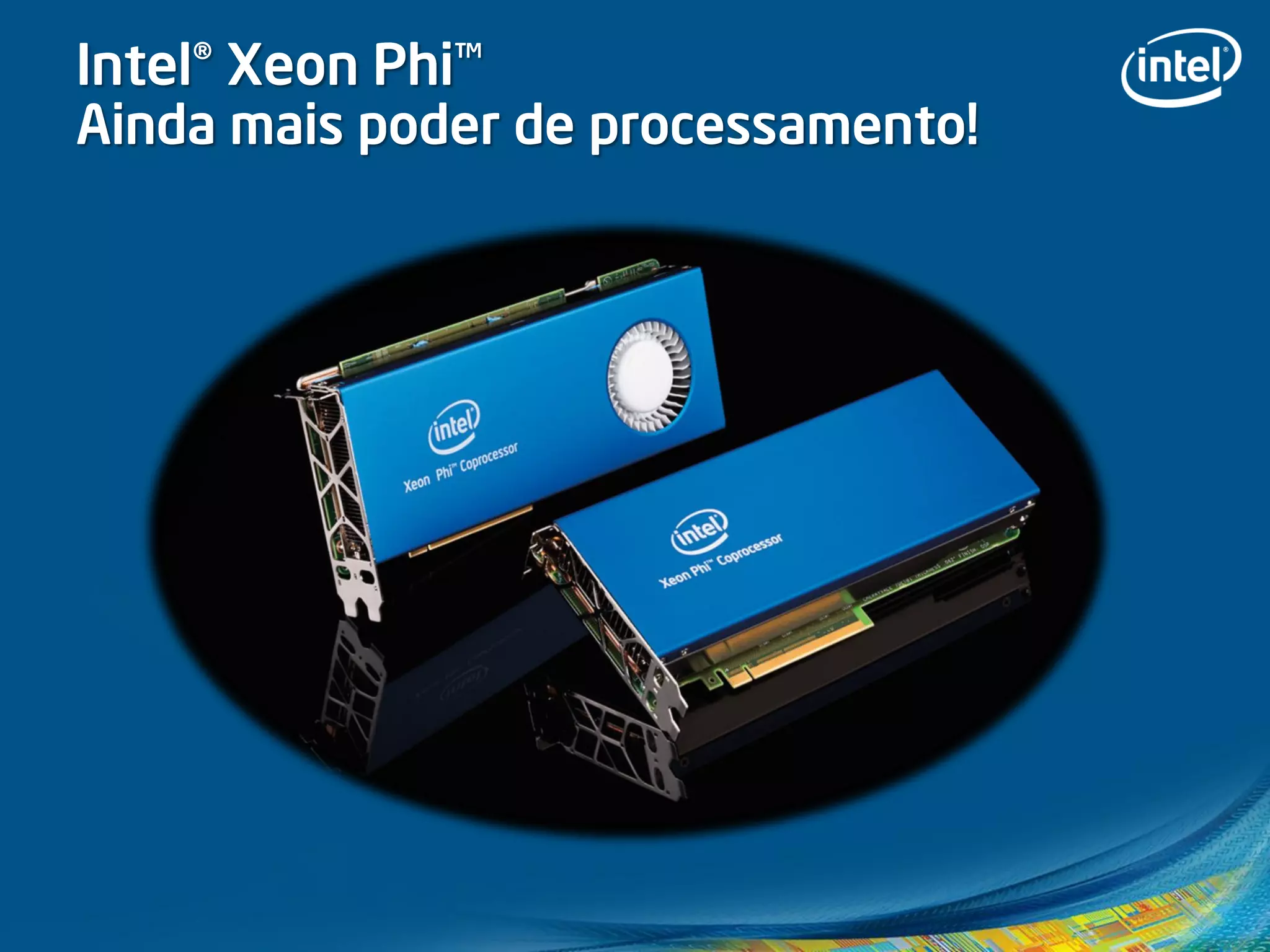
Intel® Xeon Phi™
Ainda mais poder de processamento!
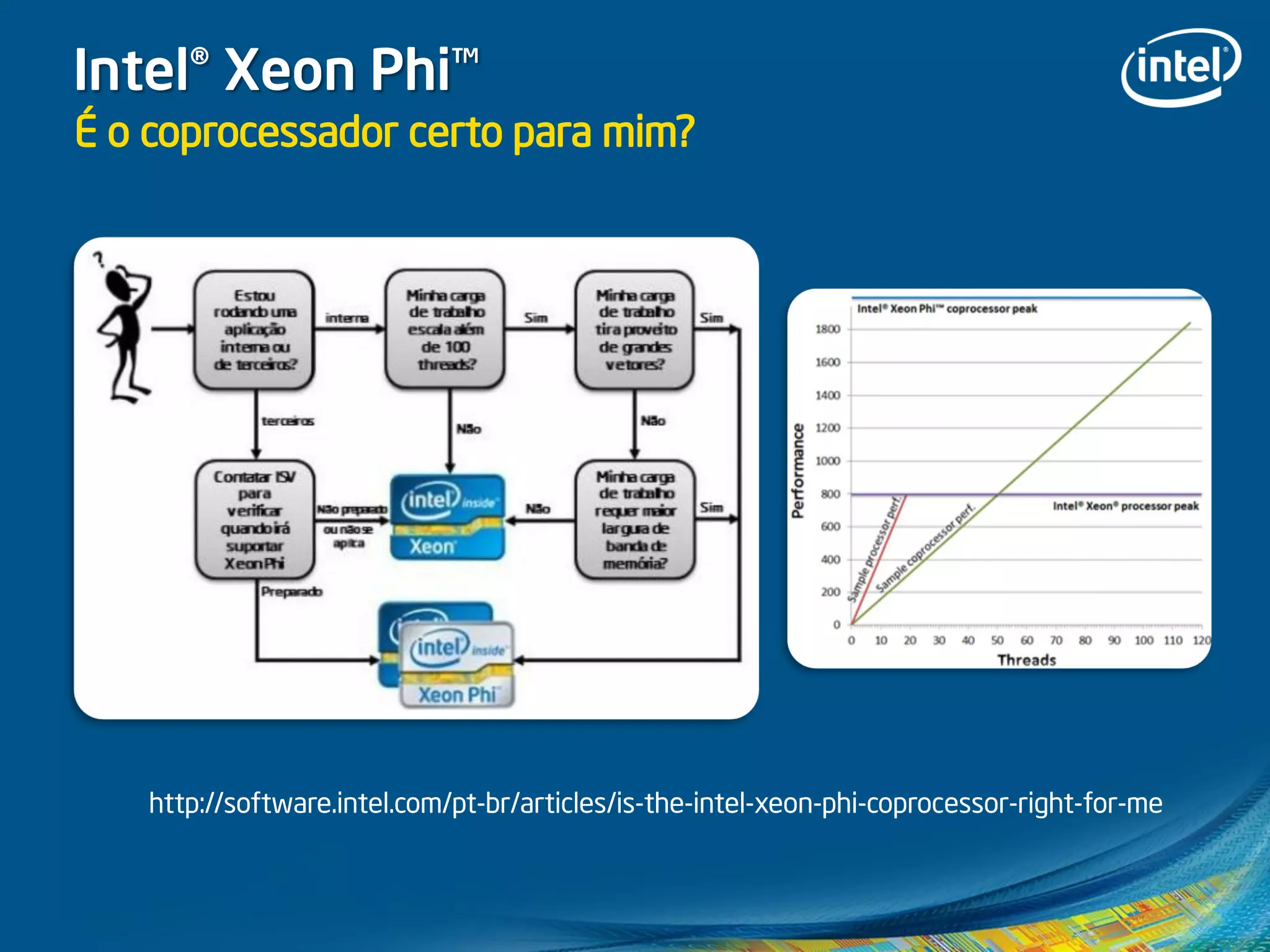
Intel® Xeon Phi™
É o coprocessador certo para mim?
http://software.intel.com/pt-br/articles/is-the-intel-xeon-phi-coprocessor-right-for-me
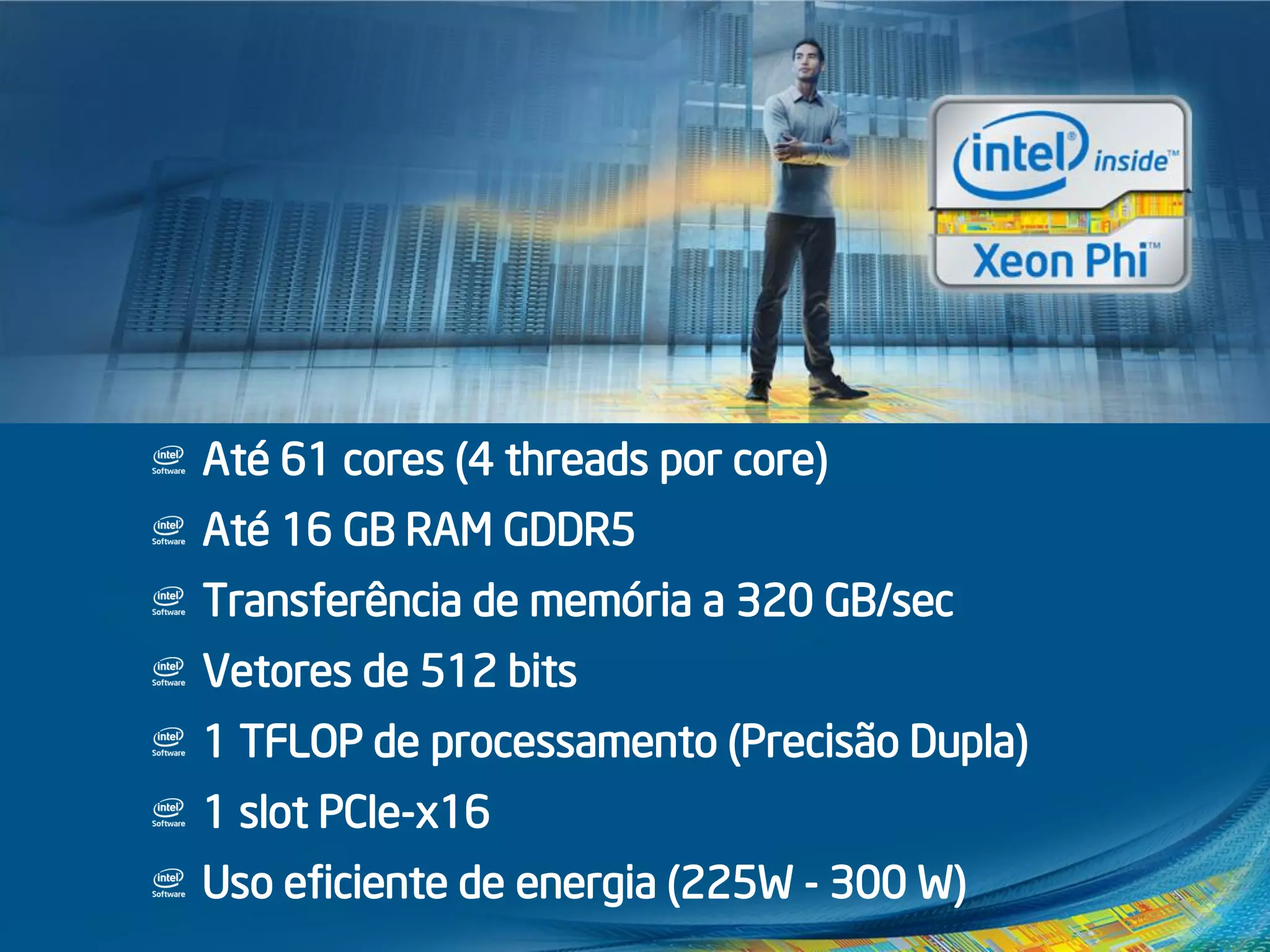
Até 61 cores (4 threads por core)
Até 16 GB RAM GDDR5
Transferência de memória a 320 GB/sec
Vetores de 512 bits
1 TFLOP de processamento (Precisão Dupla)
1 slot PCIe-x16
Uso eficiente de energia (225W - 300 W)
Intel® Xeon Phi™
Ainda mais poder de
processamento!
Intel® Xeon Phi™
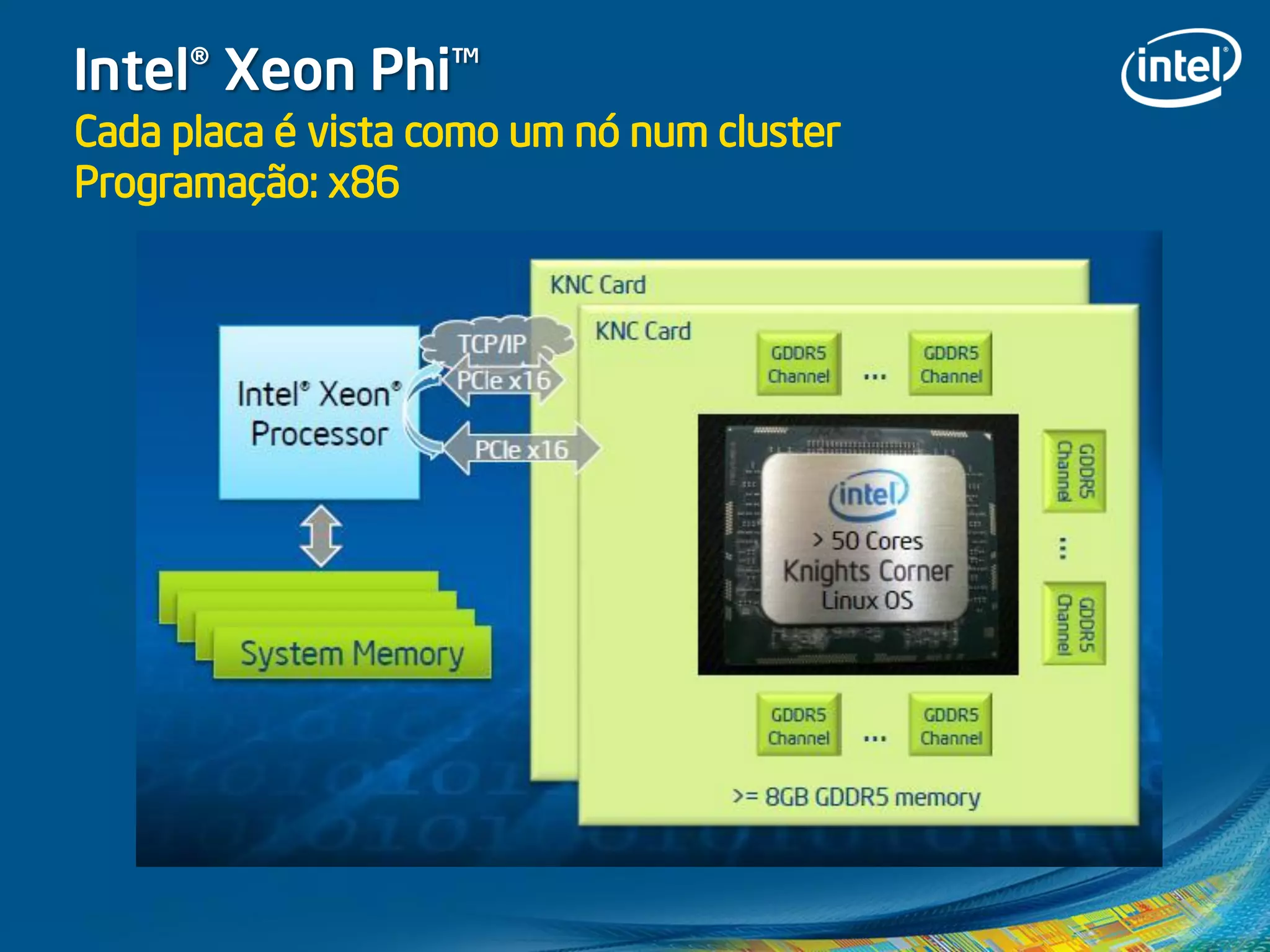
Cada placa é vista como um nó num cluster
Programação: x86
Intel® Xeon Phi™
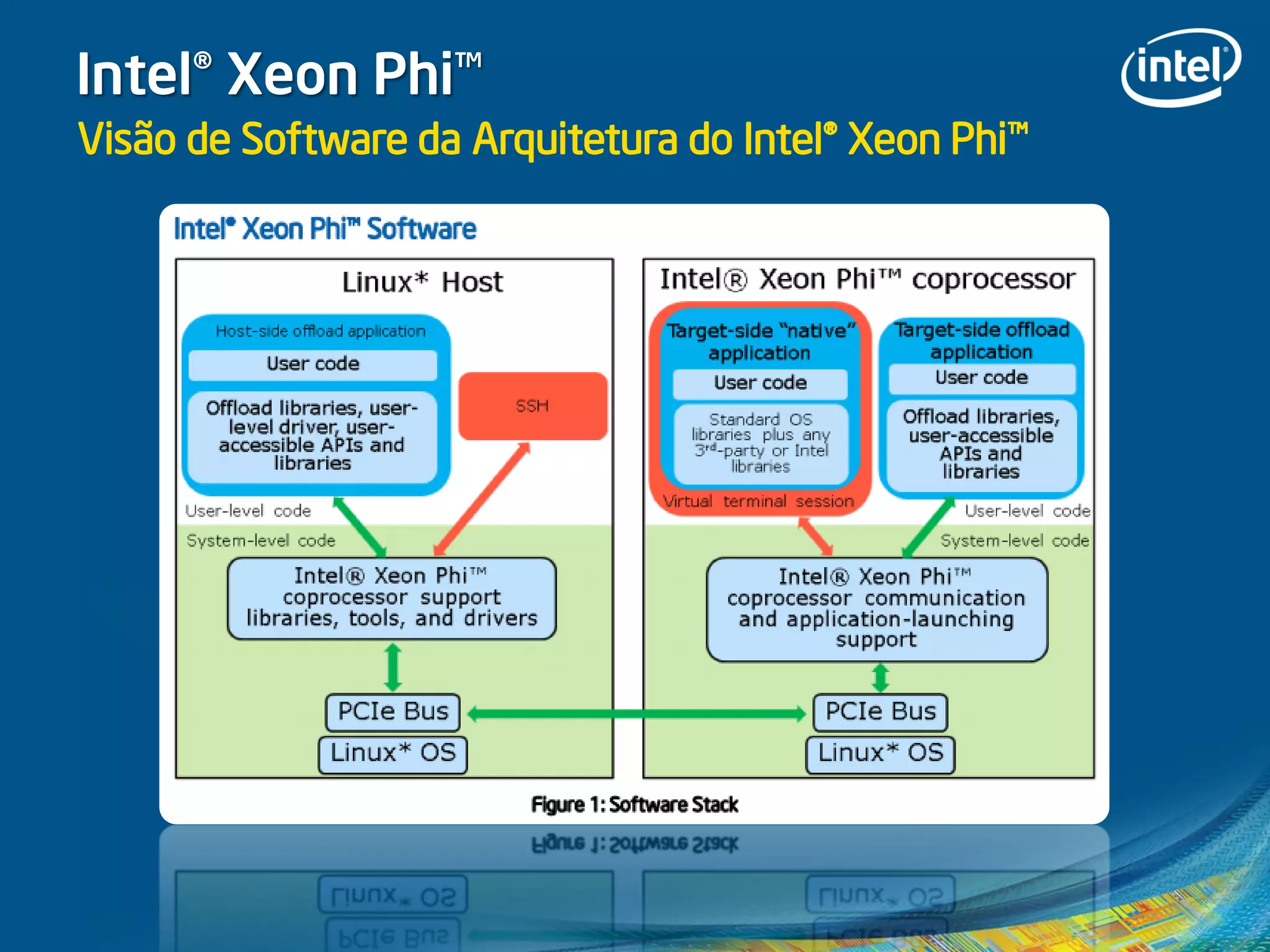
Visão de Software da Arquitetura do Intel® Xeon Phi™
Intel® Xeon Phi™
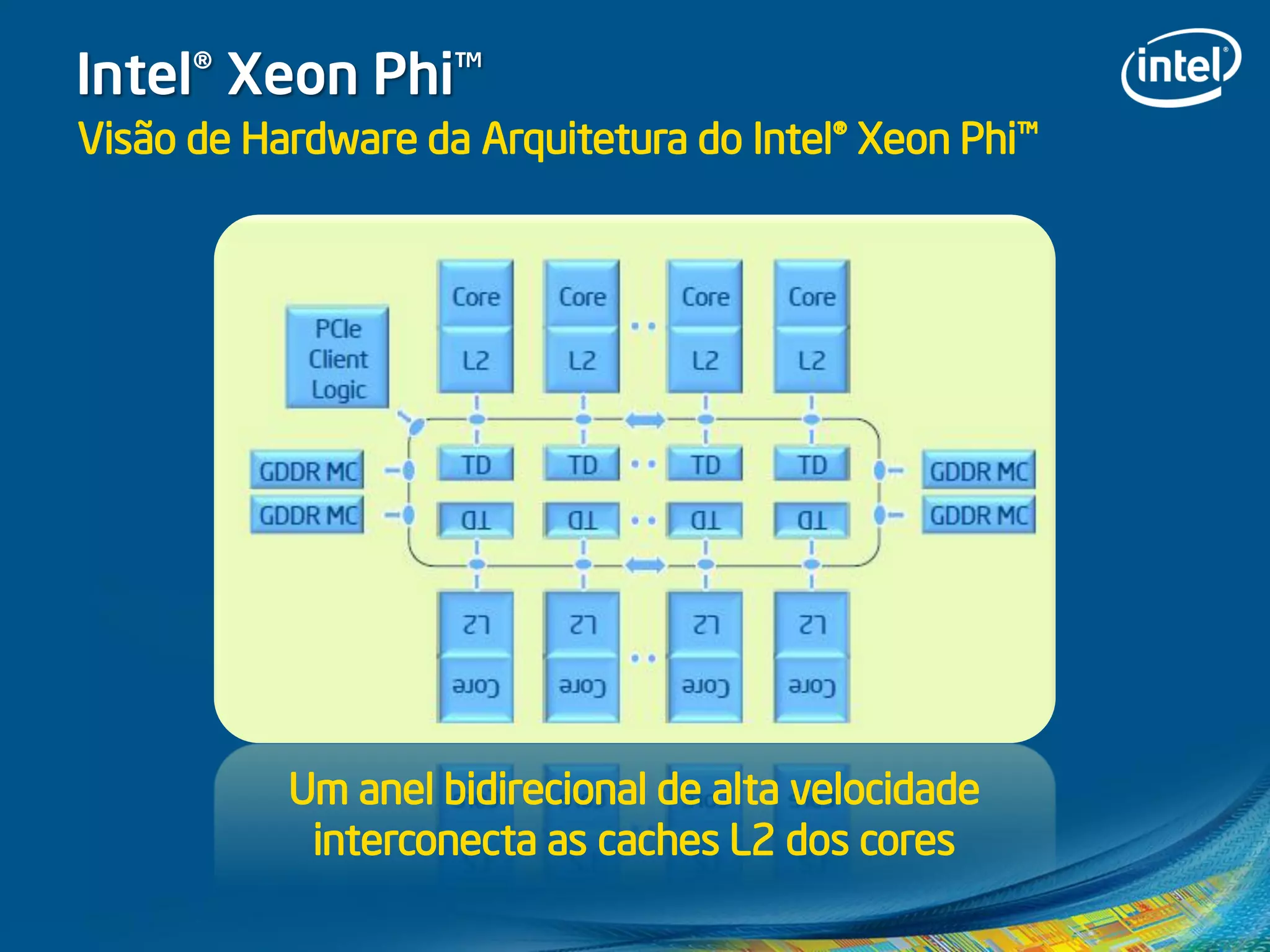
Visão de Hardware da Arquitetura do Intel® Xeon Phi™
Um anel bidirecional de alta velocidade
interconecta as caches L2 dos cores
Intel® Xeon Phi™
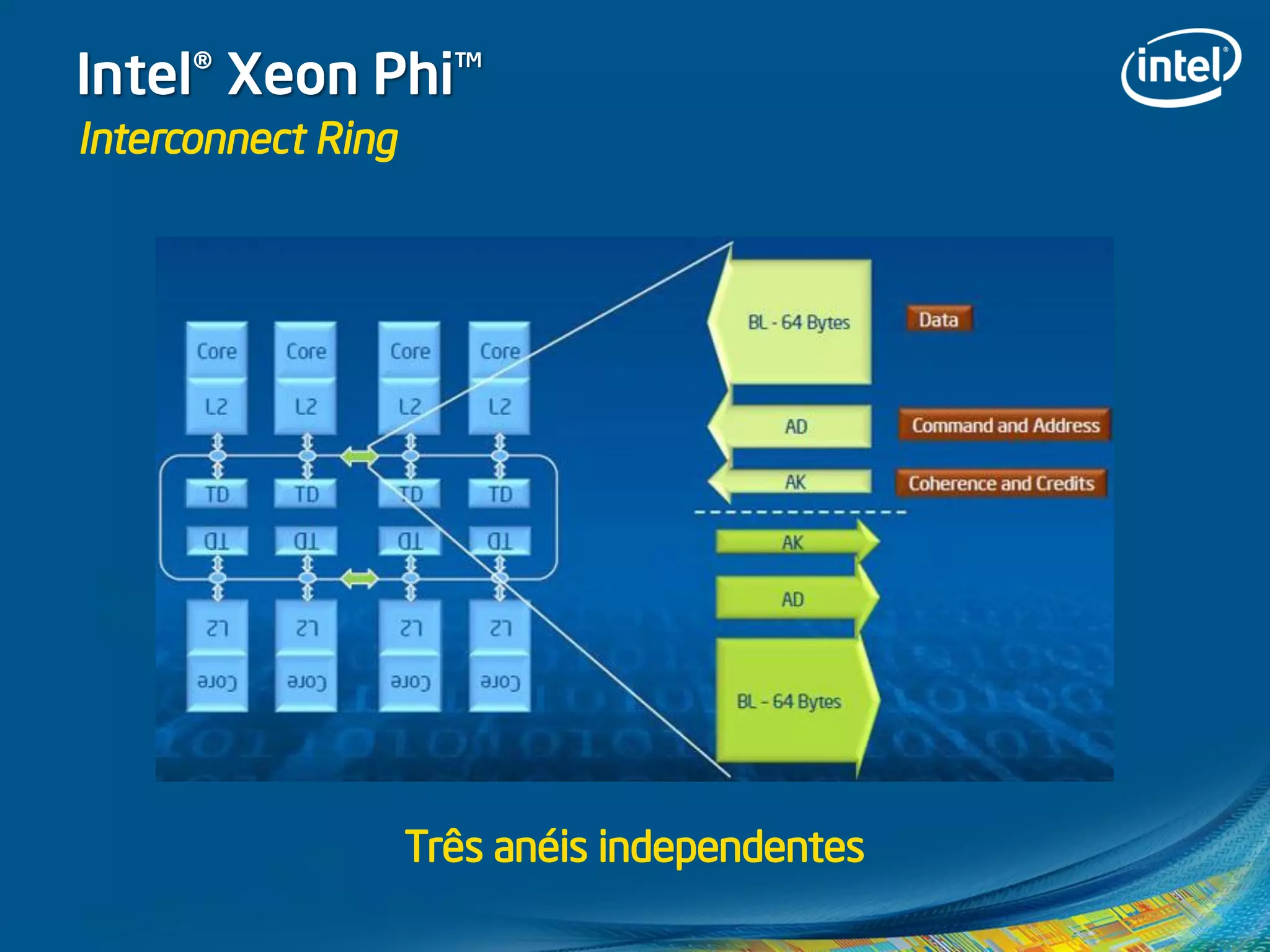
Interconnect Ring
Três anéis independentes
Intel® Xeon Phi™
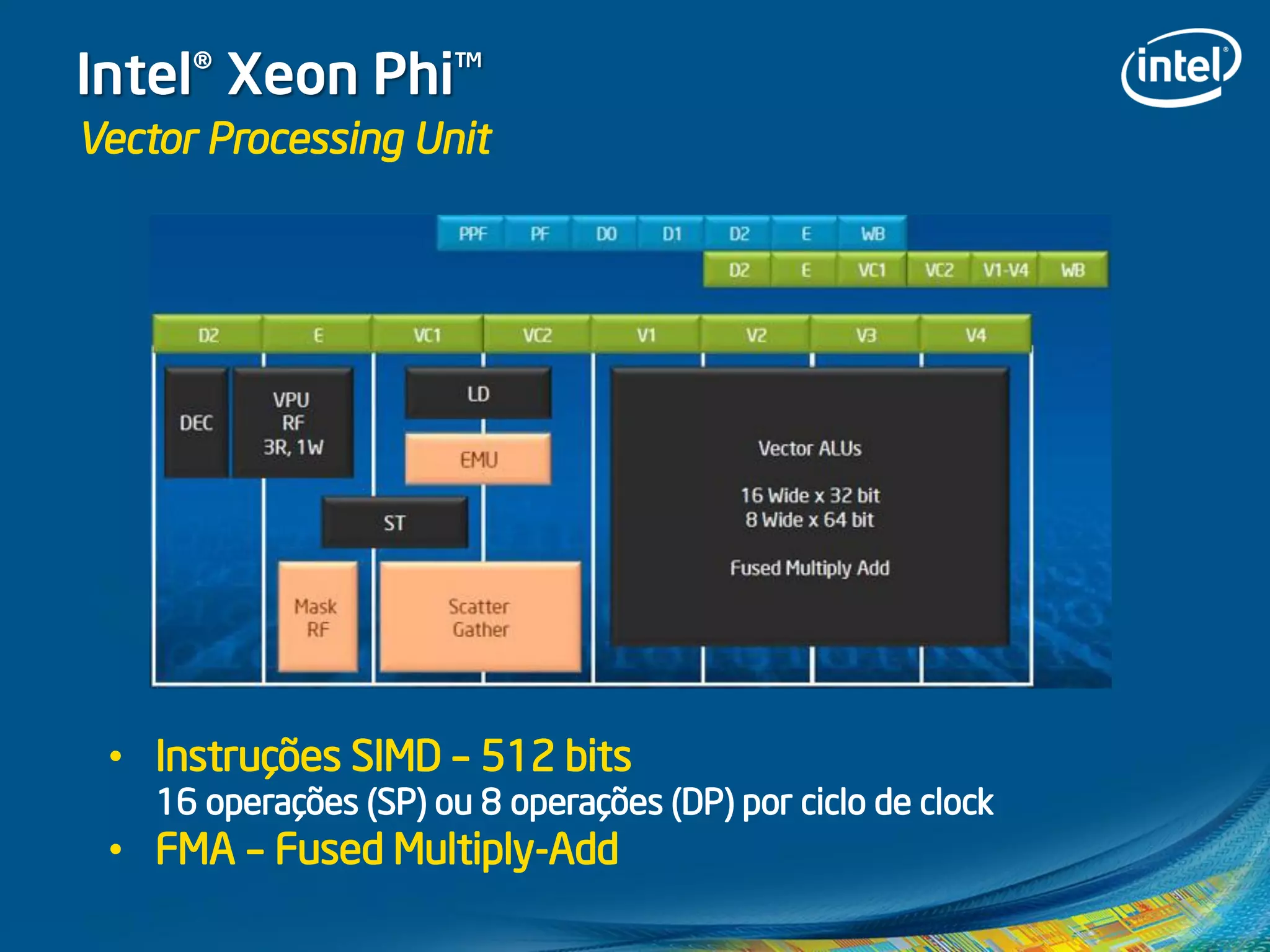
Vector Processing Unit
• Instruções SIMD – 512 bits
16 operações (SP) ou 8 operações (DP) por ciclo de clock
• FMA – Fused Multiply-Add
Intel® Xeon Phi™
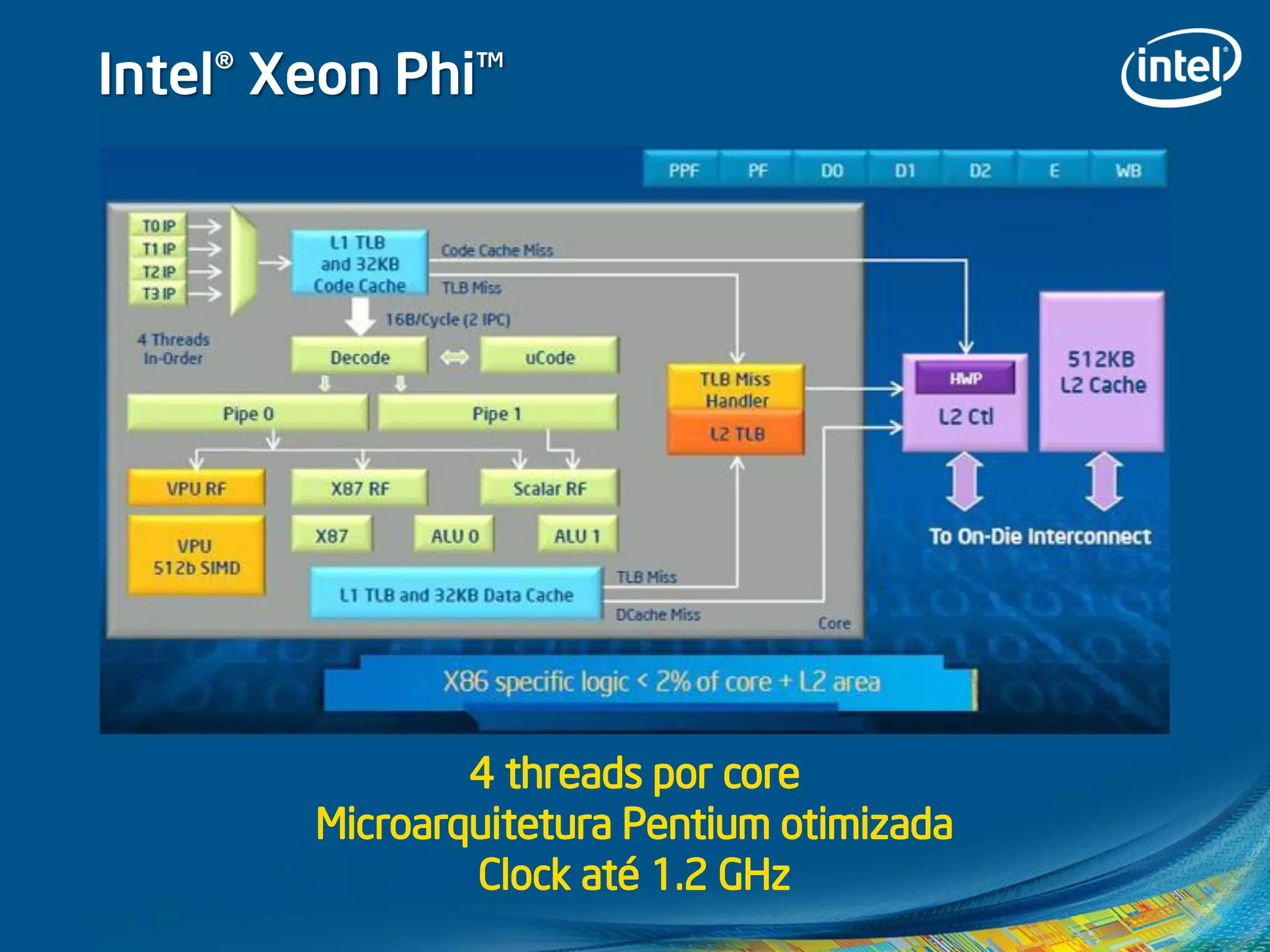
4 threads por core
Microarquitetura Pentium otimizada
Clock até 1.2 GHz
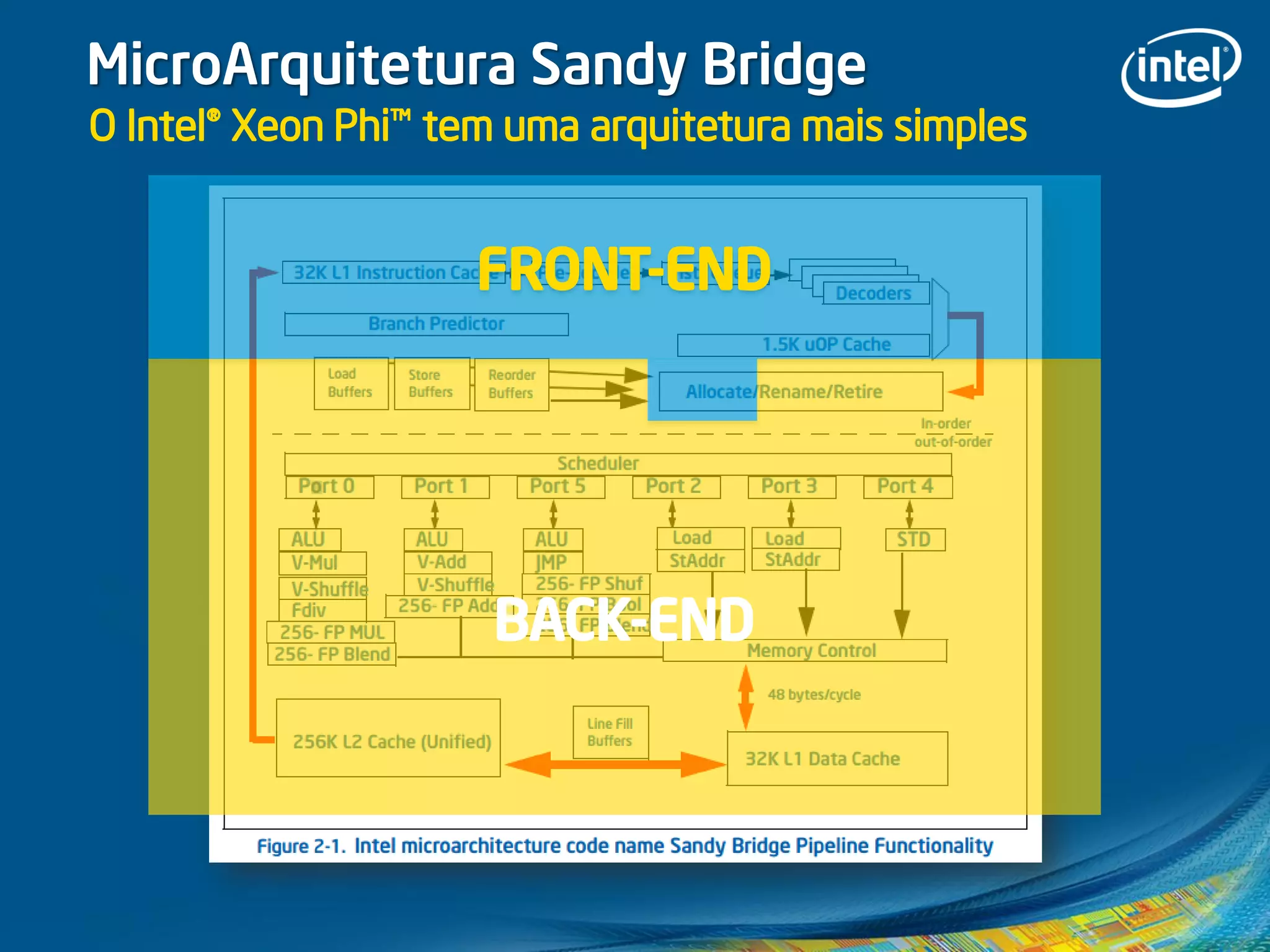
MicroArquitetura Sandy Bridge
FRONT-END
BACK-END
O Intel® Xeon Phi™ tem uma arquitetura mais simples
Intel® Xeon Phi™
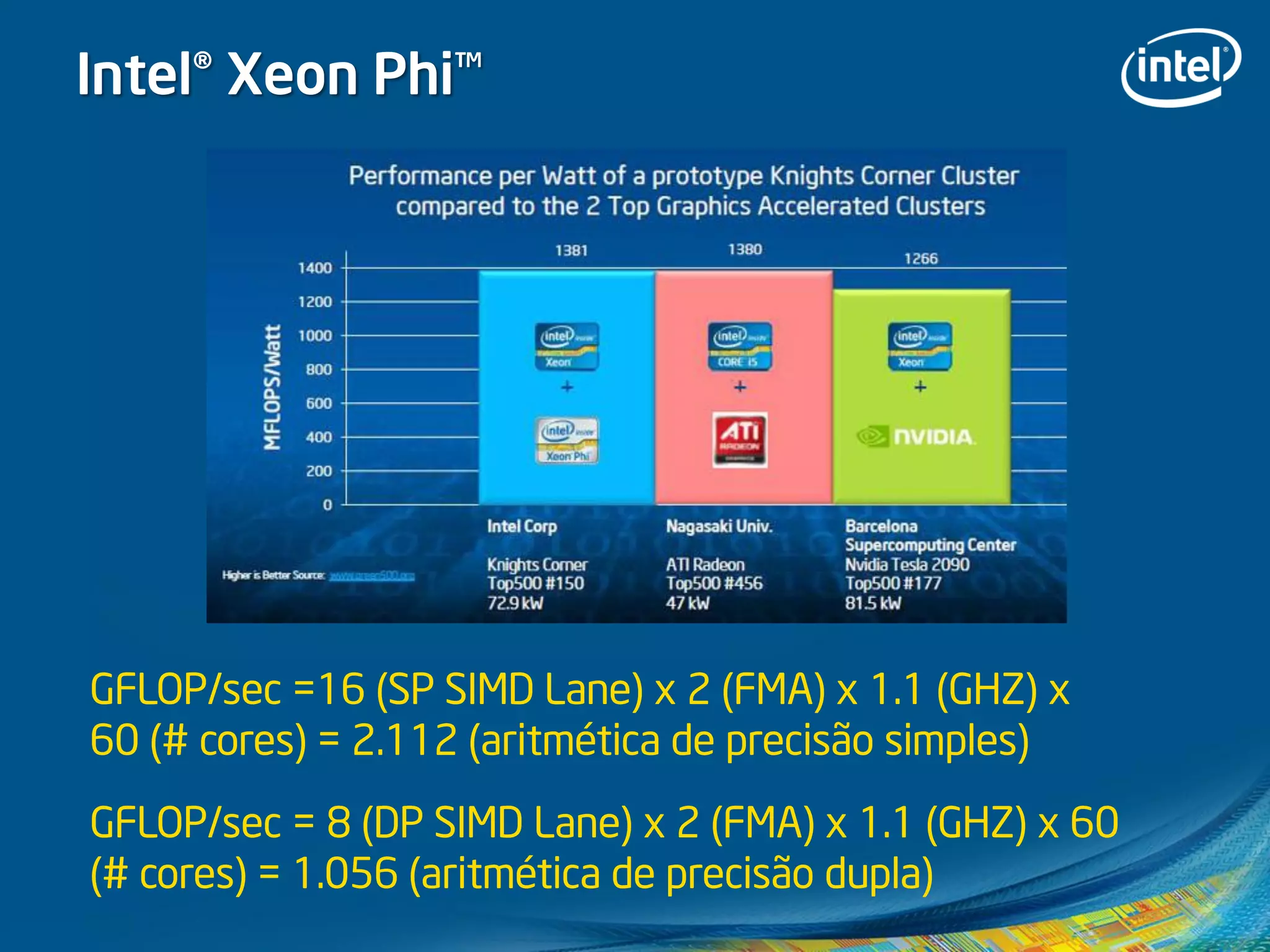
GFLOP/sec =16 (SP SIMD Lane) x 2 (FMA) x 1.1 (GHZ) x
60 (# cores) = 2.112 (aritmética de precisão simples)
GFLOP/sec = 8 (DP SIMD Lane) x 2 (FMA) x 1.1 (GHZ) x 60
(# cores) = 1.056 (aritmética de precisão dupla)
Nota sobre Otimização
• INFORMATION IN THIS DOCUMENT IS PROVIDED IN CONNECTION WITH INTEL PRODUCTS. NO LICENSE, EXPRESS OR IMPLIED, BY ESTOPPEL OR
OTHERWISE, TO ANY INTELLECTUAL PROPERTY RIGHTS IS GRANTED BY THIS DOCUMENT. EXCEPT AS PROVIDED IN INTEL'S TERMS AND CONDITIONS
OF SALE FOR SUCH PRODUCTS, INTEL ASSUMES NO LIABILITY WHATSOEVER AND INTEL DISCLAIMS ANY EXPRESS OR IMPLIED WARRANTY, RELATING
TO SALE AND/OR USE OF INTEL PRODUCTS INCLUDING LIABILITY OR WARRANTIES RELATING TO FITNESS FOR A PARTICULAR PURPOSE,
MERCHANTABILITY, OR INFRINGEMENT OF ANY PATENT, COPYRIGHT OR OTHER INTELLECTUAL PROPERTY RIGHT.
• A "Mission Critical Application" is any application in which failure of the Intel Product could result, directly or indirectly, in personal injury or
death. SHOULD YOU PURCHASE OR USE INTEL'S PRODUCTS FOR ANY SUCH MISSION CRITICAL APPLICATION, YOU SHALL INDEMNIFY AND HOLD INTEL
AND ITS SUBSIDIARIES, SUBCONTRACTORS AND AFFILIATES, AND THE DIRECTORS, OFFICERS, AND EMPLOYEES OF EACH, HARMLESS AGAINST ALL
CLAIMS COSTS, DAMAGES, AND EXPENSES AND REASONABLE ATTORNEYS' FEES ARISING OUT OF, DIRECTLY OR INDIRECTLY, ANY CLAIM OF PRODUCT
LIABILITY, PERSONAL INJURY, OR DEATH ARISING IN ANY WAY OUT OF SUCH MISSION CRITICAL APPLICATION, WHETHER OR NOT INTEL OR ITS
SUBCONTRACTOR WAS NEGLIGENT IN THE DESIGN, MANUFACTURE, OR WARNING OF THE INTEL PRODUCT OR ANY OF ITS PARTS.
• Intel may make changes to specifications and product descriptions at any time, without notice. Designers must not rely on the absence or characteristics
of any features or instructions marked "reserved" or "undefined". Intel reserves these for future definition and shall have no responsibility whatsoever
for conflicts or incompatibilities arising from future changes to them. The information here is subject to change without notice. Do not finalize a design
with this information.
• The products described in this document may contain design defects or errors known as errata which may cause the product to deviate from published
specifications. Current characterized errata are available on request.
• Intel processor numbers are not a measure of performance. Processor numbers differentiate features within each processor family, not across different
processor families. Go to: http://www.intel.com/products/processor_number.
• Contact your local Intel sales office or your distributor to obtain the latest specifications and before placing your product order.
• Copies of documents which have an order number and are referenced in this document, or other Intel literature, may be obtained by calling 1-800-548-
4725, or go to: http://www.intel.com/design/literature.htm
• Intel, Core, Atom, Pentium, Intel inside, Sponsors of Tomorrow, Pentium, 386, 486, DX2 and the Intel logo are trademarks of Intel Corporation in the
United States and other countries.
• *Other names and brands may be claimed as the property of others.
• Copyright ©2012 Intel Corporation.
Legal Disclaimer
Risk Factors
The above statements and any others in this document that refer to plans and expectations for the second quarter, the year and the future are forward-looking
statements that involve a number of risks and uncertainties. Words such as “anticipates,” “expects,” “intends,” “plans,” “believes,” “seeks,” “estimates,” “may,”
“will,” “should” and their variations identify forward-looking statements. Statements that refer to or are based on projections, uncertain events or assumptions
also identify forward-looking statements. Many factors could affect Intel’s actual results, and variances from Intel’s current expectations regarding such factors
could cause actual results to differ materially from those expressed in these forward-looking statements. Intel presently considers the following to be the
important factors that could cause actual results to differ materially from the company’s expectations. Demand could be different from Intel's expectations due
to factors including changes in business and economic conditions, including supply constraints and other disruptions affecting customers; customer acceptance of
Intel’s and competitors’ products; changes in customer order patterns including order cancellations; and changes in the level of inventory at customers.
Uncertainty in global economic and financial conditions poses a risk that consumers and businesses may defer purchases in response to negative financial events,
which could negatively affect product demand and other related matters. Intel operates in intensely competitive industries that are characterized by a high
percentage of costs that are fixed or difficult to reduce in the short term and product demand that is highly variable and difficult to forecast. Revenue and the
gross margin percentage are affected by the timing of Intel product introductions and the demand for and market acceptance of Intel's products; actions taken
by Intel's competitors, including product offerings and introductions, marketing programs and pricing pressures and Intel’s response to such actions; and Intel’s
ability to respond quickly to technological developments and to incorporate new features into its products. Intel is in the process of transitioning to its next
generation of products on 22nm process technology, and there could be execution and timing issues associated with these changes, including products defects
and errata and lower than anticipated manufacturing yields. The gross margin percentage could vary significantly from expectations based on capacity utilization;
variations in inventory valuation, including variations related to the timing of qualifying products for sale; changes in revenue levels; segment product mix; the
timing and execution of the manufacturing ramp and associated costs; start-up costs; excess or obsolete inventory; changes in unit costs; defects or disruptions
in the supply of materials or resources; product manufacturing quality/yields; and impairments of long-lived assets, including manufacturing, assembly/test and
intangible assets. The majority of Intel’s non-marketable equity investment portfolio balance is concentrated in companies in the flash memory market segment,
and declines in this market segment or changes in management’s plans with respect to Intel’s investments in this market segment could result in significant
impairment charges, impacting restructuring charges as well as gains/losses on equity investments and interest and other. Intel's results could be affected by
adverse economic, social, political and physical/infrastructure conditions in countries where Intel, its customers or its suppliers operate, including military conflict
and other security risks, natural disasters, infrastructure disruptions, health concerns and fluctuations in currency exchange rates. Expenses, particularly certain
marketing and compensation expenses, as well as restructuring and asset impairment charges, vary depending on the level of demand for Intel's products and
the level of revenue and profits. Intel’s results could be affected by the timing of closing of acquisitions and divestitures. Intel's results could be affected by
adverse effects associated with product defects and errata (deviations from published specifications), and by litigation or regulatory matters involving
intellectual property, stockholder, consumer, antitrust, disclosure and other issues, such as the litigation and regulatory matters described in Intel's SEC reports.
An unfavorable ruling could include monetary damages or an injunction prohibiting Intel from manufacturing or selling one or more products, precluding particular
business practices, impacting Intel’s ability to design its products, or requiring other remedies such as compulsory licensing of intellectual property. A detailed
discussion of these and other factors that could affect Intel’s results is included in Intel’s SEC filings, including the report on Form 10-K for the year ended Dec.
31, 2011.
Rev. 4/17/12
Arquitetura do coprocessador Intel® Xeon Phi™ - Intel Software Conference 2013

Arquitetura do coprocessador Intel® Xeon Phi™ - Intel Software Conference 2013

  • 1.
    Arquitetura do coprocessador Intel®Xeon Phi™ Luciano Palma Community Manager – Servers & HPC Intel Software do Brasil Luciano.Palma@intel.com
  • 2.
    Intel® Xeon Phi™ Aindamais poder de processamento!
  • 3.
    Intel® Xeon Phi™ Éo coprocessador certo para mim? http://software.intel.com/pt-br/articles/is-the-intel-xeon-phi-coprocessor-right-for-me
  • 4.
    Até 61 cores(4 threads por core) Até 16 GB RAM GDDR5 Transferência de memória a 320 GB/sec Vetores de 512 bits 1 TFLOP de processamento (Precisão Dupla) 1 slot PCIe-x16 Uso eficiente de energia (225W - 300 W) Intel® Xeon Phi™ Ainda mais poder de processamento!
  • 5.
    Intel® Xeon Phi™ Cadaplaca é vista como um nó num cluster Programação: x86
  • 6.
    Intel® Xeon Phi™ Visãode Software da Arquitetura do Intel® Xeon Phi™
  • 7.
    Intel® Xeon Phi™ Visãode Hardware da Arquitetura do Intel® Xeon Phi™ Um anel bidirecional de alta velocidade interconecta as caches L2 dos cores
  • 8.
    Intel® Xeon Phi™ InterconnectRing Três anéis independentes
  • 9.
    Intel® Xeon Phi™ VectorProcessing Unit • Instruções SIMD – 512 bits 16 operações (SP) ou 8 operações (DP) por ciclo de clock • FMA – Fused Multiply-Add
  • 10.
    Intel® Xeon Phi™ 4threads por core Microarquitetura Pentium otimizada Clock até 1.2 GHz
  • 11.
    MicroArquitetura Sandy Bridge FRONT-END BACK-END OIntel® Xeon Phi™ tem uma arquitetura mais simples
  • 12.
    Intel® Xeon Phi™ GFLOP/sec=16 (SP SIMD Lane) x 2 (FMA) x 1.1 (GHZ) x 60 (# cores) = 2.112 (aritmética de precisão simples) GFLOP/sec = 8 (DP SIMD Lane) x 2 (FMA) x 1.1 (GHZ) x 60 (# cores) = 1.056 (aritmética de precisão dupla)
  • 13.
  • 14.
    • INFORMATION INTHIS DOCUMENT IS PROVIDED IN CONNECTION WITH INTEL PRODUCTS. NO LICENSE, EXPRESS OR IMPLIED, BY ESTOPPEL OR OTHERWISE, TO ANY INTELLECTUAL PROPERTY RIGHTS IS GRANTED BY THIS DOCUMENT. EXCEPT AS PROVIDED IN INTEL'S TERMS AND CONDITIONS OF SALE FOR SUCH PRODUCTS, INTEL ASSUMES NO LIABILITY WHATSOEVER AND INTEL DISCLAIMS ANY EXPRESS OR IMPLIED WARRANTY, RELATING TO SALE AND/OR USE OF INTEL PRODUCTS INCLUDING LIABILITY OR WARRANTIES RELATING TO FITNESS FOR A PARTICULAR PURPOSE, MERCHANTABILITY, OR INFRINGEMENT OF ANY PATENT, COPYRIGHT OR OTHER INTELLECTUAL PROPERTY RIGHT. • A "Mission Critical Application" is any application in which failure of the Intel Product could result, directly or indirectly, in personal injury or death. SHOULD YOU PURCHASE OR USE INTEL'S PRODUCTS FOR ANY SUCH MISSION CRITICAL APPLICATION, YOU SHALL INDEMNIFY AND HOLD INTEL AND ITS SUBSIDIARIES, SUBCONTRACTORS AND AFFILIATES, AND THE DIRECTORS, OFFICERS, AND EMPLOYEES OF EACH, HARMLESS AGAINST ALL CLAIMS COSTS, DAMAGES, AND EXPENSES AND REASONABLE ATTORNEYS' FEES ARISING OUT OF, DIRECTLY OR INDIRECTLY, ANY CLAIM OF PRODUCT LIABILITY, PERSONAL INJURY, OR DEATH ARISING IN ANY WAY OUT OF SUCH MISSION CRITICAL APPLICATION, WHETHER OR NOT INTEL OR ITS SUBCONTRACTOR WAS NEGLIGENT IN THE DESIGN, MANUFACTURE, OR WARNING OF THE INTEL PRODUCT OR ANY OF ITS PARTS. • Intel may make changes to specifications and product descriptions at any time, without notice. Designers must not rely on the absence or characteristics of any features or instructions marked "reserved" or "undefined". Intel reserves these for future definition and shall have no responsibility whatsoever for conflicts or incompatibilities arising from future changes to them. The information here is subject to change without notice. Do not finalize a design with this information. • The products described in this document may contain design defects or errors known as errata which may cause the product to deviate from published specifications. Current characterized errata are available on request. • Intel processor numbers are not a measure of performance. Processor numbers differentiate features within each processor family, not across different processor families. Go to: http://www.intel.com/products/processor_number. • Contact your local Intel sales office or your distributor to obtain the latest specifications and before placing your product order. • Copies of documents which have an order number and are referenced in this document, or other Intel literature, may be obtained by calling 1-800-548- 4725, or go to: http://www.intel.com/design/literature.htm • Intel, Core, Atom, Pentium, Intel inside, Sponsors of Tomorrow, Pentium, 386, 486, DX2 and the Intel logo are trademarks of Intel Corporation in the United States and other countries. • *Other names and brands may be claimed as the property of others. • Copyright ©2012 Intel Corporation. Legal Disclaimer
  • 15.
    Risk Factors The abovestatements and any others in this document that refer to plans and expectations for the second quarter, the year and the future are forward-looking statements that involve a number of risks and uncertainties. Words such as “anticipates,” “expects,” “intends,” “plans,” “believes,” “seeks,” “estimates,” “may,” “will,” “should” and their variations identify forward-looking statements. Statements that refer to or are based on projections, uncertain events or assumptions also identify forward-looking statements. Many factors could affect Intel’s actual results, and variances from Intel’s current expectations regarding such factors could cause actual results to differ materially from those expressed in these forward-looking statements. Intel presently considers the following to be the important factors that could cause actual results to differ materially from the company’s expectations. Demand could be different from Intel's expectations due to factors including changes in business and economic conditions, including supply constraints and other disruptions affecting customers; customer acceptance of Intel’s and competitors’ products; changes in customer order patterns including order cancellations; and changes in the level of inventory at customers. Uncertainty in global economic and financial conditions poses a risk that consumers and businesses may defer purchases in response to negative financial events, which could negatively affect product demand and other related matters. Intel operates in intensely competitive industries that are characterized by a high percentage of costs that are fixed or difficult to reduce in the short term and product demand that is highly variable and difficult to forecast. Revenue and the gross margin percentage are affected by the timing of Intel product introductions and the demand for and market acceptance of Intel's products; actions taken by Intel's competitors, including product offerings and introductions, marketing programs and pricing pressures and Intel’s response to such actions; and Intel’s ability to respond quickly to technological developments and to incorporate new features into its products. Intel is in the process of transitioning to its next generation of products on 22nm process technology, and there could be execution and timing issues associated with these changes, including products defects and errata and lower than anticipated manufacturing yields. The gross margin percentage could vary significantly from expectations based on capacity utilization; variations in inventory valuation, including variations related to the timing of qualifying products for sale; changes in revenue levels; segment product mix; the timing and execution of the manufacturing ramp and associated costs; start-up costs; excess or obsolete inventory; changes in unit costs; defects or disruptions in the supply of materials or resources; product manufacturing quality/yields; and impairments of long-lived assets, including manufacturing, assembly/test and intangible assets. The majority of Intel’s non-marketable equity investment portfolio balance is concentrated in companies in the flash memory market segment, and declines in this market segment or changes in management’s plans with respect to Intel’s investments in this market segment could result in significant impairment charges, impacting restructuring charges as well as gains/losses on equity investments and interest and other. Intel's results could be affected by adverse economic, social, political and physical/infrastructure conditions in countries where Intel, its customers or its suppliers operate, including military conflict and other security risks, natural disasters, infrastructure disruptions, health concerns and fluctuations in currency exchange rates. Expenses, particularly certain marketing and compensation expenses, as well as restructuring and asset impairment charges, vary depending on the level of demand for Intel's products and the level of revenue and profits. Intel’s results could be affected by the timing of closing of acquisitions and divestitures. Intel's results could be affected by adverse effects associated with product defects and errata (deviations from published specifications), and by litigation or regulatory matters involving intellectual property, stockholder, consumer, antitrust, disclosure and other issues, such as the litigation and regulatory matters described in Intel's SEC reports. An unfavorable ruling could include monetary damages or an injunction prohibiting Intel from manufacturing or selling one or more products, precluding particular business practices, impacting Intel’s ability to design its products, or requiring other remedies such as compulsory licensing of intellectual property. A detailed discussion of these and other factors that could affect Intel’s results is included in Intel’s SEC filings, including the report on Form 10-K for the year ended Dec. 31, 2011. Rev. 4/17/12