Įžanginis žodis:
ISACA, sertifikacijos ir mokymai
Dr. Vilius Benetis, CISA, CRISC
ISACA Lietuvos skyriaus pirmininkas
www.isaca.lt
ISACA®
Pasitikėjimas informacinėmis sistemomis ir jų nauda
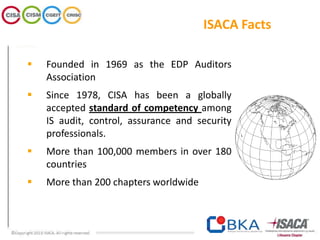
ISACA Facts
 Founded in 1969 as the EDP Auditors
Association
 Since 1978, CISA has been a globally
accepted standard of competency among
IS audit, control, assurance and security
professionals.
 More than 100,000 members in over 180
countries
 More than 200 chapters worldwide
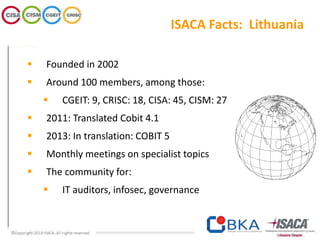
ISACA Facts: Lithuania
 Founded in 2002
 Around 100 members, among those:
 CGEIT: 9, CRISC: 18, CISA: 45, CISM: 27
 2011: Translated Cobit 4.1
 2013: In translation: COBIT 5
 Monthly meetings on specialist topics
 The community for:
 IT auditors, infosec, governance
Certification Requirements
• Earn a passing score on the ISACA exam
• Submit verified evidence of a minimum of 3 years
of relevant experience (for ex. covering 3 of the 5
job practice domains)
• Submit completed certification application within 5
years of passing exam and receive approval
• Adhere to the ISACA Code of Professional Ethics
• Comply with the ISACA Continuing Professional
Education Policy
Administration of the Exam
2013 Exam Dates:
Saturday 8 June 2013
Saturday 7 September 2013 (only CISA/CISM)
Saturday 14 December 2013
– More than 240 test sites offered for each exam
administration (Lithuania – Vilnius)
– Offered in every city where there is an ISACA chapter or a
large interest by individuals to sit for the exam
– Passing mark of 450 on a common scale of 200 to 800
2013 Registration Fees:
14 December 2013
Early Registration – On or before 21 August 2013:
• ISACA Member: US $485.00
• Non-Member: US $660.00
Final Registration – After 21 August, but on or before 25 October 2013:
• ISACA Member: US $535.00
• Non-Member: US $710.00
Register Online at www.isaca.org/examreg and save $$
• Online registration via the ISACA web site is encouraged, as
candidates will save US $75. Non-members can join ISACA at
the same time, which maximizes their savings.
Exam registration fees must be paid in full to sit for the exam. Those whose
exam registration fees are not paid will not be sent an exam admission ticket
and their registration will be cancelled.
Bulletin of Information
(BOI) and Registration
Form
• There is a Bulletin of Information for each exam administration for
each exam.
• Can be downloaded from the ISACA web site at:
http://www.isaca.org/Certification/
Bulletin includes:
– Requirements for certification
– Exam description
– Registration instructions
– Test date procedures
– Score reporting
– Test center locations
– Registration forms
Types of Questions on
the ISACA Exam
 Exam consists of 200 multiple choice questions administered
over a four-hour period
 Questions are designed to test practical knowledge and
experience
 Questions require the candidate to choose one best answer
 Every question or statement has four options (answer choices)
Quality of the Exam
Ensured By:
 Job Analysis Study: Determines content
 Test Development Standards: Ensures high standards for
the development and review of questions
 Review Process: Provides two reviews of questions by
independent committees before acceptance into pool
 Periodic Pool Cleaning: Ensures that questions in the pool
are up-to-date by continuously reviewing questions
 Statistical Analysis of Questions: Ensures quality questions
and grading by analyzing exam statistics for each language
Study Materials
ISACA Members Non-Members
Candidate’s Guide to the C* Exam……..…free to each paid registrant
(also available online at www.isaca.org/)
C* Review Manual 2013….…………….. (US) $85.00 (US) $115.00
C* Review Questions, Answers & ……... (US) $40.00 (US) $60.00
Explanations Manual 2013
C* Review Questions, Answers & ……... (US) $40.00 (US) $60.00
Explanations Manual 2013 Supplement
C* Online Review Course (US) $185.00 (US) $225.00
A proper study plan consists of several steps:
Self-appraisal
Determination of the type of study program
Having an adequate amount of time to prepare
Maintaining momentum
Readiness review
Become involved in your local chapter and explore
networking opportunities and study groups.
How to Develop a Study Plan
How to Study for the Exam
 Read the Candidate’s Guide thoroughly
 Study the Review Manual
 Work through the Review Questions, Answers &
Explanations Manual, Supplements and/or online review
course
 Participate in an Chapter Review Course
 Read literature in areas where you need to strengthen skills
 Spend time studying the complement of your field: If
controls focused, study from risk focus and vice-versa
 Join or organize study groups
Continuing Professional
Education (CPE) Policy Details
Once certified, the certification must be renewed annually. Maintaining the
certification requires:
• Earning and reporting an annual minimum of 20 hours of continuing
professional education
• Earning and reporting a minimum of 120 hours of continuing
education for each fixed three-year period (each 3-year cycle)
• Pay the annual certification maintenance fee
• Respond and submit required documentation of continuing education
activities if selected for an annual audit
• Comply with the ISACA Code of Professional Ethics
(www.isaca.org/ethics)
ISACA membership provides many CPE opportunities which can assist
you with meeting this requirement. For more details visit
www.isaca.org/cpe.
Continuing Professional
Education (CPE)
Requirements
ISACA sets forth this Code of Professional Ethics to guide the professional and
personal conduct of members of the association and/or its certification holders.
Failure to comply with this Code of Professional Ethics can result in an investigation
into a member's or certification holder's conduct and, ultimately, in disciplinary
measures.
Members and ISACA certification holders shall:
1. Support the implementation of, and encourage compliance
with, appropriate standards and procedures for the effective governance
and management of enterprise information systems and
technology, including: audit, control, security and risk management.
2. Perform their duties with objectivity, due diligence and professional
care, in accordance with professional standards.
3. Serve in the interest of stakeholders in a lawful manner, while
maintaining high standards of conduct and character, and not discrediting
their profession or the Association.
ISACA Code of
Professional Ethics
ISACA Code of
Professional Ethics
(continued)
Members and ISACA certification holders shall:
4. Maintain the privacy and confidentiality of information obtained in the
course of their activities unless disclosure is required by legal authority.
Such information shall not be used for personal benefit or released to
inappropriate parties.
5. Maintain competency in their respective fields and agree to undertake only
those activities they can reasonably expect to complete with the necessary
skills, knowledge and competence.
6. Inform appropriate parties of the results of work performed including the
disclosure of all significant facts known to them that, if not disclosed, may
distort the reporting of the results.
7. Support the professional education of stakeholders in enhancing their
understanding of the governance and management of enterprise
information systems and technology, including: audit, control, security and
risk management.
www.isaca.org/ethics
Norite sužinoti daugiau?
Susisiekite su mumis:
 El.paštu: asociacija@isaca.lt
 Internete: www.isaca.lt
Ačiū už dėmesį!
Daugiau informacijos apie organizuojamus ISACA sertifikacijų mokymus rasite www.bka.lt
Susisiekite telefonu 8 5 2780502 arba el.paštu mokymai@bka.lt

ISACA Lietuva. Asociacija, sertifikacijos ir mokymai

  • 2.
    Įžanginis žodis: ISACA, sertifikacijosir mokymai Dr. Vilius Benetis, CISA, CRISC ISACA Lietuvos skyriaus pirmininkas www.isaca.lt ISACA® Pasitikėjimas informacinėmis sistemomis ir jų nauda
  • 3.
    ISACA Facts  Foundedin 1969 as the EDP Auditors Association  Since 1978, CISA has been a globally accepted standard of competency among IS audit, control, assurance and security professionals.  More than 100,000 members in over 180 countries  More than 200 chapters worldwide
  • 4.
    ISACA Facts: Lithuania Founded in 2002  Around 100 members, among those:  CGEIT: 9, CRISC: 18, CISA: 45, CISM: 27  2011: Translated Cobit 4.1  2013: In translation: COBIT 5  Monthly meetings on specialist topics  The community for:  IT auditors, infosec, governance
  • 5.
    Certification Requirements • Earna passing score on the ISACA exam • Submit verified evidence of a minimum of 3 years of relevant experience (for ex. covering 3 of the 5 job practice domains) • Submit completed certification application within 5 years of passing exam and receive approval • Adhere to the ISACA Code of Professional Ethics • Comply with the ISACA Continuing Professional Education Policy
  • 6.
    Administration of theExam 2013 Exam Dates: Saturday 8 June 2013 Saturday 7 September 2013 (only CISA/CISM) Saturday 14 December 2013 – More than 240 test sites offered for each exam administration (Lithuania – Vilnius) – Offered in every city where there is an ISACA chapter or a large interest by individuals to sit for the exam – Passing mark of 450 on a common scale of 200 to 800
  • 7.
    2013 Registration Fees: 14December 2013 Early Registration – On or before 21 August 2013: • ISACA Member: US $485.00 • Non-Member: US $660.00 Final Registration – After 21 August, but on or before 25 October 2013: • ISACA Member: US $535.00 • Non-Member: US $710.00 Register Online at www.isaca.org/examreg and save $$ • Online registration via the ISACA web site is encouraged, as candidates will save US $75. Non-members can join ISACA at the same time, which maximizes their savings. Exam registration fees must be paid in full to sit for the exam. Those whose exam registration fees are not paid will not be sent an exam admission ticket and their registration will be cancelled.
  • 8.
    Bulletin of Information (BOI)and Registration Form • There is a Bulletin of Information for each exam administration for each exam. • Can be downloaded from the ISACA web site at: http://www.isaca.org/Certification/ Bulletin includes: – Requirements for certification – Exam description – Registration instructions – Test date procedures – Score reporting – Test center locations – Registration forms
  • 9.
    Types of Questionson the ISACA Exam  Exam consists of 200 multiple choice questions administered over a four-hour period  Questions are designed to test practical knowledge and experience  Questions require the candidate to choose one best answer  Every question or statement has four options (answer choices)
  • 10.
    Quality of theExam Ensured By:  Job Analysis Study: Determines content  Test Development Standards: Ensures high standards for the development and review of questions  Review Process: Provides two reviews of questions by independent committees before acceptance into pool  Periodic Pool Cleaning: Ensures that questions in the pool are up-to-date by continuously reviewing questions  Statistical Analysis of Questions: Ensures quality questions and grading by analyzing exam statistics for each language
  • 11.
    Study Materials ISACA MembersNon-Members Candidate’s Guide to the C* Exam……..…free to each paid registrant (also available online at www.isaca.org/) C* Review Manual 2013….…………….. (US) $85.00 (US) $115.00 C* Review Questions, Answers & ……... (US) $40.00 (US) $60.00 Explanations Manual 2013 C* Review Questions, Answers & ……... (US) $40.00 (US) $60.00 Explanations Manual 2013 Supplement C* Online Review Course (US) $185.00 (US) $225.00
  • 12.
    A proper studyplan consists of several steps: Self-appraisal Determination of the type of study program Having an adequate amount of time to prepare Maintaining momentum Readiness review Become involved in your local chapter and explore networking opportunities and study groups. How to Develop a Study Plan
  • 13.
    How to Studyfor the Exam  Read the Candidate’s Guide thoroughly  Study the Review Manual  Work through the Review Questions, Answers & Explanations Manual, Supplements and/or online review course  Participate in an Chapter Review Course  Read literature in areas where you need to strengthen skills  Spend time studying the complement of your field: If controls focused, study from risk focus and vice-versa  Join or organize study groups
  • 14.
  • 15.
    Once certified, thecertification must be renewed annually. Maintaining the certification requires: • Earning and reporting an annual minimum of 20 hours of continuing professional education • Earning and reporting a minimum of 120 hours of continuing education for each fixed three-year period (each 3-year cycle) • Pay the annual certification maintenance fee • Respond and submit required documentation of continuing education activities if selected for an annual audit • Comply with the ISACA Code of Professional Ethics (www.isaca.org/ethics) ISACA membership provides many CPE opportunities which can assist you with meeting this requirement. For more details visit www.isaca.org/cpe. Continuing Professional Education (CPE) Requirements
  • 16.
    ISACA sets forththis Code of Professional Ethics to guide the professional and personal conduct of members of the association and/or its certification holders. Failure to comply with this Code of Professional Ethics can result in an investigation into a member's or certification holder's conduct and, ultimately, in disciplinary measures. Members and ISACA certification holders shall: 1. Support the implementation of, and encourage compliance with, appropriate standards and procedures for the effective governance and management of enterprise information systems and technology, including: audit, control, security and risk management. 2. Perform their duties with objectivity, due diligence and professional care, in accordance with professional standards. 3. Serve in the interest of stakeholders in a lawful manner, while maintaining high standards of conduct and character, and not discrediting their profession or the Association. ISACA Code of Professional Ethics
  • 17.
    ISACA Code of ProfessionalEthics (continued) Members and ISACA certification holders shall: 4. Maintain the privacy and confidentiality of information obtained in the course of their activities unless disclosure is required by legal authority. Such information shall not be used for personal benefit or released to inappropriate parties. 5. Maintain competency in their respective fields and agree to undertake only those activities they can reasonably expect to complete with the necessary skills, knowledge and competence. 6. Inform appropriate parties of the results of work performed including the disclosure of all significant facts known to them that, if not disclosed, may distort the reporting of the results. 7. Support the professional education of stakeholders in enhancing their understanding of the governance and management of enterprise information systems and technology, including: audit, control, security and risk management. www.isaca.org/ethics
  • 18.
    Norite sužinoti daugiau? Susisiekitesu mumis:  El.paštu: asociacija@isaca.lt  Internete: www.isaca.lt Ačiū už dėmesį! Daugiau informacijos apie organizuojamus ISACA sertifikacijų mokymus rasite www.bka.lt Susisiekite telefonu 8 5 2780502 arba el.paštu mokymai@bka.lt

Editor's Notes

  • #15 CRISC Continuing Education Policy Details
  • #17 Read from slide
  • #18 Read from slideFailure to comply with this Code of Professional Ethics can result in an investigation into a member's, and/or certification holder's conduct and, ultimately, in disciplinary measures.