www.cfainstitute.org
THE CFA
CHARTERDemonstrate your mastery of the investment analysis and decision-making skills most
needed for a competitive career in the global investment management profession.
The Chartered Financial Analyst®
(CFA) credential is the professional standard of choice
for more than 31,000 investment firms worldwide. Leading firms demand investment
professionals with the real-world analytical skills, technical competence, and highest
professional standards when hiring, often requiring the CFA credential for consideration.
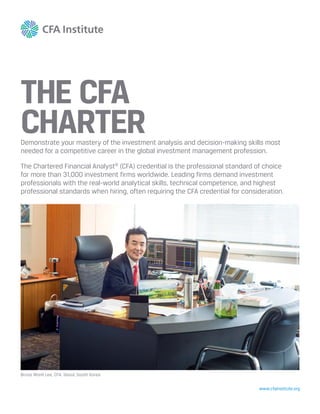
Bruce Wonil Lee, CFA, Seoul, South Korea
BENEFITS OF EARNING THE CFA CHARTER
•	 REAL-WORLD EXPERTISE. Demonstrate your fluency with an
advanced investment management and analysis curriculum that
leverages current best practices and the experience of practition-
ers around the world to bridge real-world practices and theoretical
knowledge.
•	 CAREER RECOGNITION. Stand out in the competitive global industry
and gain instant credibility with peers, employers, and clients who
know the hard work, intelligence, and profound commitment it
takes to earn the charter.
•	 ETHICAL GROUNDING. Learn to apply ethical practices and gain a
foundation of the skills needed to demonstrate the commitment to
high standards of accountability and integrity that build a trusted
reputation.
•	 GLOBAL COMMUNITY. Join a vast professional network of more than
135,000 charterholders worldwide and gain unmatched career
resources, important relationships, and lifelong insights.
•	 EMPLOYER DEMAND. The top 11 global employers of charterholders
include JP Morgan Chase, Bank of America, Merrill Lynch, UBS, RBC,
HSBC, Wells Fargo, Credit Suisse, Morgan Stanley, Smith Barney,
BlackRock, and Citigroup.
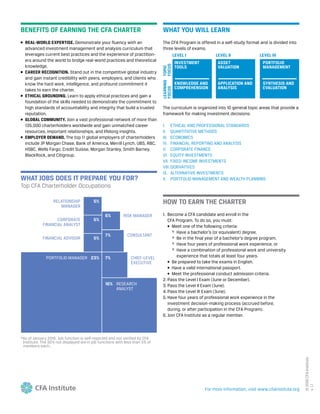
WHAT JOBS DOES IT PREPARE YOU FOR?
Top CFA Charterholder Occupations
For more information, visit www.cfainstitute.org
WHAT YOU WILL LEARN
The CFA Program is offered in a self-study format and is divided into
three levels of exams.
LEVEL I	 LEVEL II	 LEVEL III
INVESTMENT	ASSET	 PORTFOLIO
TOOLS	 VALUATION	MANAGEMENT
KNOWLEDGE AND	 APPLICATION AND	 SYNTHESIS AND
COMPREHENSION	ANALYSIS	 EVALUATION
LEARNING	TOPIC
FOCUS	FOCUS
The curriculum is organized into 10 general topic areas that provide a
framework for making investment decisions:
I.	 	ETHICAL AND PROFESSIONAL STANDARDS
II.	 QUANTITATIVE METHODS
III.	 	ECONOMICS
IV.	 FINANCIAL REPORTING AND ANALYSIS
V.	 CORPORATE FINANCE
VI.	 EQUITY INVESTMENTS
VII.	FIXED-INCOME INVESTMENTS
VIII.	DERIVATIVES
IX.	 ALTERNATIVE INVESTMENTS
X.	 PORTFOLIO MANAGEMENT AND WEALTH PLANNING
HOW TO EARN THE CHARTER
1.	 Become a CFA candidate and enroll in the
CFA Program. To do so, you must:
•	 Meet one of the following criteria:
ºº Have a bachelor’s (or equivalent) degree,
ºº Be in the final year of a bachelor’s degree program,
ºº Have four years of professional work experience, or
ºº Have a combination of professional work and university
experience that totals at least four years.
•	 Be prepared to take the exams in English.
•	 Have a valid international passport.
•	 Meet the professional conduct admission criteria.
2.	Pass the Level I Exam (June or December).
3.	Pass the Level II Exam (June).
4.	Pass the Level III Exam (June).
5.	Have four years of professional work experience in the
investment decision-making process (accrued before,
during, or after participation in the CFA Program).
6.	Join CFA Institute as a regular member.
©2016CFAInstitute
v.1.1
*As of January 2016. Job function is self-reported and not verified by CFA
Institute. The 30% not displayed are in job functions with less than 5% of
members each.
PORTFOLIO MANAGER 23%
RESEARCH
ANALYST
16%
7% CHIEF-LEVEL
EXECUTIVE
7% CONSULTANT
6% RISK MANAGER
5%FINANCIAL ADVISOR
5%CORPORATE
FINANCIAL ANALYST
5%RELATIONSHIP
MANAGER

cfa_charter_factsheet

  • 1.
    www.cfainstitute.org THE CFA CHARTERDemonstrate yourmastery of the investment analysis and decision-making skills most needed for a competitive career in the global investment management profession. The Chartered Financial Analyst® (CFA) credential is the professional standard of choice for more than 31,000 investment firms worldwide. Leading firms demand investment professionals with the real-world analytical skills, technical competence, and highest professional standards when hiring, often requiring the CFA credential for consideration. Bruce Wonil Lee, CFA, Seoul, South Korea
  • 2.
    BENEFITS OF EARNINGTHE CFA CHARTER • REAL-WORLD EXPERTISE. Demonstrate your fluency with an advanced investment management and analysis curriculum that leverages current best practices and the experience of practition- ers around the world to bridge real-world practices and theoretical knowledge. • CAREER RECOGNITION. Stand out in the competitive global industry and gain instant credibility with peers, employers, and clients who know the hard work, intelligence, and profound commitment it takes to earn the charter. • ETHICAL GROUNDING. Learn to apply ethical practices and gain a foundation of the skills needed to demonstrate the commitment to high standards of accountability and integrity that build a trusted reputation. • GLOBAL COMMUNITY. Join a vast professional network of more than 135,000 charterholders worldwide and gain unmatched career resources, important relationships, and lifelong insights. • EMPLOYER DEMAND. The top 11 global employers of charterholders include JP Morgan Chase, Bank of America, Merrill Lynch, UBS, RBC, HSBC, Wells Fargo, Credit Suisse, Morgan Stanley, Smith Barney, BlackRock, and Citigroup. WHAT JOBS DOES IT PREPARE YOU FOR? Top CFA Charterholder Occupations For more information, visit www.cfainstitute.org WHAT YOU WILL LEARN The CFA Program is offered in a self-study format and is divided into three levels of exams. LEVEL I LEVEL II LEVEL III INVESTMENT ASSET PORTFOLIO TOOLS VALUATION MANAGEMENT KNOWLEDGE AND APPLICATION AND SYNTHESIS AND COMPREHENSION ANALYSIS EVALUATION LEARNING TOPIC FOCUS FOCUS The curriculum is organized into 10 general topic areas that provide a framework for making investment decisions: I. ETHICAL AND PROFESSIONAL STANDARDS II. QUANTITATIVE METHODS III. ECONOMICS IV. FINANCIAL REPORTING AND ANALYSIS V. CORPORATE FINANCE VI. EQUITY INVESTMENTS VII. FIXED-INCOME INVESTMENTS VIII. DERIVATIVES IX. ALTERNATIVE INVESTMENTS X. PORTFOLIO MANAGEMENT AND WEALTH PLANNING HOW TO EARN THE CHARTER 1. Become a CFA candidate and enroll in the CFA Program. To do so, you must: • Meet one of the following criteria: ºº Have a bachelor’s (or equivalent) degree, ºº Be in the final year of a bachelor’s degree program, ºº Have four years of professional work experience, or ºº Have a combination of professional work and university experience that totals at least four years. • Be prepared to take the exams in English. • Have a valid international passport. • Meet the professional conduct admission criteria. 2. Pass the Level I Exam (June or December). 3. Pass the Level II Exam (June). 4. Pass the Level III Exam (June). 5. Have four years of professional work experience in the investment decision-making process (accrued before, during, or after participation in the CFA Program). 6. Join CFA Institute as a regular member. ©2016CFAInstitute v.1.1 *As of January 2016. Job function is self-reported and not verified by CFA Institute. The 30% not displayed are in job functions with less than 5% of members each. PORTFOLIO MANAGER 23% RESEARCH ANALYST 16% 7% CHIEF-LEVEL EXECUTIVE 7% CONSULTANT 6% RISK MANAGER 5%FINANCIAL ADVISOR 5%CORPORATE FINANCIAL ANALYST 5%RELATIONSHIP MANAGER