ISA-M Template
<Your Organization>
This document uses templates from the Integration Solution Advisor Methodology (ISA-M)
provided by SAP SE. SAP SE is not responsible for the content of this document.
ISA-M Template Version 3.1
Further information can be found here.
Integration Solution Advisor Methodology (ISA-M)
Overview
2
Overview
▪ Enables the systematic selection of integration technologies
▪ Customer-proven set of core integration patterns
▪ Extensible to future use cases and technologies
▪ Focus on key dimensions of the problem space
▪ Open to SAP & Non-SAP Middleware
* Customers and partners must comply with the Terms of Use (“TOU”)
ISA-M Template for Use by Customers and Partners (*)
▪ Reusable within organizations, projects or services
▪ Accelerator to define integration guidelines
▪ Can be adapted/extended to specific needs
ISA-M Template
Terms of Use
3
You must comply with the following Terms of Use ("TOU") when modifying, copying, distributing, transmitting, reproducing,
publishing, or creating derivative works from any of the ISA-M templates in this document. SAP reserves the right to update
the TOU at any time without notice. The most current version of the TOU can be reviewed at (link to SAP Jam Group).
Terms of Use
(1) You are required to register at SAP Integration Architecture Community (SAP JAM Group).
(2) You must include the Mandatory Citation in your document. You must not make any change to the Mandatory
Citation.
(3) You agree not to make any changes to Integration Style names and definitions of the Integration Solution Advisor
Methodology (ISA-M).
(4) You are entirely responsible for any content that you create using Integration Styles and templates from the ISA-M.
SAP is not liable for any damage or loss caused by any content that you create.
(5) You agree to indemnify and hold SAP, its affiliates, subsidiaries, officers, agents, partners, employees, and
licensors harmless from any claim or demand, including reasonable attorneys fees, made by any third party due to
or arising out of Your modifying, copying, distributing, transmitting, reproducing, publishing, or creating derivative
works from any of the ISA-M templates in this document or Your usage of this ISA-M template, Your breach of this
TOU or SAP's Copyright or Privacy Statements as outlined at SAP.com, or Your alleged violation of any other rights
of a third party.
(6) This ISA-M template is being provided to You AS IS, WITHOUT ANY WARRANTY, ESCROW, TRAINING, OR
SERVICE OBLIGATIONS WHATSOEVER ON THE PART OF SAP. SAP MAKES NO EXPRESS OR IMPLIED
WARRANTIES OF ANY TYPE WHATSOEVER, INCLUDING BUT NOT LIMITED TO IMPLIED WARRANTIES OF
MERCHANTABILITY AND OF FITNESS FOR A PARTICULAR PURPOSE. YOU ASSUME ALL RISKS
ASSOCIATED WITH ITS USE OF THE ISA-M TEMPLATE, INCLUDING WITHOUT LIMITATION RISKS
RELATING TO QUALITY, PERFORMANCE, DATA LOSS, AND UTILITY.
(7) SAP does not guarantee or warrant any features or qualities of the ISA-M template or give any undertaking with
regard to any other quality. Statements and explanations to this ISA-M template in promotional material or on
SAP.com and in the documentation are made for explanatory purposes only; they are not meant to constitute any
guarantee or warranty of certain features. No warranty or undertaking shall be implied from any published SAP
description of or advertisement except to the extent SAP has expressly confirmed such warranty or undertaking in
writing. Warranties are validly given only with the express written confirmation of SAPs management.
(8) SAP does not represent or endorse the accuracy or reliability of any any information provided under this ISA-M
template or the ISA-M template itself. SAP shall not be liable for damages caused by the use of the content and/or
information.
9) TO THE EXTENT ALLOWABLE BY APPLICABLE LAW, SAP AND ITS AFFILIATES, SUBSIDIARIES, OFFICERS,
EMPLOYEES, AGENTS, PARTNERS, AND LICENSORS ARE NOT LIABLE TO YOU FOR ANY DIRECT,
INDIRECT, INCIDENTAL, SPECIAL, PUNITIVE, CONSEQUENTIAL, OR EXEMPLARY DAMAGES, INCLUDING,
BUT NOT LIMITED TO, DAMAGES FOR LOSS OF PROFITS, REVENUE, GOODWILL, USE, DATA, OR OTHER
INTANGIBLE LOSSES (EVEN IF SAP HAS BEEN ADVISED OF THE POSSIBILITY OF SUCH DAMAGES),
HOWEVER CAUSED, WHETHER IN CONTRACT, TORT, OR OTHERWISE, ARISING OUT OF OR RESULTING
FROM: (i) THE USE OF THIS ISA-M TEMPLATE; (ii) THE COST OF PROCUREMENT OF SUBSTITUTE GOODS
AND SERVICES ARISING OUT OF YOUR USE OR INABILITY TO THIS ISA-M TEMPLATE OR CONTENT, OR
(iii) ANY OTHER MATTER RELATING TO THE ISA-M TEMPLATE.
10) SAP SE or its affiliated companies have no obligation to pursue any course of business outlined in this ISA-M
template or any related presentation, or to develop or release any functionality mentioned therein. This document,
or any related presentation, and SAP SE’s or its affiliated companies’ strategy and possible future developments,
products, and/or platform directions and functionality are all subject to change and may be changed by SAP SE or
its affiliated companies at any time for any reason without notice. The information in this document is not a
commitment, promise or legal obligation to deliver any material, code, or functionality. All forward-looking
statements are subject to various risks and uncertainties that could cause actual results to differ materially from
expectations. Readers are cautioned not to place undue reliance on these forward-looking statements, and they
should not be relied upon in making purchasing decisions.
11) SAP and other SAP products and services mentioned herein as well as their respective logos are trademarks or
registered trademarks of SAP SE (or an SAP affiliate company) in Germany and other countries. All other product
and service names mentioned are the trademarks of their respective companies. Please see
http://global.sap.com/corporate-en/legal/copyright/index.epx for additional trademark information and notices.
Mandatory
Citation
This document uses templates from the Integration Solution Advisor Methodology (ISA-M)
provided by SAP SE. SAP SE is not responsible for the content of this document.
ISA-M Template Version 3.1
Further information can be found here.
Document History
4
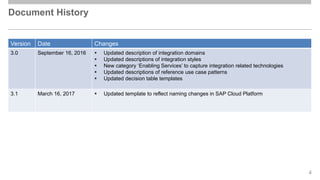
Version Date Changes
3.0 September 16, 2016 ▪ Updated description of integration domains
▪ Updated descriptions of integration styles
▪ New category ‘Enabling Services’ to capture integration related technologies
▪ Updated descriptions of reference use case patterns
▪ Updated decision table templates
3.1 March 16, 2017 ▪ Updated template to reflect naming changes in SAP Cloud Platform
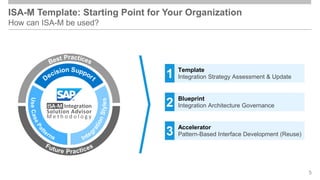
ISA-M Template: Starting Point for Your Organization
How can ISA-M be used?
5
Accelerator
Pattern-Based Interface Development (Reuse)
3
Template
Integration Strategy Assessment & Update
1
Blueprint
Integration Architecture Governance
2
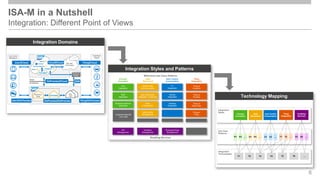
ISA-M in a Nutshell
Integration: Different Point of Views
6
Integration Styles and Patterns
Integration Domains
Technology Mapping
7
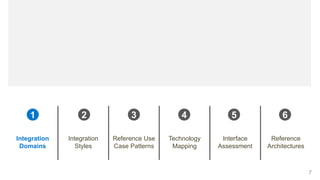
Integration
Domains
Integration
Styles
Reference Use
Case Patterns
Technology
Mapping
Interface
Assessment
Reference
Architectures
1 2 3 4 5 6
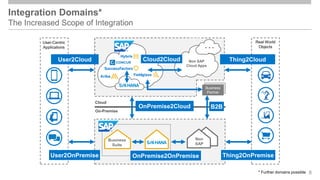
Integration Domains*
The Increased Scope of Integration
* Further domains possible 8
On-Premise
Business
Partner
B2B
Cloud
OnPremise2Cloud
Real World
Objects
User2OnPremise
User2Cloud
Non-SAP
Clouds
Business
Suite
OnPremise2OnPremise
Non
SAP
Thing2OnPremise
Thing2Cloud
Non SAP
Cloud Apps
Clouds
…
Cloud2Cloud
User-Centric
Applications
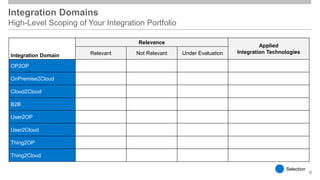
Integration Domains
High-Level Scoping of Your Integration Portfolio
Integration Domain
Relevance
Applied
Integration Technologies
Relevant Not Relevant Under Evaluation
OP2OP
OnPremise2Cloud
Cloud2Cloud
B2B
User2OP
User2Cloud
Thing2OP
Thing2Cloud
Selection
9
10
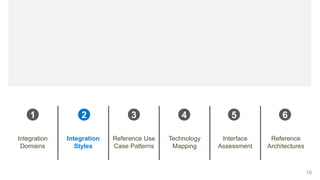
Integration
Domains
Integration
Styles
Reference Use
Case Patterns
Technology
Mapping
Interface
Assessment
Reference
Architectures
1 2 3 4 5 6
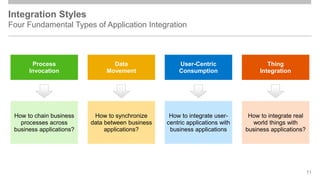
Integration Styles
Four Fundamental Types of Application Integration
11
User-Centric
Consumption
How to integrate user-
centric applications with
business applications
Data
Movement
How to synchronize
data between business
applications?
Process
Invocation
How to chain business
processes across
business applications?
Thing
Integration
How to integrate real
world things with
business applications?
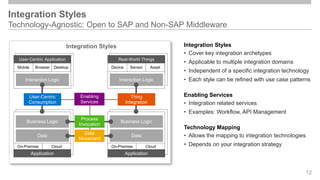
Integration Styles
Technology-Agnostic: Open to SAP and Non-SAP Middleware
12
Integration Styles Integration Styles
• Cover key integration archetypes
• Applicable to multiple integration domains
• Independent of a specific integration technology
• Each style can be refined with use case patterns
Enabling Services
• Integration related services
• Examples: Workflow, API Management
Technology Mapping
• Allows the mapping to integration technologies
• Depends on your integration strategy
Application
Business Logic
On-Premise Cloud
Data
Application
Business Logic
On-Premise Cloud
Data
Interaction Logic
Mobile Browser Desktop
User-Centric Application
User-Centric
Consumption
Interaction Logic
Device Sensor Asset
Real-World Things
Thing
Integration
Enabling
Services
Process
Invocation
Data
Movement
Key Characteristics by Example
SAP Cloud for Customers and SAP ERP
13
User-Centric
Consumption
Data
Movement
Process
Invocation
Thing
Integration
Key Characteristics
Objective
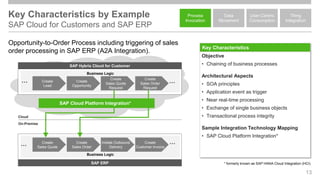
• Chaining of business processes
Architectural Aspects
• SOA principles
• Application event as trigger
• Near real-time processing
• Exchange of single business objects
• Transactional process integrity
Sample Integration Technology Mapping
• SAP Cloud Platform Integration*
Business Logic
SAP Hybris Cloud for Customer
Create
Opportunity
Business Logic
SAP ERP
Create
Sales Quote
Request
Create
Sales Order
Request
Create
Sales Quote
Create
Sales Order
Initiate Outbound
Delivery
Create
Customer Invoice
Create
Lead
…
…
…
…
Opportunity-to-Order Process including triggering of sales
order processing in SAP ERP (A2A Integration).
Cloud
On-Premise
SAP Cloud Platform Integration*
* formerly known as SAP HANA Cloud Integration (HCI)
Key Characteristics by Example
SAP IT: Governance and Integration Platform (GIP)*
14
User-Centric
Consumption
Data
Movement
Process
Invocation
Thing
Integration
On Premise
Data Governance and Integration Platform (SAP IT)
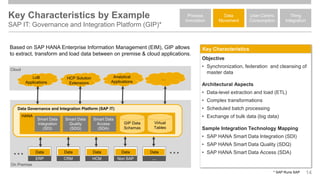
Based on SAP HANA Enterprise Information Management (EIM), GIP allows
to extract, transform and load data between on premise & cloud applications.
Data
ERP
… …
Data
CRM
Data
HCM
Data
Non SAP
Data
…
Key Characteristics
Objective
• Synchronization, federation and cleansing of
master data
Architectural Aspects
• Data-level extraction and load (ETL)
• Complex transformations
• Scheduled batch processing
• Exchange of bulk data (big data)
Sample Integration Technology Mapping
• SAP HANA Smart Data Integration (SDI)
• SAP HANA Smart Data Quality (SDQ)
• SAP HANA Smart Data Access (SDA)
Cloud
LoB
Applications
HANA
Smart Data
Integration
(SDI)
Smart Data
Quality
(SDQ)
Smart Data
Access
(SDA)
GIP Data
Schemas
Virtual
Tables
HCP Solution
Extensions
Analytical
Applications
…
* SAP Runs SAP
Key Characteristics by Example
SAP Cloud Platform Mobile Services
15
User-Centric
Consumption
Data
Movement
Process
Invocation
Thing
Integration
Key Characteristics
Objective
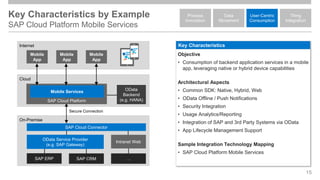
• Consumption of backend application services in a mobile
app, leveraging native or hybrid device capabilities
Architectural Aspects
• Common SDK: Native, Hybrid, Web
• OData Offline / Push Notifications
• Security Integration
• Usage Analytics/Reporting
• Integration of SAP and 3rd Party Systems via OData
• App Lifecycle Management Support
Sample Integration Technology Mapping
• SAP Cloud Platform Mobile Services
Internet
On-Premise
Cloud
OData Service Provider
(e.g. SAP Gateway)
Mobile
App
SAP Cloud Platform
Mobile Services
SAP ERP SAP CRM …
SAP Cloud Connector
Intranet Web
Secure Connection
Mobile
App
Mobile
App
OData
Backend
(e.g. HANA)
Key Characteristics by Example
Lab Preview – SAP Vehicle Insights
16
User-Centric
Consumption
Data
Movement
Process
Invocation
Thing
Integration
Key Characteristics
Objective
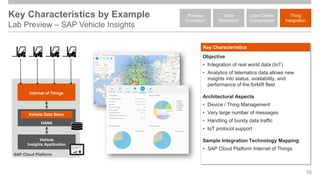
• Integration of real world data (IoT)
• Analytics of telematics data allows new
insights into status, availability, and
performance of the forklift fleet
Architectural Aspects
• Device / Thing Management
• Very large number of messages
• Handling of bursty data traffic
• IoT protocol support
Sample Integration Technology Mapping
• SAP Cloud Platform Internet of Things
SAP Cloud Platform
Vehicle
Insights Application
HANA
Internet of Things
Vehicle Data Store
Integration Styles
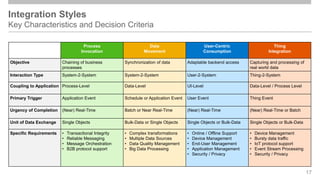
Key Characteristics and Decision Criteria
17
Process
Invocation
Data
Movement
User-Centric
Consumption
Thing
Integration
Objective Chaining of business
processes
Synchronization of data Adaptable backend access Capturing and processing of
real world data
Interaction Type System-2-System System-2-System User-2-System Thing-2-System
Coupling to Application Process-Level Data-Level UI-Level Data-Level / Process Level
Primary Trigger Application Event Schedule or Application Event User Event Thing Event
Urgency of Completion (Near) Real-Time Batch or Near Real-Time (Near) Real-Time (Near) Real-Time or Batch
Unit of Data Exchange Single Objects Bulk-Data or Single Objects Single Objects or Bulk-Data Single Objects or Bulk-Data
Specific Requirements • Transactional Integrity
• Reliable Messaging
• Message Orchestration
• B2B protocol support
• Complex transformations
• Multiple Data Sources
• Data Quality Management
• Big Data Processing
• Online / Offline Support
• Device Management
• End-User Management
• Application Management
• Security / Privacy
• Device Management
• Bursty data traffic
• IoT protocol support
• Event Stream Processing
• Security / Privacy
18
Integration
Domains
Integration
Styles
Reference Use
Case Patterns
Technology
Mapping
Interface
Assessment
Reference
Architectures
1 2 3 4 5 6
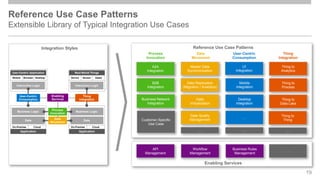
Reference Use Case Patterns
Extensible Library of Typical Integration Use Cases
19
Integration Styles Reference Use Case Patterns
…
Data
Movement
Master Data
Synchronization
Data Replication
(Migration / Analytics)
Data
Virtualization
Data Quality
Management
…
Thing
Integration
Thing to
Analytics
Thing to
Process
Thing to
Data Lake
Thing to
Thing
…
Enabling Services
Workflow
Management
…
Business Rules
Management
API
Management
Process
Invocation
A2A
Integration
B2B
Integration
Business Network
Integration
Customer-Specific
Use Case
User-Centric
Consumption
UI
Integration
Mobile
Integration
Desktop
Integration
…
…
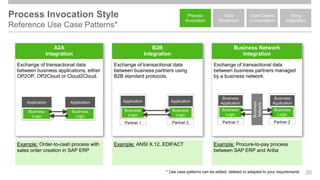
Process Invocation Style
Reference Use Case Patterns*
20
* Use case patterns can be added, deleted or adapted to your requirements
User-Centric
Consumption
Data
Movement
Process
Invocation
Thing
Integration
A2A
Integration
Exchange of transactional data
between business applications, either
OP2OP, OP2Cloud or Cloud2Cloud.
Business
Logic
Application
Business
Logic
Application
Example: Order-to-cash process with
sales order creation in SAP ERP
B2B
Integration
Exchange of transactional data
between business partners using
B2B standard protocols.
Example: ANSI X.12, EDIFACT
Partner 1
Business
Logic
Application
Business
Logic
Application
Partner 2
Business Network
Integration
Exchange of transactional data
between business partners managed
by a business network.
Example: Procure-to-pay process
between SAP ERP and Ariba
Partner 1
Business
Logic
Business
Application
Business
Logic
Business
Application
Partner 2
Business
Network
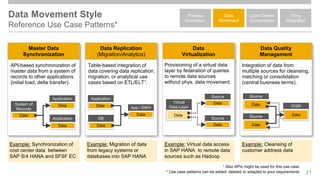
Data Movement Style
Reference Use Case Patterns*
21
* Use case patterns can be added, deleted or adapted to your requirements
User-Centric
Consumption
Data
Movement
Process
Invocation
Thing
Integration
Data Replication
(Migration/Analytics)
Table-based integration of
data covering data replication,
migration, or analytical use
cases based on ETL/ELT1.
Data
Application
Data
DB
Data
App / DWH
Example: Migration of data
from legacy systems or
databases into SAP HANA
Master Data
Synchronization
API-based synchronization of
master data from a system of
records to other applications
(initial load, delta transfer).
Data
Application
Data
System of
Records
Data
Application
Example: Synchronization of
cost center data between
SAP S/4 HANA and SFSF EC
Data
Virtualization
Provisioning of a virtual data
layer by federation of queries
to remote data sources
without phys. data movement.
Example: Virtual data access
in SAP HANA to remote data
sources such as Hadoop
Data
Source
Data
Virtual
Data Layer
Data
Source
Data Quality
Management
Integration of data from
multiple sources for cleansing,
matching or consolidation
(central business terms).
Example: Cleansing of
customer address data
Data
Source
Data
Source
DQM
Data
1 Also APIs might be used for this use case
User-Centric Consumption Style
Reference Use Case Patterns*
22
* Use case patterns can be added, deleted or adapted to your requirements
User-Centric
Consumption
Data
Movement
Process
Invocation
Thing
Integration
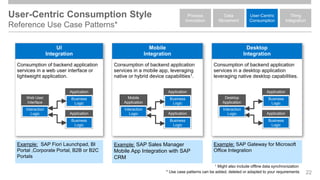
UI
Integration
Consumption of backend application
services in a web user interface or
lightweight application.
Example: SAP Fiori Launchpad, BI
Portal ,Corporate Portal, B2B or B2C
Portals
Desktop
Integration
Consumption of backend application
services in a desktop application
leveraging native desktop capabilities.
Example: SAP Gateway for Microsoft
Office Integration
Mobile
Integration
Consumption of backend application
services in a mobile app, leveraging
native or hybrid device capabilities1.
Example: SAP Sales Manager
Mobile App Integration with SAP
CRM
Business
Logic
Application
Business
Logic
Application
Interaction
Logic
Web User
Interface
Business
Logic
Application
Business
Logic
Application
Interaction
Logic
Mobile
Application
Business
Logic
Application
Business
Logic
Application
Interaction
Logic
Desktop
Application
1 Might also include offline data synchronization
Thing Integration Style
Reference Use Case Patterns*
23
* Use case patterns can be added, deleted or adapted to your requirements
User-Centric
Consumption
Data
Movement
Process
Invocation
Thing
Integration
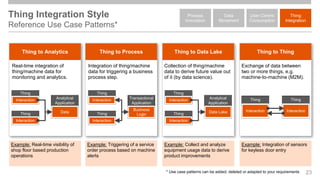
Thing to Analytics
Real-time integration of
thing/machine data for
monitoring and analytics.
Example: Real-time visibility of
shop floor based production
operations
Thing to Thing
Exchange of data between
two or more things, e.g.
machine-to-machine (M2M).
Example: Integration of sensors
for keyless door entry
Thing to Data Lake
Collection of thing/machine
data to derive future value out
of it (by data science).
Thing to Process
Integration of thing/machine
data for triggering a business
process step.
Example: Triggering of a service
order process based on machine
alerts
Data
Analytical
Application
Interaction
Thing
Interaction
Thing
Business
Logic
Transactional
Application
Interaction
Thing
Interaction
Thing Data Lake
Analytical
Application
Interaction
Thing
Interaction
Thing
Example: Collect and analyze
equipment usage data to derive
product improvements
Interaction
Thing
Interaction
Thing
24
Integration
Domains
Integration
Styles
Reference Use
Case Patterns
Technology
Mapping
Interface
Assessment
Reference
Architectures
1 2 3 4 5 6
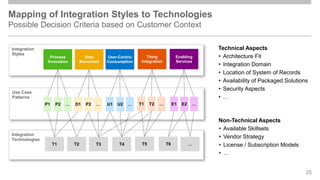
Mapping of Integration Styles to Technologies
Possible Decision Criteria based on Customer Context
25
Integration
Technologies
Use Case
Patterns
Integration
Styles
P1 P2 … D1 P2 …
T1 T2 T3
U1 U2 …
T4
T1 T2 …
T5
Technical Aspects
 Architecture Fit
 Integration Domain
 Location of System of Records
 Availability of Packaged Solutions
 Security Aspects
 …
Non-Technical Aspects
 Available Skillsets
 Vendor Strategy
 License / Subscription Models
 …
Data
Movement
Process
Invocation
User-Centric
Consumption
Thing
Integration
Enabling
Services
E1 E2 …
T6 …
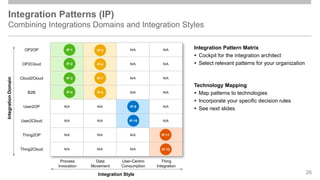
Integration Patterns (IP)
Combining Integrations Domains and Integration Styles
Integration
Domain
N/A N/A
N/A N/A
N/A N/A
N/A N/A
N/A N/A N/A
N/A N/A N/A
N/A N/A N/A
N/A N/A N/A
OP2OP
OP2Cloud
Cloud2Cloud
B2B
User2OP
User2Cloud
Thing2OP
Thing2Cloud
Process
Invocation
Data
Movement
User-Centric
Consumption
Thing
Integration
Integration Style
IP-2
IP-3
IP-4
IP-5
IP-6
IP-7
IP-8
IP-1 Integration Pattern Matrix
▪ Cockpit for the integration architect
▪ Select relevant patterns for your organization
Technology Mapping
▪ Map patterns to technologies
▪ Incorporate your specific decision rules
▪ See next slides
26
IP-9
IP-10
IP-11
IP-12
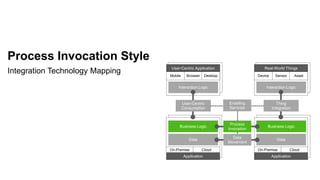
Process Invocation Style
Integration Technology Mapping
Application
Business Logic
On-Premise Cloud
Data
Application
Business Logic
On-Premise Cloud
Data
Interaction Logic
Mobile Browser Desktop
User-Centric Application
User-Centric
Consumption
Interaction Logic
Device Sensor Asset
Real-World Things
Thing
Integration
Enabling
Services
Process
Invocation
Data
Movement
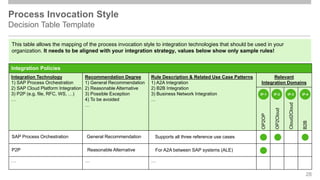
Process Invocation Style
Decision Table Template
Integration Policies
Integration Technology
1) SAP Process Orchestration
2) SAP Cloud Platform Integration
3) P2P (e.g. file, RFC, WS, …)
…
Recommendation Degree
1) General Recommendation
2) Reasonable Alternative
3) Possible Exception
4) To be avoided
…
Rule Description & Related Use Case Patterns
1) A2A Integration
2) B2B Integration
3) Business Network Integration
…
Relevant
Integration Domains
OP2OP
OP2Cloud
Cloud2Cloud
B2B
… … …
This table allows the mapping of the process invocation style to integration technologies that should be used in your
organization. It needs to be aligned with your integration strategy, values below show only sample rules!
IP-4
IP-1 IP-3
IP-2
28
SAP Process Orchestration General Recommendation Supports all three reference use cases
P2P Reasonable Alternative For A2A between SAP systems (ALE)
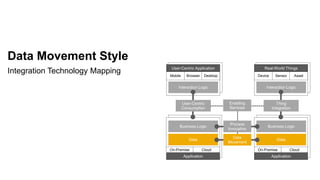
Data Movement Style
Integration Technology Mapping
Application
Business Logic
On-Premise Cloud
Data
Application
Business Logic
On-Premise Cloud
Data
Interaction Logic
Mobile Browser Desktop
User-Centric Application
User-Centric
Consumption
Interaction Logic
Device Sensor Asset
Real-World Things
Thing
Integration
Enabling
Services
Process
Invocation
Data
Movement
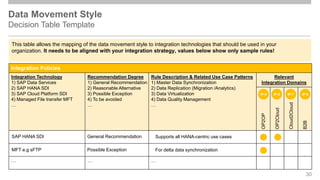
Data Movement Style
Decision Table Template
Integration Policies
Integration Technology
1) SAP Data Services
2) SAP HANA SDI
3) SAP Cloud Platform SDI
4) Managed File transfer MFT
…
Recommendation Degree
1) General Recommendation
2) Reasonable Alternative
3) Possible Exception
4) To be avoided
…
Rule Description & Related Use Case Patterns
1) Master Data Synchronization
2) Data Replication (Migration /Analytics)
3) Data Virtualization
4) Data Quality Management
…
Relevant
Integration Domains
OP2OP
OP2Cloud
Cloud2Cloud
B2B
… … …
30
IP-8
IP-5 IP-7
IP-6
SAP HANA SDI General Recommendation Supports all HANA-centric use cases
MFT e.g sFTP Possible Exception For delta data synchronization
This table allows the mapping of the data movement style to integration technologies that should be used in your
organization. It needs to be aligned with your integration strategy, values below show only sample rules!
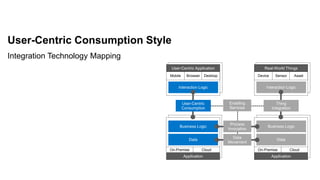
User-Centric Consumption Style
Integration Technology Mapping
Application
Business Logic
On-Premise Cloud
Data
Application
Business Logic
On-Premise Cloud
Data
Interaction Logic
Mobile Browser Desktop
User-Centric Application
User-Centric
Consumption
Interaction Logic
Device Sensor Asset
Real-World Things
Thing
Integration
Enabling
Services
Process
Invocation
Data
Movement
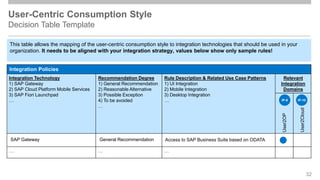
User-Centric Consumption Style
Decision Table Template
Integration Policies
Integration Technology
1) SAP Gateway
2) SAP Cloud Platform Mobile Services
3) SAP Fiori Launchpad
…
Recommendation Degree
1) General Recommendation
2) Reasonable Alternative
3) Possible Exception
4) To be avoided
…
Rule Description & Related Use Case Patterns
1) UI Integration
2) Mobile Integration
3) Desktop Integration
…
Relevant
Integration
Domains
User2OP
User2Cloud
… … …
32
IP-9 IP-10
SAP Gateway General Recommendation Access to SAP Business Suite based on ODATA
This table allows the mapping of the user-centric consumption style to integration technologies that should be used in your
organization. It needs to be aligned with your integration strategy, values below show only sample rules!
Thing Integration Style
Integration Technology Mapping
Application
Business Logic
On-Premise Cloud
Data
Application
Business Logic
On-Premise Cloud
Data
Interaction Logic
Mobile Browser Desktop
User-Centric Application
User-Centric
Consumption
Interaction Logic
Device Sensor Asset
Real-World Things
Thing
Integration
Enabling
Services
Process
Invocation
Data
Movement
Thing Integration Style
Decision Table Template
Integration Policies
Integration Technology
1) SAP Cloud Platform Internet of Things
2) …
Recommendation Degree
1) General Recommendation
2) Reasonable Alternative
3) Possible Exception
4) To be avoided
…
Rule Description & Related Use Case Patterns
1) Thing to Analytic
2) Thing to Machine
3) Thing to Data Lake
4) Thing to Thing (M2M)
…
Relevant
Integration
Domains
Thing2OP
Thing2Cloud
… … …
34
IP-11 IP-12
SAP Cloud Platform Internet of Things General Recommendation Integration of sensor data for SAP cloud apps
This table allows the mapping of the thing integration style to integration technologies that should be used in your organization.
It needs to be aligned with your integration strategy, values below show only sample rules!
35
Integration
Domains
Integration
Styles
Reference Use
Case Patterns
Technology
Mapping
Interface
Assessment
Reference
Architectures
1 2 3 4 5 6
Reference Use Case Pattern Matrix
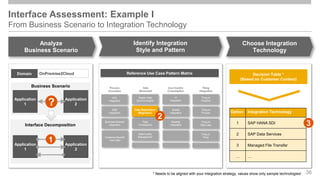
Interface Assessment: Example I
From Business Scenario to Integration Technology
36
Analyze
Business Scenario
Identify Integration
Style and Pattern
Choose Integration
Technology
Option Integration Technology
1 SAP HANA SDI
2 SAP Data Services
3 Managed File Transfer
… …
Decision Table *
(Based on Customer Context)
Data Replication
(Migration)
If not, decompose your
business scenario into single
interfaces for custom-built
integration
Business Scenario
Application
1
Application
2
?
If not, decompose your
business scenario into single
interfaces for custom-built
integration
Interface Decomposition
Application
1
Application
2
OnPremise2Cloud
Domain
* Needs to be aligned with your integration strategy, values show only sample technologies!
1
2
3
Reference Use Case Pattern Matrix
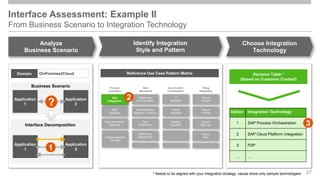
Interface Assessment: Example II
From Business Scenario to Integration Technology
37
Analyze
Business Scenario
Identify Integration
Style and Pattern
Choose Integration
Technology
Option Integration Technology
1 SAP Process Orchestration
2 SAP Cloud Platform Integration
3 P2P
… …
Decision Table *
(Based on Customer Context)
A2A
Integration
If not, decompose your
business scenario into single
interfaces for custom-built
integration
Business Scenario
Application
1
Application
2
?
If not, decompose your
business scenario into single
interfaces for custom-built
integration
Interface Decomposition
Application
1
Application
2
OnPremise2Cloud
Domain
* Needs to be aligned with your integration strategy, values show only sample technologies!
1
2
3
Reference Use Case Pattern Matrix
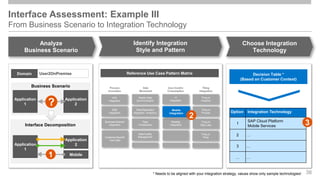
Interface Assessment: Example III
From Business Scenario to Integration Technology
38
Analyze
Business Scenario
Identify Integration
Style and Pattern
Choose Integration
Technology
Option Integration Technology
1
SAP Cloud Platform
Mobile Services
2 …
3 …
… …
Decision Table *
(Based on Customer Context)
Mobile
Integration
If not, decompose your
business scenario into single
interfaces for custom-built
integration
Business Scenario
Application
1
Application
2
?
If not, decompose your
business scenario into single
interfaces for custom-built
integration
Interface Decomposition
Application
1
Application
2
User2OnPremise
Domain
Mobile
* Needs to be aligned with your integration strategy, values show only sample technologies!
1
2
3
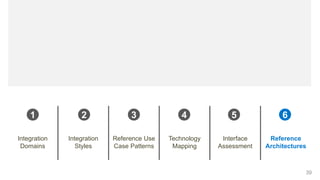
39
Integration
Domains
Integration
Styles
Reference Use
Case Patterns
Technology
Mapping
Interface
Assessment
Reference
Architectures
1 2 3 4 5 6
Reference Architecture Blueprint
Attach Architecture Related Information (per Integration Technology)
40
Integration Technology
(e.g. SAP Process Orchestration)
Technical
System
Architecture
Network /
Security
Architecture
High
Availability
Concept
Software
Logistics
Organizational
Information
…

ISA M Template for cloud implemenation DRP

  • 1.
    ISA-M Template <Your Organization> Thisdocument uses templates from the Integration Solution Advisor Methodology (ISA-M) provided by SAP SE. SAP SE is not responsible for the content of this document. ISA-M Template Version 3.1 Further information can be found here.
  • 2.
    Integration Solution AdvisorMethodology (ISA-M) Overview 2 Overview ▪ Enables the systematic selection of integration technologies ▪ Customer-proven set of core integration patterns ▪ Extensible to future use cases and technologies ▪ Focus on key dimensions of the problem space ▪ Open to SAP & Non-SAP Middleware * Customers and partners must comply with the Terms of Use (“TOU”) ISA-M Template for Use by Customers and Partners (*) ▪ Reusable within organizations, projects or services ▪ Accelerator to define integration guidelines ▪ Can be adapted/extended to specific needs
  • 3.
    ISA-M Template Terms ofUse 3 You must comply with the following Terms of Use ("TOU") when modifying, copying, distributing, transmitting, reproducing, publishing, or creating derivative works from any of the ISA-M templates in this document. SAP reserves the right to update the TOU at any time without notice. The most current version of the TOU can be reviewed at (link to SAP Jam Group). Terms of Use (1) You are required to register at SAP Integration Architecture Community (SAP JAM Group). (2) You must include the Mandatory Citation in your document. You must not make any change to the Mandatory Citation. (3) You agree not to make any changes to Integration Style names and definitions of the Integration Solution Advisor Methodology (ISA-M). (4) You are entirely responsible for any content that you create using Integration Styles and templates from the ISA-M. SAP is not liable for any damage or loss caused by any content that you create. (5) You agree to indemnify and hold SAP, its affiliates, subsidiaries, officers, agents, partners, employees, and licensors harmless from any claim or demand, including reasonable attorneys fees, made by any third party due to or arising out of Your modifying, copying, distributing, transmitting, reproducing, publishing, or creating derivative works from any of the ISA-M templates in this document or Your usage of this ISA-M template, Your breach of this TOU or SAP's Copyright or Privacy Statements as outlined at SAP.com, or Your alleged violation of any other rights of a third party. (6) This ISA-M template is being provided to You AS IS, WITHOUT ANY WARRANTY, ESCROW, TRAINING, OR SERVICE OBLIGATIONS WHATSOEVER ON THE PART OF SAP. SAP MAKES NO EXPRESS OR IMPLIED WARRANTIES OF ANY TYPE WHATSOEVER, INCLUDING BUT NOT LIMITED TO IMPLIED WARRANTIES OF MERCHANTABILITY AND OF FITNESS FOR A PARTICULAR PURPOSE. YOU ASSUME ALL RISKS ASSOCIATED WITH ITS USE OF THE ISA-M TEMPLATE, INCLUDING WITHOUT LIMITATION RISKS RELATING TO QUALITY, PERFORMANCE, DATA LOSS, AND UTILITY. (7) SAP does not guarantee or warrant any features or qualities of the ISA-M template or give any undertaking with regard to any other quality. Statements and explanations to this ISA-M template in promotional material or on SAP.com and in the documentation are made for explanatory purposes only; they are not meant to constitute any guarantee or warranty of certain features. No warranty or undertaking shall be implied from any published SAP description of or advertisement except to the extent SAP has expressly confirmed such warranty or undertaking in writing. Warranties are validly given only with the express written confirmation of SAPs management. (8) SAP does not represent or endorse the accuracy or reliability of any any information provided under this ISA-M template or the ISA-M template itself. SAP shall not be liable for damages caused by the use of the content and/or information. 9) TO THE EXTENT ALLOWABLE BY APPLICABLE LAW, SAP AND ITS AFFILIATES, SUBSIDIARIES, OFFICERS, EMPLOYEES, AGENTS, PARTNERS, AND LICENSORS ARE NOT LIABLE TO YOU FOR ANY DIRECT, INDIRECT, INCIDENTAL, SPECIAL, PUNITIVE, CONSEQUENTIAL, OR EXEMPLARY DAMAGES, INCLUDING, BUT NOT LIMITED TO, DAMAGES FOR LOSS OF PROFITS, REVENUE, GOODWILL, USE, DATA, OR OTHER INTANGIBLE LOSSES (EVEN IF SAP HAS BEEN ADVISED OF THE POSSIBILITY OF SUCH DAMAGES), HOWEVER CAUSED, WHETHER IN CONTRACT, TORT, OR OTHERWISE, ARISING OUT OF OR RESULTING FROM: (i) THE USE OF THIS ISA-M TEMPLATE; (ii) THE COST OF PROCUREMENT OF SUBSTITUTE GOODS AND SERVICES ARISING OUT OF YOUR USE OR INABILITY TO THIS ISA-M TEMPLATE OR CONTENT, OR (iii) ANY OTHER MATTER RELATING TO THE ISA-M TEMPLATE. 10) SAP SE or its affiliated companies have no obligation to pursue any course of business outlined in this ISA-M template or any related presentation, or to develop or release any functionality mentioned therein. This document, or any related presentation, and SAP SE’s or its affiliated companies’ strategy and possible future developments, products, and/or platform directions and functionality are all subject to change and may be changed by SAP SE or its affiliated companies at any time for any reason without notice. The information in this document is not a commitment, promise or legal obligation to deliver any material, code, or functionality. All forward-looking statements are subject to various risks and uncertainties that could cause actual results to differ materially from expectations. Readers are cautioned not to place undue reliance on these forward-looking statements, and they should not be relied upon in making purchasing decisions. 11) SAP and other SAP products and services mentioned herein as well as their respective logos are trademarks or registered trademarks of SAP SE (or an SAP affiliate company) in Germany and other countries. All other product and service names mentioned are the trademarks of their respective companies. Please see http://global.sap.com/corporate-en/legal/copyright/index.epx for additional trademark information and notices. Mandatory Citation This document uses templates from the Integration Solution Advisor Methodology (ISA-M) provided by SAP SE. SAP SE is not responsible for the content of this document. ISA-M Template Version 3.1 Further information can be found here.
  • 4.
    Document History 4 Version DateChanges 3.0 September 16, 2016 ▪ Updated description of integration domains ▪ Updated descriptions of integration styles ▪ New category ‘Enabling Services’ to capture integration related technologies ▪ Updated descriptions of reference use case patterns ▪ Updated decision table templates 3.1 March 16, 2017 ▪ Updated template to reflect naming changes in SAP Cloud Platform
  • 5.
    ISA-M Template: StartingPoint for Your Organization How can ISA-M be used? 5 Accelerator Pattern-Based Interface Development (Reuse) 3 Template Integration Strategy Assessment & Update 1 Blueprint Integration Architecture Governance 2
  • 6.
    ISA-M in aNutshell Integration: Different Point of Views 6 Integration Styles and Patterns Integration Domains Technology Mapping
  • 7.
  • 8.
    Integration Domains* The IncreasedScope of Integration * Further domains possible 8 On-Premise Business Partner B2B Cloud OnPremise2Cloud Real World Objects User2OnPremise User2Cloud Non-SAP Clouds Business Suite OnPremise2OnPremise Non SAP Thing2OnPremise Thing2Cloud Non SAP Cloud Apps Clouds … Cloud2Cloud User-Centric Applications
  • 9.
    Integration Domains High-Level Scopingof Your Integration Portfolio Integration Domain Relevance Applied Integration Technologies Relevant Not Relevant Under Evaluation OP2OP OnPremise2Cloud Cloud2Cloud B2B User2OP User2Cloud Thing2OP Thing2Cloud Selection 9
  • 10.
  • 11.
    Integration Styles Four FundamentalTypes of Application Integration 11 User-Centric Consumption How to integrate user- centric applications with business applications Data Movement How to synchronize data between business applications? Process Invocation How to chain business processes across business applications? Thing Integration How to integrate real world things with business applications?
  • 12.
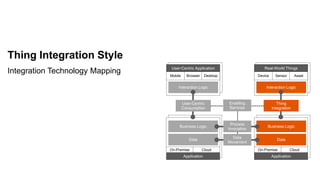
    Integration Styles Technology-Agnostic: Opento SAP and Non-SAP Middleware 12 Integration Styles Integration Styles • Cover key integration archetypes • Applicable to multiple integration domains • Independent of a specific integration technology • Each style can be refined with use case patterns Enabling Services • Integration related services • Examples: Workflow, API Management Technology Mapping • Allows the mapping to integration technologies • Depends on your integration strategy Application Business Logic On-Premise Cloud Data Application Business Logic On-Premise Cloud Data Interaction Logic Mobile Browser Desktop User-Centric Application User-Centric Consumption Interaction Logic Device Sensor Asset Real-World Things Thing Integration Enabling Services Process Invocation Data Movement
  • 13.
    Key Characteristics byExample SAP Cloud for Customers and SAP ERP 13 User-Centric Consumption Data Movement Process Invocation Thing Integration Key Characteristics Objective • Chaining of business processes Architectural Aspects • SOA principles • Application event as trigger • Near real-time processing • Exchange of single business objects • Transactional process integrity Sample Integration Technology Mapping • SAP Cloud Platform Integration* Business Logic SAP Hybris Cloud for Customer Create Opportunity Business Logic SAP ERP Create Sales Quote Request Create Sales Order Request Create Sales Quote Create Sales Order Initiate Outbound Delivery Create Customer Invoice Create Lead … … … … Opportunity-to-Order Process including triggering of sales order processing in SAP ERP (A2A Integration). Cloud On-Premise SAP Cloud Platform Integration* * formerly known as SAP HANA Cloud Integration (HCI)
  • 14.
    Key Characteristics byExample SAP IT: Governance and Integration Platform (GIP)* 14 User-Centric Consumption Data Movement Process Invocation Thing Integration On Premise Data Governance and Integration Platform (SAP IT) Based on SAP HANA Enterprise Information Management (EIM), GIP allows to extract, transform and load data between on premise & cloud applications. Data ERP … … Data CRM Data HCM Data Non SAP Data … Key Characteristics Objective • Synchronization, federation and cleansing of master data Architectural Aspects • Data-level extraction and load (ETL) • Complex transformations • Scheduled batch processing • Exchange of bulk data (big data) Sample Integration Technology Mapping • SAP HANA Smart Data Integration (SDI) • SAP HANA Smart Data Quality (SDQ) • SAP HANA Smart Data Access (SDA) Cloud LoB Applications HANA Smart Data Integration (SDI) Smart Data Quality (SDQ) Smart Data Access (SDA) GIP Data Schemas Virtual Tables HCP Solution Extensions Analytical Applications … * SAP Runs SAP
  • 15.
    Key Characteristics byExample SAP Cloud Platform Mobile Services 15 User-Centric Consumption Data Movement Process Invocation Thing Integration Key Characteristics Objective • Consumption of backend application services in a mobile app, leveraging native or hybrid device capabilities Architectural Aspects • Common SDK: Native, Hybrid, Web • OData Offline / Push Notifications • Security Integration • Usage Analytics/Reporting • Integration of SAP and 3rd Party Systems via OData • App Lifecycle Management Support Sample Integration Technology Mapping • SAP Cloud Platform Mobile Services Internet On-Premise Cloud OData Service Provider (e.g. SAP Gateway) Mobile App SAP Cloud Platform Mobile Services SAP ERP SAP CRM … SAP Cloud Connector Intranet Web Secure Connection Mobile App Mobile App OData Backend (e.g. HANA)
  • 16.
    Key Characteristics byExample Lab Preview – SAP Vehicle Insights 16 User-Centric Consumption Data Movement Process Invocation Thing Integration Key Characteristics Objective • Integration of real world data (IoT) • Analytics of telematics data allows new insights into status, availability, and performance of the forklift fleet Architectural Aspects • Device / Thing Management • Very large number of messages • Handling of bursty data traffic • IoT protocol support Sample Integration Technology Mapping • SAP Cloud Platform Internet of Things SAP Cloud Platform Vehicle Insights Application HANA Internet of Things Vehicle Data Store
  • 17.
    Integration Styles Key Characteristicsand Decision Criteria 17 Process Invocation Data Movement User-Centric Consumption Thing Integration Objective Chaining of business processes Synchronization of data Adaptable backend access Capturing and processing of real world data Interaction Type System-2-System System-2-System User-2-System Thing-2-System Coupling to Application Process-Level Data-Level UI-Level Data-Level / Process Level Primary Trigger Application Event Schedule or Application Event User Event Thing Event Urgency of Completion (Near) Real-Time Batch or Near Real-Time (Near) Real-Time (Near) Real-Time or Batch Unit of Data Exchange Single Objects Bulk-Data or Single Objects Single Objects or Bulk-Data Single Objects or Bulk-Data Specific Requirements • Transactional Integrity • Reliable Messaging • Message Orchestration • B2B protocol support • Complex transformations • Multiple Data Sources • Data Quality Management • Big Data Processing • Online / Offline Support • Device Management • End-User Management • Application Management • Security / Privacy • Device Management • Bursty data traffic • IoT protocol support • Event Stream Processing • Security / Privacy
  • 18.
  • 19.
    Reference Use CasePatterns Extensible Library of Typical Integration Use Cases 19 Integration Styles Reference Use Case Patterns … Data Movement Master Data Synchronization Data Replication (Migration / Analytics) Data Virtualization Data Quality Management … Thing Integration Thing to Analytics Thing to Process Thing to Data Lake Thing to Thing … Enabling Services Workflow Management … Business Rules Management API Management Process Invocation A2A Integration B2B Integration Business Network Integration Customer-Specific Use Case User-Centric Consumption UI Integration Mobile Integration Desktop Integration … …
  • 20.
    Process Invocation Style ReferenceUse Case Patterns* 20 * Use case patterns can be added, deleted or adapted to your requirements User-Centric Consumption Data Movement Process Invocation Thing Integration A2A Integration Exchange of transactional data between business applications, either OP2OP, OP2Cloud or Cloud2Cloud. Business Logic Application Business Logic Application Example: Order-to-cash process with sales order creation in SAP ERP B2B Integration Exchange of transactional data between business partners using B2B standard protocols. Example: ANSI X.12, EDIFACT Partner 1 Business Logic Application Business Logic Application Partner 2 Business Network Integration Exchange of transactional data between business partners managed by a business network. Example: Procure-to-pay process between SAP ERP and Ariba Partner 1 Business Logic Business Application Business Logic Business Application Partner 2 Business Network
  • 21.
    Data Movement Style ReferenceUse Case Patterns* 21 * Use case patterns can be added, deleted or adapted to your requirements User-Centric Consumption Data Movement Process Invocation Thing Integration Data Replication (Migration/Analytics) Table-based integration of data covering data replication, migration, or analytical use cases based on ETL/ELT1. Data Application Data DB Data App / DWH Example: Migration of data from legacy systems or databases into SAP HANA Master Data Synchronization API-based synchronization of master data from a system of records to other applications (initial load, delta transfer). Data Application Data System of Records Data Application Example: Synchronization of cost center data between SAP S/4 HANA and SFSF EC Data Virtualization Provisioning of a virtual data layer by federation of queries to remote data sources without phys. data movement. Example: Virtual data access in SAP HANA to remote data sources such as Hadoop Data Source Data Virtual Data Layer Data Source Data Quality Management Integration of data from multiple sources for cleansing, matching or consolidation (central business terms). Example: Cleansing of customer address data Data Source Data Source DQM Data 1 Also APIs might be used for this use case
  • 22.
    User-Centric Consumption Style ReferenceUse Case Patterns* 22 * Use case patterns can be added, deleted or adapted to your requirements User-Centric Consumption Data Movement Process Invocation Thing Integration UI Integration Consumption of backend application services in a web user interface or lightweight application. Example: SAP Fiori Launchpad, BI Portal ,Corporate Portal, B2B or B2C Portals Desktop Integration Consumption of backend application services in a desktop application leveraging native desktop capabilities. Example: SAP Gateway for Microsoft Office Integration Mobile Integration Consumption of backend application services in a mobile app, leveraging native or hybrid device capabilities1. Example: SAP Sales Manager Mobile App Integration with SAP CRM Business Logic Application Business Logic Application Interaction Logic Web User Interface Business Logic Application Business Logic Application Interaction Logic Mobile Application Business Logic Application Business Logic Application Interaction Logic Desktop Application 1 Might also include offline data synchronization
  • 23.
    Thing Integration Style ReferenceUse Case Patterns* 23 * Use case patterns can be added, deleted or adapted to your requirements User-Centric Consumption Data Movement Process Invocation Thing Integration Thing to Analytics Real-time integration of thing/machine data for monitoring and analytics. Example: Real-time visibility of shop floor based production operations Thing to Thing Exchange of data between two or more things, e.g. machine-to-machine (M2M). Example: Integration of sensors for keyless door entry Thing to Data Lake Collection of thing/machine data to derive future value out of it (by data science). Thing to Process Integration of thing/machine data for triggering a business process step. Example: Triggering of a service order process based on machine alerts Data Analytical Application Interaction Thing Interaction Thing Business Logic Transactional Application Interaction Thing Interaction Thing Data Lake Analytical Application Interaction Thing Interaction Thing Example: Collect and analyze equipment usage data to derive product improvements Interaction Thing Interaction Thing
  • 24.
  • 25.
    Mapping of IntegrationStyles to Technologies Possible Decision Criteria based on Customer Context 25 Integration Technologies Use Case Patterns Integration Styles P1 P2 … D1 P2 … T1 T2 T3 U1 U2 … T4 T1 T2 … T5 Technical Aspects  Architecture Fit  Integration Domain  Location of System of Records  Availability of Packaged Solutions  Security Aspects  … Non-Technical Aspects  Available Skillsets  Vendor Strategy  License / Subscription Models  … Data Movement Process Invocation User-Centric Consumption Thing Integration Enabling Services E1 E2 … T6 …
  • 26.
    Integration Patterns (IP) CombiningIntegrations Domains and Integration Styles Integration Domain N/A N/A N/A N/A N/A N/A N/A N/A N/A N/A N/A N/A N/A N/A N/A N/A N/A N/A N/A N/A OP2OP OP2Cloud Cloud2Cloud B2B User2OP User2Cloud Thing2OP Thing2Cloud Process Invocation Data Movement User-Centric Consumption Thing Integration Integration Style IP-2 IP-3 IP-4 IP-5 IP-6 IP-7 IP-8 IP-1 Integration Pattern Matrix ▪ Cockpit for the integration architect ▪ Select relevant patterns for your organization Technology Mapping ▪ Map patterns to technologies ▪ Incorporate your specific decision rules ▪ See next slides 26 IP-9 IP-10 IP-11 IP-12
  • 27.
    Process Invocation Style IntegrationTechnology Mapping Application Business Logic On-Premise Cloud Data Application Business Logic On-Premise Cloud Data Interaction Logic Mobile Browser Desktop User-Centric Application User-Centric Consumption Interaction Logic Device Sensor Asset Real-World Things Thing Integration Enabling Services Process Invocation Data Movement
  • 28.
    Process Invocation Style DecisionTable Template Integration Policies Integration Technology 1) SAP Process Orchestration 2) SAP Cloud Platform Integration 3) P2P (e.g. file, RFC, WS, …) … Recommendation Degree 1) General Recommendation 2) Reasonable Alternative 3) Possible Exception 4) To be avoided … Rule Description & Related Use Case Patterns 1) A2A Integration 2) B2B Integration 3) Business Network Integration … Relevant Integration Domains OP2OP OP2Cloud Cloud2Cloud B2B … … … This table allows the mapping of the process invocation style to integration technologies that should be used in your organization. It needs to be aligned with your integration strategy, values below show only sample rules! IP-4 IP-1 IP-3 IP-2 28 SAP Process Orchestration General Recommendation Supports all three reference use cases P2P Reasonable Alternative For A2A between SAP systems (ALE)
  • 29.
    Data Movement Style IntegrationTechnology Mapping Application Business Logic On-Premise Cloud Data Application Business Logic On-Premise Cloud Data Interaction Logic Mobile Browser Desktop User-Centric Application User-Centric Consumption Interaction Logic Device Sensor Asset Real-World Things Thing Integration Enabling Services Process Invocation Data Movement
  • 30.
    Data Movement Style DecisionTable Template Integration Policies Integration Technology 1) SAP Data Services 2) SAP HANA SDI 3) SAP Cloud Platform SDI 4) Managed File transfer MFT … Recommendation Degree 1) General Recommendation 2) Reasonable Alternative 3) Possible Exception 4) To be avoided … Rule Description & Related Use Case Patterns 1) Master Data Synchronization 2) Data Replication (Migration /Analytics) 3) Data Virtualization 4) Data Quality Management … Relevant Integration Domains OP2OP OP2Cloud Cloud2Cloud B2B … … … 30 IP-8 IP-5 IP-7 IP-6 SAP HANA SDI General Recommendation Supports all HANA-centric use cases MFT e.g sFTP Possible Exception For delta data synchronization This table allows the mapping of the data movement style to integration technologies that should be used in your organization. It needs to be aligned with your integration strategy, values below show only sample rules!
  • 31.
    User-Centric Consumption Style IntegrationTechnology Mapping Application Business Logic On-Premise Cloud Data Application Business Logic On-Premise Cloud Data Interaction Logic Mobile Browser Desktop User-Centric Application User-Centric Consumption Interaction Logic Device Sensor Asset Real-World Things Thing Integration Enabling Services Process Invocation Data Movement
  • 32.
    User-Centric Consumption Style DecisionTable Template Integration Policies Integration Technology 1) SAP Gateway 2) SAP Cloud Platform Mobile Services 3) SAP Fiori Launchpad … Recommendation Degree 1) General Recommendation 2) Reasonable Alternative 3) Possible Exception 4) To be avoided … Rule Description & Related Use Case Patterns 1) UI Integration 2) Mobile Integration 3) Desktop Integration … Relevant Integration Domains User2OP User2Cloud … … … 32 IP-9 IP-10 SAP Gateway General Recommendation Access to SAP Business Suite based on ODATA This table allows the mapping of the user-centric consumption style to integration technologies that should be used in your organization. It needs to be aligned with your integration strategy, values below show only sample rules!
  • 33.
    Thing Integration Style IntegrationTechnology Mapping Application Business Logic On-Premise Cloud Data Application Business Logic On-Premise Cloud Data Interaction Logic Mobile Browser Desktop User-Centric Application User-Centric Consumption Interaction Logic Device Sensor Asset Real-World Things Thing Integration Enabling Services Process Invocation Data Movement
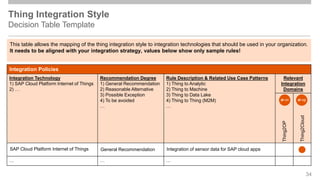
  • 34.
    Thing Integration Style DecisionTable Template Integration Policies Integration Technology 1) SAP Cloud Platform Internet of Things 2) … Recommendation Degree 1) General Recommendation 2) Reasonable Alternative 3) Possible Exception 4) To be avoided … Rule Description & Related Use Case Patterns 1) Thing to Analytic 2) Thing to Machine 3) Thing to Data Lake 4) Thing to Thing (M2M) … Relevant Integration Domains Thing2OP Thing2Cloud … … … 34 IP-11 IP-12 SAP Cloud Platform Internet of Things General Recommendation Integration of sensor data for SAP cloud apps This table allows the mapping of the thing integration style to integration technologies that should be used in your organization. It needs to be aligned with your integration strategy, values below show only sample rules!
  • 35.
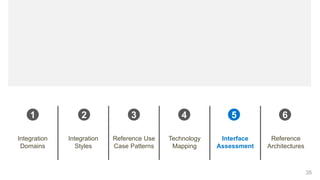
  • 36.
    Reference Use CasePattern Matrix Interface Assessment: Example I From Business Scenario to Integration Technology 36 Analyze Business Scenario Identify Integration Style and Pattern Choose Integration Technology Option Integration Technology 1 SAP HANA SDI 2 SAP Data Services 3 Managed File Transfer … … Decision Table * (Based on Customer Context) Data Replication (Migration) If not, decompose your business scenario into single interfaces for custom-built integration Business Scenario Application 1 Application 2 ? If not, decompose your business scenario into single interfaces for custom-built integration Interface Decomposition Application 1 Application 2 OnPremise2Cloud Domain * Needs to be aligned with your integration strategy, values show only sample technologies! 1 2 3
  • 37.
    Reference Use CasePattern Matrix Interface Assessment: Example II From Business Scenario to Integration Technology 37 Analyze Business Scenario Identify Integration Style and Pattern Choose Integration Technology Option Integration Technology 1 SAP Process Orchestration 2 SAP Cloud Platform Integration 3 P2P … … Decision Table * (Based on Customer Context) A2A Integration If not, decompose your business scenario into single interfaces for custom-built integration Business Scenario Application 1 Application 2 ? If not, decompose your business scenario into single interfaces for custom-built integration Interface Decomposition Application 1 Application 2 OnPremise2Cloud Domain * Needs to be aligned with your integration strategy, values show only sample technologies! 1 2 3
  • 38.
    Reference Use CasePattern Matrix Interface Assessment: Example III From Business Scenario to Integration Technology 38 Analyze Business Scenario Identify Integration Style and Pattern Choose Integration Technology Option Integration Technology 1 SAP Cloud Platform Mobile Services 2 … 3 … … … Decision Table * (Based on Customer Context) Mobile Integration If not, decompose your business scenario into single interfaces for custom-built integration Business Scenario Application 1 Application 2 ? If not, decompose your business scenario into single interfaces for custom-built integration Interface Decomposition Application 1 Application 2 User2OnPremise Domain Mobile * Needs to be aligned with your integration strategy, values show only sample technologies! 1 2 3
  • 39.
  • 40.
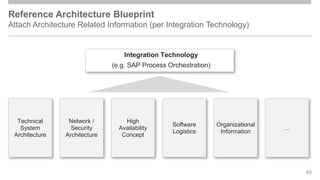
    Reference Architecture Blueprint AttachArchitecture Related Information (per Integration Technology) 40 Integration Technology (e.g. SAP Process Orchestration) Technical System Architecture Network / Security Architecture High Availability Concept Software Logistics Organizational Information …