Ron Jacobs [email_address] Is Social Media Marketing the New Direct Marketing? Or, is Social Media just stealing our souls? A Presentation for direct mail? data? search? Email? web?
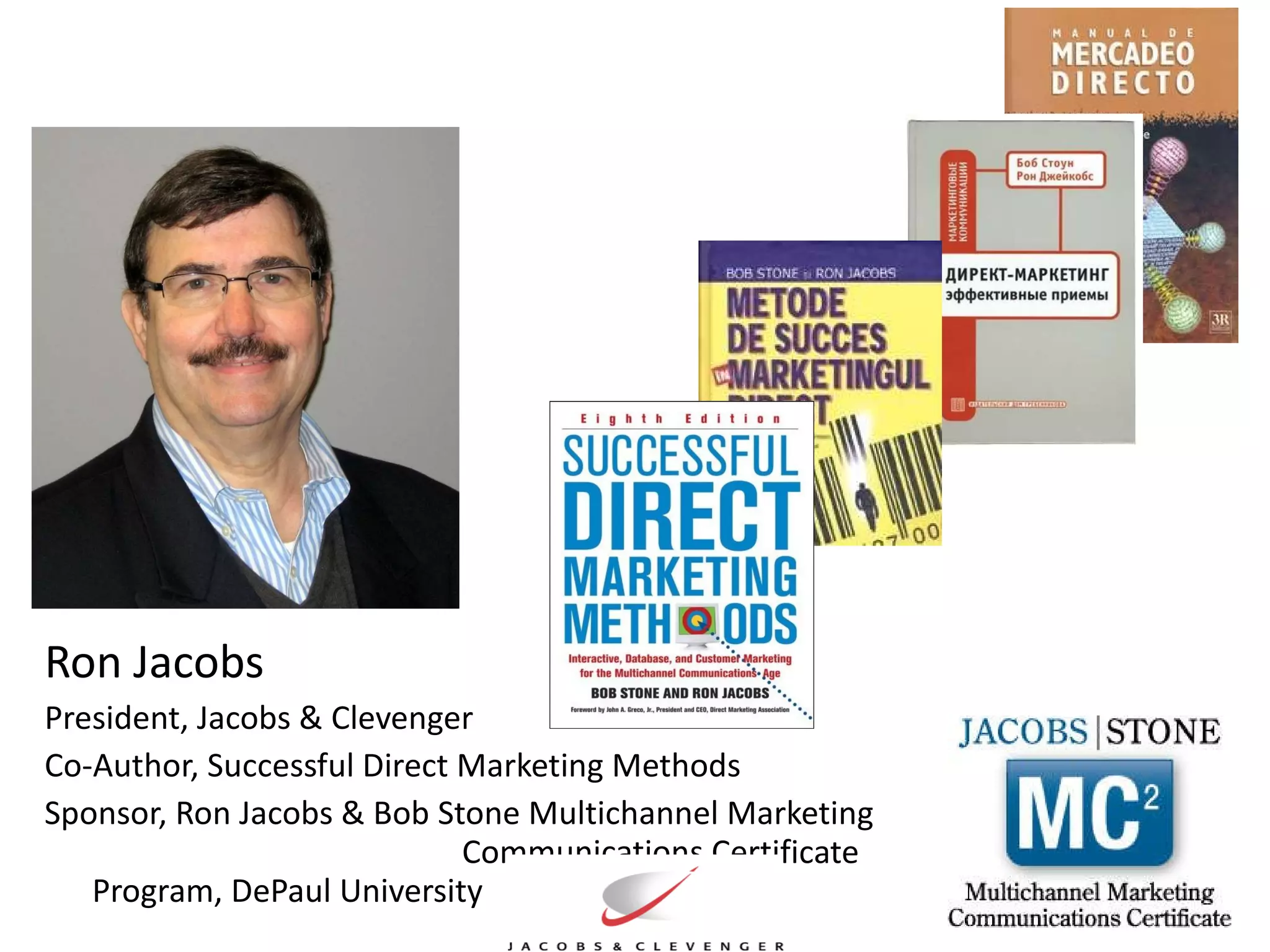
Ron Jacobs President, Jacobs & Clevenger Co-Author, Successful Direct Marketing Methods Sponsor, Ron Jacobs & Bob Stone Multichannel Marketing  Communications Certificate Program, DePaul University
Agenda The need to redefine Direct Marketing Direct Marketing is Interactive, Interactive Marketing is Direct (Stan Rapp) How Direct Marketing and Social Media Marketing overlap How Social Media Marketing is creating data  The importance of establishing  Key Performance Indicators Explore attribution models for multichannel marketing communications http://vimeo.com/10251808
Direct Marketing How do you define it?
Direct marketing  is a form of  advertising  that reaches its audience without using traditional formal channels of advertising, such as TV, newspapers or radio. Businesses communicate straight to the consumer with advertising techniques such as fliers, catalogue distribution, promotional letters, and street advertising. Direct Advertising is a sub-discipline and type of  marketing . There are two main definitional characteristics which distinguish it from other types of marketing. The first is that it sends its message directly to  consumers , without the use of intervening commercial communication  media . The second characteristic is the core principle of successful  Advertising  driving a specific "call to action." This aspect of direct marketing involves an emphasis on trackable, measurable, positive responses from consumers (known simply as "response" in the industry) regardless of medium. If the advertisement asks the prospect to take a specific action, for instance call a  free phone  number or visit a Web site, then the effort is considered to be  direct response  advertising. Direct marketing is predominantly used by small to medium-size enterprises with limited advertising budgets that do not have a well-recognized  brand  message. A well-executed direct advertising campaign can offer a positive return on investment as the message is not hidden with overcomplicated branding. Instead, direct advertising is straight to the point; offers a product, service, or event; and explains how to get the offered product, service, or event.
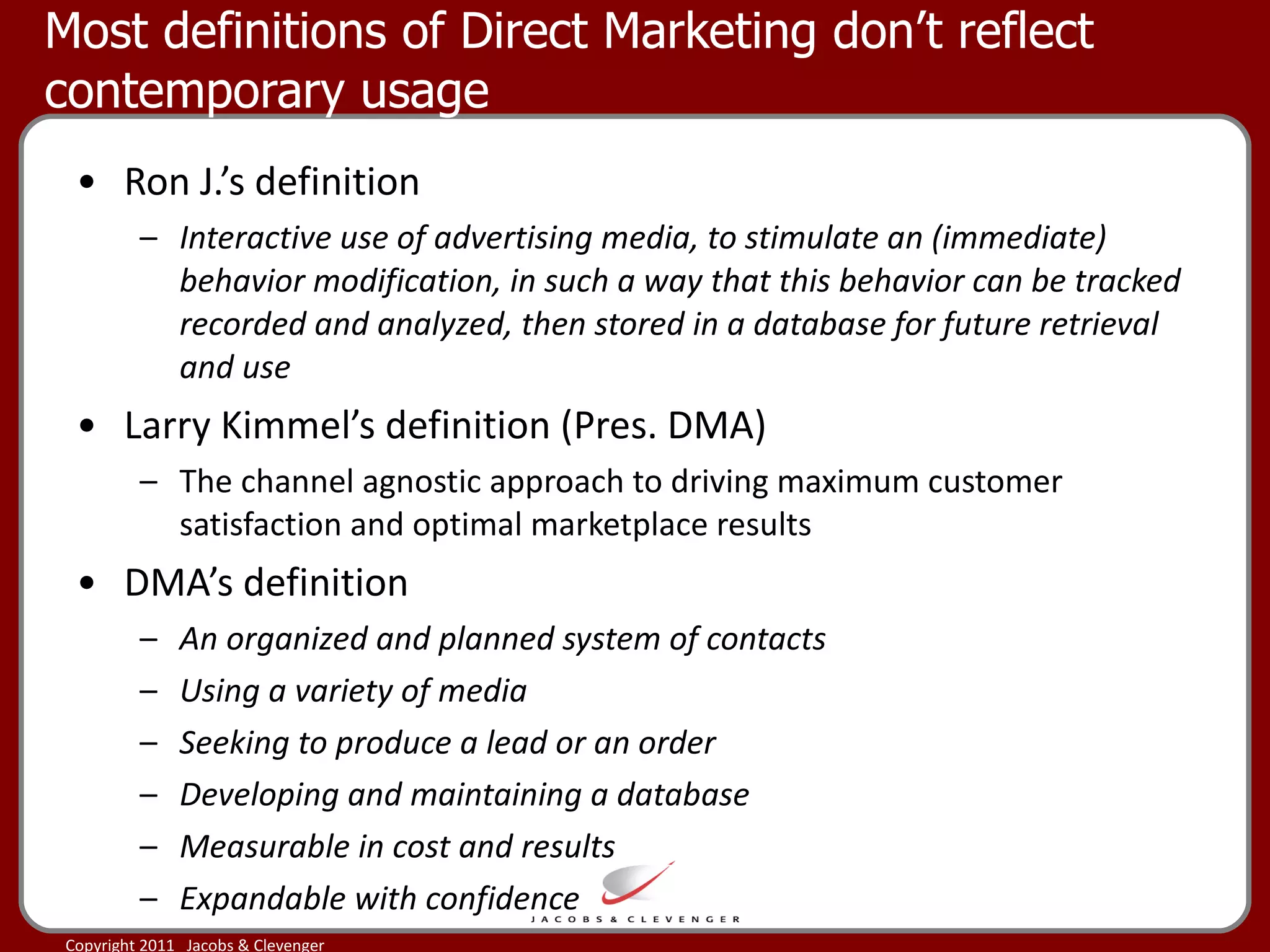
Most definitions of Direct Marketing don’t reflect contemporary usage Ron J.’s definition Interactive use of advertising media, to stimulate an (immediate) behavior modification, in such a way that this behavior can be tracked recorded and analyzed, then stored in a database for future retrieval and use Larry Kimmel’s definition (Pres. DMA) The channel agnostic approach to driving maximum customer satisfaction and optimal marketplace results DMA’s definition An organized and planned system of contacts Using a variety of media  Seeking to produce a lead or an order Developing and maintaining a database Measurable in cost and results Expandable with confidence
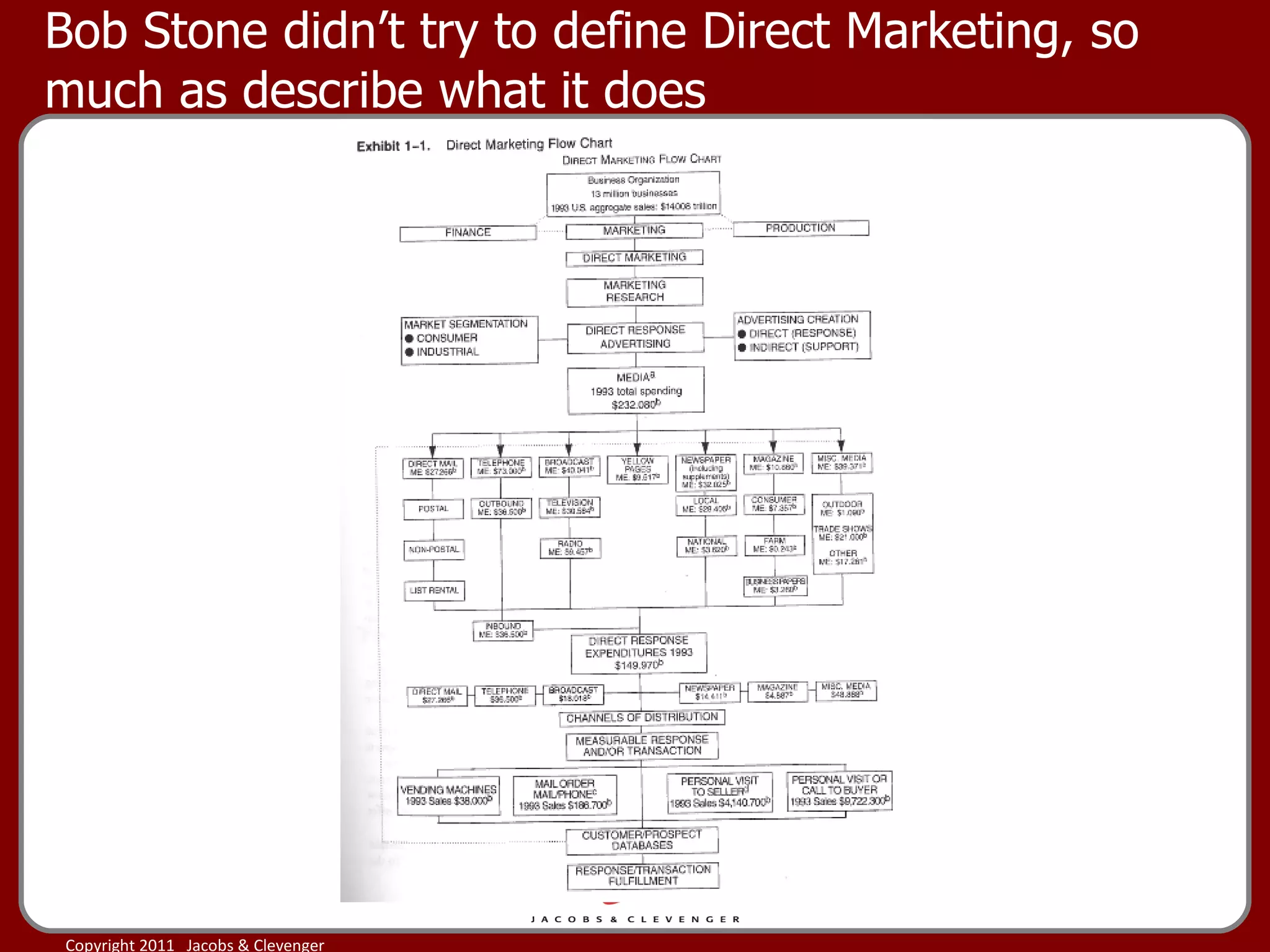
Bob Stone didn’t try to define Direct Marketing, so much as describe what it does
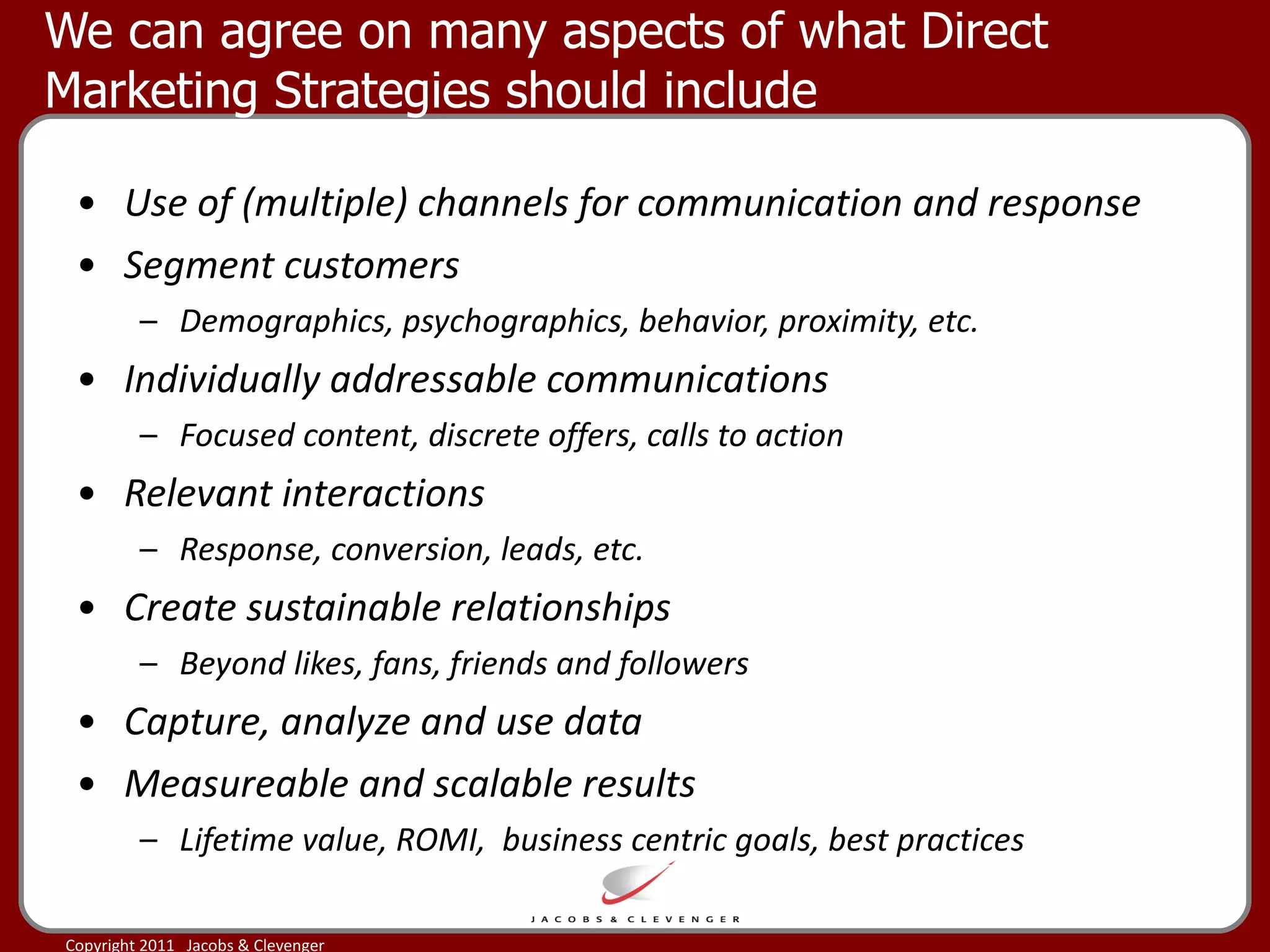
We can agree on many aspects of what Direct Marketing Strategies should include Use of (multiple) channels for communication and response Segment customers  Demographics, psychographics, behavior, proximity, etc. Individually addressable communications Focused content, discrete offers, calls to action  Relevant interactions  Response, conversion, leads, etc. Create sustainable relationships Beyond likes, fans, friends and followers Capture, analyze and use data  Measureable and scalable results Lifetime value, ROMI,  business centric goals, best practices
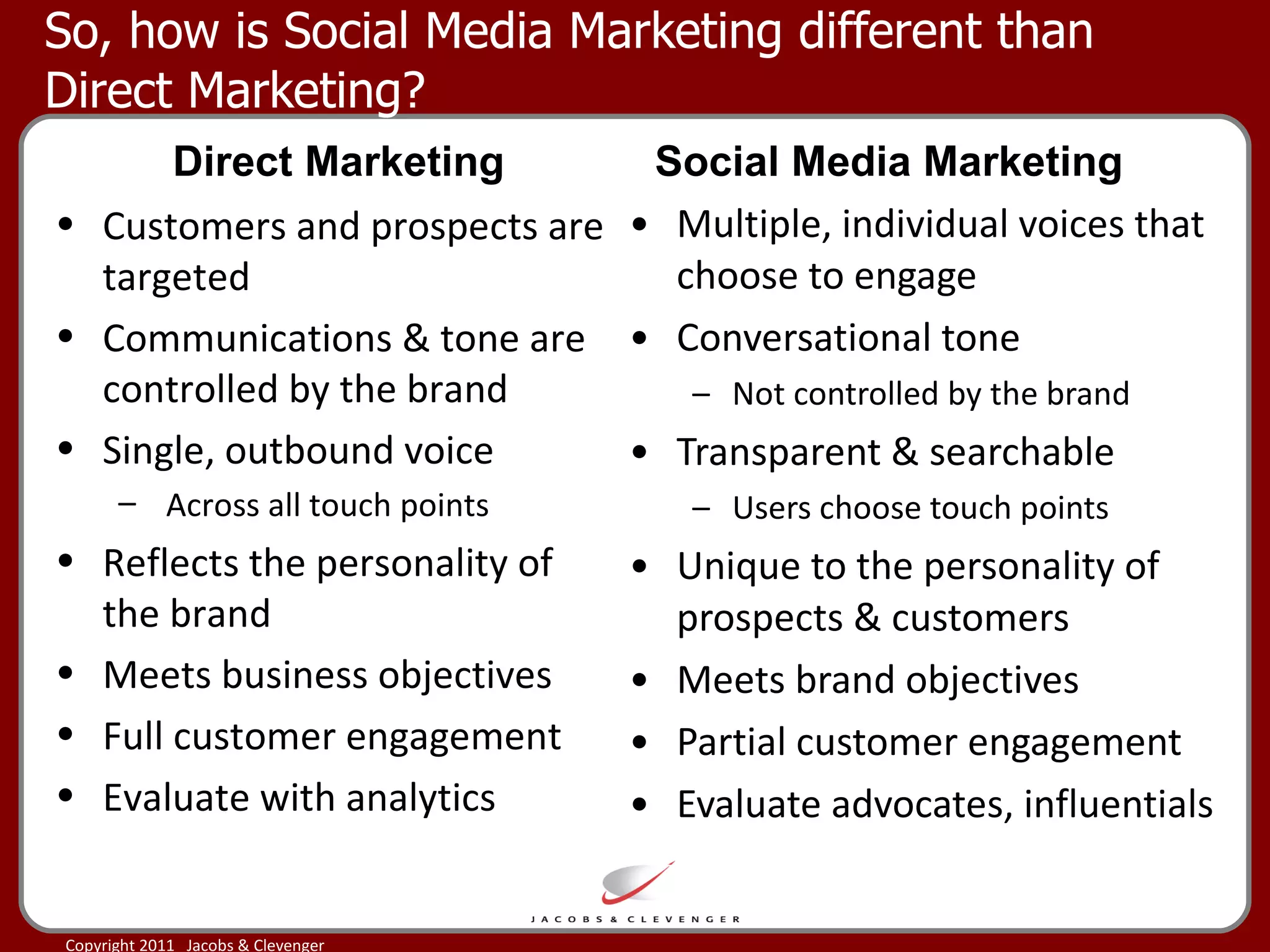
So, how is Social Media Marketing different than Direct Marketing? Multiple, individual voices that choose to engage Conversational tone Not controlled by the brand Transparent & searchable Users choose touch points Unique to the personality of prospects & customers Meets brand objectives Partial customer engagement Evaluate advocates, influentials Customers and prospects are targeted Communications & tone are controlled by the brand Single, outbound voice Across all touch points Reflects the personality of the brand Meets business objectives Full customer engagement Evaluate with analytics  Direct Marketing Social Media Marketing
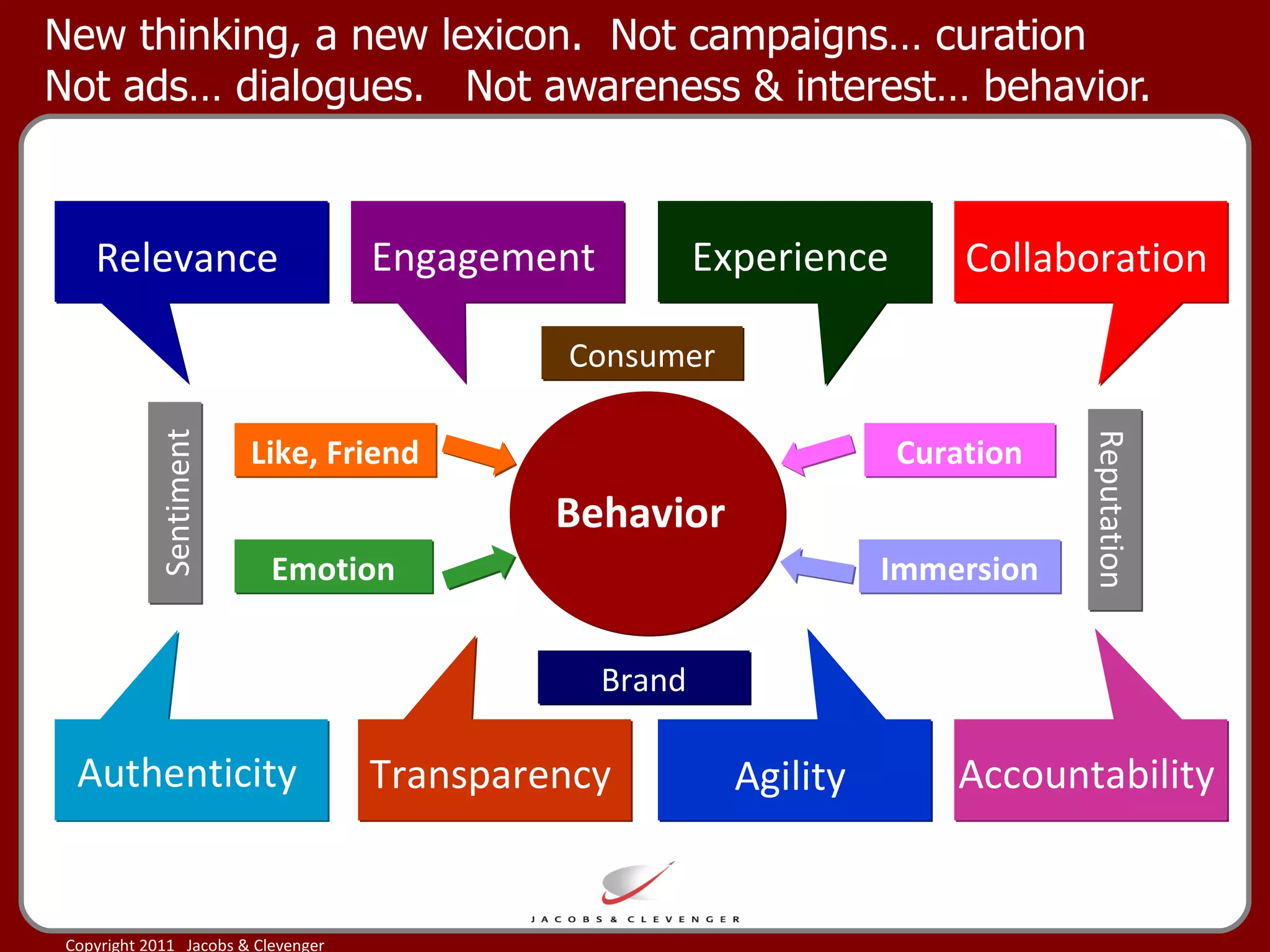
New thinking, a new lexicon.  Not campaigns… curation Not ads… dialogues.  Not awareness & interest… behavior.  Reputation Sentiment Experience Collaboration Engagement Relevance Authenticity Transparency Accountability Agility Behavior Like, Friend Curation Immersion Emotion Brand Consumer
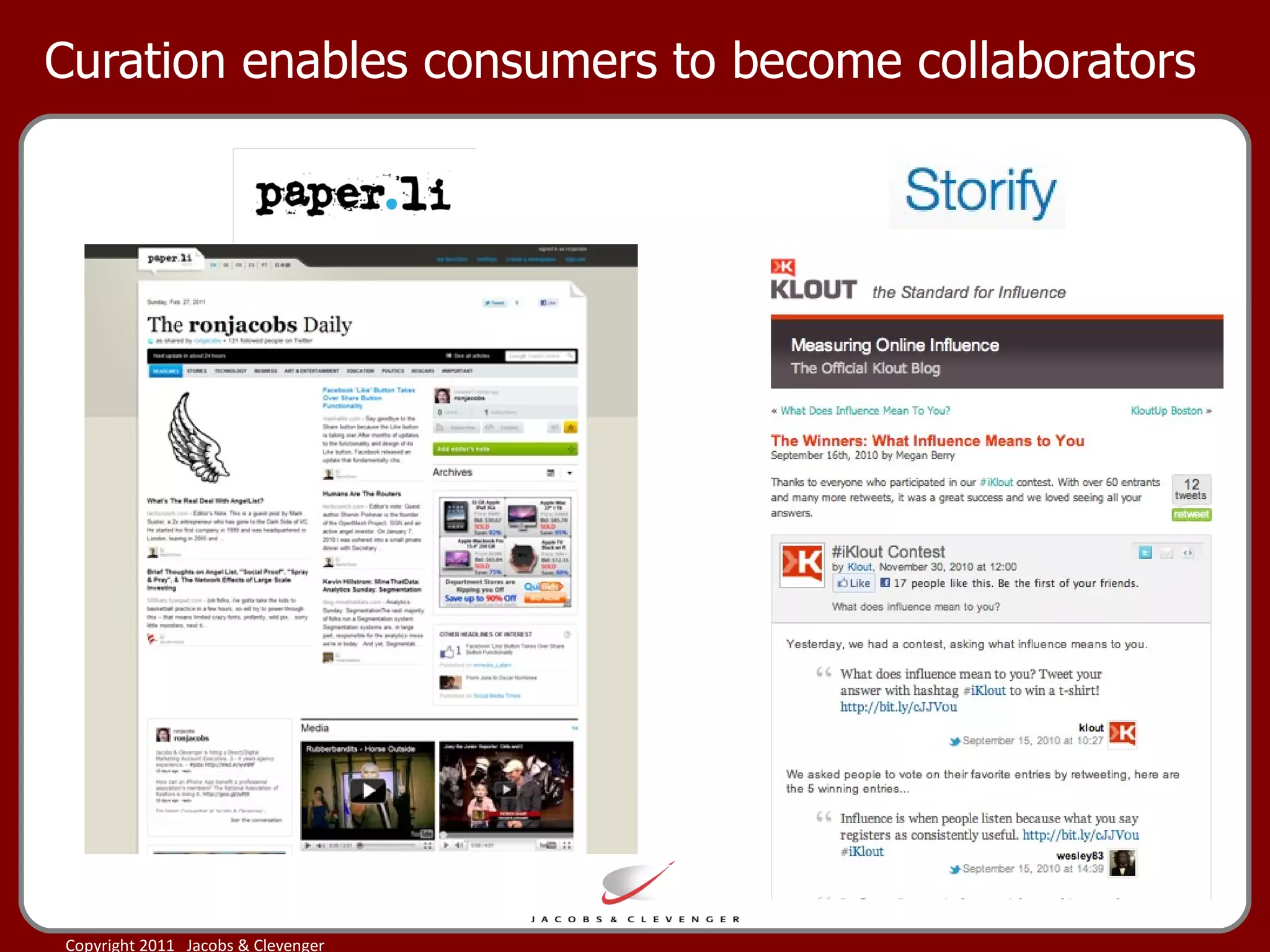
Curation enables consumers to become collaborators
Media Vs Channels It’s about effectiveness, not efficiency
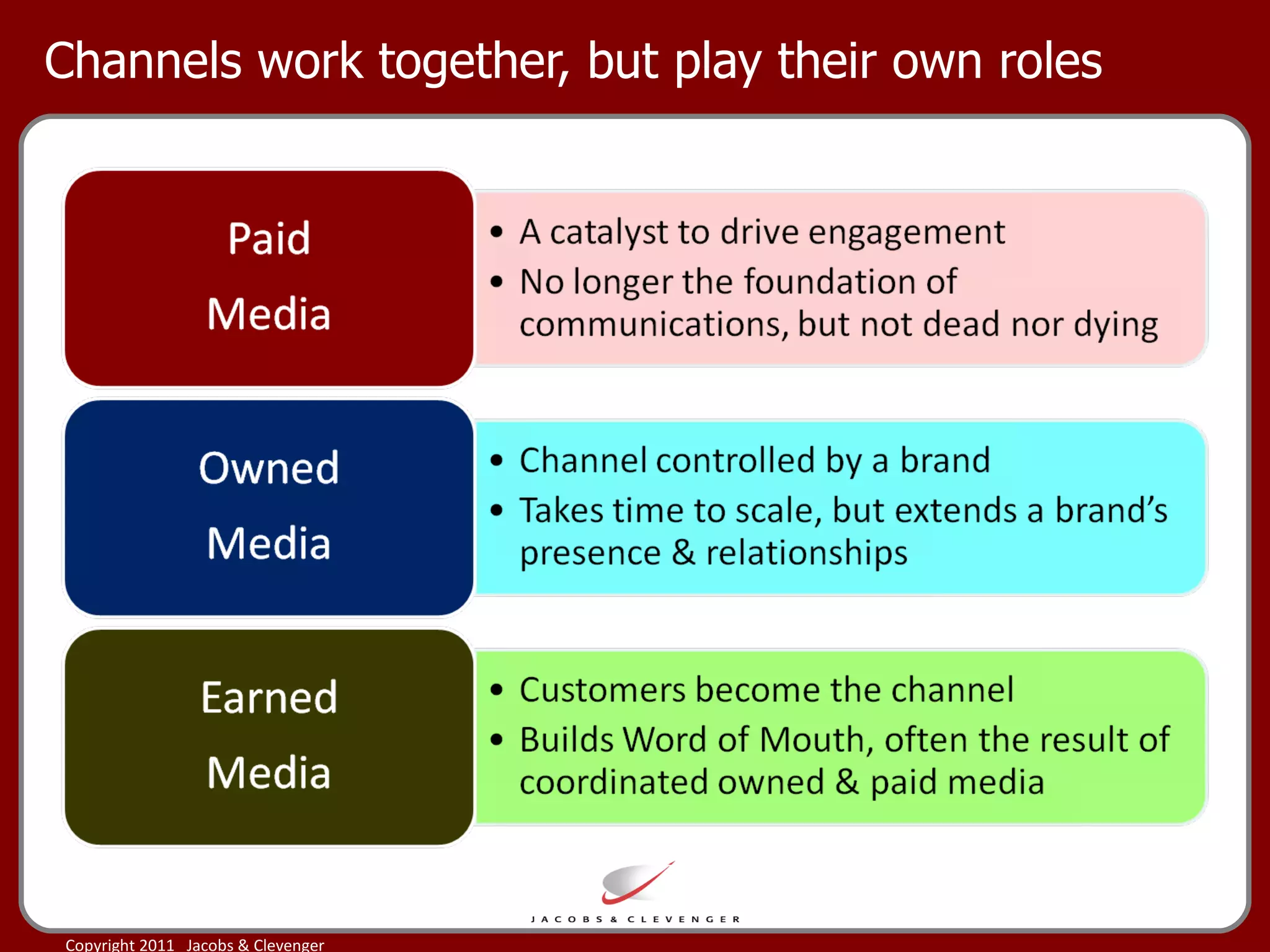
Channels work together, but play their own roles
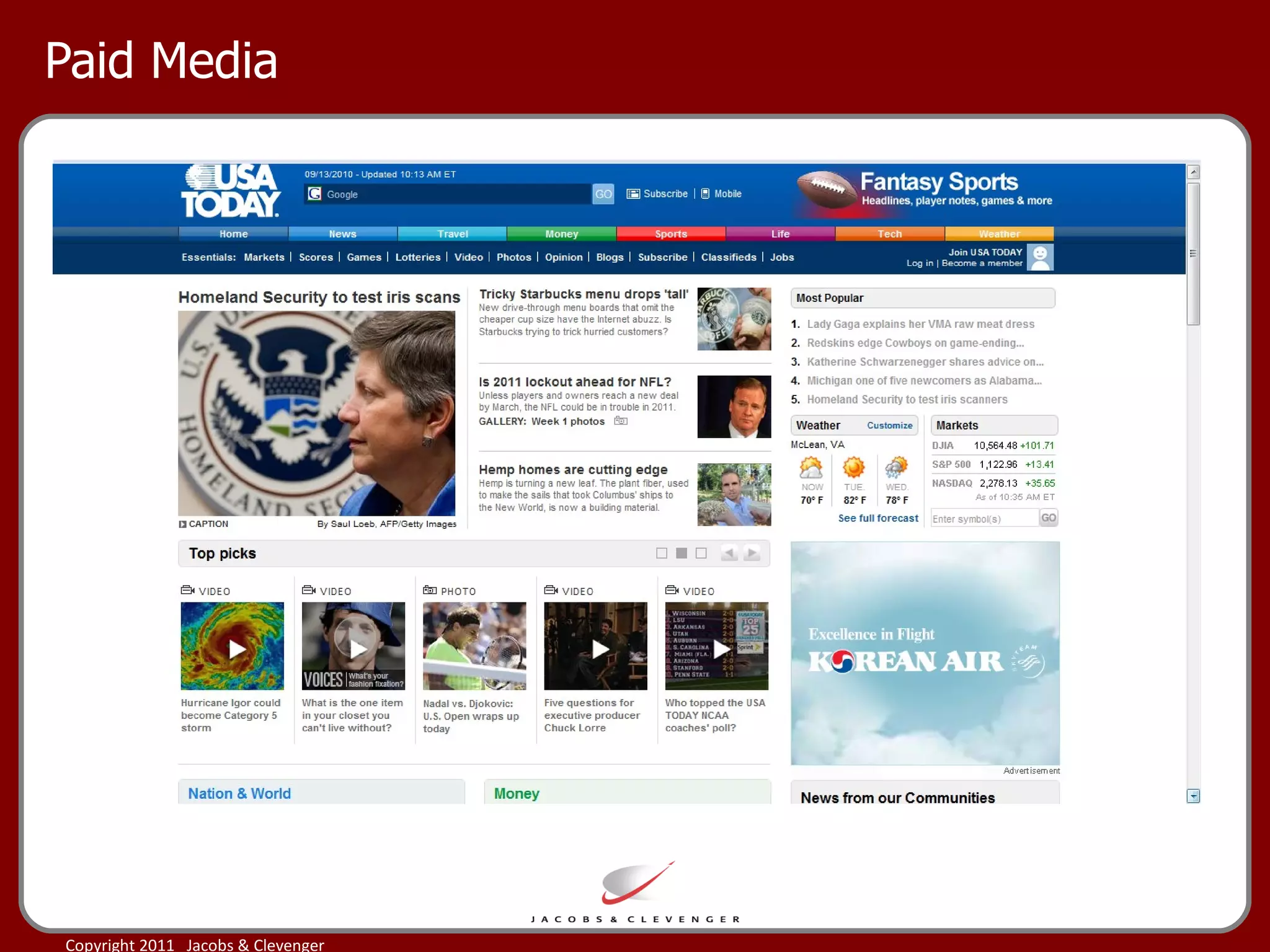
Paid Media
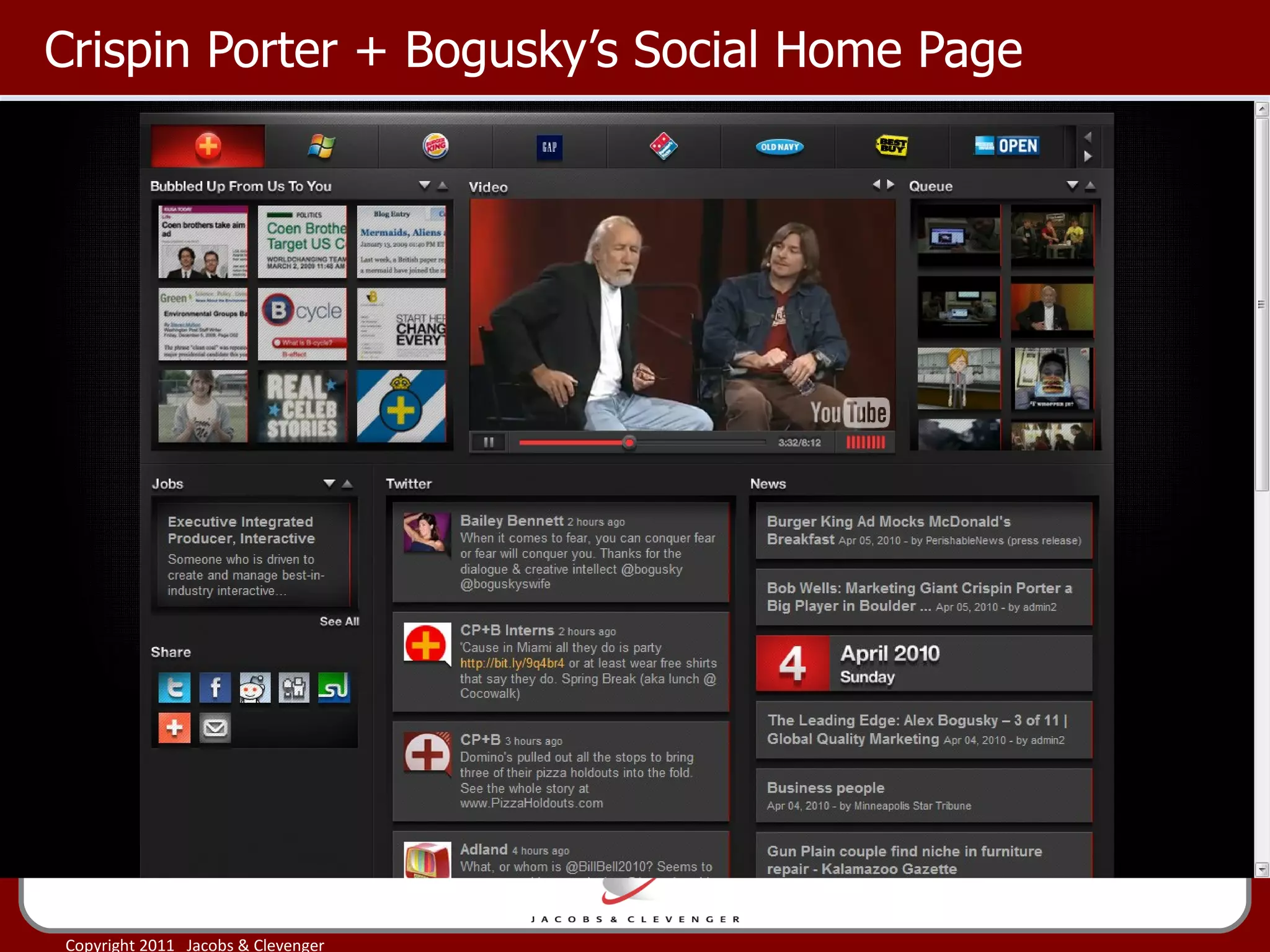
Crispin Porter + Bogusky’s Social Home Page
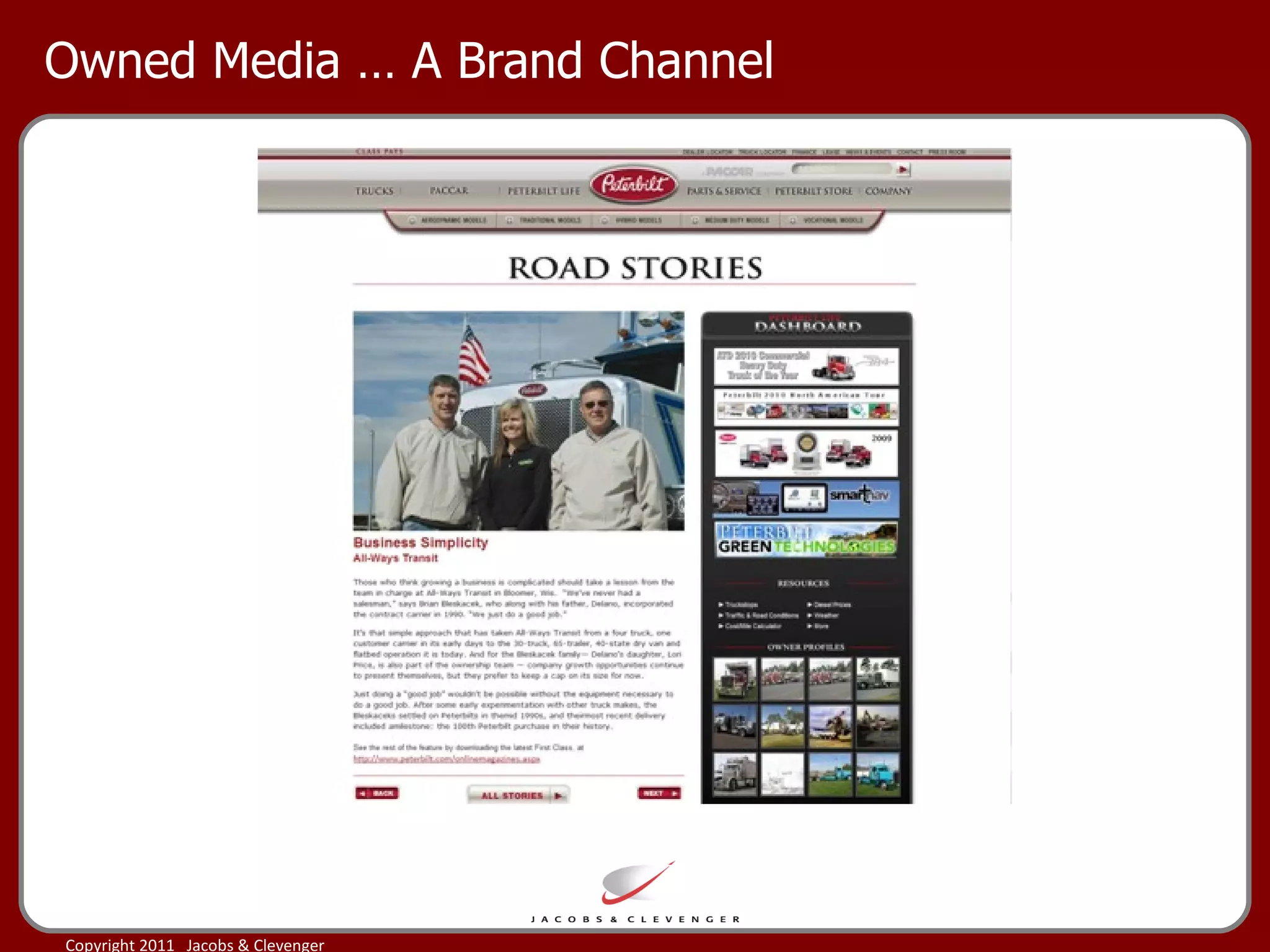
Owned Media … A Brand Channel
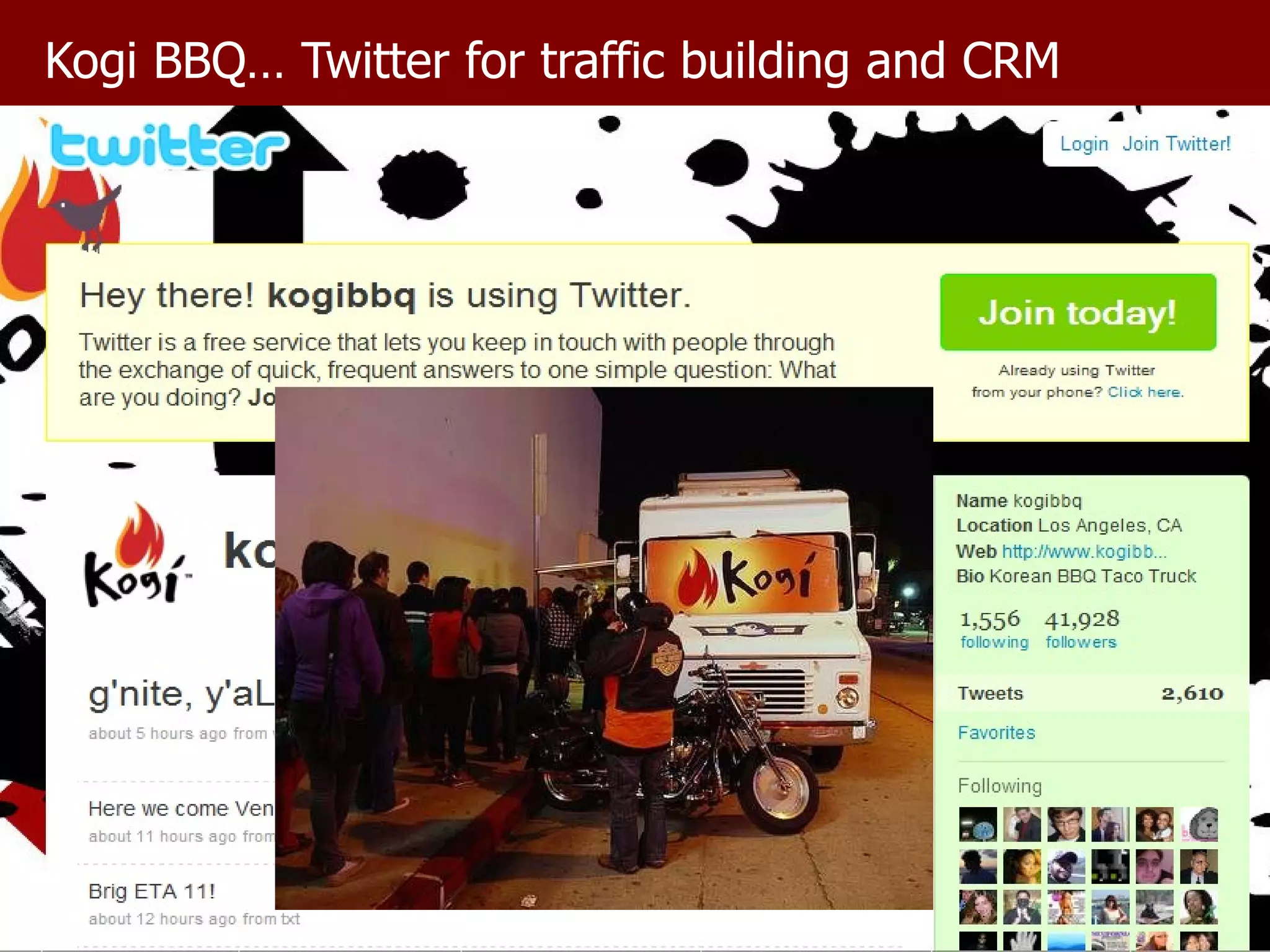
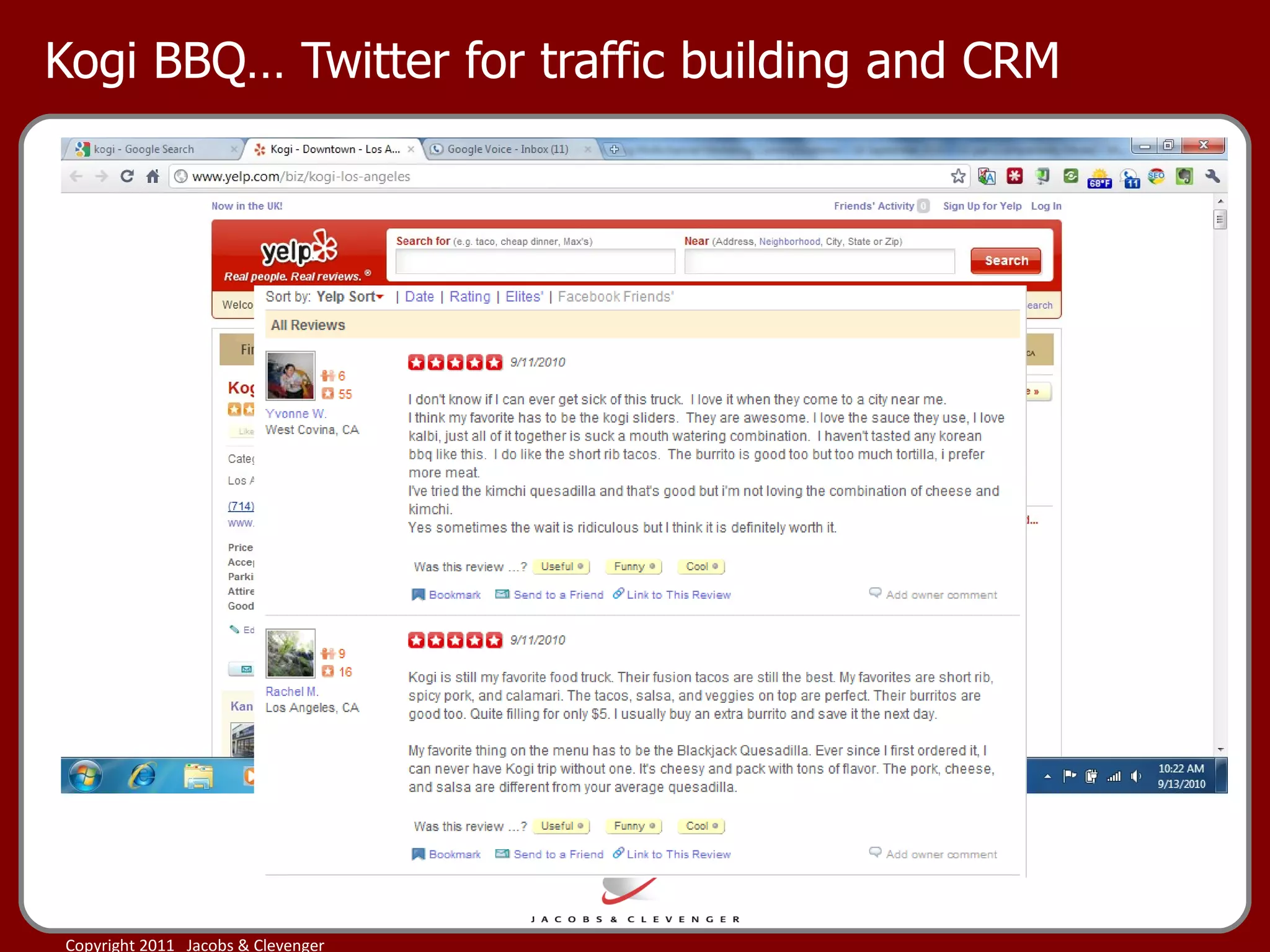
Kogi BBQ… Twitter for traffic building and CRM
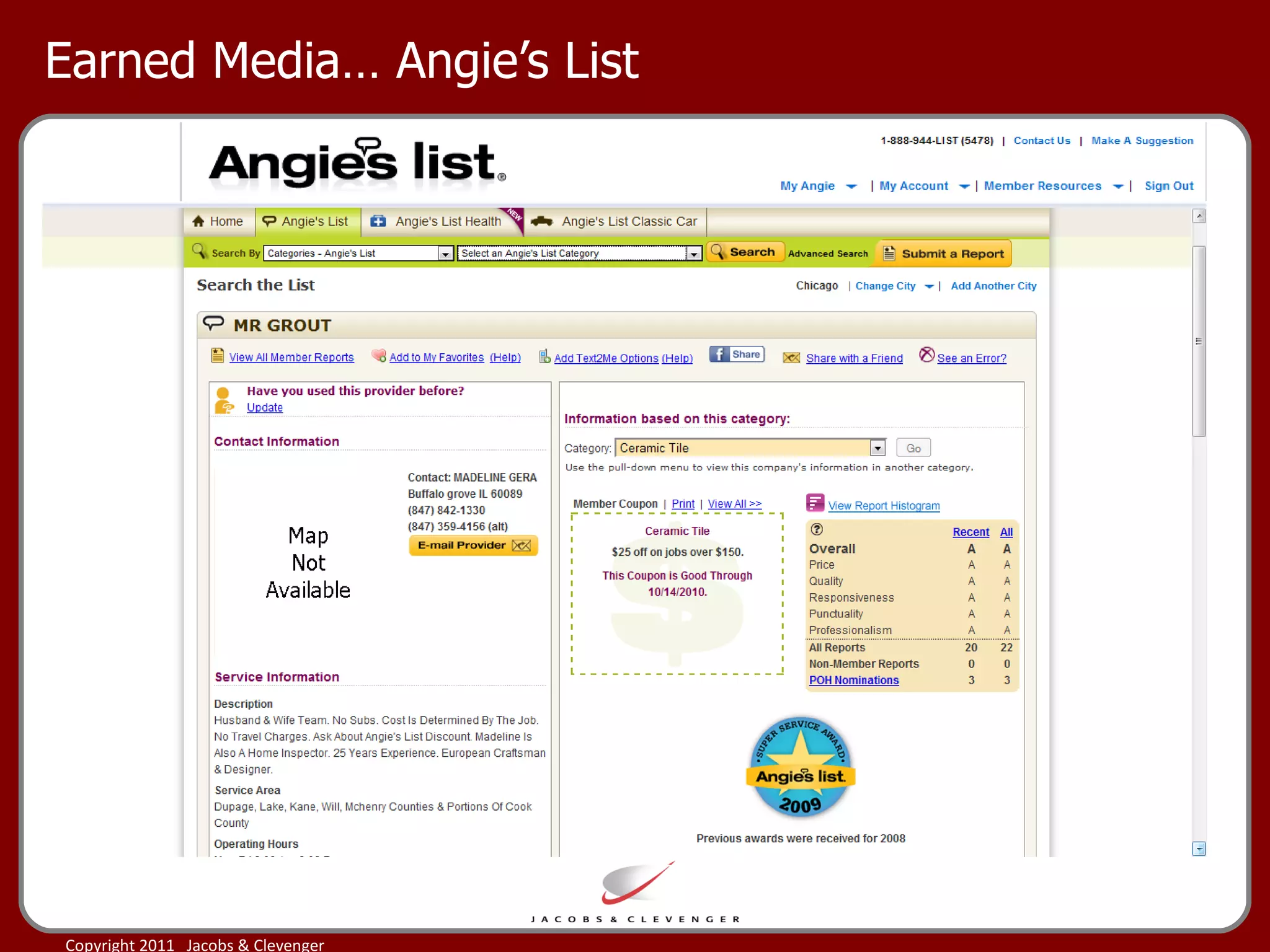
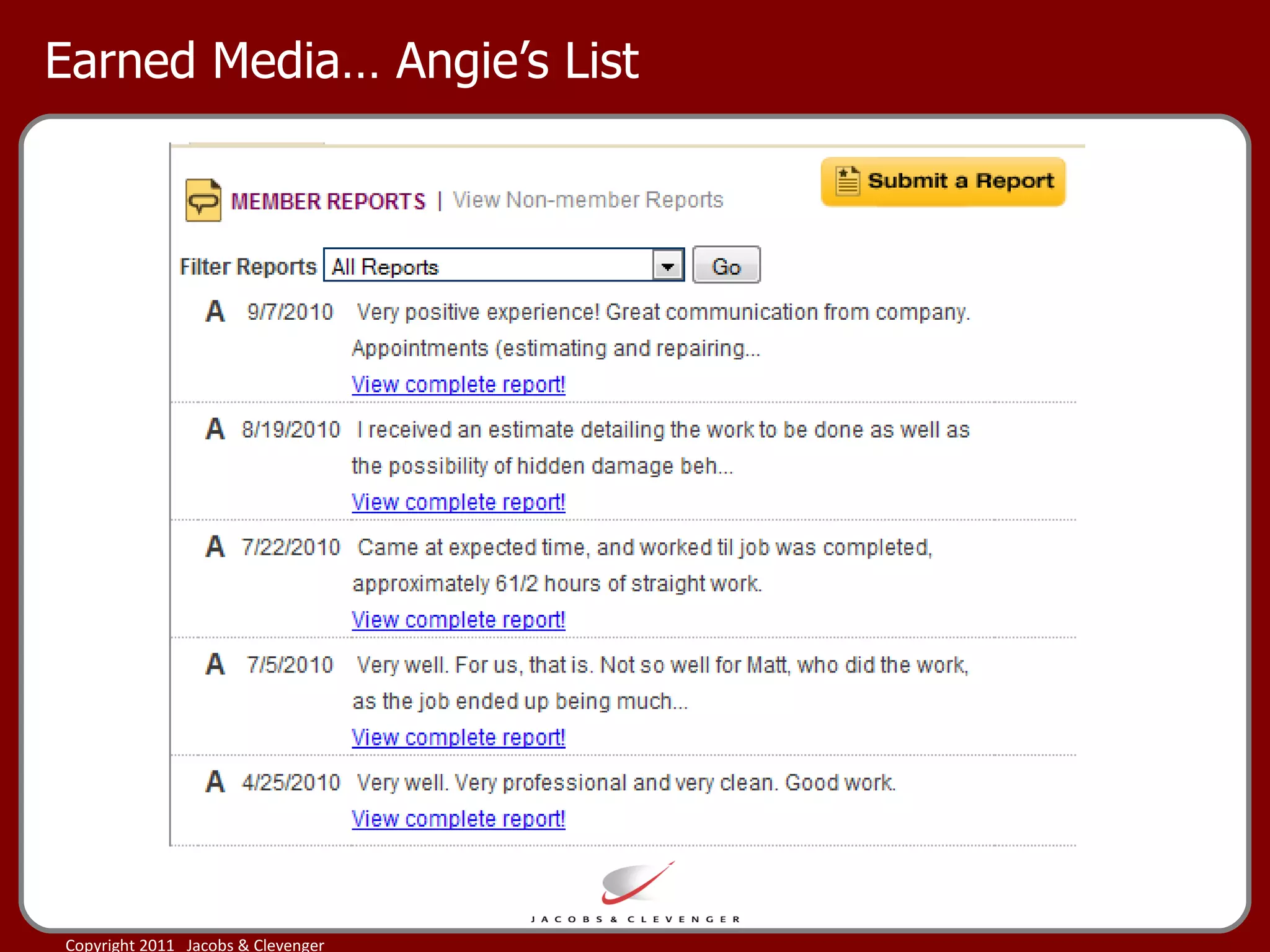
Earned Media… Angie’s List
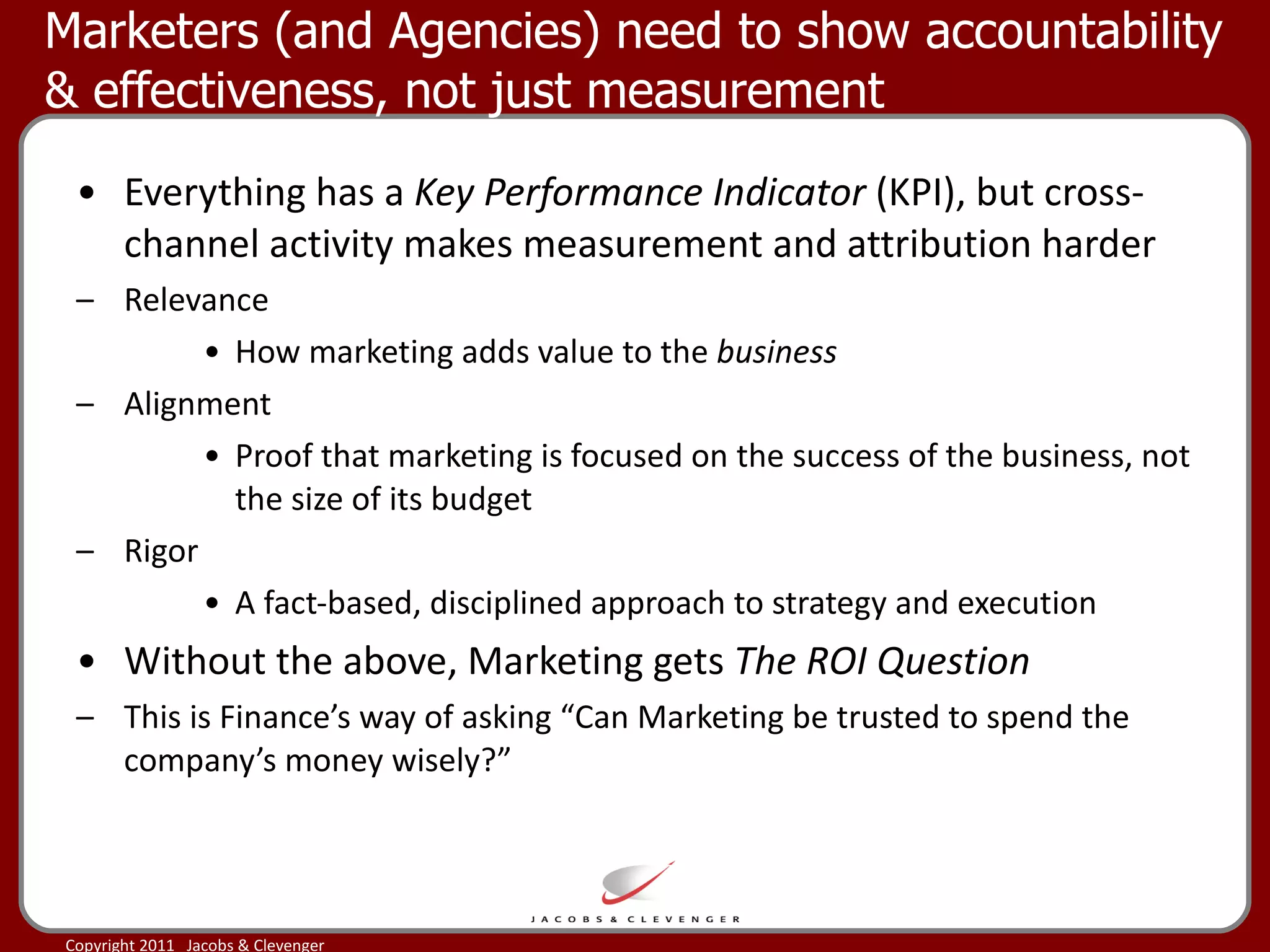
Marketers (and Agencies) need to show accountability & effectiveness, not just measurement  Everything has a  Key Performance Indicator  (KPI), but cross-channel activity makes measurement and attribution harder Relevance How marketing adds value to the  business  Alignment Proof that marketing is focused on the success of the business, not the size of its budget  Rigor A fact-based, disciplined approach to strategy and execution Without the above, Marketing gets  The ROI Question This is Finance’s way of asking “Can Marketing be trusted to spend the company’s money wisely?” 
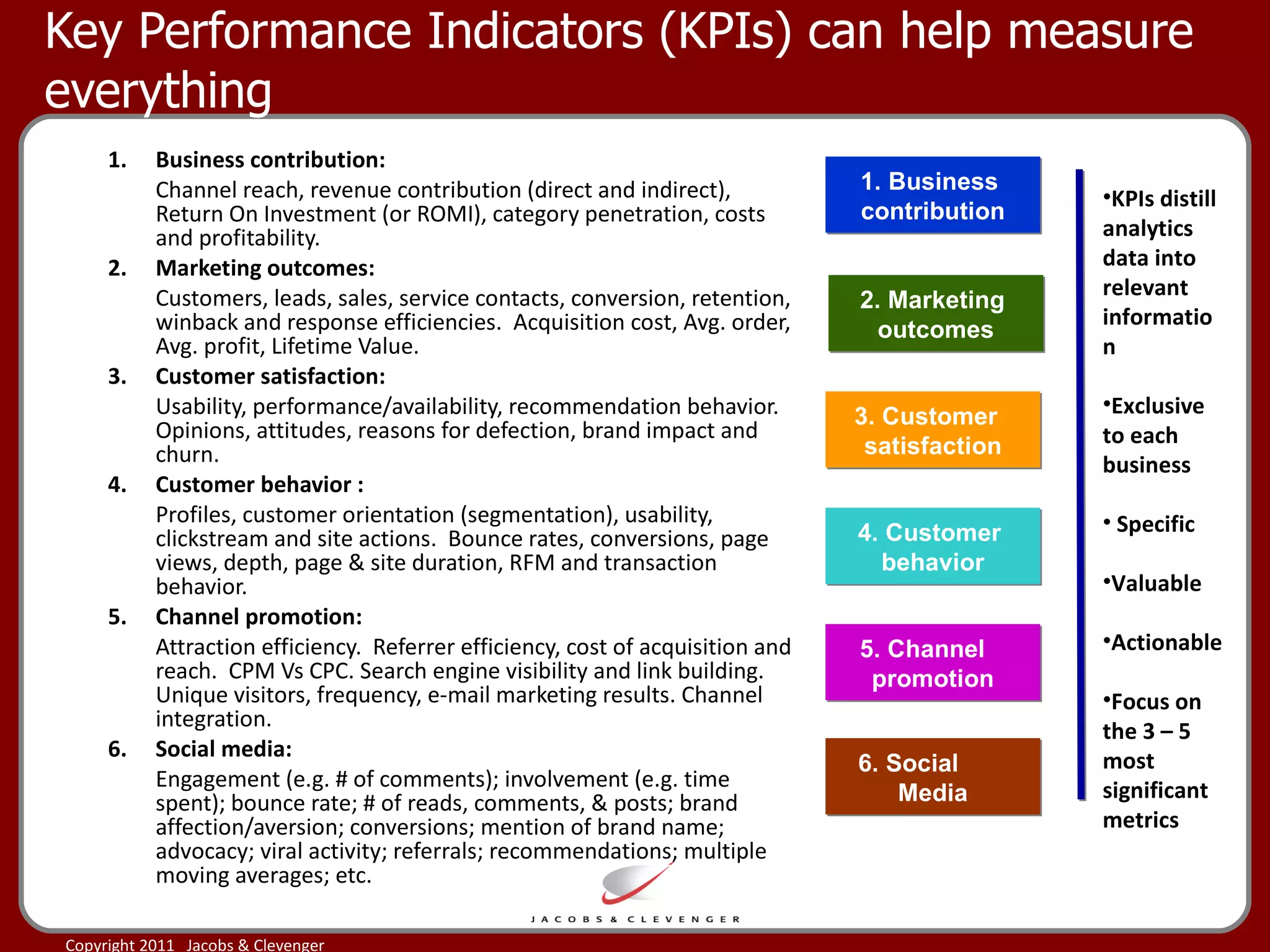
Key Performance Indicators (KPIs) can help measure everything 1. Business contribution: Channel reach, revenue contribution (direct and indirect), Return On Investment (or ROMI), category penetration, costs and profitability.  2. Marketing outcomes:  Customers, leads, sales, service contacts, conversion, retention, winback and response efficiencies.  Acquisition cost, Avg. order, Avg. profit, Lifetime Value.  3. Customer satisfaction: Usability, performance/availability, recommendation behavior.  Opinions, attitudes, reasons for defection, brand impact and churn. 4.  Customer behavior : Profiles, customer orientation (segmentation), usability, clickstream and site actions.  Bounce rates, conversions, page views, depth, page & site duration, RFM and transaction behavior.  5. Channel promotion: Attraction efficiency.  Referrer efficiency, cost of acquisition and reach.  CPM Vs CPC. Search engine visibility and link building. Unique visitors, frequency, e-mail marketing results. Channel integration. 6.  Social media: Engagement (e.g. # of comments); involvement (e.g. time spent); bounce rate; # of reads, comments, & posts; brand affection/aversion; conversions; mention of brand name; advocacy; viral activity; referrals; recommendations; multiple moving averages; etc. 1. Business  contribution 2. Marketing  outcomes 3. Customer  satisfaction 4. Customer  behavior 5. Channel  promotion 6. Social  Media KPIs distill analytics data into relevant information Exclusive to each business Specific Valuable Actionable Focus on the 3 – 5 most significant metrics
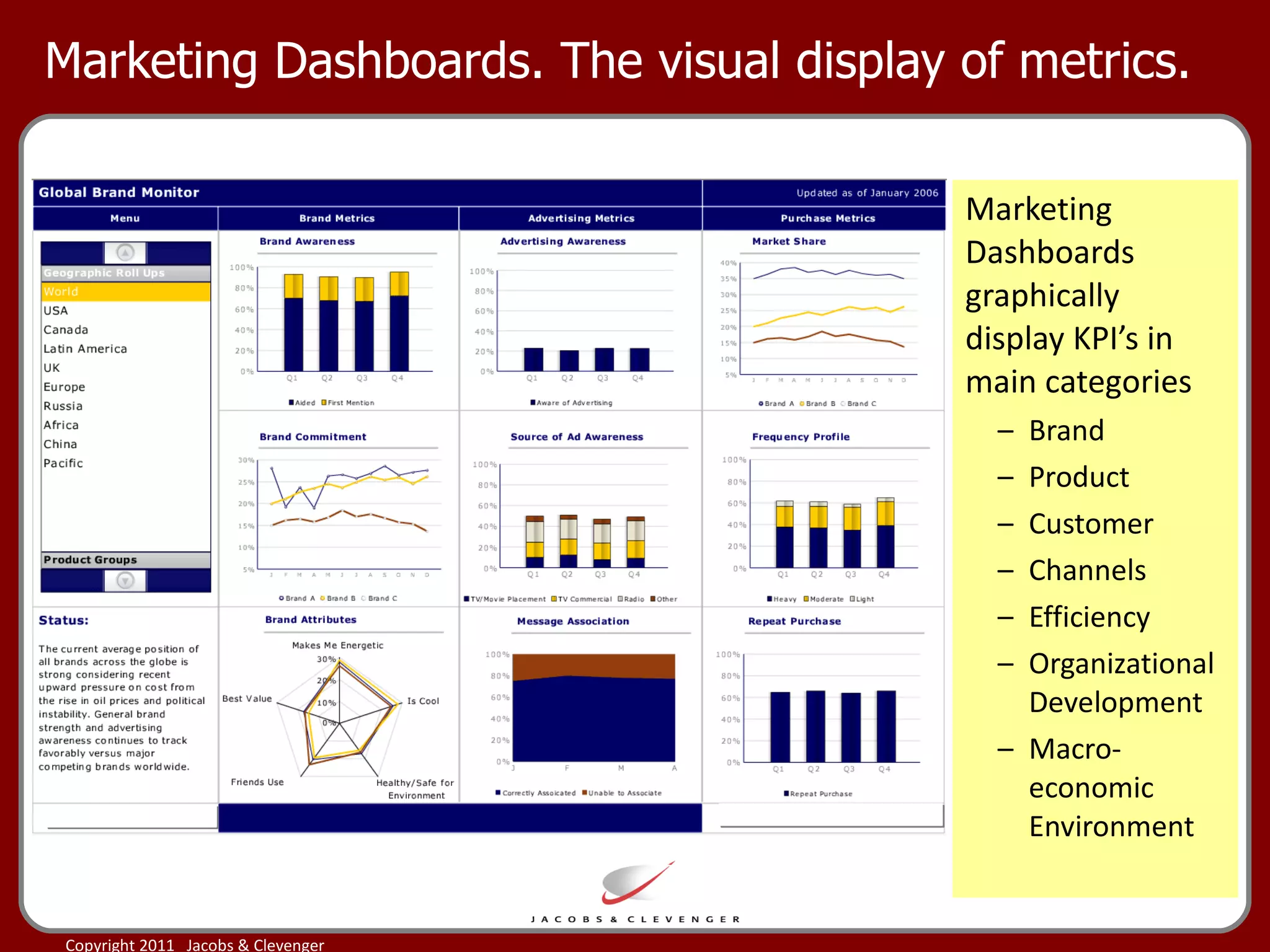
Marketing Dashboards. The visual display of metrics. Marketing Dashboards  graphically display KPI’s in main categories  Brand Product Customer Channels Efficiency Organizational Development Macro-economic Environment
Social Media It’s already being by brands to optimize marketing
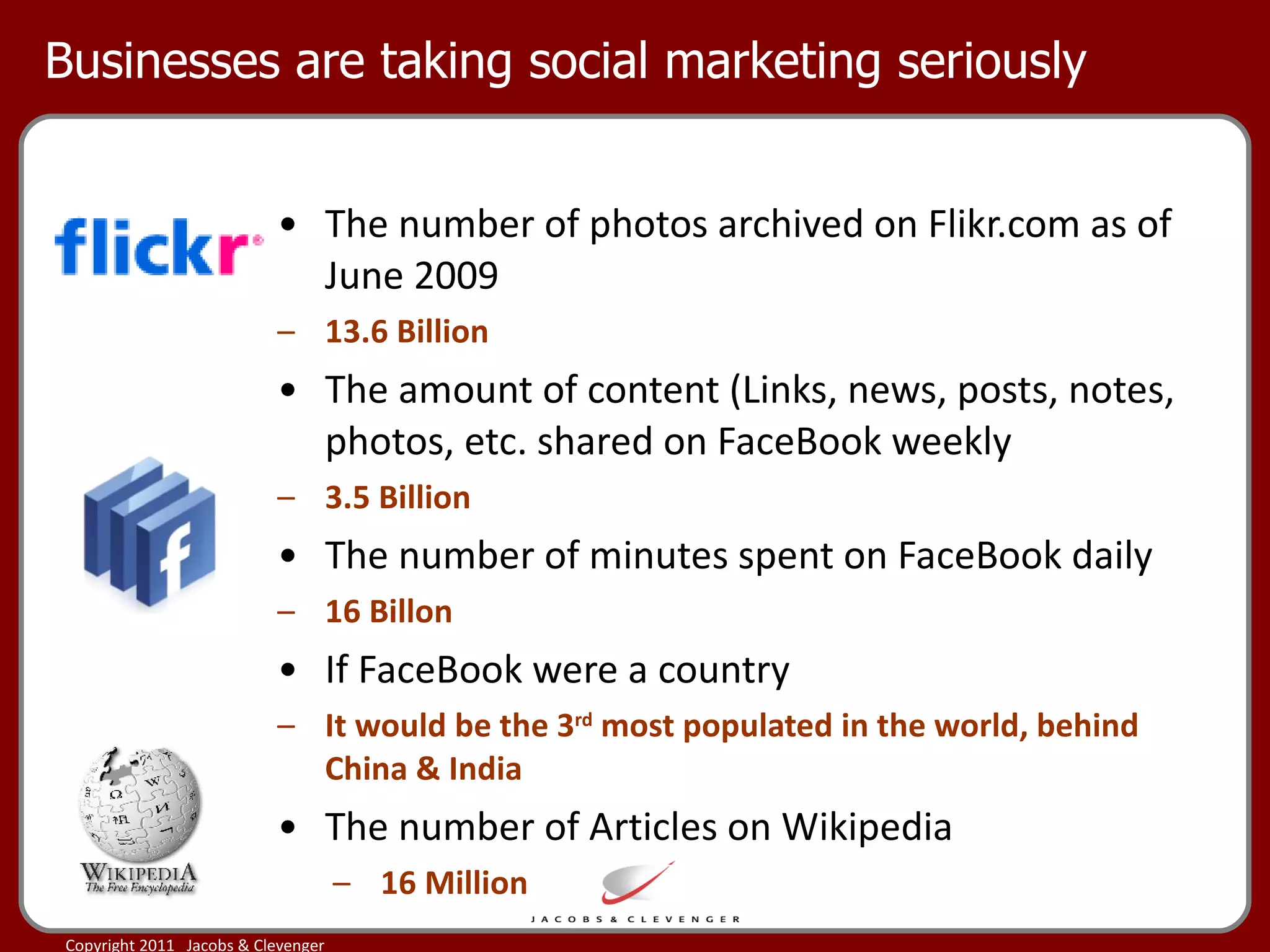
Businesses are taking social marketing seriously The number of photos archived on Flikr.com as of June 2009 13.6 Billion The amount of content (Links, news, posts, notes, photos, etc. shared on FaceBook weekly  3.5 Billion The number of minutes spent on FaceBook daily 16 Billon If FaceBook were a country It would be the 3 rd  most populated in the world, behind China & India The number of Articles on Wikipedia 16 Million
Businesses are taking social marketing seriously The amount of video uploaded to YouTube every minute 24 hours The amount of time it would take to view every video on YouTube 1,750 Years The number of YouTube videos viewed per day 2 Billion The average number of tweets on Twitter.com every day 65 Million
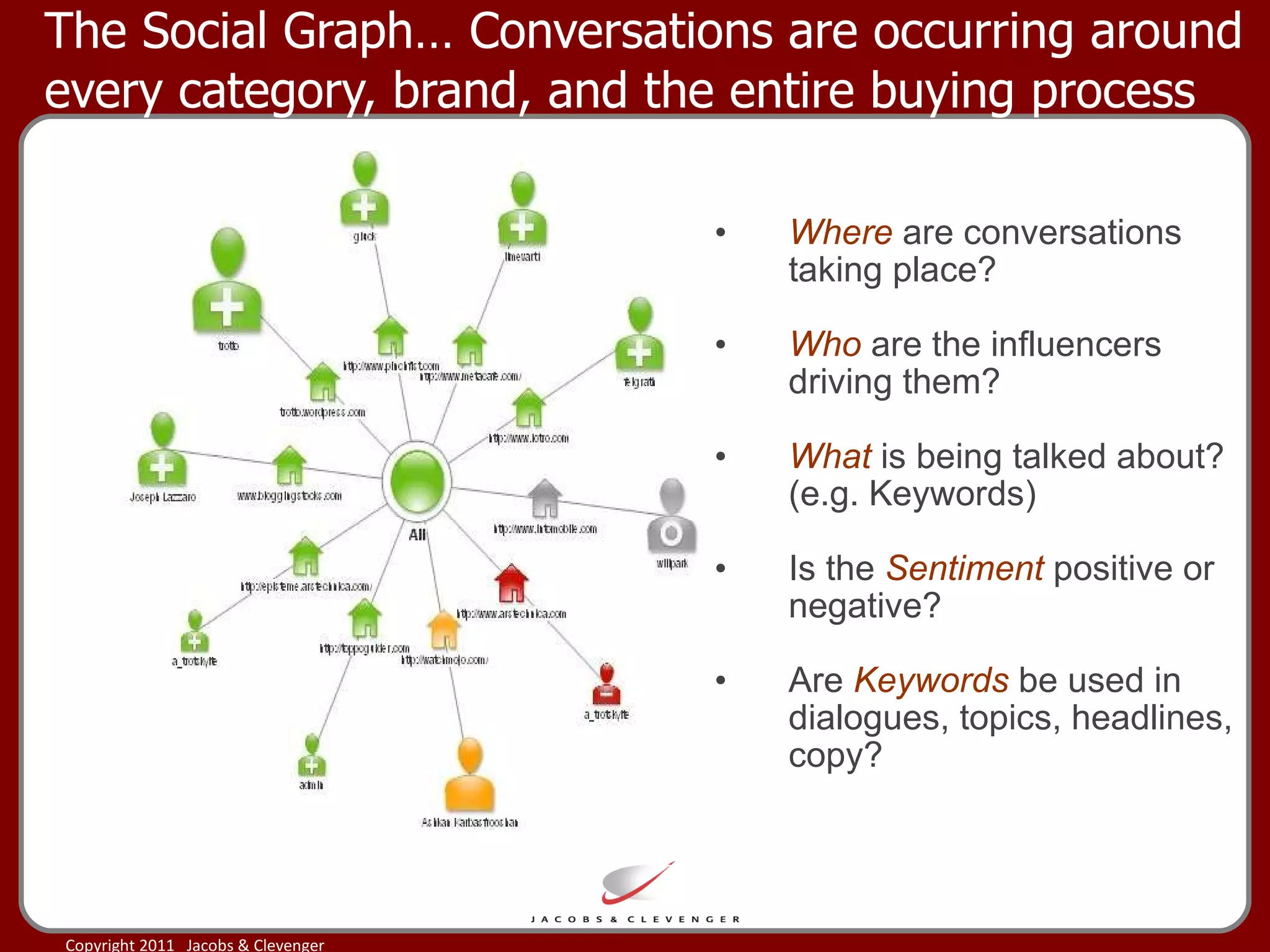
The Social Graph… Conversations are occurring around every category, brand, and the entire buying process Where  are conversations taking place? Who  are the influencers driving them? What  is being talked about? (e.g. Keywords) Is the  Sentiment  positive or negative? Are  Keywords  be used in dialogues, topics, headlines, copy?
Online data begins to unlock the riddle of prospects & customers  Social monitoring merges with Web analytics Alterian, Omniture, Coremetrics/IBM, Webtrends Technology like Hadoop makes it easy for companies to tap unlimited data E.g. New York Times making its archives public Twitter archived by Library of Congress Facebook Cassandra, Amazon Dynamo, Google BigTable Dashboards and data visualization tools make it easy to understand Balancing privacy and personalization
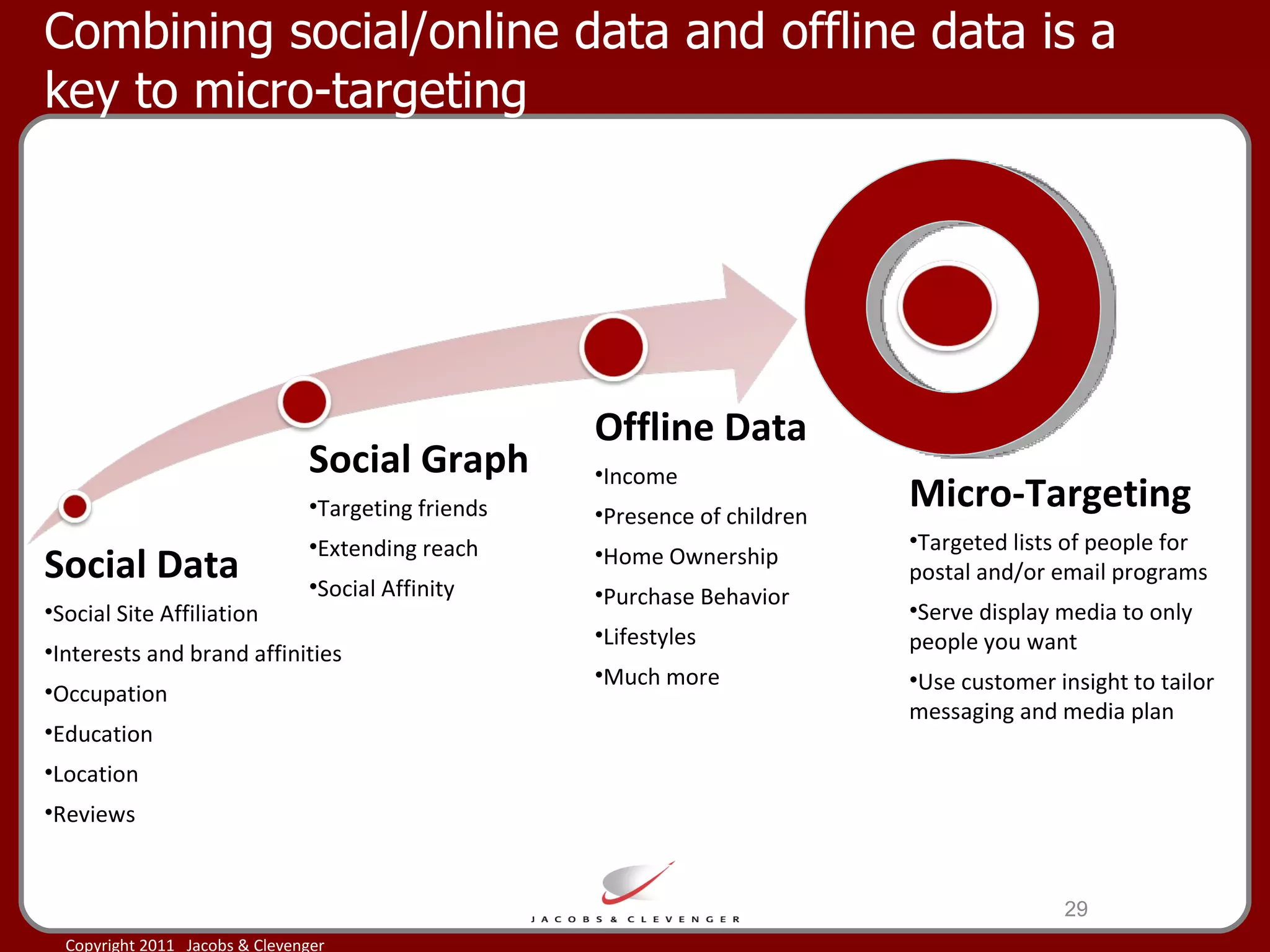
Combining social/online data and offline data is a key to micro-targeting Social Data Social Site Affiliation Interests and brand affinities Occupation Education Location Reviews Social Graph Targeting friends Extending reach Social Affinity Offline Data Income Presence of children Home Ownership Purchase Behavior Lifestyles Much more Micro-Targeting Targeted lists of people for postal and/or email programs Serve display media to only people you want Use customer insight to tailor messaging and media plan
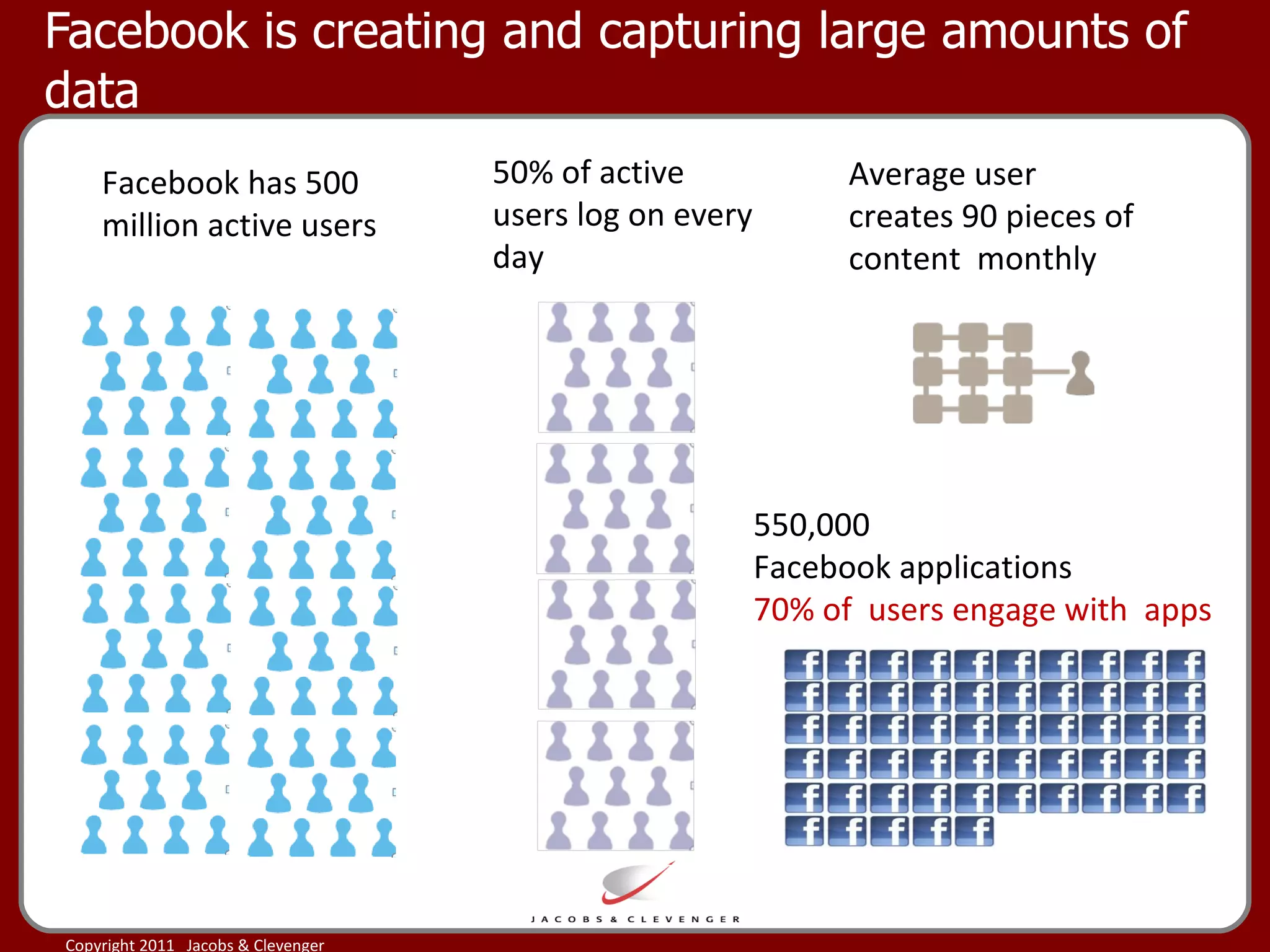
Facebook is creating and capturing large amounts of data Facebook has 500 million active users 50% of active users log on every day Average user creates 90 pieces of content  monthly 550,000  Facebook applications  70% of  users engage with  apps
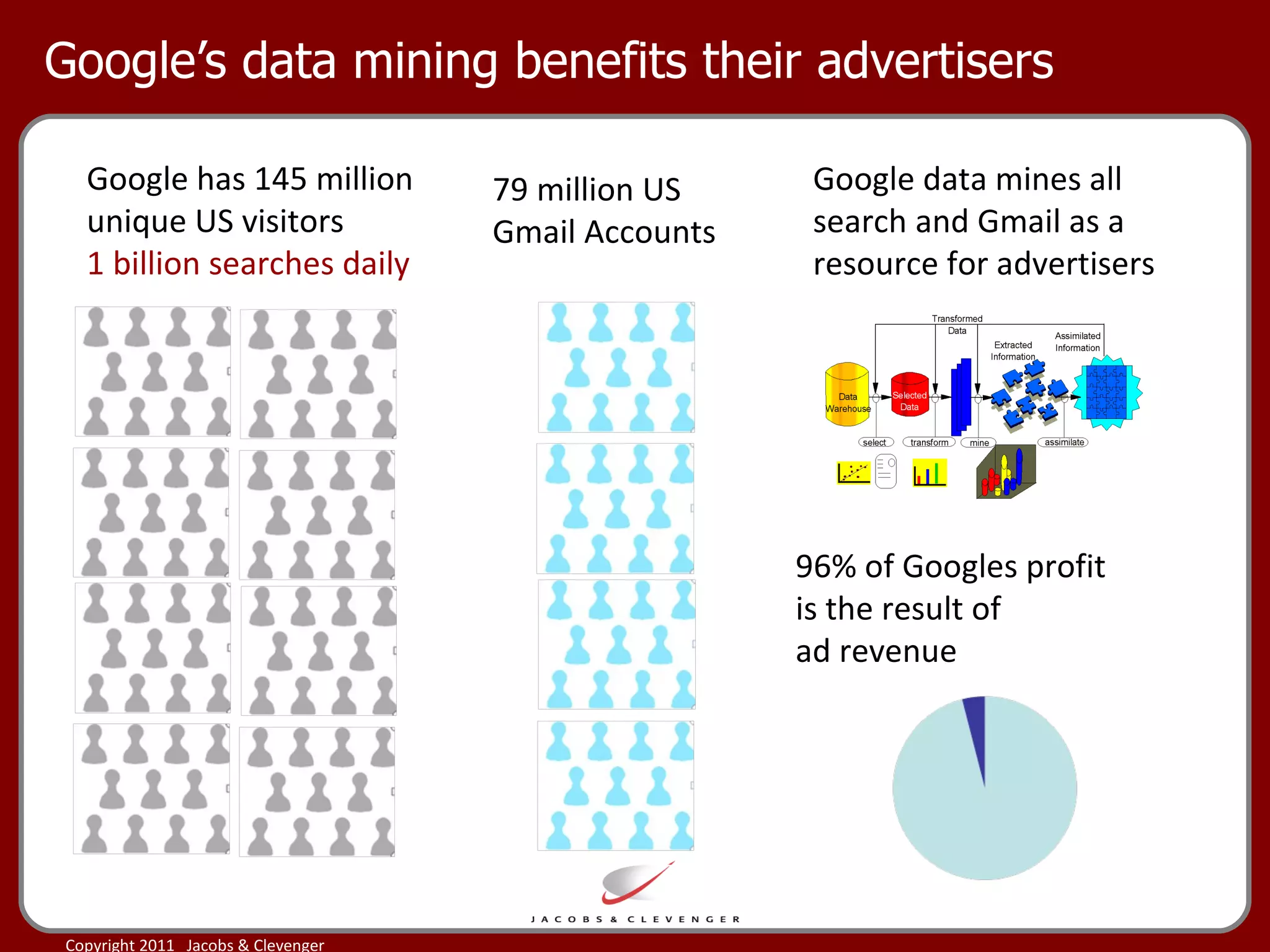
Google’s data mining benefits their advertisers 79 million US Gmail Accounts Google has 145 million unique US visitors 1 billion searches daily  Google data mines all search and Gmail as a resource for advertisers 96% of Googles profit is the result of  ad revenue
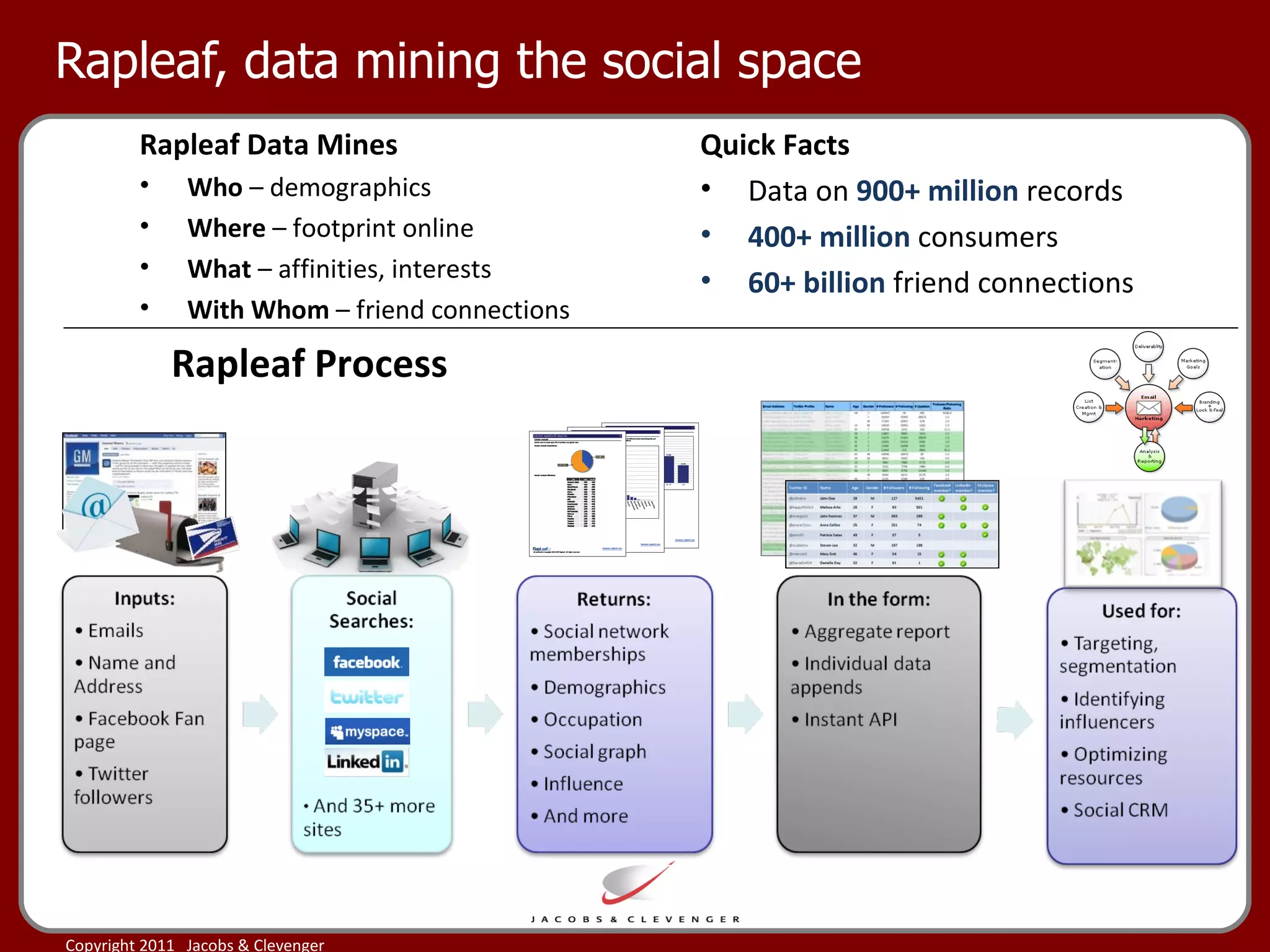
Rapleaf, data mining the social space Rapleaf Data Mines Who  – demographics Where  – footprint online What  – affinities, interests With Whom  – friend connections Rapleaf Process Quick Facts Data on  900+ million  records 400+ million  consumers 60+ billion  friend connections
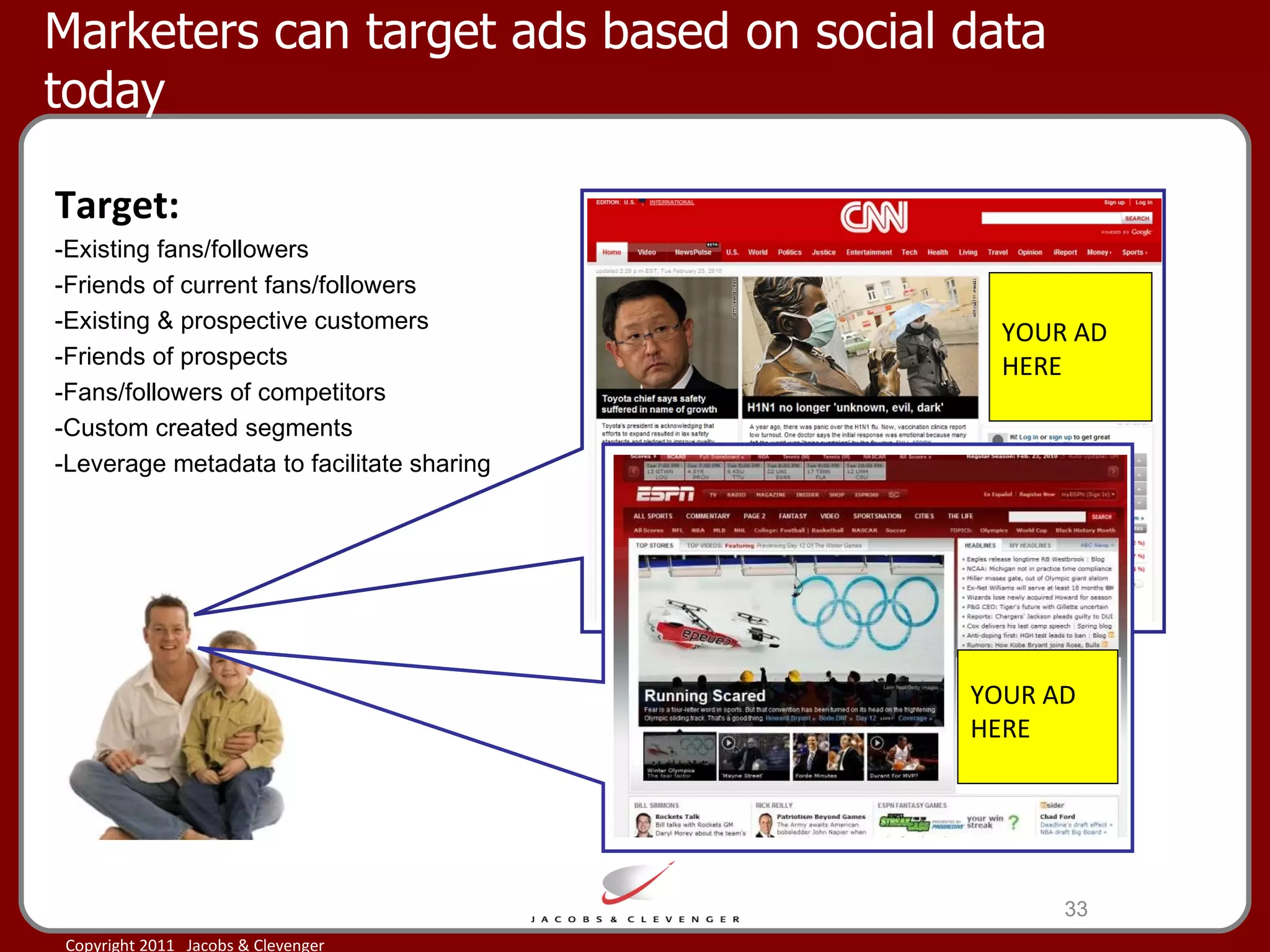
YOUR AD HERE YOUR AD HERE Marketers can target ads based on social data today Target: -Existing fans/followers -Friends of current fans/followers -Existing & prospective customers -Friends of prospects -Fans/followers of competitors -Custom created segments -Leverage metadata to facilitate sharing
Bringing Social Media Marketing to life  Alterian Buzz Bowl
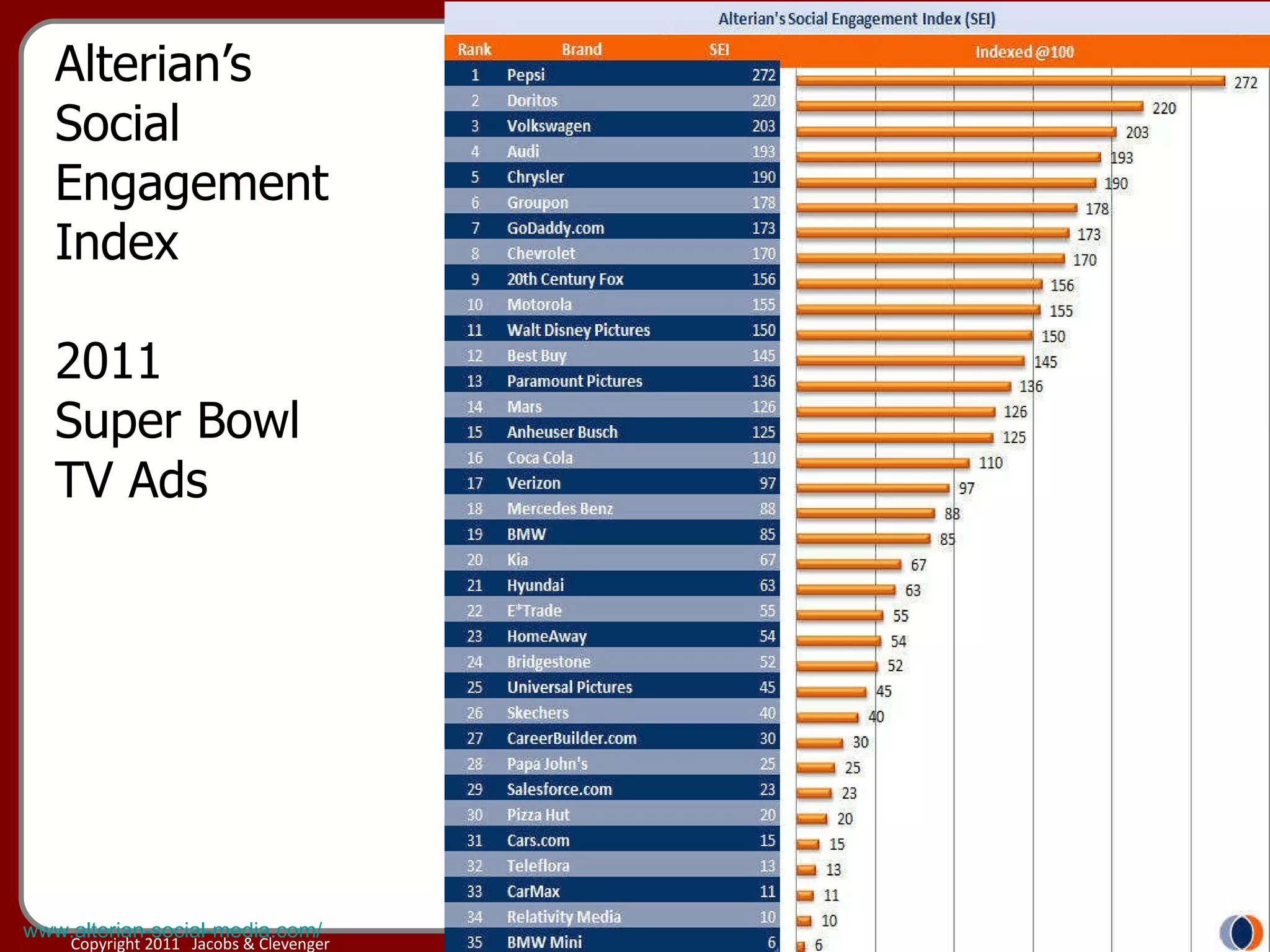
Alterian’s Social Engagement Index 2011 Super Bowl TV Ads www.alterian-social-media.com/
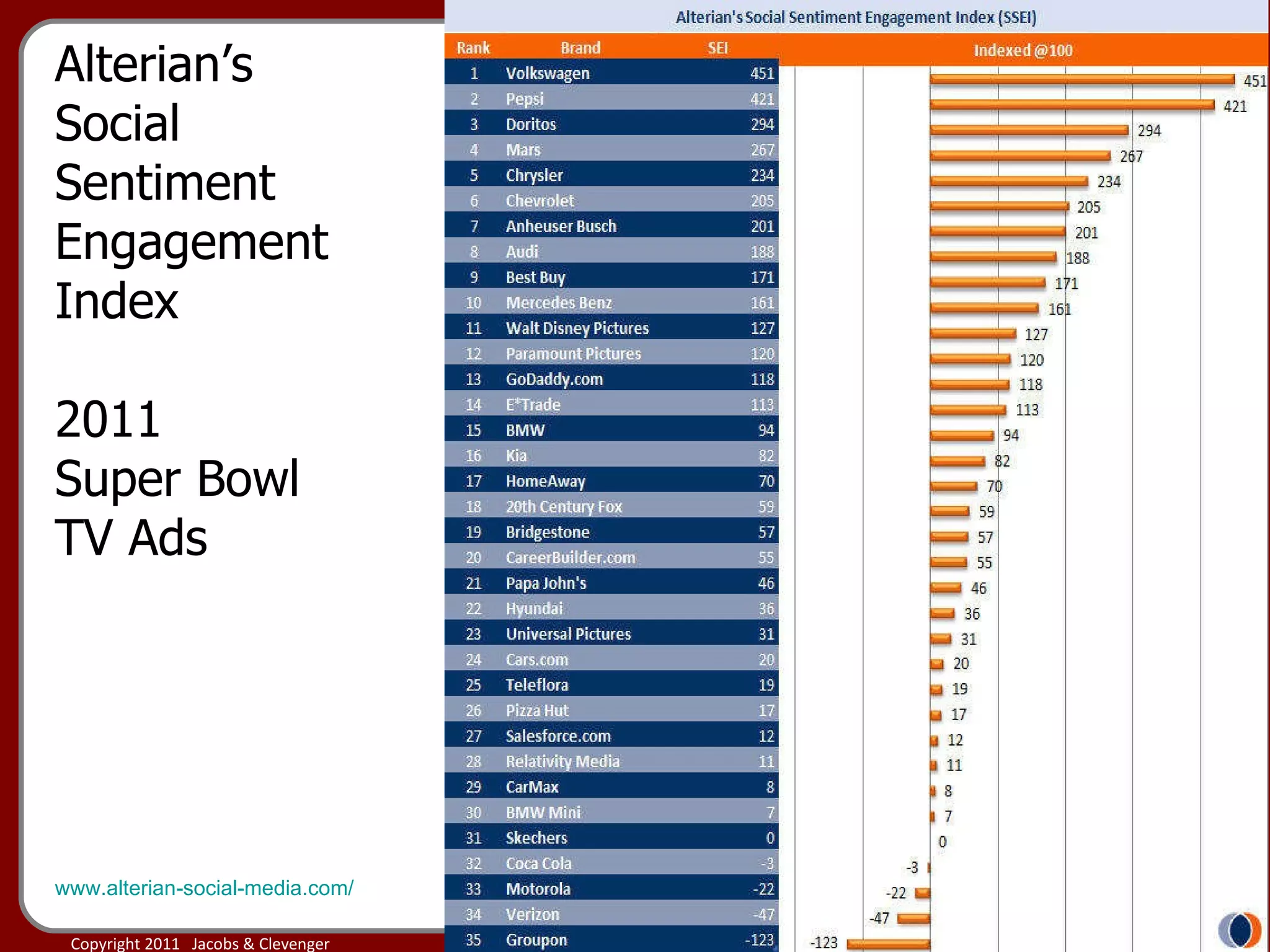
Alterian’s Social  Sentiment Engagement Index 2011 Super Bowl TV Ads www.alterian-social-media.com/
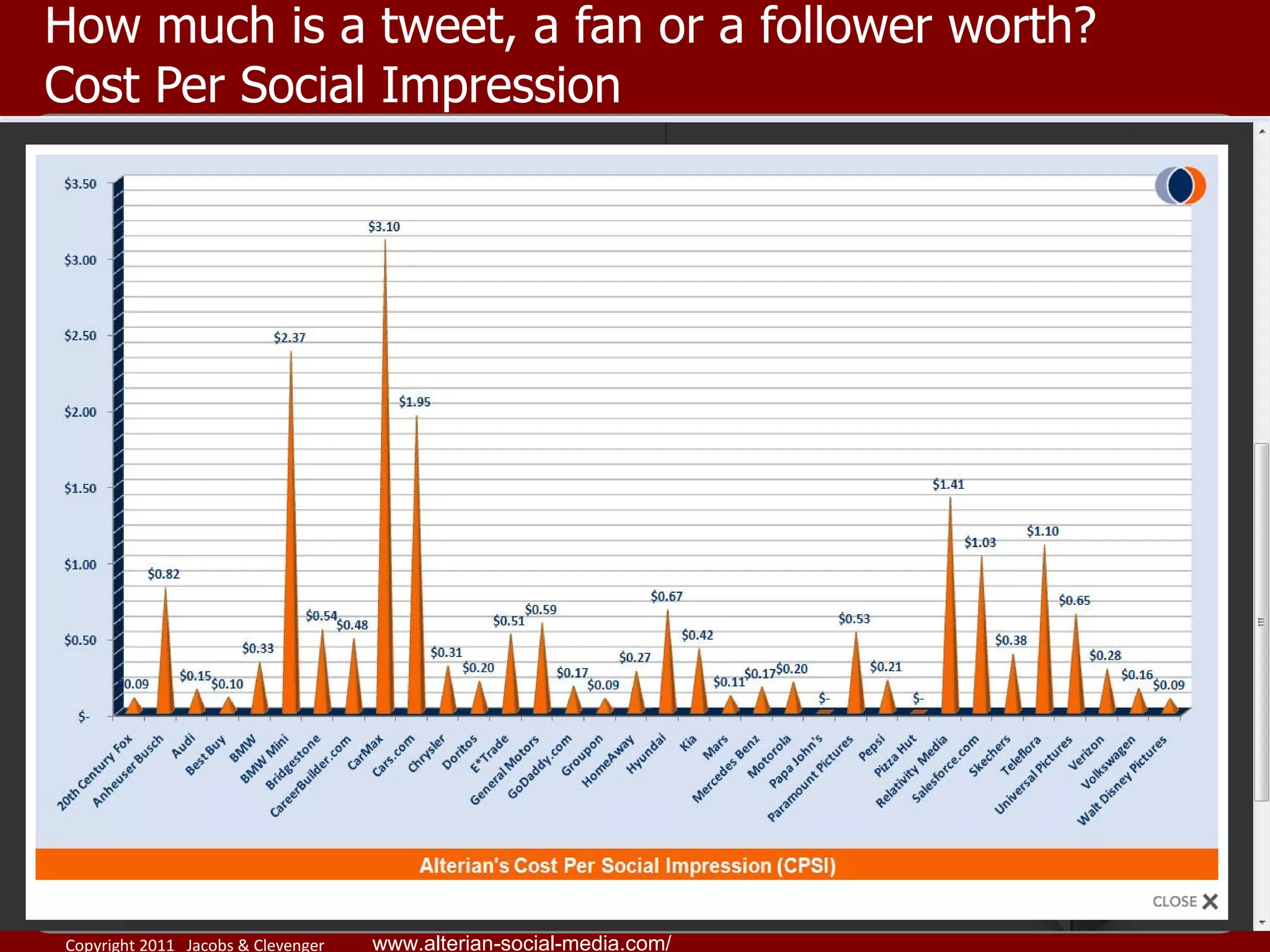
How much is a tweet, a fan or a follower worth?  Cost Per Social Impression www.alterian-social-media.com/
Ads effect Mobile as well, which is growing faster than predicted Mobile searches related to Chrysler, a Super Bowl advertiser, were 102 times higher after the ad was televised Desktop searches for Chrysler increased only 48 times  For GoDaddy.com, another Super Bowl advertiser, mobile searches for the brand were 315 times higher than usual Desktop searches were only 38 times higher There are 200 million plus YouTube mobile playbacks per day 78% of smartphone users shop on their device Apps Market… Apple leads with 82.7% share in 2010  (Forrester) Avg. cost of paid apps -- $2.43 $1.7 billion globally in 2010 $38 billion globally by 2015 Source: Google
Conclusions Direct Marketing, like all marketing, is effected by social media marketing Social Media Marketing is creating even more marketing data To prove marketing effectiveness, use a few KPI’s aligned with  organizational goals, which have indisputable rigor  Customer engagement is attributable to customer experience Relevancy is both earned and bought It’s not Push or Pull… It’s Push and Pull!!! “ If you don’t like change, you’re going to like irrelevance even less.”
Questions & Answers Questions?
Thank You! [email_address]

Is social media the new direct marketing - 3 march 2011 -- slideshare

  • 1.
    Ron Jacobs [email_address]Is Social Media Marketing the New Direct Marketing? Or, is Social Media just stealing our souls? A Presentation for direct mail? data? search? Email? web?
  • 2.
    Ron Jacobs President,Jacobs & Clevenger Co-Author, Successful Direct Marketing Methods Sponsor, Ron Jacobs & Bob Stone Multichannel Marketing Communications Certificate Program, DePaul University
  • 3.
    Agenda The needto redefine Direct Marketing Direct Marketing is Interactive, Interactive Marketing is Direct (Stan Rapp) How Direct Marketing and Social Media Marketing overlap How Social Media Marketing is creating data The importance of establishing Key Performance Indicators Explore attribution models for multichannel marketing communications http://vimeo.com/10251808
  • 4.
    Direct Marketing Howdo you define it?
  • 5.
    Direct marketing is a form of advertising that reaches its audience without using traditional formal channels of advertising, such as TV, newspapers or radio. Businesses communicate straight to the consumer with advertising techniques such as fliers, catalogue distribution, promotional letters, and street advertising. Direct Advertising is a sub-discipline and type of marketing . There are two main definitional characteristics which distinguish it from other types of marketing. The first is that it sends its message directly to consumers , without the use of intervening commercial communication media . The second characteristic is the core principle of successful Advertising driving a specific "call to action." This aspect of direct marketing involves an emphasis on trackable, measurable, positive responses from consumers (known simply as "response" in the industry) regardless of medium. If the advertisement asks the prospect to take a specific action, for instance call a free phone number or visit a Web site, then the effort is considered to be direct response advertising. Direct marketing is predominantly used by small to medium-size enterprises with limited advertising budgets that do not have a well-recognized brand message. A well-executed direct advertising campaign can offer a positive return on investment as the message is not hidden with overcomplicated branding. Instead, direct advertising is straight to the point; offers a product, service, or event; and explains how to get the offered product, service, or event.
  • 6.
    Most definitions ofDirect Marketing don’t reflect contemporary usage Ron J.’s definition Interactive use of advertising media, to stimulate an (immediate) behavior modification, in such a way that this behavior can be tracked recorded and analyzed, then stored in a database for future retrieval and use Larry Kimmel’s definition (Pres. DMA) The channel agnostic approach to driving maximum customer satisfaction and optimal marketplace results DMA’s definition An organized and planned system of contacts Using a variety of media Seeking to produce a lead or an order Developing and maintaining a database Measurable in cost and results Expandable with confidence
  • 7.
    Bob Stone didn’ttry to define Direct Marketing, so much as describe what it does
  • 8.
    We can agreeon many aspects of what Direct Marketing Strategies should include Use of (multiple) channels for communication and response Segment customers Demographics, psychographics, behavior, proximity, etc. Individually addressable communications Focused content, discrete offers, calls to action Relevant interactions Response, conversion, leads, etc. Create sustainable relationships Beyond likes, fans, friends and followers Capture, analyze and use data Measureable and scalable results Lifetime value, ROMI, business centric goals, best practices
  • 9.
    So, how isSocial Media Marketing different than Direct Marketing? Multiple, individual voices that choose to engage Conversational tone Not controlled by the brand Transparent & searchable Users choose touch points Unique to the personality of prospects & customers Meets brand objectives Partial customer engagement Evaluate advocates, influentials Customers and prospects are targeted Communications & tone are controlled by the brand Single, outbound voice Across all touch points Reflects the personality of the brand Meets business objectives Full customer engagement Evaluate with analytics Direct Marketing Social Media Marketing
  • 10.
    New thinking, anew lexicon. Not campaigns… curation Not ads… dialogues. Not awareness & interest… behavior. Reputation Sentiment Experience Collaboration Engagement Relevance Authenticity Transparency Accountability Agility Behavior Like, Friend Curation Immersion Emotion Brand Consumer
  • 11.
    Curation enables consumersto become collaborators
  • 12.
    Media Vs ChannelsIt’s about effectiveness, not efficiency
  • 13.
    Channels work together,but play their own roles
  • 14.
  • 15.
    Crispin Porter +Bogusky’s Social Home Page
  • 16.
    Owned Media …A Brand Channel
  • 17.
    Kogi BBQ… Twitterfor traffic building and CRM
  • 18.
    Kogi BBQ… Twitterfor traffic building and CRM
  • 19.
  • 20.
  • 21.
    Marketers (and Agencies)need to show accountability & effectiveness, not just measurement Everything has a Key Performance Indicator (KPI), but cross-channel activity makes measurement and attribution harder Relevance How marketing adds value to the business Alignment Proof that marketing is focused on the success of the business, not the size of its budget Rigor A fact-based, disciplined approach to strategy and execution Without the above, Marketing gets The ROI Question This is Finance’s way of asking “Can Marketing be trusted to spend the company’s money wisely?” 
  • 22.
    Key Performance Indicators(KPIs) can help measure everything 1. Business contribution: Channel reach, revenue contribution (direct and indirect), Return On Investment (or ROMI), category penetration, costs and profitability. 2. Marketing outcomes: Customers, leads, sales, service contacts, conversion, retention, winback and response efficiencies. Acquisition cost, Avg. order, Avg. profit, Lifetime Value. 3. Customer satisfaction: Usability, performance/availability, recommendation behavior. Opinions, attitudes, reasons for defection, brand impact and churn. 4. Customer behavior : Profiles, customer orientation (segmentation), usability, clickstream and site actions. Bounce rates, conversions, page views, depth, page & site duration, RFM and transaction behavior. 5. Channel promotion: Attraction efficiency. Referrer efficiency, cost of acquisition and reach. CPM Vs CPC. Search engine visibility and link building. Unique visitors, frequency, e-mail marketing results. Channel integration. 6. Social media: Engagement (e.g. # of comments); involvement (e.g. time spent); bounce rate; # of reads, comments, & posts; brand affection/aversion; conversions; mention of brand name; advocacy; viral activity; referrals; recommendations; multiple moving averages; etc. 1. Business contribution 2. Marketing outcomes 3. Customer satisfaction 4. Customer behavior 5. Channel promotion 6. Social Media KPIs distill analytics data into relevant information Exclusive to each business Specific Valuable Actionable Focus on the 3 – 5 most significant metrics
  • 23.
    Marketing Dashboards. Thevisual display of metrics. Marketing Dashboards graphically display KPI’s in main categories Brand Product Customer Channels Efficiency Organizational Development Macro-economic Environment
  • 24.
    Social Media It’salready being by brands to optimize marketing
  • 25.
    Businesses are takingsocial marketing seriously The number of photos archived on Flikr.com as of June 2009 13.6 Billion The amount of content (Links, news, posts, notes, photos, etc. shared on FaceBook weekly 3.5 Billion The number of minutes spent on FaceBook daily 16 Billon If FaceBook were a country It would be the 3 rd most populated in the world, behind China & India The number of Articles on Wikipedia 16 Million
  • 26.
    Businesses are takingsocial marketing seriously The amount of video uploaded to YouTube every minute 24 hours The amount of time it would take to view every video on YouTube 1,750 Years The number of YouTube videos viewed per day 2 Billion The average number of tweets on Twitter.com every day 65 Million
  • 27.
    The Social Graph…Conversations are occurring around every category, brand, and the entire buying process Where are conversations taking place? Who are the influencers driving them? What is being talked about? (e.g. Keywords) Is the Sentiment positive or negative? Are Keywords be used in dialogues, topics, headlines, copy?
  • 28.
    Online data beginsto unlock the riddle of prospects & customers Social monitoring merges with Web analytics Alterian, Omniture, Coremetrics/IBM, Webtrends Technology like Hadoop makes it easy for companies to tap unlimited data E.g. New York Times making its archives public Twitter archived by Library of Congress Facebook Cassandra, Amazon Dynamo, Google BigTable Dashboards and data visualization tools make it easy to understand Balancing privacy and personalization
  • 29.
    Combining social/online dataand offline data is a key to micro-targeting Social Data Social Site Affiliation Interests and brand affinities Occupation Education Location Reviews Social Graph Targeting friends Extending reach Social Affinity Offline Data Income Presence of children Home Ownership Purchase Behavior Lifestyles Much more Micro-Targeting Targeted lists of people for postal and/or email programs Serve display media to only people you want Use customer insight to tailor messaging and media plan
  • 30.
    Facebook is creatingand capturing large amounts of data Facebook has 500 million active users 50% of active users log on every day Average user creates 90 pieces of content monthly 550,000 Facebook applications 70% of users engage with apps
  • 31.
    Google’s data miningbenefits their advertisers 79 million US Gmail Accounts Google has 145 million unique US visitors 1 billion searches daily Google data mines all search and Gmail as a resource for advertisers 96% of Googles profit is the result of ad revenue
  • 32.
    Rapleaf, data miningthe social space Rapleaf Data Mines Who – demographics Where – footprint online What – affinities, interests With Whom – friend connections Rapleaf Process Quick Facts Data on 900+ million records 400+ million consumers 60+ billion friend connections
  • 33.
    YOUR AD HEREYOUR AD HERE Marketers can target ads based on social data today Target: -Existing fans/followers -Friends of current fans/followers -Existing & prospective customers -Friends of prospects -Fans/followers of competitors -Custom created segments -Leverage metadata to facilitate sharing
  • 34.
    Bringing Social MediaMarketing to life Alterian Buzz Bowl
  • 35.
    Alterian’s Social EngagementIndex 2011 Super Bowl TV Ads www.alterian-social-media.com/
  • 36.
    Alterian’s Social Sentiment Engagement Index 2011 Super Bowl TV Ads www.alterian-social-media.com/
  • 37.
    How much isa tweet, a fan or a follower worth? Cost Per Social Impression www.alterian-social-media.com/
  • 38.
    Ads effect Mobileas well, which is growing faster than predicted Mobile searches related to Chrysler, a Super Bowl advertiser, were 102 times higher after the ad was televised Desktop searches for Chrysler increased only 48 times For GoDaddy.com, another Super Bowl advertiser, mobile searches for the brand were 315 times higher than usual Desktop searches were only 38 times higher There are 200 million plus YouTube mobile playbacks per day 78% of smartphone users shop on their device Apps Market… Apple leads with 82.7% share in 2010 (Forrester) Avg. cost of paid apps -- $2.43 $1.7 billion globally in 2010 $38 billion globally by 2015 Source: Google
  • 39.
    Conclusions Direct Marketing,like all marketing, is effected by social media marketing Social Media Marketing is creating even more marketing data To prove marketing effectiveness, use a few KPI’s aligned with organizational goals, which have indisputable rigor Customer engagement is attributable to customer experience Relevancy is both earned and bought It’s not Push or Pull… It’s Push and Pull!!! “ If you don’t like change, you’re going to like irrelevance even less.”
  • 40.
  • 41.

Editor's Notes

  • #5 Users increasingly prefer different channels for different types of messages e.g. A phone app for checking airline schedules, web site for making reservations, SMS for flight delay notifications, email for upgrade and mileage status and Facebook feed for airline promotions. Each channels role in the marketing mix becomes clearer Channels have specific roles and message types Clarity allows marketers to better focus content creation on more meaningful messages; measure and evaluate success, and better communicate each channels benefits to management
  • #11 For years, marketers have tried to build awareness, create perceptions, brand identities, position products, create stories, spin ideas, etc. What marketers wanted were actions that would lead to conversions from within their audiences Unless they induce behavior, communications do not result in sales Deliver relevant, compelling and timely messages to drive behavior Buyers don’t know what they want until they see it in context People focus on the relative advantage of one thing over another Communications must engage, nurture and provoke prospect & customer behavior It’s an era of co-innovation & collaboration leading to customer engagement
  • #13 Users increasingly prefer different channels for different types of messages e.g. A phone app for checking airline schedules, web site for making reservations, SMS for flight delay notifications, email for upgrade and mileage status and Facebook feed for airline promotions. Each channels role in the marketing mix becomes clearer Channels have specific roles and message types Clarity allows marketers to better focus content creation on more meaningful messages; measure and evaluate success, and better communicate each channels benefits to management
  • #14 Create a solar system of owned media.  Owned media is a channel you control. There is fully-owned media (like your website) and partially-owned media (like Facebook fan page or Twitter account). Owned media creates brand portability. Now you can extend your brand's presence beyond your web site so that it exists in many places across the web - specifically through social media sites and unique communities. In a recession in which marketing budgets are being cut by 20%, the ability to communicate directly with consumers who  want  to engage with your brand through long-term relationships can be invaluable.   Recognize that earned media is a result of brand behavior.  "Earned media" is an old PR term that essentially meant getting your brand into free media rather than having to pay for it through advertising. However the term has evolved into the transparent and permanent word-of-mouth that is being created through social media. You need to learn how to listen and respond to both the good (positive organic) and bad (spurned) as well as consider when to try and stimulate earned media through word-of-mouth marketing. Paid media is not dead, but it is evolving into a catalyst.  Many people are predicting the end of paid media (aka advertising). However, that prediction may be premature as no other type of media can guarantee the immediacy and scale that paid media can. However, paid media is shifting away from the foundation and evolving into a catalyst that is needed at key periods to drive more engagement(e.g. Q4 holidays).
  • #23 1. Business contribution These are effectiveness measures comparing the performance of the online channel with other channels. Examples: • Online revenue contribution ($, %) – direct and indirect (i.e. transacted online and referred online from offline); • Online profit contribution ($, %) – Profit contribution to the company in the period; • Online sales transaction contribution (n, %) – direct and indirect (% sales online may differ considerably from % revenue or profit contribution if there is a different average order value or profitability online); • Online service transaction contribution (n, %, $) – what percentage of different types of customer service occur online. Cost savings can be calculated for these also; • Online reach % – Share of online users attracted to the site in an industry category in a week or month assessed by services such as Hitwise or Netratings. Strictly, reach should be assessed through reaching customers via third party sites; • Online market share – % of online market revenue captured in comparison with offline. This is difficult to establish in some markets, dependent on industry collaboration; • Online customer migration – % of existing customers using online services. 2. Marketing outcomes: • Sales (n, $) (If relevant); • Leads (n) (registrations of other opportunities to sell); • Cost per Acquisition (CPA) – Promotional cost of obtaining a first time sale; • Other costs – Cost of good sold and average margin. Cost of service; • Average order value (Basket size); • Lifetime value ($) for different customer groups; • Average touch frequency – for example, for e-mail marketing. 3. Customer satisfaction: • Customer satisfaction and loyalty indices; • Number of comments from site and e-mail (% favorable and unfavorable); • Brand metrics (brand favorability); • Site performance and availability; • E-mail enquiry response time and accuracy. 4. Customer behavior: • Site engagement rates (Bounce rates overall and for different pages); • Site conversion rates (Visit to Sale, Visit to opportunity and Opportunity to Sale); • E-mail conversion rates (Newsletter and campaign related); • Visits involving a page view in different categories (Product pages, Service pages, Where to Buy, Contact Us). Visits / customers can be scored according to this; • Visits to purchase/Time to purchase – indication of number of visits involved with purchase; • Number of products purchased per customer; • Transaction behavior (Recency, Frequency, Monetary value analysis for different categories and customer types). RF analysis also relevant for site visits, e-mail response and different service types; • Activity or participation levels (Percentage of customer base / registrations who are actively using online service(s)). nActivated, nActive, nDormant, nLapsed, etc.; • Loyalty or churn metrics (% of customers repeat purchasing in given time, e.g. 1 year). 5. Channel promotion: • Referrer mix from different sources (direct, search, affiliates, etc); • Share of search (main terms within market); • Cost Per Click/Cost Per Contact (Visitors) average and CPM average for online/offline ads. 6. Social Media A variety of measures that quantify some very soft measurements. This is state of the art just now.
  • #28 Learn Who the key influencers are Demographics, psychographics, specifics Create a dialogue with influencers to engage them Learn What is being talked about Including themes, tags, specific words Use these words in your own conversations, copy, keywords, etc. Learn consumers Mood . Are they positive or negative. What is the trend? Sentiment is an important behavioral and economic indicator
  • #31 According to Facebook terms and conditions, to use apps you agree to let Facebook download personal information… Of the user and their friends!
  • #32 Google data mines both in and out Gmail.
  • #34 To overcome that challenge, web publishers — a label which includes most digital marketers — are increasingly encouraged to tag their content with metadata, describing it with machine-friendly RDFa or microformat vocabularies. For instance, Facebook's Open Graph Protocol leverages such metadata to facilitate sharing among friends and like-interested communities. Google Rich Snippets and Yahoo SearchMonkey leverage such structured data to improve search results for locations, people, reviews, events, and more.
  • #36 Social Engagement Index (SEI) - The SEI is a proxy for a brand social reach and is calculated by weighting the raw number of conversations by the reach of its participants.  The raw score is then calibrated into an index.  A score of 100 is the base brand score.  Anything above this indicates a greater net reach of social conversations compared to the average brand. Social Sentiment Engagement Index (SSEI) - The SSEI is a composite that combines measures of both engagement and sentiment.  We calculate engagement by measuring the raw number of social conversations factored upon the reach per conversation participant.  We then apply a function that accounts for the sentiment of positive and negative comments.  Finally we calibrate this into an index based upon 100 point brand score.  Anything above this indicates a greater net amount of positive engagements, while a score less than indicates more negative.  The further away from 100 a score falls the more intense the sentiment.
  • #37 Social Sentiment Engagement Index (SSEI) - The SSEI is a composite that combines measures of both engagement and sentiment.  We calculate engagement by measuring the raw number of social conversations factored upon the reach per conversation participant.  We then apply a function that accounts for the sentiment of positive and negative comments.  Finally we calibrate this into an index based upon 100 point brand score.  Anything above this indicates a greater net amount of positive engagements, while a score less than indicates more negative.  The further away from 100 a score falls the more intense the sentiment.
  • #38 Cost Per Social Impression (CPSM) - How much would you be willing to pay for a Tweet?  or a new fan or follower?  Clearly social media is in its infancy as a cross-channel media measurement tool, but already it's clear the social space is an excellent medium for measurement as it reflects and resonates brands spend in other channels.  In an effort to gauge how successful the brands were at converting their Super Bowl media spend to social engagement we've taken the potential reach of the conversation, using a popularity score as a multiplier, and divided it by the media spend.  In looking at a brands CPSM, the closer to $0.00 the better.