See discussions, stats, and author profiles for this publication at: https://www.researchgate.net/publication/342162878
ROLE OF SOCIAL MEDIA IN THE CHANGING FACE OF INDIAN POLITICS: A
STUDY WITH SPECIAL REFERENCE TO FACEBOOK
Article · June 2020
CITATION
1
READS
3,500
2 authors, including:
Some of the authors of this publication are also working on these related projects:
Solar Energy Mission: Paving the Way for India’s Transformational Future View project
Deepak Kumar Adhana
Lingaya's University
29 PUBLICATIONS   26 CITATIONS   
SEE PROFILE
All content following this page was uploaded by Deepak Kumar Adhana on 14 June 2020.
The user has requested enhancement of the downloaded file.
© 2018 IJRAR January 2019, Volume 06, Issue 1 www.ijrar.org (E-ISSN 2348-1269, P- ISSN 2349-5138)
IJRAR19J1432 International Journal of Research and Analytical Reviews (IJRAR) www.ijrar.org 935
ROLE OF SOCIAL MEDIA IN THE CHANGING
FACE OF INDIAN POLITICS: A STUDY WITH
SPECIAL REFERENCE TO FACEBOOK
DEEPAK KUMAR ADHANA
Asst. Professor, Kamal Institute of Higher Education And Advance Technology, New Delhi
MAYANK SAXENA
Asst. Professor, Department of Management, JS (PG) College, Sikandrabad
ABSTRACT:
Digital media is changing the way political parties interact with voters bridging the gap like never before.
Given today’s era of increasing social media usage, and growing internet penetration due to increased
usage of smartphones on the one hand and saturation of traditional mediums on the other, digital media
offers the perfect platform for political parties to reach audiences worldwide. The use of digital and social
media increases the reach of communication efforts and allows targeting the advocacy and tailoring it as
per the audiences marketers/campaigners are trying to reach.
2014 Lok Sabha elections were the first social media election for 1.2 billion strong India with the advent of
Social Media giants in India, namely Facebook and Twitter, whose users run into million from urban areas
to rural areas. Social media in 2014 India has emerged as a frontrunner in terms of Marketing and PR
communications especially in the arena of politics, an area which has traditionally been predominantly
dependent of modes of promotion such as television, print, radio, rallies etc. It saw social media as a new
battleground. Narendra Modi emerged as India’s Obama. This election saw politicians leveraging. Social
media used to reach out to constituents like never before.
The present paper highlights the scenario of social media in India. It also studies how the Facebook users
are concentrated in major urban centers .The study exhibits the comparison of Facebook use with the
traditional media and how Facebook demographics vary across states. The paper in the end talks about
ways how social media have changed Indian politics.
KEY WORDS: Facebook, Indian Politics, Social media, Traditional media, Twitter
I. Introduction:
India’s 16th
National General Election was held in nine phases during April to May 2014. It was probably one
of the most awaited elections in the recent times. It was due to the changing Politics of India. Social media
played a vital role in deciding which party wins the most seats. An interesting report published in April 2013
by the Internet and Mobile Association of India (IAMAI). The Mumbai-based Iris Knowledge Foundation
assisted IAMAI in the study. Don’t you think herein, you should learn about social media marketing courses
© 2018 IJRAR January 2019, Volume 06, Issue 1 www.ijrar.org (E-ISSN 2348-1269, P- ISSN 2349-5138)
IJRAR19J1432 International Journal of Research and Analytical Reviews (IJRAR) www.ijrar.org 936
in Mumbai? Facebook users have a tremendous impact over the results of the polls in 160 of India‘s 543
constituencies. The reason for this is the youth of India. As per study, 50% of population is below 25 age
group. Secondly, 65% is below 35 % age group. This population is either studying in college or working in
various companies. Companies such as IT companies, BPO‘s, research centres and various other sectors or are
either entrepreneur. Their busy schedule has created a virtual distance between television and radio. It is
especially in case of acquiring or sharing information. The youth is tech savvy and love being connected with
updated trends and topics. Such connectivity is possible by using laptops, desktops or the most favourite a
network connected mobiles.
Social Media– A Road way to reach out to Youth
Even though politicians for their campaign still use posters, cut-outs, fliers, graffiti and personal rally’s to
reach and win over voters but with the social media changing the picture of urban India, political parties are
becoming tech savvy and realizing that social media is the only way to reach out to the youth. A good
example is Indian Prime Minister Narendra Modi, He was the main and first person who uses social media
power in 2014 election and rise as a great leader in India, Indians love and blessed him through social media
and his party became a major party in 2014 elections.
For 2009 general election social media usage in India was little. Today, however, Facebook has 294 million
users and Twitter has an estimated 33 million accounts in the country. As per the LAMAI report 2013 this
change for presence of social media could be observed as every political party participating in 2014 general
election has set a 2-5% of its election budget for spending on social media. The report says that the leading
parties Bhartiya Janata Party (BJP) and Nation congress party has set this it 500 crores and 400 crores,
respectively.
Let us look into some incidents in Indian politics where social media has created a huge impact.
The 2014 Delhi elections saw a totally novice political party Aam Aadmi Party (AAP) which came into power
by seeking donations and votes over the social media. They not only got the requisite funding but also
managed to attract a large number of activists to promote their election campaign. A large part of the credit of
electoral victories of Mr. Naveen Patnaik, CM of Orissa goes to his social media campaign. The young
populace which constitutes 40% of his voter base is highly sensitive to the information circulating over the
social media. Mr. Nitish Kumar, CM of Bihar hired the same election campaign team that Mr. Modi used in
2014 to carry on his social media campaign. Thus, in the last 5 years, social media has become an integral
component in driving the fate of various political parties.
Narendra Modi was among the first Indian politicians to be on Twitter, Facebook and Google+. AAP used
Pinstorm to compare how the party is faring against other parties. Political parties followers fought hashtag
© 2018 IJRAR January 2019, Volume 06, Issue 1 www.ijrar.org (E-ISSN 2348-1269, P- ISSN 2349-5138)
IJRAR19J1432 International Journal of Research and Analytical Reviews (IJRAR) www.ijrar.org 937
wars on social media platforms. AAP used Twitter for three-fourth of their social media connections. All
election campaign news, announcements, and major information of AAP were communicated through twitter.
AAP’s appeal among social media users is evident from 18 million worth of donations collected
through Invite Referrals’ campaign on social media platforms such as Twitter, Facebook and mobile
messaging applications such as WhatsApp, in just one month. Besides donations, AAP was also engaged in
sending campaigning messages on WhatsApp and answering queries on frankly.
Politicians are organizing Google + Hangouts to reach voters. Market pundits expect the next general
elections in 2019 to be dependent largely on the social media presence of political parties in India and the
brands they create for themselves.
The Indian Left parties which were traditionally banking on the labour and lower classes along with a section
of the educated middle class are increasingly being left out of the new emerging political discourse in the
country partly due to social media.
“Now no serious politician is seen as being able to avoid social media altogether,”
A Big Role of Twitter in Politics
Over the past few years, a large number of politicians have been using Twitter to get out their message. While
Twitter is limited to 280 characters, that seeming disadvantage is really a big advantage for politicians. It
forces them to point their message down to the minimum number of words which provides greater precision.
There is no genuine example of a politician taking full advantage of Twitter than the 2016 presidential
campaign of Donald Trump.
An outsider who never held political office before, Donald Trump used Twitter in a way that created breaking
news. Because his tweets were limited to 140 (At that time) characters, his message was not only read by his
followers, but the press would post the entire passage in their stories. Because Twitter allowed Trump’s
message to go through unfiltered, it made a powerful impact in terms of voter engagement.
Donald Trump’s victory in becoming the first President in the modern era to have never held public office or
have been a military general before was due in part to his use of Twitter to control the narrative. Today, he’s
expanding his use of social media through YouTube by posting videos that reach millions of people.
© 2018 IJRAR January 2019, Volume 06, Issue 1 www.ijrar.org (E-ISSN 2348-1269, P- ISSN 2349-5138)
IJRAR19J1432 International Journal of Research and Analytical Reviews (IJRAR) www.ijrar.org 938
Let us now look into some reasons why social media is increasingly becoming important for the politics
of our country:
1. Easy way to disseminate information to a large audience
2. Tool for citizen engagement by promoting a two-way communication – Many political parties use
social media to invite suggestions for their election manifesto, take feedback from the people about
their current performance etc. Thus, it ties the people with the political party by creates a sense of
belongingness and involvement.
3. Increases transparency –The work of the political party is floated on the social media and real-time
feedback from the citizens is encouraged. It also helps the party to communicate its goals and
ideologies as well as give a detailed analysis about the amount of work that has been accomplished. It
also encourages political candidates to speak more truth rather than selling rhetoric to the voters during
their election speeches.
4. Voice of the marginalized people – The people who were marginalized earlier can now communicate
their ideas to a big audience with considerable ease. This will set the platform for the formation of new
political alternatives and greater options for the voters. This will also bring in more accountability to
the veteran political parties as they can be shown the door if they don’t work.
5. Cost effective – Social media incurs low cost when compared to other modes likes print or electronic
media for the communication of information. This opens the field for a large number of players to
contest in the race who were earlier not able to compete due to a shortage of funds.
II. Literature Review
1. "The Penetration of Social Media in Governance, Political Reforms and Building Public Perception"
This article by Mr. Ratnesh Dwivedi emphasizes over social media’s role in publicizing political activities
such as protests, and also tries to answer two important questions in the context of social media and its power
to bring governance.
 Is there any evidence that such actions have led to substantive political change?
 Is it possible to develop a set of reflectors to more effectively capture the impact of new technologies
and social media over questions of political change?
It concludes with findings that the roles of the social media, in promoting good governance are recognized by
many governments and policy-makers in these countries.
© 2018 IJRAR January 2019, Volume 06, Issue 1 www.ijrar.org (E-ISSN 2348-1269, P- ISSN 2349-5138)
IJRAR19J1432 International Journal of Research and Analytical Reviews (IJRAR) www.ijrar.org 939
2. “Social Media, American Interests, and the Arab Spring”
Arab Spring events that began in late 2010 changed the political scenario in many countries all over the world.
The contribution of the social media and Internet to the events of the Arab Spring has led to idea that open
access and a free Internet can eventually turn out to be a good weapon. This paper examines that idea, through
examples that highlight the dangers associated with it. The ability of social media to quickly reach masses and
allow them to share and spread information resulted in the rapid spread of Arab Spring.
3. “Lokpal and the role of media in propping up anticorruption movement in India”
This paper by Dr. Atanu Mohapatra studies the role of the media as an - institutional limb of the modern
democracy‖ during the recently held Jan Lokpal movement which was unprecedented in many ways. This
article also points out that massive use of social media in Lok Pal movement turned out to be a trend setter and
can be seen as a successful experimentation for good cause. People can use social media content to get the
status of a movement and identify the goals it wants to achieve. Finally it essays out how the movement that
was initiated by the social media influenced the traditional media which ultimately resulted in grabbing the
attention of whole India and World
4. “Social Media, Political change and Human rights”
This paper examines the role of social media in political change scenario in the context of the Arab Spring
uprisings. Clay Shirky’s and Malcolm Gladwell’s arguments regarding the importance of social media use in
revolutions are analysed. This essay finally concludes by outlining Evgeny Molotov’s arguments, and his
contentions that Internet and social media can serve as tools of oppression rather than emancipation, and
disseminators of hatred and propaganda rather than democracy and tolerance. Finally, it also analyses the
roles, responsibilities, and accountability of social media companies in the sake of revolution.
5. Social media in relation to politics in Odisha, India: An Overview
This paper by Parida S. K. and Das A analyses the importance of social media and at the same time
emphasizes on the importance of innovative ideas for its effective impact. It also points out how politicians
are using social media for wooing younger population with reference to a study of recent developments in the
state of Odisha undertaken by Chief Minister Naveen Patnaik who has to woo young voters, who constitute
approx. above 40 percent of the total electorates in the state, This paper concludes with a notion that social
media will become an important platform for election campaign in near future. And no doubt Social media
will prove to be a game changing platform in future elections.
© 2018 IJRAR January 2019, Volume 06, Issue 1 www.ijrar.org (E-ISSN 2348-1269, P- ISSN 2349-5138)
IJRAR19J1432 International Journal of Research and Analytical Reviews (IJRAR) www.ijrar.org 940
6. Deconstructing Social Media in India
This article written by Alessandro Cisilin focuses on current developments in Indian politics those are
influenced by social media regards with next year’s assembly elections in the rapidly-growing “IT-India”.
It also gives brief summary of successful social media political campaigns all over the world till now such as
one that is very famously referred to as is first Obama presidential victory in 2008.
7. Philip Behnke (2010), Social Media and Politics
This book by Philip Behke is a compilation of 13 essays and studies that show the role social networking in
political communication in Asian countries. Each of the 13 chapters shows how online networking
communities and social networks such as Facebook, Twitter and blogs, are now a day’s used as a medium in
the general political communication the Asia — either active or passive way. This book talks about prime
ministers, politicians, Presidents and their first steps with Twitter and Facebook, and also about the politically
influenced bloggers who are courageous enough to expose their self-opinions to a large audience. The facts
and figures in the essays show evidence for this across a broad perspective.
8. “Social Networks and Development of Political Interest”
This research addresses the issue of developing political interest by evaluating one of its key influencer, the
social media. Using a panel of 499 teenagers those are surveyed annually for three consecutive years, this
study examines how political interest is affected by constant political discussion within a teenager’s friends,
teachers and family. Analysis of the data confirmed that parents who discuss politics have children’s who are
interested in the politics. Friends were often found to be on par with parents in their ability to influence
political interest, and results about teachers showed that some courses, such as history, can play an important
role.
9. “Social Media Sites of Politicians Influence Their Perception by Constituents”
This research paper by Annie Hellweg points out how politicians can use their Facebook and Twitter handles
in the most effective and innovative fashion and incorporate these new social media outlets as campaign tools
and strategy. It concludes as voter’s value personable content over general electability. Voters received more
positively politicians with personable content compared to those who relied on professional content from
Twitter which was studied.
10. “The Impact of Social Media in Social and Political Aspects in Malaysia: An Overview”
This paper by Lalitha Muniandy examines the impact of social media in the political and social aspects,
specifically in the Malaysia. Social media has changed the Malaysian sphere in all aspects of life. Social
© 2018 IJRAR January 2019, Volume 06, Issue 1 www.ijrar.org (E-ISSN 2348-1269, P- ISSN 2349-5138)
IJRAR19J1432 International Journal of Research and Analytical Reviews (IJRAR) www.ijrar.org 941
aspects cover basically on how social media is helping Malaysian people to communicate with each other.
And Political aspects talks about the changes brought by social media in the politics of Malaysia.
Significance of the Study:
Significance of this study can be attributed to the rapidly growing internet and social media penetration all
over the world and most specifically in India. It has urged everyone to be innovative to get benefitted. It all
started with 2008 US elections and then there after whole world have time to time experienced the power of
social media through various revolts etc. (e.g. Arab spring).
Now as General Elections (2019) In India are approaching fast it’s important to see how Indian political
parties are making use of these newly identified medium of campaigning to reach out wider audience. Also
it’s important to study dark side of Social media.
III. OBJECTIVES AND METHODOLOGY:
The objectives and the research methodology are as follows:
OBJECTIVES OF STUDY:
The present study has been geared to achieve the following objectives;
1. To analyse the scenario of Social Media in India
2. To study why Facebook matters for Indian political parties
3. To study some ways indicating how Social Media have changed Indian politics
RESEARCH METHODOLOGY:
Type of Research: Quantitative and Analytical Research
Data Collection Method: This study has been carried out with the help of secondary data only, all the data
has been collected from the various sources such as websites & reports and compiled as said by the need of
the study.
Sources of Data Collection: The study is based on the published data. For the purpose of present study, the
data was extracted from the various newspapers, journals, articles and websites particularly from report of
Hindustan Times analysis of anonymous and aggregated data from Facebook’s advertising portal.
IV. Whom can political parties reach on Facebook and why it matters
Facebook is used by 270 million Indians in the age group of 18-65 monthly, meaning political parties can
reach an estimated 36% of the voting age population on the platform. And the user base is growing: the
© 2018 IJRAR January 2019, Volume 06, Issue 1 www.ijrar.org (E-ISSN 2348-1269, P- ISSN 2349-5138)
IJRAR19J1432 International Journal of Research and Analytical Reviews (IJRAR) www.ijrar.org 942
number of Facebook users in India has more than doubled since the previous general election in 2014,
according to data portal Statista.
The numbers highlight the importance of Facebook as India gears up for what some consider will be an
election that is fought as much on the dusty streets of Bharat as on the social media platform. And it comes as
the social networking platform confronts a global crisis as lawmakers and regulators across the world call for
greater scrutiny to check potential abuse and misuse of it to sway election outcomes.
Indian Facebook users, however, are skewed towards specific demographics. A Hindustan Times analysis of
anonymous and aggregated data from Facebook’s advertising portal shows that the bulk of the platform’s
Indian users is men, under the age of 30 and live in urban clusters. National averages further hide the massive
state-wide differences.
Why Facebook is Different:
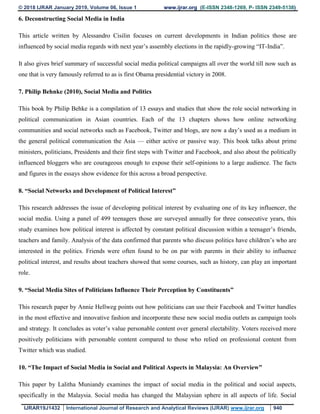
Even though the platform’s reach is limited and significantly lower compared to the traditional media
channels – over 70% of men and women watch TV at least once a week – Facebook is crucial because of its
unique feature; targeted advertising, which allows advertisers to place customized ads for different users based
on demographics, behaviour, internets and various other parameters. In theory, the same political party can
show contradictory message to two different people – without the other person ever knowing of the activity in
a parallel Facebook universe.
How Facebook use compares with traditional media
% of population that is exposed to newspaper, TV, radio at least once a week Vs % of population on Facebook
(MAU)
Newspaper TV Radio Facebook
WOMEN 27 71 11 16
MEN 55 78 21 55
© 2018 IJRAR January 2019, Volume 06, Issue 1 www.ijrar.org (E-ISSN 2348-1269, P- ISSN 2349-5138)
IJRAR19J1432 International Journal of Research and Analytical Reviews (IJRAR) www.ijrar.org 943
NOTE: Data for newspaper, TV and radio based on NFHS 2015-16. Facebook MAU (monthly active users) as
per FB's ads platform
Source: Facebook Advertising API, Census 2011, HT Calculations, NFHS 2015-16
V. Facebook India, a men’s World:
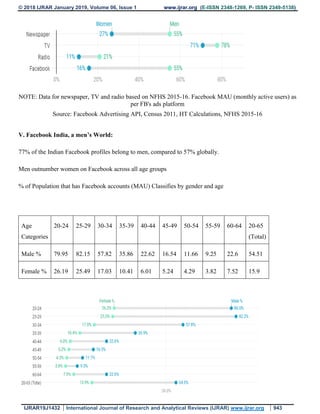
77% of the Indian Facebook profiles belong to men, compared to 57% globally.
Men outnumber women on Facebook across all age groups
% of Population that has Facebook accounts (MAU) Classifies by gender and age
Age
Categories
20-24 25-29 30-34 35-39 40-44 45-49 50-54 55-59 60-64 20-65
(Total)
Male % 79.95 82.15 57.82 35.86 22.62 16.54 11.66 9.25 22.6 54.51
Female % 26.19 25.49 17.03 10.41 6.01 5.24 4.29 3.82 7.52 15.9
© 2018 IJRAR January 2019, Volume 06, Issue 1 www.ijrar.org (E-ISSN 2348-1269, P- ISSN 2349-5138)
IJRAR19J1432 International Journal of Research and Analytical Reviews (IJRAR) www.ijrar.org 944
MAU = monthly active users
Figure 1: % of Population that has Facebook accounts (MAU) Classifies by gender and age
Source: Facebook Advertising API, HT Analysis
This is not a platform-specific issue, but indicative of the gender inequality in access to the internet and
technology. According to the Digital Gender Gaps project anchored by the University of Oxford, India ranks
at 170th among 178 countries on this parameter.
Age Categories 20-24 25-29 30-34 35-39 40-44 45-49 50-54 55-59 60-64
Monthly
Active Users
55.05 54.12 37.78 23.65 14.59 10.94 8.02 6.73 14.87
Monthly Active Users as % of population 2018
Youth dominates
Young people dominate the platform: 63% of all users are below the age of 30. When compared with Census
data, 55 % of all Indians in the age group of 20-24 have Facebook accounts. This proportion steadily
declines—less than 7% of Indians in the 55-59 age groups use the platform.
Facebook will be most effective in reaching first-time voters: an estimated 140 million Indians will vote for
the first time in the 2019 elections and around 53% of these, numbering 75 million, have Facebook accounts.
In terms of the Facebook population, this age cohort of 18-22 constitutes nearly 28% of all Indian users.
79.95 82.15
57.82
35.86
22.62
16.54
11.66 9.25
22.6
54.51
26.19
25.49
17.03
10.41
6.01 5.24 4.29 3.82
7.52 15.9
0
10
20
30
40
50
60
70
80
90
20-24 25-29 30-34 35-39 40-44 45-49 50-54 55-59 60-64 20-65
(Total)
Male %
Female %
© 2018 IJRAR January 2019, Volume 06, Issue 1 www.ijrar.org (E-ISSN 2348-1269, P- ISSN 2349-5138)
IJRAR19J1432 International Journal of Research and Analytical Reviews (IJRAR) www.ijrar.org 945
Facebook usage highest for the younger age cohorts
Estimated monthly active Indian Facebook users as a % of population (2018)
Figure 2: Estimated monthly active Indian Facebook users as a % of population (2018)
Source: Facebook ads API; HT Analysis
VI. India vs. Bharat
Data from Facebook ads platform, which we used for this analysis, doesn’t provide a rural-urban population
breakup. But user figures for major cities show how the reach of Facebook beyond major urban clusters is
limited.
For example, Hyderabad constitutes 19% of Telangana’s population but has 59% of the state’s Facebook
users. Similarly, the Facebook population is skewed towards Kolkata in West Bengal; Mumbai and Pune in
Maharashtra
Facebook users are concentrated in major urban centers
STATE CITY % of state's
Facebook
Population
% of state's total
Population
Karnataka Bangalore (Karnataka) 47 19
Telangana Hyderabad (Telangana) 59 19
Maharashtra Mumbai & Pune
(Maharashtra)
38 19
West Bengal Kolkata (West Bengal) 28 16
Assam Gauhati (Assam) 31 7
55.05
54.12
37.78
23.65
14.59
10.94
8.02
6.73
14.87
0 10 20 30 40 50 60
20-24
25-29
30-34
35-39
40-44
45-49
50-54
55-59
60-64
© 2018 IJRAR January 2019, Volume 06, Issue 1 www.ijrar.org (E-ISSN 2348-1269, P- ISSN 2349-5138)
IJRAR19J1432 International Journal of Research and Analytical Reviews (IJRAR) www.ijrar.org 946
Rajasthan Jaipur (Rajasthan) 19 5
Gujarat Ahmedabad (Gujarat) 18 9
Figure 3: Facebook users are concentrated in major urban centers
Source: Facebook ads API; Census 2011; HT Analysis
The limited reach in rural implies that issues that dominate political discourse on Facebook—both what
people discuss and parties promote—would be mostly urban-centric.
VII. State-wise Differences:
In addition, Facebook demographics vary across states. Close to 63% of the total population (age group 20-
65) in Delhi-National Capital Region (NCR) is estimated to be on Facebook, while only 17.8% of Bihar is.
47
59
38
28 31
19 18
19 19 19 16
7 5
9
0
10
20
30
40
50
60
70
% of state's Facebook
Population
% of state's total
Population 
© 2018 IJRAR January 2019, Volume 06, Issue 1 www.ijrar.org (E-ISSN 2348-1269, P- ISSN 2349-5138)
IJRAR19J1432 International Journal of Research and Analytical Reviews (IJRAR) www.ijrar.org 947
More prosperous states have a higher Facebook usage
Estimated Facebook users (MAU) as a % of total population (2018)
Figure 4: Facebook demographics vary across states
Source: Facebook ads API; HT Analysis
Around 81% of the current Indian Facebook users accessed the network through a high-speed 4G connection,
data from the ads platform shows. This is due to the rise in access to smartphones and the declining cost of
mobile data packs. This also influences the mode of information dissemination. It is more viable to share and
consume video content on the platform.
Even if political parties don’t spend money on advertising, the cost to share content through their pages is
zero, which makes the medium appealing for campaigns.
“Social media is becoming crucial due to the scale of user base which is huge now. Further, the drastic
reduction in the rates of telecom data enhances the longevity of interest across social media and increases
appetite to consume digital content.”
63
51.64
51.46
49.53
47.9
46.25
46.06
45.45
42.5
40.52
36
34.1
33.32
32.58
29.82
28.88
27.98
25.18
25.08
24.04
22.94
17.8
0 10 20 30 40 50 60 70
Delhi
Haryana
Himachal Pradesh
Uttarakhand
Punjab
Gujarat
Kerala
Maharashtra
Karnataka
Jammu and Kashmir
India
Rajasthan
Tamil Nadu
Andhra Pradesh
West Bengal
Assam
Chhattisgarh
Odisha
Madhya Pradesh
Uttar Pradesh
Jharkand
Bihar
© 2018 IJRAR January 2019, Volume 06, Issue 1 www.ijrar.org (E-ISSN 2348-1269, P- ISSN 2349-5138)
IJRAR19J1432 International Journal of Research and Analytical Reviews (IJRAR) www.ijrar.org 948
VIII. Social Media have changed Indian Politics:
Here are some ways Social Media have changed Indian politics;
1. Direct
Contact with
Voters
Social media tools including Facebook, Twitter and YouTube allow
politicians to speak directly to voters without spending a dime. Using those
social media allows politicians to circumvent the traditional method of
reaching voters through paid advertising or earned media. UK's Financial
Times has called Narendra Modi as "India's first social media prime
minister".
2.
Advertising
without
Paying For
Advertising
It has become fairly common for political campaigns to produce commercials
and publish them for free on YouTube instead of, or in addition to, paying for
time on television or the radio.
Often times, journalists covering campaigns will write about those YouTube
ads, essentially broadcasting their message to a wider audience at no cost to
the politicians.
3. Impact on
young voters
Youngsters were in the forefront when it came to using social networks as a
tool of discussing political content. Social media savvy politicians such as
Modi and Kejriwal made the most of the opportunity and had a mind-
boggling impact on young voters, especially the first-timers.
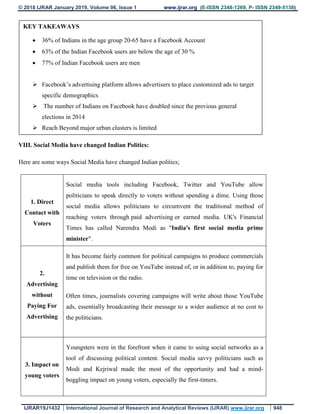
KEY TAKEAWAYS
 36% of Indians in the age group 20-65 have a Facebook Account
 63% of the Indian Facebook users are below the age of 30 %
 77% of Indian Facebook users are men
 Facebook’s advertising platform allows advertisers to place customized ads to target
specific demographics
 The number of Indians on Facebook have doubled since the previous general
elections in 2014
 Reach Beyond major urban clusters is limited
© 2018 IJRAR January 2019, Volume 06, Issue 1 www.ijrar.org (E-ISSN 2348-1269, P- ISSN 2349-5138)
IJRAR19J1432 International Journal of Research and Analytical Reviews (IJRAR) www.ijrar.org 949
Politicians and youth had a mutual impact on each other with their active
participation in social media platforms such as Facebook and Twitter.
4. Image
boosting:
Politicians have used social media to boost their images just like big brands.
For example, every time Modi was scheduled to address a political rally, there
was an update on Facebook and Twitter. Social media was also flooded with
images of Modi and his campaign and what he spoke on those rallies,
registering his image in the minds of the users, many among them were
impressionable first-time voters.
This strategy did help him to create an aura around his persona during the
elections.
5. Overtook
the
mainstream
media
Social media was able to bypass the mainstream media such as newspapers
and television during the elections. Dedicated accounts and pages of the
parties doled out images, videos and activities continuously over social media
platforms to digital savvy party followers. They got the minute-to-minute
updates on their smart phones when on the move.
Through Twitter and Facebook, parties tried to reach out to vast number of
voters and pulled them into the political conversation. In a new changed
mainstream, media is no longer the firsthand source of news for the active
social media users.
6. Powerful
media for
freedom of
speech:
Social media is an incredible platform to express, share thoughts and create
awareness. Social media has emerged not only as a medium of freedom of
expression, but also as a source of content for mainstream media to develop
and build stories around them.
7. Campaigns
Go Viral
Twitter and Facebook have become instrumental in organizing campaigns.
They allow like-minded voters and activists to easily share news and
information such as campaign events with each other. That's what the "Share"
function on Facebook and "retweet" feature of Twitter are for.
© 2018 IJRAR January 2019, Volume 06, Issue 1 www.ijrar.org (E-ISSN 2348-1269, P- ISSN 2349-5138)
IJRAR19J1432 International Journal of Research and Analytical Reviews (IJRAR) www.ijrar.org 950
8. Tailoring
the Message
to the
Audience
Political campaigns can tap into a wealth of information or analytics about the
people who are following them on social media, and customize their messages
based on selected demographics. In other words, a campaign may find one
message appropriate for voters under 30 years old will not be as effective with
over 60 years old.
9.
Fundraising
Some campaigns have used so-called "money bombs" to raise large amounts
of cash in short period of time. Money bombs are typically 24-hour periods in
which candidates press their supporters to donate money. They use social
media such as Twitter and Facebook to get the word out, and often tie these
money bombs to specific controversies that emerge during campaigns. The
2014 Delhi elections saw Aam Aadmi Party (AAP) which came into power by
seeking donations and votes over the social media.
10. Feedback
Asking for feedback from voters or constituents can be a good thing. And it
can be a very bad thing, depending on how politicians respond. Many
campaigns hire staffers to monitor their social media channels for negative
response and scrub anything unflattering. But such a bunker-like mentality
can make a campaign appear defensive and closed off from the public. Well
run modern day campaigns will engage the public regardless of whether their
feedback is negative or positive.
11. Weighing
Public
Opinion
The value of social media is in its immediacy. Politicians and campaign do
absolutely nothing without first knowing how their policy statements or
moves will play among the electorate, and Twitter and Facebook both allow
them to instantaneously gauge how the public is responding to an issue or
controversy. Politicians can then adjust their campaigns accordingly, in real
time, without the use of high-priced consultants or expensive polling.
Conclusion:
Thanks to social media, Indian democracy went into participatory mode with millions of young voters
participating in the electoral process. One can only hope that this unprecedented participation now leads to
empowerment in a holistic sense.
© 2018 IJRAR January 2019, Volume 06, Issue 1 www.ijrar.org (E-ISSN 2348-1269, P- ISSN 2349-5138)
IJRAR19J1432 International Journal of Research and Analytical Reviews (IJRAR) www.ijrar.org 951
The advent of social media has enabled an unprecedented empowerment and engagement of the ‘AAM
AADMI’ for expressing political opinions. A positive development of social media emergence has been that
the youth is talking about the political issues. Earlier the political discussions were restricted only to those
who read newspapers, watched news channels or participated in discussions in nukkad of a village or clubs.
But now, social networking has made the youth of India to sit up and discuss political issues. A very large
number of youth influenced by the social media have become politically active in recent times. They spend
time to analyze and discuss politics. Thanks to this new-found interest, women are also voting in large
numbers.
That’s why the politicians of India have adopted social media because they know where and how to find the
youth of the country on majority. One has seen major difference of the power of youth, in the recent times of
Gujarat elections 2017, where the voting demographics were torn between urban and rural categories of
voting. Needless to say, one can majorly see the effect of social media on Indian politics.
Reference:
1) Jordan Cook (2013), “Social Media, American Interests, and the Arab Spring” Dalhousie Journal of
Interdisciplinary Management (DJIM). Volume 9, spring-2013
2) Sarah Joseph (2012) “Social Media, Political change and Human rights”. 35 B.C. Int’l & Comp. L. Rev.
145
3) Dr. Atanu Mohapatra (2013), “Lokpal and the role of media in propping up anticorruption movement in
India”. IJSSR, Vol.2 (3), March (2013)
4) Parida S. K. and Das A. (2014), Social media in relation to politics in Odisha, India: An Overview.
International Journal of Interdisciplinary and multidisciplinary studies, Vol.1
5) Mr. Ratnesh Dwivedi (2011) "The Penetration of Social Media in Governance, Political Reforms and
Building Public Perception" Manthan: International Journal of Mass Communication 6.1 (2011): 163-167.
6) Alessandro Cisilin (2013), Deconstructing Social Media in India. Journal of south asia woman studies,
Vol.14 No. 1
7) Mark Granovetter (2005), “Impact of Social Structure on Economic outcomes”. Journal of economic
Perspective. Vol. 19 No. 1 winter 2005
https://www.statista.com/statistics/268136/top-15-countries-based-on-number-of-facebook-users/
https://www.translatemedia.com/translation-services/social-media/india-social-media/
http://gs.statcounter.com/social-media-stats/all/india
Newspaper:
Hindustan Times 29 November, 2018
View publication stats

Ijrar19 j1432

  • 1.
    See discussions, stats,and author profiles for this publication at: https://www.researchgate.net/publication/342162878 ROLE OF SOCIAL MEDIA IN THE CHANGING FACE OF INDIAN POLITICS: A STUDY WITH SPECIAL REFERENCE TO FACEBOOK Article · June 2020 CITATION 1 READS 3,500 2 authors, including: Some of the authors of this publication are also working on these related projects: Solar Energy Mission: Paving the Way for India’s Transformational Future View project Deepak Kumar Adhana Lingaya's University 29 PUBLICATIONS   26 CITATIONS    SEE PROFILE All content following this page was uploaded by Deepak Kumar Adhana on 14 June 2020. The user has requested enhancement of the downloaded file.
  • 2.
    © 2018 IJRARJanuary 2019, Volume 06, Issue 1 www.ijrar.org (E-ISSN 2348-1269, P- ISSN 2349-5138) IJRAR19J1432 International Journal of Research and Analytical Reviews (IJRAR) www.ijrar.org 935 ROLE OF SOCIAL MEDIA IN THE CHANGING FACE OF INDIAN POLITICS: A STUDY WITH SPECIAL REFERENCE TO FACEBOOK DEEPAK KUMAR ADHANA Asst. Professor, Kamal Institute of Higher Education And Advance Technology, New Delhi MAYANK SAXENA Asst. Professor, Department of Management, JS (PG) College, Sikandrabad ABSTRACT: Digital media is changing the way political parties interact with voters bridging the gap like never before. Given today’s era of increasing social media usage, and growing internet penetration due to increased usage of smartphones on the one hand and saturation of traditional mediums on the other, digital media offers the perfect platform for political parties to reach audiences worldwide. The use of digital and social media increases the reach of communication efforts and allows targeting the advocacy and tailoring it as per the audiences marketers/campaigners are trying to reach. 2014 Lok Sabha elections were the first social media election for 1.2 billion strong India with the advent of Social Media giants in India, namely Facebook and Twitter, whose users run into million from urban areas to rural areas. Social media in 2014 India has emerged as a frontrunner in terms of Marketing and PR communications especially in the arena of politics, an area which has traditionally been predominantly dependent of modes of promotion such as television, print, radio, rallies etc. It saw social media as a new battleground. Narendra Modi emerged as India’s Obama. This election saw politicians leveraging. Social media used to reach out to constituents like never before. The present paper highlights the scenario of social media in India. It also studies how the Facebook users are concentrated in major urban centers .The study exhibits the comparison of Facebook use with the traditional media and how Facebook demographics vary across states. The paper in the end talks about ways how social media have changed Indian politics. KEY WORDS: Facebook, Indian Politics, Social media, Traditional media, Twitter I. Introduction: India’s 16th National General Election was held in nine phases during April to May 2014. It was probably one of the most awaited elections in the recent times. It was due to the changing Politics of India. Social media played a vital role in deciding which party wins the most seats. An interesting report published in April 2013 by the Internet and Mobile Association of India (IAMAI). The Mumbai-based Iris Knowledge Foundation assisted IAMAI in the study. Don’t you think herein, you should learn about social media marketing courses
  • 3.
    © 2018 IJRARJanuary 2019, Volume 06, Issue 1 www.ijrar.org (E-ISSN 2348-1269, P- ISSN 2349-5138) IJRAR19J1432 International Journal of Research and Analytical Reviews (IJRAR) www.ijrar.org 936 in Mumbai? Facebook users have a tremendous impact over the results of the polls in 160 of India‘s 543 constituencies. The reason for this is the youth of India. As per study, 50% of population is below 25 age group. Secondly, 65% is below 35 % age group. This population is either studying in college or working in various companies. Companies such as IT companies, BPO‘s, research centres and various other sectors or are either entrepreneur. Their busy schedule has created a virtual distance between television and radio. It is especially in case of acquiring or sharing information. The youth is tech savvy and love being connected with updated trends and topics. Such connectivity is possible by using laptops, desktops or the most favourite a network connected mobiles. Social Media– A Road way to reach out to Youth Even though politicians for their campaign still use posters, cut-outs, fliers, graffiti and personal rally’s to reach and win over voters but with the social media changing the picture of urban India, political parties are becoming tech savvy and realizing that social media is the only way to reach out to the youth. A good example is Indian Prime Minister Narendra Modi, He was the main and first person who uses social media power in 2014 election and rise as a great leader in India, Indians love and blessed him through social media and his party became a major party in 2014 elections. For 2009 general election social media usage in India was little. Today, however, Facebook has 294 million users and Twitter has an estimated 33 million accounts in the country. As per the LAMAI report 2013 this change for presence of social media could be observed as every political party participating in 2014 general election has set a 2-5% of its election budget for spending on social media. The report says that the leading parties Bhartiya Janata Party (BJP) and Nation congress party has set this it 500 crores and 400 crores, respectively. Let us look into some incidents in Indian politics where social media has created a huge impact. The 2014 Delhi elections saw a totally novice political party Aam Aadmi Party (AAP) which came into power by seeking donations and votes over the social media. They not only got the requisite funding but also managed to attract a large number of activists to promote their election campaign. A large part of the credit of electoral victories of Mr. Naveen Patnaik, CM of Orissa goes to his social media campaign. The young populace which constitutes 40% of his voter base is highly sensitive to the information circulating over the social media. Mr. Nitish Kumar, CM of Bihar hired the same election campaign team that Mr. Modi used in 2014 to carry on his social media campaign. Thus, in the last 5 years, social media has become an integral component in driving the fate of various political parties. Narendra Modi was among the first Indian politicians to be on Twitter, Facebook and Google+. AAP used Pinstorm to compare how the party is faring against other parties. Political parties followers fought hashtag
  • 4.
    © 2018 IJRARJanuary 2019, Volume 06, Issue 1 www.ijrar.org (E-ISSN 2348-1269, P- ISSN 2349-5138) IJRAR19J1432 International Journal of Research and Analytical Reviews (IJRAR) www.ijrar.org 937 wars on social media platforms. AAP used Twitter for three-fourth of their social media connections. All election campaign news, announcements, and major information of AAP were communicated through twitter. AAP’s appeal among social media users is evident from 18 million worth of donations collected through Invite Referrals’ campaign on social media platforms such as Twitter, Facebook and mobile messaging applications such as WhatsApp, in just one month. Besides donations, AAP was also engaged in sending campaigning messages on WhatsApp and answering queries on frankly. Politicians are organizing Google + Hangouts to reach voters. Market pundits expect the next general elections in 2019 to be dependent largely on the social media presence of political parties in India and the brands they create for themselves. The Indian Left parties which were traditionally banking on the labour and lower classes along with a section of the educated middle class are increasingly being left out of the new emerging political discourse in the country partly due to social media. “Now no serious politician is seen as being able to avoid social media altogether,” A Big Role of Twitter in Politics Over the past few years, a large number of politicians have been using Twitter to get out their message. While Twitter is limited to 280 characters, that seeming disadvantage is really a big advantage for politicians. It forces them to point their message down to the minimum number of words which provides greater precision. There is no genuine example of a politician taking full advantage of Twitter than the 2016 presidential campaign of Donald Trump. An outsider who never held political office before, Donald Trump used Twitter in a way that created breaking news. Because his tweets were limited to 140 (At that time) characters, his message was not only read by his followers, but the press would post the entire passage in their stories. Because Twitter allowed Trump’s message to go through unfiltered, it made a powerful impact in terms of voter engagement. Donald Trump’s victory in becoming the first President in the modern era to have never held public office or have been a military general before was due in part to his use of Twitter to control the narrative. Today, he’s expanding his use of social media through YouTube by posting videos that reach millions of people.
  • 5.
    © 2018 IJRARJanuary 2019, Volume 06, Issue 1 www.ijrar.org (E-ISSN 2348-1269, P- ISSN 2349-5138) IJRAR19J1432 International Journal of Research and Analytical Reviews (IJRAR) www.ijrar.org 938 Let us now look into some reasons why social media is increasingly becoming important for the politics of our country: 1. Easy way to disseminate information to a large audience 2. Tool for citizen engagement by promoting a two-way communication – Many political parties use social media to invite suggestions for their election manifesto, take feedback from the people about their current performance etc. Thus, it ties the people with the political party by creates a sense of belongingness and involvement. 3. Increases transparency –The work of the political party is floated on the social media and real-time feedback from the citizens is encouraged. It also helps the party to communicate its goals and ideologies as well as give a detailed analysis about the amount of work that has been accomplished. It also encourages political candidates to speak more truth rather than selling rhetoric to the voters during their election speeches. 4. Voice of the marginalized people – The people who were marginalized earlier can now communicate their ideas to a big audience with considerable ease. This will set the platform for the formation of new political alternatives and greater options for the voters. This will also bring in more accountability to the veteran political parties as they can be shown the door if they don’t work. 5. Cost effective – Social media incurs low cost when compared to other modes likes print or electronic media for the communication of information. This opens the field for a large number of players to contest in the race who were earlier not able to compete due to a shortage of funds. II. Literature Review 1. "The Penetration of Social Media in Governance, Political Reforms and Building Public Perception" This article by Mr. Ratnesh Dwivedi emphasizes over social media’s role in publicizing political activities such as protests, and also tries to answer two important questions in the context of social media and its power to bring governance.  Is there any evidence that such actions have led to substantive political change?  Is it possible to develop a set of reflectors to more effectively capture the impact of new technologies and social media over questions of political change? It concludes with findings that the roles of the social media, in promoting good governance are recognized by many governments and policy-makers in these countries.
  • 6.
    © 2018 IJRARJanuary 2019, Volume 06, Issue 1 www.ijrar.org (E-ISSN 2348-1269, P- ISSN 2349-5138) IJRAR19J1432 International Journal of Research and Analytical Reviews (IJRAR) www.ijrar.org 939 2. “Social Media, American Interests, and the Arab Spring” Arab Spring events that began in late 2010 changed the political scenario in many countries all over the world. The contribution of the social media and Internet to the events of the Arab Spring has led to idea that open access and a free Internet can eventually turn out to be a good weapon. This paper examines that idea, through examples that highlight the dangers associated with it. The ability of social media to quickly reach masses and allow them to share and spread information resulted in the rapid spread of Arab Spring. 3. “Lokpal and the role of media in propping up anticorruption movement in India” This paper by Dr. Atanu Mohapatra studies the role of the media as an - institutional limb of the modern democracy‖ during the recently held Jan Lokpal movement which was unprecedented in many ways. This article also points out that massive use of social media in Lok Pal movement turned out to be a trend setter and can be seen as a successful experimentation for good cause. People can use social media content to get the status of a movement and identify the goals it wants to achieve. Finally it essays out how the movement that was initiated by the social media influenced the traditional media which ultimately resulted in grabbing the attention of whole India and World 4. “Social Media, Political change and Human rights” This paper examines the role of social media in political change scenario in the context of the Arab Spring uprisings. Clay Shirky’s and Malcolm Gladwell’s arguments regarding the importance of social media use in revolutions are analysed. This essay finally concludes by outlining Evgeny Molotov’s arguments, and his contentions that Internet and social media can serve as tools of oppression rather than emancipation, and disseminators of hatred and propaganda rather than democracy and tolerance. Finally, it also analyses the roles, responsibilities, and accountability of social media companies in the sake of revolution. 5. Social media in relation to politics in Odisha, India: An Overview This paper by Parida S. K. and Das A analyses the importance of social media and at the same time emphasizes on the importance of innovative ideas for its effective impact. It also points out how politicians are using social media for wooing younger population with reference to a study of recent developments in the state of Odisha undertaken by Chief Minister Naveen Patnaik who has to woo young voters, who constitute approx. above 40 percent of the total electorates in the state, This paper concludes with a notion that social media will become an important platform for election campaign in near future. And no doubt Social media will prove to be a game changing platform in future elections.
  • 7.
    © 2018 IJRARJanuary 2019, Volume 06, Issue 1 www.ijrar.org (E-ISSN 2348-1269, P- ISSN 2349-5138) IJRAR19J1432 International Journal of Research and Analytical Reviews (IJRAR) www.ijrar.org 940 6. Deconstructing Social Media in India This article written by Alessandro Cisilin focuses on current developments in Indian politics those are influenced by social media regards with next year’s assembly elections in the rapidly-growing “IT-India”. It also gives brief summary of successful social media political campaigns all over the world till now such as one that is very famously referred to as is first Obama presidential victory in 2008. 7. Philip Behnke (2010), Social Media and Politics This book by Philip Behke is a compilation of 13 essays and studies that show the role social networking in political communication in Asian countries. Each of the 13 chapters shows how online networking communities and social networks such as Facebook, Twitter and blogs, are now a day’s used as a medium in the general political communication the Asia — either active or passive way. This book talks about prime ministers, politicians, Presidents and their first steps with Twitter and Facebook, and also about the politically influenced bloggers who are courageous enough to expose their self-opinions to a large audience. The facts and figures in the essays show evidence for this across a broad perspective. 8. “Social Networks and Development of Political Interest” This research addresses the issue of developing political interest by evaluating one of its key influencer, the social media. Using a panel of 499 teenagers those are surveyed annually for three consecutive years, this study examines how political interest is affected by constant political discussion within a teenager’s friends, teachers and family. Analysis of the data confirmed that parents who discuss politics have children’s who are interested in the politics. Friends were often found to be on par with parents in their ability to influence political interest, and results about teachers showed that some courses, such as history, can play an important role. 9. “Social Media Sites of Politicians Influence Their Perception by Constituents” This research paper by Annie Hellweg points out how politicians can use their Facebook and Twitter handles in the most effective and innovative fashion and incorporate these new social media outlets as campaign tools and strategy. It concludes as voter’s value personable content over general electability. Voters received more positively politicians with personable content compared to those who relied on professional content from Twitter which was studied. 10. “The Impact of Social Media in Social and Political Aspects in Malaysia: An Overview” This paper by Lalitha Muniandy examines the impact of social media in the political and social aspects, specifically in the Malaysia. Social media has changed the Malaysian sphere in all aspects of life. Social
  • 8.
    © 2018 IJRARJanuary 2019, Volume 06, Issue 1 www.ijrar.org (E-ISSN 2348-1269, P- ISSN 2349-5138) IJRAR19J1432 International Journal of Research and Analytical Reviews (IJRAR) www.ijrar.org 941 aspects cover basically on how social media is helping Malaysian people to communicate with each other. And Political aspects talks about the changes brought by social media in the politics of Malaysia. Significance of the Study: Significance of this study can be attributed to the rapidly growing internet and social media penetration all over the world and most specifically in India. It has urged everyone to be innovative to get benefitted. It all started with 2008 US elections and then there after whole world have time to time experienced the power of social media through various revolts etc. (e.g. Arab spring). Now as General Elections (2019) In India are approaching fast it’s important to see how Indian political parties are making use of these newly identified medium of campaigning to reach out wider audience. Also it’s important to study dark side of Social media. III. OBJECTIVES AND METHODOLOGY: The objectives and the research methodology are as follows: OBJECTIVES OF STUDY: The present study has been geared to achieve the following objectives; 1. To analyse the scenario of Social Media in India 2. To study why Facebook matters for Indian political parties 3. To study some ways indicating how Social Media have changed Indian politics RESEARCH METHODOLOGY: Type of Research: Quantitative and Analytical Research Data Collection Method: This study has been carried out with the help of secondary data only, all the data has been collected from the various sources such as websites & reports and compiled as said by the need of the study. Sources of Data Collection: The study is based on the published data. For the purpose of present study, the data was extracted from the various newspapers, journals, articles and websites particularly from report of Hindustan Times analysis of anonymous and aggregated data from Facebook’s advertising portal. IV. Whom can political parties reach on Facebook and why it matters Facebook is used by 270 million Indians in the age group of 18-65 monthly, meaning political parties can reach an estimated 36% of the voting age population on the platform. And the user base is growing: the
  • 9.
    © 2018 IJRARJanuary 2019, Volume 06, Issue 1 www.ijrar.org (E-ISSN 2348-1269, P- ISSN 2349-5138) IJRAR19J1432 International Journal of Research and Analytical Reviews (IJRAR) www.ijrar.org 942 number of Facebook users in India has more than doubled since the previous general election in 2014, according to data portal Statista. The numbers highlight the importance of Facebook as India gears up for what some consider will be an election that is fought as much on the dusty streets of Bharat as on the social media platform. And it comes as the social networking platform confronts a global crisis as lawmakers and regulators across the world call for greater scrutiny to check potential abuse and misuse of it to sway election outcomes. Indian Facebook users, however, are skewed towards specific demographics. A Hindustan Times analysis of anonymous and aggregated data from Facebook’s advertising portal shows that the bulk of the platform’s Indian users is men, under the age of 30 and live in urban clusters. National averages further hide the massive state-wide differences. Why Facebook is Different: Even though the platform’s reach is limited and significantly lower compared to the traditional media channels – over 70% of men and women watch TV at least once a week – Facebook is crucial because of its unique feature; targeted advertising, which allows advertisers to place customized ads for different users based on demographics, behaviour, internets and various other parameters. In theory, the same political party can show contradictory message to two different people – without the other person ever knowing of the activity in a parallel Facebook universe. How Facebook use compares with traditional media % of population that is exposed to newspaper, TV, radio at least once a week Vs % of population on Facebook (MAU) Newspaper TV Radio Facebook WOMEN 27 71 11 16 MEN 55 78 21 55
  • 10.
    © 2018 IJRARJanuary 2019, Volume 06, Issue 1 www.ijrar.org (E-ISSN 2348-1269, P- ISSN 2349-5138) IJRAR19J1432 International Journal of Research and Analytical Reviews (IJRAR) www.ijrar.org 943 NOTE: Data for newspaper, TV and radio based on NFHS 2015-16. Facebook MAU (monthly active users) as per FB's ads platform Source: Facebook Advertising API, Census 2011, HT Calculations, NFHS 2015-16 V. Facebook India, a men’s World: 77% of the Indian Facebook profiles belong to men, compared to 57% globally. Men outnumber women on Facebook across all age groups % of Population that has Facebook accounts (MAU) Classifies by gender and age Age Categories 20-24 25-29 30-34 35-39 40-44 45-49 50-54 55-59 60-64 20-65 (Total) Male % 79.95 82.15 57.82 35.86 22.62 16.54 11.66 9.25 22.6 54.51 Female % 26.19 25.49 17.03 10.41 6.01 5.24 4.29 3.82 7.52 15.9
  • 11.
    © 2018 IJRARJanuary 2019, Volume 06, Issue 1 www.ijrar.org (E-ISSN 2348-1269, P- ISSN 2349-5138) IJRAR19J1432 International Journal of Research and Analytical Reviews (IJRAR) www.ijrar.org 944 MAU = monthly active users Figure 1: % of Population that has Facebook accounts (MAU) Classifies by gender and age Source: Facebook Advertising API, HT Analysis This is not a platform-specific issue, but indicative of the gender inequality in access to the internet and technology. According to the Digital Gender Gaps project anchored by the University of Oxford, India ranks at 170th among 178 countries on this parameter. Age Categories 20-24 25-29 30-34 35-39 40-44 45-49 50-54 55-59 60-64 Monthly Active Users 55.05 54.12 37.78 23.65 14.59 10.94 8.02 6.73 14.87 Monthly Active Users as % of population 2018 Youth dominates Young people dominate the platform: 63% of all users are below the age of 30. When compared with Census data, 55 % of all Indians in the age group of 20-24 have Facebook accounts. This proportion steadily declines—less than 7% of Indians in the 55-59 age groups use the platform. Facebook will be most effective in reaching first-time voters: an estimated 140 million Indians will vote for the first time in the 2019 elections and around 53% of these, numbering 75 million, have Facebook accounts. In terms of the Facebook population, this age cohort of 18-22 constitutes nearly 28% of all Indian users. 79.95 82.15 57.82 35.86 22.62 16.54 11.66 9.25 22.6 54.51 26.19 25.49 17.03 10.41 6.01 5.24 4.29 3.82 7.52 15.9 0 10 20 30 40 50 60 70 80 90 20-24 25-29 30-34 35-39 40-44 45-49 50-54 55-59 60-64 20-65 (Total) Male % Female %
  • 12.
    © 2018 IJRARJanuary 2019, Volume 06, Issue 1 www.ijrar.org (E-ISSN 2348-1269, P- ISSN 2349-5138) IJRAR19J1432 International Journal of Research and Analytical Reviews (IJRAR) www.ijrar.org 945 Facebook usage highest for the younger age cohorts Estimated monthly active Indian Facebook users as a % of population (2018) Figure 2: Estimated monthly active Indian Facebook users as a % of population (2018) Source: Facebook ads API; HT Analysis VI. India vs. Bharat Data from Facebook ads platform, which we used for this analysis, doesn’t provide a rural-urban population breakup. But user figures for major cities show how the reach of Facebook beyond major urban clusters is limited. For example, Hyderabad constitutes 19% of Telangana’s population but has 59% of the state’s Facebook users. Similarly, the Facebook population is skewed towards Kolkata in West Bengal; Mumbai and Pune in Maharashtra Facebook users are concentrated in major urban centers STATE CITY % of state's Facebook Population % of state's total Population Karnataka Bangalore (Karnataka) 47 19 Telangana Hyderabad (Telangana) 59 19 Maharashtra Mumbai & Pune (Maharashtra) 38 19 West Bengal Kolkata (West Bengal) 28 16 Assam Gauhati (Assam) 31 7 55.05 54.12 37.78 23.65 14.59 10.94 8.02 6.73 14.87 0 10 20 30 40 50 60 20-24 25-29 30-34 35-39 40-44 45-49 50-54 55-59 60-64
  • 13.
    © 2018 IJRARJanuary 2019, Volume 06, Issue 1 www.ijrar.org (E-ISSN 2348-1269, P- ISSN 2349-5138) IJRAR19J1432 International Journal of Research and Analytical Reviews (IJRAR) www.ijrar.org 946 Rajasthan Jaipur (Rajasthan) 19 5 Gujarat Ahmedabad (Gujarat) 18 9 Figure 3: Facebook users are concentrated in major urban centers Source: Facebook ads API; Census 2011; HT Analysis The limited reach in rural implies that issues that dominate political discourse on Facebook—both what people discuss and parties promote—would be mostly urban-centric. VII. State-wise Differences: In addition, Facebook demographics vary across states. Close to 63% of the total population (age group 20- 65) in Delhi-National Capital Region (NCR) is estimated to be on Facebook, while only 17.8% of Bihar is. 47 59 38 28 31 19 18 19 19 19 16 7 5 9 0 10 20 30 40 50 60 70 % of state's Facebook Population % of state's total Population 
  • 14.
    © 2018 IJRARJanuary 2019, Volume 06, Issue 1 www.ijrar.org (E-ISSN 2348-1269, P- ISSN 2349-5138) IJRAR19J1432 International Journal of Research and Analytical Reviews (IJRAR) www.ijrar.org 947 More prosperous states have a higher Facebook usage Estimated Facebook users (MAU) as a % of total population (2018) Figure 4: Facebook demographics vary across states Source: Facebook ads API; HT Analysis Around 81% of the current Indian Facebook users accessed the network through a high-speed 4G connection, data from the ads platform shows. This is due to the rise in access to smartphones and the declining cost of mobile data packs. This also influences the mode of information dissemination. It is more viable to share and consume video content on the platform. Even if political parties don’t spend money on advertising, the cost to share content through their pages is zero, which makes the medium appealing for campaigns. “Social media is becoming crucial due to the scale of user base which is huge now. Further, the drastic reduction in the rates of telecom data enhances the longevity of interest across social media and increases appetite to consume digital content.” 63 51.64 51.46 49.53 47.9 46.25 46.06 45.45 42.5 40.52 36 34.1 33.32 32.58 29.82 28.88 27.98 25.18 25.08 24.04 22.94 17.8 0 10 20 30 40 50 60 70 Delhi Haryana Himachal Pradesh Uttarakhand Punjab Gujarat Kerala Maharashtra Karnataka Jammu and Kashmir India Rajasthan Tamil Nadu Andhra Pradesh West Bengal Assam Chhattisgarh Odisha Madhya Pradesh Uttar Pradesh Jharkand Bihar
  • 15.
    © 2018 IJRARJanuary 2019, Volume 06, Issue 1 www.ijrar.org (E-ISSN 2348-1269, P- ISSN 2349-5138) IJRAR19J1432 International Journal of Research and Analytical Reviews (IJRAR) www.ijrar.org 948 VIII. Social Media have changed Indian Politics: Here are some ways Social Media have changed Indian politics; 1. Direct Contact with Voters Social media tools including Facebook, Twitter and YouTube allow politicians to speak directly to voters without spending a dime. Using those social media allows politicians to circumvent the traditional method of reaching voters through paid advertising or earned media. UK's Financial Times has called Narendra Modi as "India's first social media prime minister". 2. Advertising without Paying For Advertising It has become fairly common for political campaigns to produce commercials and publish them for free on YouTube instead of, or in addition to, paying for time on television or the radio. Often times, journalists covering campaigns will write about those YouTube ads, essentially broadcasting their message to a wider audience at no cost to the politicians. 3. Impact on young voters Youngsters were in the forefront when it came to using social networks as a tool of discussing political content. Social media savvy politicians such as Modi and Kejriwal made the most of the opportunity and had a mind- boggling impact on young voters, especially the first-timers. KEY TAKEAWAYS  36% of Indians in the age group 20-65 have a Facebook Account  63% of the Indian Facebook users are below the age of 30 %  77% of Indian Facebook users are men  Facebook’s advertising platform allows advertisers to place customized ads to target specific demographics  The number of Indians on Facebook have doubled since the previous general elections in 2014  Reach Beyond major urban clusters is limited
  • 16.
    © 2018 IJRARJanuary 2019, Volume 06, Issue 1 www.ijrar.org (E-ISSN 2348-1269, P- ISSN 2349-5138) IJRAR19J1432 International Journal of Research and Analytical Reviews (IJRAR) www.ijrar.org 949 Politicians and youth had a mutual impact on each other with their active participation in social media platforms such as Facebook and Twitter. 4. Image boosting: Politicians have used social media to boost their images just like big brands. For example, every time Modi was scheduled to address a political rally, there was an update on Facebook and Twitter. Social media was also flooded with images of Modi and his campaign and what he spoke on those rallies, registering his image in the minds of the users, many among them were impressionable first-time voters. This strategy did help him to create an aura around his persona during the elections. 5. Overtook the mainstream media Social media was able to bypass the mainstream media such as newspapers and television during the elections. Dedicated accounts and pages of the parties doled out images, videos and activities continuously over social media platforms to digital savvy party followers. They got the minute-to-minute updates on their smart phones when on the move. Through Twitter and Facebook, parties tried to reach out to vast number of voters and pulled them into the political conversation. In a new changed mainstream, media is no longer the firsthand source of news for the active social media users. 6. Powerful media for freedom of speech: Social media is an incredible platform to express, share thoughts and create awareness. Social media has emerged not only as a medium of freedom of expression, but also as a source of content for mainstream media to develop and build stories around them. 7. Campaigns Go Viral Twitter and Facebook have become instrumental in organizing campaigns. They allow like-minded voters and activists to easily share news and information such as campaign events with each other. That's what the "Share" function on Facebook and "retweet" feature of Twitter are for.
  • 17.
    © 2018 IJRARJanuary 2019, Volume 06, Issue 1 www.ijrar.org (E-ISSN 2348-1269, P- ISSN 2349-5138) IJRAR19J1432 International Journal of Research and Analytical Reviews (IJRAR) www.ijrar.org 950 8. Tailoring the Message to the Audience Political campaigns can tap into a wealth of information or analytics about the people who are following them on social media, and customize their messages based on selected demographics. In other words, a campaign may find one message appropriate for voters under 30 years old will not be as effective with over 60 years old. 9. Fundraising Some campaigns have used so-called "money bombs" to raise large amounts of cash in short period of time. Money bombs are typically 24-hour periods in which candidates press their supporters to donate money. They use social media such as Twitter and Facebook to get the word out, and often tie these money bombs to specific controversies that emerge during campaigns. The 2014 Delhi elections saw Aam Aadmi Party (AAP) which came into power by seeking donations and votes over the social media. 10. Feedback Asking for feedback from voters or constituents can be a good thing. And it can be a very bad thing, depending on how politicians respond. Many campaigns hire staffers to monitor their social media channels for negative response and scrub anything unflattering. But such a bunker-like mentality can make a campaign appear defensive and closed off from the public. Well run modern day campaigns will engage the public regardless of whether their feedback is negative or positive. 11. Weighing Public Opinion The value of social media is in its immediacy. Politicians and campaign do absolutely nothing without first knowing how their policy statements or moves will play among the electorate, and Twitter and Facebook both allow them to instantaneously gauge how the public is responding to an issue or controversy. Politicians can then adjust their campaigns accordingly, in real time, without the use of high-priced consultants or expensive polling. Conclusion: Thanks to social media, Indian democracy went into participatory mode with millions of young voters participating in the electoral process. One can only hope that this unprecedented participation now leads to empowerment in a holistic sense.
  • 18.
    © 2018 IJRARJanuary 2019, Volume 06, Issue 1 www.ijrar.org (E-ISSN 2348-1269, P- ISSN 2349-5138) IJRAR19J1432 International Journal of Research and Analytical Reviews (IJRAR) www.ijrar.org 951 The advent of social media has enabled an unprecedented empowerment and engagement of the ‘AAM AADMI’ for expressing political opinions. A positive development of social media emergence has been that the youth is talking about the political issues. Earlier the political discussions were restricted only to those who read newspapers, watched news channels or participated in discussions in nukkad of a village or clubs. But now, social networking has made the youth of India to sit up and discuss political issues. A very large number of youth influenced by the social media have become politically active in recent times. They spend time to analyze and discuss politics. Thanks to this new-found interest, women are also voting in large numbers. That’s why the politicians of India have adopted social media because they know where and how to find the youth of the country on majority. One has seen major difference of the power of youth, in the recent times of Gujarat elections 2017, where the voting demographics were torn between urban and rural categories of voting. Needless to say, one can majorly see the effect of social media on Indian politics. Reference: 1) Jordan Cook (2013), “Social Media, American Interests, and the Arab Spring” Dalhousie Journal of Interdisciplinary Management (DJIM). Volume 9, spring-2013 2) Sarah Joseph (2012) “Social Media, Political change and Human rights”. 35 B.C. Int’l & Comp. L. Rev. 145 3) Dr. Atanu Mohapatra (2013), “Lokpal and the role of media in propping up anticorruption movement in India”. IJSSR, Vol.2 (3), March (2013) 4) Parida S. K. and Das A. (2014), Social media in relation to politics in Odisha, India: An Overview. International Journal of Interdisciplinary and multidisciplinary studies, Vol.1 5) Mr. Ratnesh Dwivedi (2011) "The Penetration of Social Media in Governance, Political Reforms and Building Public Perception" Manthan: International Journal of Mass Communication 6.1 (2011): 163-167. 6) Alessandro Cisilin (2013), Deconstructing Social Media in India. Journal of south asia woman studies, Vol.14 No. 1 7) Mark Granovetter (2005), “Impact of Social Structure on Economic outcomes”. Journal of economic Perspective. Vol. 19 No. 1 winter 2005 https://www.statista.com/statistics/268136/top-15-countries-based-on-number-of-facebook-users/ https://www.translatemedia.com/translation-services/social-media/india-social-media/ http://gs.statcounter.com/social-media-stats/all/india Newspaper: Hindustan Times 29 November, 2018 View publication stats View publication stats