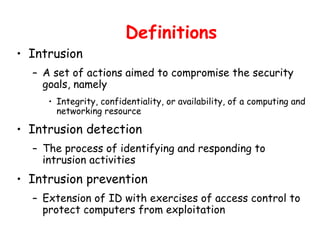
Definitions
• Intrusion
– Aset of actions aimed to compromise the security
goals, namely
• Integrity, confidentiality, or availability, of a computing and
networking resource
• Intrusion detection
– The process of identifying and responding to
intrusion activities
• Intrusion prevention
– Extension of ID with exercises of access control to
protect computers from exploitation
3.
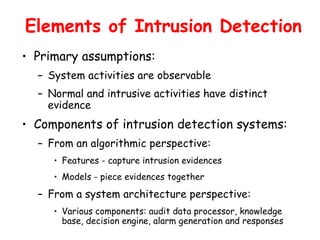
Elements of IntrusionDetection
• Primary assumptions:
– System activities are observable
– Normal and intrusive activities have distinct
evidence
• Components of intrusion detection systems:
– From an algorithmic perspective:
• Features - capture intrusion evidences
• Models - piece evidences together
– From a system architecture perspective:
• Various components: audit data processor, knowledge
base, decision engine, alarm generation and responses
4.
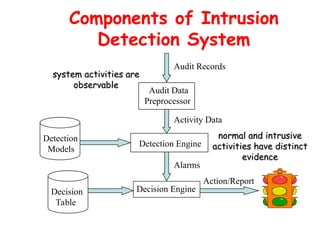
Components of Intrusion
DetectionSystem
Audit Data
Preprocessor
Audit Records
Activity Data
Detection
Models
Detection Engine
Alarms
Decision
Table
Decision Engine
Action/Report
system activities are
system activities are
observable
observable
normal and intrusive
normal and intrusive
activities have distinct
activities have distinct
evidence
evidence
5.
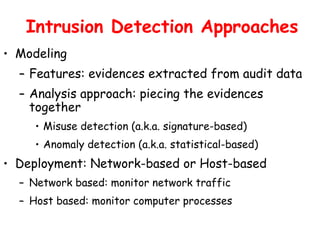
Intrusion Detection Approaches
•Modeling
– Features: evidences extracted from audit data
– Analysis approach: piecing the evidences
together
• Misuse detection (a.k.a. signature-based)
• Anomaly detection (a.k.a. statistical-based)
• Deployment: Network-based or Host-based
– Network based: monitor network traffic
– Host based: monitor computer processes
6.
Misuse Detection
Intrusion
Patterns:
Sequences of
systemcalls,
patterns of
network traffic,
etc.
activities
pattern
matching
intrusion
Can’t detect new attacks
Example: if (traffic contains “x90+de[^rn]{30}”) then “attack detected”
Problems?
7.
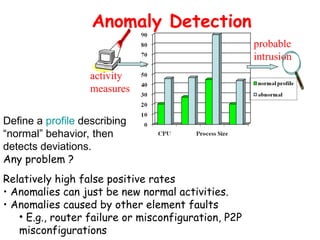
Anomaly Detection
activity
measures
probable
intrusion
Relatively highfalse positive rates
• Anomalies can just be new normal activities.
• Anomalies caused by other element faults
• E.g., router failure or misconfiguration, P2P
misconfigurations
Define a profile describing
“normal” behavior, then
detects deviations.
Any problem ?
8.
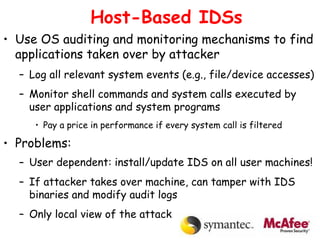
Host-Based IDSs
• UseOS auditing and monitoring mechanisms to find
applications taken over by attacker
– Log all relevant system events (e.g., file/device accesses)
– Monitor shell commands and system calls executed by
user applications and system programs
• Pay a price in performance if every system call is filtered
• Problems:
– User dependent: install/update IDS on all user machines!
– If attacker takes over machine, can tamper with IDS
binaries and modify audit logs
– Only local view of the attack
9.
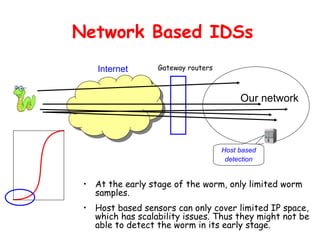
Network Based IDSs
•At the early stage of the worm, only limited worm
samples.
• Host based sensors can only cover limited IP space,
which has scalability issues. Thus they might not be
able to detect the worm in its early stage.
Gateway routers
Internet
Our network
Host based
detection
10.
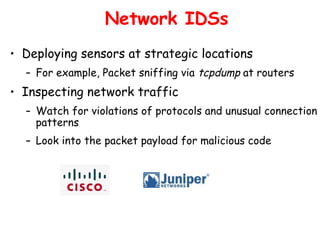
Network IDSs
• Deployingsensors at strategic locations
– For example, Packet sniffing via tcpdump at routers
• Inspecting network traffic
– Watch for violations of protocols and unusual connection
patterns
– Look into the packet payload for malicious code
11.
Network IDSs
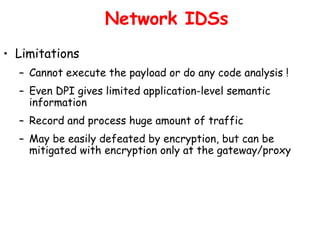
• Limitations
–Cannot execute the payload or do any code analysis !
– Even DPI gives limited application-level semantic
information
– Record and process huge amount of traffic
– May be easily defeated by encryption, but can be
mitigated with encryption only at the gateway/proxy
12.
Host-based vs. Network-basedIDS
• Give an attack that can only be detected by
host-based IDS but not network-based IDS
• Sample attack:
– SQL injection attack
Problems with CurrentIDSs
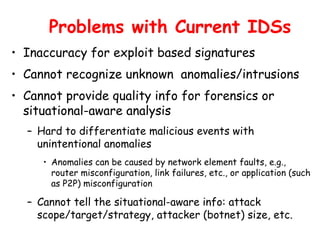
• Inaccuracy for exploit based signatures
• Cannot recognize unknown anomalies/intrusions
• Cannot provide quality info for forensics or
situational-aware analysis
– Hard to differentiate malicious events with
unintentional anomalies
• Anomalies can be caused by network element faults, e.g.,
router misconfiguration, link failures, etc., or application (such
as P2P) misconfiguration
– Cannot tell the situational-aware info: attack
scope/target/strategy, attacker (botnet) size, etc.
17.
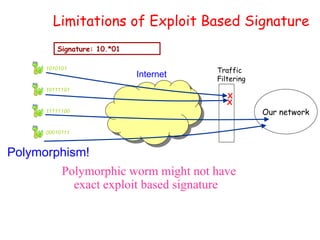
Limitations of ExploitBased Signature
1010101
10111101
11111100
00010111
Our network
Traffic
Filtering
Internet
Signature: 10.*01
X
X
Polymorphic worm might not have
exact exploit based signature
Polymorphism!
18.
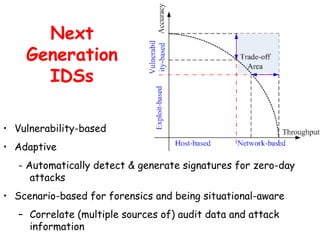
Next
Generation
IDSs
• Vulnerability-based
• Adaptive
-Automatically detect & generate signatures for zero-day
attacks
• Scenario-based for forensics and being situational-aware
– Correlate (multiple sources of) audit data and attack
information
19.
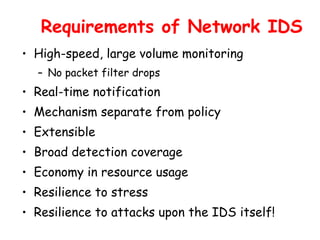
Requirements of NetworkIDS
• High-speed, large volume monitoring
– No packet filter drops
• Real-time notification
• Mechanism separate from policy
• Extensible
• Broad detection coverage
• Economy in resource usage
• Resilience to stress
• Resilience to attacks upon the IDS itself!
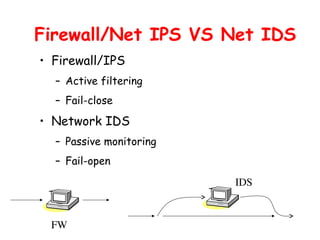
#15 Protection is not free/cheap. For example, an intrusion detection system (IDS) needs to analyze each packet. This requires a lot of computing power, usually a dedicated high-end workstation. If the IDS is real-time then its response time must be short.
When there is insufficient resources, some protection mechanisms will simply not let data in (fail-close). For example, a firewall, which filters each packet, will simply drop packets when it is overloaded. The dropped packet will not be able to reach beyond the firewall into the internal network. The user experience may not be a happy one because of data loss. However, other protection mechanisms will check/analyze as much as they can but will effectively let all data (fail-open) when there is insufficient resources. For example, an IDS, which simply copies a packet and analyzes it (while the packet continues to reach its target), may only be able to check a packet after a lengthy delay when it is overloaded, letting the packet to complete its potentially malicious actions.
When assessing the protection mechanisms, we will develop models and evaluate under what conditions they will fail-close or fail-open.

![Misuse Detection
Intrusion
Patterns:
Sequences of
system calls,
patterns of
network traffic,
etc.
activities
pattern
matching
intrusion
Can’t detect new attacks
Example: if (traffic contains “x90+de[^rn]{30}”) then “attack detected”
Problems?](https://image.slidesharecdn.com/is-lecture10intrusiondetectionsystem-251204052221-718131f1/85/IS-Lecture-10-Intrusion-Detection-System-ppt-6-320.jpg)