Is Asperger’s Syndrome a Different Classification than High-Functioning Autism?Kayla SweeneyPsy250 Writing in PsychologyBradley WaltmanArgosy University
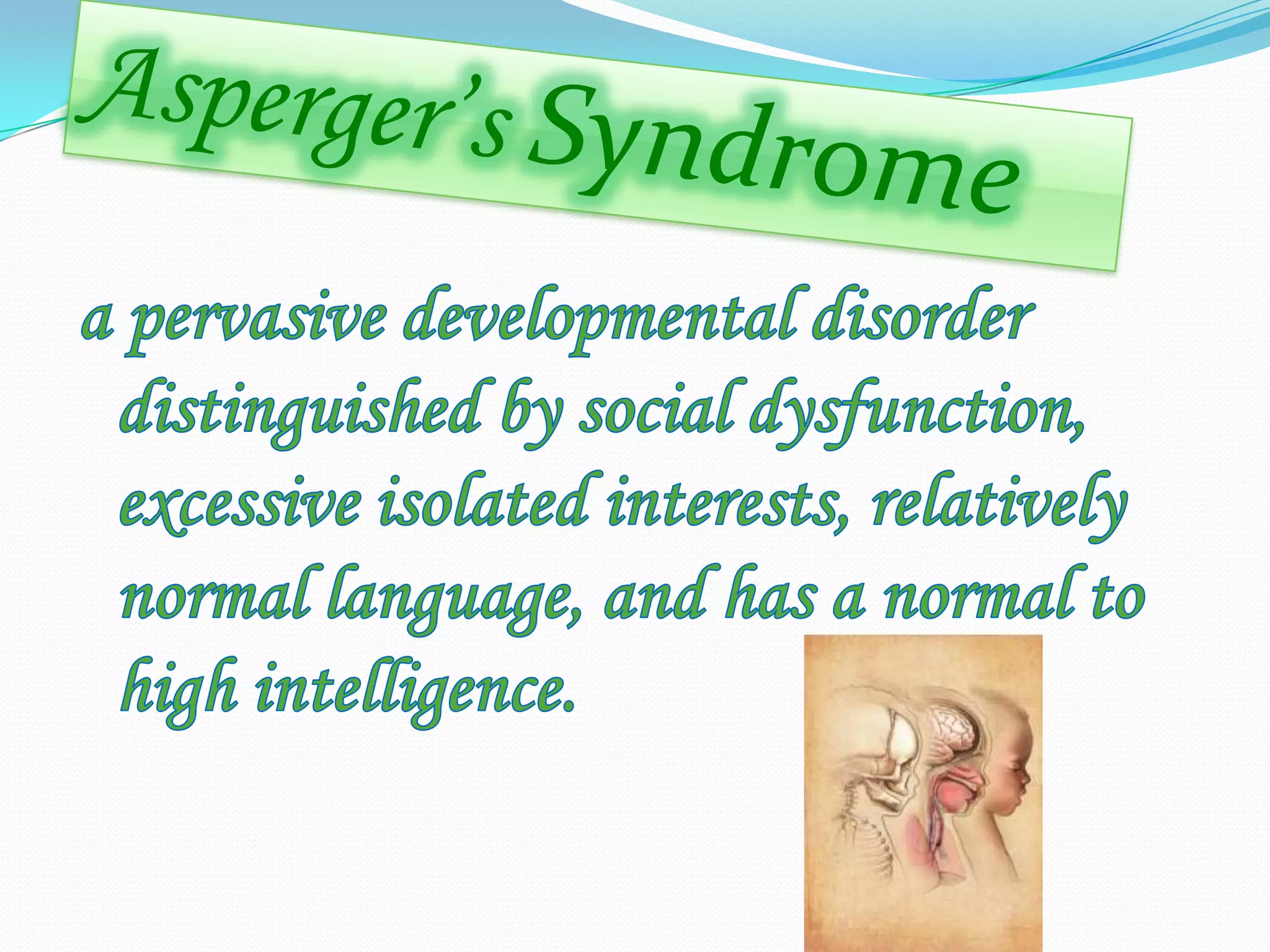
Asperger’s Syndromea pervasive developmental disorder distinguished by social dysfunction, excessive isolated interests, relatively normal language, and has a normal to high intelligence.
High-Functioning AutismA pervasive developmental disorder characterized by autistic traits, but IQ is normal.
AS and HFA are classified as different conditions, however many believe they are they same.  The question being examined is AS is a different condition from HFA on terms of neurobehavioral and neurocognitive characteristics.
The importance of studying this topic is because a debate is going on whether Asperger’s Syndrome is a different diagnostic condition from Autism or are these two conditions  on opposite sides of autistic disorders .
Motor Planning DeficitLaterizationPedantic Speaking Neurobehavioral
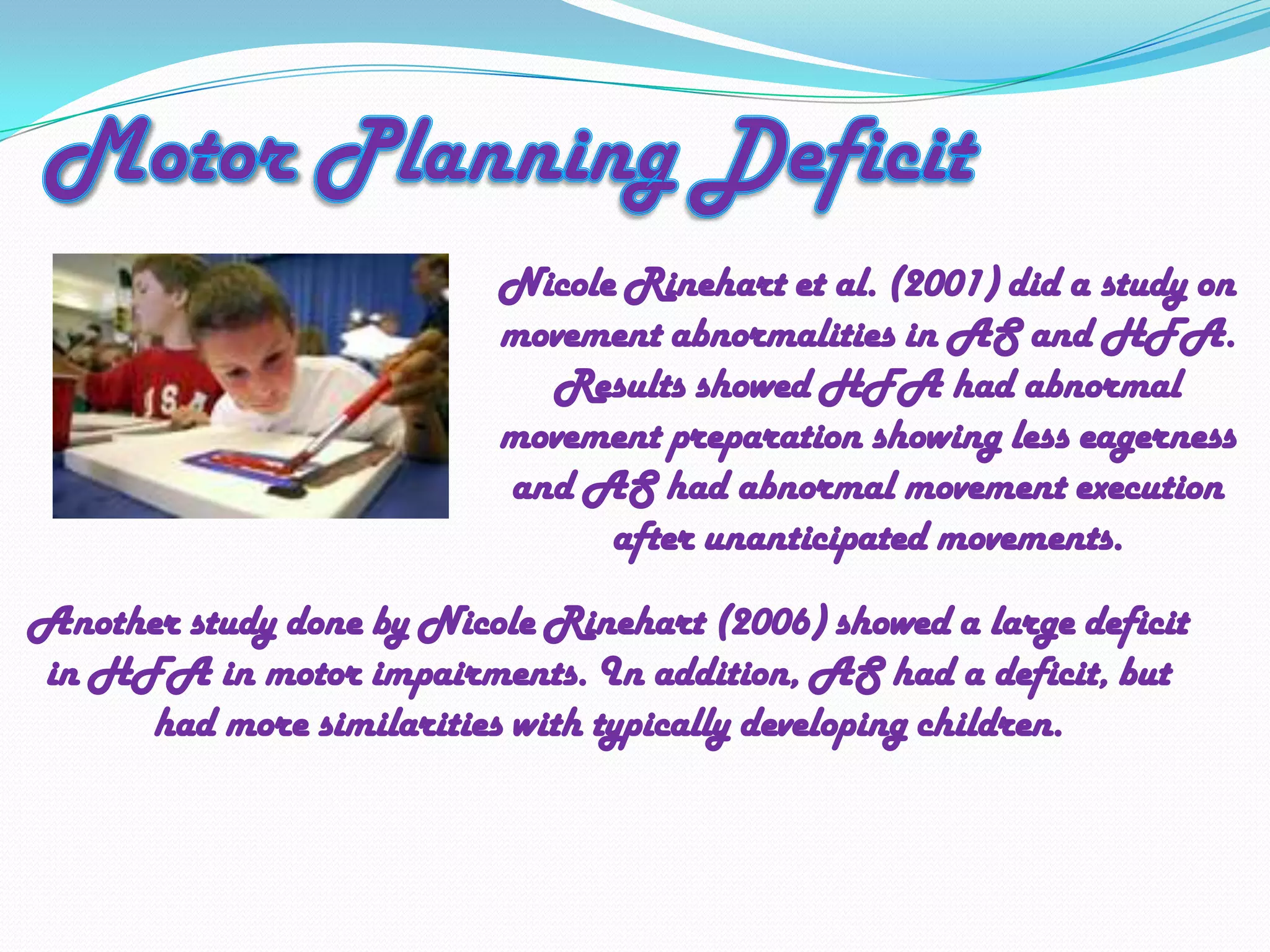
Motor Planning DeficitNicole Rinehart et al. (2001) did a study on movement abnormalities in AS and HFA.  Results showed HFA had abnormal movement preparation showing less eagerness and AS had abnormal movement execution after unanticipated movements. Another study done by Nicole Rinehart (2006) showed a large deficit in HFA in motor impairments. In addition, AS had a deficit, but had more similarities with typically developing children.
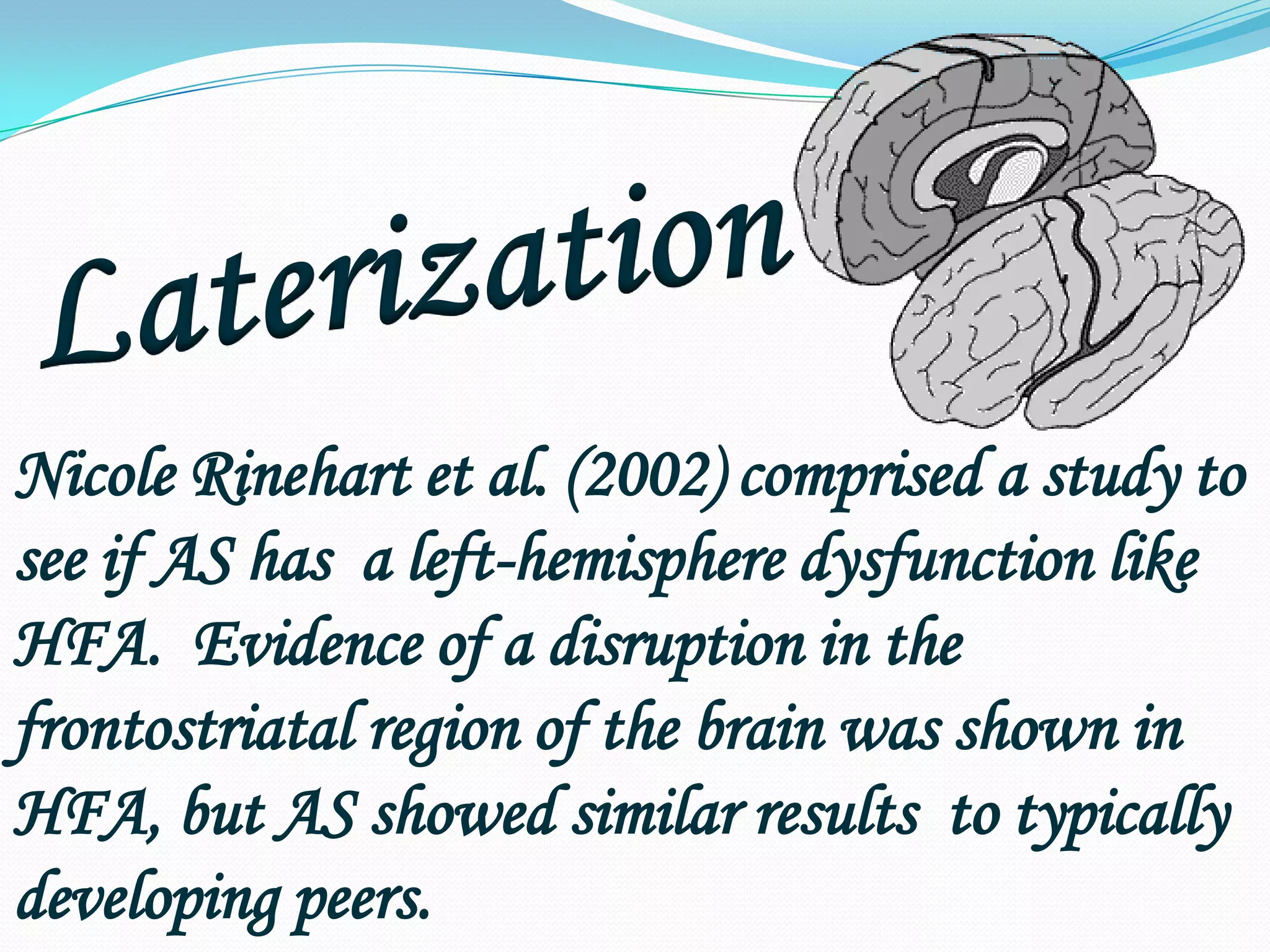
LaterizationNicole Rinehart et al. (2002) comprised a study to see if AS has  a left-hemisphere dysfunction like HFA.  Evidence of a disruption in the frontostriatal region of the brain was shown in HFA, but AS showed similar results  to typically developing peers.
Pedantic SpeechA child loves to talk about their favorite toy, however, it is hard to talk to that child because all they want to talk about is their toy and nothing else.  Mohammed Ghaziuddin and Lenore Gerstein studied to see if pedantic speech is a clinical feature of AS.  Their results showed AS pedantic speech is more prominent than in HFA.
IntelligenceMemory IllusionEmotion PerceptionThought DisorderNeurocognitive
IntelligenceMohammad Ghaziuddin and Kimberly Mountain-Kimichi found AS’ verbal IQ was highand their performance IQ was low.  The HFA had a high PIQ and a low VIQ.  Tomonori Koyama et al. (2007) also supports Mohammad and Kimberly’s results.  Also HFA showed more abnormal communication than AS.
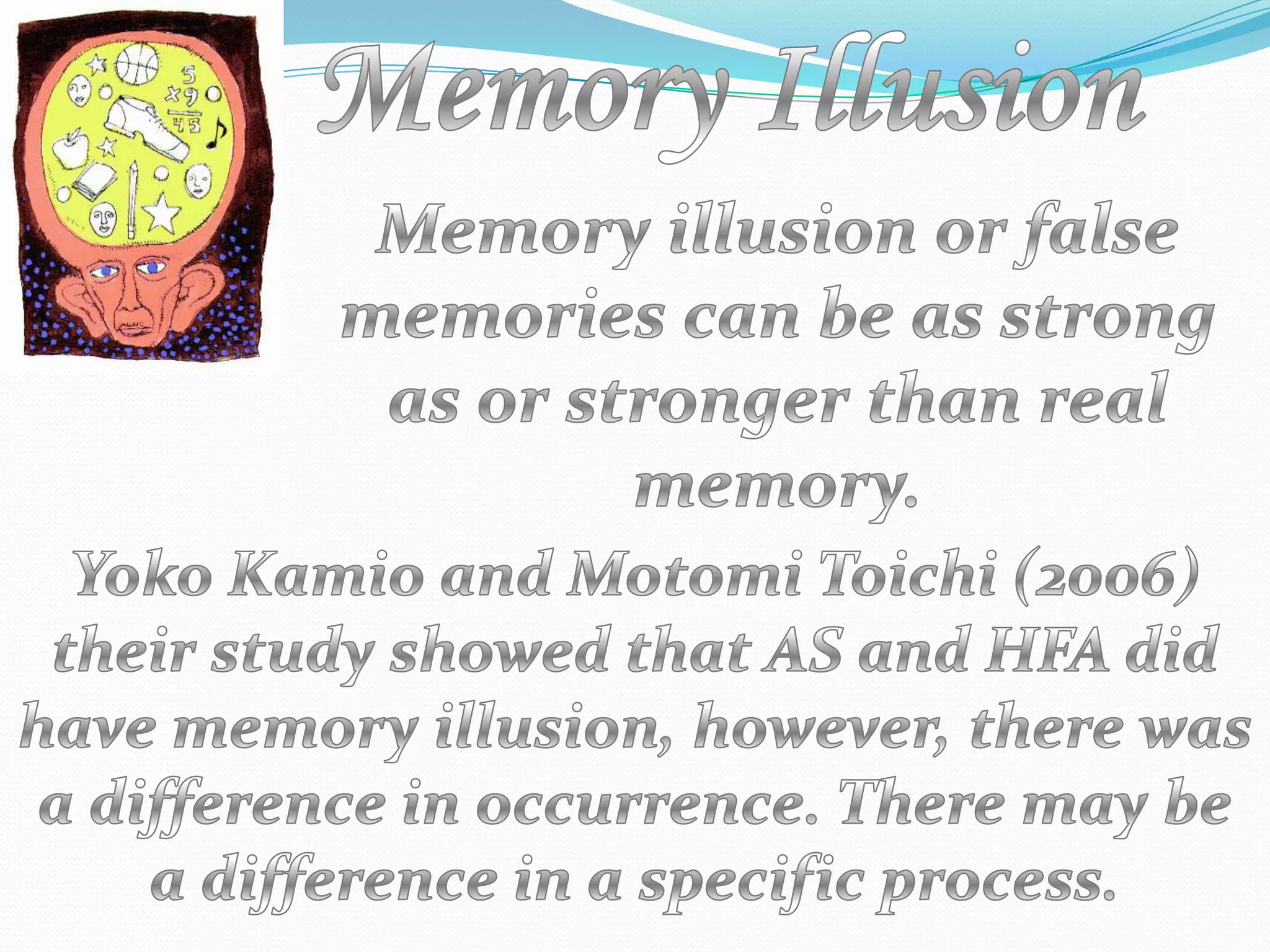
MemoryIllusionMemory illusion or false memories can be as strong as or stronger than real memory.Yoko Kamio and MotomiToichi (2006) their study showed that AS and HFA did have memory illusion, however, there was a difference in occurrence. There may be a difference in a specific process.
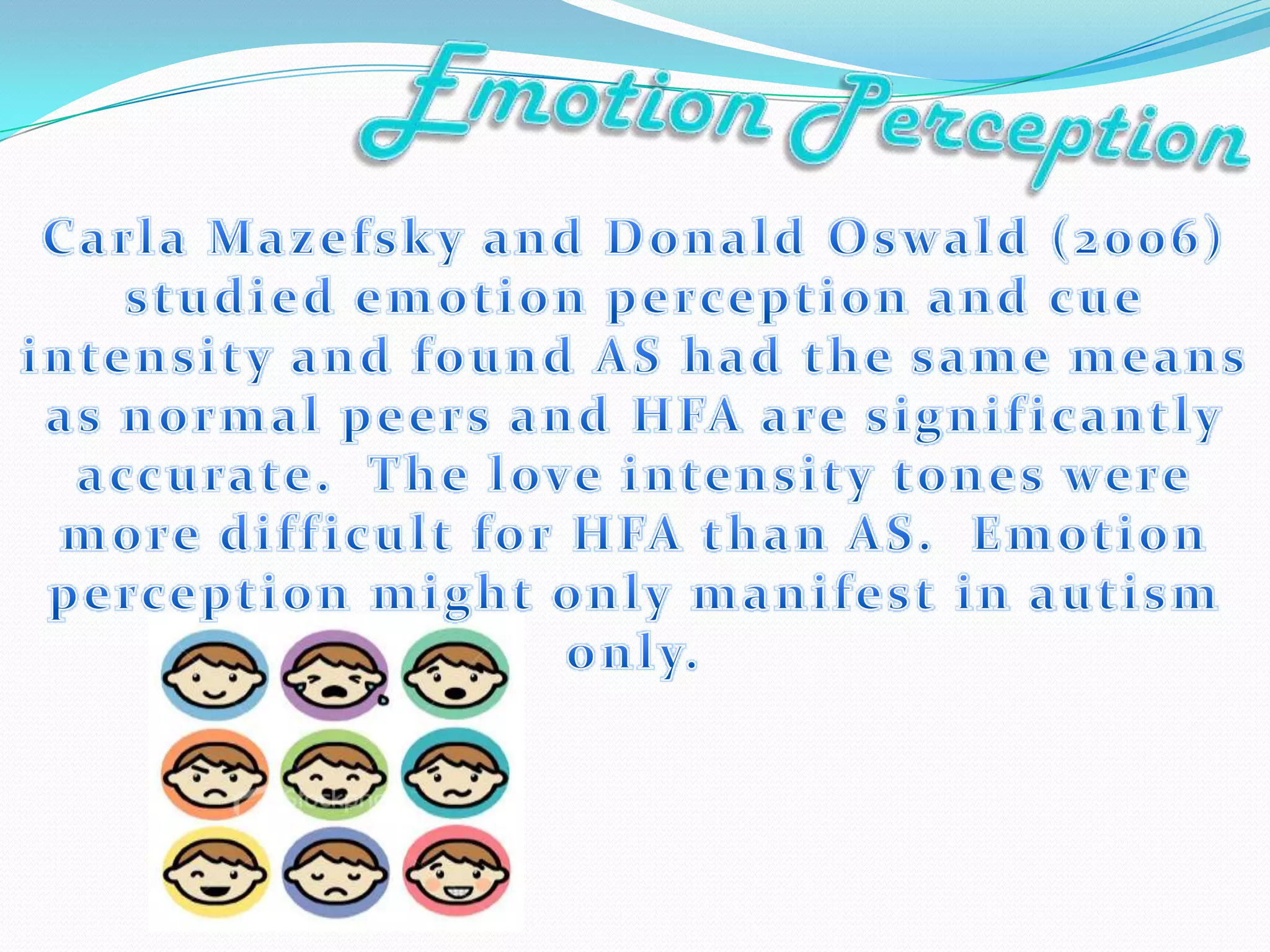
EmotionPerceptionCarla Mazefsky and Donald Oswald (2006)  studied emotion perception and cue intensity and found AS had the same means as normal peers and HFA are significantly accurate.  The love intensity tones were more difficult for HFA than AS.  Emotion perception might only manifest in autism only.
Thought DisorderBoth AS and HFA are known for disorganized thinking.  There is a difference on the abnormalities.  Mohammad Ghaziuddin et al. (1995) used a Rorschach test and found the difference was AS are more introversive and HFA are more extroversive.?
ConclusionsThe debate whether AS should be considered a different diagnostic condition from HFA.  Laterization and IQ scores have shown there is a significant distinction between Asperger’s Syndrome and High-Functioning Autism.  However, more research needs to be done with bigger samples  and different or modified tests.  Also, AS needs to be compared to HFA and not normal controls.
Ghaziuddin, Mohammad,. Gerstein, Leonore. (1996). Pedantic Speaking Style 	Differentiates Asperger Syndrome from High-Functioning Autism 	[Electronic Version]. Journal of       Autism and Developmental Disorders, Vol. 26, No. 6.Ghaziuddin, Mohammad., Mountain-Kimchi, Kimberly. (2004). Defining the 	IntellectualProfile Of Asperger Syndrome: Comparison with High-	Functioning Autism [Electronic       Version]. Journal of Autism and Developmental Disorders, Vol. 34, No. 3.Ghaziuddin, Mohammad., Leininger, Lisa., &Tsai, Luke. (1995). Brief Report: 	Thought Disorder in Asperger Syndrome: Comparison with High-Functioning 	Autism [Electronic Version]. Journal of Autism and Developmental 	Disorders, Vol. 25, No. 3.Kamio, Yoko., Motomi, Toichi. (2007). Memory Illusion in High-Functioning 	Autism andAsperger’s Disorder [Electronic Version]. Journal of Autism 	and Developmental Disorders, 37, 867-876.References
Koyama, Tomonori., Tachimori, Hisateru., Osada, Hirokazu., Takeda, Toshinobu., & Kurita,Hiroshi. (2007). Cognitive and Symptom Profiles in Asperger’s 	Syndrome and High-Functioning Autism [Electronic Version]. Psychiatry a	ndClinical Neurosciences, 	61,99-104.Merriam-Webster Online Dictionary. 	(2009). Retrieved June 19, 2009, from http://www.merriam-webster.com/medical/extroversiveMazefsky, Carla A., Oswald, Donald P. (2007). Emotion Perception in Asperger’s 	Syndrome And High-Functioning Autism: The Importance of Diagnostic 	Criteria and Cue Intensity [Electronic Version]. Journal of Autism and 	Developmental 	Disorders, 37, 1086-1095.Rinehart, Nicole J., Bellgrove, Mark A., Tonge, Bruce J., Brereton, Avril V., 	Howells-Rankin,Debra., & Bradshaw, John L. (2006). An Examination of 	Movement Kinematics in 	Young People with High-Functioning Autism and 	Asperger’s Disorder: Further Evidence For a Motor Planning Deficit 	[Electronic Version]. Journal of Autism and Developmental Disorders, 36, 	757-767.References
Rinehart, Nicole J., Bradshaw, John L., Brereton, Avril V., & 	Tonge, Bruce J. (2001). MovementPreparation in High-	Functioning Autism and Asperger 	Disorder: A Serial Choice 	Reaction Time Task Involving MotorReprogramming 	[Electronic version]. Journal ofAutism and Developmental 	Disorders, Vol. 31, No. 1.Rinehart, Nicole J., Bradshaw, John L., Brereton, Avril V., & 	Tonge, Bruce J. (2002).Lateralization in Individuals with High-	Functioning Autism and Asperger’s Disorder:A Frontostriatal 	Model [Electronic Version]. Journal of Autism and 	Developmental Disorders, Vol. 32, No. 4.Thede, Linda L., Coolidge, Frederick L. (2007). Psychological and 	Neurobehavioral Comparisons with Children with Asperger’s 	Disorder Versus High-Functioning Autism[Electronic 	Version]. Journal of Autism and Developmental Disorders, 37, 	847-854.References

Is Asperger’S Syndromea Different Classificationthan High Functioning Presentation

  • 1.
    Is Asperger’s Syndromea Different Classification than High-Functioning Autism?Kayla SweeneyPsy250 Writing in PsychologyBradley WaltmanArgosy University
  • 2.
    Asperger’s Syndromea pervasivedevelopmental disorder distinguished by social dysfunction, excessive isolated interests, relatively normal language, and has a normal to high intelligence.
  • 3.
    High-Functioning AutismA pervasivedevelopmental disorder characterized by autistic traits, but IQ is normal.
  • 4.
    AS and HFAare classified as different conditions, however many believe they are they same. The question being examined is AS is a different condition from HFA on terms of neurobehavioral and neurocognitive characteristics.
  • 5.
    The importance ofstudying this topic is because a debate is going on whether Asperger’s Syndrome is a different diagnostic condition from Autism or are these two conditions on opposite sides of autistic disorders .
  • 6.
  • 7.
    Motor Planning DeficitNicoleRinehart et al. (2001) did a study on movement abnormalities in AS and HFA. Results showed HFA had abnormal movement preparation showing less eagerness and AS had abnormal movement execution after unanticipated movements. Another study done by Nicole Rinehart (2006) showed a large deficit in HFA in motor impairments. In addition, AS had a deficit, but had more similarities with typically developing children.
  • 8.
    LaterizationNicole Rinehart etal. (2002) comprised a study to see if AS has a left-hemisphere dysfunction like HFA. Evidence of a disruption in the frontostriatal region of the brain was shown in HFA, but AS showed similar results to typically developing peers.
  • 9.
    Pedantic SpeechA childloves to talk about their favorite toy, however, it is hard to talk to that child because all they want to talk about is their toy and nothing else. Mohammed Ghaziuddin and Lenore Gerstein studied to see if pedantic speech is a clinical feature of AS. Their results showed AS pedantic speech is more prominent than in HFA.
  • 10.
  • 11.
    IntelligenceMohammad Ghaziuddin andKimberly Mountain-Kimichi found AS’ verbal IQ was highand their performance IQ was low. The HFA had a high PIQ and a low VIQ. Tomonori Koyama et al. (2007) also supports Mohammad and Kimberly’s results. Also HFA showed more abnormal communication than AS.
  • 12.
    MemoryIllusionMemory illusion orfalse memories can be as strong as or stronger than real memory.Yoko Kamio and MotomiToichi (2006) their study showed that AS and HFA did have memory illusion, however, there was a difference in occurrence. There may be a difference in a specific process.
  • 13.
    EmotionPerceptionCarla Mazefsky andDonald Oswald (2006) studied emotion perception and cue intensity and found AS had the same means as normal peers and HFA are significantly accurate. The love intensity tones were more difficult for HFA than AS. Emotion perception might only manifest in autism only.
  • 14.
    Thought DisorderBoth ASand HFA are known for disorganized thinking. There is a difference on the abnormalities. Mohammad Ghaziuddin et al. (1995) used a Rorschach test and found the difference was AS are more introversive and HFA are more extroversive.?
  • 15.
    ConclusionsThe debate whetherAS should be considered a different diagnostic condition from HFA. Laterization and IQ scores have shown there is a significant distinction between Asperger’s Syndrome and High-Functioning Autism. However, more research needs to be done with bigger samples and different or modified tests. Also, AS needs to be compared to HFA and not normal controls.
  • 16.
    Ghaziuddin, Mohammad,. Gerstein,Leonore. (1996). Pedantic Speaking Style Differentiates Asperger Syndrome from High-Functioning Autism [Electronic Version]. Journal of Autism and Developmental Disorders, Vol. 26, No. 6.Ghaziuddin, Mohammad., Mountain-Kimchi, Kimberly. (2004). Defining the IntellectualProfile Of Asperger Syndrome: Comparison with High- Functioning Autism [Electronic Version]. Journal of Autism and Developmental Disorders, Vol. 34, No. 3.Ghaziuddin, Mohammad., Leininger, Lisa., &Tsai, Luke. (1995). Brief Report: Thought Disorder in Asperger Syndrome: Comparison with High-Functioning Autism [Electronic Version]. Journal of Autism and Developmental Disorders, Vol. 25, No. 3.Kamio, Yoko., Motomi, Toichi. (2007). Memory Illusion in High-Functioning Autism andAsperger’s Disorder [Electronic Version]. Journal of Autism and Developmental Disorders, 37, 867-876.References
  • 17.
    Koyama, Tomonori., Tachimori,Hisateru., Osada, Hirokazu., Takeda, Toshinobu., & Kurita,Hiroshi. (2007). Cognitive and Symptom Profiles in Asperger’s Syndrome and High-Functioning Autism [Electronic Version]. Psychiatry a ndClinical Neurosciences, 61,99-104.Merriam-Webster Online Dictionary. (2009). Retrieved June 19, 2009, from http://www.merriam-webster.com/medical/extroversiveMazefsky, Carla A., Oswald, Donald P. (2007). Emotion Perception in Asperger’s Syndrome And High-Functioning Autism: The Importance of Diagnostic Criteria and Cue Intensity [Electronic Version]. Journal of Autism and Developmental Disorders, 37, 1086-1095.Rinehart, Nicole J., Bellgrove, Mark A., Tonge, Bruce J., Brereton, Avril V., Howells-Rankin,Debra., & Bradshaw, John L. (2006). An Examination of Movement Kinematics in Young People with High-Functioning Autism and Asperger’s Disorder: Further Evidence For a Motor Planning Deficit [Electronic Version]. Journal of Autism and Developmental Disorders, 36, 757-767.References
  • 18.
    Rinehart, Nicole J.,Bradshaw, John L., Brereton, Avril V., & Tonge, Bruce J. (2001). MovementPreparation in High- Functioning Autism and Asperger Disorder: A Serial Choice Reaction Time Task Involving MotorReprogramming [Electronic version]. Journal ofAutism and Developmental Disorders, Vol. 31, No. 1.Rinehart, Nicole J., Bradshaw, John L., Brereton, Avril V., & Tonge, Bruce J. (2002).Lateralization in Individuals with High- Functioning Autism and Asperger’s Disorder:A Frontostriatal Model [Electronic Version]. Journal of Autism and Developmental Disorders, Vol. 32, No. 4.Thede, Linda L., Coolidge, Frederick L. (2007). Psychological and Neurobehavioral Comparisons with Children with Asperger’s Disorder Versus High-Functioning Autism[Electronic Version]. Journal of Autism and Developmental Disorders, 37, 847-854.References