Integrated Risk Management for Africa
IRMA key data European Commission funded Research Project 3 years €  3.5M total budget - € 2.5M EC contribution Started in June 2008: the kick-off meeting was held in Luxembourg on 3-5 June 2008 9 EU & 6 African Partners  including major players in the IP business the governments of Luxembourg, Mozambique and Morocco participate to support the emergency service trials
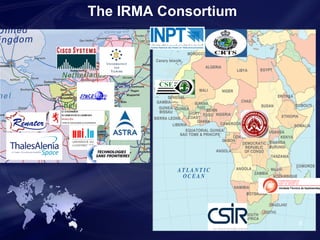
IRMA KEY DATA  The consortium INDUSTRY PLAYERS GOVERNMENTAL ORGANISATIONS NGO BEST-IN-CLASS RESEARCH
University of Luxembourg (UL), Luxembourg Centre d e Communication du Gouvernement (CCG), Luxembourg Technologies Sans Frontières (TSF), Luxembourg Spacebel S.A. (SPB), Belgium Thales Alenia Space France (TAS-F), France SES ASTRA TECHCOM S.A. (SES-ASTRA), Luxemburg Cisco Systems International B.V. (Cisco), The Netherlands Réseau National de Télécommunication pour la Technologie, l’enseignement et la Recherche (RENATER), France Universiteit Van Tilburg (KUB), The Netherlands IRMA Project - Partners
Council for Scientific and Industrial Research (CSIR), South Africa Centre de Suivi Ecologique (CSE), Senegal Centre Royal de Télédétection Spatiale (CRTS), Morocco Institut National des Postes & Telecommunications (INPT) - Agence Nationale de Réglementation des Télécommunications (ANRT), Morocco Ecole Nationale Supérieure Polytechnique de l’Université de Yaoundé I (ENSP), Cameroon Unidade Técnica de Implementação da Politica de Informática (ICT Policy Implementation Technical Unit) (UTICT) (Subcontractors: INGC & INAM),  Mozambique IRMA Project – Partners
The IRMA Consortium
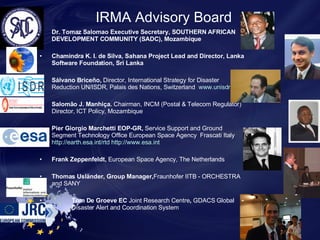
Dr. Tomaz Salomao Executive Secretary, SOUTHERN AFRICAN DEVELOPMENT COMMUNITY (SADC), Mozambique Chamindra K. I. de Silva, Sahana Project Lead and Director, Lanka Software Foundation, Sri Lanka Sálvano Briceño,  Director, International Strategy for Disaster Reduction UN/ISDR, Palais des Nations, Switzerland  www.unisdr.org   Salomão J. Manhiça.  Chairman, INCM (Postal & Telecom Regulator) Director, ICT Policy, Mozambique  Pier Giorgio Marchetti EOP-GR,  Service Support and Ground Segment Technology Office European Space Agency   Frascati Italy    http://earth.esa.int/rtd   http://www.esa.int Frank Zeppenfeldt,  European Space Agency, The Netherlands Thomas Usländer, Group Manager, Fraunhofer IITB - ORCHESTRA and SANY Tom De Groeve EC  Joint Research Centre ,  GDACS Global  Disaster Alert and Coordination System IRMA Advisory Board
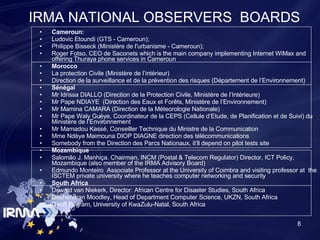
Cameroun: Ludovic Etoundi (GTS - Cameroun);  Philippe Bisseck (Ministère de l'urbanisme - Cameroun); Roger Fotso, CEO de Saconets which is the main company implementing Internet WiMax and offering Thuraya phone services in Cameroun Morocco La protection Civile (Ministère de l’intérieur) Direction de la surveillance et de la prévention des risques (Département de l’Environnement) Sénégal Mr Idrissa DIALLO (Direction de la Protection Civile, Ministère de l’Intérieure)  Mr Pape NDIAYE  (Direction des Eaux et Forêts, Ministère de l’Environnement) Mr Mamina CAMARA (Direction de la Méteorologie Nationale) Mr Pape Waly Guèye, Coordinateur de la CEPS (Cellule d’Etude, de Planification et de Suivi) du Ministère de l’Environnement Mr Mamadou Kassé, Conseiller Technique du Ministre de la Communication  Mme Ndèye Maimouna DIOP DIAGNE direction des télécommunications Somebody from the Direction des Parcs Nationaux, it’ll depend on pilot tests site Mozambique Salomão J. Manhiça. Chairman, INCM (Postal & Telecom Regulator) Director, ICT Policy, Mozambique (also member of the IRMA Advisory Board) Edmundo Monteiro  Associate Professor at the University of Coimbra and visiting professor at  the ISCTEM private university where he teaches computer networking and security South Africa Dewald van Niekerk, Director: African Centre for Disaster Studies, South Africa Deshendran Moodley, Head of Department Computer Science, UKZN, South Africa Geoff Pegram, University of KwaZulu-Natal, South Africa IRMA NATIONAL OBSERVERS  BOARDS
IRMA Vision An innovative use of advanced ICT has the capacity to provide at a low cost, very effective tools to improve substantially environmental risk management effectiveness even when the data infrastructure and or the telecommunication infrastructure is limited. In addition, the IRMA experience will pave the way to a range of new applications in support of regional development such as: Environmental management Regional planning Next generation IP based networks
IRMA Project Goals To develop and validate a state-of-the-art ICT  service platform designed to support the management of a wide range of environmental risks during all risk phases from risk assessment to recovery  To integrate existing  generic services provided by international organizations To develop additional local services To assess the value of IRMA by implementing five disaster scenarios validated by the stakeholders To make a substantial part of the IRMA platform available as open source free software
IRMA technical approach  (continued) Create solutions that are as universal as possible Interworking with existing networks is a wish but not in the focus of the project Trial and validation activities will show the application of the results in the real life crisis scenarios Results of u-2010 project as showcase for other countries
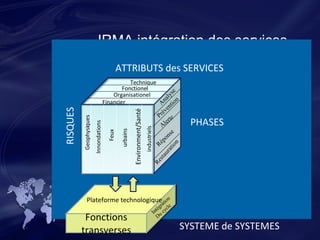
IRMA intégration des services Fonctions transverses Plateforme technologique Geophysiques Innondations Feux urbains Environment/Santé industriels Technique Fonctionel Organisationel Financier RISQUES ATTRIBUTS des SERVICES SYSTEME de SYSTEMES PHASES Analyse  Prévention  Alerte Réponse  Restauration  Intégration Du cycle
IRMA Expected Achievements A coherent suite of architectural concepts and methodologies applicable to multi-risks management situations in Africa , including advanced multiple vulnerability assessment to cope with complex emergencies. An integrated set of tools , compliant with the above mentioned concepts and methodologies and with current and emerging international standards.  A pre-operational infrastructure and access-platform , assessed by end-users through operational scenarios serving as reference for future larger scale deployment and providing  the facilities for prototyping risk  management systems and for supporting a  rapid development of applications services.
Specific applications  (bushfire, flood, desertification and urban risks) dedicated to the demonstration of multi-risks management in Africa.  A versatile communications system  enabling high and/or low rates Internet transfer.  A reliable, low cost communications system enabling alert messages and possibly emergency communications in any location of Africa  (i.e. even where no electricity is supplied) A management concept  to monitor and automatically control  the functions of services and networks  shown as critical through the dependability  and vulnerability analysis. IRMA Expected Achievements
IRMA Contribution to EC policies DG Development: the EU strategy for Disaster Risk Reduction (DRR) in Developing Countries , whose objective is to contribute to sustainable development by reducing the burden of disaster in the most vulnerable countries and by the integration of DRR into development and humanitarian policies and into crisis response.  DG Environment : to contribute to the creation of a Single Environment Information Space and to INSPIRE DG Information and Society : advancing the Internet by deploying IPv6, especially in Africa DG Research : to contribute to the validation of the SICA  approach to international cooperation with  developing countries DG Enterprise : to integrate upcoming  GMES downstream services
IRMA Communication Network CSIR UTICT  ENSP  CSE  CRTS ANRT  UL CCG SES TSF SPB TAS-F
IRMA: the Senegal Scenarios (Bush Fire and Desertification) Desertification CSE
IRMA: the Mozambique Scenarios (Floods) UTICT  FLOODS
IRMA: the Cameroon-Yaoundé Urban Risk Scenario – The Sensor Network ENSP
IRMA: the Moroccan Integrated Risk Scenarios (Flood, Urban risk) CRTS  ANRT
IRMA: the South African Integrated Risk Scenarios (Flood, Bush fire, Urban Risk) CSIR
IRMA Project Functional Structure
IRMA Project Structure
WP0: Project Management WP Leader: UL, CCG WP objectives: to provide the internal project management and the overall co-ordination of activities, financial and technical planning and control.  to establish the project management procedures to perform the management duties (reports) to establish the project website  Deliverable N° Deliverable name  Deadline D0.1 Project presentation  T0+3 D0.2 Project procedures: project management plan, reporting procedures, reporting templates,  quality assurance plan, website.  T0+3, T0+4 D0.3. 1 - 4 Periodic reports T0+10, T0+19, T0+28, T0+38 D0.4 Publishable Final Project Report  T0+38
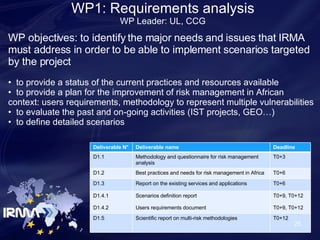
WP1: Requirements analysis WP Leader: UL, CCG WP objectives: to identify the major needs and issues that IRMA must address in order to be able to implement scenarios targeted by the project to provide a status of the current practices and resources available  to provide a plan for the improvement of risk management in African context: users requirements, methodology to represent multiple vulnerabilities to evaluate the past and on-going activities (IST projects, GEO…) to define detailed scenarios  Deliverable N° Deliverable name  Deadline D1.1 Methodology and questionnaire for risk management analysis T0+3 D1.2 Best practices and needs for risk management in Africa T0+6 D1.3 Report on the existing services and applications T0+6 D1.4.1 D1.4.2 Scenarios definition report Users requirements document T0+9, T0+12 T0+9, T0+12 D1.5 Scientific report on multi-risk methodologies T0+12
WP2: System Definition and Architecture WP Leader: TAS-F WP objectives: to design a service oriented architecture to provide the technical requirements based on WP1 results to study the technologies resulting from previous and on-going projects to analyse and select open source components applicable to IRMA to design a cost-effective, sustainable global architecture to produce technical specifications for the core IRMA platform sub-systems to provide a test and validation plan for the sub-systems to provide a methodology and development handbook Deliverable N° Deliverable name  Deadline D2.1 Technical Requirement Document  T0+9, T0+18 D2.2 Report on the potential use of background and open source components T0+12 D2.3 Global Architecture Design Document T0+12, T0+18 D2.4 Specifications of the Data Acquisition sub-systems T0+6, T0+16, T0+30 D2.5 Specifications of Risk Management Applications T0+15 D2.6 Specifications of the Telecommunication sub-systems T0+15, T0+30 D2.7 Test and Validation Plan T0+18 D2.8 Methodology and development handbook T0+10
WP 3.1: Implementation and Integration of IRMA Core Services WP Leader: TAS-F WP objectives: to develop the ready-to-use generic set of tools to integrate and test the IRMA generic platform  to provide an installation kit of the IRMA generic platform to deploy it to the countries involved in the experimentations  Deliverable N° Deliverable name  Deadline D3.1 Generic IRMA platform Test and Validation Report for the Generic IRMA platform IRMA generic platform "installation kit and deployment guidelines"  T0+20 T0+22 T0+24
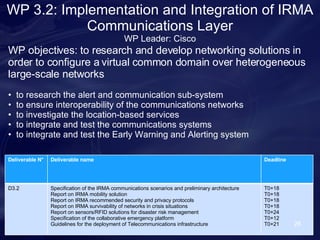
WP 3.2: Implementation and Integration of IRMA Communications Layer WP Leader: Cisco WP objectives: to research and develop networking solutions in order to configure a virtual common domain over heterogeneous large-scale networks to research the alert and communication sub-system to ensure interoperability of the communications networks to investigate the location-based services t o integrate and test the communications systems to integrate and test the Early Warning and Alerting system Deliverable N° Deliverable name  Deadline D3.2 Specification of the IRMA communications scenarios and preliminary architecture Report on IRMA mobility solution  Report on IRMA recommended security and privacy protocols  Report on IRMA survivability of networks in crisis situations Report on sensors/RFID solutions for disaster risk management Specification of the collaborative emergency platform Guidelines for the deployment of Telecommunications infrastructure T0+18 T0+18 T0+18 T0+18 T0+24 T0+12 T0+21
WP 4.0: Tests, trials, validation and final demo WP Leader: Spacebel WP objectives:  to develop, implement, test, and demonstrate the pilots and to co-ordinate the implementation of the three pilots in Senegal, Mozambique, and Morocco to perform the global demonstration
WP 4.1:  Implementation and demonstration of the risk management in Senegal WP Leader: CSE Deliverable N° Deliverable name  Deadline D4.1.1 Software component T0+25 D4.1.2 Integration test and validation plan T0+25 D4.1.3 Integration test and validation report (thematic platform) T0+27 D4.1.4 Test report for the communications infrastructure T0+27 D4.1.5 Integration test and validation report (full scenario) T0+28 D4.1.6 Evaluation report for the demonstration  T0+31
WP 4.2:  Implementation and demonstration of the risk management in Cameroon WP Leader: ENSP Deliverable N° Deliverable name  Deadline D4.2.1 Software component T0+26 D4.2.2 Integration test and validation plan T0+26 D4.2.3 Integration test and validation report (thematic platform) T0+28 D4.2.4 Test report for the communications infrastructure T0+28 D4.2.5 Integration test and validation report (full scenario) T0+29 D4.2.6 Evaluation report for the demonstration  T0+32
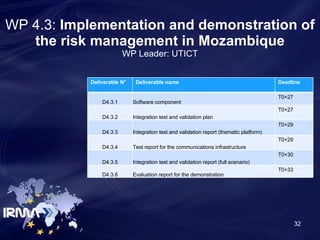
WP 4.3:  Implementation and demonstration of the risk management in Mozambique WP Leader: UTICT Deliverable N° Deliverable name  Deadline D4.3.1 Software component T0+27 D4.3.2 Integration test and validation plan T0+27 D4.3.3 Integration test and validation report (thematic platform) T0+29 D4.3.4 Test report for the communications infrastructure T0+29 D4.3.5 Integration test and validation report (full scenario) T0+30 D4.3.6 Evaluation report for the demonstration  T0+33
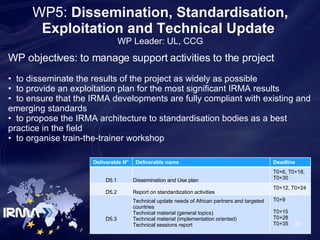
WP5:  Dissemination, Standardisation, Exploitation and Technical Update  WP Leader: UL, CCG WP objectives: to manage support activities to the project to disseminate the results of the project as widely as possible to provide an exploitation plan for the most significant IRMA results to  ensure that the IRMA developments are fully compliant with existing and emerging standards  to p ropose the IRMA architecture to standardisation bodies as a best practice in the field to  organise train-the-trainer workshop Deliverable N° Deliverable name  Deadline D5.1 Dissemination and Use plan T0+6, T0+18, T0+30  D5.2 Report on standardization activities  T0+12, T0+24 D5.3 Technical update needs of African partners and targeted countries  Technical material (general topics) Technical material (implementation oriented)  Technical sessions report T0+9 T0+15 T0+28 T0+35
IRMA Work Plan
More information on http://www.irma.lu  Contact details:  Guy Weets - guy.weets@uni.lu Prof. Dr. Thomas Engel [email_address] + 352 4666 44 5263

Irma Project Profile V 2.2

  • 1.
  • 2.
    IRMA key dataEuropean Commission funded Research Project 3 years € 3.5M total budget - € 2.5M EC contribution Started in June 2008: the kick-off meeting was held in Luxembourg on 3-5 June 2008 9 EU & 6 African Partners including major players in the IP business the governments of Luxembourg, Mozambique and Morocco participate to support the emergency service trials
  • 3.
    IRMA KEY DATA The consortium INDUSTRY PLAYERS GOVERNMENTAL ORGANISATIONS NGO BEST-IN-CLASS RESEARCH
  • 4.
    University of Luxembourg(UL), Luxembourg Centre d e Communication du Gouvernement (CCG), Luxembourg Technologies Sans Frontières (TSF), Luxembourg Spacebel S.A. (SPB), Belgium Thales Alenia Space France (TAS-F), France SES ASTRA TECHCOM S.A. (SES-ASTRA), Luxemburg Cisco Systems International B.V. (Cisco), The Netherlands Réseau National de Télécommunication pour la Technologie, l’enseignement et la Recherche (RENATER), France Universiteit Van Tilburg (KUB), The Netherlands IRMA Project - Partners
  • 5.
    Council for Scientificand Industrial Research (CSIR), South Africa Centre de Suivi Ecologique (CSE), Senegal Centre Royal de Télédétection Spatiale (CRTS), Morocco Institut National des Postes & Telecommunications (INPT) - Agence Nationale de Réglementation des Télécommunications (ANRT), Morocco Ecole Nationale Supérieure Polytechnique de l’Université de Yaoundé I (ENSP), Cameroon Unidade Técnica de Implementação da Politica de Informática (ICT Policy Implementation Technical Unit) (UTICT) (Subcontractors: INGC & INAM), Mozambique IRMA Project – Partners
  • 6.
  • 7.
    Dr. Tomaz SalomaoExecutive Secretary, SOUTHERN AFRICAN DEVELOPMENT COMMUNITY (SADC), Mozambique Chamindra K. I. de Silva, Sahana Project Lead and Director, Lanka Software Foundation, Sri Lanka Sálvano Briceño, Director, International Strategy for Disaster Reduction UN/ISDR, Palais des Nations, Switzerland www.unisdr.org Salomão J. Manhiça. Chairman, INCM (Postal & Telecom Regulator) Director, ICT Policy, Mozambique Pier Giorgio Marchetti EOP-GR, Service Support and Ground Segment Technology Office European Space Agency  Frascati Italy   http://earth.esa.int/rtd http://www.esa.int Frank Zeppenfeldt, European Space Agency, The Netherlands Thomas Usländer, Group Manager, Fraunhofer IITB - ORCHESTRA and SANY Tom De Groeve EC Joint Research Centre , GDACS Global Disaster Alert and Coordination System IRMA Advisory Board
  • 8.
    Cameroun: Ludovic Etoundi(GTS - Cameroun); Philippe Bisseck (Ministère de l'urbanisme - Cameroun); Roger Fotso, CEO de Saconets which is the main company implementing Internet WiMax and offering Thuraya phone services in Cameroun Morocco La protection Civile (Ministère de l’intérieur) Direction de la surveillance et de la prévention des risques (Département de l’Environnement) Sénégal Mr Idrissa DIALLO (Direction de la Protection Civile, Ministère de l’Intérieure) Mr Pape NDIAYE  (Direction des Eaux et Forêts, Ministère de l’Environnement) Mr Mamina CAMARA (Direction de la Méteorologie Nationale) Mr Pape Waly Guèye, Coordinateur de la CEPS (Cellule d’Etude, de Planification et de Suivi) du Ministère de l’Environnement Mr Mamadou Kassé, Conseiller Technique du Ministre de la Communication Mme Ndèye Maimouna DIOP DIAGNE direction des télécommunications Somebody from the Direction des Parcs Nationaux, it’ll depend on pilot tests site Mozambique Salomão J. Manhiça. Chairman, INCM (Postal & Telecom Regulator) Director, ICT Policy, Mozambique (also member of the IRMA Advisory Board) Edmundo Monteiro Associate Professor at the University of Coimbra and visiting professor at the ISCTEM private university where he teaches computer networking and security South Africa Dewald van Niekerk, Director: African Centre for Disaster Studies, South Africa Deshendran Moodley, Head of Department Computer Science, UKZN, South Africa Geoff Pegram, University of KwaZulu-Natal, South Africa IRMA NATIONAL OBSERVERS BOARDS
  • 9.
    IRMA Vision Aninnovative use of advanced ICT has the capacity to provide at a low cost, very effective tools to improve substantially environmental risk management effectiveness even when the data infrastructure and or the telecommunication infrastructure is limited. In addition, the IRMA experience will pave the way to a range of new applications in support of regional development such as: Environmental management Regional planning Next generation IP based networks
  • 10.
    IRMA Project GoalsTo develop and validate a state-of-the-art ICT service platform designed to support the management of a wide range of environmental risks during all risk phases from risk assessment to recovery To integrate existing generic services provided by international organizations To develop additional local services To assess the value of IRMA by implementing five disaster scenarios validated by the stakeholders To make a substantial part of the IRMA platform available as open source free software
  • 11.
    IRMA technical approach (continued) Create solutions that are as universal as possible Interworking with existing networks is a wish but not in the focus of the project Trial and validation activities will show the application of the results in the real life crisis scenarios Results of u-2010 project as showcase for other countries
  • 12.
    IRMA intégration desservices Fonctions transverses Plateforme technologique Geophysiques Innondations Feux urbains Environment/Santé industriels Technique Fonctionel Organisationel Financier RISQUES ATTRIBUTS des SERVICES SYSTEME de SYSTEMES PHASES Analyse Prévention Alerte Réponse Restauration Intégration Du cycle
  • 13.
    IRMA Expected AchievementsA coherent suite of architectural concepts and methodologies applicable to multi-risks management situations in Africa , including advanced multiple vulnerability assessment to cope with complex emergencies. An integrated set of tools , compliant with the above mentioned concepts and methodologies and with current and emerging international standards. A pre-operational infrastructure and access-platform , assessed by end-users through operational scenarios serving as reference for future larger scale deployment and providing the facilities for prototyping risk management systems and for supporting a rapid development of applications services.
  • 14.
    Specific applications (bushfire, flood, desertification and urban risks) dedicated to the demonstration of multi-risks management in Africa. A versatile communications system enabling high and/or low rates Internet transfer. A reliable, low cost communications system enabling alert messages and possibly emergency communications in any location of Africa (i.e. even where no electricity is supplied) A management concept to monitor and automatically control the functions of services and networks shown as critical through the dependability and vulnerability analysis. IRMA Expected Achievements
  • 15.
    IRMA Contribution toEC policies DG Development: the EU strategy for Disaster Risk Reduction (DRR) in Developing Countries , whose objective is to contribute to sustainable development by reducing the burden of disaster in the most vulnerable countries and by the integration of DRR into development and humanitarian policies and into crisis response. DG Environment : to contribute to the creation of a Single Environment Information Space and to INSPIRE DG Information and Society : advancing the Internet by deploying IPv6, especially in Africa DG Research : to contribute to the validation of the SICA approach to international cooperation with developing countries DG Enterprise : to integrate upcoming GMES downstream services
  • 16.
    IRMA Communication NetworkCSIR UTICT ENSP CSE CRTS ANRT UL CCG SES TSF SPB TAS-F
  • 17.
    IRMA: the SenegalScenarios (Bush Fire and Desertification) Desertification CSE
  • 18.
    IRMA: the MozambiqueScenarios (Floods) UTICT FLOODS
  • 19.
    IRMA: the Cameroon-YaoundéUrban Risk Scenario – The Sensor Network ENSP
  • 20.
    IRMA: the MoroccanIntegrated Risk Scenarios (Flood, Urban risk) CRTS ANRT
  • 21.
    IRMA: the SouthAfrican Integrated Risk Scenarios (Flood, Bush fire, Urban Risk) CSIR
  • 22.
  • 23.
  • 24.
    WP0: Project ManagementWP Leader: UL, CCG WP objectives: to provide the internal project management and the overall co-ordination of activities, financial and technical planning and control. to establish the project management procedures to perform the management duties (reports) to establish the project website Deliverable N° Deliverable name Deadline D0.1 Project presentation T0+3 D0.2 Project procedures: project management plan, reporting procedures, reporting templates, quality assurance plan, website. T0+3, T0+4 D0.3. 1 - 4 Periodic reports T0+10, T0+19, T0+28, T0+38 D0.4 Publishable Final Project Report T0+38
  • 25.
    WP1: Requirements analysisWP Leader: UL, CCG WP objectives: to identify the major needs and issues that IRMA must address in order to be able to implement scenarios targeted by the project to provide a status of the current practices and resources available to provide a plan for the improvement of risk management in African context: users requirements, methodology to represent multiple vulnerabilities to evaluate the past and on-going activities (IST projects, GEO…) to define detailed scenarios Deliverable N° Deliverable name Deadline D1.1 Methodology and questionnaire for risk management analysis T0+3 D1.2 Best practices and needs for risk management in Africa T0+6 D1.3 Report on the existing services and applications T0+6 D1.4.1 D1.4.2 Scenarios definition report Users requirements document T0+9, T0+12 T0+9, T0+12 D1.5 Scientific report on multi-risk methodologies T0+12
  • 26.
    WP2: System Definitionand Architecture WP Leader: TAS-F WP objectives: to design a service oriented architecture to provide the technical requirements based on WP1 results to study the technologies resulting from previous and on-going projects to analyse and select open source components applicable to IRMA to design a cost-effective, sustainable global architecture to produce technical specifications for the core IRMA platform sub-systems to provide a test and validation plan for the sub-systems to provide a methodology and development handbook Deliverable N° Deliverable name Deadline D2.1 Technical Requirement Document T0+9, T0+18 D2.2 Report on the potential use of background and open source components T0+12 D2.3 Global Architecture Design Document T0+12, T0+18 D2.4 Specifications of the Data Acquisition sub-systems T0+6, T0+16, T0+30 D2.5 Specifications of Risk Management Applications T0+15 D2.6 Specifications of the Telecommunication sub-systems T0+15, T0+30 D2.7 Test and Validation Plan T0+18 D2.8 Methodology and development handbook T0+10
  • 27.
    WP 3.1: Implementation andIntegration of IRMA Core Services WP Leader: TAS-F WP objectives: to develop the ready-to-use generic set of tools to integrate and test the IRMA generic platform to provide an installation kit of the IRMA generic platform to deploy it to the countries involved in the experimentations Deliverable N° Deliverable name Deadline D3.1 Generic IRMA platform Test and Validation Report for the Generic IRMA platform IRMA generic platform "installation kit and deployment guidelines" T0+20 T0+22 T0+24
  • 28.
    WP 3.2: Implementation andIntegration of IRMA Communications Layer WP Leader: Cisco WP objectives: to research and develop networking solutions in order to configure a virtual common domain over heterogeneous large-scale networks to research the alert and communication sub-system to ensure interoperability of the communications networks to investigate the location-based services t o integrate and test the communications systems to integrate and test the Early Warning and Alerting system Deliverable N° Deliverable name Deadline D3.2 Specification of the IRMA communications scenarios and preliminary architecture Report on IRMA mobility solution Report on IRMA recommended security and privacy protocols Report on IRMA survivability of networks in crisis situations Report on sensors/RFID solutions for disaster risk management Specification of the collaborative emergency platform Guidelines for the deployment of Telecommunications infrastructure T0+18 T0+18 T0+18 T0+18 T0+24 T0+12 T0+21
  • 29.
    WP 4.0: Tests, trials,validation and final demo WP Leader: Spacebel WP objectives: to develop, implement, test, and demonstrate the pilots and to co-ordinate the implementation of the three pilots in Senegal, Mozambique, and Morocco to perform the global demonstration
  • 30.
    WP 4.1: Implementationand demonstration of the risk management in Senegal WP Leader: CSE Deliverable N° Deliverable name Deadline D4.1.1 Software component T0+25 D4.1.2 Integration test and validation plan T0+25 D4.1.3 Integration test and validation report (thematic platform) T0+27 D4.1.4 Test report for the communications infrastructure T0+27 D4.1.5 Integration test and validation report (full scenario) T0+28 D4.1.6 Evaluation report for the demonstration T0+31
  • 31.
    WP 4.2: Implementationand demonstration of the risk management in Cameroon WP Leader: ENSP Deliverable N° Deliverable name Deadline D4.2.1 Software component T0+26 D4.2.2 Integration test and validation plan T0+26 D4.2.3 Integration test and validation report (thematic platform) T0+28 D4.2.4 Test report for the communications infrastructure T0+28 D4.2.5 Integration test and validation report (full scenario) T0+29 D4.2.6 Evaluation report for the demonstration T0+32
  • 32.
    WP 4.3: Implementationand demonstration of the risk management in Mozambique WP Leader: UTICT Deliverable N° Deliverable name Deadline D4.3.1 Software component T0+27 D4.3.2 Integration test and validation plan T0+27 D4.3.3 Integration test and validation report (thematic platform) T0+29 D4.3.4 Test report for the communications infrastructure T0+29 D4.3.5 Integration test and validation report (full scenario) T0+30 D4.3.6 Evaluation report for the demonstration T0+33
  • 33.
    WP5: Dissemination,Standardisation, Exploitation and Technical Update WP Leader: UL, CCG WP objectives: to manage support activities to the project to disseminate the results of the project as widely as possible to provide an exploitation plan for the most significant IRMA results to ensure that the IRMA developments are fully compliant with existing and emerging standards to p ropose the IRMA architecture to standardisation bodies as a best practice in the field to organise train-the-trainer workshop Deliverable N° Deliverable name Deadline D5.1 Dissemination and Use plan T0+6, T0+18, T0+30 D5.2 Report on standardization activities T0+12, T0+24 D5.3 Technical update needs of African partners and targeted countries Technical material (general topics) Technical material (implementation oriented) Technical sessions report T0+9 T0+15 T0+28 T0+35
  • 34.
  • 35.
    More information onhttp://www.irma.lu Contact details: Guy Weets - guy.weets@uni.lu Prof. Dr. Thomas Engel [email_address] + 352 4666 44 5263