CONTACTUS:
Tel: +27 (0)12 346 9047 or +27 (0)12 564 5516
Fax: +27 (0)86 633 3223
Address: 1st Floor, North Wing, Central Hub,
Automotive Supplier Park, 30 Helium Road, Rosslyn
Postal: P.O. Box 461, Rosslyn, 0200
Website: www.sharedserv.co.za
A brand by
INTRODUCTION
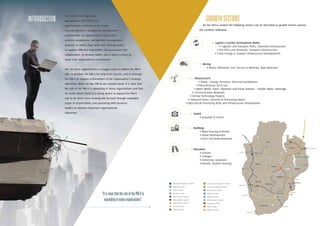
Logistics Corridor Development Nodes
• Logistics and Transport Parks, Industrial Infrastructure
• Dry Ports and Terminals, Transport Infrastructure
• Clean Energy to Support Infrastructure Developments
Mining
• Mines, Refineries (Incl. Access to Minerals, Raw Materials)
Infrastructure
• Power / Energy Provision, Electrical Installations
• Petrochemical, Oil & Gas
• Water Works: Dams, Pipelines and Pump Stations - Potable Water, Sewerage
• Communication Networks
• Hi/new Technology Projects
• Industrial Parks, Factories & Processing plants
• Agricultural Processing Hubs and Infrastructure Development
Health
• Hospitals & Clinics
Buildings
• Mass-housing Schemes
• Urban Development
• Inner-city Redevelopment
Education
• Schools
• Colleges
• University Campuses
• Hostels, Student Housing
TAH Tripoli-Windhoek Corridor
Melange Corridor
Lobito Corridor
Namibe Corridor
Trans-Cunene Corridor
Trans-Kalahari Corridor
1
2
3
4
5
6
Trans-Caprivi Corridor
Oranje Corridor
Central Corridor
7
8
9
South Africa
Namibia
Botswana
Mozambique
Zimbabwe
Zambia
Angola
DRC
Tanzania
Malawi
Maputo
Beira
Dar Es Salaam
Luanda
Walvis Bay
Luderitz
Cape Town
Durban
Lusaka
1
2
3
4
5
6
7
8
9
10
11
12
13
14
15
18
17
16
GROWTHSECTORS
On the Africa content the following sectors can be described as growth sectors around
the corridors indicated.
Dar Es Salaam (Tazara) Corridor
TAH Cairo-Gabarone Corridor
North-South Corridor
10
11
12
Mtwara Corridor
Nacala Corridor
Shire-Zambezi Corridor
Limpopo Corridor
Beira Corridor
Maputo Corridor
13
14
15
16
17
18
“ItisclearthattheroleofthePM-Uis
expandinginmanyorganisations”
The role of the Programme
Management Unit (PM-U) in
organisations continues to be a topic
of great interest to programme management
practitioners. As organisations mature their
projects, programme, and portfolio management
practices to better align work with strategic goals,
to support effective stakeholder communication and
collaboration, to develop talent, and to place a focus on
value from organisational investments.
Yet, for many organisations a struggle exists to define the PM-U
role, to position the PM-U for long-term success, and to leverage
the PM-U to support achievement of the organisation’s strategic
objectives. While no two PM-Us are created equal, it is clear that
the role of the PM-U is expanding in many organisations and that
for many others there is a strong desire to expand the PM-U
role to be much more strategically focused through expanded
scope of responsibility and partnering with business
leaders to advance important organisational
objectives.
INTRODUCTION
The World Bank, IMF and various funders all over the world are looking for mechanisms to package and develop
the infrastructure and natural resources of Africa with a responsible business models and reporting mechanisms.
Over the next 10 years, Africa needs to spend approximately $94bn annually on essential infrastructure, including
another 7,000 megawatts a year in power capacity, just to keep up with growing demand.
However, preparing bankable infrastructure projects are proving difficult due to lack of finance, skills shortages,
unsupportive regulators, and weaknesses in project governance. Even Africa’s most commercially viable sector –
energy – is suffering. This task is one of the key performance areas (KPA, s) of a PM-U Africa.
China dominates investment in Africa’s infrastructure, accounting for more than Europe and North America
together and comfortably exceeding the combined efforts of all multilateral and regional development banks.
Energy is by far the most attractive sector attracting more than half of the commitments. Between 2011 and 2040,
energy demand in Africa will grow from 590 to 3,100 terawatt-hours, according to the Programme for Infrastructure
Development in Africa (PIDA).
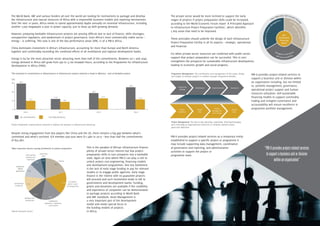
Despite strong engagement from key players like China and the US, there remains a big gap between what’s
committed and what’s received. ICA member pay-outs were $11.4bn in 2013 – less than half the commitments
of $25.3bn.
This is the paradox of African infrastructure finance:
plenty of private-sector interest but few project-
preparation skills to turn prospects into a bankable
state. Again an area where PM-U can play a role to
unlock project cost engineering, financing models
and development programmes. One key bottleneck
is the lack of early stage funding to pay for relevant
studies or to engage public agencies. Early stage
finance is the riskiest with no guarantee projects
will proceed and such investment tends to fall to
governments and development banks. Funding,
grants and donations are available if the credibility
and experience of companies can be demonstrated
to package projects according to World Bank
and IMF standards. Asset Management is
a very important part of the development
model and needs special focus in
the funding models of projects
in Africa.
29.1
9.7
11.9
8.7
18.7
12.7
25.3
11.4
30
20
10
0
2010 2011 2012 2013
(SB)
ICA commitments ICA disbursements
*The mismatch in commitments vs disbursements to infrastructure projects indicates a break in efficiency - lack of bankable projects
Project Preparation improvements required to address the paradox in infrastructure financing
*Most important factors causing bottlenecks in project preparation
Local partner
capacity and
experience
Inaccurate
data
Finance
Corruption
and/or a lack
of transparency
Inadequate
legislative / regulatory
environment
Redtape and
bureaucracy
Institutional
incapacity
Inadequate
offtake
agreements
9.3
10.5
11.5
11.7
16.3
17.4
19.7
3.5
*World Economic Forum
The private sector would be more inclined to support the early
stages of projects if project preparation skills could be increased,
according to the World Economic Forum report ‘A Principled Approach
to Infrastructure Project Preparation Facilities‘, which identifies
5 key areas that need to be improved.
These principles should underlie the design of each Infrastructure
Project Preparation Facility in all its aspects – strategic, operational
and financial.
It’s when private-sector resources are combined with public-sector
support that project preparation can be successful. This in turn
strengthens the prospects for sustainable infrastructure development,
leading to economic growth and social progress.
PM-U provides project-related services as a temporary entity
established to support a specific project or programme it
may include supporting data management, coordination
of governance and reporting, and administrative
activities to support the project or
programme team.
Programme
Strategy
Mobilization Implementation Operations
Project
Definition
Project
Plan
Project
Management
and Control
Project
Close
Programme Management: The coordination and management of the scope, timing
and budget of multiple projects to achieve strategic Programme benefits.
Project Management: The day-to-day planning, organising, directing/managing
and controlling of organisational resources to complete specific project
goals and objectives.
Clear Objectives and Focused Strateg
y
Self-
Sustainable
Financing
Model
ExcellenceinPortfolio
M
anagement Cost-Effec
tiveandValue-Adding
Ad
visoryServices
and Accountability
Stringent Governance
PM-U provides project-related services to
support a business unit or division within
an organisation including, but not limited
to, portfolio management, governance,
operational project support and human
resources utilization. Self-sustainable
financing models to support commodity
trading and stringent Governance and
accountability will ensure excellence in
programme portfolio management.
“PM-Uprovidesproject-relatedservices
tosupportabusinessunitordivision
withinanorganisation”
PM-U Provides enabling processes to
continuously support management of projects,
programme or portfolio work throughout the organisation.
Uses the governance, processes, practices, and tools established by the
organisation and provides administrative support for delivery of the project, programme
or portfolio work within its domain.
Global PM-U,s are responsible for alignment of projects and programme work to Countries national development
plans, corporate strategy, establishing and ensuring appropriate enterprise governance, and performing portfolio
management functions to ensure strategy alignment and benefits realization.
PM-U supports project work by equipping the organisation with methodologies, standards and tools to enable
project managers to better deliver projects. Increases the capability of the organisation with good practices and
a central point of contact for project managers.
PM-U may facilitate governance at the national/country level and incorporate strategy development and strategic
planning support. The PM-U may have direct responsibility for or influence over other lower-level PM-Us. Management
of multiple stakeholders and ensuring continuous communication are important roles of the enterprise PM-U. The PM-U
as a Centre of Excellence increases the capability of the organisation by implementing good practices and providing a
central point of contact for project managers. It may provide training, mentoring and capability development for people
and could also facilitate knowledge management through knowledge capture and information distribution.
This important first step laid out a basic understanding of the current PM-U landscape and addressed questions raised
by mid- to upper-levels of management responsible for developing, reincarnating and managing PM-Us. Furthermore,
by aligning performance metrics in the delivery of business value, the PM-U Frameworks are being more effective via
the use of methods, services and processes. PM-U directors and managers will be able to:
1. Compare their own PM-U with a closely matching framework to benchmark against important service and
performance criteria
2. Learn about best common practices across all the PM-U Frameworks and the higher performing PM-Us.
Programme
Management
Office
Programme
Integration
Dependency
Awareness
Governance
Facilitation
Standards
Adherence
P
rogramme
Ad
m
inistration
Programme
Reporting
ACTIVITIES
Vendor/Contract Management
Benefit Management
People Change Management
Resource Management
Scope Management
ACTIVITIES
Programme Governance & Planning
Communication Management
Quality Management
Risk Management
Issue Management
PMO Framework
• Standards, methodologies and processes
methodology definition
• Impact measurement and monitoring
• Project programme delivery
• Define the business goals
• Resource management
• Schedule/cost/scope management
• Business realization management
• Risk management
• Stakeholder management
• Project integration
• Strategic alignment
• Resource management allocation
• Opportunities and investment analysis
• Talent management training, career paths, career
development, capability/skills development and
certifications /qualifications / credentials
• Governance and performance management reporting
• Metrics/KPIs; compliance
• Financial management
• PM-U performance management
• Organisational change management
• Customer/stakeholder satisfaction
• Service providers management
• Communications administration
• Support Tools (provisioning/implementation/support)
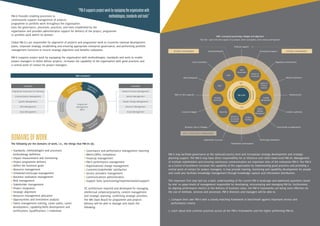
ITC architecture required and developed for managing
intellectual collateral/property, content management
and strategic planning, confirming strategic priorities.
The MIS Dash Board for programme and projects
delivery will be able to manage and report the
following:
DOMAINSOFWORK
The following are the domains of work, i.e., the things that PM-Us do;
Risk
Assessment
Policies &
Procedures
System &
Process
Controls
Funding
Management
Project
Delivery
Management
Project
Tracking
Finance &
Accounting
Processing
Reporting
Steering
Committee
Legal
Audit
Political support
Socio economics
Social framework
Stakeholder participation
Technology framework
Cross-border arrangements
Corridor authority
Infrastructure
Natural resources
Regulatory environment
Economical support
Stakeholder structure
Business case & linkages
Country linkages
Skills & Tech capacity
Risk framework
RISK & INTELLIGENCE MANAGEMENT
INTERNAL ENVIRONMENT EXTERNAL ENVIRONMENT
PMO: Conceptual positioning, linkages and alignment
The hub - each and every aspect of a project, from conception, until closure and beyond!
PM-U/MI
MIS
Transparent
24/7
Dashboard
“PM-Usupportsprojectworkbyequippingtheorganisationwith
methodologies,standardsandtools”

PM-U Final Brochure Layout Sept 2015 update

  • 1.
    CONTACTUS: Tel: +27 (0)12346 9047 or +27 (0)12 564 5516 Fax: +27 (0)86 633 3223 Address: 1st Floor, North Wing, Central Hub, Automotive Supplier Park, 30 Helium Road, Rosslyn Postal: P.O. Box 461, Rosslyn, 0200 Website: www.sharedserv.co.za A brand by
  • 2.
    INTRODUCTION Logistics Corridor DevelopmentNodes • Logistics and Transport Parks, Industrial Infrastructure • Dry Ports and Terminals, Transport Infrastructure • Clean Energy to Support Infrastructure Developments Mining • Mines, Refineries (Incl. Access to Minerals, Raw Materials) Infrastructure • Power / Energy Provision, Electrical Installations • Petrochemical, Oil & Gas • Water Works: Dams, Pipelines and Pump Stations - Potable Water, Sewerage • Communication Networks • Hi/new Technology Projects • Industrial Parks, Factories & Processing plants • Agricultural Processing Hubs and Infrastructure Development Health • Hospitals & Clinics Buildings • Mass-housing Schemes • Urban Development • Inner-city Redevelopment Education • Schools • Colleges • University Campuses • Hostels, Student Housing TAH Tripoli-Windhoek Corridor Melange Corridor Lobito Corridor Namibe Corridor Trans-Cunene Corridor Trans-Kalahari Corridor 1 2 3 4 5 6 Trans-Caprivi Corridor Oranje Corridor Central Corridor 7 8 9 South Africa Namibia Botswana Mozambique Zimbabwe Zambia Angola DRC Tanzania Malawi Maputo Beira Dar Es Salaam Luanda Walvis Bay Luderitz Cape Town Durban Lusaka 1 2 3 4 5 6 7 8 9 10 11 12 13 14 15 18 17 16 GROWTHSECTORS On the Africa content the following sectors can be described as growth sectors around the corridors indicated. Dar Es Salaam (Tazara) Corridor TAH Cairo-Gabarone Corridor North-South Corridor 10 11 12 Mtwara Corridor Nacala Corridor Shire-Zambezi Corridor Limpopo Corridor Beira Corridor Maputo Corridor 13 14 15 16 17 18 “ItisclearthattheroleofthePM-Uis expandinginmanyorganisations” The role of the Programme Management Unit (PM-U) in organisations continues to be a topic of great interest to programme management practitioners. As organisations mature their projects, programme, and portfolio management practices to better align work with strategic goals, to support effective stakeholder communication and collaboration, to develop talent, and to place a focus on value from organisational investments. Yet, for many organisations a struggle exists to define the PM-U role, to position the PM-U for long-term success, and to leverage the PM-U to support achievement of the organisation’s strategic objectives. While no two PM-Us are created equal, it is clear that the role of the PM-U is expanding in many organisations and that for many others there is a strong desire to expand the PM-U role to be much more strategically focused through expanded scope of responsibility and partnering with business leaders to advance important organisational objectives.
  • 3.
    INTRODUCTION The World Bank,IMF and various funders all over the world are looking for mechanisms to package and develop the infrastructure and natural resources of Africa with a responsible business models and reporting mechanisms. Over the next 10 years, Africa needs to spend approximately $94bn annually on essential infrastructure, including another 7,000 megawatts a year in power capacity, just to keep up with growing demand. However, preparing bankable infrastructure projects are proving difficult due to lack of finance, skills shortages, unsupportive regulators, and weaknesses in project governance. Even Africa’s most commercially viable sector – energy – is suffering. This task is one of the key performance areas (KPA, s) of a PM-U Africa. China dominates investment in Africa’s infrastructure, accounting for more than Europe and North America together and comfortably exceeding the combined efforts of all multilateral and regional development banks. Energy is by far the most attractive sector attracting more than half of the commitments. Between 2011 and 2040, energy demand in Africa will grow from 590 to 3,100 terawatt-hours, according to the Programme for Infrastructure Development in Africa (PIDA). Despite strong engagement from key players like China and the US, there remains a big gap between what’s committed and what’s received. ICA member pay-outs were $11.4bn in 2013 – less than half the commitments of $25.3bn. This is the paradox of African infrastructure finance: plenty of private-sector interest but few project- preparation skills to turn prospects into a bankable state. Again an area where PM-U can play a role to unlock project cost engineering, financing models and development programmes. One key bottleneck is the lack of early stage funding to pay for relevant studies or to engage public agencies. Early stage finance is the riskiest with no guarantee projects will proceed and such investment tends to fall to governments and development banks. Funding, grants and donations are available if the credibility and experience of companies can be demonstrated to package projects according to World Bank and IMF standards. Asset Management is a very important part of the development model and needs special focus in the funding models of projects in Africa. 29.1 9.7 11.9 8.7 18.7 12.7 25.3 11.4 30 20 10 0 2010 2011 2012 2013 (SB) ICA commitments ICA disbursements *The mismatch in commitments vs disbursements to infrastructure projects indicates a break in efficiency - lack of bankable projects Project Preparation improvements required to address the paradox in infrastructure financing *Most important factors causing bottlenecks in project preparation Local partner capacity and experience Inaccurate data Finance Corruption and/or a lack of transparency Inadequate legislative / regulatory environment Redtape and bureaucracy Institutional incapacity Inadequate offtake agreements 9.3 10.5 11.5 11.7 16.3 17.4 19.7 3.5 *World Economic Forum The private sector would be more inclined to support the early stages of projects if project preparation skills could be increased, according to the World Economic Forum report ‘A Principled Approach to Infrastructure Project Preparation Facilities‘, which identifies 5 key areas that need to be improved. These principles should underlie the design of each Infrastructure Project Preparation Facility in all its aspects – strategic, operational and financial. It’s when private-sector resources are combined with public-sector support that project preparation can be successful. This in turn strengthens the prospects for sustainable infrastructure development, leading to economic growth and social progress. PM-U provides project-related services as a temporary entity established to support a specific project or programme it may include supporting data management, coordination of governance and reporting, and administrative activities to support the project or programme team. Programme Strategy Mobilization Implementation Operations Project Definition Project Plan Project Management and Control Project Close Programme Management: The coordination and management of the scope, timing and budget of multiple projects to achieve strategic Programme benefits. Project Management: The day-to-day planning, organising, directing/managing and controlling of organisational resources to complete specific project goals and objectives. Clear Objectives and Focused Strateg y Self- Sustainable Financing Model ExcellenceinPortfolio M anagement Cost-Effec tiveandValue-Adding Ad visoryServices and Accountability Stringent Governance PM-U provides project-related services to support a business unit or division within an organisation including, but not limited to, portfolio management, governance, operational project support and human resources utilization. Self-sustainable financing models to support commodity trading and stringent Governance and accountability will ensure excellence in programme portfolio management. “PM-Uprovidesproject-relatedservices tosupportabusinessunitordivision withinanorganisation”
  • 4.
    PM-U Provides enablingprocesses to continuously support management of projects, programme or portfolio work throughout the organisation. Uses the governance, processes, practices, and tools established by the organisation and provides administrative support for delivery of the project, programme or portfolio work within its domain. Global PM-U,s are responsible for alignment of projects and programme work to Countries national development plans, corporate strategy, establishing and ensuring appropriate enterprise governance, and performing portfolio management functions to ensure strategy alignment and benefits realization. PM-U supports project work by equipping the organisation with methodologies, standards and tools to enable project managers to better deliver projects. Increases the capability of the organisation with good practices and a central point of contact for project managers. PM-U may facilitate governance at the national/country level and incorporate strategy development and strategic planning support. The PM-U may have direct responsibility for or influence over other lower-level PM-Us. Management of multiple stakeholders and ensuring continuous communication are important roles of the enterprise PM-U. The PM-U as a Centre of Excellence increases the capability of the organisation by implementing good practices and providing a central point of contact for project managers. It may provide training, mentoring and capability development for people and could also facilitate knowledge management through knowledge capture and information distribution. This important first step laid out a basic understanding of the current PM-U landscape and addressed questions raised by mid- to upper-levels of management responsible for developing, reincarnating and managing PM-Us. Furthermore, by aligning performance metrics in the delivery of business value, the PM-U Frameworks are being more effective via the use of methods, services and processes. PM-U directors and managers will be able to: 1. Compare their own PM-U with a closely matching framework to benchmark against important service and performance criteria 2. Learn about best common practices across all the PM-U Frameworks and the higher performing PM-Us. Programme Management Office Programme Integration Dependency Awareness Governance Facilitation Standards Adherence P rogramme Ad m inistration Programme Reporting ACTIVITIES Vendor/Contract Management Benefit Management People Change Management Resource Management Scope Management ACTIVITIES Programme Governance & Planning Communication Management Quality Management Risk Management Issue Management PMO Framework • Standards, methodologies and processes methodology definition • Impact measurement and monitoring • Project programme delivery • Define the business goals • Resource management • Schedule/cost/scope management • Business realization management • Risk management • Stakeholder management • Project integration • Strategic alignment • Resource management allocation • Opportunities and investment analysis • Talent management training, career paths, career development, capability/skills development and certifications /qualifications / credentials • Governance and performance management reporting • Metrics/KPIs; compliance • Financial management • PM-U performance management • Organisational change management • Customer/stakeholder satisfaction • Service providers management • Communications administration • Support Tools (provisioning/implementation/support) ITC architecture required and developed for managing intellectual collateral/property, content management and strategic planning, confirming strategic priorities. The MIS Dash Board for programme and projects delivery will be able to manage and report the following: DOMAINSOFWORK The following are the domains of work, i.e., the things that PM-Us do; Risk Assessment Policies & Procedures System & Process Controls Funding Management Project Delivery Management Project Tracking Finance & Accounting Processing Reporting Steering Committee Legal Audit Political support Socio economics Social framework Stakeholder participation Technology framework Cross-border arrangements Corridor authority Infrastructure Natural resources Regulatory environment Economical support Stakeholder structure Business case & linkages Country linkages Skills & Tech capacity Risk framework RISK & INTELLIGENCE MANAGEMENT INTERNAL ENVIRONMENT EXTERNAL ENVIRONMENT PMO: Conceptual positioning, linkages and alignment The hub - each and every aspect of a project, from conception, until closure and beyond! PM-U/MI MIS Transparent 24/7 Dashboard “PM-Usupportsprojectworkbyequippingtheorganisationwith methodologies,standardsandtools”