Download to read offline
![International Research Journal of Engineering and Technology (IRJET) e-ISSN: 2395-0056
Volume: 06 Issue: 07 | July 2019 www.irjet.net p-ISSN: 2395-0072
© 2019, IRJET | Impact Factor value: 7.211 | ISO 9001:2008 Certified Journal | Page 815
Persons Identification Tool for Visually Impaired - Digital Eye
Kalyani Sargar1, Dr. Dhananjay Bhole2, Suchita Patil3
1Computer Engineering K J Somaiya, Vidhyavihar, Mumbai-77, India
2Department of Education and Extention, Savitribai Phule Pune University, Pune
3Computer Engineering K J Somaiya, Vidhyavihar, Mumbai-77, India
-------------------------------------------------------------------------***------------------------------------------------------------------------
Abstract - One of the most difficult tasks faced by
visually impaired persons is identification of people.
Here presenting the design and implementation of a
face detection and recognition system for the
visually impaired through the use of mobile
computing. This mobile system is assisted by a
server based support system. Computer vision
methods such as convolutional neural networks and
cascade classifiers are used to further investigate
performance. Experiment results show high face
detection accuracy. Our project is based on face
recognition system where there are pre-trained
image in the datasets. The images are combined as a
mixture from different datasets to combine the
trained images for maximum accuracy, and post face
recognition the outcomes are used to determine the
Emotion, Age and Gender. Dataset used for this
project consists of images from different datasets
combined and trained to create a model wise
accuracy. It was proved that in surroundings with
maximum faces too it gives the maximum model
accuracy up to 95.7%.
Keywords - Face Detection and Recognition, Emotion
Detection, Gender Detection, Age Detection.
1. INTRODUCTION
Visual impairment, also known as vision impairment or
vision loss, is a decreased ability to see to a degree that
causes problems not fixable by usual means, such as
glasses. Living with visual impairment can be
challenging, since many daily-life situations are difficult
to understand without good visual acuity. Technology
has the potential to significantly improve the lives of
visually impaired people.
An individual is identified by his/her face. Face being the
most important part, used for distinguishing a person
from another. Each face has different features and has
different characteristics of its own. So, face recognition
plays a vital role in human behavior. These systems used
for the blind can do a lot of help to the blind, so this is
what proposing this new idea and a beginning for the
disabled ones.
In this paper, the blind will be himself able to identify
people due to face recognition and will get a audio
message about the person, “This is so and so person” and
the blind can be himself able to speak to them without
having to wait for person from opposite to come to him
and speak to him, just he has to identify the person
(provided the person details saved in system database).
The new faces can also be added to the database. In
actual, the idea is to bring the vision level of blind a bit
more closer to the normal ones. Even they would be able
to recognize people and their expressions, age and
gender on their own with the help of face recognized
from the image captured.
The model which is used for the Age and Gender
classification contains approximately 600,000
parameters. It was trained on the IMDB gender dataset,
which contains 460,723 RGB images where each image
belongs to the class “woman” or “man”, and it achieved
an accuracy of 96% in this dataset. We also validated this
model in the FER-2013 dataset. This dataset contains
35,887 grayscale images where each image belongs to
one of the following classes {“angry”, “disgust”, “fear”,
“happy”, “sad”, “surprise”, “neutral”}. Our initial model
achieved an accuracy of 66% in this dataset. The
organization of the paper is as follows: Section 1:
Introduction to the Topic
Section 2: Literature Survey
Section 3: Implementation
Section 4: Results
Section 5: Conclusion
2. LITERATURE SURVEY
Face recognition is an evolving area, changing and
improving constantly. Many research areas affect face
recognition - computer vision, optics, pattern
recognition, neural networks, machine learning, and
psychology. Face recognition is a non-invasive
identification system and faster than other systems since
multiple faces can be analyzed at the same time. The
difference between face detection and identification is
face detection is to identify a face from an image and
locate the face. Face recognition is making the decision
“whose face is it?” using an image data.
This research is mainly focus on the Dlib Face
recognition, age, gender and emotion Recognition
techniques.
A. Face Detection [1]
The first process in automatic face recognition is](https://image.slidesharecdn.com/irjet-v6i772-191101071106/85/IRJET-Persons-Identification-Tool-for-Visually-Impaired-Digital-Eye-1-320.jpg)
![International Research Journal of Engineering and Technology (IRJET) e-ISSN: 2395-0056
Volume: 06 Issue: 07 | July 2019 www.irjet.net p-ISSN: 2395-0072
© 2019, IRJET | Impact Factor value: 7.211 | ISO 9001:2008 Certified Journal | Page 815
Persons Identification Tool for Visually Impaired - Digital Eye
Kalyani Sargar1, Dr. Dhananjay Bhole2, Suchita Patil3
1Computer Engineering K J Somaiya, Vidhyavihar, Mumbai-77, India
2Department of Education and Extention, Savitribai Phule Pune University, Pune
3Computer Engineering K J Somaiya, Vidhyavihar, Mumbai-77, India
-------------------------------------------------------------------------***------------------------------------------------------------------------
Abstract - One of the most difficult tasks faced by
visually impaired persons is identification of people.
Here presenting the design and implementation of a
face detection and recognition system for the
visually impaired through the use of mobile
computing. This mobile system is assisted by a
server based support system. Computer vision
methods such as convolutional neural networks and
cascade classifiers are used to further investigate
performance. Experiment results show high face
detection accuracy. Our project is based on face
recognition system where there are pre-trained
image in the datasets. The images are combined as a
mixture from different datasets to combine the
trained images for maximum accuracy, and post face
recognition the outcomes are used to determine the
Emotion, Age and Gender. Dataset used for this
project consists of images from different datasets
combined and trained to create a model wise
accuracy. It was proved that in surroundings with
maximum faces too it gives the maximum model
accuracy up to 95.7%.
Keywords - Face Detection and Recognition, Emotion
Detection, Gender Detection, Age Detection.
1. INTRODUCTION
Visual impairment, also known as vision impairment or
vision loss, is a decreased ability to see to a degree that
causes problems not fixable by usual means, such as
glasses. Living with visual impairment can be
challenging, since many daily-life situations are difficult
to understand without good visual acuity. Technology
has the potential to significantly improve the lives of
visually impaired people.
An individual is identified by his/her face. Face being the
most important part, used for distinguishing a person
from another. Each face has different features and has
different characteristics of its own. So, face recognition
plays a vital role in human behavior. These systems used
for the blind can do a lot of help to the blind, so this is
what proposing this new idea and a beginning for the
disabled ones.
In this paper, the blind will be himself able to identify
people due to face recognition and will get a audio
message about the person, “This is so and so person” and
the blind can be himself able to speak to them without
having to wait for person from opposite to come to him
and speak to him, just he has to identify the person
(provided the person details saved in system database).
The new faces can also be added to the database. In
actual, the idea is to bring the vision level of blind a bit
more closer to the normal ones. Even they would be able
to recognize people and their expressions, age and
gender on their own with the help of face recognized
from the image captured.
The model which is used for the Age and Gender
classification contains approximately 600,000
parameters. It was trained on the IMDB gender dataset,
which contains 460,723 RGB images where each image
belongs to the class “woman” or “man”, and it achieved
an accuracy of 96% in this dataset. We also validated this
model in the FER-2013 dataset. This dataset contains
35,887 grayscale images where each image belongs to
one of the following classes {“angry”, “disgust”, “fear”,
“happy”, “sad”, “surprise”, “neutral”}. Our initial model
achieved an accuracy of 66% in this dataset. The
organization of the paper is as follows: Section 1:
Introduction to the Topic
Section 2: Literature Survey
Section 3: Implementation
Section 4: Results
Section 5: Conclusion
2. LITERATURE SURVEY
Face recognition is an evolving area, changing and
improving constantly. Many research areas affect face
recognition - computer vision, optics, pattern
recognition, neural networks, machine learning, and
psychology. Face recognition is a non-invasive
identification system and faster than other systems since
multiple faces can be analyzed at the same time. The
difference between face detection and identification is
face detection is to identify a face from an image and
locate the face. Face recognition is making the decision
“whose face is it?” using an image data.
This research is mainly focus on the Dlib Face
recognition, age, gender and emotion Recognition
techniques.
A. Face Detection [1]
The first process in automatic face recognition is](https://image.slidesharecdn.com/irjet-v6i772-191101071106/75/IRJET-Persons-Identification-Tool-for-Visually-Impaired-Digital-Eye-1-2048.jpg)
![International Research Journal of Engineering and Technology (IRJET) e-ISSN: 2395-0056
Volume: 06 Issue: 07 | July 2019 www.irjet.net p-ISSN: 2395-0072
© 2019, IRJET | Impact Factor value: 7.211 | ISO 9001:2008 Certified Journal | Page 816
face detection. The accurate detection of human
faces is much more important process. The face
detection is a computer vision technology to detect
the frontal faces of the human from digital images.
This research uses frontal faces detection by facial
landmark detection of nose and upper lips. Nose is
the center point of the facial landmarks.
B. Face Feature Point positioning
In this research, the principle of face feature
localization algorithm, the algorithm first use
detector to get face detection box, and then the
shape of the sample initialization. In the training, a
stochastic forest model is established at the
position of each feature point using the pixel
difference feature, and then the built-in model is
used to estimate the position offset of the training
sample feature point, and the position offset of
each feature point[1].The linear incremental least
squares method is used to fit the shape increment
of the training sample and the real shape
increment to obtain a global optimization.
The research describes the process involved in the
face recognition like face alignment and feature
extraction and also emphasizes the importance of
the face alignment, thus the accuracy is observed.
Eigen Face Recognizer: It uses PCA (Principal
Component Analysis), for reducing the
dimensionality of the data by projecting, it onto a
lower dimensional subspace [2].
Fisher Face Recognizer: It uses LDA (Linear
Discriminant Analysis), where the dimensionality
reduction takes place such that the within class
variance is reduced and between class, variance is
maximized[2].
Local Binary Pattern Histogram: LBPH where the
local structure of the image is summarized by
comparing each pixel with its neighborhood[2].
Dlib is a Feature-based Approach, local features on
the face such as eyes and nose are detected and
based upon which recognition is performed[2].
C. Emotion, Age and Gender Detection [4]
Facial attribute recognition, including age, gender
and emotion, has been a topic of interest among
computer vision researchers for over a decade. Due
to the release of large labeled datasets, as well as
the advances made in the design of convolutional
neural networks, error rates have dropped
significantly. In many cases, these systems are able
to outperform humans. In this work, we present an
end-to-end system capable of estimating facial
attributes including age, gender and emotion
with low error rates. The contributions of this
research are summarized below.
An end-to-end pipeline[3][4], along with novel
deep networks, that not only are computationally
inexpensive, but also outperform competitive
methods on several benchmarks.
A large datasets for age, emotion and gender
recognition that are used to train state-of-the-art
deep neural networks.
This Research, validates models by creating a real-
time vision system which accomplishes the tasks of
face detection, gender, age classification and
emotion classification simultaneously.
3. IMPLEMENTATION
Figure 1 - System Work Flow Architecture of Person
Identification and Persons Description
Image Capture: Image capture is clicking of image using
camera and Photo gallery Images will be considered for
the Face recognition and image description purpose.
Preprocessing: It is also possible to use the facial
landmarks detector, which is available inside the dlib.
The landmark detector has been trained to recognize 68
specifics points on a face which is shown in figure. This
method has been trained with many pictures, which
have been manually labeled before for each landmark.
Figure 2: Preprocessing process[1]](https://image.slidesharecdn.com/irjet-v6i772-191101071106/85/IRJET-Persons-Identification-Tool-for-Visually-Impaired-Digital-Eye-2-320.jpg)
![International Research Journal of Engineering and Technology (IRJET) e-ISSN: 2395-0056
Volume: 06 Issue: 07 | July 2019 www.irjet.net p-ISSN: 2395-0072
© 2019, IRJET | Impact Factor value: 7.211 | ISO 9001:2008 Certified Journal | Page 817
Face Recognition:
This step includes the preprocessing stage. In this stage
for Face recognition, dlib used for identifying the image
from the region of interest (RoI). As shown in figure.
Figure 3. Face Recognition[6]
Image Description: Image Description is the process of
generating textual description of an image. This figure
shows the pipeline of our system. Images are collected
from different sources and labeled for different tasks.
Over 4 million images of more than 40,000people are
collected for the task of facial recognition. All images are
labeled with their corresponding gender label and part
of the data is annotated with emotion. These images are
later pruned using a semi-automated process with a
team of human annotators in the loop. The images are
pre-processed next to extract the faces and align them.
The aligned images are then fed to our proprietary deep
network for training. The model which is used for the
Age and Gender classification, contains approximately
600,000 parameters. It was trained on the IMDB gender
dataset, which contains 460,723 RGB images where each
image belongs to the class “woman” or “man”, and it
achieved an accuracy of 96% in this dataset. We also
validated this model in the FER-2013 dataset. This
dataset contains 35,887 grayscale images where each
image belongs to one of the following classes {“angry”,
“disgust”, “fear”, “happy”, “sad”, “surprise”, “neutral”}.
Our initial model achieved an accuracy of 66% in this
dataset[3].
Figure 4: Model of Image Description[3]
4. RESULTS
For the Pixel based face recognition algorithms
comparisons, each face has 50 images. Three
applications were written to iterate through the
parameters of each algorithm. On each iteration, the
algorithm is trained using different parameters and
tested against a photo. The resulting data is plotted at
the after finishing the tests. Creates ID for each person is
added in dataset.
The face as ID-17 and the rest are between ID-20 and ID-
21, which is the same person. The first test image and
the plots are analysed below. The resulting ID change is
plotted below in figure 5. Note when components were
1, it identified.
Figure 5: The ID from the face recogniser changes
between two classes
Confidence is plotted in figure 6, increasing with
components. From this plot it appears the best is when
components are below 20.
Figure 6: The Confidence increasing with No. of
components
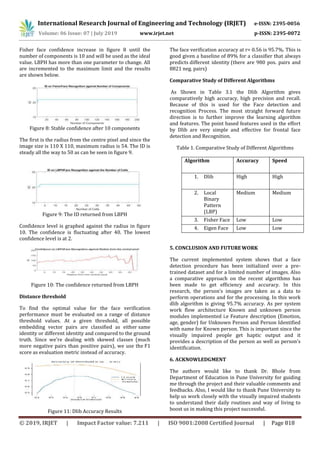
The ID results from Fisherface are more stable than
Eigenface and is on ID-21 as seen in figure 7.
Figure 7: Fisherface ID is stable](https://image.slidesharecdn.com/irjet-v6i772-191101071106/85/IRJET-Persons-Identification-Tool-for-Visually-Impaired-Digital-Eye-3-320.jpg)
![International Research Journal of Engineering and Technology (IRJET) e-ISSN: 2395-0056
Volume: 06 Issue: 07 | July 2019 www.irjet.net p-ISSN: 2395-0072
© 2019, IRJET | Impact Factor value: 7.211 | ISO 9001:2008 Certified Journal | Page 819
REFERENCES
[1] Sharma, Karthikeyan Shanmuga,sundaram, Sathees
Kumar Ramasamy. "FAREC - CNN Based Efficient
FaceRecognition Technique using Dlib" ISBN No.978-1-
4673-9545-8, VOLUME-4, ISSUE-4, APR-2017 :192-195
[2]Lahiru Dinalankara"Face Detection & Face
Recognition Using Open Computer Vision Classifies
" IJCST Vol. 7, Issue 1, Aug 2017, 2229-4333
[3]Eran Eidinger, Roee Enbar, Tal Hassner
“Age and Gender Estimation of Unfiltered Faces” IEEE
TRANSACTIONS ON INFORMATION FORENSICS AND
SECURITY, VOL. 9, Issue: 12,2015, 2170 - 2179
[4] Octavio Arriaga, Paul G. Ploger and Matias
Valdenegro"Real-time Convolutional Neural Networks
for Emotion and Gender Classification" arXiv preprint
arXiv:1710.07557 2017:324-331.
[5] Li, Xiang-Yu, and Zhen-Xian Lin. "Face Recognition
Based on HOG and Fast PCA Algorithm." In The Euro-
China Conference on Intelligent Data Analysis and
Applications, Springer, Cham, 2017: 10-21.
[6] Solanki, Kamini, and Prashant Pittalia. "Review of
face recognition techniques." International Journal of
Computer Applications 133, no. 12, 2016: 20-24.
[7] Dang, Kirti, and Shanu Sharma. "Review and
comparison of face detection algorithms." In Cloud
Computing, Data Science & Engineering-Confluence,
2017 7th International Conference on, IEEE, 2017: 629-
633.
[8] Kavita, Ms. Manjeet Kaur“A Survey paper for Face
Recognition Technologies” International Journal of
Scientific and Research Publications, Volume 6, Issue 7,
July 2016:441-445.](https://image.slidesharecdn.com/irjet-v6i772-191101071106/85/IRJET-Persons-Identification-Tool-for-Visually-Impaired-Digital-Eye-5-320.jpg)

This document presents a face detection and recognition system to help visually impaired people identify individuals. The system uses computer vision techniques like convolutional neural networks and cascade classifiers for face detection with high accuracy. It then performs face recognition on pre-trained image datasets to determine a person's identity, as well as their emotion, age and gender. The system was tested on a combined dataset of images and achieved 95.7% accuracy in identifying faces, even when there were many faces present. This person identification tool aims to help the visually impaired better interact with others by audibly providing the name and attributes of detected individuals.


