International Research Journal of Engineering and Technology (IRJET) e-ISSN: 2395-0056
Volume: 05 Issue: 04 | Apr-2018 www.irjet.net p-ISSN: 2395-0072
© 2018, IRJET | Impact Factor value: 6.171 | ISO 9001:2008 Certified Journal | Page 255
Fingerprint Based Automatic Ration Distribution System
Anjali Raj1, Ayana Asokan2 , Gayathri S3,Pooja U4, Niveditha N5 , Asha Arvind6
1,2,3,4,5 Students, Dept of Electronics and Communication Engineering, Ammini College of Engineering,Kerala,India
6Assistant Professor, Dept.of Electronics and Communication Engineering, Ammini College of Engineering, Kerala,
India
---------------------------------------------------------------------***---------------------------------------------------------------------
Abstract – The resources in the world are finite and
though the desire for resources is infinite. One of the largest
retail systems in the world is India’s public distribution
system. The manual work involved and lack of automation,
makes this system inefficient. The conventional ration card
system is replaced by automatic rationing system. This
system uses authenticated finger print detector to provide
products to the users. When the input is provided, the
products are obtained from automatized ration shop. This
system provides products with accurate weight and
unnecessary selling of goods can be avoided. The ration shop
is connected to government via GSM to prevent
irregularities in ration distribution.
Key Words: Authentication, Finger print detection,
GSM, Public distribution system, Ration card.
1.INTRODUCTION
One of the largest retail systems in the world’s is India’s
public distribution system with four lakhs fair price shops.
These shops provide sugar, rice, wheat, kerosene etc to the
customers at affordable rates. This network of shops is
spread all over the country which is controlled and
monitored by central government along with state
government Quantities of these products are fixed for each
family depending on their monthly income. There are
many families who do not claim their quota of food grains
every month. The shop dealers may have fake ration cards
which inhibits the customers from getting the exact
amount of ration they need. The dealer may sell the goods
at higher rates to outer markets there by earning a good
profit. This makes the current public distribution system
corrupted and inefficient. The current scenario has led to
anarchy and black marketing. The government is not
getting any acknowledgement regarding the supply of
food grains with the current system. Involvement of
manual work creates irregularities there by replacing the
actual products by meagre quality products and supplying
them. The automatic ration distribution system uses finger
print technology to automatize the public distribution
system thereby minimizing the corruptions. In this system,
the manual work is replaced by automated system. The
smart card replaces the ration card by including all user
information. This system is much more secured and easy
to use. This method can eradicate corruption in public
distribution system to a great extent.
2. PROPOSED SYSTEM
The proposed system runs on the basis of automation. The
heart of the system is the microcontroller PIC16F877A. the
biometric or finger print identification is the first step of
the system. The finger print of each user will be stored in a
database. After identifying the finger print, the name of the
person and ration will be displayed via LCD display. The
user can now enter the amount of ration he wants through
a five keypad. The valves of the system open to provide the
commodities. The details of the purchase will be sent over
a GSM to the user‘s mobile and authorities. The proposed
system implements a centralized web enabled ration
distribution and corruption controlling system. The goods
are stored in a storage tank and when goods are inserted in
ration shop, the quantity log is updated. The quantity log
can be accessed by the user whenever he needs to collect
ration from the ration shop. This method prevents
increased corruption in private as well as public sector.
The adulteration in consumables can be prevented to a
great extent with this system. This system is very cost
effective and time saving approach.
2.1 Automatic rationing System Technology
The method of finding match between two human finger
prints refers to finger print identification. It involves
enrollment, searching and verification. Enrollment
captures finger print from the sensor. The most commonly
used algorithm for finger print recognition is minutiae
based algorithm. Minutiae and patterns are very important
in the analysis of fingerprints since no two fingers have
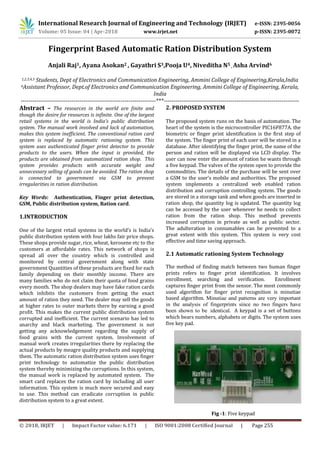
been shown to be identical. A keypad is a set of buttons
which bears numbers, alphabets or digits. The system uses
five key pad.
Fig -1: Five keypad
International Research Journal of Engineering and Technology (IRJET) e-ISSN: 2395-0056
Volume: 05 Issue: 04 | Apr-2018 www.irjet.net p-ISSN: 2395-0072
© 2018, IRJET | Impact Factor value: 6.171 | ISO 9001:2008 Certified Journal | Page 256
The buttons and corresponding functions of five key pad
are as shown:
Table -1: Buttons and functions
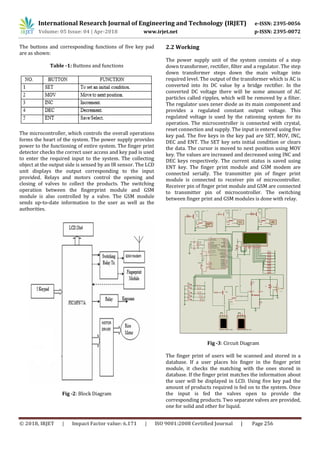
The microcontroller, which controls the overall operations
forms the heart of the system. The power supply provides
power to the functioning of entire system. The finger print
detector checks the correct user access and key pad is used
to enter the required input to the system. The collecting
object at the output side is sensed by an IR sensor. The LCD
unit displays the output corresponding to the input
provided. Relays and motors control the opening and
closing of valves to collect the products. The switching
operation between the fingerprint module and GSM
module is also controlled by a valve. The GSM module
sends up-to-date information to the user as well as the
authorities.
Fig -2: Block Diagram
2.2 Working
The power supply unit of the system consists of a step
down transformer, rectifier, filter and a regulator. The step
down transformer steps down the main voltage into
required level. The output of the transformer which is AC is
converted into its DC value by a bridge rectifier. In the
converted DC voltage there will be some amount of AC
particles called ripples, which will be removed by a filter.
The regulator uses zener diode as its main component and
provides a regulated constant output voltage. This
regulated voltage is used by the rationing system for its
operation. The microcontroller is connected with crystal,
reset connection and supply. The input is entered using five
key pad. The five keys in the key pad are SET, MOV, INC,
DEC and ENT. The SET key sets initial condition or clears
the data. The cursor is moved to next position using MOV
key. The values are increased and decreased using INC and
DEC keys respectively. The current status is saved using
ENT key. The finger print module and GSM modem are
connected serially. The transmitter pin of finger print
module is connected to receiver pin of microcontroller.
Receiver pin of finger print module and GSM are connected
to transmitter pin of microcontroller. The switching
between finger print and GSM modules is done with relay.
Fig -3: Circuit Diagram
The finger print of users will be scanned and stored in a
database. If a user places his finger in the finger print
module, it checks the matching with the ones stored in
database. If the finger print matches the information about
the user will be displayed in LCD. Using five key pad the
amount of products required is fed on to the system. Once
the input is fed the valves open to provide the
corresponding products. Two separate valves are provided,
one for solid and other for liquid.
International Research Journal of Engineering and Technology (IRJET) e-ISSN: 2395-0056
Volume: 05 Issue: 04 | Apr-2018 www.irjet.net p-ISSN: 2395-0072
© 2018, IRJET | Impact Factor value: 6.171 | ISO 9001:2008 Certified Journal | Page 257
Fig -4: Simulated Result
Fig -5: Hardware Setup
Fig -6: Valve opened providing rice
3. CONCLUSIONS
The automatic ration distribution system depicts a
platform where the irregularities in public distribution
system can be eradicated to a greater extent. This system
eliminates man power thereby increasing efficiency and
accuracy of the consumables.
REFERENCES
[1] A.N Madur and Sham Nysae, “Automation in Rationing
Using ARM7,”vol. 1, Jul. 2013, pp. 168-171.
[2] Pranjal Pedwal, “Real Time Automatic Ration Material
Distribution System”, vol.5, issue.3, Mar.2016, pp.734-
739.
[3] M.S Manivannan and P.Kannan, “Smart Ration
Distribution System”, vol.3, Oct.2015, pp.347-353
[4] Bharati Chilad, “Smart Ration Distribution System
Using RFID”, vol.4, issue.3, Jun.2016, pp.827-833

IRJET- Fingerprint Based Automatic Ration Distribution System

  • 1.
    International Research Journalof Engineering and Technology (IRJET) e-ISSN: 2395-0056 Volume: 05 Issue: 04 | Apr-2018 www.irjet.net p-ISSN: 2395-0072 © 2018, IRJET | Impact Factor value: 6.171 | ISO 9001:2008 Certified Journal | Page 255 Fingerprint Based Automatic Ration Distribution System Anjali Raj1, Ayana Asokan2 , Gayathri S3,Pooja U4, Niveditha N5 , Asha Arvind6 1,2,3,4,5 Students, Dept of Electronics and Communication Engineering, Ammini College of Engineering,Kerala,India 6Assistant Professor, Dept.of Electronics and Communication Engineering, Ammini College of Engineering, Kerala, India ---------------------------------------------------------------------***--------------------------------------------------------------------- Abstract – The resources in the world are finite and though the desire for resources is infinite. One of the largest retail systems in the world is India’s public distribution system. The manual work involved and lack of automation, makes this system inefficient. The conventional ration card system is replaced by automatic rationing system. This system uses authenticated finger print detector to provide products to the users. When the input is provided, the products are obtained from automatized ration shop. This system provides products with accurate weight and unnecessary selling of goods can be avoided. The ration shop is connected to government via GSM to prevent irregularities in ration distribution. Key Words: Authentication, Finger print detection, GSM, Public distribution system, Ration card. 1.INTRODUCTION One of the largest retail systems in the world’s is India’s public distribution system with four lakhs fair price shops. These shops provide sugar, rice, wheat, kerosene etc to the customers at affordable rates. This network of shops is spread all over the country which is controlled and monitored by central government along with state government Quantities of these products are fixed for each family depending on their monthly income. There are many families who do not claim their quota of food grains every month. The shop dealers may have fake ration cards which inhibits the customers from getting the exact amount of ration they need. The dealer may sell the goods at higher rates to outer markets there by earning a good profit. This makes the current public distribution system corrupted and inefficient. The current scenario has led to anarchy and black marketing. The government is not getting any acknowledgement regarding the supply of food grains with the current system. Involvement of manual work creates irregularities there by replacing the actual products by meagre quality products and supplying them. The automatic ration distribution system uses finger print technology to automatize the public distribution system thereby minimizing the corruptions. In this system, the manual work is replaced by automated system. The smart card replaces the ration card by including all user information. This system is much more secured and easy to use. This method can eradicate corruption in public distribution system to a great extent. 2. PROPOSED SYSTEM The proposed system runs on the basis of automation. The heart of the system is the microcontroller PIC16F877A. the biometric or finger print identification is the first step of the system. The finger print of each user will be stored in a database. After identifying the finger print, the name of the person and ration will be displayed via LCD display. The user can now enter the amount of ration he wants through a five keypad. The valves of the system open to provide the commodities. The details of the purchase will be sent over a GSM to the user‘s mobile and authorities. The proposed system implements a centralized web enabled ration distribution and corruption controlling system. The goods are stored in a storage tank and when goods are inserted in ration shop, the quantity log is updated. The quantity log can be accessed by the user whenever he needs to collect ration from the ration shop. This method prevents increased corruption in private as well as public sector. The adulteration in consumables can be prevented to a great extent with this system. This system is very cost effective and time saving approach. 2.1 Automatic rationing System Technology The method of finding match between two human finger prints refers to finger print identification. It involves enrollment, searching and verification. Enrollment captures finger print from the sensor. The most commonly used algorithm for finger print recognition is minutiae based algorithm. Minutiae and patterns are very important in the analysis of fingerprints since no two fingers have been shown to be identical. A keypad is a set of buttons which bears numbers, alphabets or digits. The system uses five key pad. Fig -1: Five keypad
  • 2.
    International Research Journalof Engineering and Technology (IRJET) e-ISSN: 2395-0056 Volume: 05 Issue: 04 | Apr-2018 www.irjet.net p-ISSN: 2395-0072 © 2018, IRJET | Impact Factor value: 6.171 | ISO 9001:2008 Certified Journal | Page 256 The buttons and corresponding functions of five key pad are as shown: Table -1: Buttons and functions The microcontroller, which controls the overall operations forms the heart of the system. The power supply provides power to the functioning of entire system. The finger print detector checks the correct user access and key pad is used to enter the required input to the system. The collecting object at the output side is sensed by an IR sensor. The LCD unit displays the output corresponding to the input provided. Relays and motors control the opening and closing of valves to collect the products. The switching operation between the fingerprint module and GSM module is also controlled by a valve. The GSM module sends up-to-date information to the user as well as the authorities. Fig -2: Block Diagram 2.2 Working The power supply unit of the system consists of a step down transformer, rectifier, filter and a regulator. The step down transformer steps down the main voltage into required level. The output of the transformer which is AC is converted into its DC value by a bridge rectifier. In the converted DC voltage there will be some amount of AC particles called ripples, which will be removed by a filter. The regulator uses zener diode as its main component and provides a regulated constant output voltage. This regulated voltage is used by the rationing system for its operation. The microcontroller is connected with crystal, reset connection and supply. The input is entered using five key pad. The five keys in the key pad are SET, MOV, INC, DEC and ENT. The SET key sets initial condition or clears the data. The cursor is moved to next position using MOV key. The values are increased and decreased using INC and DEC keys respectively. The current status is saved using ENT key. The finger print module and GSM modem are connected serially. The transmitter pin of finger print module is connected to receiver pin of microcontroller. Receiver pin of finger print module and GSM are connected to transmitter pin of microcontroller. The switching between finger print and GSM modules is done with relay. Fig -3: Circuit Diagram The finger print of users will be scanned and stored in a database. If a user places his finger in the finger print module, it checks the matching with the ones stored in database. If the finger print matches the information about the user will be displayed in LCD. Using five key pad the amount of products required is fed on to the system. Once the input is fed the valves open to provide the corresponding products. Two separate valves are provided, one for solid and other for liquid.
  • 3.
    International Research Journalof Engineering and Technology (IRJET) e-ISSN: 2395-0056 Volume: 05 Issue: 04 | Apr-2018 www.irjet.net p-ISSN: 2395-0072 © 2018, IRJET | Impact Factor value: 6.171 | ISO 9001:2008 Certified Journal | Page 257 Fig -4: Simulated Result Fig -5: Hardware Setup Fig -6: Valve opened providing rice 3. CONCLUSIONS The automatic ration distribution system depicts a platform where the irregularities in public distribution system can be eradicated to a greater extent. This system eliminates man power thereby increasing efficiency and accuracy of the consumables. REFERENCES [1] A.N Madur and Sham Nysae, “Automation in Rationing Using ARM7,”vol. 1, Jul. 2013, pp. 168-171. [2] Pranjal Pedwal, “Real Time Automatic Ration Material Distribution System”, vol.5, issue.3, Mar.2016, pp.734- 739. [3] M.S Manivannan and P.Kannan, “Smart Ration Distribution System”, vol.3, Oct.2015, pp.347-353 [4] Bharati Chilad, “Smart Ration Distribution System Using RFID”, vol.4, issue.3, Jun.2016, pp.827-833