Download to read offline
![International Research Journal of Engineering and Technology (IRJET) e-ISSN: 2395-0056
Volume: 06 Issue: 07 | July 2019 www.irjet.net p-ISSN: 2395-0072
© 2019, IRJET | Impact Factor value: 7.34 | ISO 9001:2008 Certified Journal | Page 3035
Comparative Analysis between Sequential and Iterative Project
Management Approaches
Aishwarya Vijay Patil
B.Tech in Information Technology from Rajarambapu Institute of Technology, Affiliated to Shivaji University,
Maharashtra, India
----------------------------------------------------------------------***---------------------------------------------------------------------
Abstract - Since the past few decades, there is tremendous
development in I.T Field. With theemergingofvariouscutting-
edge technologies, the way of project management is also
changed rapidly. Newproject managementmethodologieslike
PRINCE2, Agile, Rapid Applications, Spiral, etc. are evolved to
meet the changing requirements and modern scenario. But
this all methodologies are based on two principal software
management approaches recognized as sequential and
iterative. These approaches, more generally referred to as
software development models, formsafoundationformultiple
project management methodologies. Before understanding
various methodologies and determining which is better for a
given project, it's crucial to analyze the model on which these
methodologies are based on. This paper discusses two main
approaches of project management: sequential and iterative,
to give a deeper insight. The purpose of thispaperistoanalyze
both approaches, understand their features and drawbacks
and finally identify which approach is better suited for which
kind of project.
Key Words: Project Management approaches in I.T,
Software Project Management Methodologies,
Sequential, Iterative, Waterfall, Agile, SDLC, I.T
1. INTRODUCTION
In today’s era, project management is the initial and most
vital element of the software development process. Project
management drives the whole process in the right direction.
Proper managementfacilitatessmoothstrategic alignmentof
goals and plans for complex and multi-faceted projects.
Project management assures that balance is maintained
between available resources, scheduled timeline, cost
estimated along with the quality of the project. Every I.T.
company follows a well-defined project management
methodology. There could be a single methodologyfollowed
for all projects in the organization or each project can havea
different style of management based on need.
There are various types of methodologies like agile,
waterfall, spiral, etc. These methodologies may follow a
sequential or iterative approach but all of these
methodologies go through the identical well-defined
software development process. This process is nothing but
the software development life cycle (SDLC). The software
development life cycle is split into non-parallel distinct
phases which are Requirement elicitation, Design,
Implementation, Testing, Deployment, and Maintenance [1].
Figure 1 describes flow of SDLC.
F
Fig-1 SDLC.
Following are SDLC phases:
1.1 Requirements elicitation
This is the beginning round of the software development
process where all requirements are assembled from several
stakeholders like client, end-users, vendors, etc. by the
business analyst. These requirements are examined,
validated and prioritized by the team. This phase comprises
interviewing customers, brainstorming, creating
questionnaires, etc. These business needs are documented
with precision in a requirement specification document.
1.2 Design
The requirement specification document from
requirement elicitation phase is utilized as input in this
phase. All functional and non-functional requirements are
analyzed by senior manager and architecture to sketch
software architecture, high-level and low-level design of the
product. This includes specifying software and hardware
requirements, technology to use, network, databases, user](https://image.slidesharecdn.com/irjet-v6i7460-191121085926/85/IRJET-Comparative-Analysis-between-Sequential-and-Iterative-Project-Management-Approaches-1-320.jpg)
![International Research Journal of Engineering and Technology (IRJET) e-ISSN: 2395-0056
Volume: 06 Issue: 07 | July 2019 www.irjet.net p-ISSN: 2395-0072
© 2019, IRJET | Impact Factor value: 7.34 | ISO 9001:2008 Certified Journal | Page 3035
Comparative Analysis between Sequential and Iterative Project
Management Approaches
Aishwarya Vijay Patil
B.Tech in Information Technology from Rajarambapu Institute of Technology, Affiliated to Shivaji University,
Maharashtra, India
----------------------------------------------------------------------***---------------------------------------------------------------------
Abstract - Since the past few decades, there is tremendous
development in I.T Field. With theemergingofvariouscutting-
edge technologies, the way of project management is also
changed rapidly. Newproject managementmethodologieslike
PRINCE2, Agile, Rapid Applications, Spiral, etc. are evolved to
meet the changing requirements and modern scenario. But
this all methodologies are based on two principal software
management approaches recognized as sequential and
iterative. These approaches, more generally referred to as
software development models, formsafoundationformultiple
project management methodologies. Before understanding
various methodologies and determining which is better for a
given project, it's crucial to analyze the model on which these
methodologies are based on. This paper discusses two main
approaches of project management: sequential and iterative,
to give a deeper insight. The purpose of thispaperistoanalyze
both approaches, understand their features and drawbacks
and finally identify which approach is better suited for which
kind of project.
Key Words: Project Management approaches in I.T,
Software Project Management Methodologies,
Sequential, Iterative, Waterfall, Agile, SDLC, I.T
1. INTRODUCTION
In today’s era, project management is the initial and most
vital element of the software development process. Project
management drives the whole process in the right direction.
Proper managementfacilitatessmoothstrategic alignmentof
goals and plans for complex and multi-faceted projects.
Project management assures that balance is maintained
between available resources, scheduled timeline, cost
estimated along with the quality of the project. Every I.T.
company follows a well-defined project management
methodology. There could be a single methodologyfollowed
for all projects in the organization or each project can havea
different style of management based on need.
There are various types of methodologies like agile,
waterfall, spiral, etc. These methodologies may follow a
sequential or iterative approach but all of these
methodologies go through the identical well-defined
software development process. This process is nothing but
the software development life cycle (SDLC). The software
development life cycle is split into non-parallel distinct
phases which are Requirement elicitation, Design,
Implementation, Testing, Deployment, and Maintenance [1].
Figure 1 describes flow of SDLC.
F
Fig-1 SDLC.
Following are SDLC phases:
1.1 Requirements elicitation
This is the beginning round of the software development
process where all requirements are assembled from several
stakeholders like client, end-users, vendors, etc. by the
business analyst. These requirements are examined,
validated and prioritized by the team. This phase comprises
interviewing customers, brainstorming, creating
questionnaires, etc. These business needs are documented
with precision in a requirement specification document.
1.2 Design
The requirement specification document from
requirement elicitation phase is utilized as input in this
phase. All functional and non-functional requirements are
analyzed by senior manager and architecture to sketch
software architecture, high-level and low-level design of the
product. This includes specifying software and hardware
requirements, technology to use, network, databases, user](https://image.slidesharecdn.com/irjet-v6i7460-191121085926/75/IRJET-Comparative-Analysis-between-Sequential-and-Iterative-Project-Management-Approaches-1-2048.jpg)
![International Research Journal of Engineering and Technology (IRJET) e-ISSN: 2395-0056
Volume: 06 Issue: 07 | July 2019 www.irjet.net p-ISSN: 2395-0072
© 2019, IRJET | Impact Factor value: 7.34 | ISO 9001:2008 Certified Journal | Page 3036
interfaces,system interface, etc. Software design description
document (SDD) is drafted in this phase which describes
“how “of the software [2].
1.3 Implementation
This is the phase where the actual product built takes
place. The information in SDD is used to develop theproduct.
Initially, the product is generatedinsmallchunksbydifferent
developers. After ensuring that each unit works fine, these
units are integrated to develop the whole product. Source
code is the yield of this phase.
1.4 Testing
The testing team conducts testing to ensure each piece of
product operatesas expected andwithoutanydefects.Aimof
this phase is also to ensure all requirements in requirement
specification documents are met. Testing phase involves
various stages as follow [3]:
Requirement Analysis
Quality Assurance (QA) team understands the
requirements in terms of what they will be testing
and estimates the testable requirements.
Test Planning
In thisstage, the testing process overview is defined
and test schedules are planned.
Test Case Development
In thisstage, the testing team drafts the detailedtest
cases.
Test Environment Setup
This involves setting up software and hardware
required for testing of the product.
Test Execution
In this stage, the testing team start executing test
cases and records test case as pass or fail as per the
results and if any flaw is located corresponding test
case with the bug is reported to the developer. After
modification from development team retesting is
perform.
Test Cycle Closure
This stage is performedwhentestingandretestingis
completed. Test closure report & Test metrics are
outlined.
1.5 Deployment
After the product passes all the testcasesandacceptedby
the client, it is deployed client-side in their respective
environment by installing the application on client servers.
1.6 Maintenance
This phase is performed after the product goes live and
carried out throughout the life cycle of the product. This
covers error correction, enhancement of performance and
quality, adding new functions and removal of obsolete ones,
introduction ofnewfeaturesandoptimizationofthesoftware
[2].
All software management approaches go through these
phases but in a diverse pattern or different manner.
2. Sequential Project Management Approach
In this approach, all the phases are carried out in linear
fashion. Next phase cannot be started until the previous one
concludes because the output of the previous phase is input
to the next phase. Due to this reason, any delays in the prior
phase causes a delay in later phases.
The best example of project management methodology
which uses a sequential approach is the waterfall. In natural
waterfall, where once the water has flowed through the edge
of the cliff, never returns to the top of the hill [2]. Similarly, in
waterfall methodology, phases cannot be revisited. The only
way to revisit a phase is to start the process again with the
opening phase [4]. Well, this is justified because waterfall
model was discovered inthemanufacturingandconstruction
industry where there is a need for things to fall sequentially.
E.g. one cannot start building roofuntilwallsareconstructed.
In construction and manufacturing industry hardly any
requirements are altered once implementedisstarted.Butin
software industry, this is not the case as client requirements
often change. So in methodologies with a sequential
approach, excess time is spent on planning and it is essential
to map out a clear plan.
Fig-2 Waterfall model.](https://image.slidesharecdn.com/irjet-v6i7460-191121085926/85/IRJET-Comparative-Analysis-between-Sequential-and-Iterative-Project-Management-Approaches-2-320.jpg)
![International Research Journal of Engineering and Technology (IRJET) e-ISSN: 2395-0056
Volume: 06 Issue: 07 | July 2019 www.irjet.net p-ISSN: 2395-0072
© 2019, IRJET | Impact Factor value: 7.34 | ISO 9001:2008 Certified Journal | Page 3037
2.1 Advantages of the sequential approach
Plain, easy to understand and straight-forward
approach.
It is document-intensive so every step, decision,
research, etc. are well documented and documents
can be utilized in further alike projects.
As there are well define deliveries at the end of each
phase, it's easy to measure development.
Project is broken into discrete and clearly
understandable phases so project management is
straightforward and smooth.
Client involvement is minimal so no time is spent
waiting for the consent of the client at each stage.
It is best forminiatureprojects where requirements
are clear up front.
Well suited for a project that is expected to flow
steadily downwards and where extremely
structured programs are needed [4].
Team members can operateonotherprojectsbefore
their phase begins or after their phase ends,
returning to the project as needed.
Waterfall model has a clear and rigid structure so it
does not demand any special training for project
managers or employees. It has an easy learning
curve.
2.2 Disadvantages of the sequential approach
It is expensive to revert to the previous phase.
If one phase is delayed, subsequent phases are also
delayed, affecting the deadline.
As there is no room for additional requirements, if a
client wishes to append a new feature when the
project is in the implementation or testing phase it’s
unfeasible to do so.
Not suitable for a large and complicated project
where requirements are not well defined.
It involves a high-risk factor.
Ultimate working software is available only at the
end of the process and as no prototype is used, the
client doesn’t have a clear picture of the product
until the end.
A trivial error in any previous phase can cause a
huge problem for subsequent phases as each phase
depends on the prior phase.
Testingisdelayedwhichcannegativelyinfluencethe
project.
Client engagement is minimal which can let to
confusion between team and client.
Errors can escape the process and be found in later
stages [5].
3. Iterative Project Management approach
In the iterative approach, the softwaredevelopmentiscut
in a series of repeated cycle or loops called iterations. The
first four phases of SDLC: Requirements elicitation, Design,
Implementation, Testingoccursinrepeatedloops. According
to the PMBOK Guide Sixth Edition [6]: “Iterative Life Cycle is
a project life cycle where the project scope is generally
determined early in the project life cycle, but time and cost
estimates are routinely modified as the project team’s
understanding of theproductincreases."With eachiteration,
new features are introduced or old once are revised as
demanded. At the end of each iteration, a new version of the
software is produced. The last stage of the cycle involves
client collaboration where a modified version of product is
reviewed by the client. Feedbacks given by client are shared
with developers and any changes suggested by the client are
incorporated in upcoming cycles. It is possible that business
strategy may change or risks may emerge, in such cases
strategic realignment of plan and goal can be done in the
further iteration. Iterations take place until the software is
evolved in a fully developed system as per therequirements.
The most suitable example of methodology which uses
iterative approach is agile. According to the 12th Annual
State of Agile report, the Iterative Planning was the second
and iterations review was fourth most-employed Agile
Technique in 2018 [7].
Craig Larman [8] explains that each iteration consists of
the analysis of the plan, the Design, its Code and the Test
together called as ADTC. TheADTCwheel ismoretechnically
referred to as the PDCA (Plan, Design, Check, and Adjust).
This PDCA cycle is implemented on eachiterationseparately
in the following manner [9]:
P (Plan) – Iteration Planning
The team collaborates to outline the objectives,
scope and risk assessment for the forthcoming
iterations. If this is not the first iteration, the
reviews and feedback of the client are discussed to
plan accordingly. The team comes up with schedule
estimates and also classifies therequiredresources.
It also summarizes the work done and determines
the Iteration Goals.](https://image.slidesharecdn.com/irjet-v6i7460-191121085926/85/IRJET-Comparative-Analysis-between-Sequential-and-Iterative-Project-Management-Approaches-3-320.jpg)
![International Research Journal of Engineering and Technology (IRJET) e-ISSN: 2395-0056
Volume: 06 Issue: 07 | July 2019 www.irjet.net p-ISSN: 2395-0072
© 2019, IRJET | Impact Factor value: 7.34 | ISO 9001:2008 Certified Journal | Page 3039
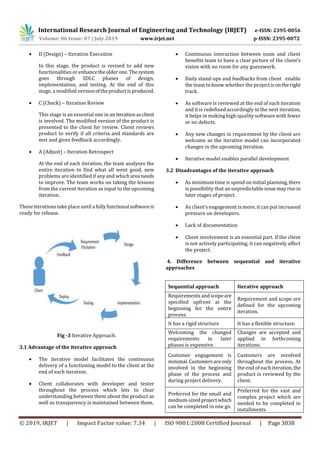
Table-1 Difference between Sequential and iterative
approach.
5. When to use what
5.1 Sequential approach
When the scope of the project is known in advance.
When requirements are well defined and not
subjected to changes.
Small and medium-sized project.
When the client is not available, or not actively
committed to the process.
There is no need of prototype and client needs the
entire product in one time delivery.
Where product development mainly consists of
adding limited functionalities to an existing set of
functionality [2].
When management or client expects intensive-
documentation.
5.2 Iterative approach
When the scope of the project is unknown
beforehand.
When client doesn’t have a clear vision of product
and requirements are expected to change.
Complex and large projects where is it not possible
to develop product in one go.
When the client is ready to actively be part of the
process.
A quick prototype with only certain functionalities
is needed before the final product is available [2].
When employees are well trained in using the
iterative approach.
When detailed documentation with precision is not
expected.
6. CONCLUSION
Iterative and Sequential are both essential project
management approaches. Both have their prosandconsand
are suited for specific types of projects. To wrap up, the
sequential approach can be applied to a small or medium-
sized project where requirements are not subjected to
change and client is not part of development process. The
iterative approach is best suited for a project where scope
and requirements are notwell definedandinscenario where
client is agreed to actively participate in process.
REFERENCES
[1] Hans van Vliet, “Software Engineering: Principles and
Practice” Third Edition, Wiley, 2007.
[2] Vaishnavi Kannan, Smita Jhajharia, Dr. Seema Verma,
”Agile vs waterfall: A Comparative Analysis”, IJSETR,
Volume 3, Issue 10, October 2014.
[3] http://www.softwaretestingclass.com/software-testing-
life-cycle-stlc/.
[4] Adetokunbo A.A. Adenowo, Basirat A. Adenowo,
”Software Engineering Methodologies: A Review of the
Waterfall Model and Object Oriented Approach”,
International Journal of Scientific & Engineering
Research, Volume 4, Issue 7, July-2013.
[5] Eduardo Málaga Chocano,”A Comparative Study of
Iterative Prototyping vs. Waterfall Process Applied To
Small and Medium Sized Software Projects”, April 2004.
[6] A Guide to the Project Management Body of Knowledge
(PMBOK Guide), Sixth Edition, by Project Management
Institute, 2017.
[7] 12th Annual State of Agile Report.
(https://explore.versionone.com/state-of-agile/12th-
annual-state-of-agile-report-overview)
[8] Craig Larman,”Agile and Iterative Development: A
manager’s Guide”, Addison-Wesley Professional, 2003.
[9] K.A.Chandrakanth,” PLAN DO CHECK ACT (PDCA)
IMPROVING QUALITY THROUGH AGILE
ACCOUNTABILITY”.
Project is one-time
delivered only at the end of
the process.
Continues delivery at the
end of each iteration.
Sequential is more
document-drivenapproach.
Documentation is
comparatively given less
importance.
Risk of failure is more as
result may not meet the
customer's expectations.
Risk of failure is less as
customers can suggest
changes at the end of each
iteration. So product build
is as per customer's input
and expectation.
Scope of the project is
known beforehand
Scope of project is not
known in advance.](https://image.slidesharecdn.com/irjet-v6i7460-191121085926/85/IRJET-Comparative-Analysis-between-Sequential-and-Iterative-Project-Management-Approaches-5-320.jpg)

This document compares sequential and iterative project management approaches. It begins by providing context on the evolution of project management methodologies in IT to meet changing requirements. It then discusses the two main approaches - sequential and iterative. The sequential approach follows phases in a linear fashion where the output of one phase is the input of the next. An example is the waterfall model. Key advantages are its simplicity and structure while disadvantages include inability to adapt to changes and delays propagating between phases. The document aims to analyze the features and drawbacks of both approaches to determine which is better suited for different project types.


