Download to read offline
![International Research Journal of Engineering and Technology (IRJET) e-ISSN: 2395-0056
Volume: 06 Issue: 09 | Sep 2019 www.irjet.net p-ISSN: 2395-0072
© 2019, IRJET | Impact Factor value: 7.34 | ISO 9001:2008 Certified Journal | Page 2005
AIR POLLUTION DETECTION USING MODIFIED TRAINGULAR MUTATION
BASED PARTICLE SWARM OPTIMIZATION
Pawandeep Kaur1, Prabhdeep Singh2, Kirandeep Singh3
1,2,3Department of Computer Science & Engineering, IKGPTU
----------------------------------------------------------------------------***--------------------------------------------------------------------------
ABSTRACT - The increase in population, emissions from industries and manufacturing activities, automobiles exhaust,
etc., are reasons that are contributing to the air pollution. Many countries have declared it as major threat to human
life. Currently air pollution is measured by utilizing spatially distributed sensors. However, due to sensor expenses and
size limits the operational efficiency. Therefore, many researchers have proposed air pollution detection system using
machine learning tools without deploying any particular kind of sensors. It reduces the cost of air pollution monitoring
system. In this research work, a novel particle swarm optimization-based machine learning models to predict the
concentration of benzene in the air has been designed to overcome the gaps found in the literature. Additionally, to
modify particle swarm optimization-based machine learning models by considering the triangular mutation operator. It
has improved the global and local search capabilities of particle swarm optimization and also it increases the
convergence speed. Extensive analysis reveals that the proposed technique outperforms the existing techniques.
KEYWORDS: AIR POLLUTION, BENZENE, PREDICTION, MACHINE LEARNING
1. INTRODUCTION
Earth’s climate is changing rapidly and there are good reasons to believe that the release of carbon emissions by human
activity is one of the many causes. This climate change comes in many forms such as variations in precipitation patterns and
variations in storm patterns. One of the lesser studied forms is the change in wind patterns, both at low and high altitudes [1].
This project will look at global carbon emissions, global temperature anomalies, and global wind pattern anomalies at high
altitude to see if there are geographic and / or temporal correlations between the three metrics [2]. The sources responsible
for air pollution are of two categories which are natural sources and man-made sources. The natural sources include forest
fires, volcanic eruption, and wind erosion of soil, natural radio activity and decomposition of organic matter by bacteria [3].
The manmade sources are much diversified. These include automobile, industries, thermal power plants and
agricultural activities [4]. The fossils fuels (coal, oil, natural gas) are burnt in industries, thermal power plants and
automobiles. Due to this carbon monoxide (C0), carbon dioxide (CO2), sulphur dioxide (SO2), sulphur trioxide (SO3) and
nitrogen oxides are emitted. Different hydrocarbons (methane, butane, ethylene, benzene) and suspended particulate matters
(dust, lead cadmium, chromium, arsenic salt etc.) are also present in these emissions [5]. These gases and suspended
particulate matter (SPM) produced as result of burning fossils fuels are the greatest source of air pollution [6].
The pollutants released from natural sources of air pollution are dispersed in a vast area and do not cause any serious
damage. Most of the health-related air pollutants come from man-made sources of air pollution [7]. In large cities, breathing
the polluted air proves harmful to human health. Carbon monoxide, a serious air pollutant, reduces the oxygen carrying
capacity of blood and causes nausea, headache, muscular weakness and slurring of speed. Oxides of nitrogen can damage the
lungs, heart and kidneys of man and other creatures [8]. The presence of hydrocarbon in air causes irritation to eyes, bronchial
construction, sneezing and coughing. In densely populated cities, the air pollution may take the form of industrial smog and
photo chemical smog [9].
People are paying increasing attention to air pollution over the past decades, since it significantly impacts human
health and causes serious harm to other living organisms such as animals and food crops. A lot of air pollution monitoring
stations have been built around the world to inform people about air pollution status, such as the concentration of PM2.5,
PM10, and O3. Besides monitoring, there is an urgent demand for air pollution prediction, which could benefit the
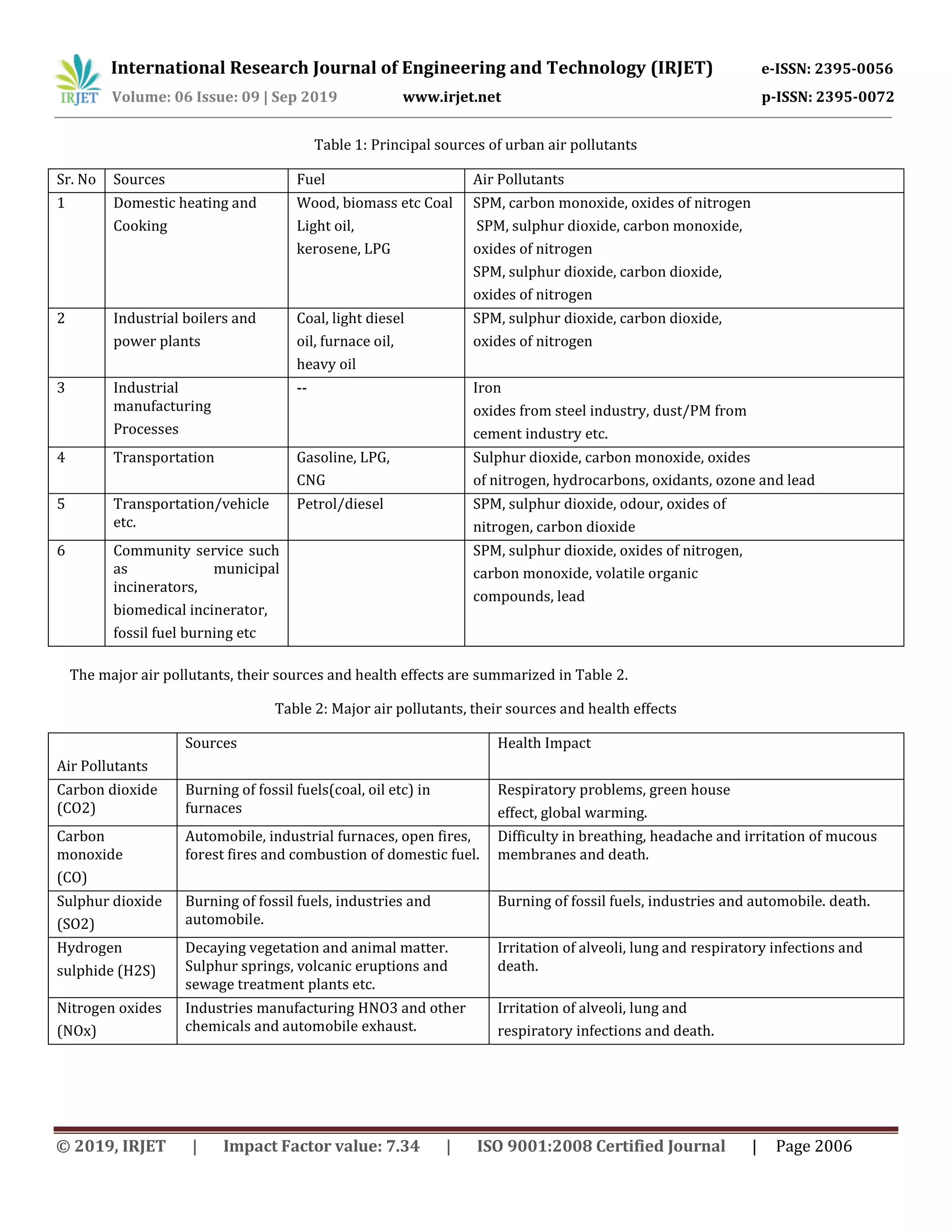
government’s policy-making and public outdoor activities. The detailed classification of air pollutants by sources and usage of
fuel is given in the Table 1.](https://image.slidesharecdn.com/irjet-v6i9312-191219084657/75/IRJET-Air-Pollution-Detection-using-Modified-Traingular-Mutation-based-Particle-Swarm-Optimization-1-2048.jpg)
![International Research Journal of Engineering and Technology (IRJET) e-ISSN: 2395-0056
Volume: 06 Issue: 09 | Sep 2019 www.irjet.net p-ISSN: 2395-0072
© 2019, IRJET | Impact Factor value: 7.34 | ISO 9001:2008 Certified Journal | Page 2008
2. RELATED WORK
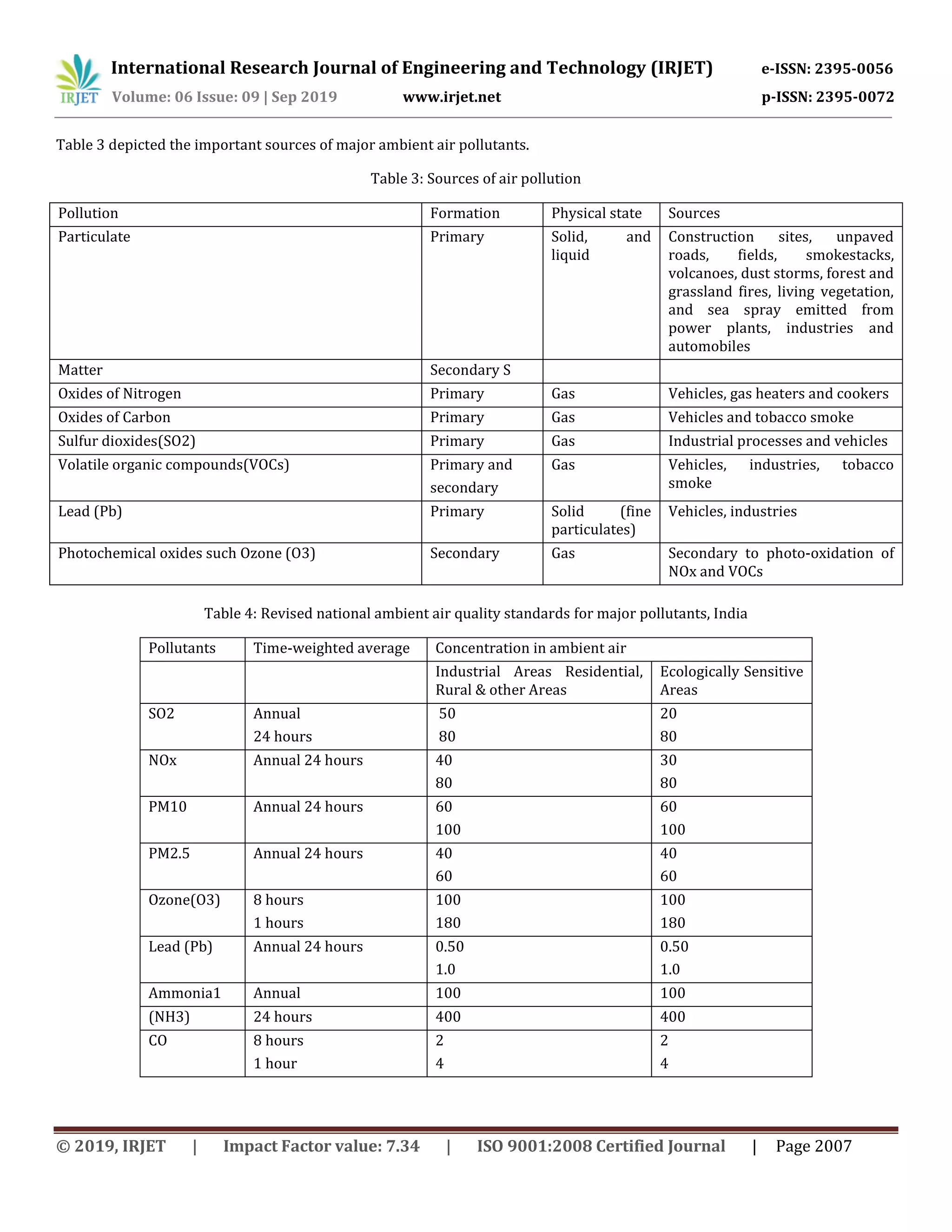
Dominici et al. (2010)[7] Modeling the joint behavior of multivariate extreme events is of interest in a wide range of
applications, ranging from telecommunications to Earth and environmental sciences, such as hydrology, seismology, and
applications related to climate change or air pollution monitoring. Simultaneous exposure to multiple air pollutants seriously
affects public health worldwide, causing loss of life and livelihood and requiring costly health care. Therefore, policymakers
such as those at the US Environmental Protection Agency (EPA), are researching multivariate approaches to quantify air
pollution risks the issue of air pollution is compounded by global warming and climate change, as increasingly high
temperatures are suspected to contribute to raising ozone concentrations and aggravating their ect in the human body
Kahle et al. (2015)[8]. This pressing situation urges a greater understanding and better monitoring of air pollution extremes,
the complexity of which poses a challenge for standard statistical techniques. Indeed, multiple air pollutants are often
recorded at various spatial locations and, therefore, the modeling of peak exposures across a spatial region must transcend the
assumption of independence in order to capture their spatial variability. In this paper, we propose a new methodological
framework based on Extreme-Value Theory, for estimating the probability that multiple air pollutants and temperatures will
be simultaneously extreme at different spatial locations. The statistical modeling of single extreme variables observed over
space is usually based on spatial max-stable processes.
Davison et al. (2012)[9]which are the only possible limit models for properly renormalized block maxima and whose block
size increases to in nity. Except in the case of asymptotic independence, these models can be used to capture the potentially
strong spatial dependence that may exist among variables at extreme levels. Models for asymptotically independent data in
the bivariate case were introduced by
Huser et al. (2017)[10] proposed several spatial models for high threshold exceedances that can handle both asymptotic
dependence and independence; see also the related paper by
Krupskii et al. (2018)[11]. However, the current literature on multivariate modeling of spatial extremes is still rather sparse.
Here, we restrict ourselves to asymptotic dependence by modeling multivariate block maxima recorded over space using a
suitable max-stable process.
Oesting et al. (2017)[12] introduced a bi variant Brown{ Resnick max-stable process to jointly model the spatial
observations and forecasts of wind gusts in Northern Germany. In this paper, we propose a new class of multivariate max-
stable processes that extends the Reich{ Shaby model
Reich et al.(2012)[13] to the multivariate setting, and that is suitable for studying the spatial and cross-dependence
structures of multiple max-stable random fields within an intuitive and computationally convenient hierarchical tree-based
framework. In contrast to the standard spatial processes based on the Gaussian distribution, the computationally demanding
nature of the likelihood function for max-stable processes has hampered their use in high-dimensional settings within both
frequentist and Bayesian frameworks
Thibaud et al. (2016)[14] showed how the Brown{Resnick max-stable process may be submitted using a well-designed
Markov chain Monte Carlo (MCMC) algorithm; however, this remains excessively expensive in high dimensions. From a
computational perspective, it is convenient to relax the max-stable structure by assuming conditional independence of the
extreme observations given an unobserved latent process
Opitz et al., 2018)[15]. This significantly facilitates Bayesian and likelihood-based inference and may be helpful for
estimating marginal distributions by borrowing strength across locations. Unfortunately, when the latent process is Gaussian,
the resulting dependence structure lacks exibility and cannot capture strong external dependence.
Reich and Shaby, 2012)[16] on the other hand possesses a conditional independence representation given some latent -
stable random effects and is jointly max-stable. Other popular max-stable processes do not possess such a convenient
hierarchical characterization. In this paper, we generalize the Reich {Shaby process for the modeling of multivariate spatial
extremes by assuming a nested, tree-based,-stable latent structure, which allows us to maintain a moderate computational
burden. In our proposed model, each variable is described using a Reich Shaby spatial process and the dependence among](https://image.slidesharecdn.com/irjet-v6i9312-191219084657/75/IRJET-Air-Pollution-Detection-using-Modified-Traingular-Mutation-based-Particle-Swarm-Optimization-4-2048.jpg)
![International Research Journal of Engineering and Technology (IRJET) e-ISSN: 2395-0056
Volume: 06 Issue: 09 | Sep 2019 www.irjet.net p-ISSN: 2395-0072
© 2019, IRJET | Impact Factor value: 7.34 | ISO 9001:2008 Certified Journal | Page 2009
variables at different locations may be expressed in terms often asymmetric max-mixture of multivariate nested logistic
distributions
Stephenson, 2003)[17]. The global dependence structure may be represented by a tree framework, in which theleaves"(i.e.,
the terminal nodes) correspond to the different spatial max-stable processes representing different variables of interest (e.g.,
pollutants), and the tree branches" describe the relationships among these processes, which are grouped into clusters. The
intra-cluster cross-dependence is assumed to be exchangeable and stronger than the inter-cluster cross dependence .In
principle, the underlying tree structure might involve an arbitrary number oflayers" (i.e., node levels) in order to describe
more complicated forms of cross-dependence among the spatial processes, although more complex trees necessarily imply an
increased number of latent variables and parameters, thus complicating the inference procedure. The remainder of this paper
is organized as follows. The theoretical background for the geostatistical modeling of extremes is reviewed in x2. In x3, we
introduce a novel class of hierarchical max-stable processes built from nested -stable random effects for the joint modeling of
multivariate extremes over space, and study its dependence properties. We3also detail our inference procedure based on an
MCMC algorithm, and describe some simulation experiments. In x4, we use our nested max-stable model to investigate the
spatial and cross-dependence structures of the concentration maxima of various air pollutants and temperature, observed at a
number of sites across the Los Angeles area in California, US. x5 concludes with some remarks and perspectives for future
research.
Chang et al. (2011)[18]. The World Health Organization classified air pollution as a major environmental health risk,
estimating that 4.2 million premature deaths in can be attributed to exposure to outdoor air pollution (World Health
Organization and others,. Nitrogen dioxide (NO2), a highly reactive gas monitored by the EPA, is formed primarily from fuel-
burning emissions.
Katsouyanni et al. (2009)[19]. Health effects from short-term exposures include cardiovascular effects and premature
mortality as well as difficulty breathing and increased occurrence of hospital visits due to decreased lung capacity including
asthma exacerbation (US Environmental Protection Agency,
McKenzie et al. (2016)[20]. Long term effects include cardiovascular effects, premature mortality, diabetes, poorer birth
outcomes, cancer, and asthma in children (US Environmental Protection Agency, 2016). NO2 also reacts with water in the
atmosphere to produce ozone and acid rain. The resulting nitrate particles from this reaction can contribute to particulate
matter less than 2.5 microns in diameter all of which have additional environmental health considerations. NO2 can react with
water, ozone, and nitric oxide (NO) multiple times over a span of several hours to form and re-form NO2 and NO. Emissions of
nitroous oxides are primarily in the form of NO, where 92% of NO is anthropogenic with 56% estimated to be from mobile
emissions.
Kim et al.(2012)[21]Hence understanding patterns of mobile emissions are paramount to protecting public health,
particularly for susceptible populations, such as children, the elderly, and those with asthma or compromised immune
systems. The vast majority of health studies to date have focused on the relationship between human health effects and longer
term exposures, such as 1-hour or daily average aggregate effects. Additionally, these studies are based on air-quality
measurements for which spatial information is often limited due to the number of stationary monitors measuring air quality
over large regions.
Adler et al. (2015)[22]. International efforts include Air Map Korea Project (Rooney, 2018), which aims to install over 4.5
million monitors on telephone poles, public phone booths and central offices, and Smart City Barcelona’s Lighting Masterplan
(Adler, 2016), which equipped lampposts with air quality sensors to relay information to the city and to the public. London
showed creativity in air quality monitoring with their Pigeon Patrol
McKenzie et al. (2016)[23] fitting pigeons with mobile air quality sensors to measure nitrogen dioxide across the city.
Methodology utilizing this information to provide real-time air pollution maps as well as short-term air quality forecasts on a
fine-resolution temporal and spatial scale may revolutionize people’s understanding of their personal environment and
exposures, having real-world implications and impacts on citizens. As the effects of air pollution and the differences in
pollutant microenvironments become more widely studied and understood, people are increasingly concerned with
understanding their immediate personal environment and its effect on their health. They are interested in real-time
information on a very localized scale in order to make informed decisions on their day-to-day activities.
Schiffman et al. (2017)[24] EPA’s widely used Air Quality Index (AQI) uses high quality hourly data from stationary Federal
Reference Monitors (FRMs) and Federal Equivalency Monitors (FEM) to implement a color-coded air quality scale and public](https://image.slidesharecdn.com/irjet-v6i9312-191219084657/75/IRJET-Air-Pollution-Detection-using-Modified-Traingular-Mutation-based-Particle-Swarm-Optimization-5-2048.jpg)
![International Research Journal of Engineering and Technology (IRJET) e-ISSN: 2395-0056
Volume: 06 Issue: 09 | Sep 2019 www.irjet.net p-ISSN: 2395-0072
© 2019, IRJET | Impact Factor value: 7.34 | ISO 9001:2008 Certified Journal | Page 2010
messaging system. Real-time and forecasted AQI’s are provided to the public via EPA’s AirNow website (airnow.gov) and are
available by city, state, or ZIP code. Localized sensor networks, which may include mobile sensors, may provide additional
information on which to build, refine, and expand air quality information available to the public.
Apte et al. ( 2017)[25]. The cars drive through the city on spatiotemporal tracks and measure ambient NO2 each second. This
study provides a unique source of highly detailed data with spatial band temporal complexities. It can provide information
about commuter exposure, hot spots within high-trafficked city streets, as well as complex patterns due to meteorological
effects and microenvironments. This fine-scale spatial and temporal information could also lead to the methodology and
information needed to start to characterize acute exposure. It is particularly important to understand near-road and city-
street environments. The US Environmental Protection Agency reports that over 45 million people live in close proximity to
major roadway (US Environmental Protection Agency, 2018). The novel data set provides information about air quality
surrounding roadways and commonly trafficked areas that is not available from the limited number of stationary monitors
across an area or region.
Snyder et al. (2013)[26] Fine-scale air quality measurement and analysis have been powered by recent advances in sensor
technologies, which allow for the use of mobile network platform with low-cost sensors for the purpose of general monitoring
As a complement to fixed point networks, mobile air quality monitoring can improve spatial coverage and be used to.
Dutta et al.(2009)[27] smart-phone map air pollution with improved spatial and temporal resolution. In particular, fine-
scale air quality monitoring is essential in urban settings, because the measurements vary dramatically over space and time
and closely relate to several factors, such as land use, traffic, and meteorology. Several mobile platform have been developed,
such as wearable device. Finally, we conduct a simulated experiment to determine the relative effectiveness of a fleet of mobile
monitors compared to a network of fixed-location monitors, and find that mobile monitors provide more accurate estimation
and prediction compared to limited fixed-location monitors.
3. PROPOSED METHODOLOGY
This section contains graphical flowchart and step by step methodology of the proposed technique.
Figure 5: Graphical representation of proposed methodology](https://image.slidesharecdn.com/irjet-v6i9312-191219084657/75/IRJET-Air-Pollution-Detection-using-Modified-Traingular-Mutation-based-Particle-Swarm-Optimization-6-2048.jpg)
![International Research Journal of Engineering and Technology (IRJET) e-ISSN: 2395-0056
Volume: 06 Issue: 09 | Sep 2019 www.irjet.net p-ISSN: 2395-0072
© 2019, IRJET | Impact Factor value: 7.34 | ISO 9001:2008 Certified Journal | Page 2014
5. CONCLUSION
Many countries have declared air pollution as a major threat to human life as it causes several diseases. Currently air pollution
is measured by utilizing spatially distributed sensors, but due to sensor expenses and range limits the operational efficiency.
Therefore, many researchers have proposed air pollution detection system using machine learning tools without deploying
any particular kind of sensors. Thus, it reduces the cost of air pollution monitoring system. The reason behind the study is to
predict the concentration of benzene, which is considered as most hazardous for human being as it causes blood cancer to
individuals. In this research work, a novel particle swarm optimization-based machine learning models to predict the
concentration of benzene in the air has been designed to overcome the gaps found in the literature. Additionally, to modify
particle swarm optimization-based machine learning models by considering the triangular mutation operator. It has improved
the global and local search capabilities of particle swarm optimization and also it increases the convergence speed. Extensive
analysis reveal that the proposed technique outperforms the existing techniques.
REFERENCES
[1] Vardoulakis S, Fisher BEA, Pericleous K, Gonzalez-Flesca N. Modelling air qualityin street canyons: a review.
Atmospheric Environment 2003; 37:155-82.
[2] Donnelly A, Misstear B, Broderick B. Real time air quality forecasting using integrated parametric and non-parametric
regression techniques. Atmospheric Environment 2015;103:53-65.
[3] Zheng Y, Yi X, Li M, Li R, Shan Z, Chang E, et al. Forecasting Fine-Grained Air Quality Based on Big Data. KDD 2015.
Sydney, NSW, Australia2015.
[4] Liang Y, Ke S, Zhang J, Yi X, Zheng Y. GeoMAN: Multi-level Attention Networks for Geo-sensory Time Series Prediction.
IJCAI-182018. p. 3428-34.
[5] Z. Qi and et al., “Deep Air Learning: Interpolation, Prediction, and Feature Analysis of Fine-grained Air Quality,” TKDE
2018, unpublished.
[6] J. Zhang, D. Qi, “Deep Spatio-Temporal Residual Networks for Citywide Crowd Flows Prediction,” AAAI 2017.
[7] Dominici, F., Peng, R. D., Barr, C. D. and Bell, M. L. (2010) Protecting human health from air pollution: shifting from a
single-pollutant to a multi-pollutant approach. Epidemiology 21(2), 187{194.
[8] Kahle, J. J., Neas, L. M., Devlin, R. B., Case, M. W., Schmitt, M. T., Madden, M. C. andDiaz-Sanchez, D. (2015) Interaction
e_ects of temperature and ozone on lung functionand markers of systemic inammation, coagulation, and _brinolysis: A
crossover study ofhealthy young volunteers. Environ Health Perspect 123(4),310{316.
[9] Davison, A. C. and Gholamrezaee, M. M. (2012) Geostatistics of extremes. Proceedings of the Royal Society A:
Mathematical, Physical and Engineering Sciences 468, 581{608.
[10] Huser, R., Opitz, T. and Thibaud, E. (2017) Bridging asymptotic independence and dependence in spatial extremes using
Gaussian scale mixtures. Spatial Statistics. 21, 166{186.
[11] Krupskii, P., Huser, R. and Genton, M. G. (2018) Factor copula models for replicated spatial data. Journal of the American
Statistical Association To appear.
[12] Oesting, M., Schlather, M. and Friederichs, P. (2017) Statistical post-processing of forecasts for extremes using bi variate
Brown {Resnick processes with an application to wind gusts. Extremes 20(2), 309{332.
[13] Reich, B. J. and Shaby, B. A. (2012) A hierarchical max-stable spatial model for extreme precipitation. Annals of Applied
Statistics 6(4), 1430{1451.
[14] Thibaud, E., Aalto, J., Cooley, D. S., Davison, A. C. and Heikkinen, J. (2016) Bayesian inference for the Brown{Resnick
process, with an application to extreme low temperatures. Annals of Applied Statistics 10(4), 2303{2324.](https://image.slidesharecdn.com/irjet-v6i9312-191219084657/75/IRJET-Air-Pollution-Detection-using-Modified-Traingular-Mutation-based-Particle-Swarm-Optimization-10-2048.jpg)
![International Research Journal of Engineering and Technology (IRJET) e-ISSN: 2395-0056
Volume: 06 Issue: 09 | Sep 2019 www.irjet.net p-ISSN: 2395-0072
© 2019, IRJET | Impact Factor value: 7.34 | ISO 9001:2008 Certified Journal | Page 2015
[15] Opitz, T., Huser, R., Bakka, H. and Rue, H. (2018) INLA goes extreme: Bayesian tail regression for the estimation of high
spatio-temporal quantiles. arXiv preprint 1802.01085.
[16] Reich, B. J. and Shaby, B. A. (2012) A hierarchical max-stable spatial model for extreme precipitation. Annals of Applied
Statistics 6(4), 1430{1451.
[17] Stephenson, A. (2003) Simulating multivariate extreme value distributions of logistic type. Extremes 6(1), 49{59.
[18] Chang, H. H., Reich, B. J. and Miranda, M. L. (2011) Time-to-event analysis of fine particle air pollution and preterm
birth: results from North Carolina, 2001–2005. American Journal of Epidemiology, 175, 91–98.
[19] Katsouyanni, K., Samet, J. M., Anderson, H. R., Atkinson, R., Le, A. T., Medina, S., Samoli, E., Touloumi, G., Burnett, R. T.,
Krewski, D. et al. (2009) Air pollution and health: a European and North American approach (APHENA). Research
Report (Health Effects Institute), 5–90.
[20] McKenzie, S. (2016) Pigeon Air Patrol to the rescue! Birds with backpacks track air pollution. CNN. Retrieved from:
https://www.cnn.com/2016/03/16/europe/ pigeon-air-patrol-pollution-london/index.html [Last accessed on 2018 Jul
11].
[21] Kim, J. W., Jeong, Y. K. and Lee, I. W. (2012) Automatic sensor arrangement system for building energy and
environmental management. Energy Procedia, 14, 265–270.
[22] Adler, L. (2015) Monitoring air quality and the impacts of pollution. Data-Smart City Solutions. Retrieved from:
https://datasmart.ash.harvard.edu/news/article/monitoring-air-quality-and-the-impacts-of-pollution-679 [Last
accessed on 2018 Jul 11].
[23] McKenzie, S. (2016) Pigeon Air Patrol to the rescue! Birds with backpacks track air pollution. CNN. Retrieved from:
https://www.cnn.com/2016/03/16/europe/ pigeon-air-patrol-pollution-london/index.html [Last accessed on 2018 Jul
11].
[24] Schiffman, R. (2017) A cheap pollution sensor will keep you off the dirtiest roads. NewScientist. Retrieved from:
https://www.newscientist.com/article/ 2148503-a-cheap-pollution-sensor-will-keep-you-off-the-dirtiest-roads/ [Last
accessed on 2018 Jul 11].
[25] Apte, J. S., Messier, K. P., Gani, S., Brauer, M., Kirchstetter, T. W., Lunden, M. M., Marshall, J. D., Portier, C. J., Vermeulen, R.
C. and Hamburg, S. P. (2017) High-resolution air pollution mapping with google street view cars: exploiting big data.
Environmental Science& Technology,51, 6999–7008.
[26] Snyder, E. G., Watkins, T. H., Solomon, P. A., Thoma, E. D., Williams, R. W., Hagler, G. S., Shelow, D., Hindin, D. A., Kilaru, V.
J. and Preuss, P. W. (2013) The changing paradigm of air pollution monitoring.
[27] Dutta, P., Aoki, P. M., Kumar, N., Mainwaring, A., Myers, C.,Willett,W. andWoodruff, A. (2009) Common sense:
participatory urban sensing using a network of handheld air quality monitors. In Proceedings of the 7th ACM
conference on embedded networked sensor systems, 349–350.ACM.](https://image.slidesharecdn.com/irjet-v6i9312-191219084657/75/IRJET-Air-Pollution-Detection-using-Modified-Traingular-Mutation-based-Particle-Swarm-Optimization-11-2048.jpg)

This document discusses air pollution detection using a modified particle swarm optimization technique. It begins with an abstract that outlines using machine learning tools and a novel particle swarm optimization model to predict benzene concentration in air. This is aimed to overcome gaps in previous literature and improve particle swarm optimization by adding a triangular mutation operator to enhance search capabilities and convergence speed. The document then provides background on sources of air pollution, major pollutants, health effects, and standards in India before reviewing related work applying statistical techniques to better understand multivariate air pollution extremes.


