Grass
Our green resource
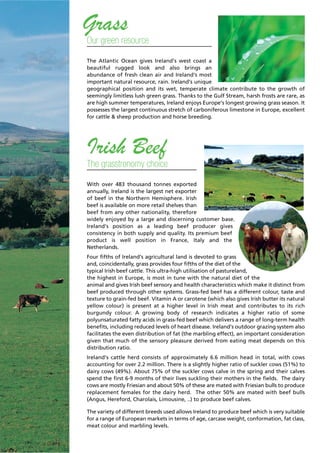
The Atlantic Ocean gives Ireland’s west coast a
beautiful rugged look and also brings an
abundance of fresh clean air and Ireland‘s most
important natural resource, rain. Ireland’s unique
geographical position and its wet, temperate climate contribute to the growth of
seemingly limitless lush green grass. Thanks to the Gulf Stream, harsh frosts are rare, as
are high summer temperatures, Ireland enjoys Europe’s longest growing grass season. It
possesses the largest continuous stretch of carboniferous limestone in Europe, excellent
for cattle & sheep production and horse breeding.


Irish Beef
The grasstronomy choice
With over 483 thousand tonnes exported
annually, Ireland is the largest net exporter
of beef in the Northern Hemisphere. Irish
beef is available on more retail shelves than
beef from any other nationality, therefore
widely enjoyed by a large and discerning customer base.
Ireland’s position as a leading beef producer gives
consistency in both supply and quality. Its premium beef
product is well position in France, Italy and the
Netherlands.
Four fifths of Ireland’s agricultural land is devoted to grass
and, coincidentally, grass provides four fifths of the diet of the
typical Irish beef cattle. This ultra-high utilisation of pastureland,
the highest in Europe, is most in tune with the natural diet of the
animal and gives Irish beef sensory and health characteristics which make it distinct from
beef produced through other systems. Grass-fed beef has a different colour, taste and
texture to grain-fed beef. Vitamin A or carotene (which also gives Irish butter its natural
yellow colour) is present at a higher level in Irish meat and contributes to its rich
burgundy colour. A growing body of research indicates a higher ratio of some
polyunsaturated fatty acids in grass-fed beef which delivers a range of long-term health
benefits, including reduced levels of heart disease. Ireland’s outdoor grazing system also
facilitates the even distribution of fat (the marbling effect), an important consideration
given that much of the sensory pleasure derived from eating meat depends on this
distribution ratio.
Ireland’s cattle herd consists of approximately 6.6 million head in total, with cows
accounting for over 2.2 million. There is a slightly higher ratio of suckler cows (51%) to
dairy cows (49%). About 75% of the suckler cows calve in the spring and their calves
spend the first 6-9 months of their lives suckling their mothers in the fields. The dairy
cows are mostly Friesian and about 50% of these are mated with Friesian bulls to produce
replacement females for the dairy herd. The other 50% are mated with beef bulls
(Angus, Hereford, Charolais, Limousine, ..) to produce beef calves.

The variety of different breeds used allows Ireland to produce beef which is very suitable
for a range of European markets in terms of age, carcase weight, conformation, fat class,
meat colour and marbling levels.
Irish Lamb
The Perfect Choice
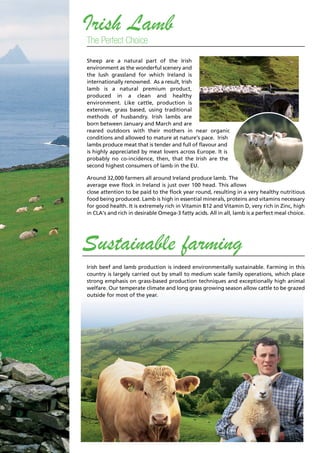
Sheep are a natural part of the Irish
environment as the wonderful scenery and
the lush grassland for which Ireland is
internationally renowned. As a result, Irish
lamb is a natural premium product,
produced in a clean and healthy
environment. Like cattle, production is
extensive, grass based, using traditional
methods of husbandry. Irish lambs are
born between January and March and are
reared outdoors with their mothers in near organic
conditions and allowed to mature at nature’s pace. Irish
lambs produce meat that is tender and full of flavour and
is highly appreciated by meat lovers across Europe. It is
probably no co-incidence, then, that the Irish are the
second highest consumers of lamb in the EU.

Around 32,000 farmers all around Ireland produce lamb. The
average ewe flock in Ireland is just over 100 head. This allows
close attention to be paid to the flock year round, resulting in a very healthy nutritious
food being produced. Lamb is high in essential minerals, proteins and vitamins necessary
for good health. It is extremely rich in Vitamin B12 and Vitamin D, very rich in Zinc, high
in CLA’s and rich in desirable Omega-3 fatty acids. All in all, lamb is a perfect meal choice.


Sustainable farming
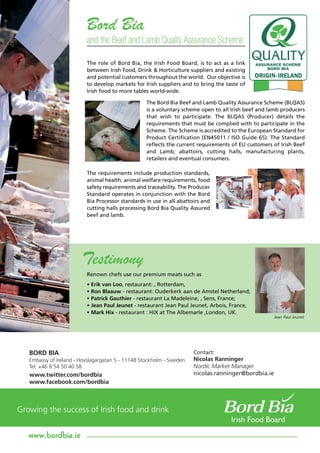
Irish beef and lamb production is indeed environmentally sustainable. Farming in this
country is largely carried out by small to medium scale family operations, which place
strong emphasis on grass-based production techniques and exceptionally high animal
welfare. Our temperate climate and long grass growing season allow cattle to be grazed
outside for most of the year.
Bord Bia
                       and the Beef and Lamb Quality Assurance Scheme

                       The role of Bord Bia, the Irish Food Board, is to act as a link
                       between Irish Food, Drink & Horticulture suppliers and existing
                       and potential customers throughout the world. Our objective is
                       to develop markets for Irish suppliers and to bring the taste of
                       Irish food to more tables world-wide.

                                                The Bord Bia Beef and Lamb Quality Assurance Scheme (BLQAS)
                                                is a voluntary scheme open to all Irish beef and lamb producers
                                                that wish to participate. The BLQAS (Producer) details the
                                                requirements that must be complied with to participate in the
                                                Scheme. The Scheme is accredited to the European Standard for
                                                Product Certification (EN45011 / ISO Guide 65). The Standard
                                                reflects the current requirements of EU customers of Irish Beef
                                                and Lamb; abattoirs, cutting halls, manufacturing plants,
                                                retailers and eventual consumers.

                       The requirements include production standards,
                       animal health, animal welfare requirements, food
                       safety requirements and traceability. The Producer
                       Standard operates in conjunction with the Bord
                       Bia Processor standards in use in all abattoirs and
                       cutting halls processing Bord Bia Quality Assured
                       beef and lamb.


                     Testimony
                       Renown chefs use our premium meats such as
                       • Erik van Loo, restaurant: , Rotterdam,
                       • Ron Blaauw - restaurant: Ouderkerk aan de Amstel Netherland;
                       • Patrick Gauthier - restaurant La Madeleine, , Sens, France;
                       • Jean Paul Jeunet - restaurant Jean Paul Jeunet, Arbois, France,
                       • Mark Hix - restaurant : HIX at The Albemarle ,London, UK.
                                                                                                  Jean Paul Jeunet


BORD BIA                                                           Contact:
Embassy of Ireland - Hovslagargatan 5 - 11148 Stockholm - Sweden   Nicolas Ranninger
Tel: +46 8 54 50 40 58                                             Nordic Market Manager
www.twitter.com/bordbia                                            nicolas.ranninger@bordbia.ie
www.facebook.com/bordbia


www.bordbia.ie

Irish Beef & Lamb

  • 2.
    Grass Our green resource TheAtlantic Ocean gives Ireland’s west coast a beautiful rugged look and also brings an abundance of fresh clean air and Ireland‘s most important natural resource, rain. Ireland’s unique geographical position and its wet, temperate climate contribute to the growth of seemingly limitless lush green grass. Thanks to the Gulf Stream, harsh frosts are rare, as are high summer temperatures, Ireland enjoys Europe’s longest growing grass season. It possesses the largest continuous stretch of carboniferous limestone in Europe, excellent for cattle & sheep production and horse breeding. Irish Beef The grasstronomy choice With over 483 thousand tonnes exported annually, Ireland is the largest net exporter of beef in the Northern Hemisphere. Irish beef is available on more retail shelves than beef from any other nationality, therefore widely enjoyed by a large and discerning customer base. Ireland’s position as a leading beef producer gives consistency in both supply and quality. Its premium beef product is well position in France, Italy and the Netherlands. Four fifths of Ireland’s agricultural land is devoted to grass and, coincidentally, grass provides four fifths of the diet of the typical Irish beef cattle. This ultra-high utilisation of pastureland, the highest in Europe, is most in tune with the natural diet of the animal and gives Irish beef sensory and health characteristics which make it distinct from beef produced through other systems. Grass-fed beef has a different colour, taste and texture to grain-fed beef. Vitamin A or carotene (which also gives Irish butter its natural yellow colour) is present at a higher level in Irish meat and contributes to its rich burgundy colour. A growing body of research indicates a higher ratio of some polyunsaturated fatty acids in grass-fed beef which delivers a range of long-term health benefits, including reduced levels of heart disease. Ireland’s outdoor grazing system also facilitates the even distribution of fat (the marbling effect), an important consideration given that much of the sensory pleasure derived from eating meat depends on this distribution ratio. Ireland’s cattle herd consists of approximately 6.6 million head in total, with cows accounting for over 2.2 million. There is a slightly higher ratio of suckler cows (51%) to dairy cows (49%). About 75% of the suckler cows calve in the spring and their calves spend the first 6-9 months of their lives suckling their mothers in the fields. The dairy cows are mostly Friesian and about 50% of these are mated with Friesian bulls to produce replacement females for the dairy herd. The other 50% are mated with beef bulls (Angus, Hereford, Charolais, Limousine, ..) to produce beef calves. The variety of different breeds used allows Ireland to produce beef which is very suitable for a range of European markets in terms of age, carcase weight, conformation, fat class, meat colour and marbling levels.
  • 3.
    Irish Lamb The PerfectChoice Sheep are a natural part of the Irish environment as the wonderful scenery and the lush grassland for which Ireland is internationally renowned. As a result, Irish lamb is a natural premium product, produced in a clean and healthy environment. Like cattle, production is extensive, grass based, using traditional methods of husbandry. Irish lambs are born between January and March and are reared outdoors with their mothers in near organic conditions and allowed to mature at nature’s pace. Irish lambs produce meat that is tender and full of flavour and is highly appreciated by meat lovers across Europe. It is probably no co-incidence, then, that the Irish are the second highest consumers of lamb in the EU. Around 32,000 farmers all around Ireland produce lamb. The average ewe flock in Ireland is just over 100 head. This allows close attention to be paid to the flock year round, resulting in a very healthy nutritious food being produced. Lamb is high in essential minerals, proteins and vitamins necessary for good health. It is extremely rich in Vitamin B12 and Vitamin D, very rich in Zinc, high in CLA’s and rich in desirable Omega-3 fatty acids. All in all, lamb is a perfect meal choice. Sustainable farming Irish beef and lamb production is indeed environmentally sustainable. Farming in this country is largely carried out by small to medium scale family operations, which place strong emphasis on grass-based production techniques and exceptionally high animal welfare. Our temperate climate and long grass growing season allow cattle to be grazed outside for most of the year.
  • 4.
    Bord Bia and the Beef and Lamb Quality Assurance Scheme The role of Bord Bia, the Irish Food Board, is to act as a link between Irish Food, Drink & Horticulture suppliers and existing and potential customers throughout the world. Our objective is to develop markets for Irish suppliers and to bring the taste of Irish food to more tables world-wide. The Bord Bia Beef and Lamb Quality Assurance Scheme (BLQAS) is a voluntary scheme open to all Irish beef and lamb producers that wish to participate. The BLQAS (Producer) details the requirements that must be complied with to participate in the Scheme. The Scheme is accredited to the European Standard for Product Certification (EN45011 / ISO Guide 65). The Standard reflects the current requirements of EU customers of Irish Beef and Lamb; abattoirs, cutting halls, manufacturing plants, retailers and eventual consumers. The requirements include production standards, animal health, animal welfare requirements, food safety requirements and traceability. The Producer Standard operates in conjunction with the Bord Bia Processor standards in use in all abattoirs and cutting halls processing Bord Bia Quality Assured beef and lamb. Testimony Renown chefs use our premium meats such as • Erik van Loo, restaurant: , Rotterdam, • Ron Blaauw - restaurant: Ouderkerk aan de Amstel Netherland; • Patrick Gauthier - restaurant La Madeleine, , Sens, France; • Jean Paul Jeunet - restaurant Jean Paul Jeunet, Arbois, France, • Mark Hix - restaurant : HIX at The Albemarle ,London, UK. Jean Paul Jeunet BORD BIA Contact: Embassy of Ireland - Hovslagargatan 5 - 11148 Stockholm - Sweden Nicolas Ranninger Tel: +46 8 54 50 40 58 Nordic Market Manager www.twitter.com/bordbia nicolas.ranninger@bordbia.ie www.facebook.com/bordbia www.bordbia.ie