(Photos from http://www.worldatlas.com)


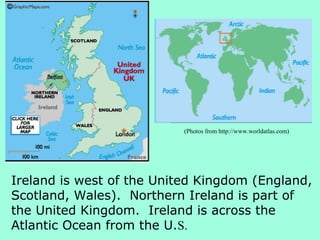
Ireland is west of the United Kingdom (England,
Scotland, Wales). Northern Ireland is part of
the United Kingdom. Ireland is across the
Atlantic Ocean from the U.S.
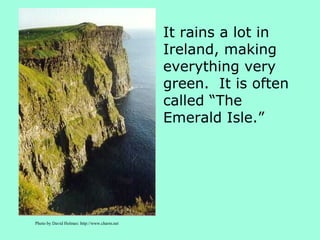
It rains a lot in
                                              Ireland, making
                                              everything very
                                              green. It is often
                                              called “The
                                              Emerald Isle.”


Photo by David Holmes: http://www.charm.net
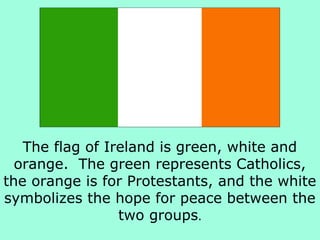
The flag of Ireland is green, white and
  orange. The green represents Catholics,
the orange is for Protestants, and the white
symbolizes the hope for peace between the
                 two groups.
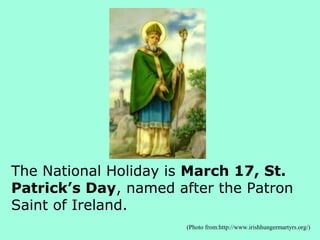
The National Holiday is March 17, St.
Patrick’s Day, named after the Patron
Saint of Ireland.
                       (Photo from:http://www.irishhungermartyrs.org/)
Most people in Ireland speak
English, but a few still speak
Gaelic. You might hear
someone say “Erin go bragh”
on St. Patrick’s Day, which is
Gaelic for “Ireland forever.”


        (Sound file from: http://www.irish-sayings.com/)
(Photo from: http://www.publicmuseum.oshkosh.net/Exhibits/Communities/communities.html)   (Photos from: http://www.eurocoins.co.uk/ireland.html)


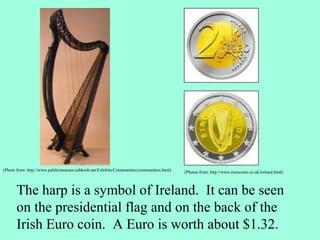
      The harp is a symbol of Ireland. It can be seen
      on the presidential flag and on the back of the
      Irish Euro coin. A Euro is worth about $1.32.
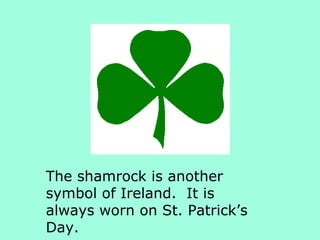
The shamrock is another
symbol of Ireland. It is
always worn on St. Patrick’s
Day.
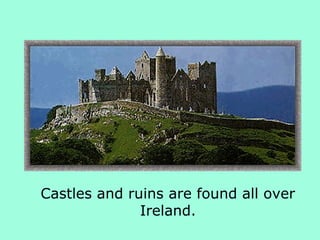
Castles and ruins are found all over
              Ireland.
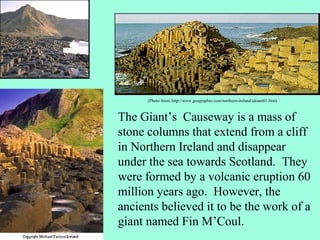
(Photo from: http://www.geographia.com/northern-ireland/ukiant01.htm)


The Giant’s Causeway is a mass of
stone columns that extend from a cliff
in Northern Ireland and disappear
under the sea towards Scotland. They
were formed by a volcanic eruption 60
million years ago. However, the
ancients believed it to be the work of a
giant named Fin M’Coul.
The Celts, warriors from
western Europe, controlled
Ireland for 1000 years. Today
the term “celtic” is often used to
refer to anything traditionally
Irish, such as celtic music and
celtic dance. Dance, music,
holidays, and traditions are all
part of a people’s culture.
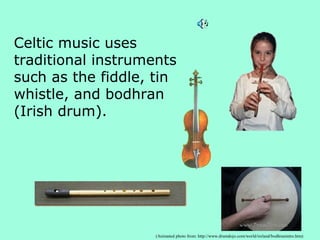
Celtic music uses
traditional instruments
such as the fiddle, tin
whistle, and bodhran
(Irish drum).


                    (Animated photo from: http://www.drumdojo.com/world/ireland/bodhranintro.htm)
Why do we celebrate
St. Patrick’s Day ?
•It’s fun to celebrate
holidays from around the
world. Even if you’re not
Irish, you can enjoy
celebrating the holiday by
wearing green, which is
also a sign of spring.
HAPPY S. PATRICK´S DAY

Ireland

  • 2.
    (Photos from http://www.worldatlas.com) Irelandis west of the United Kingdom (England, Scotland, Wales). Northern Ireland is part of the United Kingdom. Ireland is across the Atlantic Ocean from the U.S.
  • 3.
    It rains alot in Ireland, making everything very green. It is often called “The Emerald Isle.” Photo by David Holmes: http://www.charm.net
  • 4.
    The flag ofIreland is green, white and orange. The green represents Catholics, the orange is for Protestants, and the white symbolizes the hope for peace between the two groups.
  • 5.
    The National Holidayis March 17, St. Patrick’s Day, named after the Patron Saint of Ireland. (Photo from:http://www.irishhungermartyrs.org/)
  • 6.
    Most people inIreland speak English, but a few still speak Gaelic. You might hear someone say “Erin go bragh” on St. Patrick’s Day, which is Gaelic for “Ireland forever.” (Sound file from: http://www.irish-sayings.com/)
  • 7.
    (Photo from: http://www.publicmuseum.oshkosh.net/Exhibits/Communities/communities.html) (Photos from: http://www.eurocoins.co.uk/ireland.html) The harp is a symbol of Ireland. It can be seen on the presidential flag and on the back of the Irish Euro coin. A Euro is worth about $1.32.
  • 8.
    The shamrock isanother symbol of Ireland. It is always worn on St. Patrick’s Day.
  • 9.
    Castles and ruinsare found all over Ireland.
  • 10.
    (Photo from: http://www.geographia.com/northern-ireland/ukiant01.htm) TheGiant’s Causeway is a mass of stone columns that extend from a cliff in Northern Ireland and disappear under the sea towards Scotland. They were formed by a volcanic eruption 60 million years ago. However, the ancients believed it to be the work of a giant named Fin M’Coul.
  • 11.
    The Celts, warriorsfrom western Europe, controlled Ireland for 1000 years. Today the term “celtic” is often used to refer to anything traditionally Irish, such as celtic music and celtic dance. Dance, music, holidays, and traditions are all part of a people’s culture.
  • 12.
    Celtic music uses traditionalinstruments such as the fiddle, tin whistle, and bodhran (Irish drum). (Animated photo from: http://www.drumdojo.com/world/ireland/bodhranintro.htm)
  • 13.
    Why do wecelebrate St. Patrick’s Day ? •It’s fun to celebrate holidays from around the world. Even if you’re not Irish, you can enjoy celebrating the holiday by wearing green, which is also a sign of spring.
  • 14.