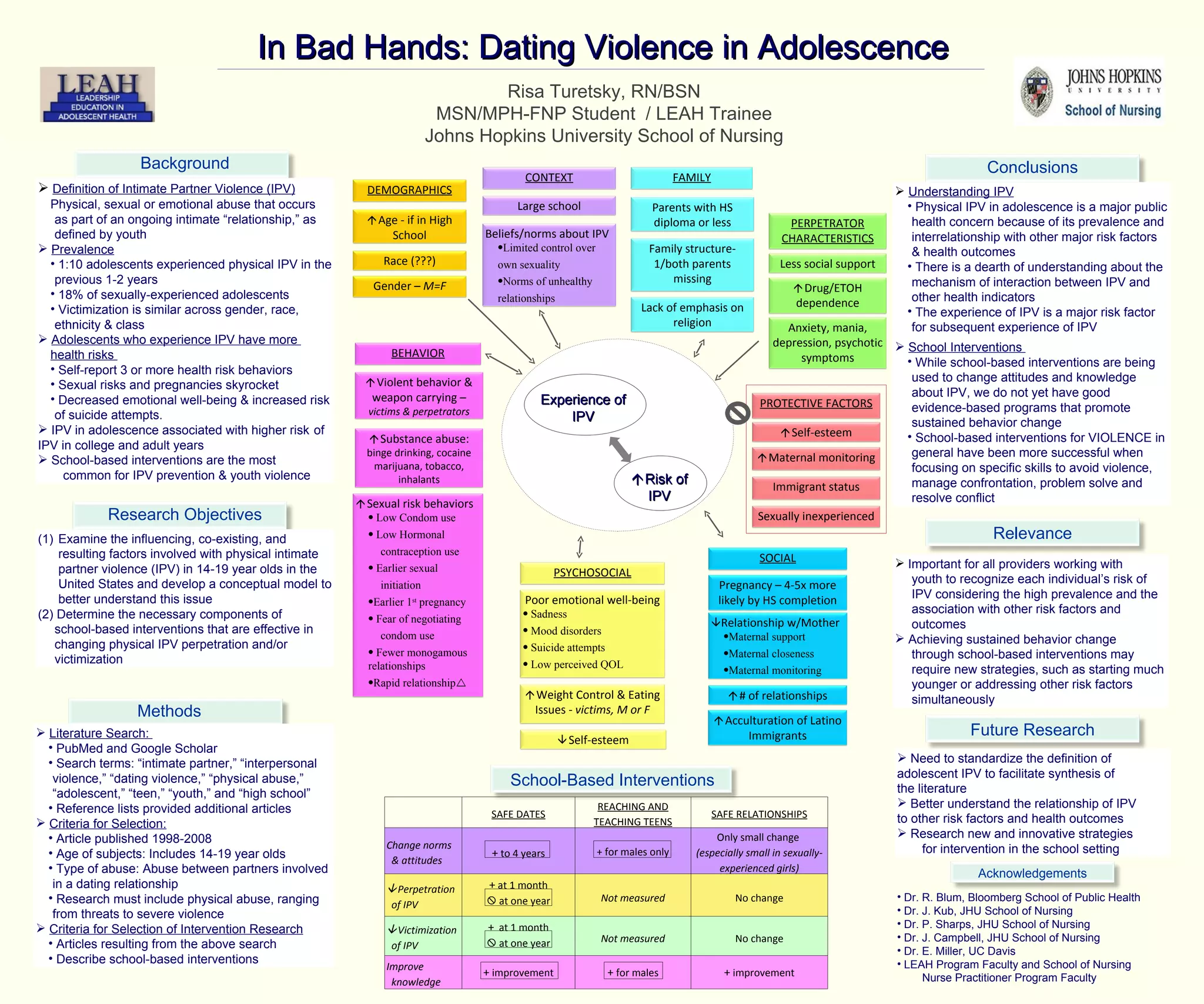
School-Based Interventions Background In Bad Hands: Dating Violence in Adolescence Risa Turetsky, RN/BSN MSN/MPH-FNP Student  / LEAH Trainee Johns Hopkins University School of Nursing Definition of Intimate Partner Violence (IPV) Physical, sexual or emotional abuse that occurs as part of an ongoing intimate “relationship,” as defined by youth Prevalence 1:10 adolescents experienced physical IPV in the previous 1-2 years 18% of sexually-experienced adolescents Victimization is similar across gender, race, ethnicity & class Adolescents who experience IPV have more  health risks  Self-report 3 or more health risk behaviors Sexual risks and pregnancies skyrocket Decreased emotional well-being & increased risk of suicide attempts. IPV in adolescence associated with higher risk  of IPV in college and adult years School-based interventions are the most  common for IPV prevention & youth violence Examine the influencing, co-existing, and  resulting factors involved with physical intimate partner violence (IPV) in 14-19 year olds in the United States and develop a conceptual model to better understand this issue (2) Determine the necessary components of  school-based interventions that are effective in changing physical IPV perpetration and/or victimization Research Objectives Literature Search:  PubMed and Google Scholar  Search terms: “intimate partner,” “interpersonal violence,” “dating violence,” “physical abuse,” “adolescent,” “teen,” “youth,” and “high school”  Reference lists provided additional articles  Criteria for Selection: Article published 1998-2008 Age of subjects: Includes 14-19 year olds Type of abuse: Abuse between partners involved in a dating relationship Research must include physical abuse, ranging from threats to severe violence Criteria for Selection of Intervention Research   Articles resulting from the above search Describe school-based interventions Methods Understanding IPV Physical IPV in adolescence is a major public health concern because of its prevalence and interrelationship with other major risk factors & health outcomes There is a dearth of understanding about the mechanism of interaction between IPV and other health indicators The experience of IPV is a major risk factor for subsequent experience of IPV School Interventions  While school-based interventions are being used to change attitudes and knowledge about IPV, we do not yet have good evidence-based programs that promote sustained behavior change School-based interventions for VIOLENCE in general have been more successful when focusing on specific skills to avoid violence, manage confrontation, problem solve and resolve conflict Conclusions Important for all providers working with  youth to recognize each individual’s risk of IPV considering the high prevalence and the association with other risk factors and outcomes Achieving sustained behavior change  through school-based interventions may require new strategies, such as starting much younger or addressing other risk factors simultaneously Relevance Need to standardize the definition of  adolescent IPV to facilitate synthesis of  the literature Better understand the relationship of IPV  to other risk factors and health outcomes  Research new and innovative strategies for intervention in the school setting Future Research Dr. R. Blum, Bloomberg School of Public Health Dr. J. Kub, JHU School of Nursing Dr. P. Sharps, JHU School of Nursing Dr. J. Campbell, JHU School of Nursing Dr. E. Miller, UC Davis LEAH Program Faculty and School of Nursing  Nurse Practitioner Program Faculty Acknowledgements Experience of IPV   Risk of IPV PERPETRATOR CHARACTERISTICS Less social support   Drug/ETOH dependence Anxiety, mania, depression, psychotic symptoms Beliefs/norms about IPV Limited control over  own sexuality Norms of unhealthy  relationships Large school CONTEXT   Age - if in High School DEMOGRAPHICS Race (???) Gender –  M=F SOCIAL   Acculturation of Latino Immigrants   # of relationships Pregnancy – 4-5x more likely by HS completion  Relationship w/Mother Maternal support Maternal closeness Maternal monitoring Family structure- 1/both parents missing FAMILY Parents with HS diploma or less Lack of emphasis on religion PSYCHOSOCIAL   Self-esteem Poor emotional well-being Sadness Mood disorders Suicide attempts Low perceived QOL   Weight Control & Eating Issues -  victims, M or F BEHAVIOR   Substance abuse:  binge drinking, cocaine marijuana, tobacco, inhalants   Sexual risk behaviors Low Condom use Low Hormonal  contraception use Earlier sexual  initiation Earlier 1 st  pregnancy Fear of negotiating  condom use Fewer monogamous  relationships Rapid relationship    Violent behavior & weapon carrying –  victims & perpetrators PROTECTIVE FACTORS Immigrant status   Maternal monitoring   Self-esteem Sexually inexperienced SAFE DATES REACHING AND TEACHING TEENS SAFE RELATIONSHIPS Change norms  & attitudes +  to 4 years + for males only Only small change  (especially small in sexually-experienced girls)   P erpetration  of IPV +  at 1 month    at one year Not measured No change   V ictimization  of IPV +   at 1 month    at one year Not measured No change Improve  knowledge +  improvement +  for males +  improvement

In Bad Hands: Dating Violence in Adolescents

  • 1.
    School-Based Interventions BackgroundIn Bad Hands: Dating Violence in Adolescence Risa Turetsky, RN/BSN MSN/MPH-FNP Student / LEAH Trainee Johns Hopkins University School of Nursing Definition of Intimate Partner Violence (IPV) Physical, sexual or emotional abuse that occurs as part of an ongoing intimate “relationship,” as defined by youth Prevalence 1:10 adolescents experienced physical IPV in the previous 1-2 years 18% of sexually-experienced adolescents Victimization is similar across gender, race, ethnicity & class Adolescents who experience IPV have more health risks Self-report 3 or more health risk behaviors Sexual risks and pregnancies skyrocket Decreased emotional well-being & increased risk of suicide attempts. IPV in adolescence associated with higher risk of IPV in college and adult years School-based interventions are the most common for IPV prevention & youth violence Examine the influencing, co-existing, and resulting factors involved with physical intimate partner violence (IPV) in 14-19 year olds in the United States and develop a conceptual model to better understand this issue (2) Determine the necessary components of school-based interventions that are effective in changing physical IPV perpetration and/or victimization Research Objectives Literature Search: PubMed and Google Scholar Search terms: “intimate partner,” “interpersonal violence,” “dating violence,” “physical abuse,” “adolescent,” “teen,” “youth,” and “high school” Reference lists provided additional articles Criteria for Selection: Article published 1998-2008 Age of subjects: Includes 14-19 year olds Type of abuse: Abuse between partners involved in a dating relationship Research must include physical abuse, ranging from threats to severe violence Criteria for Selection of Intervention Research Articles resulting from the above search Describe school-based interventions Methods Understanding IPV Physical IPV in adolescence is a major public health concern because of its prevalence and interrelationship with other major risk factors & health outcomes There is a dearth of understanding about the mechanism of interaction between IPV and other health indicators The experience of IPV is a major risk factor for subsequent experience of IPV School Interventions While school-based interventions are being used to change attitudes and knowledge about IPV, we do not yet have good evidence-based programs that promote sustained behavior change School-based interventions for VIOLENCE in general have been more successful when focusing on specific skills to avoid violence, manage confrontation, problem solve and resolve conflict Conclusions Important for all providers working with youth to recognize each individual’s risk of IPV considering the high prevalence and the association with other risk factors and outcomes Achieving sustained behavior change through school-based interventions may require new strategies, such as starting much younger or addressing other risk factors simultaneously Relevance Need to standardize the definition of adolescent IPV to facilitate synthesis of the literature Better understand the relationship of IPV to other risk factors and health outcomes Research new and innovative strategies for intervention in the school setting Future Research Dr. R. Blum, Bloomberg School of Public Health Dr. J. Kub, JHU School of Nursing Dr. P. Sharps, JHU School of Nursing Dr. J. Campbell, JHU School of Nursing Dr. E. Miller, UC Davis LEAH Program Faculty and School of Nursing Nurse Practitioner Program Faculty Acknowledgements Experience of IPV   Risk of IPV PERPETRATOR CHARACTERISTICS Less social support   Drug/ETOH dependence Anxiety, mania, depression, psychotic symptoms Beliefs/norms about IPV Limited control over own sexuality Norms of unhealthy relationships Large school CONTEXT   Age - if in High School DEMOGRAPHICS Race (???) Gender – M=F SOCIAL   Acculturation of Latino Immigrants   # of relationships Pregnancy – 4-5x more likely by HS completion  Relationship w/Mother Maternal support Maternal closeness Maternal monitoring Family structure- 1/both parents missing FAMILY Parents with HS diploma or less Lack of emphasis on religion PSYCHOSOCIAL   Self-esteem Poor emotional well-being Sadness Mood disorders Suicide attempts Low perceived QOL   Weight Control & Eating Issues - victims, M or F BEHAVIOR   Substance abuse: binge drinking, cocaine marijuana, tobacco, inhalants   Sexual risk behaviors Low Condom use Low Hormonal contraception use Earlier sexual initiation Earlier 1 st pregnancy Fear of negotiating condom use Fewer monogamous relationships Rapid relationship    Violent behavior & weapon carrying – victims & perpetrators PROTECTIVE FACTORS Immigrant status   Maternal monitoring   Self-esteem Sexually inexperienced SAFE DATES REACHING AND TEACHING TEENS SAFE RELATIONSHIPS Change norms & attitudes + to 4 years + for males only Only small change (especially small in sexually-experienced girls)   P erpetration of IPV + at 1 month  at one year Not measured No change   V ictimization of IPV + at 1 month  at one year Not measured No change Improve knowledge + improvement + for males + improvement