


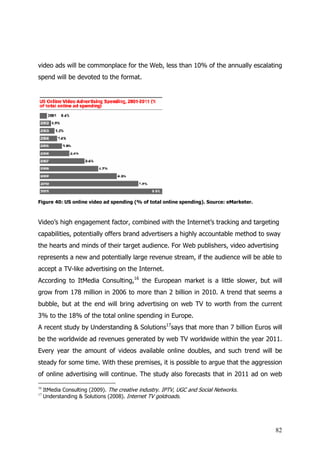


Bocconi University

                Faculty of Economics


Master of Science in Economics and Management for Arts,
           Culture, Media and Entertainment


      Business models for web TV


                      Supervisor:
                     Paola Dubini


                       Examiner:
                 Massimiliano Nuccio


                    Master thesis by:

                  Alessandro Masi
                       1286053


                      A.A. 2008/2009
1
To my grandfather


“If you’re walking down the right path and you’re willing to keep walking, eventually
you’ll make progress” – B. Obama


                                                                                   2
Abstract


The thesis aims to define peculiar business models for web TV, still an almost
unexplored ground inside the economic theory, despite technological progress and a
steady growing audience made it recently so attractive in terms of investments for
both entrepreneurs and advertisers.
Even though there is not yet agreement on a definition, it is essentially a video box
contained into a webpage. The audiovisual content can be live or on demand, and
watched for free or by payment, or the user can subscribe to the service. The
majority of the videos on the web are user-generated.
Many players entered this market in the recent past, and the figures show that the
offering is growing steadily, supported by an increasing demand. The path seems to
take to the result that every website will have audiovisual content and every user will
be able to watch content that is tailored to his taste, according to the “long tail”
theory of the infinite market niches.
Advertising in the main source of revenues but, according to the strategic
positioning, it can be mixed with or substituted by others.


                                                                                     3
Contents


Introduction


1. What is web TV


2. The research
   2.1 Methods
   2.2 Data analysis
   2.3 Findings


3. Case studies
   3.1 Glomera
   3.2 ShareMedia
   3.3 Google Video – YouTube
   3.4 RCS Digital
   3.5 Libero Video
   3.6 Relevance of the case studies


4. Strategic issues and business models
   4.1 Economic framework
   4.2 Economic structure
   4.3 Business models


Conclusions


Acknowledgements


                                          4
Resources


Appendix A


Appendix B


Appendix C


             5
Introduction


The research question on the basis of the present study is whether exists an
economic reasons for the growth of web TV or not, and what are the business
models that make it sustainable in the long term.
It will prove the point that there is a solid economic foundation on the ground of
such expansion, besides it will identify the business models assumed according to the
strategic variables.
The first chapter seeks to provide a definition of what is web TV, why it is different
from IPTV, and why it is so innovative and therefore attractive in terms of business
opportunities.
Then, a statistical research over 152 websites brings to actually identify peculiar
features that characterize web TV, dominant modalities of revenue enhancement,
source and characteristics of the audiovisual content, and finally licensing, uploading
and privacy regimes. The analysis focuses on the variables that determine the
business model: type of content, operator and source of revenues.
In the third chapter, a case study over five different successful instances of web TV
is conducted, in order to analyze reasons of such good performance. Case studies
are organized into four main sections: general information about the company (brief
history, definition of the business line, primary competitors), business strategy
(business framework, key points of the offer, market positioning, critical factors of
success), business model, and future scenarios.
As a result, strategic issues and business models for web TV are identified. The
objective is to better understand the dominant models: it can be used as a guideline
either by present companies or for future business opportunities in this field.


                                                                                     6
1. What is web TV?


What exactly is web TV? There is no agreement on a definition. It comes with
different names – web TV, IPTV, enhanced TV, personal TV, and interactive TV, for
example – which signify slightly different things. At the lower end of complexity, it is
merely a narrowband two-way Internet-style individualized (“asynchronous”) channel
that accompanies regular one-way “synchronous” broadband broadcast TV or cable.
This internet channel can provide information in conjunction with broadcast
programs, such as details on news and sports, or enable transactions (including e-
commerce) in response to TV advertisement. This is known as “enhanced TV”. At the
other end of complexity is a full asynchronous two-way TV, with each user receiving
and transmitting individualized TV programs, including direct interaction in the
program plot line. In between is one-way broadband with a narrowband return
channel that can be used to select video programs on demand (VOD).
Every new medium starts as a substitute and then evolves into something quite new.
Web TV, too, will first be used to access video servers that store existing programs,
making them available for viewing at any time. But soon, going beyond the
convenience of viewer choice and control, web TV will enable and encourage new
types of entertainment, education, and games that take advantage of the Internet’s
interactive capabilities. This assumes, of course, technical capability and economic
viability (Ross, 2008).
As asserted in a study by Noll (2004), web TV is many things, or even a combination
of things. In its most obvious implementation, web TV is conventional television
obtained over the Internet. Rather than watching television programs broadcast over
the air or over cable, television programs are accessed over the Internet and then
watched in real time, using a technology known as video streaming. Not only
conventional television, but also movies, cartoons, and video shorts.
Web TV is the adoption of an Internet-like interface in accessing and watching
television – a new form of video navigation over the Internet. Web TV is a more


                                                                                      7
interactive approach to controlling the television experience with the ability to obtain
all sorts of ancillary information while watching television, as promoted by Wink
Communications.
Web TV is the use of the home TV set to view Internet sites, as offered by WebTV
Networks, perhaps in conjunction with conventional television viewing, the so called
Internet-enhanced TV, which could evolve into Internet-delivered TV on a wide basis.
Web TV is the use of the Internet protocol to store and transmit video, both at the
TV studio and also to various locations. Rather than storing and transmitting digital
video as a continuous stream of bits, the digital video is packetized into packets
specified by the Internet protocol (Ross, 2008).
It is now useful to go more in depth and define clearly the different forms Web TV
actually assumes. Basically, a webcast is a media file distributed over the Internet
using streaming media technology, multimedia that are constantly received by, and
normally presented to, an end-user while being delivered by a streaming provider.
Internet television is a commonly streamed medium. It is a television service
distributed via the Internet. The two forms of viewing web TV are streaming from a
single or multiple websites and downloading in the form of video podcasts or
individual files. The video may be also broadcast with a peer-to-peer network, which
doesn’t rely on a single website’s streaming. Peer-to-peer software applications are
designed to redistribute video streams in real time on a P2P network; the distributed
video streams are typically TV channels from all over the world but may also come
from other sources. The draw to these applications is significant because they have
the potential to make any TV channel globally available, because it is not a central
server to broadcast the signal to every single user, so the flow can spread easier and
with lower infrastructure costs for the broadcaster, eventually higher for the user
(Blumenthal, 2006).
Internet television differs from IPTV in that IPTV offerings, while also based on the
IP protocol stacks, are typically offered on discrete service provider networks, highly
managed to provide guaranteed quality of service and good bandwidth, and usually


                                                                                      8
requiring a special IPTV set-top-box. The official definition of IPTV, approved by the
International Telecommunication Union focus group (2007) on IPTV is as follows:
“IPTV is defined as multimedia services delivered over IP based networks managed
to provide the required level of quality of service and experience, security,
interactivity and reliability.”   It is characterized by single or multiple program
transport streams (MPTS) which are sourced by the same network operator that
owns or directly controls the delivery to the consumer.
Compared to IPTV, web TV is a quick-to-market and relatively low investment
service, since it rides on existing infrastructure including broadband, ADSL, Wi-Fi,
cable and satellite, which makes it a valuable tool for a wide variety of service
providers and content owners looking for new revenue streams. A web TV provider
has no control over the final delivery and so broadcasts on a “best effort” basis.
Elementary streams over IP networks and proprietary variants as used by websites
such as YouTube are now rarely considered to be IPTV services (Vogel, 2007).
The relative ease of establishing a web TV service seems at first a threat to IPTV
operators’ huge investment, but both services do not necessarily compete for the
same customers and there are some synergies between the two such as a common
technology platform in the form of web-based technologies for content storage and
delivery.
Broadcast IPTV has two major architecture forms: free and fee-based. The free
sector is growing rapidly and major television broadcasters worldwide are
transmitting their broadcast signal over the Internet. Because IPTV uses standard
protocols, it promises lower costs for operators and lower prices for users: using set-
top boxes with broadband connections, video can be streamed to households more
efficiently (Harte, 2007).
The IP-based platform offers significant advantages, including the ability to integrate
television with other IP-based services, like high speed Internet access and VoIP. A
switched IP network also allows for the delivery of significantly more content and
functionality: content remains in the network and only the content the customer


                                                                                     9
selects is sent into the customer’s home. That frees up bandwidth, and the
customer’s choice is less restricted by the size of the “pipe” into the home. However,
this also implies that the customer’s privacy could be compromised to a greater
extent than is possible with traditional TV or satellite networks, since enables the
service provider to accurately track each and every program watched and the
duration of watching for each viewer.
Internet allows three different distribution modalities, alternatives and bidirectional:
unicast, multicast and P2P.
The first one is based on the Internet model client/server: the client asks, the server
manages each single request; such modality is typical of the web TV, and every one
user more corresponds to higher capacity of the server, and therefore to higher
infrastructure managing costs, that is the opposite of the broadcasting model.
The second one does not present such problem, since each source can serve a
virtually infinite amount of clients, that are differently from the broadcast model,
known to the source; however such structure works only inside private IP networks,
closed and controlled, and for this reason this is the protocol on which the IPTV is
based: only telecom operators (Telco) can build a network with a multicast
transmission capacity, so that only authorized users can view that contents.
The P2P protocol allows overcoming the unicast paradox without the closed logic of
the multicast. Each single user of the P2P network becomes also a retransmitter, a
server, for other clients.
As a result, business models and offerings change. Both web TV and IPTV ensure
through the Internet protocol the interactivity and the multimedia capacity, but
through unicast, multicast of P2P (bidirectional) give to the user the possibility to
benefit in asynchronous or non-linear and off-line ways from the audiovisual
contents, with a step towards a multichannel service: advertisement and VOD selling
become the principal streams of revenues. VOD is particularly used as a source of
revenue for IPTV, whereas for the web TV it is usually free, financed through
advertisement, and it allows personalization and the possibility to create a personal


                                                                                     10
programme schedule, usable whenever the user wants. The limitation for the IPTV is
given by variety and diversification of contents, based on competition among
providers (Eastman and Ferguson, 2006).
At the beginnings, the term web TV was used particularly referring to broadcasters
that used the Internet as an alternative channel for its programming, and therefore a
traditional live television signal distributed through webcasting.
New possibilities were then given by the evolution of the streaming towards the
progressive download and the P2P, together with the diffusion of the On Demand.
However, it was most of all the technological and economical accessibility to
production and publishing of contents to shift the role of users from passive to
active. Nowadays, everyone is able to create and edit videos, to publish and share
them on the web. The Web 2.0 era comes with a revolution and with the expansion
of the UGC (User Generated Content) world. Nevertheless, videos can be enjoyed
through cell phones and iPods, through the podcasting.
The explosion of Web 2.0 and UGC brings to the success of On line video companies,
such as YouTube, that are video sharing websites that allow the user-producer to
publish the content usually for free, being such companies financed by advertising.
Such companies offer a wide range of services: video uploading in different formats,
licensing of the content through copyright or copyleft licenses, syndication,
personalization of the player, pay-per-view contents managed through DRM systems,
advertising spaces (Sparrow, 2007).
Sometimes programming is not left entirely to the user’s uploading activity, so that
the transmitter manages a very peculiar business model, where contents are mainly
user generated but responds to a precise editorial choice.
All in all, web TV is all of that, and is characterized by a model that is open towards
whoever is a right holder on the content, is highly diversified and dynamic, since a
huge amount of small and medium producers provide contents.
Taking into consideration the definition of “value chain” by Michael Porter (1985), it
seems that it may be a useful key to analyze the logic of the web TV, seen as


                                                                                    11
subsequent activities, with the principal changes from the traditional television
distribution system.


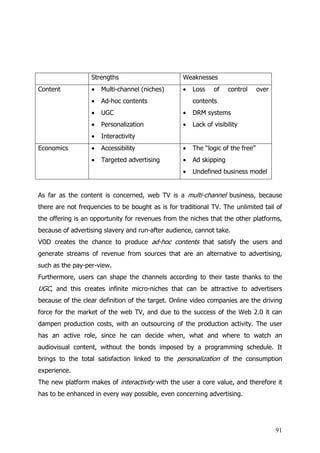
Figure 1: comparison between traditional TV and web TV value chains.


For web TV, network provider and service provider consolidate into the internet
service provider. As far as the content creation, a transmitter on this platform can
buy contents and formats from outside, but can also produce inside ad-hoc for the
web, can digitalize its programming if coming from other platforms, or open to the
UGC; packaging and aggregation of programming has to be intended as a managing
activity of the space available on the server for the contents; publication and
distribution is based on the rent of the on-line band necessary; navigation and
selection processes are managed in terms of layout, to allow the client to access to
the diverse collateral services, such as on-line guide, forum, chat, payment of
premium contents; viewing and consumption experiences imply for the transmitter a


                                                                                 12
series of activities such as the running of the band, and the management of
interactivity and contents and services providing requested by the user.
In conclusion, web TV is radically different both from traditional and from IPTV:
communication with the user is bidirectional (unicast or P2P); accessibility is at the
maximum level both from the transmitter (low investments) and the user (mostly
free) side; fruition is possible almost everywhere, also off-line; contents are also User
Generated, On Demand, and channels are virtually unlimited; fruition time is decided
by the user; high interactivity; consuming activity is mainly on a singular base; user
has an active attitude towards the medium; satisfaction is connected to the choice
and not seen just as distraction and recreation.


2. The research


This chapter analyses a whole set of features, the business model, and also the
content licensing, the uploading and the privacy regimes of 152 websites that can be
included, following the definition given in the first chapter, into the broad category of
web TV. The aim of the research is to find out peculiarities, common features and
differences within the sample, in order to move closer to define which strategic
variables determine the type of business model chosen by each web TV.


   2.1       Methods


First of all, the sample has been selected starting from the top 200 websites, in
terms of Unique Visitors for online video distribution, either of user generated or
professionally-produced content., accessible from Italy and whose main language is
Italian or English. A third criterion is the presence at least of two on demand or one


                                                                                      13
live channel. The tool used is Google AdPlanner, a database that measures websites
performance.
Data have been then organized into a dataset, using the software Excel 2007,
composed of 152 websites and 94 variables, so that the total observation was
14,288. The sample has been therefore purified from 48 websites, that had not
enough dignity to be included in the sample, or they were not in line with one or
more of the criteria, or their domain had been recently cancelled.
The final step of the analysis has been the cluster analysis through Self-Organizing
Maps (SOM) and k-means Algorithms. The software used is MATLAB r2007b.
Self-Organizing Maps-SOM (Kohonen, 1995) provides a non-parametric model of
data mining without hypothesis on data distribution: data are not-supervised and not
target defined a-priori, and spatial organization of data is given through topological
maps. SOM helps to classify and visualize clustering and projection, and therefore it
gathers data and helps reduce dimensionality. The cluster analysis involves the 152
samples and 44 variables, selected as more relevant for the objective of the
research. The variables of the dataset have been transformed into binary algorithms,
in order to allow to the software to process the data.
Afterwards, in order to define better the clustering composition, a two-step clustering
is conducted by using SPSS Statistics 17.0, since the two-step clustering is designed
for hierarchical cluster analysis of large samples with categorical data. The clusters
have been also categorized by variable importance.


                                                                                    14
2.2         Data analysis


To begin with, the research considers the figures related to Unique Visitors1 and
Average Stay2 for each web TV. The first measure is also, as just said, one of the
criteria to choose the sample.
Such figures have been analyzed on a worldwide base and not on a specific country
base because, in terms of amount of visitors, and therefore creation of communities,
this criterion is more relevant then the country-based one. It is clear that, in terms of
advertising investments, the specific territory would have to be preferred, particularly
if the advertiser wants to target a specific population. However, the most important
mechanism to advertise on the web today is to be part of the Google AdSense
network or alternatively to entrust a media center to plan the advertisement
campaign effectively, and both of them are characterized by a worldwide base.
As far as the first class of figures, as shown in the table below, YouTube leads with
84 million Unique Visitors worldwide. To be noticed that such figure is quite hard to
measure, especially on a world scale, it is subject to change month by month and
further it comes from statistic estimation.
However, it gives a general idea of the audience for a particular website. As
expected, YouTube leads, but it was not expected to find an Italian website, Ansa,
within the first fifteen. Taking a look to the rest of the table, Flickr and Metacafe, two
social networks that include a relevant amount of video content, fill the second and
third position, followed by another giant among the pure video-sharing and film
streaming websites, which is MegaVideo.


1
  Unique Visitors (users) is the estimated, unduplicated number of people who visit a site over a
specific month; it gives the idea of the percent of the target that is possible to reach.
2
  Average Stay is the average time a visitor spends on the site; gives the idea of how much the site is
able to attract and then retain the visitor, and therefore for how much time he is exposed to
advertisement.


                                                                                                    15
Among the top 15, we also find two web TV with mainly live content, Justin TV and
UStream TV, respectively with 12 and 6.1 million Unique Visitors a month.


Figure 2: top 15 Unique Visitors (Users) and Average Stay


Finally, the German MyVideo is together with Ansa, the only site whose primary
language is not English.


Figure 3: top 15 Italian web TVs for Unique Visitors (Users) and Average Stay


                                                                                16
Shifting to the Italian websites, that certainly cannot attempt to the worldwide base
for a problem of scarce spread of the Italian language in the world, we find six web
TV with news content, such as Ansa, TGCom, Repubblica TV, Corriere TV, Gazzetta
TV, Sky TG24, within the top 15 for Unique Visitors worldwide.
Internet is first of all a huge network, and therefore the presence of many news
services with video content is not a surprise at all.
The second cluster in the chart above is composed by shifting media, which are
already operating on other platforms, like TV and radio. Those sites are RAI TV,
ComingSoon, LA7, Deejay, RTL and RadioRadicale: their main strength is a built
reputation and so a customer base of faithful clients that goes to be an addition to
new clients on the web.
The third cluster relates to web portals, which are also Internet Service Providers in
Italy, which chose to add a relevant amount of video content in order to increase
users for the many services they provide. They use web TV as a way to create
communities, diffuse the brand awareness and eventually retain such customers for
other services. Those sites are Libero Video, the first video-sharing portal in Italy,
and Yalp, web TV part of Telecom Group and relative to Alice, its Internet branch.
The last spot is occupied by FilmGratis, a portal for videogames downloading and
film streaming, a classic example of entertainment content website.
The research also considered, as said above, the Average Stay of visitors: this figure
is particularly interesting and useful if compared to Unique Visitors. As a general
understanding of the matter, it can be argued that news content, such as
Bloomberg, websites with live content, such as Justin TV, and film streaming
websites, such as MegaVideo, besides video-sharing websites that combine a wide
range of UGC with professionally-produced contents from partners, such as YouTube,
lead this chart.
On the contrary, social networks with video content characterized by big amount of
Unique Visitors, such as Flickr, tend to retain visitors for approximately 7-8 minutes,
that is more or less the time needed to interact with the other members of that


                                                                                     17
community, and pure video-sharing website with mainly funny UGC, such as Break,
tend to have an Avg Stay of 5-6 minutes, that is more or less the length of one or
two videos.


Figure 4: top 15 web TVs for Average Stay of users


The table above shows the top 15 web TV ordered by Avg Stay. First of all, the
figure for web TV is above the average of the generic website, for which the Avg
Stay is approximately 6-7 minutes. This is due to the strategic role of videos, as an
retention element for the visitor: he usually looks at the webpage at the least for the
time the video is shown.
The table shows a range from 9,40 for RAI TV to 30 minutes for Bloomberg, and is
essentially composed by websites with news content, such as Ansa, live streaming,
such as Pandora TV, or film streaming through P2P, such as MegaVideo.
As a result, the general finding from this analysis is that brand, reputation and
community, influence the Unique Visitors figure, but the type of content, its quality,
its uniqueness and its relevance, influence the Avg Stay figure.
The second part of the research relies on an analysis of 94 variables (see Appendix
B) over the sample of 152 websites (see Appendix A). The following part of this


                                                                                    18
chapter will go more in depth over the most important, the ones that are considered
as decisive to the definition of the strategic issues and the business models in the
                           on
last chapter.
Taking a look at the foundation year and the registrant country, the bar charts below
show a peak in the year 2006 and a neat prevalence of US and Italy as registrant
countries, even though the latter is due to the fact that the sample has been picked
                 hough
out among websites accessible from Italy, otherwise it would have been unlikely to
be so close to US. Seventy websites have been registered in the US, fifty
                                                                    fifty-five in Italy,
and seven in the UK, but worthy to be mentioned is the presence of countries as
Portugal, Romania, and even Curacao, in the Holland’s Antilles.


                           Registrant country

          70
          60
          50
           40
           30
           20
           10
             0
                          Australia
                           Canada
                           France
                        Germany
                     Hong Kong
                            India
                         Ireland
                          Israel
                           Italy
                  Netherlands
                      Portugal
                     Romania
                 South Korea
                        Spain
                     Sweden
                 Switzerland
                                                UK
                                                     USA
                                                           Curacao


Figure 5: registrant countries


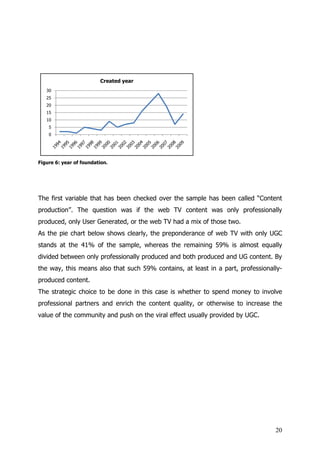
As far as the creation year, the bar chart shows an upward trend with a sharp
increase from 2003 to 2006, when web TV founded reach the peak at twenty
                                                                  twenty-eight.
Then, the trend reverses and drops to just seven in 2008, with a slight recover in
2009, when fourteen web TV have been created so far.


                                                                                     19
Created year
   30
   25
   20
   15
   10
    5
    0


Figure 6: year of foundation.


The first variable that has been checked over the sample has been called “Content
production”. The question was if the web TV content was on professionally
                                                        only
produced, only User Generated, or the web TV had a mix of those two.
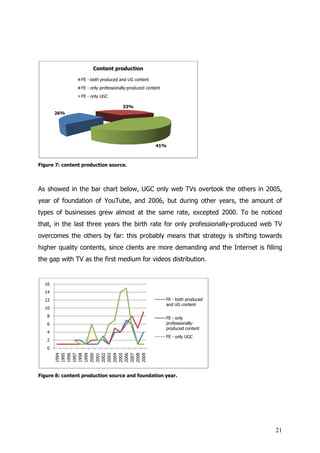
As the pie chart below shows clearly, the preponderance of web TV with only UGC
stands at the 41% of the sample, whereas the remaining 59% is almost equally
divided between only professionally produced and both produced and UG content. By
the way, this means also that such 59% contains, at least in a part, professionally
                                                                     professionally-
produced content.
The strategic choice to be done in this case is whether to spend money to involve
professional partners and enrich the content quality, or otherwise to increase the
value of the community and push on the viral effect usually provided by UGC.


                                                                                 20
Content production

                 FE - both produced and UG content
                 FE - only professionally
                           professionally-produced content
                 FE - only UGC

                                      33%
       26%


                                                       41%


Figure 7: content production source.
        :


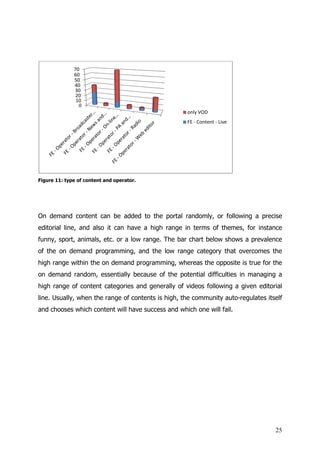
As showed in the bar chart below, UGC only web TVs overtook the others in 2005,
year of foundation of YouTube, and 2006, but during other years, the amount of
types of businesses grew almost at the same rate, excepted 2000. To be noticed
that, in the last three years the birth rate for only professionally produced web TV
                                                      professionally-produced
overcomes the others by far: this probably means that strategy is shifting towards
higher quality contents, since clients are more demanding and the Internet is filling
the gap with TV as the first medium for videos distribution.


  16
  14
  12                                                         FE - both produced
                                                             and UG content
  10
   8                                                         FE - only
   6                                                         professionally-
                                                             produced content
   4
                                                             FE - only UGC
   2
   0
       1994
       1995
       1996
       1997
       1998
       1999
       2000
       2001
       2002
       2003
       2004
       2005
       2006
       2007
       2008
       2009


Figure 8: content production source and foundation year.
                   roduction


                                                                                  21
As far as the type of operator that is involved directly into the business, the research
identifies basically four core groups:
•   The pure players, companies that operates as Internet Service Provider or born
    with the Internet as core business (Web Editor), or companies that have as core
    activity the running of a web TV (Online Video Company).
•   Broadcaster and local TV, companies that have as core business the production
    and/or distribution through broadcasting, satellite or cable TV, of video contents.
•   Other media, companies already operating into the media industry, specifically in
    the publishing industry (News and magazines) or Radio
•   Public administration (PA) and other companies, which operates a web TV as a
    public service or as an instrument for internal communication (corporate web TV).
The time series below shows the peak in the birth of web TV managed by pure
players and broadcasters in 2006, that also fluctuate with a similar trend.
Despite the few companies coming from other sectors within the sample influences
the analysis, is worth to mention the slight increase of birth rate between 2008 and
2009 for the other groups of companies, especially News and Magazines: this means
that the barriers to entry for new players are being knocked down, because of the
drop of the costs of infrastructure and the spread of the advertisement among more
actors in order to reach untapped market niches of clients.


                                                                                      22
16
                                                            FE - Operator -
  14                                                        Broadcaster and Local TV
  12                                                        FE - Operator - News and
                                                            magazines
  10
                                                            FE - Operator - On-line
   8
                                                            video company
   6                                                        FE - Operator - PA and
   4                                                        other companies

   2                                                        FE - Operator - Radio

   0
                                                            FE - Operator - Web
       1994
       1995
       1996
       1997
       1998
       1999
       2000
       2001
       2002
       2003
       2004
       2005
       2006
       2007
       2008
       2009
                                                            editor


Figure 9: operator core business industry and foundation year.


At this point, crossing the two features, Content production and Operator, through a
bar chart with the amount of operator on percentage base, we see that about the
65% of content is UG only for pure players, whereas the prefer the professionally-
produced content at about the same level, that is 65-75%. In particular,
broadcasters and radios choose to include in their programming very few UGC, at the
most they include a mix of professionally-produced and UG content.
This result is could be due either to specific strategies or to the availability, as
regards to broadcasters, of content from the traditional television. If the first is true,
the most likely reason is the preservation of the brand image, which UGC could
damage, if not supported by an active community of competent uploaders.


                                                                                       23
100%
            90%
            80%
            70%
            60%
            50%
            40%
             30%
             20%                              FE - only UGC
             10%
              0%
                                              FE - only professionally-
                                              produced content
                                              FE - both produced and UG
                                              content


Figure 10: content production and operator.
         :


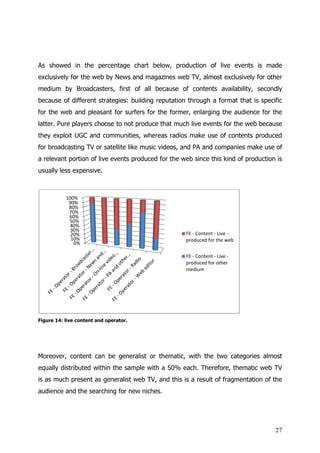
As far as the flow of the content, it can be divided into Live and On Demand.
Technical requirements, costs of infrastructure and, last but not least, availability of
enough programming to fill a programme schedule of live contents, are the reasons
for the preference for a VOD only web TV. Video on Demand is less expensive to be
produced and distributed, allows the user to watch the video whenever he likes, and
   duced
UGC can be added to programming.
Live content is present in broadcasters’ web TV, because, of course, of availability of
contents from traditional television, in a small portion in pure players’ web TV, and at
a little higher level in radio’s and PA and other companies, the former essentially to
attract audience, the latter to provide a better service to the citizen or the employee
                                                                               employee.


                                                                                      24
70
              60
              50
              40
              30
               20
               10
                0
                                                    only VOD
                                                    FE - Content - Live


Figure 11: type of content and operator.
         :


On demand content can be added to the portal randomly, or following a precise
editorial line, and also it can have a high range in terms of themes, for instance
funny, sport, animals, etc. or a low range. The bar chart below shows a prevalence
                                                          below
of the on demand programming, and the low range category that overcomes the
high range within the on demand programming, whereas the opposite is true for the
on demand random, essentially because of the potential difficulties in man
                                                                       managing a
high range of content categories and generally of videos following a given editorial
line. Usually, when the range of contents is high, the community auto
                                                                 auto-regulates itself
and chooses which content will have success and which one will fail.


                                                                                   25
90
     80
     70
     60
     50
     40                                      FE - Content - On
      30                                     Demand - low range
      20
      10                                     FE - Content - On
       0                                     Demand - high range

            FE - Content -
             On Demand FE - Content -
            programming On Demand
                           random


Figure 12: on demand content.


As regards to the live content, it can be produced for the web or for other medium,
and can be characterized by continuous3 or discrete flow from the broadcaster to the
user. Live events that are webcasted on web TV are usually produced for other
                           webcasted
medium, as showed in the bar chart below. Then, the slight prevalence of continuous
flow over discrete flow is the consequence of the diffusion of P2P streaming, which
allows watching live events, especially sport events, on the desktop.
                                        sport


      40
      30
      20
      10
                                              FE - Content - Live -
        0
                                              Discrete flow
            FE - Content -                    FE - Content - Live -
                         FE - Content -
                 Live -                       Continuous flow
                              Live -
            produced for
                         produced for
                 other
                            the web
               medium


Figure 13: live content.


3
  Traditional TV has continuous flow because gaps between two programmes are filled out by
commercials. Therefore a web TV with live contents and continuous flow is the perfect transposition of
traditional TV on the desktop.


                                                                                                   26
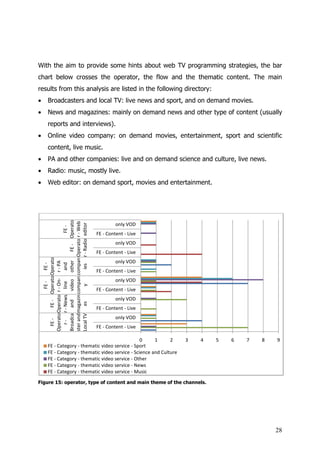
As showed in the percentage chart below, production of live events is made
exclusively for the web by News and magazines web TV, almost exclusively for other
medium by Broadcasters, first of all because of contents availability, secondly
because of different strategies: building reputation through a format that is specific
for the web and pleasant for surfers for the former, enlarging the audience for the
latter. Pure players choose to not produce that much live events for the web because
               ayers
they exploit UGC and communities, whereas radios make use of contents produced
for broadcasting TV or satellite like music videos, and PA and companies make use of
a relevant portion of live events produced for the web since this kind of production is
usually less expensive.


           100%
            90%
            80%
            70%
            60%
            50%
            40%
             30%
             20%                                    FE - Content - Live -
             10%                                    produced for the web
              0%

                                                    FE - Content - Live -
                                                    produced for other
                                                    medium


Figure 14: live content and operator.
         :


Moreover, content can be generalist or thematic, with the two categories almost
                                       thematic,
equally distributed within the sample with a 50% each. Therefore, thematic web TV
is as much present as generalist web TV, and this is a result of fragmentation of the
                                       ,
audience and the searching for new niches.


                                                                                    27
With the aim to provide some hints about web TV programming strategies, the bar
chart below crosses the operator, the flow and the thematic content. The main
results from this analysis are listed in the following directory:
•       Broadcasters and local TV: live news and sport, and on demand movies.
•       News and magazines: mainly on demand news and other type of content (usually
        reports and interviews).
•       Online video company: on demand movies, entertainment, sport and scientific
        content, live music.
•       PA and other companies: live and on demand science and culture, live news.
•       Radio: music, mostly live.
•       Web editor: on demand sport, movies and entertainment.
                                     FE - Operato
    ster and magazin compan compan Operato r - Web


                                                              only VOD
                              ies r - Radio editor
                                              FE -


                                                     FE - Content - Live
                                                              only VOD
                                                     FE - Content - Live
              FE - Operato Operato


                                                              only VOD
                      video other
    Operato Operato r - On- r - PA
                              and
                              FE -


                                                     FE - Content - Live
                                                              only VOD
                       FE -


       r - r - News line


                        y


                                                     FE - Content - Live
                                                              only VOD
    Broadca and

    Local TV es


                                                     FE - Content - Live
                                                              only VOD
      FE -


                                                     FE - Content - Live

                                                    0     1      2         3   4   5   6   7   8   9
        FE - Category - thematic video service - Sport
        FE - Category - thematic video service - Science and Culture
        FE - Category - thematic video service - Other
        FE - Category - thematic video service - News
        FE - Category - thematic video service - Music
Figure 15: operator, type of content and main theme of the channels.


                                                                                                   28
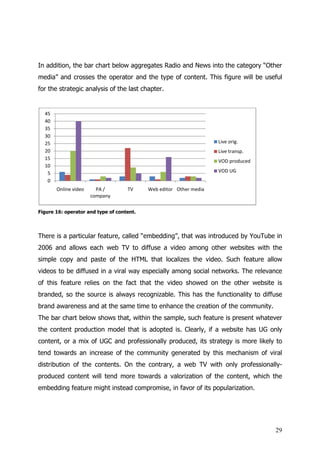
In addition, the bar chart below aggregates Radio and News into the category “Other
media” and crosses the operator and the type of content. This figure will be useful
for the strategic analysis of the last chapter.


  45
  40
  35
  30
  25                                                                Live orig.
  20                                                                Live transp.
  15
                                                                    VOD produced
  10
   5                                                                VOD UG
   0
       Online video     PA /        TV     Web editor Other media
                      company

Figure 16: operator and type of content.


There is a particular feature, called “embedding”, that was introduced by YouTube in
2006 and allows each web TV to diffuse a video among other websites with the
simple copy and paste of the HTML that localizes the video. Such feature allow
videos to be diffused in a viral way especially among social networks. The relevance
of this feature relies on the fact that the video showed on the other website is
branded, so the source is always recognizable. This has the functionality to diffuse
brand awareness and at the same time to enhance the creation of the community.
The bar chart below shows that, within the sample, such feature is present whatever
the content production model that is adopted is. Clearly, if a website has UG only
content, or a mix of UGC and professionally produced, its strategy is more likely to
tend towards an increase of the community generated by this mechanism of viral
distribution of the contents. On the contrary, a web TV with only professionally-
produced content will tend more towards a valorization of the content, which the
embedding feature might instead compromise, in favor of its popularization.


                                                                                   29
90
    80
    70
    60                                         FE - only UGC
    50
     40                                        FE - only professionally-
     30                                        produced content
     20
     10                                        FE - both produced and UG
      0                                        content

          FE – embedding
                           no embedding


Figure 17: content production and embedding feature.


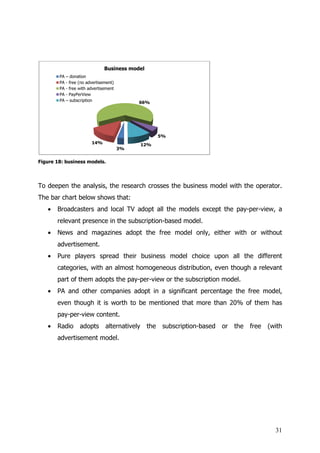
Concerning business models, and therefore the way web TV generates revenues, as
showed in the pie chart below, the 2/3 of the web TV in the sample are included in
the model free with advertisement, then the 17% adopt the payment model
(subscription and pay-per-view), and the same percentage adopt the free model
                         -view),
(composed of free with no advertisement and web TV that accept donation)
                          advertisement                        donation).
To be noticed that more than one model can be adopted at the same time: for
instance, many video-sharing websites has a premium section for which a
                     sharing
subscription and usually a monthly fee has to be paid. Even, many s
                                                                  streaming
channels have both free and pay
                            pay-per-view content.


                                                                               30
Business model
        PA – donation
        PA - free (no advertisement)
        PA - free with advertisement
        PA - PayPerView
        PA – subscription                   66%


                                                      5%
                        14%                    12%
                                       3%


Figure 18: business models.


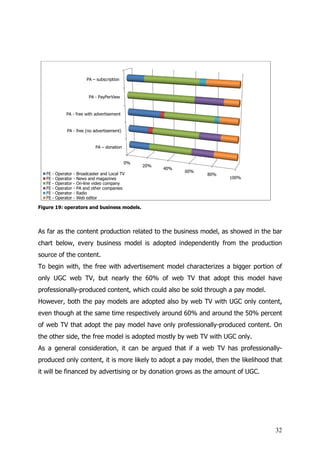
To deepen the analysis, the research crosses the business model with the operator.
The bar chart below shows that:
   •   Broadcasters and local TV adopt all the models except the pay
                                                                 pay-per-view, a
       relevant presence in the subscription
                                subscription-based model.
   •   News and magazines adopt the free model only, either with or without
       advertisement.
   •   Pure players spread their business model choice upon all the differen
                                                                    different
       categories, with an almost homogeneous distribution, even though a relevant
                 ,
       part of them adopts the pay
                               pay-per-view or the subscription model.
   •   PA and other companies adopt in a significant percentage the free model,
       even though it is worth to be mentioned that more than 20% of them has
                                               that
       pay-per-view content.
               view
   •   Radio      adopts       alternatively    the    subscription-based
                                                       subscription based   or   the   free   (with
       advertisement model.


                                                                                                31
PA – subscription


                               PA - PayPerView


               PA - free with advertisement


               PA - free (no advertisement)


                                  PA – donation


                                                  0%
                                                       20%
                                                             40%
                                                                   60%
   FE -   Operator   -   Broadcaster and Local TV                        80%
   FE -   Operator   -   News and magazines                                    100%
   FE -   Operator   -   On-line video company
                            line
   FE -   Operator   -   PA and other companies
   FE -   Operator   -   Radio
   FE -   Operator   -   Web editor

Figure 19: operators and business models.
         :


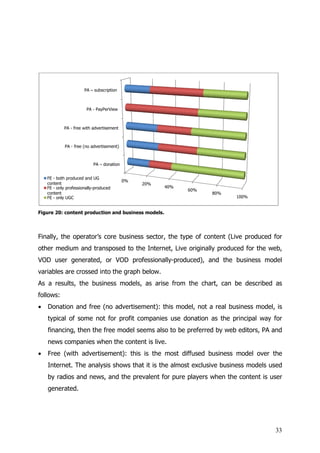
As far as the content production related to the business model, as showed in the bar
chart below, every business model is adopted independently from the production
           ,
source of the content.
To begin with, the free with advertisement model characterizes a bigger portion of
only UGC web TV, but nearly the 60% of web TV that adopt this model have
professionally-produced content, which could also be sold through a pay model.
However, both the pay models are adopted also by web TV with UGC only content,
even though at the same time respectively around 60% and around the 50% percent
of web TV that adopt the pay model have only professionally-produced content. On
                                                            produced
the other side, the free model is adopted mostly by web TV with UGC only.
As a general consideration, it can be argued that if a web TV has professionally
                                                                  professionally-
produced only content, it is more likely to adopt a pay model, then the likelihood that
it will be financed by advertising or by donation grows as the amount of UGC.


                                                                                      32
PA – subscription


                        PA - PayPerView


            PA - free with advertisement


             PA - free (no advertisement)


                            PA – donation


    FE - both produced and UG
                                            0%
    content                                      20%
    FE - only professionally-produced                  40%
                                                             60%
    content                                                        80%
    FE - only UGC                                                        100%


Figure 20: content production and business models.


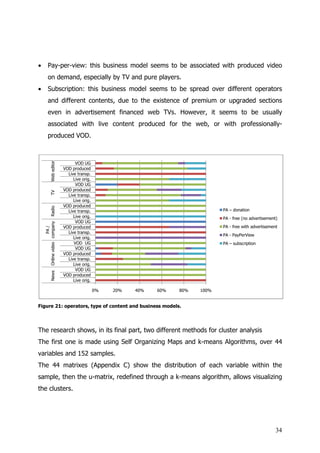
Finally, the operator’s core business sector, the type of content (Live produced for
other medium and transposed to the Internet, Live originally produced for the web
                                                          ly                  web,
VOD user generated, or VOD professionally
                           professionally-produced), and the business model
variables are crossed into the graph below.
As a results, the business models, as arise from the chart, can be described as
            ,
follows:
•   Donation and free (no advertisement) this model, not a real business model, is
                          advertisement):          ,
    typical of some not for profit companies use donation as the principal way for
    financing, then the free model seems also to be preferred by web editors, PA and
    news companies when the content is live.
•   Free (with advertisement): this is the most diffused business mod over the
               advertisement):                                    model
    Internet. The analysis shows that it is the almost exclusive business models used
    by radios and news, and the prevalent for pure players when the content is user
    generated.


                                                                                  33
•       Pay-per-view: this business model seems to be associated with produced video
        on demand, especially by TV and pure players.
•       Subscription: this business model seems to be spread over different operators
        and different contents, due to the existence of premium or upgraded sections
        even in advertisement financed web TVs. However, it seems to be usually
        associated with live content produced for the web, or with professionally-
        produced VOD.
               Web editor


                                  VOD UG
                            VOD produced
                              Live transp.
                                 Live orig.
                                  VOD UG
                            VOD produced
               TV


                              Live transp.
                                 Live orig.
                            VOD produced
               Radio


                              Live transp.                                        PA – donation
                                 Live orig.                                       PA - free (no advertisement)
                                  VOD UG
    Online video company


                            VOD produced                                          PA - free with advertisement
                   PA /


                              Live transp.
                                                                                  PA - PayPerView
                                 Live orig.
                                 VOD UG                                           PA – subscription
                                  VOD UG
                            VOD produced
                              Live transp.
                                 Live orig.
                                  VOD UG
               News


                            VOD produced
                                 Live orig.

                                              0%   20%   40%   60%   80%   100%


Figure 21: operators, type of content and business models.


The research shows, in its final part, two different methods for cluster analysis
The first one is made using Self Organizing Maps and k-means Algorithms, over 44
variables and 152 samples.
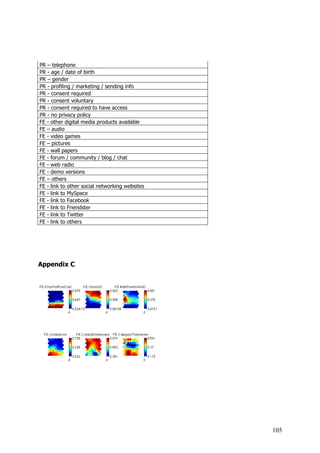
The 44 matrixes (Appendix C) show the distribution of each variable within the
sample, then the u-matrix, redefined through a k-means algorithm, allows visualizing
the clusters.


                                                                                                             34
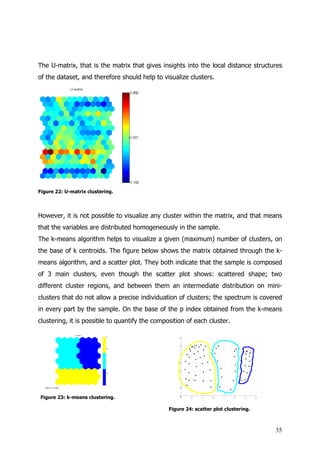
The U-matrix, that is the matrix that gives insights into the local distance structures
of the dataset, and therefore should help to visualize clusters.


Figure 22: U-matrix clustering.


However, it is not possible to visualize any cluster within the matrix, and that means
that the variables are distributed homogeneously in the sample.
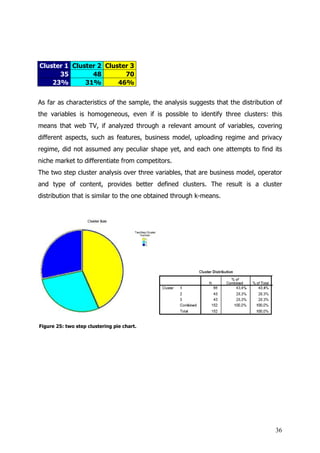
The k-means algorithm helps to visualize a given (maximum) number of clusters, on
the base of k centroids. The figure below shows the matrix obtained through the k-
means algorithm, and a scatter plot. They both indicate that the sample is composed
of 3 main clusters, even though the scatter plot shows: scattered shape; two
different cluster regions, and between them an intermediate distribution on mini-
clusters that do not allow a precise individuation of clusters; the spectrum is covered
in every part by the sample. On the base of the p index obtained from the k-means
clustering, it is possible to quantify the composition of each cluster.


Figure 23: k-means clustering.

                                                Figure 24: scatter plot clustering.


                                                                                      35
Cluster 1 Cluster 2 Cluster 3
      35        48        70
    23%       31%       46%


As far as characteristics of the sample, the analysis suggests that the distribution of
the variables is homogeneous, even if is possible to identify three clusters: this
means that web TV, if analyzed through a relevant amount of variables, covering
different aspects, such as features, business model, uploading regime and privacy
regime, did not assumed any peculiar shape yet, and each one attempts to find its
niche market to differentiate from competitors.
The two step cluster analysis over three variables, that are business model, operator
and type of content, provides better defined clusters. The result is a cluster
distribution that is similar to the one obtained through k-means.


Figure 25: two step clustering pie chart.


                                                                                    36
The bar charts below show the distribution of the single variables within each cluster.


Figure 26: content distribution within the clusters.


Figure 27: operators distribution within the clusters.


Figure 28: business models distribution within the clusters.


                                                                                    37
Furthermore, the Bonferroni adjustment4 with the classification by variable says that
the variable “Content” is more significant (is a larger value) in the cluster 2, the
variable “Operator” is more significant in the clusters 1 and 3, and the variable
“Business model” is more significant in the cluster 2 but also in the cluster 3.
Analyzing this data it is possible to describe the characteristics of each cluster:
    •   Cluster 1: is composed by web TVs operated by an online video companies,
        whose content is almost exclusively VOD, more user generated than
        professionally-produced,         that     adopt     the    business      model      free    with
        advertisement, or in some cases they require subscription and they also have
        pay-per-view content.
    •   Cluster 2: is composed mainly by web TVs operated by broadcasting
        companies and radios, with a relevant presence of companies from other
        industries and PA, whose content is live produced for other medium and
        sometimes professionally-produced VOD, that adopt the free model, mainly
        with advertising but can be financed by donations, even though they
        sometimes offer pay-per-view content.
    •   Cluster 3: is composed mainly by web TVs operated by web editors and
        companies of the publishing industry, whose content is mainly VOD
        professionally-produced but also user generated, and often offer live content
        produced for the web, that adopt the free model advertisement-financed but
        often require subscription for at least some part of their content.


4
  In statistics, the Bonferroni correction is a method used to address the problem of multiple
comparisons. It is based on the idea that if an experimenter is testing n dependent or independent
hypotheses on a set of data, then one way of maintaining the family-wise error rate is to test each
individual hypothesis at a statistical significance level of 1/n times what it would be if only one
hypothesis were tested. So if you want the significance level for the whole family of tests to be (at
most) α, then the Bonferroni correction would be to test each of the individual tests at a significance
level of (α/n). Statistically significant simply means that a given result is unlikely to have occurred by
chance assuming your hypothesis is correct.


                                                                                                       38
2.3         Findings


All in all, the analysis shows that there are basically two primary variables that
determine the business strategy of a web TV:
    •    Business model chosen
    •    Type of content of the web TV
Those two variables are inter-dependent, and the choice is also related to the core
business of the operator.
Then, some secondary variables allow the web TV to differentiate from competitors:
   •    The range of VOD channels
   •    The amount of live content
   •    The role of the community
   •    The type of advertising
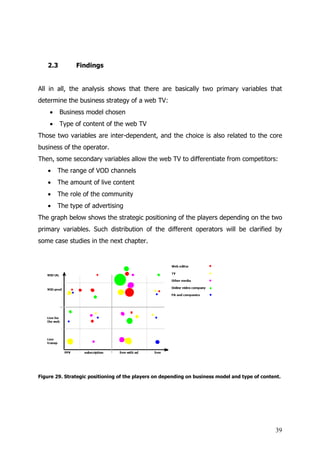
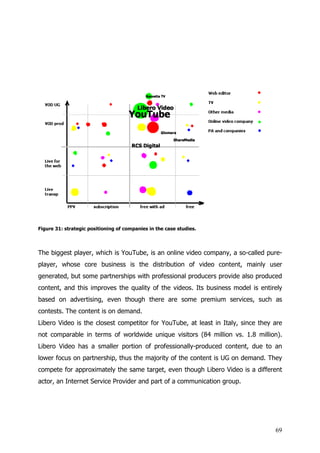
The graph below shows the strategic positioning of the players depending on the two
primary variables. Such distribution of the different operators will be clarified by
some case studies in the next chapter.


Figure 29. Strategic positioning of the players on depending on business model and type of content.


                                                                                                39
3. Case studies


In order to give an empirical approach to the research, some case studies have been
chosen to provide concrete instances about the analysis. Each of them has specific
peculiarities that will be analyzed and clarified more in depth.
Such cases have been discussed following face to face semi-structured interviews to
managers of that companies in the period September and October 2009.
The case studies have been organized into four main sections: general information
about the company (identity card, brief history, definition of the business line,
primary competitors), business strategy (business framework, key points of the
offering, positioning, critical factors of success), business model, and future
scenarios.


    3.1         Glomera


Website address                              www.glomera.com
Languages                                    Italian, English, French, Spanish, Slovenian
Commercial name                              Glomera
Created year                                 2007
Registrant name                              Dynamic Fun S.r.l.
Registrant country                           Italy
Description                                  Glomera   empowers     companies     and    content
                                             owners — from independent producers to major
                                             broadcast networks — to virally distribute their
                                             content. It aims to help them in the creation of
                                             dynamic, connected online communities, whilst
                                             retaining ownership and branding control.
Unique visitors (users)                      8,500
Average time on site                         7:30


                                                                                              40
General information about the company
Glomera.tv, managed by the company Dynamic Fun S.r.l, was founded in 2007 and
operates on packaging and distribution of contents, mainly at a b2b level.
The initial project has been split into 2 parts: media platform to create the channel,
to give a structure to the programming, and to manage it autonomously;
transmission platform to distribute using P2P or unicast protocols according to the
kind of partner.
Then, the company entered to the b2b market with the brand Glomera. The first on-
line programme on streaming was TV SMAU, 44th edition of the Information and
Communications Technology international fair, with the possibility to enjoy the use of
additional contents, such as interviews to exhibitors, recorded conferences and
technical deepening.
Dynamic Fun is a company whose mission is to create and develop any kind of
wireless communication project, particularly in Entertainment and Business sectors.
Glomera is a platform that allows to create and manage, in a totally autonomous
way, personalized web TV, and offering to companies (corporate), content provider,
and video producers (video blogger), a new way to carry the contents and attract
users’ interest. It is also a marketing instrument and a system for companies to
interact with their clients. It allows also integrating the dedicated channels and the
interactive boxes into other websites.
Mogulus and Joost, and ShareMedia in Italy, offer similar services: the first webcasts
live events through unicast protocol, whereas the second webcasts both through P2P
and unicast, supporting high investments in terms of infrastructure through venture
capital resources.


Business strategy
The consumption of online video contents on the web is growing sharply. The
highest part of portals that carry video contents does not offer linearity in terms of
use of the service.


                                                                                   41
P2P protocol seems to have at least two advantages: the content provider keeps the
content since the client does not download the videos, and an unlimited opportunity
to exploit economies of scale with lower investments in terms of capacity.
Glomera’s management believe that without the use of the P2P protocol, no one
model of web TV could resist to the growth of its audience. P2P is more complicated
technologically, but more efficient economically, even though it is currently
disfavored because of lower resolution compared to the unicast, given low uploading
speed of actual connections, and the required installation of software or plug-ins.
As regard to premium contents, they don’t see them as appropriate for web TV for
two reasons: P2P can’t ensure a level of the service that is adequate to expectations
of the clients who pay for the showing; premium videos are created to be shown on
HD screens, not on a pc screen.
Glomera produces and manages web TV, and provides all tools that are necessary to
manage the programming in autonomous way in a wide range of languages. Its
target is composed either by whoever has a limited amount of videos or by whoever
desires a dedicated channel to broadcast 24/7. Furthermore, interactive functions
such as chat, comment boxes and votes to contents, contextually to the webcasted
videos, facilitate the creation of virtual communities and other forms of interaction
that are typical of Web 2.0
The innovative technology is the P2P streaming, that allows the rapid distribution of
high quality contents to an unlimited number of users, with the possibility to develop
new business and communication models, thanks to the considerable reduction of
bandwidth costs. Videos are legal, safe and protected for the content provider
because they cannot be downloaded and cannot be copied.
Private firms, professional video producers and beginners can easily upload their
videos and manage a personalized streaming channel, and also integrate it on their
website. Nevertheless, Glomera allows to webcast live events and interviews.
Moreover, the possibility to integrate the personalized channel into other websites
and portals, allows partners to increase users and be on the web virally.


                                                                                      42
Key points of the offer are as follows:
• Creation of a personalized channel: a logo, photos and external links can be added
  to the channel, which can be embedded on client’s own website, and videos are
  protected because can’t be downloaded.
• Contents can be managed directly through simple tools, and a personalized
  programming can be created.
• Personalized interactive functions, such as descriptions, documents downloading,
  images and external links.
• Social interaction tools, such as chat and comments threads.
• Reports about the audience, with the possibility to change the programming on
  the base of it.
• Viral functionalities: Glomera gives the possibility to create a network of members
  who can diffuse contents on their own portals in a viral way, like video sharing
  and embedding, and alerts sending to know when a programme is webcasted.
• Revenues from advertising videos, which can be added to the programming, and
  from banners and links to sponsors.
In order to enhance the success of its clients, Glomera provides supporting services
to the production and running of web channels, such as consulting service for the
creation and the start-up of the web TV, technical support to the running of the
channel and the programming, organization and conduct of the videos and the
channel, production and post-production of videos related to events, interviews,
conferences and reportage.
To be noticed that Glomera offers solutions both for internal and external web TV:
the former is used by companies for e-learning and know-how sharing of its
employees mainly through the unicast, whereas the latter is used to reach potential
clients through P2P streaming with a highly branded medium at a low cost.
The market positioning of Glomera starts from the objective to create a project
founded on a highly sustainable business, since it is not financed by any venture
capital fund as some competitors like Mogulus, Joost and Babelgum, and therefore it


                                                                                  43
has the objective of differentiating as much as possible from competitors and create
peculiar marks of distinctiveness.
Critical factors of success are:
•   lowering of bandwidth costs;
•   no limitations to users simultaneously connected;
•   integration and personalization of the channel on the company’s website and
    possibility to embed it into other portals;
•   highly targeted communication campaigns and e-commerce offerings together
    with videos;
•   statistics about audience and click rating;
•   simple tools for the running and the organization of contents of programming;
•   differentiation and valorization of various levels of interactions: among users and
    between users and company.


Business model
Glomera offers services to companies for a fee. It is a fixed and all inclusive amount
that is between 3,000€ and 5,000€ a month. However it can be lowered by the
insertion of advertising on the portal Glomera.tv, which contains the videos of the
different users of the service. A portion of the revenues from advertising goes to the
channel from which videos come, proportionally to the audience of such channel,
with the logic to incentivize the production.
The company ensures the webcasting of the channel through P2P streaming, and
with an unlimited base of users.


Future scenarios
Advertising is growing steadily and rapidly, and it will converge on videos more than
on banners. This kind of market is still partially undeveloped, and this is neither
responsibility of the agencies, which could reintroduce at a lower cost on web TV the
same campaigns that runs on other media, nor of the companies that don’t have


                                                                                    44
clear media plans. It is responsibility of media centers, which manage investments
and media planning in a portion that is so high that doesn’t allow to other actors to
enter into the market with profit, but only with marginal revenues. The only actor
that is currently able to manage video advertising at a world level is Google, which is
a kind of media center for the web, as already did with textual advertising with
Google Ads.
As far as the company, the prevalent plan is to stay into the internet business, for
the confidence into its still untapped potential. They plan to focus on:
•   optimal management of the contents;
•   easy interface;
•   no additional software needed (Glomera works with a plug-in);
•   light and little intrusive platform.
Glomera.tv, the portal dedicated to vehicle the partners’ televisions, enhances users
to enter to a bouquet of thematic channels, while partners can spread their
programming and reach new potential users. Within Glomera.tv, advertisement will
enlarge revenue streams, because thematic channels will become highly branded and
therefore will attract high investments.


    3.2         ShareMedia


Website address                             www.sharemedia.it
Languages                                   Italian
Commercial name                             ShareMedia
Created year                                2006
Registrant name                             Unicity S.p.a.
Registrant country                          Italy
Description                                 Corporate TV, interactive VOD service and
                                            audiovisuals production.
Unique visitors (users)                     7,500
Average time on site                        5:30


                                                                                    45
General information about the company
Unicity S.p.a. arose from the entrepreneurship of a group of communication and
software development professionals, with the contribution of Eworks, an Italian
venture capital. It is one of the most important Italian web agencies, and it provides
integrated services and solutions for the web. Starting from 2005, they implemented
a web TV platform, ShareMedia, realized together with Unidata S.p.a.
Unicity operates in the Information & Communication Technology industry, and
offers a wide range of services, such as creation of portals and websites, e-learning
and media integration solutions. The web TV platform, ShareMedia, allows to create
and run television formats on the web and to create corporate TV for private firms,
for e-learning companies, and for the Public Administration.
ShareMedia proposes a concept that can be assimilated to Glomera in Italy. Another
competitor is Narrowstep, a British company. Different realities exist in the Italian
market, like TXY Polymedia, that comes from the broadcasting industry. It can be
assumed that ShareMedia has features that are peculiar of a system of Video
Content Management.


Business strategy
ShareMedia came into existence within a market with high potential of growth. The
idea has been positively welcomed by big companies and institutions, less by small
and medium companies, because of the difficulties to understand the communicative
potential of integrating a web TV into the company’s website.
In addition, ShareMedia found difficult to get in touch with film producers, which the
management considered as an attractive partner because of the difficulties for small
producers to distribute to theaters. By contrast, such sector saw web TV more as a
menace than as an alternative.
ShareMedia provides the technological resource for whoever wants to create a web
TV. It enhances the creation of thematic channels and audiovisual formats, with high


                                                                                   46
personalization features. The objective is not only to serve as support for such
initiatives, but also to project them directly: they are also evaluating the creation of a
web TV b2b, as a communication strategy for companies.
Corporate TV is a form of communication integrated into the website of companies
and institutions, and has diverse finalities: internal communication, promotion,
support and motivation to sales networks, events and presentations, information
services but also selling of entertainment contents.
ShareMedia is also present on the contents side. Unicity S.p.a. owns Blueray, a
company that is specialized on ideation, project and realization of videos for
communication, training, information and corporate image, which produces mainly
television and radio commercials, institutional videos, shorts and formats.
Despite this kind of strategy doesn’t bring to great advantages, it shows a kind of
dynamicity because the company proposes itself as able to improve the quality of
videos owned by clients.
In this phase ShareMedia strategy is focused on corporate clients, and it gives them
the possibility to create a Corporate TV. The biggest part of clients are institutions
and big companies, whereas among small and medium companies we can find Rai
Radiotelevisione Italiana, Monte dei Paschi di Siena, Arma dei Carabinieri, Ministero
della Salute e dell’Ambiente.
The collaboration with RAI concerns an experimental project of a format produced
for the web, called “L’Universo della Conoscenza”, in which there is convergence
among traditional TV, video on demand, a web portal, pay-per-view contents, and an
archive with thousands of hours of programming. The joint venture Rai-Unicity
realized a cultural thematic channel characterized by three elements, such as
qualitative and quantitative richness of contents, interactivity and the 80% of video
on demand.
However, ShareMedia provides both streaming and downloading services and
products with different characteristics, inside a unique platform with diverse


                                                                                       47
functionalities, as the possibility for the user to choose the way to enjoy the
contents.


Business model
There is not a peculiar business model, since ShareMedia exploits at least three ways
to create value and generate revenues:
•   Premium contents to be downloaded at a price.
•   On-line training., to be used by companies in addition to traditional training.
•   Digital advertising: substitution of traditional banners with interactive commercials
    or other formats that come from traditional broadcasting and are rearranged.
The objective is to embed those sources of revenues into the editorial project related
to corporate communication. However, it has been difficult to monetize in the short
and medium term so far, because clients have mainly institutional, popular or
entertainment character.
Among his clients, only one is implementing a project financed through banner and
interactive commercials. The scarcity of editorial projects is motivated by the
inexistence of clear, defined and sustainable business models.


Future scenarios
ShareMedia management doesn’t believe that web TV can substitute traditional TV
because of the attitude of people and because of different model proposed by web
TV, which is based on the On Demand and is highly “democratic”.
The actual scenario is characterized by a transition phase in which also corporate
strategy looks to the Internet as a great opportunity to distribute the contents.
As regards to ShareMedia helps companies in this transition to the web, that in the
near future will become a key in terms of marketing. ShareMedia plans to attract, in
the long run, also consumers, in addition to corporate clients.


                                                                                      48
In the short and medium term, the attention will focus on b2b, in order to overcome
the actual problems, which are basically cultural and technological, because of lacks
of interaction with the new media, and insufficient infrastructure.
The biggest challenge is to differentiate from competitors: formats and language
should change and adapt to the needs of the new platform, a crucial point for web
TV to be finally successful.


    3.3         Google Video – YouTube


Website address                             www.youtube.com
Languages                                   German,    English,   Spanish,   French,   Italian,
                                            Norwegian, Dutch, Polish, Russian, Swedish,
                                            Portuguese, Czech
Commercial name                             YouTube
Created year                                2005
Registrant name                             YouTube, Inc.
Registrant country                          USA
Description                                 Largest video-sharing website in the world.
Unique visitors (users)                     84,000,000
Average time on site                        12:00


General information about the company
In September 1998 Larry Page and Sergey Brin founded Google with the objective of
creating a service to organize online information on Internet.
Google is today the main search engine in the world, with a database of over 8
billion of URL, and the possibility to find any kind of website, given some keywords,
in a fraction of second.


                                                                                            49
Google has also bunch of additional services, like Google Ads, Google Earth, etc. and
moreover Google Video, born as video-sharing website and become, after the
acquisition of YouTube in 2006, a search engine for videos, for 1.65 million Dollars.
YouTube was founded with financing of Sequoia Capital in 2005 and rapidly became
the most important video-sharing website in the world. After the acquisition from
Google, it has been operating as independent subsidiary of Google Corp.
Such success increased after the closing of some partnerships with important content
providers as CBS, BBC, Universal Music Group, Sony BMG, Warner Music Group, NBA,
Sundance Channel and many others, in order to diversify its offer to consolidate the
leadership and attempt to solve the big problems related to copyright.
Within the huge amount of video-sharing websites that allow uploading user
generated videos, it can be distinguished between horizontal and vertical portals: the
former , such as Yahoo!, Libero and Alice Dailymotion, offer a wide range of services
in addition to the possibility to upload user generated videos; the latter focus on
video-sharing only.
However, the main competitors for YouTube seem to be horizontal portals that
succeeded in creating wide communities through the collateral services, but no
competitors succeeded in attracting so many users just through the video uploading.
One of the main competitors was Google Video, which after the acquisition of
YouTube became a search engine for videos.


Business strategy
YouTube is the market leader vertical and generalist video-sharing portal, and it
allows watching videos, interacting with other users, but most of all to upload
contents: with this kind of platform is possible to create a personal TV channel.
The offer is dominated by User generated Contents, but its growing success is due to
agreements with majors and TV broadcasters, that enlarged the offer with higher
quality and longer videos, through which the portal increased its value and assumed
a meaning that is different from the simple logic of video-sharing. Concerning


                                                                                        50
technical issues, videos uploaded from standard users are limited to 100MB and 10
minutes, whereas an official partner can upload 300MB videos.
Everyone can create a channel to upload videos and realize an online personal
archive, after free registration and choosing of an account, that can be: standard,
director (user can add a logo and some personal elements), musician or comedian
(logo, information about the genre or the style and tour dates, links to buy CDs),
guru (logo, genre and some links).
Inside the official partners category there are companies operating in media, such as
broadcasters and content owners, but also standard accounts that can be awarded
for creativity and success obtained by videos.
The layout of each channel can be customized: there are videos uploaded by the
user, the favorite videos, comments from other users, subscribed channels. Partners’
pages are different also in the watch page, with a small banner on the right of the
player that brings directly to the partner channel, and on the right are showed videos
uploaded by the same account.
Some factors that initiatives from the partners and determined YouTube as an
alternative platform of communication: a wide community, and the video as
communicative form. The more the community is big, the more the message from a
website is effective. This is the main reason for the success of the social networks,
such as Facebook and Flickr, but videos are even more powerful and direct means of
communication. For instance, the band Red Hot Chili Peppers and Warner Bros Music
asked fans to upload in YouTube a video based on a song that they had just released
on Amazon and iTunes, and they received more than 400 videos in 70 days: the
winner’s video has been uploaded on their channel and the person won 5,000 Dollars
and a weekend with the band.
From that moment, YouTube has a page dedicated to contests that is similar to the
partner’s one, with an interactive window on the top-right with a video that explain
the contest, the possibility to upload the video to participate and to watch other


                                                                                   51
participants’ videos. Each organizer of the contest chooses rules and modalities,
whereas YouTube offer the service by fee.
Born as a “box” for UGC, the portal gives to users a determinant role because of the
importance of social networks in the web 2.0. However, YouTube fronted from the
beginning the problem of control of uploaded contents, both related to ethics and to
copyright protection. The company has protection systems of the rights that allow
recognizing a content that is under copyright law: if removed after a claim of a
content owner, the same file can’t be uploaded again. After then has been built a
system that recognize the ID given to any video, on the base of a series of frames,
so neither the publishing of contents realized through the editing of protected frames
can be uploaded.
Critical factors for the success of YouTube are:
•   Ease of use.
•   Quickness of the enjoyment: the video uploaded can be immediately watched.
•   Community: possibility to comment, vote and share the videos.
•   Embedding: first website to give the possibility to embed the video into other
    websites, just through a simple copy/paste of the HTML code, giving viral success
    and visibility to the videos.
Compared to traditional television, YouTube’s role is complementary more than being
a substitute, because traditional broadcasters can upload contents to catch a larger
audience, that otherwise would be impossible to reach, simply creating their partner
channel on YouTube.


Business model
Despite it is the first video portal with an amount of users that is bigger than any
other video-sharing website, YouTube did not generate as much revenue as it could.
However, Google purchased it for 1.65 million Dollars. Audience is enormous, but
economic results have been poor, so it has been necessary to develop a sustainable


                                                                                   52
and profitable business model. First profits from the big investment came in 2008,
after some instruments able to monetize the huge audience were introduced.
There are four advertisement models that constitute the business model of YouTube:
•   Active display advertising: it is the classical advertisement format, present in each
    section of YouTube except the homepage. There is the possibility to choose
    channels of the video platform and the websites on which advertise, with the only
    condition that such websites are part of the Google content network, so that
    target can be segmented and the probability of success of the advertising
    campaign is higher. The contextualization is also a characteristic of Google Ads,
    but in this particular case the advertiser chooses websites on which put the ad,
    and not an algorithm.
•   Sponsor channel: for companies that are not in the media sector, and therefore
    are not in the category of official partners, but have the use of a big video
    archive, YouTube gives the possibility to create, by fee, a channel characterized
    by the same functionalities that a partner channel can have. It is the case of
    companies that might want to sell its products, promote initiatives, advertise with
    much creativity, increase the brand awareness and improve the image. Such
    sponsor channel has not a fixed cost, on the contrary there is a minimum amount
    in order to generate sufficient traffic towards the client’s channel, and guarantee
    the success of the client. The display advertising is showed both on the portal
    and, if requested on the content network of Google, in a way that increase
    synergies between the two portals and the benefits are more evident. The
    initiative lasts three months, then there is a down-grade to standard channel, that
    differently from sponsor and partner channels, can host third parties ads by
    concession of YouTube: benefits from revenues coming from this banner go both
    to Google and to the owner of the channel, according to the revenue-sharing
    model. As regards to the visualization of the page that contains the video, the
    mechanism works only with clients that previously accepted to insert ad on their
    videos.


                                                                                      53
•   PVA (Participatory Video Ads): it is a click-to-play video format that can be found
    on the right-top of the home page and is usually used to promote a sponsor
    channel, or a particular film or product. Besides the video, it is allowed to the
    user to deepen what is proposed through: a small banner on the top of the player
    that can bring to the related YouTube channel or to the related website, or two
    links on the bottom of the player that can bring to the same of the homepage but
    in the related page or to the channel of the uploader.
•   Transparent banner on the video: it is the most interesting and recent model,
    that give the possibility to watch, within the 20% bottom of the video, a
    transparent banner that is contextual to the topic of the video and appears 15
    seconds after the starting of it. It can be: clicked, so the video stops and another
    player opens up inside the principal player, then the video starts again; closed
    immediately by the user; neither clicked nor closed, so it disappears after a few
    time and then appears again at the end of the video. Advertising can be included
    only on official partners websites, included the standard accounts that have been
    upgraded for creativity and success. Revenues from the ads are shared and such
    revenue-sharing applied also to basic users pushes towards higher quality
    productions. Equally to the sponsor channel, the percentage retained by Google is
    not fixed but depends on the strategic value of the partner.
The last thing to be considered about YouTube business model is the complete
absence of advertisement on videos, because formats such as the pre roll damage
the user experience. Moreover, UGC have been considered as not suitable to be
source of revenue because of a matter of ethics and also because of protection of
the copyright, retained by the users.
The most part of companies contact YouTube and Google directly without passing
through media centers, so Google has created an internal structure dedicated to
customer base and created built-in specialized competences for the planning and the
creation of the ads.


                                                                                     54
Future scenarios
The attitude is towards the improvements to the YouTube service, enhancing
innovation and research. A recent improvement has been the possibility to have a
bigger player in HD to watch the videos.
The current objective tends particularly towards the increase of revenues and the
strengthening of the community. As far as the ad formats, particularly the PVA and
the transparent banners will be implemented. It is unlikely that pay-per-view
contents will be offered, because this would distort YouTube philosophy, on the
contrary the revenue-sharing model will be extended because the catchment area is
large enough to support creativity and share revenues with the users.


    3.4         RCS Digital


Website address                            video.corriere.it
Languages                                  Italian
Commercial name                            Corriere della Sera TV
                                           Gazzetta TV
Created year                               2005
Registrant name                            RCS Quotidiani S.p.a.
Registrant country                         Italy
Description                                Video on demand service of the newspapers
                                           Corriere della Sera and Gazzetta dello Sport
Unique visitors (users)                    1,100,000 + 390,000
Average time on site                       3:30 + 3:10


General information about the company
RCS MediaGroup is a publishing group operating in sectors of newspapers,
magazines and books, in the divisions of radio, new media and digital TV, as well as
being among the most important actors of advertising collection and distribution.
RCS Quotidiani is the publisher of the daily headings of the Group, in Italy and


                                                                                          55
abroad. The company is the market leader for Italy, where detains a market share of
21%. In 2008 revenues from newspapers have been around 1.3 billion Euros.
RCS Digital is a company, controlled at 100% by RCS Quotidiani, which runs the
websites Corriere.it and Gazzetta.it and the development of brands and editorial
assets of RCS over digital media. The Mediacenter inside the two websites was
launched in 2005 and has been conceived to be the video box of the two principal
websites of the group. The ratio for the set-up of the websites derives from the
analysis of some best practices online, such as New York Times and Washington
Post. The two multimedia sections have been revised more than one time so far, due
to the increase of contents amount and related layout modifications.
Contemporary to the born of the Mediacenter, the company created a new
organizational structure, the multimedia offering, composed of multimedia marketing
and video production. There are two editorial units, one for Corriere.it and the other
for Gazzetta.it, composed of journalists focalized on the online. The value of auto-
production is guaranteed by the inner production staff, characterized by high
flexibility and readiness.
RCS Digital S.p.a. is dedicated to the management and the development of editorial
activities of RCS over digital media: Corriere.it, online magazines and thematic
channels, Gazzetta.it, classified offering, mobile and gaming.
Corriere.it, more than including a complete overview over the main facts in Italy and
in the world, has an offering that is characterized by thematic channels, such as
ViviMilano, Salute, Viaggi and Casa.
Gazzetta.it, the main website for sport news in Italy and Europe, has among recent
innovations, GazzaSpace, the website section that gives voice to readers, where is
possible to comment the articles, participate to the forum and express opinions about
sport news.
Both Corriere.it and Gazzetta.it put at their surfers disposal a rich TV/Video offering,
with image galleries, video contents and deepens ad hoc for the web, besides real
online news and many thematic columns by famous Italian journalists.


                                                                                     56
RCS Digital operates in the classified ads with successful initiatives in jobs
(TrovoLavoro.it), real estate (TrovoCasa.it) and automotive (Automobili.com) sectors.
Thanks to RCS DB Games, RCS MediaGroup is also present in the online gaming with
Fueps.com, games and online entertainment portal.
The leadership positions in the online property makes RCS Digital attractive for
advertisers, because of many different and highly targeted communication forms.
In less than three years of activity in the mobile sector, RCS Digital affirmed itself as
leader in the infonews segment, thanks to an offering of over 50 information services
(SMS, MMS, and mobile Site) and to a rich portfolio of updated multimedia contents.
RCS Mobile is the portal that collects and makes available for all the operators mobile
services from five different important brands: Corriere della Sera, La Gazzetta dello
Sport, Max, Novella 2000 and Astra.
The present case study will take into consideration only the two portals Corriere.it
and Gazzetta.it, which are information products, with a video section and many
entertainment features.
The main competitor in Italy for Corriere.it is Repubblica.it. Both offer services with
photos, audio and videos, within the logic of interactivity with the user. Another
competitor inside the information field is TGCOM. A significant distance in terms of
unique visitors separates Corriere.it from the other headlines. However, despite the
difference in terms of contents and objective with the traditional portals, those are
certainly competitors in terms of advertisement collection.
In those terms, RCS competitors are also portals that offer only videos as an
entertainment and not information, such as YouTube or the Italians Libero Video and
Alice Video. Nevertheless, the will is to not compete against those kind of portals
because the offering and the strategic positioning are a way different, linked to a
logic of editorial headline and contents about current events and other kind of news.


                                                                                      57
Business strategy
The big companies of the publishing industry, that in the past were focused on
traditional offerings like newspapers and television, are currently investing a huge
amount of resources for videonews over the Internet. There are examples like News
Corp. and the acquisition of Dow Jones and the implementation of the Wall Street
Journal website, but also BBC, Mediaset, CBS, New York Times or MTV Networks, or
specifically news agencies like Ansa and Reuters: they are all implementing effective
videonews over their portals.
Internet has high untapped potential and the video sector has high growing rates,
but does not cannibalize newspapers readers, because the offering is different.
Internet users are not characterized by high fidelity, basically because the use is
free, and this affect the customer retention rate. However, it is the free model that
arises from the web TV context, because the pay content would clash with
broadcasting or satellite television. Relevant for this business model to be sustainable
is advertisement investments, considered that Internet is not seen as a residual
medium, saturation rates of advertising are high and the unsold decreases. Further,
the IP protocol gives the possibility to obtain a good quality despite investments
usually lower than required for television.
RCS Digital has different channels because, in this way, the advertiser can choose
one or more of that for his investment, the sport area for instance, even not referred
to video only.
From the point of view of technology, the bandwidth is not considered a problem
anymore, since higher potentialities for the user would imply higher expectations
from the offering, which would have to adapt to the demand. In addition, podcasts
have not been considered as a possibility yet especially for a matter of publicity
rights, since an uncontrolled distribution would decrease the value of the signature to
a specific article.
The offering is almost totally composed of contents produced by the editorial office.
The inner production is a specific choice of the editor to guarantee flexibility and


                                                                                     58
readiness. A small space is currently dedicated to UGC on the portal Gazzetta.it, in
the section “Your videos” even if it is clear that they are a growth driver that is
fundamental for the website. The production is strictly linked to the headline, to
information and current events, and videos are conceived for an exclusive fruition on
the web, through Video on Demand.
Videonews distributed on the base of the sections of Corriere della Sera represent a
strength: Italy, world, culture, sport, science and entertainment. The production is
not predetermined but is related to what happens each day, and the typical length is
between one and three-four minutes. Afterwards, the sections cinema, Milan and
free time have been added.
Some contents have characteristics that are similar to TV production planning, such
as TV news, meteorology, reports and meetings. TV news audience is not relevant as
compared to videonews and reports, but it is programmed to be webcasted at
11:30am and at 4:30pm every day; it has a specific format that is shaped according
to the characteristics of the Internet. The two editions of meteorological news, one in
the morning about that day and the other in the evening about the day after, have
unstable reach, because of seasonality or news items. The reports compose the
proper programming, with a weekly cadence and an archive with past editions and
big signatures of journalists.
The connection between Corriere TV and the principal signatures of the newspaper
creates affection among viewers, and that creates a specific target, even though
other viewers follow more the videonews channels, that reach peaks especially in the
second part of the day. In addition, viewers are very discretionary about the contents
and they don’t stand programming choice passively.
As far as the positioning, the main competitor Repubblica.it for instance created in
2005 RadioRepubblica, a web radio channel, but Corriere chose immediately the
video, then Repubblica was a follower. Nevertheless, Repubblica has a model that is
more similar to television: it has a daily live programme from 10am to 1pm, also
because it is present on digital TV and follows a precise programming strategy based


                                                                                    59
on synergies. Corriere TV operates only on the Internet and its offering is exclusively
VOD. Furthermore, differently from Repubblica, emphasizes the link with the
signatures of the newspapers, considering them as a driver for affection and a
source of value for the portal. As regards to Gazzetta TV, it is also in competition
with traditional TV because it is a right holder for highlights of soccer games.


Business model
The business model adopted by RCS is characterized by free contents with
advertisement. A premium section, the Passport area, was created in the portal
Gazzetta.it, at the cost of 4 Euros a month, but it has been shut down after few time
because of not much clients. Therefore, revenues come from advertising on the
videos as pre-rolls that lasts about ten seconds, and from few banners.
There are not marketing campaigns over other websites because RCS believes his
own brand is strong enough to invest huge resources on his network with flows
towards the other portals of the group.
Currently, from 8 to 9 million of users watch videos on the two Mediacenter each
month, with Corriere.it that leads at about 5 million, even though Gazzetta.it
recovers during big sport events. Gazzetta.it growth rate depends particularly from
the UGC area, which will drive the enlargement of the audience in the near future.
Figures provided by the company show a +43% of video users for September 2009
compared to the same month of 2008.
The investments, either for structure or for production, have been huge and the
company did not reach the break-even point yet, even though it is really hard to be
calculated given revenues from so many different activities.
Revenues from advertising for the two portals are confidential, but figures show a
+2% in advertising revenues from the Internet, despite of a decrease in all the other
media, in the first half of 2009 compared to the first half of 2008, an upward trend
that characterize the whole advertising market in Italy (+7.9%).


                                                                                    60
Figure 30: total advertising market and comparison with RCS. Source: RCS MediaGroup.


Future scenario
AS far as short-medium term strategies, RCS plans to exploit at a higher level the
UGC, already present on Gazzetta.it, because they pushed the growth of the portal,
in a way that can enlarge the existent section and opening a channel also on
Corriere.it. The model would imply a manageable amount of video uploading, in
order to enhance customer retention without requiring unaffordable work to
moderate and control the contents.
The video offering will be soon broadened with new reports and special editions, in
order to cover the biggest part possible of actual facts and news. It will be soon
available a new platform for the contents to ensure an interaction with the content,
so a bigger window, more quality and amount of channels, with the content that can
be embedded into other websites, but with a visible brand of RCS. Other innovations
as related items, programmed on the base of precise editorial choices, will be
introduced. Finally, new forms of advertising will enhance greater interaction of the
investors with the UGC area, looking at an increase of the amount of content in order
to segment the target and make the ad more effective.


                                                                                       61
The partnership between RCS Digital and Digital Bros, leader in Italy for production
and distribution of videogames, and the following RCS DB Games joint venture to
create the first Italian portal specialized in videogames and web entertainment,
shows the intention of the company to reinforce its presence on the Internet and
eventually create more synergies among the different divisions.
In the long term, it is a possibility the landing on digital TV or IPTV, which would
increase also the potential of the Mediacenter to be effective and gain more
audience.


    3.5         Libero Video


Website address                            video.libero.it
Languages                                  Italian
Commercial name                            Libero Video
Created year                               2006
Registrant name                            Wind Telecomunicazioni S.p.A.
Registrant country                         Italy
Description                                Video section of the portal Libero.it, packaging
                                           and distribution of contents, mainly UG
Unique visitors (users)                    1,800,000
Average time on site                       7:00


General information about the company
Wind Telecomunicazioni S.p.A. was founded in 1997 and is one of the few operators
in Europe that offers integrated telephone and Internet services. Wind is the first
operator in the phone service industry and among the biggest Italian Internet Service
Providers, with 1.25 million clients with direct access and about a million Internet
broadband clients. Moreover, the company is the third mobile phone operator, with
about 15 million clients. Wind has been an innovator in terms of services and offering


                                                                                         62
in Italy, focusing on new market standards: integration of phone services, evolution
of the Internet, a global answer to clients and companies communication needs. The
Wind strategy concerning the broadband was designed to exploit the synergies
between connectivity offered by Libero ADSL at 20Mbps, and the contents offered by
the portal Libero.it, currently the first Italian website in terms of page-views.
In particular, Libero Video is among the services offered by the portal Libero.it. The
concept was to realize something completely enjoyable on the web. They began to
analyze the diffusion of the broadband connection and the use of the multimedia
contents, in order to understand which way the project should take.
Basically, the idea was to not use UGC only, but high quality videos. They tried to get
in touch with big production companies, such as Endemol and Magnolia, able to
provide content-driven formats and attract huge amount of viewers. They also
wanted to exploit the main characteristic of the web, which is interaction and
involvement of the users, through sms, videos and other kinds of contribution.
In this first phase the considered business model was the selling of high quality
contents, both streaming and downloading.
In the same period, Google Video was created to give users the double functionality
of uploading and viewing through a proprietary mechanism: users had to download a
client to upload their videos, but the community was not able to know the author of
the video. Google Program offered also the possibility to be paid for the video,
according to a complicated rule.
Libero considered such model not appropriate with the internet philosophy because
of the slowness of the fruition due to the proprietary mechanism of uploading and
viewing, and because of missed incentives to the community, since users could not
be recognized as authors of the videos.
They found other models that dulled such obstacles: one of them was YouTube,
which became the template as guide for technological choices, and prompting of the
relationship with the user for generating the community. In particular, two new


                                                                                    63
elements made of YouTube a winning model: the adoption of Flash Player and the
embedding feature.
The YouTube model clarified the ideas about what to do: they had to aim on auto-
produced products, so they started to work to technical requirements and in 2006
Libero Video was launched. The service was really hard to be managed in the first
period. In fact, for a service provider, a video-sharing portal is consuming in terms of
bandwidth because, due to his viral nature and the ease of use, many people watch
videos at the same time. The average time spent on the website started to grow
sensibly, due also to the community section, in which users communicate, makes
new friends, gives vent to his creativity etc. Human resources for this new project
came both from marketing and from technical departments.
Afterwards, were introduced the automatic charts Top Movers and Top 100, and the
navigation through tags, and then in 2007 the layout was changed, the memory was
enlarged and was given the possibility to the user to choose a thumbnail for the
video.
Wind Group operates into four sectors: Wind is the mobile phone and related brand,
Infostrada is the home phone service brand, Libero is the brand for Internet services,
and iNet provides services and ad hoc Internet contents for companies.
Libero is an Internet service provider, and the main products are: community, search
engine, mail, news, video, and ADSL & Internet. Services are included into the portal
Libero.it, the real reference point for the company.
Libero Video is one of the main distribution platforms worldwide and the first in Italy.
The UGC phenomenon brings to a sharp growth of the amount of portals that offer
this kind of service, so there are many competitors. For its characteristics, though, a
first comer like Libero has some advantages upon new competitors. YouTube offers a
similar service, but Libero Video is part of a service provider company, so it is able to
share resources among different sectors. Another competitor is Alice Video
(Dailymotion), which is a follower but could have some advantages in terms of


                                                                                      64
content, being part of the same group of a broadcaster as La7. Google Video can be
also considered as a competitor.


Business strategy
There are many elements that are relevant to the business, exogenous variables as
the development of the broadband connection, the informatics culture of the
population or the diffusion of video standards. The diffusion and penetration of the
broadband favored the growth of these services, even though in Italy this is
happening at a lower rate than in other European countries. Another variable is the
recovery of advertisement investments, that provides a valid business model, and
that recalls for increasing attention from professional producers of the contents that
see videos as a new business opportunity in this sector.
People dedicate more time to the navigation on the Internet, clamping down the role
of television as principal mean of entertainment. The time spent online is a crucial
factor for Libero: to increase it, it levers on the viral and the communities.
In Italy there is few competition among providers and advertising, despite growing
on the Internet, is mainly oriented towards television. There is not a focus, neither a
particular interest, upon this sector yet, and therefore there is still a lack of
investments and attention from entrepreneurs and politicians.
A technological aspect emerged as relevant in the context of video-sharing, being an
important innovation: the embedding feature. With this mechanism, every website
can show videos stored on other portals. This means that every HTML page, such as
a blog, might become a web TV just exploiting this simple feature with no costs of
infrastructure on the server side. At the beginning, many operators opposed to this
feature, which implies losing control over editorial contents and advertisement. The
phenomenon spread so quickly that nowadays a video-sharing portal has more
viewers on other websites through embedded players.
Libero Video gives the opportunity to every user, after registration, to upload his
UGC. Afterwards the launch of YouTube, Libero Video added contents of higher


                                                                                    65
quality, through supplying partnerships, implementing a diversification strategy. This
made the portal less homogeneous and polarized on funny contents that were
conceived to generate audience. Videos offered today are 95% UGC and 5%
professionally-produced contents. The partners are: Affari Italiani, National
Geographic Channel, Le Iene, SixRooms, Radio 105, Gossip News, Meetic, FX, Lucky
Red, and TjNet. Inside the UGC, there is a section dedicated to independent
producers, called Director, who are able to produce videos of higher quality and
more often. The biggest part of the offer is constituted by the incredible amount of
contents uploaded by Uploader or simple users.
The library of Libero Video is composed of some hundreds of thousands of videos,
divided into categories, such as Entertainment, Music and Shorts (35%), News, Sport
and Current events (20%), and other categories as Travels and Cars (45%).
A characteristic of Libero Video is the objective criteria, based on automatic
algorithms, to decide which video will be showed in the homepage. The message
from the company is that everybody is able to become famous within the portal and
this depends just on the uploaded content. For instance, there is a chart for Top
Movers, more viewers within less time, or for Top 100, more viewers in the previous
day. Charts are updated every two hours, and give an idea of how a video can be
viral in the website: an avalanche effect determined by the users that promote a
video and diffuse it on the web. This is a characteristic on which Libero Video
leverages.
Given the type of service that transfer the importance to the users, a control system
over the uploading and an effective search method are needed. The control over the
uploaded videos is done both by the editors and with the help of the community, and
are done every two hours, in the moment in which the charts are composed,
exception done for the category Sexy videos, that are checked one by one, with the
related category that is protected by a filter. For what concerns the searching
mechanism, in 2007 has been introduced the navigation through tags, that generates
links between videos, besides the presence of the similar videos. However, the most


                                                                                   66
used techniques are still the play page and the searching using a specific query. The
first page is a pre-vision of the video, then the user using tags or similar videos,
starts to navigate randomly.
Users serve therefore also as censors for the contents. There are affectionate users,
called Leaders, which act as a sort of guide for the portal and are trusted by other
users. They signal inappropriate videos and also inappropriate users, and the results
are satisfying.
To sum up the critical factors of success of Libero Video:
•   The choice to use the Adobe Flash technology, because allows the user to watch
    the contents through progressive download with no requirement to install any
    client software.
•   The ease of uploading: any type of format is processed automatically.
•   High integration between community and video: with a nickname is possible to
    manage both the own video gallery and the profile in the community.


Business model
The business model today is based on advertising only, even though at the beginning
the idea was to sell quality contents. Advertising has different shapes in the portal.
The first one is into the Play Videos, which are videos at fee made by producers, to
who is guaranteed the exposition in the homepage, from which then is possible to go
into charts and exploit the viral effect of the system. A new format is the Video
Commercial that turns on in the homepage. The second one is the banner sold to
advertisers through Google AdSense.
Advertising inside the videos is considered too intrusive towards the user: the
objective is to enlarge the audience and this would decrease it.
The portal could have been marketed a way better, but Wind strategy put it at third
position after the other brands of the group.
Figures are very impressive: about 250,000 unique visitors a day, between 2 and 5
downloads a day, 364,000 Euros in the first half of 2009 from ad on video streaming


                                                                                   67
between Spot and Video Play, 754,000 Euros on banners, 150,000 Euros from
Google AdSense program.


Future scenarios
The awareness of the incredible amount of portals oriented to video-sharing of UGC
makes sure that a rapid success as they had in 2005 would not be possible today.
Now is the moment to generate revenues from the value and the reputation that has
been created and push on them as much as possible. The actual question is whether
to differentiate from the new-comers or not, and if so, how much? The three main
strengths to rely on are: the big community, the reputation as first video-sharing
portal in Italy (and for a few time, direct competitor for YouTube), the inner
resources that don’t presume the involvement of external companies (as is for Alice
Dailymotion, born from an acquisition).
The short term strategy is to:
•   Rely more on high quality contents, with attention more on partners than on
    directors. New partners will be involved in the short term.
•   Reorganize the homepage layout, trying to create a sort of editorial line, as a kind
    of programming based on the most followed categories.
•   Realize a synergy with the mobile TV platform, simply adding an uploading
    channel.
As far as the long term strategy, the direction is to make more partnerships, to
consolidate the community, to undertake any kind of action with the logic of
enlarging the audience. Further, the company plans to integrate with the mobile also
the download, allowing watching videos on the cell phone.


    3.6         Relevance of the case studies


The figure below shows the strategic positioning of the companies described in the
case studies.


                                                                                     68
Figure 31: strategic positioning of companies in the case studies.


The biggest player, which is YouTube, is an online video company, a so-called pure-
player, whose core business is the distribution of video content, mainly user
generated, but some partnerships with professional producers provide also produced
content, and this improves the quality of the videos. Its business model is entirely
based on advertising, even though there are some premium services, such as
contests. The content is on demand.
Libero Video is the closest competitor for YouTube, at least in Italy, since they are
not comparable in terms of worldwide unique visitors (84 million vs. 1.8 million).
Libero Video has a smaller portion of professionally-produced content, due to an
lower focus on partnership, thus the majority of the content is UG on demand. They
compete for approximately the same target, even though Libero Video is a different
actor, an Internet Service Provider and part of a communication group.


                                                                                  69
RCS Digital operates through a free advertising-based model. The content is mainly
VOD professionally-produced, but some live events are also webcasted, especially
news and reports. Its main competitor, Repubblica TV, has not been considered in
the case studies. Gazzetta TV has also a section for uploading UGC.
Glomera and ShareMedia operate and compete in the b2b market. The first one
provides a platform to create a web TV to companies (corporate), content provider,
and video producers (video blogger) and also shows the contents produced on
Glomera.tv. ShareMedia allows to create and run television formats on the web and
to create corporate TV for private firms, for e-learning companies, and for the Public
Administration. They both provide the service by fee, and they both operate at the
edge between ad-financed and free (in the case of Public Administration or corporate
TV for internal communication), but the first relies more on advertising than the
second.


4. Strategic issues and business models


      4.1          Economic framework


According to a recent study by ABI research5 “the consumption of broadband video
both with fee and financed by advertisement will grow considerably in the next
years. This growth will bring to the birth of new distribution channels and to the
broadening of the audience base that frequently watch online video contents from
5
    ABI research (2007). Broadband Video and Internet TV


                                                                                   70
the present 300 million to over a billion in 2012. This will contribute to develop new
and evolved business models that will bring to a rich industry in the next years”.
The first step to define the business models is to quantify the potential of web TV. A
good proxy is the broadband diffusion. Figures provided by AGCOM6 say that in 2008
411 million people had access to the broadband, and with an increase by 260 million
in 2005 at a steady rate.


Figure 32: broadband worldwide diffusion. Source: AGCOM.


Europe has a high concentration of access: at the end of 2008, 132 million clients, of
whom the 85% in the Western countries, and with a penetration rate that in seven
countries is higher of the 26% for the US. To be noticed that 1/3 of users is localized
in three Asian countries (China, Japan and South Korea), whereas the US have about
80 million users. In Italy, the broadband access has been growing in the last years,
and today more than 11 million people are potential customers for web TV, even
though the penetration rate is still low at 14.5%.


6
    AGCOM (2009). Relazione annuale sull’attività svolta e sui programmi di lavoro.


                                                                                      71
Figure 33: broadband access in Italy. Source: AGCOM.


Nevertheless, the real question is how broadband users actually watch web TV?
The ABI research about broadband TV and internet says that at the end of 2007,
around 300 million people watch frequently online videos. The seminar “Emerging
TV” organized by IAB (Interactive Advertising Bureau) Italy, says that 45% of
Italians broadband users watch frequently online videos, and the figure is expected
to grow. According to a research by Ofcom7, audience is abandoning traditional TV
for web TV, and currently the 52% of Italians watch frequently music videos online
(71% of 18-24 demographics), the 37% watch TV programmes online (51% of 18-24
demographics), the 41% watch user-generated content online (67% of 18-24
demographics), and the 51% watch news programmes online (54% of 25-44
demographics).


7
    OFCOM (2008). The International Communications Market.


                                                                                72
Figure 34: watching TV programmes online. Source: Ofcom.


As far as the contents, the bar chart below shows that at least the 50% of 18-24
years old Italians have watched online video content at least once.


Figure 35: use of online video content by 18-24 years old. Source: Ofcom.


According to the data provided, the customer base for web TV in Italy can be
quantified in approximately 4 million people, engrossed in large part in the 18-24
demographics, whereas in the US it is approximately 35 million.

The increase of the demand has been nourished by the a contextual increase of the
supply. According to Future Exploration Network8, there are about seven billions
videos on the Internet (the majority are user-generated), whereas the magazine for

8
    Future Exploration Network (2007). Future of Media Report.


                                                                               73
the magazine Wired9 there are more than five billion online channels, and the video
  traffic doubles every six months according to Forrester Research10.
  Advertising is the main financial source for a web TV. In 2007, as showed in the pie
  chart below, the global advertising spending for the Internet was 31 billion Dollars.
  Traditional media still dominate global advertising spending, however advertising
  patterns are rapidly shifting as non-targeted media such as broadcast TV and
  newspapers lose market share and pricing power, and new media channels increase
  their share. The fastest growing and largest segments of digital advertising over the
  next few years are forecast to be paid search, mobile and video, according to Future
  Explanation Network. The domain of digital advertising will continue to expand, for
  example newspapers delivered on e-paper with video content will be a new forum for
  digital, personalized advertisement.


Figure 36: global ad spending by                Figure 37: growth in digital advertising.
medium. Source: Optimedia.                      Source: IAB.


  Formerly, in 2007 the marketing manager of Nielsen//NetRatings11, said that “the
  Web 2.0 and in particular video contents websites, are the main beneficiaries of the


  9
     Haven B. (2008). Should your brand use video online? . Wired Magazine
  10
     Forrester Research (2008). The real potential of Internet Video.
  11
     http://www.nielsen-online.com/pr/pr_070423_IT.pdf


                                                                                            74
broadband, because the broadening of the bandwidth allows a new experience, in
which the user is able to watch the web TV surrounded by the interactivity of the
Internet. As a result, the online video offering is growing together with the
technological improvement. The success of websites of the Web 2.0, not only of
YouTube, the video channels of Libero, Yalp, Google, and other web TVs as video
sections of Repubblica and the Mediacenter of Corriere and Gazzetta…”
As far as the main source of financing of the web TV, that is advertising, a research
by Forrester Research12 22% of respondents watched banners around videos, the
37% as pre-rolls at the start of the video, and the 14% as middle or post-roll at the
end of the video. By the way, the same study says that the 52% has never clicked
on any ad, and this show that the advertising message does not catch the interest of
the Internet user yet.
A survey by eMarketer13 shows the reaction of American users to ad breaks inside
the video. The click-through rate for online video ads is 0.74% for in-stream ads,
0.47% for expandable in-page formats, and 0.40% for standard formats: less than
1% may not sound like much, but it is far higher than most display ads (typically
plain GIF or JPG image ads get about 0.1% click-through rates).
In addition, the study shows that interaction with online video ads has been
increasing more rapidly than the rest of the online, as shown in the line chart below.


12
     Haven, B. (2008). Should your brand use online video?
13
     eMarketer (2007). Video ads get the clicks


                                                                                    75
Figure 38: interaction rate for online video ads, as compared with online ads. Source: eMarketer.


The question now is how much advertising people are willing to endure to watch
video content for free, and it is unresolved. While many people seem to appreciate
the long-standing concept of free content in exchange for viewing advertising,
several factors unique to the Internet turn free content on its head. That includes not
only user-generated video content competing with the professionally created kind,
but also the wealth of the web chooses, video or not, that an individual can click
away to in an instant if ad annoys.
Another survey by eMarketer14 says that only the 54% of the respondents think that
advertising is a fair way for websites to provide free professionally-produced videos,
however implied on the flip side of that data is that 46% of respondents do not
believe that advertising in exchange for free content is a fair deal. A further flip side
implication in the data is that 48% of respondents would rather pay to see their
favorite online videos than watch an ad. Also the length of online video ads has
become a key pivot in determining how best to use the format. When the surveyed
were asked if they were willing to watch advertising before a free online video, the
responses split nearly equally into three groups: the 30% who are not willing, the
31% who said it depends on the content and 39% who are willing (with 25% only
willing on the length of the ad).
14
     eMarketer (2007). Online Video Ad sticking point.


                                                                                                    76
As a result, it is clear that for both online video advertising and content, the debate
on how best to use video for Internet remains up in the air.
People are shifting to web TV to keep an interactive role, and they tend to not accept
advertising, at least in the format formerly typical of traditional TV. At this point, in
order to generate revenues, a web TV has to choose first of all whether to use
advertising or to find alternative business models: there are alternatives as the
subscription-based model or to exploit most the pay-per-view and therefore to
increase the quality of the content. Another way may be to develop models of self-
financing of the business, particularly in cases where the web TV is mainly a UGC
sharing service. The residual way is to find the right way to deliver the advertisement
unless losing audience.


    4.2        Economic structure


This section analyzes the costs and the sources of revenues for a web TV.
The costs for a web TV (Vogel, 2007) are similar to traditional TV, with some
differences:
•   Cost of production, acquisition or digitalization of the contents: web TV has no
    needs to reach minimum levels of audience and the Internet entertainment,
    where programming schedule is not the scarce resource allows to think to
    contents not only as hit, because it would be not wise to spend lots of money for
    small niches of audience. There is no need of reliable formats or famous hosts,
    because niches look for alternatives. Production costs are therefore lowered,
    because the only need is to webcast an interesting and alternative content, or
    even cancelled in case of UGC video-sharing services.
•   Storage cost: a hardware or a hard-disk is needed to archive all the digital
    contents, transmit the content to the server and webcast the content to the host.


                                                                                      77
•   Publishing and distribution cost: this cost is to keep the content online and rent
    the broadband. It is low because the Internet is not a proprietary system: nobody
    owns the bandwidth and everybody is able to distribute the content with few or
    no money. The only fix cost is the cost to create the Web portal and to register
    the DNS domain. To keep the content online, and distribute an increasing amount
    of contents, the webcaster needs to rent a bandwidth that is scalar to the number
    of users that he wants to serve, following the logic of the unicast: more users
    increase the cost. The ratio is therefore opposite to the fix cost of the traditional
    broadcasting. However, at a certain level of users, the increase may become
    relevant, particularly for live streaming. However, the adoption of the P2P
    protocol instead of the unicast, the costs for the band can be lowered until 90%,
    and being fixed costs again whatever the dimension of the audience.
    All in all, Internet lowers also this cost, being both the band and the storage costs
    actually commodities that can be purchased from many suppliers for a few
    money.
    This kind of economy relies on satisfying niches more than enlarging the
    audience. The amount of contents available and the fragmentation, and also the
    lowering of production and distribution costs allow overcoming barriers to entry
    and letting the game to be played by many different actors, from big
    multinational companies till the young independent video-maker.
    It also opened to the proliferation of the UGC, through the use of a cell phone or
    a camera and a cheap video editing software, that are then distributed on the
    Web by Online video companies, mostly for free. This kind of companies can
    adopt profitable business models and provide to other users the distribution and
    sharing service for free, possibly with some premium service.
    Revenues for a web TV come from:
•   Pay-per-view for VOD: a web TV, given the low distribution and storage cost, is
    able to satisfy many different market niches through VOD service, that other
    platforms, except IPTV, cannot offer. However, a website that sells or rent


                                                                                      78
contents, has a defined business model that is however adopted buy few
    operators that adopt mostly the model free. By the way, the most part of
    webcasters do not offer premium contents yet, or they add premium contents to
    free contents, and at the most they choose to sell live programs instead of on
    demand. The most diffused content is the sport event, the TV series, and the
    movies, even though on that content the competition from other platforms is
    strong.
•   Subscription: subscription is usually seen as a barrier to entry not sustainable for
    Internet users, since it requires an engagement that is usually avoided. As the
    analysis of the second chapter showed, it is usually associated with live content
    produced for the web, or with professionally-produced VOD, and it is mainly used
    by companies whose core industry is not the Internet, have consolidated brand
    awareness and a customer base that is willing to pay for a long engagement with
    the service.
•   Donation: this is a form of revenue that is borrowed from free logic of the
    Internet, and is used mostly from open-source software developers, that give the
    possibility to users to make donations to improve the product performance, and is
    certainly a marginal logic that is used from few video portals.
•   Advertising (banner, Google Ads, embedded video): this is the main business
    model used by web TV operators. The key word for advertising today is targeting,
    because is better to concentrate the efforts on a restricted audience and address
    the message more effectively.
    In the first era of the Web the approach was to distribute the ad in function of
    the category, mostly as banners around the video (Breakenridge, 2008). The
    banner ad is one of the most diffused form on the Web. Banners are usually paid
    on the base of the click-through rate, which is the number of clicks on the
    number of visualizations. As respect to the classic ad, the banner performance is
    measurable, so the ad can be effectively addressed to the desired target.
    However, this advertisement method does not take into account that on the


                                                                                     79
Internet the audience changes as a function of the content, and therefore
websites cannot be categorized a priori.
The approach given by AdSense and AdWords by Google completely changed the
advertising market on the Internet, including web TV. With this system, websites
are not categorized a priori: AdSense is addressed to publishers that want to
generate value from the website by adding ad, whereas AdWords in addressed to
ones that want to invest on an advertising campaign. Through AdSense, a
publisher can decide how many campaigns he wants to have on its website and
for each one arrange format, dimension and colors. The innovation relies on the
smartness of the system, because AdSense verifies which contents surround the
ad and adapt the ad to the content, to which it is always related. Revenues are
generated only if and when the ad is clicked. This system generated the biggest
advertising network on the Internet, which is managed by Google. Web TV have
an additional advantage by this system: the ad has for sure the attention of the
viewer, and the click-through rate is usually higher. On the other side, AdWords
allows to address the ad towards a specific territory, increasing the targeting, and
to show the message on the base of key words that are decided by the
advertiser. The maximum daily budget is the “cost per click” (CPC) that is decided
by the advertiser. Even the smallest market niche can be reached with a low
investment. Those two systems made a revolution for the ad on the Internet, also
for the web TV operators.
The ad on a web TV can be positioned in many ways. The ad can be also added
directly to the video, as pre-roll, medium-roll or post-roll, or even in transparency
on the video. It can be positioned also in different places of the video, where it
can catch better the attention of the viewer. The segmentation of the contents
into many different categories, as well as the thematic channels or the tags
associated with the contents, have this particular objective, which is to choose
the right video into which put the ad.


                                                                                  80
All in all, web TV has advertising as main source of revenue, and the exploitation of
the innovations brought by the Internet to the advertising industry makes it even
more attractive as business model. The pay-per-view of the On Demand has still
untapped potential, but today banners, Google Ad, and roll are the most used source
of revenues because of their targeting ability. The new concept of the advertising
makes it an informative vehicle for the viewer, and therefore more effective. The
new way is a useful advertising that will be more targeted in the next future.
The economic dimension of this phenomenon for web TV can be described through
some figures about advertising on online video provided by a study by eMarketer.15
In 2008 for online video in the US the spending has been 1,350 Dollars and is
expected to grow till 4,300 Dollars in 2001. The chart below shows that the online
video ad spending grows at terrific rates, but at 89% the year 2007 shows the
greatest year-over-year growth. Coming from such a small base, however, makes
this high rate relatively easy to attain. More important indicators come over the next
two years, at around 38% or higher.


Figure 39: US online video ad spending (millions). Source: eMarketer

The study shows also that still, putting these high growth rates into perspective,
video will represent only 6.2% of the online ad spend this year. Even in 2011, when


15
     eMarketer (2009). TV commercials move online


                                                                                   81
video ads will be commonplace for the Web, less than 10% of the annually escalating
spend will be devoted to the format.


Figure 40: US online video ad spending (% of total online spending). Source: eMarketer.


Video’s high engagement factor, combined with the Internet’s tracking and targeting
capabilities, potentially offers brand advertisers a highly accountable method to sway
the hearts and minds of their target audience. For Web publishers, video advertising
represents a new and potentially large revenue stream, if the audience will be able to
accept a TV-like advertising on the Internet.
According to ItMedia Consulting,16 the European market is a little slower, but will
grow from 178 million in 2006 to more than 2 billion in 2010. A trend that seems a
bubble, but at the end will bring advertising on web TV to worth from the current
3% to the 18% of the total online spending in Europe.
A recent study by Understanding & Solutions17says that more than 7 billion Euros will
be the worldwide ad revenues generated by web TV worldwide within the year 2011.
Every year the amount of videos available online doubles, and such trend will be
steady for some time. With these premises, it is possible to argue that the aggression
of online advertising will continue. The study also forecasts that in 2011 ad on web

16
     ItMedia Consulting (2009). The creative industry. IPTV, UGC and Social Networks.
17
     Understanding & Solutions (2008). Internet TV goldroads.


                                                                                          82
TV will be the 16.5% of the 41.5 billion Euros of the total online advertising
spending.
In addition, according to eMarketer18, revenues generated by UGC in the US will also
grow to 1.17 million Dollars in 2011, and a relevant amount of revenues will be
generated by the selling of TV programmes through pay-per-view at 3 billion Dollars
worldwide in 2010.
Finally, according to a recent study by ITMedia Consulting19the turnover for web TV
in Italy was around 28 million Euros in 2008, being the 16% of the total turnover for
web TV in Europe. Compared to the figure provided by Nielses//NetRatings about
total online ad spending in Italy in the same year, that is 282 million Euros, and
given that ad is the main source of revenues for a web TV, it can be assumed that
web TV collect around the 10% of online advertising investment, that is 7% more
than the European figure. To be noticed that the Italian market, if divided into big,
medium and small players, shows a gap of around 18 million Euros between big and
small players, due to language constraints of the small players, that have no market
outside Italy.


      4.3          Business models


According to David Hallerman, a senior analyst at eMarketer, “Despite the success,
web TV is still young, and is not yet clear where do real revenues come from
because business model is not yet defined. Some rely on advertising, others on pay-
per-view, others do both”.
The complexity of the phenomenon and its potential make necessary to understand
what is the economic principle that regulates web TV and which the prevalent
business models.

18
     eMarketer (2008). UGC and on demand
19
     ITMedia Consulting (2009). Online video in Europe


                                                                                  83
Facts and figures analyzed about web TV bring to connect the success of the new
business with long tail theory20 applied to entertainment business, that is a is a
retailing concept describing the niche strategy of selling a large number of unique
items in relatively small quantities – usually in addition to selling fewer popular items
in large quantities. The distribution and inventory costs of businesses successfully
applying this strategy allow them to realize significant profit out of selling small
volumes of hard-to-find items to many customers instead of only selling large
volumes of a reduced number of popular items. The total sales of this large number
of "non-hit items" is called the Long Tail.


Figure 41: the long tail. Source: www.wired.com


The concept has been formulated by Cris Anderson in an article on Wired Magazine
in 2004 and afterwards in the book “The long tail: why the future of business is
selling less of more” (2006). Basically, he says that Internet makes convenient for a
company to sell small volumes of products or services because the unlimited range of
products generates infinite demand. Internet knocks down retailing room and
distribution constraints. As a result, niche products becomes successful because of

20
  Given a large enough availability of choice, a large population of customers, and negligible stocking
and distribution costs, the selection and buying pattern of the population results in a power law
distribution curve, or Pareto distribution. This suggests that a market with a high freedom of choice
will create a certain degree of inequality by favoring the upper 20% of the items ("hits" or "head")
against the other 80% ("non-hits" or "long tail"). This is known as the Pareto principle or 80–20 rule.


                                                                                                    84
the existence of unlimited market niches with untapped potential, with a worldwide
market available, and with advanced search tools.
As a result, the return on investment for a niche product can be equal to a hit, since
many niche products can be sold easily. In addition, the Internet denies the 80/20
Pareto rule that states that only the 20% of products becomes a hit: on the Internet,
each and every product has the possibility to become a hit, and it actually happens
that the 99% of the products are sold or consumed at least once.
The advent of the Web and then of the Web 2.0, and the diffusion of the UGC, made
the concept of scarcity obsolete, with a huge amount of niche products that, taken
altogether, are equal to hits in terms of revenues.
The long tail theory is a solid base to attribute an economic foundation to the web
TV, that has no bonds in terms of programming schedule (time), channels (space),
and because is mostly founded on VOD (maximum range) ensures the opening of
infinite micro-niches of contents either from traditional broadcasters or from users,
satisfying million of people and diverse tastes that constitute the long tail. And it
does not matter the dimension of each niche, because even few hundreds of people
contribute to create an audience absolutely larger than the traditional one, debasing
the logic of the content produced to attract the maximum audience possible.
It is argued that, since costs for a web TV are negligible, business models can be
distributed over a plane whose variables are the two main alternatives for business
financing, advertising and payment (pay-per-view and subscription), opportunely
mixed with the specific offering. The graph below shows the positioning of the three
models.


                                                                                   85
Figure 42: business models distribution


Taking into account the long tail theory, and considering what emerged from the
empirical analysis in the chapter 2 and from the case studies, it is possible to argue
that there are basically four business models.
•   B2c premium model. Web TV whose revenues are generated by the sale of the
    contents (pay-per-view or with subscription), with marginal revenues from
    advertising. The key for the success is based on a wide range of premium
    contents that even marginally one by one, satisfy niches, and contribute to the
    total revenues altogether, from 30% to 60% (Anderson, 2006). The sale is
    related not only to VOD, but also to live events: in this way web TV operates as a
    horizontal competitor for pay-tv and pay-per-view on other platforms, thus it
    seems that the characteristics of the platform are not valorized (in fact there are
    very few actors operating in this way). The real problem in this case is the fight
    for the rights on the event, which are usually very expensive and not suitable for
    the majority of the companies. Therefore, this model applies more for exclusive
    contents that do not compete with other platforms as broadcasting TV, satellite
    and IPTV.
•   B2c advertising-based model. This is the most diffused model. There are many
    alternatives to associate the ad with the content, basically outside or inside the


                                                                                    86
video: in the first case, the format is the banner, in the second both pre-rolls (for
on demand and for some live channels, today also with the click-to-play format
that brings the user directly to the advertiser website), and inside the video (for
live channels). The trade-off between effectiveness and intrusiveness: pre-rolls
catch better the attention but are more intrusive. Among the newest formats, the
overlay is a good compromise between effectiveness and intrusiveness, even
though it is not so diffused because of the technological complexity and
sometimes for the limited creativity (Breakenridge, 2008).
An alternative is represented by the ad-funded contents, which represent a new
concept for advertising, based on the production of funny, attractive and
instructive video ads that promote indirectly the product or the company, and are
spread over the Web because of the viral content or through thematic channels
(Moriarty et al., 2009).
In this business model, VOD guarantees the satisfaction of myriads of niches,
thus even the smallest webcaster is able to target effectively the new forms of
advertising that characterize the Internet.
In addition, the high segmentation of channels makes possible the development
of new formats, as well as particular topics, that the traditional TV cannot
consider because too much focused on retaining and broadening the audience
and gain share. Also broadcasters from TV or satellite have been attracted from
the new opportunity of produce specific formats for the web (e.g. Class, a
satellite network).
The typical type of content that is offered in this business model is the UGC, and
the main actor is the online video company. The typical example is YouTube, a
video-sharing ad-based website, which is nowadays one of the most “crowded”
places in the world, and therefore an incredible attraction for advertisers. The
only risks for a business like YouTube derives from copyright and from the
uploading of dirty videos.


                                                                                  87
•   B2c mixed. Sometimes free and premium contents are mixed. Typically, contents
    are not surrounded by ads, there are special contents, HD videos, better audio
    and the possibility of podcasting. The risk, by the way, is to move away from the
    main strength of the Internet, that is the free fruition.
    Therefore, it may be suggestible to look for another kind of mix, for instance by
    sharing advertising revenues.
    A sub-model can be created when volumes and pricing of advertising are
    increased due to the addition of higher quality contents produced by independent
    producers, and revenues are shared with contents creators. This is done by
    Blip.tv and Brightcove, that use in this way more than one center of revenue: this
    model allows to reach the critical mass of audience and attract advertisers,
    besides generates win-win situations, since every producer can choose if retain all
    the revenues from advertising on his video, or pay for the service and share
    revenues with the content aggregator. Every user can also create premium
    catalogues and sell the contents.
    Another interesting alternative sub-model is provided by Current, a traditional TV
    broadcaster that oriented the business towards the integration with UGC.
    Basically, Current incentives the production of the contents with tutorials and with
    rewards and payments, and then makes the programming schedule on the base
    of such UGC, chosen according to editorial strategies and also to the votes of the
    community. This model overcomes the problem of the copyright, incentives the
    affection of the community, is again a win-win game, and satisfies even the
    smallest market niche.
In addition to these three models, there are still residual possibilities to generate
revenues with different strategies like customer relationship and b2b.
•   CRM-based model. This model falls within a precise marketing and CRM strategy,
    whose objective is to empower communication and interaction with clients.
    Companies and PA recognizes the importance of web TV as a communication
    tool, either inside or outside the company.


                                                                                     88
•   B2b model. Some pure players choose to leave the b2c market and act as service,
    solutions, and contents providers for other companies or PA, as showed by the
    cases of Glomera and ShareMedia, which provide the know-how and the
    resources to implement the creation of a web TV for other actors.
Business model and content is chosen by every actor according to its strategic
objectives. The figure below shows the strategic clustering of the actors in
dependency of the content.


Figure 43: strategic clustering (see figure 16 for comparison)


There are basically five possible strategies that depend on the type of content, each
one relative to an operator:
•   Pure strategies. The pure players, whose core business field is the Internet, offer
    on demand channels, either UGC or editorials, and live programming produced for
    the Web. The initiatives are heterogeneous, from online video companies (e.g.
    YouTube) to others supported by important investors (e.g. Current), to start-up
    of small businesses with innovative solutions (e.g. ShareMedia), programmes or
    modalities of content production. The majority started with ad-based business


                                                                                    89
models, then moved towards the integration of premium contents, or towards the
    b2b market (e.g. Glomera).
•   Portfolio strategies. The web editors, that offer mainly on demand channels,
    either editorials or UGC. The logic is oriented towards enlarging the
    comprehensive portfolio of the offering as contents, service and features. Web
    editors (e.g. Libero) are increasingly enclosing videos into the portals, due also to
    the use of the embedding feature. The most diffused business models is the ad-
    based, but many also have premium channels.
•   Multichannel strategies. The broadcasters offer mainly live contents transposed or
    on demand programming, as a completion of the rest of their offer by nature.
    The presence of live contents produced for the web and the increase of on
    demand programming shows a rise of the attention for the new platform and of
    the potential of the Web, not only as a competitor, but also as a possibility for
    synergies and enrichment of the offering. Some chose the ad-based model (e.g.
    RAI and Sky) both as pre-roll and as banner, others (e.g. Mediaset) the pay-per-
    view, thus the premium model.
•   Multichannel & portfolio strategies. For traditional publishing companies and
    radios, web TV is reasoned by a precise strategy to enter into the Web channel
    and extend the portfolio of the offering. Among the most interesting cases, the
    big publishing companies (e.g. RCS) and some radios (e.g. Radio Deejay).
    Business models is mainly ad-based and rarely premium.
•   CRM strategies. Public Administrations and companies, with the objective to
    consolidate the relationship with the citizen/client and the diffusion of the brand
    awareness. Content is mainly on demand produced for the web.


In order to define a good strategy, strengths and weaknesses of web TV, concerning
the contents and the economics, should be evaluated carefully. They are summarized
in the table below.


                                                                                      90
Strengths                        Weaknesses
Content           •   Multi-channel (niches)       •   Loss    of    control     over
                  •   Ad-hoc contents                  contents
                  •   UGC                          •   DRM systems
                  •   Personalization              •   Lack of visibility
                  •   Interactivity
Economics         •   Accessibility                •   The “logic of the free”
                  •   Targeted advertising         •   Ad skipping
                                                   •   Undefined business model


As far as the content is concerned, web TV is a multi-channel business, because
there are not frequencies to be bought as is for traditional TV. The unlimited tail of
the offering is an opportunity for revenues from the niches that the other platforms,
because of advertising slavery and run-after audience, cannot take.
VOD creates the chance to produce ad-hoc contents that satisfy the users and
generate streams of revenue from sources that are an alternative to advertising,
such as the pay-per-view.
Furthermore, users can shape the channels according to their taste thanks to the
UGC, and this creates infinite micro-niches that can be attractive to advertisers
because of the clear definition of the target. Online video companies are the driving
force for the market of the web TV, and due to the success of the Web 2.0 it can
dampen production costs, with an outsourcing of the production activity. The user
has an active role, since he can decide when, what and where to watch an
audiovisual content, without the bonds imposed by a programming schedule. It
brings to the total satisfaction linked to the personalization of the consumption
experience.
The new platform makes of interactivity with the user a core value, and therefore it
has to be enhanced in every way possible, even concerning advertising.


                                                                                        91
By contrast, there are some weaknesses. First of all, the diffusion of UGC brings to
the loss of the control over the content, thus it happens that the quality is very low,
or even to copyright infringements, so the operator has to choose whether to act
directly to avoid that content protected by copyright is shown on the portal or not
(e.g. YouTube recently changed from passive to actively involved to protect
copyrighted content), or alternatively to entrust the community to filter unlawful
material or to create partnerships with content providers (Sparrow, 2007). Another
weakness is the need to adopt DRM systems for premium contents (Harte, 2007):
they are proprietary systems and so customers are usually forced to buy a particular
device to watch the content, and this can bring them towards other contents. In
addition, contents on the internet suffer of a lack of visibility, which is resolved only
by search engines that address the user to their video websites (e.g. Google and
YouTube).
From an economic point of view, the accessibility to the service by the user and most
of all by the suppliers is a node for the rise of web TV. The free model dominates the
Internet and web TV perfectly grabbed the secret, generating business models that
are alternatives to the payment for the content. On the side of suppliers, accessibility
is enhanced by the low production costs, or zero in the case of UGC. Also the storage
and publishing costs are lowered as respect to traditional broadcasting. Secondly, the
main source of revenues for many web TVs, which is advertising, can be
contextualized through systems as Google AdSense/AdWords, or the classification of
videos by tags for the subsequent insertion of an embedded ad, so the message can
be directed to the specific target. The user that looks for a content that perfectly
express his taste is exposed to an ad that he may find funny, interesting, or useful.
The ad is less annoying on the Web, whereas the webcaster can be remunerated
according to the clicks on the banners and a double good ratio revenues / user,
whereas the advertiser can performance much better than on traditional media,
where the message sometimes reaches the wrong target.


                                                                                      92
On the other side, web TV economics has weaknesses. To begin with, it reduces the
possibility to exploit pay-per-view and subscription-based models because of the
“logic of the free” that dominates the Internet. Despite the offering is mostly VOD
and satisfies the micro-niches, the users are usually unwilling to pay for the content:
they can easily find free substitutes due to the unlimited offering of the Web. It is
very hard today to rely on business models that leave aside the advertising (the
donation is used mostly by open source software developers or by some no-profit
firms). Moreover, ad skipping is a common practice among Internet users, so the ad
needs to be interesting, not intrusive and immediate to be effective.
Finally, a further obstacle is the lack of a settled business models, or better, the
presence of many undefined and heterogeneous business models, that makes
impossible, or very hard, the benchmarking for new potential entrants. As matters
stand, there two recognizable business models, the ad-based and the premium,
surrounded by many experiments.
The uncertainty on the possibility to create a value sustainable in the long term may
discourage, however the potential of web TV is very high and more players will go
through the long tail in the next future.


                                                                                    93
Conclusions


From the analysis of the strategies and the business models, it emerges that the
potential of web TV, not only on the basis of figures that show a steady growth, but
also according to an economic theory, is huge.
“Forget squeezing millions from a few megahits at the top of the charts. The future
of entertainment is in the millions of niche markets at the shallow end of the
bitstream.” This sentence is impressed on the pages of the blog Wired.com by Cris
Anderson, who applied the long tail theory to the entartainement industry,
particularly to the consumption of audiovisual products on the Web.
According to the theory, Internet overcomes distribution constraints and limited
offering and makes possible even to the smallest business to generate revenues
reaching the market niches.
The current context is highly scattered, given the high accessibility to the market:
webcasters shape the business model according to different strategic objectives,
which are basically related to the operator and to the type of content.
The majority of money for web TV today comes from advertising, therefore the ad-
based model is the most diffused. However, many also choose premium models
(subscription and pay-per-view), or at least to include premium services into the
offering.
Web TV is a growing business, therefore there is still room for new entrants,
however those should evaluate carefully which are the resources to rely on, and how
to overcome the weaknesses either concerning content or economics.


                                                                                 94
Acknowledgements


First of all, I gratefully acknowledge my family. As I said the last time, without your
support I would not have been here now. Thanks!


I wish to thank my grandfather, to have been such a great man. I wish you were
here.


I want to thank my old and dear friends from Potenza, my hometown, to be so crazy
but so close to me even when I am far away. Special thanks to my buddy, Giovanni
Rosiello. He knows why.


Big thanks to people who were with me during the fantastic experience in the US last
year, they became my second family. Many thanks also to all my friends around the
world, I hope to see you soon!


I want to thank my colleagues and friends, Teo and Lalla.


I am also greatly indebted to professors at Bocconi, particularly to Prof. Dubini and
Prof. Nuccio, who gave me support for this thesis.


Most of all, I need to thank all the people I loved and who loved me during these
two years. Thank you! ;)


                                                                                    95
Resources


Albarran, A. (2005). Handbook of Media Management And Economics. 1st ed. New
York: Routledge.


Anderson, C. (2006). The long tail: why the future of business is selling less of more.
New York, NY : Hyperion.


Blumenthal, H.J., Goodenough, O., Blumenthal, H. (2006). This Business of
Television. 3rd ed. New York: St Martin’s Press.


Bonk, K. (2008). Strategic communications for nonprofits : a step-by-step guide to
working with the media. 2nd ed. San Francisco : Jossey-Bass.


Breakenridge, D. (2008). PR 2.0: New Media, New Tools, New Audiences. 1st ed.
Upper Saddle River, NJ: FT Prentice Hall.


Caporarello, L., Baggio, R. (2005). Statistica con SPSS. Milan : Egea.


Chan-Olmsted, S. (2006). Competitive Strategy for Media Firms: Strategic and Brand
Management in Changing Media Markets. 1st ed. New York: Routledge.


Eastman, S., Ferguson, D. (2006). Media programming: strategies and practices. 7th
ed. Belmont, CA : Thomson Wadsworth.


Einhorn, M. (2002). Internet television and copyright licensing: balancing cents and
sensibility. Working Paper. Yale.


                                                                                    96
Gordon, W. (1982). Fair Use as Market Failure: A Structural and Economic Analysis of
the Betamax Case and its Predecessors. Working Paper. Columbia.


Gross, L., Gross, B., Perebinossoff, P. (2005). Programming for TV, Radio & The
Internet, Second Edition: Strategy, Development & Evaluation. 2nd ed. Boston: Focal
Press.


Gudykunst, W., Mody, B. (2002). Handbook of international and intercultural
communication. 2nd ed. Thousand Oaks, CA: Sage Publications.


Harte, L. (2007). Introduction to digital rights management. New York : Althos.


Johnston, J. (2008). Media Relations: Issues and Strategies. 1st ed. New York: Paul &
Co. Pub Consortium.


La Piana, D., Hayes, M. (2005). Play to win : the nonprofit guide to competitive
strategy. 1st ed. San Francisco: Jossey-Bass.


Lampel, J., Shamsie, J., Lant, T. (2006). The business of culture: strategic
perspectives on entertainment and media. 1st ed. Mahwah, NJ : Lawrence Erlbaum
Associates.


Lehu, J. (2007). Branded entertainment : product placement & brand strategy in the
entertainment business. 1st ed. Philadelphia : Kogan Page.


Moriarty, S., Mitchell, N., Wells, W. (2009). Advertising: principles & practice. 8th ed.
Upper Saddle River, N.J.: Pearson Prentice Hall.


                                                                                      97
Noam E., Groebel J., Gerbarg, D. (2004). Internet television. 1st ed. Mahwah, NJ :
Lawrence Erlbaum Associates.


Noll, M. A. (2006). The Evolution of Media. 1st ed. Lanham,MD: Rowman & Littlefield
Publishers, Inc.


Prandelli, E., Verona, G. (2006). Marketing in rete. Milan : McGraw-Hill.


Roos, J., Von Krogh, G., Simcic Brønn, P. (1996). Managing strategy processes in
emergent industries : the case of media firms. 1st ed. Basingstoke : Macmillan
Business.


Ross, S. M. (2008). Beyond the box: television and the Internet. Malden, MA :
Blackwell.


Shane, E. (1999). Selling electronic media. Boston : Focal Press.


Sparrow, A. (2007). Film and television distribution and the Internet. Burlington :
Gower.


Tyler Eastman, S., Ferguson, D. (2009). Media programming: strategies and
practices. 8th ed. New York: Thomson Wadsworth.


Villeneuve, T. (2006). Corporate partnering : structuring & negotiating domestic &
international strategic alliances. 4th ed. New York: Aspen Publishers.


Vogel, H. (2007). Entertainment industry economics: a guide for financial analysis.
7th ed. New York, NY : Cambridge University Press.


                                                                                98
Websites


www.ofcom.org.uk


www.google.com/adplanner


www.agcom.it


www.emarketer.com


www.nielsen-online.com


www.alexa.com


www.compete.com


www.quantcast.com


www.wired.com


www.univideo.org


                           99
Appendix A


http://tg24.sky.it
http://tv.oneworld.net/
http://tv.repubblica.it/home
http://video.berecruited.com/
http://video.corriere.it/
http://video.gazzetta.it/
http://video.google.com/
http://video.libero.it
http://video.msn.com
http://video.sky.it/
http://videos.streetfire.net/
http://webtv.camera.it/
http://www.5min.com/
http://www.99dollarmusicvideos.com/
http://www.aajkatv.com/
http://www.agus.it
http://www.allmusic.tv
http://www.ambiente.tv
http://www.aniboom.com/
http://www.antenna6.tv
http://www.arcoiris.tv
http://www.atom.com/
http://www.bellvideostore.ca/
http://www.blastbeat.tv/
http://www.blip.tv/
http://www.blockbuster.com/download
http://www.bloomberg.com
http://www.bluchannel.tv
http://www.bocconitv.unibocconi.it/
http://www.booksweb.tv/
http://www.break.com/
http://www.breaktaker.com/
http://www.brightcove.com
http://www.broadbandsports.com/
http://www.buzznet.com/
http://www.carspace.com/videos
http://www.channel101.com/
http://www.cinemanow.com/
http://www.classcity.it
http://www.clevver.com/user-videos
http://www.clipfish.de/
http://www.clipshack.com/
http://www.comingsoon.it
http://www.crackle.com/


                                      100
http://www.crossingtv.it/
http://www.current.com
http://www.dailycomedy.com/videos/
http://www.dailymotion.com
http://www.dance-tech.net/
http://www.deviantart.com/
http://www.dogster.com/video/
http://www.dotsub.com/
http://www.ebaumsworld.com/video/featured/
http://www.engagemedia.org/
http://www.esnips.com/community/video
http://www.exeform.it/
http://www.expotv.com/make
http://www.filmgratis.tv/
http://www.firststoke.com/
http://www.flickr.com/
http://www.flixya.com/
http://www.funnyordie.com/
http://www.ganges.com/
http://www.gawkk.com/
http://www.glomera.com
http://www.glumbert.com/
http://www.graboid.com/
http://www.grindtv.com/upload/
http://www.guardatv.it
http://www.guba.com/
http://www.heavy.com/guide/videos/featured
http://www.helpfulvideo.com/
http://www.hook.tv/
http://www.incucina.tv
http://www.italiatv.it/
http://www.joost.com/
http://www.jumpcut.com/
http://www.justin.tv
http://www.kewego.com/
http://www.la7.it
http://www.liveleak.com/
http://www.livevideo.com/
http://www.lonelyplanet.tv/
http://www.lustich.de/videos/
http://www.medicinefilms.com/
http://www.mediterraneonews.it/
http://www.megavideo.com/
http://www.metacafe.com/
http://www.motionbox.com/
http://www.mydeejay.deejay.it
http://www.myvideo.de/


                                             101
http://www.ngvision.org/
http://www.ondatv.it
http://www.ourmedia.org/
http://www.ourstage.com/
http://www.pandora.tv/
http://www.panjea.com/
http://www.photobucket.com/
http://www.primocanale.it
http://www.radioitalia.it
http://www.radioradicale.it
http://www.radiostar.tv/
http://www.rai.tv
http://www.rajshri.com/
http://www.reeltime.com/
http://www.revver.com/
http://www.rocketboom.com
http://www.romatv.it/
http://www.romauno.tv
http://www.rtl.it
http://www.sat2000.it
http://www.sclipo.com/
http://www.selfcasttv.com/
http://www.sharemedia.it
http://www.siciliatv.org
http://www.smartvideochannel.com/
http://www.spike.com/
http://www.sportitalia.com
http://www.stickam.com/
http://www.streamerone.it
http://www.sumo.tv/
http://www.sutree.com/
http://www.teachertube.com/
http://www.tefchannel.it
http://www.tele90.it
http://www.telecaprisport.it
http://www.telecolor.it
http://www.teleiride.tv
http://www.teleliguriasud.it
http://www.telemolise.com
http://www.televisionet.tv
http://www.tgcom.mediaset.it/
http://www.trooptube.tv/
http://www.tvbook.it/
http://www.tvdigit.it/
http://www.tvparma.it
http://www.ugoto.com/videos.html
http://www.unotv.net


                                    102
http://www.ustream.tv
http://www.videosift.com/
http://www.vidiac.com/
http://www.vidilife.com/
http://www.vidipedia.org/
http://www.vidivodo.com/
http://www.viewdo.com/
http://www.vimeo.com/
http://www.vsocial.com/video/
http://www.vuze.com/
http://www.yalp.alice.it
http://www.yourdailymedia.com/
http://www.youtube.com/
http://www.zml2.com/


Appendix B


GE - website address (web TV directory)
GE – language
GE - commercial name
GE - created year
GE - registrant name
GE - registrant country
GE- website description
FE - Content production
FE - Content - Live
FE - Content - Live - Continuous/Discrete flow
FE - Content - Live - produced for other medium/for the web
FE - Content - On Demand
FE - Content - On Demand random/programming
FE - Content - On Demand - low/high range
FE - Category - generalist/thematic video service
FE - Category - thematic video service - specific
FE - Adverstisement banners
FE – downloading
FE - restrictions on downloading
FE – embedding
FE - podcasting
FE - Operator - Web editor
PA – subscription
PA - PayPerView
PA - free with advertisement


                                                              103
PA - prerolls / postrolls / overlays
PA - free (no advertisement)
PA – donation
LR - all rights reserved
LR - Creative Commons / GPL
LR - CC / GPL lincense on website
LR - all rights reserved on website
LR – other
LR - not found
LR - CC / GPL license on videos
LR - all rights reserved on videos
LR - DRM / TPMs apply to all or some content
LR - circumvention of TPMs not allowed
LR - Modifications not allowed
LR - other conditions
LR - no licensing regime specified
UP - Uploading allowed
UP - registration required to submit
UP - only specific content can be submitted
UP – detail
UP - restrictions are imposed on submissions
UP - sexual content / bad language / unlawful content excluded
UP - content violating third parties' IPRs excluded
UP - unauthorized advertisement excluded
UP - possibility to file copyright infringement notice
UP - Claim of ownership
UP - Non-exclusive license
UP - license is irrevocable
UP - License allows derivative works
UP - non-exclusive license must be granted to each user of the
website
UP - CC / GPL to third parties must / may be used
UP - submissions are remunerated
UP - remuneration subject to conditions
UP - remuneration subject to conditions (specify)
UP - lump sum
UP - lump sum (specify)
UP - advertising revenue sharing
UP - advertising revenue sharing (specify)
UP - advertising revenue sharing (specify on what)
UP - other conditions
UP - prizes / awards
UP - prizes / awards (specify:)
PR - Registration required
PR – email
PR - name / surname
PR - post code (or equivalent)


                                                                 104
PR – telephone
PR - age / date of birth
PR – gender
PR - profiling / marketing / sending info
PR - consent required
PR - consent voluntary
PR - consent required to have access
PR - no privacy policy
FE - other digital media products available
FE – audio
FE - video games
FE – pictures
FE - wall papers
FE - forum / community / blog / chat
FE - web radio
FE - demo versions
FE – others
FE - link to other social networking websites
FE - link to MySpace
FE - link to Facebook
FE - link to Friendster
FE - link to Twitter
FE - link to others


Appendix C


                                                105
106
107

Business Models for Web TV - Research Report

  • 1.
    Bocconi University Faculty of Economics Master of Science in Economics and Management for Arts, Culture, Media and Entertainment Business models for web TV Supervisor: Paola Dubini Examiner: Massimiliano Nuccio Master thesis by: Alessandro Masi 1286053 A.A. 2008/2009
  • 2.
  • 3.
    To my grandfather “Ifyou’re walking down the right path and you’re willing to keep walking, eventually you’ll make progress” – B. Obama 2
  • 4.
    Abstract The thesis aimsto define peculiar business models for web TV, still an almost unexplored ground inside the economic theory, despite technological progress and a steady growing audience made it recently so attractive in terms of investments for both entrepreneurs and advertisers. Even though there is not yet agreement on a definition, it is essentially a video box contained into a webpage. The audiovisual content can be live or on demand, and watched for free or by payment, or the user can subscribe to the service. The majority of the videos on the web are user-generated. Many players entered this market in the recent past, and the figures show that the offering is growing steadily, supported by an increasing demand. The path seems to take to the result that every website will have audiovisual content and every user will be able to watch content that is tailored to his taste, according to the “long tail” theory of the infinite market niches. Advertising in the main source of revenues but, according to the strategic positioning, it can be mixed with or substituted by others. 3
  • 5.
    Contents Introduction 1. What isweb TV 2. The research 2.1 Methods 2.2 Data analysis 2.3 Findings 3. Case studies 3.1 Glomera 3.2 ShareMedia 3.3 Google Video – YouTube 3.4 RCS Digital 3.5 Libero Video 3.6 Relevance of the case studies 4. Strategic issues and business models 4.1 Economic framework 4.2 Economic structure 4.3 Business models Conclusions Acknowledgements 4
  • 6.
  • 7.
    Introduction The research questionon the basis of the present study is whether exists an economic reasons for the growth of web TV or not, and what are the business models that make it sustainable in the long term. It will prove the point that there is a solid economic foundation on the ground of such expansion, besides it will identify the business models assumed according to the strategic variables. The first chapter seeks to provide a definition of what is web TV, why it is different from IPTV, and why it is so innovative and therefore attractive in terms of business opportunities. Then, a statistical research over 152 websites brings to actually identify peculiar features that characterize web TV, dominant modalities of revenue enhancement, source and characteristics of the audiovisual content, and finally licensing, uploading and privacy regimes. The analysis focuses on the variables that determine the business model: type of content, operator and source of revenues. In the third chapter, a case study over five different successful instances of web TV is conducted, in order to analyze reasons of such good performance. Case studies are organized into four main sections: general information about the company (brief history, definition of the business line, primary competitors), business strategy (business framework, key points of the offer, market positioning, critical factors of success), business model, and future scenarios. As a result, strategic issues and business models for web TV are identified. The objective is to better understand the dominant models: it can be used as a guideline either by present companies or for future business opportunities in this field. 6
  • 8.
    1. What isweb TV? What exactly is web TV? There is no agreement on a definition. It comes with different names – web TV, IPTV, enhanced TV, personal TV, and interactive TV, for example – which signify slightly different things. At the lower end of complexity, it is merely a narrowband two-way Internet-style individualized (“asynchronous”) channel that accompanies regular one-way “synchronous” broadband broadcast TV or cable. This internet channel can provide information in conjunction with broadcast programs, such as details on news and sports, or enable transactions (including e- commerce) in response to TV advertisement. This is known as “enhanced TV”. At the other end of complexity is a full asynchronous two-way TV, with each user receiving and transmitting individualized TV programs, including direct interaction in the program plot line. In between is one-way broadband with a narrowband return channel that can be used to select video programs on demand (VOD). Every new medium starts as a substitute and then evolves into something quite new. Web TV, too, will first be used to access video servers that store existing programs, making them available for viewing at any time. But soon, going beyond the convenience of viewer choice and control, web TV will enable and encourage new types of entertainment, education, and games that take advantage of the Internet’s interactive capabilities. This assumes, of course, technical capability and economic viability (Ross, 2008). As asserted in a study by Noll (2004), web TV is many things, or even a combination of things. In its most obvious implementation, web TV is conventional television obtained over the Internet. Rather than watching television programs broadcast over the air or over cable, television programs are accessed over the Internet and then watched in real time, using a technology known as video streaming. Not only conventional television, but also movies, cartoons, and video shorts. Web TV is the adoption of an Internet-like interface in accessing and watching television – a new form of video navigation over the Internet. Web TV is a more 7
  • 9.
    interactive approach tocontrolling the television experience with the ability to obtain all sorts of ancillary information while watching television, as promoted by Wink Communications. Web TV is the use of the home TV set to view Internet sites, as offered by WebTV Networks, perhaps in conjunction with conventional television viewing, the so called Internet-enhanced TV, which could evolve into Internet-delivered TV on a wide basis. Web TV is the use of the Internet protocol to store and transmit video, both at the TV studio and also to various locations. Rather than storing and transmitting digital video as a continuous stream of bits, the digital video is packetized into packets specified by the Internet protocol (Ross, 2008). It is now useful to go more in depth and define clearly the different forms Web TV actually assumes. Basically, a webcast is a media file distributed over the Internet using streaming media technology, multimedia that are constantly received by, and normally presented to, an end-user while being delivered by a streaming provider. Internet television is a commonly streamed medium. It is a television service distributed via the Internet. The two forms of viewing web TV are streaming from a single or multiple websites and downloading in the form of video podcasts or individual files. The video may be also broadcast with a peer-to-peer network, which doesn’t rely on a single website’s streaming. Peer-to-peer software applications are designed to redistribute video streams in real time on a P2P network; the distributed video streams are typically TV channels from all over the world but may also come from other sources. The draw to these applications is significant because they have the potential to make any TV channel globally available, because it is not a central server to broadcast the signal to every single user, so the flow can spread easier and with lower infrastructure costs for the broadcaster, eventually higher for the user (Blumenthal, 2006). Internet television differs from IPTV in that IPTV offerings, while also based on the IP protocol stacks, are typically offered on discrete service provider networks, highly managed to provide guaranteed quality of service and good bandwidth, and usually 8
  • 10.
    requiring a specialIPTV set-top-box. The official definition of IPTV, approved by the International Telecommunication Union focus group (2007) on IPTV is as follows: “IPTV is defined as multimedia services delivered over IP based networks managed to provide the required level of quality of service and experience, security, interactivity and reliability.” It is characterized by single or multiple program transport streams (MPTS) which are sourced by the same network operator that owns or directly controls the delivery to the consumer. Compared to IPTV, web TV is a quick-to-market and relatively low investment service, since it rides on existing infrastructure including broadband, ADSL, Wi-Fi, cable and satellite, which makes it a valuable tool for a wide variety of service providers and content owners looking for new revenue streams. A web TV provider has no control over the final delivery and so broadcasts on a “best effort” basis. Elementary streams over IP networks and proprietary variants as used by websites such as YouTube are now rarely considered to be IPTV services (Vogel, 2007). The relative ease of establishing a web TV service seems at first a threat to IPTV operators’ huge investment, but both services do not necessarily compete for the same customers and there are some synergies between the two such as a common technology platform in the form of web-based technologies for content storage and delivery. Broadcast IPTV has two major architecture forms: free and fee-based. The free sector is growing rapidly and major television broadcasters worldwide are transmitting their broadcast signal over the Internet. Because IPTV uses standard protocols, it promises lower costs for operators and lower prices for users: using set- top boxes with broadband connections, video can be streamed to households more efficiently (Harte, 2007). The IP-based platform offers significant advantages, including the ability to integrate television with other IP-based services, like high speed Internet access and VoIP. A switched IP network also allows for the delivery of significantly more content and functionality: content remains in the network and only the content the customer 9
  • 11.
    selects is sentinto the customer’s home. That frees up bandwidth, and the customer’s choice is less restricted by the size of the “pipe” into the home. However, this also implies that the customer’s privacy could be compromised to a greater extent than is possible with traditional TV or satellite networks, since enables the service provider to accurately track each and every program watched and the duration of watching for each viewer. Internet allows three different distribution modalities, alternatives and bidirectional: unicast, multicast and P2P. The first one is based on the Internet model client/server: the client asks, the server manages each single request; such modality is typical of the web TV, and every one user more corresponds to higher capacity of the server, and therefore to higher infrastructure managing costs, that is the opposite of the broadcasting model. The second one does not present such problem, since each source can serve a virtually infinite amount of clients, that are differently from the broadcast model, known to the source; however such structure works only inside private IP networks, closed and controlled, and for this reason this is the protocol on which the IPTV is based: only telecom operators (Telco) can build a network with a multicast transmission capacity, so that only authorized users can view that contents. The P2P protocol allows overcoming the unicast paradox without the closed logic of the multicast. Each single user of the P2P network becomes also a retransmitter, a server, for other clients. As a result, business models and offerings change. Both web TV and IPTV ensure through the Internet protocol the interactivity and the multimedia capacity, but through unicast, multicast of P2P (bidirectional) give to the user the possibility to benefit in asynchronous or non-linear and off-line ways from the audiovisual contents, with a step towards a multichannel service: advertisement and VOD selling become the principal streams of revenues. VOD is particularly used as a source of revenue for IPTV, whereas for the web TV it is usually free, financed through advertisement, and it allows personalization and the possibility to create a personal 10
  • 12.
    programme schedule, usablewhenever the user wants. The limitation for the IPTV is given by variety and diversification of contents, based on competition among providers (Eastman and Ferguson, 2006). At the beginnings, the term web TV was used particularly referring to broadcasters that used the Internet as an alternative channel for its programming, and therefore a traditional live television signal distributed through webcasting. New possibilities were then given by the evolution of the streaming towards the progressive download and the P2P, together with the diffusion of the On Demand. However, it was most of all the technological and economical accessibility to production and publishing of contents to shift the role of users from passive to active. Nowadays, everyone is able to create and edit videos, to publish and share them on the web. The Web 2.0 era comes with a revolution and with the expansion of the UGC (User Generated Content) world. Nevertheless, videos can be enjoyed through cell phones and iPods, through the podcasting. The explosion of Web 2.0 and UGC brings to the success of On line video companies, such as YouTube, that are video sharing websites that allow the user-producer to publish the content usually for free, being such companies financed by advertising. Such companies offer a wide range of services: video uploading in different formats, licensing of the content through copyright or copyleft licenses, syndication, personalization of the player, pay-per-view contents managed through DRM systems, advertising spaces (Sparrow, 2007). Sometimes programming is not left entirely to the user’s uploading activity, so that the transmitter manages a very peculiar business model, where contents are mainly user generated but responds to a precise editorial choice. All in all, web TV is all of that, and is characterized by a model that is open towards whoever is a right holder on the content, is highly diversified and dynamic, since a huge amount of small and medium producers provide contents. Taking into consideration the definition of “value chain” by Michael Porter (1985), it seems that it may be a useful key to analyze the logic of the web TV, seen as 11
  • 13.
    subsequent activities, withthe principal changes from the traditional television distribution system. Figure 1: comparison between traditional TV and web TV value chains. For web TV, network provider and service provider consolidate into the internet service provider. As far as the content creation, a transmitter on this platform can buy contents and formats from outside, but can also produce inside ad-hoc for the web, can digitalize its programming if coming from other platforms, or open to the UGC; packaging and aggregation of programming has to be intended as a managing activity of the space available on the server for the contents; publication and distribution is based on the rent of the on-line band necessary; navigation and selection processes are managed in terms of layout, to allow the client to access to the diverse collateral services, such as on-line guide, forum, chat, payment of premium contents; viewing and consumption experiences imply for the transmitter a 12
  • 14.
    series of activitiessuch as the running of the band, and the management of interactivity and contents and services providing requested by the user. In conclusion, web TV is radically different both from traditional and from IPTV: communication with the user is bidirectional (unicast or P2P); accessibility is at the maximum level both from the transmitter (low investments) and the user (mostly free) side; fruition is possible almost everywhere, also off-line; contents are also User Generated, On Demand, and channels are virtually unlimited; fruition time is decided by the user; high interactivity; consuming activity is mainly on a singular base; user has an active attitude towards the medium; satisfaction is connected to the choice and not seen just as distraction and recreation. 2. The research This chapter analyses a whole set of features, the business model, and also the content licensing, the uploading and the privacy regimes of 152 websites that can be included, following the definition given in the first chapter, into the broad category of web TV. The aim of the research is to find out peculiarities, common features and differences within the sample, in order to move closer to define which strategic variables determine the type of business model chosen by each web TV. 2.1 Methods First of all, the sample has been selected starting from the top 200 websites, in terms of Unique Visitors for online video distribution, either of user generated or professionally-produced content., accessible from Italy and whose main language is Italian or English. A third criterion is the presence at least of two on demand or one 13
  • 15.
    live channel. Thetool used is Google AdPlanner, a database that measures websites performance. Data have been then organized into a dataset, using the software Excel 2007, composed of 152 websites and 94 variables, so that the total observation was 14,288. The sample has been therefore purified from 48 websites, that had not enough dignity to be included in the sample, or they were not in line with one or more of the criteria, or their domain had been recently cancelled. The final step of the analysis has been the cluster analysis through Self-Organizing Maps (SOM) and k-means Algorithms. The software used is MATLAB r2007b. Self-Organizing Maps-SOM (Kohonen, 1995) provides a non-parametric model of data mining without hypothesis on data distribution: data are not-supervised and not target defined a-priori, and spatial organization of data is given through topological maps. SOM helps to classify and visualize clustering and projection, and therefore it gathers data and helps reduce dimensionality. The cluster analysis involves the 152 samples and 44 variables, selected as more relevant for the objective of the research. The variables of the dataset have been transformed into binary algorithms, in order to allow to the software to process the data. Afterwards, in order to define better the clustering composition, a two-step clustering is conducted by using SPSS Statistics 17.0, since the two-step clustering is designed for hierarchical cluster analysis of large samples with categorical data. The clusters have been also categorized by variable importance. 14
  • 16.
    2.2 Data analysis To begin with, the research considers the figures related to Unique Visitors1 and Average Stay2 for each web TV. The first measure is also, as just said, one of the criteria to choose the sample. Such figures have been analyzed on a worldwide base and not on a specific country base because, in terms of amount of visitors, and therefore creation of communities, this criterion is more relevant then the country-based one. It is clear that, in terms of advertising investments, the specific territory would have to be preferred, particularly if the advertiser wants to target a specific population. However, the most important mechanism to advertise on the web today is to be part of the Google AdSense network or alternatively to entrust a media center to plan the advertisement campaign effectively, and both of them are characterized by a worldwide base. As far as the first class of figures, as shown in the table below, YouTube leads with 84 million Unique Visitors worldwide. To be noticed that such figure is quite hard to measure, especially on a world scale, it is subject to change month by month and further it comes from statistic estimation. However, it gives a general idea of the audience for a particular website. As expected, YouTube leads, but it was not expected to find an Italian website, Ansa, within the first fifteen. Taking a look to the rest of the table, Flickr and Metacafe, two social networks that include a relevant amount of video content, fill the second and third position, followed by another giant among the pure video-sharing and film streaming websites, which is MegaVideo. 1 Unique Visitors (users) is the estimated, unduplicated number of people who visit a site over a specific month; it gives the idea of the percent of the target that is possible to reach. 2 Average Stay is the average time a visitor spends on the site; gives the idea of how much the site is able to attract and then retain the visitor, and therefore for how much time he is exposed to advertisement. 15
  • 17.
    Among the top15, we also find two web TV with mainly live content, Justin TV and UStream TV, respectively with 12 and 6.1 million Unique Visitors a month. Figure 2: top 15 Unique Visitors (Users) and Average Stay Finally, the German MyVideo is together with Ansa, the only site whose primary language is not English. Figure 3: top 15 Italian web TVs for Unique Visitors (Users) and Average Stay 16
  • 18.
    Shifting to theItalian websites, that certainly cannot attempt to the worldwide base for a problem of scarce spread of the Italian language in the world, we find six web TV with news content, such as Ansa, TGCom, Repubblica TV, Corriere TV, Gazzetta TV, Sky TG24, within the top 15 for Unique Visitors worldwide. Internet is first of all a huge network, and therefore the presence of many news services with video content is not a surprise at all. The second cluster in the chart above is composed by shifting media, which are already operating on other platforms, like TV and radio. Those sites are RAI TV, ComingSoon, LA7, Deejay, RTL and RadioRadicale: their main strength is a built reputation and so a customer base of faithful clients that goes to be an addition to new clients on the web. The third cluster relates to web portals, which are also Internet Service Providers in Italy, which chose to add a relevant amount of video content in order to increase users for the many services they provide. They use web TV as a way to create communities, diffuse the brand awareness and eventually retain such customers for other services. Those sites are Libero Video, the first video-sharing portal in Italy, and Yalp, web TV part of Telecom Group and relative to Alice, its Internet branch. The last spot is occupied by FilmGratis, a portal for videogames downloading and film streaming, a classic example of entertainment content website. The research also considered, as said above, the Average Stay of visitors: this figure is particularly interesting and useful if compared to Unique Visitors. As a general understanding of the matter, it can be argued that news content, such as Bloomberg, websites with live content, such as Justin TV, and film streaming websites, such as MegaVideo, besides video-sharing websites that combine a wide range of UGC with professionally-produced contents from partners, such as YouTube, lead this chart. On the contrary, social networks with video content characterized by big amount of Unique Visitors, such as Flickr, tend to retain visitors for approximately 7-8 minutes, that is more or less the time needed to interact with the other members of that 17
  • 19.
    community, and purevideo-sharing website with mainly funny UGC, such as Break, tend to have an Avg Stay of 5-6 minutes, that is more or less the length of one or two videos. Figure 4: top 15 web TVs for Average Stay of users The table above shows the top 15 web TV ordered by Avg Stay. First of all, the figure for web TV is above the average of the generic website, for which the Avg Stay is approximately 6-7 minutes. This is due to the strategic role of videos, as an retention element for the visitor: he usually looks at the webpage at the least for the time the video is shown. The table shows a range from 9,40 for RAI TV to 30 minutes for Bloomberg, and is essentially composed by websites with news content, such as Ansa, live streaming, such as Pandora TV, or film streaming through P2P, such as MegaVideo. As a result, the general finding from this analysis is that brand, reputation and community, influence the Unique Visitors figure, but the type of content, its quality, its uniqueness and its relevance, influence the Avg Stay figure. The second part of the research relies on an analysis of 94 variables (see Appendix B) over the sample of 152 websites (see Appendix A). The following part of this 18
  • 20.
    chapter will gomore in depth over the most important, the ones that are considered as decisive to the definition of the strategic issues and the business models in the on last chapter. Taking a look at the foundation year and the registrant country, the bar charts below show a peak in the year 2006 and a neat prevalence of US and Italy as registrant countries, even though the latter is due to the fact that the sample has been picked hough out among websites accessible from Italy, otherwise it would have been unlikely to be so close to US. Seventy websites have been registered in the US, fifty fifty-five in Italy, and seven in the UK, but worthy to be mentioned is the presence of countries as Portugal, Romania, and even Curacao, in the Holland’s Antilles. Registrant country 70 60 50 40 30 20 10 0 Australia Canada France Germany Hong Kong India Ireland Israel Italy Netherlands Portugal Romania South Korea Spain Sweden Switzerland UK USA Curacao Figure 5: registrant countries As far as the creation year, the bar chart shows an upward trend with a sharp increase from 2003 to 2006, when web TV founded reach the peak at twenty twenty-eight. Then, the trend reverses and drops to just seven in 2008, with a slight recover in 2009, when fourteen web TV have been created so far. 19
  • 21.
    Created year 30 25 20 15 10 5 0 Figure 6: year of foundation. The first variable that has been checked over the sample has been called “Content production”. The question was if the web TV content was on professionally only produced, only User Generated, or the web TV had a mix of those two. As the pie chart below shows clearly, the preponderance of web TV with only UGC stands at the 41% of the sample, whereas the remaining 59% is almost equally divided between only professionally produced and both produced and UG content. By the way, this means also that such 59% contains, at least in a part, professionally professionally- produced content. The strategic choice to be done in this case is whether to spend money to involve professional partners and enrich the content quality, or otherwise to increase the value of the community and push on the viral effect usually provided by UGC. 20
  • 22.
    Content production FE - both produced and UG content FE - only professionally professionally-produced content FE - only UGC 33% 26% 41% Figure 7: content production source. : As showed in the bar chart below, UGC only web TVs overtook the others in 2005, year of foundation of YouTube, and 2006, but during other years, the amount of types of businesses grew almost at the same rate, excepted 2000. To be noticed that, in the last three years the birth rate for only professionally produced web TV professionally-produced overcomes the others by far: this probably means that strategy is shifting towards higher quality contents, since clients are more demanding and the Internet is filling the gap with TV as the first medium for videos distribution. 16 14 12 FE - both produced and UG content 10 8 FE - only 6 professionally- produced content 4 FE - only UGC 2 0 1994 1995 1996 1997 1998 1999 2000 2001 2002 2003 2004 2005 2006 2007 2008 2009 Figure 8: content production source and foundation year. roduction 21
  • 23.
    As far asthe type of operator that is involved directly into the business, the research identifies basically four core groups: • The pure players, companies that operates as Internet Service Provider or born with the Internet as core business (Web Editor), or companies that have as core activity the running of a web TV (Online Video Company). • Broadcaster and local TV, companies that have as core business the production and/or distribution through broadcasting, satellite or cable TV, of video contents. • Other media, companies already operating into the media industry, specifically in the publishing industry (News and magazines) or Radio • Public administration (PA) and other companies, which operates a web TV as a public service or as an instrument for internal communication (corporate web TV). The time series below shows the peak in the birth of web TV managed by pure players and broadcasters in 2006, that also fluctuate with a similar trend. Despite the few companies coming from other sectors within the sample influences the analysis, is worth to mention the slight increase of birth rate between 2008 and 2009 for the other groups of companies, especially News and Magazines: this means that the barriers to entry for new players are being knocked down, because of the drop of the costs of infrastructure and the spread of the advertisement among more actors in order to reach untapped market niches of clients. 22
  • 24.
    16 FE - Operator - 14 Broadcaster and Local TV 12 FE - Operator - News and magazines 10 FE - Operator - On-line 8 video company 6 FE - Operator - PA and 4 other companies 2 FE - Operator - Radio 0 FE - Operator - Web 1994 1995 1996 1997 1998 1999 2000 2001 2002 2003 2004 2005 2006 2007 2008 2009 editor Figure 9: operator core business industry and foundation year. At this point, crossing the two features, Content production and Operator, through a bar chart with the amount of operator on percentage base, we see that about the 65% of content is UG only for pure players, whereas the prefer the professionally- produced content at about the same level, that is 65-75%. In particular, broadcasters and radios choose to include in their programming very few UGC, at the most they include a mix of professionally-produced and UG content. This result is could be due either to specific strategies or to the availability, as regards to broadcasters, of content from the traditional television. If the first is true, the most likely reason is the preservation of the brand image, which UGC could damage, if not supported by an active community of competent uploaders. 23
  • 25.
    100% 90% 80% 70% 60% 50% 40% 30% 20% FE - only UGC 10% 0% FE - only professionally- produced content FE - both produced and UG content Figure 10: content production and operator. : As far as the flow of the content, it can be divided into Live and On Demand. Technical requirements, costs of infrastructure and, last but not least, availability of enough programming to fill a programme schedule of live contents, are the reasons for the preference for a VOD only web TV. Video on Demand is less expensive to be produced and distributed, allows the user to watch the video whenever he likes, and duced UGC can be added to programming. Live content is present in broadcasters’ web TV, because, of course, of availability of contents from traditional television, in a small portion in pure players’ web TV, and at a little higher level in radio’s and PA and other companies, the former essentially to attract audience, the latter to provide a better service to the citizen or the employee employee. 24
  • 26.
    70 60 50 40 30 20 10 0 only VOD FE - Content - Live Figure 11: type of content and operator. : On demand content can be added to the portal randomly, or following a precise editorial line, and also it can have a high range in terms of themes, for instance funny, sport, animals, etc. or a low range. The bar chart below shows a prevalence below of the on demand programming, and the low range category that overcomes the high range within the on demand programming, whereas the opposite is true for the on demand random, essentially because of the potential difficulties in man managing a high range of content categories and generally of videos following a given editorial line. Usually, when the range of contents is high, the community auto auto-regulates itself and chooses which content will have success and which one will fail. 25
  • 27.
    90 80 70 60 50 40 FE - Content - On 30 Demand - low range 20 10 FE - Content - On 0 Demand - high range FE - Content - On Demand FE - Content - programming On Demand random Figure 12: on demand content. As regards to the live content, it can be produced for the web or for other medium, and can be characterized by continuous3 or discrete flow from the broadcaster to the user. Live events that are webcasted on web TV are usually produced for other webcasted medium, as showed in the bar chart below. Then, the slight prevalence of continuous flow over discrete flow is the consequence of the diffusion of P2P streaming, which allows watching live events, especially sport events, on the desktop. sport 40 30 20 10 FE - Content - Live - 0 Discrete flow FE - Content - FE - Content - Live - FE - Content - Live - Continuous flow Live - produced for produced for other the web medium Figure 13: live content. 3 Traditional TV has continuous flow because gaps between two programmes are filled out by commercials. Therefore a web TV with live contents and continuous flow is the perfect transposition of traditional TV on the desktop. 26
  • 28.
    As showed inthe percentage chart below, production of live events is made exclusively for the web by News and magazines web TV, almost exclusively for other medium by Broadcasters, first of all because of contents availability, secondly because of different strategies: building reputation through a format that is specific for the web and pleasant for surfers for the former, enlarging the audience for the latter. Pure players choose to not produce that much live events for the web because ayers they exploit UGC and communities, whereas radios make use of contents produced for broadcasting TV or satellite like music videos, and PA and companies make use of a relevant portion of live events produced for the web since this kind of production is usually less expensive. 100% 90% 80% 70% 60% 50% 40% 30% 20% FE - Content - Live - 10% produced for the web 0% FE - Content - Live - produced for other medium Figure 14: live content and operator. : Moreover, content can be generalist or thematic, with the two categories almost thematic, equally distributed within the sample with a 50% each. Therefore, thematic web TV is as much present as generalist web TV, and this is a result of fragmentation of the , audience and the searching for new niches. 27
  • 29.
    With the aimto provide some hints about web TV programming strategies, the bar chart below crosses the operator, the flow and the thematic content. The main results from this analysis are listed in the following directory: • Broadcasters and local TV: live news and sport, and on demand movies. • News and magazines: mainly on demand news and other type of content (usually reports and interviews). • Online video company: on demand movies, entertainment, sport and scientific content, live music. • PA and other companies: live and on demand science and culture, live news. • Radio: music, mostly live. • Web editor: on demand sport, movies and entertainment. FE - Operato ster and magazin compan compan Operato r - Web only VOD ies r - Radio editor FE - FE - Content - Live only VOD FE - Content - Live FE - Operato Operato only VOD video other Operato Operato r - On- r - PA and FE - FE - Content - Live only VOD FE - r - r - News line y FE - Content - Live only VOD Broadca and Local TV es FE - Content - Live only VOD FE - FE - Content - Live 0 1 2 3 4 5 6 7 8 9 FE - Category - thematic video service - Sport FE - Category - thematic video service - Science and Culture FE - Category - thematic video service - Other FE - Category - thematic video service - News FE - Category - thematic video service - Music Figure 15: operator, type of content and main theme of the channels. 28
  • 30.
    In addition, thebar chart below aggregates Radio and News into the category “Other media” and crosses the operator and the type of content. This figure will be useful for the strategic analysis of the last chapter. 45 40 35 30 25 Live orig. 20 Live transp. 15 VOD produced 10 5 VOD UG 0 Online video PA / TV Web editor Other media company Figure 16: operator and type of content. There is a particular feature, called “embedding”, that was introduced by YouTube in 2006 and allows each web TV to diffuse a video among other websites with the simple copy and paste of the HTML that localizes the video. Such feature allow videos to be diffused in a viral way especially among social networks. The relevance of this feature relies on the fact that the video showed on the other website is branded, so the source is always recognizable. This has the functionality to diffuse brand awareness and at the same time to enhance the creation of the community. The bar chart below shows that, within the sample, such feature is present whatever the content production model that is adopted is. Clearly, if a website has UG only content, or a mix of UGC and professionally produced, its strategy is more likely to tend towards an increase of the community generated by this mechanism of viral distribution of the contents. On the contrary, a web TV with only professionally- produced content will tend more towards a valorization of the content, which the embedding feature might instead compromise, in favor of its popularization. 29
  • 31.
    90 80 70 60 FE - only UGC 50 40 FE - only professionally- 30 produced content 20 10 FE - both produced and UG 0 content FE – embedding no embedding Figure 17: content production and embedding feature. Concerning business models, and therefore the way web TV generates revenues, as showed in the pie chart below, the 2/3 of the web TV in the sample are included in the model free with advertisement, then the 17% adopt the payment model (subscription and pay-per-view), and the same percentage adopt the free model -view), (composed of free with no advertisement and web TV that accept donation) advertisement donation). To be noticed that more than one model can be adopted at the same time: for instance, many video-sharing websites has a premium section for which a sharing subscription and usually a monthly fee has to be paid. Even, many s streaming channels have both free and pay pay-per-view content. 30
  • 32.
    Business model PA – donation PA - free (no advertisement) PA - free with advertisement PA - PayPerView PA – subscription 66% 5% 14% 12% 3% Figure 18: business models. To deepen the analysis, the research crosses the business model with the operator. The bar chart below shows that: • Broadcasters and local TV adopt all the models except the pay pay-per-view, a relevant presence in the subscription subscription-based model. • News and magazines adopt the free model only, either with or without advertisement. • Pure players spread their business model choice upon all the differen different categories, with an almost homogeneous distribution, even though a relevant , part of them adopts the pay pay-per-view or the subscription model. • PA and other companies adopt in a significant percentage the free model, even though it is worth to be mentioned that more than 20% of them has that pay-per-view content. view • Radio adopts alternatively the subscription-based subscription based or the free (with advertisement model. 31
  • 33.
    PA – subscription PA - PayPerView PA - free with advertisement PA - free (no advertisement) PA – donation 0% 20% 40% 60% FE - Operator - Broadcaster and Local TV 80% FE - Operator - News and magazines 100% FE - Operator - On-line video company line FE - Operator - PA and other companies FE - Operator - Radio FE - Operator - Web editor Figure 19: operators and business models. : As far as the content production related to the business model, as showed in the bar chart below, every business model is adopted independently from the production , source of the content. To begin with, the free with advertisement model characterizes a bigger portion of only UGC web TV, but nearly the 60% of web TV that adopt this model have professionally-produced content, which could also be sold through a pay model. However, both the pay models are adopted also by web TV with UGC only content, even though at the same time respectively around 60% and around the 50% percent of web TV that adopt the pay model have only professionally-produced content. On produced the other side, the free model is adopted mostly by web TV with UGC only. As a general consideration, it can be argued that if a web TV has professionally professionally- produced only content, it is more likely to adopt a pay model, then the likelihood that it will be financed by advertising or by donation grows as the amount of UGC. 32
  • 34.
    PA – subscription PA - PayPerView PA - free with advertisement PA - free (no advertisement) PA – donation FE - both produced and UG 0% content 20% FE - only professionally-produced 40% 60% content 80% FE - only UGC 100% Figure 20: content production and business models. Finally, the operator’s core business sector, the type of content (Live produced for other medium and transposed to the Internet, Live originally produced for the web ly web, VOD user generated, or VOD professionally professionally-produced), and the business model variables are crossed into the graph below. As a results, the business models, as arise from the chart, can be described as , follows: • Donation and free (no advertisement) this model, not a real business model, is advertisement): , typical of some not for profit companies use donation as the principal way for financing, then the free model seems also to be preferred by web editors, PA and news companies when the content is live. • Free (with advertisement): this is the most diffused business mod over the advertisement): model Internet. The analysis shows that it is the almost exclusive business models used by radios and news, and the prevalent for pure players when the content is user generated. 33
  • 35.
    Pay-per-view: this business model seems to be associated with produced video on demand, especially by TV and pure players. • Subscription: this business model seems to be spread over different operators and different contents, due to the existence of premium or upgraded sections even in advertisement financed web TVs. However, it seems to be usually associated with live content produced for the web, or with professionally- produced VOD. Web editor VOD UG VOD produced Live transp. Live orig. VOD UG VOD produced TV Live transp. Live orig. VOD produced Radio Live transp. PA – donation Live orig. PA - free (no advertisement) VOD UG Online video company VOD produced PA - free with advertisement PA / Live transp. PA - PayPerView Live orig. VOD UG PA – subscription VOD UG VOD produced Live transp. Live orig. VOD UG News VOD produced Live orig. 0% 20% 40% 60% 80% 100% Figure 21: operators, type of content and business models. The research shows, in its final part, two different methods for cluster analysis The first one is made using Self Organizing Maps and k-means Algorithms, over 44 variables and 152 samples. The 44 matrixes (Appendix C) show the distribution of each variable within the sample, then the u-matrix, redefined through a k-means algorithm, allows visualizing the clusters. 34
  • 36.
    The U-matrix, thatis the matrix that gives insights into the local distance structures of the dataset, and therefore should help to visualize clusters. Figure 22: U-matrix clustering. However, it is not possible to visualize any cluster within the matrix, and that means that the variables are distributed homogeneously in the sample. The k-means algorithm helps to visualize a given (maximum) number of clusters, on the base of k centroids. The figure below shows the matrix obtained through the k- means algorithm, and a scatter plot. They both indicate that the sample is composed of 3 main clusters, even though the scatter plot shows: scattered shape; two different cluster regions, and between them an intermediate distribution on mini- clusters that do not allow a precise individuation of clusters; the spectrum is covered in every part by the sample. On the base of the p index obtained from the k-means clustering, it is possible to quantify the composition of each cluster. Figure 23: k-means clustering. Figure 24: scatter plot clustering. 35
  • 37.
    Cluster 1 Cluster2 Cluster 3 35 48 70 23% 31% 46% As far as characteristics of the sample, the analysis suggests that the distribution of the variables is homogeneous, even if is possible to identify three clusters: this means that web TV, if analyzed through a relevant amount of variables, covering different aspects, such as features, business model, uploading regime and privacy regime, did not assumed any peculiar shape yet, and each one attempts to find its niche market to differentiate from competitors. The two step cluster analysis over three variables, that are business model, operator and type of content, provides better defined clusters. The result is a cluster distribution that is similar to the one obtained through k-means. Figure 25: two step clustering pie chart. 36
  • 38.
    The bar chartsbelow show the distribution of the single variables within each cluster. Figure 26: content distribution within the clusters. Figure 27: operators distribution within the clusters. Figure 28: business models distribution within the clusters. 37
  • 39.
    Furthermore, the Bonferroniadjustment4 with the classification by variable says that the variable “Content” is more significant (is a larger value) in the cluster 2, the variable “Operator” is more significant in the clusters 1 and 3, and the variable “Business model” is more significant in the cluster 2 but also in the cluster 3. Analyzing this data it is possible to describe the characteristics of each cluster: • Cluster 1: is composed by web TVs operated by an online video companies, whose content is almost exclusively VOD, more user generated than professionally-produced, that adopt the business model free with advertisement, or in some cases they require subscription and they also have pay-per-view content. • Cluster 2: is composed mainly by web TVs operated by broadcasting companies and radios, with a relevant presence of companies from other industries and PA, whose content is live produced for other medium and sometimes professionally-produced VOD, that adopt the free model, mainly with advertising but can be financed by donations, even though they sometimes offer pay-per-view content. • Cluster 3: is composed mainly by web TVs operated by web editors and companies of the publishing industry, whose content is mainly VOD professionally-produced but also user generated, and often offer live content produced for the web, that adopt the free model advertisement-financed but often require subscription for at least some part of their content. 4 In statistics, the Bonferroni correction is a method used to address the problem of multiple comparisons. It is based on the idea that if an experimenter is testing n dependent or independent hypotheses on a set of data, then one way of maintaining the family-wise error rate is to test each individual hypothesis at a statistical significance level of 1/n times what it would be if only one hypothesis were tested. So if you want the significance level for the whole family of tests to be (at most) α, then the Bonferroni correction would be to test each of the individual tests at a significance level of (α/n). Statistically significant simply means that a given result is unlikely to have occurred by chance assuming your hypothesis is correct. 38
  • 40.
    2.3 Findings All in all, the analysis shows that there are basically two primary variables that determine the business strategy of a web TV: • Business model chosen • Type of content of the web TV Those two variables are inter-dependent, and the choice is also related to the core business of the operator. Then, some secondary variables allow the web TV to differentiate from competitors: • The range of VOD channels • The amount of live content • The role of the community • The type of advertising The graph below shows the strategic positioning of the players depending on the two primary variables. Such distribution of the different operators will be clarified by some case studies in the next chapter. Figure 29. Strategic positioning of the players on depending on business model and type of content. 39
  • 41.
    3. Case studies Inorder to give an empirical approach to the research, some case studies have been chosen to provide concrete instances about the analysis. Each of them has specific peculiarities that will be analyzed and clarified more in depth. Such cases have been discussed following face to face semi-structured interviews to managers of that companies in the period September and October 2009. The case studies have been organized into four main sections: general information about the company (identity card, brief history, definition of the business line, primary competitors), business strategy (business framework, key points of the offering, positioning, critical factors of success), business model, and future scenarios. 3.1 Glomera Website address www.glomera.com Languages Italian, English, French, Spanish, Slovenian Commercial name Glomera Created year 2007 Registrant name Dynamic Fun S.r.l. Registrant country Italy Description Glomera empowers companies and content owners — from independent producers to major broadcast networks — to virally distribute their content. It aims to help them in the creation of dynamic, connected online communities, whilst retaining ownership and branding control. Unique visitors (users) 8,500 Average time on site 7:30 40
  • 42.
    General information aboutthe company Glomera.tv, managed by the company Dynamic Fun S.r.l, was founded in 2007 and operates on packaging and distribution of contents, mainly at a b2b level. The initial project has been split into 2 parts: media platform to create the channel, to give a structure to the programming, and to manage it autonomously; transmission platform to distribute using P2P or unicast protocols according to the kind of partner. Then, the company entered to the b2b market with the brand Glomera. The first on- line programme on streaming was TV SMAU, 44th edition of the Information and Communications Technology international fair, with the possibility to enjoy the use of additional contents, such as interviews to exhibitors, recorded conferences and technical deepening. Dynamic Fun is a company whose mission is to create and develop any kind of wireless communication project, particularly in Entertainment and Business sectors. Glomera is a platform that allows to create and manage, in a totally autonomous way, personalized web TV, and offering to companies (corporate), content provider, and video producers (video blogger), a new way to carry the contents and attract users’ interest. It is also a marketing instrument and a system for companies to interact with their clients. It allows also integrating the dedicated channels and the interactive boxes into other websites. Mogulus and Joost, and ShareMedia in Italy, offer similar services: the first webcasts live events through unicast protocol, whereas the second webcasts both through P2P and unicast, supporting high investments in terms of infrastructure through venture capital resources. Business strategy The consumption of online video contents on the web is growing sharply. The highest part of portals that carry video contents does not offer linearity in terms of use of the service. 41
  • 43.
    P2P protocol seemsto have at least two advantages: the content provider keeps the content since the client does not download the videos, and an unlimited opportunity to exploit economies of scale with lower investments in terms of capacity. Glomera’s management believe that without the use of the P2P protocol, no one model of web TV could resist to the growth of its audience. P2P is more complicated technologically, but more efficient economically, even though it is currently disfavored because of lower resolution compared to the unicast, given low uploading speed of actual connections, and the required installation of software or plug-ins. As regard to premium contents, they don’t see them as appropriate for web TV for two reasons: P2P can’t ensure a level of the service that is adequate to expectations of the clients who pay for the showing; premium videos are created to be shown on HD screens, not on a pc screen. Glomera produces and manages web TV, and provides all tools that are necessary to manage the programming in autonomous way in a wide range of languages. Its target is composed either by whoever has a limited amount of videos or by whoever desires a dedicated channel to broadcast 24/7. Furthermore, interactive functions such as chat, comment boxes and votes to contents, contextually to the webcasted videos, facilitate the creation of virtual communities and other forms of interaction that are typical of Web 2.0 The innovative technology is the P2P streaming, that allows the rapid distribution of high quality contents to an unlimited number of users, with the possibility to develop new business and communication models, thanks to the considerable reduction of bandwidth costs. Videos are legal, safe and protected for the content provider because they cannot be downloaded and cannot be copied. Private firms, professional video producers and beginners can easily upload their videos and manage a personalized streaming channel, and also integrate it on their website. Nevertheless, Glomera allows to webcast live events and interviews. Moreover, the possibility to integrate the personalized channel into other websites and portals, allows partners to increase users and be on the web virally. 42
  • 44.
    Key points ofthe offer are as follows: • Creation of a personalized channel: a logo, photos and external links can be added to the channel, which can be embedded on client’s own website, and videos are protected because can’t be downloaded. • Contents can be managed directly through simple tools, and a personalized programming can be created. • Personalized interactive functions, such as descriptions, documents downloading, images and external links. • Social interaction tools, such as chat and comments threads. • Reports about the audience, with the possibility to change the programming on the base of it. • Viral functionalities: Glomera gives the possibility to create a network of members who can diffuse contents on their own portals in a viral way, like video sharing and embedding, and alerts sending to know when a programme is webcasted. • Revenues from advertising videos, which can be added to the programming, and from banners and links to sponsors. In order to enhance the success of its clients, Glomera provides supporting services to the production and running of web channels, such as consulting service for the creation and the start-up of the web TV, technical support to the running of the channel and the programming, organization and conduct of the videos and the channel, production and post-production of videos related to events, interviews, conferences and reportage. To be noticed that Glomera offers solutions both for internal and external web TV: the former is used by companies for e-learning and know-how sharing of its employees mainly through the unicast, whereas the latter is used to reach potential clients through P2P streaming with a highly branded medium at a low cost. The market positioning of Glomera starts from the objective to create a project founded on a highly sustainable business, since it is not financed by any venture capital fund as some competitors like Mogulus, Joost and Babelgum, and therefore it 43
  • 45.
    has the objectiveof differentiating as much as possible from competitors and create peculiar marks of distinctiveness. Critical factors of success are: • lowering of bandwidth costs; • no limitations to users simultaneously connected; • integration and personalization of the channel on the company’s website and possibility to embed it into other portals; • highly targeted communication campaigns and e-commerce offerings together with videos; • statistics about audience and click rating; • simple tools for the running and the organization of contents of programming; • differentiation and valorization of various levels of interactions: among users and between users and company. Business model Glomera offers services to companies for a fee. It is a fixed and all inclusive amount that is between 3,000€ and 5,000€ a month. However it can be lowered by the insertion of advertising on the portal Glomera.tv, which contains the videos of the different users of the service. A portion of the revenues from advertising goes to the channel from which videos come, proportionally to the audience of such channel, with the logic to incentivize the production. The company ensures the webcasting of the channel through P2P streaming, and with an unlimited base of users. Future scenarios Advertising is growing steadily and rapidly, and it will converge on videos more than on banners. This kind of market is still partially undeveloped, and this is neither responsibility of the agencies, which could reintroduce at a lower cost on web TV the same campaigns that runs on other media, nor of the companies that don’t have 44
  • 46.
    clear media plans.It is responsibility of media centers, which manage investments and media planning in a portion that is so high that doesn’t allow to other actors to enter into the market with profit, but only with marginal revenues. The only actor that is currently able to manage video advertising at a world level is Google, which is a kind of media center for the web, as already did with textual advertising with Google Ads. As far as the company, the prevalent plan is to stay into the internet business, for the confidence into its still untapped potential. They plan to focus on: • optimal management of the contents; • easy interface; • no additional software needed (Glomera works with a plug-in); • light and little intrusive platform. Glomera.tv, the portal dedicated to vehicle the partners’ televisions, enhances users to enter to a bouquet of thematic channels, while partners can spread their programming and reach new potential users. Within Glomera.tv, advertisement will enlarge revenue streams, because thematic channels will become highly branded and therefore will attract high investments. 3.2 ShareMedia Website address www.sharemedia.it Languages Italian Commercial name ShareMedia Created year 2006 Registrant name Unicity S.p.a. Registrant country Italy Description Corporate TV, interactive VOD service and audiovisuals production. Unique visitors (users) 7,500 Average time on site 5:30 45
  • 47.
    General information aboutthe company Unicity S.p.a. arose from the entrepreneurship of a group of communication and software development professionals, with the contribution of Eworks, an Italian venture capital. It is one of the most important Italian web agencies, and it provides integrated services and solutions for the web. Starting from 2005, they implemented a web TV platform, ShareMedia, realized together with Unidata S.p.a. Unicity operates in the Information & Communication Technology industry, and offers a wide range of services, such as creation of portals and websites, e-learning and media integration solutions. The web TV platform, ShareMedia, allows to create and run television formats on the web and to create corporate TV for private firms, for e-learning companies, and for the Public Administration. ShareMedia proposes a concept that can be assimilated to Glomera in Italy. Another competitor is Narrowstep, a British company. Different realities exist in the Italian market, like TXY Polymedia, that comes from the broadcasting industry. It can be assumed that ShareMedia has features that are peculiar of a system of Video Content Management. Business strategy ShareMedia came into existence within a market with high potential of growth. The idea has been positively welcomed by big companies and institutions, less by small and medium companies, because of the difficulties to understand the communicative potential of integrating a web TV into the company’s website. In addition, ShareMedia found difficult to get in touch with film producers, which the management considered as an attractive partner because of the difficulties for small producers to distribute to theaters. By contrast, such sector saw web TV more as a menace than as an alternative. ShareMedia provides the technological resource for whoever wants to create a web TV. It enhances the creation of thematic channels and audiovisual formats, with high 46
  • 48.
    personalization features. Theobjective is not only to serve as support for such initiatives, but also to project them directly: they are also evaluating the creation of a web TV b2b, as a communication strategy for companies. Corporate TV is a form of communication integrated into the website of companies and institutions, and has diverse finalities: internal communication, promotion, support and motivation to sales networks, events and presentations, information services but also selling of entertainment contents. ShareMedia is also present on the contents side. Unicity S.p.a. owns Blueray, a company that is specialized on ideation, project and realization of videos for communication, training, information and corporate image, which produces mainly television and radio commercials, institutional videos, shorts and formats. Despite this kind of strategy doesn’t bring to great advantages, it shows a kind of dynamicity because the company proposes itself as able to improve the quality of videos owned by clients. In this phase ShareMedia strategy is focused on corporate clients, and it gives them the possibility to create a Corporate TV. The biggest part of clients are institutions and big companies, whereas among small and medium companies we can find Rai Radiotelevisione Italiana, Monte dei Paschi di Siena, Arma dei Carabinieri, Ministero della Salute e dell’Ambiente. The collaboration with RAI concerns an experimental project of a format produced for the web, called “L’Universo della Conoscenza”, in which there is convergence among traditional TV, video on demand, a web portal, pay-per-view contents, and an archive with thousands of hours of programming. The joint venture Rai-Unicity realized a cultural thematic channel characterized by three elements, such as qualitative and quantitative richness of contents, interactivity and the 80% of video on demand. However, ShareMedia provides both streaming and downloading services and products with different characteristics, inside a unique platform with diverse 47
  • 49.
    functionalities, as thepossibility for the user to choose the way to enjoy the contents. Business model There is not a peculiar business model, since ShareMedia exploits at least three ways to create value and generate revenues: • Premium contents to be downloaded at a price. • On-line training., to be used by companies in addition to traditional training. • Digital advertising: substitution of traditional banners with interactive commercials or other formats that come from traditional broadcasting and are rearranged. The objective is to embed those sources of revenues into the editorial project related to corporate communication. However, it has been difficult to monetize in the short and medium term so far, because clients have mainly institutional, popular or entertainment character. Among his clients, only one is implementing a project financed through banner and interactive commercials. The scarcity of editorial projects is motivated by the inexistence of clear, defined and sustainable business models. Future scenarios ShareMedia management doesn’t believe that web TV can substitute traditional TV because of the attitude of people and because of different model proposed by web TV, which is based on the On Demand and is highly “democratic”. The actual scenario is characterized by a transition phase in which also corporate strategy looks to the Internet as a great opportunity to distribute the contents. As regards to ShareMedia helps companies in this transition to the web, that in the near future will become a key in terms of marketing. ShareMedia plans to attract, in the long run, also consumers, in addition to corporate clients. 48
  • 50.
    In the shortand medium term, the attention will focus on b2b, in order to overcome the actual problems, which are basically cultural and technological, because of lacks of interaction with the new media, and insufficient infrastructure. The biggest challenge is to differentiate from competitors: formats and language should change and adapt to the needs of the new platform, a crucial point for web TV to be finally successful. 3.3 Google Video – YouTube Website address www.youtube.com Languages German, English, Spanish, French, Italian, Norwegian, Dutch, Polish, Russian, Swedish, Portuguese, Czech Commercial name YouTube Created year 2005 Registrant name YouTube, Inc. Registrant country USA Description Largest video-sharing website in the world. Unique visitors (users) 84,000,000 Average time on site 12:00 General information about the company In September 1998 Larry Page and Sergey Brin founded Google with the objective of creating a service to organize online information on Internet. Google is today the main search engine in the world, with a database of over 8 billion of URL, and the possibility to find any kind of website, given some keywords, in a fraction of second. 49
  • 51.
    Google has alsobunch of additional services, like Google Ads, Google Earth, etc. and moreover Google Video, born as video-sharing website and become, after the acquisition of YouTube in 2006, a search engine for videos, for 1.65 million Dollars. YouTube was founded with financing of Sequoia Capital in 2005 and rapidly became the most important video-sharing website in the world. After the acquisition from Google, it has been operating as independent subsidiary of Google Corp. Such success increased after the closing of some partnerships with important content providers as CBS, BBC, Universal Music Group, Sony BMG, Warner Music Group, NBA, Sundance Channel and many others, in order to diversify its offer to consolidate the leadership and attempt to solve the big problems related to copyright. Within the huge amount of video-sharing websites that allow uploading user generated videos, it can be distinguished between horizontal and vertical portals: the former , such as Yahoo!, Libero and Alice Dailymotion, offer a wide range of services in addition to the possibility to upload user generated videos; the latter focus on video-sharing only. However, the main competitors for YouTube seem to be horizontal portals that succeeded in creating wide communities through the collateral services, but no competitors succeeded in attracting so many users just through the video uploading. One of the main competitors was Google Video, which after the acquisition of YouTube became a search engine for videos. Business strategy YouTube is the market leader vertical and generalist video-sharing portal, and it allows watching videos, interacting with other users, but most of all to upload contents: with this kind of platform is possible to create a personal TV channel. The offer is dominated by User generated Contents, but its growing success is due to agreements with majors and TV broadcasters, that enlarged the offer with higher quality and longer videos, through which the portal increased its value and assumed a meaning that is different from the simple logic of video-sharing. Concerning 50
  • 52.
    technical issues, videosuploaded from standard users are limited to 100MB and 10 minutes, whereas an official partner can upload 300MB videos. Everyone can create a channel to upload videos and realize an online personal archive, after free registration and choosing of an account, that can be: standard, director (user can add a logo and some personal elements), musician or comedian (logo, information about the genre or the style and tour dates, links to buy CDs), guru (logo, genre and some links). Inside the official partners category there are companies operating in media, such as broadcasters and content owners, but also standard accounts that can be awarded for creativity and success obtained by videos. The layout of each channel can be customized: there are videos uploaded by the user, the favorite videos, comments from other users, subscribed channels. Partners’ pages are different also in the watch page, with a small banner on the right of the player that brings directly to the partner channel, and on the right are showed videos uploaded by the same account. Some factors that initiatives from the partners and determined YouTube as an alternative platform of communication: a wide community, and the video as communicative form. The more the community is big, the more the message from a website is effective. This is the main reason for the success of the social networks, such as Facebook and Flickr, but videos are even more powerful and direct means of communication. For instance, the band Red Hot Chili Peppers and Warner Bros Music asked fans to upload in YouTube a video based on a song that they had just released on Amazon and iTunes, and they received more than 400 videos in 70 days: the winner’s video has been uploaded on their channel and the person won 5,000 Dollars and a weekend with the band. From that moment, YouTube has a page dedicated to contests that is similar to the partner’s one, with an interactive window on the top-right with a video that explain the contest, the possibility to upload the video to participate and to watch other 51
  • 53.
    participants’ videos. Eachorganizer of the contest chooses rules and modalities, whereas YouTube offer the service by fee. Born as a “box” for UGC, the portal gives to users a determinant role because of the importance of social networks in the web 2.0. However, YouTube fronted from the beginning the problem of control of uploaded contents, both related to ethics and to copyright protection. The company has protection systems of the rights that allow recognizing a content that is under copyright law: if removed after a claim of a content owner, the same file can’t be uploaded again. After then has been built a system that recognize the ID given to any video, on the base of a series of frames, so neither the publishing of contents realized through the editing of protected frames can be uploaded. Critical factors for the success of YouTube are: • Ease of use. • Quickness of the enjoyment: the video uploaded can be immediately watched. • Community: possibility to comment, vote and share the videos. • Embedding: first website to give the possibility to embed the video into other websites, just through a simple copy/paste of the HTML code, giving viral success and visibility to the videos. Compared to traditional television, YouTube’s role is complementary more than being a substitute, because traditional broadcasters can upload contents to catch a larger audience, that otherwise would be impossible to reach, simply creating their partner channel on YouTube. Business model Despite it is the first video portal with an amount of users that is bigger than any other video-sharing website, YouTube did not generate as much revenue as it could. However, Google purchased it for 1.65 million Dollars. Audience is enormous, but economic results have been poor, so it has been necessary to develop a sustainable 52
  • 54.
    and profitable businessmodel. First profits from the big investment came in 2008, after some instruments able to monetize the huge audience were introduced. There are four advertisement models that constitute the business model of YouTube: • Active display advertising: it is the classical advertisement format, present in each section of YouTube except the homepage. There is the possibility to choose channels of the video platform and the websites on which advertise, with the only condition that such websites are part of the Google content network, so that target can be segmented and the probability of success of the advertising campaign is higher. The contextualization is also a characteristic of Google Ads, but in this particular case the advertiser chooses websites on which put the ad, and not an algorithm. • Sponsor channel: for companies that are not in the media sector, and therefore are not in the category of official partners, but have the use of a big video archive, YouTube gives the possibility to create, by fee, a channel characterized by the same functionalities that a partner channel can have. It is the case of companies that might want to sell its products, promote initiatives, advertise with much creativity, increase the brand awareness and improve the image. Such sponsor channel has not a fixed cost, on the contrary there is a minimum amount in order to generate sufficient traffic towards the client’s channel, and guarantee the success of the client. The display advertising is showed both on the portal and, if requested on the content network of Google, in a way that increase synergies between the two portals and the benefits are more evident. The initiative lasts three months, then there is a down-grade to standard channel, that differently from sponsor and partner channels, can host third parties ads by concession of YouTube: benefits from revenues coming from this banner go both to Google and to the owner of the channel, according to the revenue-sharing model. As regards to the visualization of the page that contains the video, the mechanism works only with clients that previously accepted to insert ad on their videos. 53
  • 55.
    PVA (Participatory Video Ads): it is a click-to-play video format that can be found on the right-top of the home page and is usually used to promote a sponsor channel, or a particular film or product. Besides the video, it is allowed to the user to deepen what is proposed through: a small banner on the top of the player that can bring to the related YouTube channel or to the related website, or two links on the bottom of the player that can bring to the same of the homepage but in the related page or to the channel of the uploader. • Transparent banner on the video: it is the most interesting and recent model, that give the possibility to watch, within the 20% bottom of the video, a transparent banner that is contextual to the topic of the video and appears 15 seconds after the starting of it. It can be: clicked, so the video stops and another player opens up inside the principal player, then the video starts again; closed immediately by the user; neither clicked nor closed, so it disappears after a few time and then appears again at the end of the video. Advertising can be included only on official partners websites, included the standard accounts that have been upgraded for creativity and success. Revenues from the ads are shared and such revenue-sharing applied also to basic users pushes towards higher quality productions. Equally to the sponsor channel, the percentage retained by Google is not fixed but depends on the strategic value of the partner. The last thing to be considered about YouTube business model is the complete absence of advertisement on videos, because formats such as the pre roll damage the user experience. Moreover, UGC have been considered as not suitable to be source of revenue because of a matter of ethics and also because of protection of the copyright, retained by the users. The most part of companies contact YouTube and Google directly without passing through media centers, so Google has created an internal structure dedicated to customer base and created built-in specialized competences for the planning and the creation of the ads. 54
  • 56.
    Future scenarios The attitudeis towards the improvements to the YouTube service, enhancing innovation and research. A recent improvement has been the possibility to have a bigger player in HD to watch the videos. The current objective tends particularly towards the increase of revenues and the strengthening of the community. As far as the ad formats, particularly the PVA and the transparent banners will be implemented. It is unlikely that pay-per-view contents will be offered, because this would distort YouTube philosophy, on the contrary the revenue-sharing model will be extended because the catchment area is large enough to support creativity and share revenues with the users. 3.4 RCS Digital Website address video.corriere.it Languages Italian Commercial name Corriere della Sera TV Gazzetta TV Created year 2005 Registrant name RCS Quotidiani S.p.a. Registrant country Italy Description Video on demand service of the newspapers Corriere della Sera and Gazzetta dello Sport Unique visitors (users) 1,100,000 + 390,000 Average time on site 3:30 + 3:10 General information about the company RCS MediaGroup is a publishing group operating in sectors of newspapers, magazines and books, in the divisions of radio, new media and digital TV, as well as being among the most important actors of advertising collection and distribution. RCS Quotidiani is the publisher of the daily headings of the Group, in Italy and 55
  • 57.
    abroad. The companyis the market leader for Italy, where detains a market share of 21%. In 2008 revenues from newspapers have been around 1.3 billion Euros. RCS Digital is a company, controlled at 100% by RCS Quotidiani, which runs the websites Corriere.it and Gazzetta.it and the development of brands and editorial assets of RCS over digital media. The Mediacenter inside the two websites was launched in 2005 and has been conceived to be the video box of the two principal websites of the group. The ratio for the set-up of the websites derives from the analysis of some best practices online, such as New York Times and Washington Post. The two multimedia sections have been revised more than one time so far, due to the increase of contents amount and related layout modifications. Contemporary to the born of the Mediacenter, the company created a new organizational structure, the multimedia offering, composed of multimedia marketing and video production. There are two editorial units, one for Corriere.it and the other for Gazzetta.it, composed of journalists focalized on the online. The value of auto- production is guaranteed by the inner production staff, characterized by high flexibility and readiness. RCS Digital S.p.a. is dedicated to the management and the development of editorial activities of RCS over digital media: Corriere.it, online magazines and thematic channels, Gazzetta.it, classified offering, mobile and gaming. Corriere.it, more than including a complete overview over the main facts in Italy and in the world, has an offering that is characterized by thematic channels, such as ViviMilano, Salute, Viaggi and Casa. Gazzetta.it, the main website for sport news in Italy and Europe, has among recent innovations, GazzaSpace, the website section that gives voice to readers, where is possible to comment the articles, participate to the forum and express opinions about sport news. Both Corriere.it and Gazzetta.it put at their surfers disposal a rich TV/Video offering, with image galleries, video contents and deepens ad hoc for the web, besides real online news and many thematic columns by famous Italian journalists. 56
  • 58.
    RCS Digital operatesin the classified ads with successful initiatives in jobs (TrovoLavoro.it), real estate (TrovoCasa.it) and automotive (Automobili.com) sectors. Thanks to RCS DB Games, RCS MediaGroup is also present in the online gaming with Fueps.com, games and online entertainment portal. The leadership positions in the online property makes RCS Digital attractive for advertisers, because of many different and highly targeted communication forms. In less than three years of activity in the mobile sector, RCS Digital affirmed itself as leader in the infonews segment, thanks to an offering of over 50 information services (SMS, MMS, and mobile Site) and to a rich portfolio of updated multimedia contents. RCS Mobile is the portal that collects and makes available for all the operators mobile services from five different important brands: Corriere della Sera, La Gazzetta dello Sport, Max, Novella 2000 and Astra. The present case study will take into consideration only the two portals Corriere.it and Gazzetta.it, which are information products, with a video section and many entertainment features. The main competitor in Italy for Corriere.it is Repubblica.it. Both offer services with photos, audio and videos, within the logic of interactivity with the user. Another competitor inside the information field is TGCOM. A significant distance in terms of unique visitors separates Corriere.it from the other headlines. However, despite the difference in terms of contents and objective with the traditional portals, those are certainly competitors in terms of advertisement collection. In those terms, RCS competitors are also portals that offer only videos as an entertainment and not information, such as YouTube or the Italians Libero Video and Alice Video. Nevertheless, the will is to not compete against those kind of portals because the offering and the strategic positioning are a way different, linked to a logic of editorial headline and contents about current events and other kind of news. 57
  • 59.
    Business strategy The bigcompanies of the publishing industry, that in the past were focused on traditional offerings like newspapers and television, are currently investing a huge amount of resources for videonews over the Internet. There are examples like News Corp. and the acquisition of Dow Jones and the implementation of the Wall Street Journal website, but also BBC, Mediaset, CBS, New York Times or MTV Networks, or specifically news agencies like Ansa and Reuters: they are all implementing effective videonews over their portals. Internet has high untapped potential and the video sector has high growing rates, but does not cannibalize newspapers readers, because the offering is different. Internet users are not characterized by high fidelity, basically because the use is free, and this affect the customer retention rate. However, it is the free model that arises from the web TV context, because the pay content would clash with broadcasting or satellite television. Relevant for this business model to be sustainable is advertisement investments, considered that Internet is not seen as a residual medium, saturation rates of advertising are high and the unsold decreases. Further, the IP protocol gives the possibility to obtain a good quality despite investments usually lower than required for television. RCS Digital has different channels because, in this way, the advertiser can choose one or more of that for his investment, the sport area for instance, even not referred to video only. From the point of view of technology, the bandwidth is not considered a problem anymore, since higher potentialities for the user would imply higher expectations from the offering, which would have to adapt to the demand. In addition, podcasts have not been considered as a possibility yet especially for a matter of publicity rights, since an uncontrolled distribution would decrease the value of the signature to a specific article. The offering is almost totally composed of contents produced by the editorial office. The inner production is a specific choice of the editor to guarantee flexibility and 58
  • 60.
    readiness. A smallspace is currently dedicated to UGC on the portal Gazzetta.it, in the section “Your videos” even if it is clear that they are a growth driver that is fundamental for the website. The production is strictly linked to the headline, to information and current events, and videos are conceived for an exclusive fruition on the web, through Video on Demand. Videonews distributed on the base of the sections of Corriere della Sera represent a strength: Italy, world, culture, sport, science and entertainment. The production is not predetermined but is related to what happens each day, and the typical length is between one and three-four minutes. Afterwards, the sections cinema, Milan and free time have been added. Some contents have characteristics that are similar to TV production planning, such as TV news, meteorology, reports and meetings. TV news audience is not relevant as compared to videonews and reports, but it is programmed to be webcasted at 11:30am and at 4:30pm every day; it has a specific format that is shaped according to the characteristics of the Internet. The two editions of meteorological news, one in the morning about that day and the other in the evening about the day after, have unstable reach, because of seasonality or news items. The reports compose the proper programming, with a weekly cadence and an archive with past editions and big signatures of journalists. The connection between Corriere TV and the principal signatures of the newspaper creates affection among viewers, and that creates a specific target, even though other viewers follow more the videonews channels, that reach peaks especially in the second part of the day. In addition, viewers are very discretionary about the contents and they don’t stand programming choice passively. As far as the positioning, the main competitor Repubblica.it for instance created in 2005 RadioRepubblica, a web radio channel, but Corriere chose immediately the video, then Repubblica was a follower. Nevertheless, Repubblica has a model that is more similar to television: it has a daily live programme from 10am to 1pm, also because it is present on digital TV and follows a precise programming strategy based 59
  • 61.
    on synergies. CorriereTV operates only on the Internet and its offering is exclusively VOD. Furthermore, differently from Repubblica, emphasizes the link with the signatures of the newspapers, considering them as a driver for affection and a source of value for the portal. As regards to Gazzetta TV, it is also in competition with traditional TV because it is a right holder for highlights of soccer games. Business model The business model adopted by RCS is characterized by free contents with advertisement. A premium section, the Passport area, was created in the portal Gazzetta.it, at the cost of 4 Euros a month, but it has been shut down after few time because of not much clients. Therefore, revenues come from advertising on the videos as pre-rolls that lasts about ten seconds, and from few banners. There are not marketing campaigns over other websites because RCS believes his own brand is strong enough to invest huge resources on his network with flows towards the other portals of the group. Currently, from 8 to 9 million of users watch videos on the two Mediacenter each month, with Corriere.it that leads at about 5 million, even though Gazzetta.it recovers during big sport events. Gazzetta.it growth rate depends particularly from the UGC area, which will drive the enlargement of the audience in the near future. Figures provided by the company show a +43% of video users for September 2009 compared to the same month of 2008. The investments, either for structure or for production, have been huge and the company did not reach the break-even point yet, even though it is really hard to be calculated given revenues from so many different activities. Revenues from advertising for the two portals are confidential, but figures show a +2% in advertising revenues from the Internet, despite of a decrease in all the other media, in the first half of 2009 compared to the first half of 2008, an upward trend that characterize the whole advertising market in Italy (+7.9%). 60
  • 62.
    Figure 30: totaladvertising market and comparison with RCS. Source: RCS MediaGroup. Future scenario AS far as short-medium term strategies, RCS plans to exploit at a higher level the UGC, already present on Gazzetta.it, because they pushed the growth of the portal, in a way that can enlarge the existent section and opening a channel also on Corriere.it. The model would imply a manageable amount of video uploading, in order to enhance customer retention without requiring unaffordable work to moderate and control the contents. The video offering will be soon broadened with new reports and special editions, in order to cover the biggest part possible of actual facts and news. It will be soon available a new platform for the contents to ensure an interaction with the content, so a bigger window, more quality and amount of channels, with the content that can be embedded into other websites, but with a visible brand of RCS. Other innovations as related items, programmed on the base of precise editorial choices, will be introduced. Finally, new forms of advertising will enhance greater interaction of the investors with the UGC area, looking at an increase of the amount of content in order to segment the target and make the ad more effective. 61
  • 63.
    The partnership betweenRCS Digital and Digital Bros, leader in Italy for production and distribution of videogames, and the following RCS DB Games joint venture to create the first Italian portal specialized in videogames and web entertainment, shows the intention of the company to reinforce its presence on the Internet and eventually create more synergies among the different divisions. In the long term, it is a possibility the landing on digital TV or IPTV, which would increase also the potential of the Mediacenter to be effective and gain more audience. 3.5 Libero Video Website address video.libero.it Languages Italian Commercial name Libero Video Created year 2006 Registrant name Wind Telecomunicazioni S.p.A. Registrant country Italy Description Video section of the portal Libero.it, packaging and distribution of contents, mainly UG Unique visitors (users) 1,800,000 Average time on site 7:00 General information about the company Wind Telecomunicazioni S.p.A. was founded in 1997 and is one of the few operators in Europe that offers integrated telephone and Internet services. Wind is the first operator in the phone service industry and among the biggest Italian Internet Service Providers, with 1.25 million clients with direct access and about a million Internet broadband clients. Moreover, the company is the third mobile phone operator, with about 15 million clients. Wind has been an innovator in terms of services and offering 62
  • 64.
    in Italy, focusingon new market standards: integration of phone services, evolution of the Internet, a global answer to clients and companies communication needs. The Wind strategy concerning the broadband was designed to exploit the synergies between connectivity offered by Libero ADSL at 20Mbps, and the contents offered by the portal Libero.it, currently the first Italian website in terms of page-views. In particular, Libero Video is among the services offered by the portal Libero.it. The concept was to realize something completely enjoyable on the web. They began to analyze the diffusion of the broadband connection and the use of the multimedia contents, in order to understand which way the project should take. Basically, the idea was to not use UGC only, but high quality videos. They tried to get in touch with big production companies, such as Endemol and Magnolia, able to provide content-driven formats and attract huge amount of viewers. They also wanted to exploit the main characteristic of the web, which is interaction and involvement of the users, through sms, videos and other kinds of contribution. In this first phase the considered business model was the selling of high quality contents, both streaming and downloading. In the same period, Google Video was created to give users the double functionality of uploading and viewing through a proprietary mechanism: users had to download a client to upload their videos, but the community was not able to know the author of the video. Google Program offered also the possibility to be paid for the video, according to a complicated rule. Libero considered such model not appropriate with the internet philosophy because of the slowness of the fruition due to the proprietary mechanism of uploading and viewing, and because of missed incentives to the community, since users could not be recognized as authors of the videos. They found other models that dulled such obstacles: one of them was YouTube, which became the template as guide for technological choices, and prompting of the relationship with the user for generating the community. In particular, two new 63
  • 65.
    elements made ofYouTube a winning model: the adoption of Flash Player and the embedding feature. The YouTube model clarified the ideas about what to do: they had to aim on auto- produced products, so they started to work to technical requirements and in 2006 Libero Video was launched. The service was really hard to be managed in the first period. In fact, for a service provider, a video-sharing portal is consuming in terms of bandwidth because, due to his viral nature and the ease of use, many people watch videos at the same time. The average time spent on the website started to grow sensibly, due also to the community section, in which users communicate, makes new friends, gives vent to his creativity etc. Human resources for this new project came both from marketing and from technical departments. Afterwards, were introduced the automatic charts Top Movers and Top 100, and the navigation through tags, and then in 2007 the layout was changed, the memory was enlarged and was given the possibility to the user to choose a thumbnail for the video. Wind Group operates into four sectors: Wind is the mobile phone and related brand, Infostrada is the home phone service brand, Libero is the brand for Internet services, and iNet provides services and ad hoc Internet contents for companies. Libero is an Internet service provider, and the main products are: community, search engine, mail, news, video, and ADSL & Internet. Services are included into the portal Libero.it, the real reference point for the company. Libero Video is one of the main distribution platforms worldwide and the first in Italy. The UGC phenomenon brings to a sharp growth of the amount of portals that offer this kind of service, so there are many competitors. For its characteristics, though, a first comer like Libero has some advantages upon new competitors. YouTube offers a similar service, but Libero Video is part of a service provider company, so it is able to share resources among different sectors. Another competitor is Alice Video (Dailymotion), which is a follower but could have some advantages in terms of 64
  • 66.
    content, being partof the same group of a broadcaster as La7. Google Video can be also considered as a competitor. Business strategy There are many elements that are relevant to the business, exogenous variables as the development of the broadband connection, the informatics culture of the population or the diffusion of video standards. The diffusion and penetration of the broadband favored the growth of these services, even though in Italy this is happening at a lower rate than in other European countries. Another variable is the recovery of advertisement investments, that provides a valid business model, and that recalls for increasing attention from professional producers of the contents that see videos as a new business opportunity in this sector. People dedicate more time to the navigation on the Internet, clamping down the role of television as principal mean of entertainment. The time spent online is a crucial factor for Libero: to increase it, it levers on the viral and the communities. In Italy there is few competition among providers and advertising, despite growing on the Internet, is mainly oriented towards television. There is not a focus, neither a particular interest, upon this sector yet, and therefore there is still a lack of investments and attention from entrepreneurs and politicians. A technological aspect emerged as relevant in the context of video-sharing, being an important innovation: the embedding feature. With this mechanism, every website can show videos stored on other portals. This means that every HTML page, such as a blog, might become a web TV just exploiting this simple feature with no costs of infrastructure on the server side. At the beginning, many operators opposed to this feature, which implies losing control over editorial contents and advertisement. The phenomenon spread so quickly that nowadays a video-sharing portal has more viewers on other websites through embedded players. Libero Video gives the opportunity to every user, after registration, to upload his UGC. Afterwards the launch of YouTube, Libero Video added contents of higher 65
  • 67.
    quality, through supplyingpartnerships, implementing a diversification strategy. This made the portal less homogeneous and polarized on funny contents that were conceived to generate audience. Videos offered today are 95% UGC and 5% professionally-produced contents. The partners are: Affari Italiani, National Geographic Channel, Le Iene, SixRooms, Radio 105, Gossip News, Meetic, FX, Lucky Red, and TjNet. Inside the UGC, there is a section dedicated to independent producers, called Director, who are able to produce videos of higher quality and more often. The biggest part of the offer is constituted by the incredible amount of contents uploaded by Uploader or simple users. The library of Libero Video is composed of some hundreds of thousands of videos, divided into categories, such as Entertainment, Music and Shorts (35%), News, Sport and Current events (20%), and other categories as Travels and Cars (45%). A characteristic of Libero Video is the objective criteria, based on automatic algorithms, to decide which video will be showed in the homepage. The message from the company is that everybody is able to become famous within the portal and this depends just on the uploaded content. For instance, there is a chart for Top Movers, more viewers within less time, or for Top 100, more viewers in the previous day. Charts are updated every two hours, and give an idea of how a video can be viral in the website: an avalanche effect determined by the users that promote a video and diffuse it on the web. This is a characteristic on which Libero Video leverages. Given the type of service that transfer the importance to the users, a control system over the uploading and an effective search method are needed. The control over the uploaded videos is done both by the editors and with the help of the community, and are done every two hours, in the moment in which the charts are composed, exception done for the category Sexy videos, that are checked one by one, with the related category that is protected by a filter. For what concerns the searching mechanism, in 2007 has been introduced the navigation through tags, that generates links between videos, besides the presence of the similar videos. However, the most 66
  • 68.
    used techniques arestill the play page and the searching using a specific query. The first page is a pre-vision of the video, then the user using tags or similar videos, starts to navigate randomly. Users serve therefore also as censors for the contents. There are affectionate users, called Leaders, which act as a sort of guide for the portal and are trusted by other users. They signal inappropriate videos and also inappropriate users, and the results are satisfying. To sum up the critical factors of success of Libero Video: • The choice to use the Adobe Flash technology, because allows the user to watch the contents through progressive download with no requirement to install any client software. • The ease of uploading: any type of format is processed automatically. • High integration between community and video: with a nickname is possible to manage both the own video gallery and the profile in the community. Business model The business model today is based on advertising only, even though at the beginning the idea was to sell quality contents. Advertising has different shapes in the portal. The first one is into the Play Videos, which are videos at fee made by producers, to who is guaranteed the exposition in the homepage, from which then is possible to go into charts and exploit the viral effect of the system. A new format is the Video Commercial that turns on in the homepage. The second one is the banner sold to advertisers through Google AdSense. Advertising inside the videos is considered too intrusive towards the user: the objective is to enlarge the audience and this would decrease it. The portal could have been marketed a way better, but Wind strategy put it at third position after the other brands of the group. Figures are very impressive: about 250,000 unique visitors a day, between 2 and 5 downloads a day, 364,000 Euros in the first half of 2009 from ad on video streaming 67
  • 69.
    between Spot andVideo Play, 754,000 Euros on banners, 150,000 Euros from Google AdSense program. Future scenarios The awareness of the incredible amount of portals oriented to video-sharing of UGC makes sure that a rapid success as they had in 2005 would not be possible today. Now is the moment to generate revenues from the value and the reputation that has been created and push on them as much as possible. The actual question is whether to differentiate from the new-comers or not, and if so, how much? The three main strengths to rely on are: the big community, the reputation as first video-sharing portal in Italy (and for a few time, direct competitor for YouTube), the inner resources that don’t presume the involvement of external companies (as is for Alice Dailymotion, born from an acquisition). The short term strategy is to: • Rely more on high quality contents, with attention more on partners than on directors. New partners will be involved in the short term. • Reorganize the homepage layout, trying to create a sort of editorial line, as a kind of programming based on the most followed categories. • Realize a synergy with the mobile TV platform, simply adding an uploading channel. As far as the long term strategy, the direction is to make more partnerships, to consolidate the community, to undertake any kind of action with the logic of enlarging the audience. Further, the company plans to integrate with the mobile also the download, allowing watching videos on the cell phone. 3.6 Relevance of the case studies The figure below shows the strategic positioning of the companies described in the case studies. 68
  • 70.
    Figure 31: strategicpositioning of companies in the case studies. The biggest player, which is YouTube, is an online video company, a so-called pure- player, whose core business is the distribution of video content, mainly user generated, but some partnerships with professional producers provide also produced content, and this improves the quality of the videos. Its business model is entirely based on advertising, even though there are some premium services, such as contests. The content is on demand. Libero Video is the closest competitor for YouTube, at least in Italy, since they are not comparable in terms of worldwide unique visitors (84 million vs. 1.8 million). Libero Video has a smaller portion of professionally-produced content, due to an lower focus on partnership, thus the majority of the content is UG on demand. They compete for approximately the same target, even though Libero Video is a different actor, an Internet Service Provider and part of a communication group. 69
  • 71.
    RCS Digital operatesthrough a free advertising-based model. The content is mainly VOD professionally-produced, but some live events are also webcasted, especially news and reports. Its main competitor, Repubblica TV, has not been considered in the case studies. Gazzetta TV has also a section for uploading UGC. Glomera and ShareMedia operate and compete in the b2b market. The first one provides a platform to create a web TV to companies (corporate), content provider, and video producers (video blogger) and also shows the contents produced on Glomera.tv. ShareMedia allows to create and run television formats on the web and to create corporate TV for private firms, for e-learning companies, and for the Public Administration. They both provide the service by fee, and they both operate at the edge between ad-financed and free (in the case of Public Administration or corporate TV for internal communication), but the first relies more on advertising than the second. 4. Strategic issues and business models 4.1 Economic framework According to a recent study by ABI research5 “the consumption of broadband video both with fee and financed by advertisement will grow considerably in the next years. This growth will bring to the birth of new distribution channels and to the broadening of the audience base that frequently watch online video contents from 5 ABI research (2007). Broadband Video and Internet TV 70
  • 72.
    the present 300million to over a billion in 2012. This will contribute to develop new and evolved business models that will bring to a rich industry in the next years”. The first step to define the business models is to quantify the potential of web TV. A good proxy is the broadband diffusion. Figures provided by AGCOM6 say that in 2008 411 million people had access to the broadband, and with an increase by 260 million in 2005 at a steady rate. Figure 32: broadband worldwide diffusion. Source: AGCOM. Europe has a high concentration of access: at the end of 2008, 132 million clients, of whom the 85% in the Western countries, and with a penetration rate that in seven countries is higher of the 26% for the US. To be noticed that 1/3 of users is localized in three Asian countries (China, Japan and South Korea), whereas the US have about 80 million users. In Italy, the broadband access has been growing in the last years, and today more than 11 million people are potential customers for web TV, even though the penetration rate is still low at 14.5%. 6 AGCOM (2009). Relazione annuale sull’attività svolta e sui programmi di lavoro. 71
  • 73.
    Figure 33: broadbandaccess in Italy. Source: AGCOM. Nevertheless, the real question is how broadband users actually watch web TV? The ABI research about broadband TV and internet says that at the end of 2007, around 300 million people watch frequently online videos. The seminar “Emerging TV” organized by IAB (Interactive Advertising Bureau) Italy, says that 45% of Italians broadband users watch frequently online videos, and the figure is expected to grow. According to a research by Ofcom7, audience is abandoning traditional TV for web TV, and currently the 52% of Italians watch frequently music videos online (71% of 18-24 demographics), the 37% watch TV programmes online (51% of 18-24 demographics), the 41% watch user-generated content online (67% of 18-24 demographics), and the 51% watch news programmes online (54% of 25-44 demographics). 7 OFCOM (2008). The International Communications Market. 72
  • 74.
    Figure 34: watchingTV programmes online. Source: Ofcom. As far as the contents, the bar chart below shows that at least the 50% of 18-24 years old Italians have watched online video content at least once. Figure 35: use of online video content by 18-24 years old. Source: Ofcom. According to the data provided, the customer base for web TV in Italy can be quantified in approximately 4 million people, engrossed in large part in the 18-24 demographics, whereas in the US it is approximately 35 million. The increase of the demand has been nourished by the a contextual increase of the supply. According to Future Exploration Network8, there are about seven billions videos on the Internet (the majority are user-generated), whereas the magazine for 8 Future Exploration Network (2007). Future of Media Report. 73
  • 75.
    the magazine Wired9there are more than five billion online channels, and the video traffic doubles every six months according to Forrester Research10. Advertising is the main financial source for a web TV. In 2007, as showed in the pie chart below, the global advertising spending for the Internet was 31 billion Dollars. Traditional media still dominate global advertising spending, however advertising patterns are rapidly shifting as non-targeted media such as broadcast TV and newspapers lose market share and pricing power, and new media channels increase their share. The fastest growing and largest segments of digital advertising over the next few years are forecast to be paid search, mobile and video, according to Future Explanation Network. The domain of digital advertising will continue to expand, for example newspapers delivered on e-paper with video content will be a new forum for digital, personalized advertisement. Figure 36: global ad spending by Figure 37: growth in digital advertising. medium. Source: Optimedia. Source: IAB. Formerly, in 2007 the marketing manager of Nielsen//NetRatings11, said that “the Web 2.0 and in particular video contents websites, are the main beneficiaries of the 9 Haven B. (2008). Should your brand use video online? . Wired Magazine 10 Forrester Research (2008). The real potential of Internet Video. 11 http://www.nielsen-online.com/pr/pr_070423_IT.pdf 74
  • 76.
    broadband, because thebroadening of the bandwidth allows a new experience, in which the user is able to watch the web TV surrounded by the interactivity of the Internet. As a result, the online video offering is growing together with the technological improvement. The success of websites of the Web 2.0, not only of YouTube, the video channels of Libero, Yalp, Google, and other web TVs as video sections of Repubblica and the Mediacenter of Corriere and Gazzetta…” As far as the main source of financing of the web TV, that is advertising, a research by Forrester Research12 22% of respondents watched banners around videos, the 37% as pre-rolls at the start of the video, and the 14% as middle or post-roll at the end of the video. By the way, the same study says that the 52% has never clicked on any ad, and this show that the advertising message does not catch the interest of the Internet user yet. A survey by eMarketer13 shows the reaction of American users to ad breaks inside the video. The click-through rate for online video ads is 0.74% for in-stream ads, 0.47% for expandable in-page formats, and 0.40% for standard formats: less than 1% may not sound like much, but it is far higher than most display ads (typically plain GIF or JPG image ads get about 0.1% click-through rates). In addition, the study shows that interaction with online video ads has been increasing more rapidly than the rest of the online, as shown in the line chart below. 12 Haven, B. (2008). Should your brand use online video? 13 eMarketer (2007). Video ads get the clicks 75
  • 77.
    Figure 38: interactionrate for online video ads, as compared with online ads. Source: eMarketer. The question now is how much advertising people are willing to endure to watch video content for free, and it is unresolved. While many people seem to appreciate the long-standing concept of free content in exchange for viewing advertising, several factors unique to the Internet turn free content on its head. That includes not only user-generated video content competing with the professionally created kind, but also the wealth of the web chooses, video or not, that an individual can click away to in an instant if ad annoys. Another survey by eMarketer14 says that only the 54% of the respondents think that advertising is a fair way for websites to provide free professionally-produced videos, however implied on the flip side of that data is that 46% of respondents do not believe that advertising in exchange for free content is a fair deal. A further flip side implication in the data is that 48% of respondents would rather pay to see their favorite online videos than watch an ad. Also the length of online video ads has become a key pivot in determining how best to use the format. When the surveyed were asked if they were willing to watch advertising before a free online video, the responses split nearly equally into three groups: the 30% who are not willing, the 31% who said it depends on the content and 39% who are willing (with 25% only willing on the length of the ad). 14 eMarketer (2007). Online Video Ad sticking point. 76
  • 78.
    As a result,it is clear that for both online video advertising and content, the debate on how best to use video for Internet remains up in the air. People are shifting to web TV to keep an interactive role, and they tend to not accept advertising, at least in the format formerly typical of traditional TV. At this point, in order to generate revenues, a web TV has to choose first of all whether to use advertising or to find alternative business models: there are alternatives as the subscription-based model or to exploit most the pay-per-view and therefore to increase the quality of the content. Another way may be to develop models of self- financing of the business, particularly in cases where the web TV is mainly a UGC sharing service. The residual way is to find the right way to deliver the advertisement unless losing audience. 4.2 Economic structure This section analyzes the costs and the sources of revenues for a web TV. The costs for a web TV (Vogel, 2007) are similar to traditional TV, with some differences: • Cost of production, acquisition or digitalization of the contents: web TV has no needs to reach minimum levels of audience and the Internet entertainment, where programming schedule is not the scarce resource allows to think to contents not only as hit, because it would be not wise to spend lots of money for small niches of audience. There is no need of reliable formats or famous hosts, because niches look for alternatives. Production costs are therefore lowered, because the only need is to webcast an interesting and alternative content, or even cancelled in case of UGC video-sharing services. • Storage cost: a hardware or a hard-disk is needed to archive all the digital contents, transmit the content to the server and webcast the content to the host. 77
  • 79.
    Publishing and distribution cost: this cost is to keep the content online and rent the broadband. It is low because the Internet is not a proprietary system: nobody owns the bandwidth and everybody is able to distribute the content with few or no money. The only fix cost is the cost to create the Web portal and to register the DNS domain. To keep the content online, and distribute an increasing amount of contents, the webcaster needs to rent a bandwidth that is scalar to the number of users that he wants to serve, following the logic of the unicast: more users increase the cost. The ratio is therefore opposite to the fix cost of the traditional broadcasting. However, at a certain level of users, the increase may become relevant, particularly for live streaming. However, the adoption of the P2P protocol instead of the unicast, the costs for the band can be lowered until 90%, and being fixed costs again whatever the dimension of the audience. All in all, Internet lowers also this cost, being both the band and the storage costs actually commodities that can be purchased from many suppliers for a few money. This kind of economy relies on satisfying niches more than enlarging the audience. The amount of contents available and the fragmentation, and also the lowering of production and distribution costs allow overcoming barriers to entry and letting the game to be played by many different actors, from big multinational companies till the young independent video-maker. It also opened to the proliferation of the UGC, through the use of a cell phone or a camera and a cheap video editing software, that are then distributed on the Web by Online video companies, mostly for free. This kind of companies can adopt profitable business models and provide to other users the distribution and sharing service for free, possibly with some premium service. Revenues for a web TV come from: • Pay-per-view for VOD: a web TV, given the low distribution and storage cost, is able to satisfy many different market niches through VOD service, that other platforms, except IPTV, cannot offer. However, a website that sells or rent 78
  • 80.
    contents, has adefined business model that is however adopted buy few operators that adopt mostly the model free. By the way, the most part of webcasters do not offer premium contents yet, or they add premium contents to free contents, and at the most they choose to sell live programs instead of on demand. The most diffused content is the sport event, the TV series, and the movies, even though on that content the competition from other platforms is strong. • Subscription: subscription is usually seen as a barrier to entry not sustainable for Internet users, since it requires an engagement that is usually avoided. As the analysis of the second chapter showed, it is usually associated with live content produced for the web, or with professionally-produced VOD, and it is mainly used by companies whose core industry is not the Internet, have consolidated brand awareness and a customer base that is willing to pay for a long engagement with the service. • Donation: this is a form of revenue that is borrowed from free logic of the Internet, and is used mostly from open-source software developers, that give the possibility to users to make donations to improve the product performance, and is certainly a marginal logic that is used from few video portals. • Advertising (banner, Google Ads, embedded video): this is the main business model used by web TV operators. The key word for advertising today is targeting, because is better to concentrate the efforts on a restricted audience and address the message more effectively. In the first era of the Web the approach was to distribute the ad in function of the category, mostly as banners around the video (Breakenridge, 2008). The banner ad is one of the most diffused form on the Web. Banners are usually paid on the base of the click-through rate, which is the number of clicks on the number of visualizations. As respect to the classic ad, the banner performance is measurable, so the ad can be effectively addressed to the desired target. However, this advertisement method does not take into account that on the 79
  • 81.
    Internet the audiencechanges as a function of the content, and therefore websites cannot be categorized a priori. The approach given by AdSense and AdWords by Google completely changed the advertising market on the Internet, including web TV. With this system, websites are not categorized a priori: AdSense is addressed to publishers that want to generate value from the website by adding ad, whereas AdWords in addressed to ones that want to invest on an advertising campaign. Through AdSense, a publisher can decide how many campaigns he wants to have on its website and for each one arrange format, dimension and colors. The innovation relies on the smartness of the system, because AdSense verifies which contents surround the ad and adapt the ad to the content, to which it is always related. Revenues are generated only if and when the ad is clicked. This system generated the biggest advertising network on the Internet, which is managed by Google. Web TV have an additional advantage by this system: the ad has for sure the attention of the viewer, and the click-through rate is usually higher. On the other side, AdWords allows to address the ad towards a specific territory, increasing the targeting, and to show the message on the base of key words that are decided by the advertiser. The maximum daily budget is the “cost per click” (CPC) that is decided by the advertiser. Even the smallest market niche can be reached with a low investment. Those two systems made a revolution for the ad on the Internet, also for the web TV operators. The ad on a web TV can be positioned in many ways. The ad can be also added directly to the video, as pre-roll, medium-roll or post-roll, or even in transparency on the video. It can be positioned also in different places of the video, where it can catch better the attention of the viewer. The segmentation of the contents into many different categories, as well as the thematic channels or the tags associated with the contents, have this particular objective, which is to choose the right video into which put the ad. 80
  • 82.
    All in all,web TV has advertising as main source of revenue, and the exploitation of the innovations brought by the Internet to the advertising industry makes it even more attractive as business model. The pay-per-view of the On Demand has still untapped potential, but today banners, Google Ad, and roll are the most used source of revenues because of their targeting ability. The new concept of the advertising makes it an informative vehicle for the viewer, and therefore more effective. The new way is a useful advertising that will be more targeted in the next future. The economic dimension of this phenomenon for web TV can be described through some figures about advertising on online video provided by a study by eMarketer.15 In 2008 for online video in the US the spending has been 1,350 Dollars and is expected to grow till 4,300 Dollars in 2001. The chart below shows that the online video ad spending grows at terrific rates, but at 89% the year 2007 shows the greatest year-over-year growth. Coming from such a small base, however, makes this high rate relatively easy to attain. More important indicators come over the next two years, at around 38% or higher. Figure 39: US online video ad spending (millions). Source: eMarketer The study shows also that still, putting these high growth rates into perspective, video will represent only 6.2% of the online ad spend this year. Even in 2011, when 15 eMarketer (2009). TV commercials move online 81
  • 83.
    video ads willbe commonplace for the Web, less than 10% of the annually escalating spend will be devoted to the format. Figure 40: US online video ad spending (% of total online spending). Source: eMarketer. Video’s high engagement factor, combined with the Internet’s tracking and targeting capabilities, potentially offers brand advertisers a highly accountable method to sway the hearts and minds of their target audience. For Web publishers, video advertising represents a new and potentially large revenue stream, if the audience will be able to accept a TV-like advertising on the Internet. According to ItMedia Consulting,16 the European market is a little slower, but will grow from 178 million in 2006 to more than 2 billion in 2010. A trend that seems a bubble, but at the end will bring advertising on web TV to worth from the current 3% to the 18% of the total online spending in Europe. A recent study by Understanding & Solutions17says that more than 7 billion Euros will be the worldwide ad revenues generated by web TV worldwide within the year 2011. Every year the amount of videos available online doubles, and such trend will be steady for some time. With these premises, it is possible to argue that the aggression of online advertising will continue. The study also forecasts that in 2011 ad on web 16 ItMedia Consulting (2009). The creative industry. IPTV, UGC and Social Networks. 17 Understanding & Solutions (2008). Internet TV goldroads. 82
  • 84.
    TV will bethe 16.5% of the 41.5 billion Euros of the total online advertising spending. In addition, according to eMarketer18, revenues generated by UGC in the US will also grow to 1.17 million Dollars in 2011, and a relevant amount of revenues will be generated by the selling of TV programmes through pay-per-view at 3 billion Dollars worldwide in 2010. Finally, according to a recent study by ITMedia Consulting19the turnover for web TV in Italy was around 28 million Euros in 2008, being the 16% of the total turnover for web TV in Europe. Compared to the figure provided by Nielses//NetRatings about total online ad spending in Italy in the same year, that is 282 million Euros, and given that ad is the main source of revenues for a web TV, it can be assumed that web TV collect around the 10% of online advertising investment, that is 7% more than the European figure. To be noticed that the Italian market, if divided into big, medium and small players, shows a gap of around 18 million Euros between big and small players, due to language constraints of the small players, that have no market outside Italy. 4.3 Business models According to David Hallerman, a senior analyst at eMarketer, “Despite the success, web TV is still young, and is not yet clear where do real revenues come from because business model is not yet defined. Some rely on advertising, others on pay- per-view, others do both”. The complexity of the phenomenon and its potential make necessary to understand what is the economic principle that regulates web TV and which the prevalent business models. 18 eMarketer (2008). UGC and on demand 19 ITMedia Consulting (2009). Online video in Europe 83
  • 85.
    Facts and figuresanalyzed about web TV bring to connect the success of the new business with long tail theory20 applied to entertainment business, that is a is a retailing concept describing the niche strategy of selling a large number of unique items in relatively small quantities – usually in addition to selling fewer popular items in large quantities. The distribution and inventory costs of businesses successfully applying this strategy allow them to realize significant profit out of selling small volumes of hard-to-find items to many customers instead of only selling large volumes of a reduced number of popular items. The total sales of this large number of "non-hit items" is called the Long Tail. Figure 41: the long tail. Source: www.wired.com The concept has been formulated by Cris Anderson in an article on Wired Magazine in 2004 and afterwards in the book “The long tail: why the future of business is selling less of more” (2006). Basically, he says that Internet makes convenient for a company to sell small volumes of products or services because the unlimited range of products generates infinite demand. Internet knocks down retailing room and distribution constraints. As a result, niche products becomes successful because of 20 Given a large enough availability of choice, a large population of customers, and negligible stocking and distribution costs, the selection and buying pattern of the population results in a power law distribution curve, or Pareto distribution. This suggests that a market with a high freedom of choice will create a certain degree of inequality by favoring the upper 20% of the items ("hits" or "head") against the other 80% ("non-hits" or "long tail"). This is known as the Pareto principle or 80–20 rule. 84
  • 86.
    the existence ofunlimited market niches with untapped potential, with a worldwide market available, and with advanced search tools. As a result, the return on investment for a niche product can be equal to a hit, since many niche products can be sold easily. In addition, the Internet denies the 80/20 Pareto rule that states that only the 20% of products becomes a hit: on the Internet, each and every product has the possibility to become a hit, and it actually happens that the 99% of the products are sold or consumed at least once. The advent of the Web and then of the Web 2.0, and the diffusion of the UGC, made the concept of scarcity obsolete, with a huge amount of niche products that, taken altogether, are equal to hits in terms of revenues. The long tail theory is a solid base to attribute an economic foundation to the web TV, that has no bonds in terms of programming schedule (time), channels (space), and because is mostly founded on VOD (maximum range) ensures the opening of infinite micro-niches of contents either from traditional broadcasters or from users, satisfying million of people and diverse tastes that constitute the long tail. And it does not matter the dimension of each niche, because even few hundreds of people contribute to create an audience absolutely larger than the traditional one, debasing the logic of the content produced to attract the maximum audience possible. It is argued that, since costs for a web TV are negligible, business models can be distributed over a plane whose variables are the two main alternatives for business financing, advertising and payment (pay-per-view and subscription), opportunely mixed with the specific offering. The graph below shows the positioning of the three models. 85
  • 87.
    Figure 42: businessmodels distribution Taking into account the long tail theory, and considering what emerged from the empirical analysis in the chapter 2 and from the case studies, it is possible to argue that there are basically four business models. • B2c premium model. Web TV whose revenues are generated by the sale of the contents (pay-per-view or with subscription), with marginal revenues from advertising. The key for the success is based on a wide range of premium contents that even marginally one by one, satisfy niches, and contribute to the total revenues altogether, from 30% to 60% (Anderson, 2006). The sale is related not only to VOD, but also to live events: in this way web TV operates as a horizontal competitor for pay-tv and pay-per-view on other platforms, thus it seems that the characteristics of the platform are not valorized (in fact there are very few actors operating in this way). The real problem in this case is the fight for the rights on the event, which are usually very expensive and not suitable for the majority of the companies. Therefore, this model applies more for exclusive contents that do not compete with other platforms as broadcasting TV, satellite and IPTV. • B2c advertising-based model. This is the most diffused model. There are many alternatives to associate the ad with the content, basically outside or inside the 86
  • 88.
    video: in thefirst case, the format is the banner, in the second both pre-rolls (for on demand and for some live channels, today also with the click-to-play format that brings the user directly to the advertiser website), and inside the video (for live channels). The trade-off between effectiveness and intrusiveness: pre-rolls catch better the attention but are more intrusive. Among the newest formats, the overlay is a good compromise between effectiveness and intrusiveness, even though it is not so diffused because of the technological complexity and sometimes for the limited creativity (Breakenridge, 2008). An alternative is represented by the ad-funded contents, which represent a new concept for advertising, based on the production of funny, attractive and instructive video ads that promote indirectly the product or the company, and are spread over the Web because of the viral content or through thematic channels (Moriarty et al., 2009). In this business model, VOD guarantees the satisfaction of myriads of niches, thus even the smallest webcaster is able to target effectively the new forms of advertising that characterize the Internet. In addition, the high segmentation of channels makes possible the development of new formats, as well as particular topics, that the traditional TV cannot consider because too much focused on retaining and broadening the audience and gain share. Also broadcasters from TV or satellite have been attracted from the new opportunity of produce specific formats for the web (e.g. Class, a satellite network). The typical type of content that is offered in this business model is the UGC, and the main actor is the online video company. The typical example is YouTube, a video-sharing ad-based website, which is nowadays one of the most “crowded” places in the world, and therefore an incredible attraction for advertisers. The only risks for a business like YouTube derives from copyright and from the uploading of dirty videos. 87
  • 89.
    B2c mixed. Sometimes free and premium contents are mixed. Typically, contents are not surrounded by ads, there are special contents, HD videos, better audio and the possibility of podcasting. The risk, by the way, is to move away from the main strength of the Internet, that is the free fruition. Therefore, it may be suggestible to look for another kind of mix, for instance by sharing advertising revenues. A sub-model can be created when volumes and pricing of advertising are increased due to the addition of higher quality contents produced by independent producers, and revenues are shared with contents creators. This is done by Blip.tv and Brightcove, that use in this way more than one center of revenue: this model allows to reach the critical mass of audience and attract advertisers, besides generates win-win situations, since every producer can choose if retain all the revenues from advertising on his video, or pay for the service and share revenues with the content aggregator. Every user can also create premium catalogues and sell the contents. Another interesting alternative sub-model is provided by Current, a traditional TV broadcaster that oriented the business towards the integration with UGC. Basically, Current incentives the production of the contents with tutorials and with rewards and payments, and then makes the programming schedule on the base of such UGC, chosen according to editorial strategies and also to the votes of the community. This model overcomes the problem of the copyright, incentives the affection of the community, is again a win-win game, and satisfies even the smallest market niche. In addition to these three models, there are still residual possibilities to generate revenues with different strategies like customer relationship and b2b. • CRM-based model. This model falls within a precise marketing and CRM strategy, whose objective is to empower communication and interaction with clients. Companies and PA recognizes the importance of web TV as a communication tool, either inside or outside the company. 88
  • 90.
    B2b model. Some pure players choose to leave the b2c market and act as service, solutions, and contents providers for other companies or PA, as showed by the cases of Glomera and ShareMedia, which provide the know-how and the resources to implement the creation of a web TV for other actors. Business model and content is chosen by every actor according to its strategic objectives. The figure below shows the strategic clustering of the actors in dependency of the content. Figure 43: strategic clustering (see figure 16 for comparison) There are basically five possible strategies that depend on the type of content, each one relative to an operator: • Pure strategies. The pure players, whose core business field is the Internet, offer on demand channels, either UGC or editorials, and live programming produced for the Web. The initiatives are heterogeneous, from online video companies (e.g. YouTube) to others supported by important investors (e.g. Current), to start-up of small businesses with innovative solutions (e.g. ShareMedia), programmes or modalities of content production. The majority started with ad-based business 89
  • 91.
    models, then movedtowards the integration of premium contents, or towards the b2b market (e.g. Glomera). • Portfolio strategies. The web editors, that offer mainly on demand channels, either editorials or UGC. The logic is oriented towards enlarging the comprehensive portfolio of the offering as contents, service and features. Web editors (e.g. Libero) are increasingly enclosing videos into the portals, due also to the use of the embedding feature. The most diffused business models is the ad- based, but many also have premium channels. • Multichannel strategies. The broadcasters offer mainly live contents transposed or on demand programming, as a completion of the rest of their offer by nature. The presence of live contents produced for the web and the increase of on demand programming shows a rise of the attention for the new platform and of the potential of the Web, not only as a competitor, but also as a possibility for synergies and enrichment of the offering. Some chose the ad-based model (e.g. RAI and Sky) both as pre-roll and as banner, others (e.g. Mediaset) the pay-per- view, thus the premium model. • Multichannel & portfolio strategies. For traditional publishing companies and radios, web TV is reasoned by a precise strategy to enter into the Web channel and extend the portfolio of the offering. Among the most interesting cases, the big publishing companies (e.g. RCS) and some radios (e.g. Radio Deejay). Business models is mainly ad-based and rarely premium. • CRM strategies. Public Administrations and companies, with the objective to consolidate the relationship with the citizen/client and the diffusion of the brand awareness. Content is mainly on demand produced for the web. In order to define a good strategy, strengths and weaknesses of web TV, concerning the contents and the economics, should be evaluated carefully. They are summarized in the table below. 90
  • 92.
    Strengths Weaknesses Content • Multi-channel (niches) • Loss of control over • Ad-hoc contents contents • UGC • DRM systems • Personalization • Lack of visibility • Interactivity Economics • Accessibility • The “logic of the free” • Targeted advertising • Ad skipping • Undefined business model As far as the content is concerned, web TV is a multi-channel business, because there are not frequencies to be bought as is for traditional TV. The unlimited tail of the offering is an opportunity for revenues from the niches that the other platforms, because of advertising slavery and run-after audience, cannot take. VOD creates the chance to produce ad-hoc contents that satisfy the users and generate streams of revenue from sources that are an alternative to advertising, such as the pay-per-view. Furthermore, users can shape the channels according to their taste thanks to the UGC, and this creates infinite micro-niches that can be attractive to advertisers because of the clear definition of the target. Online video companies are the driving force for the market of the web TV, and due to the success of the Web 2.0 it can dampen production costs, with an outsourcing of the production activity. The user has an active role, since he can decide when, what and where to watch an audiovisual content, without the bonds imposed by a programming schedule. It brings to the total satisfaction linked to the personalization of the consumption experience. The new platform makes of interactivity with the user a core value, and therefore it has to be enhanced in every way possible, even concerning advertising. 91
  • 93.
    By contrast, thereare some weaknesses. First of all, the diffusion of UGC brings to the loss of the control over the content, thus it happens that the quality is very low, or even to copyright infringements, so the operator has to choose whether to act directly to avoid that content protected by copyright is shown on the portal or not (e.g. YouTube recently changed from passive to actively involved to protect copyrighted content), or alternatively to entrust the community to filter unlawful material or to create partnerships with content providers (Sparrow, 2007). Another weakness is the need to adopt DRM systems for premium contents (Harte, 2007): they are proprietary systems and so customers are usually forced to buy a particular device to watch the content, and this can bring them towards other contents. In addition, contents on the internet suffer of a lack of visibility, which is resolved only by search engines that address the user to their video websites (e.g. Google and YouTube). From an economic point of view, the accessibility to the service by the user and most of all by the suppliers is a node for the rise of web TV. The free model dominates the Internet and web TV perfectly grabbed the secret, generating business models that are alternatives to the payment for the content. On the side of suppliers, accessibility is enhanced by the low production costs, or zero in the case of UGC. Also the storage and publishing costs are lowered as respect to traditional broadcasting. Secondly, the main source of revenues for many web TVs, which is advertising, can be contextualized through systems as Google AdSense/AdWords, or the classification of videos by tags for the subsequent insertion of an embedded ad, so the message can be directed to the specific target. The user that looks for a content that perfectly express his taste is exposed to an ad that he may find funny, interesting, or useful. The ad is less annoying on the Web, whereas the webcaster can be remunerated according to the clicks on the banners and a double good ratio revenues / user, whereas the advertiser can performance much better than on traditional media, where the message sometimes reaches the wrong target. 92
  • 94.
    On the otherside, web TV economics has weaknesses. To begin with, it reduces the possibility to exploit pay-per-view and subscription-based models because of the “logic of the free” that dominates the Internet. Despite the offering is mostly VOD and satisfies the micro-niches, the users are usually unwilling to pay for the content: they can easily find free substitutes due to the unlimited offering of the Web. It is very hard today to rely on business models that leave aside the advertising (the donation is used mostly by open source software developers or by some no-profit firms). Moreover, ad skipping is a common practice among Internet users, so the ad needs to be interesting, not intrusive and immediate to be effective. Finally, a further obstacle is the lack of a settled business models, or better, the presence of many undefined and heterogeneous business models, that makes impossible, or very hard, the benchmarking for new potential entrants. As matters stand, there two recognizable business models, the ad-based and the premium, surrounded by many experiments. The uncertainty on the possibility to create a value sustainable in the long term may discourage, however the potential of web TV is very high and more players will go through the long tail in the next future. 93
  • 95.
    Conclusions From the analysisof the strategies and the business models, it emerges that the potential of web TV, not only on the basis of figures that show a steady growth, but also according to an economic theory, is huge. “Forget squeezing millions from a few megahits at the top of the charts. The future of entertainment is in the millions of niche markets at the shallow end of the bitstream.” This sentence is impressed on the pages of the blog Wired.com by Cris Anderson, who applied the long tail theory to the entartainement industry, particularly to the consumption of audiovisual products on the Web. According to the theory, Internet overcomes distribution constraints and limited offering and makes possible even to the smallest business to generate revenues reaching the market niches. The current context is highly scattered, given the high accessibility to the market: webcasters shape the business model according to different strategic objectives, which are basically related to the operator and to the type of content. The majority of money for web TV today comes from advertising, therefore the ad- based model is the most diffused. However, many also choose premium models (subscription and pay-per-view), or at least to include premium services into the offering. Web TV is a growing business, therefore there is still room for new entrants, however those should evaluate carefully which are the resources to rely on, and how to overcome the weaknesses either concerning content or economics. 94
  • 96.
    Acknowledgements First of all,I gratefully acknowledge my family. As I said the last time, without your support I would not have been here now. Thanks! I wish to thank my grandfather, to have been such a great man. I wish you were here. I want to thank my old and dear friends from Potenza, my hometown, to be so crazy but so close to me even when I am far away. Special thanks to my buddy, Giovanni Rosiello. He knows why. Big thanks to people who were with me during the fantastic experience in the US last year, they became my second family. Many thanks also to all my friends around the world, I hope to see you soon! I want to thank my colleagues and friends, Teo and Lalla. I am also greatly indebted to professors at Bocconi, particularly to Prof. Dubini and Prof. Nuccio, who gave me support for this thesis. Most of all, I need to thank all the people I loved and who loved me during these two years. Thank you! ;) 95
  • 97.
    Resources Albarran, A. (2005).Handbook of Media Management And Economics. 1st ed. New York: Routledge. Anderson, C. (2006). The long tail: why the future of business is selling less of more. New York, NY : Hyperion. Blumenthal, H.J., Goodenough, O., Blumenthal, H. (2006). This Business of Television. 3rd ed. New York: St Martin’s Press. Bonk, K. (2008). Strategic communications for nonprofits : a step-by-step guide to working with the media. 2nd ed. San Francisco : Jossey-Bass. Breakenridge, D. (2008). PR 2.0: New Media, New Tools, New Audiences. 1st ed. Upper Saddle River, NJ: FT Prentice Hall. Caporarello, L., Baggio, R. (2005). Statistica con SPSS. Milan : Egea. Chan-Olmsted, S. (2006). Competitive Strategy for Media Firms: Strategic and Brand Management in Changing Media Markets. 1st ed. New York: Routledge. Eastman, S., Ferguson, D. (2006). Media programming: strategies and practices. 7th ed. Belmont, CA : Thomson Wadsworth. Einhorn, M. (2002). Internet television and copyright licensing: balancing cents and sensibility. Working Paper. Yale. 96
  • 98.
    Gordon, W. (1982).Fair Use as Market Failure: A Structural and Economic Analysis of the Betamax Case and its Predecessors. Working Paper. Columbia. Gross, L., Gross, B., Perebinossoff, P. (2005). Programming for TV, Radio & The Internet, Second Edition: Strategy, Development & Evaluation. 2nd ed. Boston: Focal Press. Gudykunst, W., Mody, B. (2002). Handbook of international and intercultural communication. 2nd ed. Thousand Oaks, CA: Sage Publications. Harte, L. (2007). Introduction to digital rights management. New York : Althos. Johnston, J. (2008). Media Relations: Issues and Strategies. 1st ed. New York: Paul & Co. Pub Consortium. La Piana, D., Hayes, M. (2005). Play to win : the nonprofit guide to competitive strategy. 1st ed. San Francisco: Jossey-Bass. Lampel, J., Shamsie, J., Lant, T. (2006). The business of culture: strategic perspectives on entertainment and media. 1st ed. Mahwah, NJ : Lawrence Erlbaum Associates. Lehu, J. (2007). Branded entertainment : product placement & brand strategy in the entertainment business. 1st ed. Philadelphia : Kogan Page. Moriarty, S., Mitchell, N., Wells, W. (2009). Advertising: principles & practice. 8th ed. Upper Saddle River, N.J.: Pearson Prentice Hall. 97
  • 99.
    Noam E., GroebelJ., Gerbarg, D. (2004). Internet television. 1st ed. Mahwah, NJ : Lawrence Erlbaum Associates. Noll, M. A. (2006). The Evolution of Media. 1st ed. Lanham,MD: Rowman & Littlefield Publishers, Inc. Prandelli, E., Verona, G. (2006). Marketing in rete. Milan : McGraw-Hill. Roos, J., Von Krogh, G., Simcic Brønn, P. (1996). Managing strategy processes in emergent industries : the case of media firms. 1st ed. Basingstoke : Macmillan Business. Ross, S. M. (2008). Beyond the box: television and the Internet. Malden, MA : Blackwell. Shane, E. (1999). Selling electronic media. Boston : Focal Press. Sparrow, A. (2007). Film and television distribution and the Internet. Burlington : Gower. Tyler Eastman, S., Ferguson, D. (2009). Media programming: strategies and practices. 8th ed. New York: Thomson Wadsworth. Villeneuve, T. (2006). Corporate partnering : structuring & negotiating domestic & international strategic alliances. 4th ed. New York: Aspen Publishers. Vogel, H. (2007). Entertainment industry economics: a guide for financial analysis. 7th ed. New York, NY : Cambridge University Press. 98
  • 100.
  • 101.
    Appendix A http://tg24.sky.it http://tv.oneworld.net/ http://tv.repubblica.it/home http://video.berecruited.com/ http://video.corriere.it/ http://video.gazzetta.it/ http://video.google.com/ http://video.libero.it http://video.msn.com http://video.sky.it/ http://videos.streetfire.net/ http://webtv.camera.it/ http://www.5min.com/ http://www.99dollarmusicvideos.com/ http://www.aajkatv.com/ http://www.agus.it http://www.allmusic.tv http://www.ambiente.tv http://www.aniboom.com/ http://www.antenna6.tv http://www.arcoiris.tv http://www.atom.com/ http://www.bellvideostore.ca/ http://www.blastbeat.tv/ http://www.blip.tv/ http://www.blockbuster.com/download http://www.bloomberg.com http://www.bluchannel.tv http://www.bocconitv.unibocconi.it/ http://www.booksweb.tv/ http://www.break.com/ http://www.breaktaker.com/ http://www.brightcove.com http://www.broadbandsports.com/ http://www.buzznet.com/ http://www.carspace.com/videos http://www.channel101.com/ http://www.cinemanow.com/ http://www.classcity.it http://www.clevver.com/user-videos http://www.clipfish.de/ http://www.clipshack.com/ http://www.comingsoon.it http://www.crackle.com/ 100
  • 102.
    http://www.crossingtv.it/ http://www.current.com http://www.dailycomedy.com/videos/ http://www.dailymotion.com http://www.dance-tech.net/ http://www.deviantart.com/ http://www.dogster.com/video/ http://www.dotsub.com/ http://www.ebaumsworld.com/video/featured/ http://www.engagemedia.org/ http://www.esnips.com/community/video http://www.exeform.it/ http://www.expotv.com/make http://www.filmgratis.tv/ http://www.firststoke.com/ http://www.flickr.com/ http://www.flixya.com/ http://www.funnyordie.com/ http://www.ganges.com/ http://www.gawkk.com/ http://www.glomera.com http://www.glumbert.com/ http://www.graboid.com/ http://www.grindtv.com/upload/ http://www.guardatv.it http://www.guba.com/ http://www.heavy.com/guide/videos/featured http://www.helpfulvideo.com/ http://www.hook.tv/ http://www.incucina.tv http://www.italiatv.it/ http://www.joost.com/ http://www.jumpcut.com/ http://www.justin.tv http://www.kewego.com/ http://www.la7.it http://www.liveleak.com/ http://www.livevideo.com/ http://www.lonelyplanet.tv/ http://www.lustich.de/videos/ http://www.medicinefilms.com/ http://www.mediterraneonews.it/ http://www.megavideo.com/ http://www.metacafe.com/ http://www.motionbox.com/ http://www.mydeejay.deejay.it http://www.myvideo.de/ 101
  • 103.
    http://www.ngvision.org/ http://www.ondatv.it http://www.ourmedia.org/ http://www.ourstage.com/ http://www.pandora.tv/ http://www.panjea.com/ http://www.photobucket.com/ http://www.primocanale.it http://www.radioitalia.it http://www.radioradicale.it http://www.radiostar.tv/ http://www.rai.tv http://www.rajshri.com/ http://www.reeltime.com/ http://www.revver.com/ http://www.rocketboom.com http://www.romatv.it/ http://www.romauno.tv http://www.rtl.it http://www.sat2000.it http://www.sclipo.com/ http://www.selfcasttv.com/ http://www.sharemedia.it http://www.siciliatv.org http://www.smartvideochannel.com/ http://www.spike.com/ http://www.sportitalia.com http://www.stickam.com/ http://www.streamerone.it http://www.sumo.tv/ http://www.sutree.com/ http://www.teachertube.com/ http://www.tefchannel.it http://www.tele90.it http://www.telecaprisport.it http://www.telecolor.it http://www.teleiride.tv http://www.teleliguriasud.it http://www.telemolise.com http://www.televisionet.tv http://www.tgcom.mediaset.it/ http://www.trooptube.tv/ http://www.tvbook.it/ http://www.tvdigit.it/ http://www.tvparma.it http://www.ugoto.com/videos.html http://www.unotv.net 102
  • 104.
    http://www.ustream.tv http://www.videosift.com/ http://www.vidiac.com/ http://www.vidilife.com/ http://www.vidipedia.org/ http://www.vidivodo.com/ http://www.viewdo.com/ http://www.vimeo.com/ http://www.vsocial.com/video/ http://www.vuze.com/ http://www.yalp.alice.it http://www.yourdailymedia.com/ http://www.youtube.com/ http://www.zml2.com/ Appendix B GE -website address (web TV directory) GE – language GE - commercial name GE - created year GE - registrant name GE - registrant country GE- website description FE - Content production FE - Content - Live FE - Content - Live - Continuous/Discrete flow FE - Content - Live - produced for other medium/for the web FE - Content - On Demand FE - Content - On Demand random/programming FE - Content - On Demand - low/high range FE - Category - generalist/thematic video service FE - Category - thematic video service - specific FE - Adverstisement banners FE – downloading FE - restrictions on downloading FE – embedding FE - podcasting FE - Operator - Web editor PA – subscription PA - PayPerView PA - free with advertisement 103
  • 105.
    PA - prerolls/ postrolls / overlays PA - free (no advertisement) PA – donation LR - all rights reserved LR - Creative Commons / GPL LR - CC / GPL lincense on website LR - all rights reserved on website LR – other LR - not found LR - CC / GPL license on videos LR - all rights reserved on videos LR - DRM / TPMs apply to all or some content LR - circumvention of TPMs not allowed LR - Modifications not allowed LR - other conditions LR - no licensing regime specified UP - Uploading allowed UP - registration required to submit UP - only specific content can be submitted UP – detail UP - restrictions are imposed on submissions UP - sexual content / bad language / unlawful content excluded UP - content violating third parties' IPRs excluded UP - unauthorized advertisement excluded UP - possibility to file copyright infringement notice UP - Claim of ownership UP - Non-exclusive license UP - license is irrevocable UP - License allows derivative works UP - non-exclusive license must be granted to each user of the website UP - CC / GPL to third parties must / may be used UP - submissions are remunerated UP - remuneration subject to conditions UP - remuneration subject to conditions (specify) UP - lump sum UP - lump sum (specify) UP - advertising revenue sharing UP - advertising revenue sharing (specify) UP - advertising revenue sharing (specify on what) UP - other conditions UP - prizes / awards UP - prizes / awards (specify:) PR - Registration required PR – email PR - name / surname PR - post code (or equivalent) 104
  • 106.
    PR – telephone PR- age / date of birth PR – gender PR - profiling / marketing / sending info PR - consent required PR - consent voluntary PR - consent required to have access PR - no privacy policy FE - other digital media products available FE – audio FE - video games FE – pictures FE - wall papers FE - forum / community / blog / chat FE - web radio FE - demo versions FE – others FE - link to other social networking websites FE - link to MySpace FE - link to Facebook FE - link to Friendster FE - link to Twitter FE - link to others Appendix C 105
  • 107.
  • 108.