Analyzing Recorded
   Purchase Prices

         Gordon K. Vella
PRICE ≠ VALUE

   Price does not equate to value!

   Price and value gap is the primary reason for the
    credit market and investment market instability and
    collapse.

   Price is determined by a single purchaser and/or
    investor while value is driven by a broader exhibition
    of transactions…or not?!
SUB-PRIME CRISIS
                     Does any Single Source Bear the Blame?
   NOT ONLY the home buyers who failed to keep their end
    of the mortgage bargain…
   NOT ONLY the physicists/mathematicians concocting
    inexplicable formulas on which to base credit swaps and
    derivatives…
   NOT ONLY the CEOs and analysts who were not looking
    when the vague financial instruments were bought and
    sold…
   NOT ONLY the 2000 Congress and President who
    legalized gambling on Wall Street…the same law that was
    established after the Great Depression…
ISSUES THAT IMPACT PRICE
                                   Commercial Transactions
   Cash put on the table to off-set lease up cost for the
    sake of mitigating risk for the buyer

   1031 transaction

   Owner/user may have purchased property at price
    reflecting:
       “Investment Value”
       “Value in Use”
ISSUES THAT IMPACT PRICE
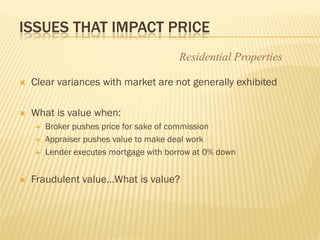
                                         Residential Properties

   Clear variances with market are not generally exhibited

   What is value when:
       Broker pushes price for sake of commission
       Appraiser pushes value to make deal work
       Lender executes mortgage with borrow at 0% down


   Fraudulent value…What is value?
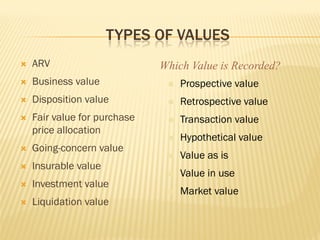
TYPES OF VALUES
   ARV                       Which Value is Recorded?
   Business value                Prospective value
   Disposition value             Retrospective value
   Fair value for purchase       Transaction value
    price allocation
                                  Hypothetical value
   Going-concern value
                                  Value as is
   Insurable value
                                  Value in use
   Investment value
                                  Market value
   Liquidation value
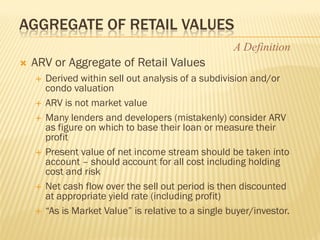
AGGREGATE OF RETAIL VALUES
                                                      A Definition
   ARV or Aggregate of Retail Values
       Derived within sell out analysis of a subdivision and/or
        condo valuation
       ARV is not market value
       Many lenders and developers (mistakenly) consider ARV
        as figure on which to base their loan or measure their
        profit
       Present value of net income stream should be taken into
        account – should account for all cost including holding
        cost and risk
       Net cash flow over the sell out period is then discounted
        at appropriate yield rate (including profit)
       “As is Market Value” is relative to a single buyer/investor.
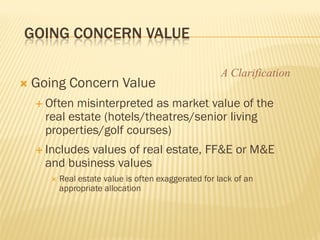
GOING CONCERN VALUE

                                                       A Clarification
   Going Concern Value
     Often misinterpreted as market value of the
      real estate (hotels/theatres/senior living
      properties/golf courses)
     Includesvalues of real estate, FF&E or M&E
      and business values
          Real estate value is often exaggerated for lack of an
           appropriate allocation
PURCHASE PRICE ALLOCATION

                                   Another Clarification
   Purchase Price Allocation
     Toweight the poor performing properties in a
      portfolio transaction for future collateralization
     To apportion a portfolio acquisition price to
      individual properties based on market forces
     To allocate a predetermined purchase price
      between the tangible and intangible assets
      being acquired for financial reporting purposes
A CLEAR VIEW
                      Understanding What Is Recorded
   Current economic collapse due to a
    price/value gap
   Various values may reflect anything but
    market value
   Recorded purchase price may not indicate
    market value
   Understanding the various definitions of value
    and being in tune with the market bridges the
    chasm between price and value
Analyzing Recorded Purchase
                      Prices

                  Gordon K. Vella

Ipt Property Tax Symposiumpdf

  • 1.
    Analyzing Recorded Purchase Prices Gordon K. Vella
  • 2.
    PRICE ≠ VALUE  Price does not equate to value!  Price and value gap is the primary reason for the credit market and investment market instability and collapse.  Price is determined by a single purchaser and/or investor while value is driven by a broader exhibition of transactions…or not?!
  • 3.
    SUB-PRIME CRISIS Does any Single Source Bear the Blame?  NOT ONLY the home buyers who failed to keep their end of the mortgage bargain…  NOT ONLY the physicists/mathematicians concocting inexplicable formulas on which to base credit swaps and derivatives…  NOT ONLY the CEOs and analysts who were not looking when the vague financial instruments were bought and sold…  NOT ONLY the 2000 Congress and President who legalized gambling on Wall Street…the same law that was established after the Great Depression…
  • 4.
    ISSUES THAT IMPACTPRICE Commercial Transactions  Cash put on the table to off-set lease up cost for the sake of mitigating risk for the buyer  1031 transaction  Owner/user may have purchased property at price reflecting:  “Investment Value”  “Value in Use”
  • 5.
    ISSUES THAT IMPACTPRICE Residential Properties  Clear variances with market are not generally exhibited  What is value when:  Broker pushes price for sake of commission  Appraiser pushes value to make deal work  Lender executes mortgage with borrow at 0% down  Fraudulent value…What is value?
  • 6.
    TYPES OF VALUES  ARV Which Value is Recorded?  Business value  Prospective value  Disposition value  Retrospective value  Fair value for purchase  Transaction value price allocation  Hypothetical value  Going-concern value  Value as is  Insurable value  Value in use  Investment value  Market value  Liquidation value
  • 7.
    AGGREGATE OF RETAILVALUES A Definition  ARV or Aggregate of Retail Values  Derived within sell out analysis of a subdivision and/or condo valuation  ARV is not market value  Many lenders and developers (mistakenly) consider ARV as figure on which to base their loan or measure their profit  Present value of net income stream should be taken into account – should account for all cost including holding cost and risk  Net cash flow over the sell out period is then discounted at appropriate yield rate (including profit)  “As is Market Value” is relative to a single buyer/investor.
  • 8.
    GOING CONCERN VALUE A Clarification  Going Concern Value  Often misinterpreted as market value of the real estate (hotels/theatres/senior living properties/golf courses)  Includesvalues of real estate, FF&E or M&E and business values  Real estate value is often exaggerated for lack of an appropriate allocation
  • 9.
    PURCHASE PRICE ALLOCATION Another Clarification  Purchase Price Allocation  Toweight the poor performing properties in a portfolio transaction for future collateralization  To apportion a portfolio acquisition price to individual properties based on market forces  To allocate a predetermined purchase price between the tangible and intangible assets being acquired for financial reporting purposes
  • 10.
    A CLEAR VIEW Understanding What Is Recorded  Current economic collapse due to a price/value gap  Various values may reflect anything but market value  Recorded purchase price may not indicate market value  Understanding the various definitions of value and being in tune with the market bridges the chasm between price and value
  • 11.
    Analyzing Recorded Purchase Prices Gordon K. Vella