PRINCIPLES OF
VALUATION
GEET P. SHAH
B.E. Civil, M.Sc. (Real Estate Valuation),
C.E., A.M.I.E., A.M.I.V., F.G.I.C.E.A.
(M. No.)- +8141407055
(Email Id)- geetushah15@gmail.com
1
What is Valuation?
• Valuation is the determination of monetary value
at some specific date, of the property rights
encompassed in an ownership.
• Property rights means the exclusive right to
possess, enjoy & dispose.
• Valuation requires application of logical principles
and tested methods leading to estimate of value
under given circumstances. In short, valuation is
both science as well as art.
2
Differentiating Cost, Price & Value
• Cost is the amount required
to produce or acquire some
goods or services. It is either
estimated in advance or it is a
fact if incurred.
• Price is the amount asked or
paid for some goods or
services. Price becomes cost
to the buyer and it is a fact.
• Value is an estimate of the
price what it ought to be.
Value is present worth of
future benefits of Income.
3
Objectives of Valuation
• The process of valuation requires the valuer to
make impartial judgments as to the reliability of
inputs and assumptions. For a valuation to be
credible it is important that those judgments are
made in a way that promotes transparency and
minimizes the influence of any subjective factors
on the process.
• Judgment used in a valuation must be applied
objectively to avoid biased analysis, opinions and
conclusions.
4
Purpose of Valuation
 Sale or Purchase of the property by an
Individual, Trust or Company.
 Land Acquisition.
 Bank Loan / Mortgage / Security
 Liquidation / Insolvency / Auction
 Under Wealth Tax Act (Now Inactive)
 Under Income Tax Act (Capital Gain Tax)
 Stamp Duty Purpose
 Insurance Purpose
5
Purpose of Valuation
Under Town Planning Act (Compensation and
Valuation of O.P & F.P.)
Litigation over property rights
Under Companies Act
Acquisition / Mergers / Amalgamations of
Companies
Lease/ Rent / License Purpose of Properties
Family Partition
Visa
6
Who is a Valuer?
• Valuer has been defined as “ an individual,
group of individuals, or a firm possessing the
necessary quality, ability and experience to
undertake valuation in an objective, unbiased
and competent manner.”
• In some jurisdictions, licensing of valuer is
required before one can become a valuer.
7
Market Value as per IVS
• Market Value is the estimated amount for
which an asset or liability should exchange on
the valuation date between a willing buyer
and a willing seller in an arm's length
transaction, after proper marketing and where
the parties had each acted knowledgeably,
prudently and without compulsion.
8
Other Types of Value
• Realizable Value: The said market value is normally
in an ideal perfect market scenario. In actual
property transactions, the payment of such type of
deal is deferred and in instalment spread over a
period of time. However, when a bank / financial
institution wishes to recover its money by sale /
action of the property in one go, this result in a
discounted payment. Further, marketability may also
be reduced as the complete consideration has to be
in “Accounted for or White Money”; it is a common
knowledge that a huge amount of parallel economy /
unaccounted money operates in property
transaction. Hence the realizable value would be
lower than the market value.
9
Other Types of Value
• Liquidation value is the likely price of an asset when it
is allowed insufficient time to sell on the open market,
thereby reducing its exposure to potential buyers.
Liquidation value is typically lower than fair market
value. Unlike cash or securities, certain illiquid assets,
like real estate, often require a period of several
months in order to obtain their fair market value in a
sale, and will generally sell for a significantly lower
price if a sale is forced to occur in a shorter time
period. Liquidation value may be either the result of
a forced liquidation or an orderly liquidation. Either
value assumes that the sale is consummated by a seller
who is compelled to sell and assumes an exposure
period which is less than normal market.
10
Other Types of Value
• Going Concern Value: It relates to the running
business. It implies that a business is being
valued under normal operating conditions
including tangible and intangible assets.
• Book Value: Value of Assets are shown in
balance sheet as original cost less
depreciation is called Book Value.
11
Other Types of Value
• Salvage Value: It is an amount that is likely to be
realized on sale of property or portion of
property which has been separated from it
because that component is no longer useful. It
normally applies to machine part or building but
not for land.
• Scrap Value: It is an amount likely to be obtained
for a portion or a component of a material item
when it is sold at the end of its useful life. E.g:
Building is demolished then certain old material
may be sold in form of scrap.
12
Other Types of Value
• Sentimental Value: Owner may have certain
attachment to a particular property and he
will not sell it even at a sensational price, this
can be termed as sentimental value.
• Special Value: It can arise when the asset has
some attractive characteristics to a particular
buyer and not for all buyer in the market. E.g.
special price paid to a neighboring property.
13
Other Types of Value
• Potential Value: This term indicates the value
derivable from a property and it is put to
different possible uses after being developed
to its Highest & Best Use, maximum capacity
and efficiency.
• Speculative Value: Many prospective buyers
buy the property with a sole intention of
selling again at a higher price. This is termed
as speculative value.
14
Highest and Best Use Concept
• The market value of an asset will reflect its
highest and best use. The highest and best use is
the use of an asset that maximizes its productivity
and that is possible, legally permissible and
financially feasible. The highest and best use may
be for continuation of an assets existing use or for
some alternative use. This is determined by the
use that a market participant would have in mind
for the asset when formulating the price that it
would be willing to bid.
15
16
Role of a Valuer
• Analyzing all the Factors and estimate value of
the property for a given purpose.
• The role of Valuer is “VALUE ESTIMATION” &
not “COST ESTIMATION”.
• Three Vital Questions to be asked by Valuer:
1. Value for Whom?
2. Value for what Purpose?
3. Value as on which Date?
17
Four Pillars of Value
• Utility
• Scarcity
• Demand
• Marketability / Transferability
18
19
Factors affecting the Values
• Economic Factors
• Legal Factors
• Physical / Technical Factors
• Social / Socio-Economy Factors
20
Factors affecting the Values
• Economic Factors:
Demand and supply in the market
Macro economic Factors like inflation,
deflation
Boom or recession
Government Policies relating to interest rates
Parallel economy etc.
21
Factors affecting the Values
• Legal Factors:
Title and tenure of the property
Relevant Development Control Regulations
like GDCR Rules, Town Planning act etc.
Effect of pending litigation
Effects of encumbrances like tenancy, lease,
easement, mortgage etc.
22
Factors affecting the Values
• Physical Factors:
 Land:
Shape
Size
Topography
Geographical situation
Soil condition
Vista etc.
23
Factors affecting the Values
• Physical Factors:
 Building:
Type of Construction
Material used
Architectural planning and design
Services and amenities provided
Age, physical condition and expected future life
Effect of depreciation and obsolescence etc.
24
Factors affecting the Values
• Social Factors:
 Situation and location of the property
 Neighborhood
 Type of the locality
 Availability of civic, social and other facilities
 Distance from other landmarks
 Local beliefs like corner plots, T - Junction
plots, etc
 Stigma
25
26
Classification of properties
• There are three major Classes of the Property:
1. Investment Property
2. Marketable Non-Investment Property
3. Non-Marketable Non-Investment Property
27
1. Investment Property
• Investment Property is always Marketable.
• It has Utility. (Monetary Value to the owner)
• It has Liquidity. (Recovery of investment)
• E.g. Rented / Leased / Licensed property
(Residential House, Shop & Office), Cinema,
Hotel, Petrol Pump, Motel etc. which are
income generating Properties
• Valuation of such properties is done by
Income Approach.
28
2. Marketable Non-Investment Property
• Marketable Non-Investment Property is
always Marketable.
• It has Utility. (Monetary Value to the owner)
• E.g. Self-Occupied property (Residential
House, Shop & Office)
• Valuation of such properties is done by Market
Approach.
29
3. Non-Marketable Non-Investment Property
• Non-Marketable Non-Investment Property has
Utility. (Monetary Value to the owner)
• E.g. Religious Properties, Public School
Properties, Jail, Municipal Town Halls, Non-
profit Making Hospitals, Government
Buildings etc.
• Valuation of such properties is done by Cost
Approach.
30
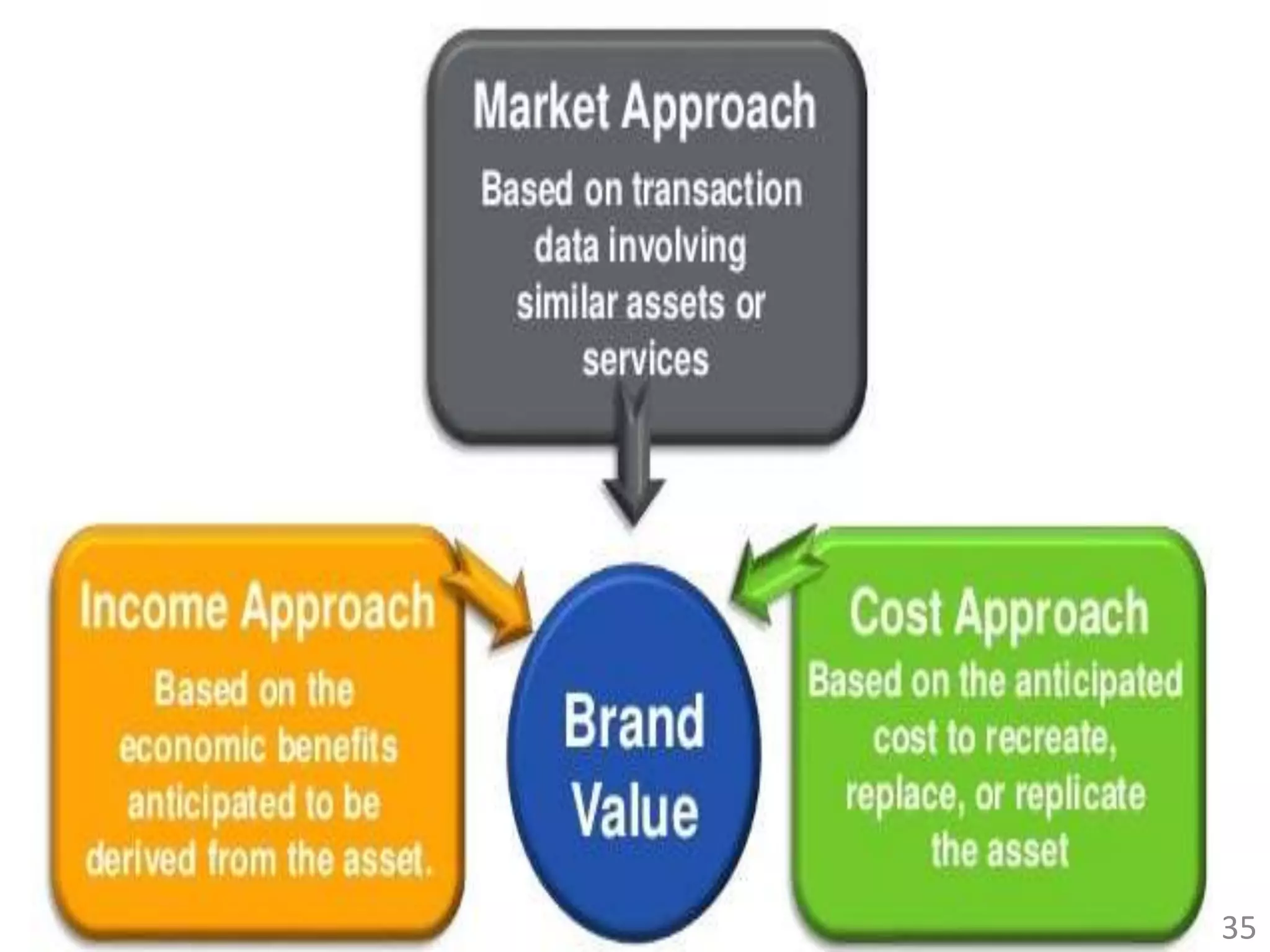
Approaches of Valuation
• There are three approaches of valuation of
properties. They are:
1. Income Approach
2. Market Approach
3. Cost Approach
31
Income Approach
• This approach first estimates the expected future
benefit flows from a property. This benefit flows are
then converted into market value, through variety of
mathematical techniques for capitalization.
• It follows the basic principle of an investor expecting to
get a return on his capital investment.
• Income approach provides an indication of value by
converting future cash flows to single current capital
value.
• Valuation of income generating properties is done by
this approach through rent capitalization method.
32
Market Approach
• The market value of a property is found by comparison
with the properties in the surrounding area sold or
purchased recently by conducting Market Survey &
considering prices paid or received in such
transactions.
• It provides an indication of value by comparing the
subject assets with identical or similar assets for which
price information is available.
• It includes following methods like sales comparison
method, hypothetical plotting, hypothetical
development, residual method, adjustment grid,
weightage average method, price regression method
etc.
33
Cost Approach
• In this approach, the valuer estimates the difference in
value between the property being valued and a newly
constructed building with required utility.
• The valuer estimates the cost to construct a
reproduction of, or replacement for, the existing
structure along with improvements, and then deducts
all accrued depreciation as of the effective date of
valuation.
• It includes following methods like Land & Building
Method by Depreciated Replacement Cost method,
Plinth Area method etc.
34
35
Procedure to follow for valuation:
1. Identification of the property.
2. Identification of the interest in real property.
3. Purpose of valuation.
4. Definition of the value to be estimated.
5. Referring Legal documents
6. Site Inspection
7. Data collection (Physical, Technical, Legal, Economic &
Social)
8. Valuation Approaches & Methods to be adopted.
9. Reconciliation
10. Final Estimate of Value
36
THANKING YOU
37
GEET P. SHAH
B.E. Civil, M.Sc. (Real Estate Valuation),
C.E., A.M.I.E., A.M.I.V., F.G.I.C.E.A.
(M. No.)- +8141407055
(Email Id)- geetushah15@gmail.com

Principles of Valuation

  • 1.
    PRINCIPLES OF VALUATION GEET P.SHAH B.E. Civil, M.Sc. (Real Estate Valuation), C.E., A.M.I.E., A.M.I.V., F.G.I.C.E.A. (M. No.)- +8141407055 (Email Id)- geetushah15@gmail.com 1
  • 2.
    What is Valuation? •Valuation is the determination of monetary value at some specific date, of the property rights encompassed in an ownership. • Property rights means the exclusive right to possess, enjoy & dispose. • Valuation requires application of logical principles and tested methods leading to estimate of value under given circumstances. In short, valuation is both science as well as art. 2
  • 3.
    Differentiating Cost, Price& Value • Cost is the amount required to produce or acquire some goods or services. It is either estimated in advance or it is a fact if incurred. • Price is the amount asked or paid for some goods or services. Price becomes cost to the buyer and it is a fact. • Value is an estimate of the price what it ought to be. Value is present worth of future benefits of Income. 3
  • 4.
    Objectives of Valuation •The process of valuation requires the valuer to make impartial judgments as to the reliability of inputs and assumptions. For a valuation to be credible it is important that those judgments are made in a way that promotes transparency and minimizes the influence of any subjective factors on the process. • Judgment used in a valuation must be applied objectively to avoid biased analysis, opinions and conclusions. 4
  • 5.
    Purpose of Valuation Sale or Purchase of the property by an Individual, Trust or Company.  Land Acquisition.  Bank Loan / Mortgage / Security  Liquidation / Insolvency / Auction  Under Wealth Tax Act (Now Inactive)  Under Income Tax Act (Capital Gain Tax)  Stamp Duty Purpose  Insurance Purpose 5
  • 6.
    Purpose of Valuation UnderTown Planning Act (Compensation and Valuation of O.P & F.P.) Litigation over property rights Under Companies Act Acquisition / Mergers / Amalgamations of Companies Lease/ Rent / License Purpose of Properties Family Partition Visa 6
  • 7.
    Who is aValuer? • Valuer has been defined as “ an individual, group of individuals, or a firm possessing the necessary quality, ability and experience to undertake valuation in an objective, unbiased and competent manner.” • In some jurisdictions, licensing of valuer is required before one can become a valuer. 7
  • 8.
    Market Value asper IVS • Market Value is the estimated amount for which an asset or liability should exchange on the valuation date between a willing buyer and a willing seller in an arm's length transaction, after proper marketing and where the parties had each acted knowledgeably, prudently and without compulsion. 8
  • 9.
    Other Types ofValue • Realizable Value: The said market value is normally in an ideal perfect market scenario. In actual property transactions, the payment of such type of deal is deferred and in instalment spread over a period of time. However, when a bank / financial institution wishes to recover its money by sale / action of the property in one go, this result in a discounted payment. Further, marketability may also be reduced as the complete consideration has to be in “Accounted for or White Money”; it is a common knowledge that a huge amount of parallel economy / unaccounted money operates in property transaction. Hence the realizable value would be lower than the market value. 9
  • 10.
    Other Types ofValue • Liquidation value is the likely price of an asset when it is allowed insufficient time to sell on the open market, thereby reducing its exposure to potential buyers. Liquidation value is typically lower than fair market value. Unlike cash or securities, certain illiquid assets, like real estate, often require a period of several months in order to obtain their fair market value in a sale, and will generally sell for a significantly lower price if a sale is forced to occur in a shorter time period. Liquidation value may be either the result of a forced liquidation or an orderly liquidation. Either value assumes that the sale is consummated by a seller who is compelled to sell and assumes an exposure period which is less than normal market. 10
  • 11.
    Other Types ofValue • Going Concern Value: It relates to the running business. It implies that a business is being valued under normal operating conditions including tangible and intangible assets. • Book Value: Value of Assets are shown in balance sheet as original cost less depreciation is called Book Value. 11
  • 12.
    Other Types ofValue • Salvage Value: It is an amount that is likely to be realized on sale of property or portion of property which has been separated from it because that component is no longer useful. It normally applies to machine part or building but not for land. • Scrap Value: It is an amount likely to be obtained for a portion or a component of a material item when it is sold at the end of its useful life. E.g: Building is demolished then certain old material may be sold in form of scrap. 12
  • 13.
    Other Types ofValue • Sentimental Value: Owner may have certain attachment to a particular property and he will not sell it even at a sensational price, this can be termed as sentimental value. • Special Value: It can arise when the asset has some attractive characteristics to a particular buyer and not for all buyer in the market. E.g. special price paid to a neighboring property. 13
  • 14.
    Other Types ofValue • Potential Value: This term indicates the value derivable from a property and it is put to different possible uses after being developed to its Highest & Best Use, maximum capacity and efficiency. • Speculative Value: Many prospective buyers buy the property with a sole intention of selling again at a higher price. This is termed as speculative value. 14
  • 15.
    Highest and BestUse Concept • The market value of an asset will reflect its highest and best use. The highest and best use is the use of an asset that maximizes its productivity and that is possible, legally permissible and financially feasible. The highest and best use may be for continuation of an assets existing use or for some alternative use. This is determined by the use that a market participant would have in mind for the asset when formulating the price that it would be willing to bid. 15
  • 16.
  • 17.
    Role of aValuer • Analyzing all the Factors and estimate value of the property for a given purpose. • The role of Valuer is “VALUE ESTIMATION” & not “COST ESTIMATION”. • Three Vital Questions to be asked by Valuer: 1. Value for Whom? 2. Value for what Purpose? 3. Value as on which Date? 17
  • 18.
    Four Pillars ofValue • Utility • Scarcity • Demand • Marketability / Transferability 18
  • 19.
  • 20.
    Factors affecting theValues • Economic Factors • Legal Factors • Physical / Technical Factors • Social / Socio-Economy Factors 20
  • 21.
    Factors affecting theValues • Economic Factors: Demand and supply in the market Macro economic Factors like inflation, deflation Boom or recession Government Policies relating to interest rates Parallel economy etc. 21
  • 22.
    Factors affecting theValues • Legal Factors: Title and tenure of the property Relevant Development Control Regulations like GDCR Rules, Town Planning act etc. Effect of pending litigation Effects of encumbrances like tenancy, lease, easement, mortgage etc. 22
  • 23.
    Factors affecting theValues • Physical Factors:  Land: Shape Size Topography Geographical situation Soil condition Vista etc. 23
  • 24.
    Factors affecting theValues • Physical Factors:  Building: Type of Construction Material used Architectural planning and design Services and amenities provided Age, physical condition and expected future life Effect of depreciation and obsolescence etc. 24
  • 25.
    Factors affecting theValues • Social Factors:  Situation and location of the property  Neighborhood  Type of the locality  Availability of civic, social and other facilities  Distance from other landmarks  Local beliefs like corner plots, T - Junction plots, etc  Stigma 25
  • 26.
  • 27.
    Classification of properties •There are three major Classes of the Property: 1. Investment Property 2. Marketable Non-Investment Property 3. Non-Marketable Non-Investment Property 27
  • 28.
    1. Investment Property •Investment Property is always Marketable. • It has Utility. (Monetary Value to the owner) • It has Liquidity. (Recovery of investment) • E.g. Rented / Leased / Licensed property (Residential House, Shop & Office), Cinema, Hotel, Petrol Pump, Motel etc. which are income generating Properties • Valuation of such properties is done by Income Approach. 28
  • 29.
    2. Marketable Non-InvestmentProperty • Marketable Non-Investment Property is always Marketable. • It has Utility. (Monetary Value to the owner) • E.g. Self-Occupied property (Residential House, Shop & Office) • Valuation of such properties is done by Market Approach. 29
  • 30.
    3. Non-Marketable Non-InvestmentProperty • Non-Marketable Non-Investment Property has Utility. (Monetary Value to the owner) • E.g. Religious Properties, Public School Properties, Jail, Municipal Town Halls, Non- profit Making Hospitals, Government Buildings etc. • Valuation of such properties is done by Cost Approach. 30
  • 31.
    Approaches of Valuation •There are three approaches of valuation of properties. They are: 1. Income Approach 2. Market Approach 3. Cost Approach 31
  • 32.
    Income Approach • Thisapproach first estimates the expected future benefit flows from a property. This benefit flows are then converted into market value, through variety of mathematical techniques for capitalization. • It follows the basic principle of an investor expecting to get a return on his capital investment. • Income approach provides an indication of value by converting future cash flows to single current capital value. • Valuation of income generating properties is done by this approach through rent capitalization method. 32
  • 33.
    Market Approach • Themarket value of a property is found by comparison with the properties in the surrounding area sold or purchased recently by conducting Market Survey & considering prices paid or received in such transactions. • It provides an indication of value by comparing the subject assets with identical or similar assets for which price information is available. • It includes following methods like sales comparison method, hypothetical plotting, hypothetical development, residual method, adjustment grid, weightage average method, price regression method etc. 33
  • 34.
    Cost Approach • Inthis approach, the valuer estimates the difference in value between the property being valued and a newly constructed building with required utility. • The valuer estimates the cost to construct a reproduction of, or replacement for, the existing structure along with improvements, and then deducts all accrued depreciation as of the effective date of valuation. • It includes following methods like Land & Building Method by Depreciated Replacement Cost method, Plinth Area method etc. 34
  • 35.
  • 36.
    Procedure to followfor valuation: 1. Identification of the property. 2. Identification of the interest in real property. 3. Purpose of valuation. 4. Definition of the value to be estimated. 5. Referring Legal documents 6. Site Inspection 7. Data collection (Physical, Technical, Legal, Economic & Social) 8. Valuation Approaches & Methods to be adopted. 9. Reconciliation 10. Final Estimate of Value 36
  • 37.
    THANKING YOU 37 GEET P.SHAH B.E. Civil, M.Sc. (Real Estate Valuation), C.E., A.M.I.E., A.M.I.V., F.G.I.C.E.A. (M. No.)- +8141407055 (Email Id)- geetushah15@gmail.com