10th National Convention on Statistics (NCS) 
EDSA Shangri-La Hotel 
October 1-2, 2007 
Measuring the Informal Sector in the Philippines and the Trends in Asia 
by 
Jorge V. Sibal 
For additional information, please contact: 
Author’s name : Jorge V. Sibal 
Designation : Dean 
Affiliation : UP School of Labor and Industrial Relations 
Address : Diliman, Quezon City 
Tel. no. : 9207717 
E-mail : jvsibal@up.edu.ph
Measuring the Informal Sector in the Philippines1 
and the Trends in Asia 
by 
Prof. Jorge V. Sibal, Dean, UP SOLAIR 
In the 2007 national consultation conference on legal empowerment of the poor 
conducted by the UNDP in Manila, an NGO leader of a coalition of informal sector groups in 
Metro Manila lamented the lack of concern of the government on sidewalk vendors during the 
last decade. 
When asked about the situation of the sidewalk vendors and the rest of the informal 
sector workers, former Chief Justice of the Supreme Court Artemio Panganiban opined that 
being a man of law, the first thing that can be done to protect the informal sector workers is to 
have them defined by the law. The former Chief Justice was himself a member of the informal 
sector as a child worker selling newspapers as a result of poverty2. 
Defining the Informal Sector 
The first step that can to be done in order to measure the informal sector is to define it. 
In 1993, the International Labour Organization attempted to define the informal sector as- 
“very small-scale units producing and distributing goods and services, and 
consisting largely of independent, self-employed producers in urban areas of 
developing countries, some of whom also employ family labor and/or few hired 
workers or apprentices; which operate with very little capital, or none at all; which 
utilize low level of technology and skills, which therefore operate at low level of 
productivity; and which generally provide very low and irregular incomes and 
highly unstable employment to those who work in it. They are informal in the 
1 Paper presented at the 10th National Convention on Statistics, 1-2 October, 2007, EDSA Shangri-La 
Hotel, Mandaluyong City, sponsored by the National Statistical Coordination Board. 
2 Refer to the UNDP National Consultation in Manila by the Commission on Legal Empowerment of the 
Poor, July 25-26, 2007, http://legalempowerment.undp.org/press/photos_philippines.html (viewed Sept. 
12, 1007).
sense that they are for the most part unregistered and unrecorded in official 
statistics; they tend to have little or no organized markets, to credit institutions, to 
formal education and training institutions, or to many public services and 
amenities; they are not recognized, supported or regulated by the government; 
they are often compelled by circumstances to operate outside the framework of 
law that are almost invariably beyond the pale of social protection, labor 
legislation and protective measures at the workplace” (Litong, et.al 2002, p. 21). 
The Philippine informal sector was officially defined in the Social Reform and Poverty 
Alleviation Act of 1988 (RA 9485) as: “poor individuals who operate businesses that are very 
small in scale and not registered with any national government agency, and to workers in such 
enterprises who sell their services in exchange for subsistence wages or other forms of 
compensation…” 
The National Statistical Coordination Board (NSCB) defined informal sector as follows 
(Lao & Inocian, 2007): 
“Conceptual definition- 
The informal sector consists of ‘units’ engaged in the production of goods and services 
with the primary objective of generating employment and incomes to the persons 
concerned in order to earn a living. 
These units typically operate at a low level of organization, with little or no division 
between labor and capital as factors of production. It consists of household 
unincorporated enterprises that are market and non-market producers of goods as well 
as market producers of services. 
Labor relations, where they exist, are based on casual employment, kinship or personal 
and social relations rather than formal contractual arrangements.
Operational definition- 
For statistical purposes, the informal sector shall refer to household unincorporated 
enterprises which consist of both informal own-account enterprises and enterprises of 
informal employers. 
Informal own-account enterprises are household unincorporated enterprises owned and 
operated by own-account workers, either alone or in partnership with member/s of the 
same or other households which may employ unpaid family workers as well as 
occasionally / seasonally hired workers but do not employ employees on continuing 
basis. 
Enterprises of informal em ployers are household unincorporated enterprises owned and 
operated by own-account workers, either alone or in partnership with members of the 
same or other household which employ one or more employees on a continuing basis…” 
The above definition generally conforms with the definition of the ILO (1993). It however 
deviates in the following aspects: 
1. The informal sector enterprises are “not registered or formally approved by 
authorities”. The study of Alonzo and Abrera-Mangahas (1990) revealed that 52.4% 
of the informal sector enterprises surveyed in Metro Manila were registered with the 
local government unit while 25% were registered with the DTI, SEC or a national 
agency. 
Registration was highest among professional services at 63.6% at national agencies, 
and 86% at the level of LGUs. License to operate among professional services is 
required. 
The second highest is the transport services where franchises in operating jeepneys, 
mini-buses, tricycles, etc. are needed. Sixty percent are registered with the national 
agencies while 88% are registered with the LGUs.
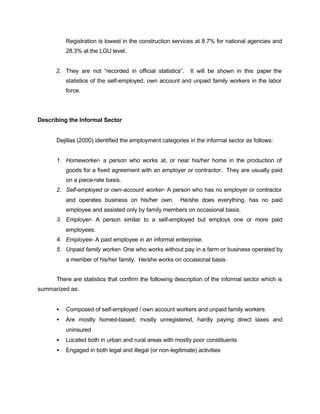
Registration is lowest in the construction services at 8.7% for national agencies and 
28.3% at the LGU level. 
2. They are not “recorded in official statistics”. It will be shown in this paper the 
statistics of the self-employed, own account and unpaid family workers in the labor 
force. 
Describing the Informal Sector 
Dejillas (2000) identified the employment categories in the informal sector as follows: 
1. Homeworker- a person who works at, or near his/her home in the production of 
goods for a fixed agreement with an employer or contractor. They are usually paid 
on a piece-rate basis. 
2. Self-employed or own-account worker- A person who has no employer or contractor 
and operates business on his/her own. He/she does everything, has no paid 
employee and assisted only by family members on occasional basis. 
3. Employer- A person similar to a self-employed but employs one or more paid 
employees. 
4. Employee- A paid employee in an informal enterprise. 
5. Unpaid family worker- One who works without pay in a farm or business operated by 
a member of his/her family. He/she works on occasional basis. 
There are statistics that confirm the following description of the informal sector which is 
summarized as: 
· Composed of self-employed / own account workers and unpaid family workers 
· Are mostly homed-based, mostly unregistered, hardly paying direct taxes and 
uninsured 
· Located both in urban and rural areas with mostly poor constituents 
· Engaged in both legal and illegal (or non-legitimate) activities
· Majority work purely in the informal sector but some are also working on a limited 
period (on contractual arrangement) in the formal sector as wage workers, 
consultants, sales agents, service providers, etc. 
The studies of Alonzo and Abrera-Mangahas (1990) and others show the following data: 
1. Nature of Activities: 70% are engaged in vending and selling with 50% operating 
sari-sari (variety) store, and 25% selling raw and cooked food. Twenty five percent 
are engaged in crafts and manufacturing where 55% are in tailoring and 
dressmaking, 25% in bakery and 9.3% in metal works. 
2. Most of the enterprises are young. Forty seven percent are one year old enterprises. 
3. Thirty two percent are single person operation and only 34% hire one worker. The 
highest number of workers hired at an average of 2.5 is in manufacturing and 
vending while the lowest number of hired workers is in the transport at 1.5. 
4. On the type of organization of the small enterprises, none was incorporated. Single 
proprietorship accounted to 86.3% and partnership, 13.7%. 
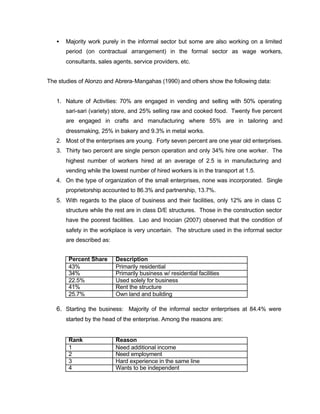
5. With regards to the place of business and their facilities, only 12% are in class C 
structure while the rest are in class D/E structures. Those in the construction sector 
have the poorest facilities. Lao and Inocian (2007) observed that the condition of 
safety in the workplace is very uncertain. The structure used in the informal sector 
are described as: 
Percent Share Description 
43% Primarily residential 
34% Primarily business w/ residential facilities 
22.5% Used solely for business 
41% Rent the structure 
25.7% Own land and building 
6. Starting the business: Majority of the informal sector enterprises at 84.4% were 
started by the head of the enterprise. Among the reasons are: 
Rank Reason 
1 Need additional income 
2 Need employment 
3 Hard experience in the same line 
4 Wants to be independent
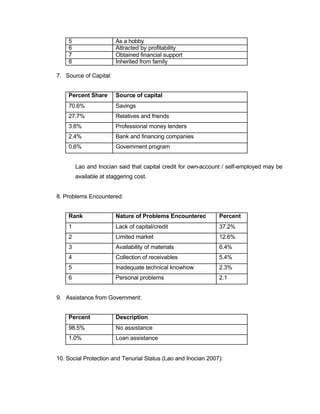
5 As a hobby 
6 Attracted by profitability 
7 Obtained financial support 
8 Inherited from family 
7. Source of Capital: 
Percent Share Source of capital 
70.6% Savings 
27.7% Relatives and friends 
3.6% Professional money lenders 
2.4% Bank and financing companies 
0.6% Government program 
Lao and Inocian said that capital credit for own-account / self-employed may be 
available at staggering cost. 
8. Problems Encountered: 
Rank Nature of Problems Encountered Percent 
1 Lack of capital/credit 37.2% 
2 Limited market 12.6% 
3 Availability of materials 6.4% 
4 Collection of receivables 5.4% 
5 Inadequate technical knowhow 2.3% 
6 Personal problems 2.1 
9. Assistance from Government: 
Percent Description 
98.5% No assistance 
1.0% Loan assistance 
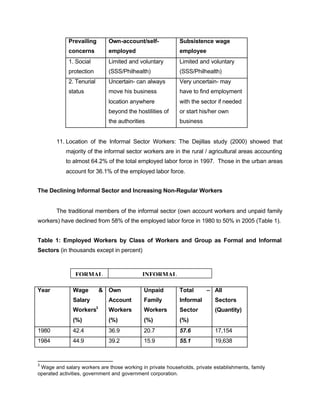
10. Social Protection and Tenurial Status (Lao and Inocian 2007):
Prevailing 
concerns 
Own-account/self-employed 
Subsistence wage 
employee 
1. Social 
protection 
Limited and voluntary 
(SSS/Philhealth) 
Limited and voluntary 
(SSS/Philhealth) 
2. Tenurial 
status 
Uncertain- can always 
move his business 
location anywhere 
beyond the hostilities of 
the authorities 
Very uncertain- may 
have to find employment 
with the sector if needed 
or start his/her own 
business 
11. Location of the Informal Sector Workers: The Dejillas study (2000) showed that 
majority of the informal sector workers are in the rural / agricultural areas accounting 
to almost 64.2% of the total employed labor force in 1997. Those in the urban areas 
account for 36.1% of the employed labor force. 
The Declining Informal Sector and Increasing Non-Regular Workers 
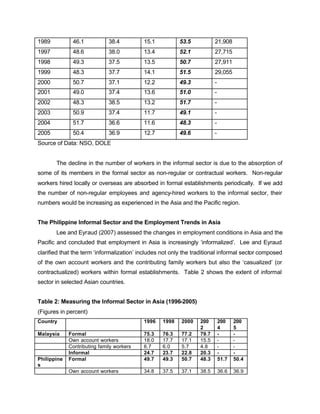
The traditional members of the informal sector (own account workers and unpaid family 
workers) have declined from 58% of the employed labor force in 1980 to 50% in 2005 (Table 1). 
Table 1: Employed Workers by Class of Workers and Group as Formal and Informal 
Sectors (in thousands except in percent) 
FORMAL INFORMAL 
Year Wage & 
Salary 
Workers3 
(%) 
Own 
Account 
Workers 
(%) 
Unpaid 
Family 
Workers 
(%) 
Total – 
Informal 
Sector 
(%) 
All 
Sectors 
(Quantity) 
1980 42.4 36.9 20.7 57.6 17,154 
1984 44.9 39.2 15.9 55.1 19,638 
3 Wage and salary workers are those working in private households, private establishments, family 
operated activities, government and government corporation.
1989 46.1 38.4 15.1 53.5 21,908 
1997 48.6 38.0 13.4 52.1 27,715 
1998 49.3 37.5 13.5 50.7 27,911 
1999 48.3 37.7 14.1 51.5 29,055 
2000 50.7 37.1 12.2 49.3 - 
2001 49.0 37.4 13.6 51.0 - 
2002 48.3 38.5 13.2 51.7 - 
2003 50.9 37.4 11.7 49.1 - 
2004 51.7 36.6 11.6 48.3 - 
2005 50.4 36.9 12.7 49.6 - 
Source of Data: NSO, DOLE 
The decline in the number of workers in the informal sector is due to the absorption of 
some of its members in the formal sector as non-regular or contractual workers. Non-regular 
workers hired locally or overseas are absorbed in formal establishments periodically. If we add 
the number of non-regular employees and agency-hired workers to the informal sector, their 
numbers would be increasing as experienced in the Asia and the Pacific region. 
The Philippine Informal Sector and the Employment Trends in Asia 
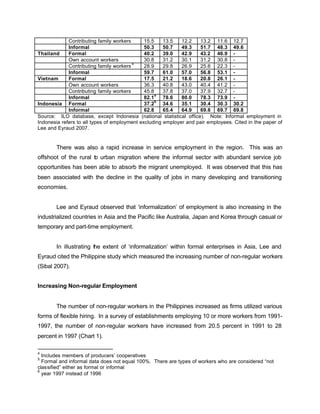
Lee and Eyraud (2007) assessed the changes in employment conditions in Asia and the 
Pacific and concluded that employment in Asia is increasingly ‘informalized’. Lee and Eyraud 
clarified that the term ‘informalization’ includes not only the traditional informal sector composed 
of the own account workers and the contributing family workers but also the ‘casualized’ (or 
contractualized) workers within formal establishments. Table 2 shows the extent of informal 
sector in selected Asian countries. 
Table 2: Measuring the Informal Sector in Asia (1996-2005) 
(Figures in percent) 
Country 1996 1998 2000 200 
2 
200 
4 
200 
5 
Malaysia Formal 75.3 76.3 77.2 79.7 - - 
Own account workers 18.0 17.7 17.1 15.5 - - 
Contributing family workers 6.7 6.0 5.7 4.8 - - 
Informal 24.7 23.7 22.8 20.3 - - 
Philippine 
s 
Formal 49.7 49.3 50.7 48.3 51.7 50.4 
Own account workers 34.8 37.5 37.1 38.5 36.6 36.9
Contributing family workers 15.5 13.5 12.2 13.2 11.6 12.7 
Informal 50.3 50.7 49.3 51.7 48.3 49.6 
Thailand Formal 40.2 39.0 42.9 43.2 46.9 - 
Own account workers 30.8 31.2 30.1 31.2 30.8 - 
Contributing family workers 4 28.9 29.8 26.9 25.6 22.3 - 
Informal 59.7 61.0 57.0 56.8 53.1 - 
Vietnam Formal 17.5 21.2 18.6 20.8 26.1 - 
Own account workers 36.3 40.8 43.0 40.4 41.2 - 
Contributing family workers 45.8 37.8 37.0 37.9 32.7 - 
Informal 82.15 78.6 80.0 78.3 73.9 - 
Indonesia Formal 37.26 34.6 35.1 30.4 30.3 30.2 
Informal 62.8 65.4 64.9 69.6 69.7 69.8 
Source: ILO database, except Indonesia (national statistical office). Note: Informal employment in 
Indonesia refers to all types of employment excluding employer and pair employees. Cited in the paper of 
Lee and Eyraud 2007. 
There was also a rapid increase in service employment in the region. This was an 
offshoot of the rural to urban migration where the informal sector with abundant service job 
opportunities has been able to absorb the migrant unemployed. It was observed that this has 
been associated with the decline in the quality of jobs in many developing and transitioning 
economies. 
Lee and Eyraud observed that ‘informalization’ of employment is also increasing in the 
industrialized countries in Asia and the Pacific like Australia, Japan and Korea through casual or 
temporary and part-time employment. 
In illustrating the extent of ‘informalization’ within formal enterprises in Asia, Lee and 
Eyraud cited the Philippine study which measured the increasing number of non-regular workers 
(Sibal 2007). 
Increasing Non-regular Employment 
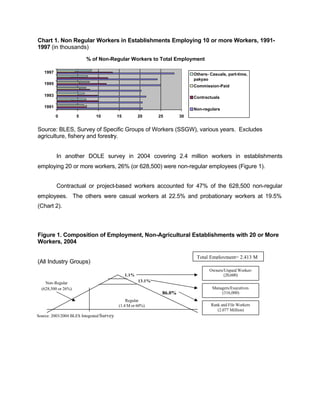
The number of non-regular workers in the Philippines increased as firms utilized various 
forms of flexible hiring. In a survey of establishments employing 10 or more workers from 1991- 
1997, the number of non-regular workers have increased from 20.5 percent in 1991 to 28 
percent in 1997 (Chart 1). 
4 Includes members of producers’ cooperatives 
5 Formal and informal data does not equal 100%. There are types of workers who are considered “not 
classified” either as formal or informal 
6 year 1997 instead of 1996
Chart 1. Non Regular Workers in Establishments Employing 10 or more Workers, 1991- 
1997 (in thousands) 
% of Non-Regular Workers to Total Employment 
1997 Others- Casuals, part-time, 
0 5 10 15 20 25 30 
1995 
1993 
1991 
pakyao 
Commission-Paid 
Contractuals 
Non-regulars 
Source: BLES, Survey of Specific Groups of Workers (SSGW), various years. Excludes 
agriculture, fishery and forestry. 
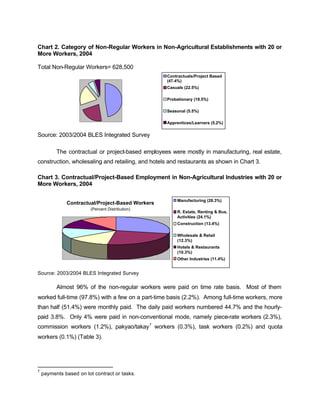
In another DOLE survey in 2004 covering 2.4 million workers in establishments 
employing 20 or more workers, 26% (or 628,500) were non-regular employees (Figure 1). 
Contractual or project-based workers accounted for 47% of the 628,500 non-regular 
employees. The others were casual workers at 22.5% and probationary workers at 19.5% 
(Chart 2). 
Figure 1. Composition of Employment, Non-Agricultural Establishments with 20 or More 
Workers, 2004 
(All Industry Groups) 
Total Employment= 2.413 M 
Owners/Unpaid Workers 
(20,600) 
Managers/Executives 
(316,000) 
(20,600) 
Rank and File Workers 
(2.077 Million) 
Non-Regular 
(628,500 or 26%) 
Regular 
(1.4 M or 60%) 
86.0% 
13.1% 
1.1% 
Source: 2003/2004 BLES Integrated Survey
Chart 2. Category of Non-Regular Workers in Non-Agricultural Establishments with 20 or 
More Workers, 2004 
Total Non-Regular Workers= 628,500 
Contractuals/Project Based 
(47.4%) 
Casuals (22.5%) 
Probationary (19.5%) 
Seasonal (5.5%) 
Apprentices/Learners (5.2%) 
Source: 2003/2004 BLES Integrated Survey 
The contractual or project-based employees were mostly in manufacturing, real estate, 
construction, wholesaling and retailing, and hotels and restaurants as shown in Chart 3. 
Chart 3. Contractual/Project-Based Employment in Non-Agricultural Industries with 20 or 
More Workers, 2004 
Contractual/Project-Based Workers 
(Percent Distribution) 
Manufacturing (28.3%) 
R. Estate, Renting & Bus. 
Activities (24.1%) 
Construction (13.4%) 
Wholesale & Retail 
(12.3%) 
Hotels & Restaurants 
(10.3%) 
Other Industries (11.4%) 
Source: 2003/2004 BLES Integrated Survey 
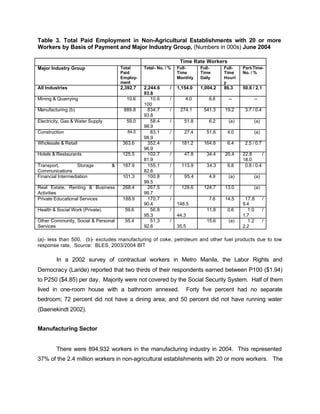
Almost 96% of the non-regular workers were paid on time rate basis. Most of them 
worked full-time (97.8%) with a few on a part-time basis (2.2%). Among full-time workers, more 
than half (51.4%) were monthly paid. The daily paid workers numbered 44.7% and the hourly-paid 
3.8%. Only 4% were paid in non-conventional mode, namely piece-rate workers (2.3%), 
commission workers (1.2%), pakyao/takay7 workers (0.3%), task workers (0.2%) and quota 
workers (0.1%) (Table 3). 
7 payments based on lot contract or tasks.
Table 3. Total Paid Employment in Non-Agricultural Establishments with 20 or more 
Workers by Basis of Payment and Major Industry Group, (Numbers in 000s) June 2004 
Time Rate Workers 
Major Industry Group Total 
Paid 
Employ-ment 
Total- No. / % Full- 
Time 
Monthly 
Full- 
Time 
Daily 
Full- 
Time 
Hourl 
y 
Part-Time- 
No. / % 
All Industries 2,392.7 2,244.6 / 
93.8 
1,154.0 1,004.2 86.3 50.6 / 2.1 
Mining & Quarrying 10.6 10.6 / 
100 
4.0 6.6 -- -- 
Manufacturing (b) 889.8 834.7 / 
93.8 
274.1 541.3 19.2 3.7 / 0.4 
Electricity, Gas & Water Supply 59.0 58.4 / 
98.9 
51.8 6.2 (a) (a) 
Construction 84.0 83.1 / 
98.9 
27.4 51.6 4.0 (a) 
Wholesale & Retail 363.6 352.4 / 
96.9 
181.2 164.8 6.4 2.5 / 0.7 
Hotels & Restaurants 125.5 102.7 / 
81.9 
47.8 34.4 20.4 22.8 / 
18.0 
Transport, Storage & 
Communications 
187.9 155.1 / 
82.6 
113.9 34.3 6.8 0.8 / 0.4 
Financial Intermediation 101.3 100.8 / 
99.5 
95.4 4.9 (a) (a) 
Real Estate, Renting & Business 
Activities 
268.4 267.5 / 
99.7 
129.6 124.7 13.0 (a) 
Private Educational Services 188.9 170.7 / 
90.4 148.5 
7.6 14.5 17.8 / 
9.4 
Health & Social Work (Private) 59.6 56.8 / 
95.3 44.3 
11.8 0.6 1.0 / 
1.7 
Other Community, Social & Personal 
Services 
55.4 51.3 / 
92.6 35.5 
15.6 (a) 1.2 / 
2.2 
(a)- less than 500, (b)- excludes manufacturing of coke, petroleum and other fuel products due to low 
response rate, Source: BLES, 2003/2004 BIT 
In a 2002 survey of contractual workers in Metro Manila, the Labor Rights and 
Democracy (Laride) reported that two thirds of their respondents earned between P100 ($1.94) 
to P250 ($4.85) per day. Majority were not covered by the Social Security System. Half of them 
lived in one-room house with a bathroom annexed. Forty five percent had no separate 
bedroom; 72 percent did not have a dining area; and 50 percent did not have running water 
(Daenekindt 2002). 
Manufacturing Sector 
There were 894,932 workers in the manufacturing industry in 2004. This represented 
37% of the 2.4 million workers in non-agricultural establishments with 20 or more workers. The
industry produced products ranging from food, apparel, steel, cement, machineries and 
equipment, chemical products, wood and furniture products, etc. 
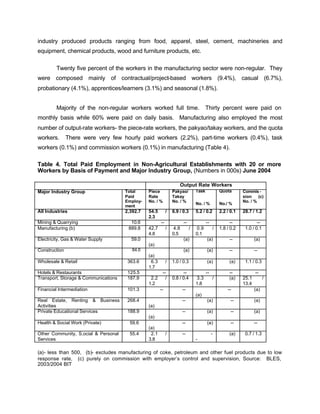
Twenty five percent of the workers in the manufacturing sector were non-regular. They 
were composed mainly of contractual/project-based workers (9.4%), casual (6.7%), 
probationary (4.1%), apprentices/learners (3.1%) and seasonal (1.8%). 
Majority of the non-regular workers worked full time. Thirty percent were paid on 
monthly basis while 60% were paid on daily basis. Manufacturing also employed the most 
number of output-rate workers- the piece-rate workers, the pakyao/takay workers, and the quota 
workers. There were very few hourly paid workers (2.2%), part-time workers (0.4%), task 
workers (0.1%) and commission workers (0.1%) in manufacturing (Table 4). 
Table 4. Total Paid Employment in Non-Agricultural Establishments with 20 or more 
Workers by Basis of Payment and Major Industry Group, (Numbers in 000s) June 2004 
Output Rate Workers 
Major Industry Group Total 
Paid 
Employ-ment 
Piece 
Rate 
No. / % 
Pakyao/ 
Takay 
No. / % 
Task 
No. / % 
Quota 
No./ % 
Commis-sion 
(c) 
No. / % 
All Industries 2,392.7 54.5 / 
2.3 
6.9 / 0.3 5.2 / 0.2 2.2 / 0.1 28.7 / 1.2 
Mining & Quarrying 10.6 -- -- -- -- -- 
Manufacturing (b) 889.8 42.7 / 
4.8 
4.8 / 
0.5 
0.9 / 
0.1 
1.8 / 0.2 1.0 / 0.1 
Electricity, Gas & Water Supply 59.0 
(a) 
(a) (a) -- (a) 
Construction 84.0 
(a) 
(a) (a) -- -- 
Wholesale & Retail 363.6 6.3 / 
1.7 
1.0 / 0.3 (a) (a) 1.1 / 0.3 
Hotels & Restaurants 125.5 -- -- -- -- -- 
Transport, Storage & Communications 187.9 2.2 / 
1.2 
0.8 / 0.4 3.3 / 
1.8 
(a) 25.1 / 
13.4 
Financial Intermediation 101.3 -- -- 
(a) 
-- (a) 
Real Estate, Renting & Business 
Activities 
268.4 
(a) 
-- (a) -- (a) 
Private Educational Services 188.9 
(a) 
-- (a) -- (a) 
Health & Social Work (Private) 59.6 
(a) 
-- (a) -- -- 
Other Community, S,ocial & Personal 
Services 
55.4 2.1 / 
3.8 
-- - 
- 
(a) 0.7 / 1.3 
(a)- less than 500, (b)- excludes manufacturing of coke, petroleum and other fuel products due to low 
response rate, (c) purely on commission with employer’s control and supervision, Source: BLES, 
2003/2004 BIT
Retail and Wholesale Trade Sector 
The retail and wholesale trade was the second biggest employer among non-agricultural 
establishments with 20 or more workers. It employed 367,703 in 2004 or 15% of the 2.4 million 
workers employed in establishments covered by the survey. Twenty five percent of the 
employees were non-regulars, the same percentage as in manufacturing. 
Among the 94,155 non-regular employees, 39% were contractual or project based, 32% 
were casuals, 19% were on probation, and 9% were seasonal workers. By mode of payment, 
96.5% were paid based on time rates with almost all workers (99.3%) working on full-time basis. 
Almost half of these fulltime workers (49.3%) were monthly paid with 44.8 percent being daily 
paid. Only 1.7 percent were hourly paid. 
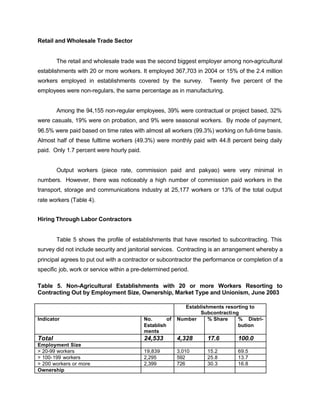
Output workers (piece rate, commission paid and pakyao) were very minimal in 
numbers. However, there was noticeably a high number of commission paid workers in the 
transport, storage and communications industry at 25,177 workers or 13% of the total output 
rate workers (Table 4). 
Hiring Through Labor Contractors 
Table 5 shows the profile of establishments that have resorted to subcontracting. This 
survey did not include security and janitorial services. Contracting is an arrangement whereby a 
principal agrees to put out with a contractor or subcontractor the performance or completion of a 
specific job, work or service within a pre-determined period. 
Table 5. Non-Agricultural Establishments with 20 or more Workers Resorting to 
Contracting Out by Employment Size, Ownership, Market Type and Unionism, June 2003 
Establishments resorting to 
Subcontracting 
Indicator No. of 
Establish 
ments 
Number % Share % Distri-bution 
Total 24,533 4,328 17.6 100.0 
Employment Size 
> 20-99 workers 19,839 3,010 15.2 69.5 
> 100-199 workers 2,295 592 25.8 13.7 
> 200 workers or more 2,399 726 30.3 16.8 
Ownership
> Wholly Filipino 21,116 2,984 14.1 68.9 
> With foreign equity 2,336 854 36.6 19.7 
> Wholly foreign 1,081 490 45.3 11.3 
Market Type 
> Wholly domestic 20,384 3,048 15.0 70.4 
>Export only 1,162 306 26.3 7.1 
> Both market 2,987 974 32.6 22.5 
Spread of Operations 
> Multinational 2,025 887 43.8 20.5 
> Not multinational 22,508 3,441 15.3 79.5 
Unionism 
> With Union 3,640 918 25.2 21.2 
> Without union 20,893 3,410 16.3 78.8 
Source: DOLE BLES, 2002-2003 BLES Integrated Survey 
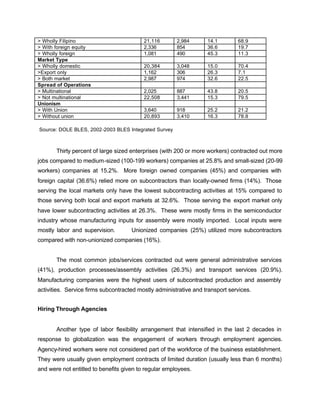
Thirty percent of large sized enterprises (with 200 or more workers) contracted out more 
jobs compared to medium-sized (100-199 workers) companies at 25.8% and small-sized (20-99 
workers) companies at 15.2%. More foreign owned companies (45%) and companies with 
foreign capital (36.6%) relied more on subcontractors than locally-owned firms (14%). Those 
serving the local markets only have the lowest subcontracting activities at 15% compared to 
those serving both local and export markets at 32.6%. Those serving the export market only 
have lower subcontracting activities at 26.3%. These were mostly firms in the semiconductor 
industry whose manufacturing inputs for assembly were mostly imported. Local inputs were 
mostly labor and supervision. Unionized companies (25%) utilized more subcontractors 
compared with non-unionized companies (16%). 
The most common jobs/services contracted out were general administrative services 
(41%), production processes/assembly activities (26.3%) and transport services (20.9%). 
Manufacturing companies were the highest users of subcontracted production and assembly 
activities. Service firms subcontracted mostly administrative and transport services. 
Hiring Through Agencies 
Another type of labor flexibility arrangement that intensified in the last 2 decades in 
response to globalization was the engagement of workers through employment agencies. 
Agency-hired workers were not considered part of the workforce of the business establishment. 
They were usually given employment contracts of limited duration (usually less than 6 months) 
and were not entitled to benefits given to regular employees.
As of June 2003, agency-hired workers comprised 10.8 percent (316,000 workers) of the 
total number of persons engaged in non-agricultural establishments with 20 or more workers. 
The average number of agency-hired worker was 21 per establishment. Security services 
comprised the biggest bulk at 37 percent. This was followed by production/assembly (23%), 
janitorial (15%), marketing/sales (10.6%), general administrative (3.3%), transport service (3%), 
and others (7.5%). 
The bigger sized enterprises hired more agency workers than the smaller firms. 
Companies with foreign capital, catering to the export-oriented, or unionized hired more agency 
workers than firms that were Filipino-owned, catering to the local market or non-unionized 
(DOLE Labstat Updates 2006). 
Concluding Statements 
A disturbing conclusion of Lee and Eyraud (2007) is that “with the ‘informalization’ of 
employment, income/wage inequity has widened”. The informal sector offers a reservoir of 
cheap surplus labor that can be tapped for non-regular employment. As a result of the race to 
the bottom wage competition, informal and non-regular workers tend to earn less than the 
formal sector workers, thus increasing further the income inequity between the informal and 
formal sectors. 
The alternative approach to this disturbing trend is the race to the top wage competition. 
This can be achieved through continuing skills upgrading of all workers in the formal and 
informal sectors for labor flexibility and productivity, and the advocacy and implementation of 
social compliance standards at the workplace. Social compliance in the workplace can be 
achieved through various modes- from the compulsory state legislations to the voluntary 
industry accords, promotion of good practices and continuous improvement in the workplace. 
Continuous monitoring and measuring of the condition of workers especially in the 
informal sector is a very important component in this advocacy of combating the race to the 
bottom tendencies that came along the increasing ‘informalization’ of employment in fast 
growing Asia and the rest of the world.
References: 
Alonzo, Ruperto and M.A. Abrera-Mangahas 1990, “The Informal Sector in Metro Manila: 
Findings from a Recent Survey”, Geneva: ILO 
Daenekindt, Roger 2002, “Filipino Workers as Victims of Globalization”, Philippine Journal of 
Labor and Industrial Relations, Quezon City: UP SOLAIR. 
Dejillas, Leopoldo 2000, Globalization, Gender and Employment in the Informal Economy: The 
Case of the Philippines, Manila: ILO 
DOLE Labstat Updates 2006, “The 2005 Employment Situation”, Manila: DOLE Bureau of Labor 
and Employment Statistics, January 2006. 
ILO 1993, Development of Urban Informal Sector: Policies and Strategies Discussion Paper, 
Geneva: World Employment Programme, January 1993 
Lao, Edmund and Jeremy Inocian 2007, “The Future of the Workers in the Informal Sector: 
Towards Fulfilling the Constitutional Mandate of Social Justice and Human Rights in the 
Informal Sector”, Cebu City: ESCR Asia (manuscript) 
Lee, Sangheon and F. Eyraud 2007, “Globalization, Deregulation and Workers: Changes 
and Outcomes”, Workshop on Globalization and Changes in Employment Conditions in 
Asia and the Pacific, Seoul: ILO and Korea Labor Institute 
Litong, Glenda, R. Lao and J. Apolonio 2002, An Assessment of the Situation of the Informal 
Sector in the Philippines: A Human Rights Perspective, Manila: United Nations 
Development Programme 
Sibal, Jorge 2007, “Globalization and Changes in Work and Employment Conditions in the 
Philippines”, Workshop on Globalization and Changes in Employment Conditions in Asia 
and the Pacific, Seoul: ILO and Korea Labor Institute

Ips22 03

  • 1.
    10th National Conventionon Statistics (NCS) EDSA Shangri-La Hotel October 1-2, 2007 Measuring the Informal Sector in the Philippines and the Trends in Asia by Jorge V. Sibal For additional information, please contact: Author’s name : Jorge V. Sibal Designation : Dean Affiliation : UP School of Labor and Industrial Relations Address : Diliman, Quezon City Tel. no. : 9207717 E-mail : jvsibal@up.edu.ph
  • 2.
    Measuring the InformalSector in the Philippines1 and the Trends in Asia by Prof. Jorge V. Sibal, Dean, UP SOLAIR In the 2007 national consultation conference on legal empowerment of the poor conducted by the UNDP in Manila, an NGO leader of a coalition of informal sector groups in Metro Manila lamented the lack of concern of the government on sidewalk vendors during the last decade. When asked about the situation of the sidewalk vendors and the rest of the informal sector workers, former Chief Justice of the Supreme Court Artemio Panganiban opined that being a man of law, the first thing that can be done to protect the informal sector workers is to have them defined by the law. The former Chief Justice was himself a member of the informal sector as a child worker selling newspapers as a result of poverty2. Defining the Informal Sector The first step that can to be done in order to measure the informal sector is to define it. In 1993, the International Labour Organization attempted to define the informal sector as- “very small-scale units producing and distributing goods and services, and consisting largely of independent, self-employed producers in urban areas of developing countries, some of whom also employ family labor and/or few hired workers or apprentices; which operate with very little capital, or none at all; which utilize low level of technology and skills, which therefore operate at low level of productivity; and which generally provide very low and irregular incomes and highly unstable employment to those who work in it. They are informal in the 1 Paper presented at the 10th National Convention on Statistics, 1-2 October, 2007, EDSA Shangri-La Hotel, Mandaluyong City, sponsored by the National Statistical Coordination Board. 2 Refer to the UNDP National Consultation in Manila by the Commission on Legal Empowerment of the Poor, July 25-26, 2007, http://legalempowerment.undp.org/press/photos_philippines.html (viewed Sept. 12, 1007).
  • 3.
    sense that theyare for the most part unregistered and unrecorded in official statistics; they tend to have little or no organized markets, to credit institutions, to formal education and training institutions, or to many public services and amenities; they are not recognized, supported or regulated by the government; they are often compelled by circumstances to operate outside the framework of law that are almost invariably beyond the pale of social protection, labor legislation and protective measures at the workplace” (Litong, et.al 2002, p. 21). The Philippine informal sector was officially defined in the Social Reform and Poverty Alleviation Act of 1988 (RA 9485) as: “poor individuals who operate businesses that are very small in scale and not registered with any national government agency, and to workers in such enterprises who sell their services in exchange for subsistence wages or other forms of compensation…” The National Statistical Coordination Board (NSCB) defined informal sector as follows (Lao & Inocian, 2007): “Conceptual definition- The informal sector consists of ‘units’ engaged in the production of goods and services with the primary objective of generating employment and incomes to the persons concerned in order to earn a living. These units typically operate at a low level of organization, with little or no division between labor and capital as factors of production. It consists of household unincorporated enterprises that are market and non-market producers of goods as well as market producers of services. Labor relations, where they exist, are based on casual employment, kinship or personal and social relations rather than formal contractual arrangements.
  • 4.
    Operational definition- Forstatistical purposes, the informal sector shall refer to household unincorporated enterprises which consist of both informal own-account enterprises and enterprises of informal employers. Informal own-account enterprises are household unincorporated enterprises owned and operated by own-account workers, either alone or in partnership with member/s of the same or other households which may employ unpaid family workers as well as occasionally / seasonally hired workers but do not employ employees on continuing basis. Enterprises of informal em ployers are household unincorporated enterprises owned and operated by own-account workers, either alone or in partnership with members of the same or other household which employ one or more employees on a continuing basis…” The above definition generally conforms with the definition of the ILO (1993). It however deviates in the following aspects: 1. The informal sector enterprises are “not registered or formally approved by authorities”. The study of Alonzo and Abrera-Mangahas (1990) revealed that 52.4% of the informal sector enterprises surveyed in Metro Manila were registered with the local government unit while 25% were registered with the DTI, SEC or a national agency. Registration was highest among professional services at 63.6% at national agencies, and 86% at the level of LGUs. License to operate among professional services is required. The second highest is the transport services where franchises in operating jeepneys, mini-buses, tricycles, etc. are needed. Sixty percent are registered with the national agencies while 88% are registered with the LGUs.
  • 5.
    Registration is lowestin the construction services at 8.7% for national agencies and 28.3% at the LGU level. 2. They are not “recorded in official statistics”. It will be shown in this paper the statistics of the self-employed, own account and unpaid family workers in the labor force. Describing the Informal Sector Dejillas (2000) identified the employment categories in the informal sector as follows: 1. Homeworker- a person who works at, or near his/her home in the production of goods for a fixed agreement with an employer or contractor. They are usually paid on a piece-rate basis. 2. Self-employed or own-account worker- A person who has no employer or contractor and operates business on his/her own. He/she does everything, has no paid employee and assisted only by family members on occasional basis. 3. Employer- A person similar to a self-employed but employs one or more paid employees. 4. Employee- A paid employee in an informal enterprise. 5. Unpaid family worker- One who works without pay in a farm or business operated by a member of his/her family. He/she works on occasional basis. There are statistics that confirm the following description of the informal sector which is summarized as: · Composed of self-employed / own account workers and unpaid family workers · Are mostly homed-based, mostly unregistered, hardly paying direct taxes and uninsured · Located both in urban and rural areas with mostly poor constituents · Engaged in both legal and illegal (or non-legitimate) activities
  • 6.
    · Majority workpurely in the informal sector but some are also working on a limited period (on contractual arrangement) in the formal sector as wage workers, consultants, sales agents, service providers, etc. The studies of Alonzo and Abrera-Mangahas (1990) and others show the following data: 1. Nature of Activities: 70% are engaged in vending and selling with 50% operating sari-sari (variety) store, and 25% selling raw and cooked food. Twenty five percent are engaged in crafts and manufacturing where 55% are in tailoring and dressmaking, 25% in bakery and 9.3% in metal works. 2. Most of the enterprises are young. Forty seven percent are one year old enterprises. 3. Thirty two percent are single person operation and only 34% hire one worker. The highest number of workers hired at an average of 2.5 is in manufacturing and vending while the lowest number of hired workers is in the transport at 1.5. 4. On the type of organization of the small enterprises, none was incorporated. Single proprietorship accounted to 86.3% and partnership, 13.7%. 5. With regards to the place of business and their facilities, only 12% are in class C structure while the rest are in class D/E structures. Those in the construction sector have the poorest facilities. Lao and Inocian (2007) observed that the condition of safety in the workplace is very uncertain. The structure used in the informal sector are described as: Percent Share Description 43% Primarily residential 34% Primarily business w/ residential facilities 22.5% Used solely for business 41% Rent the structure 25.7% Own land and building 6. Starting the business: Majority of the informal sector enterprises at 84.4% were started by the head of the enterprise. Among the reasons are: Rank Reason 1 Need additional income 2 Need employment 3 Hard experience in the same line 4 Wants to be independent
  • 7.
    5 As ahobby 6 Attracted by profitability 7 Obtained financial support 8 Inherited from family 7. Source of Capital: Percent Share Source of capital 70.6% Savings 27.7% Relatives and friends 3.6% Professional money lenders 2.4% Bank and financing companies 0.6% Government program Lao and Inocian said that capital credit for own-account / self-employed may be available at staggering cost. 8. Problems Encountered: Rank Nature of Problems Encountered Percent 1 Lack of capital/credit 37.2% 2 Limited market 12.6% 3 Availability of materials 6.4% 4 Collection of receivables 5.4% 5 Inadequate technical knowhow 2.3% 6 Personal problems 2.1 9. Assistance from Government: Percent Description 98.5% No assistance 1.0% Loan assistance 10. Social Protection and Tenurial Status (Lao and Inocian 2007):
  • 8.
    Prevailing concerns Own-account/self-employed Subsistence wage employee 1. Social protection Limited and voluntary (SSS/Philhealth) Limited and voluntary (SSS/Philhealth) 2. Tenurial status Uncertain- can always move his business location anywhere beyond the hostilities of the authorities Very uncertain- may have to find employment with the sector if needed or start his/her own business 11. Location of the Informal Sector Workers: The Dejillas study (2000) showed that majority of the informal sector workers are in the rural / agricultural areas accounting to almost 64.2% of the total employed labor force in 1997. Those in the urban areas account for 36.1% of the employed labor force. The Declining Informal Sector and Increasing Non-Regular Workers The traditional members of the informal sector (own account workers and unpaid family workers) have declined from 58% of the employed labor force in 1980 to 50% in 2005 (Table 1). Table 1: Employed Workers by Class of Workers and Group as Formal and Informal Sectors (in thousands except in percent) FORMAL INFORMAL Year Wage & Salary Workers3 (%) Own Account Workers (%) Unpaid Family Workers (%) Total – Informal Sector (%) All Sectors (Quantity) 1980 42.4 36.9 20.7 57.6 17,154 1984 44.9 39.2 15.9 55.1 19,638 3 Wage and salary workers are those working in private households, private establishments, family operated activities, government and government corporation.
  • 9.
    1989 46.1 38.415.1 53.5 21,908 1997 48.6 38.0 13.4 52.1 27,715 1998 49.3 37.5 13.5 50.7 27,911 1999 48.3 37.7 14.1 51.5 29,055 2000 50.7 37.1 12.2 49.3 - 2001 49.0 37.4 13.6 51.0 - 2002 48.3 38.5 13.2 51.7 - 2003 50.9 37.4 11.7 49.1 - 2004 51.7 36.6 11.6 48.3 - 2005 50.4 36.9 12.7 49.6 - Source of Data: NSO, DOLE The decline in the number of workers in the informal sector is due to the absorption of some of its members in the formal sector as non-regular or contractual workers. Non-regular workers hired locally or overseas are absorbed in formal establishments periodically. If we add the number of non-regular employees and agency-hired workers to the informal sector, their numbers would be increasing as experienced in the Asia and the Pacific region. The Philippine Informal Sector and the Employment Trends in Asia Lee and Eyraud (2007) assessed the changes in employment conditions in Asia and the Pacific and concluded that employment in Asia is increasingly ‘informalized’. Lee and Eyraud clarified that the term ‘informalization’ includes not only the traditional informal sector composed of the own account workers and the contributing family workers but also the ‘casualized’ (or contractualized) workers within formal establishments. Table 2 shows the extent of informal sector in selected Asian countries. Table 2: Measuring the Informal Sector in Asia (1996-2005) (Figures in percent) Country 1996 1998 2000 200 2 200 4 200 5 Malaysia Formal 75.3 76.3 77.2 79.7 - - Own account workers 18.0 17.7 17.1 15.5 - - Contributing family workers 6.7 6.0 5.7 4.8 - - Informal 24.7 23.7 22.8 20.3 - - Philippine s Formal 49.7 49.3 50.7 48.3 51.7 50.4 Own account workers 34.8 37.5 37.1 38.5 36.6 36.9
  • 10.
    Contributing family workers15.5 13.5 12.2 13.2 11.6 12.7 Informal 50.3 50.7 49.3 51.7 48.3 49.6 Thailand Formal 40.2 39.0 42.9 43.2 46.9 - Own account workers 30.8 31.2 30.1 31.2 30.8 - Contributing family workers 4 28.9 29.8 26.9 25.6 22.3 - Informal 59.7 61.0 57.0 56.8 53.1 - Vietnam Formal 17.5 21.2 18.6 20.8 26.1 - Own account workers 36.3 40.8 43.0 40.4 41.2 - Contributing family workers 45.8 37.8 37.0 37.9 32.7 - Informal 82.15 78.6 80.0 78.3 73.9 - Indonesia Formal 37.26 34.6 35.1 30.4 30.3 30.2 Informal 62.8 65.4 64.9 69.6 69.7 69.8 Source: ILO database, except Indonesia (national statistical office). Note: Informal employment in Indonesia refers to all types of employment excluding employer and pair employees. Cited in the paper of Lee and Eyraud 2007. There was also a rapid increase in service employment in the region. This was an offshoot of the rural to urban migration where the informal sector with abundant service job opportunities has been able to absorb the migrant unemployed. It was observed that this has been associated with the decline in the quality of jobs in many developing and transitioning economies. Lee and Eyraud observed that ‘informalization’ of employment is also increasing in the industrialized countries in Asia and the Pacific like Australia, Japan and Korea through casual or temporary and part-time employment. In illustrating the extent of ‘informalization’ within formal enterprises in Asia, Lee and Eyraud cited the Philippine study which measured the increasing number of non-regular workers (Sibal 2007). Increasing Non-regular Employment The number of non-regular workers in the Philippines increased as firms utilized various forms of flexible hiring. In a survey of establishments employing 10 or more workers from 1991- 1997, the number of non-regular workers have increased from 20.5 percent in 1991 to 28 percent in 1997 (Chart 1). 4 Includes members of producers’ cooperatives 5 Formal and informal data does not equal 100%. There are types of workers who are considered “not classified” either as formal or informal 6 year 1997 instead of 1996
  • 11.
    Chart 1. NonRegular Workers in Establishments Employing 10 or more Workers, 1991- 1997 (in thousands) % of Non-Regular Workers to Total Employment 1997 Others- Casuals, part-time, 0 5 10 15 20 25 30 1995 1993 1991 pakyao Commission-Paid Contractuals Non-regulars Source: BLES, Survey of Specific Groups of Workers (SSGW), various years. Excludes agriculture, fishery and forestry. In another DOLE survey in 2004 covering 2.4 million workers in establishments employing 20 or more workers, 26% (or 628,500) were non-regular employees (Figure 1). Contractual or project-based workers accounted for 47% of the 628,500 non-regular employees. The others were casual workers at 22.5% and probationary workers at 19.5% (Chart 2). Figure 1. Composition of Employment, Non-Agricultural Establishments with 20 or More Workers, 2004 (All Industry Groups) Total Employment= 2.413 M Owners/Unpaid Workers (20,600) Managers/Executives (316,000) (20,600) Rank and File Workers (2.077 Million) Non-Regular (628,500 or 26%) Regular (1.4 M or 60%) 86.0% 13.1% 1.1% Source: 2003/2004 BLES Integrated Survey
  • 12.
    Chart 2. Categoryof Non-Regular Workers in Non-Agricultural Establishments with 20 or More Workers, 2004 Total Non-Regular Workers= 628,500 Contractuals/Project Based (47.4%) Casuals (22.5%) Probationary (19.5%) Seasonal (5.5%) Apprentices/Learners (5.2%) Source: 2003/2004 BLES Integrated Survey The contractual or project-based employees were mostly in manufacturing, real estate, construction, wholesaling and retailing, and hotels and restaurants as shown in Chart 3. Chart 3. Contractual/Project-Based Employment in Non-Agricultural Industries with 20 or More Workers, 2004 Contractual/Project-Based Workers (Percent Distribution) Manufacturing (28.3%) R. Estate, Renting & Bus. Activities (24.1%) Construction (13.4%) Wholesale & Retail (12.3%) Hotels & Restaurants (10.3%) Other Industries (11.4%) Source: 2003/2004 BLES Integrated Survey Almost 96% of the non-regular workers were paid on time rate basis. Most of them worked full-time (97.8%) with a few on a part-time basis (2.2%). Among full-time workers, more than half (51.4%) were monthly paid. The daily paid workers numbered 44.7% and the hourly-paid 3.8%. Only 4% were paid in non-conventional mode, namely piece-rate workers (2.3%), commission workers (1.2%), pakyao/takay7 workers (0.3%), task workers (0.2%) and quota workers (0.1%) (Table 3). 7 payments based on lot contract or tasks.
  • 13.
    Table 3. TotalPaid Employment in Non-Agricultural Establishments with 20 or more Workers by Basis of Payment and Major Industry Group, (Numbers in 000s) June 2004 Time Rate Workers Major Industry Group Total Paid Employ-ment Total- No. / % Full- Time Monthly Full- Time Daily Full- Time Hourl y Part-Time- No. / % All Industries 2,392.7 2,244.6 / 93.8 1,154.0 1,004.2 86.3 50.6 / 2.1 Mining & Quarrying 10.6 10.6 / 100 4.0 6.6 -- -- Manufacturing (b) 889.8 834.7 / 93.8 274.1 541.3 19.2 3.7 / 0.4 Electricity, Gas & Water Supply 59.0 58.4 / 98.9 51.8 6.2 (a) (a) Construction 84.0 83.1 / 98.9 27.4 51.6 4.0 (a) Wholesale & Retail 363.6 352.4 / 96.9 181.2 164.8 6.4 2.5 / 0.7 Hotels & Restaurants 125.5 102.7 / 81.9 47.8 34.4 20.4 22.8 / 18.0 Transport, Storage & Communications 187.9 155.1 / 82.6 113.9 34.3 6.8 0.8 / 0.4 Financial Intermediation 101.3 100.8 / 99.5 95.4 4.9 (a) (a) Real Estate, Renting & Business Activities 268.4 267.5 / 99.7 129.6 124.7 13.0 (a) Private Educational Services 188.9 170.7 / 90.4 148.5 7.6 14.5 17.8 / 9.4 Health & Social Work (Private) 59.6 56.8 / 95.3 44.3 11.8 0.6 1.0 / 1.7 Other Community, Social & Personal Services 55.4 51.3 / 92.6 35.5 15.6 (a) 1.2 / 2.2 (a)- less than 500, (b)- excludes manufacturing of coke, petroleum and other fuel products due to low response rate, Source: BLES, 2003/2004 BIT In a 2002 survey of contractual workers in Metro Manila, the Labor Rights and Democracy (Laride) reported that two thirds of their respondents earned between P100 ($1.94) to P250 ($4.85) per day. Majority were not covered by the Social Security System. Half of them lived in one-room house with a bathroom annexed. Forty five percent had no separate bedroom; 72 percent did not have a dining area; and 50 percent did not have running water (Daenekindt 2002). Manufacturing Sector There were 894,932 workers in the manufacturing industry in 2004. This represented 37% of the 2.4 million workers in non-agricultural establishments with 20 or more workers. The
  • 14.
    industry produced productsranging from food, apparel, steel, cement, machineries and equipment, chemical products, wood and furniture products, etc. Twenty five percent of the workers in the manufacturing sector were non-regular. They were composed mainly of contractual/project-based workers (9.4%), casual (6.7%), probationary (4.1%), apprentices/learners (3.1%) and seasonal (1.8%). Majority of the non-regular workers worked full time. Thirty percent were paid on monthly basis while 60% were paid on daily basis. Manufacturing also employed the most number of output-rate workers- the piece-rate workers, the pakyao/takay workers, and the quota workers. There were very few hourly paid workers (2.2%), part-time workers (0.4%), task workers (0.1%) and commission workers (0.1%) in manufacturing (Table 4). Table 4. Total Paid Employment in Non-Agricultural Establishments with 20 or more Workers by Basis of Payment and Major Industry Group, (Numbers in 000s) June 2004 Output Rate Workers Major Industry Group Total Paid Employ-ment Piece Rate No. / % Pakyao/ Takay No. / % Task No. / % Quota No./ % Commis-sion (c) No. / % All Industries 2,392.7 54.5 / 2.3 6.9 / 0.3 5.2 / 0.2 2.2 / 0.1 28.7 / 1.2 Mining & Quarrying 10.6 -- -- -- -- -- Manufacturing (b) 889.8 42.7 / 4.8 4.8 / 0.5 0.9 / 0.1 1.8 / 0.2 1.0 / 0.1 Electricity, Gas & Water Supply 59.0 (a) (a) (a) -- (a) Construction 84.0 (a) (a) (a) -- -- Wholesale & Retail 363.6 6.3 / 1.7 1.0 / 0.3 (a) (a) 1.1 / 0.3 Hotels & Restaurants 125.5 -- -- -- -- -- Transport, Storage & Communications 187.9 2.2 / 1.2 0.8 / 0.4 3.3 / 1.8 (a) 25.1 / 13.4 Financial Intermediation 101.3 -- -- (a) -- (a) Real Estate, Renting & Business Activities 268.4 (a) -- (a) -- (a) Private Educational Services 188.9 (a) -- (a) -- (a) Health & Social Work (Private) 59.6 (a) -- (a) -- -- Other Community, S,ocial & Personal Services 55.4 2.1 / 3.8 -- - - (a) 0.7 / 1.3 (a)- less than 500, (b)- excludes manufacturing of coke, petroleum and other fuel products due to low response rate, (c) purely on commission with employer’s control and supervision, Source: BLES, 2003/2004 BIT
  • 15.
    Retail and WholesaleTrade Sector The retail and wholesale trade was the second biggest employer among non-agricultural establishments with 20 or more workers. It employed 367,703 in 2004 or 15% of the 2.4 million workers employed in establishments covered by the survey. Twenty five percent of the employees were non-regulars, the same percentage as in manufacturing. Among the 94,155 non-regular employees, 39% were contractual or project based, 32% were casuals, 19% were on probation, and 9% were seasonal workers. By mode of payment, 96.5% were paid based on time rates with almost all workers (99.3%) working on full-time basis. Almost half of these fulltime workers (49.3%) were monthly paid with 44.8 percent being daily paid. Only 1.7 percent were hourly paid. Output workers (piece rate, commission paid and pakyao) were very minimal in numbers. However, there was noticeably a high number of commission paid workers in the transport, storage and communications industry at 25,177 workers or 13% of the total output rate workers (Table 4). Hiring Through Labor Contractors Table 5 shows the profile of establishments that have resorted to subcontracting. This survey did not include security and janitorial services. Contracting is an arrangement whereby a principal agrees to put out with a contractor or subcontractor the performance or completion of a specific job, work or service within a pre-determined period. Table 5. Non-Agricultural Establishments with 20 or more Workers Resorting to Contracting Out by Employment Size, Ownership, Market Type and Unionism, June 2003 Establishments resorting to Subcontracting Indicator No. of Establish ments Number % Share % Distri-bution Total 24,533 4,328 17.6 100.0 Employment Size > 20-99 workers 19,839 3,010 15.2 69.5 > 100-199 workers 2,295 592 25.8 13.7 > 200 workers or more 2,399 726 30.3 16.8 Ownership
  • 16.
    > Wholly Filipino21,116 2,984 14.1 68.9 > With foreign equity 2,336 854 36.6 19.7 > Wholly foreign 1,081 490 45.3 11.3 Market Type > Wholly domestic 20,384 3,048 15.0 70.4 >Export only 1,162 306 26.3 7.1 > Both market 2,987 974 32.6 22.5 Spread of Operations > Multinational 2,025 887 43.8 20.5 > Not multinational 22,508 3,441 15.3 79.5 Unionism > With Union 3,640 918 25.2 21.2 > Without union 20,893 3,410 16.3 78.8 Source: DOLE BLES, 2002-2003 BLES Integrated Survey Thirty percent of large sized enterprises (with 200 or more workers) contracted out more jobs compared to medium-sized (100-199 workers) companies at 25.8% and small-sized (20-99 workers) companies at 15.2%. More foreign owned companies (45%) and companies with foreign capital (36.6%) relied more on subcontractors than locally-owned firms (14%). Those serving the local markets only have the lowest subcontracting activities at 15% compared to those serving both local and export markets at 32.6%. Those serving the export market only have lower subcontracting activities at 26.3%. These were mostly firms in the semiconductor industry whose manufacturing inputs for assembly were mostly imported. Local inputs were mostly labor and supervision. Unionized companies (25%) utilized more subcontractors compared with non-unionized companies (16%). The most common jobs/services contracted out were general administrative services (41%), production processes/assembly activities (26.3%) and transport services (20.9%). Manufacturing companies were the highest users of subcontracted production and assembly activities. Service firms subcontracted mostly administrative and transport services. Hiring Through Agencies Another type of labor flexibility arrangement that intensified in the last 2 decades in response to globalization was the engagement of workers through employment agencies. Agency-hired workers were not considered part of the workforce of the business establishment. They were usually given employment contracts of limited duration (usually less than 6 months) and were not entitled to benefits given to regular employees.
  • 17.
    As of June2003, agency-hired workers comprised 10.8 percent (316,000 workers) of the total number of persons engaged in non-agricultural establishments with 20 or more workers. The average number of agency-hired worker was 21 per establishment. Security services comprised the biggest bulk at 37 percent. This was followed by production/assembly (23%), janitorial (15%), marketing/sales (10.6%), general administrative (3.3%), transport service (3%), and others (7.5%). The bigger sized enterprises hired more agency workers than the smaller firms. Companies with foreign capital, catering to the export-oriented, or unionized hired more agency workers than firms that were Filipino-owned, catering to the local market or non-unionized (DOLE Labstat Updates 2006). Concluding Statements A disturbing conclusion of Lee and Eyraud (2007) is that “with the ‘informalization’ of employment, income/wage inequity has widened”. The informal sector offers a reservoir of cheap surplus labor that can be tapped for non-regular employment. As a result of the race to the bottom wage competition, informal and non-regular workers tend to earn less than the formal sector workers, thus increasing further the income inequity between the informal and formal sectors. The alternative approach to this disturbing trend is the race to the top wage competition. This can be achieved through continuing skills upgrading of all workers in the formal and informal sectors for labor flexibility and productivity, and the advocacy and implementation of social compliance standards at the workplace. Social compliance in the workplace can be achieved through various modes- from the compulsory state legislations to the voluntary industry accords, promotion of good practices and continuous improvement in the workplace. Continuous monitoring and measuring of the condition of workers especially in the informal sector is a very important component in this advocacy of combating the race to the bottom tendencies that came along the increasing ‘informalization’ of employment in fast growing Asia and the rest of the world.
  • 18.
    References: Alonzo, Rupertoand M.A. Abrera-Mangahas 1990, “The Informal Sector in Metro Manila: Findings from a Recent Survey”, Geneva: ILO Daenekindt, Roger 2002, “Filipino Workers as Victims of Globalization”, Philippine Journal of Labor and Industrial Relations, Quezon City: UP SOLAIR. Dejillas, Leopoldo 2000, Globalization, Gender and Employment in the Informal Economy: The Case of the Philippines, Manila: ILO DOLE Labstat Updates 2006, “The 2005 Employment Situation”, Manila: DOLE Bureau of Labor and Employment Statistics, January 2006. ILO 1993, Development of Urban Informal Sector: Policies and Strategies Discussion Paper, Geneva: World Employment Programme, January 1993 Lao, Edmund and Jeremy Inocian 2007, “The Future of the Workers in the Informal Sector: Towards Fulfilling the Constitutional Mandate of Social Justice and Human Rights in the Informal Sector”, Cebu City: ESCR Asia (manuscript) Lee, Sangheon and F. Eyraud 2007, “Globalization, Deregulation and Workers: Changes and Outcomes”, Workshop on Globalization and Changes in Employment Conditions in Asia and the Pacific, Seoul: ILO and Korea Labor Institute Litong, Glenda, R. Lao and J. Apolonio 2002, An Assessment of the Situation of the Informal Sector in the Philippines: A Human Rights Perspective, Manila: United Nations Development Programme Sibal, Jorge 2007, “Globalization and Changes in Work and Employment Conditions in the Philippines”, Workshop on Globalization and Changes in Employment Conditions in Asia and the Pacific, Seoul: ILO and Korea Labor Institute