The IPCC
AR-5: What
the future
holds for this
region?
June 2015 Areej Riaz
What is IPCC
 An intergovernmental body set up by UNEP and WMO in 1988
 It provides:
1. Scientific evidence base on Climate Change
2. Projections of Climate Change impacts
3. Set of scenarios and opportunities for Climate Change Adaptation
and Mitigation
2
IPCC reports are the result of extensive work from
scientists around the world.
1 Summary for Policymakers
1 Technical Summary
16 Chapters
235 Authors
900 Reviewers
More than 2000 pages
Close to 10,000 references
More than 38,000 comments
OVERVIEW OF ASSESSMENT REPORTS
4
ASSESSMENT REPORTS RELEASE (Year)
First Assessment Report ( FAR) 1990
Second Assessment Report (SAR) 1996
Third Assessment Report ( TAR) 2001
Fourth Assessment Report ( AR4) 2007
Fifth Assessment Report (AR5) 2013
WHAT MAKES AR5 SPECIAL?
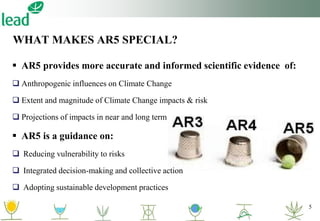
 AR5 provides more accurate and informed scientific evidence of:
 Anthropogenic influences on Climate Change
 Extent and magnitude of Climate Change impacts & risk
 Projections of impacts in near and long term
 AR5 is a guidance on:
 Reducing vulnerability to risks
 Integrated decision-making and collective action
 Adopting sustainable development practices
5
6
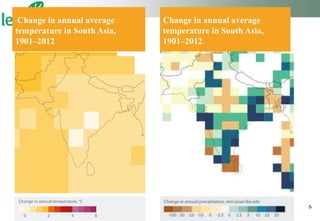
Change in annual average
temperature in South Asia,
1901–2012
Change in annual average
temperature in South Asia,
1901–2012
7
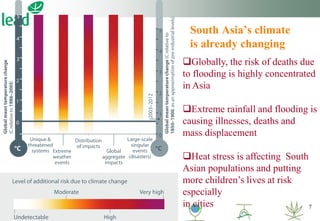
South Asia’s climate
is already changing
Globally, the risk of deaths due
to flooding is highly concentrated
in Asia
Extreme rainfall and flooding is
causing illnesses, deaths and
mass displacement
Heat stress is affecting South
Asian populations and putting
more children’s lives at risk
especially
in cities
8
9
10
In the Indo-Gangetic Plains
due to heat stress, yields of
wheat could fall by
50%.
THE AR5 PROJECTIONS FOR ASIA
2°C to >3°C
rise in average annual temperature
in South Asia by the 21st
century.
Oceans in subtropical and tropical
regions of Asia could warm under
all emissions scenarios.
Malnutrition could increase severe
stunting in children by
62%
in South Asia
In parts of Asia,
irrigation demand will
increase by
40%
Mitigation in agriculture, forestry and other land
use could contribute between 20% and 60%
by 2030
Between 2000 – 2010 transport
emissions increased by
42%
Adaptation can reduce
the risks
of climate change
Increased riverine,
coastal, and urban
flooding leading to
widespread damage
to infrastructure,
livelihoods and
settlements in Asia.
(medium
confidence)
Adaptation can
reduce the risks
of climate change
Increased risk of
heat-related
mortality
(high confidence)
Adaptation can
reduce the risks
of climate
change
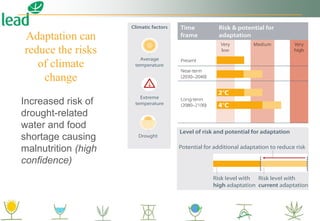
Increased risk of
drought-related
water and food
shortage causing
malnutrition (high
confidence)
Asia has many
adaptation
options
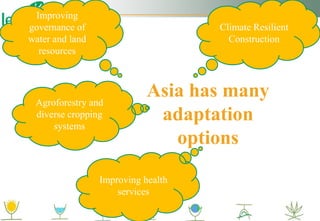
Asia has many
adaptation
options
Climate Resilient
Construction
Improving
governance of
water and land
resources
Agroforestry and
diverse cropping
systems
Improving health
services
IPCC AR5 for LAPA training

IPCC AR5 for LAPA training

  • 1.
    The IPCC AR-5: What thefuture holds for this region? June 2015 Areej Riaz
  • 2.
    What is IPCC An intergovernmental body set up by UNEP and WMO in 1988  It provides: 1. Scientific evidence base on Climate Change 2. Projections of Climate Change impacts 3. Set of scenarios and opportunities for Climate Change Adaptation and Mitigation 2
  • 3.
    IPCC reports arethe result of extensive work from scientists around the world. 1 Summary for Policymakers 1 Technical Summary 16 Chapters 235 Authors 900 Reviewers More than 2000 pages Close to 10,000 references More than 38,000 comments
  • 4.
    OVERVIEW OF ASSESSMENTREPORTS 4 ASSESSMENT REPORTS RELEASE (Year) First Assessment Report ( FAR) 1990 Second Assessment Report (SAR) 1996 Third Assessment Report ( TAR) 2001 Fourth Assessment Report ( AR4) 2007 Fifth Assessment Report (AR5) 2013
  • 5.
    WHAT MAKES AR5SPECIAL?  AR5 provides more accurate and informed scientific evidence of:  Anthropogenic influences on Climate Change  Extent and magnitude of Climate Change impacts & risk  Projections of impacts in near and long term  AR5 is a guidance on:  Reducing vulnerability to risks  Integrated decision-making and collective action  Adopting sustainable development practices 5
  • 6.
    6 Change in annualaverage temperature in South Asia, 1901–2012 Change in annual average temperature in South Asia, 1901–2012
  • 7.
    7 South Asia’s climate isalready changing Globally, the risk of deaths due to flooding is highly concentrated in Asia Extreme rainfall and flooding is causing illnesses, deaths and mass displacement Heat stress is affecting South Asian populations and putting more children’s lives at risk especially in cities
  • 8.
  • 9.
  • 10.
    10 In the Indo-GangeticPlains due to heat stress, yields of wheat could fall by 50%. THE AR5 PROJECTIONS FOR ASIA 2°C to >3°C rise in average annual temperature in South Asia by the 21st century. Oceans in subtropical and tropical regions of Asia could warm under all emissions scenarios. Malnutrition could increase severe stunting in children by 62% in South Asia In parts of Asia, irrigation demand will increase by 40% Mitigation in agriculture, forestry and other land use could contribute between 20% and 60% by 2030 Between 2000 – 2010 transport emissions increased by 42%
  • 11.
    Adaptation can reduce therisks of climate change Increased riverine, coastal, and urban flooding leading to widespread damage to infrastructure, livelihoods and settlements in Asia. (medium confidence)
  • 12.
    Adaptation can reduce therisks of climate change Increased risk of heat-related mortality (high confidence)
  • 13.
    Adaptation can reduce therisks of climate change Increased risk of drought-related water and food shortage causing malnutrition (high confidence)
  • 14.
  • 15.
    Asia has many adaptation options ClimateResilient Construction Improving governance of water and land resources Agroforestry and diverse cropping systems Improving health services