IP in IT
      FOCUS SESSION
Swapna Sundar, CEO, IP DOME
2 categories of computer software
(vis à vis ownership, use patterns and possibilities,
and IPimplications)

(a) Proprietary software: owned as private property by
    a company or individual software developer

(b) FLOSS (Free / Libre / Open Source Software)
    1. Free Software
     2.Open Source Software.


  11/25/2012           (c) swapna sundar, 2012          2
Proprietary software licensed under End User License
Agreement.

• cannot be copied, shared, modified, redistributed,
  or reverse engineered by other software
  developers or users.

• Their business model permits use of the software
  on only 1 computer and/or require extra fees for
  each additional computer or work station

Recommend application programmes which are
compatible with the code found in the operating
system.
 11/25/2012           (c) swapna sundar, 2012        3
FLOSS
• users must have open access to the source code
  over which no ownership is exercised

Free software (Copyleft Principle)

 Use the software however they wish

 fit it to their needs

 Redistribute it to other users for free, or at a
charge, not fixed beforehand, who could themselves
use it according to their own needs.

 11/25/2012               (c) swapna sundar, 2012   4
Open Source Initiative (OSI) principles:

1. No royalty or other fee
2. Availability of the source code.
3. Right to modify and create derivative works.
4. May require modified versions to be distributed as
the original version plus patches.
7. All rights granted must flow through to/with
redistributed versions.
8. The license applies to the program as a whole and
each of its components.
9. The license permits the distribution of open source
and closed source software together.

OS allows ownership of contribution.
 11/25/2012            (c) swapna sundar, 2012       5
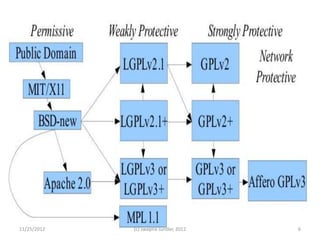
11/25/2012   (c) swapna sundar, 2012   6
Do You Want an Open Source License At All?

When you release s/w under OSS, you have no control over who get
to use it or how it is used. Even if you sell it, your customer can
redistribute it.

Do you want to give the right to proprietary forks - an new line of
development, independent of your own efforts. Not permitted under
GPL

Do you have to keep track of who is using the s/w for license fee?

Is the license you are currently using compatible with the OSS you
want?


   11/25/2012                 (c) swapna sundar, 2012                 7
Do you want contributors? Then you must pick a recognizable
license.

You can write your own license too.

Do you want to make a lot of money from a small pool of users?

ISSUES

Difficult to say what is a derivative work

s/w once released under OSS license cannot be taken back even
though © belongs to you

Attribution notices must be meticulously followed

11/25/2012                  (c) swapna sundar, 2012              8
JACOBSEN Vs. KATZER

Robert Jacobsen is a member of the Java Model Railroad Interface
(JMRI) Project, and Matthew Katzer, is the owner of a proprietary
vendor of model train software called KAMIND associates.

Katzer incorporated code written by Jacobsen into Katzer's software,
and deleted the copyright notices included in that software in the
process. From the F/OSS perspective, one of the most important
questions involved whether a developer of software that made its
code available for free - which, like most open source projects the
JMRI Project did - can collect damages for copyright infringement.

F/OSS licences include obligation of a commercial developer to "give
back" its own changes to the code for the benefit of others and an
obligation to acknowledge the authorship of those that had created
the earlier code.
   11/25/2012                (c) swapna sundar, 2012                9
The court found in favour of Jacobsen on three key points:

1. The code in question was sufficiently original to be entitled to
copyright protection. While not unique to F/OSS code, this was a
legal issue on which Jacobsen had to prevail in order to assert
claims under copyright law.

2. While the JMRI Project made its code available for free, there
was "evidence in the record attributing a monetary value for the
actual work performed by the contributors to the JMRI project,"
thus laying the basis for monetary damages.

3. The removal of the copyright and authorship data contained in
    the pirated code was a violation of the Digital Millennium
    Copyright Act, thus providing a basis for suit for that action in
    violation of the JMRI license.
Katzer settled paying Jacobsen US$100,000.
 11/25/2012                  (c) swapna sundar, 2012                  10
Layout designs (topographies) of integrated circuits are protected
under sui generis Law. India has the Semiconductor Integrated Circuits
Layout Design Act, 2000 to project unique novel and original
Semiconductor Integrated Circuit. Term: 10 years from date of filing or
date of first exploitation(two years).

Defined as a product having transistors and other circuitry elements,
which are inseparably formed on a semiconductor material or an
insulating material or inside the semiconductor material and designed
to perform an electronic circuitry function.

Semiconductor intellectual property core, or IP block - a reusable
unit of logic, cell, or chip layout design may be licensed to another
party or can be owned and used by a single party alone.

There are also providers of open source cores.
OpenCores.org offers a wide variety of designs.
   11/25/2012                  (c) swapna sundar, 2012                  11
A database right is considered to be a property right in
EU and UK, comparable to but distinct from copyright,
to recognise the investment made in compiling a
database, even when this does not involve the
'creative' aspect. TERM: 15 years.

Protection for databases in India which provided under
the traditional copyright regime which includes under
section 2 (o) …compilations including computer
databases. Term: 60 years


11/25/2012             (c) swapna sundar, 2012             12
In India, a person is entitled to a patent if

1. He is the owner of the invention
2. the invention is the proper subject matter for a patent, and
3. the invention is "useful", "new", and “inventive“
4. The invention should not have been published with some narrow
exceptions

In India, s/w per se is not a patentable subject matter

In re Bilsky: "the invention is not implemented on a specific
apparatus and merely manipulates [an] abstract idea and solves a
purely mathematical problem without any limitation to a practical
application, therefore, the invention is not directed to the
technological arts."


  11/25/2012                   (c) swapna sundar, 2012              13
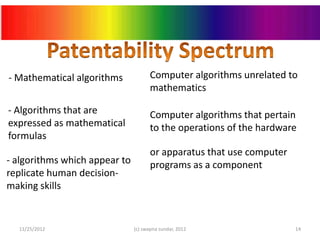
- Mathematical algorithms             Computer algorithms unrelated to
                                      mathematics

- Algorithms that are                 Computer algorithms that pertain
expressed as mathematical             to the operations of the hardware
formulas
                                      or apparatus that use computer
- algorithms which appear to          programs as a component
replicate human decision-
making skills


  11/25/2012                   (c) swapna sundar, 2012                 14
Software copyright is not essentially different from any other sort of
copyright. Specifically, it is unlawful for anyone other than the owner
of the rights to run the program, copy the program, modify the
program or distribute the program, except with the permission of the
rights owner.

No registration, copyright notice, or other such formality is needed to
establish copyright. Copyright protection is automatic.

Copyright protects only the computer program itself, and not the
ideas behind the program. That is to say, it is perfectly permissible to
take a computer program written by someone else, and write
another that does the same thing.

Ownership: Employer/Programmer; Moral rights: Programmer

 11/25/2012                  (c) swapna sundar, 2012                 15
Wholly unlicensed use: for example, copying a piece of software from
a friend, or over the Internet, etc., where the licence for the software
does not explicitly permit this.

Overuse: for example, buying a piece of software licensed for one
computer, and installing it on two.

Failure to have a licence assigned, or to relicense: if you acquire
hardware second-hand, this does not necessarily transfer all software
licenses, and you must take steps to ensure that your use is lawful.

Shareware abuse: where software is licensed "for evaluation
purposes only" or the like, it is copyright infringement to exceed
these terms.

Obtaining software fraudulently: for example, getting a reduced rate
by11/25/2012
   pretending that your business issundar, 2012
                            (c) swapna a educational institution. 16
"Warez" copyright infringement: making warez copies, running
warez sites, and the people who download and use warez copies
are all copyright infringers.

Illicit "special offers" from hardware vendors: a hardware vendor
sells a computer with unlicensed software installed.

Making an unlawful copy of software on a burnable CD-ROM, or the
like, for the purpose of giving it to someone else. Making a back-up
copy is usually lawful.

Counterfeiting: this is the making of unlawful copies of software on
burnable CD-ROM, or the like, on a commercial scale, and having
them sold under the pretence that they are lawful copies (by
putting them in deceptive packaging, etc.)

 11/25/2012                 (c) swapna sundar, 2012                 17
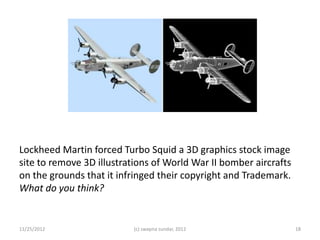
Lockheed Martin forced Turbo Squid a 3D graphics stock image
site to remove 3D illustrations of World War II bomber aircrafts
on the grounds that it infringed their copyright and Trademark.
What do you think?


11/25/2012                (c) swapna sundar, 2012                  18
11/25/2012   (c) swapna sundar, 2012   19
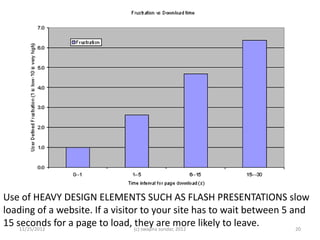
Use of HEAVY DESIGN ELEMENTS SUCH AS FLASH PRESENTATIONS slow
loading of a website. If a visitor to your site has to wait between 5 and
15 seconds for a page to load, (c) swapnaare more likely to leave.
    11/25/2012
                                 they sundar, 2012                     20
11/25/2012   (c) swapna sundar, 2012   21
11/25/2012   (c) swapna sundar, 2012   22
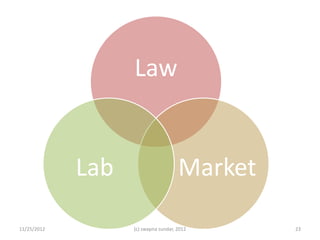
Law


             Lab                      Market

11/25/2012         (c) swapna sundar, 2012     23
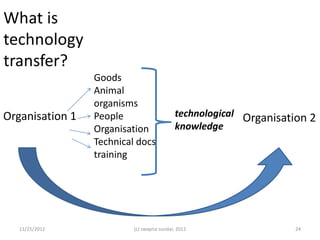
Goods
                 Animal
                 organisms
Organisation 1   People                     technological Organisation 2
                 Organisation               knowledge
                 Technical docs
                 training


   11/25/2012             (c) swapna sundar, 2012                  24
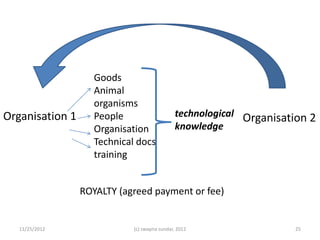
Goods
                    Animal
                    organisms
Organisation 1      People                     technological Organisation 2
                    Organisation               knowledge
                    Technical docs
                    training


                 ROYALTY (agreed payment or fee)


   11/25/2012                (c) swapna sundar, 2012                  25
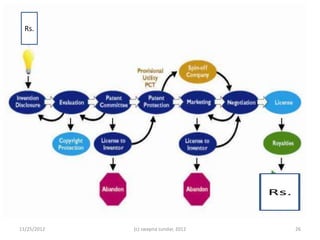
Rs.


11/25/2012   (c) swapna sundar, 2012   26
11/25/2012   (c) swapna sundar, 2012   27
11/25/2012   (c) swapna sundar, 2012   28
11/25/2012   (c) swapna sundar, 2012   29
11/25/2012   (c) swapna sundar, 2012   30
© Linda Katehi, University
11/25/2012                   (c) swapna sundar, 2012   31
of California, 2010
11/25/2012   (c) swapna sundar, 2012   32
11/25/2012   (c) swapna sundar, 2012   33
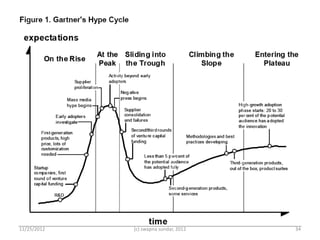
11/25/2012   (c) swapna sundar, 2012   34
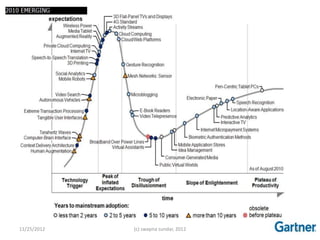
11/25/2012   (c) swapna sundar, 2012   35
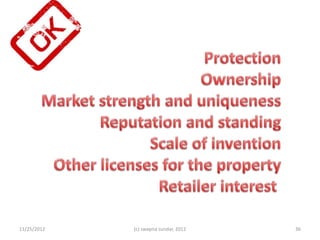
11/25/2012   (c) swapna sundar, 2012   36
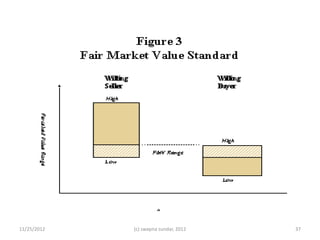
11/25/2012   (c) swapna sundar, 2012   37
11/25/2012   (c) swapna sundar, 2012   38
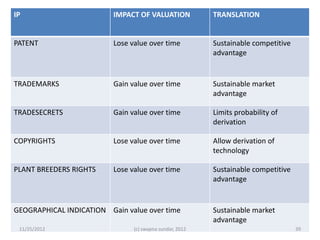
IP                        IMPACT OF VALUATION             TRANSLATION


PATENT                    Lose value over time            Sustainable competitive
                                                          advantage


TRADEMARKS                Gain value over time            Sustainable market
                                                          advantage

TRADESECRETS              Gain value over time            Limits probability of
                                                          derivation

COPYRIGHTS                Lose value over time            Allow derivation of
                                                          technology

PLANT BREEDERS RIGHTS     Lose value over time            Sustainable competitive
                                                          advantage


GEOGRAPHICAL INDICATION Gain value over time              Sustainable market
                                                          advantage
 11/25/2012                     (c) swapna sundar, 2012                             39
11/25/2012   (c) swapna sundar, 2012   40
The Valuation Purpose refers to the primary usage of the valuation analysis.

Transaction Strategy: A strategic purpose for valuing IP is when one is
considering buying, selling, or transferring the asset in a licensing arrangement
or acquisition. Usually, the transaction strategy end-purpose is a ‘go versus no
go’ recommendation. That is, at what price am I willing to enter into this
proposed transaction?

Financial Reporting: Valuing IP and other prescribed intangible assets for
reporting on public financial statements. The end deliverable is usually a report
specifying the value and change in value of the subject assets.

Litigation: A high-profile purpose of intellectual property valuation is to
compute damage awards in an infringement lawsuit.

Bankruptcy: During a corporate bankruptcy and reorganization, often the most
valuable assets remaining are IP-related. Valuation is required by the
Bankruptcy Court to properly dispose of the assets and reorganize the company,
if necessary.

11/25/2012                        (c) swapna sundar, 2012                      41
The Foundation of IP valuation analysis consists of four building blocks,
     each with an associated question:
     •Purpose – Why are we valuing the asset?
     •Description – What is the asset?
     •Premise – How will the asset be used?
     •Standard – Who is the assumed buyer of the asset?

     1. For instance, a litigation matter requires complete and thorough
        documentation whereas for a technology transfer valuation, a lower
        level of documentation will suffice, generally.
     2. understanding these foundational questions will ensure that the
        valuation will address all relevant considerations.


11/25/2012                       (c) swapna sundar, 2012                         42
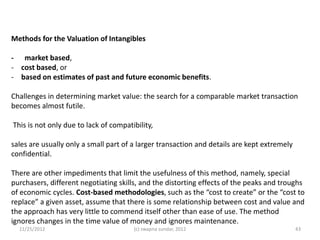
Methods for the Valuation of Intangibles

- market based,
- cost based, or
- based on estimates of past and future economic benefits.

Challenges in determining market value: the search for a comparable market transaction
becomes almost futile.

This is not only due to lack of compatibility,

sales are usually only a small part of a larger transaction and details are kept extremely
confidential.

There are other impediments that limit the usefulness of this method, namely, special
purchasers, different negotiating skills, and the distorting effects of the peaks and troughs
of economic cycles. Cost-based methodologies, such as the “cost to create” or the “cost to
replace” a given asset, assume that there is some relationship between cost and value and
the approach has very little to commend itself other than ease of use. The method
ignores changes in the time value of money and ignores maintenance.
  11/25/2012                           (c) swapna sundar, 2012                               43
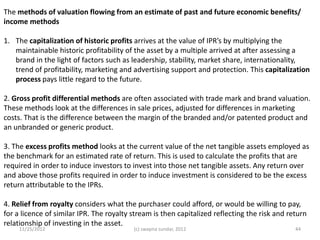
The methods of valuation flowing from an estimate of past and future economic benefits/
income methods

1. The capitalization of historic profits arrives at the value of IPR’s by multiplying the
   maintainable historic profitability of the asset by a multiple arrived at after assessing a
   brand in the light of factors such as leadership, stability, market share, internationality,
   trend of profitability, marketing and advertising support and protection. This capitalization
   process pays little regard to the future.

2. Gross profit differential methods are often associated with trade mark and brand valuation.
These methods look at the differences in sale prices, adjusted for differences in marketing
costs. That is the difference between the margin of the branded and/or patented product and
an unbranded or generic product.

3. The excess profits method looks at the current value of the net tangible assets employed as
the benchmark for an estimated rate of return. This is used to calculate the profits that are
required in order to induce investors to invest into those net tangible assets. Any return over
and above those profits required in order to induce investment is considered to be the excess
return attributable to the IPRs.

4. Relief from royalty considers what the purchaser could afford, or would be willing to pay,
for a licence of similar IPR. The royalty stream is then capitalized reflecting the risk and return
relationship of investing in the asset.
     11/25/2012                           (c) swapna sundar, 2012                              44
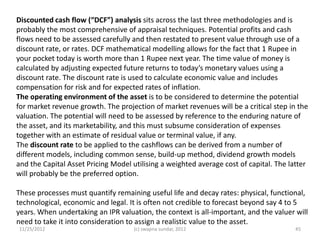
Discounted cash flow (“DCF”) analysis sits across the last three methodologies and is
probably the most comprehensive of appraisal techniques. Potential profits and cash
flows need to be assessed carefully and then restated to present value through use of a
discount rate, or rates. DCF mathematical modelling allows for the fact that 1 Rupee in
your pocket today is worth more than 1 Rupee next year. The time value of money is
calculated by adjusting expected future returns to today’s monetary values using a
discount rate. The discount rate is used to calculate economic value and includes
compensation for risk and for expected rates of inflation.
The operating environment of the asset is to be considered to determine the potential
for market revenue growth. The projection of market revenues will be a critical step in the
valuation. The potential will need to be assessed by reference to the enduring nature of
the asset, and its marketability, and this must subsume consideration of expenses
together with an estimate of residual value or terminal value, if any.
The discount rate to be applied to the cashflows can be derived from a number of
different models, including common sense, build-up method, dividend growth models
and the Capital Asset Pricing Model utilising a weighted average cost of capital. The latter
will probably be the preferred option.

These processes must quantify remaining useful life and decay rates: physical, functional,
technological, economic and legal. It is often not credible to forecast beyond say 4 to 5
years. When undertaking an IPR valuation, the context is all-important, and the valuer will
need to take it into consideration to assign a realistic value to the asset.
11/25/2012                           (c) swapna sundar, 2012                           45
IP STRATEGY ADVISORS
             At the intersection of the Law, the Lab and the Market


                       No. 7/8 Flowers III Lane
                           Chennai 600084
                       Phone: 0091 44 26430474
                         Mobile: 09841282396
                       Email: swapna@ipdome.in
                            www.ipdome.in


11/25/2012                   (c) swapna sundar, 2012                  46

Ip in it

  • 1.
    IP in IT FOCUS SESSION Swapna Sundar, CEO, IP DOME
  • 2.
    2 categories ofcomputer software (vis à vis ownership, use patterns and possibilities, and IPimplications) (a) Proprietary software: owned as private property by a company or individual software developer (b) FLOSS (Free / Libre / Open Source Software) 1. Free Software 2.Open Source Software. 11/25/2012 (c) swapna sundar, 2012 2
  • 3.
    Proprietary software licensedunder End User License Agreement. • cannot be copied, shared, modified, redistributed, or reverse engineered by other software developers or users. • Their business model permits use of the software on only 1 computer and/or require extra fees for each additional computer or work station Recommend application programmes which are compatible with the code found in the operating system. 11/25/2012 (c) swapna sundar, 2012 3
  • 4.
    FLOSS • users musthave open access to the source code over which no ownership is exercised Free software (Copyleft Principle)  Use the software however they wish  fit it to their needs  Redistribute it to other users for free, or at a charge, not fixed beforehand, who could themselves use it according to their own needs. 11/25/2012 (c) swapna sundar, 2012 4
  • 5.
    Open Source Initiative(OSI) principles: 1. No royalty or other fee 2. Availability of the source code. 3. Right to modify and create derivative works. 4. May require modified versions to be distributed as the original version plus patches. 7. All rights granted must flow through to/with redistributed versions. 8. The license applies to the program as a whole and each of its components. 9. The license permits the distribution of open source and closed source software together. OS allows ownership of contribution. 11/25/2012 (c) swapna sundar, 2012 5
  • 6.
    11/25/2012 (c) swapna sundar, 2012 6
  • 7.
    Do You Wantan Open Source License At All? When you release s/w under OSS, you have no control over who get to use it or how it is used. Even if you sell it, your customer can redistribute it. Do you want to give the right to proprietary forks - an new line of development, independent of your own efforts. Not permitted under GPL Do you have to keep track of who is using the s/w for license fee? Is the license you are currently using compatible with the OSS you want? 11/25/2012 (c) swapna sundar, 2012 7
  • 8.
    Do you wantcontributors? Then you must pick a recognizable license. You can write your own license too. Do you want to make a lot of money from a small pool of users? ISSUES Difficult to say what is a derivative work s/w once released under OSS license cannot be taken back even though © belongs to you Attribution notices must be meticulously followed 11/25/2012 (c) swapna sundar, 2012 8
  • 9.
    JACOBSEN Vs. KATZER RobertJacobsen is a member of the Java Model Railroad Interface (JMRI) Project, and Matthew Katzer, is the owner of a proprietary vendor of model train software called KAMIND associates. Katzer incorporated code written by Jacobsen into Katzer's software, and deleted the copyright notices included in that software in the process. From the F/OSS perspective, one of the most important questions involved whether a developer of software that made its code available for free - which, like most open source projects the JMRI Project did - can collect damages for copyright infringement. F/OSS licences include obligation of a commercial developer to "give back" its own changes to the code for the benefit of others and an obligation to acknowledge the authorship of those that had created the earlier code. 11/25/2012 (c) swapna sundar, 2012 9
  • 10.
    The court foundin favour of Jacobsen on three key points: 1. The code in question was sufficiently original to be entitled to copyright protection. While not unique to F/OSS code, this was a legal issue on which Jacobsen had to prevail in order to assert claims under copyright law. 2. While the JMRI Project made its code available for free, there was "evidence in the record attributing a monetary value for the actual work performed by the contributors to the JMRI project," thus laying the basis for monetary damages. 3. The removal of the copyright and authorship data contained in the pirated code was a violation of the Digital Millennium Copyright Act, thus providing a basis for suit for that action in violation of the JMRI license. Katzer settled paying Jacobsen US$100,000. 11/25/2012 (c) swapna sundar, 2012 10
  • 11.
    Layout designs (topographies)of integrated circuits are protected under sui generis Law. India has the Semiconductor Integrated Circuits Layout Design Act, 2000 to project unique novel and original Semiconductor Integrated Circuit. Term: 10 years from date of filing or date of first exploitation(two years). Defined as a product having transistors and other circuitry elements, which are inseparably formed on a semiconductor material or an insulating material or inside the semiconductor material and designed to perform an electronic circuitry function. Semiconductor intellectual property core, or IP block - a reusable unit of logic, cell, or chip layout design may be licensed to another party or can be owned and used by a single party alone. There are also providers of open source cores. OpenCores.org offers a wide variety of designs. 11/25/2012 (c) swapna sundar, 2012 11
  • 12.
    A database rightis considered to be a property right in EU and UK, comparable to but distinct from copyright, to recognise the investment made in compiling a database, even when this does not involve the 'creative' aspect. TERM: 15 years. Protection for databases in India which provided under the traditional copyright regime which includes under section 2 (o) …compilations including computer databases. Term: 60 years 11/25/2012 (c) swapna sundar, 2012 12
  • 13.
    In India, aperson is entitled to a patent if 1. He is the owner of the invention 2. the invention is the proper subject matter for a patent, and 3. the invention is "useful", "new", and “inventive“ 4. The invention should not have been published with some narrow exceptions In India, s/w per se is not a patentable subject matter In re Bilsky: "the invention is not implemented on a specific apparatus and merely manipulates [an] abstract idea and solves a purely mathematical problem without any limitation to a practical application, therefore, the invention is not directed to the technological arts." 11/25/2012 (c) swapna sundar, 2012 13
  • 14.
    - Mathematical algorithms Computer algorithms unrelated to mathematics - Algorithms that are Computer algorithms that pertain expressed as mathematical to the operations of the hardware formulas or apparatus that use computer - algorithms which appear to programs as a component replicate human decision- making skills 11/25/2012 (c) swapna sundar, 2012 14
  • 15.
    Software copyright isnot essentially different from any other sort of copyright. Specifically, it is unlawful for anyone other than the owner of the rights to run the program, copy the program, modify the program or distribute the program, except with the permission of the rights owner. No registration, copyright notice, or other such formality is needed to establish copyright. Copyright protection is automatic. Copyright protects only the computer program itself, and not the ideas behind the program. That is to say, it is perfectly permissible to take a computer program written by someone else, and write another that does the same thing. Ownership: Employer/Programmer; Moral rights: Programmer 11/25/2012 (c) swapna sundar, 2012 15
  • 16.
    Wholly unlicensed use:for example, copying a piece of software from a friend, or over the Internet, etc., where the licence for the software does not explicitly permit this. Overuse: for example, buying a piece of software licensed for one computer, and installing it on two. Failure to have a licence assigned, or to relicense: if you acquire hardware second-hand, this does not necessarily transfer all software licenses, and you must take steps to ensure that your use is lawful. Shareware abuse: where software is licensed "for evaluation purposes only" or the like, it is copyright infringement to exceed these terms. Obtaining software fraudulently: for example, getting a reduced rate by11/25/2012 pretending that your business issundar, 2012 (c) swapna a educational institution. 16
  • 17.
    "Warez" copyright infringement:making warez copies, running warez sites, and the people who download and use warez copies are all copyright infringers. Illicit "special offers" from hardware vendors: a hardware vendor sells a computer with unlicensed software installed. Making an unlawful copy of software on a burnable CD-ROM, or the like, for the purpose of giving it to someone else. Making a back-up copy is usually lawful. Counterfeiting: this is the making of unlawful copies of software on burnable CD-ROM, or the like, on a commercial scale, and having them sold under the pretence that they are lawful copies (by putting them in deceptive packaging, etc.) 11/25/2012 (c) swapna sundar, 2012 17
  • 18.
    Lockheed Martin forcedTurbo Squid a 3D graphics stock image site to remove 3D illustrations of World War II bomber aircrafts on the grounds that it infringed their copyright and Trademark. What do you think? 11/25/2012 (c) swapna sundar, 2012 18
  • 19.
    11/25/2012 (c) swapna sundar, 2012 19
  • 20.
    Use of HEAVYDESIGN ELEMENTS SUCH AS FLASH PRESENTATIONS slow loading of a website. If a visitor to your site has to wait between 5 and 15 seconds for a page to load, (c) swapnaare more likely to leave. 11/25/2012 they sundar, 2012 20
  • 21.
    11/25/2012 (c) swapna sundar, 2012 21
  • 22.
    11/25/2012 (c) swapna sundar, 2012 22
  • 23.
    Law Lab Market 11/25/2012 (c) swapna sundar, 2012 23
  • 24.
    Goods Animal organisms Organisation 1 People technological Organisation 2 Organisation knowledge Technical docs training 11/25/2012 (c) swapna sundar, 2012 24
  • 25.
    Goods Animal organisms Organisation 1 People technological Organisation 2 Organisation knowledge Technical docs training ROYALTY (agreed payment or fee) 11/25/2012 (c) swapna sundar, 2012 25
  • 26.
    Rs. 11/25/2012 (c) swapna sundar, 2012 26
  • 27.
    11/25/2012 (c) swapna sundar, 2012 27
  • 28.
    11/25/2012 (c) swapna sundar, 2012 28
  • 29.
    11/25/2012 (c) swapna sundar, 2012 29
  • 30.
    11/25/2012 (c) swapna sundar, 2012 30
  • 31.
    © Linda Katehi,University 11/25/2012 (c) swapna sundar, 2012 31 of California, 2010
  • 32.
    11/25/2012 (c) swapna sundar, 2012 32
  • 33.
    11/25/2012 (c) swapna sundar, 2012 33
  • 34.
    11/25/2012 (c) swapna sundar, 2012 34
  • 35.
    11/25/2012 (c) swapna sundar, 2012 35
  • 36.
    11/25/2012 (c) swapna sundar, 2012 36
  • 37.
    11/25/2012 (c) swapna sundar, 2012 37
  • 38.
    11/25/2012 (c) swapna sundar, 2012 38
  • 39.
    IP IMPACT OF VALUATION TRANSLATION PATENT Lose value over time Sustainable competitive advantage TRADEMARKS Gain value over time Sustainable market advantage TRADESECRETS Gain value over time Limits probability of derivation COPYRIGHTS Lose value over time Allow derivation of technology PLANT BREEDERS RIGHTS Lose value over time Sustainable competitive advantage GEOGRAPHICAL INDICATION Gain value over time Sustainable market advantage 11/25/2012 (c) swapna sundar, 2012 39
  • 40.
    11/25/2012 (c) swapna sundar, 2012 40
  • 41.
    The Valuation Purposerefers to the primary usage of the valuation analysis. Transaction Strategy: A strategic purpose for valuing IP is when one is considering buying, selling, or transferring the asset in a licensing arrangement or acquisition. Usually, the transaction strategy end-purpose is a ‘go versus no go’ recommendation. That is, at what price am I willing to enter into this proposed transaction? Financial Reporting: Valuing IP and other prescribed intangible assets for reporting on public financial statements. The end deliverable is usually a report specifying the value and change in value of the subject assets. Litigation: A high-profile purpose of intellectual property valuation is to compute damage awards in an infringement lawsuit. Bankruptcy: During a corporate bankruptcy and reorganization, often the most valuable assets remaining are IP-related. Valuation is required by the Bankruptcy Court to properly dispose of the assets and reorganize the company, if necessary. 11/25/2012 (c) swapna sundar, 2012 41
  • 42.
    The Foundation ofIP valuation analysis consists of four building blocks, each with an associated question: •Purpose – Why are we valuing the asset? •Description – What is the asset? •Premise – How will the asset be used? •Standard – Who is the assumed buyer of the asset? 1. For instance, a litigation matter requires complete and thorough documentation whereas for a technology transfer valuation, a lower level of documentation will suffice, generally. 2. understanding these foundational questions will ensure that the valuation will address all relevant considerations. 11/25/2012 (c) swapna sundar, 2012 42
  • 43.
    Methods for theValuation of Intangibles - market based, - cost based, or - based on estimates of past and future economic benefits. Challenges in determining market value: the search for a comparable market transaction becomes almost futile. This is not only due to lack of compatibility, sales are usually only a small part of a larger transaction and details are kept extremely confidential. There are other impediments that limit the usefulness of this method, namely, special purchasers, different negotiating skills, and the distorting effects of the peaks and troughs of economic cycles. Cost-based methodologies, such as the “cost to create” or the “cost to replace” a given asset, assume that there is some relationship between cost and value and the approach has very little to commend itself other than ease of use. The method ignores changes in the time value of money and ignores maintenance. 11/25/2012 (c) swapna sundar, 2012 43
  • 44.
    The methods ofvaluation flowing from an estimate of past and future economic benefits/ income methods 1. The capitalization of historic profits arrives at the value of IPR’s by multiplying the maintainable historic profitability of the asset by a multiple arrived at after assessing a brand in the light of factors such as leadership, stability, market share, internationality, trend of profitability, marketing and advertising support and protection. This capitalization process pays little regard to the future. 2. Gross profit differential methods are often associated with trade mark and brand valuation. These methods look at the differences in sale prices, adjusted for differences in marketing costs. That is the difference between the margin of the branded and/or patented product and an unbranded or generic product. 3. The excess profits method looks at the current value of the net tangible assets employed as the benchmark for an estimated rate of return. This is used to calculate the profits that are required in order to induce investors to invest into those net tangible assets. Any return over and above those profits required in order to induce investment is considered to be the excess return attributable to the IPRs. 4. Relief from royalty considers what the purchaser could afford, or would be willing to pay, for a licence of similar IPR. The royalty stream is then capitalized reflecting the risk and return relationship of investing in the asset. 11/25/2012 (c) swapna sundar, 2012 44
  • 45.
    Discounted cash flow(“DCF”) analysis sits across the last three methodologies and is probably the most comprehensive of appraisal techniques. Potential profits and cash flows need to be assessed carefully and then restated to present value through use of a discount rate, or rates. DCF mathematical modelling allows for the fact that 1 Rupee in your pocket today is worth more than 1 Rupee next year. The time value of money is calculated by adjusting expected future returns to today’s monetary values using a discount rate. The discount rate is used to calculate economic value and includes compensation for risk and for expected rates of inflation. The operating environment of the asset is to be considered to determine the potential for market revenue growth. The projection of market revenues will be a critical step in the valuation. The potential will need to be assessed by reference to the enduring nature of the asset, and its marketability, and this must subsume consideration of expenses together with an estimate of residual value or terminal value, if any. The discount rate to be applied to the cashflows can be derived from a number of different models, including common sense, build-up method, dividend growth models and the Capital Asset Pricing Model utilising a weighted average cost of capital. The latter will probably be the preferred option. These processes must quantify remaining useful life and decay rates: physical, functional, technological, economic and legal. It is often not credible to forecast beyond say 4 to 5 years. When undertaking an IPR valuation, the context is all-important, and the valuer will need to take it into consideration to assign a realistic value to the asset. 11/25/2012 (c) swapna sundar, 2012 45
  • 46.
    IP STRATEGY ADVISORS At the intersection of the Law, the Lab and the Market No. 7/8 Flowers III Lane Chennai 600084 Phone: 0091 44 26430474 Mobile: 09841282396 Email: swapna@ipdome.in www.ipdome.in 11/25/2012 (c) swapna sundar, 2012 46