This	
  project	
  has	
  received	
  funding	
  from	
  the	
  European	
  Union’s	
  Horizon	
  2020	
  
research,	
  and	
  innova=on	
  programme	
  under	
  grant	
  agreement	
  n°645775	
  
Wai=ng	
  for	
  the	
  organiser…	
  
The	
  webinar	
  will	
  begin	
  shortly	
  
This	
  project	
  has	
  received	
  funding	
  from	
  the	
  European	
  Union’s	
  Horizon	
  2020	
  
research,	
  and	
  innova=on	
  programme	
  under	
  grant	
  agreement	
  n°645775	
  
R&D	
  in	
  China	
  and	
  Co-­‐funding	
  for	
  
Horizon	
  2020	
  
3	
  
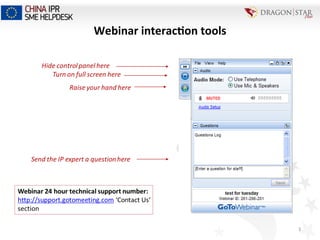
Webinar	
  interac+on	
  tools	
  
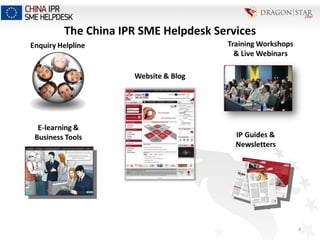
The	
  China	
  IPR	
  SME	
  Helpdesk	
  Services	
  
4	
  
5	
  
  Start	
  Date:	
  1/2/2015,	
  End	
  Date:	
  31/1/2018	
  
  Based	
   upon	
   the	
   outputs	
   and	
   the	
   established	
   mechanism	
   of	
   the	
  
previous	
  DRAGON-­‐STAR	
  project	
  
  The	
   DRAGON-­‐STARPLUS	
   is	
   supported	
   by	
   European	
   Commission	
  
(H2020),	
  to	
  provide	
  services	
  on	
  three	
  levels:	
  
•  To	
   support	
   the	
   European	
   and	
   Chinese	
   research	
   communi=es	
   to	
  
establish	
  collabora=ons	
  under	
  Horizon	
  2020	
  and	
  beyond.	
  
•  To	
  provide	
  a	
  coopera=on	
  pla^orm	
  and	
  tools	
  to	
  policy	
  makers,	
  aiming	
  
ul=mately	
  to	
  support	
  and	
  enhance	
  the	
  bilateral	
  coopera=on,	
  through	
  
the	
  concept	
  of	
  mutual	
  benefit	
  
•  To	
  provide	
  a	
  coopera=on	
  pla^orm	
  to	
  funding	
  agencies	
  for	
  exchanging	
  
best	
  prac=ces	
  and	
  for	
  planning	
  joint	
  ac=vi=es.	
  
Dragon	
  Star	
  Plus	
  
This	
  project	
  has	
  received	
  funding	
  from	
  the	
  European	
  Union’s	
  Horizon	
  2020	
  
research,	
  and	
  innova=on	
  programme	
  under	
  grant	
  agreement	
  n°645775	
  
The	
  IP	
  implica=ons	
  of	
  
undertaking	
  R&D	
  in	
  China	
  
Dr	
  .Thomas	
  PaBloch,	
  Partner	
  at	
  Taylor	
  Wessing,	
  June	
  
15th,	
  2016	
  
7	
  
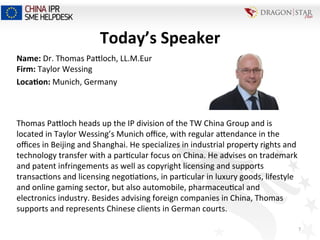
Name:	
  Dr.	
  Thomas	
  Pacloch,	
  LL.M.Eur	
  
Firm:	
  Taylor	
  Wessing	
  
Loca+on:	
  Munich,	
  Germany	


Thomas	
  Pacloch	
  heads	
  up	
  the	
  IP	
  division	
  of	
  the	
  TW	
  China	
  Group	
  and	
  is	
  
located	
  in	
  Taylor	
  Wessing’s	
  Munich	
  office,	
  with	
  regular	
  acendance	
  in	
  the	
  
offices	
  in	
  Beijing	
  and	
  Shanghai.	
  He	
  specializes	
  in	
  industrial	
  property	
  rights	
  and	
  
technology	
  transfer	
  with	
  a	
  par=cular	
  focus	
  on	
  China.	
  He	
  advises	
  on	
  trademark	
  
and	
  patent	
  infringements	
  as	
  well	
  as	
  copyright	
  licensing	
  and	
  supports	
  
transac=ons	
  and	
  licensing	
  nego=a=ons,	
  in	
  par=cular	
  in	
  luxury	
  goods,	
  lifestyle	
  
and	
  online	
  gaming	
  sector,	
  but	
  also	
  automobile,	
  pharmaceu=cal	
  and	
  
electronics	
  industry.	
  Besides	
  advising	
  foreign	
  companies	
  in	
  China,	
  Thomas	
  
supports	
  and	
  represents	
  Chinese	
  clients	
  in	
  German	
  courts.	


Today’s	
  Speaker	
  
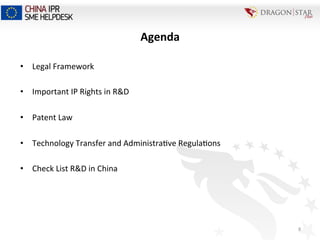
•  Legal	
  Framework	
  
•  Important	
  IP	
  Rights	
  in	
  R&D	
  	
  
•  Patent	
  Law	
  
•  Technology	
  Transfer	
  and	
  Administra=ve	
  Regula=ons	
  
•  Check	
  List	
  R&D	
  in	
  China	
  
8	
  
Agenda	
  
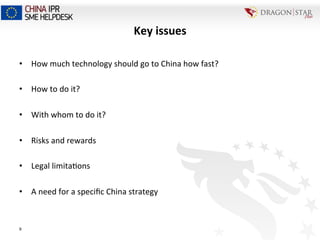
9
Key	
  issues	
  
•  How	
  much	
  technology	
  should	
  go	
  to	
  China	
  how	
  fast?	
  
•  How	
  to	
  do	
  it?	
  
•  With	
  whom	
  to	
  do	
  it?	
  
•  Risks	
  and	
  rewards	


•  Legal	
  limita=ons	
  
•  A	
  need	
  for	
  a	
  specific	
  China	
  strategy	
  
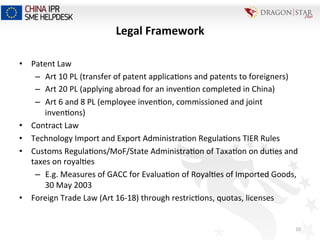
Legal	
  Framework	
  	
  
•  Patent	
  Law	
  
–  Art	
  10	
  PL	
  (transfer	
  of	
  patent	
  applica=ons	
  and	
  patents	
  to	
  foreigners)	
  
–  Art	
  20	
  PL	
  (applying	
  abroad	
  for	
  an	
  inven=on	
  completed	
  in	
  China)	
  
–  Art	
  6	
  and	
  8	
  PL	
  (employee	
  inven=on,	
  commissioned	
  and	
  joint	
  
inven=ons)	
  
•  Contract	
  Law	
  
•  Technology	
  Import	
  and	
  Export	
  Administra=on	
  Regula=ons	
  TIER	
  Rules	
  
•  Customs	
  Regula=ons/MoF/State	
  Administra=on	
  of	
  Taxa=on	
  on	
  du=es	
  and	
  
taxes	
  on	
  royal=es	
  
–  E.g.	
  Measures	
  of	
  GACC	
  for	
  Evalua=on	
  of	
  Royal=es	
  of	
  Imported	
  Goods,	
  
30	
  May	
  2003	
  
•  Foreign	
  Trade	
  Law	
  (Art	
  16-­‐18)	
  through	
  restric=ons,	
  quotas,	
  licenses	


10	
  
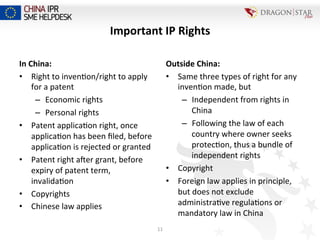
11	
  
Important	
  IP	
  Rights	
  
In	
  China:	
  
•  Right	
  to	
  inven=on/right	
  to	
  apply	
  
for	
  a	
  patent	
  
–  Economic	
  rights	
  
–  Personal	
  rights	
  
•  Patent	
  applica=on	
  right,	
  once	
  
applica=on	
  has	
  been	
  filed,	
  before	
  
applica=on	
  is	
  rejected	
  or	
  granted	
  
•  Patent	
  right	
  aier	
  grant,	
  before	
  
expiry	
  of	
  patent	
  term,	
  
invalida=on	
  
•  Copyrights	
  
•  Chinese	
  law	
  applies	
  
Outside	
  China:	
  
•  Same	
  three	
  types	
  of	
  right	
  for	
  any	
  
inven=on	
  made,	
  but	
  	
  
–  Independent	
  from	
  rights	
  in	
  
China	
  
–  Following	
  the	
  law	
  of	
  each	
  
country	
  where	
  owner	
  seeks	
  
protec=on,	
  thus	
  a	
  bundle	
  of	
  
independent	
  rights	
  
•  Copyright	
  
•  Foreign	
  law	
  applies	
  in	
  principle,	
  
but	
  does	
  not	
  exclude	
  
administra=ve	
  regula=ons	
  or	
  
mandatory	
  law	
  in	
  China	
  
Patent	
  Law	
  and	
  transfer	
  of	
  patents	
  and	
  patent	
  
applica=ons	
  
•  Any	
  transfer	
  of	
  patents	
  or	
  patent	
  applica=ons	
  in	
  China	
  to	
  a	
  foreigner	
  
requires	
  approval/registra=on	
  by	
  SIPO	
  
–  Prior	
  compliance	
  with	
  TIER	
  condi=on	
  for	
  registra=on	
  of	
  transfer	
  
–  Transfer	
  only	
  valid	
  with	
  successful	
  registra=on	
  
•  No	
  SIPO	
  approval	
  necessary	
  for	
  transfer	
  of	
  right	
  to	
  apply	
  for	
  a	
  patent	
  
•  Under	
  Patent	
  Law	
  (not	
  TIER):	
  No	
  mandatory	
  registra=on/approval	
  for	
  
patent	
  licenses	


•  Addi=onal:	
  Patent	
  applica=ons	
  abroad	
  for	
  inven=ons	
  completed	
  in	
  China	
  
require	
  compliance	
  with	
  requirement	
  of	
  confiden=ality	
  examina=on	
  
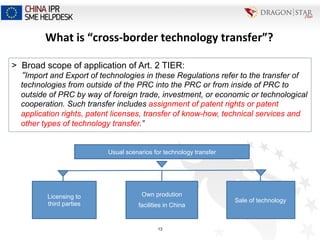
Usual scenarios for technology transfer
Own prodution
facilities in China
Licensing to
third parties
Sale of technology
>  Broad scope of application of Art. 2 TIER:
“Import and Export of technologies in these Regulations refer to the transfer of
technologies from outside of the PRC into the PRC or from inside of PRC to
outside of PRC by way of foreign trade, investment, or economic or technological
cooperation. Such transfer includes assignment of patent rights or patent
application rights, patent licenses, transfer of know-how, technical services and
other types of technology transfer.”
What	
  is	
  “cross-­‐border	
  technology	
  transfer”?	
  
13
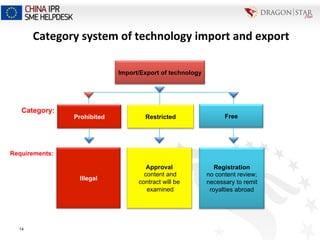
RestrictedProhibited Free
Approval
content and
contract will be
examined
Registration
no content review;
necessary to remit
royalties abroad
Illegal
14
Category	
  system	
  of	
  technology	
  import	
  and	
  export	
  
Import/Export of technology
Category:
Requirements:
Limita+ons	
  for	
  technology	
  import	
  or	
  export	
  	
  
•  Contract	
  for	
  restricted	
  technology	
  is	
  only	
  valid	
  once	
  approved	
  by	
  
authority;	
  contract	
  for	
  free	
  technology	
  is	
  valid	
  upon	
  signing	
  	
  
•  For	
  restricted	
  technology,	
  no	
  substan=al	
  nego=a=on	
  and/or	
  contract	
  
signing	
  before	
  obtaining	
  a	
  “lecer	
  of	
  intent	
  for	
  the	
  technology	
  export”	
  by	
  
authority	
  
•  For	
  certain	
  restricted	
  technology,	
  confiden=ality	
  review	
  shall	
  be	
  
conducted	
  by	
  authori=es	
  
15
Why	
  register	
  or	
  obtaining	
  approval?	
  
•  Remimng	
  money	
  abroad	
  (in	
  the	
  past,	
  s=ll	
  required	
  by	
  some	
  banks	
  now)	
  
•  Requests	
  by	
  tax	
  and	
  customs	
  authori=es	
  
•  Transfer	
  of	
  patent	
  right	
  or	
  patent	
  applica=on	
  right	
  from	
  Chinese	
  en=ty	
  or	
  
holder	
  to	
  foreigner	
  
•  Compliance	
  with	
  Foreign	
  Trade	
  Law	
  
•  Avoiding	
  viola=on	
  of	
  administra=ve	
  law	
  (offence)	
  
•  Serious	
  consequences	
  in	
  case	
  of	
  restricted	
  or	
  prohibited	
  technology	
  (criminal	
  
measures,	
  fines,	
  possible	
  loss	
  of	
  foreign	
  trade	
  license,	
  sequestra=on	
  of	
  illegal	
  
income)	
  
16
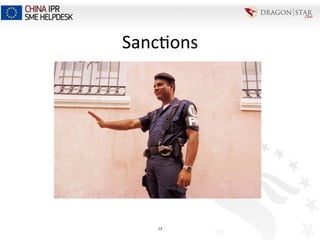
Sanc=ons	
  
17
Art.	
  61(2)	
  and	
  (3)	
  Foreign	
  Trade	
  Law	
  
•  Anyone	
  who	
  imports	
  or	
  exports	
  any	
  technology	
  that	
  is	
  banned	
  from	
  import	
  or	
  
export	
  or	
  unlawfully	
  imports	
  or	
  exports	
  any	
  technology	
  that	
  is	
  restricted	
  from	
  
import	
  or	
  export	
  shall	
  be	
  ordered	
  by	
  the	
  foreign	
  trade	
  department	
  of	
  the	
  
State	
  Council	
  to	
  correct,	
  and	
  be	
  fined	
  two	
  =mes	
  up	
  to	
  5	
  =mes	
  the	
  illegal	
  
proceeds	
  and	
  the	
  illegal	
  proceeds	
  shall	
  be	
  confiscated.	
  Where	
  there	
  are	
  no	
  
illegal	
  proceeds	
  or	
  the	
  illegal	
  proceeds	
  are	
  not	
  as	
  much	
  as	
  10,000	
  RMB,	
  it	
  shall	
  
be	
  fined	
  10,000	
  RMB	
  up	
  to	
  50,000	
  RMB.	
  If	
  the	
  offence	
  cons=tutes	
  any	
  crime,	
  it	
  
shall	
  be	
  subject	
  to	
  criminal	
  liabili=es.	
  
•  As	
  of	
  the	
  day	
  when	
  the	
  decision	
  on	
  administra=ve	
  sanc=on	
  as	
  described	
  in	
  the	
  
two	
  preceding	
  paragraphs	
  takes	
  effect,	
  the	
  foreign	
  trade	
  department	
  of	
  the	
  
State	
  Council	
  or	
  other	
  relevant	
  departments	
  of	
  the	
  State	
  Council	
  may,	
  within	
  a	
  
period	
  of	
  three	
  years,	
  refuse	
  to	
  accept	
  the	
  offender’s	
  applica=ons	
  for	
  import	
  
or	
  export	
  quotas	
  or	
  licenses,	
  or	
  prohibit	
  the	
  offender	
  from	
  engaging	
  in	
  the	
  
import	
  or	
  export	
  of	
  relevant	
  goods	
  or	
  technology	
  within	
  a	
  period	
  of	
  one	
  year	
  
up	
  to	
  three	
  years.	
  	
  
Limita+ons	
  e.g.	
  for	
  technology	
  import	
  
•  During	
  the	
  validity	
  term	
  of	
  a	
  technology	
  import	
  contract,	
  the	
  achievement	
  of	
  
improvements	
  must	
  belong	
  to	
  the	
  party	
  making	
  the	
  improvements	
  
•  Mandatory	
  guarantee	
  for	
  non-­‐infringement	
  of	
  third-­‐party	
  rights	
  
•  Mandatory	
  guarantee	
  that	
  the	
  imported	
  technology	
  is	
  complete,	
  correct,	
  
effec=ve	
  and	
  capable	
  of	
  achieving	
  the	
  pre-­‐determined	
  technological	
  
objec=ves	
  
•  If	
  not	
  s=pulated	
  in	
  contract,	
  restric=ons	
  on	
  use	
  of	
  jointly	
  innovated	
  technology	
  	
  
•  No	
  “monopolis=c”	
  clauses	
  in	
  contract	
  allowed,	
  such	
  as	
  condi=on	
  for	
  purchase	
  
of	
  non-­‐essen=al	
  technologies,	
  raw	
  materials	
  etc.	
  
•  “Rule	
  of	
  reason”	
  required	
  for	
  certain	
  other	
  restric=ons	
  
19
Risk	
  assessment	
  and	
  best	
  prac+ce	
  
•  Choice	
  of	
  law	
  clause	
  may	
  not	
  exempt	
  the	
  Chinese	
  mandatory	
  liability	
  
•  Risk	
  of	
  loss	
  of	
  ownership	
  for	
  any	
  IP	
  developed	
  or	
  co-­‐developed	
  with	
  Chinese	
  
partners,	
  if	
  no	
  appropriate	
  agreement	
  is	
  in	
  place	
  
•  Nego=a=on	
  with	
  State-­‐owned	
  Chinese	
  partner	
  will	
  be	
  “IP-­‐driven“	
  to	
  secure	
  
ownership	
  
–  Low	
  risks	
  for	
  pure	
  licensing	
  contracts	
  
–  Higher	
  risks	
  if	
  adapta=ons	
  to	
  processes	
  or	
  further	
  development	
  based	
  on	
  
Know-­‐how	
  of	
  licensor	
  
–  Commissioned	
  and	
  joint	
  development	
  
–  Ques=on	
  of	
  access	
  right	
  of	
  Chinese	
  government	
  in	
  case	
  of	
  lack	
  of	
  use	
  in	
  
China?	
  
Check	
  list	
  R&D	
  in	
  China	
  
•  R&D	
  environment/policy	
  background:	
  
•  R&D	
  capabili=es	
  in	
  China	
  
•  R&D	
  incen=ves:	
  Taxes,	
  import	
  du=es,	
  visas	
  
•  Government	
  policies	
  (indigenous	
  innova=on)	
  and	
  government	
  
procurement	
  
•  Protec=on	
  and	
  use	
  of	
  R&D	
  results	
  
•  Use	
  requirements	
  for	
  patents	
  obtained	
  through	
  public	
  funds	
  
•  Compulsory	
  licensing	
  in	
  China	
  and	
  An=-­‐Monopoly	
  Law	
  
•  Level	
  of	
  infringements	
  in	
  China	
  
•  Know-­‐how	
  protec=on	
  
•  Enforcement	
  of	
  locally	
  owned	
  rights	
  
•  Enforcement	
  of	
  jointly	
  owned	
  rights	
  
Check	
  list	
  R&D	
  in	
  China	
  
•  Joint	
  innova=on	
  and	
  improvements	
  by	
  partners	
  
•  Contractual	
  agreements	
  on	
  (unilateral)	
  grant-­‐back	
  clauses	
  
•  Contractual	
  agreements	
  on	
  improvements	
  
•  Joint	
  inven=ons	
  
•  Commissioned	
  research	
  	
  
•  Employee	
  inven=ons	
  
•  Remunera=on	
  risks	
  (adequate	
  levels,	
  liable	
  party)	
  
•  Securing	
  inven=ons	
  from	
  employees	
  
•  “Job-­‐related	
  technology	
  results“	
  and	
  pre-­‐emp=ve	
  rights	
  
•  Employee	
  crea=ons/copyright	
  and	
  securing	
  ownership	
  
Check	
  list	
  R&D	
  in	
  China	
  
•  Technology	
  transfer:	
  
•  Restric=ons	
  on	
  transfer	
  of	
  Chinese	
  owned	
  patents	
  to	
  foreigners:	
  
Art	
  10	
  Patent	
  Law	
  
•  Technology	
  transfer	
  in	
  and	
  out	
  of	
  China:	
  TIER	
  rules	
  
•  Mandatory	
  contractual	
  clauses	
  and	
  warran=es	
  
•  Limita=ons	
  in	
  case	
  of	
  technology	
  investments	
  and	
  tech	
  transfer	
  
(contribu=on	
  in	
  kind)	
  
•  Taxes	
  
•  Patents	
  and	
  protec=on	
  of	
  inven=ons:	
  
•  Patent	
  filing	
  –	
  op=ons	
  and	
  limita=ons	
  for	
  patentability	
  	
  
•  Restric=ons	
  on	
  free	
  patent	
  filing:	
  confiden=ality	
  examina=on	
  
•  U=lity	
  models	
  and	
  defensive	
  filing	
  strategies	
  
This	
  project	
  has	
  received	
  funding	
  from	
  the	
  European	
  Union’s	
  Horizon	
  2020	
  
research,	
  and	
  innova=on	
  programme	
  under	
  grant	
  agreement	
  n°645775	
  
THANKS

IP Implications of undertaking R&D in China

  • 1.
    This  project  has  received  funding  from  the  European  Union’s  Horizon  2020   research,  and  innova=on  programme  under  grant  agreement  n°645775   Wai=ng  for  the  organiser…   The  webinar  will  begin  shortly  
  • 2.
    This  project  has  received  funding  from  the  European  Union’s  Horizon  2020   research,  and  innova=on  programme  under  grant  agreement  n°645775   R&D  in  China  and  Co-­‐funding  for   Horizon  2020  
  • 3.
  • 4.
    The  China  IPR  SME  Helpdesk  Services   4  
  • 5.
    5     Start  Date:  1/2/2015,  End  Date:  31/1/2018     Based   upon   the   outputs   and   the   established   mechanism   of   the   previous  DRAGON-­‐STAR  project     The   DRAGON-­‐STARPLUS   is   supported   by   European   Commission   (H2020),  to  provide  services  on  three  levels:   •  To   support   the   European   and   Chinese   research   communi=es   to   establish  collabora=ons  under  Horizon  2020  and  beyond.   •  To  provide  a  coopera=on  pla^orm  and  tools  to  policy  makers,  aiming   ul=mately  to  support  and  enhance  the  bilateral  coopera=on,  through   the  concept  of  mutual  benefit   •  To  provide  a  coopera=on  pla^orm  to  funding  agencies  for  exchanging   best  prac=ces  and  for  planning  joint  ac=vi=es.   Dragon  Star  Plus  
  • 6.
    This  project  has  received  funding  from  the  European  Union’s  Horizon  2020   research,  and  innova=on  programme  under  grant  agreement  n°645775   The  IP  implica=ons  of   undertaking  R&D  in  China   Dr  .Thomas  PaBloch,  Partner  at  Taylor  Wessing,  June   15th,  2016  
  • 7.
    7   Name:  Dr.  Thomas  Pacloch,  LL.M.Eur   Firm:  Taylor  Wessing   Loca+on:  Munich,  Germany       Thomas  Pacloch  heads  up  the  IP  division  of  the  TW  China  Group  and  is   located  in  Taylor  Wessing’s  Munich  office,  with  regular  acendance  in  the   offices  in  Beijing  and  Shanghai.  He  specializes  in  industrial  property  rights  and   technology  transfer  with  a  par=cular  focus  on  China.  He  advises  on  trademark   and  patent  infringements  as  well  as  copyright  licensing  and  supports   transac=ons  and  licensing  nego=a=ons,  in  par=cular  in  luxury  goods,  lifestyle   and  online  gaming  sector,  but  also  automobile,  pharmaceu=cal  and   electronics  industry.  Besides  advising  foreign  companies  in  China,  Thomas   supports  and  represents  Chinese  clients  in  German  courts.       Today’s  Speaker  
  • 8.
    •  Legal  Framework   •  Important  IP  Rights  in  R&D     •  Patent  Law   •  Technology  Transfer  and  Administra=ve  Regula=ons   •  Check  List  R&D  in  China   8   Agenda  
  • 9.
    9 Key  issues   • How  much  technology  should  go  to  China  how  fast?   •  How  to  do  it?   •  With  whom  to  do  it?   •  Risks  and  rewards     •  Legal  limita=ons   •  A  need  for  a  specific  China  strategy  
  • 10.
    Legal  Framework     •  Patent  Law   –  Art  10  PL  (transfer  of  patent  applica=ons  and  patents  to  foreigners)   –  Art  20  PL  (applying  abroad  for  an  inven=on  completed  in  China)   –  Art  6  and  8  PL  (employee  inven=on,  commissioned  and  joint   inven=ons)   •  Contract  Law   •  Technology  Import  and  Export  Administra=on  Regula=ons  TIER  Rules   •  Customs  Regula=ons/MoF/State  Administra=on  of  Taxa=on  on  du=es  and   taxes  on  royal=es   –  E.g.  Measures  of  GACC  for  Evalua=on  of  Royal=es  of  Imported  Goods,   30  May  2003   •  Foreign  Trade  Law  (Art  16-­‐18)  through  restric=ons,  quotas,  licenses       10  
  • 11.
    11   Important  IP  Rights   In  China:   •  Right  to  inven=on/right  to  apply   for  a  patent   –  Economic  rights   –  Personal  rights   •  Patent  applica=on  right,  once   applica=on  has  been  filed,  before   applica=on  is  rejected  or  granted   •  Patent  right  aier  grant,  before   expiry  of  patent  term,   invalida=on   •  Copyrights   •  Chinese  law  applies   Outside  China:   •  Same  three  types  of  right  for  any   inven=on  made,  but     –  Independent  from  rights  in   China   –  Following  the  law  of  each   country  where  owner  seeks   protec=on,  thus  a  bundle  of   independent  rights   •  Copyright   •  Foreign  law  applies  in  principle,   but  does  not  exclude   administra=ve  regula=ons  or   mandatory  law  in  China  
  • 12.
    Patent  Law  and  transfer  of  patents  and  patent   applica=ons   •  Any  transfer  of  patents  or  patent  applica=ons  in  China  to  a  foreigner   requires  approval/registra=on  by  SIPO   –  Prior  compliance  with  TIER  condi=on  for  registra=on  of  transfer   –  Transfer  only  valid  with  successful  registra=on   •  No  SIPO  approval  necessary  for  transfer  of  right  to  apply  for  a  patent   •  Under  Patent  Law  (not  TIER):  No  mandatory  registra=on/approval  for   patent  licenses     •  Addi=onal:  Patent  applica=ons  abroad  for  inven=ons  completed  in  China   require  compliance  with  requirement  of  confiden=ality  examina=on  
  • 13.
    Usual scenarios fortechnology transfer Own prodution facilities in China Licensing to third parties Sale of technology >  Broad scope of application of Art. 2 TIER: “Import and Export of technologies in these Regulations refer to the transfer of technologies from outside of the PRC into the PRC or from inside of PRC to outside of PRC by way of foreign trade, investment, or economic or technological cooperation. Such transfer includes assignment of patent rights or patent application rights, patent licenses, transfer of know-how, technical services and other types of technology transfer.” What  is  “cross-­‐border  technology  transfer”?   13
  • 14.
    RestrictedProhibited Free Approval content and contractwill be examined Registration no content review; necessary to remit royalties abroad Illegal 14 Category  system  of  technology  import  and  export   Import/Export of technology Category: Requirements:
  • 15.
    Limita+ons  for  technology  import  or  export     •  Contract  for  restricted  technology  is  only  valid  once  approved  by   authority;  contract  for  free  technology  is  valid  upon  signing     •  For  restricted  technology,  no  substan=al  nego=a=on  and/or  contract   signing  before  obtaining  a  “lecer  of  intent  for  the  technology  export”  by   authority   •  For  certain  restricted  technology,  confiden=ality  review  shall  be   conducted  by  authori=es   15
  • 16.
    Why  register  or  obtaining  approval?   •  Remimng  money  abroad  (in  the  past,  s=ll  required  by  some  banks  now)   •  Requests  by  tax  and  customs  authori=es   •  Transfer  of  patent  right  or  patent  applica=on  right  from  Chinese  en=ty  or   holder  to  foreigner   •  Compliance  with  Foreign  Trade  Law   •  Avoiding  viola=on  of  administra=ve  law  (offence)   •  Serious  consequences  in  case  of  restricted  or  prohibited  technology  (criminal   measures,  fines,  possible  loss  of  foreign  trade  license,  sequestra=on  of  illegal   income)   16
  • 17.
  • 18.
    Art.  61(2)  and  (3)  Foreign  Trade  Law   •  Anyone  who  imports  or  exports  any  technology  that  is  banned  from  import  or   export  or  unlawfully  imports  or  exports  any  technology  that  is  restricted  from   import  or  export  shall  be  ordered  by  the  foreign  trade  department  of  the   State  Council  to  correct,  and  be  fined  two  =mes  up  to  5  =mes  the  illegal   proceeds  and  the  illegal  proceeds  shall  be  confiscated.  Where  there  are  no   illegal  proceeds  or  the  illegal  proceeds  are  not  as  much  as  10,000  RMB,  it  shall   be  fined  10,000  RMB  up  to  50,000  RMB.  If  the  offence  cons=tutes  any  crime,  it   shall  be  subject  to  criminal  liabili=es.   •  As  of  the  day  when  the  decision  on  administra=ve  sanc=on  as  described  in  the   two  preceding  paragraphs  takes  effect,  the  foreign  trade  department  of  the   State  Council  or  other  relevant  departments  of  the  State  Council  may,  within  a   period  of  three  years,  refuse  to  accept  the  offender’s  applica=ons  for  import   or  export  quotas  or  licenses,  or  prohibit  the  offender  from  engaging  in  the   import  or  export  of  relevant  goods  or  technology  within  a  period  of  one  year   up  to  three  years.    
  • 19.
    Limita+ons  e.g.  for  technology  import   •  During  the  validity  term  of  a  technology  import  contract,  the  achievement  of   improvements  must  belong  to  the  party  making  the  improvements   •  Mandatory  guarantee  for  non-­‐infringement  of  third-­‐party  rights   •  Mandatory  guarantee  that  the  imported  technology  is  complete,  correct,   effec=ve  and  capable  of  achieving  the  pre-­‐determined  technological   objec=ves   •  If  not  s=pulated  in  contract,  restric=ons  on  use  of  jointly  innovated  technology     •  No  “monopolis=c”  clauses  in  contract  allowed,  such  as  condi=on  for  purchase   of  non-­‐essen=al  technologies,  raw  materials  etc.   •  “Rule  of  reason”  required  for  certain  other  restric=ons   19
  • 20.
    Risk  assessment  and  best  prac+ce   •  Choice  of  law  clause  may  not  exempt  the  Chinese  mandatory  liability   •  Risk  of  loss  of  ownership  for  any  IP  developed  or  co-­‐developed  with  Chinese   partners,  if  no  appropriate  agreement  is  in  place   •  Nego=a=on  with  State-­‐owned  Chinese  partner  will  be  “IP-­‐driven“  to  secure   ownership   –  Low  risks  for  pure  licensing  contracts   –  Higher  risks  if  adapta=ons  to  processes  or  further  development  based  on   Know-­‐how  of  licensor   –  Commissioned  and  joint  development   –  Ques=on  of  access  right  of  Chinese  government  in  case  of  lack  of  use  in   China?  
  • 21.
    Check  list  R&D  in  China   •  R&D  environment/policy  background:   •  R&D  capabili=es  in  China   •  R&D  incen=ves:  Taxes,  import  du=es,  visas   •  Government  policies  (indigenous  innova=on)  and  government   procurement   •  Protec=on  and  use  of  R&D  results   •  Use  requirements  for  patents  obtained  through  public  funds   •  Compulsory  licensing  in  China  and  An=-­‐Monopoly  Law   •  Level  of  infringements  in  China   •  Know-­‐how  protec=on   •  Enforcement  of  locally  owned  rights   •  Enforcement  of  jointly  owned  rights  
  • 22.
    Check  list  R&D  in  China   •  Joint  innova=on  and  improvements  by  partners   •  Contractual  agreements  on  (unilateral)  grant-­‐back  clauses   •  Contractual  agreements  on  improvements   •  Joint  inven=ons   •  Commissioned  research     •  Employee  inven=ons   •  Remunera=on  risks  (adequate  levels,  liable  party)   •  Securing  inven=ons  from  employees   •  “Job-­‐related  technology  results“  and  pre-­‐emp=ve  rights   •  Employee  crea=ons/copyright  and  securing  ownership  
  • 23.
    Check  list  R&D  in  China   •  Technology  transfer:   •  Restric=ons  on  transfer  of  Chinese  owned  patents  to  foreigners:   Art  10  Patent  Law   •  Technology  transfer  in  and  out  of  China:  TIER  rules   •  Mandatory  contractual  clauses  and  warran=es   •  Limita=ons  in  case  of  technology  investments  and  tech  transfer   (contribu=on  in  kind)   •  Taxes   •  Patents  and  protec=on  of  inven=ons:   •  Patent  filing  –  op=ons  and  limita=ons  for  patentability     •  Restric=ons  on  free  patent  filing:  confiden=ality  examina=on   •  U=lity  models  and  defensive  filing  strategies  
  • 24.
    This  project  has  received  funding  from  the  European  Union’s  Horizon  2020   research,  and  innova=on  programme  under  grant  agreement  n°645775   THANKS