KKR & KSR INSTITUTE OF TECHNOLOGYAND SCIENCES
(AUTONOMOUS)
INTERNET OF THINGS (IOT)
PRESENTED BY:
K.SHOWRIBABU
20JR1A05A5
III YEAR
CSE-2
What is IOT
 IOT- INTERNET OF THINGS
 IOT is physical objects- devices, vehicles, and other items embedded with
electronics, software, sensors, and network connectivity-that enables these
objects to collect data and exchange data.
FEATURES
 Artificial intelligence
 Connectivity
 Sensor
 Size considerations(Small devices)
Technology:
 RFID
 Wifi
 Barcode e Qr code
 Sensors and smartphones
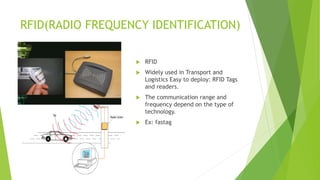
RFID(RADIO FREQUENCY IDENTIFICATION)
 RFID
 Widely used in Transport and
Logistics Easy to deploy: RFID Tags
and readers.
 The communication range and
frequency depend on the type of
technology.
 Ex: fastag
WIFI(wireless fidelity)
 WIFI
 Very common and widely used both
in indoor and outdoor
environments
 General purpose
 Low cost
 High interoperable
 May be not a good solution in some
special conditions.
QR Code
 Low cost
 No technological difficulties
 Several devices can read a barcode
 Starting point for more complex
systems
Sensors and Smart phones
 In the near future almost
everybody will probably have a
smartphone
 A smartphone isn’t just a mobile
phone that has access to the
internet
 The iPhone has a lot of different
types of sensors
APPLICATIONS:
 Smart home
 IOT in agriculture
 Energy Engagement
 Transport and logistics
 Smart lightning
IoT in Agriculture
CONCLUSION
 Innovative technologies and approaches will be required to make IOT a reality
 Main objective of IOT is to make the functionality of physical devices become
smart.
IOT-5A5.pptx

IOT-5A5.pptx

  • 1.
    KKR & KSRINSTITUTE OF TECHNOLOGYAND SCIENCES (AUTONOMOUS) INTERNET OF THINGS (IOT) PRESENTED BY: K.SHOWRIBABU 20JR1A05A5 III YEAR CSE-2
  • 3.
    What is IOT IOT- INTERNET OF THINGS  IOT is physical objects- devices, vehicles, and other items embedded with electronics, software, sensors, and network connectivity-that enables these objects to collect data and exchange data.
  • 4.
    FEATURES  Artificial intelligence Connectivity  Sensor  Size considerations(Small devices)
  • 5.
    Technology:  RFID  Wifi Barcode e Qr code  Sensors and smartphones
  • 6.
    RFID(RADIO FREQUENCY IDENTIFICATION) RFID  Widely used in Transport and Logistics Easy to deploy: RFID Tags and readers.  The communication range and frequency depend on the type of technology.  Ex: fastag
  • 7.
    WIFI(wireless fidelity)  WIFI Very common and widely used both in indoor and outdoor environments  General purpose  Low cost  High interoperable  May be not a good solution in some special conditions.
  • 8.
    QR Code  Lowcost  No technological difficulties  Several devices can read a barcode  Starting point for more complex systems
  • 9.
    Sensors and Smartphones  In the near future almost everybody will probably have a smartphone  A smartphone isn’t just a mobile phone that has access to the internet  The iPhone has a lot of different types of sensors
  • 10.
    APPLICATIONS:  Smart home IOT in agriculture  Energy Engagement  Transport and logistics  Smart lightning
  • 12.
  • 13.
    CONCLUSION  Innovative technologiesand approaches will be required to make IOT a reality  Main objective of IOT is to make the functionality of physical devices become smart.