IOT
The age of Smart
1
Rohan Patil – TANNUM Consulting
Contents
01 Background
02 The Age of Smart
03 What is IoT?
04 IoT Sectors
05 IoT Development Phases
06 IoT Components
07 Example
08 Conclusion
2
Background
3
 The Internet is now 20 years old
 Over 2 billion people are connected to it using computers, smart phones, tablets.
 The internet currently connects people to people (P2P), called as Internet Phase 1.
 The next phase of the internet is just beginning, will connect people to everyday devices (M2P)
and every day devices to each other (M2M)
 The increasing intelligence of everyday devices is a global, accelerating, and unstoppable
phenomenon.
The Age of Smart
4
 It started with Smart Phones.
 Everyday devices like lights, cars, thermostat, TV etc. are being made smart. (By connecting
them together & over Internet)
 Theses every day devices will not only send data to Internet but they will be also controlled over
the internet.
 This devices become “things” on the “Internet of Things”.
What is IoT?
5
 No single definition
 Internet of Things - ”A platform where we connect everyday things embedded with electronics,
software, and sensors to the internet enabling them to collect and exchange data.”
Internet of Things (IoT) Sectors
6
 Home
 Health Medical
 Fitness & Wellness
 Factory & Industry
 Agriculture
 Cars & Roads
 Cities
Internet of Things (IoT) Development Phases
7
 Passive – RFID sensors etc
 Active – Responds to sensor data
 Aware – Can make choice based on data
 Autonomous – e.g. self driving cars
Internet of Things (IoT) Components
8
 The Things – sensors, actuators etc.
 The Network
 The Platforms, Apps and Services
IoT Components – The Things: Sensors & Devices
9
 IoT devices will mainly be:
 Low Power (power usage & computational power)
 Low Cost
 Wireless
 Examples are sensors – temperature, pressure etc.
 To turn an everyday devices like a house or a car into smart house or car or a “thing” will require
that the object has:
 A unique address – IPv6 address
 A way to connect to network – wireless
 Sensors e.g. temperature, light, speed etc.
IoT Components – IoT Networks
10
 The Internet of things will utilize the existing networking infrastructure, technologies and protocols
currently used in homes/offices and on the Internet, and will introduce many more.
 Wi-Fi
 Bluetooth
 New technologies – LPWAN, ZigBee, 6LoWpan and Thread
 At application level there are host new protocols:
 HTTP
 MQTT (new)
 COAP (new)
IoT Components – IoT Platforms, Apps and Services
11
 An IoT platform combines several IOT functions in one.
 It can collect and distribute data, convert data between protocols, store and analyse data.
 These platforms are available as cloud based and standalone platforms. Which are available from
many companies large & small. Examples:
 Amazon Web Services (AWS)
 IBM Watson (Bluemix)
 Microsoft Azure
 Etc.
Example – Smart City
12
 India’s population expected to surpass China’s by 2024
 Anticipated to reach 1.5 billion by 2030, with 40% housed in Urban areas.
 Lately, the rate of technology adoption has increased and cities around the world are becoming
smarter.
 Newer technologies along with faster and easier connectivity allow cities to optimize resources,
save money, and at the same time provide better services to citizen.
 The increasing intelligence of cities is a global, accelerating, and unstoppable phenomenon.
What technologies are used?
13
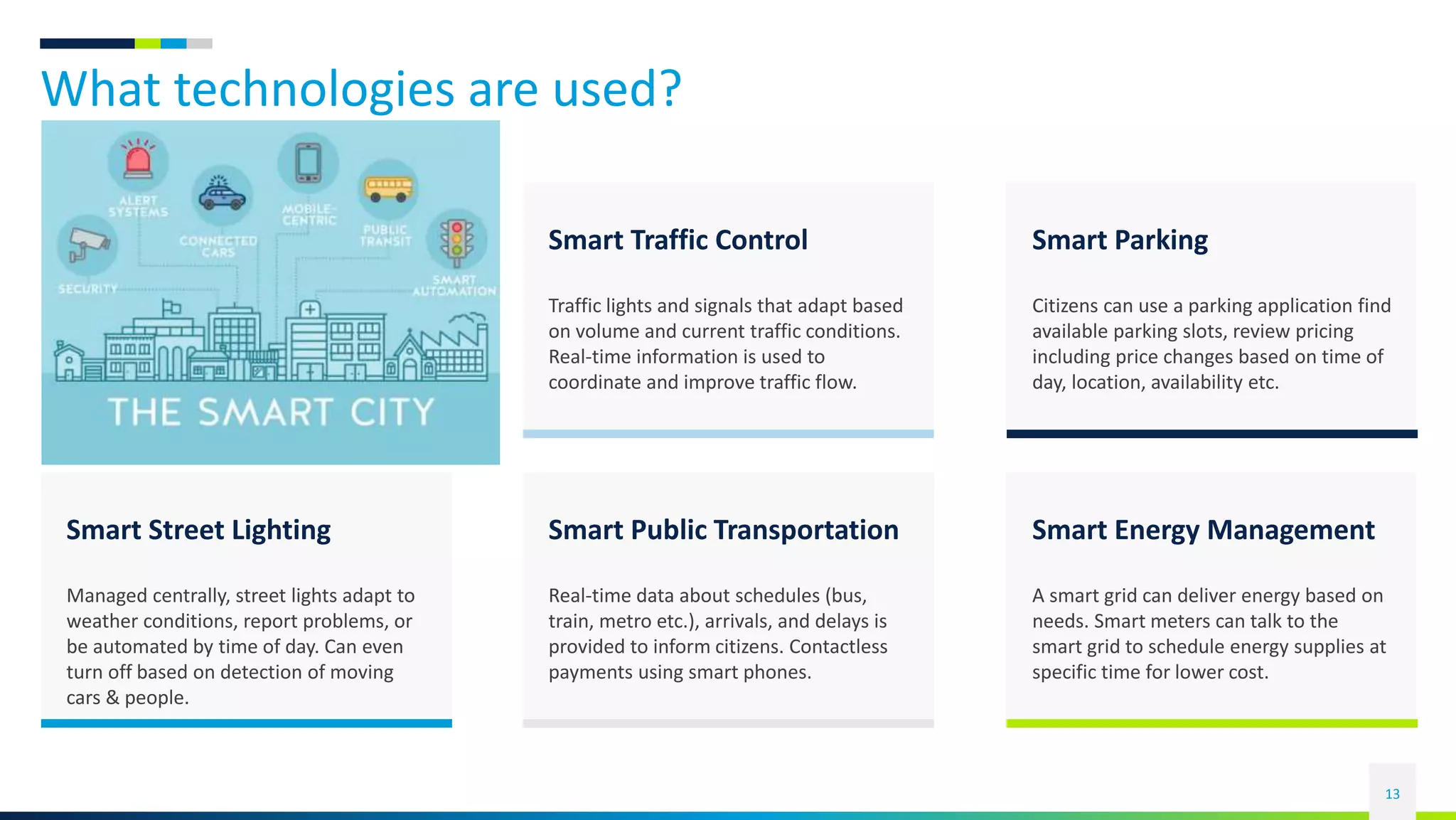
Smart Traffic Control
Traffic lights and signals that adapt based
on volume and current traffic conditions.
Real-time information is used to
coordinate and improve traffic flow.
Smart Parking
Citizens can use a parking application find
available parking slots, review pricing
including price changes based on time of
day, location, availability etc.
Smart Public Transportation
Real-time data about schedules (bus,
train, metro etc.), arrivals, and delays is
provided to inform citizens. Contactless
payments using smart phones.
Smart Energy Management
A smart grid can deliver energy based on
needs. Smart meters can talk to the
smart grid to schedule energy supplies at
specific time for lower cost.
Smart Street Lighting
Managed centrally, street lights adapt to
weather conditions, report problems, or
be automated by time of day. Can even
turn off based on detection of moving
cars & people.
What technologies are used?
14
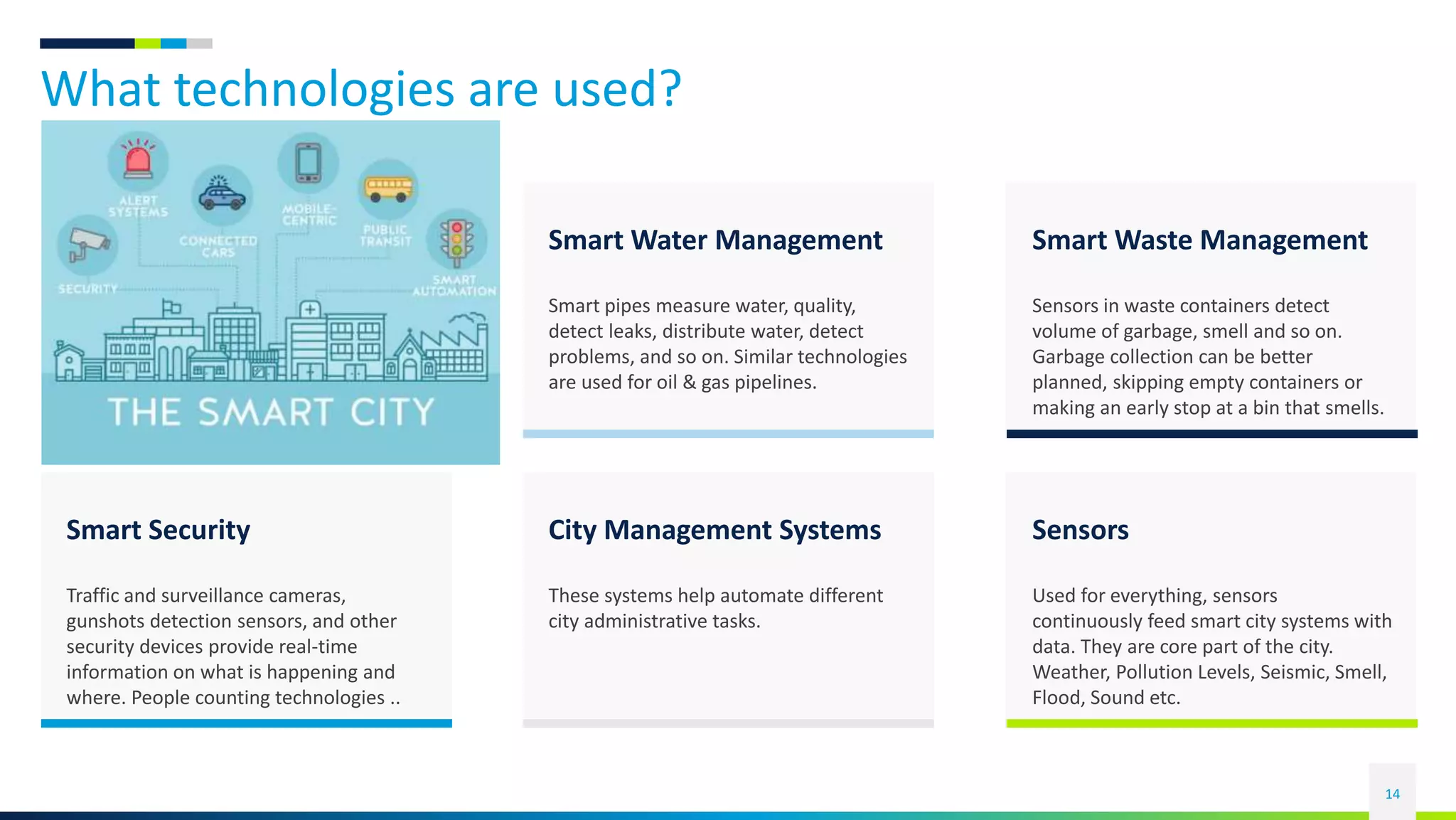
Smart Water Management
Smart pipes measure water, quality,
detect leaks, distribute water, detect
problems, and so on. Similar technologies
are used for oil & gas pipelines.
Smart Waste Management
Sensors in waste containers detect
volume of garbage, smell and so on.
Garbage collection can be better
planned, skipping empty containers or
making an early stop at a bin that smells.
City Management Systems
These systems help automate different
city administrative tasks.
Sensors
Used for everything, sensors
continuously feed smart city systems with
data. They are core part of the city.
Weather, Pollution Levels, Seismic, Smell,
Flood, Sound etc.
Smart Security
Traffic and surveillance cameras,
gunshots detection sensors, and other
security devices provide real-time
information on what is happening and
where. People counting technologies ..
7/4/2020 15
Thank you

IOT - The age of smart

  • 1.
    IOT The age ofSmart 1 Rohan Patil – TANNUM Consulting
  • 2.
    Contents 01 Background 02 TheAge of Smart 03 What is IoT? 04 IoT Sectors 05 IoT Development Phases 06 IoT Components 07 Example 08 Conclusion 2
  • 3.
    Background 3  The Internetis now 20 years old  Over 2 billion people are connected to it using computers, smart phones, tablets.  The internet currently connects people to people (P2P), called as Internet Phase 1.  The next phase of the internet is just beginning, will connect people to everyday devices (M2P) and every day devices to each other (M2M)  The increasing intelligence of everyday devices is a global, accelerating, and unstoppable phenomenon.
  • 4.
    The Age ofSmart 4  It started with Smart Phones.  Everyday devices like lights, cars, thermostat, TV etc. are being made smart. (By connecting them together & over Internet)  Theses every day devices will not only send data to Internet but they will be also controlled over the internet.  This devices become “things” on the “Internet of Things”.
  • 5.
    What is IoT? 5 No single definition  Internet of Things - ”A platform where we connect everyday things embedded with electronics, software, and sensors to the internet enabling them to collect and exchange data.”
  • 6.
    Internet of Things(IoT) Sectors 6  Home  Health Medical  Fitness & Wellness  Factory & Industry  Agriculture  Cars & Roads  Cities
  • 7.
    Internet of Things(IoT) Development Phases 7  Passive – RFID sensors etc  Active – Responds to sensor data  Aware – Can make choice based on data  Autonomous – e.g. self driving cars
  • 8.
    Internet of Things(IoT) Components 8  The Things – sensors, actuators etc.  The Network  The Platforms, Apps and Services
  • 9.
    IoT Components –The Things: Sensors & Devices 9  IoT devices will mainly be:  Low Power (power usage & computational power)  Low Cost  Wireless  Examples are sensors – temperature, pressure etc.  To turn an everyday devices like a house or a car into smart house or car or a “thing” will require that the object has:  A unique address – IPv6 address  A way to connect to network – wireless  Sensors e.g. temperature, light, speed etc.
  • 10.
    IoT Components –IoT Networks 10  The Internet of things will utilize the existing networking infrastructure, technologies and protocols currently used in homes/offices and on the Internet, and will introduce many more.  Wi-Fi  Bluetooth  New technologies – LPWAN, ZigBee, 6LoWpan and Thread  At application level there are host new protocols:  HTTP  MQTT (new)  COAP (new)
  • 11.
    IoT Components –IoT Platforms, Apps and Services 11  An IoT platform combines several IOT functions in one.  It can collect and distribute data, convert data between protocols, store and analyse data.  These platforms are available as cloud based and standalone platforms. Which are available from many companies large & small. Examples:  Amazon Web Services (AWS)  IBM Watson (Bluemix)  Microsoft Azure  Etc.
  • 12.
    Example – SmartCity 12  India’s population expected to surpass China’s by 2024  Anticipated to reach 1.5 billion by 2030, with 40% housed in Urban areas.  Lately, the rate of technology adoption has increased and cities around the world are becoming smarter.  Newer technologies along with faster and easier connectivity allow cities to optimize resources, save money, and at the same time provide better services to citizen.  The increasing intelligence of cities is a global, accelerating, and unstoppable phenomenon.
  • 13.
    What technologies areused? 13 Smart Traffic Control Traffic lights and signals that adapt based on volume and current traffic conditions. Real-time information is used to coordinate and improve traffic flow. Smart Parking Citizens can use a parking application find available parking slots, review pricing including price changes based on time of day, location, availability etc. Smart Public Transportation Real-time data about schedules (bus, train, metro etc.), arrivals, and delays is provided to inform citizens. Contactless payments using smart phones. Smart Energy Management A smart grid can deliver energy based on needs. Smart meters can talk to the smart grid to schedule energy supplies at specific time for lower cost. Smart Street Lighting Managed centrally, street lights adapt to weather conditions, report problems, or be automated by time of day. Can even turn off based on detection of moving cars & people.
  • 14.
    What technologies areused? 14 Smart Water Management Smart pipes measure water, quality, detect leaks, distribute water, detect problems, and so on. Similar technologies are used for oil & gas pipelines. Smart Waste Management Sensors in waste containers detect volume of garbage, smell and so on. Garbage collection can be better planned, skipping empty containers or making an early stop at a bin that smells. City Management Systems These systems help automate different city administrative tasks. Sensors Used for everything, sensors continuously feed smart city systems with data. They are core part of the city. Weather, Pollution Levels, Seismic, Smell, Flood, Sound etc. Smart Security Traffic and surveillance cameras, gunshots detection sensors, and other security devices provide real-time information on what is happening and where. People counting technologies ..
  • 15.

Editor's Notes

  • #7 The IOT will affect many areas of day to day life. Some of the main sectors are:
  • #8 The growth of the IOT is expected to go through several stages of development. We are currently in the early stages of development (Passive phase) were we are receiving data from objects and manually taking action.
  • #9 An IOT system comprises three basic Components.
  • #10 In contrast to computers and tablets which are the main devices currently connected to the Internet.
  • #11 Protocols are designed to operate at a particular level in the networking stack. TCP/IP uses a 4 level model and we will discuss IOT networking using this model. because of the requirement for low powered end devices there will be major developments in the Wireless connectivity protocols.
  • #14 How does city becomes ”smarter”? What technologies are used?
  • #15 How does city becomes ”smarter”? What technologies are used?