IOT in
medicine
Hello!
We are “ hanan ,yasmine,abeer,mostafa
,mohammed”
We are here to talk about iot in medicine and some
of its applications .
2
outline
○ Introduction
○ Transforming the healthcare by IOT
○ What is IOMT?
○ Why IOMT ?
○ IOMT system (logical levels)
○ Applications of IOMT
○ Challenges of IOMT
○ The Road ahead
3
introduction
1
Introduction
In internet of things(IOT) , devices can gather and
share information with each other and the cloud ,
making it possible to collect , record and analyze new
data streams faster and more accurately . Hence
resulted in improved care quality and access in
healthcare industry :
5
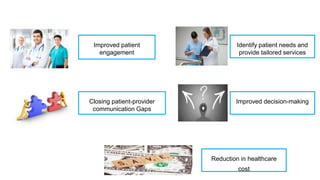
Improved patient
engagement
6
Closing patient-provider
communication Gaps
Identify patient needs and
provide tailored services
Improved decision-making
Reduction in healthcare
cost
Transforming
the healthcare
by IOT
2
Transforming the
healthcare by IOT
One of the main ways IoT is changing Healthcare is
Telehealth.
Telehealth is where technology meets the healthcare
industry to deliver virtual medical, health and
educational services.
The ever-increasing cost of providing healthcare is
the primary driver behind telehealth’s popularity
8
9
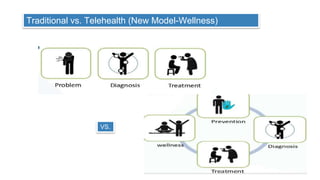
Traditional vs. Telehealth (New Model-Wellness)
VS.
Transforming the
healthcare by IOT
How does Telehealth reduce costs?
#1 Reduces number of hospitalizations
By keeping patients out of hospitals therefore cutting
the expense of hospital stays/visits.
#2 Reduces amount of employee absenteeism
By providing patients access to care and disease
management through wellness programs and the like
results in less time away from the workplace.
10
Transforming the
healthcare by IOT
#3 Grants Patients the Ability to Administer Their
Own Care
Transferring some of the responsibility to patients for
their own treatments often leads to reductions in
hospital or doctor visits.
#4 Limits Non-Essential Expenditures
Savings through a decrease or elimination of travels
costs and lost income/productivity levels.
11
Transforming the
healthcare by IOT
#5 Improves Overall Health
Increasing disease and treatment awareness and
education can lead to improved patient health and
consequently a reduction of healthcare costs.
12
What is
IOMT?
3
14
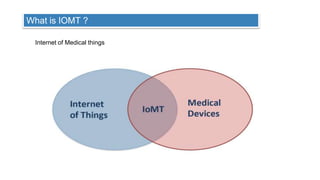
What is IOMT ?
Internet of Medical things
Why IOMT?
4
16
Why IOMT ?
Aging World Population Will Continue to Burden the Healthcare System
The IoMT might be the silver bullet for our communities to address a burdened healthcare
system that will only be under more stress as our population continues to age. By
2025, 1.2 billion of the 8 billion people on earth will be elderly; equivalent to the population
of India. Elderly people tend to have more healthcare issues, therefore increasing costs.
So, as life expectancy rises, it is expected that healthcare costs will follow suit.
IoMT can provide a better way to care for our elderly and has a tremendous potential to
help deal with the rising costs of care. IoMT devices can help track vitals and heart
performance, monitor glucose and other body systems, and activity and sleeping levels.
Adhering to Doctor’s Orders
IoMT isn’t intended to replace healthcare providers but to provide them with the data
gathered from devices for better diagnoses and treatment plans as well as to reduce
inefficiencies and waste in the healthcare system.
17
Why IOMT ?
Adhering to Doctor’s Orders (cont…)
A connected medical device provides objective reporting of actual activity, whereas
without its reporting providers must rely on subjective patient reports to detail how they
feel. Similarly, IoMT devices help to monitor patient behavior and activity away from the
office, so the provider will have actual data to refer to regarding compliance to patient
therapy recommendations and what transpires after a patient leaves a medical facility.
As well as all reasons mentioned in Telehealth
IOMT system
(logical levels)
5
19
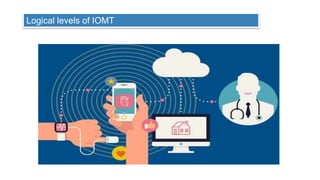
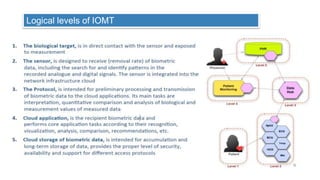
Logical levels of IOMT
20
Logical levels of IOMT
Applications of
IOMT
6
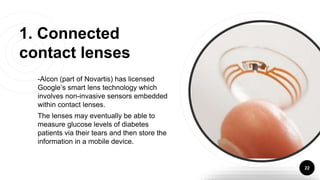
1. Connected
contact lenses
-Alcon (part of Novartis) has licensed
Google’s smart lens technology which
involves non-invasive sensors embedded
within contact lenses.
The lenses may eventually be able to
measure glucose levels of diabetes
patients via their tears and then store the
information in a mobile device.
22
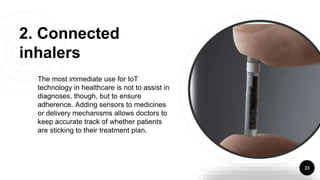
The most immediate use for IoT
technology in healthcare is not to assist in
diagnoses, though, but to ensure
adherence. Adding sensors to medicines
or delivery mechanisms allows doctors to
keep accurate track of whether patients
are sticking to their treatment plan.
23
2. Connected
inhalers
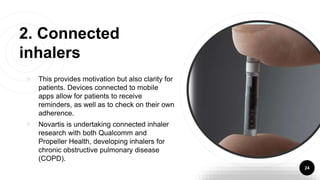
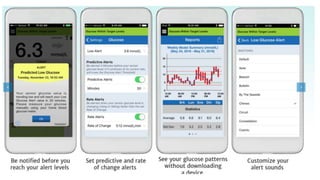
○ This provides motivation but also clarity for
patients. Devices connected to mobile
apps allow for patients to receive
reminders, as well as to check on their own
adherence.
○ Novartis is undertaking connected inhaler
research with both Qualcomm and
Propeller Health, developing inhalers for
chronic obstructive pulmonary disease
(COPD).
24
2. Connected
inhalers
Propeller’s Breezhaler device connects to its
digital platform via a sensor, passively
recording and transmitting usage data.
Novartis’ own device will likely not be released
until 2019, though, showing the timescales
involved in this sort of research.
25
2. Connected
inhalers
26
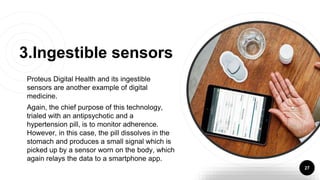
Proteus Digital Health and its ingestible
sensors are another example of digital
medicine.
Again, the chief purpose of this technology,
trialed with an antipsychotic and a
hypertension pill, is to monitor adherence.
However, in this case, the pill dissolves in the
stomach and produces a small signal which is
picked up by a sensor worn on the body, which
again relays the data to a smartphone app.
27
3.Ingestible sensors
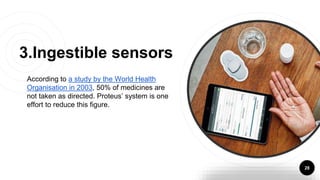
According to a study by the World Health
Organisation in 2003, 50% of medicines are
not taken as directed. Proteus’ system is one
effort to reduce this figure.
28
3.Ingestible sensors
Challenges of
IOMT
7
30
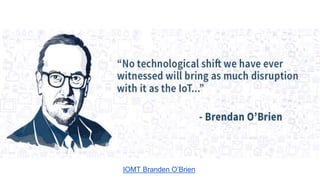
IOMT Branden O’Brien
31
1. Interoperability :
To work effectively, IoMT solutions must be
interoperable with one another, along with the
various providers and payers that are using
the technologies.
2. Security :
As more medical devices become connected
to one another and other systems, there's an
increased risk for a data breaches or
cyberattacks.
32
3. Data privacy :
Patients may not be comfortable with regular sharing
of their health information, which means healthcare
organizations and vendors must learn how to
maintain trust in the digital age.
4.Scalability :
To fully realize the value of IoMT tools, healthcare
organizations must scale them across their entire
system to drive patient outcomes.
33
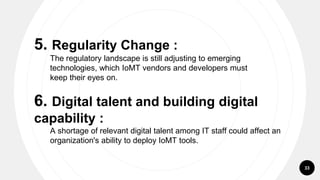
5. Regularity Change :
The regulatory landscape is still adjusting to emerging
technologies, which IoMT vendors and developers must
keep their eyes on.
6. Digital talent and building digital
capability :
A shortage of relevant digital talent among IT staff could affect an
organization's ability to deploy IoMT tools.
The Road
Ahead
8
35
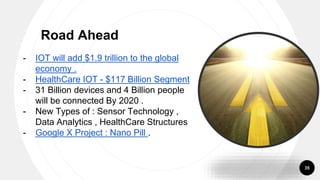
Road Ahead
- IOT will add $1.9 trillion to the global
economy .
- HealthCare IOT - $117 Billion Segment
- 31 Billion devices and 4 Billion people
will be connected By 2020 .
- New Types of : Sensor Technology ,
Data Analytics , HealthCare Structures
- Google X Project : Nano Pill .
Thanks!
Any questions ?
36

Io t in medicine final version

  • 1.
  • 2.
    Hello! We are “hanan ,yasmine,abeer,mostafa ,mohammed” We are here to talk about iot in medicine and some of its applications . 2
  • 3.
    outline ○ Introduction ○ Transformingthe healthcare by IOT ○ What is IOMT? ○ Why IOMT ? ○ IOMT system (logical levels) ○ Applications of IOMT ○ Challenges of IOMT ○ The Road ahead 3
  • 4.
  • 5.
    Introduction In internet ofthings(IOT) , devices can gather and share information with each other and the cloud , making it possible to collect , record and analyze new data streams faster and more accurately . Hence resulted in improved care quality and access in healthcare industry : 5
  • 6.
    Improved patient engagement 6 Closing patient-provider communicationGaps Identify patient needs and provide tailored services Improved decision-making Reduction in healthcare cost
  • 7.
  • 8.
    Transforming the healthcare byIOT One of the main ways IoT is changing Healthcare is Telehealth. Telehealth is where technology meets the healthcare industry to deliver virtual medical, health and educational services. The ever-increasing cost of providing healthcare is the primary driver behind telehealth’s popularity 8
  • 9.
    9 Traditional vs. Telehealth(New Model-Wellness) VS.
  • 10.
    Transforming the healthcare byIOT How does Telehealth reduce costs? #1 Reduces number of hospitalizations By keeping patients out of hospitals therefore cutting the expense of hospital stays/visits. #2 Reduces amount of employee absenteeism By providing patients access to care and disease management through wellness programs and the like results in less time away from the workplace. 10
  • 11.
    Transforming the healthcare byIOT #3 Grants Patients the Ability to Administer Their Own Care Transferring some of the responsibility to patients for their own treatments often leads to reductions in hospital or doctor visits. #4 Limits Non-Essential Expenditures Savings through a decrease or elimination of travels costs and lost income/productivity levels. 11
  • 12.
    Transforming the healthcare byIOT #5 Improves Overall Health Increasing disease and treatment awareness and education can lead to improved patient health and consequently a reduction of healthcare costs. 12
  • 13.
  • 14.
    14 What is IOMT? Internet of Medical things
  • 15.
  • 16.
    16 Why IOMT ? AgingWorld Population Will Continue to Burden the Healthcare System The IoMT might be the silver bullet for our communities to address a burdened healthcare system that will only be under more stress as our population continues to age. By 2025, 1.2 billion of the 8 billion people on earth will be elderly; equivalent to the population of India. Elderly people tend to have more healthcare issues, therefore increasing costs. So, as life expectancy rises, it is expected that healthcare costs will follow suit. IoMT can provide a better way to care for our elderly and has a tremendous potential to help deal with the rising costs of care. IoMT devices can help track vitals and heart performance, monitor glucose and other body systems, and activity and sleeping levels. Adhering to Doctor’s Orders IoMT isn’t intended to replace healthcare providers but to provide them with the data gathered from devices for better diagnoses and treatment plans as well as to reduce inefficiencies and waste in the healthcare system.
  • 17.
    17 Why IOMT ? Adheringto Doctor’s Orders (cont…) A connected medical device provides objective reporting of actual activity, whereas without its reporting providers must rely on subjective patient reports to detail how they feel. Similarly, IoMT devices help to monitor patient behavior and activity away from the office, so the provider will have actual data to refer to regarding compliance to patient therapy recommendations and what transpires after a patient leaves a medical facility. As well as all reasons mentioned in Telehealth
  • 18.
  • 19.
  • 20.
  • 21.
  • 22.
    1. Connected contact lenses -Alcon(part of Novartis) has licensed Google’s smart lens technology which involves non-invasive sensors embedded within contact lenses. The lenses may eventually be able to measure glucose levels of diabetes patients via their tears and then store the information in a mobile device. 22
  • 23.
    The most immediateuse for IoT technology in healthcare is not to assist in diagnoses, though, but to ensure adherence. Adding sensors to medicines or delivery mechanisms allows doctors to keep accurate track of whether patients are sticking to their treatment plan. 23 2. Connected inhalers
  • 24.
    ○ This providesmotivation but also clarity for patients. Devices connected to mobile apps allow for patients to receive reminders, as well as to check on their own adherence. ○ Novartis is undertaking connected inhaler research with both Qualcomm and Propeller Health, developing inhalers for chronic obstructive pulmonary disease (COPD). 24 2. Connected inhalers
  • 25.
    Propeller’s Breezhaler deviceconnects to its digital platform via a sensor, passively recording and transmitting usage data. Novartis’ own device will likely not be released until 2019, though, showing the timescales involved in this sort of research. 25 2. Connected inhalers
  • 26.
  • 27.
    Proteus Digital Healthand its ingestible sensors are another example of digital medicine. Again, the chief purpose of this technology, trialed with an antipsychotic and a hypertension pill, is to monitor adherence. However, in this case, the pill dissolves in the stomach and produces a small signal which is picked up by a sensor worn on the body, which again relays the data to a smartphone app. 27 3.Ingestible sensors
  • 28.
    According to astudy by the World Health Organisation in 2003, 50% of medicines are not taken as directed. Proteus’ system is one effort to reduce this figure. 28 3.Ingestible sensors
  • 29.
  • 30.
  • 31.
    31 1. Interoperability : Towork effectively, IoMT solutions must be interoperable with one another, along with the various providers and payers that are using the technologies. 2. Security : As more medical devices become connected to one another and other systems, there's an increased risk for a data breaches or cyberattacks.
  • 32.
    32 3. Data privacy: Patients may not be comfortable with regular sharing of their health information, which means healthcare organizations and vendors must learn how to maintain trust in the digital age. 4.Scalability : To fully realize the value of IoMT tools, healthcare organizations must scale them across their entire system to drive patient outcomes.
  • 33.
    33 5. Regularity Change: The regulatory landscape is still adjusting to emerging technologies, which IoMT vendors and developers must keep their eyes on. 6. Digital talent and building digital capability : A shortage of relevant digital talent among IT staff could affect an organization's ability to deploy IoMT tools.
  • 34.
  • 35.
    35 Road Ahead - IOTwill add $1.9 trillion to the global economy . - HealthCare IOT - $117 Billion Segment - 31 Billion devices and 4 Billion people will be connected By 2020 . - New Types of : Sensor Technology , Data Analytics , HealthCare Structures - Google X Project : Nano Pill .
  • 36.