INVISIBLE CLOAKING
T SRIRAM REDDY
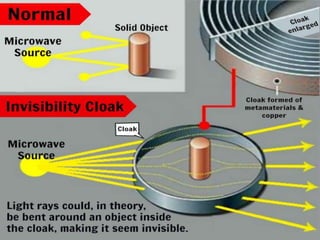
Cloaking is a technology that can cause objects to be
partially or wholly invisible to parts of
the electromagnetic (EM) spectrum.
According to Fermat’s Principle, light follows the
trajectory of the shortest optical path, that is, the path
over which the integral of the refractive index function
is minimal. Therefore, the refractive index of an optical
medium determines how light propagates within it.
Consequently, by a suitable choice of refractive index
profile for an optical medium, light rays can be bent
around and made to propagate in closed loops.
INTRODUCTION
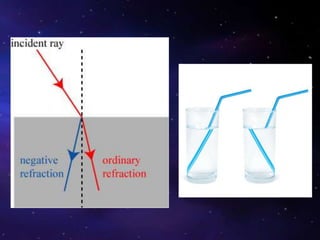
It can make the light bend in an opposite direction from
normal paths.
It is made up of individual pieces of fiber glass arranged
in parallel rows.
These hollow fibers are motels of photons –light checks
in, but it never checks out.
The arrangement of it enables the cloak to deflect or
bend the light making it appear as nothing.
METAMATERIALS
INVISIBILITY CLOAK SYSTEM
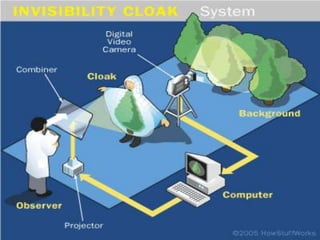
A digital video camera captures the scene behind the
person wearing the cloak.
The computer processes the captured image or video so
it will look realistic when it is projected.
The projector receives the enhanced image from the
computer and shines it through the opening onto the
combiner.
The silvered half of the mirror, bounces the projected
image toward the person wearing the cloak.
The cloak acts like a movie screen, reflecting light
directly back to the source.
Light rays bouncing off the cloak pass through the
transparent part of the mirror and fall on the user's eyes.
The person wearing the cloak appears invisible because
the background scene is being displayed onto the retro-
reflective material.
ACOUSTIC CLOAKING
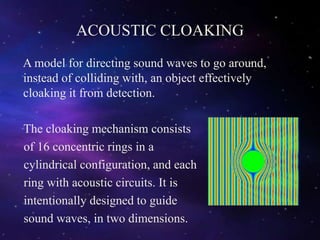
A model for directing sound waves to go around,
instead of colliding with, an object effectively
cloaking it from detection.
The cloaking mechanism consists
of 16 concentric rings in a
cylindrical configuration, and each
ring with acoustic circuits. It is
intentionally designed to guide
sound waves, in two dimensions.
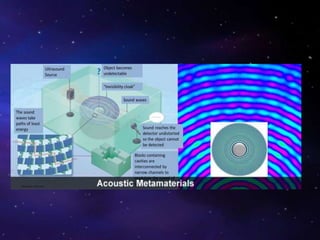
Each ring has a different index of refraction. This causes
sound waves to vary their speed from ring to ring.
The sound waves propagate around the outer ring,
guided by the channels in the circuits, which bend the
waves to wrap them around the outer layers of the
cloak.
The acoustic cloaking device works in all three
dimensions, no matter which direction the sound is
coming from or where the observer is located, and holds
potential for future applications such as sonar avoidance
and architectural acoustics.
The cloak could be used to cover volume of any shape
but moving the material would spoil the effect.
Current devices work only for narrow range of
wavelength but light has many wavelengths.
It is a slow process.
LIMITATIONS
APPLICATIONS
Cloaking military devices
Advanced concert halls
Stealth warships
Diagnosis
Magic, Art
FUTURE SCOPE
Many practical uses exist for materials that can
precisely control the paths of light, sound and harmful
radiation. There are just as many sinister applications
that come to mind for a cloaking device.
The Invisibility Cloak is another impossible product
made possible by rapidly advancing technologies and
a better understanding of our universe. It would
benefit the public to readily address the social impact
of invisibility before it materializes in real
applications.
Invisible cloaking
Invisible cloaking

Invisible cloaking

  • 1.
  • 2.
    Cloaking is atechnology that can cause objects to be partially or wholly invisible to parts of the electromagnetic (EM) spectrum. According to Fermat’s Principle, light follows the trajectory of the shortest optical path, that is, the path over which the integral of the refractive index function is minimal. Therefore, the refractive index of an optical medium determines how light propagates within it. Consequently, by a suitable choice of refractive index profile for an optical medium, light rays can be bent around and made to propagate in closed loops. INTRODUCTION
  • 5.
    It can makethe light bend in an opposite direction from normal paths. It is made up of individual pieces of fiber glass arranged in parallel rows. These hollow fibers are motels of photons –light checks in, but it never checks out. The arrangement of it enables the cloak to deflect or bend the light making it appear as nothing. METAMATERIALS
  • 7.
    INVISIBILITY CLOAK SYSTEM Adigital video camera captures the scene behind the person wearing the cloak. The computer processes the captured image or video so it will look realistic when it is projected. The projector receives the enhanced image from the computer and shines it through the opening onto the combiner.
  • 8.
    The silvered halfof the mirror, bounces the projected image toward the person wearing the cloak. The cloak acts like a movie screen, reflecting light directly back to the source. Light rays bouncing off the cloak pass through the transparent part of the mirror and fall on the user's eyes. The person wearing the cloak appears invisible because the background scene is being displayed onto the retro- reflective material.
  • 9.
    ACOUSTIC CLOAKING A modelfor directing sound waves to go around, instead of colliding with, an object effectively cloaking it from detection. The cloaking mechanism consists of 16 concentric rings in a cylindrical configuration, and each ring with acoustic circuits. It is intentionally designed to guide sound waves, in two dimensions.
  • 10.
    Each ring hasa different index of refraction. This causes sound waves to vary their speed from ring to ring. The sound waves propagate around the outer ring, guided by the channels in the circuits, which bend the waves to wrap them around the outer layers of the cloak. The acoustic cloaking device works in all three dimensions, no matter which direction the sound is coming from or where the observer is located, and holds potential for future applications such as sonar avoidance and architectural acoustics.
  • 12.
    The cloak couldbe used to cover volume of any shape but moving the material would spoil the effect. Current devices work only for narrow range of wavelength but light has many wavelengths. It is a slow process. LIMITATIONS
  • 13.
    APPLICATIONS Cloaking military devices Advancedconcert halls Stealth warships Diagnosis Magic, Art
  • 14.
    FUTURE SCOPE Many practicaluses exist for materials that can precisely control the paths of light, sound and harmful radiation. There are just as many sinister applications that come to mind for a cloaking device. The Invisibility Cloak is another impossible product made possible by rapidly advancing technologies and a better understanding of our universe. It would benefit the public to readily address the social impact of invisibility before it materializes in real applications.