MANUALLY SCIENTIFICALLY
Alinsonorin, Aldwin Jake
 Avelino, Nichole Jonh
Tabar, Charmaine Marie
 Torres, Cates
Trazo, Arman Ann
 Unabia, Sheila Mae
Villasencio, Vina
Made possible
 Ways to create
-manual way
-scientific way
 Discovery
-recent
-scientist’s insights
 Sources
Manual Way
(just to mean literally “invisible”)
Just to mean literally “invisible”
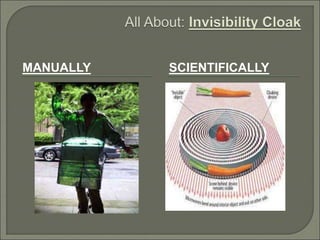
A digital video camera captures the scene
behind the person wearing the cloak.
The computer processes the captured
image or video so it will look realistic when
it is projected.
The projector receives the enhanced
image from the computer and shines it
through the opening onto the combiner.
The silvered half of the mirror, bounces the
projected image toward the person
wearing the cloak.
The cloak acts like a movie screen,
reflecting light directly back to the source.
Light rays bouncing off the cloak pass
through the transparent part of the mirror
and fall on the user's eyes.
The person wearing the cloak appears
invisible because the background scene is
being displayed onto the retro-reflective
material.
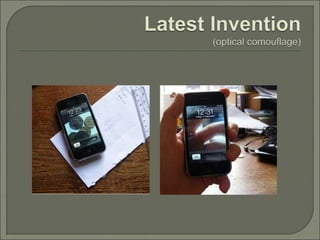
It is connected with the idea of OPTICAL
COMOUFLAGE.
It means to blend with the surroundings.

It is the method which allows an organism
or object to remain indiscernible from the
surrounding environment.
It would only provide invisibility in the
visible portion of the spectrum.
Scientific way
(deflecting microwaves)
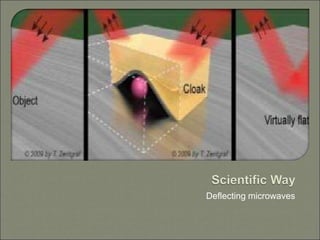
Deflecting microwaves
By the use of metamaterials
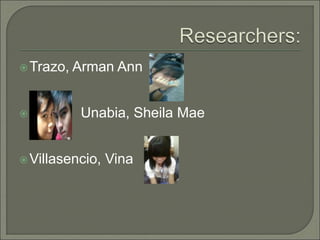
Cloak made up of individual pieces of fiber
glass arranged in parallel rows.
These hollow fibers are motels of photons
–light checks in, but it never checks out
The arrangement of it enables the cloak to
deflect or bend the light making it appear
as nothing.
This is all about manipulating light.
This is known as transformation optics.
A phenomenon that
compels some wavelengths
of light to flow around an
objects like water around a
stone.
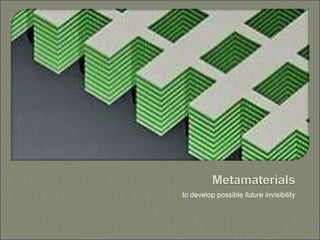
to develop possible future invisibility
It can deflect microwaves around a three-
dimensional object
It contains bits of metal or other
substances
Embedded in precise patterns
It can make the light bend in an opposite
direction from normal paths
 A manmade composites engineered on a
nano scale with properties entirely different
to anything found in nature.
Artificially engineered structures with
optical properties that bend light in
unnatural ways
Recent studies
As of year 2006, the cloak is now made of
more than 10,000 individual pieces of
fiberglass.
This new device can cloak much wider
spectrum of waves and will scale far more
easily to infrared and visible light.
For now the vanishing act takes place on a
nanoscale, measured in billionths of a
meter.
Scientists have created a paper-thin
material that absorbs 99.995 percent of the
light that hits it.
The invisibility cloak was minute,
measuring 100 microns by 30 microns --
one micron being one-thousandth of a
millimeter -- and the bump it hid was 10
times smaller.
Scientist’s insights
“Cloaking is just the tip of the
iceberg, with transformation optics
you can do many other tricks.”
-Vladimir Shalaev-
(professor of electrical and computer engineering at Purdue
University and an expert in the fledging field)
“There are a lot of materials that are very
absorbing of light so that once the light
gets in, very little is reflected. That is not
the big issue. The big issue is persuading
the light to go in the first place.”
-John Pendry-
(Physics Professor at Imperial College
London)
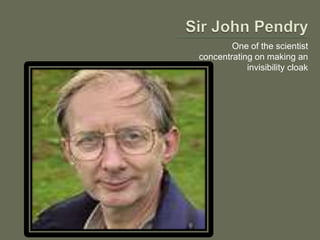
One of the scientist
concentrating on making an
invisibility cloak
"What you want to do is to surround
yourself with a transparent material that is
not only transparent but bends the light
around you.“
-Doctor Ulf Leonhardt-
(Physicist at Scotland's St. Andrews University)
“It would be possible to make invisibility
cloak on a large scale but technically, it's
totally impossible with the knowledge we
have now."
-Nicholas Stenger-
(one of the scientists from Karlsruhe Institute of
Technology in Germany )
"The cloak made of metamaterial reduces
both an object's reflection and its shadow,
either of which would enable its detection.“
-David R. Smith-
(Augustine Scholar and professor of electrical
and computer engineering at Duke)
One of the scientist
concentrating on making an
invisibility cloak
 AUGMENTED STEREOSCOPIC VISION
IN SURGERY
COCKPIT FLOORS
TRANSPARENT REAR HATCH
STEALTH TECHNOLOGY
A lot of interesting thing have been done
and already we have seen that anyone can
be almost invisible with this technology.
Research work is going on and soon we
will have even more astonishing results.
http://news.discovery.com/tech/invisibility-
cloak-3d.html
http://science.howstuffworks.com/invisibilit
y-cloak.htm
http://www.washingtonpost.com/wp-
dyn/content/article/2008/02/19/AR2008021
902617.html
http://www.sciencedaily.com/releases/2009
/05/090501154143.htm
http://www.imperial.ac.uk/centenary/flash/ti
meline/images/people/small/pendry.jpg

35228348-Invisibility-Cloak.ppt

  • 1.
  • 2.
    Alinsonorin, Aldwin Jake Avelino, Nichole Jonh Tabar, Charmaine Marie  Torres, Cates
  • 3.
    Trazo, Arman Ann Unabia, Sheila Mae Villasencio, Vina
  • 4.
  • 5.
     Ways tocreate -manual way -scientific way  Discovery -recent -scientist’s insights  Sources
  • 6.
    Manual Way (just tomean literally “invisible”)
  • 7.
    Just to meanliterally “invisible”
  • 8.
    A digital videocamera captures the scene behind the person wearing the cloak. The computer processes the captured image or video so it will look realistic when it is projected.
  • 10.
    The projector receivesthe enhanced image from the computer and shines it through the opening onto the combiner. The silvered half of the mirror, bounces the projected image toward the person wearing the cloak.
  • 11.
    The cloak actslike a movie screen, reflecting light directly back to the source. Light rays bouncing off the cloak pass through the transparent part of the mirror and fall on the user's eyes.
  • 12.
    The person wearingthe cloak appears invisible because the background scene is being displayed onto the retro-reflective material. It is connected with the idea of OPTICAL COMOUFLAGE.
  • 13.
    It means toblend with the surroundings. It is the method which allows an organism or object to remain indiscernible from the surrounding environment. It would only provide invisibility in the visible portion of the spectrum.
  • 14.
  • 15.
  • 16.
    By the useof metamaterials Cloak made up of individual pieces of fiber glass arranged in parallel rows. These hollow fibers are motels of photons –light checks in, but it never checks out
  • 17.
    The arrangement ofit enables the cloak to deflect or bend the light making it appear as nothing. This is all about manipulating light. This is known as transformation optics.
  • 18.
    A phenomenon that compelssome wavelengths of light to flow around an objects like water around a stone.
  • 19.
    to develop possiblefuture invisibility
  • 20.
    It can deflectmicrowaves around a three- dimensional object It contains bits of metal or other substances Embedded in precise patterns It can make the light bend in an opposite direction from normal paths
  • 21.
     A manmadecomposites engineered on a nano scale with properties entirely different to anything found in nature. Artificially engineered structures with optical properties that bend light in unnatural ways
  • 22.
  • 23.
    As of year2006, the cloak is now made of more than 10,000 individual pieces of fiberglass. This new device can cloak much wider spectrum of waves and will scale far more easily to infrared and visible light.
  • 24.
    For now thevanishing act takes place on a nanoscale, measured in billionths of a meter. Scientists have created a paper-thin material that absorbs 99.995 percent of the light that hits it.
  • 25.
    The invisibility cloakwas minute, measuring 100 microns by 30 microns -- one micron being one-thousandth of a millimeter -- and the bump it hid was 10 times smaller.
  • 26.
  • 27.
    “Cloaking is justthe tip of the iceberg, with transformation optics you can do many other tricks.” -Vladimir Shalaev- (professor of electrical and computer engineering at Purdue University and an expert in the fledging field)
  • 28.
    “There are alot of materials that are very absorbing of light so that once the light gets in, very little is reflected. That is not the big issue. The big issue is persuading the light to go in the first place.” -John Pendry- (Physics Professor at Imperial College London)
  • 29.
    One of thescientist concentrating on making an invisibility cloak
  • 30.
    "What you wantto do is to surround yourself with a transparent material that is not only transparent but bends the light around you.“ -Doctor Ulf Leonhardt- (Physicist at Scotland's St. Andrews University)
  • 31.
    “It would bepossible to make invisibility cloak on a large scale but technically, it's totally impossible with the knowledge we have now." -Nicholas Stenger- (one of the scientists from Karlsruhe Institute of Technology in Germany )
  • 32.
    "The cloak madeof metamaterial reduces both an object's reflection and its shadow, either of which would enable its detection.“ -David R. Smith- (Augustine Scholar and professor of electrical and computer engineering at Duke)
  • 33.
    One of thescientist concentrating on making an invisibility cloak
  • 34.
     AUGMENTED STEREOSCOPICVISION IN SURGERY COCKPIT FLOORS TRANSPARENT REAR HATCH STEALTH TECHNOLOGY
  • 36.
    A lot ofinteresting thing have been done and already we have seen that anyone can be almost invisible with this technology. Research work is going on and soon we will have even more astonishing results.
  • 37.
  • 38.