INVESTMENT MANAGEMENT
WHAT IS INVESTMENT
• An asset or item that is purchased with the hope that
it will generate income or appreciate in the future.
• In an economic sense, an investment is the purchase
of goods that are not consumed today but are used
in the future to create wealth.
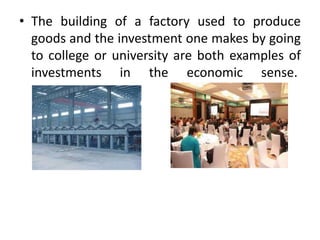
• The building of a factory used to produce
goods and the investment one makes by going
to college or university are both examples of
investments in the economic sense.
• Investment is the sacrifice of certain present value
for the uncertain future reward.
• In finance an investment is a monetary asset
purchased with the idea that the asset will provide
income in the future or appreciate and be sold at a
higher price.
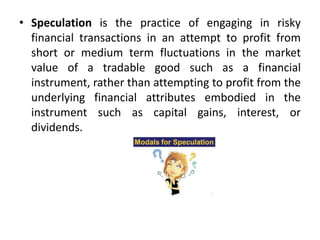
• Speculation is the practice of engaging in risky
financial transactions in an attempt to profit from
short or medium term fluctuations in the market
value of a tradable good such as a financial
instrument, rather than attempting to profit from the
underlying financial attributes embodied in the
instrument such as capital gains, interest, or
dividends.
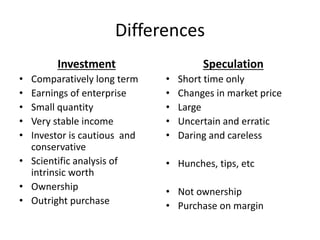
Differences
Investment
• Comparatively long term
• Earnings of enterprise
• Small quantity
• Very stable income
• Investor is cautious and
conservative
• Scientific analysis of
intrinsic worth
• Ownership
• Outright purchase
Speculation
• Short time only
• Changes in market price
• Large
• Uncertain and erratic
• Daring and careless
• Hunches, tips, etc
• Not ownership
• Purchase on margin
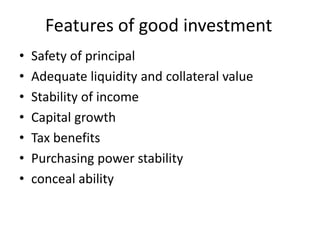
Features of good investment
• Safety of principal
• Adequate liquidity and collateral value
• Stability of income
• Capital growth
• Tax benefits
• Purchasing power stability
• conceal ability
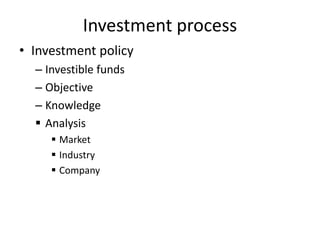
Investment process
• Investment policy
– Investible funds
– Objective
– Knowledge
 Analysis
 Market
 Industry
 Company
• Valuation
Intrinsic value
Future value
– Portfolio construction
diversification
selection and allocation
Portfolio Evaluation
Appraisal
Revision
Financial Instruments
• A real or virtual document representing a legal
agreement involving some sort of monetary
value.
• In today's financial marketplace, financial
instruments can be classified generally as
equity based, representing ownership of the
asset, or debt based, representing a loan
made by an investor to the owner of the asset.
Money Market Instruments
• Very short term Debt securities market
• Highly markatable
• Fixed income market
• Trade in large denominations
• Out of reach of individual investors
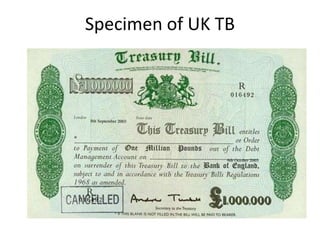
Treasury Bills
• Government raises money by selling bills to
the public.
• Investors buy the bills at a discount
• Face value is the maturity value
• Initial maturities were 91 days or 364 days
now 182 days also available in India.
• One month, Three months and six months in
US.
• Banks, Primary dealers, provident fund and
other investors can purchase
Specimen of UK TB
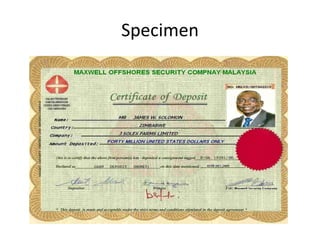
Certificate of Deposit
• It is time deposit with the bank
• CD’s are issued at discount
• Issued in denominations of Rs 100000
maturity value.
• These can be sold to another investor
• 14 days to one year
• For financial institutions its one year
• No advance can be taken and no limit
Specimen
Commercial paper
• These are debt instruments
• Highly rated companies in India can issue
• Now financial institutions can also raise short
term fund.
• 15 days to one year
• Multiple of 500000
• Issued at discount
• Banks are the major players in the primary
market.
REPOS (Repurchase Agreements)
• One party sells a security to another party
with an agreement to buy it back at a
specified time and price.
• Minimum period was 3 days now it is one day
• These are active between commercial banks.
• The difference between the sale and the buy
back price ids the interest cost
Bills rediscounting
• Bills discounting
• Rediscounting.
Call money markets
• Market for short term funds with maturity
period ranging between one day and 14 days.
Other
• Term money: Institutional borrowing
• Bank deposits
• Banker Acceptances
• Commercial bills.

Investment management

  • 1.
  • 2.
    WHAT IS INVESTMENT •An asset or item that is purchased with the hope that it will generate income or appreciate in the future. • In an economic sense, an investment is the purchase of goods that are not consumed today but are used in the future to create wealth.
  • 3.
    • The buildingof a factory used to produce goods and the investment one makes by going to college or university are both examples of investments in the economic sense.
  • 4.
    • Investment isthe sacrifice of certain present value for the uncertain future reward. • In finance an investment is a monetary asset purchased with the idea that the asset will provide income in the future or appreciate and be sold at a higher price.
  • 5.
    • Speculation isthe practice of engaging in risky financial transactions in an attempt to profit from short or medium term fluctuations in the market value of a tradable good such as a financial instrument, rather than attempting to profit from the underlying financial attributes embodied in the instrument such as capital gains, interest, or dividends.
  • 6.
    Differences Investment • Comparatively longterm • Earnings of enterprise • Small quantity • Very stable income • Investor is cautious and conservative • Scientific analysis of intrinsic worth • Ownership • Outright purchase Speculation • Short time only • Changes in market price • Large • Uncertain and erratic • Daring and careless • Hunches, tips, etc • Not ownership • Purchase on margin
  • 7.
    Features of goodinvestment • Safety of principal • Adequate liquidity and collateral value • Stability of income • Capital growth • Tax benefits • Purchasing power stability • conceal ability
  • 8.
    Investment process • Investmentpolicy – Investible funds – Objective – Knowledge  Analysis  Market  Industry  Company
  • 9.
    • Valuation Intrinsic value Futurevalue – Portfolio construction diversification selection and allocation Portfolio Evaluation Appraisal Revision
  • 10.
    Financial Instruments • Areal or virtual document representing a legal agreement involving some sort of monetary value. • In today's financial marketplace, financial instruments can be classified generally as equity based, representing ownership of the asset, or debt based, representing a loan made by an investor to the owner of the asset.
  • 11.
    Money Market Instruments •Very short term Debt securities market • Highly markatable • Fixed income market • Trade in large denominations • Out of reach of individual investors
  • 12.
    Treasury Bills • Governmentraises money by selling bills to the public. • Investors buy the bills at a discount • Face value is the maturity value • Initial maturities were 91 days or 364 days now 182 days also available in India. • One month, Three months and six months in US. • Banks, Primary dealers, provident fund and other investors can purchase
  • 13.
  • 14.
    Certificate of Deposit •It is time deposit with the bank • CD’s are issued at discount • Issued in denominations of Rs 100000 maturity value. • These can be sold to another investor • 14 days to one year • For financial institutions its one year • No advance can be taken and no limit
  • 15.
  • 16.
    Commercial paper • Theseare debt instruments • Highly rated companies in India can issue • Now financial institutions can also raise short term fund. • 15 days to one year • Multiple of 500000 • Issued at discount • Banks are the major players in the primary market.
  • 17.
    REPOS (Repurchase Agreements) •One party sells a security to another party with an agreement to buy it back at a specified time and price. • Minimum period was 3 days now it is one day • These are active between commercial banks. • The difference between the sale and the buy back price ids the interest cost
  • 18.
    Bills rediscounting • Billsdiscounting • Rediscounting.
  • 19.
    Call money markets •Market for short term funds with maturity period ranging between one day and 14 days.
  • 20.
    Other • Term money:Institutional borrowing • Bank deposits • Banker Acceptances • Commercial bills.